

Surpassing millisecond coherence in on chip superconducting quantum memories by optimizing materials and circuit design
Open accessThe DOI matches its Crossref record; 78 of the 78 references it cites were found in a registry or an index.
Abstract
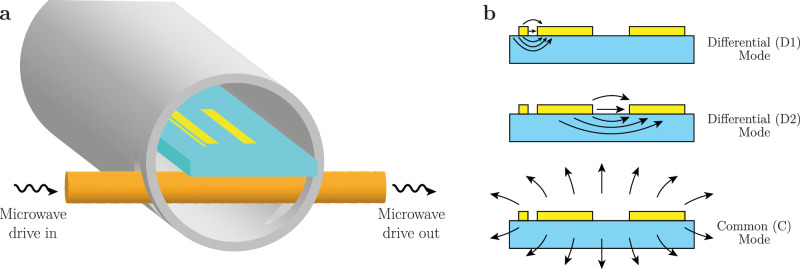
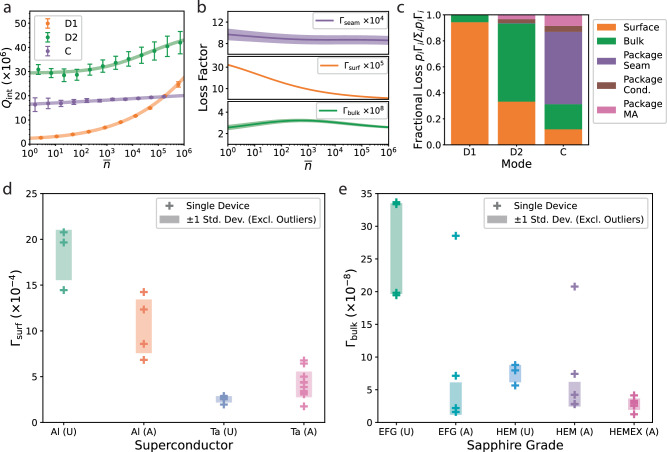
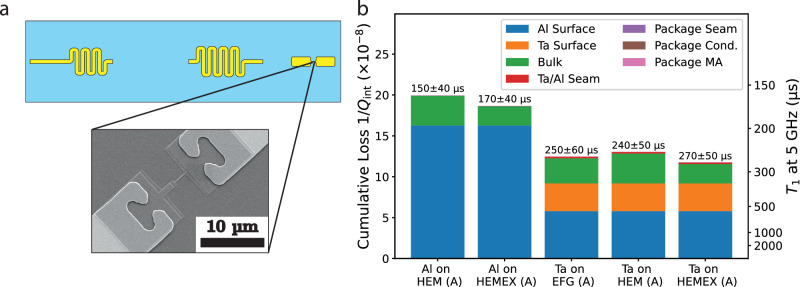
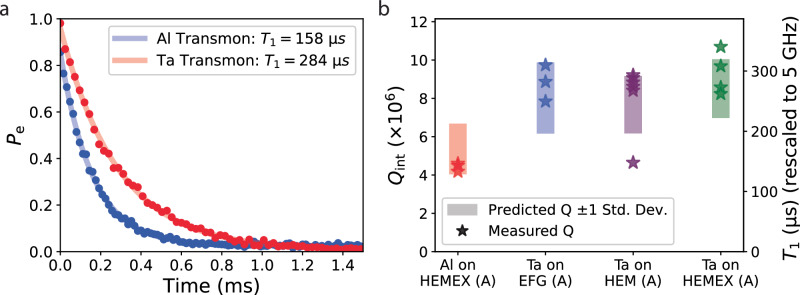
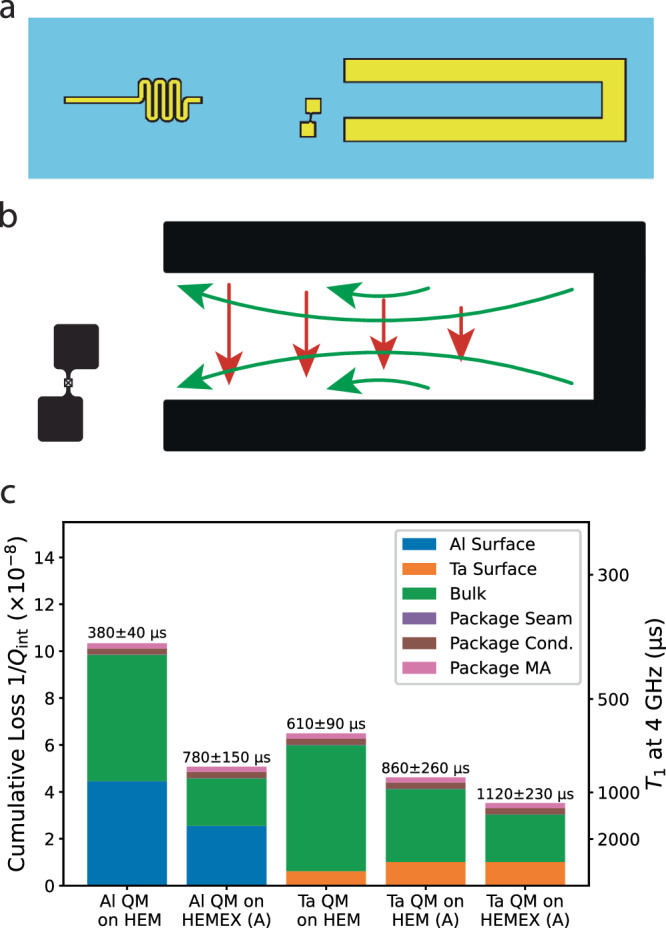
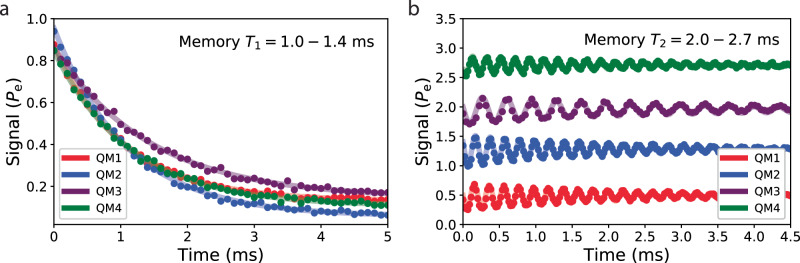
The performance of superconducting quantum circuits for quantum computing has advanced tremendously in recent decades; however, a comprehensive understanding of relaxation mechanisms does not yet exist. In this work, we utilize a multimode approach to characterizing energy losses in superconducting quantum circuits, with the goals of predicting device performance and improving coherence through materials, process, and circuit design optimization. Using this approach, we measure significant reductions in surface and bulk dielectric losses by employing a tantalum-based materials platform and annealed sapphire substrates. With this knowledge we predict the relaxation times of aluminum- and tantalum-based transmon qubits, and find that they are consistent with experimental results. We additionally optimize device geometry to maximize coherence within a coaxial tunnel architecture, and realize on-chip quantum memories with single-photon Ramsey times of 2.0 − 2.7 ms, limited by their energy relaxation times of 1.0 − 1.4 ms. These results demonstrate an advancement towards a more modular and compact coaxial circuit architecture for bosonic qubits with reproducibly high coherence.
Overview
The claims and statistics of this paper haven’t been checked yet.
Free: it reads the open-access text and checks the first 5 claims that cite a source we can check. Create a free account to check every claim.
Integrity signals
Registry
Cites
Statistics
Figures
Verification
Claims the paper makes
The claims and statistics of this paper haven’t been checked yet.
Free: it reads the open-access text and checks the first 5 claims that cite a source we can check. Create a free account to check every claim.
Self-check
Percentages, sums and reported differences re-computed from the paper’s own numbers.
The self-check needs the paper’s full text.
Citations
Cites
Quantum supremacy using a programmable superconducting processor
Arute, F., Arya, K., Babbush, R., Bacon, D., Bardin, J. C., Barends, R., Biswas, R., Boixo, S., Brandao, F. G. S. L., Buell, D. A., et al. (2019) · Nature · doi:10.1038/s41586-019-1666-5 · Cited by 7,720
Charge-insensitive qubit design derived from the Cooper pair box
Koch, J., Yu, T. M., Gambetta, J., Houck, A. A., Schuster, D. I., Majer, J., Blais, A., Devoret, M. H., Girvin, S. M., & Schoelkopf, R. J. (2007) · Physical Review A · doi:10.1103/physreva.76.042319 · Cited by 3,351 · cited 1×
“Lossesin the tripole striplinecan bedescribedusing ageneralized energy participation ratio model 25,44,55 : where Q int is the total internal quality factor of the resonator, ω is the resonance frequency, and T 1 is the energy decay time.”
BackgroundSelf-citationSurface codes: Towards practical large-scale quantum computation
Fowler, A. G., Mariantoni, M., Martinis, J. M., & Cleland, A. N. (2012) · Physical Review A · doi:10.1103/physreva.86.032324 · Cited by 3,059 · cited 1×
“However, the realization of a practical quantum computer requires far higher gate fi delities 17,18 , which necessitate further mitigation of decoherence mechanisms in quantum circuits.”
BackgroundHardware-efficient variational quantum eigensolver for small molecules and quantum magnets
Kandala, A., Mezzacapo, A., Temme, K., Takita, M., Brink, M., Chow, J. M., & Gambetta, J. M. (2017) · Nature · doi:10.1038/nature23879 · Cited by 2,982
Superconducting Qubits: Current State of Play
Kjaergaard, M., Schwartz, M. E., Braumüller, J., Krantz, P., Wang, J. I.-J., Gustavsson, S., & Oliver, W. D. (2020) · Annual Review of Condensed Matter Physics · doi:10.1146/annurev-conmatphys-031119-050605 · Cited by 1,544 · cited 1×
“The emergenceofsuperconducting qubits as a promising platformfor quantum computing has been facilitated by over two decades of steady improvements to coherence and gate fi delity 1 .”
BackgroundSuperconducting Qubits: Current State of PlayPreprint
Kjærgaard, M., Schwartz, M. E., Braumüller, J., Krantz, P., Wang, J. I.-J., Gustavsson, S., & Oliver, W. D. (2020) · DSpace@MIT (Massachusetts Institute of Technology) · Cited by 1,192
Demonstration of two-qubit algorithms with a superconducting quantum processor
DiCarlo, L., Chow, J. M., Gambetta, J. M., Bishop, L. S., Johnson, B. R., Schuster, D. I., Majer, J., Blais, A., Frunzio, L., Girvin, S. M., et al. (2009) · Nature · doi:10.1038/nature08121 · Cited by 1,172 · cited 1×
“This has enabled the demonstration of many milestones, including quantum error correction or mitigation 2 – 9 , quantum algorithms 10,11 , quantum simulations 12 – 15 , and quantum supremacy 16 using large numbers of qubits.”
Self-citationSuppressing quantum errors by scaling a surface code logical qubit
Google Quantum, A. I., Acharya, R., Aleiner, I., Allen, R., Andersen, T. I., Ansmann, M., Arute, F., Arya, K., Asfaw, A., Atalaya, J., et al. (2023) · Nature · doi:10.1038/s41586-022-05434-1 · Cited by 1,103
Scalable Quantum Simulation of Molecular Energies
O’Malley, P. J. J., Babbush, R., Kivlichan, I. D., Romero, J., McClean, J. R., Barends, R., Kelly, J., Roushan, P., Tranter, A., Ding, N., et al. (2016) · Physical Review X · doi:10.1103/physrevx.6.031007 · Cited by 1,059 · cited 1×
“This has enabled the demonstration of many milestones, including quantum error correction or mitigation 2 – 9 , quantum algorithms 10,11 , quantum simulations 12 – 15 , and quantum supremacy 16 using large numbers of qubits.”
Paik, H., Schuster, D. I., Bishop, L. S., Kirchmair, G., Catelani, G., Sears, A. P., Johnson, B. R., Reagor, M. J., Frunzio, L., Glazman, L. I., et al. (2011) · Physical Review Letters · doi:10.1103/physrevlett.107.240501 · Cited by 1,054 · cited 1×
“Additionally, dramatic improvements have also been achieved by modifying circuit geometry to reduce sensitivity to loss, an approach that has given rise to 3D transmon qubits 40 and cavity-based quantum memories with millisecond coherence times 41 – 43 .”
BackgroundSelf-citation
Cited by
Items 101–166 of 166
Routing single photons with quantum emitters coupled to nanostructures
Duda, M., Martin, N. J., Mills, E. O., Wilson, L. R., & Kok, P. (2026) · Applied Physics Reviews · doi:10.1063/5.0264750 · Cited by 2
Quantum Technologies: Trends and Implications for Cyber Defense
Jang‐Jaccard, J., Caroff, P., Blezinger, E., Mulder, V., Mermoud, A., & Lenders, V. (2025) · Springer eBooks · doi:10.1007/978-3-031-90727-2 · Cited by 2
Quasiparticle spectroscopy in tantalum films with different Ta/sapphire interfaces
Moirangthem, B. S., Joshi, K. R., McFadden, A., Oh, J., Datta, A., Tanatar, M. A., Lecocq, F., Simmonds, R. W., Zhou, L., Kramer, M. J., et al. (2026) · Quantum Science and Technology · doi:10.1088/2058-9565/ae7827 · Cited by 2
High-performance quantum interconnect between bosonic modules beyond transmission loss constraints
Huang, H., Zhou, J., Cai, W., Wang, W., Zhou, Y., Zhu, Y., Hua, Z., Xu, Y., Sun, L., Song, J., et al. (2026) · Science Bulletin · doi:10.1016/j.scib.2026.06.027 · Cited by 2
Lang, S., Schewski, A., Eisele, I., Weber, J., Guizán, C. M., Luo, Z., Singer, M., Schoof, B., Tornow, M., Mayer, T., et al. (2026) · Applied Physics Reviews · doi:10.1063/5.0331943 · Cited by 2
Gupta, H., Singer, M., Schoof, B., Cattani‐Scholz, A., Sharma, S., Rommeis, L., & Tornow, M. (2026) · Advanced Functional Materials · doi:10.1002/adfm.77131 · Cited by 2
Lombardo, F. C., & Villar, P. I. (2025) · arXiv (Cornell University) · doi:10.48550/arxiv.2504.11361 · Cited by 2
“We analysed the implementation of the above encoding protocol considering material properties that have been achieved in systems similar to the one proposed [120, 121].”
Identifying quantum coherence in quantum annealersPreprint
Aronoff, C., Howard, T., Nicholaeff, D., López‐Bezanilla, A., & DeGottardi, W. (2026) · arXiv (Cornell University) · doi:10.48550/arxiv.2602.21355 · Cited by 2
“Achieving large connectivity and precise control in such systems, however, comes at the cost of increased exposure to decoherence arising from macroscopic circuitry, control lines, and flux noise [1, 8–14].”
Alkhazaleh, A., Villegas, J., Ravaux, F., & Zharinov, A. (2026) · arXiv (Cornell University) · doi:10.48550/arxiv.2604.09050 · Cited by 2
Connectivity-induced surface-loss penalty in superconducting qubit-coupler latticesPreprint
Gu, X.-Y., Liang, G.-H., Wang, M.-C., Xiao, Y., Deng, C.-L., Liu, Z.-H., Li, T.-M., Xu, K., Xiang, Z., & Fan, H. (2026) · arXiv (Cornell University) · doi:10.48550/arxiv.2607.10743 · Cited by 2
High-Q superconducting microwave resonators using MBE titanium nitridePreprint
Ithepalli, A., Ҫirkinoğlu, H. O., Chung, E. C., Wang, X., Rajapurohita, A. R., Park, K., Chang, C. S., McMahon, P. L., Xing, H. G., Muller, D., et al. (2026) · arXiv (Cornell University) · doi:10.48550/arxiv.2607.15230 · Cited by 2
“As discussed earlier, dielectric loss tangent of bulk sapphire in the single-photon limit at 10 mK was observed to reduce from ∼ 10 − 7 to ∼ 10 − 8 after annealing at 1200 ◦ C for one hour, using tripole strip line measurements [15].”
InfluentialBosonic Error Correction with FluxoniumPreprint
Jha, S., Chowdhury, S. D., Rolleri, G., Ali, A., Sellem, L.-A., Assouly, R., Pahl, D., Pahl, L., An, J., Hassani, F., et al. (2026) · arXiv (Cornell University) · doi:10.48550/arxiv.2609.26880 · Cited by 2
Multilevel dynamical decoupling for a coupled superconducting two-qubit system
Xu, W., Zhou, T., Zhang, K., Li, Z., Guo, T., Zuo, Q., Yu, M., Jiang, J., Pan, J., Li, J., et al. (2025) · Physical Review A · doi:10.1103/6wd3-wc5s · Cited by 1
Quantum supremacy through Fock state q -boson sampling with transmon qubits
Kam, C., & Kuo, E.-J. (2025) · New Journal of Physics · doi:10.1088/1367-2630/ae2539 · Cited by 2
The Coherence Challenge: Foundations and Advancements in Superconducting Quantum Circuits
Rao, S. G. (2026) · Arabian Journal for Science and Engineering · doi:10.1007/s13369-025-10979-0 · Cited by 1
“Recently, millisecond coherence times have been reported based on optimizing materials, processing, and design [119].”
Qubit design in quantum computing hardware: Tecnologies, challenges and perspective
Song, Y. (2026) · AIP conference proceedings · doi:10.1063/12.0043498 · Cited by 1
Banerjee, T., Funni, S. D., Roy, S., Cha, J. J., & Fatemi, V. (2026) · Nano Letters · doi:10.1021/acs.nanolett.6c02734 · Cited by 1
Probing tunable Kerr nonlinearity in graphene Josephson junctions
Samanta, P., Sarkar, J., Samuel, A. A., Chand, M., Watanabe, K., Taniguchi, T., & Deshmukh, M. M. (2026) · Applied Physics Letters · doi:10.1063/5.0344221 · Cited by 1
Point defects in semiconductors: Friends and foes for quantum technologies
Zhu, Y., Zhang, Z.-H., Chen, W., Sakib, M. A., Weber‐Bargioni, A. F., Griffin, S. M., Raja, A., Sipahigil, A., & Hautier, G. (2026) · MRS Bulletin · doi:10.1557/s43577-026-01095-x · Cited by 1
Nonreciprocal Quantum Walks in Superconducting Quantum Circuits
Li, B., Wu, H., Wu, W., Zhou, Y., Li, S., & Chen, Y. (2026) · Advanced Quantum Technologies · doi:10.1002/qute.70449 · Cited by 1
Amplification of bosonic interactions through squeezing in the presence of decoherence
Anonymous, Cormick, C., & Arenz, C. (2026) · Physical Review A · doi:10.1103/n3y8-d6qd · Cited by 1
“Recent advances in these platforms indicate a significant reduction in the characteristic de-coherence rates [46, 47].”
Phonon- and magnon-mediated decoherence of a magnonic qubit
Falch, V., Brataas, A., & Danon, J. (2025) · Physical review. B./Physical review. B · doi:10.1103/g6kw-62xk · Cited by 1
Software Framework for Optically Accessible Quantum Memories Using Group‐IV Color Centers in Diamond
Strocka, Y., Belhassen, M., Schröder, T., & Pieplow, G. (2026) · Advanced Quantum Technologies · doi:10.1002/qute.202500681 · Cited by 1
Mediating high-order photon-photon interactions by Cooper-pair pairing
Borgognoni, A. (2024) · theses.fr (ABES) · doi:10.70675/9f2d9a93z1349z479bz973azd46699aa2d1f · Cited by 1
High-Throughput Microwave Package for Precise Superconducting Device MeasurementPreprint
Syong, W.-R., Miller, A., Davis, E., Pitten, J. R., Ramirez, J., Ortiz, N., Vissers, M., Bennett, D., & McRae, C. R. (2025) · arXiv (Cornell University) · doi:10.48550/arxiv.2512.18198 · Cited by 1
Wang, Z., Guan, S., Wu, F., Zhang, X., Li, Q., Chen, J., Wan, X., Xia, T., & Zhao, H. (2026) · arXiv (Cornell University) · doi:10.48550/arxiv.2603.28524 · Cited by 1
“Extensive experimental studies have verified that changes in the EPR—often achieved by systematically varying the geometries of superconducting qubits and resonators—can significantly affect the coherence time of the device [3], [5], [9], [10], [11].”
Dravid, V. P., Murthy, A. A., Lim, P., dos Santos, G. T., Mandia, R., Rondinelli, J. M., Hersam, M. C., & dos Reis, R. (2026) · arXiv (Cornell University) · doi:10.48550/arxiv.2604.03951 · Cited by 1
“Third, field-disorder overlap: the local energy density | E | 2 is enhanced at sharp edges so that the overlap between high-field and high-TLS-density regions is multiplicative rather than additive [14, 19, 26].”
Superconducting Resonators for Hybrid Semiconducting and Magnetic Quantum Systems
Cools, I. P. C. (2026) · Chalmers Research (Chalmers University of Technology) · doi:10.63959/chalmers.dt/5858 · Cited by 1
Analytical two-pulse control of universal single-qubit gates in rotational ultracold NaCs moleculesPreprint
Chen, Q., Luo, H., Guo, J.-K., Hong, Q.-Q., Fan, L., & Shu, C. (2026) · arXiv (Cornell University) · doi:10.48550/arxiv.2605.03461 · Cited by 1
Demonstration of tripartite cat states in two distinct classes of entanglementPreprint
Loke, M. C., Schwinger, J., Yu, K., Zhang, Y., Kasper, A. M., Krisnanda, T., & Gao, Y. Y. (2026) · arXiv (Cornell University) · doi:10.48550/arxiv.2607.12317 · Cited by 1
“As discussed in the main text, the fidelities of the GHZ-cat and W-cat states are primarily limited by the relatively low oscillator coherence times (Table A2), which fall short of the values (400 µ s and above) achieved in literature [42, 52].”
InfluentialAlmansouri, M., Alhuwaymel, U. T., AlYousef, I., Shafi, A., Albogime, A., Getmanov, I., Hajr, A., & Shamim, A. (2026) · arXiv (Cornell University) · doi:10.48550/arxiv.2607.22265 · Cited by 1
“In particular, qubit coherence times and resonator quality factors are strongly affected by microwave losses arising from material and fabrication imperfections [16–18].”
Fabrication-free assessment of microwave losses in germanium-based dielectrics and superconductorsPreprint
Lu, H., Aggarwal, K., Wang, X., Drexler, P., Tong, D., Olszewski, M. W., Ithepalli, A., Kong, L., Jena, D., McMahon, P. L., et al. (2026) · arXiv (Cornell University) · doi:10.48550/arxiv.2608.28463 · Cited by 1
Pairwise dressed states and twin photon-phonon generation in a tripartite quantum system
Júnior, J. R. D. S., Ribeiro, J. P. D. A., Neto, O. P. D. S., & Sohail, A. (2025) · Physica Scripta · doi:10.1088/1402-4896/ae0c72
Engineering Exotic Baths for Superconducting Quantum Circuits Using Parametric Drives
Mucci, M. (2024) · D-Scholarship@Pitt (University of Pittsburgh)
Buildings for Synthesis with Clifford+R
Deaconu, M., Gargava, N., Kalra, A. R., Mosca, M., & Yard, J. (2026) · Electronic Proceedings in Theoretical Computer Science · doi:10.4204/eptcs.456.5
Poletto, S., & Chen, A. Q. (2025) · Springer eBooks · doi:10.1007/978-3-031-90727-2_1
Hudoykulov, S., & Tashbulatov, S. (2025) · American Journal Of Applied Science And Technology · doi:10.37547/ajast/volume05issue12-32
Quantum memory devices -fabrication, characterizations, and material platforms: a review
Narayani, P. L., & Tripathi, L. N. (2026) · Physica Scripta · doi:10.1088/1402-4896/ae3989
Bukhari, M. H. S. (2026) · arXiv (Cornell University) · doi:10.48550/arxiv.2601.21528
Xu, Z., Ma, Z., Bao, W., Zheng, Y., Hu, C., Wang, J., & Cao, Z. (2026) · arXiv (Cornell University) · doi:10.48550/arxiv.2602.20730
Prospects of Kinetic Inductance Current Sensors for Multiplexed Microcalorimeter Readout
O’Neil, G. C., Bandler, S. R., Florang, I. M. F., Mates, J. A. B., Swetz, D. S., Stevenson, T. R., Swordy, L. A., Ullom, J. N., Vissers, M. R., Wheeler, J., et al. (2026) · IEEE Transactions on Applied Superconductivity · doi:10.1109/tasc.2026.3673656
“Nevertheless, there are methods for reducing TLS noise by limiting electric fields in lossy materials [29], [30].”
High-throughput microwave package for precise superconducting device measurement
Syong, W.-R., Miller, A., Davis, E., Pitten, J. R., Ramirez, J., Ortiz, N. J., Vissers, M. R., Bennett, D., & McRae, C. R. (2026) · Applied Physics Letters · doi:10.1063/5.0318350
Enhancing the precision of a quantum Wheatstone bridge through reservoir engineering
Cui, D., Li, J., & Yi, X. X. (2026) · Physical Review A · doi:10.1103/svr9-186m
Vanniappan, M., Reddy, R. A., & Mateti, J. (2026) · International Conference on Next-Gen Quantum and Advanced Computing: Algorithms, Security, and Beyond (NQComp) · doi:10.1109/nqcomp68334.2026.11497736
“This growth has been evident in research publications, demonstrations, patents, and investments since 2020 (Ganjam et al., 2024).”
Unified Flux Control Architecture for Fluxonium QubitsPreprint
Pan, X., Wang, J., Zhou, T., Guo, Y., Wang, F., Zhan, Z., Xiang, L., Li, Z., Ma, L., Ma, X., et al. (2026) · arXiv (Cornell University) · doi:10.48550/arxiv.2605.25948
Sensitivity enhancement in superconducting-qubit magnetometry via two-level systems
Gubaydullin, A. R., Slepnev, V., Vinokur, V. M., & Neukart, F. (2026) · Physical review. B./Physical review. B · doi:10.1103/vq6z-3ms7
Step-flow homoepitaxial growth of m -sapphire and integration with superconducting TiN
Verma, M., McCandless, J. P., Savant, C., Ithepalli, A., Singh, R., Protasenko, V. V., Xing, H. G., & Jena, D. (2026) · AIP Advances · doi:10.1063/5.0305249
Baptista, A., Kim, J., Rani, S., Cao, X., & Pfaff, W. (2026) · arXiv (Cornell University) · doi:10.48550/arxiv.2606.03897
Shao, Y., Chen, R., Sun, Y., Zhao, G., & Wang, X. Y. (2026) · Tribology International · doi:10.1016/j.triboint.2026.112337
Tantalum as a base material for superconducting integrated circuits
Zikiy, E. V., Smirnov, N. S., Kotenkov, S. A., Stepanov, I. A., Agafonova, J. A., Moskaleva, D. A., Matanin, A. R., Ivanov, А. I., Moskalev, D. O., Kurochkina, J. A., et al. (2026) · Communications Materials · doi:10.1038/s43246-026-01352-1
“Therefore, despite impressive results and a superiority in quality factors over other platforms under similar conditions 16,187 – 189 , further re fi nement of technological processes is necessary, focusing on reducing dielectric losses in conjunction with full-scale integration.”
Singular Vector Finite Element Basis Functions for Tetrahedra in Complex Electromagnetic GeometriesPreprint
Elkin, S. T., Khan, G., Forati, E., Langley, B. W., Timucin, D., Molavi, R., & Roth, T. E. (2026) · arXiv (Cornell University) · doi:10.48550/arxiv.2606.18140
“Correspond-ingly, various studies have determined that the leading source of losses occur in the vicinity of O (1 nm) interfaces between bulk materials [32]–[36].”
Metrology for Quantum Hardware Standardization—Charting a Pathway: A Strategic Review
Kaneko, N. (2026) · IEEJ Transactions on Electrical and Electronic Engineering · doi:10.1002/tee.70379 · Cited by 1
Das, S., Chand, M., John, S., Haldankar, S., Patankar, M. P., Prabhu, S., & Vijay, R. (2026) · Scientific Reports · doi:10.1038/s41598-026-63969-z
“As continuous improvements in fabrication techniques for qubits push coherence times towards the millisecond timescale 1–3 , providing a well-protected cryogenic environment for the qubit becomes increasingly important.”
Realization of a Quantum Topological Photon PumpPreprint
Yue, Q., Barrera, B., Ritter, M. A., Long, D. M., Lane, D. A., Chandran, A., & Kollár, A. J. (2026) · arXiv (Cornell University) · doi:10.48550/arxiv.2608.00162
SQChip-EM: A Qiskit-Metal-Based Layout-to-EM Simulation Dataset for Superconducting Quantum Chips
Peng, Y., Chen, J., Chen, Y., Zhang, S., Li, X., Li, T., Zhao, Z., & Yin, J. (2026) · ACM SIGKDD Conference on Knowledge Discovery and Data Mining (KDD) · doi:10.1145/3770855.3817558
Hagag, M. F., El‐Gendy, K. H., Zyoud, B., Jones, T. R., Seddik, K. G., & Peroulis, D. (2026) · IEEE Transactions on Quantum Engineering · doi:10.1109/tqe.2026.3728781
“SC layers are realized using Ta films, following [2] and [26], deposited via high-temperature sputtering to form the low-loss α -phase with improved crystallinity.”
InfluentialAnonymous, Belaloui, N. E., Khamadja, A. R., Lalaoui, T. E. F., Louamri, M. M., Bernal, D. E., & Rouabah, M. T. (2026) · Physical Review Research · doi:10.1103/82g5-bsvp
“However, despite recent advancements in the technology [5, 6], current quantum computers are yet to reach their promised potential to efficiently simulate complex quantum systems.”
Robustness of Dynamical Casimir Effect-Induced Quantum SynchronizationPreprint
Francisquez, S., Lombardo, F. C., & Villar, P. I. (2026) · arXiv (Cornell University) · doi:10.48550/arxiv.2609.05659
“The first two parameter sets were chosen based on experimental values reported for conventional cQED devices [43–46], while the weak regime corresponds to dissipation rates of the order of those achieved in state-of-the-art experimental implementations [37, 47, 48].”
Materials for Quantum Information Science: Roles in the Quantum Evolution 2.0Preprint
Pham, T., Ivanov, V., Goronzy, D. P., Devata, A., Feldon, J., Barton, D., & Zhou, Y. (2026) · arXiv (Cornell University) · doi:10.48550/arxiv.2609.09371
High-fidelity conditional-squeezing gate in superconducting circuits via refocusing
Schiaffino, R., Lombardo, F., & Paz, J. P. (2026) · Physical Review A · doi:10.1103/mqt6-fh7c
Inang, T., Janmathong, K., Chudpooti, N., Tantraviwat, D., Oberhammer, J., Zhang, W., & Somjit, N. (2026) · IEEE Access · doi:10.1109/access.2026.3734374
“Tantalum-based circuits on annealed sapphire have attracted attention because they can reduce surface and bulk dielectric losses and support longer coherence times [69].”
Reconfigurable Bus-based Quantum Router for Modular Superconducting ProcessorsPreprint
Yuan, B., Zhang, C., Fei, Y., Han, C., He, H., Sun, H., Zhao, B., Liu, F., Wang, W., & Shan, Z. (2026) · arXiv (Cornell University) · doi:10.48550/arxiv.2609.28881
“…first-order per-turbative master equation framework, we evaluate the average gate fidelity ¯ F across a two-dimensional coherence parameter space ( T 1 , T ϕ ∈ [10 , 600] µ s) for the three parallel gate configurations: a CZ 12 ⊗ CZ 34 , b CZ 13 ⊗ CZ 24 , and c CZ 14 ⊗ CZ 23 , as depicted in Fig.”
Eji, M. O., Kirkpatrick, T. J., Cawein, T. J., & Corbett, J. (2026) · arXiv (Cornell University) · doi:10.48550/arxiv.2610.35768
“Subsequent Ta transmons reached lifetimes of 0.5 ms [8] and, on high-resistivity Si, 1.68 ms, while Ta-based on-chip quantum memories achieved energy-relaxation times of 1.0 – 1.4 ms [16].”
InfluentialDynamical Light-Matter Coupling with Protected Superconducting OscillatorsPreprint
Valadares, F. (2026) · arXiv (Cornell University) · doi:10.48550/arxiv.2611.10295
Metadata
- Authors
- Ganjam, S., Wang, Y., Lu, Y., Banerjee, A., Lei, C. U., Krayzman, L., Kisslinger, K., Zhou, C., Li, R., Jia, Y., Liu, M., Frunzio, L., & Schoelkopf, R. J.
- Affiliations
- Yale University (US)
- Brookhaven National Laboratory (US)
- Corresponding author
- Ganjam, Suhas
- Schoelkopf, Robert J.
- ORCID
- Venue
- Nature Communications
- Published
- 2024-05-01
- Volume
- 15
- Issue
- 1
- Pages
- 3687-3687
- ISSN
- 2041-1723 (ISSN-L)
- PMC
- PMC11063213
- OpenAlex
- W4396544828
- Semantic Scholar
- 45a42553ef140e2954d0e172d4c6e6e7064d8416
- Cited by
- 93
- References
- 77
- Citations by year
- 2026: 41 · 2025: 43 · 2024: 9
- FWCI
- 13.70
- Type
- journal article
- Language
- en
- Open access
- gold
- doi.org
- Licence
- cc-by
- creativecommons.org/licenses/by/4.0 (tdm)
- creativecommons.org/licenses/by/4.0 (vor)
- Locations
- Nature Communications (publishedVersion, cc-by)
- PubMed Central (publishedVersion, cc-by)
- PubMed (publishedVersion)
- OSTI OAI (U.S. Department of Energy Office of Scientific and Technical Information) (submittedVersion)
- RePEc: Research Papers in Economics (submittedVersion)
- DOAJ (DOAJ: Directory of Open Access Journals) (submittedVersion, cc-by-sa)
- Funders
- U.S. Department of Defense (W911NF1810212, and W911-NF-23-1-0051)
- U.S. Department of Energy (DE‐SC0012704, SC0012704.)
- Yale University
- Office of Science (DE-SC-0012704, SC0012704)
- Army Research Office (W911-NF-23-1-0051)
- Brookhaven National Laboratory (SC0012704, DE- SC0012704)
- Topics
- Physical Sciences › Physics and Astronomy › Atomic and Molecular Physics, and Optics › Quantum Information and Cryptography
- Physical Sciences › Engineering › Electrical and Electronic Engineering › Superconducting and THz Device Technology
- Physical Sciences › Computer Science › Artificial Intelligence › Quantum Computing Algorithms and Architecture
- Keywords
- quantum coherence, transmon qubits, energy relaxation, dielectric loss, tantalum, sapphire substrate, bosonic qubits, device geometry optimization
About these checks
Registry, retraction, Cites and statistics results are computed, not judged, with one exception: a printed reference that no index lists is read once by a model before it counts as a citation error. Claims are extracted by a model and kept only when their quote appears verbatim in the text; each cited source is then checked, with a model’s help, for whether it says what the claim relies on. Those verdicts can be wrong — read the claim’s quote and the cited source before relying on one.
Statistics and arithmetic are recomputed, not judged.
Confidence bands are shown only for fields calibrated on our annotated test set. None is calibrated yet, so no band is shown.
What counts as a claim ›How we measure confidence ›How we check this ›
Are you an author, or do you see a problem with this page? Request a review
Data sources
Bibliographic data: Semantic Scholar, OpenAlex, Crossref.
Contains information from the Semantic Scholar Academic Graph Datasets, made available under the ODC Attribution License (ODC-BY 1.0).
Semantic Scholar’s data is described in: Kinney, R., et al. (2023). The Semantic Scholar Open Data Platform. arXiv:2301.10140.
