

Surpassing millisecond coherence in on chip superconducting quantum memories by optimizing materials and circuit design
Open accessThe DOI matches its Crossref record; 78 of the 78 references it cites were found in a registry or an index.
Abstract
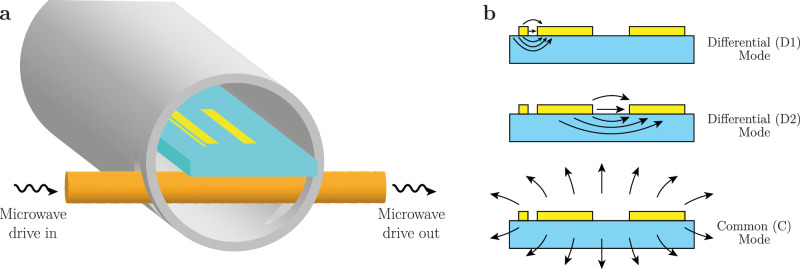
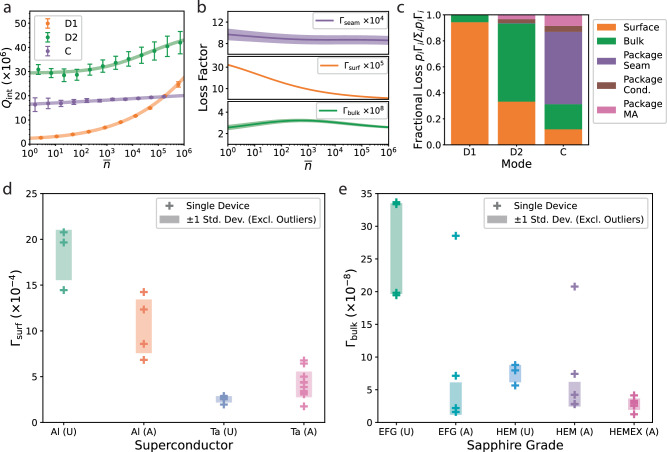
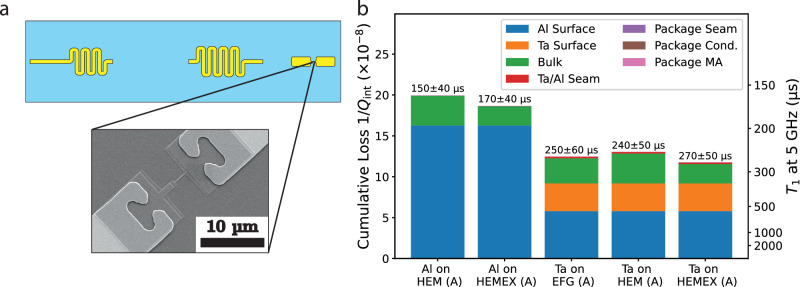
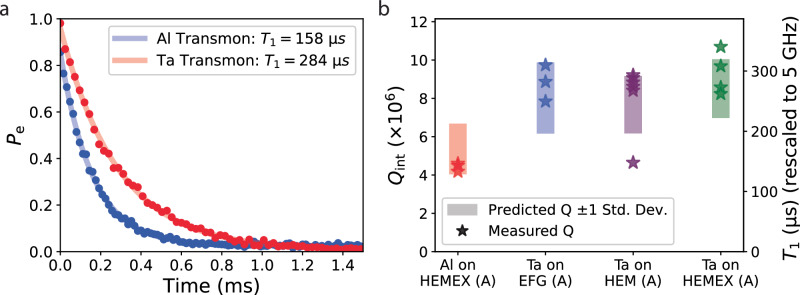
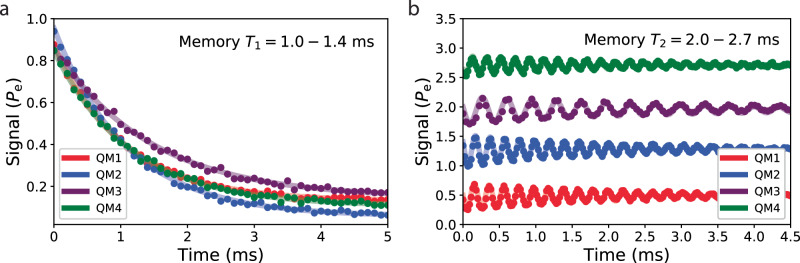
The performance of superconducting quantum circuits for quantum computing has advanced tremendously in recent decades; however, a comprehensive understanding of relaxation mechanisms does not yet exist. In this work, we utilize a multimode approach to characterizing energy losses in superconducting quantum circuits, with the goals of predicting device performance and improving coherence through materials, process, and circuit design optimization. Using this approach, we measure significant reductions in surface and bulk dielectric losses by employing a tantalum-based materials platform and annealed sapphire substrates. With this knowledge we predict the relaxation times of aluminum- and tantalum-based transmon qubits, and find that they are consistent with experimental results. We additionally optimize device geometry to maximize coherence within a coaxial tunnel architecture, and realize on-chip quantum memories with single-photon Ramsey times of 2.0 − 2.7 ms, limited by their energy relaxation times of 1.0 − 1.4 ms. These results demonstrate an advancement towards a more modular and compact coaxial circuit architecture for bosonic qubits with reproducibly high coherence.
Overview
The claims and statistics of this paper haven’t been checked yet.
Free: it reads the open-access text and checks the first 5 claims that cite a source we can check. Create a free account to check every claim.
Integrity signals
Registry
Cites
Statistics
Figures
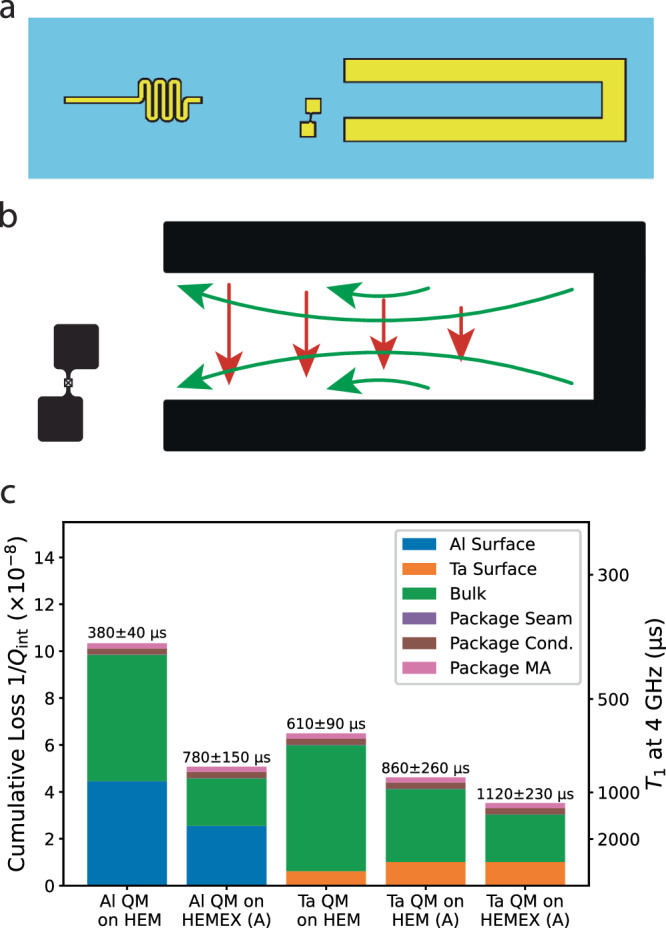
Verification
Claims the paper makes
The claims and statistics of this paper haven’t been checked yet.
Free: it reads the open-access text and checks the first 5 claims that cite a source we can check. Create a free account to check every claim.
Self-check
Percentages, sums and reported differences re-computed from the paper’s own numbers.
The self-check needs the paper’s full text.
Citations
Cites
Quantum supremacy using a programmable superconducting processor
Arute, F., Arya, K., Babbush, R., Bacon, D., Bardin, J. C., Barends, R., Biswas, R., Boixo, S., Brandao, F. G. S. L., Buell, D. A., et al. (2019) · Nature · doi:10.1038/s41586-019-1666-5 · Cited by 7,720
Charge-insensitive qubit design derived from the Cooper pair box
Koch, J., Yu, T. M., Gambetta, J., Houck, A. A., Schuster, D. I., Majer, J., Blais, A., Devoret, M. H., Girvin, S. M., & Schoelkopf, R. J. (2007) · Physical Review A · doi:10.1103/physreva.76.042319 · Cited by 3,351 · cited 1×
“Lossesin the tripole striplinecan bedescribedusing ageneralized energy participation ratio model 25,44,55 : where Q int is the total internal quality factor of the resonator, ω is the resonance frequency, and T 1 is the energy decay time.”
BackgroundSelf-citationSurface codes: Towards practical large-scale quantum computation
Fowler, A. G., Mariantoni, M., Martinis, J. M., & Cleland, A. N. (2012) · Physical Review A · doi:10.1103/physreva.86.032324 · Cited by 3,059 · cited 1×
“However, the realization of a practical quantum computer requires far higher gate fi delities 17,18 , which necessitate further mitigation of decoherence mechanisms in quantum circuits.”
BackgroundHardware-efficient variational quantum eigensolver for small molecules and quantum magnets
Kandala, A., Mezzacapo, A., Temme, K., Takita, M., Brink, M., Chow, J. M., & Gambetta, J. M. (2017) · Nature · doi:10.1038/nature23879 · Cited by 2,982
Superconducting Qubits: Current State of Play
Kjaergaard, M., Schwartz, M. E., Braumüller, J., Krantz, P., Wang, J. I.-J., Gustavsson, S., & Oliver, W. D. (2020) · Annual Review of Condensed Matter Physics · doi:10.1146/annurev-conmatphys-031119-050605 · Cited by 1,544 · cited 1×
“The emergenceofsuperconducting qubits as a promising platformfor quantum computing has been facilitated by over two decades of steady improvements to coherence and gate fi delity 1 .”
BackgroundSuperconducting Qubits: Current State of PlayPreprint
Kjærgaard, M., Schwartz, M. E., Braumüller, J., Krantz, P., Wang, J. I.-J., Gustavsson, S., & Oliver, W. D. (2020) · DSpace@MIT (Massachusetts Institute of Technology) · Cited by 1,192
Demonstration of two-qubit algorithms with a superconducting quantum processor
DiCarlo, L., Chow, J. M., Gambetta, J. M., Bishop, L. S., Johnson, B. R., Schuster, D. I., Majer, J., Blais, A., Frunzio, L., Girvin, S. M., et al. (2009) · Nature · doi:10.1038/nature08121 · Cited by 1,172 · cited 1×
“This has enabled the demonstration of many milestones, including quantum error correction or mitigation 2 – 9 , quantum algorithms 10,11 , quantum simulations 12 – 15 , and quantum supremacy 16 using large numbers of qubits.”
Self-citationSuppressing quantum errors by scaling a surface code logical qubit
Google Quantum, A. I., Acharya, R., Aleiner, I., Allen, R., Andersen, T. I., Ansmann, M., Arute, F., Arya, K., Asfaw, A., Atalaya, J., et al. (2023) · Nature · doi:10.1038/s41586-022-05434-1 · Cited by 1,103
Scalable Quantum Simulation of Molecular Energies
O’Malley, P. J. J., Babbush, R., Kivlichan, I. D., Romero, J., McClean, J. R., Barends, R., Kelly, J., Roushan, P., Tranter, A., Ding, N., et al. (2016) · Physical Review X · doi:10.1103/physrevx.6.031007 · Cited by 1,059 · cited 1×
“This has enabled the demonstration of many milestones, including quantum error correction or mitigation 2 – 9 , quantum algorithms 10,11 , quantum simulations 12 – 15 , and quantum supremacy 16 using large numbers of qubits.”
Paik, H., Schuster, D. I., Bishop, L. S., Kirchmair, G., Catelani, G., Sears, A. P., Johnson, B. R., Reagor, M. J., Frunzio, L., Glazman, L. I., et al. (2011) · Physical Review Letters · doi:10.1103/physrevlett.107.240501 · Cited by 1,054 · cited 1×
“Additionally, dramatic improvements have also been achieved by modifying circuit geometry to reduce sensitivity to loss, an approach that has given rise to 3D transmon qubits 40 and cavity-based quantum memories with millisecond coherence times 41 – 43 .”
BackgroundSelf-citationEvidence for the utility of quantum computing before fault tolerance
Kim, Y., Eddins, A., Anand, S., Wei, K. X., van den Berg, E., Rosenblatt, S., Nayfeh, H., Wu, Y., Zaletel, M., Temme, K., et al. (2023) · Nature · doi:10.1038/s41586-023-06096-3 · Cited by 1,050
Extending the lifetime of a quantum bit with error correction in superconducting circuits
Ofek, N., Petrenko, A., Heeres, R., Reinhold, P., Leghtas, Z., Vlastakis, B., Liu, Y., Frunzio, L., Girvin, S. M., Jiang, L., et al. (2016) · Nature · doi:10.1038/nature18949 · Cited by 941 · cited 1×
“This has enabled the demonstration of many milestones, including quantum error correction or mitigation 2 – 9 , quantum algorithms 10,11 , quantum simulations 12 – 15 , and quantum supremacy 16 using large numbers of qubits.”
Self-citationError mitigation extends the computational reach of a noisy quantum processor
Kandala, A., Temme, K., Córcoles, A. D., Mezzacapo, A., Chow, J. M., & Gambetta, J. M. (2019) · Nature · doi:10.1038/s41586-019-1040-7 · Cited by 871
Decoherence in Josephson Qubits from Dielectric Loss
Martinis, J. M., Cooper, K. B., McDermott, R., Steffen, M., Ansmann, M., Osborn, K. D., Cicak, K., Oh, S., Pappas, D. P., Simmonds, R. W., et al. (2005) · Physical Review Letters · doi:10.1103/physrevlett.95.210503 · Cited by 838 · cited 4×
“…can be traced to intrinsic sources of energy loss from the circuits ’ constituent materials and has revealed the existence of signi fi cant bulk and surface dielectric loss 19 – 23 , two-level-system (TLS) loss 24 – 28 , and residual quasiparticle or vortex loss in superconductors 29 – 33 .”
BackgroundInfluentialHow to factor 2048 bit RSA integers in 8 hours using 20 million noisy qubits
Gidney, C., & Ekerå, M. (2021) · Quantum · doi:10.22331/q-2021-04-15-433 · Cited by 830 · cited 1×
“However, the realization of a practical quantum computer requires far higher gate fi delities 17,18 , which necessitate further mitigation of decoherence mechanisms in quantum circuits.”
BackgroundRealizing repeated quantum error correction in a distance-three surface code
Krinner, S., Lacroix, N., Remm, A., Di Paolo, A., Genois, E., Leroux, C., Hellings, C., Lazar, S., Swiadek, F., Herrmann, J., et al. (2022) · Nature · doi:10.1038/s41586-022-04566-8 · Cited by 686 · cited 5×
“The excitation fi eld of the resonator is determined by the input power P in and can be expressed in terms of an average photon number in the resonator as n = 2 _ ω P in (see Supplementary Note 10: “ Derivation of resonator average photon number ” ).”
BackgroundInfluentialSuperconducting Microresonators: Physics and Applications
Zmuidzinas, J. (2012) · Annual Review of Condensed Matter Physics · doi:10.1146/annurev-conmatphys-020911-125022 · Cited by 645 · cited 1×
“…can be traced to intrinsic sources of energy loss from the circuits ’ constituent materials and has revealed the existence of signi fi cant bulk and surface dielectric loss 19 – 23 , two-level-system (TLS) loss 24 – 28 , and residual quasiparticle or vortex loss in superconductors 29 – 33 .”
BackgroundPlace, A. P. M., Rodgers, L. V. H., Mundada, P., Smitham, B. M., Fitzpatrick, M., Leng, Z., Premkumar, A., Bryon, J., Vrajitoarea, A., Sussman, S., et al. (2021) · Nature Communications · doi:10.1038/s41467-021-22030-5 · Cited by 563 · cited 4×
“All substrates were initially cleaned in a piranha solution (2:1 H 2 SO 4 :H 2 O 2 ) for 20min 36 , followed by a thorough rinse in DI water for 20 min.”
MethodResultInfluentialSuppressing charge noise decoherence in superconducting charge qubits
Schreier, J. A., Houck, A. A., Koch, J., Schuster, D. I., Johnson, B. R., Chow, J. M., Gambetta, J. M., Majer, J., Frunzio, L., Devoret, M. H., et al. (2008) · Physical Review B · doi:10.1103/physrevb.77.180502 · Cited by 551 · cited 2×
“This exclusion follows from the assumption that surface dielectriclossis dominated by a TLS density of ~1 μ m − 2 GHz − 1 , and therefore, the small region that is the junction itself should likely include zero TLSs and be lossless 24,64 – 66 .”
BackgroundSelf-citationControlling the Spontaneous Emission of a Superconducting Transmon Qubit
Houck, A. A., Schreier, J. A., Johnson, B. R., Chow, J. M., Koch, J., Gambetta, J. M., Schuster, D. I., Frunzio, L., Devoret, M. H., Girvin, S. M., et al. (2008) · Physical Review Letters · doi:10.1103/physrevlett.101.080502 · Cited by 501 · cited 1×
“Accord-ingly, improvements to coherence have been made by using intrinsi-callylower-lossmaterials suchassapphiresubstrates 34,35 , and tantalum thin fi lms 36,37 ; and employing contamination-minimizing fabrication processes such as acid-based etching 30,33 , substrate annealing 22,37,38 , and…”
MethodSelf-citationReal-time quantum error correction beyond break-even
Sivak, V. V., Eickbusch, A., Royer, B., Singh, S., Tsioutsios, I., Ganjam, S., Miano, A., Brock, B. L., Ding, A. Z., Frunzio, L., et al. (2023) · Nature · doi:10.1038/s41586-023-05782-6 · Cited by 407
Self-citationTowards practical quantum computers: transmon qubit with a lifetime approaching 0.5 milliseconds
Wang, C., Li, X., Xu, H., Li, Z., Wang, J., Yang, Z., Mi, Z., Liang, X., Su, T., Yang, C., et al. (2022) · npj Quantum Information · doi:10.1038/s41534-021-00510-2 · Cited by 377 · cited 4×
“…improvements to coherence have been made by using intrinsi-callylower-lossmaterials suchassapphiresubstrates 34,35 , and tantalum thin fi lms 36,37 ; and employing contamination-minimizing fabrication processes such as acid-based etching 30,33 , substrate annealing 22,37,38 , and thin-fi lm…”
MethodResultInfluentialQuantum memory with millisecond coherence in circuit QED
Reagor, M., Pfaff, W., Axline, C., Heeres, R. W., Ofek, N., Sliwa, K., Holland, E., Wang, C., Blumoff, J., Chou, K., et al. (2016) · Physical Review B · doi:10.1103/physrevb.94.014506 · Cited by 376 · cited 6×
“41 (see Supplementary Fig.”
BackgroundMethodInfluentialSelf-citationGao, J., Daal, M., Vayonakis, A., Kumar, S., Zmuidzinas, J., Sadoulet, B., Mazin, B. A., Day, P. K., & Leduc, H. G. (2008) · Applied Physics Letters · doi:10.1063/1.2906373 · Cited by 358
A dissipatively stabilized Mott insulator of photons
Ma, R., Saxberg, B., Owens, C., Leung, N., Lu, Y., Simon, J., & Schuster, D. I. (2019) · Nature · doi:10.1038/s41586-019-0897-9 · Cited by 352
Self-citationSurface participation and dielectric loss in superconducting qubits
Wang, C., Axline, C., Gao, Y. Y., Brecht, T., Chu, Y., Frunzio, L., Devoret, M. H., & Schoelkopf, R. J. (2015) · Applied Physics Letters · doi:10.1063/1.4934486 · Cited by 340
Self-citationFluctuations of Energy-Relaxation Times in Superconducting Qubits
Klimov, P. V., Kelly, J., Chen, Z., Neeley, M., Megrant, A., Burkett, B., Barends, R., Arya, K., Chiaro, B., Chen, Y., et al. (2018) · Physical Review Letters · doi:10.1103/physrevlett.121.090502 · Cited by 328 · cited 1×
“…the statistical expectation of zero TLSs present in the junction 24,64 – 66 ,this region ’ s smallareaand high energy density renders the transmon highly sensitive to deviations from that expectation due to stochastically fl uctuating TLSs both in space and frequency 67,68 over long periods of time.”
BackgroundEfficient and robust analysis of complex scattering data under noise in microwave resonators
Probst, S., Song, F. B., Bushev, P. A., Ustinov, A. V., & Weides, M. (2015) · Review of Scientific Instruments · doi:10.1063/1.4907935 · Cited by 301
Materials loss measurements using superconducting microwave resonators
McRae, C. R. H., Wang, H., Gao, J., Vissers, M. R., Brecht, T., Dunsworth, A., Pappas, D. P., & Mutus, J. (2020) · Review of Scientific Instruments · doi:10.1063/5.0017378 · Cited by 245
Bruno, A., de Lange, G., Asaad, S., van der Enden, K. L., Langford, N. K., & DiCarlo, L. (2015) · Applied Physics Letters · doi:10.1063/1.4919761 · Cited by 239
Measurement and control of quasiparticle dynamics in a superconducting qubit
Wang, C., Gao, Y. Y., Pop, I. M., Vool, U., Axline, C., Brecht, T., Heeres, R. W., Frunzio, L., Devoret, M. H., Catelani, G., et al. (2014) · Nature Communications · doi:10.1038/ncomms6836 · Cited by 230
Self-citationHot Nonequilibrium Quasiparticles in Transmon Qubits
Serniak, K., Hays, M., de Lange, G., Diamond, S., Shankar, S., Burkhart, L. D., Frunzio, L., Houzet, M., & Devoret, M. H. (2018) · Physical Review Letters · doi:10.1103/physrevlett.121.157701 · Cited by 225
Self-citationSurface loss simulations of superconducting coplanar waveguide resonators
Wenner, J., Barends, R., Bialczak, R. C., Chen, Y., Kelly, J., Lucero, E., Mariantoni, M., Megrant, A., O’Malley, P. J. J., Sank, D., et al. (2011) · Applied Physics Letters · doi:10.1063/1.3637047 · Cited by 211 · cited 3×
“Lossesin the tripole striplinecan bedescribedusing ageneralized energy participation ratio model 25,44,55 : where Q int is the total internal quality factor of the resonator, ω is the resonance frequency, and T 1 is the energy decay time.”
BackgroundReaching 10 ms single photon lifetimes for superconducting aluminum cavities
Reagor, M., Paik, H., Catelani, G., Sun, L., Axline, C., Holland, E., Pop, I. M., Masluk, N. A., Brecht, T., Frunzio, L., et al. (2013) · Applied Physics Letters · doi:10.1063/1.4807015 · Cited by 210
Self-citationTwo Level System Loss in Superconducting Microwave Resonators
Pappas, D. P., Vissers, M. R., Wisbey, D. S., Kline, J. S., & Gao, J. (2011) · IEEE Transactions on Applied Superconductivity · doi:10.1109/tasc.2010.2097578 · Cited by 173 · cited 1×
“…the following TLS model: where1/ Q 0 isthe power-independent contributionto the total internal loss, tan δ TLS is the ensemble TLS loss tangent, n c is the critical photon number beyond whichthe TLSs begin tosaturate, and β isanempirical parameter that describes TLS saturation 24 – 26 ,38, 57, 58 .”
BackgroundSuperconducting Cavity Qubit with Tens of Milliseconds Single-Photon Coherence Time
Milul, O., Guttel, B., Goldblatt, U., Hazanov, S., Joshi, L. M., Chausovsky, D., Kahn, N., Çiftyürek, E., Lafont, F., & Rosenblum, S. (2023) · PRX Quantum · doi:10.1103/prxquantum.4.030336 · Cited by 171 · cited 3×
“Additionally, dramatic improvements have also been achieved by modifying circuit geometry to reduce sensitivity to loss, an approach that has given rise to 3D transmon qubits 40 and cavity-based quantum memories with millisecond coherence times 41 – 43 .”
BackgroundMethodInfluentialCalusine, G., Melville, A., Woods, W., Das, R., Stull, C., Bolkhovsky, V., Braje, D., Hover, D., Kim, D. K., Miloshi, X., et al. (2018) · Applied Physics Letters · doi:10.1063/1.5006888 · Cited by 167 · cited 5×
“=3 nm and relative permittivity ϵ r =10 to maintain consistency with other works 38,44,45 .”
BackgroundMethodResultInfluentialFault-tolerant detection of a quantum error
Rosenblum, S., Reinhold, P., Mirrahimi, M., Jiang, L., Frunzio, L., & Schoelkopf, R. J. (2018) · Science · doi:10.1126/science.aat3996 · Cited by 167 · cited 1×
“6); Fock state decay times were measured to be 1 – 1.4 ms. Additionally, measured Fock T 2 times approached 2 T 1 , which bounds T ϕ >24 ms, similar to 3D cavity-based quantum memories 43,69 .”
BackgroundInfluentialSelf-citationReaching 10 ms single photon lifetimes for superconducting aluminum cavities
Reagor, M. J., Paik, H., Devoret, M., Glazman, L. I., Schoelkopf, R. J., Catelani, G., Sun, L., Axline, C. J., Holland, E., Pop, I. M., et al. (2013) · JuSER (Forschungszentrum Jülich) · Cited by 166
Self-citationImproving the coherence time of superconducting coplanar resonators
Wang, H., Hofheinz, M., Wenner, J., Ansmann, M., Bialczak, R. C., Lenander, M., Lucero, E., Neeley, M., O’Connell, A. D., Sank, D., et al. (2009) · Applied Physics Letters · doi:10.1063/1.3273372 · Cited by 165
Evidence for interacting two-level systems from the 1/f noise of a superconducting resonator
Burnett, J., Faoro, L., Wisby, I., Gurtovoi, V. L., Chernykh, A. V., Mikhailov, G. M., Tulin, V. A., Shaikhaidarov, R., Antonov, V., Meeson, P. J., et al. (2014) · Nature Communications · doi:10.1038/ncomms5119 · Cited by 165
Determining Interface Dielectric Losses in Superconducting Coplanar-Waveguide Resonators
Woods, W., Calusine, G., Melville, A., Sevi, A., Golden, E., Kim, D. K., Rosenberg, D., Yoder, J. L., & Oliver, W. D. (2019) · Physical Review Applied · doi:10.1103/physrevapplied.12.014012 · Cited by 164
Exploiting Dynamic Quantum Circuits in a Quantum Algorithm with Superconducting Qubits
Córcoles, A. D., Takita, M., Inoue, K., Lekuch, S., Minev, Z. K., Chow, J. M., & Gambetta, J. M. (2021) · Physical Review Letters · doi:10.1103/physrevlett.127.100501 · Cited by 162 · cited 1×
“This has enabled the demonstration of many milestones, including quantum error correction or mitigation 2 – 9 , quantum algorithms 10,11 , quantum simulations 12 – 15 , and quantum supremacy 16 using large numbers of qubits.”
Electric field spectroscopy of material defects in transmon qubits
Lisenfeld, J., Bilmes, A., Megrant, A., Barends, R., Kelly, J., Klimov, P., Weiss, G., Martinis, J. M., & Ustinov, A. V. (2019) · npj Quantum Information · doi:10.1038/s41534-019-0224-1 · Cited by 160
Efficient Multiphoton Sampling of Molecular Vibronic Spectra on a Superconducting Bosonic Processor
Wang, C. S., Curtis, J. C., Lester, B. J., Zhang, Y., Gao, Y. Y., Freeze, J., Batista, V. S., Vaccaro, P. H., Chuang, I. L., Frunzio, L., et al. (2020) · Physical Review X · doi:10.1103/physrevx.10.021060 · Cited by 151 · cited 1×
“This has enabled the demonstration of many milestones, including quantum error correction or mitigation 2 – 9 , quantum algorithms 10,11 , quantum simulations 12 – 15 , and quantum supremacy 16 using large numbers of qubits.”
Self-citationDetermining Interface Dielectric Losses in Superconducting Coplanar-Waveguide Resonators
Woods, W. H., Calusine, G., Melville, A. J., Sevi, A., Golden, E. B., Kim, D., Rosenberg, D., Yoder, J., & Oliver, W. (2019) · DSpace@MIT (Massachusetts Institute of Technology) · Cited by 146
Systematic improvements in transmon qubit coherence enabled by niobium surface encapsulation
Bal, M., Murthy, A. A., Zhu, S., Crisa, F., You, X., Huang, Z., Roy, T., Lee, J., Zanten, D. V., Pilipenko, R., et al. (2024) · npj Quantum Information · doi:10.1038/s41534-024-00840-x · Cited by 128 · cited 1×
“…to coherence have been made by using intrinsi-callylower-lossmaterials suchassapphiresubstrates 34,35 , and tantalum thin fi lms 36,37 ; and employing contamination-minimizing fabrication processes such as acid-based etching 30,33 , substrate annealing 22,37,38 , and thin-fi lm encapsulation 39 .”
MethodA superconducting dual-rail cavity qubit with erasure-detected logical measurements
Chou, K. S., Shemma, T., McCarrick, H., Chien, T.-C., Teoh, J. D., Winkel, P., Anderson, A., Chen, J., Curtis, J. C., de Graaf, S. J., et al. (2024) · Nature Physics · doi:10.1038/s41567-024-02539-4 · Cited by 121
Self-citationQuintana, C. M., Megrant, A., Chen, Z., Dunsworth, A., Chiaro, B., Barends, R., Campbell, B., Chen, Y., Hoi, I.-C., Jeffrey, E., et al. (2014) · Applied Physics Letters · doi:10.1063/1.4893297 · Cited by 120 · cited 1×
“The differences in sur-facequality of aluminum-and tantalum-based thin fi lmsmaybe due to differences in deposition conditions, lithographic patterning, or materials compatibility with the substrate, all of which can in fl uence how the fi lm grows on the substrate 61,62 .”
BackgroundSeamless High- Q Microwave Cavities for Multimode Circuit Quantum Electrodynamics
Chakram, S., Oriani, A., Naik, R., Dixit, A. V., He, K. T., Agrawal, A. K., Kwon, H., & Schuster, D. (2021) · Physical Review Letters · doi:10.1103/physrevlett.127.107701 · Cited by 119
Localization and Mitigation of Loss in Niobium Superconducting Circuits
Altoé, M. V. P., Banerjee, A., Berk, C., Hajr, A., Schwartzberg, A., Song, C., Alghadeer, M., Aloni, S., Elowson, M. J., Kreikebaum, J. M., et al. (2022) · PRX Quantum · doi:10.1103/prxquantum.3.020312 · Cited by 119 · cited 1×
“…additional 20min piranha cleaning step was performed, and to remove excess tantalum oxide that may have grown due to the strong oxidizing nature of the piranha solution, an oxide strip was performed by dipping the wafer in Transene 10:1 BOE for 20 min 38,72 , followed by a 20min rinse in DI water.”
MethodSelf-citationLifetime and Coherence of Two-Level Defects in a Josephson Junction
Shalibo, Y., Rofe, Y., Shwa, D., Zeides, F., Neeley, M., Martinis, J. M., & Katz, N. (2010) · Physical Review Letters · doi:10.1103/physrevlett.105.177001 · Cited by 118
Investigating Surface Loss Effects in Superconducting Transmon Qubits
Gambetta, J. M., Murray, C. E., Fung, Y.-K.-K., McClure, D. T., Dial, O., Shanks, W., Sleight, J. W., & Steffen, M. (2017) · IEEE Transactions on Applied Superconductivity · doi:10.1109/tasc.2016.2629670 · Cited by 97 · cited 1×
“…can be traced to intrinsic sources of energy loss from the circuits ’ constituent materials and has revealed the existence of signi fi cant bulk and surface dielectric loss 19 – 23 , two-level-system (TLS) loss 24 – 28 , and residual quasiparticle or vortex loss in superconductors 29 – 33 .”
BackgroundDemonstration of superconducting micromachined cavities
Brecht, T., Reagor, M., Chu, Y., Pfaff, W., Wang, C., Frunzio, L., Devoret, M. H., & Schoelkopf, R. J. (2015) · Applied Physics Letters · doi:10.1063/1.4935541 · Cited by 90 · cited 2×
“Additionally, their sensitivities to particular sources of loss can be tuned by modifying their geometries, a feature that has been heavily utilized in other studies to investigate various sources of loss in thin-fi lm resonators and bulk superconductors 33,38,45 – 47 , 50 – 52 .”
BackgroundSelf-citationError-corrected gates on an encoded qubit
Reinhold, P., Rosenblum, S., Ma, W.-L., Frunzio, L., Jiang, L., & Schoelkopf, R. J. (2020) · Nature Physics · doi:10.1038/s41567-020-0931-8 · Cited by 90
Self-citationAn architecture for integrating planar and 3D cQED devices
Axline, C., Reagor, M., Heeres, R., Reinhold, P., Wang, C., Shain, K., Pfaff, W., Chu, Y., Frunzio, L., & Schoelkopf, R. J. (2016) · Applied Physics Letters · doi:10.1063/1.4959241 · Cited by 88 · cited 5×
“While thin-fi lm resonators have also been shown to be a viable candidate to be used as quantum memories 20,54 , their coherence has thus far been far below their 3D counterparts.”
BackgroundMethodInfluentialSelf-citationDisentangling Losses in Tantalum Superconducting Circuits
Crowley, K. D., McLellan, R. A., Dutta, A., Shumiya, N., Place, A. P. M., Le, X. H., Gang, Y., Madhavan, T., Bland, M. P., Chang, R., et al. (2023) · Physical Review X · doi:10.1103/physrevx.13.041005 · Cited by 87 · cited 8×
“…to coherence have been made by using intrinsi-callylower-lossmaterials suchassapphiresubstrates 34,35 , and tantalum thin fi lms 36,37 ; and employing contamination-minimizing fabrication processes such as acid-based etching 30,33 , substrate annealing 22,37,38 , and thin-fi lm encapsulation 39 .”
BackgroundMethodResultInfluentialSelf-citationBulk and surface loss in superconducting transmon qubits
Dial, O., McClure, D. T., Poletto, S., Keefe, G. A., Rothwell, M. B., Gambetta, J. M., Abraham, D. W., Chow, J. M., & Steffen, M. (2016) · Superconductor Science and Technology · doi:10.1088/0953-2048/29/4/044001 · Cited by 81 · cited 1×
“…to coherence have been made by using intrinsi-callylower-lossmaterials suchassapphiresubstrates 34,35 , and tantalum thin fi lms 36,37 ; and employing contamination-minimizing fabrication processes such as acid-based etching 30,33 , substrate annealing 22,37,38 , and thin-fi lm encapsulation 39 .”
MethodMartinis, J. M., & Megrant, A. (2014) · arXiv (Cornell University) · doi:10.48550/arxiv.1410.5793 · Cited by 72 · cited 1×
“Accord-ingly, improvements to coherence have been made by using intrinsi-callylower-lossmaterials suchassapphiresubstrates 34,35 , and tantalum thin fi lms 36,37 ; and employing contamination-minimizing fabrication processes such as acid-based etching 30,33 , substrate annealing 22,37,38 , and…”
MethodRead, A. P., Chapman, B. J., Lei, C. U., Curtis, J. C., Ganjam, S., Krayzman, L., Frunzio, L., & Schoelkopf, R. J. (2023) · Physical Review Applied · doi:10.1103/physrevapplied.19.034064 · Cited by 72 · cited 5×
“HEMEX wafers were additionally graded HEM wafers based on superior optical properties 49,71 .”
BackgroundMethodResultInfluentialSelf-citationTwo-Level-System Dynamics in a Superconducting Qubit Due to Background Ionizing Radiation
Thorbeck, T., Eddins, A., Lauer, I., McClure, D. T., & Carroll, M. (2023) · PRX Quantum · doi:10.1103/prxquantum.4.020356 · Cited by 70 · cited 1×
“…the statistical expectation of zero TLSs present in the junction 24,64 – 66 ,this region ’ s smallareaand high energy density renders the transmon highly sensitive to deviations from that expectation due to stochastically fl uctuating TLSs both in space and frequency 67,68 over long periods of time.”
BackgroundDecoupling a Cooper-Pair Box to Enhance the Lifetime to 0.2 ms
Kim, Z., Suri, B., Zaretskey, V., Novikov, S., Osborn, K. D., Mizel, A., Wellstood, F. C., & Palmer, B. S. (2011) · Physical Review Letters · doi:10.1103/physrevlett.106.120501 · Cited by 69
Comparison of dielectric loss in titanium nitride and aluminum superconducting resonators
Melville, A., Calusine, G., Woods, W., Serniak, K., Golden, E., Niedzielski, B. M., Kim, D. K., Sevi, A., Yoder, J. L., Dauler, E. A., et al. (2020) · Applied Physics Letters · doi:10.1063/5.0021950 · Cited by 69 · cited 3×
“Additionally, their sensitivities to particular sources of loss can be tuned by modifying their geometries, a feature that has been heavily utilized in other studies to investigate various sources of loss in thin-fi lm resonators and bulk superconductors 33,38,45 – 47 , 50 – 52 .”
BackgroundResultDual-rail encoding with superconducting cavities
Teoh, J. D., Winkel, P., Babla, H. K., Chapman, B. J., Claes, J., de Graaf, S. J., Garmon, J. W. O., Kalfus, W. D., Lu, Y., Maiti, A., et al. (2023) · Proceedings of the National Academy of Sciences · doi:10.1073/pnas.2221736120 · Cited by 69 · cited 1×
“Additionally, the low pure dephasing observed in these devices allows for the implementation of noise-biased qubits, which can enable lower error correction thresholds toward the implementation of surface codes of dual-rail qubits 9,70 .”
BackgroundSelf-citationSubstrate surface engineering for high-quality silicon/aluminum superconducting resonators
Earnest, C. T., Béjanin, J. H., McConkey, T. G., Peters, E. A., Korinek, A., Yuan, H., & Mariantoni, M. (2018) · Superconductor Science and Technology · doi:10.1088/1361-6668/aae548 · Cited by 68 · cited 1×
“The differences in sur-facequality of aluminum-and tantalum-based thin fi lmsmaybe due to differences in deposition conditions, lithographic patterning, or materials compatibility with the substrate, all of which can in fl uence how the fi lm grows on the substrate 61,62 .”
BackgroundHigh coherence superconducting microwave cavities with indium bump bonding
Lei, C. U., Krayzman, L., Ganjam, S., Frunzio, L., & Schoelkopf, R. J. (2020) · Applied Physics Letters · doi:10.1063/5.0003907 · Cited by 67 · cited 1×
“Additionally, their sensitivities to particular sources of loss can be tuned by modifying their geometries, a feature that has been heavily utilized in other studies to investigate various sources of loss in thin-fi lm resonators and bulk superconductors 33,38,45 – 47 , 50 – 52 .”
BackgroundSelf-citationTitanium Nitride Film on Sapphire Substrate with Low Dielectric Loss for Superconducting Qubits
Deng, H., Song, Z., Gao, R., Xia, T., Bao, F., Jiang, X., Ku, H.-S., Li, Z., Ma, X., Qin, J., et al. (2023) · Physical Review Applied · doi:10.1103/physrevapplied.19.024013 · Cited by 66 · cited 1×
“We extract a single-photon bulk loss factor of (2.6 ±0.2)× 10 − 8 , while the extracted single-photon surface loss factor is nearly four orders of magnitude higher at (3.4±0.3)× 10 − 4 , which is qualitatively similar to what is observed in other studies 38,49,60 .”
ResultInfluentialCreedon, D. L., Reshitnyk, Y., Farr, W., Martinis, J. M., Duty, T. L., & Tobar, M. E. (2011) · Applied Physics Letters · doi:10.1063/1.3595942 · Cited by 62
Comparison of dielectric loss in titanium nitride and aluminum superconducting resonators
Melville, A. J., Calusine, G., Woods, W. H., Serniak, K., Golden, E. B., Niedzielski, B. M., Kim, D., Sevi, A., Yoder, J., Dauler, E., et al. (2020) · DSpace@MIT (Massachusetts Institute of Technology) · Cited by 61
Connolly, T., Kurilovich, P. D., Diamond, S., Nho, H., Bøttcher, C. G. L., Glazman, L. I., Fatemi, V., & Devoret, M. H. (2024) · Physical Review Letters · doi:10.1103/physrevlett.132.217001 · Cited by 54 · cited 2×
“First, a light-tight gold-plated copper shield internallycoated with Berkeleyblackactsasan IR photonabsorber 73 .”
BackgroundSuspending superconducting qubits by silicon micromachining
Chu, Y., Axline, C., Wang, C., Brecht, T., Gao, Y. Y., Frunzio, L., & Schoelkopf, R. J. (2016) · Applied Physics Letters · doi:10.1063/1.4962327 · Cited by 48
Self-citationPlanar Multilayer Circuit Quantum Electrodynamics
Minev, Z., Serniak, K., Pop, I. M., Leghtas, Z., Sliwa, K., Hatridge, M., Frunzio, L., Schoelkopf, R. J., & Devoret, M. (2016) · Physical Review Applied · doi:10.1103/physrevapplied.5.044021 · Cited by 47 · cited 2×
“While thin-fi lm resonators have also been shown to be a viable candidate to be used as quantum memories 20,54 , their coherence has thus far been far below their 3D counterparts.”
BackgroundMethodSelf-citationChecchin, M., Frolov, D., Lunin, A., Grassellino, A., & Romanenko, A. (2022) · Physical Review Applied · doi:10.1103/physrevapplied.18.034013 · Cited by 33 · cited 1×
“There have been signi fi cant efforts to understand and mitigate surface dielectric loss in thin-fi lm resonators 38,44 – 47 ; however, recent studies have shown that bulk dielectric loss can play a signi fi cant role 48,49 .”
BackgroundA Josephson junction defect spectrometer for measuring two-level systems
Stoutimore, M. J. A., Khalil, M. S., Lobb, C. J., & Osborn, K. D. (2012) · Applied Physics Letters · doi:10.1063/1.4744901 · Cited by 26 · cited 2×
“This exclusion follows from the assumption that surface dielectriclossis dominated by a TLS density of ~1 μ m − 2 GHz − 1 , and therefore, the small region that is the junction itself should likely include zero TLSs and be lossless 24,64 – 66 .”
BackgroundImproved superconducting qubit coherence with high-temperature substrate annealingPreprint
Kamal, A., Yoder, J., Yan, F., Gudmundsen, T., Hover, D. J., Sears, A., Welander, P. B., Orlando, T. P., Gustavsson, S., & Oliver, W. D. (2016) · arXiv (Cornell University) · doi:10.48550/arxiv.1606.09262 · Cited by 26 · cited 1×
“While previous work has shown improved device coherence using tantalum-based fabrication processes 36,38 and annealed sapphire substrates 37,53 , we use our technique to show that the aforementioned improvements originate de fi nitively from the reduction of surface loss in tantalum-based devices…”
MethodCharacterization of Microwave Loss Using Multimode Superconducting Resonators
Lei, C. U., Ganjam, S., Krayzman, L., Banerjee, A., Kisslinger, K., Hwang, S., Frunzio, L., & Schoelkopf, R. J. (2023) · Physical Review Applied · doi:10.1103/physrevapplied.20.024045 · Cited by 18 · cited 7×
“To quantify the conductor and MA losses, we use previously obtained loss factors for conventionally machined 5N5 aluminum,measuredusinga multimode resonator made entirely of 5N5 aluminum called the forky whispering-gallery-mode resonator 33 .”
BackgroundMethodInfluentialSelf-citationCorrelation of sapphire quality with uniformity and optical properties
Khattak, C. P., Schmid, F., & Smith, M. B. (1997) · Proceedings of SPIE, the International Society for Optical Engineering/Proceedings of SPIE · doi:10.1117/12.277050 · Cited by 17
Demonstrating a superconducting dual-rail cavity qubit with erasure-detected logical measurementsPreprint
Chou, K. S., Shemma, T., McCarrick, H., et al. (2023) · arXiv (Cornell University) · doi:10.48550/arxiv.2307.03169 · Cited by 5 · cited 2×
“Additionally, the low pure dephasing observed in these devices allows for the implementation of noise-biased qubits, which can enable lower error correction thresholds toward the implementation of surface codes of dual-rail qubits 9,70 .”
Background
Cited by
Millisecond lifetimes and coherence times in 2D transmon qubits
Bland, M. P., Bahrami, F., Martinez, J. G. C., Prestegaard, P. H., Smitham, B. M., Joshi, A., Hedrick, E., Kumar, S., Yang, A., Pakpour‐Tabrizi, A. C., et al. (2025) · Nature · doi:10.1038/s41586-025-09687-4 · Cited by 214
Hybrid Oscillator-Qubit Quantum Processors: Simulating Fermions, Bosons, and Gauge Fields
Crane, E., Smith, K. C., Tomesh, T., Eickbusch, A., Martyn, J. M., Kühn, S., Funcke, L., DeMarco, M. A., Chuang, I. L., Wiebe, N., et al. (2026) · Physical Review X · doi:10.1103/s5bn-z4jq · Cited by 100
Advancements in superconducting quantum computing
Jiang, Y.-Y., Deng, C., Fan, H., Li, B.-Y., Sun, L., Tan, X., Wang, W., Xue, G., Yan, F., Yu, H., et al. (2025) · National Science Review · doi:10.1093/nsr/nwaf246 · Cited by 85
“The references are [17 ,22 ,24 –29 ] for the transmon qubits, [30 –33 ] for the fluxonium qubits and [34 – 37 ] for the bosonic qubits. modes [22 ] and spontaneous emission [23 ].”
Quantum error correction of qudits beyond break-even
Brock, B. L., Singh, S., Eickbusch, A., Sivak, V. V., Ding, A. Z., Frunzio, L., Girvin, S. M., & Devoret, M. H. (2025) · Nature · doi:10.1038/s41586-025-08899-y · Cited by 64
“22 and consists of a tantalum transmon 38,39 dispersively coupled to a three-dimensional superconducting microwave cavity 40 , as shown in Fig.”
Self-citationQuantum control of an oscillator with a Kerr-cat qubit
Ding, A. Z., Brock, B. L., Eickbusch, A., Koottandavida, A., Frattini, N., Cortiñas, R. G., Joshi, V. R., de Graaf, S. J., Chapman, B. J., Ganjam, S., et al. (2025) · Nature Communications · doi:10.1038/s41467-025-60352-w · Cited by 57
“On the sapphire substrate we fabricated tantalum-based superconducting circuits 48,49 , which capacitively couple to the 3D cavities via waveguide tunnels.”
Self-citation
Metadata
- Authors
- Ganjam, S., Wang, Y., Lu, Y., Banerjee, A., Lei, C. U., Krayzman, L., Kisslinger, K., Zhou, C., Li, R., Jia, Y., Liu, M., Frunzio, L., & Schoelkopf, R. J.
- Affiliations
- Yale University (US)
- Brookhaven National Laboratory (US)
- Corresponding author
- Ganjam, Suhas
- Schoelkopf, Robert J.
- ORCID
- Venue
- Nature Communications
- Published
- 2024-05-01
- Volume
- 15
- Issue
- 1
- Pages
- 3687-3687
- ISSN
- 2041-1723 (ISSN-L)
- PMC
- PMC11063213
- OpenAlex
- W4396544828
- Semantic Scholar
- 45a42553ef140e2954d0e172d4c6e6e7064d8416
- Cited by
- 93
- References
- 77
- Citations by year
- 2026: 41 · 2025: 43 · 2024: 9
- FWCI
- 13.70
- Type
- journal article
- Language
- en
- Open access
- gold
- doi.org
- Licence
- cc-by
- creativecommons.org/licenses/by/4.0 (tdm)
- creativecommons.org/licenses/by/4.0 (vor)
- Locations
- Nature Communications (publishedVersion, cc-by)
- PubMed Central (publishedVersion, cc-by)
- PubMed (publishedVersion)
- OSTI OAI (U.S. Department of Energy Office of Scientific and Technical Information) (submittedVersion)
- RePEc: Research Papers in Economics (submittedVersion)
- DOAJ (DOAJ: Directory of Open Access Journals) (submittedVersion, cc-by-sa)
- Funders
- U.S. Department of Defense (W911NF1810212, and W911-NF-23-1-0051)
- U.S. Department of Energy (DE‐SC0012704, SC0012704.)
- Yale University
- Office of Science (DE-SC-0012704, SC0012704)
- Army Research Office (W911-NF-23-1-0051)
- Brookhaven National Laboratory (SC0012704, DE- SC0012704)
- Topics
- Physical Sciences › Physics and Astronomy › Atomic and Molecular Physics, and Optics › Quantum Information and Cryptography
- Physical Sciences › Engineering › Electrical and Electronic Engineering › Superconducting and THz Device Technology
- Physical Sciences › Computer Science › Artificial Intelligence › Quantum Computing Algorithms and Architecture
- Keywords
- quantum coherence, transmon qubits, energy relaxation, dielectric loss, tantalum, sapphire substrate, bosonic qubits, device geometry optimization
About these checks
Registry, retraction, Cites and statistics results are computed, not judged, with one exception: a printed reference that no index lists is read once by a model before it counts as a citation error. Claims are extracted by a model and kept only when their quote appears verbatim in the text; each cited source is then checked, with a model’s help, for whether it says what the claim relies on. Those verdicts can be wrong — read the claim’s quote and the cited source before relying on one.
Statistics and arithmetic are recomputed, not judged.
Confidence bands are shown only for fields calibrated on our annotated test set. None is calibrated yet, so no band is shown.
What counts as a claim ›How we measure confidence ›How we check this ›
Are you an author, or do you see a problem with this page? Request a review
Data sources
Bibliographic data: Semantic Scholar, OpenAlex, Crossref.
Contains information from the Semantic Scholar Academic Graph Datasets, made available under the ODC Attribution License (ODC-BY 1.0).
Semantic Scholar’s data is described in: Kinney, R., et al. (2023). The Semantic Scholar Open Data Platform. arXiv:2301.10140.
