

Systematic review and meta-analysis of ex-post evaluations on the effectiveness of carbon pricing
Open accessPublished version of a preprint
The DOI matches its Crossref record; 82 of the 82 references it cites were found in a registry or an index; 5 of the 39 sources its claims cite were checked for support.
Abstract
Today, more than 70 carbon pricing schemes have been implemented around the globe, but their contributions to emissions reductions remains a subject of heated debate in science and policy. Here we assess the effectiveness of carbon pricing in reducing emissions using a rigorous, machine-learning assisted systematic review and meta-analysis. Based on 483 effect sizes extracted from 80 causal ex-post evaluations across 21 carbon pricing schemes, we find that introducing a carbon price has yielded immediate and substantial emission reductions for at least 17 of these policies, despite the low level of prices in most instances. Statistically significant emissions reductions range between –5% to –21% across the schemes (–4% to –15% after correcting for publication bias). Our study highlights critical evidence gaps with regard to dozens of unevaluated carbon pricing schemes and the price elasticity of emissions reductions. More rigorous synthesis of carbon pricing and other climate policies is required across a range of outcomes to advance our understanding of “what works” and accelerate learning on climate solutions in science and policy.
Overview
CoChat Summary
TL;DR
This systematic review and meta-analysis finds that introducing carbon pricing has caused immediate, statistically significant emissions reductions for at least 17 of 21 evaluated schemes, with effects ranging from –5% to –21% (–4% to –15% after publication-bias correction). The authors conclude that context and policy design, rather than carbon price level, sector coverage, or tax-vs-trading choice, best explain heterogeneity across schemes.
Key findings
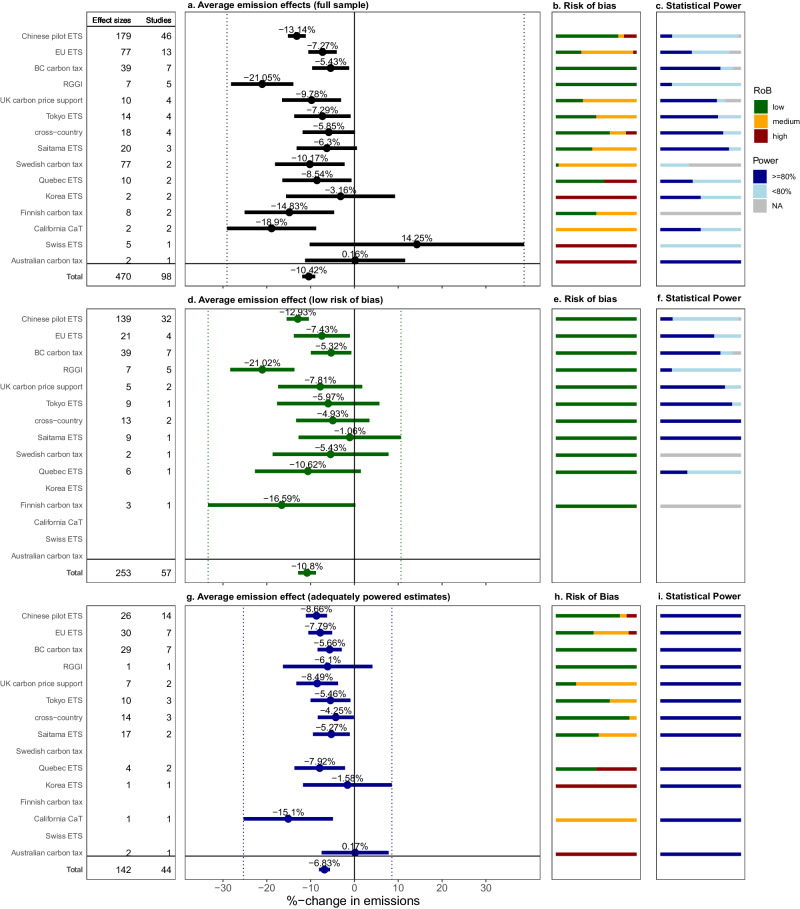
- Across 483 effect sizes from 80 ex-post evaluations of 21 carbon pricing schemes, the average treatment effect is –10.4% [95% CI = (–11.9%, –8.9%)]; 17 schemes show statistically significant reductions ranging from about –21% to –5%.
- Publication-bias correction, using the ~30% of effect sizes with adequate statistical power, reduces the average treatment effect to –6.8% [95% CI = (–8.1%, –5.6%)] and adjusts scheme-wise estimates to –15% to –4%.
- Scheme-specific estimates include Chinese pilot ETS –13.1% [95% CI = (–15.2%, –11.1%)], EU ETS –7.3% [95% CI = (–10.5%, –4.0%)], and British Columbia carbon tax –5.4% [95% CI = (–9.6%, –1.2%)].
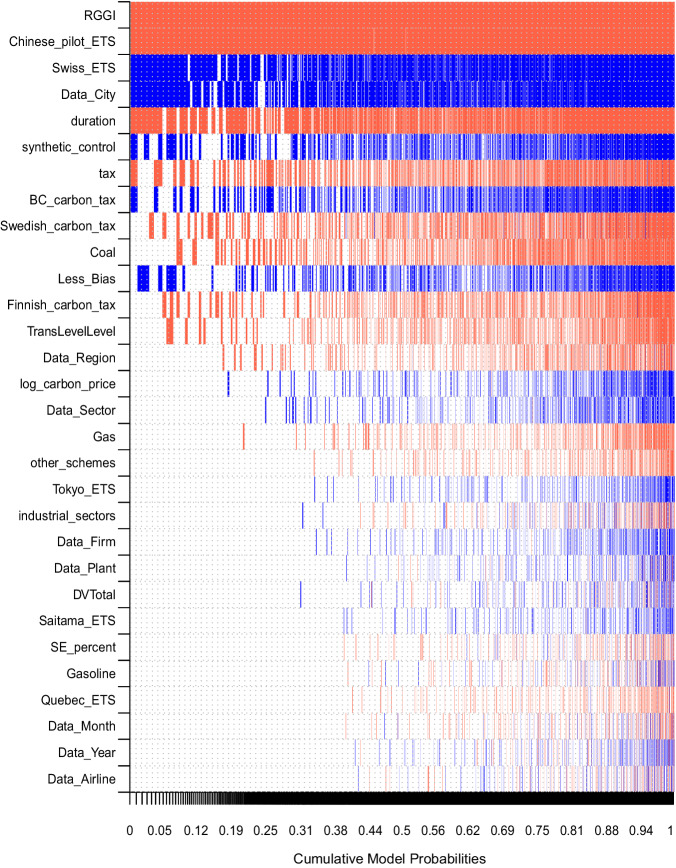
- Bayesian model averaging finds relevant explanatory variables (PIP ≥ 0.5) are dummies for RGGI, Chinese pilot ETS, Swiss ETS, city-level data, and duration; carbon price level, sector coverage, and tax-vs-cap-and-trade are not relevant (PIP < 0.5).
- Evidence gaps remain: only 20 of 73 carbon pricing policies in place in 2023 plus the repealed Australian carbon tax had ex-post evidence; 18 of 38 schemes implemented by 2015 had no effectiveness study; only nine price elasticity studies were identified.
Methods
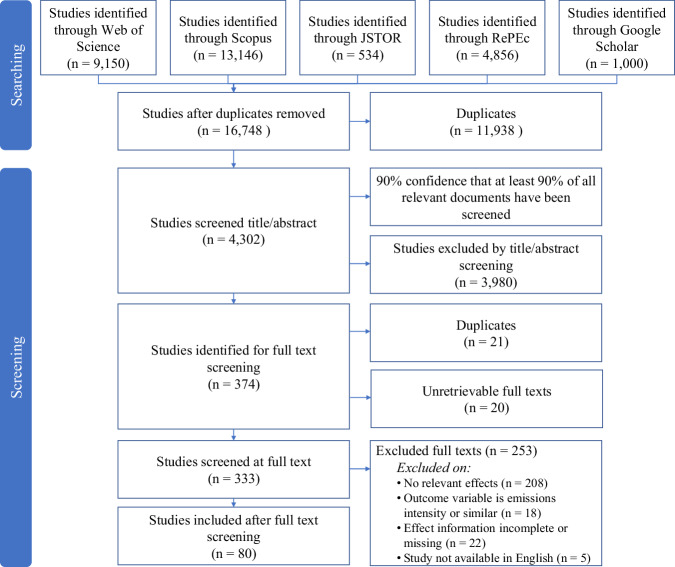
- Systematic review following Collaboration for Environmental Evidence guidance, with machine-learning-assisted screening of 16,748 articles from Web of Science, Scopus, JSTOR, RePEc, and Google Scholar; 80 quantitative ex-post evaluations across 21 carbon pricing schemes were included.
- Effect sizes were harmonised to a common treatment-effect metric: percentage difference between counterfactual emissions without carbon pricing and observed emissions after introduction; 483 effect sizes were analysed.
- Multilevel random and mixed effects models estimated average treatment effects; critical appraisal adapted ROBINS-I criteria; publication bias assessed via precision effect test and corrected using adequately powered effect sizes; Bayesian model averaging tested heterogeneity.
Limitations
- The paper states the approach is purely quantitative and meta-econometric, inherently dependent on the available evidence base, and cannot answer why particular policy designs work or under what conditions; it suggests mixed-method realist synthesis for such questions.
- The paper states substantial evidence gaps: more than 50 carbon pricing schemes have not been evaluated, fewer than ten studies assess schemes with mean carbon prices above US$ 30, only about half of studies have low risk of bias, and only 30% are adequately powered.
- The paper states that carbon price variation is dominated by between-scheme differences (91%) versus within-scheme variation (9%), limiting power to identify price effects; most primary studies assume constant treatment effects, so the finding that longer study periods show larger reductions should be treated with caution.
- Evident from the text: many schemes are covered by only one to five studies, and scheme dummies in the heterogeneity analysis may absorb omitted contextual variables, making the price coefficient difficult to interpret when scheme dummies are excluded.
Model-written summary. Check it against the paper before relying on it.
Integrity signals
Registry
Cites
Statistics
Figures
Verification
Claims the paper makes
3 Valid · 1 Not valid · 16 Not checked · 57 Own results and interpretations
At least one cited source doesn’t support this claim or points to a different paper, and none confirmed it — see the verdicts below.
In the paper
“We apply a multilevel estimation to account for the non-independence of effect sizes from the same study, assuming a compound symmetric variance-covariance matrix84.”
§ Systematic review and meta-analysis of ex-post evaluations on the effectiveness of carbon pricing > Methods > Effect size averaging
What the sources say
- Disputedcites [84] Viechtbauer, W. Conducting Meta-Analyses in R with the metafor Package. J. Stat. Softw.36 (2010). http://www.jstatsoft.org/v36/i03/. sourceExperimental — accuracy not yet measured
The Conclusions (p. 42) state that the model-fitting functions described in this paper assume independent outcomes and that functions for correlated outcomes were still under development. The paper therefore does not support attributing to these models an estimation method that accounts for within-study dependence using a compound-symmetric variance-covariance matrix. (LLM, conf=0.87)
Checked by a reasoning model — may be wrong.
plainstates a cause- Asserted: passes — The authors put it forward as true.
- Checkable: passes — It can be checked against evidence.
- Load-bearing: passes — The paper’s conclusions depend on it.
- Based: passes — The paper gives a reason why it holds.
- Disputed
Every source the paper cites for this claim was checked and supports it.
In the paper
“we correct for publication bias by estimating average effects for a subsample of effect sizes with adequate statistical power (see Methods)38, which applies to about 30% of the reviewed effect sizes.”
§ Systematic review and meta-analysis of ex-post evaluations on the effectiveness of carbon pricing > Results > Critical appraisal and publication bias
What the sources say
- Supportedcites [38] Ioannidis, J. P. A., Stanley, T. D. & Doucouliagos, H. The power of bias in economics research. Econ. J. 127, F236–F265 (2017). source
The citation is attached to the method the citing authors apply, and our copy presents exactly that method as this paper's contribution: the Introduction (Section 1, p. n/a) states 'Our second contribution is to present a new approach to correcting bias in empirical economics research, a weighted average of the adequately powered (WAAP)... calculated only on the adequately powered estimates', and Section 3.1 ('Finding the power to reduce bias') repeats 'we calculate WLS-FE on that sub-sample of the research record that is adequately powered'. The '~30% of the reviewed effect sizes' figure belongs to the citing paper's own review, not to Ioannidis et al.; in their survey the median proportion of estimates with adequate power is 10.5% (WLS-FE, Section 2/3), so that number is not being attributed to and does not need to be supported by this source. (LLM, conf=0.85)
plain- Asserted: passes — The authors put it forward as true.
- Checkable: passes — It can be checked against evidence.
- Load-bearing: unclear — It is unclear whether the paper’s conclusions depend on it.
- Based: passes — The paper gives a reason why it holds.
- Supported
The cited sources support only part of this claim — read each source’s verdict below.
In the paper
“Similar effects are found for the EU ETS, where the effectiveness increases with the increasing stringency from phases I, II, and III70–73.”
§ Systematic review and meta-analysis of ex-post evaluations on the effectiveness of carbon pricing > Discussion
What the sources say
- Not checked yetcites [70] Colmer, J., Martin, R., Muûls, M. & Wagner, U. J. Does pricing carbon mitigate climate change? Firm-level evidence from the European Union emissions trading scheme (2022). Publisher: CEPR Discussion Paper No. DP16982.
- Partly supportedcites [71] Fernández Fernández, Y., Fernández López, M., González Hernández, D. & Olmedillas Blanco, B. Institutional change and environment: Lessons from the European emission trading system. Energies 11, 706 (2018). sourceExperimental — accuracy not yet measured
The Results and Conclusions report that each EU ETS phase had a greater emissions-reducing impact than the previous one. They describe this as a strengthening of the market, but do not establish that increasing stringency caused the increase; the Results offer several possible explanations instead. No page numbers are available in our copy. (LLM, conf=0.84)
- Not checked yetcites [72] Gupta, N., Shah, J., Gupta, S. & Kaul, R. Causal impact of european union emission trading scheme on firm behaviour and economic performance: A study of german manufacturing firms (2021). https://arxiv.org/abs/2108.07163. Publisher: arXiv Version Number: 1.
- Partly supportedcites [73] Petrick, S. & Wagner, U. J. The impact of carbon trading on industry: Evidence from german manufacturing firms. SSRN Electr. J. (2014). http://www.ssrn.com/abstract=2389800. sourceExperimental — accuracy not yet measured
The Main Results (p. 18) find little emissions abatement in phase I but substantial reductions among regulated German manufacturing firms in phase II. The Introduction (p. 3) says the analysis ends in 2010, during phase II. The paper therefore does not establish a further increase in effectiveness in phase III or show that increasing stringency caused the phase-I-to-II difference. (LLM, conf=0.88)
plainstates a cause- Asserted: passes — The authors put it forward as true.
- Checkable: passes — It can be checked against evidence.
- Load-bearing: unclear — It is unclear whether the paper’s conclusions depend on it.
- Based: passes — The paper gives a reason why it holds.
A result the paper reports from its own data — it cites no other source for it, so there is none to check. The quote shows it is in the paper.
In the paper
“Studies assessing the effectiveness of carbon pricing over longer time periods find larger emission reductions.”
§ Systematic review and meta-analysis of ex-post evaluations on the effectiveness of carbon pricing > Results > Explaining heterogeneity in effect sizes
plainstates an association- Asserted: passes — The authors put it forward as true.
- Checkable: passes — It can be checked against evidence.
- Load-bearing: passes — The paper’s conclusions depend on it.
- Based: passes — The paper gives a reason why it holds.
A result the paper reports from its own data — it cites no other source for it, so there is none to check. The quote shows it is in the paper.
In the paper
“Statistically significant emissions reductions range between –5% to –21% across the schemes (–4% to –15% after correcting for publication bias).”
- Also stated in: § Critical appraisal and publication bias · plain
“ranging from –15% to –4%.”
§ Systematic review and meta-analysis of ex-post evaluations on the effectiveness of carbon pricing > Abstract
plainstates a cause- Asserted: passes — The authors put it forward as true.
- Checkable: passes — It can be checked against evidence.
- Load-bearing: passes — The paper’s conclusions depend on it.
- Based: passes — The paper gives a reason why it holds.
- Also stated in: § Critical appraisal and publication bias · plain
53 more claims
Create a free account to see all 77 claims and to verify the 34 references still open.
- It may state two separate claims as one. 5
- Probably not a substantial claim. 13
- The quote only partly states this claim. 1
Claims other papers make about this one
Each is checked against this paper’s own text: does it say what the citing paper says it does?
In the citing paper
“While carbon pricing has proven effective in reducing industry GHG emissions, 105”
From Decarbonizing lithium-ion battery primary raw materials supply chain (2024) · cites this paper as [105]
Self-check
Percentages, sums and reported differences re-computed from the paper’s own numbers.
Each contradiction between two passages listed here was confirmed by an independent check.
Rated minor: it would not touch a result — a value no result rests on, a p-value that stays on the same side of the significance level, or a conflict that is clerical, resolved elsewhere in the paper, or outside its own findings.
In the paper
§ Systematic review and meta-analysis of ex-post evaluations on the effectiveness of carbon pricing > Results > Evidence base — larger and more diverse than previously suggested
“| RGGI | 11 northeastern US states | 2009 | power | 14% | $3 | 8 | 10 |”
§ Systematic review and meta-analysis of ex-post evaluations on the effectiveness of carbon pricing > Results > Evidence base — larger and more diverse than previously suggested
“five on the Regional Greenhouse Gas Initiative (RGGI) in the United States.”
Citations
Cites
Bias in meta-analysis detected by a simple, graphical test
Egger, M., Smith, G. D., Schneider, M., & Minder, C. (1997) · BMJ · doi:10.1136/bmj.315.7109.629 · Cited by 56,722 · cited 1×
“C) If possible, the author should include more mathematical details about “Standardising effect sizes” and “Effect size averaging” in the main body of the paper rather than in the Supplementary Information.”
BackgroundConducting Meta-Analyses in R with the metafor Package
Viechtbauer, W. (2010) · Journal of Statistical Software · doi:10.18637/jss.v036.i03 · Cited by 20,464
Why Most Published Research Findings Are False
Ioannidis, J. P. A. (2005) · PLoS Medicine · doi:10.1371/journal.pmed.0020124 · Cited by 10,505
The file drawer problem and tolerance for null results.
Rosenthal, R. (1979) · Psychological Bulletin · doi:10.1037/0033-2909.86.3.638 · Cited by 9,068
Realist review - a new method of systematic review designed for complex policy interventions
Pawson, R., Greenhalgh, T., Harvey, G., & Walshe, K. (2005) · Journal of Health Services Research & Policy · doi:10.1258/1355819054308530 · Cited by 3,190 · cited 1×
“Despite these adjustments, the publication bias corrected estimates support the overall finding that carbon pricing policies cause significant reductions in in GHG emissions.”
ResultWeitzman, M. L. (1974) · The Review of Economic Studies · doi:10.2307/2296698 · Cited by 2,071
Markets in licenses and efficient pollution control programs
Montgomery, W. D. (1972) · Journal of Economic Theory · doi:10.1016/0022-0531(72)90049-x · Cited by 1,781
Bayesian Model Averaging for Linear Regression Models
Raftery, A. E., Hoeting, J. A., & Madigan, D. (1997) · Cited by 1,746
Bias and Efficiency of Meta-Analytic Variance Estimators in the Random-Effects Model
Viechtbauer, W. (2005) · Journal of Educational and Behavioral Statistics · doi:10.3102/10769986030003261 · Cited by 1,699
Bayesian Model Averaging for Linear Regression Models
Raftery, A. E., Madigan, D., & Hoeting, J. A. (1997) · Journal of the American Statistical Association · doi:10.1080/01621459.1997.10473615 · Cited by 1,287
Research works printed but not linked: 4
- IPCC. Climate Change 2022: Mitigation of Climate Change. Contribution of Working Group III to the Sixth Assessment Report of the Intergovernmental Panel on Climate Change (Cambridge University Press, Cambridge, UK and New York, NY, USA, 2022).
- Dahl, C. A. Measuring global gasoline and diesel price and income elasticities. Model. Transp. (Energy) Demand Policies 41, 2–13 (2012).
- Agnolucci, P.et al. Measuring Total Carbon Pricing. The World Bank Research Observer lkad009 (2023). https://academic.oup.com/wbro/advance-article/doi/10.1093/wbro/lkad009/7283905. · doi:10.1093/wbro/lkad009/7283905
- Ringquist, E.Meta-analysis for public management and policy (John Wiley & Sons, 2013).
Cited by
Climate policies that achieved major emission reductions: Global evidence from two decades
Stechemesser, A., Koch, N., Mark, E., Dilger, E., Klösel, P., Menicacci, L., Nachtigall, D., Pretis, F., Ritter, N., Schwarz, M., et al. (2024) · Science · doi:10.1126/science.adl6547 · Cited by 322
Self-citationTo tax or to trade? A global review of carbon emissions reduction strategies
Pan, J., Cross, J. L., Zou, X., & Zhang, B. (2024) · Energy Strategy Reviews · doi:10.1016/j.esr.2024.101508 · Cited by 104
Ahmad, M., Li, X. F., & Wu, Q. (2024) · Journal of Cleaner Production · doi:10.1016/j.jclepro.2024.143761 · Cited by 97
Decarbonizing lithium-ion battery primary raw materials supply chain
Istrate, R., Mas-Fons, A., Beylot, A., Northey, S., Vaidya, K., Sonnemann, G., Kleijn, R., & Steubing, B. (2024) · Joule · doi:10.1016/j.joule.2024.10.003 · Cited by 60
Zhang, T., & Deng, M. (2025) · Journal of Cleaner Production · doi:10.1016/j.jclepro.2025.145279 · Cited by 30
Shi, W., Zhang, Y., & Liu, J. (2024) · IEEE Transactions on Engineering Management · doi:10.1109/tem.2024.3450523 · Cited by 25
“Conversely, if a power producer successfully reduces emissions, it can sell its surplus permits [5].”
BackgroundPolicy interactions and electricity generation sector CO2 emissions: A quasi-experimental analysis
Tello, W. P. (2024) · Energy Policy · doi:10.1016/j.enpol.2024.114434 · Cited by 24
Green industrial policy can strengthen carbon pricing but not replace it
Jakob, M., & Øverland, I. (2024) · Energy Research & Social Science · doi:10.1016/j.erss.2024.103669 · Cited by 36
Carbon markets: a new form of colonialism for Indigenous Peoples?
Redvers, N., Chan, J., Odochao, S., Pratt, V., Sim, J., Gougsa, S., Kobei, D. M., & Willetts, L. (2025) · The Lancet Planetary Health · doi:10.1016/s2542-5196(25)00086-5 · Cited by 36
Harnessing dynamic carbon intensity for energy-data co-optimization in internet data centers
Liu, T., Yan, R., Zhang, J., Fan, J., Yan, G., & Li, P. R. (2025) · Renewable Energy · doi:10.1016/j.renene.2025.124626 · Cited by 33
EFFECTS OF CARBON PRICING AND OTHER CLIMATE POLICIES ON CO 2 EMISSIONS
Kohlscheen, E., Moessner, R., & Takáts, E. (2025) · National Institute Economic Review · doi:10.1017/nie.2025.10066 · Cited by 63
Beyond the factory: Ten interdisciplinary lessons for industrial decarbonisation practice and policy
Sovacool, B. K., AbdulRafiu, A., Hudson, M., McManus, M. C., Korre, A., Marr, I. H., Howard, C., & Maroto‐Valer, M. M. (2024) · Energy Reports · doi:10.1016/j.egyr.2024.05.048 · Cited by 24
Gonocruz, R. A., Ozawa, A., & Kudoh, Y. (2025) · Applied Energy · doi:10.1016/j.apenergy.2025.125300 · Cited by 19
Adnan, M. A. (2025) · Biomass and Bioenergy · doi:10.1016/j.biombioe.2025.107634 · Cited by 18
Technology innovation and environmental outcomes of road transportation policy instruments
Ma, C., Peñasco, C., & Anadón, L. D. (2025) · Nature Communications · doi:10.1038/s41467-025-59111-8 · Cited by 23
“Meanwhile, California ’ s cap-and-trade policy, introduced in 2012, has been integral to the state ’ s broader strategy to reduce greenhouse gas emissions 84 .”
Wang, L., & Wang, J. (2025) · Journal of Environmental Management · doi:10.1016/j.jenvman.2025.127731 · Cited by 23
Kerr, S., & Hu, X. (2025) · npj Climate Action · doi:10.1038/s44168-025-00220-x · Cited by 19
Anathole, U., Limei, C., & Hamza, F. (2025) · Corporate Social Responsibility and Environmental Management · doi:10.1002/csr.70256 · Cited by 17
Ethics of carbon pricing – a review of the literature
Magnetti, J., Dominioni, G., & Gordijn, B. (2024) · Climate Policy · doi:10.1080/14693062.2024.2416493 · Cited by 17
“In response to this analysis, a systematic review of ex-post studies finds significantly larger effects on emissions reductions, with significant variations across carbon pricing instruments (Döbbeling-Hildebrandt et al., 2024).”
Tong, H., Liu, J., Wang, Y. H., An, H., Song, G., Hou, Y., Tang, X., & Yi, H. (2025) · Journal of Environmental Sciences · doi:10.1016/j.jes.2025.12.029 · Cited by 15
Climate policy portfolios that accelerate emission reductions
Arvanitopoulos, T., Bulian, S., Wilson, C., Jordan, A., Tosun, J., & Vasilakos, N. V. (2026) · Nature Communications · doi:10.1038/s41467-026-68577-z · Cited by 15
“Policy evaluation studies provide complementary insights on the effectiveness of speci fi c instruments 24,46 .”
InfluentialLilliestam, J., Eckardt, J., & Bersalli, G. (2025) · One Earth · doi:10.1016/j.oneear.2025.101390 · Cited by 8
Carbon pricing reduces emissions
Sterner, T. (2024) · Nature · doi:10.1038/d41586-024-02293-w · Cited by 14
Magnetti, J., Marks, D., & Dominioni, G. (2025) · Energy Research & Social Science · doi:10.1016/j.erss.2025.104116 · Cited by 8
Modelling the impacts of policy sequencing on energy decarbonization
Luo, H., Peng, W., Fawcett, A. A., Green, J., Iyer, G. C., Meckling, J., Nahm, J., & Victor, D. G. (2025) · Nature Climate Change · doi:10.1038/s41558-025-02497-6 · Cited by 14
“For instance, a recent meta-analysis estimated that carbon pricing policies have achieved large emission reductions, with effects ranging from 5% to 21% across different schemes 54 , which is larger than suggested by some earlier reviews that used a more qualitative approach 55 .”
Song, X., Pan, C., Yuan, H., & Wang, Z. (2024) · Renewable Energy · doi:10.1016/j.renene.2024.121713 · Cited by 11
Kim, J. (2025) · Corporate Social Responsibility and Environmental Management · doi:10.1002/csr.70142 · Cited by 6
Li, H., Yang, S., Chen, A., Faming, L., Gao, W., Cui, J., & Chen, Y. (2025) · Journal of Environmental Management · doi:10.1016/j.jenvman.2025.126418 · Cited by 7
Electricity price hikes raise firewood consumption and women’s collection time in Malawi
Aggarwal, R., & Steckel, J. C. (2025) · Environmental Research Energy · doi:10.1088/2753-3751/ade1dd · Cited by 5
Self-citationChai, S., Yang, J., Bi, X., Tang, L., Zhang, M., & Zhu, J. (2025) · Utilities Policy · doi:10.1016/j.jup.2025.102084 · Cited by 11
Effectiveness of market incentives in China’s National Emission Trading Scheme
Lyu, C., Wang, K., Shi, X., Cai, B., & Yan, G. (2025) · Structural Change and Economic Dynamics · doi:10.1016/j.strueco.2025.12.011 · Cited by 5
Degradation of lithium-ion batteries: A meta-analysis
Ligorati, M., Geyer‐Klingeberg, J., Günther, T. E., & Rathgeber, A. (2026) · Chemical Engineering Journal · doi:10.1016/j.cej.2026.174528 · Cited by 5
Global inequalities in ownership-based carbon footprints
Chancel, L., & Rehm, Y. (2026) · Nature Climate Change · doi:10.1038/s41558-026-02662-5 · Cited by 7
Monetary impact valuation for sustainable business
Edinger‐Schons, L. M., Stroehle, J. C., Gümüşay, A. A., Berg, F., Besharov, M. H.-P., Busch, T., Etzion, D., Harji, K., Hsieh, N., King, A. A., et al. (2025) · Nature Sustainability · doi:10.1038/s41893-025-01630-9 · Cited by 5
What’s the best way to tackle climate change? An ‘evidence bank’ could help scientists find answers
Pearson, H. (2024) · Nature · doi:10.1038/d41586-024-01683-4 · Cited by 5
Emissions Trading with Clean-Up Certificates: Deterring Mitigation or Increasing Ambition?Preprint
Lessmann, K., Gruner, F., Kalkuhl, M., & Edenhofer, O. (2024) · SSRN Electronic Journal · doi:10.2139/ssrn.4875544 · Cited by 5
Self-citationHeterogeneous responses to carbon pricing: Firm-level evidence from Beijing emissions trading scheme
Tian, R., Wang, H., Zhang, D., Zhang, X., & Sterner, T. (2025) · Journal of Environmental Economics and Management · doi:10.1016/j.jeem.2025.103266 · Cited by 9
Thermochemical upcycling of plastic waste: A comprehensive view from technology to commercialization
Lee, J., Heo, S., Choi, D., & Kim, K.-H. (2025) · Materials Science and Engineering R Reports · doi:10.1016/j.mser.2025.101170 · Cited by 9
Zambrano‐Monserrate, M. A., Erum, N., & Bergougui, B. (2026) · The Journal of Economic Asymmetries · doi:10.1016/j.jeca.2026.e00449 · Cited by 6
Effective climate policies for ‘all seasons’: novel evidence from 40 countries
Fernández‐i‐Marín, X., Hinterleitner, M., Knill, C., & Steinebach, Y. (2026) · Climate Policy · doi:10.1080/14693062.2025.2598684 · Cited by 4
Quantifying the synergy effects of climate policy portfolios: Evidence from China
Meng, P., Liu, K., Xia, Z., & Chen, W. (2026) · Sustainable Cities and Society · doi:10.1016/j.scs.2026.107198 · Cited by 6
Shang, X., Shi, H., Li, Y., Yang, J., & Wang, Y. (2026) · Journal of Cleaner Production · doi:10.1016/j.jclepro.2026.147679 · Cited by 5
Yoder, L., Cain, A., Rao, A., Geiger, N., Kravitz, B., Mercer, M., Miniard, D., Nepal, S., Nunn, T., Sluder, M., et al. (2024) · Sustainability · doi:10.3390/su16135275 · Cited by 4
Hughes, L. W., & Landry, S. (2024) · Energies · doi:10.3390/en17225802 · Cited by 5
Pu, M., Yang, S., Aimei, C., & Deng, Z. (2025) · Plants · doi:10.3390/plants14172746 · Cited by 4
“Globally, over 70 carbon pricing schemes have been implemented, with China’s carbon prices notably lower than those in the European Union [64].”
Under what conditions and why is carbon pricing effective? A realist synthesis of ex-post evidence
Döbbeling-Hildebrandt, N., Danilenko, D., Lamb, W. F., & Minx, J. C. (2025) · Environmental Research Letters · doi:10.1088/1748-9326/ae03d8 · Cited by 5
“While additional searches for evidence would be expected to fill some of the identified gaps, systematic reviews of carbon pricing policies commonly find that large amounts of implemented policies are understudied [8, 26, 27].”
InfluentialSelf-citationThe Cultural Multiplier of Climate Policy
Torren-Peraire, D., van den Bergh, J. C. J. M., & Savin, I. V. (2025) · Environmental and Resource Economics · doi:10.1007/s10640-025-01048-z · Cited by 5
Do decarbonization policies work? Evidence from a global meta-analysis
Zhang, W., Sovacool, B. K., & Cleveland, C. J. (2026) · Energy Economics · doi:10.1016/j.eneco.2026.109145 · Cited by 8
Emissions trading with clean-up certificates: How carbon debt can increase climate ambition levels
Lessmann, K., Gruner, F., Kalkuhl, M., & Edenhofer, O. (2026) · Journal of Environmental Economics and Management · doi:10.1016/j.jeem.2026.103307 · Cited by 14
Self-citationChen, H., Gregorio, M. D., & Paavola, J. (2026) · Climate Policy · doi:10.1080/14693062.2026.2627750 · Cited by 4
Cross-national comparative assessment of synergies and conflicts in climate policy mixes
Wu, L., Liu, G., Huang, Z., Meng, J., & Zhou, Y. (2026) · Nature Climate Change · doi:10.1038/s41558-026-02574-4 · Cited by 12
Synergistic pretreatment: hybrid strategies for maximum lignocellulose valorization
Mehta, N. R. (2026) · Biodegradation · doi:10.1007/s10532-026-10296-9 · Cited by 6
“…while stronger carbon-pricing policies can improve the relative economics of low-carbon routes by increasing the cost of fossil-intensive alternatives; however, both should be framed as enabling conditions rather than strict pre-requisites (Butean et al. 2025; Döbbeling-Hildebrandt et al. 2024).”
UK Carbon Price Dynamics: Long-Memory Effects and AI-Based Forecasting
Dinca, Z., Oprean-Stan, C., & Balsalobre‐Lorente, D. (2025) · Fractal and Fractional · doi:10.3390/fractalfract9060350 · Cited by 6
Artemenkov, A. I., Medvedeva, O., Pavlov, A. N., & Ganiev, O. (2025) · Sustainability · doi:10.3390/su17031088 · Cited by 6
Cao, K., Mei, Y., & Liu, Y. (2025) · Cleaner Engineering and Technology · doi:10.1016/j.clet.2025.101044 · Cited by 2
Bartolj, T., Murovec, N., & Bearzotti, E. (2025) · SAGE Open · doi:10.1177/21582440251367893 · Cited by 2
“However, the application of EPPI to regions outside the same emissions trading system would require consideration of policy instruments like tradable permits, which play a key role in many countries’ environmental strategies (Do¨bbeling-Hildebrandt et al., 2024).”
A provincial cost analysis of electric vehicle operation in China
Li, B., Yang, M., He, G., Ruan, G., Wang, J., Cui, X., Zhong, H., & Kammen, D. M. (2025) · iScience · doi:10.1016/j.isci.2025.113504 · Cited by 2
“52 Besides, some studies indicate that an increase in the carbon prices leads to larger emissions reductions than an increase in the fuel price of the same size.”
Potential impacts of carbon pricing on vegetable cold chains
Alegbeleye, O. O., Kassie, G. T., Ndour, A., Adamseged, M. E., & Athukorala, A. N. (2025) · Future Foods · doi:10.1016/j.fufo.2025.100771 · Cited by 3
Setiabudi, A., & Suhardianto, N. (2025) · International Journal of Law and Management · doi:10.1108/ijlma-05-2025-0221 · Cited by 6
Ferreira, L., Dias, L. P., Seixas, J., & Schmidt, L. (2025) · Frontiers in Environmental Science · doi:10.3389/fenvs.2025.1635633 · Cited by 4
Kellner, M., Rütten, K., Geiger, M., Jenny, M. A., Lehrer, L., Temme, H., & Betsch, C. (2025) · npj Climate Action · doi:10.1038/s44168-025-00317-3 · Cited by 7
Does stringent climate policy decouple economic growth from greenhouse gas emissions?
Thombs, R. P., & Jorgenson, A. K. (2025) · Social Forces · doi:10.1093/sf/soaf217 · Cited by 2
Carbon taxes and climate action: Lessons from Mexico, Colombia, and Argentina
Muzzi, E., & Pereda, P. C. (2026) · Energy Policy · doi:10.1016/j.enpol.2026.115191 · Cited by 5
Bawack, R. E., Bonhoure, É., & Kan, K. A. S. (2026) · Information Systems Frontiers · doi:10.1007/s10796-026-10694-7 · Cited by 4
A policy framework for clean energy technology adoption
Pollitt, H., & Petrauskaite, M. (2026) · npj Clean Energy · doi:10.1038/s44406-026-00022-y · Cited by 3
“The TDAFmaythusexplaintheapparentdivergenceinempiricalstudiesabout theeffectivenessofcarbonpricing 49 – 51 .”
Xu, X., Gao, B., Zhao, N., Yan, X., Xu, Q., & Luo, A. (2026) · Engineering Applications of Artificial Intelligence · doi:10.1016/j.engappai.2026.115527 · Cited by 2
Klimasozialpolitik als Pfeiler der Nachhaltigkeitswende
Heinze, R. G., & Schupp, J. (2024) · Sozialer Fortschritt · doi:10.3790/sfo.2024.1442002 · Cited by 2
Guo, J., Li, T., Wu, T., Wang, Z., Zou, Z., Peng, C. H., Zhou, X., Peng, L., Liu, Z., Tang, J., et al. (2024) · The Science of The Total Environment · doi:10.1016/j.scitotenv.2024.176182 · Cited by 3
Suitor, S., Hadley, D., & Ximenes, F. A. (2025) · Land · doi:10.3390/land14030473 · Cited by 4
Zhang, X. (2025) · Economic Analysis and Policy · doi:10.1016/j.eap.2025.05.037 · Cited by 3
Baumgart, E. A., Blaufus, K., & Hechtner, F. (2025) · European Journal of Law and Economics · doi:10.1007/s10657-025-09850-2 · Cited by 2
“…introduction or evaluation of environmental taxes, such as a carbon tax, as is the case with the majority of related literature (e.g., Sumner et al., 2011 ; Döbbeling-Hildebrandt et al., 2024 ), we provide evidence on how elements of standard income taxation may help achieve climate policy goals.”
Global heterogeneity in ETS rollouts and subsequent decarbonization outcomes
Adbi, A., Agarwal, S. D., & Natarajan, S. (2025) · Energy Economics · doi:10.1016/j.eneco.2025.108921 · Cited by 2
Thematic Review of Studies on International Environmental Agreements
Zhou, S., & Fujita, T. (2025) · Sustainability · doi:10.3390/su17146256 · Cited by 4
Verwaltungsstaat als Demokratieideal – Administrative State als Demokratiegefahr?
Plebuch, J., & Pielhoff, S. (2022) · Der Staat · doi:10.3790/staa.61.2.167 · Cited by 2
The Unequal Impact of Carbon Pricing on Household Burden and Policy Responses
Yin, Z., Chen, W., Cao, J. J., Wang, J., & Lu, X. (2025) · Journal of Energy and Climate Change · doi:10.3724/j.issn.2097-4981.jecc-2024-0030 · Cited by 2
The Case Against Climate Doom: An Economist’s Guide to Climate Optimism
Jakob, M. (2025) · Springer eBooks · doi:10.1007/978-3-031-93968-6 · Cited by 1
Zhu, W., Wang, L., Sun, Z. Y., Zhang, L., & Li, X. (2025) · Buildings · doi:10.3390/buildings15152650 · Cited by 2
Ying, Q., Li, M., & Geng, Y. (2025) · Climate Policy · doi:10.1080/14693062.2025.2545325 · Cited by 3
Ebner, M., Kachi, A., Rhodes, E., & Andrew, K. (2025) · Energy Research & Social Science · doi:10.1016/j.erss.2025.104264 · Cited by 2
Carbon tax impacts on transport emissions in belt and road trade corridors: A scenario analysis
Yin, Y., Huang, L., Han, Q., & Tang, Z. (2025) · Transportation Research Interdisciplinary Perspectives · doi:10.1016/j.trip.2025.101728 · Cited by 2
Cristian Mardones, P., & Henríquez, V. (2025) · Energy · doi:10.1016/j.energy.2025.138499 · Cited by 1
Green industrial policy is not enough for net-zero decarbonization
Purdon, M. (2025) · Nature Climate Change · doi:10.1038/s41558-025-02514-8 · Cited by 1
Sivonen, J., Härmä, V., & Karvonen, S. (2025) · International Journal of Climate Change Strategies and Management · doi:10.1108/ijccsm-01-2025-0028 · Cited by 1
Portalanza, D. E., Valle, E. N., Cepeda, M., Reyes, L. S. G., Guevara, J. C., Arcos, D., Ortega, C., & Barberán, J. R. M. (2026) · Ecologies · doi:10.3390/ecologies7010023 · Cited by 1
“Zero values were treated as non-applicable/non-priced cases for that year and were therefore excluded from the averaging, ensuring that CMP reflects the average of observed (priced) entries rather than being diluted by missing or not-yet-active instruments [33].”
Pyra, M. (2026) · Energies · doi:10.3390/en19051277 · Cited by 3
Hu, Y., & Luo, A.-L. (2026) · Energy Strategy Reviews · doi:10.1016/j.esr.2026.102200 · Cited by 4
Bhattarai, U., Maraseni, T., Devkota, L. P., & Apan, A. (2026) · Environment Systems & Decisions · doi:10.1007/s10669-026-10087-w · Cited by 1
“…plays a strategic role in reduction of energy-related emissions (Sheng et al. 2024), and a balance between regulatory mandates and market-based energy management (Al Essa 2025; Döbbeling-Hildebrandt et al. 2024) could be extremely important at the regional level in future to break this cycle.”
Equitable transitions in ageing societies: how fairness perceptions transform carbon tax resistance
Ba, Y., Fong, J., & Xia, Y. (2026) · Climate Policy · doi:10.1080/14693062.2026.2657445 · Cited by 2
SAVI, A. V., Santos, L. B. M., Carra, S. H. Z., Tosto, G., & Savi, M. (2026) · Sustainability · doi:10.3390/su18136525 · Cited by 1
Accuracy, robustness and comprehensibility – Challenges in bottom-up energy system models
Prina, M. G., & Noussan, M. (2026) · PLOS Climate · doi:10.1371/journal.pclm.0000890 · Cited by 1
“Historically, many models have used carbon pricing as a proxy for policy action [164,165]; however, it is increasingly recognized that different instruments, such as renewable portfolio standards, technology-specific subsidies, regulatory bans, and feed-in tariffs, can lead to divergent system…”
Chen, L., & Zhu, Y. (2026) · Energies · doi:10.3390/en19153612 · Cited by 1
Yang, Y., Shen, H., Liu, W., Wang, Y., Ji, J., He, D., & Huang, Q. (2026) · Journal of Cleaner Production · doi:10.1016/j.jclepro.2026.148978 · Cited by 1
Tang, R., Yu, D., Han, C., Li, Y., & Shang, W. (2026) · Applied Energy · doi:10.1016/j.apenergy.2026.128789 · Cited by 1
Emissions abatement under a rate-based emissions trading system: facility-level evidence from China
Quan, Y., Tan‐Soo, J., Duan, M., & Cai, B. (2026) · Journal of Public Economics · doi:10.1016/j.jpubeco.2026.105797 · Cited by 2
Implying climate impact from carbon prices and consumption
Jessop, N., Arendarczyk, B., & Alexander, P. (2025) · Climate Policy · doi:10.1080/14693062.2025.2531094 · Cited by 1
“A recent systematic review of implemented global carbon pricing schemes shows that, when implemented, carbon pricing is an effective policy mechanism for achieving emissions reductions (Döbbeling-Hildebrandt et al., 2024).”
The Tax Treatment of Commuting Expenses and Job-Related MobilityPreprint
Baumgart, E. A., Blaufus, K., & Hechtner, F. (2024) · SSRN Electronic Journal · doi:10.2139/ssrn.4715308 · Cited by 1
Global Trends and Developments in Carbon Pricing
Cui, B., Pham, N., Ruthbah, U. H., Le, T. H., Ahrens, J., & Cohen, R. (2025) · doi:10.56227/25.1.3 · Cited by 2
Emission pricing in developing countries
Ramakrishnan, A., Fischer, C., Steckel, J. C., Sterner, T., & Lindberg, V. (2024) · Elsevier eBooks · doi:10.1016/b978-0-323-91013-2.00030-7
Self-citationEbner, M., Kachi, A., Rhodes, E., & Andrew, K. (2024) · SSRN Electronic Journal · doi:10.2139/ssrn.5020017
The cost–emission trade-off in the optimization of a mixed-fleet public bus system
Frieß, N. M., Fritz, D., Pferschy, U., & Theurl, M. C. (2026) · Research in Transportation Business & Management · doi:10.1016/j.rtbm.2026.101854
Metadata
- Authors
- Döbbeling-Hildebrandt, N., Miersch, K., Khanna, T. M., Bachelet, M., Bruns, S. B., Callaghan, M., Edenhofer, O., Flachsland, C., Forster, P. M., Kalkuhl, M., Koch, N., Lamb, W. F., Ohlendorf, N., Steckel, J. C., & Minx, J. C.
- Affiliations
- University of Leeds (GB)
- Mercator Research Institute on Global Commons and Climate Change (DE)
- University of British Columbia (CA)
- University of Kassel (DE)
- Hertie School (DE)
- University of Potsdam (DE)
- IZA - Institute of Labor Economics (DE)
- Corresponding author
- Döbbeling-Hildebrandt, Niklas
- Minx, Jan C.
- ORCID
- Venue
- Nature Communications
- Published
- 2024-05-16
- Volume
- 15
- Issue
- 1
- Pages
- 4147-4147
- ISSN
- 2041-1723 (ISSN-L)
- PMC
- PMC11099057
- OpenAlex
- W4396956648
- Semantic Scholar
- 70e2ae1f78f032da9244be355822390de43d9e53
- Cited by
- 164
- References
- 80
- Citations by year
- 2026: 78 · 2025: 65 · 2024: 20
- FWCI
- 17.78
- Type
- journal article
- Language
- en
- Open access
- gold
- doi.org
- Licence
- cc-by
- creativecommons.org/licenses/by/4.0 (tdm)
- creativecommons.org/licenses/by/4.0 (vor)
- Locations
- Nature Communications (publishedVersion, cc-by)
- PubMed Central (publishedVersion, cc-by)
- PubMed (publishedVersion)
- White Rose Research Online (University of Leeds, The University of Sheffield, University of York) (acceptedVersion)
- Document Server@UHasselt (UHasselt) (submittedVersion, cc-by)
- Publication Database PIK (Potsdam Institute for Climate Impact Research (PIK)) (submittedVersion, cc-by)
- RePEc: Research Papers in Economics (submittedVersion)
- DOAJ (DOAJ: Directory of Open Access Journals) (submittedVersion, cc-by-sa)
- OPUS 4 (Zuse Institute Berlin) (submittedVersion)
- publish.UP (University of Potsdam) (submittedVersion, cc-by)
- Funders
- Heinrich Böll Stiftung
- Bundesministerium für Bildung und Forschung (03SFK5J0)
- Horizon Europe, European Commission, Directorate-General for Research and Innovation
- Topics
- Social Sciences › Economics, Econometrics and Finance › Economics and Econometrics › Climate Change Policy and Economics
- Physical Sciences › Energy › Renewable Energy, Sustainability and the Environment › Energy, Environment, and Transportation Policies
- Social Sciences › Economics, Econometrics and Finance › Economics and Econometrics › Energy, Environment, Economic Growth
- Keywords
- carbon pricing, emission reduction, ex-post evaluation, policy effectiveness, climate policy, publication bias, evidence gaps
About these checks
Registry, retraction, Cites and statistics results are computed, not judged, with one exception: a printed reference that no index lists is read once by a model before it counts as a citation error. Claims are extracted by a model and kept only when their quote appears verbatim in the text; each cited source is then checked, with a model’s help, for whether it says what the claim relies on. Those verdicts can be wrong — read the claim’s quote and the cited source before relying on one.
The claim verdicts this report counts are experimental: their accuracy is not yet measured.
A language model drew the claims from the paper on 2026-10-05, under version 3 of the claim definition (model deepseek-v4.1-flash, prompt extract-v3).
A second model labelled each claim on 2026-10-05 (model jev-1.13-20260917, definition revision gold-guideline-v0.2).
Cited sources are checked with a language model’s help (gpt-6-sol and qwen3.8-omni-flash).
Statistics and arithmetic are recomputed, not judged.
Confidence bands are shown only for fields calibrated on our annotated test set. None is calibrated yet, so no band is shown.
What counts as a claim ›How we measure confidence ›How we check this ›
Are you an author, or do you see a problem with this page? Request a review
Data sources
Bibliographic data: Semantic Scholar, OpenAlex, Crossref.
Contains information from the Semantic Scholar Academic Graph Datasets, made available under the ODC Attribution License (ODC-BY 1.0).
Semantic Scholar’s data is described in: Kinney, R., et al. (2023). The Semantic Scholar Open Data Platform. arXiv:2301.10140.
