

Empowering a qudit-based quantum processor by traversing the dual bosonic ladder
Open accessThe DOI matches its Crossref record; 35 of the 36 references it cites were found in a registry or an index.
Abstract
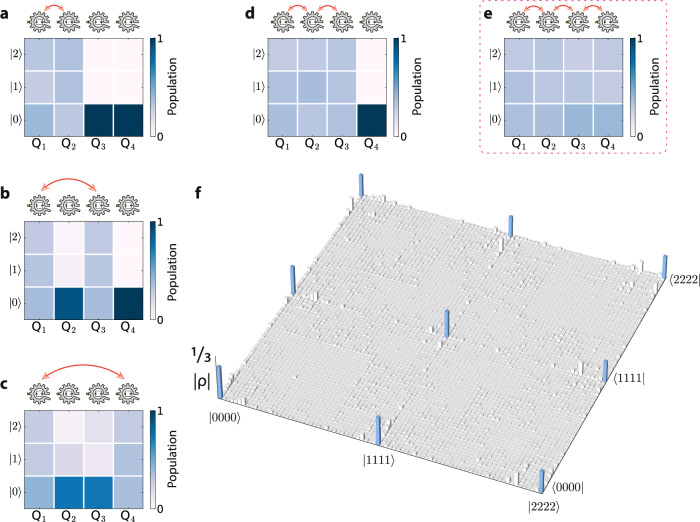
High-dimensional quantum information processing has emerged as a promising avenue to transcend hardware limitations and advance the frontiers of quantum technologies. Harnessing the untapped potential of the so-called qudits necessitates the development of quantum protocols beyond the established qubit methodologies. Here, we present a robust, hardware-efficient, and scalable approach for operating multidimensional solid-state systems using Raman-assisted two-photon interactions. We then utilize them to construct extensible multi-qubit operations, realize highly entangled multidimensional states including atomic squeezed states and Schrödinger cat states, and implement programmable entanglement distribution along a qudit array. Our work illuminates the quantum electrodynamics of strongly driven multi-qudit systems and provides the experimental foundation for the future development of high-dimensional quantum applications such as quantum sensing and fault-tolerant quantum computing.
Overview
The claims and statistics of this paper haven’t been checked yet.
Free: it reads the open-access text and checks the first 5 claims that cite a source we can check. Create a free account to check every claim.
Integrity signals
Registry
Cites
Statistics
Figures
Verification
Claims the paper makes
The claims and statistics of this paper haven’t been checked yet.
Free: it reads the open-access text and checks the first 5 claims that cite a source we can check. Create a free account to check every claim.
Self-check
Percentages, sums and reported differences re-computed from the paper’s own numbers.
The self-check needs the paper’s full text.
Citations
Cites
Charge-insensitive qubit design derived from the Cooper pair box
Koch, J., Yu, T. M., Gambetta, J., Houck, A. A., Schuster, D. I., Majer, J., Blais, A., Devoret, M. H., Girvin, S. M., & Schoelkopf, R. J. (2007) · Physical Review A · doi:10.1103/physreva.76.042319 · Cited by 3,351
Kitagawa, M., & Ueda, M. (1993) · Physical Review A · doi:10.1103/physreva.47.5138 · Cited by 1,741
Atomic Coherent States in Quantum Optics
Arecchi, F. T., Courtens, E., Gilmore, R., & Thomas, H. (1972) · Physical Review A · doi:10.1103/physreva.6.2211 · Cited by 1,490
Some Recent Advances in Density Matrix Theory
McWeeny, R. (1960) · Reviews of Modern Physics · doi:10.1103/revmodphys.32.335 · Cited by 1,460 · cited 1×
“To estimate the effects of decoherence on the reconstructed states, we compute the fi delity with and without McWeeny puri fi cation 25 , which fi nds the nearest idempotent matrix.”
On-chip generation of high-dimensional entangled quantum states and their coherent control
Kues, M., Reimer, C., Roztocki, P., Cortés, L. R., Sciara, S., Wetzel, B., Zhang, Y., Cino, A., Chu, S. T., Little, B. E., et al. (2017) · Nature · doi:10.1038/nature22986 · Cited by 1,177 · cited 2×
“In parallel with the developments of qudits using photons 8,9 , cold atoms 10 , and trapped ions 11 , recent works have highlighted the potential of superconducting circuits for high-dimensional quantum computing 12 – 16 .”
Multiparticle Entanglement of Hot Trapped Ions
Mølmer, K., & Sørensen, A. (1999) · Physical Review Letters · doi:10.1103/physrevlett.82.1835 · Cited by 1,019
New formalism for two-photon quantum optics. I. Quadrature phases and squeezed states
Caves, C. M., & Schumaker, B. L. (1985) · Physical Review A · doi:10.1103/physreva.31.3068 · Cited by 881 · cited 1×
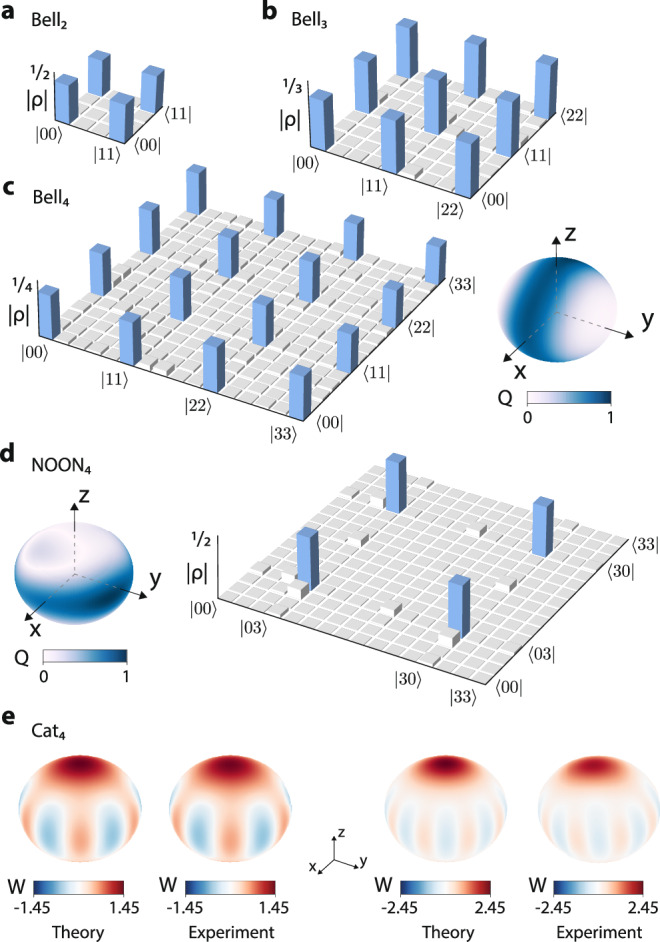
“This results in a resemblance between the high-dimensional Bell states and photonic two-mode squeezed states, ∣ Ψ i 2ms / P 1 N =0 c N ∣ NN i , where c N is a coef fi cient dependent on ζ and N is the quanta number 26 .”
Multidimensional quantum entanglement with large-scale integrated optics
Wang, J., Paesani, S., Ding, Y., Santagati, R., Skrzypczyk, P., Salavrakos, A., Tura, J., Augusiak, R., Mančinska, L., Bacco, D., et al. (2018) · Science · doi:10.1126/science.aar7053 · Cited by 816 · cited 1×
“In parallel with the developments of qudits using photons 8,9 , cold atoms 10 , and trapped ions 11 , recent works have highlighted the potential of superconducting circuits for high-dimensional quantum computing 12 – 16 .”
Confining the state of light to a quantum manifold by engineered two-photon loss
Leghtas, Z., Touzard, S., Pop, I. M., Kou, A., Vlastakis, B., Petrenko, A., Sliwa, K. M., Narla, A., Shankar, S., Hatridge, M. J., et al. (2015) · Science · doi:10.1126/science.aaa2085 · Cited by 555 · cited 4×
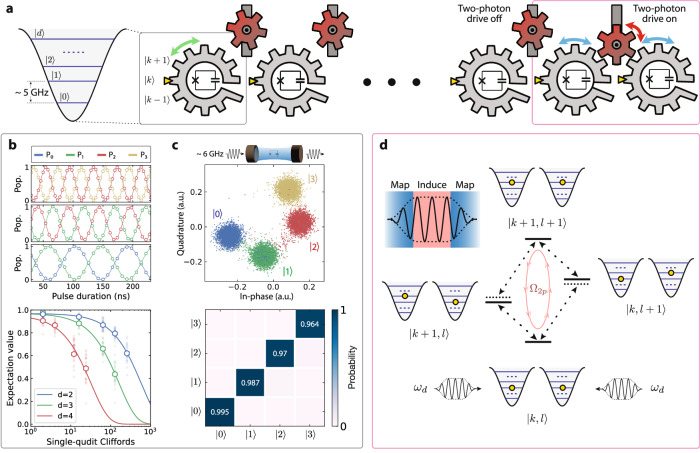
“In this context, the initialeffect ofthedrivesinvolvesdressing thequditstates,contingent ). d Sim-pli fi eddepictionoftheRaman-assistedtwo-photon-drivendynamics.”
InfluentialQudits and High-Dimensional Quantum Computing
Wang, Y., Hu, Z., Sanders, B. C., & Kais, S. (2020) · Frontiers in Physics · doi:10.3389/fphy.2020.589504 · Cited by 478 · cited 2×
“One key strategytoovercomethehardwarelimitationistopromoteaqubittoa qudit and utilize higher energy levels already present in the system to encode or transmit quantum information 1 .”
Cited by
Practical Introduction to Benchmarking and Characterization of Quantum Computers
Hashim, A., Nguyen, L. B., Goss, N., Marinelli, B., Naik, R., Chistolini, T., Hines, J., Marceaux, J. P., Kim, Y., Gokhale, P., et al. (2025) · PRX Quantum · doi:10.1103/prxquantum.6.030202 · Cited by 133
Self-citationQuantum error correction of qudits beyond break-even
Brock, B. L., Singh, S., Eickbusch, A., Sivak, V. V., Ding, A. Z., Frunzio, L., Girvin, S. M., & Devoret, M. H. (2025) · Nature · doi:10.1038/s41586-025-08899-y · Cited by 64
“…considerable experimental effort has been spent in recent years on developing qudit-based platforms for quantum computing, using donor spins in silicon 8 , ultracold atoms and molecules 9,10 , optical photons 11,12 , superconducting circuits 13–15 , trapped ions 16,17 , and vacancy centers 18,19 .”
Colloquium : Qudits for decomposing multiqubit gates and realizing quantum algorithms
Kiktenko, E. O., Nikolaeva, A. S., & Fedorov, A. K. (2025) · Reviews of Modern Physics · doi:10.1103/revmodphys.97.021003 · Cited by 62
Qudit Dynamical Decoupling on a Superconducting Quantum Processor
Tripathi, V., Goss, N., Vezvaee, A., Nguyen, L. B., Siddiqi, I. A., & Lidar, D. A. (2025) · Physical Review Letters · doi:10.1103/physrevlett.134.050601 · Cited by 57
Self-citationEfficient Control of a Transmon Qudit Using Effective Spin- 7 / 2 Rotations
Champion, E., Wang, Z., Parker, R. W., & Blok, M. (2025) · Physical Review X · doi:10.1103/vbh4-lysv · Cited by 57
“While the two lowest-energy eigenstates are well-suited for qubit computation, one can include the higher excited states to realize a qudit [23, 27, 30, 31].”
BackgroundInfluentialHigh-Coherence Kerr-Cat Qubit in 2D Architecture
Hajr, A., Qing, B., Wang, K., Koolstra, G., Pedramrazi, Z., Kang, Z., Chen, L., Nguyen, L. B., Jünger, C., Goss, N., et al. (2024) · Physical Review X · doi:10.1103/physrevx.14.041049 · Cited by 56
Self-citationQu8its for quantum simulations of lattice quantum chromodynamics
Illa, M., Robin, C., & Savage, M. J. (2024) · Physical review. D/Physical review. D. · doi:10.1103/physrevd.110.014507 · Cited by 48
Ultracoherent superconducting cavity-based multiqudit platform with error-resilient controlPreprint
Kim, T., Roy, T., You, X., Li, A. C. Y., Lamm, H., Pronitchev, O., Bal, M., Garattoni, S., Crisa, F., Bafia, D., et al. (2025) · arXiv (Cornell University) · doi:10.48550/arxiv.2506.03286 · Cited by 42
Qutrit and qubit circuits for three-flavor collective neutrino oscillations
Turro, F., Chernyshev, I. A., Bhaskar, R., & Illa, M. (2025) · Physical review. D/Physical review. D. · doi:10.1103/physrevd.111.043038 · Cited by 40
Synthetic Multidimensional Aharonov-Bohm Cages in Fock State Lattices
Zhang, J., Huang, W., Chu, J., Qiu, J., Sun, X., Tao, Z., Zhang, L., Zhang, L., Zhou, Y., Chen, Y., et al. (2025) · Physical Review Letters · doi:10.1103/physrevlett.134.070601 · Cited by 39
Scalable Improvement of the Generalized Toffoli Gate Realization Using Trapped-Ion-Based Qutrits
Nikolaeva, A. S., Zalivako, I. V., Borisenko, A. S., Semenin, N. V., Galstyan, K. P., Korolkov, A. E., Kiktenko, E. O., Khabarova, K. Y., Semerikov, I. A., Fedorov, A. K., et al. (2025) · Physical Review Letters · doi:10.1103/p1z9-6w93 · Cited by 37
High- E J / E C transmon qudits with up to 12 levels
Wang, Z., Parker, R. W., Champion, E., & Blok, M. S. (2025) · Physical Review Applied · doi:10.1103/physrevapplied.23.034046 · Cited by 29
“25(9) × 10 − 4 for a 44 ns pulse, which is comparable to typical low-E J /E C trans-mon devices with the state of art EPC around 10 − 4 to 10 − 3 [13, 42, 47–49].”
BackgroundMethodLiu, H.-T., Chen, B., Zhang, J., Xiao, Y.-X., Li, T., Huang, K., Wang, Z., Li, H., Zhao, K., Xu, Y., et al. (2025) · Physical Review Letters · doi:10.1103/lvb9-pfr3 · Cited by 28
Collective neutrino oscillations in three flavors on qubit and qutrit processors
Spagnoli, L., Goss, N., Roggero, A., Rrapaj, E., Cervia, M. J., Patwardhan, A. V., Naik, R., Balantekin, A. B., Younis, E., Santiago, D., et al. (2025) · Physical review. D/Physical review. D. · doi:10.1103/gjr1-lf8s · Cited by 24
Self-citationNon-Abelian dynamics on a cube: Improving quantum compilation through qudit-based simulations
Jiang, J., Klco, N., & Matteo, O. D. (2025) · Physical review. D/Physical review. D. · doi:10.1103/rrmd-fqx6 · Cited by 23
Quantum benchmarking of high-fidelity noise-biased operations on a detuned Kerr-cat qubit
Qing, B., Hajr, A., Wang, K., Koolstra, G., Nguyen, L. B., Hines, J., Huang, I., Bhandari, B., Chen, L., Kang, Z., et al. (2026) · Proceedings of the National Academy of Sciences · doi:10.1073/pnas.2520479123 · Cited by 20
Self-citationLattice Hamiltonians and stray interactions within quantum processors
Xu, X., Manabputra, Vignes, C., Ansari, M. H., & Martinis, J. M. (2024) · Physical Review Applied · doi:10.1103/physrevapplied.22.064030 · Cited by 16
Magic State Distillation using Asymptotically Good Codes on QuditsPreprint
Cervia, M. J., Lamm, H., Liu, D., Murairi, E. M., & Zhu, S. (2025) · arXiv (Cornell University) · doi:10.48550/arxiv.2512.21874 · Cited by 13
Advances in Josephson Junction Materials and Processes Toward Practical Quantum Computing
Kim, H. L., Jang, G., Jin, S., An, J., Shin, H., Shin, H., Luo, J., Hashim, A., Siddiqi, I. A., Kim, Y., et al. (2026) · Advanced Science · doi:10.1002/advs.78427 · Cited by 12
“The success of superconducting transmon qubits and qudits [ 101– 105 ] has been driven by sustained efforts to improve coherence through horizontal approaches, such as reinforced shielding and filtering [ 106–108 ], material purification through advanced fabrication techniques [ 23 ], packaging […”
Self-citationSynthetic High Angular Momentum Spin Dynamics in a Microwave Oscillator
Roy, S., Senanian, A., Wang, C. S., Wetherbee, O. C., Zhang, L., Cole, B., Larson, C. P., Yelton, E., Arora, K., McMahon, P. L., et al. (2025) · Physical Review X · doi:10.1103/physrevx.15.021009 · Cited by 9
Microwave-activated high-fidelity three-qubit gate scheme for fixed-frequency superconducting qubits
Zhao, K., Ma, W.-G., Wang, Z., Li, H., Huang, K., Shi, Y., Xu, K., & Fan, H. (2025) · Physical Review Applied · doi:10.1103/l721-33qk · Cited by 8
Engineering Long-Range and Multibody Interactions via Global Kinetic Constraints
Wu, R., Yang, B., Claeys, P. W., & Zhao, H. (2026) · Physical Review Letters · doi:10.1103/4l1s-kkw7 · Cited by 8
Performance of superconducting resonators suspended on SiN membranes
Chistolini, T., Lee, K., Banerjee, A., Alghadeer, M., Jünger, C., Altoé, M. V. P., Song, C., Chen, S.-D., Wang, F., Santiago, D., et al. (2024) · Applied Physics Letters · doi:10.1063/5.0222680 · Cited by 7
Self-citationQuantum Approximate Optimization via Noise-Directed Adaptive Warm-StartingPreprint
Maciejewski, F. B., Hadfield, S., Wallis, O., Pennington, G., Brandhofer, S., Woerner, S., Egger, D. J., & Venturelli, D. (2026) · arXiv (Cornell University) · doi:10.48550/arxiv.2607.09368 · Cited by 7
Quantum state engineering in three-level systems via Lewis-Riesenfeld invariants
Yu, X., Zhou, K., Zhang, H.-Y., Li, S., Huang, Z., Wen, J., Zhang, R., & Yu, Y. (2025) · Physical Review A · doi:10.1103/physreva.111.012623 · Cited by 6
Comparison of encoding schemes for quantum computing of S > 1 / 2 spin chains
Lötstedt, E., & Yamanouchi, K. (2025) · Physical Review A · doi:10.1103/7mvy-zq7j · Cited by 6
Scalable platform for qudit-based quantum computing using polar molecules
Muminov, S. K., Kiktenko, E. O., Nikolaeva, A. S., Drozhzhin, D. A., Matveenko, S. I., Fedorov, A. K., & Shlyapnikov, G. V. (2026) · Physical Review Research · doi:10.1103/tcqw-ll6v · Cited by 6
Analog quantum simulation of the Lipkin-Meshkov-Glick model in a transmon quditPreprint
Champion, E., Schwartz, A., Ijaz, M. A., Xu, X., Campbell, S., Landi, G. T., & Blok, M. (2025) · arXiv (Cornell University) · doi:10.48550/arxiv.2512.05237 · Cited by 6
“In conjunction with recent work on transmon qudit entangling gates [24–26], our results lay the groundwork for quantum simulation of complex qudit-based Hamiltonians with future applications in particle physics [6–12], quantum chemistry [13], and condensed matter [14].”
Efficient Implementation of a Single-Qutrit Gate Set via Coherent Control
Yu, X., Deng, X. H., Zheng, W., Xin, W., Zhang, T., Che, H., Zhou, K., Zhou, H., Ge, Y., Zhang, Z., et al. (2026) · Physical Review Letters · doi:10.1103/vwzp-szjp · Cited by 5
Quantum Simulations of Fundamental Physics
Savage, M. J. (2025) · International Workshop on Chiral Dynamics (CD) · doi:10.22323/1.479.0015 · Cited by 4
Floquet Engineering of Anisotropic Transverse Interactions in Superconducting QubitsPreprint
Liang, Y., Huang, W., Zhang, L., Tao, Z., Tang, K., Ji, C., Qiu, J., Sun, X., Zhou, Y., Zhang, J., et al. (2024) · arXiv (Cornell University) · doi:10.48550/arxiv.2410.10208 · Cited by 4
Hardware-Efficient Erasure Qubits With Superconducting Transmon QutritsPreprint
Liu, B.-J., Wang, Y.-Y., Wang, Y.-X., Badbaria, M., Puri, S., & Wang, C. (2026) · arXiv (Cornell University) · doi:10.48550/arxiv.2604.08672 · Cited by 4
Separating Geometry From Interference in Constrained Quantum OptimizationPreprint
Onah, C., Hadfield, S., & Michielsen, K. F. L. (2026) · arXiv (Cornell University) · doi:10.48550/arxiv.2607.13630 · Cited by 4
“Moreover our results may be further applied to quantum algorithms for problems encoded directly to emerging qudit-based quantum hardware [59, 60, 61, 62, 63, 57].”
A novel qutrit representation for RGB digital images
Rofail, M., Montaser, R., & Younes, A. (2025) · Scientific Reports · doi:10.1038/s41598-025-27910-0 · Cited by 3
Hybrid analog-digital simulation of the Abelian Higgs model with transmon qutrits
Asaduzzaman, M., Parker, R. W., Goss, N., Mohamed, A. I., Neiderbach, M., Ozzello, Z., Naik, R., Kemper, A. F., Siddiqi, I., Meurice, Y., et al. (2026) · Physical Review A · doi:10.1103/r632-zl7s · Cited by 3
Self-citationNoise-Directed Adaptive Remapping for Integer Optimization: from qubits to (encoded) quditsPreprint
Hadfield, S., Maciejewski, F. B., & Venturelli, D. (2026) · arXiv (Cornell University) · doi:10.48550/arxiv.2606.28234 · Cited by 3
“This paper is the algorithmic follow-up to a roadmap recently put forward in [16], where NDAR-QAOA on graph coloring was identified as the near-term optimization workload best matched to emerging superconducting cavity qudit processors [7]–[13], [51].”
Time-frequency-correlated native ccz gates in superconducting circuits
Wang, C., Wang, W., Fei, Y., Fan, Z., Zhao, H., Mage, Y., & Shan, Z. (2026) · Physical Review Applied · doi:10.1103/9st1-wvdl · Cited by 2
Tight bound for the total time in digital-analog quantum computation
de Andoin, M. G., & de Andoin, M. G. (2026) · Physical Review Research · doi:10.1103/pkz9-vjkh · Cited by 2
A hierarchy of quantum control and the dissociation of entanglement from quantum discord
Aljuaydi, F., Jaradat, E. K., Rahman, A. U., & Mohamed, A.-B. A. (2026) · Physics Letters A · doi:10.1016/j.physleta.2026.131363 · Cited by 2
Fault-tolerant resource comparison of qudit and qubit encodings for diagonal quadratic operators
Anonymous, Kürkçüog̃lu, D. M., Perdue, G., Maneyro, M., & Roggero, A. (2026) · Physical Review A · doi:10.1103/832q-bqlx · Cited by 2
Qudit-native framework for discrete time crystals
Ma, W., Fan, H., & Zhang, S.-X. (2025) · Physical review B · doi:10.1103/qbhv-yr3d · Cited by 1
Exploring trade-offs in quantum optimization with noisy qutrits
Bottrill, G. (2025) · cIRcle (University of British Columbia) · doi:10.14288/1.0450016 · Cited by 2
Qudit Implementation of the Rodeo Algorithm for Quantum Spectral FilteringPreprint
Rocha, J. C. S., & Dias, R. A. (2026) · arXiv (Cornell University) · doi:10.48550/arxiv.2603.16049 · Cited by 2
“Furthermore, solid-state devices also constitute a hardware platform for the implementation of multi-level qudit systems [8].”
Nugraha, F. P., Huang, Y., Liu, J., & Shao, Q. (2025) · doi:10.1109/iccad66269.2025.11240859 · Cited by 1
“Recently, qutrit (three-level qudit) has been demonstrated in superconducting hardware, including the qutrit controlled-phase (CPhase) gate [3], [4].”
Time crystals on quantum devices
Camacho, G., & Fauseweh, B. (2026) · Quantum Science and Technology · doi:10.1088/2058-9565/aeb255 · Cited by 1
Storage and Retrieval of Electronic Spin Coherence Using Nuclear Spins in a Vanadyl Paddlewheel
Lanza, M., Mironova, O. A., Bonizzoni, C., Bellini, G., Nicolini, A., Ghirri, A., Clérac, R., Rouzières, M., Cornia, A., & Affronte, M. (2026) · Journal of the American Chemical Society · doi:10.1021/jacs.6c10524 · Cited by 1
Qudit-Native Simulation of the Potts Model
Gavreev, M. A., Kiktenko, E. O., Fedorov, A. K., & Nikolaeva, A. S. (2026) · Entropy · doi:10.3390/e28020160 · Cited by 1
“[8, 9]) Moreover, one can admit is significant progress in the realization of qudit-based processors with trapped ions [10, 11], superconducting systems [12, 13], and quantum light [14].”
Fraxonium: Fractional fluxon states for qudit encoding
Chirolli, L., Brosco, V., Vool, U., Catelani, G., & Amico, L. (2026) · Quantum Science and Technology · doi:10.48550/arxiv.2605.14586 · Cited by 1
Exact and Fixed-Point Grover Search with QuditsPreprint
Roy, T. (2026) · arXiv (Cornell University) · doi:10.48550/arxiv.2607.24658 · Cited by 1
“At the same time, many emerging quantum platforms naturally support multilevel quantum systems, or qudits, as elementary information carriers [6–10].”
Exploring Number Theory and Its Applications in Quantum Computing
Prasanna Kumar, K. (2024) · International Journal for Research in Applied Science and Engineering Technology · doi:10.22214/ijraset.2024.66104
Composite-dimensional topological codes with boundaries and defects
Mousa, M., Jamadagni, A., & Dumitrescu, E. (2026) · Physical Review A · doi:10.1103/qr5v-1rg6
Quantum fidelity estimation in the resource theory of nonstabilizerness
Liu, Z., Wang, K., & Wang, X. (2025) · Physical Review A · doi:10.1103/l8tq-hhxk
Metallireunan korjausmenetelmä energiaosallistumissuhteiden simulointiin suprajohtavissa laitteissa
Mylläri, T. (2025) · Aaltodoc (Aalto University)
Co-developing methods for lattice gauge theory simulations and qudit compilation
Jiang, J. (2025) · cIRcle (University of British Columbia) · doi:10.14288/1.0450358
Qudit Implementation of the Rodeo Algorithm for Quantum Spectral FilteringPreprint
Rocha, J., & Dias, R. (2026) · Research Square · doi:10.21203/rs.3.rs-9150631/v1
Limitations of the dissipative quantum Fisher information in Liouville space
Iakovleva, T., Lecamwasam, R., & Twamley, J. (2026) · Scientific Reports · doi:10.1038/s41598-026-58555-2
“For example, it has been shown that utilising d -dimensional space of a qudit one can improve magnetometry 45 , and quantum computing 46 .”
Preparing multi-qudit states in a definite-weight subspace
Harofteh, N. Z., & Nepomechie, R. I. (2026) · Journal of Physics A Mathematical and Theoretical · doi:10.1088/1751-8121/aeaf22
“The high degree of symmetry of these states can be exploited to prepare these states more efficiently [55–58].”
Entangling two qudits of arbitrary dimension through light-atomic Faraday interactionPreprint
Surmay, R., Leonov, V. A., & Vashukevich, E. A. (2026) · arXiv (Cornell University) · doi:10.48550/arxiv.2608.19945
“This proves highly useful in quantum communication tasks [1, 2] and potentially reduces the number of the implemented quantum operations [3].”
Solovykh, I. A., Tikhonova, O. V., Pashchenko, A. V., Soloviev, I. I., & Klenov, N. V. (2026) · Journal of Radio Electronics · doi:10.30898/1684-1719.2026.7.15
Wenzhuo, L., Lu, Q., Yingying, Z., Zhou, Y., Lu, L., Zeyun, S., Zhu, Z., Wuming, L., & Xingdong, Z. (2026) · Acta Physica Sinica · doi:10.7498/aps.76.20260973
Scott, R., & Scarola, V. W. (2026) · arXiv (Cornell University) · doi:10.48550/arxiv.2609.04309
High Connectivity and Tunable Long Range Coupling in Superconducting Circuit Devices
Marinelli, B. (2026) · eScholarship (California Digital Library)
Dynamically protected erasure qubit via low-frequency charge drivingPreprint
Hajr, A., Wang, K., Qing, B., Hashim, A., Bhandari, B., Briseño-Colunga, D. D., Dressel, J., Jordan, A. N., & Siddiqi, I. A. (2026) · arXiv (Cornell University) · doi:10.48550/arxiv.2610.10432
“While high-fidelity operations can be activated via resonant or near-resonant microwave drives 8–11 , these systems remain susceptible to low-frequency 1 /f noise, a ubiquitous feature of solid-state environments 12–14 .”
Self-citationRate and depth of two-axis twisting by pair exchange under the self-Kerr constraintPreprint
Yu, Q., Li, Y., Zhai, C., Tang, S., & Lu, W. (2026) · arXiv (Cornell University) · doi:10.48550/arxiv.2610.15774
“The multi-photon processes realized so far in these platforms nevertheless convert two photons of one mode into one photon of another [46] or transfer pairs between the two ladders [47].”
Pashchenko, A. V., Tikhonova, O. V., Solovykh, I. A., Иванович, С. И., Tereshonok, M. V., Klenov, N. V., & Yakovlev, D. S. (2026) · Sensors · doi:10.3390/s26206538
“W 4 are read out by dispersive multilevel readout, for which single-shot assignment of three to five transmon levels is now routine [15,35–37,45 ,46 .”
InfluentialThe exact information cost of randomized measurements in quantum metrologyPreprint
李, 婉., & Liu, J. (2026) · arXiv (Cornell University) · doi:10.48550/arxiv.2611.00599
Dynamical Light-Matter Coupling with Protected Superconducting OscillatorsPreprint
Valadares, F. (2026) · arXiv (Cornell University) · doi:10.48550/arxiv.2611.10295
Metadata
- Authors
- Nguyen, L. B., Goss, N., Siva, K., Kim, Y., Younis, E., Qing, B., Hashim, A., Santiago, D. I., & Siddiqi, I.
- Affiliations
- Lawrence Berkeley National Laboratory (US)
- IBM (United States) (US)
- Korea University (KR)
- University of California, Berkeley (US)
- Corresponding author
- Nguyen, Long B.
- Goss, Noah
- ORCID
- Venue
- Nature Communications
- Published
- 2024-08-19
- Volume
- 15
- Issue
- 1
- Pages
- 7117-7117
- ISSN
- 2041-1723 (ISSN-L)
- PMC
- PMC11333499
- OpenAlex
- W4401697243
- Semantic Scholar
- 48b9cda939b4f5d983a83dba9f15d038383d9128
- Cited by
- 31
- References
- 36
- Citations by year
- 2026: 11 · 2025: 18 · 2024: 2
- FWCI
- 4.57
- Type
- journal article
- Language
- en
- Open access
- gold
- doi.org
- Licence
- cc-by
- creativecommons.org/licenses/by/4.0 (tdm)
- creativecommons.org/licenses/by/4.0 (vor)
- Locations
- Nature Communications (publishedVersion, cc-by)
- PubMed Central (publishedVersion, cc-by)
- PubMed (publishedVersion)
- arXiv (Cornell University) (submittedVersion, cc-by)
- eScholarship (California Digital Library) (submittedVersion, cc-by)
- RePEc: Research Papers in Economics (submittedVersion)
- DOAJ (DOAJ: Directory of Open Access Journals) (submittedVersion, cc-by-sa)
- OSTI OAI (U.S. Department of Energy Office of Scientific and Technical Information) (submittedVersion)
- arXiv (Cornell University) (cc-by)
- Funders
- U.S. Department of Energy (DE-AC02-05CH11231)
- National Science Foundation (2210391)
- National Research Foundation of Korea (2022M3H3A106307411)
- Topics
- Physical Sciences › Physics and Astronomy › Atomic and Molecular Physics, and Optics › Quantum Information and Cryptography
- Physical Sciences › Physics and Astronomy › Atomic and Molecular Physics, and Optics › Quantum optics and atomic interactions
- Physical Sciences › Physics and Astronomy › Atomic and Molecular Physics, and Optics › Semiconductor Quantum Structures and Devices
- Keywords
- qudits, Schrödinger cat states, entanglement distribution, quantum electrodynamics, programmable quantum processors
About these checks
Registry, retraction, Cites and statistics results are computed, not judged, with one exception: a printed reference that no index lists is read once by a model before it counts as a citation error. Claims are extracted by a model and kept only when their quote appears verbatim in the text; each cited source is then checked, with a model’s help, for whether it says what the claim relies on. Those verdicts can be wrong — read the claim’s quote and the cited source before relying on one.
Statistics and arithmetic are recomputed, not judged.
Confidence bands are shown only for fields calibrated on our annotated test set. None is calibrated yet, so no band is shown.
What counts as a claim ›How we measure confidence ›How we check this ›
Are you an author, or do you see a problem with this page? Request a review
Data sources
Bibliographic data: Semantic Scholar, OpenAlex, Crossref.
Contains information from the Semantic Scholar Academic Graph Datasets, made available under the ODC Attribution License (ODC-BY 1.0).
Semantic Scholar’s data is described in: Kinney, R., et al. (2023). The Semantic Scholar Open Data Platform. arXiv:2301.10140.
