

Empowering a qudit-based quantum processor by traversing the dual bosonic ladder
Open accessThe DOI matches its Crossref record; 35 of the 36 references it cites were found in a registry or an index.
Abstract
High-dimensional quantum information processing has emerged as a promising avenue to transcend hardware limitations and advance the frontiers of quantum technologies. Harnessing the untapped potential of the so-called qudits necessitates the development of quantum protocols beyond the established qubit methodologies. Here, we present a robust, hardware-efficient, and scalable approach for operating multidimensional solid-state systems using Raman-assisted two-photon interactions. We then utilize them to construct extensible multi-qubit operations, realize highly entangled multidimensional states including atomic squeezed states and Schrödinger cat states, and implement programmable entanglement distribution along a qudit array. Our work illuminates the quantum electrodynamics of strongly driven multi-qudit systems and provides the experimental foundation for the future development of high-dimensional quantum applications such as quantum sensing and fault-tolerant quantum computing.
Overview
The claims and statistics of this paper haven’t been checked yet.
Free: it reads the open-access text and checks the first 5 claims that cite a source we can check. Create a free account to check every claim.
Integrity signals
Registry
Cites
Statistics
Figures
Verification
Claims the paper makes
The claims and statistics of this paper haven’t been checked yet.
Free: it reads the open-access text and checks the first 5 claims that cite a source we can check. Create a free account to check every claim.
Self-check
Percentages, sums and reported differences re-computed from the paper’s own numbers.
The self-check needs the paper’s full text.
Citations
Cites
Charge-insensitive qubit design derived from the Cooper pair box
Koch, J., Yu, T. M., Gambetta, J., Houck, A. A., Schuster, D. I., Majer, J., Blais, A., Devoret, M. H., Girvin, S. M., & Schoelkopf, R. J. (2007) · Physical Review A · doi:10.1103/physreva.76.042319 · Cited by 3,351
Kitagawa, M., & Ueda, M. (1993) · Physical Review A · doi:10.1103/physreva.47.5138 · Cited by 1,741
Atomic Coherent States in Quantum Optics
Arecchi, F. T., Courtens, E., Gilmore, R., & Thomas, H. (1972) · Physical Review A · doi:10.1103/physreva.6.2211 · Cited by 1,490
Some Recent Advances in Density Matrix Theory
McWeeny, R. (1960) · Reviews of Modern Physics · doi:10.1103/revmodphys.32.335 · Cited by 1,460 · cited 1×
“To estimate the effects of decoherence on the reconstructed states, we compute the fi delity with and without McWeeny puri fi cation 25 , which fi nds the nearest idempotent matrix.”
On-chip generation of high-dimensional entangled quantum states and their coherent control
Kues, M., Reimer, C., Roztocki, P., Cortés, L. R., Sciara, S., Wetzel, B., Zhang, Y., Cino, A., Chu, S. T., Little, B. E., et al. (2017) · Nature · doi:10.1038/nature22986 · Cited by 1,177 · cited 2×
“In parallel with the developments of qudits using photons 8,9 , cold atoms 10 , and trapped ions 11 , recent works have highlighted the potential of superconducting circuits for high-dimensional quantum computing 12 – 16 .”
Multiparticle Entanglement of Hot Trapped Ions
Mølmer, K., & Sørensen, A. (1999) · Physical Review Letters · doi:10.1103/physrevlett.82.1835 · Cited by 1,019
New formalism for two-photon quantum optics. I. Quadrature phases and squeezed states
Caves, C. M., & Schumaker, B. L. (1985) · Physical Review A · doi:10.1103/physreva.31.3068 · Cited by 881 · cited 1×
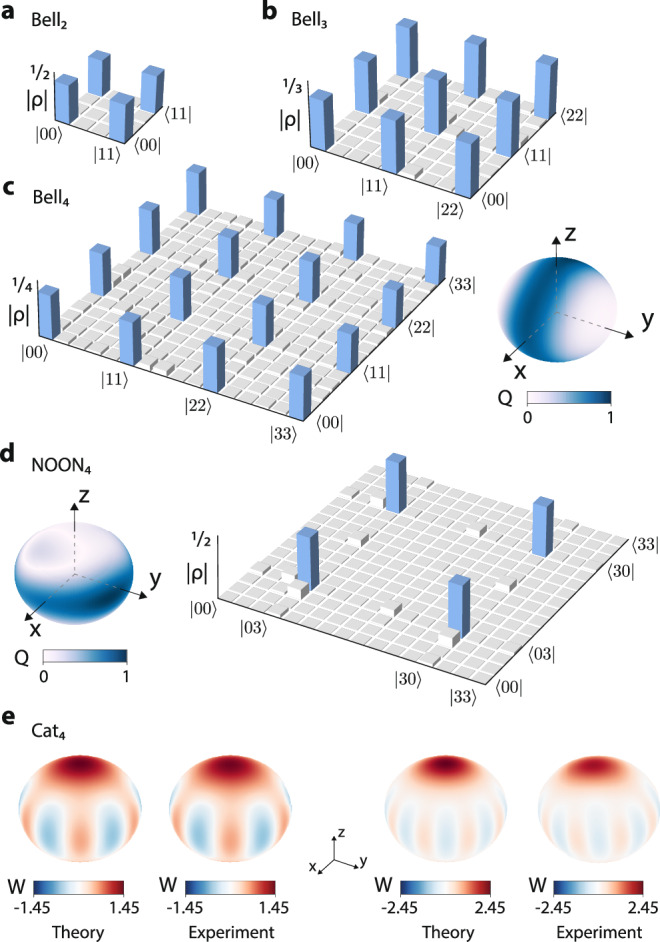
“This results in a resemblance between the high-dimensional Bell states and photonic two-mode squeezed states, ∣ Ψ i 2ms / P 1 N =0 c N ∣ NN i , where c N is a coef fi cient dependent on ζ and N is the quanta number 26 .”
Multidimensional quantum entanglement with large-scale integrated optics
Wang, J., Paesani, S., Ding, Y., Santagati, R., Skrzypczyk, P., Salavrakos, A., Tura, J., Augusiak, R., Mančinska, L., Bacco, D., et al. (2018) · Science · doi:10.1126/science.aar7053 · Cited by 816 · cited 1×
“In parallel with the developments of qudits using photons 8,9 , cold atoms 10 , and trapped ions 11 , recent works have highlighted the potential of superconducting circuits for high-dimensional quantum computing 12 – 16 .”
Confining the state of light to a quantum manifold by engineered two-photon loss
Leghtas, Z., Touzard, S., Pop, I. M., Kou, A., Vlastakis, B., Petrenko, A., Sliwa, K. M., Narla, A., Shankar, S., Hatridge, M. J., et al. (2015) · Science · doi:10.1126/science.aaa2085 · Cited by 555 · cited 4×
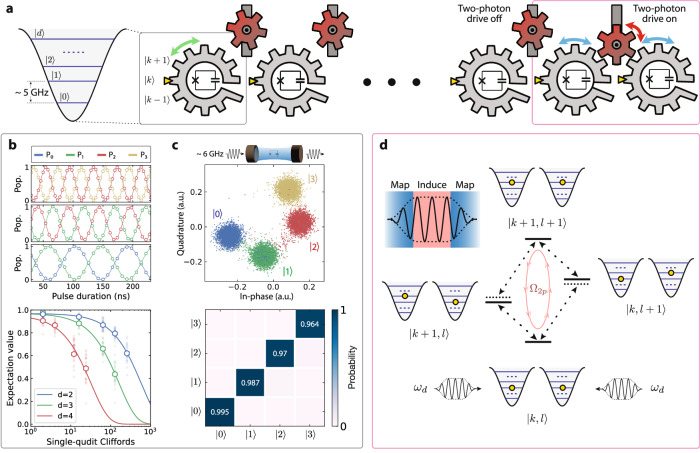
“In this context, the initialeffect ofthedrivesinvolvesdressing thequditstates,contingent ). d Sim-pli fi eddepictionoftheRaman-assistedtwo-photon-drivendynamics.”
InfluentialQudits and High-Dimensional Quantum Computing
Wang, Y., Hu, Z., Sanders, B. C., & Kais, S. (2020) · Frontiers in Physics · doi:10.3389/fphy.2020.589504 · Cited by 478 · cited 2×
“One key strategytoovercomethehardwarelimitationistopromoteaqubittoa qudit and utilize higher energy levels already present in the system to encode or transmit quantum information 1 .”
High‐Dimensional Quantum Communication: Benefits, Progress, and Future Challenges
Cozzolino, D., Da Lio, B., Bacco, D., & Oxenløwe, L. K. (2019) · Advanced Quantum Technologies · doi:10.1002/qute.201900038 · Cited by 470 · cited 1×
“Our work illuminates the quantum electrodynamics of strongly driven multi-qudit systems and provides the experimental foundation for the future development of high-dimensional quantum applications such as quantum sensing and fault-tolerant quantum computing.”
Stabilization and operation of a Kerr-cat qubit
Grimm, A., Frattini, N. E., Puri, S., Mundhada, S. O., Touzard, S., Mirrahimi, M., Girvin, S. M., Shankar, S., & Devoret, M. H. (2020) · Nature · doi:10.1038/s41586-020-2587-z · Cited by 460 · cited 2×
“In contrast with other dynamical processes in strongly driven systems, the reported quantum dynamics remain largely independent of nonlinearity 32,33 or level-matching 34 .”
Implementation of a Toffoli gate with superconducting circuits
Fedorov, A., Steffen, L., Baur, M., da Silva, M. P., & Wallraff, A. (2012) · Nature · doi:10.1038/nature10713 · Cited by 386
A universal qudit quantum processor with trapped ions
Ringbauer, M., Meth, M., Postler, L., Stricker, R., Blatt, R., Schindler, P., & Monz, T. (2022) · Nature Physics · doi:10.1038/s41567-022-01658-0 · Cited by 351 · cited 1×
“In parallel with the developments of qudits using photons 8,9 , cold atoms 10 , and trapped ions 11 , recent works have highlighted the potential of superconducting circuits for high-dimensional quantum computing 12 – 16 .”
Quantum Information Scrambling on a Superconducting Qutrit Processor
Blok, M. S., Ramasesh, V. V., Schuster, T., O’Brien, K., Kreikebaum, J. M., Dahlen, D., Morvan, A., Yoshida, B., Yao, N. Y., & Siddiqi, I. (2021) · Physical Review X · doi:10.1103/physrevx.11.021010 · Cited by 262
Self-citationCharacterizing large-scale quantum computers via cycle benchmarking
Erhard, A., Wallman, J. J., Postler, L., Meth, M., Stricker, R., Martinez, E. A., Schindler, P., Monz, T., Emerson, J., & Blatt, R. (2019) · Nature Communications · doi:10.1038/s41467-019-13068-7 · Cited by 253 · cited 1×
“We then employ cycle benchmarking 23 (CB) to characterize the precision of the realized operation.”
Agarwal, G., Puri, R., & Singh, R. (1997) · Physical Review A · doi:10.1103/physreva.56.2249 · Cited by 248 · cited 1×
“Atomic Schrödinger cat states, which are superpositions of macroscopically distinct quantum states, belong to another category of entangled states that attract considerable interest 29 .”
Enhanced Fault-Tolerant Quantum Computing ind-Level Systems
Campbell, E. T. (2014) · Physical Review Letters · doi:10.1103/physrevlett.113.230501 · Cited by 184
Photon-Mediated Spin-Exchange Dynamics of Spin-1 Atoms
Davis, E. J., Bentsen, G., Homeier, L., Li, T., & Schleier-Smith, M. H. (2019) · Physical Review Letters · doi:10.1103/physrevlett.122.010405 · Cited by 170 · cited 1×
“In parallel with the developments of qudits using photons 8,9 , cold atoms 10 , and trapped ions 11 , recent works have highlighted the potential of superconducting circuits for high-dimensional quantum computing 12 – 16 .”
Control and Tomography of a Three Level Superconducting Artificial Atom
Bianchetti, R., Filipp, S., Baur, M., Fink, J. M., Lang, C., Steffen, L., Boissonneault, M., Blais, A., & Wallraff, A. (2010) · Physical Review Letters · doi:10.1103/physrevlett.105.223601 · Cited by 162 · cited 1×
“A dispersively coupled resonator allows the readout of qudit states via heterodyne measurement 18 .”
Poletto, S., Gambetta, J. M., Merkel, S. T., Smolin, J. A., Chow, J. M., Córcoles, A. D., Keefe, G. A., Rothwell, M. B., Rozen, J. R., Abraham, D. W., et al. (2012) · Physical Review Letters · doi:10.1103/physrevlett.109.240505 · Cited by 149 · cited 1×
“In contrast with other dynamical processes in strongly driven systems, the reported quantum dynamics remain largely independent of nonlinearity 32,33 or level-matching 34 .”
High-fidelity qutrit entangling gates for superconducting circuits
Goss, N., Morvan, A., Marinelli, B., Mitchell, B. K., Nguyen, L. B., Naik, R. K., Chen, L., Jünger, C., Kreikebaum, J. M., Santiago, D. I., et al. (2022) · Nature Communications · doi:10.1038/s41467-022-34851-z · Cited by 129
Self-citationAsymptotic improvements to quantum circuits via qutrits
Gokhale, P., Baker, J. M., Duckering, C., Brown, N. C., Brown, K. R., & Chong, F. T. (2019) · Proceedings of the 46th International Symposium on Computer Architecture · doi:10.1145/3307650.3322253 · Cited by 120 · cited 1×
“In particular, it has been proposedthatusingquditsmaysimplifyquantumcircuitcomplexity 1,2 , allow the native quantum simulation of certain natural systems 3 , increase the information capacity and noise resilience in quantum communication 4 , and lead to more ef fi cient logical qubit encoding 5 – 7…”
Programmable Heisenberg interactions between Floquet qubits
Nguyen, L. B., Kim, Y., Hashim, A., Goss, N., Marinelli, B., Bhandari, B., Das, D., Naik, R., Kreikebaum, J. M., Jordan, A. N., et al. (2024) · Nature Physics · doi:10.1038/s41567-023-02326-7 · Cited by 116
Self-citationDemonstration of three- and four-body interactions between trapped-ion spins
Katz, O., Feng, L., Risinger, A., Monroe, C. R., & Cetina, M. (2023) · Nature Physics · doi:10.1038/s41567-023-02102-7 · Cited by 99 · cited 1×
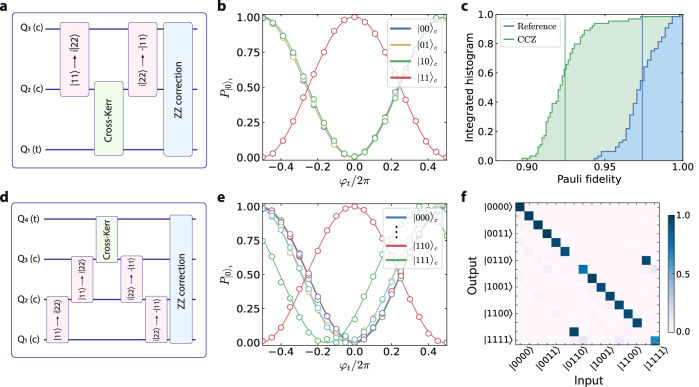
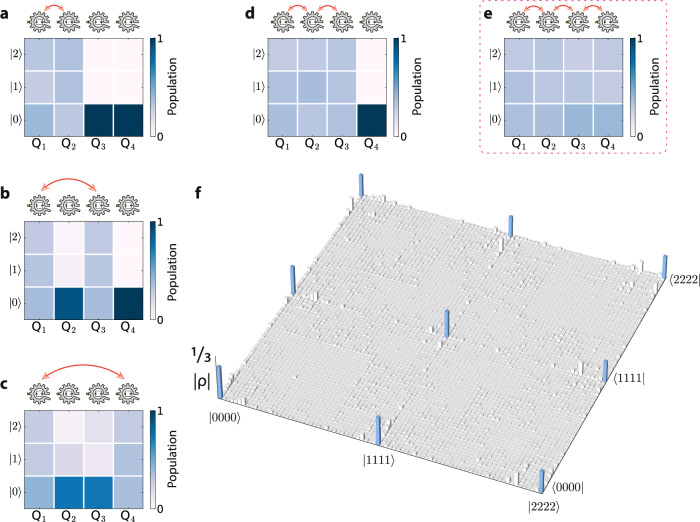
“3f shows the fl ipping of the target qubit (Q 4 ) when the control state is (cid:1) The corresponding truth table fi delity is F CCCZ =92 ð 1 Þ %, on-par with the best results previously reported in superconducting qubits 22 and trapped-ions 24 .”
Fast decoders for qudit topological codes
Anwar, H., Brown, B. J., Campbell, E. T., & Browne, D. E. (2014) · New Journal of Physics · doi:10.1088/1367-2630/16/6/063038 · Cited by 84 · cited 1×
“We provide an estimation of these and tomographic uncertainty due to shot noise in Supplementary Note 6.”
Liu, P., Wang, R., Zhang, J.-N., Zhang, Y., Cai, X., Xu, H., Li, Z., Han, J., Li, X., Xue, G., et al. (2023) · Physical Review X · doi:10.1103/physrevx.13.021028 · Cited by 81
Experimental Realization of Two Qutrits Gate with Tunable Coupling in Superconducting Circuits
Luo, K., Huang, W., Tao, Z., Zhang, L., Zhou, Y., Chu, J., Liu, W., Wang, B.-Y., Cui, J., Liu, S., et al. (2023) · Physical Review Letters · doi:10.1103/physrevlett.130.030603 · Cited by 79 · cited 1×
“In parallel with the developments of qudits using photons 8,9 , cold atoms 10 , and trapped ions 11 , recent works have highlighted the potential of superconducting circuits for high-dimensional quantum computing 12 – 16 .”
Scalable algorithm simplification using quantum AND logic
Chu, J., He, X., Zhou, Y., Yuan, J., Zhang, L., Guo, Q., Hai, Y.-J., Han, Z., Hu, C.-K., Huang, W., et al. (2022) · Nature Physics · doi:10.1038/s41567-022-01813-7 · Cited by 72
Simple procedure for phase-space measurement and entanglement validation
Rundle, R. P., Mills, P. W., Tilma, T., Samson, J. H., & Everitt, M. J. (2017) · Physical Review A · doi:10.1103/physreva.96.022117 · Cited by 71
Simple factorization of unitary transformations
de Guise, H., Di Matteo, O., & Sánchez-Soto, L. L. (2018) · Physical Review A · doi:10.1103/physreva.97.022328 · Cited by 70
Fault-Tolerant Quantum Computation Using Large Spin-Cat Codes
Omanakuttan, S., Buchemmavari, V., Gross, J. A., Deutsch, I., & Marvian, M. (2024) · PRX Quantum · doi:10.1103/prxquantum.5.020355 · Cited by 66 · cited 2×
“On the one hand, this work opens the door for exploring quantum sensing and quantum information processing with high-dimensional systems, and on the other hand, the results encourage the future development of bosonic encodings, such as spin-cats 31 , using superconducting qudits.”
Fast fault-tolerant decoder for qubit and qudit surface codes
Watson, F. H. E., Anwar, H., & Browne, D. E. (2015) · Physical Review A · doi:10.1103/physreva.92.032309 · Cited by 60 · cited 2×
“Here, we use the collective spin coherent state as the basis state with isotropic QPD 27 (Supplementary Note 7).”
Emulating two qubits with a four-level transmon qudit for variational quantum algorithms
Cao, S., Bakr, M. S., Campanaro, G., Fasciati, S. D., Wills, J., Lall, D., Shteynas, B., Chidambaram, V., Rungger, I., & Leek, P. (2024) · Quantum Science and Technology · doi:10.1088/2058-9565/ad37d4 · Cited by 51
Noise Improvements in Quantum Simulations of sQED using QutritsPreprint
Gustafson, E. (2022) · arXiv (Cornell University) · doi:10.48550/arxiv.2201.04546 · Cited by 40 · cited 1×
“…particular, it has been proposedthatusingquditsmaysimplifyquantumcircuitcomplexity 1,2 , allow the native quantum simulation of certain natural systems 3 , increase the information capacity and noise resilience in quantum communication 4 , and lead to more ef fi cient logical qubit encoding 5 – 7 .”
Cited by
Practical Introduction to Benchmarking and Characterization of Quantum Computers
Hashim, A., Nguyen, L. B., Goss, N., Marinelli, B., Naik, R., Chistolini, T., Hines, J., Marceaux, J. P., Kim, Y., Gokhale, P., et al. (2025) · PRX Quantum · doi:10.1103/prxquantum.6.030202 · Cited by 133
Self-citationQuantum error correction of qudits beyond break-even
Brock, B. L., Singh, S., Eickbusch, A., Sivak, V. V., Ding, A. Z., Frunzio, L., Girvin, S. M., & Devoret, M. H. (2025) · Nature · doi:10.1038/s41586-025-08899-y · Cited by 64
“…considerable experimental effort has been spent in recent years on developing qudit-based platforms for quantum computing, using donor spins in silicon 8 , ultracold atoms and molecules 9,10 , optical photons 11,12 , superconducting circuits 13–15 , trapped ions 16,17 , and vacancy centers 18,19 .”
Colloquium : Qudits for decomposing multiqubit gates and realizing quantum algorithms
Kiktenko, E. O., Nikolaeva, A. S., & Fedorov, A. K. (2025) · Reviews of Modern Physics · doi:10.1103/revmodphys.97.021003 · Cited by 62
Qudit Dynamical Decoupling on a Superconducting Quantum Processor
Tripathi, V., Goss, N., Vezvaee, A., Nguyen, L. B., Siddiqi, I. A., & Lidar, D. A. (2025) · Physical Review Letters · doi:10.1103/physrevlett.134.050601 · Cited by 57
Self-citationEfficient Control of a Transmon Qudit Using Effective Spin- 7 / 2 Rotations
Champion, E., Wang, Z., Parker, R. W., & Blok, M. (2025) · Physical Review X · doi:10.1103/vbh4-lysv · Cited by 57
“While the two lowest-energy eigenstates are well-suited for qubit computation, one can include the higher excited states to realize a qudit [23, 27, 30, 31].”
BackgroundInfluential
Metadata
- Authors
- Nguyen, L. B., Goss, N., Siva, K., Kim, Y., Younis, E., Qing, B., Hashim, A., Santiago, D. I., & Siddiqi, I.
- Affiliations
- Lawrence Berkeley National Laboratory (US)
- IBM (United States) (US)
- Korea University (KR)
- University of California, Berkeley (US)
- Corresponding author
- Nguyen, Long B.
- Goss, Noah
- ORCID
- Venue
- Nature Communications
- Published
- 2024-08-19
- Volume
- 15
- Issue
- 1
- Pages
- 7117-7117
- ISSN
- 2041-1723 (ISSN-L)
- PMC
- PMC11333499
- OpenAlex
- W4401697243
- Semantic Scholar
- 48b9cda939b4f5d983a83dba9f15d038383d9128
- Cited by
- 31
- References
- 36
- Citations by year
- 2026: 11 · 2025: 18 · 2024: 2
- FWCI
- 4.57
- Type
- journal article
- Language
- en
- Open access
- gold
- doi.org
- Licence
- cc-by
- creativecommons.org/licenses/by/4.0 (tdm)
- creativecommons.org/licenses/by/4.0 (vor)
- Locations
- Nature Communications (publishedVersion, cc-by)
- PubMed Central (publishedVersion, cc-by)
- PubMed (publishedVersion)
- arXiv (Cornell University) (submittedVersion, cc-by)
- eScholarship (California Digital Library) (submittedVersion, cc-by)
- RePEc: Research Papers in Economics (submittedVersion)
- DOAJ (DOAJ: Directory of Open Access Journals) (submittedVersion, cc-by-sa)
- OSTI OAI (U.S. Department of Energy Office of Scientific and Technical Information) (submittedVersion)
- arXiv (Cornell University) (cc-by)
- Funders
- U.S. Department of Energy (DE-AC02-05CH11231)
- National Science Foundation (2210391)
- National Research Foundation of Korea (2022M3H3A106307411)
- Topics
- Physical Sciences › Physics and Astronomy › Atomic and Molecular Physics, and Optics › Quantum Information and Cryptography
- Physical Sciences › Physics and Astronomy › Atomic and Molecular Physics, and Optics › Quantum optics and atomic interactions
- Physical Sciences › Physics and Astronomy › Atomic and Molecular Physics, and Optics › Semiconductor Quantum Structures and Devices
- Keywords
- qudits, Schrödinger cat states, entanglement distribution, quantum electrodynamics, programmable quantum processors
About these checks
Registry, retraction, Cites and statistics results are computed, not judged, with one exception: a printed reference that no index lists is read once by a model before it counts as a citation error. Claims are extracted by a model and kept only when their quote appears verbatim in the text; each cited source is then checked, with a model’s help, for whether it says what the claim relies on. Those verdicts can be wrong — read the claim’s quote and the cited source before relying on one.
Statistics and arithmetic are recomputed, not judged.
Confidence bands are shown only for fields calibrated on our annotated test set. None is calibrated yet, so no band is shown.
What counts as a claim ›How we measure confidence ›How we check this ›
Are you an author, or do you see a problem with this page? Request a review
Data sources
Bibliographic data: Semantic Scholar, OpenAlex, Crossref.
Contains information from the Semantic Scholar Academic Graph Datasets, made available under the ODC Attribution License (ODC-BY 1.0).
Semantic Scholar’s data is described in: Kinney, R., et al. (2023). The Semantic Scholar Open Data Platform. arXiv:2301.10140.
