

Gut Microbiome Wellness Index 2 enhances health status prediction from gut microbiome taxonomic profiles
Open accessThe DOI matches its Crossref record; 51 of the 51 references it cites were found in a registry or an index.
Abstract
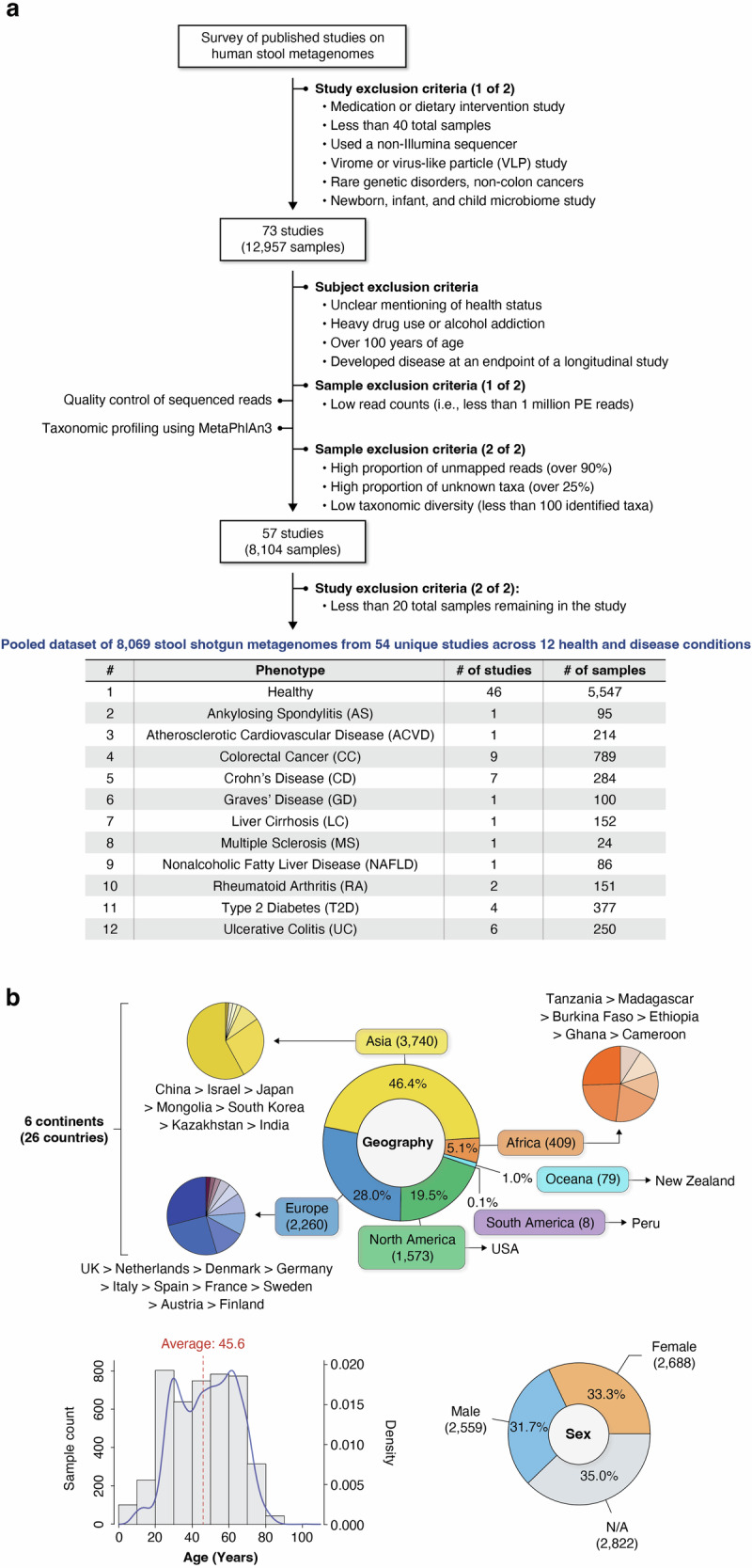
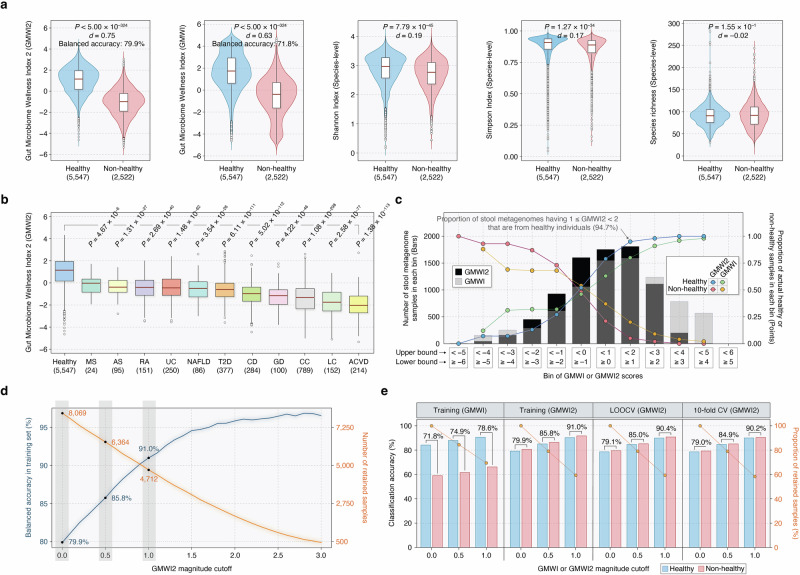
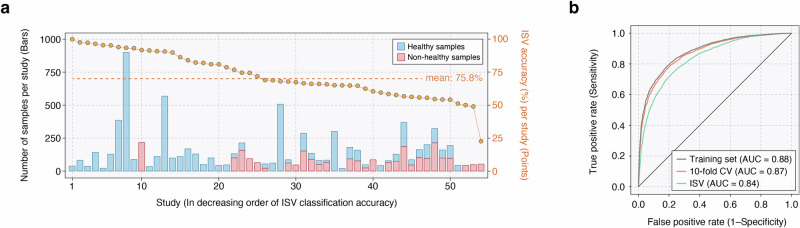
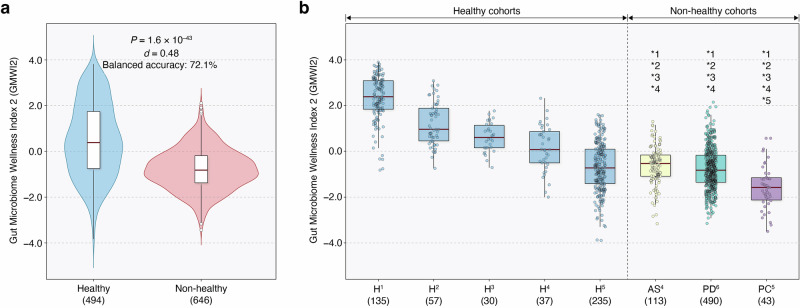
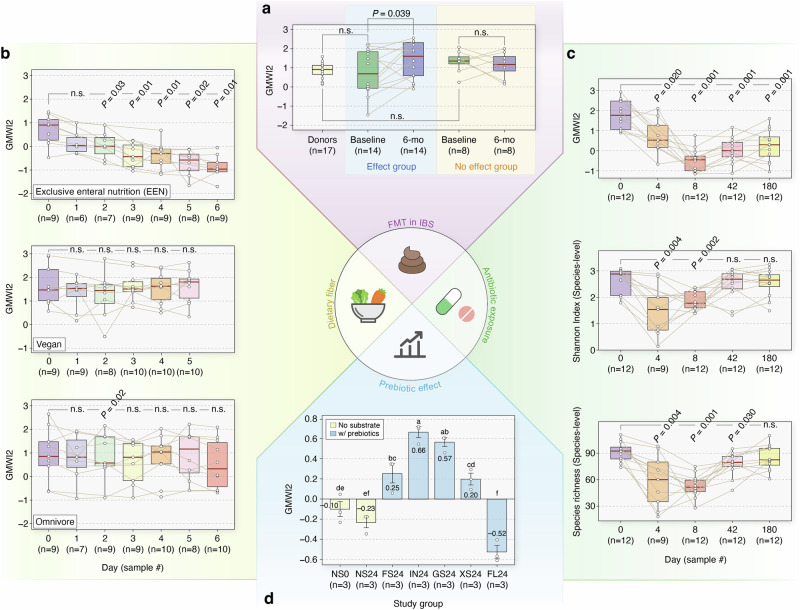
Recent advancements in translational gut microbiome research have revealed its crucial role in shaping predictive healthcare applications. Herein, we introduce the Gut Microbiome Wellness Index 2 (GMWI2), an enhanced version of our original GMWI prototype, designed as a standardized disease-agnostic health status indicator based on gut microbiome taxonomic profiles. Our analysis involves pooling existing 8069 stool shotgun metagenomes from 54 published studies across a global demographic landscape (spanning 26 countries and six continents) to identify gut taxonomic signals linked to disease presence or absence. GMWI2 achieves a cross-validation balanced accuracy of 80% in distinguishing healthy (no disease) from non-healthy (diseased) individuals and surpasses 90% accuracy for samples with higher confidence (i.e., outside the "reject option"). This performance exceeds that of the original GMWI model and traditional species-level α-diversity indices, indicating a more robust gut microbiome signature for differentiating between healthy and non-healthy phenotypes across multiple diseases. When assessed through inter-study validation and external validation cohorts, GMWI2 maintains an average accuracy of nearly 75%. Furthermore, by reevaluating previously published datasets, GMWI2 offers new insights into the effects of diet, antibiotic exposure, and fecal microbiota transplantation on gut health. Available as an open-source command-line tool, GMWI2 represents a timely, pivotal resource for evaluating health using an individual's unique gut microbial composition.
Overview
The claims and statistics of this paper haven’t been checked yet.
Free: it reads the open-access text and checks the first 5 claims that cite a source we can check. Create a free account to check every claim.
Integrity signals
Registry
Cites
Statistics
Figures
Verification
Claims the paper makes
The claims and statistics of this paper haven’t been checked yet.
Free: it reads the open-access text and checks the first 5 claims that cite a source we can check. Create a free account to check every claim.
Claims other papers make about this one
Each is checked against this paper’s own text: does it say what the citing paper says it does?
In the citing paper
“These differences enabled GMWI2 to outperform GMHI and achieve a higher dysbiosis classification accuracy of up to 90%.202”
From Gut dysbiosis in oncology: a risk factor for immunoresistance (2026) · doi:10.1038/s41422-025-01212-6 · cites this paper as [202]
Self-check
Percentages, sums and reported differences re-computed from the paper’s own numbers.
The self-check needs the paper’s full text.
Citations
Cites
Trimmomatic: a flexible trimmer for Illumina sequence data
Bolger, A. M., Lohse, M., & Usadel, B. (2014) · Bioinformatics · doi:10.1093/bioinformatics/btu170 · Cited by 65,548
Fast gapped-read alignment with Bowtie 2
Langmead, B., & Salzberg, S. L. (2012) · Nature Methods · doi:10.1038/nmeth.1923 · Cited by 56,400
Dietary Modulation of the Human Colonic Microbiota: Introducing the Concept of Prebiotics
Gibson, G. R., & Roberfroid, M. B. (1995) · The Journal of Nutrition · doi:10.1093/jn/125.6.1401 · Cited by 7,667 · cited 1×
“Overall,our fi ndingsstrengthen the evidence for the well-established bene fi ts of dietary fi ber on health 27 – 29 .”
Multi-omics of the gut microbial ecosystem in inflammatory bowel diseases
Lloyd-Price, J., Arze, C., Ananthakrishnan, A. N., Schirmer, M., Avila-Pacheco, J., Poon, T. W., Andrews, E., Ajami, N. J., Bonham, K. S., Brislawn, C. J., et al. (2019) · Nature · doi:10.1038/s41586-019-1237-9 · Cited by 3,143
Microbiome Datasets Are Compositional: And This Is Not Optional
Gloor, G. B., Macklaim, J. M., Pawlowsky-Glahn, V., & Egozcue, J. J. (2017) · Frontiers in Microbiology · doi:10.3389/fmicb.2017.02224 · Cited by 3,044
Personalized nutrition by prediction of glycemic responses
Zeevi, D., Korem, T., Zmora, N., Israeli, D., Rothschild, D., Weinberger, A., Ben-Yacov, O., Lador, D., Avnit-Sagi, T., Lotan-Pompan, M., et al. (2015) · Cell · doi:10.1016/j.cell.2015.11.001 · Cited by 2,929 · cited 1×
“Recent research into the human gut microbiome has highlighted its potential to inform the development of innovative tools for predictive healthcare 32 – 37 .”
Beghini, F., McIver, L. J., Blanco-Míguez, A., Dubois, L., Asnicar, F., Maharjan, S., Mailyan, A., Manghi, P., Scholz, M., Thomas, A. M., et al. (2021) · eLife · doi:10.7554/elife.65088 · Cited by 2,303
Health benefits of dietary fiber
Anderson, J. W., Baird, P., Davis Jr, R. H., Ferreri, S., Knudtson, M., Koraym, A., Waters, V., & Williams, C. L. (2009) · Nutrition Reviews · doi:10.1111/j.1753-4887.2009.00189.x · Cited by 2,239
Tackling the widespread and critical impact of batch effects in high-throughput data
Leek, J. T., Scharpf, R. B., Bravo, H. C., Simcha, D., Langmead, B., Johnson, W. E., Geman, D., Baggerly, K., & Irizarry, R. A. (2010) · Nature Reviews Genetics · doi:10.1038/nrg2825 · Cited by 2,196
MetaPhlAn2 for enhanced metagenomic taxonomic profiling
Truong, D. T., Franzosa, E. A., Tickle, T. L., Scholz, M., Weingart, G., Pasolli, E., Tett, A., Huttenhower, C., & Segata, N. (2015) · Nature Methods · doi:10.1038/nmeth.3589 · Cited by 2,185 · cited 1×
“Additionally, GMWI2 uses MetaPhlAn3 16 instead of MetaPhlAn2 17 for taxonomic pro fi ling, leveraging an extensively expanded marker database for a more comprehensive and accurate characterization of microbial taxa ( “ Methods ” section).”
Cited by
Clinical translation of microbiome research
Gilbert, J. A., Azad, M. B., Bäckhed, F., Blaser, M. J., Byndloss, M. X., Chiu, C. Y., Chu, H., Dugas, L. R., Elinav, E., Gibbons, S. M., et al. (2025) · Nature Medicine · doi:10.1038/s41591-025-03615-9 · Cited by 124
“Statistical and machine learning approaches can be used to identify latent microbial factors that predict or diagnose health or disease based on associations 1 , allowing for the development of microbiota wellbeing indices 2 .”
Marco, M. L., Cunningham, M., Bischoff, S. C., Clarke, G. A., Delzenne, N. M., Lewis, J., Meisel, M., Merenstein, D. J., O’Toole, P. W., Staudacher, H. M., et al. (2026) · Nature Reviews Gastroenterology & Hepatology · doi:10.1038/s41575-026-01176-x · Cited by 58
Toward a health-associated core keystone index for the human gut microbiome
Goel, A., Shete, O., Goswami, S., Samal, A., C.B., L., Kedia, S., Ahuja, V., O’Toole, P. W., Shanahan, F., & Ghosh, T. S. (2025) · Cell Reports · doi:10.1016/j.celrep.2025.115378 · Cited by 37
Zhang, Z., Yang, Z., Lin, S., Jiang, S., Zhou, X., Li, J., Lü, W., & Zhang, J. (2025) · Gut Microbes · doi:10.1080/19490976.2025.2520407 · Cited by 31
“The Gut Microbiome Wellness Index 2 (GMWI) was calculated based on the method described by Chang et al. 17 Specifically, the quality control steps included: i) the removal of overrepresented sequences using FastQC software; ii) the elimination of human DNA contaminants using Bowtie2 software; and…”
InfluentialJamerlan, A., An, S. S. A., & Hulme, J. (2025) · Gut Microbes · doi:10.1080/19490976.2025.2486518 · Cited by 40
“54 Clinical studies and pre-clinical models have been conducted to better understand the relationship between alterations in gut microbial populations and AD development.”
The impact of artificial intelligence on biomarker discovery
Javaid, H., Petrescu, C. C., Schmunk, L. J., Monahan, J., O’Reilly, P. G., Garg, M., McGirr, L., Khasawneh, M., Lail, M. A., Ganta, D., et al. (2025) · Emerging Topics in Life Sciences · doi:10.1042/etls20243003 · Cited by 36
“Emerging Topics in Life Sciences (2025) 08 89–105 https://doi.org/10.1042/ETLS20243003 leverage more classical ML algorithms, such as LASSO, elastic net regression or tree-based models [19,46,59,74,76,78,85].”
InfluentialGut dysbiosis in oncology: a risk factor for immunoresistance
(2026) · doi:10.1038/s41422-025-01212-6 · Cited by 24
Harnessing the microbiome for cancer therapy
Hajjar, R., Mars, R. A. T., & Kashyap, P. (2026) · Nature Reviews Microbiology · doi:10.1038/s41579-025-01268-6 · Cited by 34
“Second, patients with cancer often differ from healthy individuals in multiple ways unrelated to cancer itself (such as comorbidities, medication use or systemic inflammation) that can independently alter microbiome composition 193–195 .”
Healthy microbiome—moving towards functional interpretation
Zielińska, K., Udekwu, K. I., Rudnicki, W. R., Frolova, A., & Łabaj, P. P. (2025) · GigaScience · doi:10.1093/gigascience/giaf015 · Cited by 22
“A follow-up version of the same method ( , available as a pre-print is purely based on gut GMWI2) taxonomic signatures (Chang et al., 2023).”
Barrera-Suarez, M. A., Zhao, C., Karnatovskaia, L. V., & Sung, J. (2026) · Gut Microbes Reports · doi:10.1080/29933935.2026.2650247 · Cited by 22
“Leading examples include the Gut Microbiome Health Index (GMHI) 186 and its advanced successor, the Gut Microbiome Wellness Index 2 (GMWI2), 187 as well as the Health Index with Principal Component Analysis (hiPCA).”
Self-citationNam, J., Lee, Y., Lee, S., Choi, H., Lee, S. Y., & Yang, D. (2025) · Biotechnology Advances · doi:10.1016/j.biotechadv.2025.108782 · Cited by 14
Yao, H., Chen, L., Xian, Y., Liu, B., Yang, T., Tian, R., Xiao, X., Zhao, W., Ying, L., Xu, J., et al. (2025) · Journal of Translational Medicine · doi:10.1186/s12967-025-07139-1 · Cited by 12
“It plays an important role in various physiological systems, including the gastrointestinal [6], immune [7] and cardiovascular [8] systems, regulating key physiological functions and influencing the onset of disease.”
BiomeGPT: A foundation model for the human gut microbiomePreprint
Medearis, N. A., Zhu, S., & Zomorrodi, A. R. (2026) · bioRxiv (Cold Spring Harbor Laboratory) · doi:10.64898/2026.01.05.697599 · Cited by 11
Gut microbiota dysbiosis: the hidden roles in human aging and age-related diseases
Zhan, Y., Su, W., & Liu, X. (2025) · Oral Science and Homeostatic Medicine · doi:10.26599/oshm.2025.9610012 · Cited by 5
Dong, C., Yu, S., Deng, S., Xia, Z., Rigoberto, F. C., Sultan, M., Xu, X., Jin, B., Guan, Q., Sun, Z., et al. (2025) · Journal of Hazardous Materials · doi:10.1016/j.jhazmat.2025.138465 · Cited by 5
Paradigms for microbiome analysis in infectious and non-communicable diseases
Autenrieth, I. B., Bury, L., Rooney, A. M., Willmann, M., Vehreschild, M. J. G. T., & Egli, A. (2025) · Trends in Microbiology · doi:10.1016/j.tim.2025.11.016 · Cited by 7
The Gut Microbiota as a Mediator in the Relationship Between Dietary Patterns and Depression
Hernández-Cacho, A., Ni, J., García-Gavilán, J. F., Konstanti, P., Belzer, C., Vioqué, J., Corella, D., Fitó, M., Vidal, J., Torres‐Collado, L., et al. (2026) · MedComm · doi:10.1002/mco2.70562 · Cited by 6
Defazio, G., Lorusso, E., Robertis, M. D., Mello, T., Galli, A., Pesole, G., & Fosso, B. (2026) · BioData Mining · doi:10.1186/s13040-026-00532-6 · Cited by 3
“This aligns with existing literature, which reports limited discriminatory power of alpha diversity in health stratification [22] and highlights that fungal richness is considerably lower than that of prokaryotes [34, 35].”
Nalbantoğlu, Ö. U., Ermiş, B. H., & Gündoğdu, A. (2025) · Biomedical Signal Processing and Control · doi:10.1016/j.bspc.2025.108146 · Cited by 4
Tanca, A., & Uzzau, S. (2025) · Expert Review of Proteomics · doi:10.1080/14789450.2025.2580644 · Cited by 4
Lee, Y., Seo, J.-M., & Camillo, B. D. (2025) · Scientific Reports · doi:10.1038/s41598-025-24802-1 · Cited by 8
Esposito, A., Valentino, V., Tagliamonte, S., Sequino, G., Vitaglione, P., Ercolini, D., & Filippis, F. D. (2025) · Current Research in Food Science · doi:10.1016/j.crfs.2025.101289 · Cited by 4
“In addition, we calculated Gut Microbiome Wellness Index 2 (GMWI) (Chang et al., 2024), an index that predicts the health status according to the taxonomic profiling of the gut microbiome.”
Ju, Y., Lin, S., Hu, S., Jin, X., Xiao, L., Zhang, T., Zhang, Y., Zhang, L., Ma, X., Zhu, F., et al. (2026) · Gut Microbes · doi:10.1080/19490976.2026.2630563 · Cited by 2
Exo- and Endo-1,5-α-L-Arabinanases and Prebiotic Arabino-Oligosaccharides Production
Ju, Y.-R., Im, S. B., Jung, D. E., Son, M., Park, C.-Y., Jeon, M. H., Hwang, J.-M., Lee, S. J., & Kim, T. (2025) · Journal of Microbiology and Biotechnology · doi:10.4014/jmb.2412.12052 · Cited by 1
Chen, X. D. (2025) · Frontiers in Microbiomes · doi:10.3389/frmbi.2025.1605814 · Cited by 2
“Chemical process engineering (CPE) includes the fundamentals of transport phenomena and reaction engineering, as well as control engineering (Cooper and Jeffreys, 1971; Bailey and Ollis, 1986; Aris, 1989; Levenspiel, 1999; Bird et al., 2002; Chen et al., 2006; Finlayson, 2012; Chen, 2016, 2024).”
Hu, R., Fang, Y., Han, P., Han, Y., Wang, J., Liu, H., Shi, Y., Li, Z., & Zhang, L. (2026) · Frontiers in Microbiology · doi:10.3389/fmicb.2026.1854098 · Cited by 1
Hu, R., Yang, Y., Yang, T., Li, F., Hu, X., Tong, B., Chen, J. K., & Wang, Z. (2026) · Journal of Translational Medicine · doi:10.1186/s12967-026-08646-5 · Cited by 1
“…microbiota architecture, enriching beneficial commensals such as Clostridium butyricum —a butyr-ate-producing species implicated in epithelial repair— while suppressing the growth of pathogenic E. coli , as reflected by the most favorable GMHI and the lowest MDI among all intervention groups [45].”
ResMicroDb: a comprehensive database and analysis platform for the human respiratory microbiome
Ji, X., Qian, Q., Zhang, H., Cai, Q., Zhang, K., Xiao, J., Jiang, X., & Li, M. (2025) · Nucleic Acids Research · doi:10.1093/nar/gkaf1194 · Cited by 5
“Similar to the established gut microbiome health index [ 59 , 60 ], this con-ResMicroDb D 867 Figure 5.”
Sung, J. (2024) · doi:10.52843/cassyni.7pgg9r · Cited by 1
Self-citationBarak, N., Bhattacharya, H., Asnicar, F., Sung, J., Segata, N., & Yassour, M. (2025) · bioRxiv (Cold Spring Harbor Laboratory) · doi:10.1101/2025.06.12.658885 · Cited by 1
“In this work, SIAMCAT v2.”
InfluentialSelf-citationUterine microbiome signatures associated with endometriosis
Zhu, L., He, J., Xu, X., Shen, L., Yu, Y., Wong, W., Bischoff, F. Z., & Zhang, X. (2026) · BMC Biology · doi:10.1186/s12915-026-02659-8 · Cited by 1
“Nonetheless, we recognize that subtle yet consistent shifts in microbial composition across multiple taxa may carry predictive value [16].”
Reproducible Community States Resolve the Nasopharyngeal Diversity ParadoxPreprint
Song, K., Brochu, H. N., Bustos, M., Zhang, Q., Thomas, M. J., Harris, A. B., Icenhour, C. R., Letovsky, S. I., & Iyer, L. K. (2025) · bioRxiv (Cold Spring Harbor Laboratory) · doi:10.1101/2025.09.06.673381 · Cited by 1
“Building upon the Gut Microbiome Wellness Index 2 (GMWI2) framework [58] as a conceptual foundation, we developed the NMHI through LASSO-penalized logistic regression with balanced class weights and binary presence/absence encoding at 0.01% relative abundance threshold, applied only to…”
Influential‘Mining’ the Gut: The Microbiome ‘Lassonde curve’
NARANG, H., & Ahuja, V. (2025) · The National Medical Journal of India · doi:10.25259/nmji_1737_2025
Song, K., Brochu, H. N., Bustos, M., Zhang, Q., Icenhour, C. R., Letovsky, S. I., & Iyer, L. K. (2025) · Research Square · doi:10.21203/rs.3.rs-7631112/v1 · Cited by 1
AI Integration in Telemedicine for Metabolic Monitoring and Gut Microbiome Analysis
Arya, L., Rastogi, R., Sivaparvathi, M., Yallamanda, R. B., Banda, L., Katuri, V. R., Gautam, D., Elloumi, M., Tiwari, N., & Tyagi, S. (2025) · Advances in computational intelligence and robotics book series · doi:10.4018/979-8-3373-3196-6.ch004 · Cited by 1
Artificial intelligence in microbial metagenomics
Ansari, A., Shete, O., & Ghosh, T. S. (2026) · Progress in molecular biology and translational science · doi:10.1016/bs.pmbts.2026.01.009
León, L. E., Lorca, C., Fuentes, F., Pina, A., Ortúzar, M. I., Gutierrez, D., Ugalde, J. A., & Bisquertt, A. (2026) · bioRxiv (Cold Spring Harbor Laboratory) · doi:10.64898/2026.02.27.708536
Characterising oral microbial signatures for periodontal disease in the NHANES population
Zhuang, Z., Chen, Y., Wang, Y., & Wei, D. (2026) · Acta Odontologica Scandinavica · doi:10.2340/aos.v85.45662
“In addition to the frequently investigated gut microbiome [9], the oral cavity is also an essential component of this microbiota community, establishing a critical microbial niche hosting 0.5–1 trillion bacterial cells with biodiversity encompassing more than 700 distinct species [8].”
InfluentialTan, B., He, L., Wu, Z., Sun, R., Dai, Z., & Li, C. (2026) · Environmental Science Nano · doi:10.1039/d5en00967g · Cited by 1
Çiftcioğlu, U. G. E., & Nalbantoğlu, Ö. U. (2026) · Computational Biology and Chemistry · doi:10.1016/j.compbiolchem.2026.109063
Seven years of stool banking: Clinical and microbiological insights from the Ghent Stool Bank
Hamerlinck, H., Boelens, J., Looze, D. A. D., Messiaen, A.-S., Vandendriessche, S., Holvoet, T., & Verhasselt, B. (2026) · International Journal of Infectious Diseases · doi:10.1016/j.ijid.2026.108744
Zhou, C., Yang, Z., Lu, W., Zhao, J., Zhang, H., Chen, W., & Zhu, J. (2026) · Food Bioscience · doi:10.1016/j.fbio.2026.109124
Johnston, D. J. (2026) · Open Library of Humanities · doi:10.16995/olh.28617
Gao, Z., Wu, J., Lucaci, A. G., Ouyang, J., Wang, L., Ryon, K. A., Elhaik, E., Probst, A. J., Rodó, X., Velavan, T. P., et al. (2026) · Nature Communications · doi:10.1038/s41467-026-73605-z · Cited by 1
Cady, N. M., Meyer, S. R., Kim, K., Lo, B. C., So, N., Chen, G., Rosshart, S. P., Shah, Y. M., Núñez, G., Sexton, J. Z., et al. (2026) · mSphere · doi:10.1128/msphere.00926-25
Goswami, S., Arora, N., Ansari, A., Pramanik, D., Singh, P., Palanimuthu, D., & Ghosh, T. S. (2026) · bioRxiv (Cold Spring Harbor Laboratory) · doi:10.64898/2026.08.11.744126
Gastrointestinal Microbiome Diversity: A Key Player in Cancer Therapy
Singh, H., Bajaj, S., Jailabdin, S., & Hossain, K. (2026) · IGI Global eBooks · doi:10.4018/979-8-3373-3079-2.ch007
Kumar, B., Lorusso, E., Fosso, B., & Pesole, G. (2026) · Frontiers in Microbiology · doi:10.3389/fmicb.2026.1925500
“Our labels follow operational definitions previously used in microbiome health-status frameworks (Gupta et al., 2020; Chang et al., 2024).”
InfluentialMicrobiome signatures linked to cancer and treatment adverse events in a real-world cohort
Yang, L., Singh, V., Gawey, B. J., Sinnwell, J. P., Johnson, S., Billings, E. C., Gorp, T. M. V., Harrington, J. J., Slama, M. Q., Till, L. M., et al. (2026) · Cell · doi:10.1016/j.cell.2026.09.009
Bai, X., Li, Z., Sun, Y., Shi, Y., Zhou, P., 王澈, Cui, L., & Shi, L. (2026) · Frontiers in Immunology · doi:10.3389/fimmu.2026.1974872
“It is the erosion of this redundancy, rather than the loss of any single species or any phylum ratio, that most reliably marks the transition from a tolerant to a pro-in fl ammatory community, a principle now formalized in composite microbiome-health indices (37).”
Metadata
- Authors
- Chang, D., Gupta, V. K., Hur, B., Cobo-López, S., Cunningham, K. Y., Han, N. S., Lee, I., Kronzer, V. L., Teigen, L. M., Karnatovskaia, L. V., Longbrake, E. E., Davis, J. M., Nelson, H., & Sung, J.
- Affiliations
- University of Minnesota (US)
- Mayo Clinic (US)
- San Diego State University (US)
- Chungbuk National University (KR)
- Yonsei University (KR)
- Yale University (US)
- Corresponding author
- Sung, Jaeyun
- ORCID
- Venue
- Nature Communications
- Published
- 2024-08-28
- Volume
- 15
- Issue
- 1
- Pages
- 7447-7447
- ISSN
- 2041-1723 (ISSN-L)
- PMC
- PMC11358288
- OpenAlex
- W4401945686
- Cited by
- 50
- References
- 51
- Citations by year
- 2026: 26 · 2025: 23 · 2024: 1
- FWCI
- 6.81
- Type
- journal article
- Language
- en
- Open access
- gold
- doi.org
- Licence
- cc-by-nc-nd
- creativecommons.org/licenses/by-nc-nd/4.0 (tdm)
- creativecommons.org/licenses/by-nc-nd/4.0 (vor)
- Locations
- Nature Communications (publishedVersion, cc-by-nc-nd)
- PubMed Central (publishedVersion, cc-by-nc-nd)
- PubMed (publishedVersion)
- RePEc: Research Papers in Economics (publishedVersion)
- DOAJ (DOAJ: Directory of Open Access Journals) (publishedVersion)
- Funders
- U.S. Department of Health & Human Services | National Institutes of Health (UL1TR002377)
- Minnesota Partnership for Biotechnology and Medical Genomics Center for Individualized Medicine, Mayo Clinic
- Topics
- Life Sciences › Biochemistry, Genetics and Molecular Biology › Molecular Biology › Gut microbiota and health
- Health Sciences › Dentistry › Periodontics › Oral microbiology and periodontitis research
- Physical Sciences › Environmental Science › Ecology › Microbial Community Ecology and Physiology
- Keywords
- gut microbiota, health prediction, disease prediction, stool metagenomics, alpha diversity, external validation, antibiotic exposure, fecal microbiota transplantation, open source tools
- MeSH terms
- Gastrointestinal Microbiome, Bacteria, Feces, Female, Health Status, Humans, Metagenome
About these checks
Registry, retraction, Cites and statistics results are computed, not judged, with one exception: a printed reference that no index lists is read once by a model before it counts as a citation error. Claims are extracted by a model and kept only when their quote appears verbatim in the text; each cited source is then checked, with a model’s help, for whether it says what the claim relies on. Those verdicts can be wrong — read the claim’s quote and the cited source before relying on one.
Statistics and arithmetic are recomputed, not judged.
Confidence bands are shown only for fields calibrated on our annotated test set. None is calibrated yet, so no band is shown.
What counts as a claim ›How we measure confidence ›How we check this ›
Are you an author, or do you see a problem with this page? Request a review
Data sources
Bibliographic data: Semantic Scholar, OpenAlex, Crossref.
Contains information from the Semantic Scholar Academic Graph Datasets, made available under the ODC Attribution License (ODC-BY 1.0).
Semantic Scholar’s data is described in: Kinney, R., et al. (2023). The Semantic Scholar Open Data Platform. arXiv:2301.10140.
