

Distorted learning from local metacognition supports transdiagnostic underconfidence
Open accessPublished version of a preprint
The DOI matches its Crossref record; 62 of the 62 references it cites were found in a registry or an index; 4 of the 70 sources its claims cite were checked for support.
Abstract
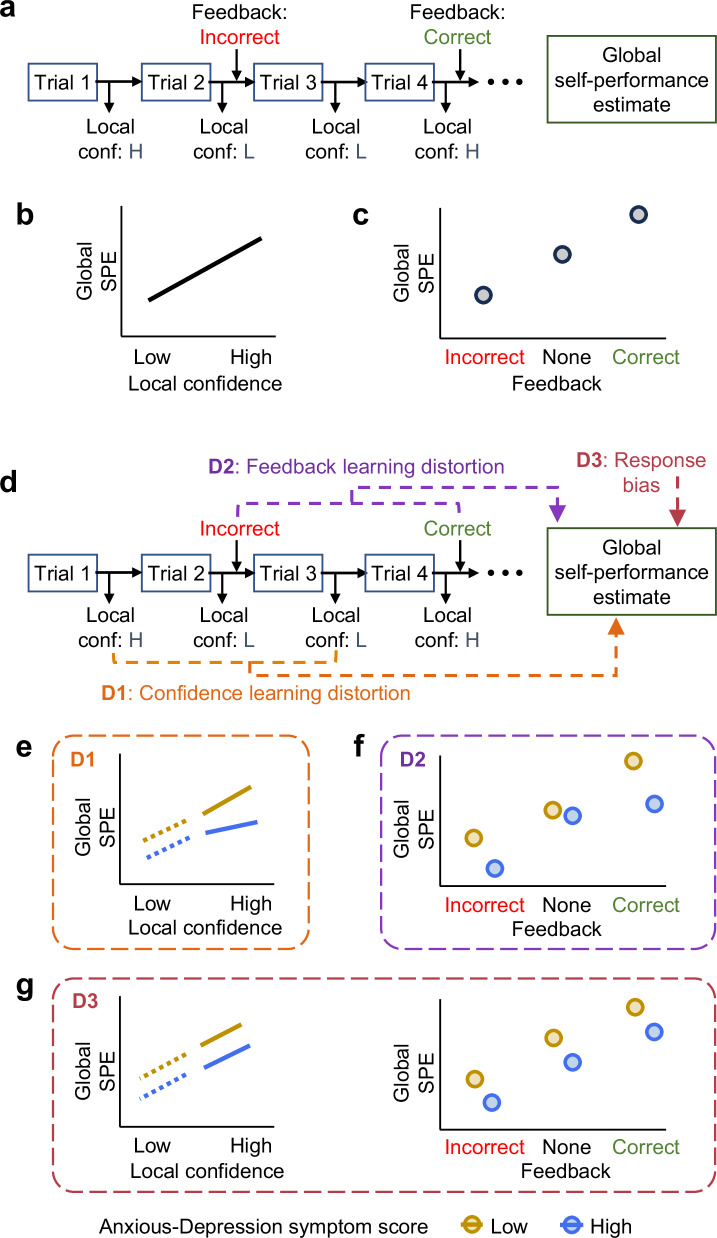
Individuals experiencing symptoms of anxiety and depression have been shown to exhibit persistent underconfidence. The origin of such metacognitive biases presents a puzzle, given that individuals should be able to learn appropriate levels of confidence from observing their own performance. In two large general population samples ( N = 230 and N = 278), we measure both 'local' confidence in individual task instances and 'global' confidence as longer-run self-performance estimates while manipulating external feedback. Global confidence is sensitive to both local confidence and feedback valence—more frequent positive (negative) feedback increases (respectively decreases) global confidence, with asymmetries in feedback also leading to shifts in affective self-beliefs. Notably, however, global confidence exhibits reduced sensitivity to instances of higher local confidence in individuals with greater subclinical anxious-depression symptomatology, despite sensitivity to feedback valence remaining intact. Our finding of blunted sensitivity to increases in local confidence offers a mechanistic basis for how persistent underconfidence is maintained in the face of intact performance.
Overview
CoChat Summary
TL;DR
In two large general-population samples, asymmetric performance feedback shifted global self-performance estimates (SPEs) without changing objective performance. Individuals with greater subclinical anxious-depression symptoms showed blunted sensitivity to their own higher local confidence when forming global SPEs, while sensitivity to feedback valence remained intact.
Key findings
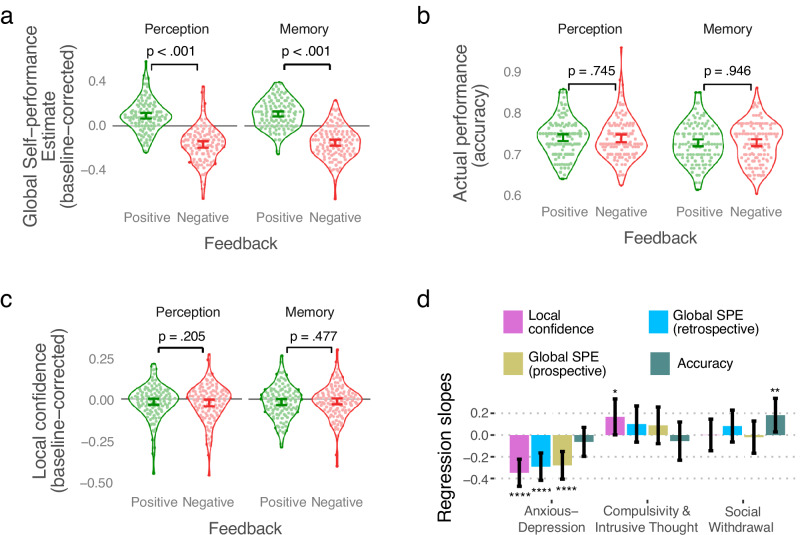
- Feedback manipulation strongly shifted global SPEs: positive feedback increased and negative feedback decreased global SPEs relative to baseline, with no significant effect on accuracy (Exp 1: χ² = 273.77, p < 0.001, β = −0.26, Cohen’s d = 1.77; Exp 2: χ² = 332.08, p < 0.001, β = −0.28, Cohen’s d = 1.77; accuracy Exp 1 p = 0.856, BF01 = 9.67; Exp 2 p = 0.642, BF01 = 7.22).
- Average local confidence predicted global SPEs across blocks (Exp 1: χ² = 48.08, p < 0.001, β = 0.46; Exp 2: χ² = 51.27, p < 0.001, β = 0.46), whereas block-wise performance fluctuations did not after accounting for local confidence.
- Higher anxious-depression symptoms were associated with lower local confidence and lower global SPEs (Exp 1 GAD-7: β = −0.03, p = 0.002; Exp 2 Anxious-Depression axis: β = −0.35, p < 0.001; global SPEs Exp 1: β = −0.05, p < 0.001; Exp 2: β = −0.29, p < 0.001).
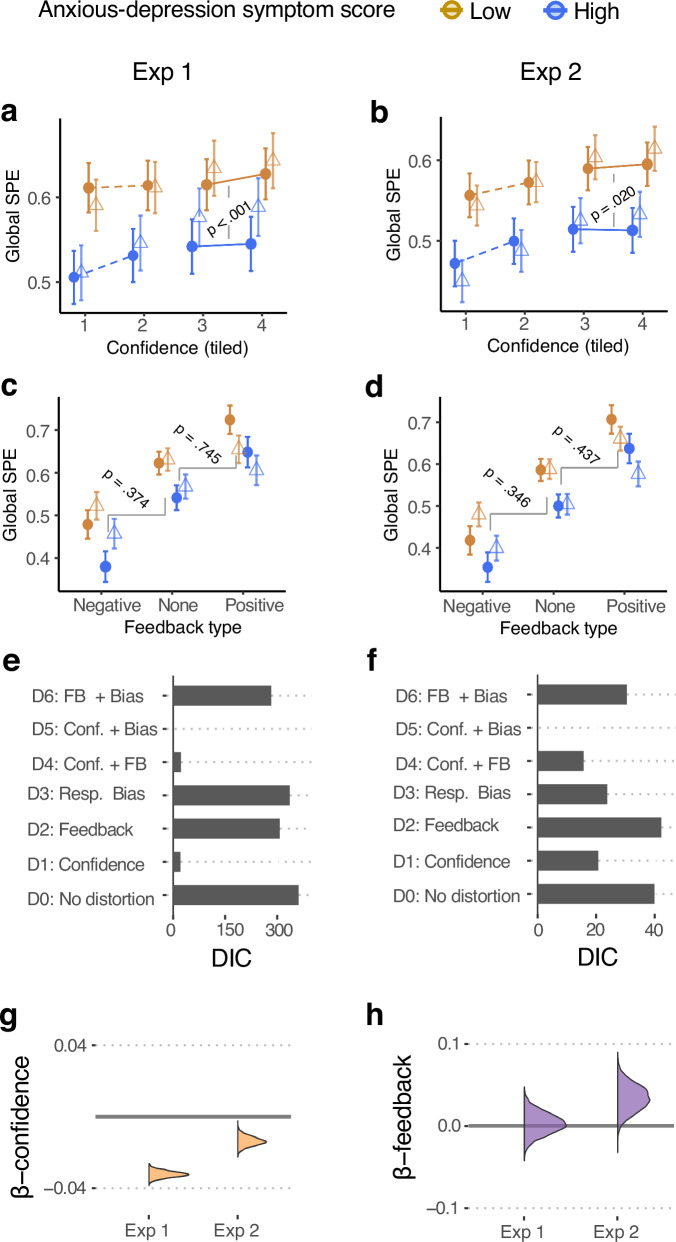
- The slope relating higher local confidence to global SPEs was blunted in individuals with higher anxious-depression scores (Exp 1 GAD: χ² = 13.66, p < 0.001, β = −0.017; Exp 1 PHQ: χ² = 4.75, p = 0.029, β = −0.009; Exp 2: χ² = 5.39, p = 0.020, β = −0.06), while feedback-valence sensitivity did not significantly interact with symptom scores. Model comparison favored a confidence-distortion-only model (D1), with negative confidence-distortion parameter βc and feedback-distortion parameter βf not differing from 0.
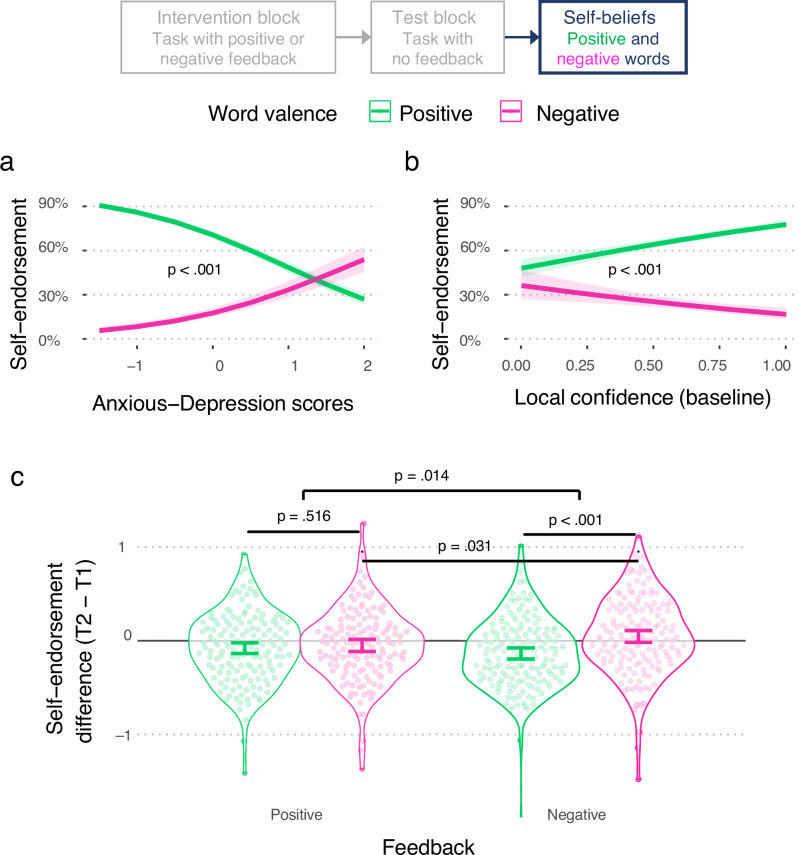
- In Exp 2, feedback also affected affective self-evaluation: a significant Feedback type × Word valence interaction on self-endorsement change (χ² = 6.08, p = 0.014, β = 0.11), with greater endorsement of negative than positive words after negative feedback (t(593) = 4.21, p < 0.001) but no such difference after positive feedback (t(593) = 0.65, p = 0.516).
Methods
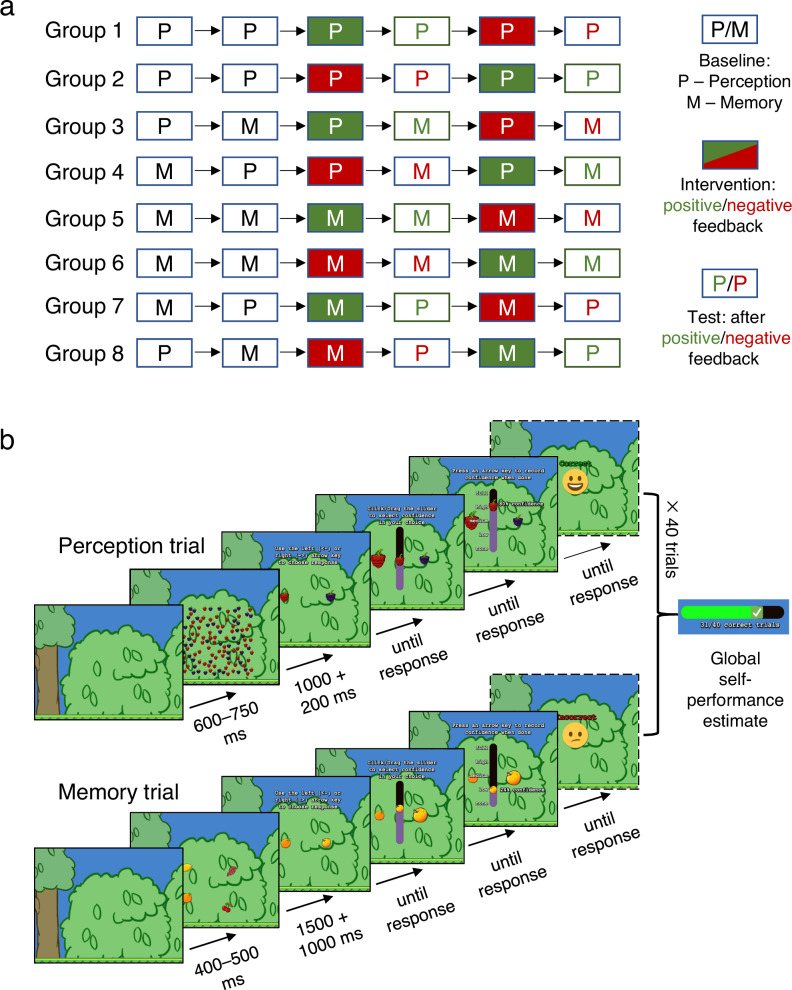
- Two non-overlapping online general-population samples from Prolific: Exp 1 exploration (N = 230) and Exp 2 preregistered validation (N = 278). Participants completed gamified perception and memory tasks with trial-wise local confidence, block-wise global SPEs, and manipulated intermittent positive or negative feedback in intervention blocks interleaved with no-feedback test blocks; Exp 2 also included a self-referential encoding task before and after feedback.
- Analyses used linear mixed regression models in R and computational modeling extending a Beta-distribution model of global SPE formation with asymmetry parameters for learning from positive vs. negative feedback (ΔLRf) and high vs. low local confidence (ΔLRc). Models D0–D6 were compared using Deviation Information Criteria, with parameters fit via MCMC sampling in JAGS.
- Symptom measures: Exp 1 used PHQ-9, GAD-7, and mini-SPIN; Exp 2 used 71 questions yielding transdiagnostic Anxious-Depression, Compulsivity and Intrusive Thought, and Social Withdrawal axes.
Limitations
- The paper states that intervention trials available to estimate feedback-learning distortions were substantially fewer than trials for confidence-learning distortions, though the authors argue the intact feedback-learning result is robust based on strong feedback effects, pooled feedback trials (4600 in Exp 1 and 5560 in Exp 2), Bayes factors, and parameter-recovery simulations.
- The paper states that the sample was a general-population online sample; although many participants surpassed clinical cutoffs, further work is needed to test generalization to individuals with clinical anxiety and/or depression diagnoses.
- The paper reports preregistration deviations: the response-bias model D3 was not preregistered, intercept terms for Models D1 and D2 were initially omitted, and after including intercepts the preregistered βf < 0 effect in Exp 1 was no longer observed, although βc < 0 remained. The text also notes DIC can favor complex models and that the very small fitted response-bias βa values were likely spurious.
- Evident from the text: Exp 2 is reported as N = 278 in the Abstract and Methods, but Fig. 3d and Fig. 4 label Exp 2 as N = 287.
Model-written summary. Check it against the paper before relying on it.
Integrity signals
Registry
Cites
Statistics
Figures
Verification
Claims the paper makes
3 Valid · 0 Not valid · 24 Not checked · 97 Own results and interpretations
Every source the paper cites for this claim was checked and supports it.
In the paper
“Together these findings have informed a computational model in which global confidence is formed by probabilistically combining instances of local confidence with feedback to update a prior over expected performance8 (Fig. 1a–c).”
§ Distorted learning from local metacognition supports transdiagnostic underconfidence > Introduction
What the sources say
- Supportedcites [8] Rouault, M., Dayan, P. & Fleming, S. M. Forming global estimates of self-performance from local confidence. Nat. Commun. 10, 1141 (2019). 30850612 PMC6408496 source
The Results > 'Computational modeling' section of our copy describes exactly this scheme: 'a learning module updating global SPEs across trials from local decision confidence and feedback', with posterior distributions over SPEs narrowing around expected performance. Supplementary-model framing in the Discussion confirms the probabilistic/precision-weighted character ('local confidence as an internal feedback signal, formalizing the fact that the evidence available for updating SPEs is more uncertain in the absence versus presence of external feedback'; 'expected accuracy (as postulated in the present Bayesian learning scheme)'), and the Introduction states global SPEs 'incorporate external feedback when it is available' and otherwise aggregate local confidence. The only wording shift is 'global confidence' for the paper's 'global self-performance estimates', which the claim itself glosses as a prior over expected performance. (LLM, conf=0.85)
plainstates a cause- Asserted: passes — The authors put it forward as true.
- Checkable: passes — It can be checked against evidence.
- Load-bearing: passes — The paper’s conclusions depend on it.
- Based: passes — The paper gives a reason why it holds.
- Supported
The cited sources support only part of this claim — read each source’s verdict below.
In the paper
“Replicating previous findings8,18, average local confidence (metacognitive bias) significantly predicted global SPEs across blocks (Exp 1: χ²= 48.08, p <0.001, β = 0.46, CI = [0.34 0.59]; Exp 2: χ²= 51.27, p <0.001, β = 0.46, CI = [0.34 0.58]).”
§ Distorted learning from local metacognition supports transdiagnostic underconfidence > Results > Feedback impacts confidence without changing performance
What the sources say
- Partly supportedcites [8] Rouault, M., Dayan, P. & Fleming, S. M. Forming global estimates of self-performance from local confidence. Nat. Commun. 10, 1141 (2019). 30850612 PMC6408496 sourceExperimental — accuracy not yet measured
In the Results section 'Establishing a direct link between local confidence and global SPEs', Rouault et al. (2019) show that FLUCTUATIONS in local confidence — specifically the difference in mean trial-by-trial confidence between the two tasks on a block (confDiff) — predicted end-of-block global SPEs/task choices (β = 1.04, p < 0.0001, over and above accuracy and RT differences; Fig. 5b,c). Our copy nowhere reports AVERAGE local confidence, i.e. metacognitive/confidence bias, as a significant predictor of global SPEs; on the contrary, the Methods ('Statistical analyses') and Results define the index they relate to SPEs (meta-d'/d', metacognitive efficiency) as controlling for 'their tendency to rate confidence high or low on the scale'. So the general link between local confidence and global SPEs is supported, but the specific attribution to bias (average confidence level) is not; the χ²/β/CI figures in the citing sentence are the citing paper's own Experiment 1/2 statistics and match nothing in this source. (LLM, conf=0.72)
- Partly supportedcites [18] Rouault, M., Will, G.-J., Fleming, S. M. & Dolan, R. J. Low self-esteem and the formation of global self-performance estimates in emerging adulthood. Transl. Psychiatry 12, 1–10 (2022). 35821225 PMC9276660 sourceExperimental — accuracy not yet measured
Our copy of Rouault et al. (2022) never regresses global SPEs on average local confidence: its block-level analyses (Results, 'Characterization of the influence of task factors on self-performance estimates'; Methods, Statistical analyses) use the difference in objective performance between tasks and learning duration (plus self-esteem) as predictors, with no local-confidence regressor. The confidence-to-SPE link appears only as a restatement of prior work — Discussion: 'in previous work, we have shown that global SPEs in a similar task are sensitive to trial-to-trial fluctuations in decision confidence [8, 9]', and Introduction: 'The main finding from this previous work is that decision confidence is a key factor contributing to the formation of self-performance estimates in the absence of feedback.' So the cited paper reports (and relies on) someone else's finding — Rouault, Dayan & Fleming (2019) Nat Commun and Rouault & Fleming (2020) PNAS — rather than being the study that produced it, which is the part the citing sentence overstates; the Exp 1/Exp 2 statistics are the citing paper's own and are not attributable here. (LLM, conf=0.72)
plainstates an association- Asserted: passes — The authors put it forward as true.
- Checkable: passes — It can be checked against evidence.
- Load-bearing: passes — The paper’s conclusions depend on it.
- Based: passes — The paper gives a reason why it holds.
- Partly supported
Every source the paper cites for this claim was checked and supports it.
In the paper
“We replicated previous findings showing that heightened anxiety symptoms are associated with lower average local confidence (metacognitive bias; Exp 1—GAD-7: χ² = 9.76, p = 0.002, β = −0.03, CI = [−0.05 −0.01]; Exp 2—Anxious-Depression axis: χ² = 29.63, p < 0.001, β = −0.35, CI = [−0.47 −0.22])2”
§ Distorted learning from local metacognition supports transdiagnostic underconfidence > Results > Distortions in the formation of global confidence in anxious-depression
What the sources say
- Supportedcites [2] Rouault, M., Seow, T., Gillan, C. M. & Fleming, S. M. Psychiatric symptom dimensions are associated with dissociable shifts in metacognition but not task performance. Biol. Psychiatry 84, 443–451 (2018). 29458997 PMC6117452 source
The Results of experiment 1 state that 'self-reported depression, social anxiety, and generalized anxiety scores all were associated with lower confidence level (all β < −.12, all p < .05)', with the Figure 2 caption noting anxiety and depression symptoms were related to lower confidence level without a change in accuracy; experiment 2's Results replicate this (generalized and social anxiety β = −.10; AD dimension β = −.20, p < .001). The Methods subsection titled 'Quantifying Confidence Level (Bias)' defines confidence level as the tendency to use higher or lower confidence ratings independently of performance, i.e. a metacognitive bias, matching the claim's 'average local confidence'. The citing paper's own GAD-7/Anxious-Depression statistics are its replication results, not attributed here, so the only content checked — the anxiety–lower-confidence-bias association in a subclinical, self-reported-symptom population — is fully stated by our copy. (LLM, conf=0.88)
plainstates an association- Asserted: passes — The authors put it forward as true.
- Checkable: passes — It can be checked against evidence.
- Load-bearing: passes — The paper’s conclusions depend on it.
- Based: passes — The paper gives a reason why it holds.
- Supported
A result the paper reports from its own data — it cites no other source for it, so there is none to check. The quote shows it is in the paper.
In the paper
“In both experiments, our feedback manipulation robustly affected global confidence and impacted subsequent affective self-evaluations.”
§ Distorted learning from local metacognition supports transdiagnostic underconfidence > Introduction
boostedstates a cause- Asserted: passes — The authors put it forward as true.
- Checkable: passes — It can be checked against evidence.
- Load-bearing: passes — The paper’s conclusions depend on it.
- Based: passes — The paper gives a reason why it holds.
A result the paper reports from its own data — it cites no other source for it, so there is none to check. The quote shows it is in the paper.
In the paper
“To pre-empt our results, we found that individuals with greater anxious-depression symptoms exhibited reduced sensitivity to increases in local confidence, despite sensitivity to feedback valence remaining intact.”
§ Distorted learning from local metacognition supports transdiagnostic underconfidence > Introduction
plainstates an association- Asserted: passes — The authors put it forward as true.
- Checkable: passes — It can be checked against evidence.
- Load-bearing: passes — The paper’s conclusions depend on it.
- Based: passes — The paper gives a reason why it holds.
61 more claims
Create a free account to see all 124 claims and to verify the 62 references still open.
- Probably not a substantial claim. 42
- The quote only partly states this claim. 1
- It may state two separate claims as one. 25
Statistics recomputed
Every reported test result, recomputed from its test statistic and degrees of freedom. A result shows as not adding up only once an independent check has confirmed it.
- Consistentt(226) = 2.19reported p = .03 · recomputed p = .030
“t(226) = 2.19, p = .030”
- Consistentt(275) = 3.12reported p = .002 · recomputed p = .002
“t(275) = 3.12, p = .002”
- Consistentt(593) = 4.21reported p < .001 · recomputed p < .001
“t(593) = 4.21, p < .001”
- Consistentt(593) = 0.65reported p = .516 · recomputed p = .516
“t(593) = 0.65, p = .516”
Self-check
Percentages, sums and reported differences re-computed from the paper’s own numbers.
Each contradiction between two passages listed here was confirmed by an independent check.
Rated major: it would touch a result — a value a result rests on, reported and recomputed p-values on opposite sides of the significance level, two passages that conflict with no sign which is right, or a cited work retracted before this paper was published.
In the paper
§ Distorted learning from local metacognition supports transdiagnostic underconfidence > Results > Distortions in the formation of global confidence in anxious-depression
“D1—Confidence distortion only, D2—Feedback distortion only”
§ Distorted learning from local metacognition supports transdiagnostic underconfidence > Methods > Computational models
“learning rate asymmetry parameters ΔLRf (for D1), ΔLRc (D2)”
Rated minor: it would not touch a result — a value no result rests on, a p-value that stays on the same side of the significance level, or a conflict that is clerical, resolved elsewhere in the paper, or outside its own findings.
In the paper
“a total of 230 participants remained for Exp 1 (age mean and SD = 32 ± 9; gender: 127 females, 185 males, 2 nonbinary)”
§ Distorted learning from local metacognition supports transdiagnostic underconfidence > Methods > Participants
Reported 230 · recomputed 314
Rated minor: it would not touch a result — a value no result rests on, a p-value that stays on the same side of the significance level, or a conflict that is clerical, resolved elsewhere in the paper, or outside its own findings.
In the paper
§ Distorted learning from local metacognition supports transdiagnostic underconfidence > Results > Feedback impacts confidence without changing performance
“d Regression coefficients depicting the relationship in Exp 2 (N = 287)”
§ Distorted learning from local metacognition supports transdiagnostic underconfidence > Methods > Participants
“278 participants for Exp 2”
Citations
Cites
Fitting Linear Mixed-Effects Models Using lme4
Bates, D., Mächler, M., Bolker, B., & Walker, S. (2015) · Journal of Statistical Software · doi:10.18637/jss.v067.i01 · Cited by 86,835
The PHQ-9: Validity of a brief depression severity measure
Kroenke, K., Spitzer, R. L., & Williams, J. B. W. (2001) · Journal of General Internal Medicine · doi:10.1046/j.1525-1497.2001.016009606.x · Cited by 44,910 · cited 1×
“For Exp 1 this included the PHQ-9 for depression 45 , GAD-7 for general anxiety 46 and the 3-item mini-SPIN for social phobia 47 .”
Self-efficacy: Toward a unifying theory of behavioral change
Bandura, A. (1977) · Psychological Review · doi:10.1037/0033-295x.84.2.191 · Cited by 43,925
A Brief Measure for Assessing Generalized Anxiety Disorder: The GAD-7
Spitzer, R. L., Kroenke, K., Williams, J. B. W., & Löwe, B. (2006) · Archives of Internal Medicine · doi:10.1001/archinte.166.10.1092 · Cited by 31,765
JAGS: A program for analysis of Bayesian graphical models using Gibbs sampling
Plummer, M. (2003) · Cited by 4,720
By Carrot or by Stick: Cognitive Reinforcement Learning in Parkinsonism
Frank, M. J., Seeberger, L. C., & O'Reilly, R. C. (2004) · Science · doi:10.1126/science.1102941 · Cited by 1,964
Metacognitive therapy for anxiety and depression
Veeraraghavan, V. (2009) · Anxiety, Stress & Coping · doi:10.1080/10615800902833770 · Cited by 1,165
Depression: Clinical, Experimental and Theoretical Aspects.
Sabshin, M. (1968) · Archives of General Psychiatry · doi:10.1001/archpsyc.1968.01740120126024 · Cited by 809
How unrealistic optimism is maintained in the face of reality
Sharot, T., Korn, C. W., & Dolan, R. J. (2011) · Nature Neuroscience · doi:10.1038/nn.2949 · Cited by 729
Self-citationThe Deviance Information Criterion: 12 Years on
Spiegelhalter, D. J., Best, N. G., Carlin, B. P., & Linde, A. (2014) · Journal of the Royal Statistical Society Series B: Statistical Methodology · doi:10.1111/rssb.12062 · Cited by 629
Cited by
The future of metacognition research: Balancing construct breadth with measurement rigor
Katyal, S., & Fleming, S. M. (2024) · Cortex · doi:10.1016/j.cortex.2023.11.002 · Cited by 63
Self-citationMetacognitive biases in anxiety-depression and compulsivity extend across perception and memory
Seow, T. X. F., Fleming, S. M., & Hauser, T. U. (2025) · PLOS mental health. · doi:10.1371/journal.pmen.0000259 · Cited by 25
Self-citationDomain-specific updating of metacognitive self-beliefs
Hoogervorst, K., Banellis, L., & Allen, M. (2024) · Cognition · doi:10.1016/j.cognition.2024.105965 · Cited by 14
Peng, Q., Zhang, Y., Liang, S., & Xu, M. (2025) · Acta Psychologica · doi:10.1016/j.actpsy.2025.105437 · Cited by 14
Saramandi, A., Crucianelli, L., Koukoutsakis, A., Nisticò, V., Mavromara, L., Goeta, D., Boido, G., Gonidakis, F., Demartini, B., Bertelli, S., et al. (2024) · Computational Psychiatry · doi:10.5334/cpsy.109 · Cited by 14
Information search under uncertainty across transdiagnostic psychopathology and healthy ageing
Mohr, G., Ince, R. A. A., & Benwell, C. (2024) · Translational Psychiatry · doi:10.1038/s41398-024-03065-w · Cited by 13
Initial Expectations and Confidence Affect the Formation of Novel Self-Beliefs and Their Revision
Schröder, A., Czekalla, N., Mayer, A. V., Zhang, L., Stolz, D. S., Korn, C. W., Diekelmann, S., Luebber, F., Paulus, F. M., Müller‐Pinzler, L., et al. (2025) · Open Mind · doi:10.1162/opmi.a.36 · Cited by 12
Seow, T. X. F., Jelinek, L., Moritz, S., & Hauser, T. U. (2025) · Nature Reviews Psychology · doi:10.1038/s44159-025-00503-4 · Cited by 12
Biased and inattentive responding contribute to apparent metacognitive biases in mental health
Sarna, N., Dar, R., & Mazor, M. (2026) · Proceedings of the National Academy of Sciences · doi:10.1073/pnas.2520832123 · Cited by 9
Chronic stroke survivors underestimate their upper limb motor ability in a simple 2D motor task
Sporn, S., Coll, M., Bestmann, S., & Ward, N. (2024) · Journal of NeuroEngineering and Rehabilitation · doi:10.1186/s12984-024-01471-1 · Cited by 7
Gender and anxiety reveal distinct computational sources of underconfidence
Katyal, S., & Fleming, S. M. (2026) · Psychological Medicine · doi:10.1017/s0033291725102808 · Cited by 6
Self-citationClinical and Cognitive Metacognition in Gaming and Gambling Disorder: A Narrative Review
van Holst, R. J., Cornelissen, K., Bockting, C., & Spada, M. M. (2024) · Current Addiction Reports · doi:10.1007/s40429-024-00597-5 · Cited by 5
Learning to be confident: How agents learn confidence based on prediction errors
Denmat, P. L., Desender, K., & Verguts, T. (2025) · Cognition · doi:10.1016/j.cognition.2025.106332 · Cited by 5
Towards an integrative neuroscience of metacognition
Fleming, S. M. (2026) · Nature reviews. Neuroscience · doi:10.1038/s41583-026-01081-x · Cited by 5
Self-citationGender and anxiety reveal distinct computational sources of underconfidence
Katyal, S., & Fleming, S. M. (2024) · doi:10.31234/osf.io/5w2vd · Cited by 2
Self-citationCognitive awareness in people with multiple sclerosis before and after neuropsychological assessment
Waskowiak, P. T., de Jong, B. A., Uitdehaag, B. M. J., Myronenko, A., Hulst, H. E., & Klein, M. (2025) · Journal of Neurology · doi:10.1007/s00415-025-13486-2 · Cited by 3
Metacognitive biases in mental health are not explained away by acquiescence and inattentionPreprint
Gillan, C. M., Fleming, S. M., Rouault, M., & Seow, T. X. F. (2025) · PsyArXiv (OSF Preprints) · doi:10.31234/osf.io/k5ab6_v1 · Cited by 3
Self-citationWilliamson, V. G., Allen, N. B., & Pfeifer, J. H. (2026) · Trends in Cognitive Sciences · doi:10.1016/j.tics.2026.06.010 · Cited by 2
Saramandi, A. (2024) · UCL Discovery (University College London) · Cited by 2
Diminished reactivity effect of confidence rating on perceptual decision-making in depression
Zhang, L., Liu, Y., Wang, Y., Gong, K., Liu, K., Lei, W. I., & Chen, J. (2025) · Frontiers in Neuroscience · doi:10.3389/fnins.2025.1638734 · Cited by 1
Self-compassion is linked to positive affect and buffers declines in self-esteem
Weis, J., Krach, S., Paulus, F. M., & Stolz, D. S. (2026) · Royal Society Open Science · doi:10.1098/rsos.260044 · Cited by 1
Metacognition and post-decisional processing in clinical decision-making
Katyal, S., & Fleming, S. M. (2026) · La Presse Médicale · doi:10.1016/j.lpm.2026.104369 · Cited by 1
Self-citationCommon psychiatric treatments alter affective dynamicsPreprint
Dercon, Q., Huys, Q. J. M., Rutledge, R. B., & Nord, C. L. (2025) · eLife · doi:10.7554/elife.107269.1 · Cited by 1
Self-citationCau, F. M., & Spano, L. D. (2025) · arXiv (Cornell University) · doi:10.48550/arxiv.2511.17509 · Cited by 2
Reinforcement learning is positively associated with anhedonia symptomsPreprint
Liang, S., & Wimmer, G. E. (2024) · PsyArXiv (OSF Preprints) · doi:10.31234/osf.io/jftrp
Common psychiatric treatments alter affective dynamicsPreprint
Dercon, Q., Huys, Q. J. M., Rutledge, R. B., & Nord, C. L. (2025) · PsyArXiv (OSF Preprints) · doi:10.31234/osf.io/q8r2b_v1
Self-citationBiased and Inattentive Responding Drive Apparent Metacognitive Biases in Mental HealthPreprint
Sarna, N., Dar, R., & Mazor, M. (2025) · PsyArXiv (OSF Preprints) · doi:10.31234/osf.io/fzwu8_v2
Socially informed control inferences inform generalisation of control beliefsPreprint
Fielder, J. C., Viding, E. M., Huys, Q. J. M., & Steinbeis, N. (2025) · PsyArXiv (OSF Preprints) · doi:10.31234/osf.io/wr5u6_v3
Self-citationCommon psychiatric treatments alter affective dynamicsPreprint
Dercon, Q., Huys, Q. J. M., Rutledge, R. B., & Nord, C. L. (2025) · eLife · doi:10.7554/elife.107269
Self-citationZhang, G.-L., Zhang, J., Li, H., Liu, W., & Zhang, X. (2025) · BMC Psychology · doi:10.1186/s40359-025-03089-x
Driving anxiety’s impact on driving performance and skills: a mixed methods exploration
Asmal, A. (2024) · Nottingham Trent University's Institutional Repository (Nottingham Trent Repository)
Degutis, J. M., Ng, E., Megwa, O. F., Agnoli, S., Fortier, C. B., Milberg, W., & Esterman, M. S. (2026) · Journal of the International Neuropsychological Society · doi:10.1017/s1355617726101945
How local and global metacognition relate to overt and covert narcissism in adolescentsPreprint
Luo, T., Shi, J., Hu, X., & Liu, C. (2026) · SSRN Electronic Journal · doi:10.2139/ssrn.6864640
Mapping abstraction and metacognition onto distinct transdiagnostic symptom profilesPreprint
Oka, T., Kunisato, Y., Koizumi, K., Murakami, M., Six, H., Taylor, J. E., & Cortese, A. (2026) · eLife · doi:10.7554/elife.112401
Mapping abstraction and metacognition onto distinct transdiagnostic symptom profilesPreprint
Oka, T., Kunisato, Y., Koizumi, K., Murakami, M., Six, H., Taylor, J. E., & Cortese, A. (2026) · medRxiv · doi:10.64898/2026.06.17.26354096
Building worlds of your own: the functional role of metacognitive bias in metacognition
Romanazzi, D., Pasini, A., Tarasi, L., & Romei, V. (2026) · Frontiers in Psychology · doi:10.3389/fpsyg.2026.1792782
Phon-Amnuaisuk, P., Teckentrup, V., Fittipaldi, S., Crossen, R. J., Fox, C. A., Hanlon, A. K., Katyal, S., Fleming, S. M., & Gillan, C. M. (2026) · eLife · doi:10.7554/elife.112173
Self-citationPhon-Amnuaisuk, P., Teckentrup, V., Fittipaldi, S., Crossen, R. J., Fox, C. A., Hanlon, A. K., Katyal, S., Fleming, S. M., & Gillan, C. M. (2026) · eLife · doi:10.7554/elife.112173.1.sa0
Self-citationPhon-Amnuaisuk, P., Teckentrup, V., Fittipaldi, S., Crossen, R. J., Fox, C. A., Hanlon, A. K., Katyal, S., Fleming, S. M., & Gillan, C. M. (2026) · eLife · doi:10.7554/elife.112173.1
Self-citationDrops in confidence precede symptoms of obsessive-compulsive disorder
Marzuki, A. A., Kosina, L., Dome, L., Hewitt, S., & Hauser, T. U. (2026) · Nature Communications · doi:10.1038/s41467-026-76671-5
Li, Y., Chen, X., Shi, J., Jian-yuan, W., Yang, C., Luo, L., & Hu, X. (2026) · Acta Psychologica · doi:10.1016/j.actpsy.2026.107715
Social feedback informs generalisation of control beliefs
Fielder, J. C., Viding, E. M., Huys, Q. J. M., & Steinbeis, N. (2026) · Cognition · doi:10.1016/j.cognition.2026.106704
Self-citationHalaj, A., Seow, T. X. F., & David, A. S. (2026) · Schizophrenia Research · doi:10.1016/j.schres.2026.09.028
Mirmohammadi, Z. (2026) · International Journal of Education and Cognitive Sciences
The role of confidence on long-term conceptual change in biology among secondary school students
Vančugovienė, V., Södervik, I., Potvin, P., & Lehtinen, E. (2026) · International Journal of Science Education · doi:10.1080/09500693.2026.2742395
Reply to Gillan et al.: What should be the null hypothesis in computational psychiatry?
Sarna, N., Dar, R., & Mazor, M. (2026) · Proceedings of the National Academy of Sciences · doi:10.1073/pnas.2628596123
Metadata
- Authors
- Katyal, S., Huys, Q. J., Dolan, R. J., & Fleming, S. M.
- Affiliations
- University of Copenhagen (DK)
- UCL Queen Square Institute of Neurology (GB)
- Corresponding author
- Katyal, Sucharit
- Fleming, Stephen M.
- Venue
- Nature Communications
- Published
- 2025-02-21
- Volume
- 16
- Issue
- 1
- Pages
- 1854-1854
- ISSN
- 2041-1723 (ISSN-L)
- PMC
- PMC11845503
- OpenAlex
- W4407837907
- Cited by
- 47
- References
- 61
- Citations by year
- 2026: 22 · 2025: 15
- FWCI
- 20.49
- Type
- journal article
- Language
- en
- Open access
- gold
- doi.org
- Licence
- cc-by
- creativecommons.org/licenses/by/4.0 (tdm)
- creativecommons.org/licenses/by/4.0 (vor)
- Locations
- Nature Communications (publishedVersion, cc-by)
- PsyArXiv (OSF Preprints) (submittedVersion, cc-by)
- PubMed (publishedVersion)
- PubMed Central (publishedVersion, cc-by)
- Research at the University of Copenhagen (University of Copenhagen) (publishedVersion, cc-by)
- RePEc: Research Papers in Economics (submittedVersion)
- DOAJ (DOAJ: Directory of Open Access Journals) (submittedVersion)
- MPG.PuRe (Max Planck Society) (submittedVersion)
- PsyArXiv (OSF Preprints) (submittedVersion)
- Funders
- Koa Health
- Topics
- Social Sciences › Psychology › Experimental and Cognitive Psychology › Anxiety, Depression, Psychometrics, Treatment, Cognitive Processes
- Life Sciences › Neuroscience › Cognitive Neuroscience › Memory Processes and Influences
- Life Sciences › Neuroscience › Cognitive Neuroscience › Neural and Behavioral Psychology Studies
- Keywords
- metacognition, underconfidence, transdiagnostic symptoms, anxiety, depression, self-confidence, feedback valence, external feedback, subclinical symptoms, self-belief
- MeSH terms
- Metacognition, Adolescent, Adult, Anxiety, Depression, Female, Humans, Learning, Male, Middle Aged, Self Concept, Young Adult
About these checks
Registry, retraction, Cites and statistics results are computed, not judged, with one exception: a printed reference that no index lists is read once by a model before it counts as a citation error. Claims are extracted by a model and kept only when their quote appears verbatim in the text; each cited source is then checked, with a model’s help, for whether it says what the claim relies on. Those verdicts can be wrong — read the claim’s quote and the cited source before relying on one.
The claim verdicts this report counts are experimental: their accuracy is not yet measured.
A language model drew the claims from the paper on 2026-11-18, under version 3 of the claim definition (model deepseek-v4.1-flash, prompt extract-v3).
A second model labelled each claim on 2026-11-18 (model jev-1.13-20260917, definition revision gold-guideline-v0.2).
Cited sources are checked with a language model’s help (qwen3.8-omni-flash).
Statistics and arithmetic are recomputed, not judged.
Confidence bands are shown only for fields calibrated on our annotated test set. None is calibrated yet, so no band is shown.
What counts as a claim ›How we measure confidence ›How we check this ›
Are you an author, or do you see a problem with this page? Request a review
Data sources
Bibliographic data: Semantic Scholar, OpenAlex, Crossref.
Contains information from the Semantic Scholar Academic Graph Datasets, made available under the ODC Attribution License (ODC-BY 1.0).
Semantic Scholar’s data is described in: Kinney, R., et al. (2023). The Semantic Scholar Open Data Platform. arXiv:2301.10140.
