

A clinical benchmark of public self-supervised pathology foundation models
Open accessThe DOI matches its Crossref record; 51 of the 51 references it cites were found in a registry or an index; 4 of the 19 sources its claims cite were checked for support.
Abstract
The use of self-supervised learning to train pathology foundation models has increased substantially in the past few years. Notably, several models trained on large quantities of clinical data have been made publicly available in recent months. This will significantly enhance scientific research in computational pathology and help bridge the gap between research and clinical deployment. With the increase in availability of public foundation models of different sizes, trained using different algorithms on different datasets, it becomes important to establish a benchmark to compare the performance of such models on a variety of clinically relevant tasks spanning multiple organs and diseases. In this work, we present a collection of pathology datasets comprising clinical slides associated with clinically relevant endpoints including cancer diagnoses and a variety of biomarkers generated during standard hospital operation from three medical centers. We leverage these datasets to systematically assess the performance of public pathology foundation models and provide insights into best practices for training foundation models and selecting appropriate pretrained models. To enable the community to evaluate their models on our clinical datasets, we make available an automated benchmarking pipeline for external use.
Overview
CoChat Summary
TL;DR
This paper presents a clinical benchmark of publicly available self-supervised pathology foundation models across 22 slide-level tasks from three health systems, covering disease detection and computational biomarker prediction. It finds that pathology-pretrained models generally outperform an ImageNet baseline, but scaling with model size, dataset size, or compute is weak, and performance depends more on pretraining dataset composition and task.
Key findings
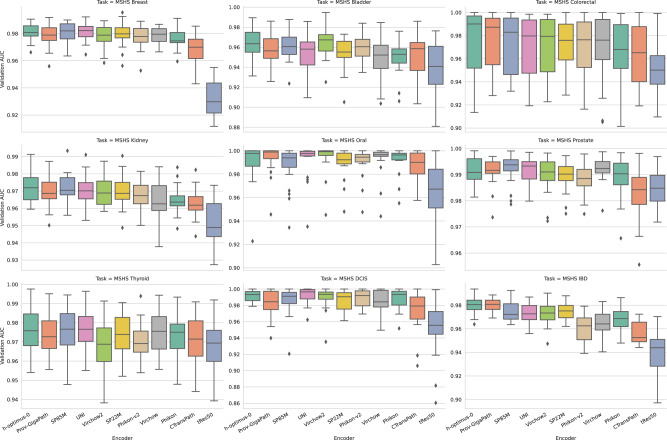
- For disease detection, all models achieved AUCs above 0.9; the ImageNet-pretrained encoder consistently underperformed pathology-trained encoders, and CTransPath was consistently inferior. The top 3 ranked models by average AUC were H-optimus-0, Prov-GigaPath, and SP85M.
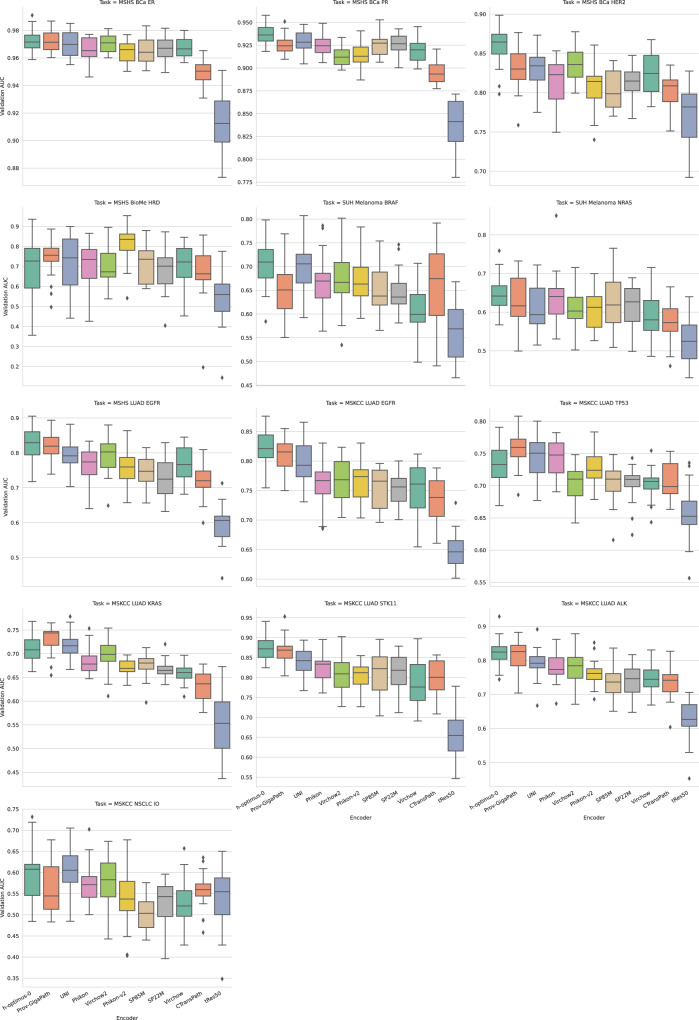
- Biomarker prediction was more variable. H-optimus-0, Prov-GigaPath, and UNI were top 3 ranked by average AUC; for ICI response in NSCLC, all models were barely above chance, with UNI performing significantly better at an average AUC of 0.6.
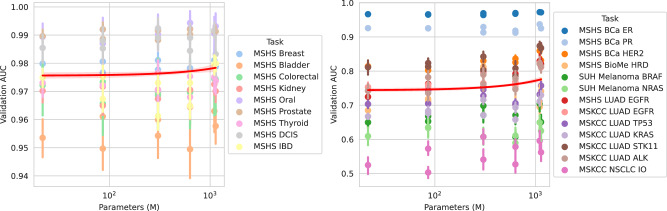
- Model size correlated weakly with detection performance (Pearson 0.055, p = 2.59e-2) and more with biomarker performance (Pearson 0.091, p = 9.52e-6). Pretraining dataset size showed no strong correlation: slides detection r = 0.008, p = 7.58e-01; biomarker r = −0.033, p = 1.07e-01; tiles detection r = 0.050, p = 7.79e-02; biomarker r = −0.048, p = 4.03e-02.
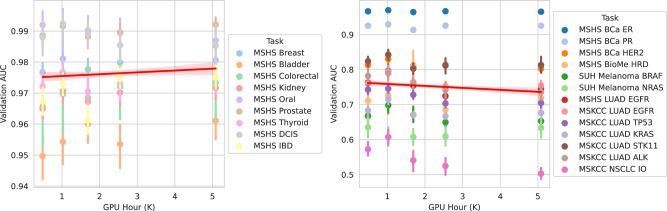
- Inference trade-offs: SP85M had average detection AUC 0.978 with 0.387 GB minimal memory, versus H-optimus-0 at 4.643 GB for a 0.2% average increase; UNI had average biomarker AUC 0.773 with 1.259 GB, versus H-optimus-0 at 4.643 GB and average AUC 0.785. Throughput ranged from 4417.4 TPS for truncated ResNet50 to 75.3 TPS for H-optimus-0; SP85M achieved 1063.6 TPS with a 0.2% average detection AUC decrease versus H-optimus-0.
Methods
- The benchmark used clinical slides from three institutions—Mount Sinai Health System (MSHS), Sahlgrenska University Hospital (SUH), and Memorial Sloan Kettering Cancer Center (MSKCC)—with detection tasks and biomarker prediction tasks summarized in Tables 2 and 3; all analysis was at 20x magnification (0.5 microns per pixel).
- For each slide, tiles were embedded with a frozen foundation model, then a Gated MIL Attention (GMA) aggregator with a linear classifier was trained. Generalization was estimated with Monte Carlo Cross-Validation: 80% train / 20% validation, 20 fixed MCCV folds, each run twice, 50 epochs with AdamW and peak learning rate 0.0001.
- Models benchmarked included CTransPath, UNI, Virchow, Prov-GigaPath, Virchow2, H-optimus-0, Phikon-v2, a truncated ResNet50 ImageNet baseline, and two in-house DINO-trained ViTs (SP22M, 21.7M parameters; SP85M, 85.8M parameters) pretrained on 423,563 H&E slides from 88,035 cases and 76,794 patients.
Limitations
- Stated: technical variability is limited to three institutions; the study focused on tile-level features using GMA with a linear classifier, with more complex aggregators out of scope; and for Virchow and Virchow2, overlap with MSKCC-based clinical tasks cannot be ruled out because they were trained on MSKCC slides.
- Stated: several questions could not be addressed due to lack of evidence, including optimal magnification, use of IHC slides, and benefits of multi-institutional pretraining data; the test data are not released to avoid data contamination.
- Evident from the text: the benchmark is not exhaustive, some scaling analyses excluded models due to missing data (e.g., Prov-GigaPath and H-optimus-0 for computational resources), and reported p-values were not adjusted for multiple hypothesis testing.
Model-written summary. Check it against the paper before relying on it.
Integrity signals
Registry
Cites
Statistics
Figures
Verification
Claims the paper makes
2 Valid · 1 Not valid · 8 Not checked · 71 Own results and interpretations
Every source the paper cites for this claim was checked and supports it.
In the paper
“ICI response prediction from H&E slides is a challenging task, yet there is evidence that descriptors of local cellular networks42, that better model the tumor microenvironment (TME) can achieve AUCs of around 0.7, on-par with PD-L1 IHC, the current clinical gold standard.”
§ A clinical benchmark of public self-supervised pathology foundation models > Results > Computational Biomarker Prediction Tasks
What the sources say
- Supportedcites [42] Xie, C. et al. Computational biomarker predicts lung ici response via deep learning-driven hierarchical spatial modelling from h&e. https://www.researchsquare.com/article/rs-1251762/v1 (2022). source
Split into 2 atoms — 2 confirmed, 0 partially supported, 0 disputed, 0 misattributed, 0 unverifiable. Expand the claim to see per-atom verdicts.
plainstates an association- Asserted: passes — The authors put it forward as true.
- Checkable: passes — It can be checked against evidence.
- Load-bearing: passes — The paper’s conclusions depend on it.
- Based: passes — The paper gives a reason why it holds.
- Supported
The sources with a verdict support this claim; the rest weren’t checked yet, have no full text we could read, or their verdicts aren’t rated yet.
In the paper
“It is becoming abundantly clear that using SSL to train image encoders on unlabeled pathology data is superior to relying on models pretrained on other domains such as natural images26,36,37.”
§ A clinical benchmark of public self-supervised pathology foundation models > Introduction
What the sources say
- Not checked yetcites [26] Campanella, G. et al. Computational pathology at health system scale–self-supervised foundation models from three billion images. Preprint at Xiv:2310.07033 (2023).
- Not checked yetcites [36] Kang, M., Song, H., Park, S., Yoo, D. & Pereira, S. Benchmarking self-supervised learning on diverse pathology datasets. In Proc. IEEE/CVF Conference on Computer Vision and Pattern Recognition 3344–3354 (IEEE, 2023). source
- Supportedcites [37] Campanella, G. et al. A clinical benchmark of public self-supervised pathology foundation models. Preprint at arXiv:2407.06508 (2024). PMC12003829 40240324 source
The cited sentence appears verbatim in our copy's Introduction ('It is becoming abundantly clear that using SSL to train image encoders on unlabeled pathology data is superior to relying on models pretrained on other domains such as natural images'), and the paper's own results back it: Results > Disease Detection Tasks states 'The ImageNet pretrained encoder is consistently under-performing the pathology trained encoders,' statistically significant across tasks except the Thyroid cohort, and the Discussion summarizes that 'the ImageNet pretrained encoder, and CTransPath to a lesser degree, consistently underperformed compared to newer models.' The Introduction likewise frames the prior reliance on natural-image encoders as a limitation SSL for pathology addresses. No qualifier in the claim is unsupported by our copy. (LLM, conf=0.92)
boostedstates a cause- Asserted: passes — The authors put it forward as true.
- Checkable: passes — It can be checked against evidence.
- Load-bearing: passes — The paper’s conclusions depend on it.
- Based: passes — The paper gives a reason why it holds.
A result the paper reports from its own data — it cites no other source for it, so there is none to check. The quote shows it is in the paper.
In the paper
“We also found that model size and pretraining dataset composition influenced performance, particularly for biomarker prediction, but not necessarily for disease detection.”
§ A clinical benchmark of public self-supervised pathology foundation models > Discussion
hedged- Asserted: passes — The authors put it forward as true.
- Checkable: passes — It can be checked against evidence.
- Load-bearing: passes — The paper’s conclusions depend on it.
- Based: passes — The paper gives a reason why it holds.
A result the paper reports from its own data — it cites no other source for it, so there is none to check. The quote shows it is in the paper.
In the paper
“Requirements range from 0.127GB for SP22M, to 4.643GB for H-optimus-0 (see Supplementary Table 8).”
§ A clinical benchmark of public self-supervised pathology foundation models > Results > Foundation Model Inference
plain- Asserted: passes — The authors put it forward as true.
- Checkable: passes — It can be checked against evidence.
- Load-bearing: passes — The paper’s conclusions depend on it.
- Based: passes — The paper gives a reason why it holds.
A result the paper reports from its own data — it cites no other source for it, so there is none to check. The quote shows it is in the paper.
In the paper
“Ranking the models based on the average AUC across tasks (Supplementary Fig. 9), the top 3 ranked models are H-optimus-0, Prov-GigaPath, and SP85M.”
§ A clinical benchmark of public self-supervised pathology foundation models > Results > Disease Detection Tasks
plain- Asserted: passes — The authors put it forward as true.
- Checkable: passes — It can be checked against evidence.
- Load-bearing: unclear — It is unclear whether the paper’s conclusions depend on it.
- Based: passes — The paper gives a reason why it holds.
42 more claims
Create a free account to see all 82 claims and to verify the 15 references still open.
- Probably not a substantial claim. 11
- It may state two separate claims as one. 28
- The quote only partly states this claim. 1
Claims other papers make about this one
Each is checked against this paper’s own text: does it say what the citing paper says it does?
The source backs part of the claim, not all of it — or backs it for a different population, condition or comparison.
In the citing paper
“To ensure the diversity of the pretraining dataset, which has proven to be a key factor in successful patch encoders21, Mass-340K is distributed across 20 organs, different stains, diverse tissue types and scanned with various scanner types (Fig. 1a and Supplementary Table 1).”
From A multimodal whole-slide foundation model for pathology (2025) · cites this paper as [21]
Experimental — accuracy not yet measuredThe cited source says what the claim attributes to it.
In the citing paper
“It is becoming abundantly clear that using SSL to train image encoders on unlabeled pathology data is superior to relying on models pretrained on other domains such as natural images26,36,37.”
From A clinical benchmark of public self-supervised pathology foundation models (2025) · cites this paper as [37]
The check wasn’t confident either way, so it gives no verdict — never disputed.
In the citing paper
“Building on the success of knowledge distillation and masked image modeling86,87 for patch encoder pretraining21,22, TITAN introduces a large-scale pretraining paradigm that leverages millions of high-resolution region-of-interests (ROIs; at 8,192 × 8,192 pixels at 20× magnification) for scalable WSI encoding.”
From A multimodal whole-slide foundation model for pathology (2025) · cites this paper as [21]
Experimental — accuracy not yet measured
Self-check
Percentages, sums and reported differences re-computed from the paper’s own numbers.
Each contradiction between two passages listed here was confirmed by an independent check.
Rated minor: it would not touch a result — a value no result rests on, a p-value that stays on the same side of the significance level, or a conflict that is clerical, resolved elsewhere in the paper, or outside its own findings.
In the paper
§ A clinical benchmark of public self-supervised pathology foundation models > Results > Foundation Model Inference
“the best-performing H-optimus-0 which requires 4643GB”
§ A clinical benchmark of public self-supervised pathology foundation models > Results > Foundation Model Inference
“Requirements range from 0.127GB for SP22M, to 4.643GB for H-optimus-0”
Rated minor: it would not touch a result — a value no result rests on, a p-value that stays on the same side of the significance level, or a conflict that is clerical, resolved elsewhere in the paper, or outside its own findings.
In the paper
§ A clinical benchmark of public self-supervised pathology foundation models > Results > Foundation Model Inference
“The best-performing H-optimus-0 required 4.643GB to achieve an average AUC of 0.785, a 1.3% increase in performance over UNI.”
§ A clinical benchmark of public self-supervised pathology foundation models > Results > Foundation Model Inference
“UNI shows a 1.5% drop in average AUC (0.773 for UNI vs 0.785 for H-optimus-0)”
Rated minor: it would not touch a result — a value no result rests on, a p-value that stays on the same side of the significance level, or a conflict that is clerical, resolved elsewhere in the paper, or outside its own findings.
In the paper
§ A clinical benchmark of public self-supervised pathology foundation models > Results > Pretraining Dataset Composition
“For colon and rectum, we have two detection tasks.”
§ A clinical benchmark of public self-supervised pathology foundation models > Results > Pretraining Dataset Composition
“We didn’t observe a significant correlation between performance and tissue prevalence for the breast tasks considered with a Pearson statistic of 0.122 (p value: 8.59e-2, Supplementary Fig. 4c).”
Citations
Cites
LeCun, Y., Bengio, Y., & Hinton, G. (2015) · Nature · doi:10.1038/nature14539 · Cited by 84,126
An Image is Worth 16x16 Words: Transformers for Image Recognition at Scale
Dosovitskiy, A., Beyer, L., Kolesnikov, A., Weissenborn, D., Zhai, X., Unterthiner, T., Dehghani, M., Minderer, M., Heigold, G., Gelly, S., et al. (2020) · arXiv · doi:10.48550/arxiv.2010.11929 · Cited by 47,472 · cited 1×
“Convolutional neural networks (CNNs) and vision transformers 2 (ViTs) have been used to solve numerous problems using supervised learning and have enabled the training of predictive models for a variety of tasks with high performance 3 – 9 .”
Swin Transformer: Hierarchical Vision Transformer using Shifted Windows
Liu, Z., Lin, Y., Cao, Y., Hu, H., Wei, Y., Zhang, Z., Lin, S., & Guo, B. (2021) · 2021 IEEE/CVF International Conference on Computer Vision (ICCV) · doi:10.1109/iccv48922.2021.00986 · Cited by 35,534 · cited 1×
“Wang et al. 18 proposed SRCL, an SSL method based on MoCo v3 10 , along with CTransPath, a model architecture that combines convolutional layers with the Swin Transformer 19 model.”
Learning Transferable Visual Models From Natural Language Supervision
Radford, A., Kim, J. W., Hallacy, C., Ramesh, A., Goh, G., Agarwal, S., Sastry, G., Askell, A., Mishkin, P., Clark, J., et al. (2021) · arXiv · doi:10.48550/arxiv.2103.00020 · Cited by 15,293 · cited 1×
“Given the evidence from the natural language and vision domains that larger datasets and higher capacity models will produce better performance especially in the SSL setting 38 – 40 , training on larger pathology datasets should be a priority.”
Decoupled Weight Decay Regularization
Loshchilov, I., & Hutter, F. (2017) · arXiv · doi:10.48550/arxiv.1711.05101 · Cited by 12,522
The cancer genome atlas pan-cancer analysis project
The Cancer Genome Atlas Research Network, Weinstein, J. N., Collisson, E. A., Mills, G. B., Shaw, K. R. M., Ozenberger, B. A., Ellrott, K., Shmulevich, I., Sander, C., & Stuart, J. M. (2013) · Nature Genetics · doi:10.1038/ng.2764 · Cited by 9,092
Masked Autoencoders Are Scalable Vision Learners
He, K., Chen, X., Xie, S., Li, Y., Dollar, P., & Girshick, R. (2022) · 2022 IEEE/CVF Conference on Computer Vision and Pattern Recognition (CVPR) · doi:10.1109/cvpr52688.2022.01553 · Cited by 8,489 · cited 2×
“Xu et al. 30 introduced Prov-GigaPath, that was created by tile-level pretraining using DINOv2 24 , followed by slide-level pretraining using a masked autoencoder 27 and LongNet 31 .”
Comprehensive molecular profiling of lung adenocarcinoma
The Cancer Genome Atlas Research Network (2014) · Nature · doi:10.1038/nature13385 · Cited by 5,732 · cited 1×
“Prov-GigaPath was evaluated on 17 genomic prediction tasks and 9 cancer subtyping tasks using both Providence and TCGA 32 data.”
Emerging Properties in Self-Supervised Vision Transformers
Caron, M., Touvron, H., Misra, I., Jegou, H., Mairal, J., Bojanowski, P., & Joulin, A. (2021) · 2021 IEEE/CVF International Conference on Computer Vision (ICCV) · doi:10.1109/iccv48922.2021.00951 · Cited by 5,638 · cited 2×
“Campanella et al. 26 compared the performance of masked autoencoders 27 (MAE) and DINO 28 using over 3 billion tiles sourced from more than 423,000 pathology slides.”
InfluentialZehir, A., Benayed, R., Shah, R. H., Syed, A., Middha, S., Kim, H. R., Srinivasan, P., Gao, J., Chakravarty, D., Devlin, S. M., et al. (2017) · Nature Medicine · doi:10.1038/nm.4333 · Cited by 3,380
Coudray, N., Ocampo, P. S., Sakellaropoulos, T., Narula, N., Snuderl, M., Fenyö, D., Moreira, A. L., Razavian, N., & Tsirigos, A. (2018) · Nature Medicine · doi:10.1038/s41591-018-0177-5 · Cited by 2,930
Data-efficient and weakly supervised computational pathology on whole-slide images
Lu, M. Y., Williamson, D. F. K., Chen, T. Y., Chen, R. J., Barbieri, M., & Mahmood, F. (2021) · Nature Biomedical Engineering · doi:10.1038/s41551-020-00682-w · Cited by 2,282
An Empirical Study of Training Self-Supervised Vision Transformers
Chen, X., Xie, S., & He, K. (2021) · 2021 IEEE/CVF International Conference on Computer Vision (ICCV) · doi:10.1109/iccv48922.2021.00950 · Cited by 1,648 · cited 1×
“Wang et al. 18 proposed SRCL, an SSL method based on MoCo v3 10 , along with CTransPath, a model architecture that combines convolutional layers with the Swin Transformer 19 model.”
Towards a general-purpose foundation model for computational pathology
Chen, R. J., Ding, T., Lu, M. Y., Williamson, D. F. K., Jaume, G., Song, A. H., Chen, B., Zhang, A., Shao, D., Shaban, M., et al. (2024) · Nature Medicine · doi:10.1038/s41591-024-02857-3 · Cited by 1,560 · cited 2×
“Chen et al. 23 introduced UNI, a ViT-large model trained on 100,000 proprietary slides using the DINOv2 24 SSL algorithm.”
Predicting cancer outcomes from histology and genomics using convolutional networks
Mobadersany, P., Yousefi, S., Amgad, M., Gutman, D. A., Barnholtz-Sloan, J. S., Velázquez Vega, J. E., Brat, D. J., & Cooper, L. A. D. (2018) · Proceedings of the National Academy of Sciences · doi:10.1073/pnas.1717139115 · Cited by 1,084 · cited 1×
“Convolutional neural networks (CNNs) and vision transformers 2 (ViTs) have been used to solve numerous problems using supervised learning and have enabled the training of predictive models for a variety of tasks with high performance 3 – 9 .”
DINOv2: Learning Robust Visual Features without Supervision
Oquab, M., Darcet, T., Moutakanni, T., Vo, H., Szafraniec, M., Khalidov, V., Fernandez, P., Haziza, D., Massa, F., El-Nouby, A., et al. (2023) · arXiv · doi:10.48550/arxiv.2304.07193 · Cited by 1,078 · cited 3×
“Vorontsov et al. 25 introduced Virchow, a ViT-huge model trained on 2 billion tiles from almost 1.5 million proprietary slides with DINOv2 24 .”
InfluentialA whole-slide foundation model for digital pathology from real-world data
Xu, H., Usuyama, N., Bagga, J., Zhang, S., Rao, R., Naumann, T., Wong, C., Gero, Z., González, J., Gu, Y., et al. (2024) · Nature · doi:10.1038/s41586-024-07441-w · Cited by 921 · cited 1×
“Recent works show progress in this respect as the digitization of pathology data becomes more prevalent 25,30,33 .”
Transformer-based unsupervised contrastive learning for histopathological image classification
Wang, X., Yang, S., Zhang, J., Wang, M., Zhang, J., Yang, W., Huang, J., & Han, X. (2022) · Medical Image Analysis · doi:10.1016/j.media.2022.102559 · Cited by 751
Attention-based Deep Multiple Instance Learning
Ilse, M., Tomczak, J. M., & Welling, M. (2018) · arXiv (Cornell University) · doi:10.48550/arxiv.1802.04712 · Cited by 636
A foundation model for clinical-grade computational pathology and rare cancers detection
Vorontsov, E., Bozkurt, A., Casson, A., Shaikovski, G., Zelechowski, M., Severson, K., Zimmermann, E., Hall, J., Tenenholtz, N., Fusi, N., et al. (2024) · Nature Medicine · doi:10.1038/s41591-024-03141-0 · Cited by 572 · cited 3×
“Vorontsov et al. 25 introduced Virchow, a ViT-huge model trained on 2 billion tiles from almost 1.5 million proprietary slides with DINOv2 24 .”
InfluentialTabibu, S., Vinod, P. K., & Jawahar, C. V. (2019) · Scientific Reports · doi:10.1038/s41598-019-46718-3 · Cited by 245
Phikon-v2, A large and public feature extractor for biomarker predictionPreprint
Filiot, A., Jacob, P. M., Kain, A. M., & Saillard, C. (2024) · arXiv (Cornell University) · doi:10.48550/arxiv.2409.09173 · Cited by 204 · cited 1×
“Phikon-v2 35 , a self-supervised vision transformer trained using DINOv2 24 , demonstrates superior performance compared to its pre-decessor, Phikon-v1 21 , and achieves results comparable to other leading histopathology foundation models.”
iBOT: Image BERT Pre-Training with Online Tokenizer
Zhou, J., Wei, C., Wang, H., Shen, W., Xie, C., Yuille, A., & Kong, T. (2021) · arXiv (Cornell University) · doi:10.48550/arxiv.2111.07832 · Cited by 201 · cited 1×
“Filiot et al. 21 analyzed the performance of iBOT 22 , an SSL framework that combines masked image modeling and contrastive learning, on histology data.”
Benchmarking Self-Supervised Learning on Diverse Pathology Datasets
Kang, M., Song, H., Park, S., Yoo, D., & Pereira, S. (2023) · 2023 IEEE/CVF Conference on Computer Vision and Pattern Recognition (CVPR) · doi:10.1109/cvpr52729.2023.00326 · Cited by 187 · cited 3×
“In contrast to previous efforts 36,41 , the dataset consists of clinical data generated during standard hospital operations from three health systems.”
Akinyelu, A. A., Zaccagna, F., Grist, J. T., Castelli, M., & Rundo, L. (2022) · Journal of Imaging · doi:10.3390/jimaging8080205 · Cited by 180
Cheng, D. T., Prasad, M., Chekaluk, Y., Benayed, R., Sadowska, J., Zehir, A., Syed, A., Wang, Y. E., Somar, J., Li, Y., et al. (2017) · BMC Medical Genomics · doi:10.1186/s12920-017-0271-4 · Cited by 158
Scaling Self-Supervised Learning for Histopathology with Masked Image Modeling
Filiot, A., Ghermi, R., Olivier, A., Jacob, P., Fidon, L., Camara, A., Mac Kain, A., Saillard, C., & Schiratti, J.-B. (2023) · doi:10.1101/2023.07.21.23292757 · Cited by 148 · cited 2×
“Filiot et al. 21 analyzed the performance of iBOT 22 , an SSL framework that combines masked image modeling and contrastive learning, on histology data.”
Comparison of Deep Transfer Learning Strategies for Digital Pathology
Mormont, R., Geurts, P., & Maree, R. (2018) · 2018 IEEE/CVF Conference on Computer Vision and Pattern Recognition Workshops (CVPRW) · doi:10.1109/cvprw.2018.00303 · Cited by 123
Gao, Z., Hong, B., Zhang, X., Yang, L., Jia, C., Wu, J., Wang, C., Meng, D., & Li, C. (2021) · Lecture notes in computer science · doi:10.1007/978-3-030-87237-3_29 · Cited by 87
Comprehensive molecular profiling of lung adenocarcinoma
Lander, E. S. (2014) · DSpace@MIT (Massachusetts Institute of Technology) · Cited by 84
Benchmarking foundation models as feature extractors for weakly supervised computational pathology
Neidlinger, P., El Nahhas, O. S. M., Muti, H. S., Lenz, T., Hoffmeister, M., Brenner, H., van Treeck, M., Langer, R., Dislich, B., Behrens, H. M., et al. (2025) · Nature Biomedical Engineering · doi:10.1038/s41551-025-01516-3 · Cited by 80
Convolutional neural networks for prostate cancer recurrence prediction
Kumar, N., Verma, R., Arora, A., Kumar, A., Gupta, S., Sethi, A., & Gann, P. H. (2017) · Proceedings of SPIE, the International Society for Optical Engineering/Proceedings of SPIE · doi:10.1117/12.2255774 · Cited by 58 · cited 1×
“The exact parameters used for training can be found in the GitHub repository and in Supplementary Tables 4 and 5.”
Self-citationVirchow2: Scaling Self-Supervised Mixed Magnification Models in Pathology
Zimmermann, E., Vorontsov, E., Viret, J., Casson, A., Zelechowski, M., Shaikovski, G., Tenenholtz, N., Hall, J., Klimstra, D., Yousfi, R., et al. (2024) · arXiv · doi:10.48550/arxiv.2408.00738 · Cited by 53
Vision Models Are More Robust And Fair When Pretrained On Uncurated Images Without Supervision
Goyal, P., Duval, Q., Seessel, I., Caron, M., Misra, I., Sagun, L., Joulin, A., & Bojanowski, P. (2022) · arXiv (Cornell University) · doi:10.48550/arxiv.2202.08360 · Cited by 44 · cited 1×
“Given the evidence from the natural language and vision domains that larger datasets and higher capacity models will produce better performance especially in the SSL setting 38 – 40 , training on larger pathology datasets should be a priority.”
Explainable Survival Analysis with Convolution-Involved Vision Transformer
Shen, Y., Liu, L., Tang, Z. G., Chen, Z., Ma, G., Dong, J., Zhang, X., Yang, L., & Zheng, Q. (2022) · Proceedings of the AAAI Conference on Artificial Intelligence · doi:10.1609/aaai.v36i2.20118 · Cited by 35
A Survey of the Self Supervised Learning Mechanisms for Vision TransformersPreprint
Khan, A., Sohail, A., Fiaz, M., Hassan, M., Afridi, T. H., Marwat, S. U., Munir, F., Ali, S., Naseem, H., Zaheer, M. Z., et al. (2024) · arXiv (Cornell University) · doi:10.48550/arxiv.2408.17059 · Cited by 34 · cited 1×
“Recently, the development of self-supervised learning (SSL) algorithms has marked a paradigm shift by enabling the training of deep neural networks on very large unlabeled datasets, yielding results on par with supervised learning strategies 10,11 .”
LongNet: Scaling Transformers to 1, 000, 000, 000 Tokens
Ding, J., Ma, S., Dong, L., Zhang, X., Huang, S., Wang, W., Zheng, N., & Wei, F. (2023) · arXiv · doi:10.48550/arxiv.2307.02486 · Cited by 34 · cited 1×
“Xu et al. 30 introduced Prov-GigaPath, that was created by tile-level pretraining using DINOv2 24 , followed by slide-level pretraining using a masked autoencoder 27 and LongNet 31 .”
(2021) · arXiv (Cornell University) · Cited by 31 · cited 1×
“This is why most studies in computationalpathologyrelyonalreadyexistingpretrainedencoders, usuallytrainedonnaturalimagesandnotWSIs 12,14 – 17 .”
Benchmarking Embedding Aggregation Methods in Computational Pathology: A Clinical Data Perspective
Chen, S., Campanella, G. S. V., Elmas, A., Stock, A., Zeng, J. J., Polydorides, A. D., Schoenfeld, A. J., Huang, K.-L., Houldsworth, J., Vanderbilt, C., et al. (2024) · Proceedings of Machine Learning Research · doi:10.48550/arxiv.2407.07841 · Cited by 28 · cited 3×
“More research in this direction will be needed as there is currently a lack of strategies that are capable of fully leveraging the global topology of the tissue in a slide 43 .”
InfluentialSelf-citationRudolfV: A Foundation Model by Pathologists for Pathologists
Dippel, J., Feulner, B., Winterhoff, T., Milbich, T., Tietz, S., Schallenberg, S., Dernbach, G., Kunft, A., Heinke, S., Eich, M.-L., et al. (2024) · arXiv · doi:10.48550/arxiv.2401.04079 · Cited by 27 · cited 1×
“Their results showed the superiority of the DINO algorithm for pathology foundation model pretraining.”
Enolase-1 as a Prognostic Biomarker of Sepsis
Ζάρρος, Α. (2023) · Journal of Exploratory Research in Pharmacology · doi:10.14218/jerp.2022.00089 · Cited by 21
Carmichael, I., Song, A. H., Chen, R. J., Williamson, D. F. K., Chen, T. Y., & Mahmood, F. (2022) · Lecture Notes in Computer Science · doi:10.1007/978-3-031-16434-7_38 · Cited by 20
H&E-based Computational Biomarker Enables Universal EGFR Screening for Lung AdenocarcinomaPreprint
Campanella, G. S. V., Ho, D. D., Häggström, I., Becker, A. S., Chang, J. S., Vanderbilt, C., & Fuchs, T. J. (2022) · arXiv (Cornell University) · doi:10.48550/arxiv.2206.10573 · Cited by 19 · cited 1×
“For the other models, it is more dif-fi cult to make general statements.”
Self-citationCampanella, G., Kwan, R., Fluder, E., Zeng, J., Stock, A., Veremis, B., Polydorides, A. D., Hedvat, C., Schoenfeld, A., Vanderbilt, C., et al. (2023) · arXiv · doi:10.48550/arxiv.2310.07033 · Cited by 15 · cited 3×
“Slides were included from 17 tissue types and the performance on downstream tasks was evaluated using tile-level and slide-level benchmarks, encompassing tissue classi fi cation and biomarker prediction.”
InfluentialSelf-citationVerma, R., Alban, T. J., Parthasarathy, P. B., Mokhtari, M., Toro, P., Cohen, M. L., Lathia, J. D., Ahluwalia, M. S., & Tiwari, P. (2024) · Science Advances · doi:10.1126/sciadv.adi0302 · Cited by 13
Self-citationBenchmarking foundation models as feature extractors for weakly-supervised computational pathologyPreprint
Neidlinger, P., Nahhas, O. S. M. E., Muti, H. S., Lenz, T., Hoffmeister, M., Brenner, H., van Treeck, M., Langer, R., Dislich, B., Behrens, H.-M., et al. (2024) · arXiv (Cornell University) · doi:10.48550/arxiv.2408.15823 · Cited by 13 · cited 2×
“In contrast to previous efforts 36,41 , the dataset consists of clinical data generated during standard hospital operations from three health systems.”
Xie, C., Vanderbilt, C., Feng, C., Ho, D., Campanella, G., Egger, J., Plodkowski, A., Girshman, J., Sawan, P., Arbour, K., et al. (2022) · doi:10.21203/rs.3.rs-1251762/v1 · Cited by 8 · cited 1×
“While there was an indication of positive correlation for the lung tasks, the same was not the case for the other organs tested.”
Self-citationA Clinical Benchmark of Public Self-Supervised Pathology Foundation ModelsPreprint
Campanella, G. S. V., Chen, S., Verma, R., et al. (2024) · arXiv (Cornell University) · doi:10.48550/arxiv.2407.06508 · Cited by 7
Self-citationGao, Z., Hong, B., Zhang, X., et al. (2021) · arXiv (Cornell University) · doi:10.48550/arxiv.2106.12265 · Cited by 5 · cited 1×
“Convolutional neural networks (CNNs) and vision transformers 2 (ViTs) have been used to solve numerous problems using supervised learning and have enabled the training of predictive models for a variety of tasks with high performance 3 – 9 .”
Carmichael, I. D., Song, A. H., Chen, R. J., et al. (2022) · arXiv (Cornell University) · doi:10.48550/arxiv.2206.08885 · Cited by 1 · cited 1×
“This is why most studies in computationalpathologyrelyonalreadyexistingpretrainedencoders, usuallytrainedonnaturalimagesandnotWSIs 12,14 – 17 .”
sinai-computational-pathology/SSL_tile_benchmarks: First Release
Campanella, G. (2025) · Zenodo (CERN European Organization for Nuclear Research) · doi:10.5281/zenodo.15110130 · Cited by 1
Self-citation
Cited by
Hallmarks of cancer—Then and now, and beyond
Hanahan, D. (2026) · Cell · doi:10.1016/j.cell.2025.12.049 · Cited by 225
A multimodal whole-slide foundation model for pathology
Ding, T., Wagner, S. J., Song, A. H., Chen, R. J., Lu, M. Y., Zhang, A., Vaidya, A. J., Jaume, G., Shaban, M., Kim, A., et al. (2025) · Nature Medicine · doi:10.1038/s41591-025-03982-3 · Cited by 171
“Building on the success of knowledge distillation and masked image modeling 86,87 for patch encoder pretraining 21,22 , TITAN introduces a large-scale pretraining paradigm that leverages millions of high-resolution region-of-interests (ROIs; at 8,192 × 8,192 pixels at 20× magnification) for…”
InfluentialBreen, J., Allen, K., Zucker, K., Godson, L., Orsi, N. M., & Ravikumar, N. (2025) · npj Precision Oncology · doi:10.1038/s41698-025-00799-8 · Cited by 82
“Histopathology foundation models have exhibited impressive performance across diverse tasks 37,46 – 49 including ovarian cancer subtyping 15,24,25 , although analyses have been relatively shallow, without thorough hyperparameter tuning and rigorous statistical comparison of downstream models.”
Application of artificial intelligence and digital tools in cancer pathology
Shaktah, L., Carrero, Z. I., Hewitt, K. J., Gustav, M., Cecchini, M. J., Foersch, S., Berezowska, S., & Kather, J. N. (2025) · The Lancet Digital Health · doi:10.1016/j.landig.2025.100933 · Cited by 52
Uncertainty-aware ensemble of foundation models differentiates glioblastoma from its mimics
Zhao, J., Lin, S.-Y., Attias, R., Mathews, L., Engel, C., Larghero, G., Vremenko, D., Kao, T., Lee, T.-H., Wang, Y.-H., et al. (2025) · Nature Communications · doi:10.1038/s41467-025-64249-6 · Cited by 27
Metadata
- Authors
- Campanella, G., Chen, S., Singh, M., Verma, R., Muehlstedt, S., Zeng, J., Stock, A., Croken, M., Veremis, B., Elmas, A., Shujski, I., Neittaanmäki, N., Huang, K.-L., Kwan, R., Houldsworth, J., Schoenfeld, A. J., & Vanderbilt, C.
- Affiliations
- Icahn School of Medicine at Mount Sinai (US)
- Sahlgrenska University Hospital (SE)
- Memorial Sloan Kettering Cancer Center (US)
- Corresponding author
- Campanella, Gabriele
- Vanderbilt, Chad
- ORCID
- Venue
- Nature Communications
- Published
- 2025-04-17
- Volume
- 16
- Issue
- 1
- Pages
- 3640-3640
- ISSN
- 2041-1723 (ISSN-L)
- PMC
- PMC12003829
- OpenAlex
- W4409488923
- Semantic Scholar
- 7f9ceffdf4ddd8effa16679d8746c6a3844a7dbf
- Cited by
- 126
- References
- 42
- Citations by year
- 2026: 90 · 2025: 34
- FWCI
- 49.74
- Type
- journal article
- Language
- en
- Open access
- gold
- doi.org
- Licence
- cc-by-nc-nd
- creativecommons.org/licenses/by-nc-nd/4.0 (tdm)
- creativecommons.org/licenses/by-nc-nd/4.0 (vor)
- Locations
- Nature Communications (publishedVersion, cc-by-nc-nd)
- PubMed Central (publishedVersion, cc-by-nc-nd)
- PubMed (publishedVersion)
- arXiv (Cornell University) (submittedVersion, cc-by)
- RePEc: Research Papers in Economics (submittedVersion)
- DOAJ (DOAJ: Directory of Open Access Journals) (submittedVersion, cc-by-sa)
- arXiv (Cornell University) (cc-by)
- Funders
- U.S. Department of Health & Human Services | NIH | U.S. National Library of Medicine (LM013766)
- Grant from the Warren Alpert Foundation through the Warren Alpert Center for Digital and Computational Pathology at Memorial Sloan Kettering Cancer Center
- Topics
- Physical Sciences › Computer Science › Artificial Intelligence › AI in cancer detection
- Health Sciences › Medicine › Radiology, Nuclear Medicine and Imaging › Radiomics and Machine Learning in Medical Imaging
- Health Sciences › Medicine › Health Informatics › Artificial Intelligence in Healthcare and Education
- Keywords
- pathology foundation models, self-supervised learning, computational pathology, benchmarking, cancer diagnosis, biomarkers
- MeSH terms
- Supervised Machine Learning, Algorithms, Humans, Neoplasms, Benchmarking
About these checks
Registry, retraction, Cites and statistics results are computed, not judged, with one exception: a printed reference that no index lists is read once by a model before it counts as a citation error. Claims are extracted by a model and kept only when their quote appears verbatim in the text; each cited source is then checked, with a model’s help, for whether it says what the claim relies on. Those verdicts can be wrong — read the claim’s quote and the cited source before relying on one.
The claim verdicts this report counts are experimental: their accuracy is not yet measured.
A language model drew the claims from the paper on 2026-10-01, under version 3 of the claim definition (model deepseek-v4.1-flash, prompt extract-v3).
A second model labelled each claim on 2026-10-01 (model jev-1.13-20260917, definition revision gold-guideline-v0.2).
Cited sources are checked with a language model’s help (qwen3.8-omni-flash).
Statistics and arithmetic are recomputed, not judged.
Confidence bands are shown only for fields calibrated on our annotated test set. None is calibrated yet, so no band is shown.
What counts as a claim ›How we measure confidence ›How we check this ›
Are you an author, or do you see a problem with this page? Request a review
Data sources
Bibliographic data: Semantic Scholar, OpenAlex, Crossref.
Contains information from the Semantic Scholar Academic Graph Datasets, made available under the ODC Attribution License (ODC-BY 1.0).
Semantic Scholar’s data is described in: Kinney, R., et al. (2023). The Semantic Scholar Open Data Platform. arXiv:2301.10140.
