

ACE2 from Pipistrellus abramus bats is a receptor for HKU5 coronaviruses
Open accessThe DOI matches its Crossref record; 110 of the 110 references it cites were found in a registry or an index; none of the 103 sources its claims cite is checked for support yet.
Abstract
The merbecovirus subgenus of coronaviruses includes Middle East Respiratory Syndrome Coronavirus (MERS-CoV), a zoonotic pathogen transmitted from dromedary camels to humans that causes severe respiratory disease. Viral discovery efforts uncover hundreds of merbecoviruses in different species across multiple continents, but few are studied under laboratory conditions, leaving basic questions regarding their human threat potential unresolved. Viral entry into host cells is a critical step for transmission between hosts. Here, we develop and apply a scalable approach to assesses novel merbecovirus cell entry across the entire merbecovirus subgenus. Merbecoviruses are sorted into clades based on the receptor-binding domain of the spike glycoprotein. Receptor tropism is clade-specific, with the clade including MERS-CoV using DPP4 and multiple clades using ACE2, including HKU5 bat coronaviruses. Mutational analysis identifies possible structural limitations to HKU5 adaptability and a cryo-EM structure of the HKU5-20s spike trimer reveals only 'down' RBDs.
Overview
CoChat Summary
TL;DR
Merbecovirus RBDs sort into four clades with clade-specific receptor use, and clade 2 HKU5 bat coronaviruses use ACE2 from their natural host *Pipistrellus abramus*. A replication-competent HKU5 molecular clone and full-length HKU5 spike enter cells expressing *P. abramus* ACE2, and the HKU5-20s spike trimer cryo-EM structure shows only “down” RBDs.
Key findings
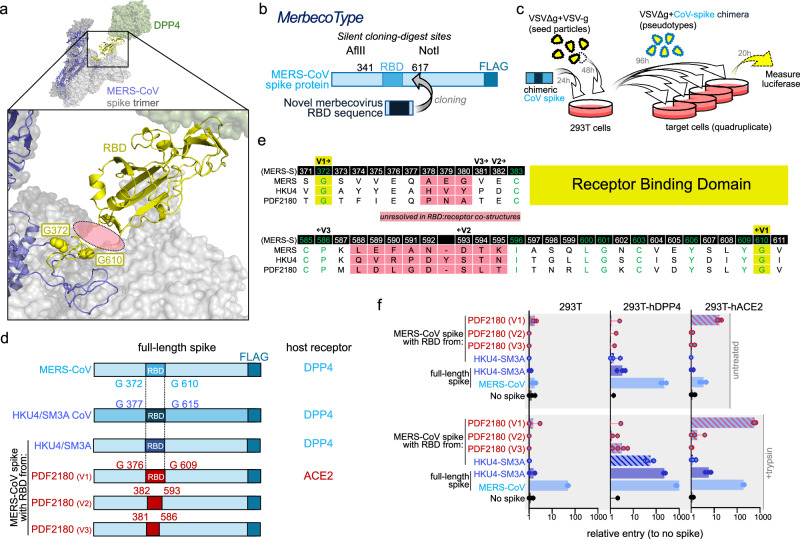
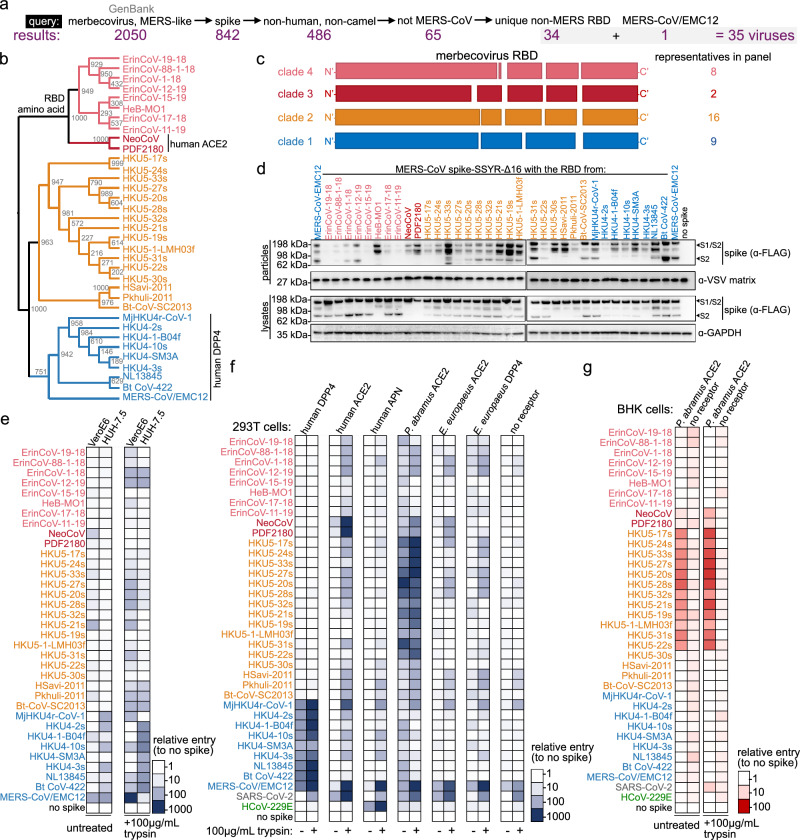
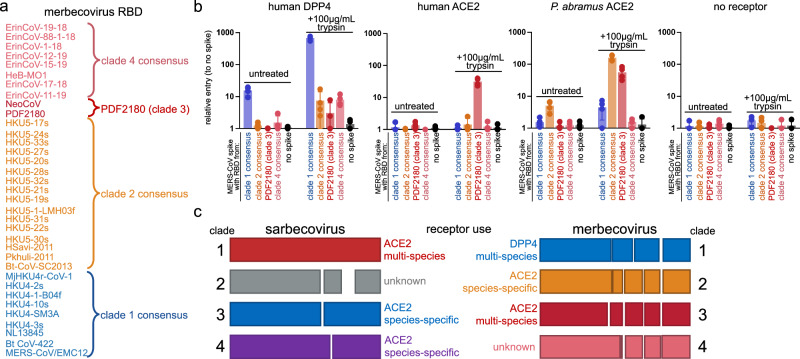
- Across 65 full-length merbecovirus spike sequences yielding 34 unique RBDs, receptor tropism was clade-specific: clade 1 used DPP4; clade 2 showed species-specific ACE2 preference; clade 3 used ACE2 more broadly; clade 4 showed no clear entry with the receptors tested.
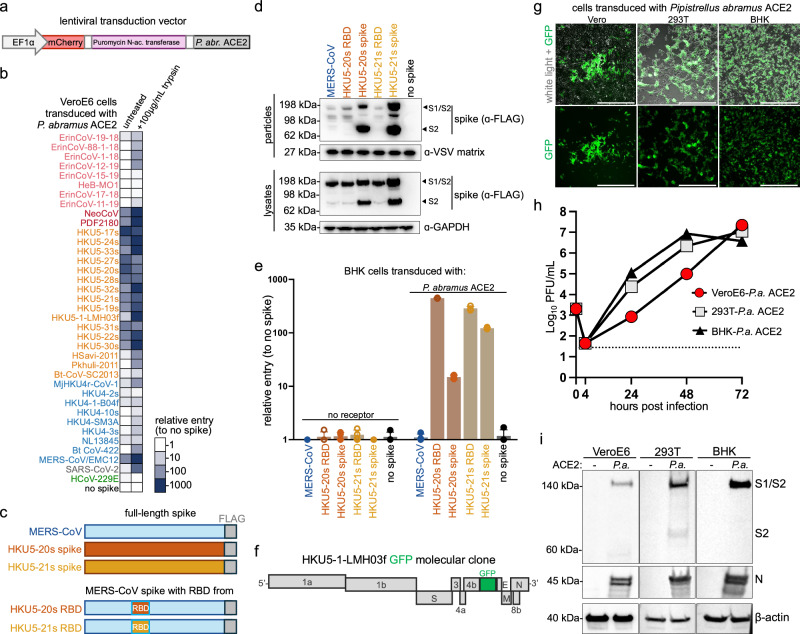
- HKU5 clade 2 RBDs and full-length HKU5-20s/21s spikes entered cells expressing *Pipistrellus abramus* ACE2, including BHK and VeroE6 cells transduced with that receptor; a replication-competent HKU5-GFP molecular clone replicated in Vero, 293T, and BHK cells stably expressing *P. abramus* ACE2.
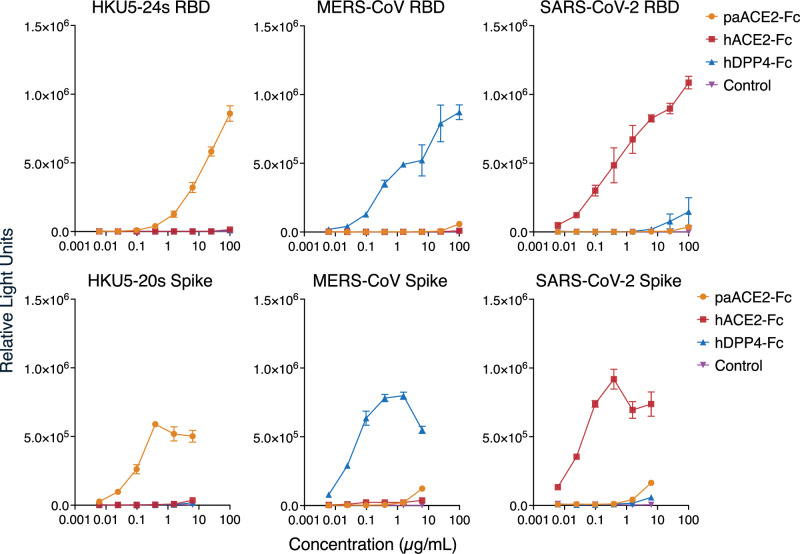
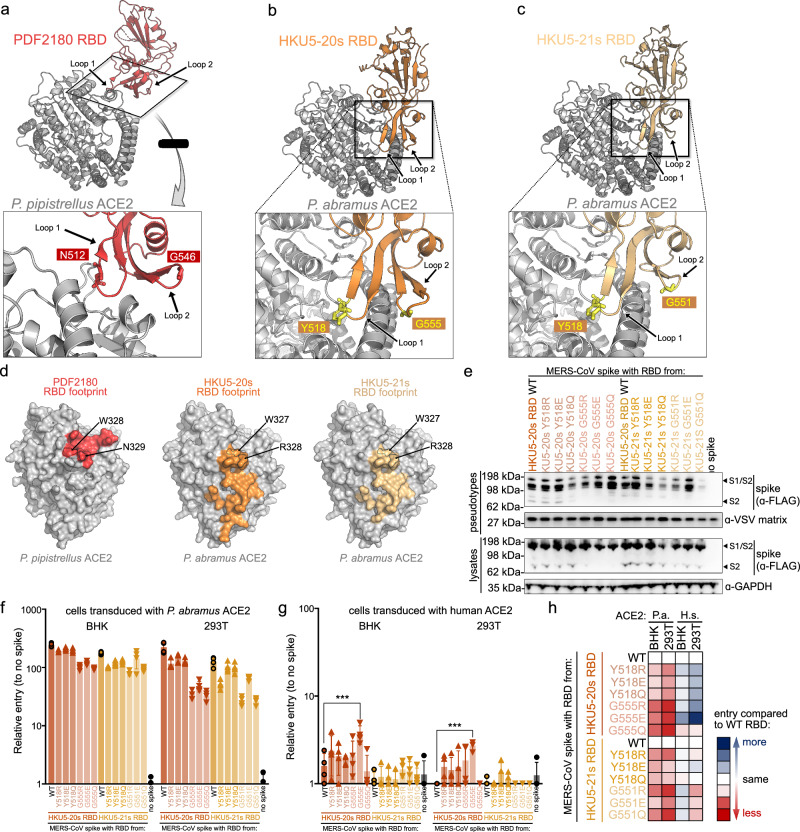
- ELISA showed dose-dependent binding of HKU5-24s RBD and full-length spike to *P. abramus* ACE2; AlphaFold3 predicted a HKU5 RBD interface involving Loop 1 and Loop 2, and Loop 2 mutations disrupted *P. abramus* ACE2 entry, with some HKU5-20s Loop 2 mutations increasing human ACE2 entry.
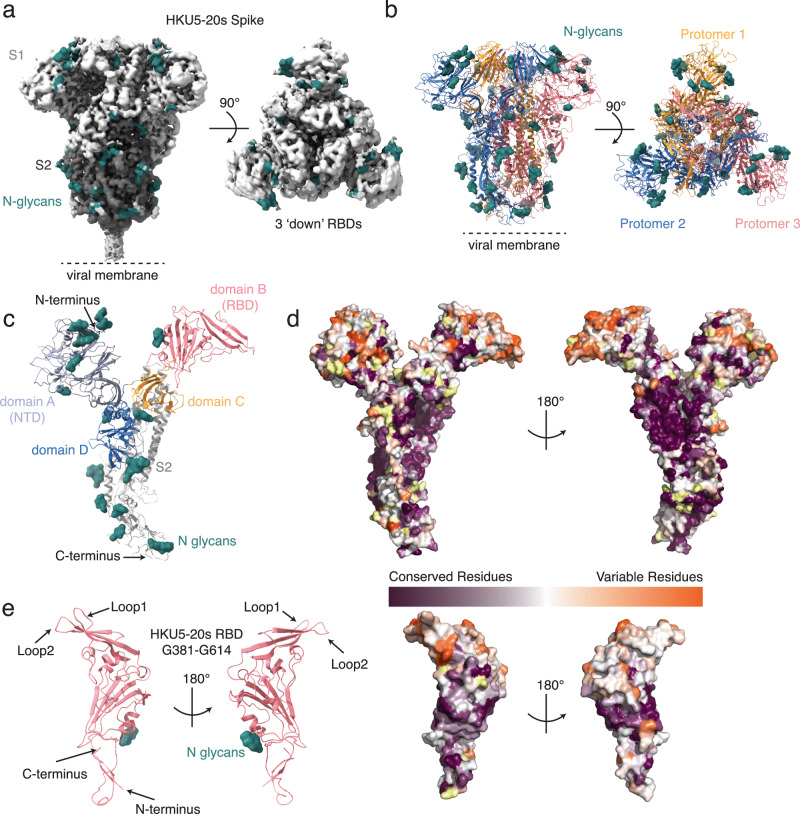
- Cryo-EM of the HKU5-20s spike trimer yielded a 2.8 Å structure with only “down” RBDs and no identifiable *P. abramus* ACE2 density.
Methods
- Generated chimeric MERS-CoV spikes by replacing the RBD between conserved glycines with 34 merbecovirus RBDs, produced VSV pseudotypes, and measured entry in 293T, VeroE6, Huh-7.5, and BHK cells with or without 100 μg/mL trypsin; entry assays used quadruplicate technical replicates and 2-way ANOVA with Tukey correction for mutation comparisons.
- Validated findings with full-length HKU5-20s/21s spike pseudotypes, a replication-competent HKU5-GFP molecular clone under BSL3 conditions, Huh7.5 ACE2/DPP4 double-knockout complementation, and ELISAs using recombinant RBD/spike and receptor-Fc fusions.
- Predicted HKU5 RBD–paACE2 interfaces with AlphaFold3 and determined a single-particle cryo-EM structure of a 2P-stabilized HKU5-20s trimeric ectodomain at 2.8 Å with C3 symmetry; sequence conservation was mapped using 10 representative merbecovirus spikes.
Limitations
- Stated: clade 4 merbecoviruses showed no clear entry with the DPP4 or ACE2 receptors tested; the authors note they may use these receptors in untested hosts, may use another receptor, or the chimeric RBD approach may miss interactions outside the RBD boundaries or require extracellular factors.
- Stated: cryo-EM grids yielded only unbound HKU5-20s spike trimer with no identifiable paACE2 density, so binding conditions need optimization; AlphaFold3 predictions require deep mutational scanning and comparative structural studies.
- Stated/evident: the study tested lineage 1 HKU5 viruses; lineage 2 HKU5 was reported by others to use human ACE2 with trypsin, and many lineage 1 HKU5 viruses showed only low-level human ACE2 entry with trypsin, which the paper calls borderline and difficult to interpret. Some merbecoviruses are also likely missing from the GenBank panel because of evolving nomenclature and incomplete metadata.
Model-written summary. Check it against the paper before relying on it.
Integrity signals
Registry
Cites
Statistics
Figures
Verification
Claims the paper makes
0 Valid · 1 Not valid · 45 Not checked · 99 Own results and interpretations
A result the paper reports from its own data — it cites no other source for it, so there is none to check. The quote shows it is in the paper.
In the paper
“However, closer inspection of published spike sequences revealed several highly conserved glycine residues flanking the RBD (MERS-CoV spike positions 372 and 610; Fig. 1a, d, e).”
§ ACE2 from Pipistrellus abramus bats is a receptor for HKU5 coronaviruses > Results > Mapping the functional receptor binding domain
plain- Asserted: passes — The authors put it forward as true.
- Checkable: passes — It can be checked against evidence.
- Load-bearing: passes — The paper’s conclusions depend on it.
- Based: passes — The paper gives a reason why it holds.
A result the paper reports from its own data — it cites no other source for it, so there is none to check. The quote shows it is in the paper.
In the paper
“Following transfection with Pipstrellus abramus ACE2, BHK cells became highly permissive for HKU5 RBD-mediated entry (Fig. 2g).”
§ ACE2 from Pipistrellus abramus bats is a receptor for HKU5 coronaviruses > Results > Merbecovirus RBD screen reveals a receptor for the HKU5 complex
plainstates a cause- Asserted: passes — The authors put it forward as true.
- Checkable: passes — It can be checked against evidence.
- Load-bearing: passes — The paper’s conclusions depend on it.
- Based: passes — The paper gives a reason why it holds.
- Rests on an assumption not shown here.
A result the paper reports from its own data — it cites no other source for it, so there is none to check. The quote shows it is in the paper.
In the paper
“Pseudotypes bearing chimeric consensus RBD spikes generally reflected clade-specific entry phenotypes observed for individual RBDs from previous experiments (Fig. 5b, c)”
§ ACE2 from Pipistrellus abramus bats is a receptor for HKU5 coronaviruses > Results > Consensus sequences mimic clade-specific entry phenotypes
hedgedstates an association- Asserted: passes — The authors put it forward as true.
- Checkable: passes — It can be checked against evidence.
- Load-bearing: passes — The paper’s conclusions depend on it.
- Based: passes — The paper gives a reason why it holds.
A result the paper reports from its own data — it cites no other source for it, so there is none to check. The quote shows it is in the paper.
In the paper
“Exogenous trypsin moderately increased entry in untransduced 293 T cells for human coronaviruses MERS-CoV and SARS-CoV-2, which uses human DPP4 and human ACE2, respectively, suggesting low levels of the human receptors were present on 293 T cells (Fig. 2f).”
§ ACE2 from Pipistrellus abramus bats is a receptor for HKU5 coronaviruses > Results > Merbecovirus RBD screen reveals a receptor for the HKU5 complex
hedgedstates a cause- Asserted: passes — The authors put it forward as true.
- Checkable: passes — It can be checked against evidence.
- Load-bearing: unclear — It is unclear whether the paper’s conclusions depend on it.
- Based: passes — The paper gives a reason why it holds.
- Rests on an assumption not shown here.
A result the paper reports from its own data — it cites no other source for it, so there is none to check. The quote shows it is in the paper.
In the paper
“while cells expressing human ACE2 exhibited low level susceptibility to SARS-CoV-2 spike and clade 3 merbecovirus RBDs (Fig. 2f).”
§ ACE2 from Pipistrellus abramus bats is a receptor for HKU5 coronaviruses > Results > Merbecovirus RBD screen reveals a receptor for the HKU5 complex
plainstates an association- Asserted: passes — The authors put it forward as true.
- Checkable: passes — It can be checked against evidence.
- Load-bearing: unclear — It is unclear whether the paper’s conclusions depend on it.
- Based: passes — The paper gives a reason why it holds.
57 more claims
Create a free account to see all 145 claims and to verify the 103 references still open.
- Probably not a substantial claim. 56
- It may state two separate claims as one. 46
Self-check
Percentages, sums and reported differences re-computed from the paper’s own numbers.
Each contradiction between two passages listed here was confirmed by an independent check.
Rated minor: it would not touch a result — a value no result rests on, a p-value that stays on the same side of the significance level, or a conflict that is clerical, resolved elsewhere in the paper, or outside its own findings.
In the paper
§ ACE2 from Pipistrellus abramus bats is a receptor for HKU5 coronaviruses > Results > HKU5 RBD mutations influence species compatibility
“a Co-structure for PDF2180 RBD and Pipistrellus pipistrellus ACE2 (PDB ID: 7wpz).”
§ ACE2 from Pipistrellus abramus bats is a receptor for HKU5 coronaviruses > Methods > Structure prediction and docking
“the co-structure of NeoCoV-RBD with P. pipistrellus ACE2 (PDB ID: 7WPZ)22”
Rated minor: it would not touch a result — a value no result rests on, a p-value that stays on the same side of the significance level, or a conflict that is clerical, resolved elsewhere in the paper, or outside its own findings.
In the paper
§ ACE2 from Pipistrellus abramus bats is a receptor for HKU5 coronaviruses > Methods > Statistics and reproducibility
“Statistical significance for mutation comparisons in Fig. 5 were determined by 2-way ANOVA with Tukey correction for multiple comparisons (GraphPad Prism v.9.5.1).”
§ ACE2 from Pipistrellus abramus bats is a receptor for HKU5 coronaviruses > Results > HKU5 RBD mutations influence species compatibility
“Figure: Fig. 6 Structure-guided mutagenesis at the HKU5:ACE2 interface. a Co-structure for PDF2180 RBD and Pipistrellus pipistrellus ACE2 (PDB ID: 7wpz).”
Citations
Cites
Highly accurate protein structure prediction with AlphaFold
Jumper, J., Evans, R., Pritzel, A., Green, T., Figurnov, M., Ronneberger, O., Tunyasuvunakool, K., Bates, R., Žídek, A., Potapenko, A., et al. (2021) · Nature · doi:10.1038/s41586-021-03819-2 · Cited by 43,764 · cited 1×
“6) 62 .”
Hoffmann, M., Kleine-Weber, H., Schroeder, S., Krüger, N., Herrler, T., Erichsen, S., Schiergens, T. S., Herrler, G., Wu, N.-H., Nitsche, A., et al. (2020) · Cell · doi:10.1016/j.cell.2020.02.052 · Cited by 20,286
Guindon, S., Dufayard, J.-F., Lefort, V., Anisimova, M., Hordijk, W., & Gascuel, O. (2010) · Systematic Biology · doi:10.1093/sysbio/syq010 · Cited by 18,376
cryoSPARC: algorithms for rapid unsupervised cryo-EM structure determination
Punjani, A., Rubinstein, J. L., Fleet, D. J., & Brubaker, M. A. (2017) · Nature Methods · doi:10.1038/nmeth.4169 · Cited by 11,626
UCSF ChimeraX: Structure visualization for researchers, educators, and developers
Pettersen, E. F., Goddard, T. D., Huang, C. C., Meng, E. C., Couch, G. S., Croll, T. I., Morris, J. H., & Ferrin, T. E. (2021) · Protein Science · doi:10.1002/pro.3943 · Cited by 9,514 · cited 1×
“Structure fi gures were made using ChimeraX 91 .”
Structure of the SARS-CoV-2 spike receptor-binding domain bound to the ACE2 receptor
Lan, J., Ge, J., Yu, J., Shan, S., Zhou, H., Fan, S., Zhang, Q., Shi, X., Wang, Q., Zhang, L., et al. (2020) · Nature · doi:10.1038/s41586-020-2180-5 · Cited by 5,983 · cited 1×
“…closer inspection of PDF2180 and HKU5 RBD interfaces with ACE2 reveals both viruses interact with ACE2 residues 328/329: a region that is also part of the interaction with RBDs from SARS-CoV-1, SARS-CoV-2 and NL63 spikes, implying this region may be a hot spot for viral interactions 19,73,74 (Fig.”
Isolation of a Novel Coronavirus from a Man with Pneumonia in Saudi Arabia
Zaki, A. M., van Boheemen, S., Bestebroer, T. M., Osterhaus, A. D. M. E., & Fouchier, R. A. M. (2012) · New England Journal of Medicine · doi:10.1056/nejmoa1211721 · Cited by 5,735 · cited 3×
“MERS-CoV was selected as the recipient spike backbone because of its extensive structural characterization and compatibility with cell-culture based models of mer-becovirus entry 1,31 – 33 .”
Automated electron microscope tomography using robust prediction of specimen movements
Mastronarde, D. N. (2005) · Journal of Structural Biology · doi:10.1016/j.jsb.2005.07.007 · Cited by 5,336 · cited 1×
“A single-particle cryo-EM dataset for HKU5-20s spike 2 P with paACE2-Fc was collected using SerialEM automated data collection software 89 on a 200keV Talos Arctica cryo-electron microscope (Thermo Fisher Scienti fi c) equipped with a K3 camera (Gatan) (Supplementary Table 1).”
Ashkenazy, H., Abadi, S., Martz, E., Chay, O., Mayrose, I., Pupko, T., & Ben-Tal, N. (2016) · Nucleic Acids Research · doi:10.1093/nar/gkw408 · Cited by 3,163
Letko, M., Marzi, A., & Munster, V. (2020) · Nature Microbiology · doi:10.1038/s41564-020-0688-y · Cited by 3,109 · cited 10×
“Lysates were clari fi ed, boiled, reduced and equivalent volumes of lysate were separated on 10% Bis-Tris gels in MOPS buffer (Invitrogen NuPage) 25 .”
InfluentialSelf-citation
Cited by
Bat-infecting merbecovirus HKU5-CoV lineage 2 can use human ACE2 as a cell entry receptor
Chen, J., Zhang, W., Li, Y., Liu, C., Dong, T., Chen, H., Wu, C., Su, J., Li, B., Zhang, W., et al. (2025) · Cell · doi:10.1016/j.cell.2025.01.042 · Cited by 113
“30,31 However, neither study reported that these HKU5-CoV-1 can efficiently utilize human ACE2 for cellular entry.”
Human coronavirus HKU1 recognition of the TMPRSS2 host receptor
McCallum, M., Park, Y., Stewart, C., Sprouse, K. R., Addetia, A., Brown, J. T., Tortorici, M. A., Gibson, C. A., Wong, E., Ieven, M. M., et al. (2024) · Cell · doi:10.1016/j.cell.2024.06.006 · Cited by 57
Multiple independent acquisitions of ACE2 usage in MERS-related coronaviruses
Ma, C., Liu, C., Park, Y., Tang, J., Chen, J., Xiong, Q., Lee, J., Stewart, C., Asarnow, D. E., Brown, J. T., et al. (2025) · Cell · doi:10.1016/j.cell.2024.12.031 · Cited by 55
Molecular basis of convergent evolution of ACE2 receptor utilization among HKU5 coronaviruses
Park, Y.-J., Liu, C., Lee, J., Brown, J. T., Ma, C.-B., Liu, P., Gen, R., Xiong, Q., Zepeda, S. K., Stewart, C., et al. (2025) · Cell · doi:10.1016/j.cell.2024.12.032 · Cited by 52
A MERS-CoV-like mink coronavirus uses ACE2 as an entry receptor
Wang, N., Ji, W., Jiao, H., Veit, M., Sun, J., Wang, Y., Ma, X., Wang, Y., Wang, Y., Li, X., et al. (2025) · Nature · doi:10.1038/s41586-025-09007-w · Cited by 34
“During the preparation of this article, we identified two publications 33,41 and three preprints 31,43,44 with overlapping yet distinctive findings.”
Metadata
- Authors
- Catanzaro, N. J., Wu, Z., Fan, C., Jefferson, V., Abdelgadir, A., Schäfer, A., Yount, B. L., Bjorkman, P. J., Baric, R., & Letko, M.
- Affiliations
- University of North Carolina at Chapel Hill (US)
- California Institute of Technology (US)
- Washington State University (US)
- Corresponding author
- Letko, Michael
- ORCID
- Venue
- Nature Communications
- Published
- 2025-05-28
- Volume
- 16
- Issue
- 1
- Pages
- 4932-4932
- ISSN
- 2041-1723 (ISSN-L)
- PMC
- PMC12119886
- OpenAlex
- W4410794035
- Cited by
- 41
- References
- 108
- Citations by year
- 2026: 14 · 2025: 19
- FWCI
- 16.22
- Type
- journal article
- Language
- en
- Open access
- gold
- doi.org
- Licence
- cc-by-nc-nd
- creativecommons.org/licenses/by-nc-nd/4.0 (tdm)
- creativecommons.org/licenses/by-nc-nd/4.0 (vor)
- Locations
- Nature Communications (publishedVersion, cc-by-nc-nd)
- bioRxiv (Cold Spring Harbor Laboratory) (submittedVersion, cc-by-nc-nd)
- PubMed Central (publishedVersion, cc-by-nc-nd)
- PubMed (publishedVersion)
- PubMed Central (submittedVersion, cc-by-nc-nd)
- Carolina Digital Repository (University of North Carolina at Chapel Hill) (submittedVersion, cc-by-nc-nd)
- PubMed (submittedVersion)
- RePEc: Research Papers in Economics (submittedVersion)
- DOAJ (DOAJ: Directory of Open Access Journals) (submittedVersion)
- UNC Libraries
- Funders
- U.S. Department of Health & Human Services | National Institutes of Health (R01AI167966)
- Topics
- Health Sciences › Medicine › Infectious Diseases › SARS-CoV-2 and COVID-19 Research
- Life Sciences › Agricultural and Biological Sciences › Animal Science and Zoology › Animal Virus Infections Studies
- Health Sciences › Medicine › Public Health, Environmental and Occupational Health › Zoonotic diseases and public health
- Keywords
- ACE2 receptor, Pipistrellus abramus, bats, MERS-CoV, receptor binding domain, spike protein, receptor tropism, viral entry, dipeptidyl peptidase IV, zoonotic transmission
- MeSH terms
- Angiotensin-Converting Enzyme 2, Animals, Chiroptera, Humans, Phylogeny, Receptors, Virus, Coronavirus, Dipeptidyl Peptidase 4, Cryoelectron Microscopy, Virus Internalization, Viral Tropism, HEK293 Cells, Spike Glycoprotein, Coronavirus, Middle East Respiratory Syndrome Coronavirus
About these checks
Registry, retraction, Cites and statistics results are computed, not judged, with one exception: a printed reference that no index lists is read once by a model before it counts as a citation error. Claims are extracted by a model and kept only when their quote appears verbatim in the text; each cited source is then checked, with a model’s help, for whether it says what the claim relies on. Those verdicts can be wrong — read the claim’s quote and the cited source before relying on one.
A language model drew the claims from the paper on 2026-11-28, under version 3 of the claim definition (model deepseek-v4.1-flash, prompt extract-v3).
A second model labelled each claim on 2026-11-28 (model jev-1.13-20260917, definition revision gold-guideline-v0.2).
Statistics and arithmetic are recomputed, not judged.
Confidence bands are shown only for fields calibrated on our annotated test set. None is calibrated yet, so no band is shown.
What counts as a claim ›How we measure confidence ›How we check this ›
Are you an author, or do you see a problem with this page? Request a review
How to cite
Cite CoChat for the checks on this page, and the paper for its own findings.
- This page
- CoChat. (2026). Citation check: ACE2 from Pipistrellus abramus bats is a receptor for HKU5 coronaviruses. https://app.cochat.ai/papers/10.1038/s41467-025-60286-3
- The paper
- Catanzaro, N. J., Wu, Z., Fan, C., Jefferson, V., Abdelgadir, A., Schäfer, A., Yount, B. L., Bjorkman, P. J., Baric, R., & Letko, M. (2025). ACE2 from Pipistrellus abramus bats is a receptor for HKU5 coronaviruses. Nature Communications. https://doi.org/10.1038/s41467-025-60286-3
Data sources
Bibliographic data: Semantic Scholar, OpenAlex, Crossref.
Contains information from the Semantic Scholar Academic Graph Datasets, made available under the ODC Attribution License (ODC-BY 1.0).
Semantic Scholar’s data is described in: Kinney, R., et al. (2023). The Semantic Scholar Open Data Platform. arXiv:2301.10140.
