

ACE2 from Pipistrellus abramus bats is a receptor for HKU5 coronaviruses
Open accessThe DOI matches its Crossref record; 110 of the 110 references it cites were found in a registry or an index; none of the 103 sources its claims cite is checked for support yet.
Abstract
The merbecovirus subgenus of coronaviruses includes Middle East Respiratory Syndrome Coronavirus (MERS-CoV), a zoonotic pathogen transmitted from dromedary camels to humans that causes severe respiratory disease. Viral discovery efforts uncover hundreds of merbecoviruses in different species across multiple continents, but few are studied under laboratory conditions, leaving basic questions regarding their human threat potential unresolved. Viral entry into host cells is a critical step for transmission between hosts. Here, we develop and apply a scalable approach to assesses novel merbecovirus cell entry across the entire merbecovirus subgenus. Merbecoviruses are sorted into clades based on the receptor-binding domain of the spike glycoprotein. Receptor tropism is clade-specific, with the clade including MERS-CoV using DPP4 and multiple clades using ACE2, including HKU5 bat coronaviruses. Mutational analysis identifies possible structural limitations to HKU5 adaptability and a cryo-EM structure of the HKU5-20s spike trimer reveals only 'down' RBDs.
Overview
CoChat Summary
TL;DR
Merbecovirus RBDs sort into four clades with clade-specific receptor use, and clade 2 HKU5 bat coronaviruses use ACE2 from their natural host *Pipistrellus abramus*. A replication-competent HKU5 molecular clone and full-length HKU5 spike enter cells expressing *P. abramus* ACE2, and the HKU5-20s spike trimer cryo-EM structure shows only “down” RBDs.
Key findings
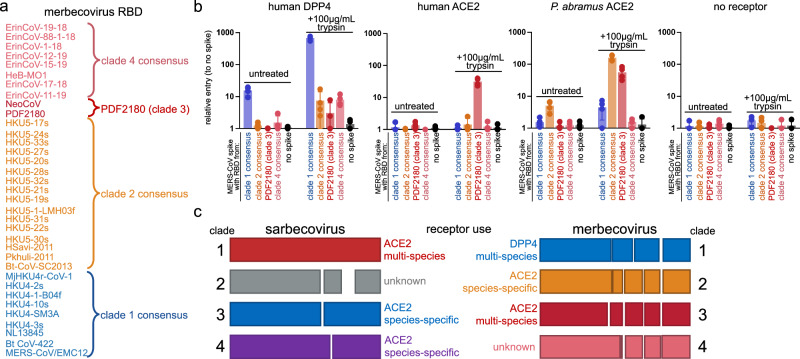
- Across 65 full-length merbecovirus spike sequences yielding 34 unique RBDs, receptor tropism was clade-specific: clade 1 used DPP4; clade 2 showed species-specific ACE2 preference; clade 3 used ACE2 more broadly; clade 4 showed no clear entry with the receptors tested.
- HKU5 clade 2 RBDs and full-length HKU5-20s/21s spikes entered cells expressing *Pipistrellus abramus* ACE2, including BHK and VeroE6 cells transduced with that receptor; a replication-competent HKU5-GFP molecular clone replicated in Vero, 293T, and BHK cells stably expressing *P. abramus* ACE2.
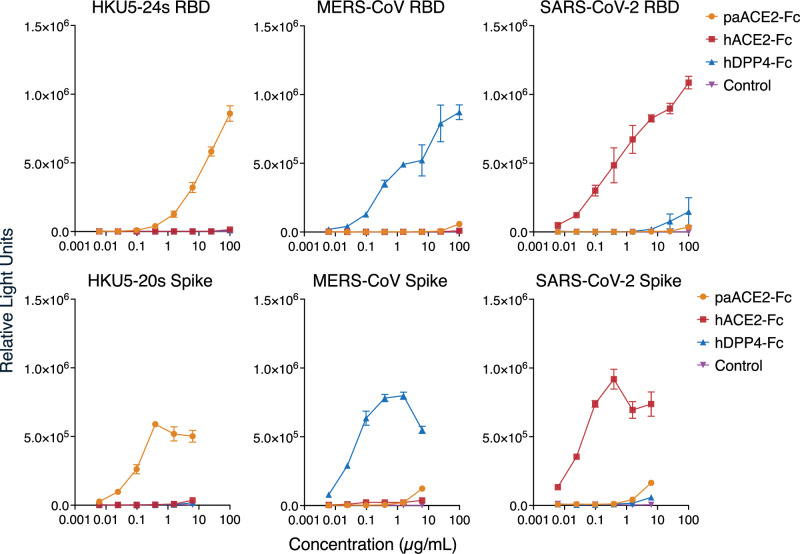
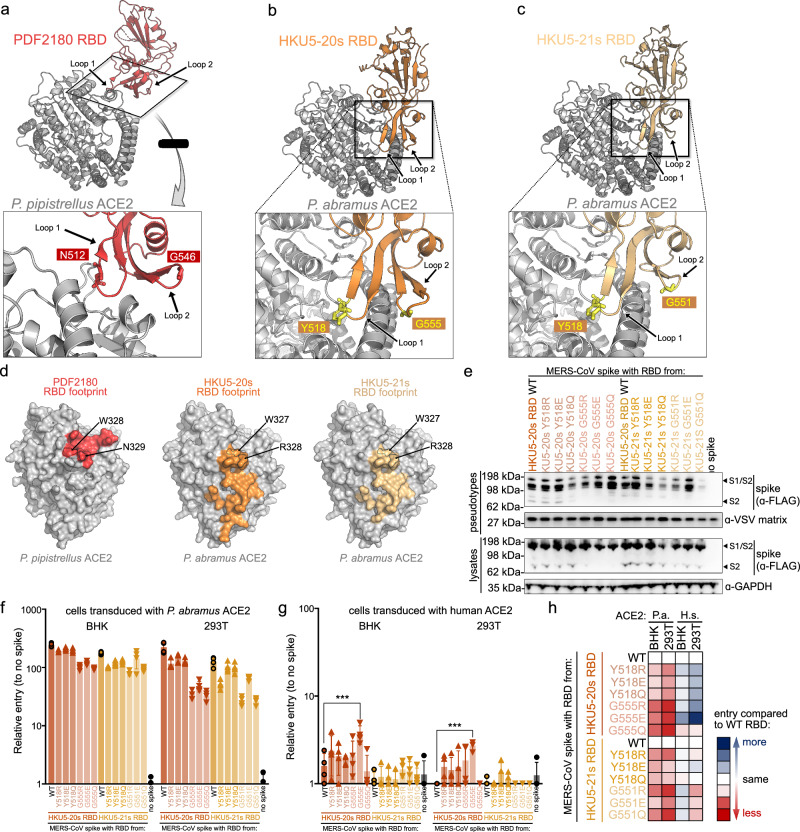
- ELISA showed dose-dependent binding of HKU5-24s RBD and full-length spike to *P. abramus* ACE2; AlphaFold3 predicted a HKU5 RBD interface involving Loop 1 and Loop 2, and Loop 2 mutations disrupted *P. abramus* ACE2 entry, with some HKU5-20s Loop 2 mutations increasing human ACE2 entry.
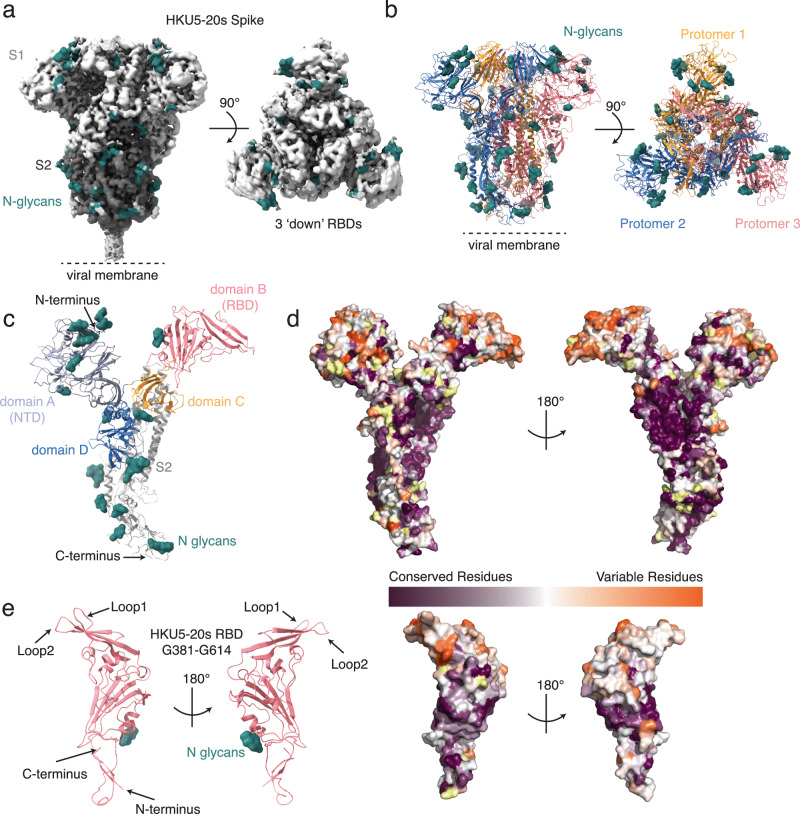
- Cryo-EM of the HKU5-20s spike trimer yielded a 2.8 Å structure with only “down” RBDs and no identifiable *P. abramus* ACE2 density.
Methods
- Generated chimeric MERS-CoV spikes by replacing the RBD between conserved glycines with 34 merbecovirus RBDs, produced VSV pseudotypes, and measured entry in 293T, VeroE6, Huh-7.5, and BHK cells with or without 100 μg/mL trypsin; entry assays used quadruplicate technical replicates and 2-way ANOVA with Tukey correction for mutation comparisons.
- Validated findings with full-length HKU5-20s/21s spike pseudotypes, a replication-competent HKU5-GFP molecular clone under BSL3 conditions, Huh7.5 ACE2/DPP4 double-knockout complementation, and ELISAs using recombinant RBD/spike and receptor-Fc fusions.
- Predicted HKU5 RBD–paACE2 interfaces with AlphaFold3 and determined a single-particle cryo-EM structure of a 2P-stabilized HKU5-20s trimeric ectodomain at 2.8 Å with C3 symmetry; sequence conservation was mapped using 10 representative merbecovirus spikes.
Limitations
- Stated: clade 4 merbecoviruses showed no clear entry with the DPP4 or ACE2 receptors tested; the authors note they may use these receptors in untested hosts, may use another receptor, or the chimeric RBD approach may miss interactions outside the RBD boundaries or require extracellular factors.
- Stated: cryo-EM grids yielded only unbound HKU5-20s spike trimer with no identifiable paACE2 density, so binding conditions need optimization; AlphaFold3 predictions require deep mutational scanning and comparative structural studies.
- Stated/evident: the study tested lineage 1 HKU5 viruses; lineage 2 HKU5 was reported by others to use human ACE2 with trypsin, and many lineage 1 HKU5 viruses showed only low-level human ACE2 entry with trypsin, which the paper calls borderline and difficult to interpret. Some merbecoviruses are also likely missing from the GenBank panel because of evolving nomenclature and incomplete metadata.
Model-written summary. Check it against the paper before relying on it.
Integrity signals
Registry
Cites
Statistics
Figures
Verification
Claims the paper makes
0 Valid · 1 Not valid · 45 Not checked · 99 Own results and interpretations
A result the paper reports from its own data — it cites no other source for it, so there is none to check. The quote shows it is in the paper.
In the paper
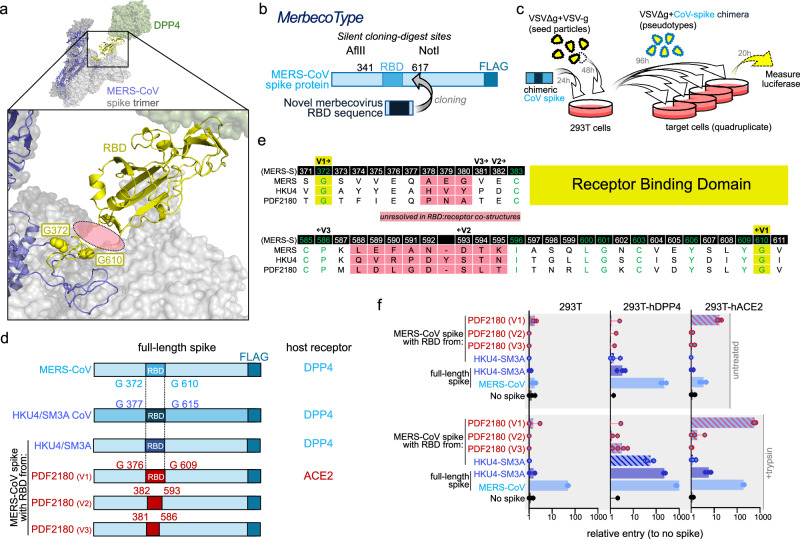
“However, closer inspection of published spike sequences revealed several highly conserved glycine residues flanking the RBD (MERS-CoV spike positions 372 and 610; Fig. 1a, d, e).”
§ ACE2 from Pipistrellus abramus bats is a receptor for HKU5 coronaviruses > Results > Mapping the functional receptor binding domain
plain- Asserted: passes — The authors put it forward as true.
- Checkable: passes — It can be checked against evidence.
- Load-bearing: passes — The paper’s conclusions depend on it.
- Based: passes — The paper gives a reason why it holds.
A result the paper reports from its own data — it cites no other source for it, so there is none to check. The quote shows it is in the paper.
In the paper
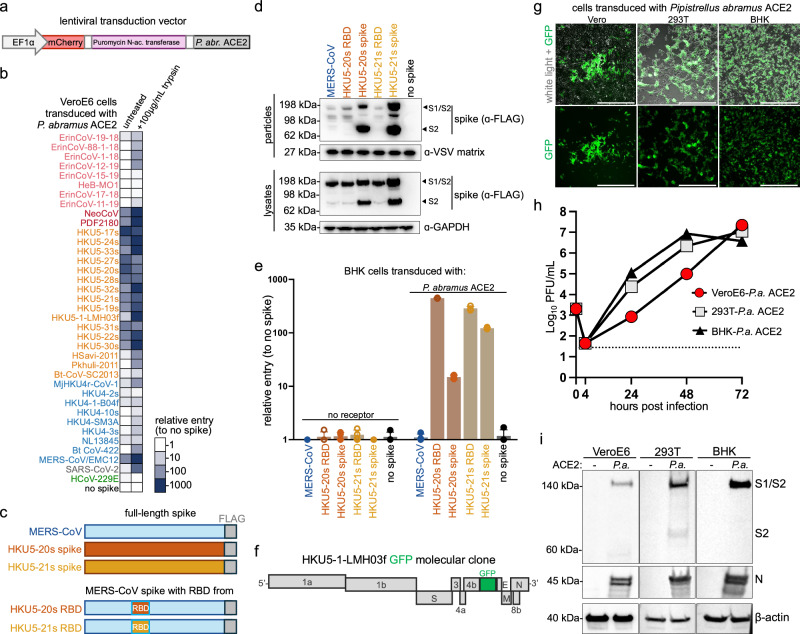
“Following transfection with Pipstrellus abramus ACE2, BHK cells became highly permissive for HKU5 RBD-mediated entry (Fig. 2g).”
§ ACE2 from Pipistrellus abramus bats is a receptor for HKU5 coronaviruses > Results > Merbecovirus RBD screen reveals a receptor for the HKU5 complex
plainstates a cause- Asserted: passes — The authors put it forward as true.
- Checkable: passes — It can be checked against evidence.
- Load-bearing: passes — The paper’s conclusions depend on it.
- Based: passes — The paper gives a reason why it holds.
- Rests on an assumption not shown here.
A result the paper reports from its own data — it cites no other source for it, so there is none to check. The quote shows it is in the paper.
In the paper
“Pseudotypes bearing chimeric consensus RBD spikes generally reflected clade-specific entry phenotypes observed for individual RBDs from previous experiments (Fig. 5b, c)”
§ ACE2 from Pipistrellus abramus bats is a receptor for HKU5 coronaviruses > Results > Consensus sequences mimic clade-specific entry phenotypes
hedgedstates an association- Asserted: passes — The authors put it forward as true.
- Checkable: passes — It can be checked against evidence.
- Load-bearing: passes — The paper’s conclusions depend on it.
- Based: passes — The paper gives a reason why it holds.
A result the paper reports from its own data — it cites no other source for it, so there is none to check. The quote shows it is in the paper.
In the paper
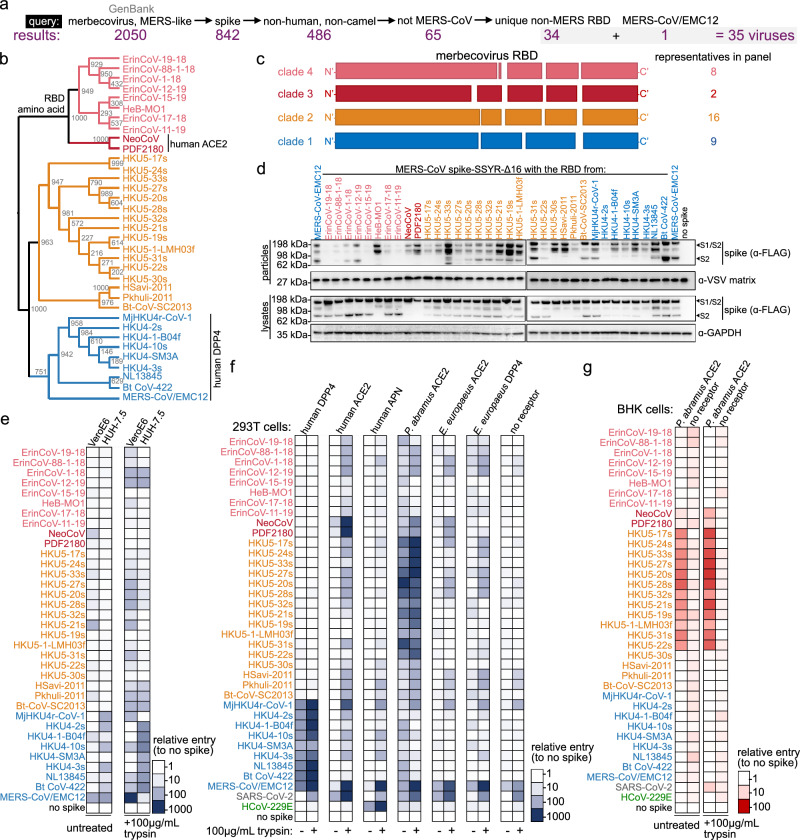
“Exogenous trypsin moderately increased entry in untransduced 293 T cells for human coronaviruses MERS-CoV and SARS-CoV-2, which uses human DPP4 and human ACE2, respectively, suggesting low levels of the human receptors were present on 293 T cells (Fig. 2f).”
§ ACE2 from Pipistrellus abramus bats is a receptor for HKU5 coronaviruses > Results > Merbecovirus RBD screen reveals a receptor for the HKU5 complex
hedgedstates a cause- Asserted: passes — The authors put it forward as true.
- Checkable: passes — It can be checked against evidence.
- Load-bearing: unclear — It is unclear whether the paper’s conclusions depend on it.
- Based: passes — The paper gives a reason why it holds.
- Rests on an assumption not shown here.
A result the paper reports from its own data — it cites no other source for it, so there is none to check. The quote shows it is in the paper.
In the paper
“while cells expressing human ACE2 exhibited low level susceptibility to SARS-CoV-2 spike and clade 3 merbecovirus RBDs (Fig. 2f).”
§ ACE2 from Pipistrellus abramus bats is a receptor for HKU5 coronaviruses > Results > Merbecovirus RBD screen reveals a receptor for the HKU5 complex
plainstates an association- Asserted: passes — The authors put it forward as true.
- Checkable: passes — It can be checked against evidence.
- Load-bearing: unclear — It is unclear whether the paper’s conclusions depend on it.
- Based: passes — The paper gives a reason why it holds.
57 more claims
Create a free account to see all 145 claims and to verify the 103 references still open.
- Probably not a substantial claim. 56
- It may state two separate claims as one. 46
Self-check
Percentages, sums and reported differences re-computed from the paper’s own numbers.
Each contradiction between two passages listed here was confirmed by an independent check.
Rated minor: it would not touch a result — a value no result rests on, a p-value that stays on the same side of the significance level, or a conflict that is clerical, resolved elsewhere in the paper, or outside its own findings.
In the paper
§ ACE2 from Pipistrellus abramus bats is a receptor for HKU5 coronaviruses > Results > HKU5 RBD mutations influence species compatibility
“a Co-structure for PDF2180 RBD and Pipistrellus pipistrellus ACE2 (PDB ID: 7wpz).”
§ ACE2 from Pipistrellus abramus bats is a receptor for HKU5 coronaviruses > Methods > Structure prediction and docking
“the co-structure of NeoCoV-RBD with P. pipistrellus ACE2 (PDB ID: 7WPZ)22”
Rated minor: it would not touch a result — a value no result rests on, a p-value that stays on the same side of the significance level, or a conflict that is clerical, resolved elsewhere in the paper, or outside its own findings.
In the paper
§ ACE2 from Pipistrellus abramus bats is a receptor for HKU5 coronaviruses > Methods > Statistics and reproducibility
“Statistical significance for mutation comparisons in Fig. 5 were determined by 2-way ANOVA with Tukey correction for multiple comparisons (GraphPad Prism v.9.5.1).”
§ ACE2 from Pipistrellus abramus bats is a receptor for HKU5 coronaviruses > Results > HKU5 RBD mutations influence species compatibility
“Figure: Fig. 6 Structure-guided mutagenesis at the HKU5:ACE2 interface. a Co-structure for PDF2180 RBD and Pipistrellus pipistrellus ACE2 (PDB ID: 7wpz).”
Citations
Cites
Highly accurate protein structure prediction with AlphaFold
Jumper, J., Evans, R., Pritzel, A., Green, T., Figurnov, M., Ronneberger, O., Tunyasuvunakool, K., Bates, R., Žídek, A., Potapenko, A., et al. (2021) · Nature · doi:10.1038/s41586-021-03819-2 · Cited by 43,764 · cited 1×
“6) 62 .”
Hoffmann, M., Kleine-Weber, H., Schroeder, S., Krüger, N., Herrler, T., Erichsen, S., Schiergens, T. S., Herrler, G., Wu, N.-H., Nitsche, A., et al. (2020) · Cell · doi:10.1016/j.cell.2020.02.052 · Cited by 20,286
Guindon, S., Dufayard, J.-F., Lefort, V., Anisimova, M., Hordijk, W., & Gascuel, O. (2010) · Systematic Biology · doi:10.1093/sysbio/syq010 · Cited by 18,376
cryoSPARC: algorithms for rapid unsupervised cryo-EM structure determination
Punjani, A., Rubinstein, J. L., Fleet, D. J., & Brubaker, M. A. (2017) · Nature Methods · doi:10.1038/nmeth.4169 · Cited by 11,626
UCSF ChimeraX: Structure visualization for researchers, educators, and developers
Pettersen, E. F., Goddard, T. D., Huang, C. C., Meng, E. C., Couch, G. S., Croll, T. I., Morris, J. H., & Ferrin, T. E. (2021) · Protein Science · doi:10.1002/pro.3943 · Cited by 9,514 · cited 1×
“Structure fi gures were made using ChimeraX 91 .”
Structure of the SARS-CoV-2 spike receptor-binding domain bound to the ACE2 receptor
Lan, J., Ge, J., Yu, J., Shan, S., Zhou, H., Fan, S., Zhang, Q., Shi, X., Wang, Q., Zhang, L., et al. (2020) · Nature · doi:10.1038/s41586-020-2180-5 · Cited by 5,983 · cited 1×
“…closer inspection of PDF2180 and HKU5 RBD interfaces with ACE2 reveals both viruses interact with ACE2 residues 328/329: a region that is also part of the interaction with RBDs from SARS-CoV-1, SARS-CoV-2 and NL63 spikes, implying this region may be a hot spot for viral interactions 19,73,74 (Fig.”
Isolation of a Novel Coronavirus from a Man with Pneumonia in Saudi Arabia
Zaki, A. M., van Boheemen, S., Bestebroer, T. M., Osterhaus, A. D. M. E., & Fouchier, R. A. M. (2012) · New England Journal of Medicine · doi:10.1056/nejmoa1211721 · Cited by 5,735 · cited 3×
“MERS-CoV was selected as the recipient spike backbone because of its extensive structural characterization and compatibility with cell-culture based models of mer-becovirus entry 1,31 – 33 .”
Automated electron microscope tomography using robust prediction of specimen movements
Mastronarde, D. N. (2005) · Journal of Structural Biology · doi:10.1016/j.jsb.2005.07.007 · Cited by 5,336 · cited 1×
“A single-particle cryo-EM dataset for HKU5-20s spike 2 P with paACE2-Fc was collected using SerialEM automated data collection software 89 on a 200keV Talos Arctica cryo-electron microscope (Thermo Fisher Scienti fi c) equipped with a K3 camera (Gatan) (Supplementary Table 1).”
Ashkenazy, H., Abadi, S., Martz, E., Chay, O., Mayrose, I., Pupko, T., & Ben-Tal, N. (2016) · Nucleic Acids Research · doi:10.1093/nar/gkw408 · Cited by 3,163
Letko, M., Marzi, A., & Munster, V. (2020) · Nature Microbiology · doi:10.1038/s41564-020-0688-y · Cited by 3,109 · cited 10×
“Lysates were clari fi ed, boiled, reduced and equivalent volumes of lysate were separated on 10% Bis-Tris gels in MOPS buffer (Invitrogen NuPage) 25 .”
InfluentialSelf-citationOu, X., Liu, Y., Lei, X., Li, P., Mi, D., Ren, L., Guo, L., Guo, R., Chen, T., Hu, J., et al. (2020) · Nature Communications · doi:10.1038/s41467-020-15562-9 · Cited by 3,097
Structure, Function, and Evolution of Coronavirus Spike Proteins
Li, F. (2016) · Annual Review of Virology · doi:10.1146/annurev-virology-110615-042301 · Cited by 2,740
Dipeptidyl peptidase 4 is a functional receptor for the emerging human coronavirus-EMC
Raj, V. S., Mou, H., Smits, S. L., Dekkers, D. H. W., Müller, M. A., Dijkman, R., Muth, D., Demmers, J. A. A., Zaki, A., Fouchier, R. A. M., et al. (2013) · Nature · doi:10.1038/nature12005 · Cited by 2,061
Structure of SARS Coronavirus Spike Receptor-Binding Domain Complexed with Receptor
Li, F., Li, W., Farzan, M., & Harrison, S. C. (2005) · Science · doi:10.1126/science.1116480 · Cited by 2,031 · cited 1×
“…closer inspection of PDF2180 and HKU5 RBD interfaces with ACE2 reveals both viruses interact with ACE2 residues 328/329: a region that is also part of the interaction with RBDs from SARS-CoV-1, SARS-CoV-2 and NL63 spikes, implying this region may be a hot spot for viral interactions 19,73,74 (Fig.”
Starr, T. N., Greaney, A. J., Hilton, S. K., Ellis, D., Crawford, K. H. D., Dingens, A. S., Navarro, M. J., Bowen, J. E., Tortorici, M. A., Walls, A. C., et al. (2020) · Cell · doi:10.1016/j.cell.2020.08.012 · Cited by 1,956
SMS: Smart Model Selection in PhyML
Lefort, V., Longueville, J.-E., & Gascuel, O. (2017) · Molecular Biology and Evolution · doi:10.1093/molbev/msx149 · Cited by 1,856 · cited 1×
“The ‘ WAG ’ matrix +G model of amino acid substitution was selected by the Smart Model Selection method with 1000 bootstrap replicates 95 .”
Hoffmann, M., Kleine-Weber, H., & Pöhlmann, S. (2020) · Molecular Cell · doi:10.1016/j.molcel.2020.04.022 · Cited by 1,852
SARS-CoV-2 neutralizing antibody structures inform therapeutic strategies
Barnes, C. O., Jette, C. A., Abernathy, M. E., Dam, K.-M. A., Esswein, S. R., Gristick, H. B., Malyutin, A. G., Sharaf, N. G., Huey-Tubman, K. E., Lee, Y. E., et al. (2020) · Nature · doi:10.1038/s41586-020-2852-1 · Cited by 1,599
ConSurf 2005: the projection of evolutionary conservation scores of residues on protein structures
Landau, M., Mayrose, I., Rosenberg, Y., Glaser, F., Martz, E., Pupko, T., & Ben-Tal, N. (2005) · Nucleic Acids Research · doi:10.1093/nar/gki370 · Cited by 1,413
Glowacka, I., Bertram, S., Müller, M. A., Allen, P., Soilleux, E., Pfefferle, S., Steffen, I., Tsegaye, T. S., He, Y., Gnirss, K., et al. (2011) · Journal of Virology · doi:10.1128/jvi.02232-10 · Cited by 1,108 · cited 1×
“…and endosomal cathepsins have been shown to cleave many different coronavirus spikes, including MERS-CoV, SARS-CoV and SARS-CoV-2, furin is another protease that plays an important role in spike biogenesis and cell entry, depending on the availability of an appropriate cleavage site 40 – 43 .”
Immunogenicity and structures of a rationally designed prefusion MERS-CoV spike antigen
Pallesen, J., Wang, N., Corbett, K. S., Wrapp, D., Kirchdoerfer, R. N., Turner, H. L., Cottrell, C. A., Becker, M. M., Wang, L., Shi, W., et al. (2017) · Proceedings of the National Academy of Sciences · doi:10.1073/pnas.1707304114 · Cited by 1,073
Evolutionary origins of the SARS-CoV-2 sarbecovirus lineage responsible for the COVID-19 pandemic
Boni, M. F., Lemey, P., Jiang, X., Lam, T. T.-Y., Perry, B. W., Castoe, T. A., Rambaut, A., & Robertson, D. L. (2020) · Nature Microbiology · doi:10.1038/s41564-020-0771-4 · Cited by 1,014
Receptor and viral determinants of SARS‐coronavirus adaptation to human ACE2
Li, W., Zhang, C., Sui, J., Kuhn, J. H., Moore, M. J., Luo, S., Wong, S., Huang, I., Xu, K., Vasilieva, N., et al. (2005) · The EMBO Journal · doi:10.1038/sj.emboj.7600640 · Cited by 988
Human aminopeptidase N is a receptor for human coronavirus 229E
Yeager, C. L., Ashmun, R. A., Williams, R. K., Cardellichio, C. B., Shapiro, L. H., Look, A. T., & Holmes, K. V. (1992) · Nature · doi:10.1038/357420a0 · Cited by 941
van Boheemen, S., de Graaf, M., Lauber, C., Bestebroer, T. M., Raj, V. S., Zaki, A. M., Osterhaus, A. D. M. E., Haagmans, B. L., Gorbalenya, A. E., Snijder, E. J., et al. (2012) · mBio · doi:10.1128/mbio.00473-12 · Cited by 914 · cited 1×
“The groups were labeled as clades 1 through 4: clade 1 includes MERS-CoV and HKU4 discovered between 2006 and 2012 1,50,51 , clade 2 includes HKU5 also discovered in 2006 50 , clade 3 incudes the African merbecoviruses,NeoCoVandPDF2180,discoveredin2017 13 ,andclade 4 includes the contemporary…”
Host cell proteases: Critical determinants of coronavirus tropism and pathogenesis
Millet, J. K., & Whittaker, G. R. (2015) · Virus Research · doi:10.1016/j.virusres.2014.11.021 · Cited by 902 · cited 1×
“After engaging with the host receptor, coronavirus spikes are processed by host-cell proteases to release the spike fusion peptide and mediate membrane fusion 38,39 .”
TMPRSS2 and furin are both essential for proteolytic activation of SARS-CoV-2 in human airway cells
Bestle, D., Heindl, M. R., Limburg, H., Van Lam van, T., Pilgram, O., Moulton, H., Stein, D. A., Hardes, K., Eickmann, M., Dolnik, O., et al. (2020) · Life Science Alliance · doi:10.26508/lsa.202000786 · Cited by 815 · cited 1×
“Because previous studies have shown that removal of the furin site from SARS-CoV-2 spike results in increased pseudotype ef fi ciency 44 – 46 , several versions of chimeric merbecovirus spikes were produced with either one or both furin sites mutated.”
Yuan, Y., Cao, D., Zhang, Y., Ma, J., Qi, J., Wang, Q., Lu, G., Wu, Y., Yan, J., Shi, Y., et al. (2017) · Nature Communications · doi:10.1038/ncomms15092 · Cited by 760 · cited 3×
“Because the RBD is the primary target of neutralizing antibodies, transitions between ’ up ’ and ‘ down ’ RBD states is believed to play a role in immune evasion 65,80 .”
InfluentialStructure of MERS-CoV spike receptor-binding domain complexed with human receptor DPP4
Wang, N., Shi, X., Jiang, L., Zhang, S., Wang, D., Tong, P., Guo, D., Fu, L., Cui, Y., Liu, X., et al. (2013) · Cell Research · doi:10.1038/cr.2013.92 · Cited by 719 · cited 2×
“MERS-CoV spike RBD bound to DPP4 (PDB ID: 4L72) 35 , the MERS-CoV spike trimer (PDB ID: 5×59) 80 , and the co-structure of NeoCoV-RBD with P. pipistrellus ACE2 (PDB ID: 7WPZ) 22 , were visualized in PyMol (version 2.4.0).”
InfluentialMillet, J. K., & Whittaker, G. R. (2014) · Proceedings of the National Academy of Sciences · doi:10.1073/pnas.1407087111 · Cited by 698 · cited 1×
“After engaging with the host receptor, coronavirus spikes are processed by host-cell proteases to release the spike fusion peptide and mediate membrane fusion 38,39 .”
Engineering human ACE2 to optimize binding to the spike protein of SARS coronavirus 2
Chan, K. K., Dorosky, D., Sharma, P., Abbasi, S. A., Dye, J. M., Kranz, D. M., Herbert, A. S., & Procko, E. (2020) · Science · doi:10.1126/science.abc0870 · Cited by 632
Ogando, N. S., Dalebout, T. J., Zevenhoven-Dobbe, J. C., Limpens, R. W. A. L., van der Meer, Y., Caly, L., Druce, J., de Vries, J. J. C., Kikkert, M., Bárcena, M., et al. (2020) · Journal of General Virology · doi:10.1099/jgv.0.001453 · Cited by 551 · cited 1×
“While Vero cells are frequently used in virus isolation attempts 1,86,87 , data from our study suggests thatHuh-7.”
Wrobel, A. G., Benton, D. J., Xu, P., Roustan, C., Martin, S. R., Rosenthal, P. B., Skehel, J. J., & Gamblin, S. J. (2020) · Nature Structural & Molecular Biology · doi:10.1038/s41594-020-0468-7 · Cited by 544
Middle East Respiratory Syndrome Coronavirus Infection in Dromedary Camels in Saudi Arabia
Alagaili, A. N., Briese, T., Mishra, N., Kapoor, V., Sameroff, S. C., de Wit, E., Munster, V. J., Hensley, L. E., Zalmout, I. S., Kapoor, A., et al. (2014) · mBio · doi:10.1128/mbio.00884-14 · Cited by 476
Shirato, K., Kawase, M., & Matsuyama, S. (2013) · Journal of Virology · doi:10.1128/jvi.01890-13 · Cited by 453
Free fatty acid binding pocket in the locked structure of SARS-CoV-2 spike protein
Toelzer, C., Gupta, K., Yadav, S. K. N., Borucu, U., Davidson, A. D., Kavanagh Williamson, M., Shoemark, D. K., Garzoni, F., Staufer, O., Milligan, R., et al. (2020) · Science · doi:10.1126/science.abd3255 · Cited by 433 · cited 1×
“MERS-CoV spike has been observed with one or two RBDs down 80 , SARS-CoV spike has been observed with two or three ‘ down ’ RBDs 80 , and SARS-CoV-2 spike has been observed with zero, one, two or three ‘ down ’ RBDs 64,65,81,82 .”
Close Relative of Human Middle East Respiratory Syndrome Coronavirus in Bat, South Africa
Ithete, N. L., Stoffberg, S., Corman, V. M., Cottontail, V. M., Richards, L. R., Schoeman, M. C., Drosten, C., Drexler, J. F., & Preiser, W. (2013) · Emerging Infectious Diseases · doi:10.3201/eid1910.130946 · Cited by 381
Zhou, T., Tsybovsky, Y., Gorman, J., Rapp, M., Cerutti, G., Chuang, G.-Y., Katsamba, P. S., Sampson, J. M., Schön, A., Bimela, J., et al. (2020) · Cell Host & Microbe · doi:10.1016/j.chom.2020.11.004 · Cited by 362
Further Evidence for Bats as the Evolutionary Source of Middle East Respiratory Syndrome Coronavirus
Anthony, S. J., Gilardi, K., Menachery, V. D., Goldstein, T., Ssebide, B., Mbabazi, R., Navarrete-Macias, I., Liang, E., Wells, H., Hicks, A., et al. (2017) · mBio · doi:10.1128/mbio.00373-17 · Cited by 357 · cited 2×
“…and 2012 1,50,51 , clade 2 includes HKU5 also discovered in 2006 50 , clade 3 incudes the African merbecoviruses,NeoCoVandPDF2180,discoveredin2017 13 ,andclade 4 includes the contemporary hedgehog merbecoviruses, “ ErinCoVs, ” discovered in Germany in 2014 and most recently identi fi ed in Italy…”
Self-citationWu, K., Li, W., Peng, G., & Li, F. (2009) · Proceedings of the National Academy of Sciences · doi:10.1073/pnas.0908837106 · Cited by 355
Li, W., Hulswit, R. J. G., Widjaja, I., Raj, V. S., McBride, R., Peng, W., Widagdo, W., Tortorici, M. A., van Dieren, B., Lang, Y., et al. (2017) · Proceedings of the National Academy of Sciences · doi:10.1073/pnas.1712592114 · Cited by 327
Molecular diversity of coronaviruses in bats
Woo, P. C. Y., Lau, S. K. P., Li, K. S. M., Poon, R. W. S., Wong, B. H. L., Tsoi, H.-W., Yip, B. C. K., Huang, Y., Chan, K.-H., & Yuen, K.-Y. (2006) · Virology · doi:10.1016/j.virol.2006.02.041 · Cited by 322 · cited 4×
“HKU5 viruses were fi rst sequenced in 2006, shown to be DPP4-independentin2014,anddemonstratedtoreplicateinVerocellsinthe presence of exogenous trypsin in 2020 12,24,50 .”
InfluentialProteolytic processing of Middle East respiratory syndrome coronavirus spikes expands virus tropism
Park, J.-E., Li, K., Barlan, A., Fehr, A. R., Perlman, S., McCray, P. B., & Gallagher, T. (2016) · Proceedings of the National Academy of Sciences · doi:10.1073/pnas.1608147113 · Cited by 307
MERS Coronaviruses in Dromedary Camels, Egypt
Chu, D. K. W., Poon, L. L. M., Gomaa, M. M., Shehata, M. M., Perera, R. A. P. M., Abu Zeid, D., El Rifay, A. S., Siu, L. Y., Guan, Y., Webby, R. J., et al. (2014) · Emerging Infectious Diseases · doi:10.3201/eid2006.140299 · Cited by 307
Molecular identification and phylogenetic analysis of baculoviruses from Lepidoptera
Jehle, J. A., Lange, M., Wang, H., Hu, Z., Wang, Y., & Hauschild, R. (2006) · Virology · doi:10.1016/j.virol.2005.10.032 · Cited by 299
Bat Origins of MERS-CoV Supported by Bat Coronavirus HKU4 Usage of Human Receptor CD26
Wang, Q., Qi, J., Yuan, Y., Xuan, Y., Han, P., Wan, Y., Ji, W., Li, Y., Wu, Y., Wang, J., et al. (2014) · Cell Host & Microbe · doi:10.1016/j.chom.2014.08.009 · Cited by 296
Almazán, F., DeDiego, M. L., Sola, I., Zuñiga, S., Nieto-Torres, J. L., Marquez-Jurado, S., Andrés, G., & Enjuanes, L. (2013) · mBio · doi:10.1128/mbio.00650-13 · Cited by 285 · cited 1×
“MERS-CoV was selected as the recipient spike backbone because of its extensive structural characterization and compatibility with cell-culture based models of mer-becovirus entry 1,31 – 33 .”
Replication and Shedding of MERS-CoV in Upper Respiratory Tract of Inoculated Dromedary Camels
Adney, D. R., van Doremalen, N., Brown, V. R., Bushmaker, T., Scott, D., de Wit, E., Bowen, R. A., & Munster, V. J. (2014) · Emerging Infectious Diseases · doi:10.3201/eid2012.141280 · Cited by 285 · cited 1×
“As controls, weincluded MERS-CoVRBD, SARS-CoV-2 RBD, and their respective receptors, human DPP4 and human ACE2 (Fig.”
Scobey, T., Yount, B. L., Sims, A. C., Donaldson, E. F., Agnihothram, S. S., Menachery, V. D., Graham, R. L., Swanstrom, J., Bove, P. F., Kim, J. D., et al. (2013) · Proceedings of the National Academy of Sciences · doi:10.1073/pnas.1311542110 · Cited by 283 · cited 2×
“MERS-CoV was selected as the recipient spike backbone because of its extensive structural characterization and compatibility with cell-culture based models of mer-becovirus entry 1,31 – 33 .”
Self-citationYang, Y., Du, L., Liu, C., Wang, L., Ma, C., Tang, J., Baric, R. S., Jiang, S., & Li, F. (2014) · Proceedings of the National Academy of Sciences · doi:10.1073/pnas.1405889111 · Cited by 281 · cited 2×
“HKU5 viruses were fi rst sequenced in 2006, shown to be DPP4-independentin2014,anddemonstratedtoreplicateinVerocellsinthe presence of exogenous trypsin in 2020 12,24,50 .”
Self-citationLau, S. K. P., Li, K. S. M., Tsang, A. K. L., Lam, C. S. F., Ahmed, S., Chen, H., Chan, K.-H., Woo, P. C. Y., & Yuen, K.-Y. (2013) · Journal of Virology · doi:10.1128/jvi.01055-13 · Cited by 278 · cited 2×
“Unlike the human respiratorycoronaviruses,allbatcoronaviruseshavebeenidenti fi edin fecal or other gut-derived samples and are presumed to be gastro-intestinal in their hosts 6,12,13 .”
Receptor recognition and cross-species infections of SARS coronavirus
Li, F. (2013) · Antiviral Research · doi:10.1016/j.antiviral.2013.08.014 · Cited by 268
Synthetic recombinant bat SARS-like coronavirus is infectious in cultured cells and in mice
Becker, M. M., Graham, R. L., Donaldson, E. F., Rockx, B., Sims, A. C., Sheahan, T., Pickles, R. J., Corti, D., Johnston, R. E., Baric, R. S., et al. (2008) · Proceedings of the National Academy of Sciences · doi:10.1073/pnas.0808116105 · Cited by 264 · cited 2×
“We have also produced chimeric sarbecovirus molecular clones that are capable of replicating with a different receptor tropism when given either a different spike gene or RBD from other sarbecoviruses, further demonstrating the feasibility of exchanging the RBD within this subgenus 30 .”
Self-citationMERS-CoV spillover at the camel-human interface
Dudas, G., Carvalho, L. M., Rambaut, A., & Bedford, T. (2018) · eLife · doi:10.7554/elife.31257 · Cited by 259
Virome characterization of game animals in China reveals a spectrum of emerging pathogens
He, W.-T., Hou, X., Zhao, J., Sun, J., He, H., Si, W., Wang, J., Jiang, Z., Yan, Z., Xing, G., et al. (2022) · Cell · doi:10.1016/j.cell.2022.02.014 · Cited by 254
Mou, H., Raj, V. S., van Kuppeveld, F. J. M., Rottier, P. J. M., Haagmans, B. L., & Bosch, B. J. (2013) · Journal of Virology · doi:10.1128/jvi.01277-13 · Cited by 241
van Doremalen, N., Miazgowicz, K. L., Milne-Price, S., Bushmaker, T., Robertson, S., Scott, D., Kinne, J., McLellan, J. S., Zhu, J., & Munster, V. J. (2014) · Journal of Virology · doi:10.1128/jvi.00676-14 · Cited by 225 · cited 1×
“To completely eliminate background signal we detected in the entry assays, 293 T cells were exchanged with BHK cells, which are not susceptible to any sarbecovirus or merbecvirus due to signi fi cant hamster receptor incompatibilities and poor cell surface expression of known receptors 59,60 .”
Wild-type human coronaviruses prefer cell-surface TMPRSS2 to endosomal cathepsins for cell entry
Shirato, K., Kawase, M., & Matsuyama, S. (2018) · Virology · doi:10.1016/j.virol.2017.11.012 · Cited by 225
ACE2 binding is an ancestral and evolvable trait of sarbecoviruses
Starr, T. N., Zepeda, S. K., Walls, A. C., Greaney, A. J., Alkhovsky, S., Veesler, D., & Bloom, J. D. (2022) · Nature · doi:10.1038/s41586-022-04464-z · Cited by 207
Trypsin Treatment Unlocks Barrier for Zoonotic Bat Coronavirus Infection
Menachery, V. D., Dinnon, K. H., Yount, B. L., McAnarney, E. T., Gralinski, L. E., Hale, A., Graham, R. L., Scobey, T., Anthony, S. J., Wang, L., et al. (2020) · Journal of Virology · doi:10.1128/jvi.01774-19 · Cited by 205 · cited 4×
“HKU5 viruses were fi rst sequenced in 2006, shown to be DPP4-independentin2014,anddemonstratedtoreplicateinVerocellsinthe presence of exogenous trypsin in 2020 12,24,50 .”
InfluentialSelf-citationMonchatre-Leroy, E., Boué, F., Boucher, J.-M., Renault, C., Moutou, F., Ar Gouilh, M., & Umhang, G. (2017) · Viruses · doi:10.3390/v9120364 · Cited by 187
Vero cell upstream bioprocess development for the production of viral vectors and vaccines
Kiesslich, S., & Kamen, A. A. (2020) · Biotechnology Advances · doi:10.1016/j.biotechadv.2020.107608 · Cited by 163 · cited 1×
“While Vero cells are frequently used in virus isolation attempts 1,86,87 , data from our study suggests thatHuh-7.”
Close relatives of MERS-CoV in bats use ACE2 as their functional receptors
Xiong, Q., Cao, L., Ma, C., Tortorici, M. A., Liu, C., Si, J., Liu, P., Gu, M., Walls, A. C., Wang, C., et al. (2022) · Nature · doi:10.1038/s41586-022-05513-3 · Cited by 159
Earnest, J. T., Hantak, M. P., Li, K., McCray, P. B., Perlman, S., & Gallagher, T. (2017) · PLOS Pathogens · doi:10.1371/journal.ppat.1006546 · Cited by 150 · cited 1×
“Additionally, while the chimeric spike strategy helps to reduce unforeseen entry barriers, dependence on extra-cellular factors remains possible, but is dif fi cult to anticipate or control 68 .”
Luo, C.-M., Wang, N., Yang, X.-L., Liu, H.-Z., Zhang, W., Li, B., Hu, B., Peng, C., Geng, Q.-B., Zhu, G.-J., et al. (2018) · Journal of Virology · doi:10.1128/jvi.00116-18 · Cited by 148 · cited 2×
“2 – 5).”
The SARS-CoV-2 spike reversibly samples an open-trimer conformation exposing novel epitopes
Costello, S. M., Shoemaker, S. R., Hobbs, H. T., Nguyen, A. W., Hsieh, C.-L., Maynard, J. A., McLellan, J. S., Pak, J. E., & Marqusee, S. (2022) · Nature Structural & Molecular Biology · doi:10.1038/s41594-022-00735-5 · Cited by 147 · cited 5×
“MERS-CoV spike has been observed with one or two RBDs down 80 , SARS-CoV spike has been observed with two or three ‘ down ’ RBDs 80 , and SARS-CoV-2 spike has been observed with zero, one, two or three ‘ down ’ RBDs 64,65,81,82 .”
InfluentialCorman, V. M., Kallies, R., Philipps, H., Göpner, G., Müller, M. A., Eckerle, I., Brünink, S., Drosten, C., & Drexler, J. F. (2014) · Journal of Virology · doi:10.1128/jvi.01600-13 · Cited by 140 · cited 1×
“2b, c, Table 1) 9,52 – 54 .”
Adaptive Evolution of MERS-CoV to Species Variation in DPP4
Letko, M., Miazgowicz, K., McMinn, R., Seifert, S. N., Sola, I., Enjuanes, L., Carmody, A., van Doremalen, N., & Munster, V. (2018) · Cell Reports · doi:10.1016/j.celrep.2018.07.045 · Cited by 134 · cited 4×
“Pipistrellus abramus ACE2 was sub-cloned from expression plasmid into a lentiviral expression vector with PCR and used to produce lentiviral particles in 293 T cells 61,96 .”
InfluentialSelf-citationStructural basis for the different states of the spike protein of SARS-CoV-2 in complex with ACE2
Yan, R., Zhang, Y., Li, Y., Ye, F., Guo, Y., Xia, L., Zhong, X., Chi, X., & Zhou, Q. (2021) · Cell Research · doi:10.1038/s41422-021-00490-0 · Cited by 123 · cited 1×
“MERS-CoV spike has been observed with one or two RBDs down 80 , SARS-CoV spike has been observed with two or three ‘ down ’ RBDs 80 , and SARS-CoV-2 spike has been observed with zero, one, two or three ‘ down ’ RBDs 64,65,81,82 .”
Zhang, S., Qiao, S., Yu, J., Zeng, J., Shan, S., Tian, L., Lan, J., Zhang, L., & Wang, X. (2021) · Nature Communications · doi:10.1038/s41467-021-21767-3 · Cited by 116 · cited 1×
“MERS-CoV spike can rapidly adapt to sub-optimal interactions with DPP4 from non-cognate species 61 , and the ongoing SARS-CoV-2 pandemic underscores the ability of spike to adapt and correct sub-optimal ACE2 interactions while simultaneously escaping the immune response 69 – 72 .”
Bat-infecting merbecovirus HKU5-CoV lineage 2 can use human ACE2 as a cell entry receptor
Chen, J., Zhang, W., Li, Y., Liu, C., Dong, T., Chen, H., Wu, C., Su, J., Li, B., Zhang, W., et al. (2025) · Cell · doi:10.1016/j.cell.2025.01.042 · Cited by 113
Chen, J., Yang, X., Si, H.-R., Gong, Q.-C., Que, T., Li, J., Li, Y., Wu, C., Zhang, W., Chen, Y., et al. (2023) · Cell · doi:10.1016/j.cell.2023.01.019 · Cited by 108
Farmed fur animals harbour viruses with zoonotic spillover potential
Zhao, J., Wan, W., Yu, K., Lemey, P., Pettersson, J. H.-O., Bi, Y., Lu, M., Li, X., Chen, Z., Zheng, M., et al. (2024) · Nature · doi:10.1038/s41586-024-07901-3 · Cited by 105 · cited 1×
“An HKU5 virus was detected in several deceased mink in China 76 .”
Cross-species recognition of SARS-CoV-2 to bat ACE2
Liu, K., Tan, S., Niu, S., Wang, J., Wu, L., Sun, H., Zhang, Y., Pan, X., Qu, X., Du, P., et al. (2020) · Proceedings of the National Academy of Sciences · doi:10.1073/pnas.2020216118 · Cited by 93
Structural dynamics in the evolution of SARS-CoV-2 spike glycoprotein
Calvaresi, V., Wrobel, A. G., Toporowska, J., Hammerschmid, D., Doores, K. J., Bradshaw, R. T., Parsons, R. B., Benton, D. J., Roustan, C., Reading, E., et al. (2023) · Nature Communications · doi:10.1038/s41467-023-36745-0 · Cited by 87 · cited 1×
“MERS-CoV spike can rapidly adapt to sub-optimal interactions with DPP4 from non-cognate species 61 , and the ongoing SARS-CoV-2 pandemic underscores the ability of spike to adapt and correct sub-optimal ACE2 interactions while simultaneously escaping the immune response 69 – 72 .”
MERS-CoV recombination: implications about the reservoir and potential for adaptation
Dudas, G., & Rambaut, A. (2016) · Virus Evolution · doi:10.1093/ve/vev023 · Cited by 84
Identification of the HIV-1 Vif and Human APOBEC3G Protein Interface
Letko, M. C., Booiman, T., Kootstra, N. A., Simon, V. R., & Ooms, M. (2015) · Cell Reports · doi:10.1016/j.celrep.2015.10.068 · Cited by 75
Self-citationPetit, C. M., Melancon, J. M., Chouljenko, V. N., Colgrove, R., Farzan, M., Knipe, D. M., & Kousoulas, K. G. (2005) · Virology · doi:10.1016/j.virol.2005.06.046 · Cited by 75
Moreno, A. M., Lelli, D., Sabato, L. D., Zaccaria, G., Boni, A., Sozzi, E., Prosperi, A., Lavazza, A., Cella, E., Castrucci, M. R., et al. (2017) · Virology Journal · doi:10.1186/s12985-017-0907-1 · Cited by 74
Middle East respiratory syndrome coronavirus (MERS-CoV) in dromedary camels in Nigeria, 2015
Chu, D. K. W., Oladipo, J. O., Perera, R. A. P. M., Kuranga, S. A., Chan, S. M. S., Poon, L. L. M., & Peiris, M. J. S. (2015) · Eurosurveillance · doi:10.2807/1560-7917.es.2015.20.49.30086 · Cited by 73
Evolution of the SARS-CoV-2 spike protein in the human host
Wrobel, A. G., Benton, D. J., Roustan, C., Borg, A., Hussain, S., Martin, S. R., Rosenthal, P. B., Skehel, J. J., & Gamblin, S. J. (2022) · Nature Communications · doi:10.1038/s41467-022-28768-w · Cited by 71
An ACE2-dependent Sarbecovirus in Russian bats is resistant to SARS-CoV-2 vaccines
Seifert, S. N., Bai, S., Fawcett, S., Norton, E. B., Zwezdaryk, K. J., Robinson, J., Gunn, B., & Letko, M. (2022) · PLOS Pathogens · doi:10.1371/journal.ppat.1010828 · Cited by 69 · cited 7×
“Pseudotypes were generated as previously described 25,28,29 .”
InfluentialSelf-citationIdentification of a Novel Betacoronavirus (Merbecovirus) in Amur Hedgehogs from China
Lau, S. K. P., Luk, H. K. H., Wong, A. C. P., Fan, R. Y. Y., Lam, C. S. F., Li, K. S. M., Ahmed, S. S., Chow, F. W. N., Cai, J.-P., Zhu, X., et al. (2019) · Viruses · doi:10.3390/v11110980 · Cited by 69
Peck, K. M., Cockrell, A. S., Yount, B. L., Scobey, T., Baric, R. S., & Heise, M. T. (2015) · Journal of Virology · doi:10.1128/jvi.03445-14 · Cited by 68 · cited 1×
“Although a distribution of ‘ up ’ and ‘ down ’ RBDs is usually found for sarbecovirus spike trimers 64,65 , we found only ‘ down ’ RBDs in the HKU5-20s trimer structure (Fig.”
Self-citationMatsuyama, S., Shirato, K., Kawase, M., Terada, Y., Kawachi, K., Fukushi, S., & Kamitani, W. (2018) · Journal of Virology · doi:10.1128/jvi.00683-18 · Cited by 68
Escolano, A., Gristick, H. B., Gautam, R., DeLaitsch, A. T., Abernathy, M. E., Yang, Z., Wang, H., Hoffmann, M. A. G., Nishimura, Y., Wang, Z., et al. (2021) · Science Translational Medicine · doi:10.1126/scitranslmed.abk1533 · Cited by 60
Fan, C., Cohen, A. A., Park, M., Hung, A. F.-H., Keeffe, J. R., Gnanapragasam, P. N. P., Lee, Y. E., Gao, H., Kakutani, L. M., Wu, Z., et al. (2022) · Immunity · doi:10.1016/j.immuni.2022.10.019 · Cited by 58
Self-citationMultiple independent acquisitions of ACE2 usage in MERS-related coronaviruses
Ma, C., Liu, C., Park, Y., Tang, J., Chen, J., Xiong, Q., Lee, J., Stewart, C., Asarnow, D. E., Brown, J. T., et al. (2025) · Cell · doi:10.1016/j.cell.2024.12.031 · Cited by 55 · cited 2×
“…was selected becauseof high sequence identity with HKU5 spikes 12 ; NeoCoV, PDF2180 and MoW-15-22 spikes were selected because they have been shown to use ACE2 21,22,23 ; BatCoV/ PKhuli, H.Savii, and SC2013 were selected as other clade 2 RBDs to compare with HKU5 RBD (Supplementary Fig.”
Molecular basis of convergent evolution of ACE2 receptor utilization among HKU5 coronaviruses
Park, Y.-J., Liu, C., Lee, J., Brown, J. T., Ma, C.-B., Liu, P., Gen, R., Xiong, Q., Zepeda, S. K., Stewart, C., et al. (2025) · Cell · doi:10.1016/j.cell.2024.12.032 · Cited by 52 · cited 1×
“6) 75 .”
Lau, S. K. P., Fan, R. Y. Y., Zhu, L., Li, K. S. M., Wong, A. C. P., Luk, H. K. H., Wong, E. Y. M., Lam, C. S. F., Lo, G. C. S., Fung, J., et al. (2021) · Nature Communications · doi:10.1038/s41467-020-20458-9 · Cited by 50
Song, X., Shi, Y., Ding, W., Niu, T., Sun, L., Tan, Y., Chen, Y., Shi, J., Xiong, Q., Huang, X., et al. (2021) · Nature Communications · doi:10.1038/s41467-020-20401-y · Cited by 47 · cited 3×
“Coronavirus RBDs on a spike trimer can be in an ’ up ’ state, with receptor contact sites being surface-exposed and capable of interacting with host cell receptors, or in the ‘ down ’ state, with the receptor contacts buried and inaccessible 11,65,79 .”
Expanded ACE2 dependencies of diverse SARS-like coronavirus receptor binding domains
Roelle, S. M., Shukla, N., Pham, A. T., Bruchez, A. M., & Matreyek, K. A. (2022) · PLOS Biology · doi:10.1371/journal.pbio.3001738 · Cited by 45
ACE2-Independent Bat Sarbecovirus Entry and Replication in Human and Bat Cells
Guo, H., Li, A., Dong, T.-Y., Su, J., Yao, Y.-L., Zhu, Y., Shi, Z.-L., & Letko, M. (2022) · mBio · doi:10.1128/mbio.02566-22 · Cited by 43 · cited 1×
“Entry assays were performed using standard approaches 26,27 .”
Self-citationReplication of MERS and SARS coronaviruses in bat cells offers insights to their ancestral origins
Lau, S. K. P., Fan, R. Y. Y., Luk, H. K. H., Zhu, L., Fung, J., Li, K. S. M., Wong, E. Y. M., Ahmed, S. S., Chan, J. F. W., Kok, R. K. H., et al. (2018) · Emerging Microbes & Infections · doi:10.1038/s41426-018-0208-9 · Cited by 37
Khaledian, E., Ulusan, S., Erickson, J., Fawcett, S., Letko, M. C., & Broschat, S. L. (2022) · eBioMedicine · doi:10.1016/j.ebiom.2022.103990 · Cited by 34
Self-citationChen, H.-Y., Huang, C., Tian, L., Huang, X., Zhang, C., Llewellyn, G. N., Rogers, G. L., Andresen, K., O’Gorman, M. R. G., Chen, Y., et al. (2021) · Journal of Virology · doi:10.1128/jvi.00966-21 · Cited by 33 · cited 1×
“BHK cells transduced with Pipistrellus abramus ACE2 were susceptible to both full-length and chimeric HKU5-20s and − 21s spikes but not MERS-CoV, a DPP4-dependent spike (Fig.”
A MERS-CoV antibody neutralizes a pre-emerging group 2c bat coronavirus
Tse, L. V., Hou, Y. J., McFadden, E., Lee, R. E., Scobey, T., Leist, S. R., Martinez, D. R., Meganck, R. M., Schäfer, A., Yount, B. L., et al. (2023) · Science Translational Medicine · doi:10.1126/scitranslmed.adg5567 · Cited by 33
Self-citationFukuma, A., Tani, H., Taniguchi, S., Shimojima, M., Saijo, M., & Fukushi, S. (2015) · Archives of Virology · doi:10.1007/s00705-015-2506-z · Cited by 31 · cited 1×
“Additionally, C-terminal truncations in the cytoplasmic tails of MERS-CoV, SARS-CoV and SARS-CoV-2 spikes increase surface expression of spike in transfected cells, resulting in improved pseudotype ef fi ciency 47 – 49 .”
Ma, C., Liu, C., Xiong, Q., Gu, M., Shi, L., Wang, C., Si, J., Tong, F., Liu, P., Huang, M., et al. (2023) · Cell Discovery · doi:10.1038/s41421-023-00566-8 · Cited by 29 · cited 3×
“Residue N329 in Pipistrellus pipistrellus ACE2 is also N-glycosylated 21 , while the corresponding residue in Pipistrellus abramus ACE2, R328, is not, which may also explain the striking restriction in receptor use.”
Sarbecovirus RBD indels and specific residues dictating multi-species ACE2 adaptiveness
Si, J.-Y., Chen, Y.-M., Sun, Y.-H., Gu, M.-X., Huang, M.-L., Shi, L.-L., Yu, X., Yang, X., Xiong, Q., Ma, C.-B., et al. (2024) · Nature Communications · doi:10.1038/s41467-024-53029-3 · Cited by 25
Coronaviruses Use ACE2 Monomers as Entry‐Receptors
Eiring, P., Klein, T., Backes, S., Streit, M., Jungblut, M., Doose, S., Beliu, G., & Sauer, M. (2023) · Angewandte Chemie International Edition · doi:10.1002/anie.202300821 · Cited by 25
De Sabato, L., Di Bartolo, I., De Marco, M. A., Moreno, A., Lelli, D., Cotti, C., Delogu, M., & Vaccari, G. (2020) · Viruses · doi:10.3390/v12121471 · Cited by 24 · cited 1×
“2b, c, Table 1) 9,52 – 54 .”
Isolation of ACE2-dependent and -independent sarbecoviruses from Chinese horseshoe bats
Guo, H., Li, A., Dong, T.-Y., Si, H.-R., Hu, B., Li, B., Zhu, Y., Shi, Z.-L., & Letko, M. (2023) · Journal of Virology · doi:10.1128/jvi.00395-23 · Cited by 22 · cited 1×
“Entry assays were performed using standard approaches 26,27 .”
Self-citationXia, L.-Y., Wang, Z.-F., Cui, X.-M., Li, Y.-G., Ye, R.-Z., Zhu, D.-Y., Li, F.-X., Zhang, J., Wang, W.-H., Zhang, M.-Z., et al. (2024) · Nature Communications · doi:10.1038/s41467-024-45453-2 · Cited by 19 · cited 1×
“A clade 1 RBD pangolin merbecovirus has been shown to use human DPP4 and was isolated in Vero81 cells 85 .”
Structure of the S1 subunit C-terminal domain from bat-derived coronavirus HKU5 spike protein
Han, X., Qi, J., Song, H., Wang, Q., Zhang, Y., Wu, Y., Lu, G., Yuen, K., Shi, Y., & Gao, G. F. (2017) · Virology · doi:10.1016/j.virol.2017.04.016 · Cited by 18 · cited 3×
“These two residues fl ank the RBD region of spike used for structures with host receptor molecules 22,34 .”
Airport noise disturbs foraging behavior of Japanese pipistrelle bats
Wang, W., Gao, H., Li, C., Deng, Y., Zhou, D., Li, Y., Zhou, W., Luo, B., Liang, H., Liu, W., et al. (2022) · Ecology and Evolution · doi:10.1002/ece3.8976 · Cited by 14 · cited 1×
“Japanese house bats ( Pipis-trellus abramus ) are the natural host for HKU5 coronaviruses and are synanthropic, roosting in human dwellings and structures, and therefore pose repeat opportunities for human exposure 50,88 .”
Loss of furin site enhances SARS-CoV-2 spike protein pseudovirus infection
Wang, Z., Zhong, K., Wang, G., Lu, Q., Li, H., Wu, Z., Zhang, Z., Yang, N., Zheng, M., Wang, Y., et al. (2023) · Gene · doi:10.1016/j.gene.2022.147144 · Cited by 11 · cited 1×
“Because previous studies have shown that removal of the furin site from SARS-CoV-2 spike results in increased pseudotype ef fi ciency 44 – 46 , several versions of chimeric merbecovirus spikes were produced with either one or both furin sites mutated.”
Self-citation(2024) · doi:10.1371/journal.ppat.1012704 · Cited by 10
Tse, A. L., Acreman, C. M., Ricardo-Lax, I., Berrigan, J., Lasso, G., Balogun, T., Kearns, F. L., Casalino, L., McClain, G. L., Chandran, A. M., et al. (2024) · doi:10.1101/2024.06.24.600393 · Cited by 10
Multiple Independent Acquisitions of ACE2 Usage in MERS-Related Coronaviruses
Ma, C.-B., Liu, C., Park, Y.-J., Tang, J., Chen, J., Xiong, Q., Lee, J., Stewart, C., Asarnow, D., Brown, J., et al. (2024) · doi:10.2139/ssrn.4891170 · Cited by 2
Cited by
Bat-infecting merbecovirus HKU5-CoV lineage 2 can use human ACE2 as a cell entry receptor
Chen, J., Zhang, W., Li, Y., Liu, C., Dong, T., Chen, H., Wu, C., Su, J., Li, B., Zhang, W., et al. (2025) · Cell · doi:10.1016/j.cell.2025.01.042 · Cited by 113
“30,31 However, neither study reported that these HKU5-CoV-1 can efficiently utilize human ACE2 for cellular entry.”
Human coronavirus HKU1 recognition of the TMPRSS2 host receptor
McCallum, M., Park, Y., Stewart, C., Sprouse, K. R., Addetia, A., Brown, J. T., Tortorici, M. A., Gibson, C. A., Wong, E., Ieven, M. M., et al. (2024) · Cell · doi:10.1016/j.cell.2024.06.006 · Cited by 57
Multiple independent acquisitions of ACE2 usage in MERS-related coronaviruses
Ma, C., Liu, C., Park, Y., Tang, J., Chen, J., Xiong, Q., Lee, J., Stewart, C., Asarnow, D. E., Brown, J. T., et al. (2025) · Cell · doi:10.1016/j.cell.2024.12.031 · Cited by 55
Molecular basis of convergent evolution of ACE2 receptor utilization among HKU5 coronaviruses
Park, Y.-J., Liu, C., Lee, J., Brown, J. T., Ma, C.-B., Liu, P., Gen, R., Xiong, Q., Zepeda, S. K., Stewart, C., et al. (2025) · Cell · doi:10.1016/j.cell.2024.12.032 · Cited by 52
A MERS-CoV-like mink coronavirus uses ACE2 as an entry receptor
Wang, N., Ji, W., Jiao, H., Veit, M., Sun, J., Wang, Y., Ma, X., Wang, Y., Wang, Y., Li, X., et al. (2025) · Nature · doi:10.1038/s41586-025-09007-w · Cited by 34
“During the preparation of this article, we identified two publications 33,41 and three preprints 31,43,44 with overlapping yet distinctive findings.”
Metadata
- Authors
- Catanzaro, N. J., Wu, Z., Fan, C., Jefferson, V., Abdelgadir, A., Schäfer, A., Yount, B. L., Bjorkman, P. J., Baric, R., & Letko, M.
- Affiliations
- University of North Carolina at Chapel Hill (US)
- California Institute of Technology (US)
- Washington State University (US)
- Corresponding author
- Letko, Michael
- ORCID
- Venue
- Nature Communications
- Published
- 2025-05-28
- Volume
- 16
- Issue
- 1
- Pages
- 4932-4932
- ISSN
- 2041-1723 (ISSN-L)
- PMC
- PMC12119886
- OpenAlex
- W4410794035
- Cited by
- 41
- References
- 108
- Citations by year
- 2026: 14 · 2025: 19
- FWCI
- 16.22
- Type
- journal article
- Language
- en
- Open access
- gold
- doi.org
- Licence
- cc-by-nc-nd
- creativecommons.org/licenses/by-nc-nd/4.0 (tdm)
- creativecommons.org/licenses/by-nc-nd/4.0 (vor)
- Locations
- Nature Communications (publishedVersion, cc-by-nc-nd)
- bioRxiv (Cold Spring Harbor Laboratory) (submittedVersion, cc-by-nc-nd)
- PubMed Central (publishedVersion, cc-by-nc-nd)
- PubMed (publishedVersion)
- PubMed Central (submittedVersion, cc-by-nc-nd)
- Carolina Digital Repository (University of North Carolina at Chapel Hill) (submittedVersion, cc-by-nc-nd)
- PubMed (submittedVersion)
- RePEc: Research Papers in Economics (submittedVersion)
- DOAJ (DOAJ: Directory of Open Access Journals) (submittedVersion)
- UNC Libraries
- Funders
- U.S. Department of Health & Human Services | National Institutes of Health (R01AI167966)
- Topics
- Health Sciences › Medicine › Infectious Diseases › SARS-CoV-2 and COVID-19 Research
- Life Sciences › Agricultural and Biological Sciences › Animal Science and Zoology › Animal Virus Infections Studies
- Health Sciences › Medicine › Public Health, Environmental and Occupational Health › Zoonotic diseases and public health
- Keywords
- ACE2 receptor, Pipistrellus abramus, bats, MERS-CoV, receptor binding domain, spike protein, receptor tropism, viral entry, dipeptidyl peptidase IV, zoonotic transmission
- MeSH terms
- Angiotensin-Converting Enzyme 2, Animals, Chiroptera, Humans, Phylogeny, Receptors, Virus, Coronavirus, Dipeptidyl Peptidase 4, Cryoelectron Microscopy, Virus Internalization, Viral Tropism, HEK293 Cells, Spike Glycoprotein, Coronavirus, Middle East Respiratory Syndrome Coronavirus
About these checks
Registry, retraction, Cites and statistics results are computed, not judged, with one exception: a printed reference that no index lists is read once by a model before it counts as a citation error. Claims are extracted by a model and kept only when their quote appears verbatim in the text; each cited source is then checked, with a model’s help, for whether it says what the claim relies on. Those verdicts can be wrong — read the claim’s quote and the cited source before relying on one.
A language model drew the claims from the paper on 2026-11-28, under version 3 of the claim definition (model deepseek-v4.1-flash, prompt extract-v3).
A second model labelled each claim on 2026-11-28 (model jev-1.13-20260917, definition revision gold-guideline-v0.2).
Statistics and arithmetic are recomputed, not judged.
Confidence bands are shown only for fields calibrated on our annotated test set. None is calibrated yet, so no band is shown.
What counts as a claim ›How we measure confidence ›How we check this ›
Are you an author, or do you see a problem with this page? Request a review
Data sources
Bibliographic data: Semantic Scholar, OpenAlex, Crossref.
Contains information from the Semantic Scholar Academic Graph Datasets, made available under the ODC Attribution License (ODC-BY 1.0).
Semantic Scholar’s data is described in: Kinney, R., et al. (2023). The Semantic Scholar Open Data Platform. arXiv:2301.10140.
