

Dual site targeting of the bacterial 70S ribosome by tetracyclines
Open accessThe DOI matches its Crossref record; 45 of the 45 references it cites were found in a registry or an index; 32 of the 49 sources its claims cite were checked for support.
Abstract
The tetracycline class of antibiotics is widely used for treating bacterial diseases including Lyme disease, anthrax, acne vulgaris, and pneumonia. Using a series of high-resolution cryo-electron microscopy (cryo-EM) structures, we show that tetracyclines can simultaneously target the mRNA decoding center in the 30S subunit and the nascent peptide exit tunnel (NPET) in the 50S subunit of the bacterial ribosome. Among the tested tetracyclines, Doxycycline was distinct in its ability to dimerize and bind the NPET at multiple locations. Structural comparison of Doxycycline, Minocycline, and Sarecycline bound to the Escherichia coli and Cutibacterium acnes 70S ribosome revealed species-specific differences affecting drug interaction and occupancy. Our results reveal a dual site mechanism of action for tetracyclines and provide a structural basis for rational design of narrow spectrum tetracyclines to overcome the rising threat of antibiotic resistance. Tetracyclines are among the most widely prescribed antibiotics worldwide. Here, the authors show that tetracyclines simultaneously target the mRNA decoding center (30S) and the peptidyltransferase center (50S) of the bacterial ribosome.
Overview
CoChat Summary
TL;DR
High-resolution cryo-EM structures of Minocycline, Doxycycline, and Sarecycline bound to *E. coli* and *Cutibacterium acnes* 70S ribosomes show that all three tetracyclines simultaneously target the 30S mRNA decoding center and a secondary site in the 50S nascent peptide exit tunnel (NPET), revising the textbook view of a single-site mechanism. Doxycycline is unique in forming dimers that block the NPET at multiple locations, and species-specific ribosomal differences plus C7 modifications alter binding pose and occupancy.
Key findings
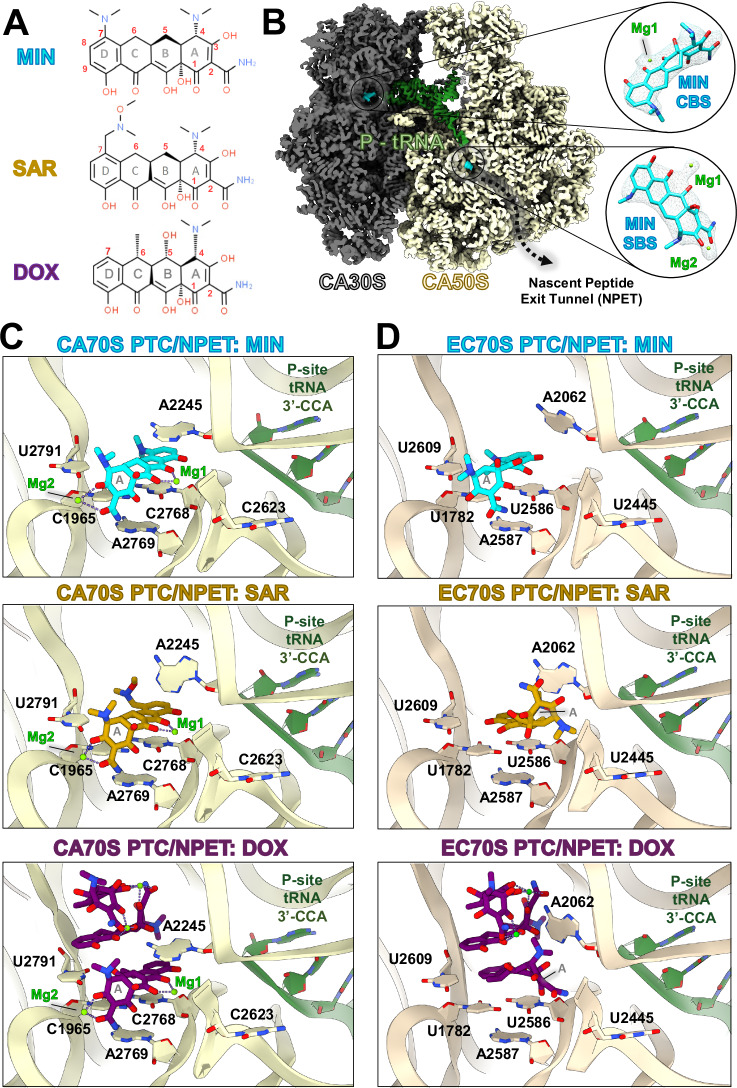
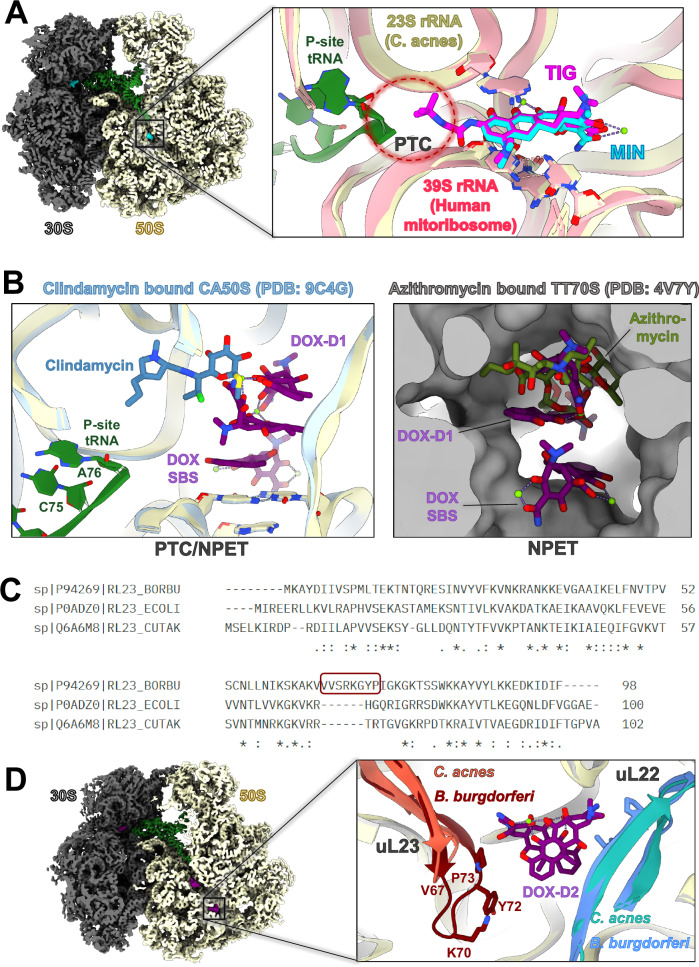
- All three tetracyclines bound both the canonical binding site (CBS) in the 30S decoding center and a secondary binding site (SBS) in the NPET near the PTC in both *C. acnes* and *E. coli* 70S ribosomes; the SBS is anchored by a non-canonical base pair (C1965:C2768 in *C. acnes*; U1782:U2586 in *E. coli*) with stacking by A2245/U2791 (*C. acnes*) or A2062/U2609 (*E. coli*).
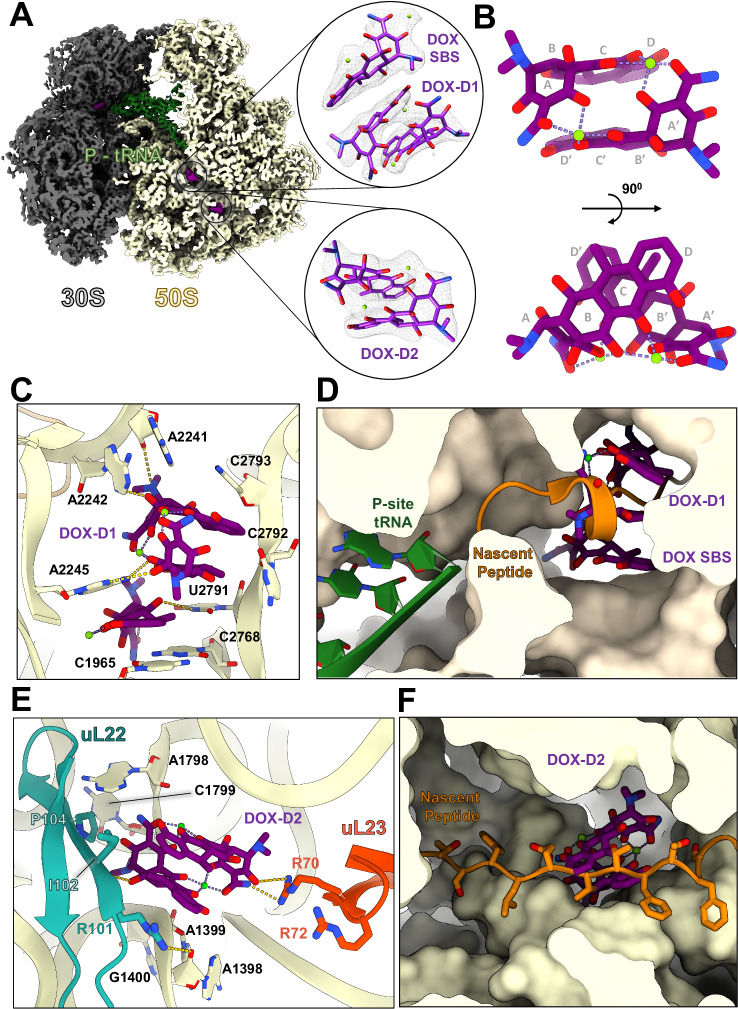
- Doxycycline dimerized in the NPET: Dox-D1 stacks on the monomeric SBS-bound molecule to form a trimer occluding the tunnel near the PTC, and Dox-D2 binds near the solvent side stabilized by uL22 and uL23; both dimers are symmetrical and coordinate two magnesium ions. A seventh Doxycycline (and Minocycline) molecule was seen intercalated between U1349 and G1350 in *C. acnes* 23S rRNA, absent for Sarecycline and absent in *E. coli*.
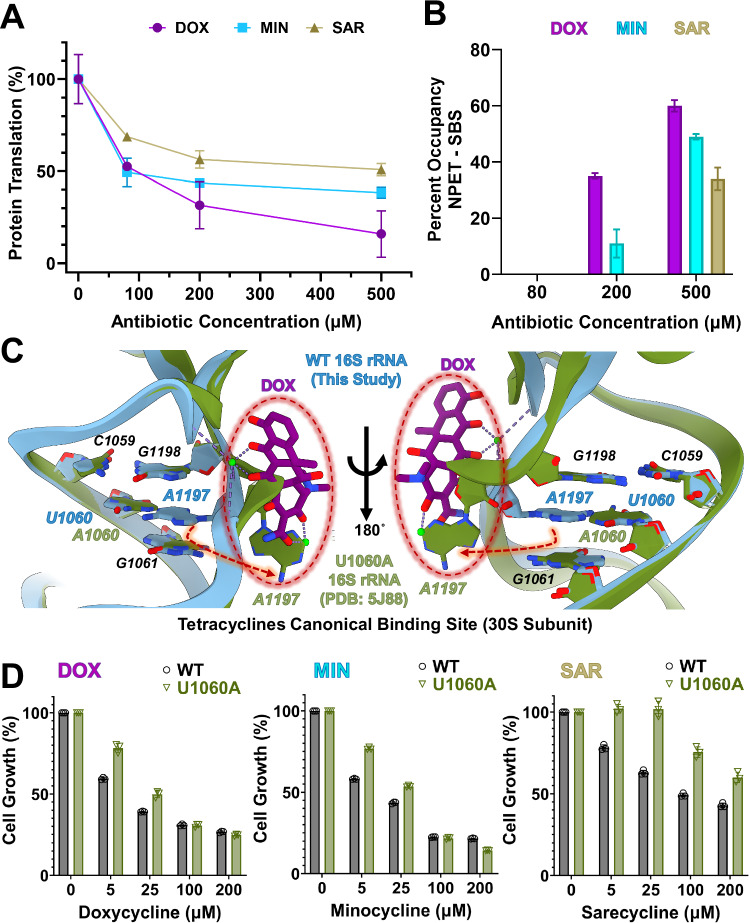
- At ≥200 µM, Doxycycline was ~2-fold more potent than Sarecycline at inhibiting *E. coli* translation, with Minocycline intermediate; occupancy at the SBS ranked Doxycycline > Minocycline > Sarecycline, and Sarecycline's SBS occupancy was two-fold lower than Doxycycline's.
- In *E. coli* strains with the CBS-ablating 16S rRNA mutations U1060A and A1197U, Sarecycline failed to inhibit growth at low micromolar concentrations, whereas Doxycycline and Minocycline remained active with ~20% lower potency; at 100–200 µM, Sarecycline was 2–3 fold weaker than Minocycline and Doxycycline against these mutants, implicating the NPET SBS in translation inhibition.
Methods
- Cryo-EM: 70S ribosomes from *C. acnes* (ATCC 11827) and *E. coli* (PURExpress Δ Ribosome Kit) reassociated with mRNA (32MF) and tRNAifMet, incubated with 500 µM (or 80/200/500 µM for occupancy series) Minocycline, Doxycycline, or Sarecycline; data collected on Titan Krios (300 kV) and Glacios (200 kV) with K3 detectors, processed in cryoSPARC v4, models built in COOT and refined in PHENIX.
- Relative antibiotic occupancy at CBS and SBS quantified from resampled charge density (CD) maps, using CD ratios between tetracycline atoms and neighboring RNA backbone atoms, with errors estimated from maximum/minimum CD ratios.
- Functional assays: PURExpress in vitro translation with firefly luciferase reporter at 80, 200, and 500 µM tetracyclines (triplicate); cell growth inhibition of *E. coli* SQ110ΔTolC WT, U1060A, and A1197U strains measured by Alamar Blue over 3 h with increasing tetracycline concentrations (three biological replicates).
Limitations
- Stated by the authors: occupancy analysis used non-translating *E. coli* 70S ribosomes, and the presence and sequence of a nascent peptide may significantly enhance or reduce SBS occupancy; whether the nascent-peptide sequence dependency of the tetracycline SBS matches that of Tetracenomycin X, and whether it differs among tetracycline derivatives, remains unknown and requires future experimental characterization.
- Stated by the authors: no correlation was observed between SBS occupancy and the identity of the non-canonical base pair (U:U vs C:C), and the allosteric effect of off-site natural 23S rRNA variations on SBS efficacy cannot be ruled out.
- Evident from the text: the effective concentration of tetracyclines inside bacterial cells at relevant tissue sites is unknown, so the concentration-dependent structural and potency findings cannot be directly mapped to in vivo drug levels; the Dox-D2 site is described as previously uncharacterized, and the *Borrelia burgdorferi* uL23 insertion rationale for Lyme disease efficacy is noted as lacking direct comparative studies with other tetracyclines.
Model-written summary. Check it against the paper before relying on it.
Integrity signals
Registry
Cites
Statistics
Figures
Verification
Claims the paper makes
17 Valid · 0 Not valid · 9 Not checked · 106 Own results and interpretations
The cited sources support only part of this claim — read each source’s verdict below.
In the paper
“Structural studies identified the mRNA decoding center in the 30S ribosomal subunit as the primary binding site, wherein tetracyclines bind close to the acceptor site (A site) codon and compete with the incoming A-site tRNA7–10.”
§ Dual site targeting of the bacterial 70S ribosome by tetracyclines > Introduction
What the sources say
- Partly supportedcites [7] Brodersen, D. E. et al. The structural basis for the action of the antibiotics tetracycline, pactamycin, and hygromycin B on the 30S ribosomal subunit. Cell103, 1143–1154 (2000). 11163189 sourceExperimental — accuracy not yet measured
The Results identify a primary tetracycline binding site near the 30S A site, and the Discussion says its position is consistent with preventing A-site tRNA binding by steric hindrance. But the Discussion places tetracycline on the opposite side of the tRNA from the codon–anticodon interaction, so the claim that it binds close to the A-site codon in the decoding center is not supported. Page numbers are unavailable in our copy. (LLM, conf=0.88)
- Not checked — no full text of the sourcecites [8] Jenner, L. et al. Structural basis for potent inhibitory activity of the antibiotic tigecycline during protein synthesis. Proc. Natl. Acad. Sci. USA 110, 3812–3816 (2013). 23431179 PMC3593886 source
- Partly supportedcites [9] Cocozaki, A. I. et al. Resistance mutations generate divergent antibiotic susceptibility profiles against translation inhibitors. Proc. Natl. Acad. Sci. USA 113, 8188–8193 (2016). 27382179 PMC4961145 sourceExperimental — accuracy not yet measured
The Results and Discussion (p. 3) place tetracycline at the 30S A site and state that it sterically blocks incoming aa-tRNA. The structural discussion (p. 4) identifies an established primary binding site, but our copy does not specifically locate it at the mRNA decoding center or state that tetracycline binds close to the A-site codon. (LLM, conf=0.83)
- Partly supportedcites [10] Paternoga, H. et al. Structural conservation of antibiotic interaction with ribosomes. Nat. Struct. Mol. Biol. 30, 1380–1392 (2023). 37550453 PMC10497419 sourceExperimental — accuracy not yet measured
The Results (Structures of antibiotic–ribosome complexes; page unavailable) identify the small ribosomal subunit as the primary binding site for tetracycline and several derivatives. Our copy does not identify that site as the mRNA decoding center, place the drugs near an A-site codon, or show competition with incoming A-site tRNA; the Discussion describes the structures studied here as vacant ribosomes. (LLM, conf=0.85)
plainstates a cause- Asserted: passes — The authors put it forward as true.
- Checkable: passes — It can be checked against evidence.
- Load-bearing: passes — The paper’s conclusions depend on it.
- Based: passes — The paper gives a reason why it holds.
- Partly supported
The cited sources support only part of this claim — read each source’s verdict below.
In the paper
“However, recent studies indicate that species specific differences in the architecture of the 70S ribosomes from pathogenic bacteria like C. acnes can influence the antibiotic binding and mechanism of action12,20.”
§ Dual site targeting of the bacterial 70S ribosome by tetracyclines > Introduction
What the sources say
- Supportedcites [12] Lomakin, I. B., Devarkar, S. C., Patel, S., Grada, A. & Bunick, C. G. Sarecycline inhibits protein translation in Cutibacterium acnes 70S ribosome using a two-site mechanism. Nucleic Acids Res. 51, 2915–2930 (2023). 36864821 PMC10085706 source
The Results section identifies C. acnes-specific ribosomal structures, and the Discussion proposes that two such proteins may influence C. acnes-specific binding of sarecycline. The Discussion also reports an unexpected second sarecycline binding site, supporting the claim about differences in antibiotic binding and mechanism of action. Page numbers are not provided in our copy. (LLM, conf=0.91)
- Could not verifycites [20] Batool, Z., Lomakin, I. B., Polikanov, Y. S. & Bunick, C. G. Sarecycline interferes with tRNA accommodation and tethers mRNA to the 70S ribosome. Proc. Natl. Acad. Sci. USA 117, 20530–20537 (2020). 32817463 PMC7456112 sourceExperimental — accuracy not yet measured
The paper’s Abstract describes sarecycline bound to a Thermus thermophilus 70S ribosome, and its Conclusions compare sarecycline’s binding and action with tetracycline’s. Although the paper mentions C. acnes in connection with acne treatment, the passages found do not address whether species-specific differences in ribosome architecture affect antibiotic binding or mechanism of action (searched: C. acnes and species-specific ribosome architecture). (LLM, conf=0.72)
hedgedstates a possible cause- Asserted: passes — The authors put it forward as true.
- Checkable: passes — It can be checked against evidence.
- Load-bearing: passes — The paper’s conclusions depend on it.
- Based: passes — The paper gives a reason why it holds.
- Supported
The sources with a verdict support this claim; the rest weren’t checked yet, have no full text we could read, or their verdicts aren’t rated yet.
In the paper
“The polypeptide sequence has been shown to be central to the mechanism of action of NPET binding inhibitors like linezolid30, Tetracenomycin X14, and macrolides27.”
§ Dual site targeting of the bacterial 70S ribosome by tetracyclines > Discussion
What the sources say
- Not checked — no full text of the sourcecites [30] Marks, J. et al. Context-specific inhibition of translation by ribosomal antibiotics targeting the peptidyl transferase center. Proc. Natl. Acad. Sci. USA 113, 12150–12155 (2016). 27791002 PMC5086994 source
- Not checked yetcites [14] Leroy, E. C., Perry, T. N., Renault, T. T. & Innis, C. A. Tetracenomycin X sequesters peptidyl-tRNA during translation of QK motifs. Nat. Chem. Biol. 19, 1091–1096 (2023). 37322159 source
Checked before — its earlier verdict is held back until a new check runs.
- Supportedcites [27] Syroegin, E.A. et al. Structural insights into context-specific inhibition of bacterial translation by macrolides. Nat. Commun. 16, 9685 (2025). 41184238 PMC12583479 source
The citation to this paper is attached to macrolides, not linezolid or Tetracenomycin X. In Results and discussion, the paper describes how the nascent polypeptide’s penultimate Arg residue changes position when a macrolide binds in the NPET, leading to translational arrest; replacing it with Ala prevents stalling. (LLM, conf=0.93)
boostedstates a cause- Asserted: passes — The authors put it forward as true.
- Checkable: passes — It can be checked against evidence.
- Load-bearing: passes — The paper’s conclusions depend on it.
- Based: passes — The paper gives a reason why it holds.
Every source the paper cites for this claim was checked and supports it.
In the paper
“Apart from bacterial ribosomes, a C:C non-canonical base pair is also found in the exact same location in the human 55S mitochondrial ribosome, and recent studies demonstrated that Tigecycline, a third-generation tetracycline, can bind at this site and potently inhibit mito-ribosomal protein translation31,32.”
§ Dual site targeting of the bacterial 70S ribosome by tetracyclines > Discussion
What the sources say
- Supportedcites [31] Li, X. et al. Structural basis for differential inhibition of eukaryotic ribosomes by tigecycline. Nat. Commun. 15, 5481 (2024). 38942792 PMC11213857 source
The Results section identifies a non-canonical C1403:C832 base pair in the human 55S mitoribosome. The Discussion says that many bacterial species have a corresponding C–C base pair at this position, supporting the claimed location match. Page numbers were not provided. (LLM, conf=0.92)
- Supportedcites [32] Shao, Q. et al. T cell toxicity induced by tigecycline binding to the mitochondrial ribosome. Nat. Commun. 16, 4080 (2025). 40312422 PMC12045974 source
The Results section on the mitochondrial peptidyl transferase center identifies a non-canonical C2502–C3073 base pair in the human mitoribosome and compares it with a similar C–C pair in the bacterial peptidyl transferase center. This supports the claim that the pair occurs at the corresponding location; page numbers are not provided in our copy. (LLM, conf=0.90)
boosted- Asserted: passes — The authors put it forward as true.
- Checkable: passes — It can be checked against evidence.
- Load-bearing: passes — The paper’s conclusions depend on it.
- Based: passes — The paper gives a reason why it holds.
- Supported
The cited sources support only part of this claim — read each source’s verdict below.
In the paper
“The crystal structure of U1060A E. coli 70S ribosome (PDB: 5J88) revealed that this mutation causes A1197 to unstack and protrude towards the mRNA channel9.”
§ Dual site targeting of the bacterial 70S ribosome by tetracyclines > Results > Occupancy analysis and functional role of the tetracycline secondary binding site
What the sources say
- Partly supportedcites [9] Cocozaki, A. I. et al. Resistance mutations generate divergent antibiotic susceptibility profiles against translation inhibitors. Proc. Natl. Acad. Sci. USA 113, 8188–8193 (2016). 27382179 PMC4961145 sourceExperimental — accuracy not yet measured
The Results and Discussion (p. 2) state that the U1060A mutation drives A1197 into a flipped-out conformation, supporting the unstacking claim. The passage does not specify that A1197 protrudes towards the mRNA channel. (LLM, conf=0.85)
plainstates a cause- Asserted: passes — The authors put it forward as true.
- Checkable: passes — It can be checked against evidence.
- Load-bearing: passes — The paper’s conclusions depend on it.
- Based: passes — The paper gives a reason why it holds.
- Partly supported
78 more claims · 2 with their cited sources checked
Create a free account to see all 132 claims and to verify the 8 references still open.
- It may state two separate claims as one. 37
- Probably not a substantial claim. 13
- The quote only partly states this claim. 1
Self-check
Percentages, sums and reported differences re-computed from the paper’s own numbers.
Each contradiction between two passages listed here was confirmed by an independent check.
Rated minor: it would not touch a result — a value no result rests on, a p-value that stays on the same side of the significance level, or a conflict that is clerical, resolved elsewhere in the paper, or outside its own findings.
In the paper
§ Dual site targeting of the bacterial 70S ribosome by tetracyclines > Results > Differences in the canonical binding site of Tetracyclines
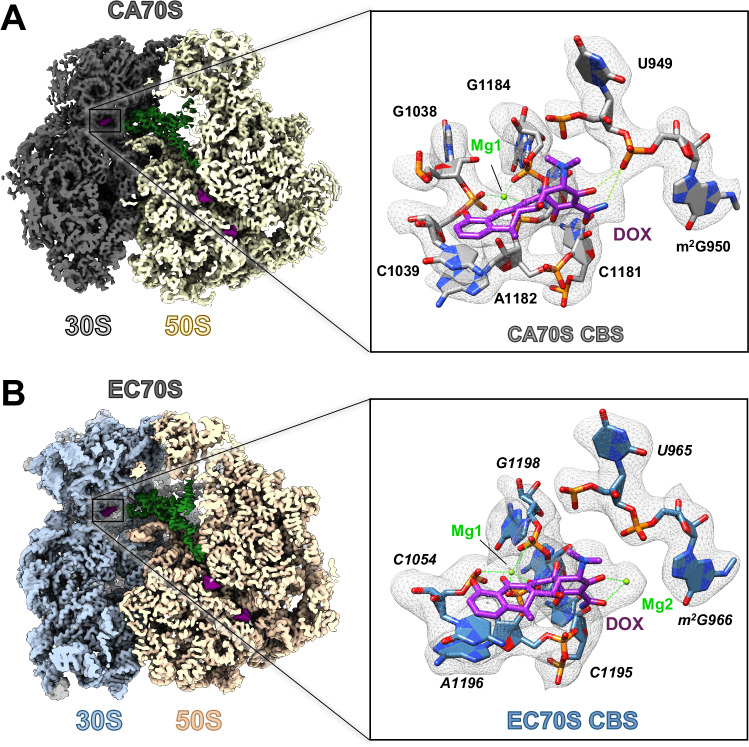
“whereas for the C. acnes 70S ribosome, the second magnesium (Mg2) is absent and the C2-carboxyamide group of tetracycline forms a direct interaction with the phosphate backbone of m2G950. This trend was observed for all three tetracyclines tested.”
§ Dual site targeting of the bacterial 70S ribosome by tetracyclines > Results > Differences in the canonical binding site of Tetracyclines
“For C. acnes 70S ribosome, this second magnesium ion shows partial occupancy (Sarecycline) or is absent (Doxycycline and Minocycline)”
Citations
Cites
UCSF Chimera—A visualization system for exploratory research and analysis
Pettersen, E. F., Goddard, T. D., Huang, C. C., Couch, G. S., Greenblatt, D. M., Meng, E. C., & Ferrin, T. E. (2004) · Journal of Computational Chemistry · doi:10.1002/jcc.20084 · Cited by 45,828 · cited 3×
“All fi gures showing atomic models and cryo-EM map densities were generated using either UCSF Chimera 42 or UCSF ChimeraX 43 .”
InfluentialCoot : model-building tools for molecular graphics
Emsley, P., & Cowtan, K. (2004) · Acta Crystallographica Section D Biological Crystallography · doi:10.1107/s0907444904019158 · Cited by 30,571
PHENIX : a comprehensive Python-based system for macromolecular structure solution
Adams, P. D., Afonine, P. V., Bunkóczi, G., Chen, V. B., Davis, I. W., Echols, N., Headd, J. J., Hung, L.-W., Kapral, G. J., Grosse-Kunstleve, R. W., et al. (2010) · Acta Crystallographica Section D Biological Crystallography · doi:10.1107/s0907444909052925 · Cited by 23,716
Overview of the CCP 4 suite and current developments
Winn, M. D., Ballard, C. C., Cowtan, K. D., Dodson, E. J., Emsley, P., Evans, P. R., Keegan, R. M., Krissinel, E. B., Leslie, A. G. W., McCoy, A., et al. (2011) · Acta Crystallographica Section D Biological Crystallography · doi:10.1107/s0907444910045749 · Cited by 12,353 · cited 2×
“The resampled maps were Fourier inverted into structure factors in ascii format using CCP4 package 44 and were used for Fourier summation along the plotting axes as a function of an added Δ B Gaussian blurring function.”
cryoSPARC: algorithms for rapid unsupervised cryo-EM structure determination
Punjani, A., Rubinstein, J. L., Fleet, D. J., & Brubaker, M. A. (2017) · Nature Methods · doi:10.1038/nmeth.4169 · Cited by 11,626
UCSF ChimeraX: Structure visualization for researchers, educators, and developers
Pettersen, E. F., Goddard, T. D., Huang, C. C., Meng, E. C., Couch, G. S., Croll, T. I., Morris, J. H., & Ferrin, T. E. (2021) · Protein Science · doi:10.1002/pro.3943 · Cited by 9,514
Automated electron microscope tomography using robust prediction of specimen movements
Mastronarde, D. N. (2005) · Journal of Structural Biology · doi:10.1016/j.jsb.2005.07.007 · Cited by 5,336 · cited 1×
“868 Å.Automateddatacollectionwassetupusingeither SerialEM 37 or EPU (ThermoFisher Scienti fi c) software suites.”
Brodersen, D. E., Clemons, W. M., Carter, A. P., Morgan-Warren, R. J., Wimberly, B. T., & Ramakrishnan, V. (2000) · Cell · doi:10.1016/s0092-8674(00)00216-6 · Cited by 950 · cited 3×
“Some structural studies reported secondary binding sites for tetracyclines, but these sites were deemed inconsequential due to their distance from the two active centers of the bacterial ribosome, the mRNA decoding center and the peptidyl-transferase center (PTC) 7,10,11 .”
Pharmacokinetics and pharmacodynamics of the tetracyclines including glycylcyclines
Agwuh, K. N. (2006) · Journal of Antimicrobial Chemotherapy · doi:10.1093/jac/dkl224 · Cited by 806 · cited 1×
“The effective concentration of tetracycline at the site of infection can vary widely depending on the dose and mode of administration 15 .”
Tetracycline Antibiotics and Resistance
Grossman, T. H. (2016) · Cold Spring Harbor Perspectives in Medicine · doi:10.1101/cshperspect.a025387 · Cited by 725
AUREOMYCIN: A PRODUCT OF THE CONTINUING SEARCH FOR NEW ANTIBIOTICS
Duggar, B. M. (1948) · Annals of the New York Academy of Sciences · doi:10.1111/j.1749-6632.1948.tb27262.x · Cited by 512
Revisiting the structures of several antibiotics bound to the bacterial ribosome
Bulkley, D., Innis, C. A., Blaha, G., & Steitz, T. A. (2010) · Proceedings of the National Academy of Sciences · doi:10.1073/pnas.1008685107 · Cited by 308 · cited 1×
“The binding site of the fi rst dimer, Dox-D1, overlaps with that of macrolides 34 andlincosamides 10,35 (Fig.5B).”
Structure of the bacterial ribosome at 2 Å resolution
Watson, Z. L., Ward, F. R., Méheust, R., Ad, O., Schepartz, A., Banfield, J. F., & Cate, J. H. (2020) · eLife · doi:10.7554/elife.60482 · Cited by 263 · cited 1×
“Initial atomic model and restraints for the E. coli and C. acnes 70S ribosome reconstructions were generated using PDB ID 7K00 and 8CRX, respectively 12,39 .”
Molecular Mechanism of Drug-Dependent Ribosome Stalling
Vazquez-Laslop, N., Thum, C., & Mankin, A. S. (2008) · Molecular Cell · doi:10.1016/j.molcel.2008.02.026 · Cited by 260 · cited 2×
“6B) 13,21,28 .”
Jenner, L., Starosta, A. L., Terry, D. S., Mikolajka, A., Filonava, L., Yusupov, M., Blanchard, S. C., Wilson, D. N., & Yusupova, G. (2013) · Proceedings of the National Academy of Sciences · doi:10.1073/pnas.1216691110 · Cited by 204 · cited 1×
“Prior structural studies on tetracycline established it binds to the bacterial 30S ribosomal subunit in the mRNA decoding center, interfering with the binding of the A-site tRNA and inhibiting bacterial protein translation 8,9 .”
Marks, J., Kannan, K., Roncase, E. J., Klepacki, D., Kefi, A., Orelle, C., Vázquez-Laslop, N., & Mankin, A. S. (2016) · Proceedings of the National Academy of Sciences · doi:10.1073/pnas.1613055113 · Cited by 159 · cited 1×
“The polypeptide sequence has been shown to be central to the mechanism of action of NPET binding inhibitors like linezolid 30 , Tetracenomycin X 14 , and macrolides 27 .”
Cunha, B. A., Sibley, C. M., & Ristuccia, A. M. (1982) · Therapeutic Drug Monitoring · doi:10.1097/00007691-198206000-00001 · Cited by 152
Sequence selectivity of macrolide-induced translational attenuation
Davis, A. R., Gohara, D. W., & Yap, M.-N. F. (2014) · Proceedings of the National Academy of Sciences · doi:10.1073/pnas.1410356111 · Cited by 123 · cited 1×
“Recent studies on NPET binding translation inhibitors like macrolides and Tetracenomycin X have established that the sequence of the nascent peptide plays a crucial role in the binding af fi nity and ef fi cacy of these inhibitors 14,26,27 .”
Endogenous rRNA Sequence Variation Can Regulate Stress Response Gene Expression and Phenotype
Kurylo, C. M., Parks, M. M., Juette, M. F., Zinshteyn, B., Altman, R. B., Thibado, J. K., Vincent, C. T., & Blanchard, S. C. (2018) · Cell Reports · doi:10.1016/j.celrep.2018.08.093 · Cited by 117 · cited 1×
“A prior study has highlighted natural sequencevariationsin the 16SrRNAof E.coli thatcandictatesensitivity to tetracyclines 29 .”
Eravacycline, a newly approved fluorocycline
Lee, Y. R., & Burton, C. E. (2019) · European Journal of Clinical Microbiology & Infectious Diseases · doi:10.1007/s10096-019-03590-3 · Cited by 98
Structural conservation of antibiotic interaction with ribosomes
Paternoga, H., Crowe-McAuliffe, C., Bock, L. V., Koller, T. O., Morici, M., Beckert, B., Myasnikov, A. G., Grubmüller, H., Nováček, J., & Wilson, D. N. (2023) · Nature Structural & Molecular Biology · doi:10.1038/s41594-023-01047-y · Cited by 94 · cited 4×
“Some structural studies reported secondary binding sites for tetracyclines, but these sites were deemed inconsequential due to their distance from the two active centers of the bacterial ribosome, the mRNA decoding center and the peptidyl-transferase center (PTC) 7,10,11 .”
InfluentialTetracenomycin X inhibits translation by binding within the ribosomal exit tunnel
Osterman, I. A., Wieland, M., Maviza, T. P., Lashkevich, K. A., Lukianov, D. A., Komarova, E. S., Zakalyukina, Y. V., Buschauer, R., Shiriaev, D. I., Leyn, S. A., et al. (2020) · Nature Chemical Biology · doi:10.1038/s41589-020-0578-x · Cited by 75 · cited 4×
“Interestingly, the ef fi cacy of Tetracenomycin X was severely lowered by mutating the U1782:U2586 of E. coli 70S ribosome to a C:C non-canonical base pair, as observed in C. acnes and Thermusthermophilus 70Sribosome 13 .”
InfluentialZhang, Z., Morgan, C. E., Bonomo, R. A., & Yu, E. W. (2021) · mBio · doi:10.1128/mbio.01031-21 · Cited by 58 · cited 1×
“Some structural studies reported secondary binding sites for tetracyclines, but these sites were deemed inconsequential due to their distance from the two active centers of the bacterial ribosome, the mRNA decoding center and the peptidyl-transferase center (PTC) 7,10,11 .”
Cocozaki, A. I., Altman, R. B., Huang, J., Buurman, E. T., Kazmirski, S. L., Doig, P., Prince, D. B., Blanchard, S. C., Cate, J. H. D., & Ferguson, A. D. (2016) · Proceedings of the National Academy of Sciences · doi:10.1073/pnas.1605127113 · Cited by 56 · cited 1×
“Prior structural studies on tetracycline established it binds to the bacterial 30S ribosomal subunit in the mRNA decoding center, interfering with the binding of the A-site tRNA and inhibiting bacterial protein translation 8,9 .”
Sarecycline interferes with tRNA accommodation and tethers mRNA to the 70S ribosome
Batool, Z., Lomakin, I. B., Polikanov, Y. S., & Bunick, C. G. (2020) · Proceedings of the National Academy of Sciences · doi:10.1073/pnas.2008671117 · Cited by 50 · cited 2×
“However, recent studies indicate that species speci fi c differences in the architecture of the 70S ribosomes from pathogenic bacteria like C. acnes canin fl uencetheantibioticbindingandmechanismofaction 12,20 .”
Self-citationDenks, K., Sliwinski, N., Erichsen, V., Borodkina, B., Origi, A., & Koch, H. (2017) · Nature Microbiology · doi:10.1038/nmicrobiol.2016.265 · Cited by 49 · cited 1×
“This loop of uL23 has been shown to be essential for sensing by the signal recognition particle that delivers a quarter of all proteins to the bacterial membrane for co-translational insertion 25 .”
Modulating co-translational protein folding by rational design and ribosome engineering
Ahn, M., Włodarski, T., Mitropoulou, A., Chan, S. H. S., Sidhu, H., Plessa, E., Becker, T. A., Budisa, N., Waudby, C. A., Beckmann, R., et al. (2022) · Nature Communications · doi:10.1038/s41467-022-31906-z · Cited by 45 · cited 1×
“…critical residues would most likely inhibit the PTC. Aligning the structure of a translating E. coli 70S ribosome with a nascent peptide (PDB:7ZP8) 23 to our structure of E. coli 70S ribosome bound to Dox-ycycline revealed that the three Doxycycline molecules completely occlude the NPET near the…”
Sarecycline: First Global Approval
Deeks, E. D. (2019) · Drugs · doi:10.1007/s40265-019-1053-4 · Cited by 44
Mutational characterization and mapping of the 70S ribosome active site
d’Aquino, A. E., Azim, T., Aleksashin, N. A., Hockenberry, A. J., Krüger, A., & Jewett, M. C. (2020) · Nucleic Acids Research · doi:10.1093/nar/gkaa001 · Cited by 40 · cited 1×
“Most of these 23S rRNA nucleotides are part of the highly conserved PTC ring and are critical for the catalysis of peptide bond formation 22 .”
Experimental charge density from electron microscopic maps
Wang, J. (2017) · Protein Science · doi:10.1002/pro.3198 · Cited by 37
Self-citationLawrence, M. G., Shamsuzzaman, M., Kondopaka, M., Pascual, C., Zengel, J. M., & Lindahl, L. (2016) · Nucleic Acids Research · doi:10.1093/nar/gkw493 · Cited by 36 · cited 1×
“The β -hairpin loop of uL22 (G96-S117 / G79-T100 ) is the largest contributor of ribosomal protein interface for the NPET in bacteria and has been shown to be essential for proper folding of the nascent chain 24 .”
Bioavailability of Doxycycline Monohydrate
Malmborg, A. (2009) · Chemotherapy · doi:10.1159/000238249 · Cited by 28
Cunha, B. A. (2012) · European Journal of Clinical Microbiology & Infectious Diseases · doi:10.1007/s10096-012-1680-0 · Cited by 27 · cited 2×
“For example, a doxycycline oral dose of 200mg per 6 h (typical dose ranges between 100-500mg per 6h) leads to a peak plasma concentration of ~15 µ M and ~700 µ M in the urine of healthy individuals 16 – 18 .”
Lomakin, I. B., Devarkar, S. C., Patel, S., Grada, A., & Bunick, C. G. (2023) · Nucleic Acids Research · doi:10.1093/nar/gkad103 · Cited by 25 · cited 6×
“The binding of all three tetracyclines at the canonical binding site of C. acnes and E. coli 70S ribosome was consistent with previously reported structural studies 7 – 10 , 12 .”
InfluentialSelf-citationTopical Minocycline Foam 4%: A Review in Acne Vulgaris
Paik, J. (2020) · American Journal of Clinical Dermatology · doi:10.1007/s40257-020-00523-1 · Cited by 25 · cited 1×
“%) topical foam formulations, FDA-approved for treat-ment of moderate to severe acne vulgaris 19 , contain Minocycline in excess of 80 millimolar concentration.”
Tetracenomycin X sequesters peptidyl-tRNA during translation of QK motifs
Leroy, E. C., Perry, T. N., Renault, T. T., & Innis, C. A. (2023) · Nature Chemical Biology · doi:10.1038/s41589-023-01343-0 · Cited by 22 · cited 5×
“Recent studies on NPET binding translation inhibitors like macrolides and Tetracenomycin X have established that the sequence of the nascent peptide plays a crucial role in the binding af fi nity and ef fi cacy of these inhibitors 14,26,27 .”
InfluentialStructural basis for differential inhibition of eukaryotic ribosomes by tigecycline
Li, X., Wang, M., Denk, T., Buschauer, R., Li, Y., Beckmann, R., & Cheng, J. (2024) · Nature Communications · doi:10.1038/s41467-024-49797-7 · Cited by 21 · cited 1×
“…ribosomes, a C:C non-canonical base pair is also found in the exact same location in the human 55S mitochondrial ribosome, and recent studies demonstrated that Tigecycline, a third-generation tetracycline, can bind at this site and potently inhibit mito-ribosomal protein translation 31,32 .”
T cell toxicity induced by tigecycline binding to the mitochondrial ribosome
Shao, Q., Khawaja, A., Nguyen, M. D., Singh, V., Zhang, J., Liu, Y., Nordin, J., Adori, M., Axel Innis, C., Castro Dopico, X., et al. (2025) · Nature Communications · doi:10.1038/s41467-025-59388-9 · Cited by 16 · cited 1×
“…ribosomes, a C:C non-canonical base pair is also found in the exact same location in the human 55S mitochondrial ribosome, and recent studies demonstrated that Tigecycline, a third-generation tetracycline, can bind at this site and potently inhibit mito-ribosomal protein translation 31,32 .”
Pharmacokinetics and bioavailability of doxycycline in humans.
Campistron, G., Coulais, Y., Caillard, C., et al. (1986) · PubMed · Cited by 14
Structural insights into context-specific inhibition of bacterial translation by macrolides
Syroegin, E. A., Aleksandrova, E. V., Kruglov, A. A., Paranjpe, M. N., Svetlov, M. S., & Polikanov, Y. S. (2025) · Nature Communications · doi:10.1038/s41467-025-64692-5 · Cited by 8
Mechanistic Basis for the Translation Inhibition of Cutibacterium acnes by Clindamycin
Lomakin, I. B., Devarkar, S. C., Grada, A., & Bunick, C. G. (2024) · Journal of Investigative Dermatology · doi:10.1016/j.jid.2024.07.013 · Cited by 7 · cited 1×
“The binding site of the fi rst dimer, Dox-D1, overlaps with that of macrolides 34 andlincosamides 10,35 (Fig.5B).”
Self-citationCryo-EM reveals multiple mechanisms of ribosome inhibition by doxycycline
Stuart, W. S., Isupov, M. N., McLaren, M., Jenkins, C. H., Monier, A., Daum, B., Norville, I. H., Gold, V. A. M., & Harmer, N. J. (2026) · Nature Communications · doi:10.1038/s41467-026-73421-5 · Cited by 3 · cited 1×
“A recently published pre-print has also independently reported the presence of this Doxycycline trimer stack at the NPET secondary binding site of Coxiella burnetii ribosomes 36 .”
Fifty Years of Minocycline and Its Evolution: A Dermatological Perspective.
Baldwin, H. E., & Ward, D. B. (2021) · PubMed · doi:10.36849/jdd..6370 · Cited by 3
Extensive natural variation in bacterial ribosomal drug-binding sites
Ekemezie, C. L., Chan, L. I., Brown, C. R., Helena-Bueno, K., Williams, T. A., & Melnikov, S. V. (2025) · Cell Reports · doi:10.1016/j.celrep.2025.115878 · Cited by 2 · cited 1×
“6B) 13,21,28 .”
Cryo-EM reveals multiple mechanisms of ribosome inhibition by doxycycline
Stuart, W. S., Isupov, M. N., McLaren, M., Jenkins, C. H., Monier, A., Daum, B., Norville, I. H., Gold, V. A. M., & Harmer, N. J. (2025) · doi:10.1101/2025.11.08.686982
Research works printed but not linked: 1
- Pettersen, E. F. et al. UCSF Chimera - A visualization system for exploratory research and analysis. J. Comput Chem. 25, 1605–1612 (2004). 15264254 · DOI · Paper page
Cited by
Han, Z., Yu, W., Jiayi, Z., et al. (2026) · Journal of Photochemistry and Photobiology A Chemistry · doi:10.1016/j.jphotochem.2026.117635
Fundamentals of dermatologic drug discovery
Grada, A. A. (2026) · Frontiers in Drug Discovery · doi:10.3389/fddsv.2026.1777138
Self-citation
Metadata
- Authors
- Devarkar, S. C., Lomakin, I. B., Wang, J., Grada, A., & Bunick, C. G.
- Affiliations
- Yale University (US)
- Case Western Reserve University (US)
- Corresponding author
- Lomakin, Ivan B.
- Bunick, Christopher G.
- Venue
- Nature Communications
- Published
- 2026-05-19
- Volume
- 17
- Issue
- 1
- ISSN
- 2041-1723 (ISSN-L)
- PMC
- PMC13186991
- OpenAlex
- W7161634351
- Cited by
- 2
- References
- 41
- Citations by year
- 2026: 2
- FWCI
- 4.09
- Type
- journal article
- Language
- en
- Open access
- gold
- doi.org
- Licence
- cc-by-nc-nd
- creativecommons.org/licenses/by-nc-nd/4.0 (tdm)
- creativecommons.org/licenses/by-nc-nd/4.0 (vor)
- Locations
- Nature Communications (publishedVersion, cc-by-nc-nd)
- PubMed (publishedVersion)
- PubMed Central (publishedVersion, cc-by-nc-nd)
- DOAJ (DOAJ: Directory of Open Access Journals) (submittedVersion, cc-by-sa)
- Funders
- American Acne and Rosacea Society
- Almirall and Ortho Dermatologics
- Topics
- Life Sciences › Biochemistry, Genetics and Molecular Biology › Molecular Biology › RNA and protein synthesis mechanisms
- Life Sciences › Immunology and Microbiology › Applied Microbiology and Biotechnology › Microbial Natural Products and Biosynthesis
- Health Sciences › Medicine › Microbiology (medical) › Antibiotic Resistance in Bacteria
- Keywords
- tetracycline, bacterial ribosome, 70S ribosome, 30S subunit, 50S subunit, peptidyl transferase center, doxycycline, minocycline, sarecycline, antibiotic resistance, narrow-spectrum antibiotics, Propionibacterium acnes, Escherichia coli, ribosome structure
- MeSH terms
- Anti-Bacterial Agents, Doxycycline, Escherichia coli, Minocycline, Models, Molecular, Propionibacterium acnes, Ribosomes, Tetracyclines, Cryoelectron Microscopy, Ribosome Subunits, Large, Bacterial
About these checks
Registry, retraction, Cites and statistics results are computed, not judged, with one exception: a printed reference that no index lists is read once by a model before it counts as a citation error. Claims are extracted by a model and kept only when their quote appears verbatim in the text; each cited source is then checked, with a model’s help, for whether it says what the claim relies on. Those verdicts can be wrong — read the claim’s quote and the cited source before relying on one.
The claim verdicts this report counts are experimental: their accuracy is not yet measured.
A language model drew the claims from the paper on 2026-09-30, under version 3 of the claim definition (model deepseek-v4.1-flash, prompt extract-v3).
A second model labelled each claim on 2026-09-30 (model jev-1.13-20260917, definition revision gold-guideline-v0.2).
Cited sources are checked with a language model’s help (gpt-6-sol).
Statistics and arithmetic are recomputed, not judged.
Confidence bands are shown only for fields calibrated on our annotated test set. None is calibrated yet, so no band is shown.
What counts as a claim ›How we measure confidence ›How we check this ›
Are you an author, or do you see a problem with this page? Request a review
Data sources
Bibliographic data: Semantic Scholar, OpenAlex, Crossref.
Contains information from the Semantic Scholar Academic Graph Datasets, made available under the ODC Attribution License (ODC-BY 1.0).
Semantic Scholar’s data is described in: Kinney, R., et al. (2023). The Semantic Scholar Open Data Platform. arXiv:2301.10140.
