

A critical examination of compound stability predictions from machine-learned formation energies
Open accessThe DOI matches its Crossref record; 45 of the 45 references it cites were found in a registry or an index.
Abstract
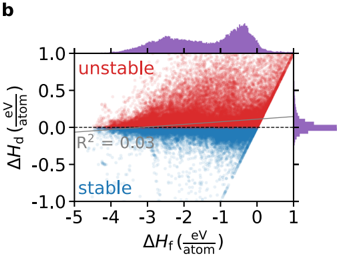
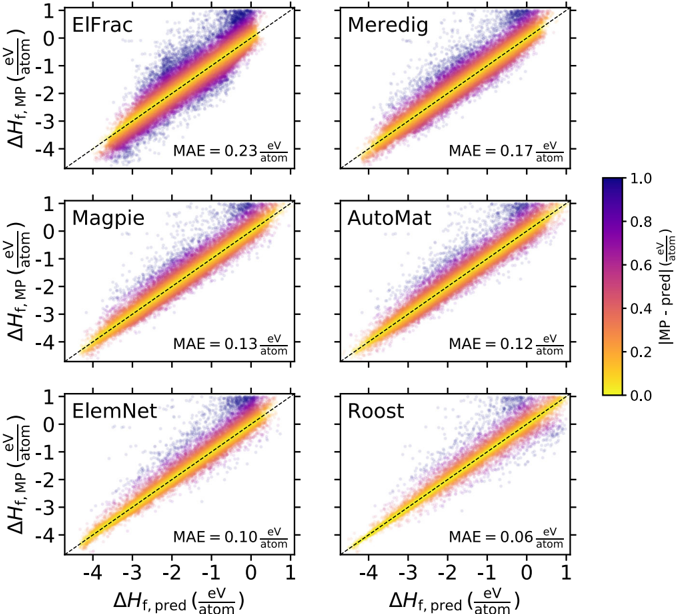
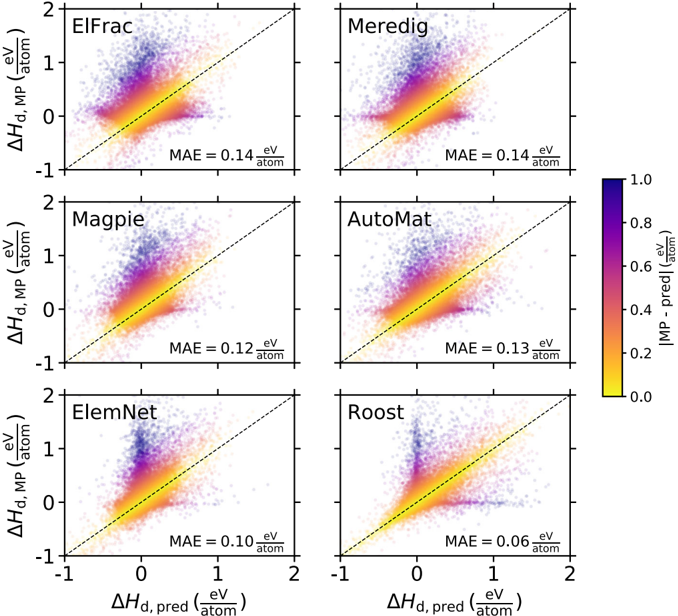
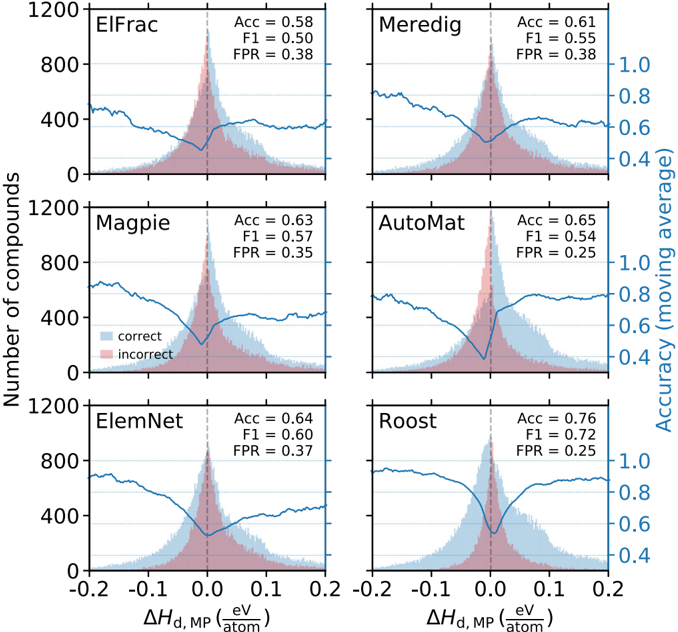
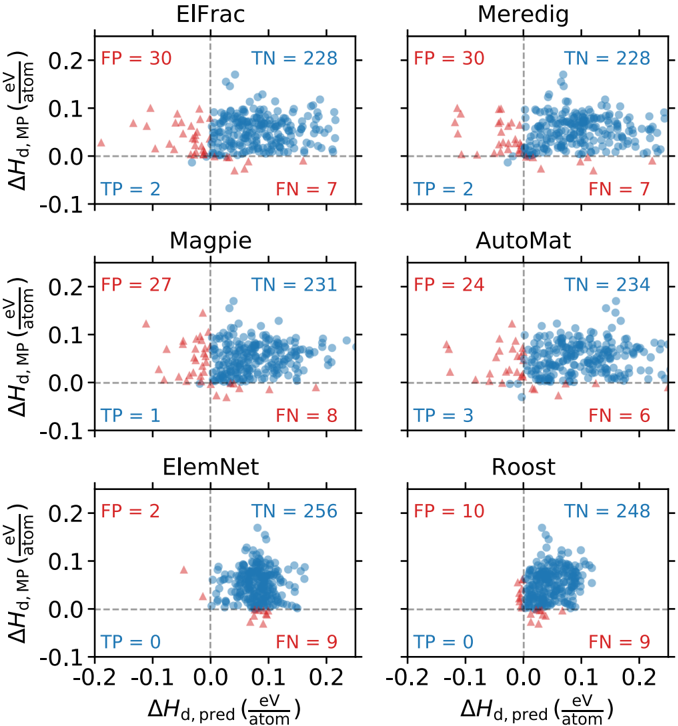
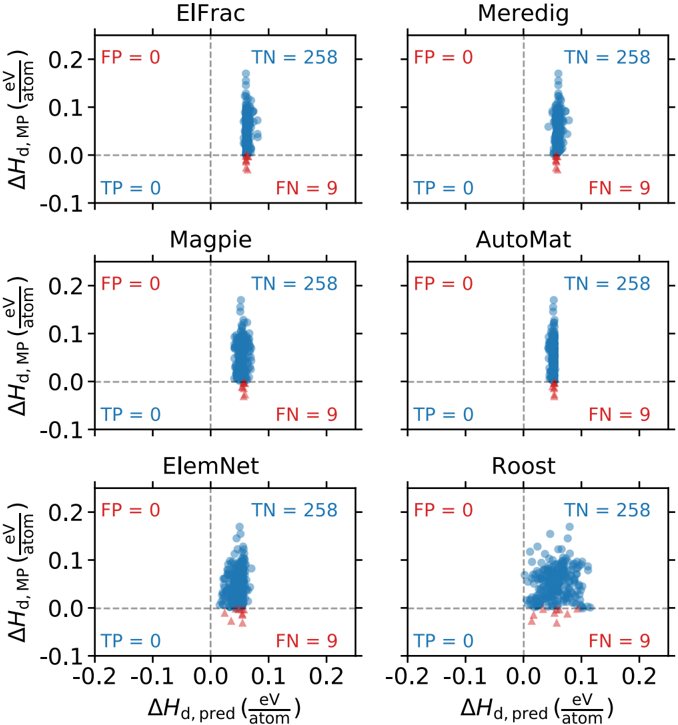
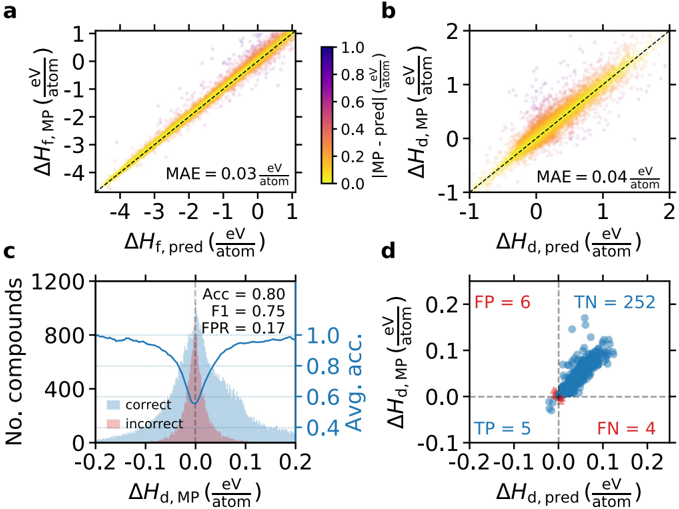
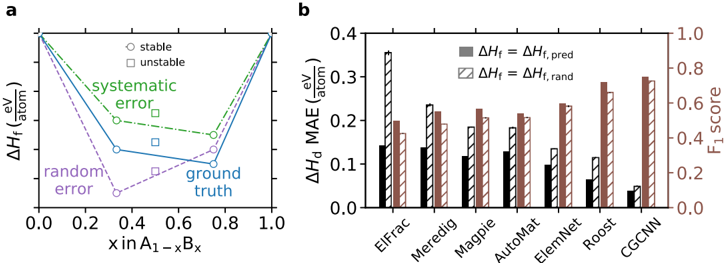
Machine learning has emerged as a novel tool for the efficient prediction of material properties, and claims have been made that machine-learned models for the formation energy of compounds can approach the accuracy of Density Functional Theory (DFT). The models tested in this work include five recently published compositional models, a baseline model using stoichiometry alone, and a structural model. By testing seven machine learning models for formation energy on stability predictions using the Materials Project database of DFT calculations for 85,014 unique chemical compositions, we show that while formation energies can indeed be predicted well, all compositional models perform poorly on predicting the stability of compounds, making them considerably less useful than DFT for the discovery and design of new solids. Most critically, in sparse chemical spaces where few stoichiometries have stable compounds, only the structural model is capable of efficiently detecting which materials are stable. The nonincremental improvement of structural models compared with compositional models is noteworthy and encourages the use of structural models for materials discovery, with the constraint that for any new composition, the ground-state structure is not known a priori. This work demonstrates that accurate predictions of formation energy do not imply accurate predictions of stability, emphasizing the importance of assessing model performance on stability predictions, for which we provide a set of publicly available tests.
Overview
The claims and statistics of this paper haven’t been checked yet.
Free: it reads the open-access text and checks the first 5 claims that cite a source we can check. Create a free account to check every claim.
Integrity signals
Registry
Cites
Statistics
Figures

Verification
Claims the paper makes
The claims and statistics of this paper haven’t been checked yet.
Free: it reads the open-access text and checks the first 5 claims that cite a source we can check. Create a free account to check every claim.
Claims other papers make about this one
Each is checked against this paper’s own text: does it say what the citing paper says it does?
The source backs part of the claim, not all of it — or backs it for a different population, condition or comparison.
In the citing paper
“Although this simplified GNN architecture is able to achieve state-of-the-art generalization on the Materials Project (MAE of 60 meV atom−1 (ref. 25)), it does not offer useful predictions for materials discovery, which was also observed by Bartel et al.25.”
From Scaling deep learning for materials discovery (2023) · cites this paper as [25]
Experimental — accuracy not yet measuredThe source backs part of the claim, not all of it — or backs it for a different population, condition or comparison.
In the citing paper
“Although data-driven methods that aid in further materials discovery have been pursued, thus far, machine-learning techniques have been ineffective in estimating stability (decomposition energy) with respect to the convex hull of energies from competing phases25.”
From Scaling deep learning for materials discovery (2023) · cites this paper as [25]
Experimental — accuracy not yet measuredThe cited source says what the claim attributes to it.
In the citing paper
“The Li/Mn transition-metal oxide family is discussed in ref. 25 to analyse the capabilities of machine-learning models for use in discovery. In the main text, we compare against the findings in the cited work suggesting limited discovery within this family through previous machine-learning methods.”
From Scaling deep learning for materials discovery (2023) · cites this paper as [25]
The cited source says what the claim attributes to it.
In the citing paper
“Although this simplified GNN architecture is able to achieve state-of-the-art generalization on the Materials Project (MAE of 60 meV atom−1 (ref. 25)), it does not offer useful predictions for materials discovery, which was also observed by Bartel et al.25.”
From Scaling deep learning for materials discovery (2023) · cites this paper as [25]
The cited source says what the claim attributes to it.
In the citing paper
“Finally, Li/Mn transition-metal oxides are a promising family to replace LiCoO2 in rechargeable batteries25 and GNoME has discovered an extra 15 candidates stable relative to the Materials Project compared with the original nine.”
From Scaling deep learning for materials discovery (2023) · cites this paper as [25]
1 more claim about this paper
Create a free account to see every claim other papers make about this one.
Self-check
Percentages, sums and reported differences re-computed from the paper’s own numbers.
The self-check needs the paper’s full text.
Citations
Cites
XGBoost: A Scalable Tree Boosting System
Chen, T., & Guestrin, C. (2016) · Proceedings of the 22nd ACM SIGKDD International Conference on Knowledge Discovery and Data Mining · doi:10.1145/2939672.2939785 · Cited by 54,569
Commentary: The Materials Project: A materials genome approach to accelerating materials innovation
Jain, A., Ong, S. P., Hautier, G., Chen, W., Richards, W. D., Dacek, S., Cholia, S., Gunter, D., Skinner, D., Ceder, G., et al. (2013) · APL Materials · doi:10.1063/1.4812323 · Cited by 13,094
Self-citationShow, Attend and Tell: Neural Image Caption Generation with Visual Attention
Xu, K., Ba, J., Kiros, R., Cho, K., Courville, A., Salakhutdinov, R., Zemel, R., & Bengio, Y. (2015) · arXiv · doi:10.48550/arxiv.1502.03044 · Cited by 8,248
Machine learning for molecular and materials science
Butler, K. T., Davies, D. W., Cartwright, H., Isayev, O., & Walsh, A. (2018) · Nature · doi:10.1038/s41586-018-0337-2 · Cited by 4,968
Xie, T., & Grossman, J. C. (2018) · Physical Review Letters · doi:10.1103/physrevlett.120.145301 · Cited by 2,828
Oxidation energies of transition metal oxides within the GGA + U framework
Wang, L., Maxisch, T., & Ceder, G. (2006) · Physical Review B · doi:10.1103/physrevb.73.195107 · Cited by 2,785
Self-citationRecent advances and applications of machine learning in solid-state materials science
Schmidt, J., Marques, M. R. G., Botti, S., & Marques, M. A. L. (2019) · npj Computational Materials · doi:10.1038/s41524-019-0221-0 · Cited by 2,607
On representing chemical environments
Bartók, A. P., Kondor, R., & Csányi, G. (2013) · Physical Review B · doi:10.1103/physrevb.87.184115 · Cited by 2,572
The Open Quantum Materials Database (OQMD): assessing the accuracy of DFT formation energies
Kirklin, S., Saal, J. E., Meredig, B., Thompson, A., Doak, J. W., Aykol, M., Rühl, S., & Wolverton, C. (2015) · npj Computational Materials · doi:10.1038/npjcompumats.2015.10 · Cited by 2,378
Li2MnO3-stabilized LiMO2 (M = Mn, Ni, Co) electrodes for lithium-ion batteries
Thackeray, M. M., Kang, S.-H., Johnson, C. S., Vaughey, J. T., Benedek, R., & Hackney, S. A. (2007) · Journal of Materials Chemistry · doi:10.1039/b702425h · Cited by 2,039
Research works printed but not linked: 5
- Choudhary, K., Kalish, I., Beams, R. & Tavazza, F. High-throughput identification and characterization of two-dimensional materials using density functional the- ory. Sci. Rep. 7, 5179 (2017).
- Davies, D. W. et al. Computational screening of all stoichiometric. Inorg. Mater. Chem. 1, 617-627 (2016).
- Goodall, R., & Lee, A. Predicting materials properties without crystal structure: deep representation learning from stoichiometry. https://arxiv.org/abs/ 1910.00617.
- Zhang, Y. et al. Efficient first-principles prediction of solid stability: towards chemical accuracy. npj Comput. Mater. 4, 9 (2018).
- Miedema, A. R. Simple model for alloys. Philips Tech. Rev. 33(no. 6), 149-160 (1973).
Cited by
Items 101–200 of 277
Hossain, A., Alharbi, H. F., Hasan, M. M., Selvanathan, V., Islam, M. A., Homyra, S., Hasan, A. K. M., Haque, M. M., Shahiduzzaman, M., & Uddin, M. M. (2025) · Computational Condensed Matter · doi:10.1016/j.cocom.2025.e01042 · Cited by 17
Environmental Stability of Crystals: A Greedy Screening
Twyman, N. M., Walsh, A., & Buonassisi, T. (2022) · Chemistry of Materials · doi:10.1021/acs.chemmater.1c02644 · Cited by 18
Patterns Lead the Way to Far-from-Equilibrium Materials
Knoll, P., Ouyang, B., & Steinbock, O. (2023) · ACS Physical Chemistry Au · doi:10.1021/acsphyschemau.3c00050 · Cited by 22
Zhong, P., Chen, T., Barroso-Luque, L., Xie, F., & Ceder, G. (2022) · Physical review. B./Physical review. B · doi:10.1103/physrevb.106.024203 · Cited by 17
Self-citationPracticing deep learning in materials science: An evaluation for predicting the formation energies
Huang, L., & Chen, L. (2020) · Journal of Applied Physics · doi:10.1063/5.0012411 · Cited by 21
Datta, J., Datta, D., & Sharma, V. (2023) · Journal of Materials Science · doi:10.1007/s10853-023-08705-y · Cited by 19
Data-centric approach to improve machine learning models for inorganic materials
Bartel, C. J. (2021) · Patterns · doi:10.1016/j.patter.2021.100382 · Cited by 19
“Models that overestimate the stability of hypothetical candidates will inevitably have high false positive rates and lead to wasted resources investigating materials predicted to be stable that will not be upon further investigation.(9) Pandey et al.”
BackgroundSelf-citationPredicting synthesis recipes of inorganic crystal materials using elementwise template formulation
Kim, S.-M., Noh, J., Gu, G. H., Chen, S., & Jung, Y. (2024) · Chemical Science · doi:10.1039/d3sc03538g · Cited by 25
Cui, Y., Zhu, J. Q., Zhou, W., Zang, H., Ren, Y., Xu, J., Zhan, S., & Ma, W. (2024) · AIP Advances · doi:10.1063/5.0186891 · Cited by 18
Zhang, S., Ma, T., Zhao, Y., Zhang, Z., Shao, W., Huang, J., Zhang, X., Zheng, Y., Wang, W., & Yang, J. Y. (2024) · Vacuum · doi:10.1016/j.vacuum.2024.113414 · Cited by 15
Optimizing Fractional Compositions to Achieve Extraordinary Properties
Falkowski, A., Kauwe, S. K., & Sparks, T. D. (2021) · Integrating materials and manufacturing innovation · doi:10.1007/s40192-021-00242-3 · Cited by 16
“Bartel et al. demonstrated decomposition energy as a reasonable analogue to thermodynamic stability and showed that networks with attention mechanisms can predict it with reasonable accuracy [22].”
BackgroundSakaushi, K., Watanabe, A., Kumeda, T., & Shibuta, Y. (2022) · ACS Applied Materials & Interfaces · doi:10.1021/acsami.1c21038 · Cited by 15
Mannodi‐Kanakkithodi, A. (2024) · Computational Materials Science · doi:10.1016/j.commatsci.2024.113108 · Cited by 18
Data driven design of compositionally complex energy materials
Wang, L., He, Z., & Ouyang, B. (2023) · Computational Materials Science · doi:10.1016/j.commatsci.2023.112513 · Cited by 15
Machine-Learning-Assisted Construction of Ternary Convex Hull Diagrams
Rossignol, H., Minotakis, M., Cobelli, M., & Sanvito, S. (2024) · Journal of Chemical Information and Modeling · doi:10.1021/acs.jcim.3c01391 · Cited by 21
“19,20 Note that these can also be constructed with compositional information only.”
BackgroundMachine-learning for designing nanoarchitectured materials by dealloying
Zhao, C., Chung, C.-C., Jiang, S., Noack, M. M., Chen, J.-H., Manandhar, K., Lynch, J. K., Zhong, H., Zhu, W., Maffettone, P. M., et al. (2022) · Communications Materials · doi:10.1038/s43246-022-00303-w · Cited by 13
“We also included thermodynamic attributes to determine the compound stabilities, including the formation energy and energy above the convex hull (approximate as decomposition enthalpy) 24 , which are available in the Matminer library 77 .”
BackgroundMethodBoosting heterogeneous catalyst discovery by structurally constrained deep learning models
Коровин, А. Н., Humonen, I. S., Samtsevich, A. I., Eremin, R. A., Vasilev, A. I., Lazarev, V. D., & Budennyy, S. (2023) · Materials Today Chemistry · doi:10.1016/j.mtchem.2023.101541 · Cited by 16
Synthesis-Aware Materials Redesign via Large Language Models
Choi, J., Kim, S.-M., & Jung, Y. (2025) · Journal of the American Chemical Society · doi:10.1021/jacs.5c07743 · Cited by 25
Cross-functional transferability in foundation machine learning interatomic potentials
Huang, X., Deng, B., Zhong, P., Kaplan, A. D., Persson, K. A., & Ceder, G. (2025) · npj Computational Materials · doi:10.1038/s41524-025-01796-y · Cited by 42
“The formation energy is referenced to the energy of constituentelemental unaries in theirreferencestates (solid orgas phase) 79,80 , and decomposition energy is referenced to the energies of competing compounds in a given chemical space 74 .”
Self-citationHu, M. (2024) · Journal of Applied Physics · doi:10.1063/5.0201778 · Cited by 14
Wide-ranging predictions of new stable compounds powered by recommendation engines
Griesemer, S. D., Baldassarri, B., Zhu, R., Shen, J., Pal, K., Park, C. W., & Wolverton, C. M. (2025) · Science Advances · doi:10.1126/sciadv.adq1431 · Cited by 19
“Bartel et al. ( 61 ) compared seven formation enthalpy ML models on the same Materials Project datasets, finding that models with lower MAE in predictions of diverse 85,014 compounds exhibited better performance in recovering the stable compounds (i.e., convex hull distance of zero).”
Yi, Z., Cao, H., Ouyang, Q., & Qian, Q. (2021) · Materials Today Communications · doi:10.1016/j.mtcomm.2021.102314 · Cited by 15
Machine-Learning-Driven Expansion of the 1D van der Waals Materials Space
Zhu, Y., Antoniuk, E. R., Wright, D., Kargar, F., Sesing, N., Sendek, A. D., Salguero, T. T., Bartels, L., Balandin, A. A., Reed, E. J., et al. (2023) · The Journal of Physical Chemistry C · doi:10.1021/acs.jpcc.3c03882 · Cited by 13
Accurate prediction of second harmonic generation coefficients using graph neural networks
Xiao, J., Li, Y., Wang, S., & He, Z. Y. (2024) · Computational Materials Science · doi:10.1016/j.commatsci.2024.113203 · Cited by 12
Lessons from the trenches on evaluating machine learning systems in materials science
Alampara, N., Schilling-Wilhelmi, M., & Jablonka, K. M. (2025) · Computational Materials Science · doi:10.1016/j.commatsci.2025.114041 · Cited by 22
Yang, J., Kalinin, S. V., Cubuk, E. D., Ziatdinov, M. A., & Ahmadi, M. (2023) · MRS Bulletin · doi:10.1557/s43577-023-00490-y · Cited by 11
Beyond independent error assumptions in large GNN atomistic models
Ock, J., Tian, T., Kitchin, J. R., & Ulissi, Z. W. (2023) · The Journal of Chemical Physics · doi:10.1063/5.0151159 · Cited by 15
Kim, J., Jung, J., Kim, S., & Han, S. (2024) · Computational Materials Science · doi:10.1016/j.commatsci.2024.112783 · Cited by 11
“However, decomposition energy, representing the energy difference between a compound and its competing compounds in a given chemical space [28], showed negligible correlation with melting points in ternary systems with 𝑅 2 of less than 0.01.”
BackgroundInfluentialMa, F., Chen, F., Xu, P., Liu, X., & Zhang, W. (2025) · Journal of Materials Chemistry A · doi:10.1039/d4ta07674e · Cited by 10
Song, Z., Niu, X., & Chen, H. (2024) · Physical Chemistry Chemical Physics · doi:10.1039/d4cp00386a · Cited by 10
Wu, Y., Li, X., Guo, R., Xu, R., Ju, M., & Wang, J. (2025) · National Science Review · doi:10.1093/nsr/nwaf081 · Cited by 15
“Bartel et al. have utilized data available in the MP to construct the convex hull, thereby obtaining the decomposition enthalpy of 85 014 inorganic crystalline solids [43 ].”
Advances in theory and computational methods for next-generation thermoelectric materials
Park, J., Ganose, A. M., & Xia, Y. (2025) · Applied Physics Reviews · doi:10.1063/5.0241645 · Cited by 11
Lin, C. X., Zhang, L., & Dong, Y. (2025) · Journal of Energy Storage · doi:10.1016/j.est.2025.116990 · Cited by 9
Zhang, Y., Oh, Y., Baek, J., Kim, M. C., Didat, Z., Song, H. W., & Lee, S. (2025) · Advanced Materials · doi:10.1002/adma.202517190 · Cited by 12
“In parallel, formation energy provides insight into material thermodynamic stability, reflecting chemical structure robustness under electrochemical environments [11, 12].”
Mahmood, Q., Tahir, S., Albalawi, H. M., Zelai, T., Hakami, O., Al‐Qaisi, S., Rahman, M. F., Aljameel, A. I., Murtaza, G., & Adam, M. (2023) · Journal of Physics and Chemistry of Solids · doi:10.1016/j.jpcs.2023.111584 · Cited by 9
Zhang, J., Kong, Y., Chen, L., Koutná, N., & Mayrhofer, P. H. (2024) · Acta Materialia · doi:10.1016/j.actamat.2024.120139 · Cited by 11
Xue, H., Cheng, G., & Yin, W. (2024) · Wiley Interdisciplinary Reviews Computational Molecular Science · doi:10.1002/wcms.1732 · Cited by 13
“6 The set of lowest-energy linear combinations for each composition forms a convex hull.”
Atsumi, T., Sato, K., Yamaguchi, Y., Hamaie, M., Yasuda, R., Tanibata, N., Takeda, H., Nakayama, M., Karasuyama, M., & Takeuchi, I. (2022) · physica status solidi (b) · doi:10.1002/pssb.202100525 · Cited by 9
Eremin, R. A., Humonen, I. S., Zolotarev, P. N., Medrish, I. V., Евгеньевич, Ж. Л., & Budennyy, S. (2022) · Crystal Growth & Design · doi:10.1021/acs.cgd.2c00463 · Cited by 11
Graph neural networks for predicting structural stability of Cd- and Zn-doped γ -CsPbI3
Eremin, R. A., Humonen, I. S., Kazakov, A. A., Lazarev, V. D., Pushkarev, A. P., & Budennyy, S. (2023) · Computational Materials Science · doi:10.1016/j.commatsci.2023.112672 · Cited by 14
Coarse-Grained Crystal Graph Neural Networks for Reticular Materials Design
Korolev, V., & Mitrofanov, A. A. (2024) · Journal of Chemical Information and Modeling · doi:10.1021/acs.jcim.3c02083 · Cited by 9
“AI methods have been utilized to examine a plethora of physicochemical parameters, including thermodynamic[4, 5, 6], electronic[7, 8, 9], mechanical[10, 11, 12], adsorption[13, 14, 15], and catalytic[16, 17, 18] properties.”
Enblom, V., Clulow, R., Ha, T., Witman, M. D., Way, L., Han, S. J., Carvalho, P. H. B. B., Stavila, V., Suh, J., Sahlberg, M., et al. (2025) · Materialia · doi:10.1016/j.mtla.2025.102414 · Cited by 14
“Big data approaches to hydride discovery emerged as possible solutions to this challenge, including compositional machine learning models [28 – 30] trained on experimentally collected thermodynamic data [31], and applied to search for possible hydrides exhibiting desired thermodynamics [32,33],…”
Structural insights and electrochemical applications of high-entropy oxides: A comprehensive review
Sheikh, K. A., & Khan, M. M. (2025) · Progress in Engineering Science · doi:10.1016/j.pes.2025.100105 · Cited by 12
Bridging artificial intelligence with photovoltaics
Lee, S., Lee, S., Lee, S., Hwang, J.-S., Oh, W., Winther, K. T., Lee, D. U., Kim, D.-H., Nielander, A. C., Jaramillo, T. F., et al. (2025) · Cell Reports Physical Science · doi:10.1016/j.xcrp.2025.102893 · Cited by 14
A Neural Network Approach to Predict Gibbs Free Energy of Ternary Solid Solutions
Laiu, P., Yang, Y., Pasini, M. L., Choi, J. Y., & Shin, D. (2022) · Journal of Phase Equilibria and Diffusion · doi:10.1007/s11669-022-01010-2 · Cited by 9
Screening New Quaternary Semiconductor Heusler Compounds By Machine-Learning Methods
Xie, R., Crivello, J., & Barreteau, C. (2023) · Chemistry of Materials · doi:10.1021/acs.chemmater.3c01323 · Cited by 8
Shen, H., Wu, J., Chen, Z., Fang, X., Li, J., Li, W., Lin, J. H., Zhu, F., Wang, X., & Chen, Y. (2023) · The Journal of Physical Chemistry C · doi:10.1021/acs.jpcc.3c05255 · Cited by 11
A Theoretical Study To Understand the Impact of Mpro of nCoV on the Hormones
Singh, M. B., Himani, Yadav, S., & Singh, P. (2024) · ChemistrySelect · doi:10.1002/slct.202304767 · Cited by 8
Ji, J., & Lee, B. (2022) · Journal of Power Sources · doi:10.1016/j.jpowsour.2022.231790 · Cited by 8
High-Throughput and Data-Driven Search for Stable Optoelectronic AMSe3 Materials
Singh, N. K., Samanta, K., Maharana, S. K., Pal, K., Tretiak, S., Talapatra, A., & Ghosh, D. (2025) · MATSUS Spring Conference · doi:10.1039/d4ta08867k · Cited by 7
Wu, H., Doner, A. C., Pang, H., & Green, W. H. (2025) · The Journal of Physical Chemistry A · doi:10.1021/acs.jpca.5c00615 · Cited by 9
Direct band gap prediction of single and double perovskite using cost-sensitive ensemble learning
Kusuma, F. J., Widianto, E., Wahyono, W., Santoso, I., Sholihun, S., Absor, M. A. U., Sakti, S. P., & Trıyana, K. (2025) · Journal of Alloys and Compounds · doi:10.1016/j.jallcom.2025.182102 · Cited by 11
Ettouzani, A., Zaghrane, A., Merzouki, G., Abbassi, A., Manaut, B., & Taj, S. (2026) · Physica Scripta · doi:10.1088/1402-4896/ae32cc · Cited by 7
Computational screen of M 2 P metal phosphides for catalytic ethane dehydrogenation
Ko, J., & Schneider, W. F. (2022) · Catalysis Science & Technology · doi:10.1039/d2cy00602b · Cited by 7
Recent Advance of Machine Learning in Selecting New Materials
Qi, X., Hu, Y., Wang, R., Yang, Y., & Zhao, Y. (2023) · 化学学报 · doi:10.6023/a22110446 · Cited by 9
Impact of Domain Knowledge on the Property Prediction of Specialized Machine Learning Models
Wang, L., He, T., & Ouyang, B. (2025) · ACS Materials Letters · doi:10.1021/acsmaterialslett.5c00726 · Cited by 13
Assessing the accuracy of compound formation energies with quantum Monte Carlo
Isaacs, E. B., Shin, H., Annaberdiyev, A., Wolverton, C. M., Mitáš, L., Benali, A., & Heinonen, O. (2022) · Physical review. B./Physical review. B · doi:10.1103/physrevb.105.224110 · Cited by 6
Dutta, R., Chen, L., Renshaw, D., & Liang, D. (2022) · PLoS ONE · doi:10.1371/journal.pone.0275485 · Cited by 8
Prediction of quantum spin Hall and Rashba effects in two-dimensional ilmenite oxides
Arokiasamy, S., Macam, G. M., Villaos, R. A. B., Maghirang, A. B., Huang, Z.-Q., Hsu, C.-H., Chang, G., & Chuang, F. (2023) · Chinese Journal of Physics · doi:10.1016/j.cjph.2023.09.022 · Cited by 7
Vasylenko, A., Asher, B. M., Collins, C. M., Gaultois, M. W., Darling, G. R., Dyer, M. S., & Rosseinsky, M. J. (2024) · The Journal of Chemical Physics · doi:10.1063/5.0180818 · Cited by 9
Wang, Z., Chen, C., Qian, S., Jia, B., Xu, Y., Guan, X., Han, Z., Tuo, Y., Du, Y., Yun, X., et al. (2025) · The Journal of Physical Chemistry C · doi:10.1021/acs.jpcc.5c02142 · Cited by 8
Supervised pretraining for material property prediction
Rahman, C. M. A., Romero, A. H., & Gyawali, P. (2025) · Communications Materials · doi:10.1038/s43246-025-00999-6 · Cited by 9
“Inrecentyears,machinelearning(ML)anddeeplearning (DL)modelshavegainedtractioninmaterialpropertyprediction,offering fasterandmoreef fi cient ways to estimate material properties 8 – 15 , at least withinthescopeofDFT.”
Vollbrecht, M., Pramanik, K., Ciacchi, L. C., & Mädler, L. (2024) · Journal of Sustainable Metallurgy · doi:10.1007/s40831-024-00888-1 · Cited by 5
Benahmedi, L., Besbes, A., & Djelti, R. (2025) · Acta Physica Polonica A · doi:10.12693/aphyspola.147.393 · Cited by 6
Chen, D., Liu, Y., Feng, P., Tao, X., Huang, Z., Zhang, X., Zhou, M., & Chen, J. (2023) · Journal of Energy Chemistry · doi:10.1016/j.jechem.2023.12.013 · Cited by 5
Song, J., Qin, Y., Shi, D., Chen, X., Li, W., Wang, Y., & Cao, C. (2024) · Physical review. B./Physical review. B · doi:10.1103/physrevb.109.035144 · Cited by 5
Machine learning of stability scores from kinetic data
Singla, V., Zhao, Q., & Savoie, B. M. (2024) · Digital Discovery · doi:10.1039/d4dd00036f · Cited by 5
Tamtaji, M., Goddard, W. A., & Chen, G. (2024) · Journal of Materials Chemistry A · doi:10.1039/d4ta06497f · Cited by 5
Kadhum, A. M., Waheeb, A. S., Mallah, S. H., Awad, M. A., Hasan, D. M., Kyhoiesh, H. A. K., Elsalam, H. E. A., & Azab, I. H. E. (2025) · Materials Chemistry and Physics · doi:10.1016/j.matchemphys.2025.131765 · Cited by 4
Ma, Y., Yuan, X., Yewale, A., & Benyahia, B. (2026) · Particuology · doi:10.1016/j.partic.2026.01.014 · Cited by 9
Islam, S., Aldaghfag, S. A., El‐Rayyes, A., Mahmud, A. A., Saidi, S., Alsalmi, O., Khan, M. T., & Saiduzzaman, M. (2026) · RSC Advances · doi:10.1039/d6ra01318j · Cited by 4
“46 Among the studied systems, Rb 2 InAgF 6 exhibits the most negative formation energy ( − 2.319 eV per atom), indicating the highest structural stability as shown in Fig.”
InfluentialVolkov, S. N., Aksenov, S. M., Yukhno, V. A., Бубнова, Р. С., Povolotskiy, A. V., Arsent’ev, M. Y., Уголков, В. Л., & Krzhizhanovskaya, M. G. (2022) · Crystal Growth & Design · doi:10.1021/acs.cgd.1c01031 · Cited by 4
Sun, Z., Sun, W., Li, S., Yang, Z., Zhang, M., Yang, Y., Geng, H.-Y., & Yu, J. (2024) · Journal of Materials Chemistry A · doi:10.1039/d4ta04495a · Cited by 5
Accurate formation enthalpies of solids using reaction networks
Fromsejer, R., Maribo‐Mogensen, B., Kontogeorgis, G. M., & Liang, X. (2024) · npj Computational Materials · doi:10.1038/s41524-024-01404-5 · Cited by 5
“Sincethedifferencesare rootedinachemicalreaction,withproductsandreactantsofnecessarily similarchemistry,wecanexpecttoobserveerror-cancellationstemming fromsimilaritiesintheirrespectiveerrors 21,39 .”
InfluentialColloidal systems as experimental platforms for physics-informed machine learning
Kang, N., Joo, Y., An, H., & Hwang, H. (2025) · Nanoscale Horizons · doi:10.1039/d5nh00568j · Cited by 5
A simple feature enriched CGCNN for predicting magnetization in transition metal compounds
Singh, S. K., Joshi, P., Sharma, A. K., & Kashyap, A. (2025) · Journal of Magnetism and Magnetic Materials · doi:10.1016/j.jmmm.2025.173541 · Cited by 4
Predicting and Synthesizing Interface Stabilized 2D Layers
Hamann, D. M., Rudin, S. P., Asaba, T., Ronning, F., Cordova, D. L. M., Lu, P., & Johnson, D. C. (2021) · Chemistry of Materials · doi:10.1021/acs.chemmater.1c01064 · Cited by 4
Charting the chemical space of Zintl phases with graph neural networks and bonding insights
Chaliha, R., Kothakonda, M. K., Lee, C., Law, J., Yang, Q., Bobev, S., & Gorai, P. (2025) · Journal of Materials Chemistry A · doi:10.1039/d5ta06210a · Cited by 4
Machine-learning-assisted density functional theory for predicting transparent conducting materials
Huang, Y., Wang, G., Xu, S., Xu, Y., Li, D., Huang, M., Samuelson, L., & Sun, X. W. (2026) · Physical Review Applied · doi:10.1103/br17-vmg2 · Cited by 3
Aghoghovbia, O., Rurali, R., Al-Fahdi, M., & Hu, M. (2026) · Chemistry of Materials · doi:10.1021/acs.chemmater.5c02214 · Cited by 5
Data-driven prediction of solid state reaction pathways in the synthesis of ferrites
Chen, Z., Liu, Y., Zhao, W., Xiao, Y., Li, P., Li, J., & Zhang, P. (2026) · Journal of Solid State Chemistry · doi:10.1016/j.jssc.2026.125914 · Cited by 4
Developing Sustainable Spintronics: Investigating Mn-Based Zintl Semiconductors for Next-Gen Devices
Hameed, U., Ullah, H., Jaouadi, M., Abbas, S. Z., Yagob, A. A., Zribi, S. M., & Yagoob, S. I. (2026) · Journal of Superconductivity and Novel Magnetism · doi:10.1007/s10948-026-07210-y · Cited by 3
AI for Accelerated Materials Discovery: From Generative Design to Autonomous Realization
Choi, J., Kim, S., Park, J., Choi, J., An, S., & Jung, Y. (2026) · Chemical Reviews · doi:10.1021/acs.chemrev.6c00154 · Cited by 11
Machine-learning models for atom-diatom reactions across isotopologues
Julian, D., Koots, R., & Pérez‐Ríos, J. (2024) · Physical Review A · doi:10.1103/physreva.110.032811 · Cited by 3
Carlsson, A., Ronchi, R. M., Rosén, J., & Dahlqvist, M. (2024) · Nanoscale · doi:10.1039/d4nr02948h · Cited by 3
Ternary materials discovery using human-in-the-loop generative machine learning
Wilfong, B., New, A., Bassen, G., Bustine, W., Pekala, M. J., Le, N. Q., Rao, K. K., Pogue, E. A., Gienger, E. B., Winiarski, M. J., et al. (2025) · RSC Advances · doi:10.1039/d5ra00427f · Cited by 5
Benchmarking Machine Learning Descriptors for Crystals
Sonpal, A., Afzal, M. A. F., An, Y., Chandrasekaran, A. R., & Halls, M. D. (2022) · ACS symposium series · doi:10.1021/bk-2022-1416.ch006 · Cited by 5
FEFOS: a method to derive oxide formation energies from oxidation states
Craig, M. J., Kleuker, F., Bajdich, M., & Melchor, M. G. (2023) · Catalysis Science & Technology · doi:10.1039/d3cy00107e · Cited by 3
“ΔD(A1−zBzOy) = ΔC(A1−zBzOy) − (1 − z)ΔC(A1B0Oy) − zΔC(A0B1Oy) (5)”
In silico investigation of Cu(In,Ga)Se 2 -based solar cells
Mirhosseini, H., Raghupathy, R. K. M., Sahoo, S. K., Wiebeler, H., Chugh, M., & Kühne, T. D. (2020) · Physical Chemistry Chemical Physics · doi:10.1039/d0cp04712k · Cited by 5
Beniwal, D., & Ray, P. (2023) · PHYSICAL REVIEW MATERIALS · doi:10.1103/physrevmaterials.7.043802 · Cited by 4
Liu, G., Jia, B., Wang, Z., Qian, S., Cui, B., Bi, Y., Dong, C., Chen, C., & Lu, P. (2026) · Materials Science in Semiconductor Processing · doi:10.1016/j.mssp.2025.110403 · Cited by 4
Machine learning drives a new paradigm in inorganic solid-state electrolytes research
Yin, X., Ma, J., Zhang, S., & Cui, G. (2026) · Computational Materials Today · doi:10.1016/j.commt.2026.100051 · Cited by 2
Machine Learning Prediction of Crystal Structure Stability toward the Design of High-Entropy Oxides
Zhou, Q., Wang, C., Wang, L., Wang, Z., Qiu, M., Dong, M., & Yu, Y. (2026) · Chinese Physics Letters · doi:10.1088/0256-307x/43/5/050801 · Cited by 3
DFT-based assessment of M3AlB2 (M = V, Nb, Mo, Hf) MAX phases for TBC applications
Adnan, L. H. K., Tanim, M. I. A., Saif, S. S., Talukder, C., Haque, K., Jahan, N., Hossain, M. M., Uddin, M. M., Rana, T. H., & Ali, M. A. (2026) · Applied Materials Today · doi:10.1016/j.apmt.2026.103219 · Cited by 3
Shao, X., Dong, Z., Ma, P., Li, L., Yao, T., Yan, Y., Li, M., Gao, Z., & Yang, W. (2026) · ChemPhysChem · doi:10.1002/cphc.202500702 · Cited by 2
Tang, J., Cao, L., Xu, G., & Li, M. (2026) · ACS Applied Materials & Interfaces · doi:10.1021/acsami.6c05353 · Cited by 3
Tan, V. W. G., Sitoh, Y., Foo, D. C. Y., Tapia, J. F. D., & Tan, R. R. (2023) · Discover Chemical Engineering · doi:10.1007/s43938-023-00031-8 · Cited by 2
“This set of equations was solved using a matrix pseudoinverse in the SciPy package for the multiplicity vector, m [44].”
MethodRole of tin clustering in band structure and thermodynamic stability of GeSn by atomistic modeling
Karthikeyan, S., & Hudait, M. K. (2024) · Journal of Vacuum Science & Technology B Nanotechnology and Microelectronics Materials Processing Measurement and Phenomena · doi:10.1116/6.0003563 · Cited by 2
Glasser, L. (2024) · Chemical Thermodynamics and Thermal Analysis · doi:10.1016/j.ctta.2024.100145 · Cited by 2
An obvervance of the new modification of metaboric acid, δ-HBO2
Kopylova, Y. O., Volkov, S. N., Arsent’ev, M. Y., Topalov, E. V., Aksenov, S. M., & Бубнова, Р. С. (2024) · Zeitschrift für Kristallographie - Crystalline Materials · doi:10.1515/zkri-2024-0104 · Cited by 2
Metadata
- Authors
- Bartel, C. J., Trewartha, A., Wang, Q., Dunn, A., Jain, A., & Ceder, G.
- Affiliations
- University of California, Berkeley (US)
- Lawrence Berkeley National Laboratory (US)
- Corresponding author
- Bartel, Christopher J.
- Ceder, Gerbrand
- Venue
- npj Computational Materials
- Published
- 2020-07-10
- Volume
- 6
- Issue
- 1
- ISSN
- 2057-3960 (ISSN-L)
- OpenAlex
- W3041359432
- Semantic Scholar
- 973cfdc47aef3f9bdd6e39651f48acbbaeaadd94
- Cited by
- 277
- References
- 43
- Citations by year
- 2026: 65 · 2025: 54 · 2024: 47 · 2023: 40 · 2022: 41 · 2021: 26 · 2020: 4
- FWCI
- 10.79
- Type
- journal article
- Language
- en
- Open access
- gold
- doi.org
- Licence
- cc-by
- creativecommons.org/licenses/by/4.0 (tdm)
- creativecommons.org/licenses/by/4.0 (vor)
- Locations
- npj Computational Materials (publishedVersion, cc-by)
- arXiv (Cornell University) (submittedVersion)
- eScholarship (California Digital Library) (submittedVersion)
- OSTI OAI (U.S. Department of Energy Office of Scientific and Technical Information) (submittedVersion)
- arXiv (Cornell University)
- Funders
- U.S. Department of Energy (DE-AC02-05-CH11231)
- Topics
- Physical Sciences › Materials Science › Materials Chemistry › Machine Learning in Materials Science
- Physical Sciences › Physics and Astronomy › Atomic and Molecular Physics, and Optics › Advanced Chemical Physics Studies
- Life Sciences › Pharmacology, Toxicology and Pharmaceutics › Drug Discovery › Computational Drug Discovery Methods
- Keywords
- formation energy, machine learning, compositional models, structural model, Materials Project, stoichiometry, materials discovery, model evaluation, ground state structure
About these checks
Registry, retraction, Cites and statistics results are computed, not judged, with one exception: a printed reference that no index lists is read once by a model before it counts as a citation error. Claims are extracted by a model and kept only when their quote appears verbatim in the text; each cited source is then checked, with a model’s help, for whether it says what the claim relies on. Those verdicts can be wrong — read the claim’s quote and the cited source before relying on one.
Statistics and arithmetic are recomputed, not judged.
Confidence bands are shown only for fields calibrated on our annotated test set. None is calibrated yet, so no band is shown.
What counts as a claim ›How we measure confidence ›How we check this ›
Are you an author, or do you see a problem with this page? Request a review
Data sources
Bibliographic data: Semantic Scholar, OpenAlex, Crossref.
Contains information from the Semantic Scholar Academic Graph Datasets, made available under the ODC Attribution License (ODC-BY 1.0).
Semantic Scholar’s data is described in: Kinney, R., et al. (2023). The Semantic Scholar Open Data Platform. arXiv:2301.10140.
