

A critical examination of compound stability predictions from machine-learned formation energies
Open accessThe DOI matches its Crossref record; 45 of the 45 references it cites were found in a registry or an index.
Abstract
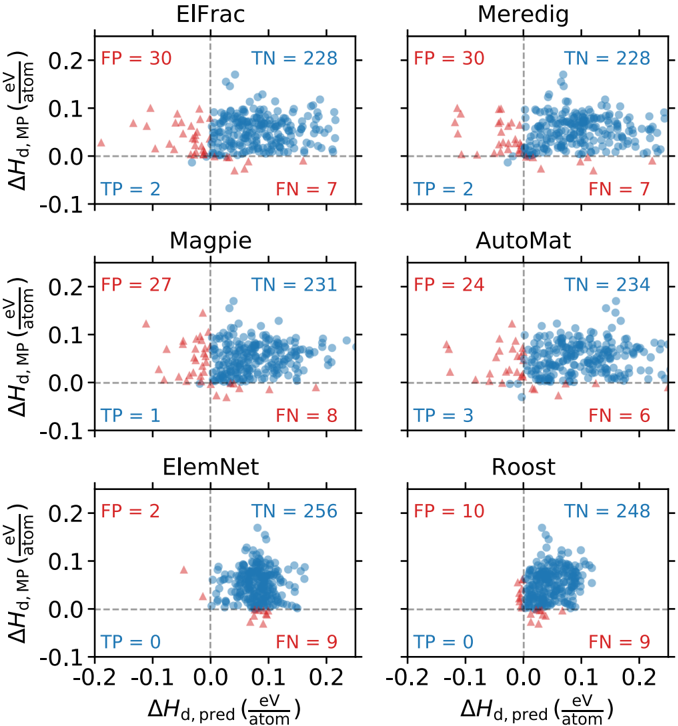
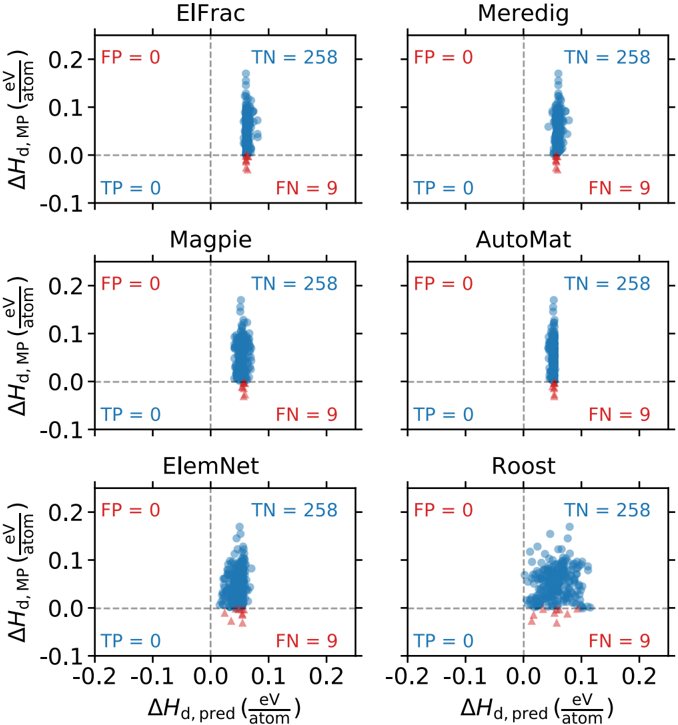
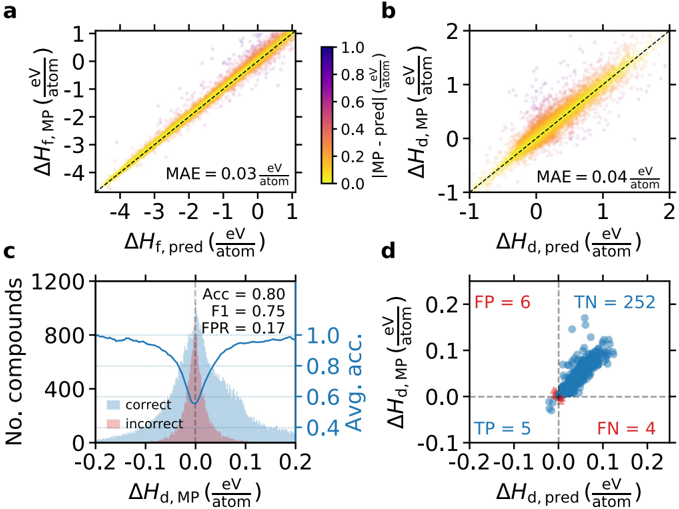
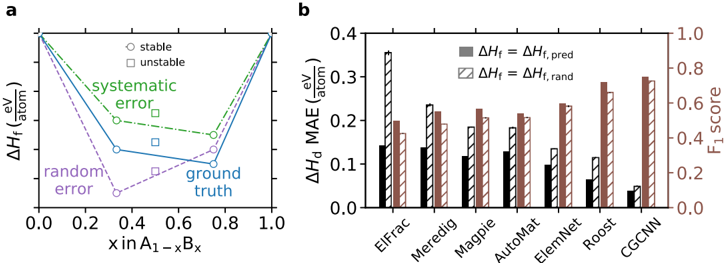
Machine learning has emerged as a novel tool for the efficient prediction of material properties, and claims have been made that machine-learned models for the formation energy of compounds can approach the accuracy of Density Functional Theory (DFT). The models tested in this work include five recently published compositional models, a baseline model using stoichiometry alone, and a structural model. By testing seven machine learning models for formation energy on stability predictions using the Materials Project database of DFT calculations for 85,014 unique chemical compositions, we show that while formation energies can indeed be predicted well, all compositional models perform poorly on predicting the stability of compounds, making them considerably less useful than DFT for the discovery and design of new solids. Most critically, in sparse chemical spaces where few stoichiometries have stable compounds, only the structural model is capable of efficiently detecting which materials are stable. The nonincremental improvement of structural models compared with compositional models is noteworthy and encourages the use of structural models for materials discovery, with the constraint that for any new composition, the ground-state structure is not known a priori. This work demonstrates that accurate predictions of formation energy do not imply accurate predictions of stability, emphasizing the importance of assessing model performance on stability predictions, for which we provide a set of publicly available tests.
Overview
The claims and statistics of this paper haven’t been checked yet.
Free: it reads the open-access text and checks the first 5 claims that cite a source we can check. Create a free account to check every claim.
Integrity signals
Registry
Cites
Statistics
Figures

Verification
Claims the paper makes
The claims and statistics of this paper haven’t been checked yet.
Free: it reads the open-access text and checks the first 5 claims that cite a source we can check. Create a free account to check every claim.
Claims other papers make about this one
Each is checked against this paper’s own text: does it say what the citing paper says it does?
The source backs part of the claim, not all of it — or backs it for a different population, condition or comparison.
In the citing paper
“Although this simplified GNN architecture is able to achieve state-of-the-art generalization on the Materials Project (MAE of 60 meV atom−1 (ref. 25)), it does not offer useful predictions for materials discovery, which was also observed by Bartel et al.25.”
From Scaling deep learning for materials discovery (2023) · cites this paper as [25]
Experimental — accuracy not yet measuredThe source backs part of the claim, not all of it — or backs it for a different population, condition or comparison.
In the citing paper
“Although data-driven methods that aid in further materials discovery have been pursued, thus far, machine-learning techniques have been ineffective in estimating stability (decomposition energy) with respect to the convex hull of energies from competing phases25.”
From Scaling deep learning for materials discovery (2023) · cites this paper as [25]
Experimental — accuracy not yet measuredThe cited source says what the claim attributes to it.
In the citing paper
“The Li/Mn transition-metal oxide family is discussed in ref. 25 to analyse the capabilities of machine-learning models for use in discovery. In the main text, we compare against the findings in the cited work suggesting limited discovery within this family through previous machine-learning methods.”
From Scaling deep learning for materials discovery (2023) · cites this paper as [25]
The cited source says what the claim attributes to it.
In the citing paper
“Although this simplified GNN architecture is able to achieve state-of-the-art generalization on the Materials Project (MAE of 60 meV atom−1 (ref. 25)), it does not offer useful predictions for materials discovery, which was also observed by Bartel et al.25.”
From Scaling deep learning for materials discovery (2023) · cites this paper as [25]
The cited source says what the claim attributes to it.
In the citing paper
“Finally, Li/Mn transition-metal oxides are a promising family to replace LiCoO2 in rechargeable batteries25 and GNoME has discovered an extra 15 candidates stable relative to the Materials Project compared with the original nine.”
From Scaling deep learning for materials discovery (2023) · cites this paper as [25]
1 more claim about this paper
Create a free account to see every claim other papers make about this one.
Self-check
Percentages, sums and reported differences re-computed from the paper’s own numbers.
The self-check needs the paper’s full text.
Citations
Cites
XGBoost: A Scalable Tree Boosting System
Chen, T., & Guestrin, C. (2016) · Proceedings of the 22nd ACM SIGKDD International Conference on Knowledge Discovery and Data Mining · doi:10.1145/2939672.2939785 · Cited by 54,569
Commentary: The Materials Project: A materials genome approach to accelerating materials innovation
Jain, A., Ong, S. P., Hautier, G., Chen, W., Richards, W. D., Dacek, S., Cholia, S., Gunter, D., Skinner, D., Ceder, G., et al. (2013) · APL Materials · doi:10.1063/1.4812323 · Cited by 13,094
Self-citationShow, Attend and Tell: Neural Image Caption Generation with Visual Attention
Xu, K., Ba, J., Kiros, R., Cho, K., Courville, A., Salakhutdinov, R., Zemel, R., & Bengio, Y. (2015) · arXiv · doi:10.48550/arxiv.1502.03044 · Cited by 8,248
Machine learning for molecular and materials science
Butler, K. T., Davies, D. W., Cartwright, H., Isayev, O., & Walsh, A. (2018) · Nature · doi:10.1038/s41586-018-0337-2 · Cited by 4,968
Xie, T., & Grossman, J. C. (2018) · Physical Review Letters · doi:10.1103/physrevlett.120.145301 · Cited by 2,828
Oxidation energies of transition metal oxides within the GGA + U framework
Wang, L., Maxisch, T., & Ceder, G. (2006) · Physical Review B · doi:10.1103/physrevb.73.195107 · Cited by 2,785
Self-citationRecent advances and applications of machine learning in solid-state materials science
Schmidt, J., Marques, M. R. G., Botti, S., & Marques, M. A. L. (2019) · npj Computational Materials · doi:10.1038/s41524-019-0221-0 · Cited by 2,607
On representing chemical environments
Bartók, A. P., Kondor, R., & Csányi, G. (2013) · Physical Review B · doi:10.1103/physrevb.87.184115 · Cited by 2,572
The Open Quantum Materials Database (OQMD): assessing the accuracy of DFT formation energies
Kirklin, S., Saal, J. E., Meredig, B., Thompson, A., Doak, J. W., Aykol, M., Rühl, S., & Wolverton, C. (2015) · npj Computational Materials · doi:10.1038/npjcompumats.2015.10 · Cited by 2,378
Li2MnO3-stabilized LiMO2 (M = Mn, Ni, Co) electrodes for lithium-ion batteries
Thackeray, M. M., Kang, S.-H., Johnson, C. S., Vaughey, J. T., Benedek, R., & Hackney, S. A. (2007) · Journal of Materials Chemistry · doi:10.1039/b702425h · Cited by 2,039
Research works printed but not linked: 5
- Choudhary, K., Kalish, I., Beams, R. & Tavazza, F. High-throughput identification and characterization of two-dimensional materials using density functional the- ory. Sci. Rep. 7, 5179 (2017).
- Davies, D. W. et al. Computational screening of all stoichiometric. Inorg. Mater. Chem. 1, 617-627 (2016).
- Goodall, R., & Lee, A. Predicting materials properties without crystal structure: deep representation learning from stoichiometry. https://arxiv.org/abs/ 1910.00617.
- Zhang, Y. et al. Efficient first-principles prediction of solid stability: towards chemical accuracy. npj Comput. Mater. 4, 9 (2018).
- Miedema, A. R. Simple model for alloys. Philips Tech. Rev. 33(no. 6), 149-160 (1973).
Cited by
Scaling deep learning for materials discovery
Merchant, A., Batzner, S., Schoenholz, S. S., Aykol, M., Cheon, G., & Cubuk, E. D. (2023) · Nature · doi:10.1038/s41586-023-06735-9 · Cited by 1,527
“Although data-driven methods that aid in further materials discovery have been pursued, thus far, machine-learning techniques have been ineffective in estimating stability (decomposition energy) with respect to the convex hull of energies from competing phases 25 .”
BackgroundMethodInfluentialRecent advances and applications of deep learning methods in materials science
Choudhary, K., DeCost, B., Chen, C., Jain, A., Tavazza, F., Cohn, R., Park, C. W., Choudhary, A., Agrawal, A., Billinge, S. J. L., et al. (2022) · npj Computational Materials · doi:10.1038/s41524-022-00734-6 · Cited by 1,172
“It is thus not a surprise that chemical formula-based methods may not be adequate in some cases 159 .”
BackgroundSelf-citationGraph neural networks for materials science and chemistry
Reiser, P., Neubert, M., Eberhard, A., Torresi, L., Zhou, C., Shao, C., Metni, H., van Hoesel, C., Schopmans, H., Sommer, T., et al. (2022) · Communications Materials · doi:10.1038/s43246-022-00315-6 · Cited by 860
Compositionally restricted attention-based network for materials property predictions
Wang, A. Y.-T., Kauwe, S. K., Murdock, R. J., & Sparks, T. D. (2021) · npj Computational Materials · doi:10.1038/s41524-021-00545-1 · Cited by 260
“CritExam__Ed Bartel et al.(55) Decomposition enthalpy 85014 (70/15/15)”
BackgroundReview of computational approaches to predict the thermodynamic stability of inorganic solids
Bartel, C. J. (2022) · Journal of Materials Science · doi:10.1007/s10853-022-06915-4 · Cited by 196
Self-citationA review of the recent progress in battery informatics
Ling, C. (2022) · npj Computational Materials · doi:10.1038/s41524-022-00713-x · Cited by 178
Data‐Driven Materials Innovation and Applications
Wang, Z., Sun, Z., Yin, H., Liu, X., Wang, J., Zhao, H., Pang, C. H., Wu, T., Li, S., Yin, Z., et al. (2022) · Advanced Materials · doi:10.1002/adma.202104113 · Cited by 187
Roadmap on Machine learning in electronic structure
Kulik, H. J., Hammerschmidt, T., Schmidt, J., Botti, S., Marques, M. A. L., Boley, M., Scheffler, M., Todorović, M., Rinke, P., Oses, C., et al. (2022) · Electronic Structure · doi:10.1088/2516-1075/ac572f · Cited by 180
“accuracy of these networks and their prediction ability is superior [28], the reported errors are not directly pertinent to high-throughput searches.”
BackgroundThe rise of high-entropy battery materials
Ouyang, B., & Zeng, Y. (2024) · Nature Communications · doi:10.1038/s41467-024-45309-9 · Cited by 176
Machine Learning for Perovskite Solar Cells and Component Materials: Key Technologies and Prospects
Liu, Y., Tan, X., Liang, J., Han, H., Xiang, P., & Yan, W. (2023) · Advanced Functional Materials · doi:10.1002/adfm.202214271 · Cited by 174
A framework to evaluate machine learning crystal stability predictions
Riebesell, J., Goodall, R. E. A., Benner, P., Chiang, Y., Deng, B., Ceder, G., Asta, M., Lee, A. A., Jain, A., & Persson, K. A. (2025) · Nature Machine Intelligence · doi:10.1038/s42256-025-01055-1 · Cited by 507
Self-citationApplications of Artificial Intelligence and Machine Learning Algorithms to Crystallization
Xiouras, C., Cameli, F., Quilló, G. L., Kavousanakis, M. E., Vlachos, D. G., & Stefanidis, G. D. (2022) · Chemical Reviews · doi:10.1021/acs.chemrev.2c00141 · Cited by 160
Crystal graph attention networks for the prediction of stable materials
Schmidt, J., Pettersson, L., Verdozzi, C., Botti, S., & Marques, M. A. L. (2021) · Science Advances · doi:10.1126/sciadv.abi7948 · Cited by 199
“(37) recommends to learn formation energies, other machine learning studies came to different conclusions (24) and showed that it is advantageous to predict directly the distance to the convex hull.”
BackgroundLi, K., DeCost, B., Choudhary, K. K., Greenwood, M., & Hattrick-Simpers, J. R. (2023) · npj Computational Materials · doi:10.1038/s41524-023-01012-9 · Cited by 197
“Formation energy prediction is a basic task for ML models used in materials science, including traditional descriptor-based models [26–28 , 53] and Weusethe ALIGNN model pretrained on the Materials Project 2018.06.01 version (denoted as MP18), which contains 69239 materials and has been used for…”
MethodInfluentialAccelerating materials discovery with Bayesian optimization and graph deep learning
Zuo, Y., Qin, M., Chen, C., Ye, W., Li, X., Luo, J., & Ong, S. P. (2021) · Materials Today · doi:10.1016/j.mattod.2021.08.012 · Cited by 168
Representations of Materials for Machine Learning
Damewood, J., Karaguesian, J., Lunger, J. R., Tan, A. R., Xie, M., Peng, J., & Gómez‐Bombarelli, R. (2023) · Annual Review of Materials Research · doi:10.1146/annurev-matsci-080921-085947 · Cited by 173
“Additionally, graph-based structural models such as CGCNN [18] or MEGNet [56] generally outperform compositional models [84].”
BackgroundMethodSynthetic accessibility and stability rules of NASICONs
Ouyang, B., Wang, J., He, T., Bartel, C. J., Huo, H., Wang, Y. E., Lacivita, V., Kim, H., & Ceder, G. (2021) · Nature Communications · doi:10.1038/s41467-021-26006-3 · Cited by 131
Self-citationChemical hardness-driven interpretable machine learning approach for rapid search of photocatalysts
Kumar, R., & Singh, A. K. (2021) · npj Computational Materials · doi:10.1038/s41524-021-00669-4 · Cited by 131
“It is in agreement with the previous reports, which show that utilizing only elemental features is suf fi cient for predicting Δ E f47,48 .”
MethodResultInfluentialCrystal structure prediction by combining graph network and optimization algorithm
Cheng, G., Gong, X.-G., & Yin, W. (2022) · Nature Communications · doi:10.1038/s41467-022-29241-4 · Cited by 163
“Second, the high accuracy of DFT calculations bene fi t from the systematic cancellation of errors relative to the experiment, and the claimed DFT-level accuracies of the ML models are obtained from training data composed of stable crystal structures 27 .”
MethodDeep dive into machine learning density functional theory for materials science and chemistry
Fiedler, L., Shah, K., Bußmann, M., & Cangi, A. (2022) · Physical Review Materials · doi:10.1103/physrevmaterials.6.040301 · Cited by 154
Machine‐Learning‐Assisted Determination of the Global Zero‐Temperature Phase Diagram of Materials
Schmidt, J., Hoffmann, N., Wang, H., Borlido, P., Carriço, P. J. M. A., Cerqueira, T. F. T., Botti, S., & Marques, M. A. L. (2023) · Advanced Materials · doi:10.1002/adma.202210788 · Cited by 234
Understanding solid-state battery electrolytes using atomistic modelling and machine learning
Dutra, A. C. C., Goldmann, B. A., Islam, M. S., & Dawson, J. A. (2025) · Nature Reviews Materials · doi:10.1038/s41578-025-00817-y · Cited by 166
Is Domain Knowledge Necessary for Machine Learning Materials Properties?
Murdock, R., Kauwe, S. K., Wang, A., & Sparks, T. D. (2020) · Integrating materials and manufacturing innovation · doi:10.1007/s40192-020-00179-z · Cited by 120
“In fact, the Fractional representation often performs as well as or better than many other featurizers in the limit of “large” data (in agreement with previous work analyzing models that use little-to-no domain knowledge[19]).”
ResultWitman, M. D., Ek, G., Ling, S., Chames, J. M., Agarwal, S., Wong, J., Allendorf, M. D., Sahlberg, M., & Stavila, V. (2021) · Chemistry of Materials · doi:10.1021/acs.chemmater.1c00647 · Cited by 116
Accelerating the prediction of stable materials with machine learning
Griesemer, S. D., Xia, Y., & Wolverton, C. M. (2023) · Nature Computational Science · doi:10.1038/s43588-023-00536-w · Cited by 123
“Although formation enthalpies calculated by DFT have an MAE of 91 meV per atom compared with experimental values 6 , CHD values calculated by DFT benefit from cancellation of errors 62,63 whereas CHD values predicted by ML do not 64 .”
MethodJain, A. (2024) · Current Opinion in Solid State and Materials Science · doi:10.1016/j.cossms.2024.101189 · Cited by 123
Self-citationMachine Learning Modeling for Accelerated Battery Materials Design in the Small Data Regime
Sendek, A. D., Ransom, B., Cubuk, E. D., Pellouchoud, L. A., Nanda, J., & Reed, E. J. (2022) · Advanced Energy Materials · doi:10.1002/aenm.202200553 · Cited by 100
Nandy, A., Duan, C., & Kulik, H. J. (2021) · Current Opinion in Chemical Engineering · doi:10.1016/j.coche.2021.100778 · Cited by 119
Uncertainty Prediction for Machine Learning Models of Material Properties
Tavazza, F., DeCost, B., & Choudhary, K. K. (2021) · ACS Omega · doi:10.1021/acsomega.1c03752 · Cited by 120
Gong, S., Yan, K., Xie, T., Shao‐Horn, Y., Gómez‐Bombarelli, R., Ji, S., & Grossman, J. C. (2023) · Science Advances · doi:10.1126/sciadv.adi3245 · Cited by 117
Artificial intelligence for catalyst design and synthesis
Zhang, L., Bing, Q., Qin, H., Yu, L., Li, H., & Deng, D. (2025) · Matter · doi:10.1016/j.matt.2025.102138 · Cited by 116
Wang, Q. S., & Yao, Y. (2025) · npj Computational Materials · doi:10.1038/s41524-025-01579-5 · Cited by 117
Self-citationMaterials discovery through machine learning formation energy
Peterson, G. G. C., & Brgoch, J. (2021) · Journal of Physics Energy · doi:10.1088/2515-7655/abe425 · Cited by 109
“This problem can be resolved by constructing a thermodynamic convex hull, drawn as the largest convex object connecting plotted∆Hf values against a compositional axis [30].”
BackgroundMachine-Learning Rationalization and Prediction of Solid-State Synthesis Conditions
Huo, H., Bartel, C. J., He, T., Trewartha, A., Dunn, A., Ouyang, B., Jain, A., & Ceder, G. (2022) · Chemistry of Materials · doi:10.1021/acs.chemmater.2c01293 · Cited by 79
Self-citationAtomSets as a hierarchical transfer learning framework for small and large materials datasets
Chen, C., & Ong, S. P. (2021) · npj Computational Materials · doi:10.1038/s41524-021-00639-w · Cited by 90
“This observation is consistent with a recent study by Bartel et al.23 For further verification of the polymorph effects, we have screened out polymorphs with diverse properties from the MP Ef, MP log ðKVRHÞ and MP log ðGVRHÞ datasets and evaluated the model errors on those polymorph datasets.”
ResultChang, R., Wang, Y.-X., & Ertekin, E. (2022) · npj Computational Materials · doi:10.1038/s41524-022-00929-x · Cited by 114
Accelerated Atomistic Modeling of Solid-State Battery Materials With Machine Learning
Guo, H., Wang, Q., Stuke, A., Urban, A., & Artrith, N. (2021) · Frontiers in Energy Research · doi:10.3389/fenrg.2021.695902 · Cited by 77
“Similarly, Bartel et al. tested seven ML models for the formation energy prediction of Li transition metal oxides, using the chemical formula as the model input (Bartel et al., 2020).”
MethodSelf-citationFactors controlling oxophilicity and carbophilicity of transition metals and main group metals
Kayode, G. O., & Montemore, M. M. (2021) · Journal of Materials Chemistry A · doi:10.1039/d1ta06453c · Cited by 74
Hu, J., Stefanov, S., Song, Y., Omee, S. S., Louis, S.-Y., Siriwardane, E. M. D., Zhao, Y., & Wei, L. (2022) · npj Computational Materials · doi:10.1038/s41524-022-00750-6 · Cited by 84
“This model has demonstrated exceptionally good performance for compound stability prediction among composition-only ML models 48 .”
JARVIS-Leaderboard: a large scale benchmark of materials design methods
Choudhary, K. K., Wines, D., Li, K., Garrity, K. F., Gupta, V., Romero, A. H., Krogel, J. T., Saritas, K., Fuhr, A., Ganesh, P., et al. (2024) · npj Computational Materials · doi:10.1038/s41524-024-01259-w · Cited by 108
“For biomolecular systems, GROMACS 135 is commonly used, and wepresentherefreeenergydifferencesandconformationalstatepopulation benchmarks for three model peptides 136 – 138 .”
Yin, H., Sun, Z., Wang, Z., Tang, D., Pang, C. H., Yu, X., Barnard, A. S., Zhao, H., & Yin, Z. (2021) · Cell Reports Physical Science · doi:10.1016/j.xcrp.2021.100482 · Cited by 71
Phase diagrams—Why they matter and how to predict them
Chew, P. Y., & Reinhardt, A. (2023) · The Journal of Chemical Physics · doi:10.1063/5.0131028 · Cited by 72
The design and optimization of heterogeneous catalysts using computational methods
Shambhawi, S., Mohan, O., Choksi, T. S., & Lapkin, A. A. (2024) · Catalysis Science & Technology · doi:10.1039/d3cy01160g · Cited by 73
Deep reinforcement learning for inverse inorganic materials design
Karpovich, C. J., Pan, E., & Olivetti, E. (2024) · npj Computational Materials · doi:10.1038/s41524-024-01474-5 · Cited by 94
“Wenotethatacomprehensivecom-parisontoneighboringcompoundsontheconvexhullwouldbenecessary todeterminetruecompoundstability 71 .”
Machine Learning Assisted Prediction of Cathode Materials for Zn‐Ion Batteries
Zhou, L., Yao, A. M., Wu, Y., Hu, Z., Huang, Y., & Hong, Z. (2021) · Advanced Theory and Simulations · doi:10.1002/adts.202100196 · Cited by 65
Mlatticeabc: Generic Lattice Constant Prediction of Crystal Materials Using Machine Learning
Li, Y., Yang, W., Dong, R., & Hu, J. (2021) · ACS Omega · doi:10.1021/acsomega.1c00781 · Cited by 60
Husain, M., Albalawi, H. M., Huwayz, M. M. A., Saqri, N. A. A., Khan, R., & Rahman, N. (2023) · Physica Scripta · doi:10.1088/1402-4896/acf695 · Cited by 53
Why big data and compute are not necessarily the path to big materials science
Fujinuma, N., DeCost, B., Hattrick-Simpers, J. R., & Lofland, S. E. (2022) · Communications Materials · doi:10.1038/s43246-022-00283-x · Cited by 60
“It can be productive to reassess 13 the predictive tasks we are striving to address with ML methods; more carefully thought out applications may provide more bene fi t than simply collecting larger datasets and training higher capacity models.”
BackgroundMao, Y., Yang, H., Sheng, Y., Wang, J., Ouyang, R., Ye, C., Yang, J., & Zhang, W. (2021) · ACS Omega · doi:10.1021/acsomega.1c01517 · Cited by 57
Darkaoui, E. M., Mouslih, S., Islah, J., Archi, M., Abbassi, A., Taj, S., Manaut, B., & Ez-Zahraouy, H. (2025) · Journal of Magnetism and Magnetic Materials · doi:10.1016/j.jmmm.2025.172980 · Cited by 48
A general framework to govern machine learning oriented materials data quality
Liu, Y., Yang, Z., Zou, X., Lin, Y., Ma, S., Zuo, W., Zou, Z., Wang, H., Avdeev, M., & Shi, S. (2025) · Materials Science and Engineering R Reports · doi:10.1016/j.mser.2025.101050 · Cited by 53
Predicting energy and stability of known and hypothetical crystals using graph neural network
Pandey, S., Qu, J., Stevanović, V., John, P. C. S., & Gorai, P. (2021) · Patterns · doi:10.1016/j.patter.2021.100361 · Cited by 51
“We also compare the stability predictions by our GNN model with those from simple composition-based models.(24) We train the Magpie model(37) on the lowest-energy structures for each composition in our dataset using 145 composition-based features.”
BackgroundMethodTowards Pareto optimal high entropy hydrides via data-driven materials discovery
Witman, M. D., Ling, S., Wadge, M. D., Bouzidi, A., Pineda-Romero, N., Clulow, R., Ek, G., Chames, J. M., Allendorf, E. J., Agarwal, S., et al. (2023) · Journal of Materials Chemistry A · doi:10.1039/d3ta02323k · Cited by 49
First-principles investigation of MXenes M 4 C 3 ( M = S c , C r , a n d M n ) for clean energy
Darkaoui, E. M., Zaghrane, A., Ouhenou, H., Abbassi, A., Agouri, M., Waqdim, A., Makayssi, T., Taj, S., Manaut, B., & Driouich, M. (2024) · Chinese Journal of Physics · doi:10.1016/j.cjph.2024.03.041 · Cited by 43
Calibrating DFT Formation Enthalpy Calculations by Multifidelity Machine Learning
Gong, S., Wang, S., Xie, T., Chae, W. H., Liu, R., Shao‐Horn, Y., & Grossman, J. C. (2022) · JACS Au · doi:10.1021/jacsau.2c00235 · Cited by 54
“It would be beneficial to design prediction schemes that can automatically extract chemistry-property relationship across different chemistries without human intervention, and data-driven ML methods(18, 24, 26, 28, 29, 32, 42) are promising candidates to learn the complex mapping between chemistry and ΔHf.”
BackgroundMethodInfluentialZaghrane, A., Ouhenou, H., Darkaoui, E. M., Agouri, M., Abbassi, A., Mekaoui, Y., Taj, S., & Manaut, B. (2023) · Chinese Journal of Physics · doi:10.1016/j.cjph.2023.08.001 · Cited by 41
Yang, J., Manganaris, P., & Mannodi‐Kanakkithodi, A. (2024) · The Journal of Chemical Physics · doi:10.1063/5.0182543 · Cited by 45
Duan, C., Chen, S., Taylor, M. G., Liu, F., & Kulik, H. J. (2021) · Chemical Science · doi:10.1039/d1sc03701c · Cited by 40
Accurate, interpretable predictions of materials properties within transformer language models
Korolev, V., & Protsenko, P. V. (2023) · Patterns · doi:10.1016/j.patter.2023.100803 · Cited by 49
“have demonstrated significant improvement in stability predictions owing to inclusion of crystal structure in representation[101].”
BackgroundAntoniuk, E. R., Cheon, G., Wang, G., Bernstein, D., Cai, W., & Reed, E. J. (2023) · npj Computational Materials · doi:10.1038/s41524-023-01114-4 · Cited by 60
Accelerating defect predictions in semiconductors using graph neural networks
Rahman, M. H., Gollapalli, P., Manganaris, P., Yadav, S. K., Pilania, G., DeCost, B., Choudhary, K. K., & Mannodi‐Kanakkithodi, A. (2024) · APL Machine Learning · doi:10.1063/5.0176333 · Cited by 53
Pal, K., Park, C. W., Xia, Y., Shen, J., & Wolverton, C. M. (2022) · npj Computational Materials · doi:10.1038/s41524-022-00732-8 · Cited by 44
Zou, H. L., Zhao, H., Lu, M., Wang, J., Deng, Z., & Wang, J. (2025) · Nature Communications · doi:10.1038/s41467-024-55525-y · Cited by 51
“However, determining the precise structures of compounds can be challenging 7,45 .”
Kouhestani, H. S., Yi, X., Qi, G., Liu, X., Wang, R., Gao, Y., Yu, X. L., & Liu, L. (2022) · Energies · doi:10.3390/en15186599 · Cited by 40
Ihalage, A. A., & Hao, Y. (2021) · npj Computational Materials · doi:10.1038/s41524-021-00536-2 · Cited by 40
Piezoelectric modulus prediction using machine learning and graph neural networks
Hu, J., & Song, Y. (2022) · Chemical Physics Letters · doi:10.1016/j.cplett.2022.139359 · Cited by 38
Zaghrane, A., Ouhenou, H., Darkaoui, E. M., Abbassi, A., Taj, S., Manaut, B., & Razouk, A. (2024) · Materials Research Bulletin · doi:10.1016/j.materresbull.2024.113071 · Cited by 32
Graph isomorphism network for materials property prediction along with explainability analysis
Xiao, J., Li, Y., & Wang, S. (2023) · Computational Materials Science · doi:10.1016/j.commatsci.2023.112619 · Cited by 34
Wang, S., Lin, H., Wakabayashi, Y., Zhou, L. Q., Roberts, C. A., Banerjee, D., Jia, H., & Ling, C. (2023) · Journal of Energy Chemistry · doi:10.1016/j.jechem.2023.02.004 · Cited by 32
Explainable Synthesizability Prediction of Inorganic Crystal Polymorphs Using Large Language Models
Kim, S.-M., Schrier, J., & Jung, Y. (2025) · Angewandte Chemie International Edition · doi:10.1002/anie.202423950 · Cited by 47
Upper-Bound Energy Minimization to Search for Stable Functional Materials with Graph Neural Networks
Law, J., Pandey, S., Gorai, P., & John, P. C. S. (2022) · JACS Au · doi:10.1021/jacsau.2c00540 · Cited by 30
“8,9 For instance, well-known solid electrolytes such as Li 10 GeP 2 S 12 , Li 6 PS 5 Cl (argyrodite), and Li 7 La 3 Zr 2 O 12 decompose at the interface with Li-metal anode forming solid-electrolyte interphases that are difficult to control and cause performance degradation.”
BackgroundOptimal thermodynamic conditions to minimize kinetic by-products in aqueous materials synthesis
Wang, Z., Sun, Y., Cruse, K., Zeng, Y., Fei, Y., Liu, Z., Shangguan, J., Byeon, Y., Jun, K., He, T., et al. (2024) · Nature Synthesis · doi:10.1038/s44160-023-00479-0 · Cited by 33
“We note that the magnitude of the thermodynamic competition scale (tens of meV per atom) in aqueous-solution-based synthesis is smaller than the thermodynamic limit for the synthesis of metastable inorganic materials (>100 meV per atom) 46 , and might be comparable with DFT errors 47–49 .”
Self-citationInverse design of semiconductor materials with deep generative models
Qin, C., Liu, J., Ma, S., Du, J., Gang, J., & Zhao, L. L. (2024) · Journal of Materials Chemistry A · doi:10.1039/d4ta02872d · Cited by 26
“40 Moreover, synthesizability of materials is a multifaceted phenomenon, with thermodynamic stability being just one aspect.”
BackgroundA universal similarity based approach for predictive uncertainty quantification in materials science
Korolev, V., Nevolin, I. M., & Protsenko, P. V. (2022) · Scientific Reports · doi:10.1038/s41598-022-19205-5 · Cited by 31
Focassio, B., Domina, M., Patil, U., Fazzio, A., & Sanvito, S. (2023) · npj Computational Materials · doi:10.1038/s41524-023-01053-0 · Cited by 46
“For instance, trained ML models can be used as predictors for properties such as the energy gaps [12–14], superconducting critical temperatures [15–19], thermodynamic stability [20], topological invariant [21, 22], just to name a few.”
MethodOuhenou, H., Zaghrane, A., Darkaoui, E. M., Agouri, M., Waqdim, A., Abbassi, A., Taj, S., Manaut, B., Idrissi, M. E., & Driouich, M. (2024) · Optical and Quantum Electronics · doi:10.1007/s11082-024-06804-x · Cited by 25
Machine-learning-assisted search for functional materials over extended chemical space
Korolev, V., Mitrofanov, A. A., Eliseev, A. A., & Tkachenko, V. (2020) · Materials Horizons · doi:10.1039/d0mh00881h · Cited by 31
High‐Throughput Screening of Bicationic Redox Materials for Chemical Looping Ammonia Synthesis
Fan, J., Li, W., Li, S., & Yang, J. (2022) · Advanced Science · doi:10.1002/advs.202202811 · Cited by 26
Phase Stability Through Machine Learning
Arróyave, R. (2022) · Journal of Phase Equilibria and Diffusion · doi:10.1007/s11669-022-01009-9 · Cited by 28
Vorotilo, S., Nepapushev, A. A., Moskovskikh, D., Buinevich, V. S., Трусов, Г. В., Kovalev, D. Y., Semenyuk, A., Stepanov, N., Vorotilo, K., Nalivaiko, A. Y., et al. (2021) · Journal of Alloys and Compounds · doi:10.1016/j.jallcom.2021.162676 · Cited by 24
Davariashtiyani, A., & Kadkhodaei, S. (2023) · Communications Materials · doi:10.1038/s43246-023-00433-9 · Cited by 30
Karimi, E., Iglauer, S., & Azhar, M. R. (2025) · Advances in Colloid and Interface Science · doi:10.1016/j.cis.2025.103686 · Cited by 26
The Open Materials 2024 (OMat24) inorganic materials dataset and models
Barroso-Luque, L., Shuaibi, M., Fu, X., Wood, B. M., Dzamba, M., Meng, G. A. O., Rizvi, A., Uyttendaele, M., Zitnick, C. L., & Ulissi, Z. W. (2026) · Nature Computational Science · doi:10.1038/s43588-026-00996-w · Cited by 586
Batalović, K., Radaković, J., Mamula, B. P., Kuzmanović, B., & Ilić, M. M. (2022) · Advanced Theory and Simulations · doi:10.1002/adts.202200293 · Cited by 25
Alibagheri, E., Ranjbar, A., Khazaei, M., Kühne, T. D., & Allaei, S. M. V. (2024) · Advanced Functional Materials · doi:10.1002/adfm.202402390 · Cited by 26
Gleaves, D., Fu, N., Siriwardane, E. M. D., Zhao, Y., & Hu, J. (2023) · Digital Discovery · doi:10.1039/d2dd00098a · Cited by 27
Yang, X., Zhou, K., He, X., & Zhang, L. (2024) · Science China Materials · doi:10.1007/s40843-024-2851-9 · Cited by 24
“10c, even crystals with E f 0 eV/atom may be unstable because there might be more stable competing phases with lower E f [252].”
Synthesizability of materials stoichiometry using semi-supervised learning
Jang, J., Noh, J., Zhou, L., Gu, G. H., Gregoire, J. M., & Jung, Y. (2024) · Matter · doi:10.1016/j.matt.2024.05.002 · Cited by 35
Kim, J. S., Mok, D. H., Kim, H., & Back, S. (2023) · ACS Applied Materials & Interfaces · doi:10.1021/acsami.3c10798 · Cited by 31
Ouhenou, H., Zaghrane, A., Agouri, M., Abbassi, A., Agoujil, F., Taj, S., & Manaut, B. (2024) · Radiation Measurements · doi:10.1016/j.radmeas.2024.107228 · Cited by 20
Li, P., Huang, Y., Chen, Y., Chen, M., Yin, W., Liu, S., Wu, Q. Y., Chen, H.-Z., Zhang, J., Zhang, X.-H., et al. (2025) · Energy storage materials · doi:10.1016/j.ensm.2025.104432 · Cited by 20
Crivello, J., Joubert, J., & Sokolovska, N. (2021) · Computational Materials Science · doi:10.1016/j.commatsci.2021.110864 · Cited by 22
Virtual sample generation in machine learning assisted materials design and discovery
Xu, P., Ji, X., Li, M., & Lu, W. (2023) · Journal of Materials Informatics · doi:10.20517/jmi.2023.18 · Cited by 26
Chen, Z., Li, H., Zhang, C., Zhang, H., Zhao, Y., Cao, J. Z., He, T., Xu, L., Xiao, H., Li, Y., et al. (2024) · Journal of Chemical Theory and Computation · doi:10.1021/acs.jctc.4c01096 · Cited by 21
Deep learning of spectra: Predicting the dielectric function of semiconductors
Grunert, M., Großmann, M., & Runge, E. (2024) · Physical Review Materials · doi:10.1103/physrevmaterials.8.l122201 · Cited by 30
Darkaoui, E. M., Islah, J., Zaman, M., Abbassi, A., Zidane, Z., Taj, S., Manaut, B., & Ez-Zahraouy, H. (2025) · Computational Condensed Matter · doi:10.1016/j.cocom.2025.e01172 · Cited by 21
Zhu, C., Liu, Y., Wang, D., Zhu, Z., Zhou, P. C., Tu, Y., Yang, G., Chen, H., Zang, Y., Du, J., et al. (2024) · Cell Reports Physical Science · doi:10.1016/j.xcrp.2024.102321 · Cited by 25
A simple denoising approach to exploit multi-fidelity data for machine learning materials properties
Liu, X., Breuck, P.-P. D., Wang, L., & Rignanese, G. (2022) · npj Computational Materials · doi:10.1038/s41524-022-00925-1 · Cited by 21
“20 In contrast, if the focus is on the absolute property value for a given structure, the difference between the experimental and calculated values cannot be neglected.”
Tripathy, N., & Sarkar, A. D. (2024) · Physical review. B./Physical review. B · doi:10.1103/physrevb.109.125414 · Cited by 18
Defect modeling in semiconductors: the role of first principles simulations and machine learning
Rahman, M. H., & Mannodi‐Kanakkithodi, A. (2025) · Journal of Physics Materials · doi:10.1088/2515-7639/adb181 · Cited by 25
Metadata
- Authors
- Bartel, C. J., Trewartha, A., Wang, Q., Dunn, A., Jain, A., & Ceder, G.
- Affiliations
- University of California, Berkeley (US)
- Lawrence Berkeley National Laboratory (US)
- Corresponding author
- Bartel, Christopher J.
- Ceder, Gerbrand
- Venue
- npj Computational Materials
- Published
- 2020-07-10
- Volume
- 6
- Issue
- 1
- ISSN
- 2057-3960 (ISSN-L)
- OpenAlex
- W3041359432
- Cited by
- 277
- References
- 43
- Citations by year
- 2026: 65 · 2025: 54 · 2024: 47 · 2023: 40 · 2022: 41 · 2021: 26 · 2020: 4
- FWCI
- 10.79
- Type
- journal article
- Language
- en
- Open access
- gold
- doi.org
- Licence
- cc-by
- creativecommons.org/licenses/by/4.0 (tdm)
- creativecommons.org/licenses/by/4.0 (vor)
- Locations
- npj Computational Materials (publishedVersion, cc-by)
- arXiv (Cornell University) (submittedVersion)
- eScholarship (California Digital Library) (submittedVersion)
- OSTI OAI (U.S. Department of Energy Office of Scientific and Technical Information) (submittedVersion)
- arXiv (Cornell University)
- Funders
- U.S. Department of Energy (DE-AC02-05-CH11231)
- Topics
- Physical Sciences › Materials Science › Materials Chemistry › Machine Learning in Materials Science
- Physical Sciences › Physics and Astronomy › Atomic and Molecular Physics, and Optics › Advanced Chemical Physics Studies
- Life Sciences › Pharmacology, Toxicology and Pharmaceutics › Drug Discovery › Computational Drug Discovery Methods
- Keywords
- formation energy, machine learning, compositional models, structural model, Materials Project, stoichiometry, materials discovery, model evaluation, ground state structure
About these checks
Registry, retraction, Cites and statistics results are computed, not judged, with one exception: a printed reference that no index lists is read once by a model before it counts as a citation error. Claims are extracted by a model and kept only when their quote appears verbatim in the text; each cited source is then checked, with a model’s help, for whether it says what the claim relies on. Those verdicts can be wrong — read the claim’s quote and the cited source before relying on one.
Statistics and arithmetic are recomputed, not judged.
Confidence bands are shown only for fields calibrated on our annotated test set. None is calibrated yet, so no band is shown.
What counts as a claim ›How we measure confidence ›How we check this ›
Are you an author, or do you see a problem with this page? Request a review
Data sources
Bibliographic data: Semantic Scholar, OpenAlex, Crossref.
Contains information from the Semantic Scholar Academic Graph Datasets, made available under the ODC Attribution License (ODC-BY 1.0).
Semantic Scholar’s data is described in: Kinney, R., et al. (2023). The Semantic Scholar Open Data Platform. arXiv:2301.10140.
