

A critical examination of compound stability predictions from machine-learned formation energies
Open accessThe DOI matches its Crossref record; 45 of the 45 references it cites were found in a registry or an index.
Abstract
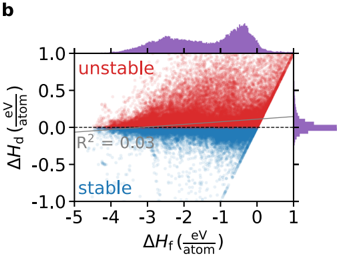
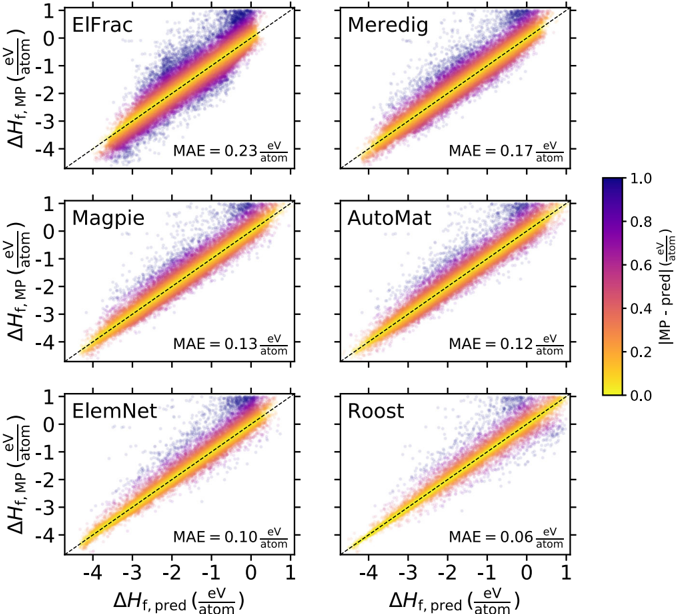
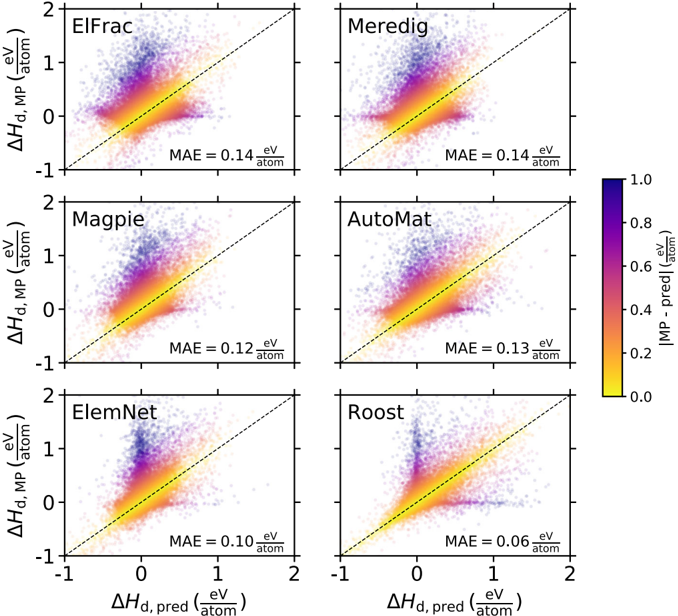
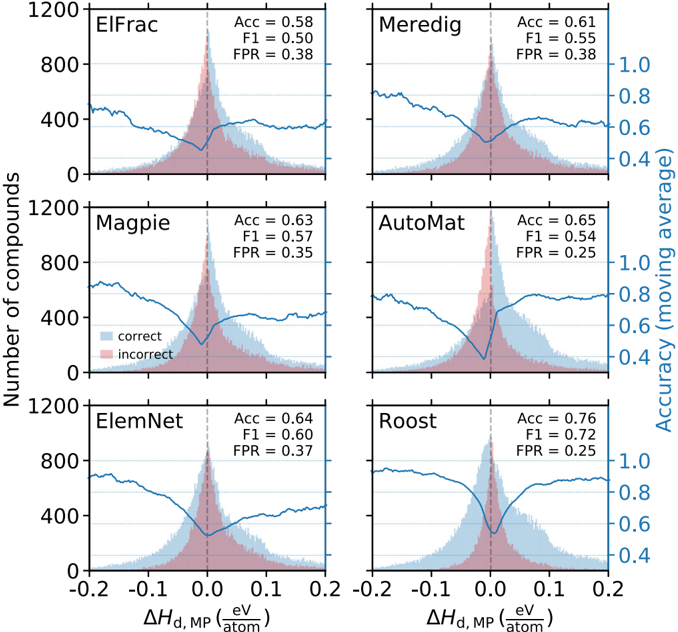
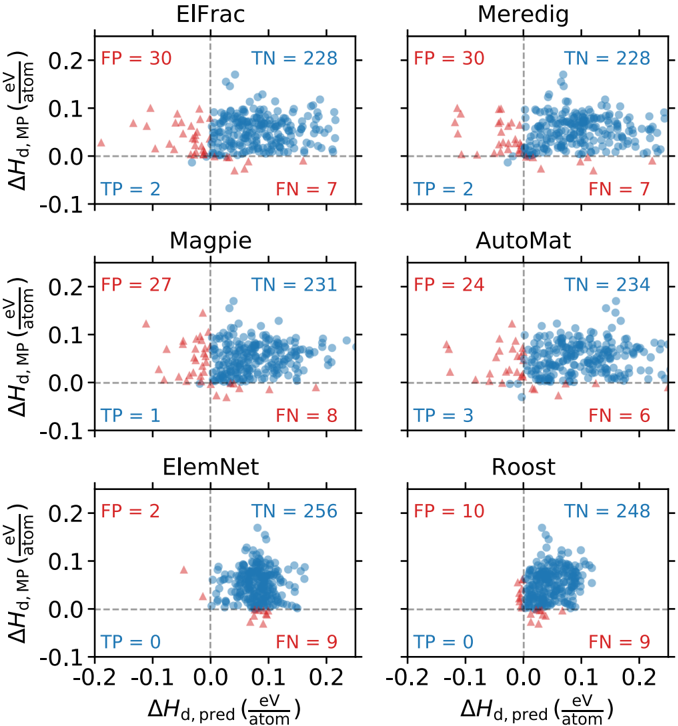
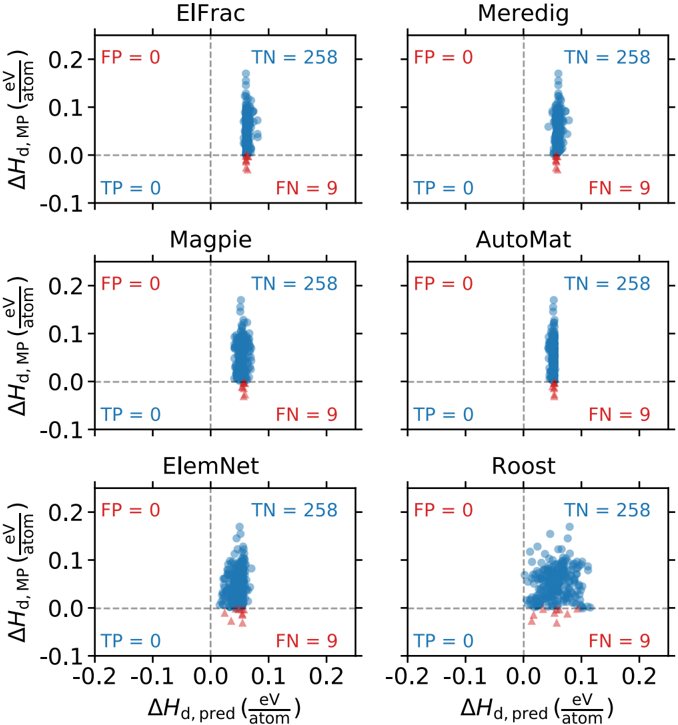
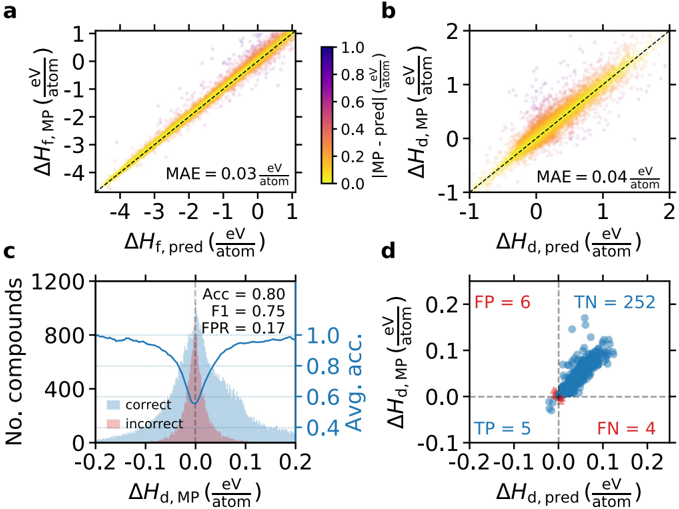
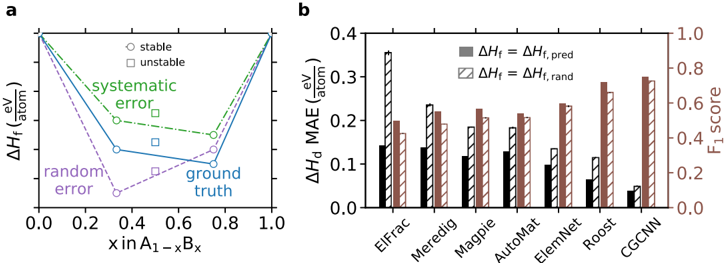
Machine learning has emerged as a novel tool for the efficient prediction of material properties, and claims have been made that machine-learned models for the formation energy of compounds can approach the accuracy of Density Functional Theory (DFT). The models tested in this work include five recently published compositional models, a baseline model using stoichiometry alone, and a structural model. By testing seven machine learning models for formation energy on stability predictions using the Materials Project database of DFT calculations for 85,014 unique chemical compositions, we show that while formation energies can indeed be predicted well, all compositional models perform poorly on predicting the stability of compounds, making them considerably less useful than DFT for the discovery and design of new solids. Most critically, in sparse chemical spaces where few stoichiometries have stable compounds, only the structural model is capable of efficiently detecting which materials are stable. The nonincremental improvement of structural models compared with compositional models is noteworthy and encourages the use of structural models for materials discovery, with the constraint that for any new composition, the ground-state structure is not known a priori. This work demonstrates that accurate predictions of formation energy do not imply accurate predictions of stability, emphasizing the importance of assessing model performance on stability predictions, for which we provide a set of publicly available tests.
Overview
The claims and statistics of this paper haven’t been checked yet.
Free: it reads the open-access text and checks the first 5 claims that cite a source we can check. Create a free account to check every claim.
Integrity signals
Registry
Cites
Statistics
Figures

Verification
Claims the paper makes
The claims and statistics of this paper haven’t been checked yet.
Free: it reads the open-access text and checks the first 5 claims that cite a source we can check. Create a free account to check every claim.
Claims other papers make about this one
Each is checked against this paper’s own text: does it say what the citing paper says it does?
The source backs part of the claim, not all of it — or backs it for a different population, condition or comparison.
In the citing paper
“Although this simplified GNN architecture is able to achieve state-of-the-art generalization on the Materials Project (MAE of 60 meV atom−1 (ref. 25)), it does not offer useful predictions for materials discovery, which was also observed by Bartel et al.25.”
From Scaling deep learning for materials discovery (2023) · cites this paper as [25]
Experimental — accuracy not yet measuredThe source backs part of the claim, not all of it — or backs it for a different population, condition or comparison.
In the citing paper
“Although data-driven methods that aid in further materials discovery have been pursued, thus far, machine-learning techniques have been ineffective in estimating stability (decomposition energy) with respect to the convex hull of energies from competing phases25.”
From Scaling deep learning for materials discovery (2023) · cites this paper as [25]
Experimental — accuracy not yet measuredThe cited source says what the claim attributes to it.
In the citing paper
“The Li/Mn transition-metal oxide family is discussed in ref. 25 to analyse the capabilities of machine-learning models for use in discovery. In the main text, we compare against the findings in the cited work suggesting limited discovery within this family through previous machine-learning methods.”
From Scaling deep learning for materials discovery (2023) · cites this paper as [25]
The cited source says what the claim attributes to it.
In the citing paper
“Although this simplified GNN architecture is able to achieve state-of-the-art generalization on the Materials Project (MAE of 60 meV atom−1 (ref. 25)), it does not offer useful predictions for materials discovery, which was also observed by Bartel et al.25.”
From Scaling deep learning for materials discovery (2023) · cites this paper as [25]
The cited source says what the claim attributes to it.
In the citing paper
“Finally, Li/Mn transition-metal oxides are a promising family to replace LiCoO2 in rechargeable batteries25 and GNoME has discovered an extra 15 candidates stable relative to the Materials Project compared with the original nine.”
From Scaling deep learning for materials discovery (2023) · cites this paper as [25]
1 more claim about this paper
Create a free account to see every claim other papers make about this one.
Self-check
Percentages, sums and reported differences re-computed from the paper’s own numbers.
The self-check needs the paper’s full text.
Citations
Cites
XGBoost: A Scalable Tree Boosting System
Chen, T., & Guestrin, C. (2016) · Proceedings of the 22nd ACM SIGKDD International Conference on Knowledge Discovery and Data Mining · doi:10.1145/2939672.2939785 · Cited by 54,569
Commentary: The Materials Project: A materials genome approach to accelerating materials innovation
Jain, A., Ong, S. P., Hautier, G., Chen, W., Richards, W. D., Dacek, S., Cholia, S., Gunter, D., Skinner, D., Ceder, G., et al. (2013) · APL Materials · doi:10.1063/1.4812323 · Cited by 13,094
Self-citationShow, Attend and Tell: Neural Image Caption Generation with Visual Attention
Xu, K., Ba, J., Kiros, R., Cho, K., Courville, A., Salakhutdinov, R., Zemel, R., & Bengio, Y. (2015) · arXiv · doi:10.48550/arxiv.1502.03044 · Cited by 8,248
Machine learning for molecular and materials science
Butler, K. T., Davies, D. W., Cartwright, H., Isayev, O., & Walsh, A. (2018) · Nature · doi:10.1038/s41586-018-0337-2 · Cited by 4,968
Xie, T., & Grossman, J. C. (2018) · Physical Review Letters · doi:10.1103/physrevlett.120.145301 · Cited by 2,828
Oxidation energies of transition metal oxides within the GGA + U framework
Wang, L., Maxisch, T., & Ceder, G. (2006) · Physical Review B · doi:10.1103/physrevb.73.195107 · Cited by 2,785
Self-citationRecent advances and applications of machine learning in solid-state materials science
Schmidt, J., Marques, M. R. G., Botti, S., & Marques, M. A. L. (2019) · npj Computational Materials · doi:10.1038/s41524-019-0221-0 · Cited by 2,607
On representing chemical environments
Bartók, A. P., Kondor, R., & Csányi, G. (2013) · Physical Review B · doi:10.1103/physrevb.87.184115 · Cited by 2,572
The Open Quantum Materials Database (OQMD): assessing the accuracy of DFT formation energies
Kirklin, S., Saal, J. E., Meredig, B., Thompson, A., Doak, J. W., Aykol, M., Rühl, S., & Wolverton, C. (2015) · npj Computational Materials · doi:10.1038/npjcompumats.2015.10 · Cited by 2,378
Li2MnO3-stabilized LiMO2 (M = Mn, Ni, Co) electrodes for lithium-ion batteries
Thackeray, M. M., Kang, S.-H., Johnson, C. S., Vaughey, J. T., Benedek, R., & Hackney, S. A. (2007) · Journal of Materials Chemistry · doi:10.1039/b702425h · Cited by 2,039
Research works printed but not linked: 5
- Choudhary, K., Kalish, I., Beams, R. & Tavazza, F. High-throughput identification and characterization of two-dimensional materials using density functional the- ory. Sci. Rep. 7, 5179 (2017).
- Davies, D. W. et al. Computational screening of all stoichiometric. Inorg. Mater. Chem. 1, 617-627 (2016).
- Goodall, R., & Lee, A. Predicting materials properties without crystal structure: deep representation learning from stoichiometry. https://arxiv.org/abs/ 1910.00617.
- Zhang, Y. et al. Efficient first-principles prediction of solid stability: towards chemical accuracy. npj Comput. Mater. 4, 9 (2018).
- Miedema, A. R. Simple model for alloys. Philips Tech. Rev. 33(no. 6), 149-160 (1973).
Cited by
Items 201–277 of 277
Lalroliana, B., Chhana, L., Lalhumhima, Celestine, L., Rai, D. P., Pachuau, L., Singh, N. S., Gurung, S., & Lalhriatzuala (2024) · New Journal of Chemistry · doi:10.1039/d4nj04230a · Cited by 2
Crystal Structure Prediction of Cs–Te with Supervised Machine Learning
Saßnick, H., & Cocchi, C. (2025) · Advanced Theory and Simulations · doi:10.1002/adts.202401344 · Cited by 3
Choi, Y., Wolverton, C. M., & Hong, S. (2025) · APL Machine Learning · doi:10.1063/5.0247514 · Cited by 2
An Easy, Simple, and Accessible Web-based Machine Learning Platform, SimPL-ML
Jang, S., Na, G. S., Lee, J., Shin, J., Kim, H. W., & Chang, H. (2022) · Integrating materials and manufacturing innovation · doi:10.1007/s40192-022-00250-x · Cited by 2
Morelock, R. J., Tran, J. T., Trindell, J. A., Bare, Z. J. L., McDaniel, A. H., Weimer, A. W., & Musgrave, C. B. (2024) · Chemistry of Materials · doi:10.1021/acs.chemmater.3c02807 · Cited by 2
Bridging Experiment and Theory to Reveal Compounds in K–Zn(Cd)–Bi Systems
Cox, T., Gvozdetskyi, V., Bertolami, M., Osborn, K., Wang, R., Ribeiro, R. A., Ho, K. M., & Zaikina, J. V. (2025) · Zeitschrift für anorganische und allgemeine Chemie · doi:10.1002/zaac.202500049 · Cited by 1
Kernel learning assisted synthesis condition exploration for ternary spinel
Liu, Y., Ansari, M., Black, R., & Hattrick-Simpers, J. R. (2025) · Communications Materials · doi:10.1038/s43246-025-00867-3 · Cited by 2
“The limited data available often restricts the ability of machine learning models to generalize across different material spaces 16,17 , especially whendealingwithnewcompoundsorstructuresnotcoveredinthetraining data 18,19 .”
Ultrafast synthesis of ternary oxides via a design-test-make-analyze workflow
Dai, H., McDermott, M. J., Chen, A. P., Recatala‐Gomez, J., Nong, W., Zhu, R., Thway, M., Morris, S. A., Schürmann, C. J., Pethe, S. D., et al. (2025) · Cell Reports Physical Science · doi:10.1016/j.xcrp.2025.102799 · Cited by 3
Formation energy prediction of material crystal structures using deep learning
Torlao, V., & Fajardo, E. (2025) · Materials Research Express · doi:10.1088/2053-1591/ae22cb · Cited by 1
Ma, Z., Zhang, S., Rui, T., Lu, L., Lan, Y., Wang, Y., Yu, Y., Deng, M., Zhang, K., Yang, Y., et al. (2026) · Journal of the American Ceramic Society · doi:10.1111/jace.70594 · Cited by 1
“…a Y atom at either the Y 1 - or Y 2 -site in Y 2 O 3 with a Sc or Yb atom was calculated according to the following formula (Equation 1 ) [ 23, 49 ]: In Equation ( 2 ), E f corresponds to the formation energy, 2 summarizes the calculated Bader charges, LC, bond lengths, and formation…”
Interpretation of Crystal Energy Landscapes with Kolmogorov–Arnold Networks
Zu, G., Mao, N., Felser, C., & Zhang, Y. (2026) · Nano Letters · doi:10.1021/acs.nanolett.6c00039 · Cited by 1
“First, operating exclusively on chemical composition grants the model universality and speed, enabling the rapid screening of any compound defined by its chemical formula [42–47].”
Guan, X., Zhang, Y., Han, S., Xiong, C., Yang, Y., Chen, C., Zhang, F., Zhang, Y., Gao, H., Feng, Z. H. O. U., et al. (2026) · Journal of Materials Informatics · doi:10.20517/jmi.2025.89 · Cited by 1
Gu, B., Trinh, N. L., Kim, W., Masroor, Z., & Lee, H. (2026) · Chemistry of Materials · doi:10.1021/acs.chemmater.6c00978 · Cited by 2
“13 For electronic properties, the ALIGNN band gap predictions were evaluated against the Materials Project benchmarks.”
Jamal, M. W., Ali, A. A., Ghodhbani, R., Sharma, R., Shrivastav, N., Dhahbi, A., & Almohammedi, A. (2026) · Physica B Condensed Matter · doi:10.1016/j.physb.2026.419047 · Cited by 2
Machine‐Learning‐Assisted Discovery and Accelerated Synthesis of Metal Phosphosulfides
Rodrigo, J. S., Kryger-Nelson, N. A., Mittmann, L. A., Bertin, E. P., Castelli, I. E., & Crovetto, A. (2026) · Small · doi:10.1002/smll.74742 · Cited by 3
Tutorials on Machine Learning Tools for Simulations in Electrocatalysis
Leite, B. I. D. S. R., Stepanova, A., Pukk, T.-H., Savchenko, D., Madsen, T., Kongi, N., & Ivaništšev, V. (2026) · ACS Materials Au · doi:10.1021/acsmaterialsau.5c00232 · Cited by 1
Süpürtülü, M., DİNDAR, Ç., & Akyüz, R. (2022) · Afyon Kocatepe University Journal of Sciences and Engineering · doi:10.35414/akufemubid.1106065 · Cited by 1
Explainable Synthesizability Prediction of Inorganic Crystal Polymorphs Using Large Language Models
Kim, S.-M., Schrier, J., & Jung, Y. (2025) · Angewandte Chemie · doi:10.1002/ange.202423950 · Cited by 3
Siriwardane, E. M. D., Dong, R., Hu, J., & Çakır, D. (2025) · The Journal of Physical Chemistry C · doi:10.1021/acs.jpcc.5c00183
“While E F indicates the tendency of a compound to form from its constituent elements, the thermodynamic factor that determines phase stability is E H , which represents the competition among E F values of all compounds within a specific chemical space [44].”
Machine learning model predicted thermodynamic stability of rare earth compounds
Chenglong, Q. I. N., Zhao, L. Y., & Jiang, G. (2025) · Acta Physica Sinica · doi:10.7498/aps.74.20250362
Additive single atom values for thermodynamics V: Lattice energies for ionic solids
Glasser, L. (2025) · Chemical Thermodynamics and Thermal Analysis · doi:10.1016/j.ctta.2025.100208
Thermodynamics of gallium-stabilized delta-plutonium: A high-temperature drop calorimetry study
Strzelecki, A., Abdul-Jabbar, N. M., Lee, T. A., Mann, S. C., Gallegos, U. F., Ramos, M., Pereyra, R. A., Pete, D., Morales, L. A., Conroy, N., et al. (2025) · Journal of Vacuum Science & Technology A Vacuum Surfaces and Films · doi:10.1116/6.0004534
Lattice Engineering Novel 2D Monolayer in Zinc Pnictides
Thapa, D., & Kim, S. (2025) · ACS Omega · doi:10.1021/acsomega.5c05775
“57 Electronic Properties.”
Thermodynamic properties of Ce3In: A combined experimental and computational study
Strzelecki, A., Phelan, W. A., Abdul-Jabbar, N. M., Parker, S. S., Barman, S. K., Muñoz, A. R., Rudin, S. P., Mann, S. C., Arellano, D. C., Cockreham, C. B., et al. (2025) · Journal of materials research/Pratt's guide to venture capital sources · doi:10.1557/s43578-025-01728-y
A charge-density machine-learning workflow for computing the infrared spectrum of molecules
Hazra, S., Patil, U., & Sanvito, S. (2025) · The Journal of Chemical Physics · doi:10.1063/5.0292221 · Cited by 3
Akter, H., Mahtab, S. S., Akhtaruzzaman, M., Abdullah, H., Namazu, T., & Uddin, M. M. (2025) · Physica B Condensed Matter · doi:10.1016/j.physb.2025.418148
Zhengjun, W. A. N. G., Changcheng, C. H. E. N., Xiongfei, Y. U. N., Zhao, H. A. N., Yali, T. U. O., Yuxi, D. U., ZHANG, X., ZHANG, C., Xiaoning, G. U. A. N., Jiangzhou, X. I. E., et al. (2025) · Acta Physica Sinica · doi:10.7498/aps.75.20251302 · Cited by 2
Machine Learning Analysis of Dimensionality Effects on Bandgap Prediction
Shravan, P. V., Latha, G., Santosh, S., N, S. R., Mohamed Javeed, A., & Priyanga, G. S. (2025) · The Journal of Physical Chemistry C · doi:10.1021/acs.jpcc.5c05232 · Cited by 1
Machine Learning in Materials Science: Current Challenges and Future Outlook
Bhaskar, A., Yadav, P., Singh, B., Singh, S. K., & Rana, S. S. (2026) · Springer eBooks · doi:10.1007/978-3-032-09540-4_11
Enhanced oxygen evolution of NiN4-graphene by small metal clusters: A DFT study
Zhang, X., Cheng, X., Chang, Q., & Zhang, Y. (2026) · Physica B Condensed Matter · doi:10.1016/j.physb.2026.418273
M3AlB2 (M = V, Nb, Mo, Hf) MAX Phase Borides for High-Temperature Applications by DFT CalculationsPreprint
Adnan, L. H. K., Tanim, I., Saif, S. S., Talukder, C., Hoque, M., Jahan, N., Hossain, M. M., Uddin, M. M., Rana, T. H., & Ali, M. A. (2026) · SSRN Electronic Journal · doi:10.2139/ssrn.6136387
Poisson’s Ratio in Cubic Materials: A New Representation and Extreme Examples
Seetharaman, M., & Norris, A. N. (2026) · Journal of Applied Mechanics · doi:10.1115/1.4071000
Deng, X., Cao, J., & Tao, S. (2026) · The Journal of Physical Chemistry Letters · doi:10.1021/acs.jpclett.5c03783
Anomaly-Detection-Driven Screening of Thermodynamic Stability from Composition Descriptors Alone
Makino, K., Yamaguchi, Y., Tanibata, N., Takeda, H., KOBAYASHI, R., Karasuyama, M., & Nakayama, M. (2026) · The Journal of Physical Chemistry Letters · doi:10.1021/acs.jpclett.5c03772 · Cited by 1
A crystal graph to vector approach for predicting magnetic properties
Singh, S. K., Sharma, A., & Kashyap, A. (2026) · Scientific Reports · doi:10.1038/s41598-026-40902-y · Cited by 1
Song, J., She, A., Song, C., Shi, D., Xuan, F., & Cao, C. (2026) · Computational Materials Science · doi:10.1016/j.commatsci.2026.115049 · Cited by 1
Bhattacharjee, S. (2026) · Computational Materials Science · doi:10.1016/j.commatsci.2026.115074
Liu, S., Wang, J., Li, B., Zhai, J., Wu, M., Cui, Z., Ren, Y., Zhang, Y., & Liu, S. (2026) · Physica B Condensed Matter · doi:10.1016/j.physb.2026.418748
CoFiNet: a coarse-to-fine attention network for structure-agnostic materials property prediction
Jia, B., Zang, H., Zhang, H., Xu, J., & Zhan, S. (2026) · Molecular Physics · doi:10.1080/00268976.2026.2667308
BiL-AttNet: A deep learning architecture for structure-agnostic material property prediction
Huobu, R., Zhang, W., Kong, C., & Yin, J. (2026) · Computational Materials Science · doi:10.1016/j.commatsci.2026.114818
Physical properties and structure of the composite Sr0.5Sn0.5V2O6–SnO2
Kolomenskaya, E. R., Abdulvakhidov, K. G., Леонидович, Ш. И., Pankov, I. V., Protsenko, B. O., Soldatov, A. V., & Abdulvakhidov, B. (2026) · Applied Physics A · doi:10.1007/s00339-026-09766-x
A New Polymorph of Lead Metagermanate Pb12[Ge12O36]-II
Aksenov, S. B., Kireev, V. E., Charkin, D. O., Kompanchenko, A. A., Arsentiev, M. Y., Bakulin, A. O., Banaru, A. M., Еремина, Т. А., & Rastsvetaeva, R. K. (2026) · Journal of Structural Chemistry · doi:10.1134/s0022476626050148
“…thermodynamic stability of the compound can be estimated with the use of a change in the Gibbs energy for the decomposition process Δ G d , which is defined as the difference between the Gibbs energy of the analyzed compound relative to all the other compounds in the respective chemical space [62].”
Band Gap Prediction of Two-Dimensional Materials Using a Gradient-Boosted Feature Selection Approach
Rowlinson, B. D., Ramamoorthy, S., Cole, J. M., & Prodromakis, T. (2026) · Journal of Chemical Information and Modeling · doi:10.1021/acs.jcim.6c00675
Shwan, Y. H., Ameen, M. A., & Mahmood, A. S. (2026) · Journal of the Korean Physical Society · doi:10.1007/s40042-026-01672-y
“When the formation energy is positive, this means the material is less energetically favorable and thus less stable [33].”
Thermodynamic assessment of machine learning models for solid-state synthesis prediction
Schlesinger, J., Hjaltason, S., Szymanski, N. J., & Bartel, C. J. (2026) · Materials Horizons · doi:10.1039/d6mh00209a · Cited by 5
Self-citationLópez-Peña, G. (2026) · SSRN Electronic Journal · doi:10.2139/ssrn.6949230
Song, S., Kwon, J., Kim, J., Shin, W., & Min, K. (2026) · Journal of Materials Chemistry A · doi:10.1039/d6ta01471b
Enhancing Generalization in Synthesizability Prediction of Structurally Dissimilar Materials
Kim, S., Kwon, S., Choi, J., & Jung, Y. (2026) · Journal of Chemical Information and Modeling · doi:10.1021/acs.jcim.6c01171
Glassy magnetic freezing of interacting clusters in materials related to the LK-99 family
Anonymous, Napoletani, D., Nikoghosyan, V. R., & GULIAN, A. M. (2026) · Physical review. B./Physical review. B · doi:10.1103/k3xs-6hyt · Cited by 1
Yu, B., He, H., & Wei, J. (2026) · Lecture notes in computer science · doi:10.1007/978-981-92-3410-3_47
Xia, Y., Hao, Y., He, X., Ma, Y., Li, J., Dai, X., & Zhang, C. Z. (2026) · Surface Science · doi:10.1016/j.susc.2026.123069
Ragavendran, V. (2026) · Computational Condensed Matter · doi:10.1016/j.cocom.2026.e01410 · Cited by 1
Nguyen, H. D., Do, M. D., Chau, Q. C., Pham, T.-L., Nguyen, P. L., Novoselov, K. S., Ghaoui, L. E., Pham, P. N. L., & Phung, V. T. (2026) · Energy and AI · doi:10.1016/j.egyai.2026.100868
Anonymous, Sokolovskiy, V. V., & Taskaev, S. V. (2026) · Physical review. B./Physical review. B · doi:10.1103/bf1b-wyp9
Kaya, H., Eryılmaz, Ü. K., Ekinci, F., Açıcı, K., Ugurlu, G., Delen, D., & Güzel, M. S. (2026) · Computational Materials Science · doi:10.1016/j.commatsci.2026.115026
A controlled framework for chemistry-shift evaluation in descriptor-based materials screening
Chen, H., & Ye, T. T. (2026) · Computational Materials Science · doi:10.1016/j.commatsci.2026.115027
Mumtaz, S., Rodney, J. D., Ratnaji, T., & Kim, B. C. (2026) · Coordination Chemistry Reviews · doi:10.1016/j.ccr.2026.218431
Transfer-learning-based refinement of volume size factors from first-principles calculations
Uesugi, T., & Matsuura, S. (2026) · Materialia · doi:10.1016/j.mtla.2026.102888
Романовна, Е. К., Sokolovskiy, V. V., & Buchelnikov, V. D. (2026) · Journal of Magnetism and Magnetic Materials · doi:10.1016/j.jmmm.2026.174541
Scientific Fragility in End-to-End Materials AI Pipelines
Kulkarni, S., Joshi, M., & Patil, R. (2023) · Journal of Artificial Intelligence for Materials Science · doi:10.68159/o548436950
Benchmarking Without Reality: Dataset Construction Bias in Materials Evaluation
Liu, W., & Min, Z. (2023) · Journal of Computational and Data-Driven Materials Engineering · doi:10.68159/e905839214
Experimental Validation Bottlenecks in AI-Guided Materials Design
Grant, O., Brooks, D., & Carter, A. (2024) · Journal of Computational and Data-Driven Materials Engineering · doi:10.68159/m640561727
Vega, C., & Hernandez, M. (2022) · Journal of Computational and Data-Driven Materials Engineering · doi:10.68159/v489956132
Yang, D., Zheng, Z., Wang, H., Zhao, H., Li, Z., Liu, Y., Xiong, Y., & Luo, Z. (2026) · Bioactive Materials · doi:10.1016/j.bioactmat.2026.08.060
“Of important, activity-oriented SAR prediction alone is insufficient for practical nanozyme development [87].”
Closed-World Training in an Open Materials Universe
Petrova, N., Stoyanova, E., & Dimitrov, I. (2024) · Journal of Computational and Data-Driven Materials Engineering · doi:10.68159/q300312652
Maqbool, A., Shahid, A., Ali, A., Al-Buriahi, M. S., Alkahtani, R. A., Alenezi, M. S., Zafar, M., & Shakil, M. (2026) · Calphad · doi:10.1016/j.calphad.2026.102991
Chemban, M. N., & Eithiraj, R. D. (2026) · Chemical Physics Impact · doi:10.1016/j.chphi.2026.101163
Wan, W., Liu, K., Tong, S., Lu, W., Liu, Y., Jiang, X., & Qian, J. (2026) · Computational Materials Science · doi:10.1016/j.commatsci.2026.115072
Reliability-bounded composition-only learning of calculated magnetic moments in Fe-rich materials
Wei, X., 赖, 奇., & Yu, X. (2026) · Materials Chemistry and Physics · doi:10.1016/j.matchemphys.2026.133070
Materials foundation models fail together: Correlated errors and collective blind spots
Kurban, H., & Kurban, M. (2026) · Computational Materials Science · doi:10.1016/j.commatsci.2026.115153
Bashir, S., Almakayeel, N., Ayari, N., Andleeb, F., Iqbal, H., & Rasul, M. N. (2026) · Journal of Molecular Graphics and Modelling · doi:10.1016/j.jmgm.2026.109619
Selvam, S. P., Kamalakannan, S., Bhamu, K. C., Zhao, Y., Wu, Y., Kang, S. G., & Cho, S. (2026) · Sustainable Energy & Fuels · doi:10.1039/d6se00924g
Data-Driven Framework to Accelerate Semiconductor Discovery
Saleh, G., & Manna, L. (2026) · ACS Materials Letters · doi:10.1021/acsmaterialslett.6c00655
Lou, Y., & Wei, N. (2026) · Inorganics · doi:10.3390/inorganics14110269
Zhou, W., Qu, N., Zhang, W., Xia, T., Liu, Y., 谭明义, & Zhu, J. (2026) · Journal of Materials Science · doi:10.1007/s10853-026-13940-0
Metadata
- Authors
- Bartel, C. J., Trewartha, A., Wang, Q., Dunn, A., Jain, A., & Ceder, G.
- Affiliations
- University of California, Berkeley (US)
- Lawrence Berkeley National Laboratory (US)
- Corresponding author
- Bartel, Christopher J.
- Ceder, Gerbrand
- Venue
- npj Computational Materials
- Published
- 2020-07-10
- Volume
- 6
- Issue
- 1
- ISSN
- 2057-3960 (ISSN-L)
- OpenAlex
- W3041359432
- Semantic Scholar
- 973cfdc47aef3f9bdd6e39651f48acbbaeaadd94
- Cited by
- 277
- References
- 43
- Citations by year
- 2026: 65 · 2025: 54 · 2024: 47 · 2023: 40 · 2022: 41 · 2021: 26 · 2020: 4
- FWCI
- 10.79
- Type
- journal article
- Language
- en
- Open access
- gold
- doi.org
- Licence
- cc-by
- creativecommons.org/licenses/by/4.0 (tdm)
- creativecommons.org/licenses/by/4.0 (vor)
- Locations
- npj Computational Materials (publishedVersion, cc-by)
- arXiv (Cornell University) (submittedVersion)
- eScholarship (California Digital Library) (submittedVersion)
- OSTI OAI (U.S. Department of Energy Office of Scientific and Technical Information) (submittedVersion)
- arXiv (Cornell University)
- Funders
- U.S. Department of Energy (DE-AC02-05-CH11231)
- Topics
- Physical Sciences › Materials Science › Materials Chemistry › Machine Learning in Materials Science
- Physical Sciences › Physics and Astronomy › Atomic and Molecular Physics, and Optics › Advanced Chemical Physics Studies
- Life Sciences › Pharmacology, Toxicology and Pharmaceutics › Drug Discovery › Computational Drug Discovery Methods
- Keywords
- formation energy, machine learning, compositional models, structural model, Materials Project, stoichiometry, materials discovery, model evaluation, ground state structure
About these checks
Registry, retraction, Cites and statistics results are computed, not judged, with one exception: a printed reference that no index lists is read once by a model before it counts as a citation error. Claims are extracted by a model and kept only when their quote appears verbatim in the text; each cited source is then checked, with a model’s help, for whether it says what the claim relies on. Those verdicts can be wrong — read the claim’s quote and the cited source before relying on one.
Statistics and arithmetic are recomputed, not judged.
Confidence bands are shown only for fields calibrated on our annotated test set. None is calibrated yet, so no band is shown.
What counts as a claim ›How we measure confidence ›How we check this ›
Are you an author, or do you see a problem with this page? Request a review
Data sources
Bibliographic data: Semantic Scholar, OpenAlex, Crossref.
Contains information from the Semantic Scholar Academic Graph Datasets, made available under the ODC Attribution License (ODC-BY 1.0).
Semantic Scholar’s data is described in: Kinney, R., et al. (2023). The Semantic Scholar Open Data Platform. arXiv:2301.10140.
