

Machine learning in concrete science: applications, challenges, and best practices
Open accessThe DOI matches its Crossref record; 190 of the 191 references it cites were found in a registry or an index; 13 of the 44 sources its claims cite were checked for support.
Abstract
Concrete, as the most widely used construction material, is inextricably connected with human development. Despite conceptual and methodological progress in concrete science, concrete formulation for target properties remains a challenging task due to the ever-increasing complexity of cementitious systems. With the ability to tackle complex tasks autonomously, machine learning (ML) has demonstrated its transformative potential in concrete research. Given the rapid adoption of ML for concrete mixture design, there is a need to understand methodological limitations and formulate best practices in this emerging computational field. Here, we review the areas in which ML has positively impacted concrete science, followed by a comprehensive discussion of the implementation, application, and interpretation of ML algorithms. We conclude by outlining future directions for the concrete community to fully exploit the capabilities of ML models.
Overview
CoChat Summary
TL;DR
This review surveys machine learning in concrete science, summarizing 389 peer-reviewed publications and arguing that ML has transformative potential for property prediction, characterization, and simulation but is limited by data sparsity, biased or unrepresentative data, weak validation, and poor interpretability. It proposes best practices around data/tool sharing, linking laboratory and field data, starting with simple models, and knowing when to trust a model.
Key findings
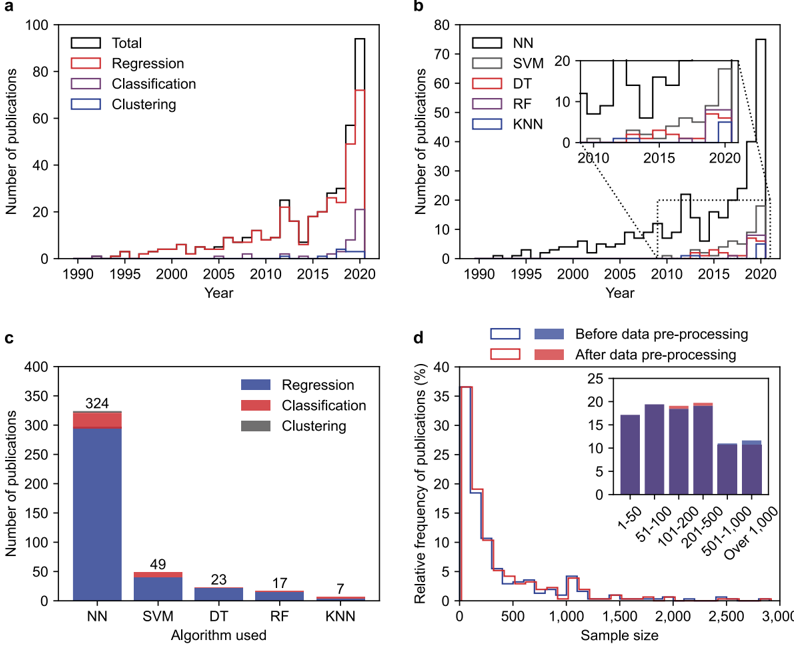
- The literature survey covered 389 peer-reviewed publications; the earliest concrete-and-ML article identified was from 1992, with publication numbers not reaching double digits until 2009. Most studies addressed regression tasks (88.2%), while classification accounted for 10.5%; neural networks were the most commonly applied algorithms.
- Regression datasets were small and skewed: sample sizes ranged from 5 to 262,569, with a median of 174 before preprocessing and 169 after; over 55% of studies had fewer than 200 samples, and only about 11% had more than 1,000 samples. Most regression studies used empirical experimental data (93.6%), with fewer using computational simulation data (7.3%); among experimental studies, 93.8% used laboratory tests and 8.4% used field tests.
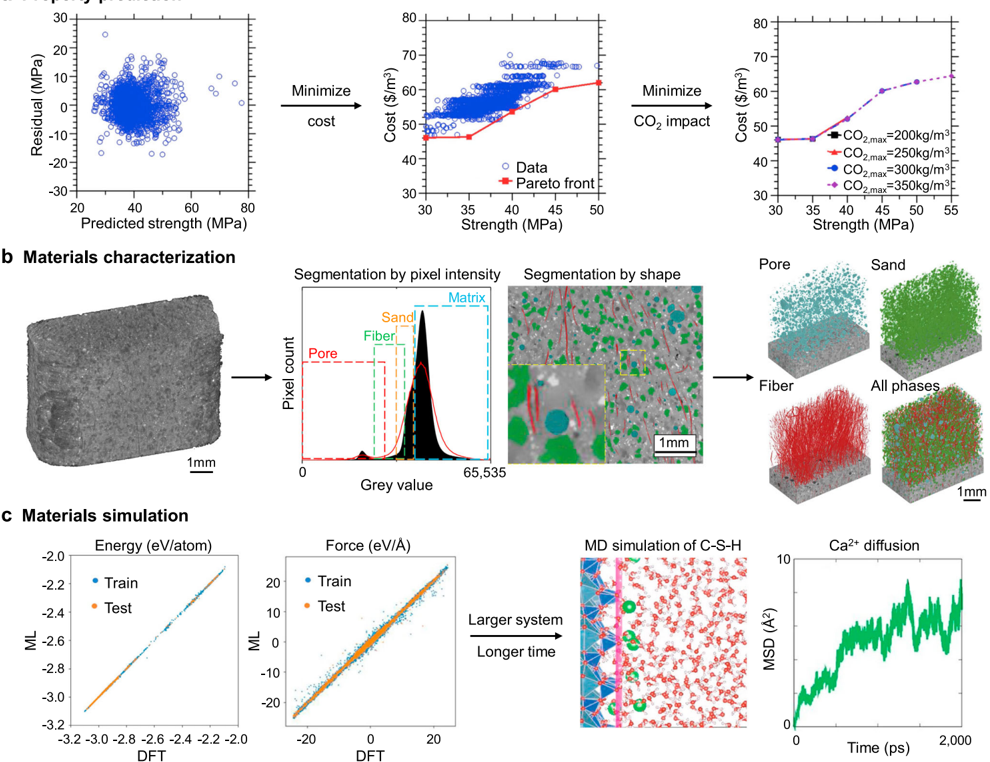
- Major application areas include property prediction (e.g., compressive, flexural, tensile, shear strength, elastic modulus, flowability, durability), materials characterization (e.g., nondestructive testing, image segmentation from X-ray computed tomography, crack detection), and materials simulation (e.g., ML potentials for large-scale molecular dynamics of C-S-H with 3,084 atoms for 2 ns).
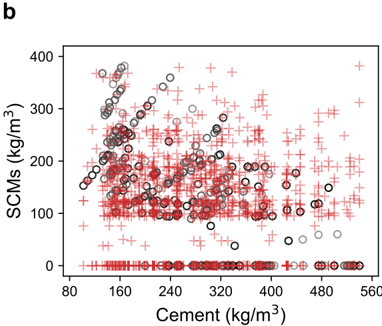
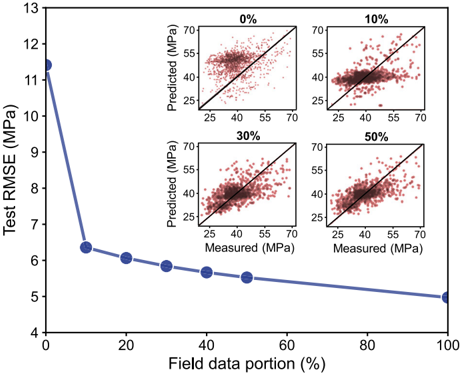
- The paper highlights data challenges (sparsity, high dimensionality, representation/measurement/temporal/deployment bias), validation challenges (hold-out and cross-validation pitfalls, especially with small datasets), and interpretability challenges (permutation-based diagnostics can generate unrealistic concrete mixtures; ML models identify association, not causation). It also reports that replacing 10% of laboratory training data with field data reduced root mean square error by 43% compared with using only laboratory data in one cited study.
Methods
- This is a review and bibliographic analysis, not a primary experimental study. The authors conducted a literature survey of 389 peer-reviewed publications on ML applications in concrete science, with survey criteria in Supplementary Note 1 and compiled data in Supplementary Dataset.
- Bibliographic data came from Web of Science for the period 1990–2020. The paper also provides a high-level summary of applications, publicly accessible datasets, and current research directions, and discusses challenges and best practices.
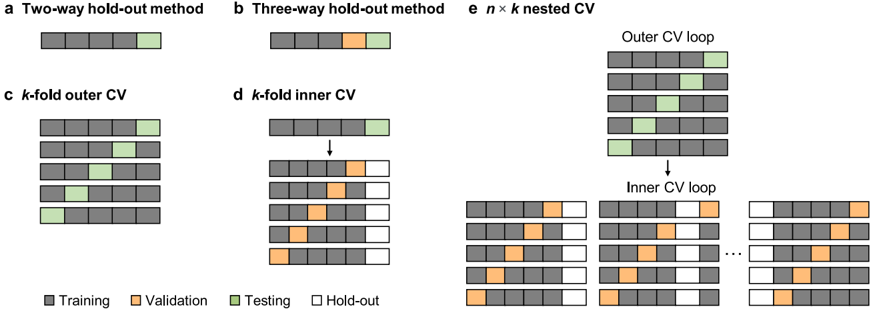
- The review synthesizes examples across property prediction, materials characterization, and materials simulation, and discusses validation approaches including two-way and three-way hold-out, k-fold cross-validation, and n × k nested cross-validation.
Limitations
- The paper states that its arguments are “not exhaustive” and aims to initiate constructive discussion rather than provide a complete treatment.
- The bibliographic analysis is limited to the surveyed publications and Web of Science period 1990–2020; detailed survey criteria and compiled data are placed in supplementary materials rather than fully in the main text.
- The review repeatedly notes limitations in the underlying ML literature: small datasets, data bias, inconsistent reporting, validation methods that may be ill-suited to small concrete datasets, and models that are not designed to establish causality.
Model-written summary. Check it against the paper before relying on it.
Integrity signals
Registry
Cites
Statistics
Figures
Verification
Claims the paper makes
11 Valid · 5 Not valid · 19 Not checked · 52 Own results and interpretations
Every source the paper cites for this claim was checked and supports it.
In the paper
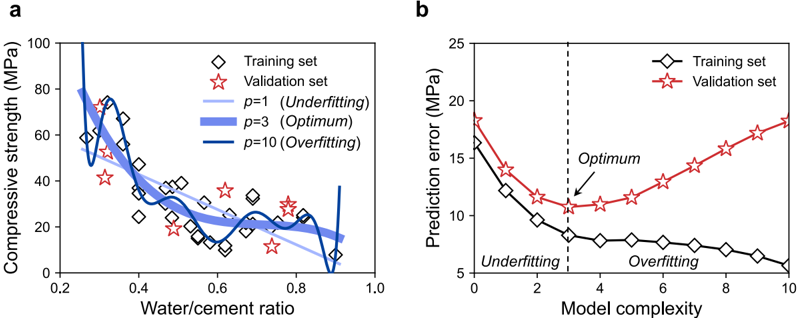
“Failure to assemble a sufficiently large dataset raises the risk of overfitting 82 (Fig. 5).”
§ Machine learning in concrete science: applications, challenges, and best practices > Data sparsity.
What the sources say
- Supportedcites [82] Kassraian-Fard, P., Matthis, C., Balsters, J. H., Maathuis, M. H. & Wenderoth, N. Promises, pitfalls, and basic guidelines for applying machine learning classifiers to psychiatric imaging data, with autism as an example. Front. Psychiatry 7, 177 (2016). source
The 'small sample size' section states directly that when features strongly exceed the number of data samples, 'a first problem is the high risk of overfitting,' and that a small but possibly complex data set can evoke an idiosyncratic fit with poor generalizability. The 'Feature Calculation' section reinforces this, noting that having many predictors relative to data samples causes classifiers to adapt to peculiarities of a specific dataset ('overfitting'), and that dimensionality reduction to alleviate overfitting is crucial 'especially in settings where restricted amount of data are available.' The Summary/Concluding Remarks likewise tie the high-dimensionality of a relatively small data set to easy overfitting. (LLM, conf=0.90)
plainstates a cause- Asserted: passes — The authors put it forward as true.
- Checkable: passes — It can be checked against evidence.
- Load-bearing: passes — The paper’s conclusions depend on it.
- Based: passes — The paper gives a reason why it holds.
- Supported
The cited sources support only part of this claim — read each source’s verdict below.
In the paper
“If the sample size is relatively small (as is generally the case in practical scenarios), the input variables of a dataset can lose their discriminating ability, as all samples in the dataset seem very distinct from each other with high dimensionality 85 .”
§ Machine learning in concrete science: applications, challenges, and best practices > High dimensionality.
What the sources say
- Partly supportedcites [85] Pestov, V. An axiomatic approach to intrinsic dimension of a dataset. Neural Netw. 21, 204-213 (2008). sourceExperimental — accuracy not yet measured
Pestov (2008) does support the substance of the paraphrase: Sect. 2.2 (p. 2) defines the curse of dimensionality as the situation where 'important features of a dataset sharply concentrate near their median (or mean) values and thus become non-discriminating', explicitly bundling in 'sparseness of points (the distance to the nearest neighbour is comparable to the average distance between two points)', i.e. samples looking mutually distinct in high dimension; Sect. 2.4 (p. 4) adds that large-margin classification with 1-Lipschitz features becomes impossible. The part the source does not support is the small-sample-size condition as the driver: in Sect. 6 (p. 8) realistic/'manageable' sample sizes are tied to the collapse and instability of the separation dimension of a noise-corrupted sample (Example 14), and the proof of Proposition 13 (p. 8) states the opposite of feature non-discrimination for such small samples — a typical high-dimensional sample forms a discrete metric space of diameter ~sqrt(2) whose Lip_1(X) 'will contain numerous 1-Lipschitz functions that are highly non-constant'. The paper's non-discrimination result is asserted for mm-spaces/domains of high intrinsic dimension (Corollary 9, p. 7, requires n >= n0 training points), not for datasets because their sample size is small. (LLM, conf=0.72)
plainstates a cause- Asserted: passes — The authors put it forward as true.
- Checkable: passes — It can be checked against evidence.
- Load-bearing: unclear — It is unclear whether the paper’s conclusions depend on it.
- Based: passes — The paper gives a reason why it holds.
- Partly supported
The cited sources support only part of this claim — read each source’s verdict below.
In the paper
“Hence, trust in ML models is strongly related to their interpretability, which has thus become a focus of active research in the ML community 116,132 .”
§ Machine learning in concrete science: applications, challenges, and best practices > Starting with simple models
What the sources say
- Partly supportedcites [116] Lipton, Z. C. The mythos of model interpretability: In machine learning, the concept of interpretability is both important and slippery. Queue 16, 1–28 (2018). sourceExperimental — accuracy not yet measured
The Introduction (p. 1) says many papers propose interpretability as a means to engender trust, and §2.1 (p. 3) says some suggest it is a prerequisite. Lipton questions what trust means and does not establish a strong relationship between trust and interpretability; the claim states that relationship more definitively than the source does. (LLM, conf=0.84)
- Not checked yetcites [132] Schmidt, P. & Biessmann, F. Quantifying interpretability and trust in machine learning systems. Preprint at http://arxiv.org/abs/1901.08558 (2019).
boostedstates an association- Asserted: passes — The authors put it forward as true.
- Checkable: passes — It can be checked against evidence.
- Load-bearing: passes — The paper’s conclusions depend on it.
- Based: passes — The paper gives a reason why it holds.
- Partly supported
The cited sources support only part of this claim — read each source’s verdict below.
In the paper
“In this regard, the knowledge shared in interdependent properties of the same material or in the same property of similar concrete types can be transferred to accelerate the training process and improve the accuracy performance of ML models, even with relatively small amounts of available data 143,144 .”
§ Machine learning in concrete science: applications, challenges, and best practices > CONCLUSIONS AND OUTLOOK
What the sources say
- Partly supportedcites [143] Song, P. S., Wu, J. C., Hwang, S. & Sheu, B. C. Assessment of statistical variations in impact resistance of high-strength concrete and high-strength steel fiber- reinforced concrete. Cem. Concr. Res. 35, 393-399 (2005). 128. Nuzzo, R. Scientific method: statistical errors. Nature 506, 150-152 (2014). 129. Leek, J. et al. Five ways to fix statistics. Nature 551, 557-559 (2017). 130. Halilaj, E. et al. Machine learning in human movement biomechanics: Best practices, common pitfalls, and new opportunities. J. Biomech. 81, 1-11 (2018). 131. Yin, M., Vaughan, J. W. & Wallach, H. Understanding the sourceExperimental — accuracy not yet measured
Split into 2 atoms — 1 confirmed, 1 partially supported, 0 disputed, 0 misattributed, 0 unverifiable. Expand the claim to see per-atom verdicts.
- Not checked yetcites [144] Ravinder et al. Artificial intelligence and machine learning in glass science and technology: 21 challenges for the 21st century. Int. J App Glass Sci. 12, 277–292 (2021). source
plainstates a cause- Asserted: passes — The authors put it forward as true.
- Checkable: passes — It can be checked against evidence.
- Load-bearing: passes — The paper’s conclusions depend on it.
- Based: passes — The paper gives a reason why it holds.
- Rests on an assumption not shown here.
- Partly supported
Every source the paper cites for this claim was checked and supports it.
In the paper
“However, it is important to note that ML models are not designed to identify causal relationships but rather association relationships 116 .”
§ Machine learning in concrete science: applications, challenges, and best practices > Causality.
What the sources say
- Supportedcites [116] Lipton, Z. C. The mythos of model interpretability: In machine learning, the concept of interpretability is both important and slippery. Queue 16, 1–28 (2018). source
Section 2.2 'Causality' (p. 3) states directly that supervised learning models are 'only optimized directly to make associations' and that 'the associations learned by supervised learning algorithms are not guaranteed to reflect causal relationships' because unobserved common causes may exist. That covers both halves of the paraphrase (association, not causal identification). Lipton adds the caveat that researchers nonetheless use such models to generate hypotheses later tested experimentally, but this does not contradict the claim about what the models are built/optimized to do. (LLM, conf=0.85)
plain- Asserted: passes — The authors put it forward as true.
- Checkable: passes — It can be checked against evidence.
- Load-bearing: passes — The paper’s conclusions depend on it.
- Based: passes — The paper gives a reason why it holds.
- Supported
44 more claims · 3 with their cited sources checked
Create a free account to see all 87 claims and to verify the 31 references still open.
- It may state two separate claims as one. 27
- Probably not a substantial claim. 12
- The quote only partly states this claim. 2
Citations
Cites
Breiman, L. (2001) · Machine Learning · doi:10.1023/a:1010933404324 · Cited by 133,538
Pan, S. J., & Yang, Q. (2010) · IEEE Transactions on Knowledge and Data Engineering · doi:10.1109/tkde.2009.191 · Cited by 23,387
Commentary: The Materials Project: A materials genome approach to accelerating materials innovation
Jain, A., Ong, S. P., Hautier, G., Chen, W., Richards, W. D., Dacek, S., Cholia, S., Gunter, D., Skinner, D., Ceder, G., et al. (2013) · APL Materials · doi:10.1063/1.4812323 · Cited by 13,094
Physics-informed machine learning
Karniadakis, G. E., Kevrekidis, I. G., Lu, L., Perdikaris, P., Wang, S., & Yang, L. (2021) · Nature Reviews Physics · doi:10.1038/s42254-021-00314-5 · Cited by 8,718
A Survey on Bias and Fairness in Machine Learning
Mehrabi, N., Morstatter, F., Saxena, N., Lerman, K., & Galstyan, A. (2022) · ACM Computing Surveys · doi:10.1145/3457607 · Cited by 5,812
A Survey on Bias and Fairness in Machine Learning
Mehrabi, N., Morstatter, F., Saxena, N., Lerman, K., & Galstyan, A. (2019) · arXiv · doi:10.48550/arxiv.1908.09635 · Cited by 5,812
Lipton, Z. C. (2018) · Queue · doi:10.1145/3236386.3241340 · Cited by 5,427
Adaptive Control Processes: A Guided Tour
Bellman, R. E. (1961) · doi:10.1515/9781400874668 · Cited by 2,802
Recent advances and applications of machine learning in solid-state materials science
Schmidt, J., Marques, M. R. G., Botti, S., & Marques, M. A. L. (2019) · npj Computational Materials · doi:10.1038/s41524-019-0221-0 · Cited by 2,607
Bias in error estimation when using cross-validation for model selection
Varma, S., & Simon, R. (2006) · BMC Bioinformatics · doi:10.1186/1471-2105-7-91 · Cited by 2,485
Research works printed but not linked: 30
- Mehta, P. K. & Monteiro, P. J. M. Concrete: microstructure, properties, and materials (McGraw-Hill Education, 2014).
- Garboczi, E. J., Bentz, D. P. & Frohnsdorff, G. J. The past, present, and future of the computational materials science of concrete. In J. Francis Young Symposium (Materials Science of Concrete Workshop, 2000).
- El-Chabib, H. & Nehdi, M. Effect of mixture design parameters on segregation of self-consolidating concrete. ACI Mater. J. 103, 374-383 (2006).
- Gunasekera, C. et al. Design of Alkali-Activated Slag-Fly Ash Concrete Mixtures Using Machine Learning. ACI Mater. J. 117, 263-278 (2020).
- Pratt, D. & Sansalone, M. Impact-echo signal interpretation using artificial intelligence. ACI Mater. J. 89, 178-187 (1992).
- Li, Z. & Radlińska, A. Artificial intelligence in concrete materials: A scientometric view. In Naser, M. Z. (ed.) Leveraging Artificial Intelligence in Engineering, Management, and Safety of Infrastructure (CRC Press, 2022).
- Rafiei, M. H., Khushefati, W. H., Demirboga, R. & Adeli, H. Neural network, machine learning, and evolutionary approaches for concrete material char- acterization. ACI Mater. J. 113, 781-789 (2016).
- Rafiei, M. H., Khushefati, W. H., Demirboga, R. & Adeli, H. Novel approach for concrete mixture design using neural dynamics model and virtual lab concept. ACI Mater. J. 114, 117-127 (2017).
- Park, K. B., Jee, N. Y., Yoon, I. S. & Lee, H. S. Prediction of temperature distribution in high-strength concrete using hydration model. ACI Mater. J. 105, 180-186 (2008).
- Kutner, M. H. et al. Applied linear statistical models (McGraw-Hill Irwin, 2005).
- Zheng, A. & Casari, A. Feature engineering for machine learning: principles and techniques for data scientists (O'Reilly Media, 2018).
- Müller, A. C. & Guido, S. Introduction to machine learning with Python: a guide for data scientists (O'Reilly Media, 2016).
- Bažant, Z. R. & Li, G. H. Unbiased statistical comparison of creep and shrinkage prediction models. ACI Mater. J. 105, 610-621 (2008).
- Hubler, M. H., Wendner, R. & Bažant, Z. P. Comprehensive database for concrete creep and shrinkage: Analysis and recommendations for testing and recording. ACI Mater. J. 112, 547-558 (2015).
- Fisher, A., Rudin, C. & Dominici, F. All models are wrong, but many are useful: Learning a variable’s importance by studying an entire class of prediction models simultaneously. J. Mach. Learn. Res. 20, 1–81 (2019).
- Lundberg, S. M. & Lee, S.-I. A Unified Approach to Interpreting Model Predictions. In Guyon, I. et al. (eds.) Advances in Neural Information Processing Systems, vol. 30 (Curran Associates, Inc., 2017).
- El-Chabib, H., Nehdi, M. & Sonebi, M. Artificial intelligence model for flowable concrete mixtures used in underwater construction and repair. ACI Mater. J. 100, 165–173 (2003).
- Basma, A. A., Barakat, S. A. & Al-Oraimi, S. Prediction of cement degree of hydration using artificial neural networks. ACI Mater. J. 96, 167–172 (1999).
- Xi, X., Yang, S., Hu, X. & Li, C. Q. Computational determination of interface fracture properties for concrete by inverse analysis. ACI Mater. J. 117, 43-53 (2020). 163.
- Nehdi, M. L. & Soliman, A. M. Artificial intelligence model for early-age autogenous shrinkage of concrete. ACI Mater. J. 109, 353–362 (2012).
- Aizawa, T. & Yokoshita, T. Applications of neural network technology to the operation and control of cement plants. ZKG Int. 48, 532–538 (1995).
- Schmidt, D. & Schmidt, D. Online prediction of the free lime content in the sintering zone and the use of neural networks for process optimization. ZKG Int. 54, 471–479 (2001).
- Oh, J. W., Lee, I. W., Kim, J. T. & Lee, G. W. Application of neural networks for proportioning of concrete mixes. ACI Mater. J. 96, 61–67 (1999).
- Ji, T., Yang, Y., Fu, M. Y., Chen, B. C. & Wu, H. C. Optimum design of reactive powder concrete mixture proportion based on artificial neural and harmony search algorithm. ACI Mater. J. 114, 41–47 (2017).
- Haj-Ali, R. M., Kurtis, K. E. & Sthapit, A. R. Neural network modeling of concrete expansion during long-term sulfate exposure. ACI Mater. J. 98, 36–43 (2001).
- Chang, C. H. & Yang, C. C. Artificial neural networks in prediction of concrete strength reduction due to high temperature. ACI Mater. J. 103, 68–69 (2006).
- Özbay, E. & Lachemi, M. Relative compressive strength of concretes under elevated temperatures. ACI Mater. J. 109, 165–175 (2012).
- Ünlü, R. An assessment of machine learning models for slump flow and examining redundant features. Comput. Concr. 25, 565–574 (2020).
- Naser, M. Z. & Salehi, H. Machine learning-driven assessment of fire-induced concrete spalling of columns. ACI Mater. J. 117, 7–16 (2020).
- Knaack, A. M., Kurama, Y. C. & Kirkner, D. J. Compressive Strength Relationships for Concrete under Elevated Temperatures. ACI Mater. J. 108, 270–280 (2011).
Cited by
Machine Learning for Perovskite Solar Cells and Component Materials: Key Technologies and Prospects
Liu, Y., Tan, X., Liang, J., Han, H., Xiang, P., & Yan, W. (2023) · Advanced Functional Materials · doi:10.1002/adfm.202214271 · Cited by 174
Alkayem, N. F., Shen, L., Mayya, A., Asteris, P. G., Fu, R., Di Luzio, G., Strauss, A., & Cao, M. (2024) · Journal of Building Engineering · doi:10.1016/j.jobe.2023.108369 · Cited by 164
Modelling of 3D concrete printing process: A perspective on material and structural simulations
Nguyen‐Van, V., Li, S., Liu, J., Nguyen, K., & Tran, P. (2022) · Additive manufacturing · doi:10.1016/j.addma.2022.103333 · Cited by 178
Unboxing machine learning models for concrete strength prediction using XAI
Elhishi, S., Elashry, A., & El‐Metwally, S. (2023) · Scientific Reports · doi:10.1038/s41598-023-47169-7 · Cited by 138
Low clinker systems - Towards a rational use of SCMs for optimal performance
Haha, M. B., Termkhajornkit, P., Ouzia, A., Uppalapati, S., & Huet, B. (2023) · Cement and Concrete Research · doi:10.1016/j.cemconres.2023.107312 · Cited by 131
Wang, S., Xia, P. C., Chen, K., Gong, F., Wang, H., Wang, Q., Zhao, Y., & Jin, W. (2023) · Journal of Building Engineering · doi:10.1016/j.jobe.2023.108065 · Cited by 137
Das, P., & Kashem, A. M. (2023) · Case Studies in Construction Materials · doi:10.1016/j.cscm.2023.e02723 · Cited by 114
Gao, Y. N., Wang, J., & Xu, X. (2024) · Automation in Construction · doi:10.1016/j.autcon.2024.105380 · Cited by 134
Sun, X., Yin, D., Qin, F., Yu, H., Lu, W., Yao, F., He, Q., Huang, X., Yan, Z., Wang, P., et al. (2023) · Nature Communications · doi:10.1038/s41467-023-37136-1 · Cited by 123
Recent Developments in Layer‐by‐Layer Assembly for Drug Delivery and Tissue Engineering Applications
Borges, J., Zeng, J., Liu, X. Q., Chang, H., Monge, C., Garot, C., Ren, K., Machillot, P., Vrana, N. E., Lavall�e, P., et al. (2023) · Advanced Healthcare Materials · doi:10.1002/adhm.202302713 · Cited by 108
Machine Learning: Models, Challenges, and Research Directions
Khoei, T. T., & Kaabouch, N. (2023) · Future Internet · doi:10.3390/fi15100332 · Cited by 124
Zhang, Y., Zhang, Q., Xu, L.-Y., Hou, W. G., Miao, Y.-S., Liu, Y., & Huang, B. (2025) · Automation in Construction · doi:10.1016/j.autcon.2025.106241 · Cited by 96
Machine learning approaches for forecasting compressive strength of high-strength concrete
Shaaban, M., Amin, M. A., Selim, S., & Riad, I. M. (2025) · Scientific Reports · doi:10.1038/s41598-025-10342-1 · Cited by 81
Data-driven multicollinearity-aware multi-objective optimisation of green concrete mixes
Shamsabadi, E. A., Salehpour, M., Zandifaez, P., & Dias‐da‐Costa, D. (2023) · Journal of Cleaner Production · doi:10.1016/j.jclepro.2023.136103 · Cited by 80
Haque, M. A., Chen, B., Kashem, A. M., Qureshi, T., & Ahmed, A. A. M. (2023) · Materials Today Communications · doi:10.1016/j.mtcomm.2023.105547 · Cited by 74
Dakal, T. C., Xu, C., & Kumar, A. (2025) · Frontiers in Medical Technology · doi:10.3389/fmedt.2024.1434799 · Cited by 93
“…random forest and decision tree models in clinical predictive modelling Machine learning is a fi eld within arti fi cial intelligence that enables independent knowledge acquisition and operational improvement through the utilization of input data, without the need for explicit programming (146).”
Zhang, Y., Ren, W., Chen, Y., Mi, Y., Lei, J., & Sun, L. (2024) · Scientific Reports · doi:10.1038/s41598-024-79502-z · Cited by 76
Ahmad, S., Ahmad, S., Akhtar, S., Ahmad, F., & Ansari, M. A. (2025) · Scientific Reports · doi:10.1038/s41598-025-08526-w · Cited by 65
Taffese, W. Z., Hilloulin, B., Zaccardi, Y. V., Marani, A., Nehdi, M. L., Hanif, M. U., Kamath, M., Nunes, S. C. B., von Greve‐Dierfeld, S., & Kanellopoulos, A. (2025) · Materials and Structures · doi:10.1617/s11527-025-02664-3 · Cited by 74
“To address these challenges, the integration of machine learning techniques has emerged as a promising avenue [10, 11].”
Predicting concrete strength through packing density using machine learning models
Giri, P. S. N. R., Pancharathi, R. K., & Janib, R. (2023) · Engineering Applications of Artificial Intelligence · doi:10.1016/j.engappai.2023.107177 · Cited by 58
Jaf, D. K. I., Abdulrahman, A. S., Abdulrahman, P. I., Mohammed, A. S., Kurda, R., Ahmed, H. U., & Faraj, R. H. (2023) · Journal of Building Engineering · doi:10.1016/j.jobe.2023.106820 · Cited by 66
Transfer learning enables prediction of steel corrosion in concrete under natural environments
Ji, H., Tian, Y., Fu, C., & Ye, H. (2024) · Cement and Concrete Composites · doi:10.1016/j.cemconcomp.2024.105488 · Cited by 61
Stacked-based machine learning to predict the uniaxial compressive strength of concrete materials
Hamed, A. K., Elshaarawy, M. K., & Alsaadawi, M. M. (2025) · Computers & Structures · doi:10.1016/j.compstruc.2025.107644 · Cited by 61
Artificial Neural Networks for Sustainable Development of the Construction Industry
Ahmed, M., Alqadhi, S. D., Mallick, J., Kahla, N. B., Lê, H. A., Singh, C. K., & Hằng, H. T. (2022) · Sustainability · doi:10.3390/su142214738 · Cited by 63
Luo, D., Wang, K., Wang, D., Sharma, A., Li, W., & Cho, I. H. (2025) · npj Materials Sustainability · doi:10.1038/s44296-025-00058-8 · Cited by 68
Machine learning for small molecule drug discovery in academia and industry
Volkamer, A., Riniker, S., Nittinger, E., Lanini, J., Grisoni, F., Evertsson, E., Rodríguez-Pérez, R., & Schneider, N. (2023) · Artificial Intelligence in the Life Sciences · doi:10.1016/j.ailsci.2022.100056 · Cited by 67
Explainable machine learning model for predicting punching shear strength of FRC flat slabs
Liu, T., Çakıroğlu, C., Islam, K., Wang, Z., & Nehdi, M. L. (2023) · Engineering Structures · doi:10.1016/j.engstruct.2023.117276 · Cited by 55
Liu, T., Chen, Z., Yang, J., Ma, L., Mol, J. M. C., & Zhang, D. (2024) · npj Materials Degradation · doi:10.1038/s41529-024-00427-z · Cited by 54
Machine learning strategies for small sample size in materials science
Tao, Q., Yu, J., Mu, X., Jia, X., Shi, R., Yao, Z., Wang, C., Zhang, H., & Liu, X. (2025) · Science China Materials · doi:10.1007/s40843-024-3204-5 · Cited by 51
“Note that a dataset containing less than 1000 data points is often considered insufficient in the field of information science [28,29].”
Prasittisopin, L. (2025) · Journal of Asian Architecture and Building Engineering · doi:10.1080/13467581.2025.2574571 · Cited by 48
Interpretable Machine Learning for Prediction of Post-Fire Self-Healing of Concrete
Rajczakowska, M., Szeląg, M., Habermehl-Cwirzen, K., Hedlund, H., & Ćwirzeń, A. (2023) · Materials · doi:10.3390/ma16031273 · Cited by 46
Advanced Machine Learning Techniques for Predicting Concrete Compressive Strength
Tak, M. S. N., Feng, Y., & Mahgoub, M. (2025) · Infrastructures · doi:10.3390/infrastructures10020026 · Cited by 52
Fan, D., Chen, Z., Cao, Y., Liu, K., Yin, T., Lv, X., Lu, J., Zhou, A., Poon, C. S., & Yu, R. (2024) · Composites Part A Applied Science and Manufacturing · doi:10.1016/j.compositesa.2024.108555 · Cited by 46
Sajjan, M., Singh, V. K., Selvarajan, R., & Kais, S. (2023) · Physical Review Research · doi:10.1103/physrevresearch.5.013146 · Cited by 52
Bayesian design of concrete with amortized Gaussian processes and multi-objective optimization
Pfeiffer, O. P., Gong, K., Severson, K., Chen, J., Gregory, J. R., Ghosh, S., Goodwin, R., & Olivetti, E. (2024) · Cement and Concrete Research · doi:10.1016/j.cemconres.2023.107406 · Cited by 55
Hilloulin, B., & Tran, V. Q. (2023) · Construction and Building Materials · doi:10.1016/j.conbuildmat.2023.132343 · Cited by 42
Chen, Q., Hu, G., & Wu, J. H. (2024) · Case Studies in Construction Materials · doi:10.1016/j.cscm.2024.e03439 · Cited by 54
Low-dimensional neural ODEs and their application in pharmacokinetics
Bräm, D. S., Nahum, U., Schropp, J., Pfister, M., & Koch, G. (2023) · Journal of Pharmacokinetics and Pharmacodynamics · doi:10.1007/s10928-023-09886-4 · Cited by 52
“In addition to the presented NODE related concepts, general ML concepts, such as hyperpa-rameter tuning and cross-validation should be applied if required in specific real-life projects [27, 28].”
BackgroundHan, S. H., Khayat, K. H., Park, S., & Yoon, J. (2023) · Journal of Building Engineering · doi:10.1016/j.jobe.2023.108393 · Cited by 42
Self-citationALTUNCI, Y. T. (2024) · Buildings · doi:10.3390/buildings14123851 · Cited by 46
Data driven design of alkali-activated concrete using sequential learning
Völker, C., Torres, B. M., Rug, T., Firdous, R., Zia, G. A. J., Lüders, S., Scaffino, H. L., Höpler, M., Böhmer, F., Pfaff, M., et al. (2023) · Journal of Cleaner Production · doi:10.1016/j.jclepro.2023.138221 · Cited by 39
Chandra, S. S., Kumar, R., Ulloa, N. A., Shakor, P., Ujwal, M. S., Onyelowe, K. C., Kumar, G. S., & Christo, M. S. (2024) · Scientific Reports · doi:10.1038/s41598-024-62412-5 · Cited by 38
“The use of regression techniques seamlessly integrating DTs to extrapolate predictions based on independent variables is needed 38,42,43 .”
MethodJiang, P., Zhao, D., Jin, C., Ye, S., Luan, C., & Tufail, R. F. (2024) · PLoS ONE · doi:10.1371/journal.pone.0310422 · Cited by 39
Machine learning-enabled optoelectronic material discovery: a comprehensive review
Shu, Y., Miao, N., Li, R., Lin, Y., Han, S., Zhou, J., & Sun, Z. (2025) · Journal of Materials Informatics · doi:10.20517/jmi.2025.13 · Cited by 41
Cement Sheath Fatigue Failure Prediction by Support Vector Machine Based Model
Zheng, D., Ozbayoglu, E. M., Miska, S. Z., & Liu, Y. (2022) · SPE Eastern Regional Meeting · doi:10.2118/211880-ms · Cited by 33
Restuccia, P., Losi, G., Chehaimi, O., Marsili, M., & Righi, M. C. (2023) · ACS Applied Materials & Interfaces · doi:10.1021/acsami.3c00662 · Cited by 37
Machine learning-based compressive strength estimation in nano silica-modified concrete
Maherian, M. F., Baran, S., Bicakci, S. N., Töreyın, B. U., & Atahan, H. N. (2023) · Construction and Building Materials · doi:10.1016/j.conbuildmat.2023.133684 · Cited by 39
Machine learning-based prediction of compressive strength for limestone calcined clay cements
Khessaimi, Y. E., Hafiane, Y. E., Smith, A., Peyratout, C. S., Tamine, K., Adly, S., & Barkatou, M. A. (2023) · Journal of Building Engineering · doi:10.1016/j.jobe.2023.107062 · Cited by 36
Islam, M. M., Das, P., Rahman, M. M., Naz, F., Kashem, A. M., Nishat, M. H., & Tabassum, N. (2024) · Journal of Building Pathology and Rehabilitation · doi:10.1007/s41024-024-00445-z · Cited by 30
Machine learning prediction of materials properties from chemical composition: Status and prospects
Alghadeer, M., Aisyah, N. D., Hezam, M., Alqahtani, S. M., Baloch, A. A. B., & Alharbi, F. H. (2024) · Chemical Physics Reviews · doi:10.1063/5.0235541 · Cited by 37
Gluth, G. J. G., Ke, X., Vollpracht, A., Weiler, L., Bernal, S. A., Cyr, M., Dombrowski-Daube, K., Geddes, D. A., Grengg, C., Galliard, C. L., et al. (2022) · Materials and Structures · doi:10.1617/s11527-022-02041-4 · Cited by 37
Nguyen, H. A. T., Pham, D. H., Lê, A. T., Ahn, Y., Oo, B. L., & Lim, B. T. (2025) · Construction and Building Materials · doi:10.1016/j.conbuildmat.2024.139746 · Cited by 29
Optimization of rice husk ash concrete design towards economic and environmental assessment
Xi, B., Zhang, N., Duan, H., He, J., Song, G., Li, H., & Shi, X. (2023) · Environmental Impact Assessment Review · doi:10.1016/j.eiar.2023.107229 · Cited by 31
Gao, Y., Li, Z., Li, Y., Zhu, Z., & Zhu, J. (2023) · Journal of Cleaner Production · doi:10.1016/j.jclepro.2023.138733 · Cited by 33
Self-citationAugmented Data-Driven Approach towards 3D Printed Concrete Mix Prediction
Rehman, S. U., Riaz, R. D., Usman, M., & Kim, I. (2024) · Applied Sciences · doi:10.3390/app14167231 · Cited by 31
“Using ML to predict the properties of printable concrete before printing the elements can prove to be beneficial; however, a technology that is still in its developing phase poses many challenges when integrating with machine learning [63–65].”
MethodBabaei, H., Zamani, M., & Mohammadi, S. (2025) · Machine learning for computational science and engineering · doi:10.1007/s44379-025-00021-3 · Cited by 40
“In contrast, ML-aided testing offers a more efficient alternative, with a major environmental impact of reduction in CO2 emissions [25–27] and lower costs [20, 25, 28].”
Montazerian, A., Øverli, J. A., & Goutianos, S. (2023) · Construction and Building Materials · doi:10.1016/j.conbuildmat.2023.132293 · Cited by 28
Artificial intelligence in civil engineering
Kapoor, N. R., Kumar, A., Kumar, A., Kumar, A., & Arora, H. C. (2024) · Elsevier eBooks · doi:10.1016/b978-0-443-13191-2.00009-2 · Cited by 50
Nguyen, H. A. T., Pham, D. H., & Ahn, Y. (2024) · Applied Sciences · doi:10.3390/app14093601 · Cited by 29
Tuvayanond, W., Kamchoom, V., & Prasittisopin, L. (2024) · Construction Innovation · doi:10.1108/ci-09-2023-0240 · Cited by 28
Anand, P., Singh, S. D., Bhowmik, P. N., & Kontoni, D. N. (2025) · Engineering Research Express · doi:10.1088/2631-8695/ada51c · Cited by 27
Dong, Y., Tang, J., Xu, X., Li, W., Feng, X., Lu, C., Hu, Z., & Liu, J. (2025) · Journal of Building Engineering · doi:10.1016/j.jobe.2025.111874 · Cited by 32
Onyelowe, K. C., Kamchoom, V., Hanandeh, S. M., Kumar, S. A., Vizuete, R. F. Z., Murillo, R. O. S., Polo, S. M. Z., Torres-Castillo, R. M., Ebid, A. M., Awoyera, P. O., et al. (2025) · Scientific Reports · doi:10.1038/s41598-025-91980-3 · Cited by 27
“Li et al. 7 examined 1030 experimental datasets using both ensemble and non-ensemble ML models to enhance concrete compressive strength predictions.”
Esteghamati, M. Z., Bean, B., Burton, H. V., & Naser, M. Z. (2025) · Journal of Structural Engineering · doi:10.1061/jsendh.steng-13301 · Cited by 38
AI-Based Support System for Monitoring the Quality of a Product within Industry 4.0 Paradigm
Rojek, I., Dostatni, E., Kopowski, J., Macko, M., & Mikołajewski, D. (2022) · Sensors · doi:10.3390/s22218107 · Cited by 32
“When discussing future plans in relation to the status of the research and its limitations, we must identify the following research priorities: • In the hardware area: expanding the number and types of sensors and effectors that can be used; and • In the software area: expanding the system’s capabilities to include no…”
BackgroundCan domain knowledge benefit machine learning for concrete property prediction?
Li, Z., Pei, T., Ying, W., Srubar, W. V., Zhang, R., Yoon, J., Ye, H., Dabo, I., & Radlińska, A. (2023) · Journal of the American Ceramic Society · doi:10.1111/jace.19549 · Cited by 35
Self-citationAkber, M. Z. (2024) · Construction and Building Materials · doi:10.1016/j.conbuildmat.2024.137884 · Cited by 28
Miao, Y., Wang, H., Zhang, Y., Feng, T., Li, Y., Liqun, L., Lin, J., Lu, Z., & Jiang, J. (2023) · Construction and Building Materials · doi:10.1016/j.conbuildmat.2023.134459 · Cited by 25
Machine learning-assisted design of high-performance perovskite photodetectors: a review
Li, X. F., Mai, Y., Lan, C., Yang, F., Zhang, P., & Li, S. (2024) · Advanced Composites and Hybrid Materials · doi:10.1007/s42114-024-01113-z · Cited by 34
Parhi, S. K., & Patro, S. K. (2025) · Langmuir · doi:10.1021/acs.langmuir.5c01813 · Cited by 25
Application of machine learning in predicting workability for alkali-activated materials
Kong, Y. K., & Kurumisawa, K. (2023) · Case Studies in Construction Materials · doi:10.1016/j.cscm.2023.e02173 · Cited by 27
Zhang, X., Akber, M. Z., Poon, C. S., & Zheng, W. (2023) · Construction and Building Materials · doi:10.1016/j.conbuildmat.2023.132754 · Cited by 29
Machine learning guided iterative mix design of geopolymer concrete
Ji, H., Lyu, Y., Ying, W., Liu, J.-C., & Ye, H. (2024) · Journal of Building Engineering · doi:10.1016/j.jobe.2024.109710 · Cited by 35
Malik, U. J., Riaz, R. D., Rehman, S. U., Usman, M., Riaz, R. E., & Hamza, R. (2024) · Case Studies in Construction Materials · doi:10.1016/j.cscm.2024.e03510 · Cited by 37
Concreting a sustainable future: A dataset of alkali-activated concrete and its properties
Torres, B. M., Völker, C., & Firdous, R. (2023) · Data in Brief · doi:10.1016/j.dib.2023.109525 · Cited by 30
Rajendran, N., Runge, T. M., Bergman, R. D., Nepal, P., Nair, N., & Ashraf, W. (2024) · Resources Conservation and Recycling · doi:10.1016/j.resconrec.2024.107917 · Cited by 25
Machine learning-based compressive strength estimation in nanomaterial-modified lightweight concrete
Alghrairi, N. S., Aziz, F. N. A. A., Rashid, S. B. A., Mohamed, M. Z., & Ibrahim, A. M. (2024) · Open Engineering · doi:10.1515/eng-2022-0604 · Cited by 28
Gashmard, H., Shakeripour, H., & Alaei, M. (2024) · Scientific Reports · doi:10.1038/s41598-024-54440-y · Cited by 27
Responsible AI in structural engineering: a framework for ethical use
Plevris, V., & Hosamo, H. (2025) · Frontiers in Built Environment · doi:10.3389/fbuil.2025.1612575 · Cited by 29
Prediction of Progressive Frost Damage Development of Concrete Using Machine-Learning Algorithms
haq, M. A. U., Xu, W., Abid, M. A., & Gong, F. (2023) · Buildings · doi:10.3390/buildings13102451 · Cited by 23
Wayo, D. D. K., Goliatt, L., & Ganji, M. D. (2025) · Reviews in Chemical Engineering · doi:10.1515/revce-2025-0022 · Cited by 27
Khan, A. Q., Muhammad, S. G., Raza, A., & Pimanmas, A. (2025) · Journal of Road Engineering · doi:10.1016/j.jreng.2024.12.002 · Cited by 23
Machine Learning-Based Framework for Predicting Creep Rupture Life of Modified 9Cr-1Mo Steel
Chai, M., He, Y., Li, Y., Song, Y., Zhang, Z., & Duan, Q. (2023) · Applied Sciences · doi:10.3390/app13084972 · Cited by 22
Degefa, A. B., Park, S., Yang, B., & Park, S. (2023) · Sustainability · doi:10.3390/su152115471 · Cited by 22
Montazerian, A., Baghban, M. H., Ramachandra, R., & Goutianos, S. (2023) · Construction and Building Materials · doi:10.1016/j.conbuildmat.2023.134014 · Cited by 23
Yang, X., Zhou, K., He, X., & Zhang, L. (2024) · Science China Materials · doi:10.1007/s40843-024-2851-9 · Cited by 24
“After model training is complete, it is necessary to evaluate the model based on the test set [70,71].”
Hoang, N., Tran, V.-D., & Tran, X.-L. (2024) · Mathematics · doi:10.3390/math12081267 · Cited by 23
“Recent review papers [9,25] have confirmed that the ANN is the most commonly applied method for the task of interest.”
MethodGiri, P. S. N. R., Pancharathi, R. K., & Midathada, L. (2024) · Journal of Building Engineering · doi:10.1016/j.jobe.2024.109994 · Cited by 23
Mesfin, W. M., & Kim, H.-K. (2024) · Engineering Applications of Artificial Intelligence · doi:10.1016/j.engappai.2024.108888 · Cited by 22
Rana, M. S., Hossain, M. M., & Li, F. (2025) · Journal of Engineering Research · doi:10.1016/j.jer.2025.01.004 · Cited by 21
Jin, W., Caron, J., & Ouellet‐Plamondon, C. (2024) · Cement and Concrete Composites · doi:10.1016/j.cemconcomp.2024.105853 · Cited by 22
Concrete Material Variability and Machine Learning Model Performance: A Comprehensive Review
Bahmani, H., Mostafaei, H., Santos, P., & Ferrández, D. (2026) · Buildings · doi:10.3390/buildings16030556 · Cited by 25
Miah, M. J., Pei, J., Kim, H., & Jang, J. G. (2023) · Construction and Building Materials · doi:10.1016/j.conbuildmat.2023.131668 · Cited by 20
ANN-based predictive mimicker for the constitutive model of engineered cementitious composites (ECC)
Malik, U. J., Khokhar, S. A., Hammad, M., Khushnood, R. A., Najam, F. A., Ali, F. A., & Shahid, M. (2024) · Construction and Building Materials · doi:10.1016/j.conbuildmat.2024.135530 · Cited by 24
Ain, Q. U., Nazir, R., Nawaz, A., Shahbaz, H., Dilshad, A., Mufti, I. U., & Iftikhar, M. (2024) · Journal of Clinical and Translational Pathology · doi:10.14218/jctp.2023.00061 · Cited by 27
“38 This study aims to impact future research, inform policymaking, and foster innovation in laboratory medicine quality assurance by aligning with current research and technological advancements.”
Yao, C., Hu, G., Chen, Q., & Wu, J. H. (2024) · Case Studies in Construction Materials · doi:10.1016/j.cscm.2024.e03530 · Cited by 28
Jacobs, R. M., Schultz, L. E., Scourtas, A., Schmidt, K. J., Price-Skelly, O., Engler, W., Foster, I. T., Blaiszik, B. J., Voyles, P. M., & Morgan, D. D. (2024) · Machine Learning Science and Technology · doi:10.1088/2632-2153/ad95db · Cited by 40
Yoon, J., Yonis, A., Park, S., Rajabipour, F., & Pyo, S. (2024) · International Journal of Concrete Structures and Materials · doi:10.1186/s40069-024-00717-5 · Cited by 23
“…correlations and provide accurate predictions, can be considered, employing a comprehensive database for various SCMs. ML models have proven successful in solving regression problems in construction materials research, such as predicting concrete strength, durability, and slump (Li et al. 2022).”
InfluentialSelf-citationCao, C., Wang, J., Kong, L., Tang, K., Xiao, Y., Gu, Y., Wang, J., & Wang, J. (2024) · Defence Technology · doi:10.1016/j.dt.2024.12.004 · Cited by 19
Sathiparan, N. (2025) · Innovative Infrastructure Solutions · doi:10.1007/s41062-025-01894-2 · Cited by 19
“Although some studies have explored the use of machine learning in predicting the properties of concrete with vari - ous supplementary cementitious materials [ 12 , 13], litera - ture specifically addressing CCA-blended concrete remains sparse.”
Metadata
- Authors
- Li, Z., Yoon, J., Zhang, R., Rajabipour, F., Srubar III, W. V., Dabo, I., & Radlińska, A.
- Affiliations
- Pennsylvania State University (US)
- Corresponding author
- Li, Zhanzhao
- Venue
- npj Computational Materials
- Published
- 2022-06-06
- Volume
- 8
- Issue
- 1
- ISSN
- 2057-3960 (ISSN-L)
- OpenAlex
- W4281859794
- Semantic Scholar
- 0ee7b5420699e299a1c55968d6fd67021fc50753
- Cited by
- 388
- References
- 184
- Citations by year
- 2026: 106 · 2025: 113 · 2024: 92 · 2023: 68 · 2022: 9
- FWCI
- 19.80
- Type
- journal article
- Language
- en
- Open access
- gold
- doi.org
- Licence
- cc-by
- creativecommons.org/licenses/by/4.0 (tdm)
- creativecommons.org/licenses/by/4.0 (vor)
- Locations
- npj Computational Materials (publishedVersion, cc-by)
- DOAJ (DOAJ: Directory of Open Access Journals) (submittedVersion, cc-by-sa)
- Funders
- Massachusetts Institute of Technology
- Topics
- Physical Sciences › Materials Science › Materials Chemistry › Machine Learning in Materials Science
- Physical Sciences › Engineering › Civil and Structural Engineering › Concrete and Cement Materials Research
- Physical Sciences › Engineering › Civil and Structural Engineering › Innovative concrete reinforcement materials
- Keywords
- machine learning, concrete science, concrete mix design, cementitious systems, concrete formulation, best practices
About these checks
Registry, retraction, Cites and statistics results are computed, not judged, with one exception: a printed reference that no index lists is read once by a model before it counts as a citation error. Claims are extracted by a model and kept only when their quote appears verbatim in the text; each cited source is then checked, with a model’s help, for whether it says what the claim relies on. Those verdicts can be wrong — read the claim’s quote and the cited source before relying on one.
The claim verdicts this report counts are experimental: their accuracy is not yet measured.
A language model drew the claims from the paper on 2026-10-04, under version 3 of the claim definition (model deepseek-v4.1-flash, prompt extract-v3).
A second model labelled each claim on 2026-10-04 (model jev-1.13-20260917, definition revision gold-guideline-v0.2).
Cited sources are checked with a language model’s help (qwen3.8-omni-flash and gpt-6-sol).
Statistics and arithmetic are recomputed, not judged.
Confidence bands are shown only for fields calibrated on our annotated test set. None is calibrated yet, so no band is shown.
What counts as a claim ›How we measure confidence ›How we check this ›
Are you an author, or do you see a problem with this page? Request a review
Data sources
Bibliographic data: Semantic Scholar, OpenAlex, Crossref.
Contains information from the Semantic Scholar Academic Graph Datasets, made available under the ODC Attribution License (ODC-BY 1.0).
Semantic Scholar’s data is described in: Kinney, R., et al. (2023). The Semantic Scholar Open Data Platform. arXiv:2301.10140.
