

Machine learning in concrete science: applications, challenges, and best practices
Open accessThe DOI matches its Crossref record; 190 of the 191 references it cites were found in a registry or an index; 13 of the 44 sources its claims cite were checked for support.
Abstract
Concrete, as the most widely used construction material, is inextricably connected with human development. Despite conceptual and methodological progress in concrete science, concrete formulation for target properties remains a challenging task due to the ever-increasing complexity of cementitious systems. With the ability to tackle complex tasks autonomously, machine learning (ML) has demonstrated its transformative potential in concrete research. Given the rapid adoption of ML for concrete mixture design, there is a need to understand methodological limitations and formulate best practices in this emerging computational field. Here, we review the areas in which ML has positively impacted concrete science, followed by a comprehensive discussion of the implementation, application, and interpretation of ML algorithms. We conclude by outlining future directions for the concrete community to fully exploit the capabilities of ML models.
Overview
CoChat Summary
TL;DR
This review surveys machine learning in concrete science, summarizing 389 peer-reviewed publications and arguing that ML has transformative potential for property prediction, characterization, and simulation but is limited by data sparsity, biased or unrepresentative data, weak validation, and poor interpretability. It proposes best practices around data/tool sharing, linking laboratory and field data, starting with simple models, and knowing when to trust a model.
Key findings
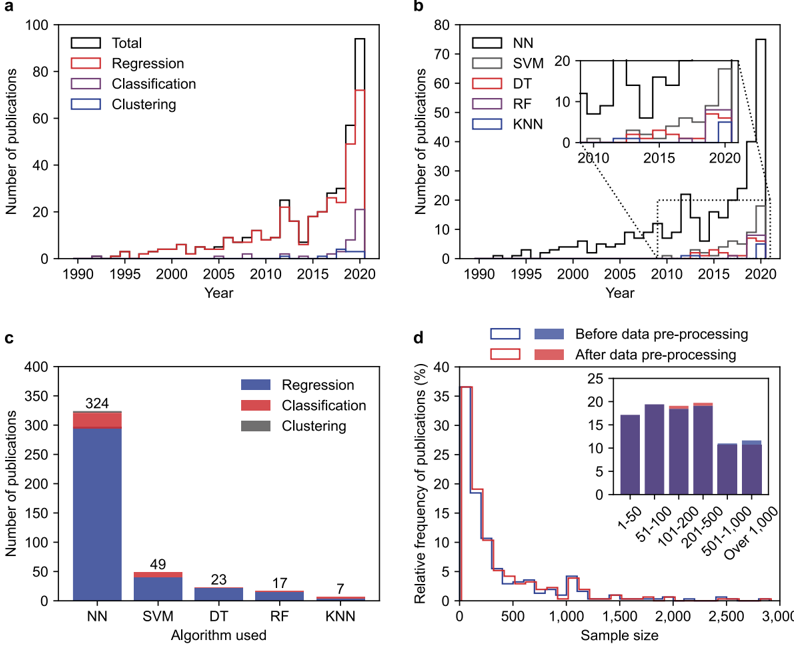
- The literature survey covered 389 peer-reviewed publications; the earliest concrete-and-ML article identified was from 1992, with publication numbers not reaching double digits until 2009. Most studies addressed regression tasks (88.2%), while classification accounted for 10.5%; neural networks were the most commonly applied algorithms.
- Regression datasets were small and skewed: sample sizes ranged from 5 to 262,569, with a median of 174 before preprocessing and 169 after; over 55% of studies had fewer than 200 samples, and only about 11% had more than 1,000 samples. Most regression studies used empirical experimental data (93.6%), with fewer using computational simulation data (7.3%); among experimental studies, 93.8% used laboratory tests and 8.4% used field tests.
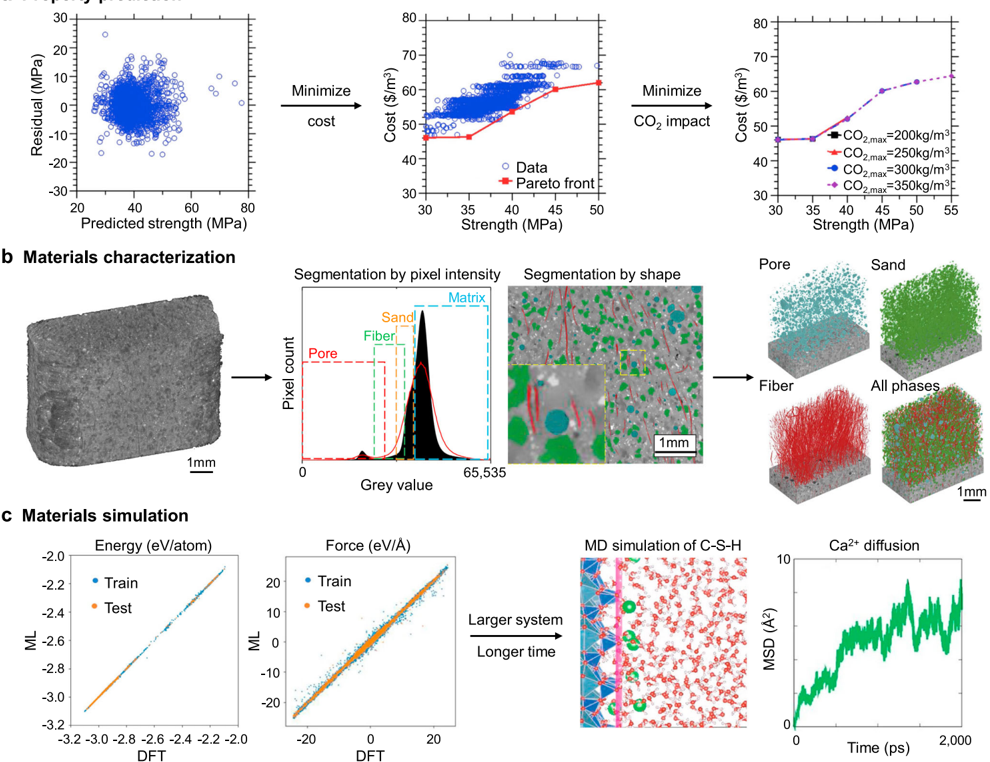
- Major application areas include property prediction (e.g., compressive, flexural, tensile, shear strength, elastic modulus, flowability, durability), materials characterization (e.g., nondestructive testing, image segmentation from X-ray computed tomography, crack detection), and materials simulation (e.g., ML potentials for large-scale molecular dynamics of C-S-H with 3,084 atoms for 2 ns).
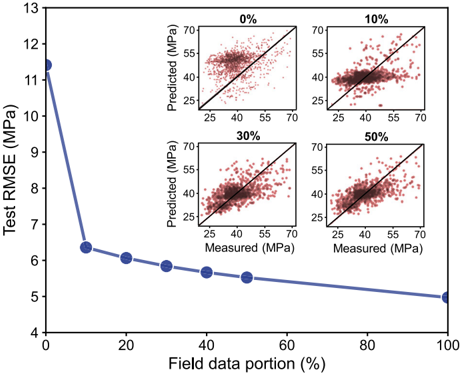
- The paper highlights data challenges (sparsity, high dimensionality, representation/measurement/temporal/deployment bias), validation challenges (hold-out and cross-validation pitfalls, especially with small datasets), and interpretability challenges (permutation-based diagnostics can generate unrealistic concrete mixtures; ML models identify association, not causation). It also reports that replacing 10% of laboratory training data with field data reduced root mean square error by 43% compared with using only laboratory data in one cited study.
Methods
- This is a review and bibliographic analysis, not a primary experimental study. The authors conducted a literature survey of 389 peer-reviewed publications on ML applications in concrete science, with survey criteria in Supplementary Note 1 and compiled data in Supplementary Dataset.
- Bibliographic data came from Web of Science for the period 1990–2020. The paper also provides a high-level summary of applications, publicly accessible datasets, and current research directions, and discusses challenges and best practices.
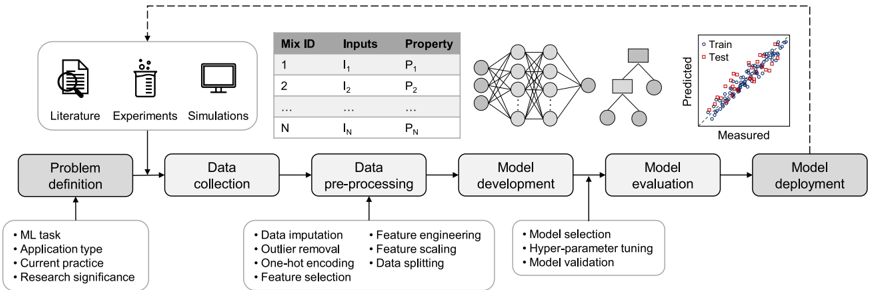
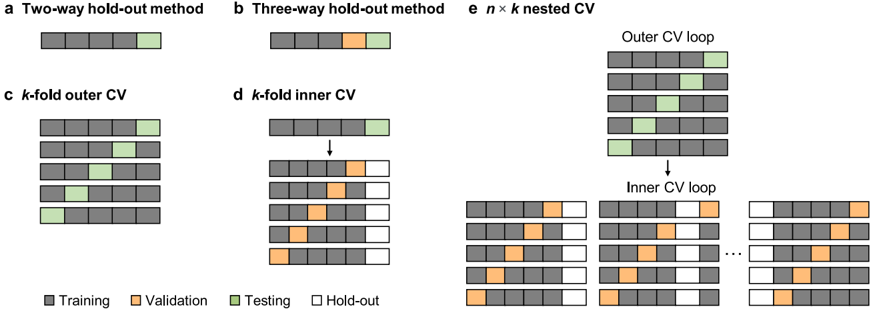
- The review synthesizes examples across property prediction, materials characterization, and materials simulation, and discusses validation approaches including two-way and three-way hold-out, k-fold cross-validation, and n × k nested cross-validation.
Limitations
- The paper states that its arguments are “not exhaustive” and aims to initiate constructive discussion rather than provide a complete treatment.
- The bibliographic analysis is limited to the surveyed publications and Web of Science period 1990–2020; detailed survey criteria and compiled data are placed in supplementary materials rather than fully in the main text.
- The review repeatedly notes limitations in the underlying ML literature: small datasets, data bias, inconsistent reporting, validation methods that may be ill-suited to small concrete datasets, and models that are not designed to establish causality.
Model-written summary. Check it against the paper before relying on it.
Integrity signals
Registry
Cites
Statistics
Figures
Verification
Claims the paper makes
11 Valid · 5 Not valid · 19 Not checked · 52 Own results and interpretations
Every source the paper cites for this claim was checked and supports it.
In the paper
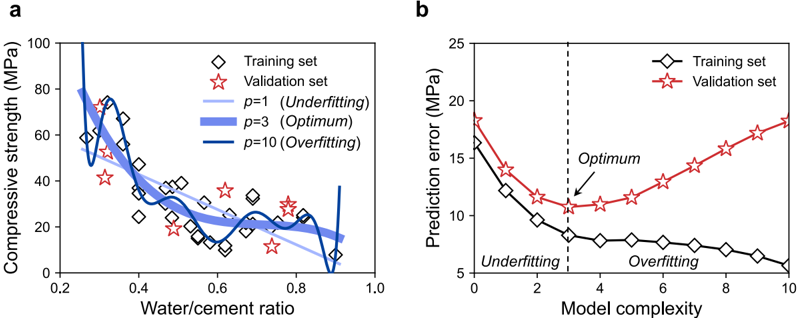
“Failure to assemble a sufficiently large dataset raises the risk of overfitting 82 (Fig. 5).”
§ Machine learning in concrete science: applications, challenges, and best practices > Data sparsity.
What the sources say
- Supportedcites [82] Kassraian-Fard, P., Matthis, C., Balsters, J. H., Maathuis, M. H. & Wenderoth, N. Promises, pitfalls, and basic guidelines for applying machine learning classifiers to psychiatric imaging data, with autism as an example. Front. Psychiatry 7, 177 (2016). source
The 'small sample size' section states directly that when features strongly exceed the number of data samples, 'a first problem is the high risk of overfitting,' and that a small but possibly complex data set can evoke an idiosyncratic fit with poor generalizability. The 'Feature Calculation' section reinforces this, noting that having many predictors relative to data samples causes classifiers to adapt to peculiarities of a specific dataset ('overfitting'), and that dimensionality reduction to alleviate overfitting is crucial 'especially in settings where restricted amount of data are available.' The Summary/Concluding Remarks likewise tie the high-dimensionality of a relatively small data set to easy overfitting. (LLM, conf=0.90)
plainstates a cause- Asserted: passes — The authors put it forward as true.
- Checkable: passes — It can be checked against evidence.
- Load-bearing: passes — The paper’s conclusions depend on it.
- Based: passes — The paper gives a reason why it holds.
- Supported
The cited sources support only part of this claim — read each source’s verdict below.
In the paper
“If the sample size is relatively small (as is generally the case in practical scenarios), the input variables of a dataset can lose their discriminating ability, as all samples in the dataset seem very distinct from each other with high dimensionality 85 .”
§ Machine learning in concrete science: applications, challenges, and best practices > High dimensionality.
What the sources say
- Partly supportedcites [85] Pestov, V. An axiomatic approach to intrinsic dimension of a dataset. Neural Netw. 21, 204-213 (2008). sourceExperimental — accuracy not yet measured
Pestov (2008) does support the substance of the paraphrase: Sect. 2.2 (p. 2) defines the curse of dimensionality as the situation where 'important features of a dataset sharply concentrate near their median (or mean) values and thus become non-discriminating', explicitly bundling in 'sparseness of points (the distance to the nearest neighbour is comparable to the average distance between two points)', i.e. samples looking mutually distinct in high dimension; Sect. 2.4 (p. 4) adds that large-margin classification with 1-Lipschitz features becomes impossible. The part the source does not support is the small-sample-size condition as the driver: in Sect. 6 (p. 8) realistic/'manageable' sample sizes are tied to the collapse and instability of the separation dimension of a noise-corrupted sample (Example 14), and the proof of Proposition 13 (p. 8) states the opposite of feature non-discrimination for such small samples — a typical high-dimensional sample forms a discrete metric space of diameter ~sqrt(2) whose Lip_1(X) 'will contain numerous 1-Lipschitz functions that are highly non-constant'. The paper's non-discrimination result is asserted for mm-spaces/domains of high intrinsic dimension (Corollary 9, p. 7, requires n >= n0 training points), not for datasets because their sample size is small. (LLM, conf=0.72)
plainstates a cause- Asserted: passes — The authors put it forward as true.
- Checkable: passes — It can be checked against evidence.
- Load-bearing: unclear — It is unclear whether the paper’s conclusions depend on it.
- Based: passes — The paper gives a reason why it holds.
- Partly supported
The cited sources support only part of this claim — read each source’s verdict below.
In the paper
“Hence, trust in ML models is strongly related to their interpretability, which has thus become a focus of active research in the ML community 116,132 .”
§ Machine learning in concrete science: applications, challenges, and best practices > Starting with simple models
What the sources say
- Partly supportedcites [116] Lipton, Z. C. The mythos of model interpretability: In machine learning, the concept of interpretability is both important and slippery. Queue 16, 1–28 (2018). sourceExperimental — accuracy not yet measured
The Introduction (p. 1) says many papers propose interpretability as a means to engender trust, and §2.1 (p. 3) says some suggest it is a prerequisite. Lipton questions what trust means and does not establish a strong relationship between trust and interpretability; the claim states that relationship more definitively than the source does. (LLM, conf=0.84)
- Not checked yetcites [132] Schmidt, P. & Biessmann, F. Quantifying interpretability and trust in machine learning systems. Preprint at http://arxiv.org/abs/1901.08558 (2019).
boostedstates an association- Asserted: passes — The authors put it forward as true.
- Checkable: passes — It can be checked against evidence.
- Load-bearing: passes — The paper’s conclusions depend on it.
- Based: passes — The paper gives a reason why it holds.
- Partly supported
The cited sources support only part of this claim — read each source’s verdict below.
In the paper
“In this regard, the knowledge shared in interdependent properties of the same material or in the same property of similar concrete types can be transferred to accelerate the training process and improve the accuracy performance of ML models, even with relatively small amounts of available data 143,144 .”
§ Machine learning in concrete science: applications, challenges, and best practices > CONCLUSIONS AND OUTLOOK
What the sources say
- Partly supportedcites [143] Song, P. S., Wu, J. C., Hwang, S. & Sheu, B. C. Assessment of statistical variations in impact resistance of high-strength concrete and high-strength steel fiber- reinforced concrete. Cem. Concr. Res. 35, 393-399 (2005). 128. Nuzzo, R. Scientific method: statistical errors. Nature 506, 150-152 (2014). 129. Leek, J. et al. Five ways to fix statistics. Nature 551, 557-559 (2017). 130. Halilaj, E. et al. Machine learning in human movement biomechanics: Best practices, common pitfalls, and new opportunities. J. Biomech. 81, 1-11 (2018). 131. Yin, M., Vaughan, J. W. & Wallach, H. Understanding the sourceExperimental — accuracy not yet measured
Split into 2 atoms — 1 confirmed, 1 partially supported, 0 disputed, 0 misattributed, 0 unverifiable. Expand the claim to see per-atom verdicts.
- Not checked yetcites [144] Ravinder et al. Artificial intelligence and machine learning in glass science and technology: 21 challenges for the 21st century. Int. J App Glass Sci. 12, 277–292 (2021). source
plainstates a cause- Asserted: passes — The authors put it forward as true.
- Checkable: passes — It can be checked against evidence.
- Load-bearing: passes — The paper’s conclusions depend on it.
- Based: passes — The paper gives a reason why it holds.
- Rests on an assumption not shown here.
- Partly supported
Every source the paper cites for this claim was checked and supports it.
In the paper
“However, it is important to note that ML models are not designed to identify causal relationships but rather association relationships 116 .”
§ Machine learning in concrete science: applications, challenges, and best practices > Causality.
What the sources say
- Supportedcites [116] Lipton, Z. C. The mythos of model interpretability: In machine learning, the concept of interpretability is both important and slippery. Queue 16, 1–28 (2018). source
Section 2.2 'Causality' (p. 3) states directly that supervised learning models are 'only optimized directly to make associations' and that 'the associations learned by supervised learning algorithms are not guaranteed to reflect causal relationships' because unobserved common causes may exist. That covers both halves of the paraphrase (association, not causal identification). Lipton adds the caveat that researchers nonetheless use such models to generate hypotheses later tested experimentally, but this does not contradict the claim about what the models are built/optimized to do. (LLM, conf=0.85)
plain- Asserted: passes — The authors put it forward as true.
- Checkable: passes — It can be checked against evidence.
- Load-bearing: passes — The paper’s conclusions depend on it.
- Based: passes — The paper gives a reason why it holds.
- Supported
44 more claims · 3 with their cited sources checked
Create a free account to see all 87 claims and to verify the 31 references still open.
- It may state two separate claims as one. 27
- Probably not a substantial claim. 12
- The quote only partly states this claim. 2
Citations
Cites
Breiman, L. (2001) · Machine Learning · doi:10.1023/a:1010933404324 · Cited by 133,538
Pan, S. J., & Yang, Q. (2010) · IEEE Transactions on Knowledge and Data Engineering · doi:10.1109/tkde.2009.191 · Cited by 23,387
Commentary: The Materials Project: A materials genome approach to accelerating materials innovation
Jain, A., Ong, S. P., Hautier, G., Chen, W., Richards, W. D., Dacek, S., Cholia, S., Gunter, D., Skinner, D., Ceder, G., et al. (2013) · APL Materials · doi:10.1063/1.4812323 · Cited by 13,094
Physics-informed machine learning
Karniadakis, G. E., Kevrekidis, I. G., Lu, L., Perdikaris, P., Wang, S., & Yang, L. (2021) · Nature Reviews Physics · doi:10.1038/s42254-021-00314-5 · Cited by 8,718
A Survey on Bias and Fairness in Machine Learning
Mehrabi, N., Morstatter, F., Saxena, N., Lerman, K., & Galstyan, A. (2022) · ACM Computing Surveys · doi:10.1145/3457607 · Cited by 5,812
A Survey on Bias and Fairness in Machine Learning
Mehrabi, N., Morstatter, F., Saxena, N., Lerman, K., & Galstyan, A. (2019) · arXiv · doi:10.48550/arxiv.1908.09635 · Cited by 5,812
Lipton, Z. C. (2018) · Queue · doi:10.1145/3236386.3241340 · Cited by 5,427
Adaptive Control Processes: A Guided Tour
Bellman, R. E. (1961) · doi:10.1515/9781400874668 · Cited by 2,802
Recent advances and applications of machine learning in solid-state materials science
Schmidt, J., Marques, M. R. G., Botti, S., & Marques, M. A. L. (2019) · npj Computational Materials · doi:10.1038/s41524-019-0221-0 · Cited by 2,607
Bias in error estimation when using cross-validation for model selection
Varma, S., & Simon, R. (2006) · BMC Bioinformatics · doi:10.1186/1471-2105-7-91 · Cited by 2,485
Machine learning algorithm validation with a limited sample size
Vabalas, A., Gowen, E., Poliakoff, E., & Casson, A. J. (2019) · PLOS ONE · doi:10.1371/journal.pone.0224365 · Cited by 1,901
Graph Networks as a Universal Machine Learning Framework for Molecules and Crystals
Chen, C., Ye, W., Zuo, Y., Zheng, C., & Ong, S. P. (2019) · Chemistry of Materials · doi:10.1021/acs.chemmater.9b01294 · Cited by 1,552
Scientific method: Statistical errors
Nuzzo, R. (2014) · Nature · doi:10.1038/506150a · Cited by 1,536
Monteiro, P. J. M., Miller, S. A., & Horvath, A. (2017) · Nature Materials · doi:10.1038/nmat4930 · Cited by 1,454 · cited 4×
“(1) Representation bias occurs when the sample underrepresents the population(90).”
BackgroundMethodInfluentialModeling of strength of high-performance concrete using artificial neural networks
Yeh, I.-C. (1998) · Cement and Concrete Research · doi:10.1016/s0008-8846(98)00165-3 · Cited by 1,447
Agrawal, A., & Choudhary, A. (2016) · APL Materials · doi:10.1063/1.4946894 · Cited by 1,385
Multivariate Density Estimation: Theory, Practice, and Visualization
Scott, D. W. (2015) · Wiley Series in Probability and Statistics · doi:10.1002/9781118575574 · Cited by 1,165
Unsupervised word embeddings capture latent knowledge from materials science literature
Tshitoyan, V., Dagdelen, J., Weston, L., Dunn, A., Rong, Z., Kononova, O., Persson, K. A., Ceder, G., & Jain, A. (2019) · Nature · doi:10.1038/s41586-019-1335-8 · Cited by 1,123
Koch, C., Georgieva, K., Kasireddy, V., Akinci, B., & Fieguth, P. (2015) · Advanced Engineering Informatics · doi:10.1016/j.aei.2015.01.008 · Cited by 1,065
Gopalakrishnan, K., Khaitan, S. K., Choudhary, A., & Agrawal, A. (2017) · Construction and Building Materials · doi:10.1016/j.conbuildmat.2017.09.110 · Cited by 955
Thermodynamic modelling of the hydration of Portland cement
Lothenbach, B., & Winnefeld, F. (2006) · Cement and Concrete Research · doi:10.1016/j.cemconres.2005.03.001 · Cited by 903
Computer vision-based concrete crack detection using U-net fully convolutional networks
Liu, Z., Cao, Y., Wang, Y., & Wang, W. (2019) · Automation in Construction · doi:10.1016/j.autcon.2019.04.005 · Cited by 833
Innovation in use and research on cementitious material
Scrivener, K. L., & Kirkpatrick, R. J. (2008) · Cement and Concrete Research · doi:10.1016/j.cemconres.2007.09.025 · Cited by 828
Cement and concrete as an engineering material: An historic appraisal and case study analysis
Gagg, C. R. (2014) · Engineering Failure Analysis · doi:10.1016/j.engfailanal.2014.02.004 · Cited by 808
von Rueden, L., Mayer, S., Beckh, K., Georgiev, B., Giesselbach, S., Heese, R., Kirsch, B., Walczak, M., Pfrommer, J., Pick, A., et al. (2021) · IEEE Transactions on Knowledge and Data Engineering · doi:10.1109/tkde.2021.3079836 · Cited by 793
Leakage in data mining: Formulation, detection, and avoidance
Kaufman, S., Rosset, S., Perlich, C., & Stitelman, O. (2012) · ACM Transactions on Knowledge Discovery from Data · doi:10.1145/2382577.2382579 · Cited by 791
Machine learning prediction of mechanical properties of concrete: Critical review
Ben Chaabene, W., Flah, M., & Nehdi, M. L. (2020) · Construction and Building Materials · doi:10.1016/j.conbuildmat.2020.119889 · Cited by 779
Dorafshan, S., Thomas, R. J., & Maguire, M. (2018) · Construction and Building Materials · doi:10.1016/j.conbuildmat.2018.08.011 · Cited by 774
Social Data: Biases, Methodological Pitfalls, and Ethical Boundaries
Olteanu, A., Castillo, C., Diaz, F., & Kıcıman, E. (2019) · Frontiers in Big Data · doi:10.3389/fdata.2019.00013 · Cited by 763
Social Data: Biases, Methodological Pitfalls, and Ethical Boundaries
Olteanu, A., Castillo, C., Diaz, F., & Kiciman, E. (2016) · doi:10.2139/ssrn.2886526 · Cited by 763
Three‐Dimensional Computer Simulation of Portland Cement Hydration and Microstructure Development
Bentz, D. P. (1997) · Journal of the American Ceramic Society · doi:10.1111/j.1151-2916.1997.tb02785.x · Cited by 602
A Framework of Potential Sources of Harm Throughout the Machine Learning Life Cycle
Suresh, H., & Guttag, J. V. (2021) · DSpace@MIT (Massachusetts Institute of Technology) · Cited by 576
Opportunities and Challenges for Machine Learning in Materials Science
Morgan, D., & Jacobs, R. (2020) · Annual Review of Materials Research · doi:10.1146/annurev-matsci-070218-010015 · Cited by 549
Machine learning for perovskite materials design and discovery
Tao, Q., Xu, P., Li, M., & Lu, W. (2021) · npj Computational Materials · doi:10.1038/s41524-021-00495-8 · Cited by 542
Understanding the Effect of Accuracy on Trust in Machine Learning Models
Yin, M., Wortman Vaughan, J., & Wallach, H. (2019) · Proceedings of the 2019 CHI Conference on Human Factors in Computing Systems · doi:10.1145/3290605.3300509 · Cited by 527
Efficient machine learning models for prediction of concrete strengths
Nguyen, H., Vu, T., Vo, T. P., & Thai, H.-T. (2021) · Construction and Building Materials · doi:10.1016/j.conbuildmat.2020.120950 · Cited by 524
Feature Engineering and Selection: A Practical Approach for Predictive Models
Kuhn, M., & Johnson, K. (2019) · doi:10.1201/9781315108230 · Cited by 523
Machine Learning for Materials Scientists: An Introductory Guide toward Best Practices
Wang, A. Y.-T., Murdock, R. J., Kauwe, S. K., Oliynyk, A. O., Gurlo, A., Brgoch, J., Persson, K. A., & Sparks, T. D. (2020) · Chemistry of Materials · doi:10.1021/acs.chemmater.0c01907 · Cited by 509
Modeling and simulation of cement hydration kinetics and microstructure development
Thomas, J. J., Biernacki, J. J., Bullard, J. W., Bishnoi, S., Dolado, J. S., Scherer, G. W., & Luttge, A. (2011) · Cement and Concrete Research · doi:10.1016/j.cemconres.2010.10.004 · Cited by 489
Halilaj, E., Rajagopal, A., Fiterau, M., Hicks, J. L., Hastie, T. J., & Delp, S. L. (2018) · Journal of Biomechanics · doi:10.1016/j.jbiomech.2018.09.009 · Cited by 460
Emerging materials intelligence ecosystems propelled by machine learning
Batra, R., Song, L., & Ramprasad, R. (2020) · Nature Reviews Materials · doi:10.1038/s41578-020-00255-y · Cited by 446
Young, B. A., Hall, A., Pilon, L., Gupta, P., & Sant, G. (2019) · Cement and Concrete Research · doi:10.1016/j.cemconres.2018.09.006 · Cited by 414
Han, Q., Gui, C., Xu, J., & Lacidogna, G. (2019) · Construction and Building Materials · doi:10.1016/j.conbuildmat.2019.07.315 · Cited by 408
Concrete material science: Past, present, and future innovations
Van Damme, H. (2018) · Cement and Concrete Research · doi:10.1016/j.cemconres.2018.05.002 · Cited by 398
Dorafshan, S., Thomas, R. J., & Maguire, M. (2018) · Data in Brief · doi:10.1016/j.dib.2018.11.015 · Cited by 388
Alpaydın, E. (2021) · The MIT Press eBooks · doi:10.7551/mitpress/13811.001.0001 · Cited by 374
µic: A new platform for modelling the hydration of cements
Bishnoi, S., & Scrivener, K. L. (2009) · Cement and Concrete Research · doi:10.1016/j.cemconres.2008.12.002 · Cited by 371
Computational design optimization of concrete mixtures: A review
DeRousseau, M. A., Kasprzyk, J. R., & Srubar, W. V. (2018) · Cement and Concrete Research · doi:10.1016/j.cemconres.2018.04.007 · Cited by 359
Modeling slump flow of concrete using second-order regressions and artificial neural networks
Yeh, I.-C. (2007) · Cement and Concrete Composites · doi:10.1016/j.cemconcomp.2007.02.001 · Cited by 307
Physics-guided Neural Networks (PGNN): An Application in Lake Temperature Modeling
Daw, A., Karpatne, A., Watkins, W., Read, J. S., & Kumar, V. (2017) · arXiv (Cornell University) · doi:10.48550/arxiv.1710.11431 · Cited by 300
van Breugel, K. (1995) · Cement and Concrete Research · doi:10.1016/0008-8846(95)00017-8 · Cited by 296
Zhang, J., Huang, Y., Wang, Y., & Ma, G. (2020) · Construction and Building Materials · doi:10.1016/j.conbuildmat.2020.119208 · Cited by 294
Khademi, F., Akbari, M., Jamal, S. M., & Nikoo, M. (2017) · Frontiers of Structural and Civil Engineering · doi:10.1007/s11709-016-0363-9 · Cited by 287
Tobermorites; their real structure and order-disorder (OD) character
Merlino, S., Bonaccorsi, E., & Armbruster, T. (1999) · American Mineralogist · doi:10.2138/am-1999-1015 · Cited by 286
Thermodynamics and cement science
Damidot, D., Lothenbach, B., Herfort, D., & Glasser, F. P. (2011) · Cement and Concrete Research · doi:10.1016/j.cemconres.2011.03.018 · Cited by 284
Prediction of surface chloride concentration of marine concrete using ensemble machine learning
Cai, R., Han, T., Liao, W., Huang, J., Li, D., Kumar, A., & Ma, H. (2020) · Cement and Concrete Research · doi:10.1016/j.cemconres.2020.106164 · Cited by 284
Performance Comparison of Pretrained Convolutional Neural Networks on Crack Detection in Buildings
Özgenel, Ç. F., & Sorguç, A. G. (2018) · Proceedings of the International Symposium on Automation and Robotics in Construction (IAARC) · doi:10.22260/isarc2018/0094 · Cited by 275
Neural networks for predicting compressive strength of structural light weight concrete
Alshihri, M. M., Azmy, A. M., & El-Bisy, M. S. (2009) · Construction and Building Materials · doi:10.1016/j.conbuildmat.2008.12.003 · Cited by 264
Hooker, G., Mentch, L., & Zhou, S. (2021) · Statistics and Computing · doi:10.1007/s11222-021-10057-z · Cited by 264
Witten, I. H., Frank, E., Hall, M. A., & Pal, C. J. (2017) · Data Mining · doi:10.1016/b978-0-12-804291-5.00010-6 · Cited by 254
Xu, J., Zhao, X., Yu, Y., Xie, T., Yang, G., & Xue, J. (2019) · Construction and Building Materials · doi:10.1016/j.conbuildmat.2019.03.234 · Cited by 246
Effect of aggregate properties on the strength and stiffness of lightweight concrete
Chi, J. M., Huang, R., Yang, C. C., & Chang, J. J. (2003) · Cement and Concrete Composites · doi:10.1016/s0958-9465(02)00020-3 · Cited by 245
Application of thermodynamic modelling to hydrated cements
Lothenbach, B., & Zajac, M. (2019) · Cement and Concrete Research · doi:10.1016/j.cemconres.2019.105779 · Cited by 241
Marani, A., & Nehdi, M. L. (2020) · Construction and Building Materials · doi:10.1016/j.conbuildmat.2020.120286 · Cited by 240
Han, T., Siddique, A., Khayat, K., Huang, J., & Kumar, A. (2020) · Construction and Building Materials · doi:10.1016/j.conbuildmat.2020.118271 · Cited by 236
Concrete crack detection and quantification using deep learning and structured light
Park, S. E., Eem, S.-H., & Jeon, H. (2020) · Construction and Building Materials · doi:10.1016/j.conbuildmat.2020.119096 · Cited by 227
A scientometric analysis and critical review of computer vision applications for construction
Martinez, P., Al-Hussein, M., & Ahmad, R. (2019) · Automation in Construction · doi:10.1016/j.autcon.2019.102947 · Cited by 221
Fuzzy logic model for the prediction of cement compressive strength
Akkurt, S., Tayfur, G., & Can, S. (2004) · Cement and Concrete Research · doi:10.1016/j.cemconres.2004.01.020 · Cited by 220
Naser, M. Z. (2021) · Automation in Construction · doi:10.1016/j.autcon.2021.103821 · Cited by 215
General Pitfalls of Model-Agnostic Interpretation Methods for Machine Learning Models
Molnar, C., König, G., Herbinger, J., Freiesleben, T., Dandl, S., Scholbeck, C. A., Casalicchio, G., Grosse-Wentrup, M., & Bischl, B. (2022) · Lecture Notes in Computer Science · doi:10.1007/978-3-031-04083-2_4 · Cited by 211
DeRousseau, M. A., Laftchiev, E., Kasprzyk, J. R., Rajagopalan, B., & Srubar, W. V. (2019) · Construction and Building Materials · doi:10.1016/j.conbuildmat.2019.08.042 · Cited by 206
Yang, Q., Shi, W., Chen, J., & Lin, W. (2020) · Automation in Construction · doi:10.1016/j.autcon.2020.103199 · Cited by 206
Zhang, J., Li, D., & Wang, Y. (2020) · Journal of Cleaner Production · doi:10.1016/j.jclepro.2020.120665 · Cited by 203
Compressive strength prediction of high-performance concrete using gradient tree boosting machine
Kaloop, M. R., Kumar, D., Samui, P., Hu, J. W., & Kim, D. (2020) · Construction and Building Materials · doi:10.1016/j.conbuildmat.2020.120198 · Cited by 203
Machine learning study of the mechanical properties of concretes containing waste foundry sand
Behnood, A., & Golafshani, E. M. (2020) · Construction and Building Materials · doi:10.1016/j.conbuildmat.2020.118152 · Cited by 202
Flah, M., Suleiman, A. R., & Nehdi, M. L. (2020) · Cement and Concrete Composites · doi:10.1016/j.cemconcomp.2020.103781 · Cited by 201
Statistical mixture design approach for eco-efficient UHPC
Ghafari, E., Costa, H., & Júlio, E. (2015) · Cement and Concrete Composites · doi:10.1016/j.cemconcomp.2014.07.016 · Cited by 191
Nguyen-Sy, T., Wakim, J., To, Q.-D., Vu, M.-N., Nguyen, T.-D., & Nguyen, T.-T. (2020) · Construction and Building Materials · doi:10.1016/j.conbuildmat.2020.119757 · Cited by 191
Computer vision for real-time extrusion quality monitoring and control in robotic construction
Kazemian, A., Yuan, X., Davtalab, O., & Khoshnevis, B. (2019) · Automation in Construction · doi:10.1016/j.autcon.2019.01.022 · Cited by 170
Nunez, I., Marani, A., Flah, M., & Nehdi, M. L. (2021) · Construction and Building Materials · doi:10.1016/j.conbuildmat.2021.125279 · Cited by 169
Influence of cement and superplasticizers type and dosage on the fluidity of cement mortars—Part I
Chandra, S., & Björnström, J. (2002) · Cement and Concrete Research · doi:10.1016/s0008-8846(02)00839-6 · Cited by 165
Khallaf, R., & Khallaf, M. (2021) · Automation in Construction · doi:10.1016/j.autcon.2021.103760 · Cited by 162
Simulation of Cement Hydration and the Connectivity of the Capillary Pore Space
Navi, P., & Pignat, C. (1996) · Advanced Cement Based Materials · doi:10.1016/s1065-7355(96)90052-8 · Cited by 155
Machine Learning in Amyotrophic Lateral Sclerosis: Achievements, Pitfalls, and Future Directions
Grollemund, V., Pradat, P.-F., Querin, G., Delbot, F., Le Chat, G., Pradat-Peyre, J.-F., & Bede, P. (2019) · Frontiers in Neuroscience · doi:10.3389/fnins.2019.00135 · Cited by 152
Semi-supervised machine-learning classification of materials synthesis procedures
Huo, H., Rong, Z., Kononova, O., Sun, W., Botari, T., He, T., Tshitoyan, V., & Ceder, G. (2019) · npj Computational Materials · doi:10.1038/s41524-019-0204-1 · Cited by 151
Farhidzadeh, A., Mpalaskas, A. C., Matikas, T. E., Farhidzadeh, H., & Aggelis, D. G. (2014) · Construction and Building Materials · doi:10.1016/j.conbuildmat.2014.05.015 · Cited by 150
Song, P. S., Wu, J. C., Hwang, S., & Sheu, B. C. (2005) · Cement and Concrete Research · doi:10.1016/j.cemconres.2004.07.021 · Cited by 141
Deep learning-based automated image segmentation for concrete petrographic analysis
Song, Y. J., Huang, Z., Shen, C., Shi, H., & Lange, D. A. (2020) · Cement and Concrete Research · doi:10.1016/j.cemconres.2020.106118 · Cited by 136
Machine learning prediction of carbonation depth in recycled aggregate concrete incorporating SCMs
Nunez, I., & Nehdi, M. L. (2021) · Construction and Building Materials · doi:10.1016/j.conbuildmat.2021.123027 · Cited by 135
Recent advances in modeling for cementitious materials
Dolado, J. S., & van Breugel, K. (2011) · Cement and Concrete Research · doi:10.1016/j.cemconres.2011.03.014 · Cited by 134
Amini, K., Jalalpour, M., & Delatte, N. (2015) · Construction and Building Materials · doi:10.1016/j.conbuildmat.2015.10.131 · Cited by 133
Xu, J., Chen, Y., Xie, T., Zhao, X., Xiong, B., & Chen, Z. (2019) · Construction and Building Materials · doi:10.1016/j.conbuildmat.2019.07.155 · Cited by 133
Kassraian-Fard, P., Matthis, C., Balsters, J. H., Maathuis, M. H., & Wenderoth, N. (2016) · Frontiers in Psychiatry · doi:10.3389/fpsyt.2016.00177 · Cited by 132
Avoiding common pitfalls in machine learning omic data science
Teschendorff, A. E. (2019) · Nature Materials · doi:10.1038/s41563-018-0241-z · Cited by 132
Analysis of carbonation behavior in concrete using neural network algorithm and carbonation modeling
Kwon, S.-J., & Song, H.-W. (2009) · Cement and Concrete Research · doi:10.1016/j.cemconres.2009.08.022 · Cited by 127
Chun, P., Ujike, I., Mishima, K., Kusumoto, M., & Okazaki, S. (2020) · Construction and Building Materials · doi:10.1016/j.conbuildmat.2020.119238 · Cited by 124
Cho, B. H., Chung, W., & Nam, B. H. (2020) · Nanomaterials · doi:10.3390/nano10112158 · Cited by 124
CaPrM: Carbonation prediction model for reinforced concrete using machine learning methods
Taffese, W. Z., Sistonen, E. V.-P., & Puttonen, J. (2015) · Construction and Building Materials · doi:10.1016/j.conbuildmat.2015.09.058 · Cited by 123
Davtalab, O., Kazemian, A., Yuan, X., & Khoshnevis, B. (2020) · Journal of Intelligent Manufacturing · doi:10.1007/s10845-020-01684-w · Cited by 119
Zhang, L. V., Marani, A., & Nehdi, M. L. (2022) · Construction and Building Materials · doi:10.1016/j.conbuildmat.2021.126103 · Cited by 119
Guo, P., Meng, W., Xu, M., Li, V. C., & Bao, Y. (2021) · Materials · doi:10.3390/ma14123143 · Cited by 114
Park, K.-B., Noguchi, T., & Plawsky, J. L. (2004) · Cement and Concrete Research · doi:10.1016/j.cemconres.2004.08.004 · Cited by 112
Huang, Y., Zhang, J., Tze Ann, F., & Ma, G. (2020) · Construction and Building Materials · doi:10.1016/j.conbuildmat.2020.120457 · Cited by 112
Bhamare, D. K., Saikia, P., Rathod, M. K., Rakshit, D., & Banerjee, J. (2021) · Building and Environment · doi:10.1016/j.buildenv.2021.107927 · Cited by 109
Genetic programming for experimental big data mining: A case study on concrete creep formulation
Gandomi, A. H., Sajedi, S., Kiani, B., & Huang, Q. (2016) · Automation in Construction · doi:10.1016/j.autcon.2016.06.010 · Cited by 108
Deep learning models for bridge deck evaluation using impact echo
Dorafshan, S., & Azari, H. (2020) · Construction and Building Materials · doi:10.1016/j.conbuildmat.2020.120109 · Cited by 108
Ramkumar, K. B., Rajkumar, P. R. K., Ahmmad, S. N., & Jegan, M. (2020) · Construction and Building Materials · doi:10.1016/j.conbuildmat.2020.120215 · Cited by 101
Leek, J. T., McShane, B. B., Gelman, A., Colquhoun, D., Nuijten, M. B., & Goodman, S. N. (2017) · Nature · doi:10.1038/d41586-017-07522-z · Cited by 100
Lorenzoni, R., Curoșu, I., Paciornik, S., Mechtcherine, V., Oppermann, M., & Silva, F. D. A. (2020) · Cement and Concrete Composites · doi:10.1016/j.cemconcomp.2020.103551 · Cited by 100
Aravind, N., Nagajothi, S., & Elavenil, S. (2021) · Construction and Building Materials · doi:10.1016/j.conbuildmat.2021.123785 · Cited by 100
Infrared thermography model for automated detection of delamination in RC bridge decks
Omar, T., Nehdi, M. L., & Zayed, T. M. (2018) · Construction and Building Materials · doi:10.1016/j.conbuildmat.2018.02.126 · Cited by 98
Chen, D., Montano, V., Huo, L., Fan, S., & Song, G. (2020) · Construction and Building Materials · doi:10.1016/j.conbuildmat.2020.119761 · Cited by 96
Prediction of concrete coefficient of thermal expansion and other properties using machine learning
Nilsen, V., Pham, L. T., Hibbard, M., Klager, A., Cramer, S. M., & Morgan, D. (2019) · Construction and Building Materials · doi:10.1016/j.conbuildmat.2019.05.006 · Cited by 95
Bouziani, T. (2013) · Construction and Building Materials · doi:10.1016/j.conbuildmat.2013.08.039 · Cited by 93
Quick image analysis of concrete pore structure based on deep learning
Zhou, S., Sheng, W., Wang, Z., Yao, W., Huang, H., Wei, Y., & Li, R. (2019) · Construction and Building Materials · doi:10.1016/j.conbuildmat.2019.03.006 · Cited by 83
Xu, Y., & Jin, R. (2018) · Construction and Building Materials · doi:10.1016/j.conbuildmat.2018.05.124 · Cited by 82
A Framework for Understanding Sources of Harm throughout the Machine Learning Life Cycle
Suresh, H., & Guttag, J. (2021) · Equity and Access in Algorithms, Mechanisms, and Optimization · doi:10.1145/3465416.3483305 · Cited by 82
A Framework for Understanding Sources of Harm throughout the Machine Learning Life Cycle
Suresh, H., & Guttag, J. V. (2019) · arXiv · doi:10.48550/arxiv.1901.10002 · Cited by 82
Full Factorial Optimization of Concrete Mix Design for Hot Climates
Soudki, K. A., El-Salakawy, E., & Elkum, N. B. (2001) · Journal of Materials in Civil Engineering · doi:10.1061/(asce)0899-1561(2001)13:6(427 · Cited by 81
Machine learning can predict setting behavior and strength evolution of hydrating cement systems
Oey, T., Jones, S. Z., Bullard, J. W., & Sant, G. (2019) · Journal of the American Ceramic Society · doi:10.1111/jace.16706 · Cited by 79
Wendner, R., Hubler, M. H., & Bažant, Z. P. (2015) · Materials and Structures · doi:10.1617/s11527-014-0515-0 · Cited by 77
Mix design of the green self-consolidating concrete: Incorporating the waste glass powder
Hendi, A., Mostofinejad, D., Sedaghatdoost, A., Zohrabi, M., Naeimi, N., & Tavakolinia, A. (2018) · Construction and Building Materials · doi:10.1016/j.conbuildmat.2018.12.020 · Cited by 77
Optimizing fresh properties and compressive strength of self-consolidating concrete
Elemam, W. E., Abdelraheem, A. H., Mahdy, M. G., & Tahwia, A. M. (2020) · Construction and Building Materials · doi:10.1016/j.conbuildmat.2020.118781 · Cited by 77
Modeling and Sensitivity Analysis of Concrete Creep with Machine Learning Methods
Li, K., Long, Y., Wang, H., & Wang, Y. (2021) · Journal of Materials in Civil Engineering · doi:10.1061/(asce)mt.1943-5533.0003843 · Cited by 77
Robinson, M. C., Glen, R. C., & Lee, A. A. (2020) · Journal of Computer-Aided Molecular Design · doi:10.1007/s10822-019-00274-0 · Cited by 74
Nasr, D., Behforouz, B., Borujeni, P. R., Borujeni, S. A., & Zehtab, B. (2019) · Construction and Building Materials · doi:10.1016/j.conbuildmat.2019.116888 · Cited by 72
A fast adaptive crack detection algorithm based on a double-edge extraction operator of FSM
Luo, Q., Ge, B., & Tian, Q. (2019) · Construction and Building Materials · doi:10.1016/j.conbuildmat.2019.01.150 · Cited by 71
Ghorbani, B., Arulrajah, A., Narsilio, G. A., & Horpibulsuk, S. (2020) · Construction and Building Materials · doi:10.1016/j.conbuildmat.2020.119688 · Cited by 71
Lorenzoni, R., Curoșu, I., Léonard, F., Paciornik, S., Mechtcherine, V., Silva, F. D. A., & Bruno, G. (2020) · Cement and Concrete Research · doi:10.1016/j.cemconres.2020.106139 · Cited by 71
Ouyang, B., Song, Y. J., Li, Y., Wu, F., Yu, H., Wang, Y., Yin, Z., Luo, X., Sant, G., & Bauchy, M. (2020) · Engineering Research Express · doi:10.14359/51728128 · Cited by 71
Ke, X., & Duan, Y. (2021) · Composites Part B Engineering · doi:10.1016/j.compositesb.2021.108801 · Cited by 70
González-Jorge, H., González‐Aguilera, D., Rodríguez‐Gonzálvez, P., & Arias, P. (2012) · Construction and Building Materials · doi:10.1016/j.conbuildmat.2011.12.053 · Cited by 69
A metaheuristic-optimized multi-output model for predicting multiple properties of pervious concrete
Zhang, J., Huang, Y., Ma, G., Sun, J., & Nener, B. (2020) · Construction and Building Materials · doi:10.1016/j.conbuildmat.2020.118803 · Cited by 68
Xi, X., Yin, Z., Yang, S., & Li, C. (2020) · Engineering Fracture Mechanics · doi:10.1016/j.engfracmech.2020.107488 · Cited by 68
Integrating Scientific Knowledge with Machine Learning for Engineering and Environmental SystemsPreprint
Willard, J., Jia, X., Xu, S., et al. (2020) · arXiv (Cornell University) · doi:10.48550/arxiv.2003.04919 · Cited by 68
Quantifying Interpretability and Trust in Machine Learning Systems
Schmidt, P. S., & Bießmann, F. (2019) · arXiv (Cornell University) · doi:10.48550/arxiv.1901.08558 · Cited by 68
Modelling cement microstructure: Pixels, particles, and property prediction
Bentz, D. P. (1999) · Materials and Structures · doi:10.1007/bf02481514 · Cited by 66
Ma, G., & Du, Q. (2020) · Construction and Building Materials · doi:10.1016/j.conbuildmat.2020.118860 · Cited by 66
Accurate data-driven prediction does not mean high reproducibility
Li, J., Liu, L., Le, T. D., & Liu, J. (2020) · Nature Machine Intelligence · doi:10.1038/s42256-019-0140-2 · Cited by 62
Machine learning for high-fidelity prediction of cement hydration kinetics in blended systems
Cook, R., Han, T., Childers, A., Ryckman, C., Khayat, K. H., Ma, H., Huang, J., & Kumar, A. (2021) · Materials & Design · doi:10.1016/j.matdes.2021.109920 · Cited by 62
Concrete properties evaluation by statistical fusion of NDT techniques
Sbartaï, Z. M., Laurens, S., Elachachi, S. M., & Payan, C. (2012) · Construction and Building Materials · doi:10.1016/j.conbuildmat.2012.09.064 · Cited by 59
Mermerdaş, K., & Arbili, M. M. (2015) · Construction and Building Materials · doi:10.1016/j.conbuildmat.2015.07.074 · Cited by 58
Güneyisi, E., Gesoğlu, M., Özturan, T., & Özbay, E. (2007) · Construction and Building Materials · doi:10.1016/j.conbuildmat.2007.10.022 · Cited by 56
A comparative assessment of bagging ensemble models for modeling concrete slump flow
Aydoğmuş, H. Y., Erdal, H. İ., Karakurt, O., Namlı, E., Türkan, Y. S., & Erdal, H. (2015) · Computers and Concrete, an International Journal · doi:10.12989/cac.2015.16.5.741 · Cited by 56
Ravinder, Venugopal, V., Bishnoi, S., Singh, S., Zaki, M., Grover, H. S., Bauchy, M., Agarwal, M., & Krishnan, N. M. A. (2021) · International Journal of Applied Glass Science · doi:10.1111/ijag.15881 · Cited by 56
Machine learning for glass science and engineering: A review
Liu, H., Fu, Z., Yang, K., Xu, X., & Bauchy, M. (2019) · Journal of Non-Crystalline Solids: X · doi:10.1016/j.nocx.2019.100036 · Cited by 53
Hossain, K. M. A., Anwar, M. S., & Samani, S. G. (2016) · Neural Computing and Applications · doi:10.1007/s00521-016-2602-3 · Cited by 51
Evaluation of carbonation progress using AIJ model, FEM analysis, and machine learning algorithms
Lee, H.-M., Lee, H., & Suraneni, P. (2020) · Construction and Building Materials · doi:10.1016/j.conbuildmat.2020.119703 · Cited by 49
Machine learning potentials for tobermorite minerals
Kobayashi, K., Nakamura, H., Yamaguchi, A., Itakura, M., Machida, M., & Okumura, M. (2020) · Computational Materials Science · doi:10.1016/j.commatsci.2020.110173 · Cited by 47
Güneyisi, E., Gesoğlu, M., & Özbay, E. (2008) · Materials and Structures · doi:10.1617/s11527-008-9395-5 · Cited by 46
An axiomatic approach to intrinsic dimension of a dataset
Pestov, V. (2008) · Neural Networks · doi:10.1016/j.neunet.2007.12.030 · Cited by 45
Zhang, M., Li, M., Shen, Y., Ren, Q., & Zhang, J. (2019) · Construction and Building Materials · doi:10.1016/j.conbuildmat.2019.02.169 · Cited by 45
Hyperspectral imaging features for mortar classification and compressive strength assessment
Fan, L., Fan, M., Alhaj, A., Chen, G., & Ma, H. (2020) · Construction and Building Materials · doi:10.1016/j.conbuildmat.2020.118935 · Cited by 44
Artificial Neural Network for Predicting Creep and Shrinkage of High Performance Concrete
Karthikeyan, J., Upadhyay, A., & Bhandari, N. M. (2008) · Journal of Advanced Concrete Technology · doi:10.3151/jact.6.135 · Cited by 42
Al-Batah, M. S., Isa, N. A. M., Zamli, K. Z., Sani, Z. M., & Azizli, K. A. (2009) · International Journal of Mineral Processing · doi:10.1016/j.minpro.2009.03.004 · Cited by 42
Prediction of chloride content in concrete using ANN and CART
Asghshahr, M. S., Rahai, A., & Ashrafi, H. (2016) · Magazine of Concrete Research · doi:10.1680/jmacr.15.00261 · Cited by 41
Dataset of tensile strength development of concrete with manufactured sand
Zhao, S., Hu, F., Ding, X., Zhao, M., Li, C., & Pei, S. (2017) · Data in Brief · doi:10.1016/j.dib.2017.02.043 · Cited by 40
Machine Learning Enables Rapid Screening of Reactive Fly Ashes Based on Their Network Topology
Song, Y. J., Yang, K., Chen, J., Wang, K., Sant, G., & Bauchy, M. (2021) · ACS Sustainable Chemistry & Engineering · doi:10.1021/acssuschemeng.0c06978 · Cited by 40
Pavement aggregate shape classification based on extreme gradient boosting
Pei, L., Sun, Z., Yu, T., Li, W., Hao, X., Hu, Y., & Yang, C. (2020) · Construction and Building Materials · doi:10.1016/j.conbuildmat.2020.119356 · Cited by 39
High-throughput design of fiber reinforced cement-based composites using deep learning
Tong, Z., Huo, J., & Wang, Z. (2020) · Cement and Concrete Composites · doi:10.1016/j.cemconcomp.2020.103716 · Cited by 39
Ford, E., Kailas, S., Maneparambil, K., & Neithalath, N. (2020) · Construction and Building Materials · doi:10.1016/j.conbuildmat.2020.120647 · Cited by 39
Mu, B., Li, Z., & Peng, J. (2000) · Cement and Concrete Research · doi:10.1016/s0008-8846(00)00333-1 · Cited by 38
Self-citationPredicting the early-stage creep dynamics of gels from their static structure by machine learning
Liu, H., Xiao, S., Tang, L., Bao, E., Li, E., Yang, C., Zhao, Z., Sant, G., Smedskjær, M. M., Guo, L., et al. (2021) · Acta Materialia · doi:10.1016/j.actamat.2021.116817 · Cited by 38
Artificial neural networks for the prediction of shear capacity of steel plate strengthened RC beams
Adhikary, B. B., & Mutsuyoshi, H. (2004) · Construction and Building Materials · doi:10.1016/j.conbuildmat.2004.03.002 · Cited by 35
Wang, Y., Shao, Y., Matovic, M. D., & Whalen, J. K. (2016) · Construction and Building Materials · doi:10.1016/j.conbuildmat.2016.07.031 · Cited by 35
Karakoç, M. B., Demirboğa, R., Türkmen, İ., & Can, İ. (2011) · Construction and Building Materials · doi:10.1016/j.conbuildmat.2011.04.068 · Cited by 34
Liu, J.-C., Huang, L., Tian, Z., & Ye, H. (2021) · Construction and Building Materials · doi:10.1016/j.conbuildmat.2021.123946 · Cited by 34
Güneyisi, E. M., Mermerdaş, K., Güneyisi, E., & Gesoğlu, M. (2014) · Materials and Structures · doi:10.1617/s11527-014-0269-8 · Cited by 32
Najigivi, A., Khaloo, A., zad, A. I., & Rashid, S. B. A. (2013) · International Journal of Concrete Structures and Materials · doi:10.1007/s40069-013-0038-z · Cited by 32
Koniorczyk, M., & Wojciechowski, M. (2009) · Construction and Building Materials · doi:10.1016/j.conbuildmat.2009.05.001 · Cited by 31
Shear strength prediction of HSC slender beams without web reinforcement
Elsanadedy, H. M., Abbas, H., Al-Salloum, Y., & Almusallam, T. H. (2015) · Materials and Structures · doi:10.1617/s11527-015-0752-x · Cited by 31
Prediction of Elastic Modulus of Concrete Using Support Vector Committee Method
Yazdi, J. S., Kalantary, F., & Yazdi, H. S. (2012) · Journal of Materials in Civil Engineering · doi:10.1061/(asce)mt.1943-5533.0000507 · Cited by 30
Lyngdoh, G. A., Li, H., Zaki, M. F. M., Krishnan, N. M. A., & Das, S. (2020) · Scientific Reports · doi:10.1038/s41598-020-78368-1 · Cited by 30
Yan, Y., Ren, Q., Xia, N. M., Shen, L., & Gu, J. (2015) · Fatigue & Fracture of Engineering Materials & Structures · doi:10.1111/ffe.12309 · Cited by 28
A novel method for multi-scale carbon fiber distribution characterization in cement-based composites
Zheng, T., Guo, H., Gao, J., & Wang, Z. (2019) · Construction and Building Materials · doi:10.1016/j.conbuildmat.2019.05.115 · Cited by 28
Suitable features selection for the HMLP and MLP networks to identify the shape of aggregate
Isa, N. A. M., Al-Batah, M. S., Zamli, K. Z., Azizli, K. A., Joret, A., & Noor, N. R. M. (2006) · Construction and Building Materials · doi:10.1016/j.conbuildmat.2006.08.005 · Cited by 27
Influence of Pumping/Extrusion on the Air-Void System of 3D Printed Concrete
Das, A., Song, Y. J., Mantellato, S., Wangler, T. P., Flatt, R. J., & Lange, D. A. (2020) · Rilem bookseries · doi:10.1007/978-3-030-49916-7_43 · Cited by 27
Estimation of sulfate expansion level of PC mortar using statistical and neural approaches
Göktepe, A. B., İnan, G., Ramyar, K., & Sezer, A. (2005) · Construction and Building Materials · doi:10.1016/j.conbuildmat.2005.01.041 · Cited by 24
A machine learning approach for the identification of the Lattice Discrete Particle Model parameters
Alnaggar, M., & Bhanot, N. (2018) · Engineering Fracture Mechanics · doi:10.1016/j.engfracmech.2018.04.041 · Cited by 24
A robust time-dependent model of alkali-silica reaction at different temperatures
Allahyari, H., Heidarpour, A., Shayan, A., & Nguyen, V. P. (2020) · Cement and Concrete Composites · doi:10.1016/j.cemconcomp.2019.103460 · Cited by 24
Rational Condition Assessment of RC Bridge Decks Subjected to Corrosion-Induced Delamination
Omar, T., Nehdi, M. L., & Zayed, T. M. (2017) · Journal of Materials in Civil Engineering · doi:10.1061/(asce)mt.1943-5533.0002114 · Cited by 21
Zheng, T., Gao, J., Wang, Z., Wei, Y., & Dou, H. (2019) · Construction and Building Materials · doi:10.1016/j.conbuildmat.2019.06.160 · Cited by 18
Sensitivity analysis of creep models considering correlation
Han, B., Xie, H., Zhang, D.-J., & Ma, X. (2015) · Materials and Structures · doi:10.1617/s11527-015-0782-4 · Cited by 17
Manca, M., Karrech, A., Dight, P., & Ciancio, D. (2018) · Construction and Building Materials · doi:10.1016/j.conbuildmat.2018.09.141 · Cited by 17
Migallón, V., Navarro-González, F. J., Penadés, J., & Villacampa, Y. (2019) · Construction and Building Materials · doi:10.1016/j.conbuildmat.2019.05.160 · Cited by 14
Investigation of framed shearwall behaviour with neural networks
Mo, Y. L., & Lin, S. S. (1994) · Magazine of Concrete Research · doi:10.1680/macr.1994.46.169.289 · Cited by 13
Prediction of shear strength of FRP-reinforced concrete members using a rule-based method
Abbasloo, A.-A., Shayanfar, M. A., Pahlavan, H., Barkhordari, M. A., & Hamze‐Ziabari, S. M. (2018) · Magazine of Concrete Research · doi:10.1680/jmacr.17.00425 · Cited by 11
Vimonsatit, V., Lee, H., Huen, W. Y., Mendis, P. A., Baduge, S. K., & Thilakarathna, S. (2020) · Construction and Building Materials · doi:10.1016/j.conbuildmat.2020.119900 · Cited by 9
Investigation of chloride diffusion in cement mortar via statistical learning theory
Liao, K., Chen, C.-T., Wu, B.-H., Chen, W., & Yeh, C.-M. (2015) · Magazine of Concrete Research · doi:10.1680/jmacr.14.00413 · Cited by 8
Undersampling Strategy for Machine-learned Deterioration Regression Model in Concrete Bridges
Okazaki, Y., Okazaki, S., Asamoto, S., & Chun, P. (2020) · Journal of Advanced Concrete Technology · doi:10.3151/jact.18.753 · Cited by 7
Advanced Quality Control Models for Concrete Admixtures
Choi, H., Venkiteela, G., Gregori, A., & Najm, H. (2019) · Journal of Materials in Civil Engineering · doi:10.1061/(asce)mt.1943-5533.0003024 · Cited by 6
Research works printed but not linked: 30
- Mehta, P. K. & Monteiro, P. J. M. Concrete: microstructure, properties, and materials (McGraw-Hill Education, 2014).
- Garboczi, E. J., Bentz, D. P. & Frohnsdorff, G. J. The past, present, and future of the computational materials science of concrete. In J. Francis Young Symposium (Materials Science of Concrete Workshop, 2000).
- El-Chabib, H. & Nehdi, M. Effect of mixture design parameters on segregation of self-consolidating concrete. ACI Mater. J. 103, 374-383 (2006).
- Gunasekera, C. et al. Design of Alkali-Activated Slag-Fly Ash Concrete Mixtures Using Machine Learning. ACI Mater. J. 117, 263-278 (2020).
- Pratt, D. & Sansalone, M. Impact-echo signal interpretation using artificial intelligence. ACI Mater. J. 89, 178-187 (1992).
- Li, Z. & Radlińska, A. Artificial intelligence in concrete materials: A scientometric view. In Naser, M. Z. (ed.) Leveraging Artificial Intelligence in Engineering, Management, and Safety of Infrastructure (CRC Press, 2022).
- Rafiei, M. H., Khushefati, W. H., Demirboga, R. & Adeli, H. Neural network, machine learning, and evolutionary approaches for concrete material char- acterization. ACI Mater. J. 113, 781-789 (2016).
- Rafiei, M. H., Khushefati, W. H., Demirboga, R. & Adeli, H. Novel approach for concrete mixture design using neural dynamics model and virtual lab concept. ACI Mater. J. 114, 117-127 (2017).
- Park, K. B., Jee, N. Y., Yoon, I. S. & Lee, H. S. Prediction of temperature distribution in high-strength concrete using hydration model. ACI Mater. J. 105, 180-186 (2008).
- Kutner, M. H. et al. Applied linear statistical models (McGraw-Hill Irwin, 2005).
- Zheng, A. & Casari, A. Feature engineering for machine learning: principles and techniques for data scientists (O'Reilly Media, 2018).
- Müller, A. C. & Guido, S. Introduction to machine learning with Python: a guide for data scientists (O'Reilly Media, 2016).
- Bažant, Z. R. & Li, G. H. Unbiased statistical comparison of creep and shrinkage prediction models. ACI Mater. J. 105, 610-621 (2008).
- Hubler, M. H., Wendner, R. & Bažant, Z. P. Comprehensive database for concrete creep and shrinkage: Analysis and recommendations for testing and recording. ACI Mater. J. 112, 547-558 (2015).
- Fisher, A., Rudin, C. & Dominici, F. All models are wrong, but many are useful: Learning a variable’s importance by studying an entire class of prediction models simultaneously. J. Mach. Learn. Res. 20, 1–81 (2019).
- Lundberg, S. M. & Lee, S.-I. A Unified Approach to Interpreting Model Predictions. In Guyon, I. et al. (eds.) Advances in Neural Information Processing Systems, vol. 30 (Curran Associates, Inc., 2017).
- El-Chabib, H., Nehdi, M. & Sonebi, M. Artificial intelligence model for flowable concrete mixtures used in underwater construction and repair. ACI Mater. J. 100, 165–173 (2003).
- Basma, A. A., Barakat, S. A. & Al-Oraimi, S. Prediction of cement degree of hydration using artificial neural networks. ACI Mater. J. 96, 167–172 (1999).
- Xi, X., Yang, S., Hu, X. & Li, C. Q. Computational determination of interface fracture properties for concrete by inverse analysis. ACI Mater. J. 117, 43-53 (2020). 163.
- Nehdi, M. L. & Soliman, A. M. Artificial intelligence model for early-age autogenous shrinkage of concrete. ACI Mater. J. 109, 353–362 (2012).
- Aizawa, T. & Yokoshita, T. Applications of neural network technology to the operation and control of cement plants. ZKG Int. 48, 532–538 (1995).
- Schmidt, D. & Schmidt, D. Online prediction of the free lime content in the sintering zone and the use of neural networks for process optimization. ZKG Int. 54, 471–479 (2001).
- Oh, J. W., Lee, I. W., Kim, J. T. & Lee, G. W. Application of neural networks for proportioning of concrete mixes. ACI Mater. J. 96, 61–67 (1999).
- Ji, T., Yang, Y., Fu, M. Y., Chen, B. C. & Wu, H. C. Optimum design of reactive powder concrete mixture proportion based on artificial neural and harmony search algorithm. ACI Mater. J. 114, 41–47 (2017).
- Haj-Ali, R. M., Kurtis, K. E. & Sthapit, A. R. Neural network modeling of concrete expansion during long-term sulfate exposure. ACI Mater. J. 98, 36–43 (2001).
- Chang, C. H. & Yang, C. C. Artificial neural networks in prediction of concrete strength reduction due to high temperature. ACI Mater. J. 103, 68–69 (2006).
- Özbay, E. & Lachemi, M. Relative compressive strength of concretes under elevated temperatures. ACI Mater. J. 109, 165–175 (2012).
- Ünlü, R. An assessment of machine learning models for slump flow and examining redundant features. Comput. Concr. 25, 565–574 (2020).
- Naser, M. Z. & Salehi, H. Machine learning-driven assessment of fire-induced concrete spalling of columns. ACI Mater. J. 117, 7–16 (2020).
- Knaack, A. M., Kurama, Y. C. & Kirkner, D. J. Compressive Strength Relationships for Concrete under Elevated Temperatures. ACI Mater. J. 108, 270–280 (2011).
Cited by
Machine Learning for Perovskite Solar Cells and Component Materials: Key Technologies and Prospects
Liu, Y., Tan, X., Liang, J., Han, H., Xiang, P., & Yan, W. (2023) · Advanced Functional Materials · doi:10.1002/adfm.202214271 · Cited by 174
Alkayem, N. F., Shen, L., Mayya, A., Asteris, P. G., Fu, R., Di Luzio, G., Strauss, A., & Cao, M. (2024) · Journal of Building Engineering · doi:10.1016/j.jobe.2023.108369 · Cited by 164
Modelling of 3D concrete printing process: A perspective on material and structural simulations
Nguyen‐Van, V., Li, S., Liu, J., Nguyen, K., & Tran, P. (2022) · Additive manufacturing · doi:10.1016/j.addma.2022.103333 · Cited by 178
Unboxing machine learning models for concrete strength prediction using XAI
Elhishi, S., Elashry, A., & El‐Metwally, S. (2023) · Scientific Reports · doi:10.1038/s41598-023-47169-7 · Cited by 138
Low clinker systems - Towards a rational use of SCMs for optimal performance
Haha, M. B., Termkhajornkit, P., Ouzia, A., Uppalapati, S., & Huet, B. (2023) · Cement and Concrete Research · doi:10.1016/j.cemconres.2023.107312 · Cited by 131
Metadata
- Authors
- Li, Z., Yoon, J., Zhang, R., Rajabipour, F., Srubar III, W. V., Dabo, I., & Radlińska, A.
- Affiliations
- Pennsylvania State University (US)
- Corresponding author
- Li, Zhanzhao
- Venue
- npj Computational Materials
- Published
- 2022-06-06
- Volume
- 8
- Issue
- 1
- ISSN
- 2057-3960 (ISSN-L)
- OpenAlex
- W4281859794
- Semantic Scholar
- 0ee7b5420699e299a1c55968d6fd67021fc50753
- Cited by
- 388
- References
- 184
- Citations by year
- 2026: 106 · 2025: 113 · 2024: 92 · 2023: 68 · 2022: 9
- FWCI
- 19.80
- Type
- journal article
- Language
- en
- Open access
- gold
- doi.org
- Licence
- cc-by
- creativecommons.org/licenses/by/4.0 (tdm)
- creativecommons.org/licenses/by/4.0 (vor)
- Locations
- npj Computational Materials (publishedVersion, cc-by)
- DOAJ (DOAJ: Directory of Open Access Journals) (submittedVersion, cc-by-sa)
- Funders
- Massachusetts Institute of Technology
- Topics
- Physical Sciences › Materials Science › Materials Chemistry › Machine Learning in Materials Science
- Physical Sciences › Engineering › Civil and Structural Engineering › Concrete and Cement Materials Research
- Physical Sciences › Engineering › Civil and Structural Engineering › Innovative concrete reinforcement materials
- Keywords
- machine learning, concrete science, concrete mix design, cementitious systems, concrete formulation, best practices
About these checks
Registry, retraction, Cites and statistics results are computed, not judged, with one exception: a printed reference that no index lists is read once by a model before it counts as a citation error. Claims are extracted by a model and kept only when their quote appears verbatim in the text; each cited source is then checked, with a model’s help, for whether it says what the claim relies on. Those verdicts can be wrong — read the claim’s quote and the cited source before relying on one.
The claim verdicts this report counts are experimental: their accuracy is not yet measured.
A language model drew the claims from the paper on 2026-10-04, under version 3 of the claim definition (model deepseek-v4.1-flash, prompt extract-v3).
A second model labelled each claim on 2026-10-04 (model jev-1.13-20260917, definition revision gold-guideline-v0.2).
Cited sources are checked with a language model’s help (qwen3.8-omni-flash and gpt-6-sol).
Statistics and arithmetic are recomputed, not judged.
Confidence bands are shown only for fields calibrated on our annotated test set. None is calibrated yet, so no band is shown.
What counts as a claim ›How we measure confidence ›How we check this ›
Are you an author, or do you see a problem with this page? Request a review
Data sources
Bibliographic data: Semantic Scholar, OpenAlex, Crossref.
Contains information from the Semantic Scholar Academic Graph Datasets, made available under the ODC Attribution License (ODC-BY 1.0).
Semantic Scholar’s data is described in: Kinney, R., et al. (2023). The Semantic Scholar Open Data Platform. arXiv:2301.10140.
