

Validated space radiation exposure predictions from earth to mars during Artemis-I
Open accessThe DOI matches its Crossref record; 42 of the 42 references it cites were found in a registry or an index; 8 of the 24 sources its claims cite were checked for support.
Abstract
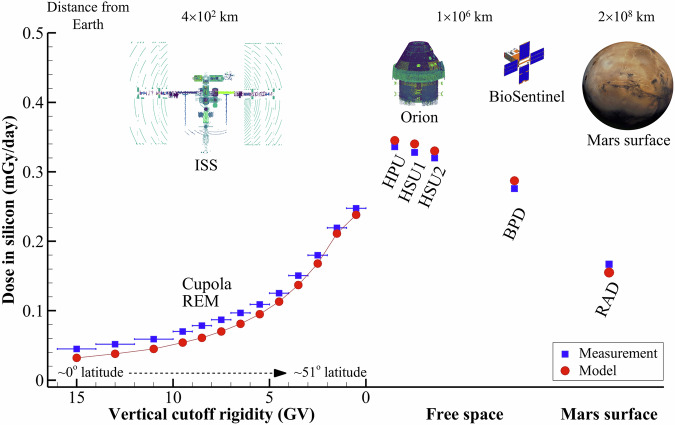
Accurate characterization of space radiation exposure is critical to assess and communicate multiple health risks for crewmembers participating in future exploration missions. A combination of models and on-board instruments are utilized to meet this requirement. In this work, computational models are evaluated against spaceflight measurements taken within the International Space Station, the Orion spacecraft, the BioSentinel CubeSat, and on the Martian surface. All calculations and measurements cover the exact same time period defined by the Artemis-I mission, and all model calculations were performed blind-without prior knowledge of the measurements. The models are shown to accurately characterize the absorbed dose-rate in highly complex and diverse shielding configurations in locations from Earth to Mars.
Overview
CoChat Summary
## TL;DR
This paper validates NASA space-radiation models against Artemis-I-era measurements from the ISS, Orion, BioSentinel, and the Mars surface, using blind calculations over the exact same mission period. The models agreed well overall, with especially strong agreement in free space and Orion, and more modest discrepancies on the ISS and Mars surface.
## Key findings
- The model calculations were compared against measurements from the ISS, Orion, BioSentinel, and Mars over the exact Artemis-I mission period, and all calculations were performed blind.
- For ISS data, model calculations were well correlated with measurements, with correlation coefficient > 0.996 for both detector locations and both nuclear physics models.
- Model results were within 5% of the available free-space measurements on Orion and BioSentinel.
- For the Mars surface, model results were within 7%–12% of the RAD-measured dose-rate; across all cases, model calculations were within ~10%–25% of ISS measurements, 4% of free-space measurements, and 10% of Mars surface measurements.
## Methods
- The study combined NASA space-radiation environment models, nuclear physics models, and radiation transport calculations to predict absorbed dose-rates for Artemis-I conditions.
- Space environments were modeled for LEO/ISS, Orion, BioSentinel, and the Martian surface; shielding geometries were represented using detailed CAD-based ray tracing for ISS and Orion, combinatorial geometry for BioSentinel, and stacked-cylinder atmosphere/regolith geometry for Mars.
- Measurements came from active silicon detectors: Timepix on ISS, Orion, and BioSentinel, and the RAD “B” detector on ISS and Mars; ISS data were filtered to remove South Atlantic Anomaly dose enhancements and binned by vertical cutoff rigidity.
## Limitations
- The authors note that the absorbed dose-rate and detectors considered are largely insensitive to neutrons, so the study does not fully address neutron-relevant human risk; they explicitly say only limited spaceflight neutron measurements exist and that >100 MeV inflight neutron measurement is constrained by mass and power limits.
- The paper states that absorbed dose can hide compensating model errors, and that large disagreements can still exist in underlying particle fluences even when absorbed dose agrees well.
- Evident from the text: ISS comparisons are affected by dynamic and uncertain shielding changes from crew movement and moved equipment, which are “nearly impossible” to capture in static CAD geometry models.
Model-written summary. Check it against the paper before relying on it.
Integrity signals
Registry
Cites
Statistics
Figures
Verification
Claims the paper makes
5 Valid · 1 Not valid · 6 Not checked · 29 Own results and interpretations
Some cited sources support this claim and some don’t — read each source’s verdict below.
In the paper
“The cylindrical geometry used to model the Martian atmosphere and surface is commonly used in such evaluations17–19, but nevertheless neglects topographical details (i.e. nearby boulders, hills, or valleys) and mass shielding that may influence measured and calculated surface dose-rates.”
§ Validated space radiation exposure predictions from earth to mars during Artemis-I > Results and discussion > Comparison of model calculations to measurements
What the sources say
- Partly supportedcites [17] Matthia, D. et al. The Martian surface radiation environment—a comparison of models and MSL/RAD measurements. J. Space Weather Space Cli. 6, A13 (2016). sourceExperimental — accuracy not yet measured
Section 3.3 (page unavailable) says that simplified geometry changed calculated particle contributions to Martian surface dose rates. Section 2.2 describes the modeled atmosphere and soil, but our copy does not identify a cylindrical geometry or say that omitted nearby boulders, hills, valleys, or mass shielding affect measured and calculated dose rates. (LLM, conf=0.82)
- Not checked — no full text of the sourcecites [18] Matthia, D. et al. The radiation environment on the surface of mars—summary of model calculations and comparison to RAD data. Life Sci. Space Res. 14, 18–28 (2017). 28887939 source
- Disputedcites [19] Slaba, T. C. & Stoffle, N. N. Evaluation of HZETRN on the martian surface: sensitivity tests and model results. Life Sci. Space Res. 14, 29–35 (2017). PMC7780709 28887940 sourceExperimental — accuracy not yet measured
The Geometry setup (p. 3) describes a regolith sphere surrounded by a spherical atmospheric shell, not the cylindrical geometry attributed to this paper. It also models 300 g/cm² of regolith along ray paths; the cited passages do not discuss whether nearby terrain or its shielding affects dose rates. (LLM, conf=0.86)
Checked by a reasoning model — may be wrong.
hedgedstates a possible cause- Asserted: passes — The authors put it forward as true.
- Checkable: passes — It can be checked against evidence.
- Load-bearing: unclear — It is unclear whether the paper’s conclusions depend on it.
- Based: passes — The paper gives a reason why it holds.
- Partly supported
The cited sources support only part of this claim — read each source’s verdict below.
In the paper
“Prior sensitivity tests19 have established that compositional details of the Martian atmosphere and regolith have little impact on surface dose-rates.”
§ Validated space radiation exposure predictions from earth to mars during Artemis-I > Results and discussion > Comparison of model calculations to measurements
What the sources say
- Partly supportedcites [19] Slaba, T. C. & Stoffle, N. N. Evaluation of HZETRN on the martian surface: sensitivity tests and model results. Life Sci. Space Res. 14, 29–35 (2017). PMC7780709 28887940 sourceExperimental — accuracy not yet measured
The Sensitivity Tests (p. 6) say that atmospheric composition and most tested regolith compositions have minimal impact on surface exposure quantities. The claim omits the paper’s explicit exception for the hydrogen-rich Phoenix regolith; Table 3 (p. 19) shows a lower dose equivalent for Phoenix than for the default regolith. (LLM, conf=0.88)
boosted- Asserted: passes — The authors put it forward as true.
- Checkable: passes — It can be checked against evidence.
- Load-bearing: unclear — It is unclear whether the paper’s conclusions depend on it.
- Based: passes — The paper gives a reason why it holds.
- Partly supported
The cited sources support only part of this claim — read each source’s verdict below.
In the paper
“However, data-driven heliospheric models suggest GCR intensities increase by at most a few percent in moving from 1 AU to 1.5 AU (Earth to Mars)23.”
§ Validated space radiation exposure predictions from earth to mars during Artemis-I > Results and discussion > Comparison of model calculations to measurements
What the sources say
- Partly supportedcites [23] Rankin, J. S. et al. Galactic cosmic rays throughout the heliosphere and in the very local interstellar medium. Space Sci. Rev. 218, 1–58 (2022). PMC9287243 35855211 sourceExperimental — accuracy not yet measured
The paper’s ‘Temporal and Spatial Variations’ section reports observed radial gradients of about 2.0–3.5% per AU from 1 to 9.5 AU, consistent with an increase of roughly 1–2% over the 0.5 AU from Earth to Mars. ‘Advances in Global Models of Solar Modulation’ also describes observation-based computations of inner-heliosphere gradients. The copy does not give a modelled Earth-to-Mars increase or establish ‘at most a few percent’ as a general upper bound across conditions. (LLM, conf=0.83)
hedgedstates a cause- Asserted: passes — The authors put it forward as true.
- Checkable: passes — It can be checked against evidence.
- Load-bearing: unclear — It is unclear whether the paper’s conclusions depend on it.
- Based: passes — The paper gives a reason why it holds.
- Partly supported
The cited sources support only part of this claim — read each source’s verdict below.
In the paper
“Although backscattered, or albedo, neutrons are known to be present on the Martian surface17–19 and are important for human risk estimation, they contribute little to the measured absorbed dose-rate in silicon being reported by the RAD detector.”
§ Validated space radiation exposure predictions from earth to mars during Artemis-I > Results and discussion > Comparison of model calculations to measurements
What the sources say
- Could not verifycites [17] Matthia, D. et al. The Martian surface radiation environment—a comparison of models and MSL/RAD measurements. J. Space Weather Space Cli. 6, A13 (2016). sourceExperimental — accuracy not yet measured
Section 3.1 says one model lacks albedo contributions to its neutron spectra, and Section 3.3 compares modeled dose rates with RAD measurements. Neither passage isolates the contribution of backscattered neutrons to RAD’s measured absorbed dose rate in silicon. A negligible contribution from particles entering from the Martian soil is noted in Section 2.1.2, but that statement concerns charged particles, not neutrons. (LLM, conf=0.68)
- Not checked — no full text of the sourcecites [18] Matthia, D. et al. The radiation environment on the surface of mars—summary of model calculations and comparison to RAD data. Life Sci. Space Res. 14, 18–28 (2017). 28887939 source
- Partly supportedcites [19] Slaba, T. C. & Stoffle, N. N. Evaluation of HZETRN on the martian surface: sensitivity tests and model results. Life Sci. Space Res. 14, 29–35 (2017). PMC7780709 28887940 sourceExperimental — accuracy not yet measured
The Sensitivity Tests (p. 5) say that roughly half of neutrons below 100 MeV are produced in the regolith and ejected upward, and that neutrons below 1 MeV make a small contribution to total exposure. They do not establish that backscattered neutrons as a whole contribute little to the absorbed dose-rate measured in RAD’s silicon detector; the small-contribution statement concerns a narrower energy range and a different exposure measure. (LLM, conf=0.78)
plain- Asserted: passes — The authors put it forward as true.
- Checkable: passes — It can be checked against evidence.
- Load-bearing: unclear — It is unclear whether the paper’s conclusions depend on it.
- Based: passes — The paper gives a reason why it holds.
- Could not verify
The cited sources support only part of this claim — read each source’s verdict below.
In the paper
“In the case of space radiation induced cancer mortality, risk projection models suffer from uncertainties exceeding 250%11.”
§ Validated space radiation exposure predictions from earth to mars during Artemis-I > Results and discussion > Context and outlook
What the sources say
- Partly supportedcites [11] Simonsen, L. C. & Slaba, T. C. Improving astronaut cancer risk assessment from space radiation with an ensemble model framework. Life Sci. Space Res. 31, 14–28 (2021). 34689946 sourceExperimental — accuracy not yet measured
The Introduction and Materials and Methods describe substantial uncertainty in projections of space-radiation-induced cancer mortality. However, the paper does not state that uncertainty exceeds 250%; searches for “250” and equivalent phrasing did not substantiate that figure. (LLM, conf=0.88)
plain- Asserted: passes — The authors put it forward as true.
- Checkable: passes — It can be checked against evidence.
- Load-bearing: unclear — It is unclear whether the paper’s conclusions depend on it.
- Based: passes — The paper gives a reason why it holds.
- Partly supported
25 more claims
Create a free account to see all 41 claims and every source verdict.
- It may state two separate claims as one. 5
- Probably not a substantial claim. 7
Self-check
Percentages, sums and reported differences re-computed from the paper’s own numbers.
Each contradiction between two passages listed here was confirmed by an independent check.
Rated minor: it would not touch a result — a value no result rests on, a p-value that stays on the same side of the significance level, or a conflict that is clerical, resolved elsewhere in the paper, or outside its own findings.
In the paper
§ Validated space radiation exposure predictions from earth to mars during Artemis-I > Results and discussion > Comparison of model calculations to measurements
“Finally, model results are within 7%–12% of the dose-rate measured on the surface of Mars by RAD during the Artemis-I mission.”
§ Validated space radiation exposure predictions from earth to mars during Artemis-I > Results and discussion > Comparison of model calculations to measurements
“Broad consideration of the results in Table 3 shows that model calculations are within ~10–25% of ISS measurements, 4% of free space measurements, and 10% of Mars surface measurements.”
Citations
Cites
Agostinelli, S., Allison, J., Amako, K., Apostolakis, J., Araujo, H., Arce, P., Asai, M., Axen, D., Banerjee, S., Barrand, G., et al. (2003) · Nuclear Instruments and Methods in Physics Research Section A: Accelerators, Spectrometers, Detectors and Associated Equipment · doi:10.1016/s0168-9002(03)01368-8 · Cited by 25,106 · cited 5×
“Results were calculated using HZETRN2020 and this collection of nuclear physics models; additional calculations were performed with HZETRN2020 and coupled nucleon/pion cross section databases generated with Geant4 15 , as described elsewhere 14 .”
InfluentialImproved general circulation models of the Martian atmosphere from the surface to above 80 km
Forget, F., Hourdin, F., Fournier, R., Hourdin, C., Talagrand, O., Collins, M., Lewis, S. R., Read, P. L., & Huot, J. (1999) · Journal of Geophysical Research: Planets · doi:10.1029/1999je001025 · Cited by 1,328 · cited 1×
“The density of each layer is modeled using the Mars Climate Database (MCD) 6.1 34,35 undercalmdustconditions.”
InfluentialMars' surface radiation environment measured with the Mars Science Laboratory's Curiosity rover
Hassler, D. M., Zeitlin, C., Wimmer-Schweingruber, R. F., Ehresmann, B., Rafkin, S., Eigenbrode, J. L., Brinza, D. E., Weigle, G., Böttcher, S., Böhm, E., et al. (2014) · Science · doi:10.1126/science.1244797 · Cited by 727 · cited 1×
“The RAD instrument was fi rst developed for the Mars Science Laboratory (MSL) as part of the Curiosity rover mission 44 – 46 .”
Self-citationMeasurements of energetic particle radiation in transit to Mars on the Mars Science Laboratory
Zeitlin, C., Hassler, D. M., Cucinotta, F. A., Ehresmann, B., Wimmer-Schweingruber, R. F., Brinza, D. E., Kang, S., Weigle, G., Böttcher, S., Böhm, E., et al. (2013) · Science · doi:10.1126/science.1235989 · Cited by 641
Self-citationPatel, Z. S., Brunstetter, T. J., Tarver, W. J., Whitmire, A. M., Zwart, S. R., Smith, S. M., & Huff, J. L. (2020) · npj Microgravity · doi:10.1038/s41526-020-00124-6 · Cited by 373 · cited 2×
“The GCR environment represents a continuous low dose-rate exposure, leading to appreciable total doses and multiple highly uncertain health consequences 1 – 5 .”
The Radiation Assessment Detector (RAD) Investigation
Hassler, D. M., Zeitlin, C., Wimmer-Schweingruber, R. F., Böttcher, S., Martin, C., Andrews, J., Böhm, E., Brinza, D. E., Bullock, M. A., Burmeister, S., et al. (2012) · Space Science Reviews · doi:10.1007/s11214-012-9913-1 · Cited by 247 · cited 1×
“The RAD instrument was fi rst developed for the Mars Science Laboratory (MSL) as part of the Curiosity rover mission 44 – 46 .”
Self-citationICRP Publication 123: Assessment of Radiation Exposure of Astronauts in Space
Dietze, G., Bartlett, D. T., Cool, D. A., Cucinotta, F. A., Jia, X., McAulay, I. R., Pelliccioni, M., Petrov, V., Reitz, G., & Sato, T. (2013) · Annals of the ICRP · doi:10.1016/j.icrp.2013.05.004 · Cited by 239
Physical and biological organ dosimetry analysis for international space station astronauts
Cucinotta, F. A., Kim, M.-H. Y., Willingham, V., & George, K. A. (2008) · Radiation Research · doi:10.1667/rr1330.1 · Cited by 196
Optimal shielding thickness for galactic cosmic ray environments
Slaba, T. C., Bahadori, A. A., Reddell, B. D., Singleterry, R. C., Clowdsley, M. S., & Blattnig, S. R. (2017) · Life Sciences in Space Research · doi:10.1016/j.lssr.2016.12.003 · Cited by 105 · cited 2×
“Shielding strategies are largely ineffective at appreciably reducing GCR exposures or risk, and validated model calculations show that too much shielding or poorly chosen shield materials 7,8 .”
Self-citationTimepix-based radiation environment monitor measurements aboard the International Space Station
Stoffle, N., Pinsky, L. S., Kroupa, M., Hoang, S. M., Idárraga, J., Amberboy, C., Rios, R. R., Hauss, J., Keller, J., Bahadori, A. A., et al. (2015) · Nuclear Instruments and Methods in Physics Research Section A Accelerators Spectrometers Detectors and Associated Equipment · doi:10.1016/j.nima.2015.02.016 · Cited by 91 · cited 1×
“They have been successfully fl own on ISS 40 for some time and were utilized on the Exploration Flight Test 1 41,42 and BioSentinel missions 16 .”
The Martian surface radiation environment – a comparison of models and MSL/RAD measurements
Matthiä, D., Ehresmann, B., Lohf, H., Köhler, J., Zeitlin, C., Appel, J., Sato, T., Slaba, T., Martin, C., Berger, T., et al. (2016) · Journal of Space Weather and Space Climate · doi:10.1051/swsc/2016008 · Cited by 91 · cited 4×
“Followingpriorveri fi cation and validation studies 17 – 19 , the geometry used to compute the Mars surface environment is de fi ned as a series of stacked cylinders, with each cylinder having a radius of 829 km.”
InfluentialSelf-citationA semiconductor radiation imaging pixel detector for space radiation dosimetry
Kroupa, M., Bahadori, A. A., Campbell-Ricketts, T., Empl, A., Hoang, S. M., Idárraga, J., Rios, R. R., Semones, E., Stoffle, N., Tlustos, L., et al. (2015) · Life Sciences in Space Research · doi:10.1016/j.lssr.2015.06.006 · Cited by 84
Solar particle event storm shelter requirements for missions beyond low Earth orbit
Townsend, L. W., Adams, J. H., Blattnig, S. R., Clowdsley, M. S., Fry, D. J., Jun, I., McLeod, C. D., Minow, J. I., Moore, D. F., Norbury, J. W., et al. (2018) · Life Sciences in Space Research · doi:10.1016/j.lssr.2018.02.002 · Cited by 81
Self-citationThe Badhwar‐O'Neill 2020 GCR Model
Slaba, T. C., & Whitman, K. (2020) · Space Weather · doi:10.1029/2020sw002456 · Cited by 78
Self-citationMatthiä, D., Hassler, D. M., de Wet, W., Ehresmann, B., Firan, A., Flores-McLaughlin, J., Guo, J., Heilbronn, L. H., Lee, K., Ratliff, H., et al. (2017) · Life Sciences in Space Research · doi:10.1016/j.lssr.2017.06.003 · Cited by 75 · cited 1×
“Previous veri fi cation and validation efforts have demonstrated that while available models agree well with measurements (and each other) for absorbed dose, substantialdisagreementcanbefoundwhenunderlyingparticle fl uencesare compared 8,17,18 .”
Self-citationResearch plans in Europe for radiation health hazard assessment in exploratory space missions
Walsh, L., Schneider, U., Fogtman, A., Kausch, C., McKenna-Lawlor, S., Narici, L., Ngo-Anh, J., Reitz, G., Sabatier, L., Santin, G., et al. (2019) · Life Sciences in Space Research · doi:10.1016/j.lssr.2019.04.002 · Cited by 59
Galactic Cosmic Rays Throughout the Heliosphere and in the Very Local Interstellar Medium
Rankin, J. S., Bindi, V., Bykov, A. M., Cummings, A. C., Della Torre, S., Florinski, V., Heber, B., Potgieter, M. S., Stone, E. C., & Zhang, M. (2022) · Space Science Reviews · doi:10.1007/s11214-022-00912-4 · Cited by 53
Advances in NASA radiation transport research: 3DHZETRN
Wilson, J. W., Slaba, T. C., Badavi, F. F., Reddell, B. D., & Bahadori, A. A. (2014) · Life Sciences in Space Research · doi:10.1016/j.lssr.2014.05.003 · Cited by 47
Self-citationSlaba, T. C., Blattnig, S. R., Reddell, B., Bahadori, A., Norman, R. B., & Badavi, F. F. (2013) · Advances in Space Research · doi:10.1016/j.asr.2013.02.015 · Cited by 46 · cited 3×
“BinningtheISSdatain thiswayestablishesthetrendindose-ratesandmodelerrorsastheradiation environmentinLEOapproachesfreespaceconditions 14,20,21 .”
InfluentialSelf-citationHeilbronn, L. H., Borak, T. B., Townsend, L. W., Tsai, P.-E., Burnham, C. A., & McBeth, R. A. (2015) · Life Sciences in Space Research · doi:10.1016/j.lssr.2015.10.005 · Cited by 44 · cited 2×
“However, neutrons are particularly important from a human risk perspective 24,25 , given their high biological effectiveness and appreciable fl uence behind thick shielding and on the lunar and Martian surfaces.”
Nuclear data for space radiation
Norbury, J. W., Miller, J., Adamczyk, A. M., Heilbronn, L. H., Townsend, L. W., Blattnig, S. R., Norman, R. B., Guetersloh, S. B., & Zeitlin, C. J. (2012) · Radiation Measurements · doi:10.1016/j.radmeas.2012.03.004 · Cited by 42 · cited 1×
“Such disagreements follow from gaps in ground-based experimental data for nuclear cross sections, particularly for production of pions, neutrons, and isotopes of hydrogen and helium 26 .”
Self-citationStatistical validation of HZETRN as a function of vertical cutoff rigidity using ISS measurements
Slaba, T. C., Blattnig, S. R., Badavi, F. F., Stoffle, N. N., Rutledge, R. D., Lee, K. T., Neal Zapp, E., Dachev, T. P., & Tomov, B. T. (2011) · Advances in Space Research · doi:10.1016/j.asr.2010.10.021 · Cited by 38 · cited 3×
“BinningtheISSdatain thiswayestablishesthetrendindose-ratesandmodelerrorsastheradiation environmentinLEOapproachesfreespaceconditions 14,20,21 .”
InfluentialSelf-citationCalibration and Characterization of the Radiation Assessment Detector (RAD) on Curiosity
Zeitlin, C., Hassler, D. M., Wimmer-Schweingruber, R. F., Ehresmann, B., Appel, J., Berger, T., Böhm, E., Böttcher, S., Brinza, D. E., Burmeister, S., et al. (2016) · Space Science Reviews · doi:10.1007/s11214-016-0303-y · Cited by 37
Self-citationImproving astronaut cancer risk assessment from space radiation with an ensemble model framework
Simonsen, L. C., & Slaba, T. C. (2021) · Life Sciences in Space Research · doi:10.1016/j.lssr.2021.07.002 · Cited by 36
Self-citationRadiation Measurements Performed with Active Detectors Relevant for Human Space Exploration
Narici, L., Berger, T., Matthiä, D., & Reitz, G. (2015) · Frontiers in Oncology · doi:10.3389/fonc.2015.00273 · Cited by 35 · cited 1×
“Toaddressthispoint Toaddressthispoint,mul-tipleradiationdetectorshavebeendeployedwithintheinterioroftheISS, providingameanstocompareinstrumentreadingsandevaluateexposure differencescausedbyshieldingvariationsatlocationsthroughoutthe station 9,10 .”
Solar proton exposure of an ICRU sphere within a complex structure part II: Ray-trace geometry
Slaba, T. C., Wilson, J. W., Badavi, F. F., Reddell, B., & Bahadori, A. A. (2016) · Life Sciences in Space Research · doi:10.1016/j.lssr.2016.05.001 · Cited by 34
Self-citationUpdated deterministic radiation transport for future deep space missions
Slaba, T. C., Wilson, J. W., Werneth, C. M., & Whitman, K. (2020) · Life Sciences in Space Research · doi:10.1016/j.lssr.2020.06.004 · Cited by 30
Self-citationMertens, C. J., Slaba, T. C., & Hu, S. (2018) · Space Weather · doi:10.1029/2018sw001971 · Cited by 28 · cited 1×
“The real-time data may be used during solar storms to guide operational decisions and mitigation strategies 6 and are also folded into acute biological responsemodels 36,37 .”
Self-citationMertens, C. J., & Slaba, T. C. (2019) · Space Weather · doi:10.1029/2019sw002363 · Cited by 26 · cited 1×
“The real-time data may be used during solar storms to guide operational decisions and mitigation strategies 6 and are also folded into acute biological responsemodels 36,37 .”
Self-citationRelativistic Abrasion–Ablation De-excitation Fragmentation (RAADFRG) model
Werneth, C. M., de Wet, W. C., Townsend, L. W., Maung, K. M., Norbury, J. W., Slaba, T. C., Norman, R. B., Blattnig, S. R., & Ford, W. P. (2021) · Nuclear Instruments and Methods in Physics Research Section B Beam Interactions with Materials and Atoms · doi:10.1016/j.nimb.2021.06.016 · Cited by 21 · cited 1×
“Fragmentationofions with mass, A > 4, is described by the RAADFRG model 29 ; nucleon interactions are described by an intranuclear transport model 12,30 , and interactions involving pions, and isotopes of hydrogen and helium are treated within the DDFRG model 31,32 .”
Self-citationZeitlin, C. J., Castro, A. J., Beard, K. B., Abdelmelek, M., Hayes, B., Johnson, A. S., Stoffle, N., & Rios, R. R. (2023) · Life Sciences in Space Research · doi:10.1016/j.lssr.2023.01.003 · Cited by 21 · cited 2×
“A modi fi ed version of MSL-RAD was developed for use on the ISS 47 , which provides greater power and mass allowances.”
InfluentialSelf-citationMatthiä, D., Burmeister, S., Przybyla, B., & Berger, T. (2023) · Life Sciences in Space Research · doi:10.1016/j.lssr.2023.04.002 · Cited by 19
Evaluation of HZETRN on the Martian surface: Sensitivity tests and model results
Slaba, T. C., & Stoffle, N. N. (2017) · Life Sciences in Space Research · doi:10.1016/j.lssr.2017.03.001 · Cited by 19
Self-citationGaza, R., Kroupa, M., Rios, R. R., Stoffle, N., Benton, E. R., & Semones, E. (2017) · Radiation Measurements · doi:10.1016/j.radmeas.2017.03.041 · Cited by 18 · cited 1×
“They have been successfully fl own on ISS 40 for some time and were utilized on the Exploration Flight Test 1 41,42 and BioSentinel missions 16 .”
Norbury, J. W. (2020) · Nuclear Instruments and Methods in Physics Research Section A Accelerators Spectrometers Detectors and Associated Equipment · doi:10.1016/j.nima.2020.164681 · Cited by 15 · cited 1×
“Fragmentationofions with mass, A > 4, is described by the RAADFRG model 29 ; nucleon interactions are described by an intranuclear transport model 12,30 , and interactions involving pions, and isotopes of hydrogen and helium are treated within the DDFRG model 31,32 .”
Self-citationZeitlin, C. J., Castro, A. J., Beard, K. B., Abdelmelek, M., Hayes, B., Johnson, A. S., Stoffle, N., Rios, R. R., Leitgab, M. A., & Hassler, D. M. (2023) · Life Sciences in Space Research · doi:10.1016/j.lssr.2023.03.005 · Cited by 11 · cited 1×
“However, neutrons are particularly important from a human risk perspective 24,25 , given their high biological effectiveness and appreciable fl uence behind thick shielding and on the lunar and Martian surfaces.”
Self-citationGalactic cosmic ray environment predictions for the NASA BioSentinel mission
Rahmanian, S., Slaba, T. C., Braby, L. A., Maria, S. R. S., Bhattacharya, S., & Straume, T. (2023) · Life Sciences in Space Research · doi:10.1016/j.lssr.2023.05.001 · Cited by 11 · cited 2×
“AcombinatorialgeometrydescriptionwasusedforBioSentinel 16 .”
Self-citationEffects of the Serber first step in 3DHZETRN-v2.1
Wilson, J. W., Werneth, C. M., Slaba, T. C., Badavi, F. F., Reddell, B., & Bahadori, A. A. (2020) · Life Sciences in Space Research · doi:10.1016/j.lssr.2020.03.004 · Cited by 11
Self-citationInvestigating material approximations in spacecraft radiation analysis
Walker, S. A., Slaba, T. C., Clowdsley, M. S., & Blattnig, S. R. (2011) · Acta Astronautica · doi:10.1016/j.actaastro.2011.02.013 · Cited by 8 · cited 1×
“Shielding strategies are largely ineffective at appreciably reducing GCR exposures or risk, and validated model calculations show that too much shielding or poorly chosen shield materials 7,8 .”
Self-citationNorbury, J. W. (2023) · Nuclear Instruments and Methods in Physics Research Section A Accelerators Spectrometers Detectors and Associated Equipment · doi:10.1016/j.nima.2023.168336 · Cited by 7 · cited 1×
“Fragmentationofions with mass, A > 4, is described by the RAADFRG model 29 ; nucleon interactions are described by an intranuclear transport model 12,30 , and interactions involving pions, and isotopes of hydrogen and helium are treated within the DDFRG model 31,32 .”
Self-citationHeavy ion charge and velocity resolution with a Medipix-based active Space Radiation Dosimeter
Pinsky, L. S., Empl, A., Stoffle, N., et al. (2010) · Proceedings - IEEE Aerospace Conference · doi:10.1109/aero.2010.5447007 · Cited by 4 · cited 1×
“Extensive ground-based testing has also been completed at accelerator facilities using various radiation sources and particle beams of interest to space fl ight 43 and each Timepix is individually calibrated and tested over a wide variety of dose rates at variousaccelerator beams.”
Self-citationA Dynamic Model for the Validation of Cosmic Rays Anisotropy at Low Earth Orbit
Badavi, F. F. (2012) · IEEE Transactions on Nuclear Science · doi:10.1109/tns.2012.2186981 · Cited by 3
Research works printed but not linked: 3
- National Academies of Sciences, Engineering, and Medicine. Space Radiation and Astronaut Health: Managing and Communicating Cancer Risks, Vol. 127 (Natl Academy Pr, 2021).
- Rios, R. Comparison of Silicon-Based Detectors.22ndWorkshop for Radiation Monitoring on ISS, Torino, Italy. https://wrmiss.org/workshops/twentysecond/Rios.pdf (2017).
- Millour, E. et al. The Mars Climate Database (Version 5.3). https://insu.hal.science/insu-04393573v1/file/Millour_E_Mars_climate.pdf (2018).
Cited by
How to keep astronauts healthy in deep space
Asrar, F. M. (2025) · Nature · doi:10.1038/d41586-025-01691-y · Cited by 5
Li, S., Gan, Y., Zhou, C., Zhou, Y., & Ding, L. (2026) · The Innovation Life · doi:10.59717/j.xinn-life.2026.100193 · Cited by 4
Houri, J. M., Berger, T., Gaza, R., Hussein, H., Schwarz, S., Waterman, G., Matthiä, D., Marsalek, K., Przybyla, B., Aeckerlein, J., et al. (2026) · Science Advances · doi:10.1126/sciadv.adz1892 · Cited by 2
“5), generated by ray-tracing a manufacturing quality Orion CAD model in HZETRN ( 49 ).”
Self-citationBeyond the lab coat: methodological challenges in space life sciences
Puyvelde, M. V., van den Berg, N., Stas, L., Savieri, P., Corluy, H. C., Cutsem, J. V., Neyt, X., Simonelli, G., & Pattyn, N. (2025) · Frontiers in Physiology · doi:10.3389/fphys.2025.1663701 · Cited by 5
“This includes cross-species cell analyses, development of predictive models, real-time monitoring, and standardization of crew dose and risk metrics related to cosmic radiation (Slaba et al., 2025; Willis et al., 2024).”
Kunja, L. A., Yi, Y., Kim, E., Sohn, J., & Jung, J. (2025) · AIP Advances · doi:10.1063/5.0293969 · Cited by 2
Metadata
- Authors
- Slaba, T. C., Rahmanian, S., George, S., Laramore, D., Norbury, J. W., Werneth, C. M., & Zeitlin, C.
- Affiliations
- Langley Research Center (US)
- Analytical Mechanics Associates (United States) (US)
- Johnson Space Center (US)
- Leidos (United States) (US)
- Corresponding author
- Slaba, Tony C.
- Venue
- npj Microgravity
- Published
- 2025-02-11
- Volume
- 11
- Issue
- 1
- Pages
- 6-6
- ISSN
- 2373-8065 (ISSN-L)
- PMC
- PMC11814067
- OpenAlex
- W4407369078
- Semantic Scholar
- 0857c9880db836e8c6f520d25a9f619cc98b5f64
- Cited by
- 11
- References
- 36
- Citations by year
- 2026: 7 · 2025: 4
- FWCI
- 7.18
- Type
- journal article
- Language
- en
- Open access
- gold
- doi.org
- Licence
- cc-by
- creativecommons.org/licenses/by/4.0 (tdm)
- creativecommons.org/licenses/by/4.0 (vor)
- Locations
- npj Microgravity (publishedVersion, cc-by)
- PubMed Central (publishedVersion, cc-by)
- PubMed (publishedVersion)
- DOAJ (DOAJ: Directory of Open Access Journals) (submittedVersion, cc-by-sa)
- Funders
- Exploration Systems Development Mission Directorate (RadWorks)
- Langley Research Center (80LARC23DA003)
- Johnson Space Center (NNJ15HK11B)
- Topics
- Physical Sciences › Physics and Astronomy › Radiation › Radiation Therapy and Dosimetry
- Health Sciences › Medicine › Physiology (medical) › Spaceflight effects on biology
- Physical Sciences › Engineering › Electrical and Electronic Engineering › Radiation Effects in Electronics
- Keywords
- space radiation exposure, Artemis I, crew health risk, spacecraft shielding, International Space Station, Orion spacecraft, Mars surface, model validation against measurements
About these checks
Registry, retraction, Cites and statistics results are computed, not judged, with one exception: a printed reference that no index lists is read once by a model before it counts as a citation error. Claims are extracted by a model and kept only when their quote appears verbatim in the text; each cited source is then checked, with a model’s help, for whether it says what the claim relies on. Those verdicts can be wrong — read the claim’s quote and the cited source before relying on one.
The claim verdicts this report counts are experimental: their accuracy is not yet measured.
A language model drew the claims from the paper on 2026-10-10, under version 3 of the claim definition (model deepseek-v4.1-flash, prompt extract-v3).
A second model labelled each claim on 2026-10-10 (model jev-1.13-20260917, definition revision gold-guideline-v0.2).
Cited sources are checked with a language model’s help (gpt-6-sol).
Statistics and arithmetic are recomputed, not judged.
Confidence bands are shown only for fields calibrated on our annotated test set. None is calibrated yet, so no band is shown.
What counts as a claim ›How we measure confidence ›How we check this ›
Are you an author, or do you see a problem with this page? Request a review
Data sources
Bibliographic data: Semantic Scholar, OpenAlex, Crossref.
Contains information from the Semantic Scholar Academic Graph Datasets, made available under the ODC Attribution License (ODC-BY 1.0).
Semantic Scholar’s data is described in: Kinney, R., et al. (2023). The Semantic Scholar Open Data Platform. arXiv:2301.10140.
