

Stress and mindfulness in Parkinson’s disease – a survey in 5000 patients
Open accessThe DOI matches its Crossref record; 64 of the 64 references it cites were found in a registry or an index.
Abstract
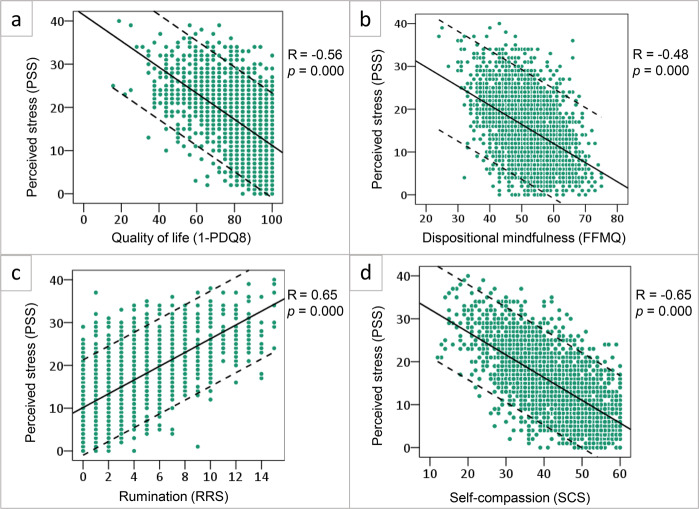
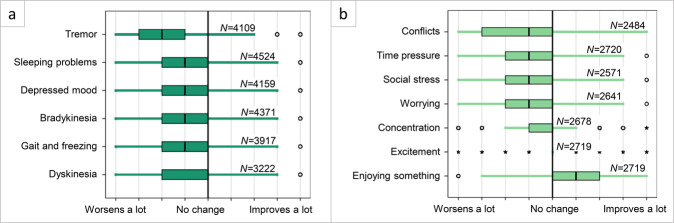
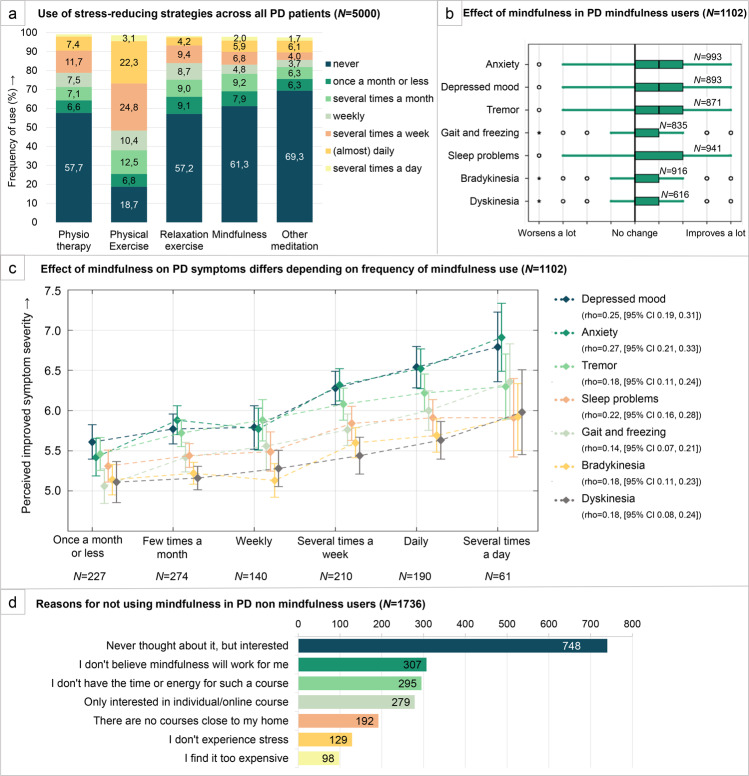
Many Parkinson’s disease (PD) patients notice that motor symptoms worsen during stress, and experience stress-related neuropsychiatric symptoms such as anxiety and depression. Here we investigated which personal and disease characteristics are associated with perceived stress in PD, which PD symptoms are sensitive to stress, and we assessed self-reported benefits of stress-reducing strategies such as mindfulness. We sent an online survey to the Fox Insight cohort (n = 28,385 PD patients, n = 11,413 healthy controls). The survey included specific questions about the influence of stress on PD symptoms, use of stress-reducing strategies, and several validated scales measuring perceived stress, anxiety, dispositional mindfulness, rumination, and self-compassion. We received completed surveys from 5000 PD patients and 1292 controls. Patients perceived more stress than controls. Among patients, stress was correlated with increased rumination (R = 0.65), lower quality of life (R = −0.56), lower self-compassion (R = −0.65), and lower dispositional mindfulness (R = −0.48). Furthermore, patients indicated that stress significantly worsened both motor symptoms – especially tremor – and non-motor symptoms. Physical exercise was most frequently used to reduce stress (83.1%). Mindfulness was practiced by 38.7% of PD respondents, who noticed improvement in both motor and non-motor symptoms. Among non-users, 43.4% were interested in gaining mindfulness skills. We conclude that PD patients experience greater levels of stress than controls, and that stress worsens both motor and non-motor symptoms. Mindfulness may improve PD symptom severity, with the strongest effects on anxiety and depressed mood. These findings justify further controlled studies to establish the merits of mindfulness and other stress-alleviating interventions.
Overview
The claims and statistics of this paper haven’t been checked yet.
Free: it reads the open-access text and checks the first 5 claims that cite a source we can check. Create a free account to check every claim.
Integrity signals
Registry
Cites
Statistics
Figures
Verification
Claims the paper makes
The claims and statistics of this paper haven’t been checked yet.
Free: it reads the open-access text and checks the first 5 claims that cite a source we can check. Create a free account to check every claim.
Claims other papers make about this one
Each is checked against this paper’s own text: does it say what the citing paper says it does?
The source backs part of the claim, not all of it — or backs it for a different population, condition or comparison.
In the citing paper
“A recent survey interviewing 5000 PD patients in the United States found that physical exercise was identified as the most frequently used method (83.1%), while 38.7% of PD respondents who practiced mindfulness noticed improvement in both motor and non-motor symptoms11.”
From A randomized clinical trial of mindfulness meditation versus exercise in Parkinson’s disease during social unrest (2023) · cites this paper as [11]
Experimental — accuracy not yet measuredThe cited source says what the claim attributes to it.
In the citing paper
“In a survey of 5000 people with PD, 39% of respondents reported they were practicing mindfulness, with benefit for both their motor and non-motor symptoms (van der Heide et al., 2021b).”
From Online Mindfulness-Based Cognitive Therapy for People with Parkinson’s Disease and Their Caregivers: a Pilot Study (2022) · cites this paper as van der Heide et al., 2021b
Self-check
Percentages, sums and reported differences re-computed from the paper’s own numbers.
The self-check needs the paper’s full text.
Citations
Cites
A Global Measure of Perceived Stress
Cohen, S., Kamarck, T., & Mermelstein, R. (1983) · Journal of Health and Social Behavior · doi:10.2307/2136404 · Cited by 32,807
The benefits of being present: Mindfulness and its role in psychological well-being
Brown, K. W., & Ryan, R. M. (2003) · Journal of Personality and Social Psychology · doi:10.1037/0022-3514.84.4.822 · Cited by 13,448
Using Self-Report Assessment Methods to Explore Facets of Mindfulness
Baer, R. A., Smith, G. T., Hopkins, J., Krietemeyer, J., & Toney, L. (2006) · Assessment · doi:10.1177/1073191105283504 · Cited by 7,511
Stress, adaptation, and disease. Allostasis and allostatic load
McEWEN, B. S. (1998) · Annals of the New York Academy of Sciences · doi:10.1111/j.1749-6632.1998.tb09546.x · Cited by 5,092
The effect of mindfulness based therapy on anxiety and depression: A meta analytic review
Hofmann, S. G., Sawyer, A. T., Witt, A. A., & Oh, D. (2010) · Journal of Consulting and Clinical Psychology · doi:10.1037/a0018555 · Cited by 3,846
Rumination reconsidered: a psychometric analysis.
Treynor, W., Gonzalez, R., & Nolen-Hoeksema, S. (2003) · Cognitive Therapy and Research · doi:10.1023/a:1023910315561 · Cited by 3,808
Neural regulation of endocrine and autonomic stress responses
Ulrich-Lai, Y. M., & Herman, J. P. (2009) · Nature Reviews Neuroscience · doi:10.1038/nrn2647 · Cited by 3,318
Construction and factorial validation of a short form of the Self-Compassion Scale
Raes, F., Pommier, E., Neff, K. D., & Van Gucht, D. (2011) · Clinical Psychology & Psychotherapy · doi:10.1002/cpp.702 · Cited by 2,997
Non-motor features of Parkinson disease
Schapira, A. H. V., Chaudhuri, K. R., & Jenner, P. (2017) · Nature Reviews Neuroscience · doi:10.1038/nrn.2017.62 · Cited by 2,053
A systematic review of prevalence studies of dementia in Parkinson's disease
Aarsland, D., Zaccai, J., & Brayne, C. (2005) · Movement Disorders · doi:10.1002/mds.20527 · Cited by 1,689
Cited by
Treatment Options for Motor and Non-Motor Symptoms of Parkinson’s Disease
Church, F. C. (2021) · Biomolecules · doi:10.3390/biom11040612 · Cited by 290
“Stress and mindfulness studies are beginning to demonstrate that being mindful can substantially benefit PwP [108,109].”
BackgroundClinical neurophysiology of Parkinson’s disease and parkinsonism
Chen, R., Berardelli, A., Bhattacharya, A., Bologna, M., Chen, K.-H. S., Fasano, A., Helmich, R. C., Hutchison, W. D., Kamble, N., Kühn, A. A., et al. (2022) · Clinical Neurophysiology Practice · doi:10.1016/j.cnp.2022.06.002 · Cited by 102
Self-citationThe clinical and electrophysiological investigation of tremor
Deuschl, G., Becktepe, J. S., Dirkx, M. F., Haubenberger, D., Hassan, A., Helmich, R. C. G., Muthuraman, M., Panyakaew, P., Schwingenschuh, P., Zeuner, K. E., et al. (2022) · Clinical Neurophysiology · doi:10.1016/j.clinph.2022.01.004 · Cited by 123
“Rest tremor typically increases in response to psychological stress or cognitive load, such as serial subtraction (Raethjen et al., 2008, van der Heide et al., 2021, Zach et al., 2017).”
Self-citationLiu, X., Chen, W., Wang, C., Liu, W., Hayashi, T., Mizuno, K., Hattori, S., Fujisaki, H., & Ikejima, T. (2021) · Physiology & Behavior · doi:10.1016/j.physbeh.2021.113593 · Cited by 49
Kwok, J. Y. Y., Choi, E. P. H., Wong, J. Y. H., Lok, K. Y. W., Ho, M.-H., Fong, D. Y. T., Kwan, J. C. Y., Pang, S. Y. Y., & Auyeung, M. (2023) · npj Parkinson's Disease · doi:10.1038/s41531-023-00452-w · Cited by 43
Metadata
- Authors
- van der Heide, A., Speckens, A. E. M., Meinders, M. J., Rosenthal, L. S., Bloem, B. R., & Helmich, R. C.
- Affiliations
- Radboud University Medical Center (NL)
- Radboud University Nijmegen (NL)
- Johns Hopkins University (US)
- Corresponding author
- Helmich, Rick C.
- ORCID
- Venue
- npj Parkinson's Disease
- Published
- 2021-01-18
- Volume
- 7
- Issue
- 1
- Pages
- 7-7
- ISSN
- 2373-8057 (ISSN-L)
- PMC
- PMC7813889
- OpenAlex
- W3124149461
- Cited by
- 82
- References
- 63
- Citations by year
- 2026: 14 · 2025: 15 · 2024: 18 · 2023: 15 · 2022: 13 · 2021: 7
- FWCI
- 6.34
- Type
- journal article
- Language
- en
- Open access
- gold
- doi.org
- Licence
- cc-by
- creativecommons.org/licenses/by/4.0 (tdm)
- creativecommons.org/licenses/by/4.0 (vor)
- Locations
- npj Parkinson s Disease (publishedVersion, cc-by)
- PubMed Central (publishedVersion, cc-by)
- PubMed (publishedVersion)
- Radboud Repository (Radboud University) (submittedVersion)
- DOAJ (DOAJ: Directory of Open Access Journals) (submittedVersion, cc-by-sa)
- Radboud Repository (Radboud University) (submittedVersion, other-oa)
- Funders
- Michael J. Fox Foundation for Parkinson’s Research (#16048)
- Topics
- Health Sciences › Medicine › Clinical Neurology › Parkinson's Disease Mechanisms and Treatments
- Social Sciences › Psychology › Clinical Psychology › Mindfulness and Compassion Interventions
- Health Sciences › Medicine › Clinical Neurology › Deep Brain Stimulation and Movement Disorders
- Keywords
- Parkinson's disease, perceived stress, mindfulness, rumination, self-compassion, anxiety, depression, motor symptoms, non-motor symptoms, tremor, physical activity, quality of life, neuropsychiatric symptoms
About these checks
Registry, retraction, Cites and statistics results are computed, not judged, with one exception: a printed reference that no index lists is read once by a model before it counts as a citation error. Claims are extracted by a model and kept only when their quote appears verbatim in the text; each cited source is then checked, with a model’s help, for whether it says what the claim relies on. Those verdicts can be wrong — read the claim’s quote and the cited source before relying on one.
Statistics and arithmetic are recomputed, not judged.
Confidence bands are shown only for fields calibrated on our annotated test set. None is calibrated yet, so no band is shown.
What counts as a claim ›How we measure confidence ›How we check this ›
Are you an author, or do you see a problem with this page? Request a review
How to cite
Cite CoChat for the checks on this page, and the paper for its own findings.
- This page
- CoChat. (2026). Citation check: Stress and mindfulness in Parkinson’s disease – a survey in 5000 patients. https://app.cochat.ai/papers/10.1038/s41531-020-00152-9
- The paper
- van der Heide, A., Speckens, A. E. M., Meinders, M. J., Rosenthal, L. S., Bloem, B. R., & Helmich, R. C. (2021). Stress and mindfulness in Parkinson’s disease – a survey in 5000 patients. npj Parkinson's Disease. https://doi.org/10.1038/s41531-020-00152-9
Data sources
Bibliographic data: Semantic Scholar, OpenAlex, Crossref.
Contains information from the Semantic Scholar Academic Graph Datasets, made available under the ODC Attribution License (ODC-BY 1.0).
Semantic Scholar’s data is described in: Kinney, R., et al. (2023). The Semantic Scholar Open Data Platform. arXiv:2301.10140.
