

Calculating energy derivatives for quantum chemistry on a quantum computer
The DOI matches its Crossref record; 38 of the 38 references it cites were found in a registry or an index.
Abstract
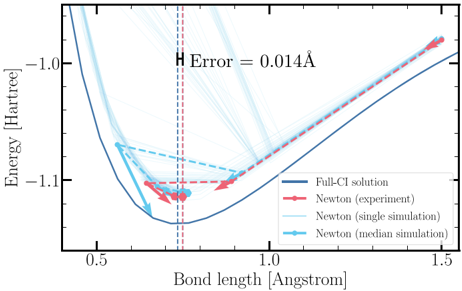
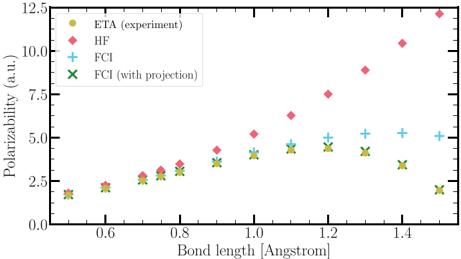
Modeling chemical reactions and complicated molecular systems has been proposed as the “killer application” of a future quantum computer. Accurate calculations of derivatives of molecular eigenenergies are essential toward this end, allowing for geometry optimization, transition state searches, predictions of the response to an applied electric or magnetic field, and molecular dynamics simulations. In this work, we survey methods to calculate energy derivatives, and present two new methods: one based on quantum phase estimation, the other on a low-order response approximation. We calculate asymptotic error bounds and approximate computational scalings for the methods presented. Implementing these methods, we perform geometry optimization on an experimental quantum processor, estimating the equilibrium bond length of the dihydrogen molecule to within $$0.014$$0.014 Å of the full configuration interaction value. Within the same experiment, we estimate the polarizability of the H$${}_{2}$$2 molecule, finding agreement at the equilibrium bond length to within $$0.06$$0.06 a.u. ($$2 \%$$2% relative error).
Overview
The claims and statistics of this paper haven’t been checked yet.
Free: it reads the open-access text and checks the first 5 claims that cite a source we can check. Create a free account to check every claim.
Integrity signals
Registry
Cites
Statistics
Figures
Verification
Claims the paper makes
The claims and statistics of this paper haven’t been checked yet.
Free: it reads the open-access text and checks the first 5 claims that cite a source we can check. Create a free account to check every claim.
Claims other papers make about this one
Each is checked against this paper’s own text: does it say what the citing paper says it does?
In the citing paper
“Besides the molecular energy, properties that can be extracted from a successfully prepared ground state, such as energy derivatives with respect to the nuclear framework, are of similar interest (Kassal and Aspuru-Guzik, 2009; O'Brien et al. , 2019).”
From Noisy intermediate-scale quantum algorithms (2022) · cites this paper as O'Brien et al. , 2019
Self-check
Percentages, sums and reported differences re-computed from the paper’s own numbers.
The self-check needs the paper’s full text.
Citations
Cites
Quantum Computing in the NISQ era and beyond
Preskill, J. (2018) · Quantum · doi:10.22331/q-2018-08-06-79 · Cited by 8,830
Quantum Computation and Quantum Information: 10th Anniversary Edition
Nielsen, M. A., & Chuang, I. L. (2012) · doi:10.1017/cbo9780511976667 · Cited by 8,436
A variational eigenvalue solver on a photonic quantum processor
Peruzzo, A., McClean, J., Shadbolt, P., Yung, M.-H., Zhou, X.-Q., Love, P. J., Aspuru-Guzik, A., & O’Brien, J. L. (2014) · Nature Communications · doi:10.1038/ncomms5213 · Cited by 4,552
Lloyd, S. (1996) · Science · doi:10.1126/science.273.5278.1073 · Cited by 3,088
Hardware-efficient variational quantum eigensolver for small molecules and quantum magnets
Kandala, A., Mezzacapo, A., Temme, K., Takita, M., Brink, M., Chow, J. M., & Gambetta, J. M. (2017) · Nature · doi:10.1038/nature23879 · Cited by 2,982
�ber das Paulische �quivalenzverbot
Jordan, P., & Wigner, E. (1928) · Zeitschrift f�r Physik · doi:10.1007/bf01331938 · Cited by 2,597
The theory of variational hybrid quantum-classical algorithms
McClean, J. R., Romero, J., Babbush, R., & Aspuru-Guzik, A. (2016) · New Journal of Physics · doi:10.1088/1367-2630/18/2/023023 · Cited by 2,227
Quantum computational chemistry
McArdle, S., Endo, S., Aspuru-Guzik, A., Benjamin, S. C., & Yuan, X. (2020) · Reviews of Modern Physics · doi:10.1103/revmodphys.92.015003 · Cited by 1,621 · cited 1×
“, number of particles), and whether additional ancilla qubits are used.(4,5) Moreover, such circuits usually approximate the target unitary U with some ~ U with some bounds on the error εH 1⁄4k U ~ UkS.”
BackgroundQuantum Chemistry in the Age of Quantum Computing
Cao, Y., Romero, J., Olson, J. P., Degroote, M., Johnson, P. D., Kieferová, M., Kivlichan, I. D., Menke, T., Peropadre, B., Sawaya, N. P. D., et al. (2019) · Chemical Reviews · doi:10.1021/acs.chemrev.8b00803 · Cited by 1,560
Simulated Quantum Computation of Molecular Energies
Aspuru-Guzik, A., Dutoi, A. D., Love, P. J., & Head-Gordon, M. (2005) · Science · doi:10.1126/science.1113479 · Cited by 1,418
Evaluating analytic gradients on quantum hardware
Schuld, M., Bergholm, V., Gogolin, C., Izaac, J., & Killoran, N. (2019) · Physical Review A · doi:10.1103/physreva.99.032331 · Cited by 1,072
Scalable Quantum Simulation of Molecular Energies
O’Malley, P. J. J., Babbush, R., Kivlichan, I. D., Romero, J., McClean, J. R., Barends, R., Kelly, J., Roushan, P., Tranter, A., Ding, N., et al. (2016) · Physical Review X · doi:10.1103/physrevx.6.031007 · Cited by 1,059
Bravyi, S. B., & Kitaev, A. Y. (2002) · Annals of Physics · doi:10.1006/aphy.2002.6254 · Cited by 1,033
An adaptive variational algorithm for exact molecular simulations on a quantum computer
Grimsley, H. R., Economou, S. E., Barnes, E., & Mayhall, N. J. (2019) · Nature Communications · doi:10.1038/s41467-019-10988-2 · Cited by 1,033
Elucidating reaction mechanisms on quantum computers
Reiher, M., Wiebe, N., Svore, K. M., Wecker, D., & Troyer, M. (2017) · Proceedings of the National Academy of Sciences · doi:10.1073/pnas.1619152114 · Cited by 745
Simulation of Many-Body Fermi Systems on a Universal Quantum Computer
Abrams, D. S., & Lloyd, S. (1997) · Physical Review Letters · doi:10.1103/physrevlett.79.2586 · Cited by 745
Strategies for quantum computing molecular energies using the unitary coupled cluster ansatz
Romero, J., Babbush, R., McClean, J. R., Hempel, C., Love, P. J., & Aspuru-Guzik, A. (2019) · Quantum Science and Technology · doi:10.1088/2058-9565/aad3e4 · Cited by 726
Motta, M., Sun, C., Tan, A. T. K., O’Rourke, M. J., Ye, E., Minnich, A. J., Brandão, F. G. S. L., & Chan, G. K.-L. (2020) · Nature Physics · doi:10.1038/s41567-019-0704-4 · Cited by 709
Efficient Quantum Algorithms for Simulating Sparse Hamiltonians
Berry, D. W., Ahokas, G., Cleve, R., & Sanders, B. C. (2007) · Communications in Mathematical Physics · doi:10.1007/s00220-006-0150-x · Cited by 692
The Bravyi-Kitaev transformation for quantum computation of electronic structure
Seeley, J. T., Richard, M. J., & Love, P. J. (2012) · The Journal of Chemical Physics · doi:10.1063/1.4768229 · Cited by 585
Hybrid quantum-classical hierarchy for mitigation of decoherence and determination of excited states
McClean, J. R., Kimchi-Schwartz, M. E., Carter, J., & de Jong, W. A. (2017) · Physical Review A · doi:10.1103/physreva.95.042308 · Cited by 516
Simulation of electronic structure Hamiltonians using quantum computers
Whitfield, J. D., Biamonte, J., & Aspuru-Guzik, A. (2011) · Molecular Physics · doi:10.1080/00268976.2011.552441 · Cited by 472
Variational Quantum Computation of Excited States
Higgott, O., Wang, D., & Brierley, S. (2019) · Quantum · doi:10.22331/q-2019-07-01-156 · Cited by 463
Computation of Molecular Spectra on a Quantum Processor with an Error-Resilient Algorithm
Colless, J. I., Ramasesh, V. V., Dahlen, D., Blok, M. S., Kimchi-Schwartz, M. E., McClean, J. R., Carter, J., de Jong, W. A., & Siddiqi, I. (2018) · Physical Review X · doi:10.1103/physrevx.8.011021 · Cited by 460
Polynomial-time quantum algorithm for the simulation of chemical dynamics
Kassal, I., Jordan, S. P., Love, P. J., Mohseni, M., & Aspuru-Guzik, A. (2008) · Proceedings of the National Academy of Sciences · doi:10.1073/pnas.0808245105 · Cited by 385
Quantum algorithms for fermionic simulations
Ortiz, G., Gubernatis, J. E., Knill, E., & Laflamme, R. (2001) · Physical Review A · doi:10.1103/physreva.64.022319 · Cited by 347
Solving strongly correlated electron models on a quantum computer
Wecker, D., Hastings, M. B., Wiebe, N., Clark, B. K., Nayak, C., & Troyer, M. (2015) · Physical Review A · doi:10.1103/physreva.92.062318 · Cited by 285
Quantum Computation of Electronic Transitions Using a Variational Quantum Eigensolver
Parrish, R. M., Hohenstein, E. G., McMahon, P. L., & Martínez, T. J. (2019) · Physical Review Letters · doi:10.1103/physrevlett.122.230401 · Cited by 282
Variational quantum algorithms for discovering Hamiltonian spectra
Jones, T., Endo, S., McArdle, S., Yuan, X., & Benjamin, S. C. (2019) · Physical Review A · doi:10.1103/physreva.99.062304 · Cited by 256
Witnessing eigenstates for quantum simulation of Hamiltonian spectra
Santagati, R., Wang, J., Gentile, A. A., Paesani, S., Wiebe, N., McClean, J. R., Morley-Short, S., Shadbolt, P. J., Bonneau, D., Silverstone, J. W., et al. (2018) · Science Advances · doi:10.1126/sciadv.aap9646 · Cited by 211
Mapping local Hamiltonians of fermions to local Hamiltonians of spins
Verstraete, F., & Cirac, J. I. (2005) · Journal of Statistical Mechanics: Theory and Experiment · doi:10.1088/1742-5468/2005/09/p09012 · Cited by 196
Low rank representations for quantum simulation of electronic structure
Motta, M., Ye, E., McClean, J. R., Li, Z., Minnich, A. J., Babbush, R., & Chan, G. K.-L. (2018) · arXiv · doi:10.48550/arxiv.1808.02625 · Cited by 173
Kivlichan, I. D., Gidney, C., Berry, D. W., Wiebe, N., McClean, J., Sun, W., Jiang, Z., Rubin, N., Fowler, A., Aspuru-Guzik, A., et al. (2020) · Quantum · doi:10.22331/q-2020-07-16-296 · Cited by 173
Iterative Qubit Coupled Cluster Approach with Efficient Screening of Generators
Ryabinkin, I. G., Lang, R. A., Genin, S. N., & Izmaylov, A. F. (2020) · Journal of Chemical Theory and Computation · doi:10.1021/acs.jctc.9b01084 · Cited by 170
Low-depth circuit ansatz for preparing correlated fermionic states on a quantum computer
Dallaire-Demers, P.-L., Romero, J., Veis, L., Sim, S., & Aspuru-Guzik, A. (2019) · Quantum Science and Technology · doi:10.1088/2058-9565/ab3951 · Cited by 119
Practical optimization for hybrid quantum-classical algorithms
Guerreschi, G. G., & Smelyanskiy, M. (2017) · arXiv · doi:10.48550/arxiv.1701.01450 · Cited by 99
Quantum algorithm for molecular properties and geometry optimization
Kassal, I., & Aspuru-Guzik, A. (2009) · The Journal of Chemical Physics · doi:10.1063/1.3266959 · Cited by 76
Dallaire-Demers, P.-L., & Wilhelm, F. K. (2016) · Physical Review A · doi:10.1103/physreva.93.032303 · Cited by 31
Research works printed but not linked: 50
- Zalka, C. Simulating quantum systems on a quantum computer. Proc. Royal Soc. Lond. A 454, 313-322 (1998). · DOI · Paper page
- Kitaev, A. Y. Quantum Measurements and the Abelian Stabilizer Problem. Preprint at: arXiv:quant-ph/9511026. https://arxiv.org/abs/quant-ph/9511026 (1995). · arXiv
- Dreizler, R. M. & Gross, E. K. U. Density Functional Theory: An Approach to the Quantum Many-Body Problem (Springer: Berlin. Heidelberg, 1990).
- Shavitt, I. & Bartlett, R. J. Many-Body Methods in Chemistry and Physics: MBPT and Coupled-Cluster Theory (Cambridge University Press, 2009). · DOI · Paper page
- Booth, G. H., Thom, A. J. & Alavi, A. Fermion monte carlo without fixed nodes: a game of life, death, and annihilation in slater determinant space. J. Chem. Phys. 131, 054106 (2009). · DOI · Paper page
- Jensen, F. Introduction to Computational Chemistry, 2nd ed. (John Wiley & Sons, 2007).
- Norman, P., Ruud, K. & Saue, T. Principles and Practices of Molecular Properties: Theory, Modeling, and Simulations. https://doi.org/10.1002/9781118794821 (John Wiley & Sons, 2018). · DOI
- Schlegel, H. B. Geometry optimization. Wiley Interdiscip. Rev. Comput. Mol. Sci. 1, 790-809 (2011). · DOI · Paper page
- Marx, D. & Hutter, J. Ab Initio Molecular Dynamics: Basic Theory and Advance Methods. https://www.cambridge.org/nl/academic/subjects/physics/mathematical-methods/ ab-initio-molecular-dynamics-basic-theory-and-advanced-methods?format=PB (Cambridge University Press, 2009). · DOI · Paper page
- Tully, J. C. Molecular dynamics with electronic transitions. J. Chem. Phys. 93, 1061-1071 (1990). · DOI · Paper page
- Behler, J. Perspective: machine learning potentials for atomistic simulations. J. Chem. Phys. 145, 170901 (2016). · DOI · Paper page
- Li, Z. & Liu, W. First-order nonadiabatic coupling matrix elements between excited states: a lagrangian formulation at the cis, rpa, td-hf, and td-dft levels. J. Chem. Phys. 141, 014110 (2014). · DOI
- Curchod, B. F., Rothlisberger, U. & Tavernelli, I. Trajectory-based nonadiabatic dynamics with time-dependent density functional theory. ChemPhysChem 14, 1314-1340 (2013). · DOI · Paper page
- Faraji, S., Matsika, S. & Krylov, A. I. Calculations of non-adiabatic couplings within equation-of-motion coupled-cluster framework: theory, implementation, and validation against multi-reference methods. J. Chem. Phys. 148, 044103 (2018). · DOI
- Jordan, S. P. Fast quantum algorithm for numerical gradient estimation. Phys. Rev. Lett. 95, 050501 (2005). · DOI · Paper page
- Gilyén, A., Arunachalam, S. & Wiebe, N. Optimizing quantum optimization algo- rithms via faster quantum gradient computation. Proc. Symp. Disc. Alg. 30, 1425-1444 (2019).
- Harrow, A. & Napp, J. Low-Depth Gradient Measurements Can Improve Convergence in Variational Hybrid Quantum-Classical Algorithms. Preprint at arXiv:1901.05374. https://arxiv.org/abs/1901.05374 (2019). · arXiv
- McArdle, S. Mayorov, A. Shan, X. Benjamin, S. & Yuan, X. Quantum Computation of Molecular Vibrations. Chem. Sci. 10, 5725-5735 (2019). · DOI · Paper page
- Roggero, A. Carlson, J. Linear Response on a Quantum Computer. Phys. Rev. C 100, 034610 (2019). · DOI
- Visscher, L. The Dirac equation in quantum chemistry: strategies to overcome the current computational problems. J. Comp. Chem. 23, 759-766 (2002). · DOI
- Knill, E., Ortiz, G. & Somma, R. D. Optimal quantum measurements of expectation values of observables. Phys. Rev. A 75, 012328 (2007). · DOI · Paper page
- Bauer, B., Wecker, D., Millis, A. J., Hastings, M. B. & Troyer, M. Hybrid quantum- classical approach to correlated materials. Phys. Rev. X 6, 031045 (2016).
- Bartlett, R. J. Coupled cluster theory and its equation of motion extensions. Wiley Interdiscip. Rev. 2, 126-211 (2011).
- O'Brien, T., Tarasinski, B. & DiCarlo, L. Density-matrix simulation of small surface codes under current and projected experimental noise. npj Quant. Inf. 3. https:// doi.org/10.1038/s41534-017-0039-x (2017). · DOI · Paper page
- Nocedal, J. & Wright, S. Numerical Optimization (Springer Science & Business Media, 2006).
- McClean, J. R. et al. Openfermion: the electronic structure package for quantum computers. Preprint at: arXiv:1710.07629. https://arxiv.org/abs/1710.07629 (2017). · arXiv
- Whitfield, J. D., Havlíček, V. & Troyer, M. Local spin operators for fermion simu- lations. Phys. Rev. A 94, 030301 (2016). · DOI · Paper page
- Steudtner, M. & Wehner, S. Fermion-to-qubit mappings with varying resource requirements for quantum simulation. New J. Phys. 20, 063010 (2018). · DOI · Paper page
- Setia, K., Bravyi, S., Mezzacapo, A. & Whitfield, J. D. Superfast encodings for Fer- mionic quantum simulation. Phys. Rev. Res. 1, 033033 (2019). · DOI · Paper page
- Setia, K. & Whitfield, J. D. Bravyi-Kitaev superfast simulation of electronic structure on a quantum computer. J. Chem. Phys. 148, 164104 (2018). · DOI · Paper page
- Tranter, A., Love, P. J., Mintert, F. & Coveney, P. V. A comparison of the Bravyi- Kitaev and Jordan-Wigner transformations for the quantum simulation of quantum chemistry. J. Chem. Theory Comput. 14, 5617-5630 (2018). · DOI · Paper page
- O'Brien, T., Rożek, P. & Akhmerov, A. Majorana-based fermionic quantum com- putation. Phys. Rev. Lett. 120, 220504 (2018). · DOI
- Hastings, M. B., Wecker, D., Bauer, B. & Troyer, M. Improving quantum algorithms for quantum chemistry. Quant. Inf. Comp. 15, 1 (2015). · DOI · Paper page
- Low, G. & Wiebe, N. Hamiltonian Simulation in the Interaction Picture. Preprint at: arXiv:1805.00675. https://arxiv.org/abs/1805.00675 (2018). · arXiv
- Motzoi, F., Kaicher, M. & Wilhelm, F. Linear and logarithmic time compositions of quantum many-body operators. Phys. Rev. Lett. 119, 160503 (2017). · DOI · Paper page
- Babbush, R., Berry, D., McClean, J. & Neven, H. Quantum simulation of chemistry with sublinear scaling to the continuum. npj Quant. Inf. 5, 92 (2019). · DOI · Paper page
- Campbell, E. A Random Compiler for Fast Hamiltonian Simulation. Phys. Rev. Lett. 123, 070503 (2019). · DOI · Paper page
- Wu, L.-A. Byrd, M. & Lidar, D. Polynomial-time simulation of pairing models on a quantum computer. Phys. Rev. Lett. 89. https://journals.aps.org/prl/abstract/ 10.1103/PhysRevLett.89.057904 (2002). · DOI · Paper page
- Motta, M. et al. Quantum Imaginary Time Evolution, Quantum Lanczos, and Quantum Thermal Averaging. Preprint at: arXiv:1901.07653. https://arxiv.org/abs/ 1901.07653 (2019). · arXiv
- Kyriienko, O. Quantum inverse iteration algorithm for near-term quantum devi- ces. Preprint at: arXiv:1901.09988. https://arxiv.org/abs/1901.09988 (2019). · arXiv
- Higgins, B. L. et al. Demonstrating Heisenberg-limited unambiguous phase esti- mation without adaptive measurements. New J. Phys. 11, 073023 (2009). · DOI · Paper page
- Ryabinkin, I. G. & Genin, S. N. Iterative Qubit Coupled Cluster Method: A Systematic Approach to the Full-ci Limit in Quantum Chemistry Calculations on Nisq Devices. Preprint at: arXiv:1906.11192. https://arxiv.org/abs/1906.11192 (2019). · arXiv
- Herasymenko, Y. & O'Brien, T.E. A Diagrammatic Approach to Variational Quantum Ansatz Construction. Preprint at: arXiv:1907.08157. https://arxiv.org/ abs/1907.08157 (2019). · arXiv
- Svore, K., Hastings, M. & Freedman, M. Faster phase estimation. Quant. Inf. Comp. 14, 306-328 (2013).
- Kimmel, S., Low, G. H. & Yoder, T. J. Robust calibration of a universal single-qubit gate set via robust phase estimation. Phys. Rev. A 92, 062315 (2015). · DOI · Paper page
- Wiebe, N. & Granade, C. Efficient bayesian phase estimation. Phys. Rev. Lett. 117, 010503 (2016). · DOI · Paper page
- O'Brien, T., Tarasinski, B. & Terhal, B. Quantum phase estimation of multiple eigenvalues for small-scale (noisy) experiments. New J. Phys. 21 https:// iopscience.iop.org/article/10.1088/1367-2630/aafb8e (2019). · DOI · Paper page
- Sagastizabal, R. et al. Error Mitigation by symmetry verification on a variational quantum Eigensolver. Phys. Rev. A 100, 010302(R) (2019). · DOI · Paper page
- Saira, O.-P. et al. Entanglement genesis by ancilla-based parity measurement in 2D circuit QED. Phys. Rev. Lett. 112, 070502 (2014). · DOI · Paper page
- Fu, X. et al. eQASM: an executable quantum instruction set architecture. In Pro- ceedings of 25th IEEE International Symposium on High-Performance Computer Architecture (HPCA), 224-237 (IEEE, 2019). · DOI · Paper page
Cited by
Noisy intermediate-scale quantum algorithms
Bharti, K., Cervera-Lierta, A., Kyaw, T. H., Haug, T., Alperin-Lea, S., Anand, A., Degroote, M., Heimonen, H., Kottmann, J. S., Menke, T., et al. (2022) · Reviews of Modern Physics · doi:10.1103/revmodphys.94.015004 · Cited by 2,231
Quantum computational chemistry
McArdle, S., Endo, S., Aspuru-Guzik, A., Benjamin, S. C., & Yuan, X. (2020) · Reviews of Modern Physics · doi:10.1103/revmodphys.92.015003 · Cited by 1,621
The DIRAC code for relativistic molecular calculations
Saue, T., Bast, R., Gomes, A. S. P., Jensen, H. J. A., Visscher, L., Aucar, I. A., Di Remigio, R., Dyall, K. G., Eliav, E., Fasshauer, E., et al. (2020) · The Journal of Chemical Physics · doi:10.1063/5.0004844 · Cited by 358
Self-citationVariational quantum algorithms for nonlinear problems
Lubasch, M., Joo, J., Moinier, P., Kiffner, M., & Jaksch, D. (2020) · Physical Review A · doi:10.1103/physreva.101.010301 · Cited by 332
“Furthermore, derivatives of the cost function, as required by some minimization algorithms [36, 55, 56], can be evaluated by combining the ideas presented here with the quantum circuits discussed in [24, 30, 57, 58].”
MethodEfficient and noise resilient measurements for quantum chemistry on near-term quantum computers
Huggins, W. J., McClean, J. R., Rubin, N. C., Jiang, Z., Wiebe, N., Whaley, K. B., & Babbush, R. (2021) · npj Quantum Information · doi:10.1038/s41534-020-00341-7 · Cited by 256
Metadata
- Authors
- O’Brien, T. E., Senjean, B., Sagastizabal, R., Bonet-Monroig, X., Dutkiewicz, A., Buda, F., DiCarlo, L., & Visscher, L.
- ORCID
- Visscher, Lucas
- Venue
- npj Quantum Information
- Published
- 2019-12-11
- Volume
- 5
- Issue
- 1
- ISSN
- 2056-6387
- Cited by
- 82
- References
- 38
- Language
- en
- Licence
- creativecommons.org/licenses/by/4.0 (tdm)
- creativecommons.org/licenses/by/4.0 (vor)
About these checks
Registry, retraction, Cites and statistics results are computed, not judged, with one exception: a printed reference that no index lists is read once by a model before it counts as a citation error. Claims are extracted by a model and kept only when their quote appears verbatim in the text; each cited source is then checked, with a model’s help, for whether it says what the claim relies on. Those verdicts can be wrong — read the claim’s quote and the cited source before relying on one.
Statistics and arithmetic are recomputed, not judged.
Confidence bands are shown only for fields calibrated on our annotated test set. None is calibrated yet, so no band is shown.
What counts as a claim ›How we measure confidence ›How we check this ›
Are you an author, or do you see a problem with this page? Request a review
Data sources
Bibliographic data: Semantic Scholar, OpenAlex, Crossref.
Contains information from the Semantic Scholar Academic Graph Datasets, made available under the ODC Attribution License (ODC-BY 1.0).
Semantic Scholar’s data is described in: Kinney, R., et al. (2023). The Semantic Scholar Open Data Platform. arXiv:2301.10140.
