

Variational fast forwarding for quantum simulation beyond the coherence time
Open accessThe DOI matches its Crossref record; 64 of the 68 references it cites were found in a registry or an index.
Abstract
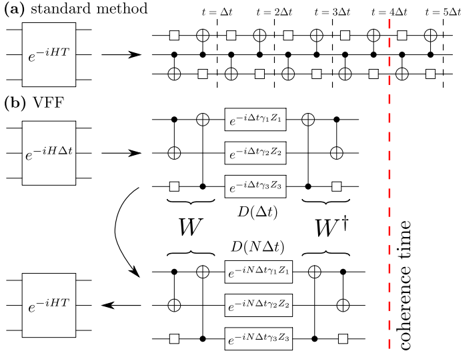
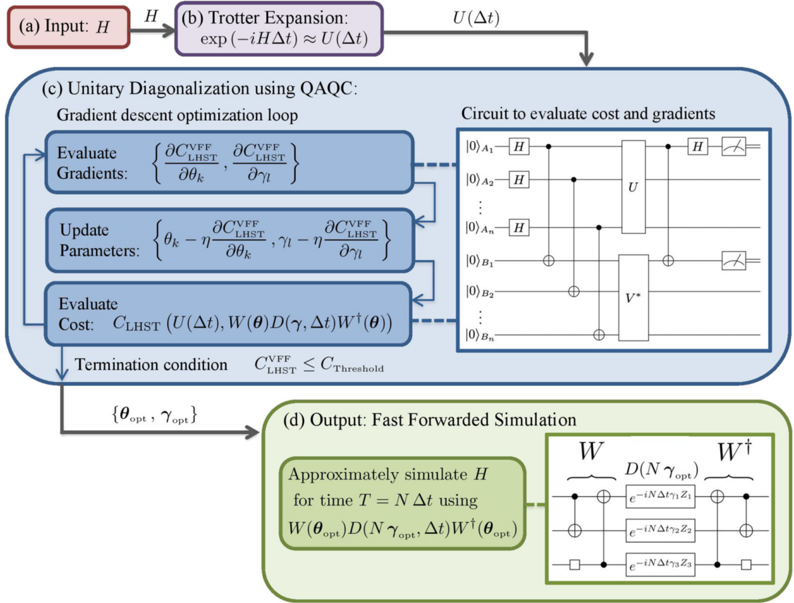
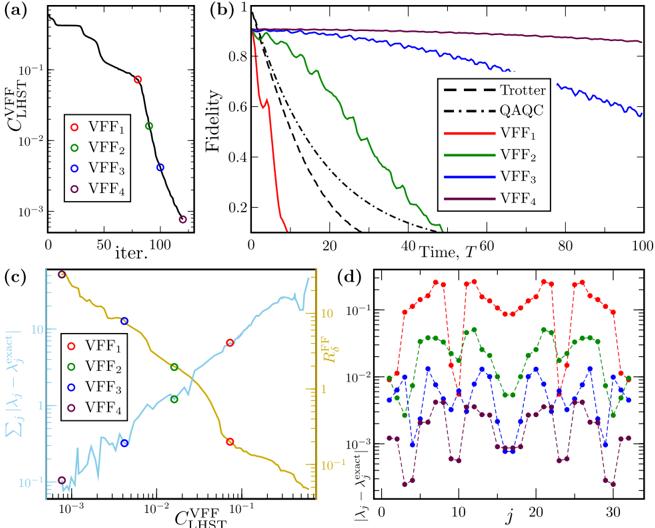
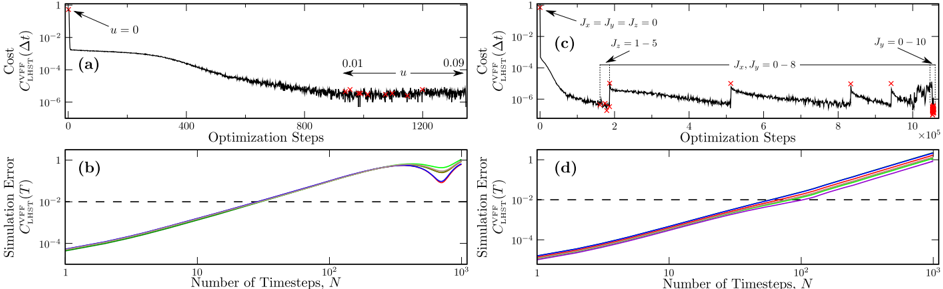
Trotterization-based, iterative approaches to quantum simulation (QS) are restricted to simulation times less than the coherence time of the quantum computer (QC), which limits their utility in the near term. Here, we present a hybrid quantum-classical algorithm, called variational fast forwarding (VFF), for decreasing the quantum circuit depth of QSs. VFF seeks an approximate diagonalization of a short-time simulation to enable longer-time simulations using a constant number of gates. Our error analysis provides two results: (1) the simulation error of VFF scales at worst linearly in the fast-forwarded simulation time, and (2) our cost function’s operational meaning as an upper bound on average-case simulation error provides a natural termination condition for VFF. We implement VFF for the Hubbard, Ising, and Heisenberg models on a simulator. In addition, we implement VFF on Rigetti’s QC to demonstrate simulation beyond the coherence time. Finally, we show how to estimate energy eigenvalues using VFF.
Overview
The claims and statistics of this paper haven’t been checked yet.
Free: it reads the open-access text and checks the first 5 claims that cite a source we can check. Create a free account to check every claim.
Integrity signals
Registry
Cites
Statistics
Figures

Verification
Claims the paper makes
The claims and statistics of this paper haven’t been checked yet.
Free: it reads the open-access text and checks the first 5 claims that cite a source we can check. Create a free account to check every claim.
Claims other papers make about this one
Each is checked against this paper’s own text: does it say what the citing paper says it does?
The source backs part of the claim, not all of it — or backs it for a different population, condition or comparison.
In the citing paper
“Similar to the idea of the SVQS, variational fast forwarding (VFF) relies on the idea of evolving a quantum state in time exp (-iHt ) within a diagonal subspace, such that an enhanced evolution time can be achieved (Cirstoiu et al. , 2020).”
From Noisy intermediate-scale quantum algorithms (2022) · cites this paper as Cirstoiu et al. , 2020
Experimental — accuracy not yet measuredThe cited source says what the claim attributes to it.
In the citing paper
“The weighted subspace VQE [110] provides an alternative way to simulate dynamics in the subspace of the low energy eigenstates [121].”
From Variational quantum algorithms (2021) · cites this paper as [121]
Self-check
Percentages, sums and reported differences re-computed from the paper’s own numbers.
The self-check needs the paper’s full text.
Citations
Cites
Simulating physics with computers
Feynman, R. P. (1982) · International Journal of Theoretical Physics · doi:10.1007/bf02650179 · Cited by 7,691
A variational eigenvalue solver on a photonic quantum processor
Peruzzo, A., McClean, J., Shadbolt, P., Yung, M.-H., Zhou, X.-Q., Love, P. J., Aspuru-Guzik, A., & O’Brien, J. L. (2014) · Nature Communications · doi:10.1038/ncomms5213 · Cited by 4,552
Two soluble models of an antiferromagnetic chain
Lieb, E., Schultz, T., & Mattis, D. (1961) · Annals of Physics · doi:10.1016/0003-4916(61)90115-4 · Cited by 4,280
Cold Bosonic Atoms in Optical Lattices
Jaksch, D., Bruder, C., Cirac, J. I., Gardiner, C. W., & Zoller, P. (1998) · Physical Review Letters · doi:10.1103/physrevlett.81.3108 · Cited by 3,685
Lloyd, S. (1996) · Science · doi:10.1126/science.273.5278.1073 · Cited by 3,088
Quantum simulations with ultracold quantum gases
Bloch, I., Dalibard, J., & Nascimbène, S. (2012) · Nature Physics · doi:10.1038/nphys2259 · Cited by 2,339
The theory of variational hybrid quantum-classical algorithms
McClean, J. R., Romero, J., Babbush, R., & Aspuru-Guzik, A. (2016) · New Journal of Physics · doi:10.1088/1367-2630/18/2/023023 · Cited by 2,227 · cited 1×
“In order to approach the issue of initializing the parameters θ and γ, we often use a perturbative method [15, 36] in which we pre-train these parameters for a slightly different Hamiltonian.”
MethodMitarai, K., Negoro, M., Kitagawa, M., & Fujii, K. (2018) · Physical Review A · doi:10.1103/physreva.98.032309 · Cited by 1,639
Cost function dependent barren plateaus in shallow parametrized quantum circuits
Cerezo, M., Sone, A., Volkoff, T., Cincio, L., & Coles, P. J. (2021) · Nature Communications · doi:10.1038/s41467-021-21728-w · Cited by 1,047
Self-citationGeneral teleportation channel, singlet fraction, and quasidistillation
Horodecki, M., Horodecki, P., & Horodecki, R. (1999) · Physical Review A · doi:10.1103/physreva.60.1888 · Cited by 965
Research works printed but not linked: 2
- Childs, A. M. & Wiebe, N. Hamiltonian simulation using linear combinations of unitary operations. Quantum Info. Comput. 12, 901-924 (2012).
- Li, Y. & Benjamin, S. C. Efficient variational quantum simulator incorporating active error minimization. Phys. Rev. X 7, 021050 (2017).
Cited by
Variational quantum algorithms
Cerezo, M., Arrasmith, A., Babbush, R., Benjamin, S. C., Endo, S., Fujii, K., McClean, J. R., Mitarai, K., Yuan, X., Cincio, L., et al. (2021) · Nature Reviews Physics · doi:10.1038/s42254-021-00348-9 · Cited by 3,385
“Similar to the subspace approach, variational fast forwarding [102] simulates the time evolution operation exp(−iHt) as U(θ∗)T (E, t)U†(θ∗) with”
Self-citationNoisy intermediate-scale quantum algorithms
Bharti, K., Cervera-Lierta, A., Kyaw, T. H., Haug, T., Alperin-Lea, S., Anand, A., Degroote, M., Heimonen, H., Kottmann, J. S., Menke, T., et al. (2022) · Reviews of Modern Physics · doi:10.1103/revmodphys.94.015004 · Cited by 2,231
Cost function dependent barren plateaus in shallow parametrized quantum circuits
Cerezo, M., Sone, A., Volkoff, T., Cincio, L., & Coles, P. J. (2021) · Nature Communications · doi:10.1038/s41467-021-21728-w · Cited by 1,047
“Equation (22) makes it clear that C0 G has the form in (6), and OG 1⁄4 1AB 1A 0 j i 0 h j is a global observable of the form in (10).”
BackgroundMethodSelf-citationProgrammable Quantum Simulations of Spin Systems with Trapped Ions
Monroe, C., Campbell, W. C., Duan, L. M., Gong, Z. X., Gorshkov, A. V., Hess, P., Islam, R., Kim, K., Linke, N., Pagano, G., et al. (2019) · arXiv · doi:10.48550/arxiv.1912.07845 · Cited by 806
Programmable quantum simulations of spin systems with trapped ions
Monroe, C., Campbell, W. C., Duan, L.-M., Gong, Z.-X., Gorshkov, A. V., Hess, P. W., Islam, R., Kim, K., Linke, N. M., Pagano, G., et al. (2021) · Reviews of Modern Physics · doi:10.1103/revmodphys.93.025001 · Cited by 802
Metadata
- Authors
- Cîrstoiu, C., Holmes, Z., Iosue, J., Cincio, L., Coles, P. J., & Sornborger, A.
- Affiliations
- Los Alamos National Laboratory (US)
- Corresponding author
- Coles, Patrick J.
- Sornborger, Andrew
- Venue
- npj Quantum Information
- Published
- 2020-09-18
- Volume
- 6
- Issue
- 1
- ISSN
- 2056-6387 (ISSN-L)
- OpenAlex
- W2979788593
- Semantic Scholar
- 7d75089a25065dcd7d3bf8b6044ee42caf60d7c6
- Cited by
- 232
- References
- 68
- Citations by year
- 2026: 19 · 2025: 35 · 2024: 38 · 2023: 43 · 2022: 41 · 2021: 48 · 2020: 8
- FWCI
- 13.75
- Type
- journal article
- Language
- en
- Open access
- gold
- doi.org
- Licence
- cc-by
- creativecommons.org/licenses/by/4.0 (tdm)
- creativecommons.org/licenses/by/4.0 (vor)
- Locations
- npj Quantum Information (publishedVersion, cc-by)
- arXiv (Cornell University) (submittedVersion)
- OSTI OAI (U.S. Department of Energy Office of Scientific and Technical Information) (submittedVersion)
- Funders
- U.S. Department of Energy (DOE) through a quantum computing program sponsored by the LANL Information Science & Technology Institute
- DOE | Office of Science
- U.S. DOE through the J. Robert Oppenheimer fellowship
- DOE | LDRD | Los Alamos National Laboratory
- DOE ASC Beyond Moore’s Law program
- Topics
- Physical Sciences › Computer Science › Artificial Intelligence › Quantum Computing Algorithms and Architecture
- Physical Sciences › Physics and Astronomy › Atomic and Molecular Physics, and Optics › Quantum many-body systems
- Physical Sciences › Physics and Astronomy › Atomic and Molecular Physics, and Optics › Quantum Information and Cryptography
- Keywords
- quantum simulation, coherence time, hybrid quantum-classical algorithms, Trotterization, circuit depth reduction, simulation error analysis, termination conditions, Hubbard model, Ising model, Heisenberg model
About these checks
Registry, retraction, Cites and statistics results are computed, not judged, with one exception: a printed reference that no index lists is read once by a model before it counts as a citation error. Claims are extracted by a model and kept only when their quote appears verbatim in the text; each cited source is then checked, with a model’s help, for whether it says what the claim relies on. Those verdicts can be wrong — read the claim’s quote and the cited source before relying on one.
Statistics and arithmetic are recomputed, not judged.
Confidence bands are shown only for fields calibrated on our annotated test set. None is calibrated yet, so no band is shown.
What counts as a claim ›How we measure confidence ›How we check this ›
Are you an author, or do you see a problem with this page? Request a review
How to cite
Cite CoChat for the checks on this page, and the paper for its own findings.
- This page
- CoChat. (2026). Citation check: Variational fast forwarding for quantum simulation beyond the coherence time. https://app.cochat.ai/papers/10.1038/s41534-020-00302-0
- The paper
- Cîrstoiu, C., Holmes, Z., Iosue, J., Cincio, L., Coles, P. J., & Sornborger, A. (2020). Variational fast forwarding for quantum simulation beyond the coherence time. npj Quantum Information. https://doi.org/10.1038/s41534-020-00302-0
Data sources
Bibliographic data: Semantic Scholar, OpenAlex, Crossref.
Contains information from the Semantic Scholar Academic Graph Datasets, made available under the ODC Attribution License (ODC-BY 1.0).
Semantic Scholar’s data is described in: Kinney, R., et al. (2023). The Semantic Scholar Open Data Platform. arXiv:2301.10140.
