

Variational fast forwarding for quantum simulation beyond the coherence time
Open accessThe DOI matches its Crossref record; 64 of the 68 references it cites were found in a registry or an index.
Abstract
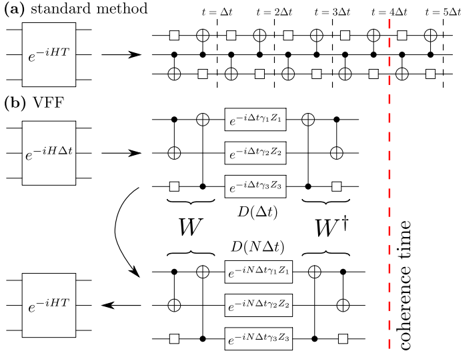
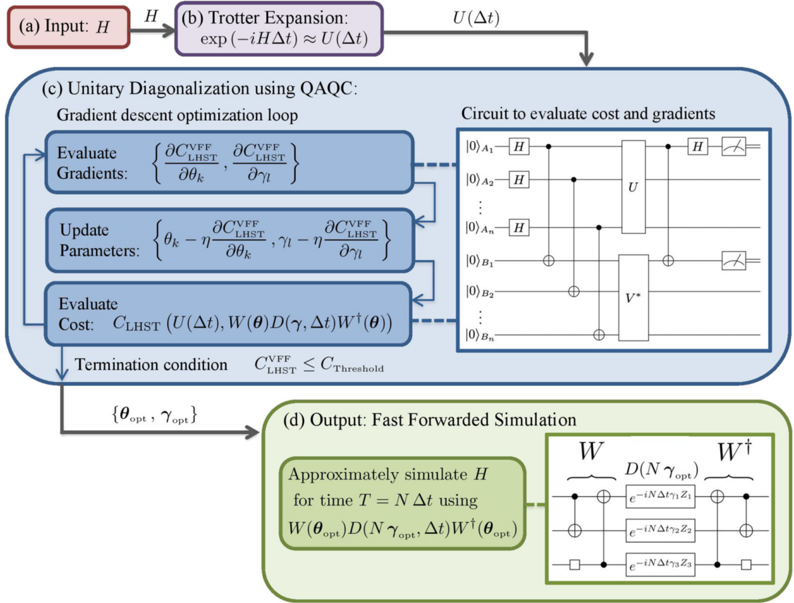
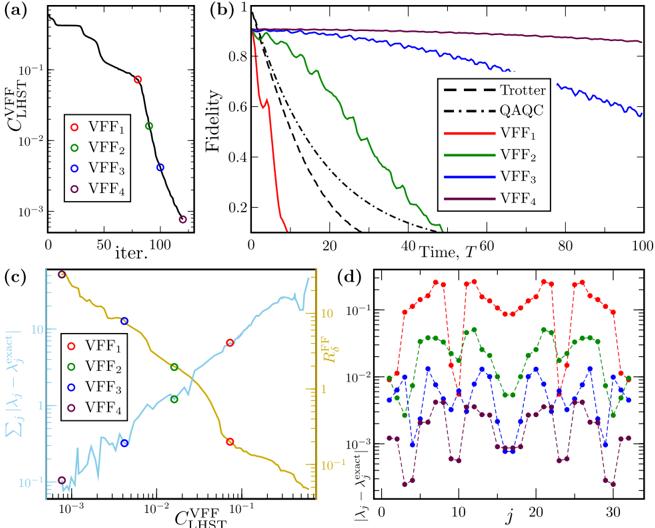
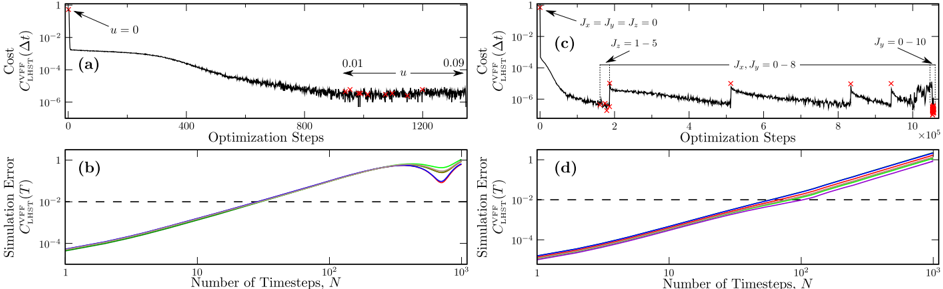
Trotterization-based, iterative approaches to quantum simulation (QS) are restricted to simulation times less than the coherence time of the quantum computer (QC), which limits their utility in the near term. Here, we present a hybrid quantum-classical algorithm, called variational fast forwarding (VFF), for decreasing the quantum circuit depth of QSs. VFF seeks an approximate diagonalization of a short-time simulation to enable longer-time simulations using a constant number of gates. Our error analysis provides two results: (1) the simulation error of VFF scales at worst linearly in the fast-forwarded simulation time, and (2) our cost function’s operational meaning as an upper bound on average-case simulation error provides a natural termination condition for VFF. We implement VFF for the Hubbard, Ising, and Heisenberg models on a simulator. In addition, we implement VFF on Rigetti’s QC to demonstrate simulation beyond the coherence time. Finally, we show how to estimate energy eigenvalues using VFF.
Overview
The claims and statistics of this paper haven’t been checked yet.
Free: it reads the open-access text and checks the first 5 claims that cite a source we can check. Create a free account to check every claim.
Integrity signals
Registry
Cites
Statistics
Figures

Verification
Claims the paper makes
The claims and statistics of this paper haven’t been checked yet.
Free: it reads the open-access text and checks the first 5 claims that cite a source we can check. Create a free account to check every claim.
Claims other papers make about this one
Each is checked against this paper’s own text: does it say what the citing paper says it does?
The source backs part of the claim, not all of it — or backs it for a different population, condition or comparison.
In the citing paper
“Similar to the idea of the SVQS, variational fast forwarding (VFF) relies on the idea of evolving a quantum state in time exp (-iHt ) within a diagonal subspace, such that an enhanced evolution time can be achieved (Cirstoiu et al. , 2020).”
From Noisy intermediate-scale quantum algorithms (2022) · cites this paper as Cirstoiu et al. , 2020
Experimental — accuracy not yet measuredThe cited source says what the claim attributes to it.
In the citing paper
“The weighted subspace VQE [110] provides an alternative way to simulate dynamics in the subspace of the low energy eigenstates [121].”
From Variational quantum algorithms (2021) · cites this paper as [121]
Self-check
Percentages, sums and reported differences re-computed from the paper’s own numbers.
The self-check needs the paper’s full text.
Citations
Cites
Simulating physics with computers
Feynman, R. P. (1982) · International Journal of Theoretical Physics · doi:10.1007/bf02650179 · Cited by 7,691
A variational eigenvalue solver on a photonic quantum processor
Peruzzo, A., McClean, J., Shadbolt, P., Yung, M.-H., Zhou, X.-Q., Love, P. J., Aspuru-Guzik, A., & O’Brien, J. L. (2014) · Nature Communications · doi:10.1038/ncomms5213 · Cited by 4,552
Two soluble models of an antiferromagnetic chain
Lieb, E., Schultz, T., & Mattis, D. (1961) · Annals of Physics · doi:10.1016/0003-4916(61)90115-4 · Cited by 4,280
Cold Bosonic Atoms in Optical Lattices
Jaksch, D., Bruder, C., Cirac, J. I., Gardiner, C. W., & Zoller, P. (1998) · Physical Review Letters · doi:10.1103/physrevlett.81.3108 · Cited by 3,685
Lloyd, S. (1996) · Science · doi:10.1126/science.273.5278.1073 · Cited by 3,088
Quantum simulations with ultracold quantum gases
Bloch, I., Dalibard, J., & Nascimbène, S. (2012) · Nature Physics · doi:10.1038/nphys2259 · Cited by 2,339
The theory of variational hybrid quantum-classical algorithms
McClean, J. R., Romero, J., Babbush, R., & Aspuru-Guzik, A. (2016) · New Journal of Physics · doi:10.1088/1367-2630/18/2/023023 · Cited by 2,227 · cited 1×
“In order to approach the issue of initializing the parameters θ and γ, we often use a perturbative method [15, 36] in which we pre-train these parameters for a slightly different Hamiltonian.”
MethodMitarai, K., Negoro, M., Kitagawa, M., & Fujii, K. (2018) · Physical Review A · doi:10.1103/physreva.98.032309 · Cited by 1,639
Cost function dependent barren plateaus in shallow parametrized quantum circuits
Cerezo, M., Sone, A., Volkoff, T., Cincio, L., & Coles, P. J. (2021) · Nature Communications · doi:10.1038/s41467-021-21728-w · Cited by 1,047
Self-citationGeneral teleportation channel, singlet fraction, and quasidistillation
Horodecki, M., Horodecki, P., & Horodecki, R. (1999) · Physical Review A · doi:10.1103/physreva.60.1888 · Cited by 965
Simulation of Many-Body Fermi Systems on a Universal Quantum Computer
Abrams, D. S., & Lloyd, S. (1997) · Physical Review Letters · doi:10.1103/physrevlett.79.2586 · Cited by 745
Simulating Hamiltonian Dynamics with a Truncated Taylor Series
Berry, D. W., Childs, A. M., Cleve, R., Kothari, R., & Somma, R. D. (2015) · Physical Review Letters · doi:10.1103/physrevlett.114.090502 · Cited by 742
A simple formula for the average gate fidelity of a quantum dynamical operation
Nielsen, M. A. (2002) · Physics Letters A · doi:10.1016/s0375-9601(02)01272-0 · Cited by 725 · cited 2×
“Specifically, it can be shown [44, 45] that”
Efficient Quantum Algorithms for Simulating Sparse Hamiltonians
Berry, D. W., Ahokas, G., Cleve, R., & Sanders, B. C. (2007) · Communications in Mathematical Physics · doi:10.1007/s00220-006-0150-x · Cited by 692
Self-verifying variational quantum simulation of lattice models
Kokail, C., Maier, C., van Bijnen, R., Brydges, T., Joshi, M. K., Jurcevic, P., Muschik, C. A., Silvi, P., Blatt, R., Roos, C. F., et al. (2019) · Nature · doi:10.1038/s41586-019-1177-4 · Cited by 594
Quantum autoencoders for efficient compression of quantum data
Romero, J., Olson, J. P., & Aspuru-Guzik, A. (2017) · Quantum Science and Technology · doi:10.1088/2058-9565/aa8072 · Cited by 559
Quantum measurements and the Abelian Stabilizer ProblemPreprint
Kitaev, A. (1995) · arXiv (Cornell University) · Cited by 510
Variational Quantum Computation of Excited States
Higgott, O., Wang, D., & Brierley, S. (2019) · Quantum · doi:10.22331/q-2019-07-01-156 · Cited by 463
Theory of variational quantum simulation
Yuan, X., Endo, S., Zhao, Q., Li, Y., & Benjamin, S. C. (2019) · Quantum · doi:10.22331/q-2019-10-07-191 · Cited by 458
Onset of a quantum phase transition with a trapped ion quantum simulator
Islam, R., Edwards, E. E., Kim, K., Korenblit, S., Noh, C., Carmichael, H., Lin, G.-D., Duan, L.-M., Joseph Wang, C.-C., Freericks, J. K., et al. (2011) · Nature Communications · doi:10.1038/ncomms1374 · Cited by 411
An initialization strategy for addressing barren plateaus in parametrized quantum circuits
Grant, E., Wossnig, L., Ostaszewski, M., & Benedetti, M. (2019) · Quantum · doi:10.22331/q-2019-12-09-214 · Cited by 406
Quantum-assisted quantum compiling
Khatri, S., LaRose, R., Poremba, A., Cincio, L., Sornborger, A. T., & Coles, P. J. (2019) · Quantum · doi:10.22331/q-2019-05-13-140 · Cited by 382
Self-citationSimulating physical phenomena by quantum networks
Somma, R., Ortiz, G., Gubernatis, J. E., Knill, E., & Laflamme, R. (2002) · Physical Review A · doi:10.1103/physreva.65.042323 · Cited by 365
Random Compiler for Fast Hamiltonian Simulation
Campbell, E. (2019) · Physical Review Letters · doi:10.1103/physrevlett.123.070503 · Cited by 355
An initialization strategy for addressing barren plateaus in parametrized quantum circuits
Grant, E., Wossnig, L., Ostaszewski, M., & Benedetti, M. (2019) · UCL Discovery (University College London) · Cited by 338
Subspace-search variational quantum eigensolver for excited states
Nakanishi, K. M., Mitarai, K., & Fujii, K. (2019) · Physical Review Research · doi:10.1103/physrevresearch.1.033062 · Cited by 337
The variation of the spectrum of a normal matrix
Hoffman, A. J., & Wielandt, H. W. (1953) · Duke Mathematical Journal · doi:10.1215/s0012-7094-53-02004-3 · Cited by 314
Gate-count estimates for performing quantum chemistry on small quantum computers
Wecker, D., Bauer, B., Clark, B. K., Hastings, M. B., & Troyer, M. (2014) · Physical Review A · doi:10.1103/physreva.90.022305 · Cited by 296
Measurement optimization in the variational quantum eigensolver using a minimum clique cover
Verteletskyi, V., Yen, T.-C., & Izmaylov, A. F. (2020) · The Journal of Chemical Physics · doi:10.1063/1.5141458 · Cited by 269 · cited 1×
“Therefore 2 n single-qubit measurements are required to compute C LHST ( U , V ), a favorable scaling compared to, for example, the O ( n 4 ) measurements that are naively required for VQE 15,38 – 40 .”
MethodVariational Quantum Simulation of General Processes
Endo, S., Sun, J., Li, Y., Benjamin, S. C., & Yuan, X. (2020) · Physical Review Letters · doi:10.1103/physrevlett.125.010501 · Cited by 237 · cited 2×
“[23] S.”
BackgroundVariational quantum state diagonalization
LaRose, R., Tikku, A., O’Neel-Judy, É., Cincio, L., & Coles, P. J. (2019) · npj Quantum Information · doi:10.1038/s41534-019-0167-6 · Cited by 199
Self-citationNoise resilience of variational quantum compiling
Sharma, K., Khatri, S., Cerezo, M., & Coles, P. J. (2020) · New Journal of Physics · doi:10.1088/1367-2630/ab784c · Cited by 196 · cited 3×
“This noise resilience is analogous to analytical and numerical results recently reported in [33].”
BackgroundMethodResultSelf-citationEfficient quantum measurement of Pauli operators in the presence of finite sampling error
Crawford, O., Straaten, B. V., Wang, D., Parks, T., Campbell, E., & Brierley, S. (2021) · Quantum · doi:10.22331/q-2021-01-20-385 · Cited by 188
Noise resilience of variational quantum compiling
Sharma, K., Khatri, S., Cerezo, M., & Coles, P. J. (2020) · Civil War Book Review · Cited by 184
Self-citationThe Trotter step size required for accurate quantum simulation of quantum chemistry
Poulin, D., Hastings, M. B., Wecker, D., Wiebe, N., Doberty, A. C., & Troyer, M. (2015) · Quantum Information and Computation · doi:10.26421/qic15.5-6-1 · Cited by 159 · cited 3×
“In addition, the operator norm, p =∞, quantifies the worst-case error and is often used in the quantum simulation literature [40, 41].”
MethodInfluentialQuantum circuits for strongly correlated quantum systems
Verstraete, F., Cirac, J. I., & Latorre, J. I. (2009) · Physical Review A · doi:10.1103/physreva.79.032316 · Cited by 158
Fast-forwarding of Hamiltonians and exponentially precise measurements
Atia, Y., & Aharonov, D. (2017) · Nature Communications · doi:10.1038/s41467-017-01637-7 · Cited by 158
Exact Ising model simulation on a quantum computer
Cervera-Lierta, A. (2018) · Quantum · doi:10.22331/q-2018-12-21-114 · Cited by 157
Quantum complexity of time evolution with chaotic Hamiltonians
Balasubramanian, V., DeCross, M. P., Kar, A., & Parrikar, O. (2020) · Journal of High Energy Physics · doi:10.1007/jhep01(2020)134 · Cited by 151 · cited 1×
“Previous results analyze fast-forwarding of Hamiltonians mostly in a computational complexity setting 27,28,33,34 , in which the asymptotic scaling of the runtime of quantum circuits implementing a large-scale simulation is important.”
ResultQuantum eigenvalue estimation via time series analysis
Somma, R. D. (2019) · New Journal of Physics · doi:10.1088/1367-2630/ab5c60 · Cited by 142
An Adaptive Optimizer for Measurement-Frugal Variational Algorithms
Kübler, J. M., Arrasmith, A., Cincio, L., & Coles, P. J. (2020) · Quantum · doi:10.22331/q-2020-05-11-263 · Cited by 141
Self-citationHarrow, A. W., & Napp, J. C. (2021) · Physical Review Letters · doi:10.1103/physrevlett.126.140502 · Cited by 121 · cited 1×
“Gradient-based approaches can improve convergence of variational quantum-classical algorithms [37], and the optimizer performance can be further enhanced by judiciously adapting the shot noise for each partial derivative [38].”
BackgroundEfficient quantum circuits for diagonal unitaries without ancillas
Welch, J., Greenbaum, D., Mostame, S., & Aspuru-Guzik, A. (2014) · New Journal of Physics · doi:10.1088/1367-2630/16/3/033040 · Cited by 114
Quantum complexity of time evolution with chaotic Hamiltonians
Balasubramanian, V. (2023) · OSTI OAI (U.S. Department of Energy Office of Scientific and Technical Information) · doi:10.1007/jhep01%282020%29134 · Cited by 113
Measuring the Rényi entropy of a two-site Fermi-Hubbard model on a trapped ion quantum computer
Linke, N. M., Johri, S., Figgatt, C., Landsman, K. A., Matsuura, A. Y., & Monroe, C. (2018) · Physical Review A · doi:10.1103/physreva.98.052334 · Cited by 112
Anschuetz, E., Olson, J., Aspuru-Guzik, A., & Cao, Y. (2019) · Lecture Notes in Computer Science · doi:10.1007/978-3-030-14082-3_7 · Cited by 104 · cited 2×
“[21] E.”
BackgroundHigher-order methods for simulations on quantum computers
Sornborger, A. T., & Stewart, E. D. (1999) · Physical Review A · doi:10.1103/physreva.60.1956 · Cited by 94
Self-citationThe entanglement fidelity and quantum error correctionPreprint
Nielsen, M. A. (1996) · arXiv (Cornell University) · doi:10.48550/arxiv.quant-ph/9606012 · Cited by 89 · cited 2×
“[43] M.”
MethodCost-Function-Dependent Barren Plateaus in Shallow Quantum Neural Networks.Preprint
Cerezo, M., Sone, A., Volkoff, T. J., Cincio, Ł., & Coles, P. J. (2020) · arXiv (Cornell University) · Cited by 83
Self-citationEngineering Vibrationally Assisted Energy Transfer in a Trapped-Ion Quantum Simulator
Gorman, D. J., Hemmerling, B., Megidish, E., Moeller, S. A., Schindler, P., Sarovar, M., & Haeffner, H. (2018) · Physical Review X · doi:10.1103/physrevx.8.011038 · Cited by 78 · cited 3×
“[5] D.”
BackgroundMethodSimulating the performance of a distance-3 surface code in a linear ion trap
Trout, C. J., Li, M., Gutiérrez, M., Wu, Y., Wang, S.-T., Duan, L., & Brown, K. R. (2018) · New Journal of Physics · doi:10.1088/1367-2630/aab341 · Cited by 77
Gokhale, P., Angiuli, O., Ding, Y., Gui, K., Tomesh, T., Suchara, M., Martonosi, M., & Chong, F. T. (2019) · arXiv (Cornell University) · doi:10.48550/arxiv.1907.13623 · Cited by 76
Quantum simulation of the Sachdev-Ye-Kitaev model by asymmetric qubitization
Babbush, R., Berry, D. W., & Neven, H. (2019) · Physical Review A · doi:10.1103/physreva.99.040301 · Cited by 71
Variational consistent histories as a hybrid algorithm for quantum foundations
Arrasmith, A., Cincio, L., Sornborger, A. T., Zurek, W. H., & Coles, P. J. (2019) · Nature Communications · doi:10.1038/s41467-019-11417-0 · Cited by 66 · cited 2×
“[19] A.”
BackgroundSelf-citationSubspace variational quantum simulator
Heya, K., Nakanishi, K. M., Mitarai, K., Yan, Z., Zuo, K., Suzuki, Y., Sugiyama, T., Tamate, S., Tabuchi, Y., Fujii, K., et al. (2023) · Physical Review Research · doi:10.1103/physrevresearch.5.023078 · Cited by 56
Subspace Variational Quantum Simulator
Heya, K., Nakanishi, K. M., Mitarai, K., Yan, Z., Zuo, K., Suzuki, Y., Sugiyama, T., Tamate, S., Tabuchi, Y., Fujii, K., et al. (2019) · arXiv · doi:10.48550/arxiv.1904.08566 · Cited by 56
Limitations on the simulation of non-sparse hamiltonians
Childs, A. M., & Kothari, R. (2010) · doi:10.5555/2011373.2011380 · Cited by 52
Experimental simulation of quantum tunneling in small systems
Feng, G., Lu, Y., Hao, L., Zhang, F., & Long, G. (2013) · Scientific Reports · doi:10.1038/srep02232 · Cited by 44 · cited 2×
“Quantum emulation and Suzuki-Trotterbased QSs have seen proof-of-principle demonstrations [2–6, 13], while Taylor expansion-based QSs have the best asymptotic scaling and will likely have application for fault-tolerant Quantum Computers (QCs) of the future.”
BackgroundFast-forwarding of Hamiltonians and exponentially precise measurements
Atia, Y., & Aharonov, D. (2017) · RePEc: Research Papers in Economics · Cited by 43
Efficient quantum circuits for diagonal unitaries without ancillas
Welch, J., Greenbaum, D., Mostame, S., & Aspuru‐Guzik, A. (2014) · Digital Access to Scholarship at Harvard (DASH) (Harvard University) · Cited by 35
Efficient quantum circuits for continuous-time quantum walks on composite graphs
Loke, T., & Wang, J. B. (2017) · Journal of Physics A Mathematical and Theoretical · doi:10.1088/1751-8121/aa53a9 · Cited by 30
Addressing hard classical problems with Adiabatically Assisted Variational Quantum Eigensolvers
Garcia-Saez, A., & Latorre, J. I. (2018) · arXiv · doi:10.48550/arxiv.1806.02287 · Cited by 28 · cited 2×
“[36] A.”
MethodEfficient quantum measurement of Pauli operatorsPreprint
Crawford, O., van Straaten, B., Wang, D., Parks, T. W., Campbell, E. T., & BRIERLEY, S. D. (2019) · arXiv (Cornell University) · Cited by 10
Quantum advantage from energy measurements of many-body quantum systems
Novo, L., Bermejo-Vega, J., & García−Patrón, R. (2021) · Refubium (Universitätsbibliothek der Freien Universität Berlin) · doi:10.17169/refubium-31445 · Cited by 4
Research works printed but not linked: 2
- Childs, A. M. & Wiebe, N. Hamiltonian simulation using linear combinations of unitary operations. Quantum Info. Comput. 12, 901-924 (2012).
- Li, Y. & Benjamin, S. C. Efficient variational quantum simulator incorporating active error minimization. Phys. Rev. X 7, 021050 (2017).
Cited by
Variational quantum algorithms
Cerezo, M., Arrasmith, A., Babbush, R., Benjamin, S. C., Endo, S., Fujii, K., McClean, J. R., Mitarai, K., Yuan, X., Cincio, L., et al. (2021) · Nature Reviews Physics · doi:10.1038/s42254-021-00348-9 · Cited by 3,385
“Similar to the subspace approach, variational fast forwarding [102] simulates the time evolution operation exp(−iHt) as U(θ∗)T (E, t)U†(θ∗) with”
Self-citationNoisy intermediate-scale quantum algorithms
Bharti, K., Cervera-Lierta, A., Kyaw, T. H., Haug, T., Alperin-Lea, S., Anand, A., Degroote, M., Heimonen, H., Kottmann, J. S., Menke, T., et al. (2022) · Reviews of Modern Physics · doi:10.1103/revmodphys.94.015004 · Cited by 2,231
Cost function dependent barren plateaus in shallow parametrized quantum circuits
Cerezo, M., Sone, A., Volkoff, T., Cincio, L., & Coles, P. J. (2021) · Nature Communications · doi:10.1038/s41467-021-21728-w · Cited by 1,047
“Equation (22) makes it clear that C0 G has the form in (6), and OG 1⁄4 1AB 1A 0 j i 0 h j is a global observable of the form in (10).”
BackgroundMethodSelf-citationProgrammable Quantum Simulations of Spin Systems with Trapped Ions
Monroe, C., Campbell, W. C., Duan, L. M., Gong, Z. X., Gorshkov, A. V., Hess, P., Islam, R., Kim, K., Linke, N., Pagano, G., et al. (2019) · arXiv · doi:10.48550/arxiv.1912.07845 · Cited by 806
Programmable quantum simulations of spin systems with trapped ions
Monroe, C., Campbell, W. C., Duan, L.-M., Gong, Z.-X., Gorshkov, A. V., Hess, P. W., Islam, R., Kim, K., Linke, N. M., Pagano, G., et al. (2021) · Reviews of Modern Physics · doi:10.1103/revmodphys.93.025001 · Cited by 802
Metadata
- Authors
- Cîrstoiu, C., Holmes, Z., Iosue, J., Cincio, L., Coles, P. J., & Sornborger, A.
- Affiliations
- Los Alamos National Laboratory (US)
- Corresponding author
- Coles, Patrick J.
- Sornborger, Andrew
- Venue
- npj Quantum Information
- Published
- 2020-09-18
- Volume
- 6
- Issue
- 1
- ISSN
- 2056-6387 (ISSN-L)
- OpenAlex
- W2979788593
- Semantic Scholar
- 7d75089a25065dcd7d3bf8b6044ee42caf60d7c6
- Cited by
- 232
- References
- 68
- Citations by year
- 2026: 19 · 2025: 35 · 2024: 38 · 2023: 43 · 2022: 41 · 2021: 48 · 2020: 8
- FWCI
- 13.75
- Type
- journal article
- Language
- en
- Open access
- gold
- doi.org
- Licence
- cc-by
- creativecommons.org/licenses/by/4.0 (tdm)
- creativecommons.org/licenses/by/4.0 (vor)
- Locations
- npj Quantum Information (publishedVersion, cc-by)
- arXiv (Cornell University) (submittedVersion)
- OSTI OAI (U.S. Department of Energy Office of Scientific and Technical Information) (submittedVersion)
- Funders
- U.S. Department of Energy (DOE) through a quantum computing program sponsored by the LANL Information Science & Technology Institute
- DOE | Office of Science
- U.S. DOE through the J. Robert Oppenheimer fellowship
- DOE | LDRD | Los Alamos National Laboratory
- DOE ASC Beyond Moore’s Law program
- Topics
- Physical Sciences › Computer Science › Artificial Intelligence › Quantum Computing Algorithms and Architecture
- Physical Sciences › Physics and Astronomy › Atomic and Molecular Physics, and Optics › Quantum many-body systems
- Physical Sciences › Physics and Astronomy › Atomic and Molecular Physics, and Optics › Quantum Information and Cryptography
- Keywords
- quantum simulation, coherence time, hybrid quantum-classical algorithms, Trotterization, circuit depth reduction, simulation error analysis, termination conditions, Hubbard model, Ising model, Heisenberg model
About these checks
Registry, retraction, Cites and statistics results are computed, not judged, with one exception: a printed reference that no index lists is read once by a model before it counts as a citation error. Claims are extracted by a model and kept only when their quote appears verbatim in the text; each cited source is then checked, with a model’s help, for whether it says what the claim relies on. Those verdicts can be wrong — read the claim’s quote and the cited source before relying on one.
Statistics and arithmetic are recomputed, not judged.
Confidence bands are shown only for fields calibrated on our annotated test set. None is calibrated yet, so no band is shown.
What counts as a claim ›How we measure confidence ›How we check this ›
Are you an author, or do you see a problem with this page? Request a review
Data sources
Bibliographic data: Semantic Scholar, OpenAlex, Crossref.
Contains information from the Semantic Scholar Academic Graph Datasets, made available under the ODC Attribution License (ODC-BY 1.0).
Semantic Scholar’s data is described in: Kinney, R., et al. (2023). The Semantic Scholar Open Data Platform. arXiv:2301.10140.
