

Variational fast forwarding for quantum simulation beyond the coherence time
Open accessThe DOI matches its Crossref record; 64 of the 68 references it cites were found in a registry or an index.
Abstract
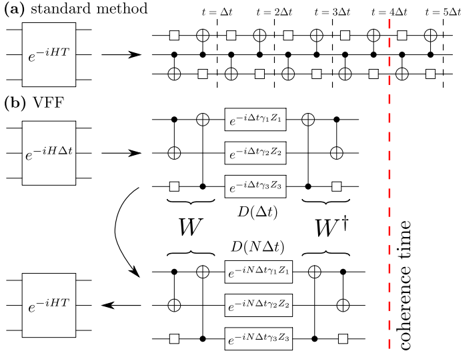
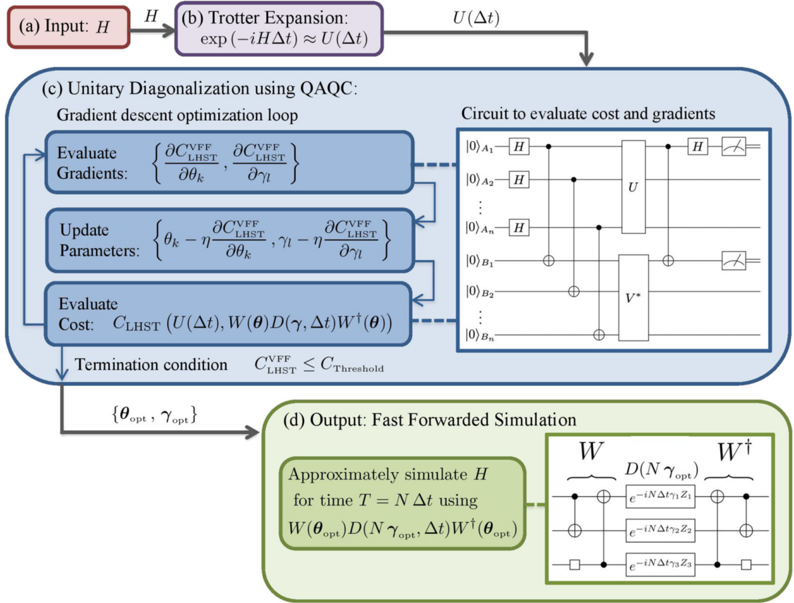
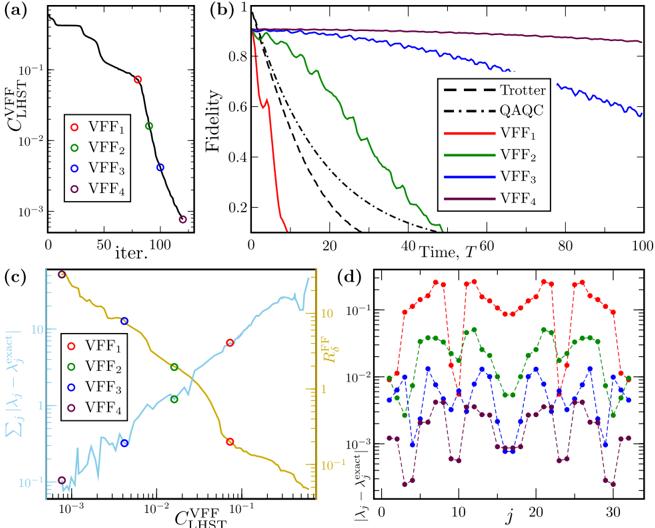
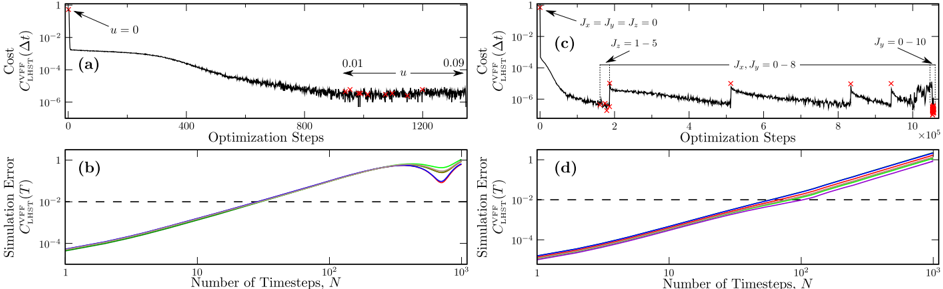
Trotterization-based, iterative approaches to quantum simulation (QS) are restricted to simulation times less than the coherence time of the quantum computer (QC), which limits their utility in the near term. Here, we present a hybrid quantum-classical algorithm, called variational fast forwarding (VFF), for decreasing the quantum circuit depth of QSs. VFF seeks an approximate diagonalization of a short-time simulation to enable longer-time simulations using a constant number of gates. Our error analysis provides two results: (1) the simulation error of VFF scales at worst linearly in the fast-forwarded simulation time, and (2) our cost function’s operational meaning as an upper bound on average-case simulation error provides a natural termination condition for VFF. We implement VFF for the Hubbard, Ising, and Heisenberg models on a simulator. In addition, we implement VFF on Rigetti’s QC to demonstrate simulation beyond the coherence time. Finally, we show how to estimate energy eigenvalues using VFF.
Overview
The claims and statistics of this paper haven’t been checked yet.
Free: it reads the open-access text and checks the first 5 claims that cite a source we can check. Create a free account to check every claim.
Integrity signals
Registry
Cites
Statistics
Figures

Verification
Claims the paper makes
The claims and statistics of this paper haven’t been checked yet.
Free: it reads the open-access text and checks the first 5 claims that cite a source we can check. Create a free account to check every claim.
Claims other papers make about this one
Each is checked against this paper’s own text: does it say what the citing paper says it does?
The source backs part of the claim, not all of it — or backs it for a different population, condition or comparison.
In the citing paper
“Similar to the idea of the SVQS, variational fast forwarding (VFF) relies on the idea of evolving a quantum state in time exp (-iHt ) within a diagonal subspace, such that an enhanced evolution time can be achieved (Cirstoiu et al. , 2020).”
From Noisy intermediate-scale quantum algorithms (2022) · cites this paper as Cirstoiu et al. , 2020
Experimental — accuracy not yet measuredThe cited source says what the claim attributes to it.
In the citing paper
“The weighted subspace VQE [110] provides an alternative way to simulate dynamics in the subspace of the low energy eigenstates [121].”
From Variational quantum algorithms (2021) · cites this paper as [121]
Self-check
Percentages, sums and reported differences re-computed from the paper’s own numbers.
The self-check needs the paper’s full text.
Citations
Cites
Simulating physics with computers
Feynman, R. P. (1982) · International Journal of Theoretical Physics · doi:10.1007/bf02650179 · Cited by 7,691
A variational eigenvalue solver on a photonic quantum processor
Peruzzo, A., McClean, J., Shadbolt, P., Yung, M.-H., Zhou, X.-Q., Love, P. J., Aspuru-Guzik, A., & O’Brien, J. L. (2014) · Nature Communications · doi:10.1038/ncomms5213 · Cited by 4,552
Two soluble models of an antiferromagnetic chain
Lieb, E., Schultz, T., & Mattis, D. (1961) · Annals of Physics · doi:10.1016/0003-4916(61)90115-4 · Cited by 4,280
Cold Bosonic Atoms in Optical Lattices
Jaksch, D., Bruder, C., Cirac, J. I., Gardiner, C. W., & Zoller, P. (1998) · Physical Review Letters · doi:10.1103/physrevlett.81.3108 · Cited by 3,685
Lloyd, S. (1996) · Science · doi:10.1126/science.273.5278.1073 · Cited by 3,088
Quantum simulations with ultracold quantum gases
Bloch, I., Dalibard, J., & Nascimbène, S. (2012) · Nature Physics · doi:10.1038/nphys2259 · Cited by 2,339
The theory of variational hybrid quantum-classical algorithms
McClean, J. R., Romero, J., Babbush, R., & Aspuru-Guzik, A. (2016) · New Journal of Physics · doi:10.1088/1367-2630/18/2/023023 · Cited by 2,227 · cited 1×
“In order to approach the issue of initializing the parameters θ and γ, we often use a perturbative method [15, 36] in which we pre-train these parameters for a slightly different Hamiltonian.”
MethodMitarai, K., Negoro, M., Kitagawa, M., & Fujii, K. (2018) · Physical Review A · doi:10.1103/physreva.98.032309 · Cited by 1,639
Cost function dependent barren plateaus in shallow parametrized quantum circuits
Cerezo, M., Sone, A., Volkoff, T., Cincio, L., & Coles, P. J. (2021) · Nature Communications · doi:10.1038/s41467-021-21728-w · Cited by 1,047
Self-citationGeneral teleportation channel, singlet fraction, and quasidistillation
Horodecki, M., Horodecki, P., & Horodecki, R. (1999) · Physical Review A · doi:10.1103/physreva.60.1888 · Cited by 965
Research works printed but not linked: 2
- Childs, A. M. & Wiebe, N. Hamiltonian simulation using linear combinations of unitary operations. Quantum Info. Comput. 12, 901-924 (2012).
- Li, Y. & Benjamin, S. C. Efficient variational quantum simulator incorporating active error minimization. Phys. Rev. X 7, 021050 (2017).
Cited by
Variational quantum algorithms
Cerezo, M., Arrasmith, A., Babbush, R., Benjamin, S. C., Endo, S., Fujii, K., McClean, J. R., Mitarai, K., Yuan, X., Cincio, L., et al. (2021) · Nature Reviews Physics · doi:10.1038/s42254-021-00348-9 · Cited by 3,385
“Similar to the subspace approach, variational fast forwarding [102] simulates the time evolution operation exp(−iHt) as U(θ∗)T (E, t)U†(θ∗) with”
Self-citationNoisy intermediate-scale quantum algorithms
Bharti, K., Cervera-Lierta, A., Kyaw, T. H., Haug, T., Alperin-Lea, S., Anand, A., Degroote, M., Heimonen, H., Kottmann, J. S., Menke, T., et al. (2022) · Reviews of Modern Physics · doi:10.1103/revmodphys.94.015004 · Cited by 2,231
Cost function dependent barren plateaus in shallow parametrized quantum circuits
Cerezo, M., Sone, A., Volkoff, T., Cincio, L., & Coles, P. J. (2021) · Nature Communications · doi:10.1038/s41467-021-21728-w · Cited by 1,047
“Equation (22) makes it clear that C0 G has the form in (6), and OG 1⁄4 1AB 1A 0 j i 0 h j is a global observable of the form in (10).”
BackgroundMethodSelf-citationProgrammable Quantum Simulations of Spin Systems with Trapped Ions
Monroe, C., Campbell, W. C., Duan, L. M., Gong, Z. X., Gorshkov, A. V., Hess, P., Islam, R., Kim, K., Linke, N., Pagano, G., et al. (2019) · arXiv · doi:10.48550/arxiv.1912.07845 · Cited by 806
Programmable quantum simulations of spin systems with trapped ions
Monroe, C., Campbell, W. C., Duan, L.-M., Gong, Z.-X., Gorshkov, A. V., Hess, P. W., Islam, R., Kim, K., Linke, N. M., Pagano, G., et al. (2021) · Reviews of Modern Physics · doi:10.1103/revmodphys.93.025001 · Cited by 802
Noise-Induced Barren Plateaus in Variational Quantum Algorithms
Wang, S., Fontana, E., Cerezo, M., Sharma, K., Sone, A., Cincio, L., & Coles, P. J. (2020) · arXiv · doi:10.48550/arxiv.2007.14384 · Cited by 791
Self-citationNoise-induced barren plateaus in variational quantum algorithms
Wang, S., Fontana, E., Cerezo, M., Sharma, K., Sone, A., Cincio, L., & Coles, P. J. (2021) · Nature Communications · doi:10.1038/s41467-021-27045-6 · Cited by 773
“[10] Cristina Cirstoiu, Zoe Holmes, Joseph Iosue, Lukasz Cincio, Patrick J Coles, and Andrew Sornborger, “Variational fast forwarding for quantum simulation beyond the coherence time,” npj Quantum Information 6, 1–10 (2020).”
BackgroundSelf-citationChallenges and opportunities in quantum machine learning
Cerezo, M., Verdon, G., Huang, H.-Y., Cincio, L., & Coles, P. J. (2022) · Nature Computational Science · doi:10.1038/s43588-022-00311-3 · Cited by 689
“QML can enhance quantum simulation for chemistry (e.g., molecular ground states [112], equilibrium states [47], and time evolution [114]) and materials science (e.g., quantum phase recognition [11] and generative design with a target property in mind [132]).”
BackgroundSelf-citationConnecting Ansatz Expressibility to Gradient Magnitudes and Barren Plateaus
Holmes, Z., Sharma, K., Cerezo, M., & Coles, P. J. (2022) · PRX Quantum · doi:10.1103/prxquantum.3.010313 · Cited by 570
“That is, one could start the variational algorithm using a shallow, highly correlated ansatz and as the cost is iteratively minimized gradually grow the ansatz [8, 15, 38] and decorrelate the parameters [37].”
BackgroundMethodSelf-citationGeneralization in quantum machine learning from few training data
Caro, M. C., Huang, H.-Y., Cerezo, M., Sharma, K., Sornborger, A., Cincio, L., & Coles, P. J. (2022) · Nature Communications · doi:10.1038/s41467-022-32550-3 · Cited by 476
Self-citationAbsence of Barren Plateaus in Quantum Convolutional Neural Networks
Pesah, A., Cerezo, M., Wang, S., Volkoff, T., Sornborger, A. T., & Coles, P. J. (2021) · Physical Review X · doi:10.1103/physrevx.11.041011 · Cited by 343
“[22] Cristina Cirstoiu, Zoe Holmes, Joseph Iosue, Lukasz Cincio, Patrick J Coles, and Andrew Sornborger, “Variational fast forwarding for quantum simulation beyond the coherence time,” npj Quantum Information 6, 1–10 (2020).”
BackgroundSelf-citationAbsence of Barren Plateaus in Quantum Convolutional Neural Networks
Pesah, A., Cerezo, M., Wang, S., Volkoff, T., Sornborger, A. T., & Coles, P. J. (2020) · arXiv · doi:10.48550/arxiv.2011.02966 · Cited by 343
Self-citationVariational Quantum Linear Solver
Bravo-Prieto, C., LaRose, R., Cerezo, M., Subasi, Y., Cincio, L., & Coles, P. J. (2019) · arXiv · doi:10.48550/arxiv.1909.05820 · Cited by 284
Self-citationVariational Quantum Linear Solver
Bravo-Prieto, C., LaRose, R., Cerezo, M., Subasi, Y., Cincio, L., & Coles, P. J. (2023) · Quantum · doi:10.22331/q-2023-11-22-1188 · Cited by 260
Self-citationEffect of barren plateaus on gradient-free optimization
Arrasmith, A., Cerezo, M., Czarnik, P., Cincio, L., & Coles, P. J. (2021) · Quantum · doi:10.22331/q-2021-10-05-558 · Cited by 248
Self-citationQuantum Computing for High-Energy Physics: State of the Art and Challenges
Di Meglio, A., Jansen, K., Tavernelli, I., Alexandrou, C., Arunachalam, S., Bauer, C. W., Borras, K., Carrazza, S., Crippa, A., Croft, V., et al. (2024) · PRX Quantum · doi:10.1103/prxquantum.5.037001 · Cited by 215
Self-citationDiagnosing Barren Plateaus with Tools from Quantum Optimal Control
Larocca, M., Czarnik, P., Sharma, K., Muraleedharan, G., Coles, P. J., & Cerezo, M. (2022) · Quantum · doi:10.22331/q-2022-09-29-824 · Cited by 214
“[12] Cristina Cirstoiu, Zoe Holmes, Joseph Iosue, Lukasz Cincio, Patrick J Coles, and Andrew Sornborger, “Variational fast forwarding for quantum simulation beyond the coherence time,” npj Quantum Information 6, 1–10 (2020).”
BackgroundSelf-citationSolving nonlinear differential equations with differentiable quantum circuits
Kyriienko, O., Paine, A. E., & Elfving, V. E. (2021) · Physical Review A · doi:10.1103/physreva.103.052416 · Cited by 185
Solving nonlinear differential equations with differentiable quantum circuits
Kyriienko, O., Paine, A. E., & Elfving, V. E. (2020) · arXiv · doi:10.48550/arxiv.2011.10395 · Cited by 185
Theory of overparametrization in quantum neural networks
Larocca, M., Ju, N., García-Martín, D., Coles, P. J., & Cerezo, M. (2023) · Nature Computational Science · doi:10.1038/s43588-023-00467-6 · Cited by 176
Self-citationHardware-efficient variational quantum algorithms for time evolution
Benedetti, M., Fiorentini, M., & Lubasch, M. (2021) · Physical Review Research · doi:10.1103/physrevresearch.3.033083 · Cited by 161
“Promising examples of quantum advantage obtained with PQCs have already been identified for time evolution [17, 18] and in other contexts such as for nonlinear partial differential equations [19, 20], dynamical mean field theory [21, 22], and machine learning [23].”
BackgroundHardware-efficient variational quantum algorithms for time evolution
Benedetti, M., Fiorentini, M., & Lubasch, M. (2020) · arXiv · doi:10.48550/arxiv.2009.12361 · Cited by 176
NISQ computing: where are we and where do we go?
Lau, J. W. Z., Lim, K. H., Shrotriya, H., & Kwek, L. C. (2022) · AAPPS Bulletin · doi:10.1007/s43673-022-00058-z · Cited by 173
“…deal with Hamiltonian evolution include those that restrict the evolution to a subspace [86], those that rely on finding approximate projections of the action of the time evolution operator on an ansatz [87, 88] and those that find approximate diagonalization of the time evolution unitary [89–91].”
BackgroundTrainability of Dissipative Perceptron-Based Quantum Neural Networks
Sharma, K., Cerezo, M., Cincio, L., & Coles, P. J. (2022) · Physical Review Letters · doi:10.1103/physrevlett.128.180505 · Cited by 159
Self-citationQuantum many-body simulations on digital quantum computers: State-of-the-art and future challenges
Fauseweh, B. (2024) · Nature Communications · doi:10.1038/s41467-024-46402-9 · Cited by 152
“One of the fi rst methods for variational time evolution that was implemented is based on variational fast forwarding (VFF) the Trot-terized time evolution 124 .”
Large gradients via correlation in random parameterized quantum circuits
Volkoff, T., & Coles, P. J. (2021) · Quantum Science and Technology · doi:10.1088/2058-9565/abd891 · Cited by 143
“[15] Cristina Cirstoiu, Zoe Holmes, Joseph Iosue, Lukasz Cincio, Patrick J Coles, and Andrew Sornborger, “Variational fast forwarding for quantum simulation beyond the coherence time,” arXiv preprint arXiv:1910.”
BackgroundSelf-citationDigital Quantum Simulation of Open Quantum Systems Using Quantum Imaginary–Time Evolution
Kamakari, H., Sun, S.-N., Motta, M., & Minnich, A. J. (2022) · PRX Quantum · doi:10.1103/prxquantum.3.010320 · Cited by 200
Variational quantum state eigensolver
Cerezo, M., Sharma, K., Arrasmith, A., & Coles, P. J. (2022) · npj Quantum Information · doi:10.1038/s41534-022-00611-6 · Cited by 136
“(23) with the fact that Pm i1⁄41eλ2i ⩾Pmi1⁄41 p(2)i (since eλi 2 L are the largest diagonal elements of eρ), we find that ffiffiffiffiffiffiffiffiffiffiffiffi Xm”
BackgroundSelf-citationEquivalence of quantum barren plateaus to cost concentration and narrow gorges
Arrasmith, A., Holmes, Z., Cerezo, M., & Coles, P. J. (2022) · Quantum Science and Technology · doi:10.1088/2058-9565/ac7d06 · Cited by 137
“[14] Cristina Cirstoiu, Zoe Holmes, Joseph Iosue, Lukasz Cincio, Patrick J Coles, and Andrew Sornborger, “Variational fast forwarding for quantum simulation beyond the coherence time,” npj Quantum Information 6, 1–10 (2020).”
Self-citationYao.jl: Extensible, Efficient Framework for Quantum Algorithm Design
Luo, X.-Z., Liu, J.-G., Zhang, P., & Wang, L. (2020) · Quantum · doi:10.22331/q-2020-10-11-341 · Cited by 157
Adaptive Variational Quantum Dynamics Simulations
Yao, Y.-X., Gomes, N., Zhang, F., Wang, C.-Z., Ho, K.-M., Iadecola, T., & Orth, P. P. (2021) · PRX Quantum · doi:10.1103/prxquantum.2.030307 · Cited by 184
Machine Learning of Noise-Resilient Quantum Circuits
Cincio, L., Rudinger, K., Sarovar, M., & Coles, P. J. (2021) · PRX Quantum · doi:10.1103/prxquantum.2.010324 · Cited by 111
Self-citationBarren Plateaus Preclude Learning Scramblers
Holmes, Z., Arrasmith, A., Yan, B., Coles, P. J., Albrecht, A., & Sornborger, A. T. (2021) · Physical Review Letters · doi:10.1103/physrevlett.126.190501 · Cited by 125
“[36] Cristina Cirstoiu, Zoe Holmes, Joseph Iosue, Lukasz Cincio, Patrick J Coles, and Andrew Sornborger, “Variational fast forwarding for quantum simulation beyond the coherence time,” npj Quantum Information 6, 1–10 (2020).”
BackgroundSelf-citationBarren plateaus preclude learning scramblers
Holmes, Z., Arrasmith, A., Yan, B., Coles, P. J., Albrecht, A., & Sornborger, A. T. (2020) · arXiv · doi:10.48550/arxiv.2009.14808 · Cited by 125
Self-citationAn Adaptive Optimizer for Measurement-Frugal Variational Algorithms
Kübler, J. M., Arrasmith, A., Cincio, L., & Coles, P. J. (2020) · Quantum · doi:10.22331/q-2020-05-11-263 · Cited by 141
Self-citationHigher order derivatives of quantum neural networks with barren plateaus
Cerezo, M., & Coles, P. J. (2021) · Quantum Science and Technology · doi:10.1088/2058-9565/abf51a · Cited by 118
Self-citationMolecular Quantum Dynamics: A Quantum Computing Perspective
Ollitrault, P. J., Miessen, A., & Tavernelli, I. (2021) · Accounts of Chemical Research · doi:10.1021/acs.accounts.1c00514 · Cited by 159
“56 4.”
An efficient quantum algorithm for the time evolution of parameterized circuits
Barison, S., Vicentini, F., & Carleo, G. (2021) · Quantum · doi:10.22331/q-2021-07-28-512 · Cited by 110
“For quantum simulation, several variational, resource friendly alternatives to Trotterization [26, 27, 28, 29] have been proposed [9, 30, 31, 32, 33].”
Adaptive Variational Quantum Dynamics Simulations
Yao, Y., Gomes, N., Zhang, F., Wang, C., Ho, K., Iadecola, T., & Orth, P. P. (2021) · Iowa State University Digital Repository (Iowa State University) · Cited by 104
Unified approach to data-driven quantum error mitigation
Lowe, A., Gordon, M. H., Czarnik, P., Arrasmith, A., Coles, P. J., & Cincio, Ł. (2021) · Physical Review Research · doi:10.1103/physrevresearch.3.033098 · Cited by 136
“[16] Cristina Cirstoiu, Zoe Holmes, Joseph Iosue, Lukasz Cincio, Patrick J Coles, and Andrew Sornborger, “Variational fast forwarding for quantum simulation beyond the coherence time,” npj Quantum Information 6, 1–10 (2020).”
BackgroundSelf-citationNeural predictor based quantum architecture search
Zhang, S.-X., Hsieh, C.-Y., Zhang, S., & Yao, H. (2021) · Machine Learning: Science and Technology · doi:10.1088/2632-2153/ac28dd · Cited by 88
Evaluating the noise resilience of variational quantum algorithms
Fontana, E., Fitzpatrick, N., Ramo, D. M., Duncan, R., & Rungger, I. (2021) · Physical Review A · doi:10.1103/physreva.104.022403 · Cited by 122
Simulating quantum materials with digital quantum computers
Oftelie, L. B., Urbánek, M., Metcalf, M., Carter, J. T., Kemper, A. F., & de Jong, W. A. (2021) · Quantum Science and Technology · doi:10.1088/2058-9565/ac1ca6 · Cited by 102
Out-of-distribution generalization for learning quantum dynamics
Caro, M. C., Huang, H.-Y., Ezzell, N., Gibbs, J., Sornborger, A. T., Cincio, Ł., Coles, P. J., & Holmes, Z. (2023) · Nature Communications · doi:10.1038/s41467-023-39381-w · Cited by 159
“We are also interested in the potential of these results to ease the classical compilation of local short-time evolutions into shorter depth circuits 30 and circuits of a particular desired structure 34,35 .”
Self-citationVariational quantum algorithm for estimating the quantum Fisher information
Beckey, J. L., Cerezo, M., Sone, A., & Coles, P. J. (2022) · Physical Review Research · doi:10.1103/physrevresearch.4.013083 · Cited by 118
“[44] Cristina Cirstoiu, Zoe Holmes, Joseph Iosue, Lukasz Cincio, Patrick J Coles, and Andrew Sornborger, “Variational fast forwarding for quantum simulation beyond the coherence time,” npj Quantum Information 6, 1–10 (2020).”
BackgroundSelf-citationQuantum algorithms for quantum dynamics
Miessen, A., Ollitrault, P. J., Tacchino, F., & Tavernelli, I. (2022) · Nature Computational Science · doi:10.1038/s43588-022-00374-2 · Cited by 131
“…picture 52 Efficient computation of QSP phases 45 Quantum singular value transformation 49,50 EOM based (VTE) 54 Adaptive variational ansatz 55 Classical superposition of qubit states 56 , time-dependent Hamiltonians 57 Optimization based VFF 60 , approximately diagonalizing e −i Ht (refs.”
MethodVariational Quantum Algorithm for Estimating the Quantum Fisher Information
Beckey, J. L., Cerezo, M., Sone, A., & Coles, P. J. (2020) · arXiv · doi:10.48550/arxiv.2010.10488 · Cited by 77
Self-citationClassically optimized Hamiltonian simulation
Keever, C. M., & Lubasch, M. (2023) · Physical Review Research · doi:10.1103/physrevresearch.5.023146 · Cited by 112
Learning to Predict Arbitrary Quantum Processes
Huang, H.-Y., Chen, S., & Preskill, J. P. (2023) · PRX Quantum · doi:10.1103/prxquantum.4.040337 · Cited by 158
Can Error Mitigation Improve Trainability of Noisy Variational Quantum Algorithms?
Wang, S., Czarnik, P., Arrasmith, A., Cerezo, M., Cincio, Ł., & Coles, P. J. (2024) · Quantum · doi:10.22331/q-2024-03-14-1287 · Cited by 133
Self-citationHamiltonian variational ansatz without barren plateaus
Park, C.-Y., & Killoran, N. (2024) · Quantum · doi:10.22331/q-2024-02-01-1239 · Cited by 141
“Such an ansatz is expressive enough for variational time evolution [33, 34, 35, 36, 37], with the benefit that the ansatz is free from bar-ren plateaus.”
BackgroundReformulation of the No-Free-Lunch Theorem for Entangled Datasets
Sharma, K., Cerezo, M., Holmes, Z., Cincio, L., Sornborger, A., & Coles, P. J. (2022) · Physical Review Letters · doi:10.1103/physrevlett.128.070501 · Cited by 62
“[47] Cristina Cirstoiu, Zoe Holmes, Joseph Iosue, Lukasz Cincio, Patrick J Coles, and Andrew Sornborger, “Variational fast forwarding for quantum simulation beyond the coherence time,” arXiv preprint arXiv:1910.”
BackgroundSelf-citationFixed Depth Hamiltonian Simulation via Cartan Decomposition
Kökcü, E., Steckmann, T., Wang, Y., Freericks, J. K., Dumitrescu, E., & Kemper, A. F. (2022) · Physical Review Letters · doi:10.1103/physrevlett.129.070501 · Cited by 117
A semi-agnostic ansatz with variable structure for variational quantum algorithms
Bilkis, M., Cerezo, M., Verdon, G., Coles, P. J., & Cincio, L. (2023) · Quantum Machine Intelligence · doi:10.1007/s42484-023-00132-1 · Cited by 58
Self-citationSolving quantum statistical mechanics with variational autoregressive networks and quantum circuits
Liu, J.-G., Mao, L., Zhang, P., & Wang, L. (2021) · Machine Learning: Science and Technology · doi:10.1088/2632-2153/aba19d · Cited by 57
Illa, M., & Savage, M. J. (2022) · Physical Review A · doi:10.1103/physreva.106.052605 · Cited by 79
“, fast-forwarding time evolution [77]) in the future.”
BackgroundVariational Quantum-Neural Hybrid Eigensolver
Zhang, S., Wan, Z., Lee, C., Hsieh, C., Zhang, S., & Yao, H. (2022) · Physical Review Letters · doi:10.1103/physrevlett.128.120502 · Cited by 77
Subspace variational quantum simulator
Heya, K., Nakanishi, K. M., Mitarai, K., Yan, Z., Zuo, K., Suzuki, Y., Sugiyama, T., Tamate, S., Tabuchi, Y., Fujii, K., et al. (2023) · Physical Review Research · doi:10.1103/physrevresearch.5.023078 · Cited by 56
“Several hybrid quantum–classical algorithms have been proposed to solve time-independent Hamiltonian dynamics on NISQ devices [9, 29–32].”
Subspace Variational Quantum Simulator
Heya, K., Nakanishi, K. M., Mitarai, K., Yan, Z., Zuo, K., Suzuki, Y., Sugiyama, T., Tamate, S., Tabuchi, Y., Fujii, K., et al. (2019) · arXiv · doi:10.48550/arxiv.1904.08566 · Cited by 56
Overlapped grouping measurement: A unified framework for measuring quantum states
Wu, B., Sun, J., Huang, Q. J., & Yuan, X. (2023) · Quantum · doi:10.22331/q-2023-01-13-896 · Cited by 106
“[28] Cristina Cirstoiu, Zoe Holmes, Joseph Iosue, Lukasz Cincio, Patrick J Coles, and Andrew Sornborger.”
BackgroundPrimitive quantum gates for an SU(2) discrete subgroup: Binary tetrahedral
Gustafson, E., Lamm, H., Lovelace, F., & Musk, D. (2022) · Physical review. D/Physical review. D. · doi:10.1103/physrevd.106.114501 · Cited by 87
Guimarães, J. D., Lim, J., Vasilevskiy, M. I., Huelga, S. F., & Plenio, M. B. (2023) · PRX Quantum · doi:10.1103/prxquantum.4.040329 · Cited by 74
Operator Sampling for Shot-frugal Optimization in Variational Algorithms
Arrasmith, A., Cincio, L., Somma, R. D., & Coles, P. J. (2020) · arXiv · doi:10.48550/arxiv.2004.06252 · Cited by 53
Self-citationQuantum autoencoders with enhanced data encoding
Bravo-Prieto, C. (2021) · Machine Learning Science and Technology · doi:10.1088/2632-2153/ac0616 · Cited by 90
Generalized quantum circuit differentiation rules
Kyriienko, O., & Elfving, V. E. (2021) · Physical Review A · doi:10.1103/physreva.104.052417 · Cited by 98
Quantum computing with and for many-body physics
Ayral, T., Besserve, P., Lacroix, D., & Guzman, E. A. R. (2023) · The European Physical Journal A · doi:10.1140/epja/s10050-023-01141-1 · Cited by 84
“Several alternative methods have been proposed: the Variational Fast-Forwarding [174,175], Incremental Structure Learning [176], the Adaptive Product Formula [177], and the Variational Time Dependent Phase Estimation [178], to quote some of them.”
MethodQuantum kernel methods for solving regression problems and differential equations
Paine, A. E., Elfving, V. E., & Kyriienko, O. (2023) · Physical Review A · doi:10.1103/physreva.107.032428 · Cited by 89
Presence and Absence of Barren Plateaus in Tensor-Network Based Machine Learning
Liu, Z., Yu, L.-W., Duan, L., & Deng, D.-L. (2022) · Physical Review Letters · doi:10.1103/physrevlett.129.270501 · Cited by 82
Determining the proton content with a quantum computer
Pérez-Salinas, A., Cruz-Martinez, J. M., Alhajri, A., & Carrazza, S. (2021) · Physical review. D/Physical review. D. · doi:10.1103/physrevd.103.034027 · Cited by 67
“[21] C.”
BackgroundPrimitive quantum gates for dihedral gauge theories
Alam, M. S., Hadfield, S., Lamm, H., & Li, A. C. Y. (2022) · Physical review. D/Physical review. D. · doi:10.1103/physrevd.105.114501 · Cited by 76
Improved Hamiltonians for Quantum Simulations of Gauge Theories
Carena, M. S., Lamm, H., Li, Y.-Y., & Liu, W. (2022) · Physical Review Letters · doi:10.1103/physrevlett.129.051601 · Cited by 87
Quantum algorithms for quantum dynamics: A performance study on the spin-boson model
Miessen, A., Ollitrault, P. J., & Tavernelli, I. (2021) · Physical Review Research · doi:10.1103/physrevresearch.3.043212 · Cited by 59
Building spatial symmetries into parameterized quantum circuits for faster training
Sauvage, F., Larocca, M., Coles, P. J., & Cerezo, M. (2024) · Quantum Science and Technology · doi:10.1088/2058-9565/ad152e · Cited by 77
“More-over, our ORB ansatz will likely be useful in the context of VQAs for dynamical simulation [61–64].”
MethodSelf-citationSubspace methods for electronic structure simulations on quantum computers
Motta, M., Kirby, W., Liepuoniute, I., Sung, K. J., Cohn, J. F., Mezzacapo, A., Klymko, K., Nguyen, N., Yoshioka, N., & Rice, J. E. (2024) · Electronic Structure · doi:10.1088/2516-1075/ad3592 · Cited by 107
Quantum unary approach to option pricing
Ramos-Calderer, S., Pérez-Salinas, A., García-Martín, D., Bravo-Prieto, C., Cortada, J., Planagumà, J., & Latorre, J. I. (2021) · Physical Review A · doi:10.1103/physreva.103.032414 · Cited by 69
Fast-forwarding quantum evolution
Gu, S., Somma, R. D., & Şahinoğlu, B. (2021) · Quantum · doi:10.22331/q-2021-11-15-577 · Cited by 93
“[44, 45] with a focus on near term simulation of qubit Hamiltonians.”
BackgroundAlgebraic compression of quantum circuits for Hamiltonian evolution
Kökcü, E., Camps, D., Oftelie, L. B., Freericks, J. K., de Jong, W. A., Beeumen, R. V., & Kemper, A. F. (2022) · Physical Review A · doi:10.1103/physreva.105.032420 · Cited by 71
Dynamical simulation via quantum machine learning with provable generalization
Gibbs, J., Holmes, Z., Caro, M. C., Ezzell, N., Huang, H.-Y., Cincio, Ł., Sornborger, A. T., & Coles, P. J. (2024) · Physical Review Research · doi:10.1103/physrevresearch.6.013241 · Cited by 67
“If this well-approximates the target unitary, i.e., V ∆ t ( α opt ) ≈ U ∆ t , then we have learned an approximate diagonalization of U ∆ t and the long-time simulation e − iHT can be approximated using the fixed depth circuit V T ( α opt ) [6, 8].”
MethodResultInfluentialSelf-citationFate of Quantum Many-Body Scars in the Presence of Disorder
Mondragon-Shem, I., Vavilov, M., & Martin, I. (2021) · PRX Quantum · doi:10.1103/prxquantum.2.030349 · Cited by 59
Berthusen, N., Trevisan, T. V., Iadecola, T., & Orth, P. P. (2022) · Physical Review Research · doi:10.1103/physrevresearch.4.023097 · Cited by 61
Multi-Neutrino Entanglement and Correlations in Dense Neutrino Systems
Illa, M., & Savage, M. J. (2023) · Physical Review Letters · doi:10.1103/physrevlett.130.221003 · Cited by 57
Symmetry enhanced variational quantum spin eigensolver
Lyu, C., Xu, X., Yung, M., & Bayat, A. (2023) · Quantum · doi:10.22331/q-2023-01-19-899 · Cited by 60
“So far, these variational algorithms have been developed for addressing problems in quantum machine learning [1, 11, 19, 22, 25, 90], combinatorial optimization [14, 26], dynamical simulations in closed [21, 30, 43, 62, 103] and open [24, 37, 45, 47, 103] systems, quantum sensing [9, 38, 50, 52, 61, 67, 68], computati…”
MethodConstant-depth circuits for dynamic simulations of materials on quantum computers
Oftelie, L. B., Beeumen, R. V., Younis, E., Smith, E., Iancu, C., & de Jong, W. A. (2022) · Materials Theory · doi:10.1186/s41313-022-00043-x · Cited by 53
“A recent work took advantage of this to variationally compile approximate circuits with a hybrid classical-quantum algorithm for fast-forwarded simulations [26].”
BackgroundLattice renormalization of quantum simulations
Carena, M. S., Lamm, H., Li, Y.-Y., & Liu, W. (2021) · Physical review. D/Physical review. D. · doi:10.1103/physrevd.104.094519 · Cited by 63
Long-time simulations for fixed input states on quantum hardware
Gibbs, J., Gili, K., Holmes, Z., Commeau, B., Arrasmith, A., Cincio, Ł., Coles, P. J., & Sornborger, A. T. (2022) · npj Quantum Information · doi:10.1038/s41534-022-00625-0 · Cited by 100
“In this work, we improve upon a recently proposed variational quantum algorithm known as Variational Fast Forwarding (VFF) 21 .”
BackgroundMethodInfluentialSelf-citationVariational Hamiltonian simulation for translational invariant systems via classical pre-processing
Mansuroglu, R., Eckstein, T., Nützel, L., Wilkinson, S. A., & Hartmann, M. J. (2023) · Quantum Science and Technology · doi:10.1088/2058-9565/acb1d0 · Cited by 56
Universal Compiling and (No-)Free-Lunch Theorems for Continuous-Variable Quantum Learning
Volkoff, T. J., Holmes, Z., & Sornborger, A. T. (2021) · PRX Quantum · doi:10.1103/prxquantum.2.040327 · Cited by 45
“This in turn opens up the possibility of simulating beyond the coherence time of a quantum processor [21].”
BackgroundSelf-citationMaking Trotterization Adaptive and Energy-Self-Correcting for NISQ Devices and Beyond
Zhao, H., Bukov, M., Heyl, M., & Moessner, R. (2023) · PRX Quantum · doi:10.1103/prxquantum.4.030319 · Cited by 61
A Variational Quantum Linear Solver Application to Discrete Finite-Element Methods
Trahan, C. J., Loveland, M., Davis, N. A., & Ellison, E. (2023) · Entropy · doi:10.3390/e25040580 · Cited by 53
Variational Quantum Simulation: A Case Study for Understanding Warm Starts
Puig, R., Drudis, M., Thanasilp, S., & Holmes, Z. (2025) · PRX Quantum · doi:10.1103/prxquantum.6.010317 · Cited by 89
Self-citationNon-trivial symmetries in quantum landscapes and their resilience to quantum noise
Fontana, E., Cerezo, M., Arrasmith, A., Rungger, I., & Coles, P. J. (2022) · Quantum · doi:10.22331/q-2022-09-15-804 · Cited by 67
“Arguably, the leading role has been played by Parametrized Quantum Circuits (PQCs), which are exploited for both Variational Quantum Algorithms [2, 3, 4, 5, 6, 7, 8, 9, 10, 11, 12, 13, 14] and Quantum Neural Networks [15, 16, 17, 18, 19].”
MethodSelf-citationNon-trivial symmetries in quantum landscapes and their resilience to quantum noise
Fontana, E., Cerezo, M., Arrasmith, A., Rungger, I., & Coles, P. J. (2020) · arXiv · doi:10.48550/arxiv.2011.08763 · Cited by 32
“[10] Cristina Cirstoiu, Zoe Holmes, Joseph Iosue, Lukasz Cincio, Patrick J Coles, and Andrew Sornborger, “Variational fast forwarding for quantum simulation beyond the coherence time,” npj Quantum Information 6, 1–10 (2020).”
BackgroundSelf-citationNoisy intermediate-scale quantum algorithm for semidefinite programming
Bharti, K., Haug, T., Vedral, V., & Kwek, L. C. (2022) · Physical Review A · doi:10.1103/physreva.105.052445 · Cited by 46
Well-conditioned multi-product formulas for hardware-friendly Hamiltonian simulation
Vazquez, A. C., Egger, D. J., Ochsner, D., & Woerner, S. (2023) · Quantum · doi:10.22331/q-2023-07-25-1067 · Cited by 56
“Further, VQAs must compute the coefficients in the EOM to high accuracy.”
BackgroundInfluentialQuantum simulation of Z 2 lattice gauge theory with minimal resources
Irmejs, R., Bañuls, M. C., & Cirac, J. I. (2023) · Physical review. D/Physical review. D. · doi:10.1103/physrevd.108.074503 · Cited by 55
“[8] Cristina Ĉırstoiu, Zoë Holmes, Joseph Iosue, Lukasz Cincio, Patrick J.”
BackgroundVariational quantum time evolution without the quantum geometric tensor
Gacon, J., Nys, J., Rossi, R., Woerner, S., & Carleo, G. (2024) · Physical Review Research · doi:10.1103/physrevresearch.6.013143 · Cited by 47
Quantum State Discrimination Using Noisy Quantum Neural Networks
Patterson, A., Chen, H., Wossnig, L., Simone Severini, B., Browne, D. E., & Rungger, I. (2021) · UCL Discovery (University College London) · Cited by 28
Tight and Efficient Gradient Bounds for Parameterized Quantum Circuits
Letcher, A., Woerner, S., & Zoufal, C. (2024) · Quantum · doi:10.22331/q-2024-09-25-1484 · Cited by 54
“Orthogonally, lo-cal formulations and approximations of the actual loss functions have been suggested as potential remedy [16, 22, 10, 23, 24, 25, 26].”
BackgroundLong-time simulations with high fidelity on quantum hardware
Gibbs, J., Gili, K., Holmes, Z., Commeau, B., Arrasmith, A., Cincio, L., Coles, P. J., & Sornborger, A. (2021) · arXiv · doi:10.48550/arxiv.2102.04313 · Cited by 28
“In this work, we improve upon a recently proposed variational quantum algorithm known as Variational Fast Forwarding (VFF) [21].”
BackgroundMethodInfluentialSelf-citationLie-algebraic classical simulations for quantum computing
Goh, M. L., Larocca, M., Cincio, Ł., Cerezo, M., & Sauvage, F. (2025) · Physical Review Research · doi:10.1103/3y65-f5w6 · Cited by 147
Metadata
- Authors
- Cîrstoiu, C., Holmes, Z., Iosue, J., Cincio, L., Coles, P. J., & Sornborger, A.
- Affiliations
- Los Alamos National Laboratory (US)
- Corresponding author
- Coles, Patrick J.
- Sornborger, Andrew
- Venue
- npj Quantum Information
- Published
- 2020-09-18
- Volume
- 6
- Issue
- 1
- ISSN
- 2056-6387 (ISSN-L)
- OpenAlex
- W2979788593
- Semantic Scholar
- 7d75089a25065dcd7d3bf8b6044ee42caf60d7c6
- Cited by
- 232
- References
- 68
- Citations by year
- 2026: 19 · 2025: 35 · 2024: 38 · 2023: 43 · 2022: 41 · 2021: 48 · 2020: 8
- FWCI
- 13.75
- Type
- journal article
- Language
- en
- Open access
- gold
- doi.org
- Licence
- cc-by
- creativecommons.org/licenses/by/4.0 (tdm)
- creativecommons.org/licenses/by/4.0 (vor)
- Locations
- npj Quantum Information (publishedVersion, cc-by)
- arXiv (Cornell University) (submittedVersion)
- OSTI OAI (U.S. Department of Energy Office of Scientific and Technical Information) (submittedVersion)
- Funders
- U.S. Department of Energy (DOE) through a quantum computing program sponsored by the LANL Information Science & Technology Institute
- DOE | Office of Science
- U.S. DOE through the J. Robert Oppenheimer fellowship
- DOE | LDRD | Los Alamos National Laboratory
- DOE ASC Beyond Moore’s Law program
- Topics
- Physical Sciences › Computer Science › Artificial Intelligence › Quantum Computing Algorithms and Architecture
- Physical Sciences › Physics and Astronomy › Atomic and Molecular Physics, and Optics › Quantum many-body systems
- Physical Sciences › Physics and Astronomy › Atomic and Molecular Physics, and Optics › Quantum Information and Cryptography
- Keywords
- quantum simulation, coherence time, hybrid quantum-classical algorithms, Trotterization, circuit depth reduction, simulation error analysis, termination conditions, Hubbard model, Ising model, Heisenberg model
About these checks
Registry, retraction, Cites and statistics results are computed, not judged, with one exception: a printed reference that no index lists is read once by a model before it counts as a citation error. Claims are extracted by a model and kept only when their quote appears verbatim in the text; each cited source is then checked, with a model’s help, for whether it says what the claim relies on. Those verdicts can be wrong — read the claim’s quote and the cited source before relying on one.
Statistics and arithmetic are recomputed, not judged.
Confidence bands are shown only for fields calibrated on our annotated test set. None is calibrated yet, so no band is shown.
What counts as a claim ›How we measure confidence ›How we check this ›
Are you an author, or do you see a problem with this page? Request a review
Data sources
Bibliographic data: Semantic Scholar, OpenAlex, Crossref.
Contains information from the Semantic Scholar Academic Graph Datasets, made available under the ODC Attribution License (ODC-BY 1.0).
Semantic Scholar’s data is described in: Kinney, R., et al. (2023). The Semantic Scholar Open Data Platform. arXiv:2301.10140.
