

Variational fast forwarding for quantum simulation beyond the coherence time
Open accessThe DOI matches its Crossref record; 64 of the 68 references it cites were found in a registry or an index.
Abstract
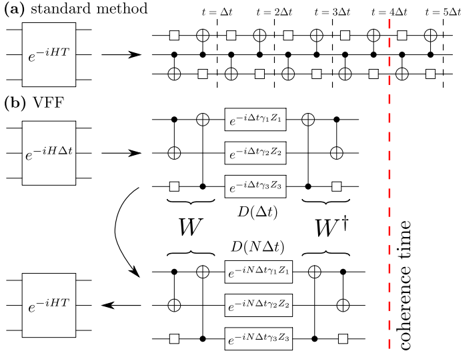
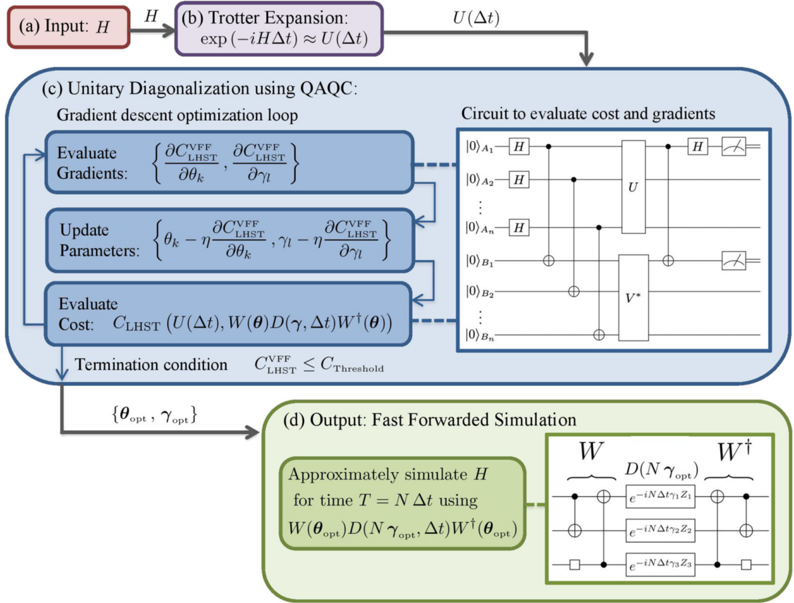
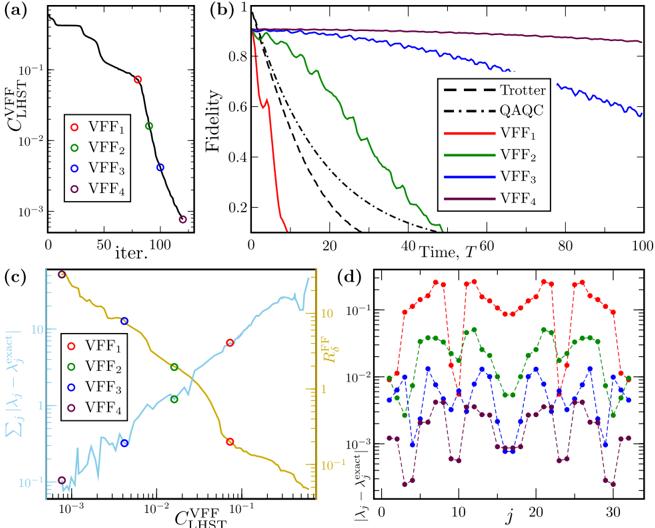
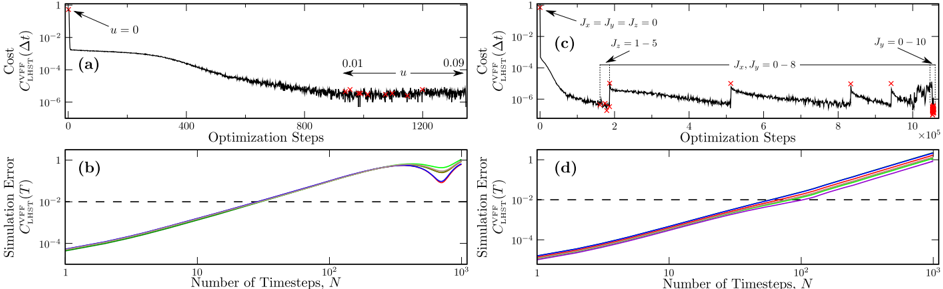
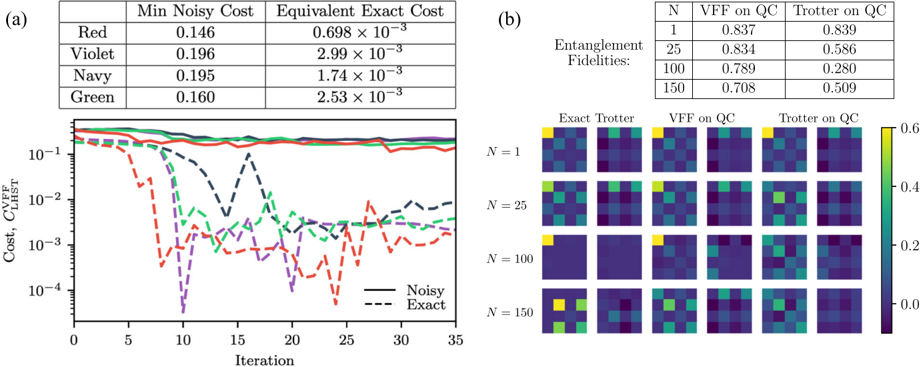
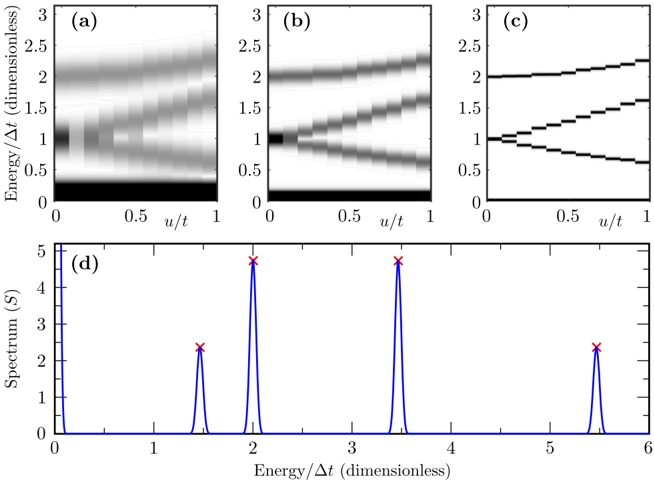
Trotterization-based, iterative approaches to quantum simulation (QS) are restricted to simulation times less than the coherence time of the quantum computer (QC), which limits their utility in the near term. Here, we present a hybrid quantum-classical algorithm, called variational fast forwarding (VFF), for decreasing the quantum circuit depth of QSs. VFF seeks an approximate diagonalization of a short-time simulation to enable longer-time simulations using a constant number of gates. Our error analysis provides two results: (1) the simulation error of VFF scales at worst linearly in the fast-forwarded simulation time, and (2) our cost function’s operational meaning as an upper bound on average-case simulation error provides a natural termination condition for VFF. We implement VFF for the Hubbard, Ising, and Heisenberg models on a simulator. In addition, we implement VFF on Rigetti’s QC to demonstrate simulation beyond the coherence time. Finally, we show how to estimate energy eigenvalues using VFF.
Overview
The claims and statistics of this paper haven’t been checked yet.
Free: it reads the open-access text and checks the first 5 claims that cite a source we can check. Create a free account to check every claim.
Integrity signals
Registry
Cites
Statistics
Figures

Verification
Claims the paper makes
The claims and statistics of this paper haven’t been checked yet.
Free: it reads the open-access text and checks the first 5 claims that cite a source we can check. Create a free account to check every claim.
Claims other papers make about this one
Each is checked against this paper’s own text: does it say what the citing paper says it does?
The source backs part of the claim, not all of it — or backs it for a different population, condition or comparison.
In the citing paper
“Similar to the idea of the SVQS, variational fast forwarding (VFF) relies on the idea of evolving a quantum state in time exp (-iHt ) within a diagonal subspace, such that an enhanced evolution time can be achieved (Cirstoiu et al. , 2020).”
From Noisy intermediate-scale quantum algorithms (2022) · cites this paper as Cirstoiu et al. , 2020
Experimental — accuracy not yet measuredThe cited source says what the claim attributes to it.
In the citing paper
“The weighted subspace VQE [110] provides an alternative way to simulate dynamics in the subspace of the low energy eigenstates [121].”
From Variational quantum algorithms (2021) · cites this paper as [121]
Self-check
Percentages, sums and reported differences re-computed from the paper’s own numbers.
The self-check needs the paper’s full text.
Citations
Cites
Simulating physics with computers
Feynman, R. P. (1982) · International Journal of Theoretical Physics · doi:10.1007/bf02650179 · Cited by 7,691
A variational eigenvalue solver on a photonic quantum processor
Peruzzo, A., McClean, J., Shadbolt, P., Yung, M.-H., Zhou, X.-Q., Love, P. J., Aspuru-Guzik, A., & O’Brien, J. L. (2014) · Nature Communications · doi:10.1038/ncomms5213 · Cited by 4,552
Two soluble models of an antiferromagnetic chain
Lieb, E., Schultz, T., & Mattis, D. (1961) · Annals of Physics · doi:10.1016/0003-4916(61)90115-4 · Cited by 4,280
Cold Bosonic Atoms in Optical Lattices
Jaksch, D., Bruder, C., Cirac, J. I., Gardiner, C. W., & Zoller, P. (1998) · Physical Review Letters · doi:10.1103/physrevlett.81.3108 · Cited by 3,685
Lloyd, S. (1996) · Science · doi:10.1126/science.273.5278.1073 · Cited by 3,088
Quantum simulations with ultracold quantum gases
Bloch, I., Dalibard, J., & Nascimbène, S. (2012) · Nature Physics · doi:10.1038/nphys2259 · Cited by 2,339
The theory of variational hybrid quantum-classical algorithms
McClean, J. R., Romero, J., Babbush, R., & Aspuru-Guzik, A. (2016) · New Journal of Physics · doi:10.1088/1367-2630/18/2/023023 · Cited by 2,227 · cited 1×
“In order to approach the issue of initializing the parameters θ and γ, we often use a perturbative method [15, 36] in which we pre-train these parameters for a slightly different Hamiltonian.”
MethodMitarai, K., Negoro, M., Kitagawa, M., & Fujii, K. (2018) · Physical Review A · doi:10.1103/physreva.98.032309 · Cited by 1,639
Cost function dependent barren plateaus in shallow parametrized quantum circuits
Cerezo, M., Sone, A., Volkoff, T., Cincio, L., & Coles, P. J. (2021) · Nature Communications · doi:10.1038/s41467-021-21728-w · Cited by 1,047
Self-citationGeneral teleportation channel, singlet fraction, and quasidistillation
Horodecki, M., Horodecki, P., & Horodecki, R. (1999) · Physical Review A · doi:10.1103/physreva.60.1888 · Cited by 965
Research works printed but not linked: 2
- Childs, A. M. & Wiebe, N. Hamiltonian simulation using linear combinations of unitary operations. Quantum Info. Comput. 12, 901-924 (2012).
- Li, Y. & Benjamin, S. C. Efficient variational quantum simulator incorporating active error minimization. Phys. Rev. X 7, 021050 (2017).
Cited by
Items 201–244 of 244
Notable Variational Algorithms: VQE, QAOA, and VQLS
Raisuddin, O. M., & De, S. (2025) · Springer eBooks · doi:10.1007/978-3-032-03325-3_36 · Cited by 1
Trotter transition in Bardeen-Cooper-Schrieffer pairing dynamics
Patra, A., Yuzbashyan, E. A., Altshuler, B. L., & Flach, S. (2025) · Physical review. E · doi:10.1103/gn7q-9byy · Cited by 2
From membership-privacy leakage to quantum machine unlearning
Su, J., He, R., Li, G., Qin, S., He, Z., Situ, H., & Gao, F. (2026) · Physical Review Applied · doi:10.1103/mdfc-pgsl · Cited by 6
Gray code based gradient-free optimization algorithm for parameterized quantum circuit
张, A. 安. Z., 武, C. 春. W., & Zhao, S. (2023) · Chinese Physics B · doi:10.1088/1674-1056/ad09cd · Cited by 2
Chen, X., Gao, P., Qiu, C.-D., Lu, Y.-N., Yang, F., Zhao, Y., Li, H., Zhang, J., Wei, S., Xing, T., et al. (2024) · New Journal of Physics · doi:10.1088/1367-2630/ad309d · Cited by 3
Variational simulation of higher-spin systems on qubit-based quantum simulators
Lyu, C., Zou, Z., Xu, X., Yung, M., & Bayat, A. (2026) · Physical Review Research · doi:10.1103/lfc9-cjqd · Cited by 3
Trade-off between bagging and boosting for quantum separability-entanglement classification
Mohanty, S. D., Patro, R. N., Biswal, P. K., Pradhan, B., & Sazim, S. (2024) · Quantum Information Processing · doi:10.1007/s11128-024-04469-9 · Cited by 1
Masoudian, A., Jakobsen, U., & Khooban, M. H. (2025) · Designs · doi:10.3390/designs9040087 · Cited by 3
Sze, M. W., Tang, Y., Dilkes, S., Ramo, D. M., Duncan, R., & Fitzpatrick, N. (2025) · Quantum Science and Technology · doi:10.1088/2058-9565/ae2292 · Cited by 8
QuaSiMo: A composable library to program hybrid workflows for quantum simulation
Nguyen, T., Oftelie, L. B., Lotshaw, P. C., Lyakh, D. I., McCaskey, A., Leyton‐Ortega, V., Pooser, R. C., Elwasif, W. R., Humble, T. S., & de Jong, W. A. (2021) · IET Quantum Communication · doi:10.1049/qtc2.12024 · Cited by 7
Quantum Simulation of Dihedral Gauge TheoriesPreprint
Alam, M. S., Hadfield, S., Lamm, H., & Li, A. C. Y. (2021) · arXiv (Cornell University) · Cited by 1
System based approach to the design of tension sensing element made of modified diamond
Dianov, S. V., & Новичков, В. М. (2020) · Civil Aviation High TECHNOLOGIES · doi:10.26467/2079-0619-2020-23-6-84-100
Gentini, L., Cuccoli, A., & Banchi, L. (2022) · Physical Review Applied · doi:10.1103/physrevapplied.18.034025 · Cited by 1
Report on scipost_202105_00027v2
Lau, J. W. Z., Haug, T., Kwek, L. C., et al. (2021) · SciPost Physics · doi:10.21468/scipost.report.3818
Hermitian matrix definiteness from quantum phase estimation
Gómez, A., & Mas, J. (2022) · Quantum Information Processing · doi:10.1007/s11128-022-03542-5 · Cited by 1
Jian, G., Yang, Y., Liu, Z., Zhu, Z., & Wang, Z.-C. (2022) · Europhysics Letters (EPL) · doi:10.1209/0295-5075/acad25
Cao, Z. (2023) · Advanced Quantum Technologies · doi:10.1002/qute.202300033
A Hybrid Quantum-Classical Algorithm for Underwater Target Classification
Wang, F., Yang, F., Li, Y., Fan, G., He, L., Liu, Y., Bai, Y., & Ya, Z. (2023) · Quantum Engineering · doi:10.1155/2023/6766820
MVITA, M. J., Zulu, N. G., Thethwayo, B., & Makhamisa, S. (2023) · International Conference on Industrial Engineering and Operations Management (IEOM) · doi:10.46254/eu6.20230207
Report on scipost_202211_00047v1
Erbanni, R., Bharti, K., Kwek, L. C., et al. (2023) · SciPost Physics · doi:10.21468/scipost.report.6592
Report on scipost_202211_00047v1
Erbanni, R., Bharti, K., Kwek, L. C., et al. (2023) · SciPost Physics · doi:10.21468/scipost.report.6495
Gyawali, G., Ahmed, M., Aspling, E. W., Ellert-Beck, L., & Lawler, M. J. (2023) · Physical review. B./Physical review. B · doi:10.1103/physrevb.108.235141 · Cited by 2
Wang, R., Zhao, R.-S., Ji, Y., Cheng, T., Fan, X., & Ma, H. (2024) · Research Square · doi:10.21203/rs.3.rs-4269684/v1
Scalable quantum dynamics compilation via quantum machine learning
Zhang, Y., Wiersema, R., Carrasquilla, J., Cincio, Ł., & Kim, Y. B. (2026) · Physical Review Research · doi:10.1103/wswv-nq6d · Cited by 25
Dechant, D., Markovich, L. A., Dunjko, V., & Tura, J. (2026) · Journal of Mathematical Physics · doi:10.1063/5.0258074 · Cited by 1
Variational Optical Phase Learning on a Continuous-Variable Quantum Compiler
Feldman, M. A., Volkoff, T. J., Hong, S., Marvinney, C. E., Holmes, Z., Pooser, R. C., Sornborger, A. T., & Marino, A. M. (2026) · PRX Quantum · doi:10.1103/7l8z-zn2m
Self-citationVariational Methods for Solving High-Dimensional Quantum Systems
Li, D. (2025) · Journal of Modern Physics · doi:10.4236/jmp.2025.165038
Quantum Advantage in Phase Unitary Learning with a Continuous-Variable Quantum Compiler
Feldman, M., Volkoff, T. J., Holmes, Z., Hong, S., Marvinney, C., Pooser, R. C., Sornborger, A. T., & Marino, A. M. (2025) · Quantum 2.0 Conference and Exhibition · doi:10.1364/quantum.2025.qw2a.5
Self-citationClassical optimization algorithms for diagonalizing quantum Hamiltonians
Li, X., Choi, S., Park, H., & Ko, T. (2025) · Physica Scripta · doi:10.1088/1402-4896/ae09de · Cited by 2
Coherence and decoherence in generalized Shor’s algorithm
叶, L. 琳. Y., Wu, Z., & 周, N. 南. Z. (2026) · Chinese Physics B · doi:10.1088/1674-1056/ae445e · Cited by 1
Efficient Classical Processing of Constant-Depth Time Evolution Circuits in Control Hardware
Francis, A., Rajagopala, A., Tubman, N. M., et al. (2025) · IEEE International Conference on Quantum Computing and Engineering (QCE) · doi:10.1109/qce65121.2025.00203
Haukisalmi, A., Ramos, D. P., Raasakka, M., Marchesin, A., Ylinen, L., & Tittonen, I. J. (2025) · Physical Review Research · doi:10.1103/x9t3-64wm · Cited by 1
Multiagent reinforcement learning for efficient variational fast-forwarding quantum circuits
Meng, F., Huang, Z., Long, Y., Luan, T., Zhang, X., Yu, X., & Zhang, Z. (2025) · Physical Review A · doi:10.1103/qrmm-z56n
A Tensor Network-Based Quantum Algorithm for the Nonlinear 1D Burgers' Equation
Meena, M. G., Jones, V., Zhang, Y., & Gao, X. (2026) · AIAA SciTech Forum · doi:10.2514/6.2026-1932 · Cited by 2
Solving Quantum Many-Body Problems on Quantum Computers
Martin, B. A. (2023) · theses.fr (ABES) · doi:10.70675/911dc194ze97bz42d2z8611z3daf90a7419c · Cited by 2
Sampling Noise and Optimized Measurement Distribution in Imaginary‐Time Quantum Dynamics Simulations
Zhang, F., Gomes, N., Aftergood, J., Iadecola, T., Yao, Y., & Orth, P. P. (2026) · Advanced Quantum Technologies · doi:10.1002/qute.70418
Beyond trotterization: Variational product formulas for quantum simulation
Assi, I. A., Vogl, M. R., Kumari, M., & LeBlanc, J. P. F. (2026) · Physical review. B./Physical review. B · doi:10.1103/941r-ql3g · Cited by 1
Fast-forwardability of qubit-mapped fermion models based on Cartan decomposition
Anonymous, Tsutsui, S., Kanasugi, S., Matsumoto, N., Maruyama, K., & Oshima, H. (2026) · Physical Review Research · doi:10.1103/zzry-8h81
Hasnaoui, H., Limongi, L., Giordani, T., Polacchi, B., Quaranta, A., Bernard, M., Sciarrino, F., & Lobino, M. (2026) · Applied Physics Reviews · doi:10.1063/5.0308063 · Cited by 2
A review of variational quantum algorithms: Insights into fault-tolerant quantum computing
Wang, Z., Huang, J., Ye, R., Li, Q., Ding, Q.-M., Huang, Y., Zhang, T., Zeng, Y., Gao, J., Yuan, X., et al. (2026) · Frontiers of Physics · doi:10.15302/frontphys.2027.023301 · Cited by 7
Circumventing query complexity barriers in learning quantum dynamics via physics-informed kernels
Wang, Y., & Zhang, L. (2026) · Quantum Science and Technology · doi:10.1088/2058-9565/ae98ec
Real-Time Simulation of Low-Energy Quantum Scattering with Quantum Circuits
Courtney, J. M., & Stancil, P. C. (2026) · The Journal of Physical Chemistry Letters · doi:10.1021/acs.jpclett.6c02134
Quantum Fast Forwarding of Non-Markovian Quantum Dynamics
Seneviratne, A., Walters, P., & Wang, F. (2026) · The Journal of Physical Chemistry Letters · doi:10.1021/acs.jpclett.6c02455
Learning Shallow Quantum Circuits
Huang, H.-Y., Liu, Y., Broughton, M., Kim, I., Anshu, A., Landau, Z. A., & McClean, J. R. (2026) · SIAM Journal on Computing · doi:10.1137/24m1689946
Metadata
- Authors
- Cîrstoiu, C., Holmes, Z., Iosue, J., Cincio, L., Coles, P. J., & Sornborger, A.
- Affiliations
- Los Alamos National Laboratory (US)
- Corresponding author
- Coles, Patrick J.
- Sornborger, Andrew
- Venue
- npj Quantum Information
- Published
- 2020-09-18
- Volume
- 6
- Issue
- 1
- ISSN
- 2056-6387 (ISSN-L)
- OpenAlex
- W2979788593
- Semantic Scholar
- 7d75089a25065dcd7d3bf8b6044ee42caf60d7c6
- Cited by
- 232
- References
- 68
- Citations by year
- 2026: 19 · 2025: 35 · 2024: 38 · 2023: 43 · 2022: 41 · 2021: 48 · 2020: 8
- FWCI
- 13.75
- Type
- journal article
- Language
- en
- Open access
- gold
- doi.org
- Licence
- cc-by
- creativecommons.org/licenses/by/4.0 (tdm)
- creativecommons.org/licenses/by/4.0 (vor)
- Locations
- npj Quantum Information (publishedVersion, cc-by)
- arXiv (Cornell University) (submittedVersion)
- OSTI OAI (U.S. Department of Energy Office of Scientific and Technical Information) (submittedVersion)
- Funders
- U.S. Department of Energy (DOE) through a quantum computing program sponsored by the LANL Information Science & Technology Institute
- DOE | Office of Science
- U.S. DOE through the J. Robert Oppenheimer fellowship
- DOE | LDRD | Los Alamos National Laboratory
- DOE ASC Beyond Moore’s Law program
- Topics
- Physical Sciences › Computer Science › Artificial Intelligence › Quantum Computing Algorithms and Architecture
- Physical Sciences › Physics and Astronomy › Atomic and Molecular Physics, and Optics › Quantum many-body systems
- Physical Sciences › Physics and Astronomy › Atomic and Molecular Physics, and Optics › Quantum Information and Cryptography
- Keywords
- quantum simulation, coherence time, hybrid quantum-classical algorithms, Trotterization, circuit depth reduction, simulation error analysis, termination conditions, Hubbard model, Ising model, Heisenberg model
About these checks
Registry, retraction, Cites and statistics results are computed, not judged, with one exception: a printed reference that no index lists is read once by a model before it counts as a citation error. Claims are extracted by a model and kept only when their quote appears verbatim in the text; each cited source is then checked, with a model’s help, for whether it says what the claim relies on. Those verdicts can be wrong — read the claim’s quote and the cited source before relying on one.
Statistics and arithmetic are recomputed, not judged.
Confidence bands are shown only for fields calibrated on our annotated test set. None is calibrated yet, so no band is shown.
What counts as a claim ›How we measure confidence ›How we check this ›
Are you an author, or do you see a problem with this page? Request a review
Data sources
Bibliographic data: Semantic Scholar, OpenAlex, Crossref.
Contains information from the Semantic Scholar Academic Graph Datasets, made available under the ODC Attribution License (ODC-BY 1.0).
Semantic Scholar’s data is described in: Kinney, R., et al. (2023). The Semantic Scholar Open Data Platform. arXiv:2301.10140.
