

Evidence for a unitary structure of spatial cognition beyond general intelligence
Open accessPublished version of a preprint
The DOI matches its Crossref record; 56 of the 57 references it cites were found in a registry or an index.
Abstract
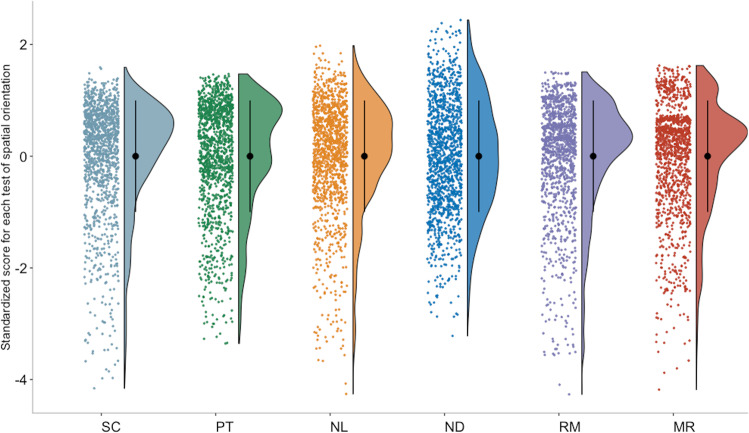
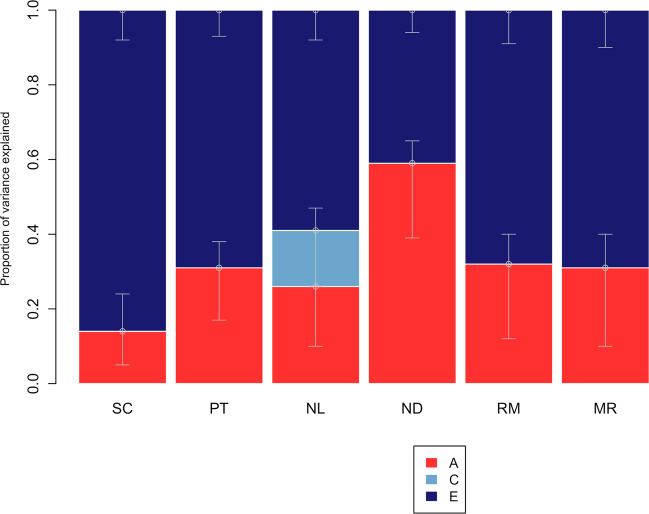
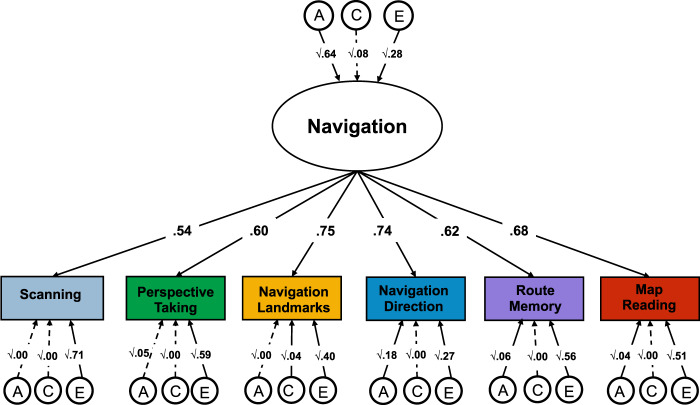
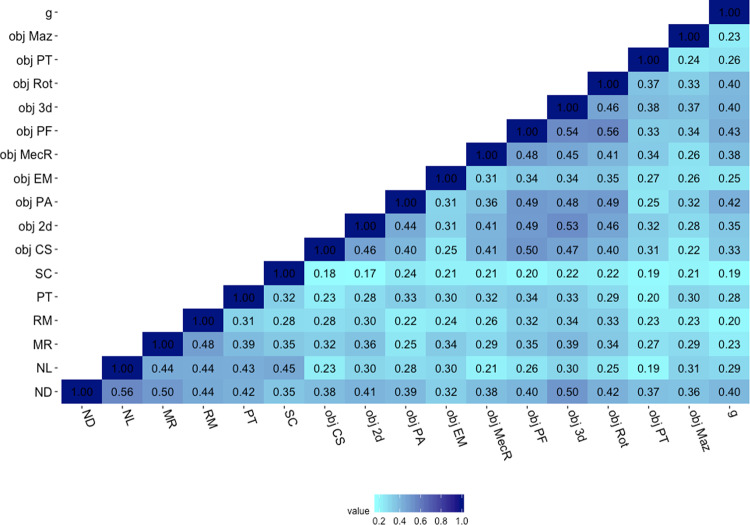
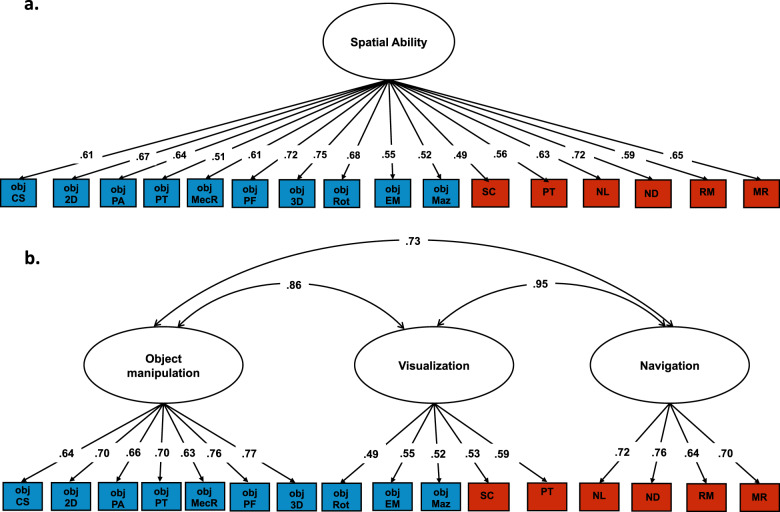
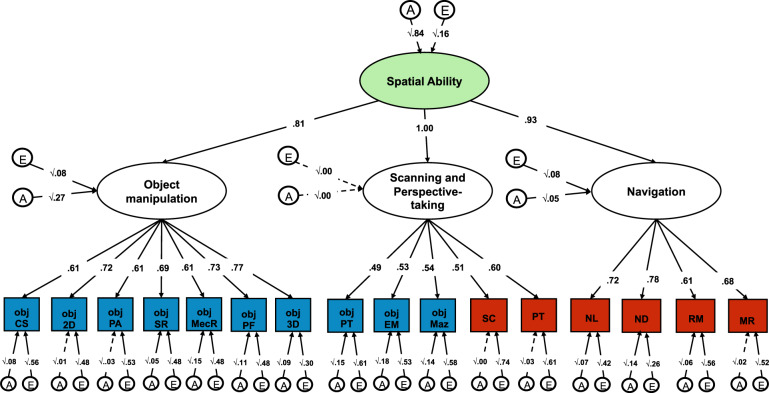
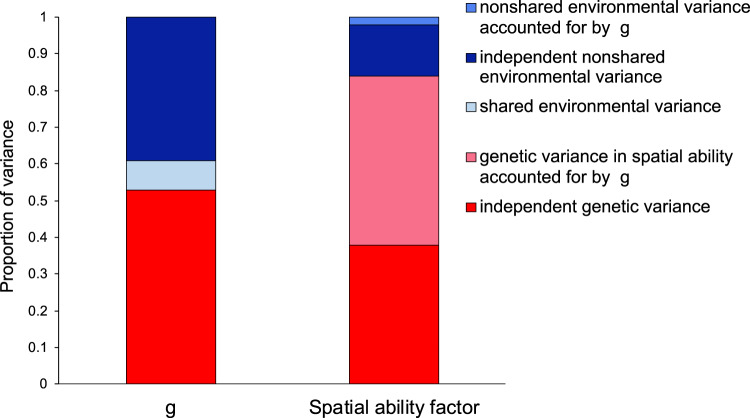
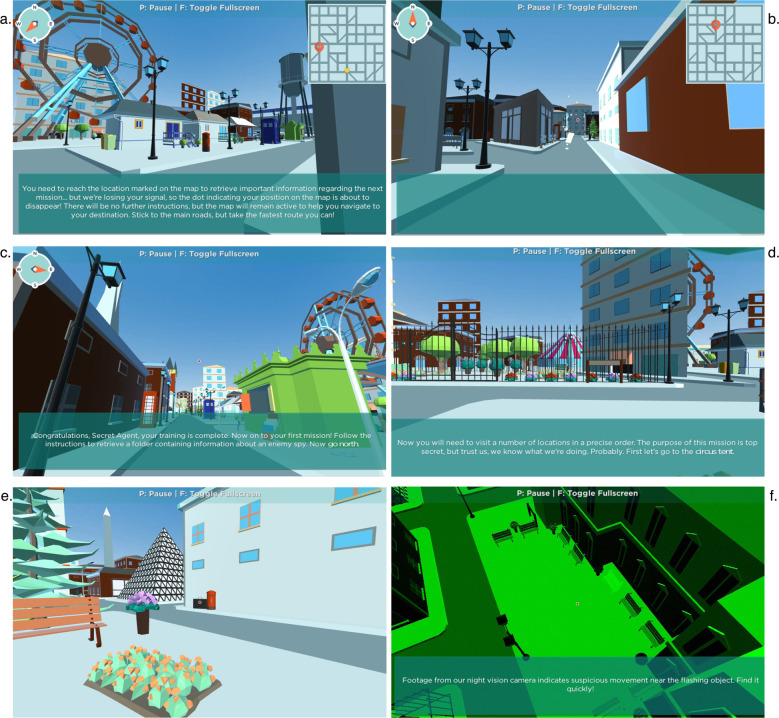
Performance in everyday spatial orientation tasks (e.g., map reading and navigation) has been considered functionally separate from performance on more abstract object-based spatial abilities (e.g., mental rotation and visualization). However, few studies have examined the link between spatial orientation and object-based spatial skills, and even fewer have done so including a wide range of spatial tests. To examine this issue and more generally to test the structure of spatial ability, we used a novel gamified battery to assess six tests of spatial orientation in a virtual environment and examined their association with ten object-based spatial tests, as well as their links to general cognitive ability ( g ). We further estimated the role of genetic and environmental factors in underlying variation and covariation in these spatial tests. Participants ( N = 2660; aged 19–22) were part of the Twins Early Development Study. The six tests of spatial orientation clustered into a single ‘ Navigation’ factor that was 64% heritable. Examining the structure of spatial ability across all 16 tests, three, substantially correlated, factors emerged: Navigation , Object Manipulation , and Visualization . These, in turn, loaded strongly onto a general factor of Spatial Ability , which was highly heritable (84%). A large portion (45%) of this high heritability was independent of g . The results point towards the existence of a common genetic network that supports all spatial abilities.
Overview
The claims and statistics of this paper haven’t been checked yet.
Free: it reads the open-access text and checks the first 5 claims that cite a source we can check. Create a free account to check every claim.
Integrity signals
Registry
Cites
Statistics
Figures
Verification
Claims the paper makes
The claims and statistics of this paper haven’t been checked yet.
Free: it reads the open-access text and checks the first 5 claims that cite a source we can check. Create a free account to check every claim.
Claims other papers make about this one
Each is checked against this paper’s own text: does it say what the citing paper says it does?
The source backs part of the claim, not all of it — or backs it for a different population, condition or comparison.
In the citing paper
“Spatial cognition, the ability to acquire, organize, exploit, and update knowledge about external space, is fundamental to both human beings and artificial intelligence (AI)1,2.”
From Brain-inspired spatial intelligence for embodied agents (2026) · cites this paper as [2]
Experimental — accuracy not yet measured
Self-check
Percentages, sums and reported differences re-computed from the paper’s own numbers.
The self-check needs the paper’s full text.
Citations
Cites
Hu, L., & Bentler, P. M. (1999) · Structural Equation Modeling A Multidisciplinary Journal · doi:10.1080/10705519909540118 · Cited by 108,788
Wickham, H. (2016) · Use R! · doi:10.1007/978-3-319-24277-4 · Cited by 33,115
Genetics of Food Intake Self-Regulation in Childhood: Literature Review and Research Opportunities
Faith, M. S., Carnell, S., & Kral, T. V. E. (2013) · Human Heredity · doi:10.1159/000353879 · Cited by 7,601
Mental Rotation of Three-Dimensional Objects
Shepard, R. N., & Metzler, J. (1971) · Science · doi:10.1126/science.171.3972.701 · Cited by 6,246
"General Intelligence," Objectively Determined and Measured
Spearman, C. (1904) · The American Journal of Psychology · doi:10.2307/1412107 · Cited by 6,207
Human Cognitive Abilities: A Survey of Factor-Analytic Studies
Carroll, J. B. (1993) · doi:10.1017/cbo9780511571312 · Cited by 4,121 · cited 2×
“15 General cognitive ability (g) only partly accounts for the genetic clustering of spatial skills 302 303 It is well established that cognitive skills correlate with each other, and that a substantial portion of variation in 304 different abilities can be accounted for by a general factor of cognitive ability (g), bo…”
BackgroundMethodAIC model selection using Akaike weights
Wagenmakers, E.-J., & Farrell, S. (2004) · Psychonomic Bulletin & Review · doi:10.3758/bf03206482 · Cited by 2,684
The malleability of spatial skills: A meta-analysis of training studies.
Uttal, D. H., Meadow, N. G., Tipton, E., Hand, L. L., Alden, A. R., Warren, C., & Newcombe, N. S. (2013) · Psychological Bulletin · doi:10.1037/a0028446 · Cited by 1,899
Wai, J., Lubinski, D., & Benbow, C. P. (2009) · Journal of Educational Psychology · doi:10.1037/a0016127 · Cited by 1,846 · cited 1×
“This test battery measures the major putative dimensions of spatial ability, and is comprised of 10 tests: (1) a mazes task (searching for a way through a 2D maze in a speeded task); (2) 2D drawing (sketching a 2D layout of a 3D object from a specified viewpoint); (3) Elithorn mazes (joining together as many dots as p…”
MethodThree-dimensional Epigenome Statistical Model: Genome-wide Chromatin Looping Prediction
Al Bkhetan, Z., & Plewczynski, D. (2018) · Scientific Reports · doi:10.1038/s41598-018-23276-8 · Cited by 1,662
Research works printed but not linked: 9
- Galton F Generic images Ninet. Century 1879 6 157 169
- Zacks JM Mires JON Tversky B Hazeltine E Mental spatial transformations of objects and perspective DISCUSSION (INTRODUCTION) Spat. Cogn. Comput. 2002 2 315 332 10.1023/A:1015584100204 · doi:10.1023/a:1015584100204
- Shelton, A. L. & Yamamoto, N. Visual memory, spatial representation, and navigationin. In Current issues in memory series. The visual world in memory (ed. Brockmole, J. R.). 140–177 (Psychology Press, 2009).
- Gaulin, S. J. C. In The Cognitive Neurosciences (ed. Gazzaniga, M. S.) 1211–1225 (The MIT Press, 1995).
- Smith P Fernandes C Strand S Cognitive Abilities Test 3 (CAT3). 2001 Windsor nferNELSON
- Raven J Raven JC Court J Manual for Raven’s Progressive Matrices and Vocabulary Scales. Raven Manual 1996 Oxford Oxford University Press
- Raven JC Raven J Court J Mill Hill Vocabulary Scale. 1998 Oxford OOP
- Martin NG Eaves LJ Stages; the first to determine the genetical and environmental model Most 1977 38 79 95
- Rijsdijk, F. V. In Encyclopedia of Statistics in Behavioral Science (eds. Everitt, B. S. & Howell, D. C.) 330–331 (John Wiley & Sons Ltd., 2005).
Cited by
Entropy of city street networks linked to future spatial navigation ability
Coutrot, A., Manley, E., Goodroe, S., Gahnstrom, C., Filomena, G., Yesiltepe, D., Dalton, R. C., Wiener, J. M., Hölscher, C., Hornberger, M., et al. (2022) · Nature · doi:10.1038/s41586-022-04486-7 · Cited by 243
“Research on brain plasticity supports the notion that experience can shape brain structure as well as function [1,2].”
Ekstrom, A. D., & Hill, P. F. (2023) · Neuron · doi:10.1016/j.neuron.2023.03.001 · Cited by 163
Spiers, H. J., Coutrot, A., & Hornberger, M. (2023) · Topics in Cognitive Science · doi:10.1111/tops.12590 · Cited by 113
“However, past research suggests a large portion of the variance in spatial navigation is separable from measures of general cognitive ability (Malanchini et al., 2020).”
BackgroundHow Can We Best Assess Spatial Skills? Practical and Conceptual Challenges
Uttal, D. H., McKee, K., Simms, N. K., Hegarty, M., & Newcombe, N. S. (2024) · Journal of Intelligence · doi:10.3390/jintelligence12010008 · Cited by 81
“More recent proposals for the structure of spatial skills include models with as few as one factor (Malanchini et al. 2020) and as many as 25 (Buckley et al. 2018).”
BackgroundNavigating Spatial Ability for Mathematics Education: a Review and Roadmap
Schenck, K. E., & Nathan, M. J. (2024) · Educational Psychology Review · doi:10.1007/s10648-024-09935-5 · Cited by 63
“In another study, Malanchini et al. (2020) administered 16 spatial tests clustered into three main sub-components: Visualization , Navigation , and Object Manipulation .”
Pouyan, A. E., Ghanbaran, A. H., & Shakibamanesh, A. (2021) · Journal of Building Engineering · doi:10.1016/j.jobe.2021.102931 · Cited by 47
Persistent gender differences in spatial ability, even in STEM experts
Сергеевна, Ц. Э., Likhanov, M. V., Budakova, A. V., Akmalov, A. F., Сабитов, И. А., Alenina, E. A., Bartseva, K. V., & Kovas, Y. V. (2023) · Heliyon · doi:10.1016/j.heliyon.2023.e15247 · Cited by 41
“Research has also shown that both genetic and environmental factors contribute to links between SA and educational and other outcomes [10,11].”
BackgroundSelf-citationIndividually tuned theta HD-tACS improves spatial performance
Zhang, D., Moraidis, A., & Klingberg, T. (2022) · Brain stimulation · doi:10.1016/j.brs.2022.10.009 · Cited by 39
Wai, J., & Lakin, J. M. (2020) · Contemporary Educational Psychology · doi:10.1016/j.cedpsych.2020.101920 · Cited by 36
Tahir, R., & Krogstie, J. (2023) · Applied Sciences · doi:10.3390/app13179508 · Cited by 36
“Santa Barbara Sense of Direction scale (SBSOD): According to [44], three substantially correlated factors emerged after examining the structure of spatial ability, and this included navigation in addition to object manipulation and visualization.”
BackgroundEvaluating and enhancing spatial cognition abilities of large language models
Yang, A., Fu, C., Jia, Q., Dong, W., Ma, M., Chen, H., Yang, F., & Wu, H. (2025) · International Journal of Geographical Information Science · doi:10.1080/13658816.2025.2490701 · Cited by 36
“To test the abilities to build the three types of knowledge, spatial cognitive experiments for humans often involve setting a ‘real’ environment, commonly supported by virtual reality (VR) technologies (Malanchini et al. 2020, Dong et al. 2022).”
The sexes do not differ in general intelligence, but they do in some specifics
Reynolds, M. R., Hajovsky, D. B., & Caemmerer, J. M. (2022) · Intelligence · doi:10.1016/j.intell.2022.101651 · Cited by 28
Using virtual global landmark to improve incidental spatial learning
Liu, J., Singh, A. K., & Lin, C. (2022) · Scientific Reports · doi:10.1038/s41598-022-10855-z · Cited by 28
Redesigning navigational aids using virtual global landmarks to improve spatial knowledge retrieval
Liu, J., Singh, A. K., Wunderlich, A., Gramann, K., & Lin, C. (2022) · npj Science of Learning · doi:10.1038/s41539-022-00132-z · Cited by 29
He, C., Boone, A. P., & Hegarty, M. (2023) · Psychonomic Bulletin & Review · doi:10.3758/s13423-023-02266-6 · Cited by 24
“…1990; Hartley et al., 2003) or angular error 1 (e.g., Hegarty et al., 2006; Ishikawa & Montello, 2006; Meilinger et al., 2014; Weisberg et al., 2014; Weisberg & Newcombe, 2018), or have measured pointing and shortcutting performance based on different environments (e.g., Malanchini et al., 2020).”
BackgroundBudakova, A. V., Likhanov, M. V., Toivainen, T., Zhurbitskiy, A. V., Sitnikova, E. O., Bezrukova, E. M., & Kovas, Y. V. (2021) · Psychology in Russia State of Art · doi:10.11621/pir.2021.0205 · Cited by 21
Self-citationFarran, E. K., Blades, M., Hudson, K. D., Sockeel, P., & Courbois, Y. (2022) · Cognitive Development · doi:10.1016/j.cogdev.2022.101153 · Cited by 23
“Recent models of spatial cognition place navigation as a central subdomain (Newcombe, 2018; Malanchini et al., 2020).”
BackgroundPapakostas, C., Troussas, C., Krouska, A., & Sgouropoulou, C. (2025) · Information · doi:10.3390/info16060429 · Cited by 16
Geography education improves spatial ability: evidence from fMRI and behavioral experiments
Dong, W., Ying, Q., Yang, T., Zhu, L., Liu, Y., & Wan, X. (2023) · Cartography and Geographic Information Science · doi:10.1080/15230406.2023.2171493 · Cited by 16
“The types of small-scale spatial ability tasks include perceptive taking and object manipulation (Malanchini et al., 2020).”
BackgroundResultRea‐Sandin, G., Oro, V., Strouse, E., Clifford, S., Wilson, M. N., Shaw, D. S., & Lemery‐Chalfant, K. (2021) · Genes Brain & Behavior · doi:10.1111/gbb.12762 · Cited by 16
“genetic factor accounted for the association between various measures of self-regulation and academic outcomes.(57,58) Genetic influences are not deterministic, as many children with a”
BackgroundThis is the way: Network perspective on targets for spatial ability development programmes
Likhanov, M. V., Павловна, М. Е., Costantini, G., Budakova, A. V., Есипенко, Е. А., Ismatullina, V. I., & Kovas, Y. V. (2022) · British Journal of Educational Psychology · doi:10.1111/bjep.12524 · Cited by 13
Self-citationLin, T. J., Buckley, J., Gumaelius, L., & Ampadu, E. (2024) · International Journal of Technology and Design Education · doi:10.1007/s10798-024-09958-7 · Cited by 12
“Similar grouping of spatial factors has also occurred empirically through structural equation modelling, with a large scale study by Malanchini et al. (2020) presenting spatial factors as grouped into object manipulation, scanning and perspective taking, and navigation factors.”
The role of the KIBRA and APOE genes in developing spatial abilities in humans
Kazantseva, A. V., Enikeeva, R. F., Davydova, Y. D., Mustafin, R. N., Takhirova, Z. R., Malykh, S. B., Lobaskova, M. M., Tikhomirova, T. N., & Khusnutdinova, E. K. (2022) · Vavilov Journal of Genetics and Breeding · doi:10.18699/vj21.097 · Cited by 13
KIBRA Gene Variant Is Associated with Ability in Chess and Science
Ahmetov, I. I., Валерьевна, В. Е., Yerdenova, M. B., Datkhabayeva, G. K., Bouzid, A., Bhamidimarri, P. M., Sharafetdinova, L. M., Egorova, E. S., Semenova, E. A., Gabdrakhmanova, L. J., et al. (2023) · Genes · doi:10.3390/genes14010204 · Cited by 10
Visualizing Cross-Sections of 3D Objects: Developing Efficient Measures Using Item Response Theory
Munns, M. E., He, C., Topete, A., & Hegarty, M. (2023) · Journal of Intelligence · doi:10.3390/jintelligence11110205 · Cited by 12
Resting State EEG Related to Mathematical Improvement After Spatial Training in Children
Zhang, D., Zaphf, A., & Klingberg, T. (2021) · Frontiers in Human Neuroscience · doi:10.3389/fnhum.2021.698367 · Cited by 12
“However, as it is difficult to hypothesize the frequency features of the training-induced changes, we used a data-driven approach to analyze spectral and coherence measures (Maris and Oostenveld, 2007).”
MethodDeterminants of individual navigation ability
Yavuz, E., & Spiers, H. J. (2026) · Nature Reviews Psychology · doi:10.1038/s44159-026-00544-3 · Cited by 9
Studying the Development of Navigation Using Virtual Environments
Nguyen, K. V., Tansan, M., & Newcombe, N. S. (2022) · Journal of Cognition and Development · doi:10.1080/15248372.2022.2133123 · Cited by 10
Likhanov, M. V., Wang, F., Lyu, J., Wang, L., & Zhou, X. (2024) · Intelligence · doi:10.1016/j.intell.2024.101875 · Cited by 9
Xiang, X., & Xi, D. (2024) · British Journal of Educational Technology · doi:10.1111/bjet.13502 · Cited by 10
Learning the layout of different environments: common or dissociated abilities?
Topete, A., He, C., & Hegarty, M. (2025) · Cognitive Research · doi:10.1186/s41235-025-00618-5 · Cited by 6
“…water maze (e.g., Padilla, et al., 2017) and Star maze (Rondi-Reig et al., 2006), and faceted navigation tasks (e.g., Iaria et al., 2003, 2007; Malanchini et al., 2020; van der Ham et al., 2020), which examine more outcome measures, including landmark and route knowledge in addition to the…”
No spatial advantage in adolescent hockey players? Exploring measure specificity and masked effects
Bartseva, K. V., Likhanov, M. V., Сергеевна, Ц. Э., Alenina, E. A., Reznichenko, I., Soldatova, E. L., & Kovas, Y. V. (2023) · Intelligence · doi:10.1016/j.intell.2023.101805 · Cited by 7
“This overlap has been attributed to overlapping genetic factors (Malanchini et al., 2020).”
InfluentialSelf-citationColombo, G., Minta, K., Thrash, T., Grübel, J., Wiener, J. M., Avraamides, M. N., Taylor, W. R., Hölscher, C., & Schinazi, V. R. (2026) · Behavior Research Methods · doi:10.3758/s13428-026-02998-y · Cited by 6
Action Predictions Facilitate Embodied Geometric Reasoning
Xia, F., Nathan, M. J., Schenck, K. E., & Swart, M. I. (2025) · Cognitive Science · doi:10.1111/cogs.70055 · Cited by 7
“We used total scores as a covariate in our analysis since evidence has revealed the existence of a common genetic network that underlies all spatial abilities (Malanchini et al., 2020).”
The impact of human agents on spatial navigation and knowledge acquisition in a virtual environment
Pacheco, T. S., Mosquera, M. S., Gärtner, K., Schmidt, V., Nolte, D., König, S. U., Pipa, G., & König, P. (2025) · Frontiers in Virtual Reality · doi:10.3389/frvir.2025.1497237 · Cited by 6
Online Short Spatial Ability Battery (OSSAB): Psychometric Norms for Older Students
Likhanov, M. V., Сергеевна, Ц. Э., & Kovas, Y. V. (2021) · Sibirskiy psikhologicheskiy zhurnal · doi:10.17223/17267080/78/7 · Cited by 7
Self-citationWard, E. M., Carlson, J. M., & Chrastil, E. R. (2025) · Cognition · doi:10.1016/j.cognition.2025.106144 · Cited by 5
“…also associated with navigational performance (Fan, Abdi, & Levine, 2021; Fields & Shelton, 2006; He, Han, Churaman, & Brown, 2021; Korthauer, Nowak, Frahmand, & Driscoll, 2017; Malanchini et al., 2020; Ngo, Weisberg, Newcombe, & Olson, 2016; Weisberg & Newcombe, 2016; Wen, Ishikawa, & Sato, 2011).”
Flø, E. E., & Smedsrud, J. H. (2025) · Frontiers in Psychology · doi:10.3389/fpsyg.2025.1545603 · Cited by 5
“Spatial ability originated from psychometric testing as a spatial factor separate from general intelligence (Mohler, 2008; Malanchini et al., 2020).”
Liu, C., Wei, Z., Liao, H., & Dong, W. (2026) · Transactions in GIS · doi:10.1111/tgis.70189 · Cited by 9
Graded encoding of spatial novelty scales in the human brain
Quent, J. A., Song, L., Liang, X., Su, Y., Yu, W., Wang, H., & Vatansever, D. (2025) · Nature Communications · doi:10.1038/s41467-025-67012-z · Cited by 7
“This spatial cognitive ability not only enhances related skills such as object manipulation and visualisation 4 , but is also crucial for healthy brain function, with its impairment showing notable links to memory disorders 5 – 8 .”
Orefice, C., Cardillo, R., Lonciari, I., Zoccante, L., & Mammarella, I. C. (2024) · Frontiers in Psychology · doi:10.3389/fpsyg.2024.1349851 · Cited by 7
“…Ungerleider and Mishkin, 1982; Linn and Petersen, 1985; Uttal et al., 2013; Rimfeld et al., 2017), to date there is no evidence for a shared conception nor for a definition of these abilities, as well as for an account of the underlying processes (Malanchini et al., 2020; Munns et al., 2022).”
BackgroundRekers, S., & Niedeggen, M. (2022) · PLoS ONE · doi:10.1371/journal.pone.0270563 · Cited by 4
“Considering this effect of education, future studies using this novel paradigm should examine which cognitive tests show distinct relationships with the navigation assessment beyond the effect of general cognitive ability, which has been shown to correlate with spatial skills [59].”
BackgroundApplicability of the Online Short Spatial Ability Battery to university students testing
Bartseva, K. V., Likhanov, M. V., Soldatova, E. L., Сергеевна, Ц. Э., Alenina, E. A., & Kovas, Y. V. (2023) · The Education and science journal · doi:10.17853/1994-5639-2023-10-183-204 · Cited by 4
Self-citationLiao, W., Keser, E., Allegrini, A. G., Rimfeld, K., Plomin, R. J., & Malanchini, M. (2025) · Biological Psychiatry Global Open Science · doi:10.1016/j.bpsgos.2025.100680 · Cited by 3
Self-citationGuo, Y., Zhang, M., Gu, J., Liu, Q., Liu, X., Wang, J., Ma, F., Zhai, L., Qi, J., & Jin, Z. (2025) · Frontiers in Psychology · doi:10.3389/fpsyg.2024.1494048 · Cited by 4
Gaižauskaitė, R., Zelionkaitė, I., & Grikšienė, R. (2025) · Behavioural Brain Research · doi:10.1016/j.bbr.2025.115520 · Cited by 3
Challenges and further directions of research on spatial thinking strategies
Bartseva, K. V., Likhanov, M. V., & Soldatova, E. L. (2023) · Bulletin of Kemerovo State University Series Humanities and Social Sciences · doi:10.21603/2542-1840-2023-7-4-383-398 · Cited by 3
Spatial skills: Envisioning a third dimension in test-based accountability
Wai, J. (2025) · Discover Education · doi:10.1007/s44217-025-00968-8 · Cited by 2
“…for long-term educational and occupational outcomes has combined different spatial measures into an aggregate construct [47, 81], and researchers using twins (thus controlling for important potential confounds: Hart et al. [34]) have argued that the structure of spatial abilities is unitary [57].”
Buckley, J., Sorby, S., Duffy, G., Maresch, G., & Power, J. (2026) · Educational Psychology Review · doi:10.1007/s10648-026-10149-0 · Cited by 3
Map-based navigation: Individual differences in perspective taking and path integration
Jetter, C., He, C., Tu, A. S., Starrett, M. J., Chrastil, E. R., & Hegarty, M. (2026) · Neuropsychologia · doi:10.1016/j.neuropsychologia.2026.109476 · Cited by 3
Hyland, T., Seery, N., & Buckley, J. (2024) · European Journal of Engineering Education · doi:10.1080/03043797.2024.2405860 · Cited by 3
“This has remained an on-going agenda, with a recent large scale study providing evidence for a general factor of spatial ability which is independent of g (Malanchini et al. 2020).”
Expression of CRY2 Gene in the Brain Is Related to Human Navigation
Xu, S., Kong, X., & Liu, J. (2021) · Frontiers in Radiology · doi:10.3389/fradi.2021.731070 · Cited by 2
Individual differences in spatial navigation: A multi-scale perspective
ZHANG, F., Meixuan, C. H. E. N., Pu, Y., & Kong, X. (2023) · Advances in Psychological Science · doi:10.3724/sp.j.1042.2023.01642 · Cited by 4
Brain-inspired spatial intelligence for embodied agents
Ruan, S., Wang, L., Kang, C., Zhu, Q., Liu, S., Wei, X., & Su, H. (2026) · Nature Communications · doi:10.1038/s41467-026-74358-5 · Cited by 1
“Spatial cognition, the ability to acquire, organize, exploit, and update knowledgeaboutexternalspace,isfundamentaltobothhumanbeings andarti fi cialintelligence(AI) 1,2 .”
Charting the Cognitive Development of Children Using Adult ‘Polygenic g Scores’
Lin, Y., & Plomin, R. J. (2026) · Intelligence & Cognitive Abilities · doi:10.65550/001c.160052 · Cited by 2
Self-citationIncorporating motor preparation time transforms micro-offline gains into micro-offline losses
Ahmed, N., Suresh, T., Hussain, S. J., & Freedberg, M. (2026) · Journal of Neurophysiology · doi:10.1152/jn.00181.2026 · Cited by 1
Motor learning under mental fatigue: the compensatory role of rest periodsPreprint
Ruffino, C., Jacquet, T., Lepers, R., Papaxanthis, C., & Truong, C. (2026) · bioRxiv (Cold Spring Harbor Laboratory) · doi:10.64898/2026.03.21.713370 · Cited by 1
Александрович, Х. Н., Fyodorova, E. D., Zhalnina, A. D., & Maslova, K. (2021) · Clinical Psychology and Special Education · doi:10.17759/cpse.2021100214
“В другой работе [17] было пок азано, что результаты пространственных тестов можно свести к факторам «Навигация», «Манипуляция объектами» и «Визуализация», за которыми стоит общий фактор пространственных способностей.”
Cauffman, S. J., Cohen, M. C., Yin, X., Demir, M., Huang, L., & Cooke, N. J. (2022) · Proceedings of the Human Factors and Ergonomics Society Annual Meeting · doi:10.1177/1071181322661189 · Cited by 2
Disorders of human spatial navigation: Developmental Topographical Disorientation
Iaria, G., & Burles, F. (2023) · Elsevier eBooks · doi:10.1016/b978-0-12-820480-1.00009-7
Distinct roles of brain network flexibility in motor learning across age
Uehara, K., Hagihara, M., & Kitajo, K. (2026) · Imaging Neuroscience · doi:10.1162/imag.a.1359
The effect of internal and external visualization of rotation on postural stability
Jost, L., Siebertz, M., Hofmann, P., & Jansen, P. (2024) · Frontiers in Cognition · doi:10.3389/fcogn.2024.1356441
Markouzis, D. (2021) · Institutional Repository Hellanicus · doi:10.26215/heal.uoa.300 · Cited by 1
Newton, C. (2023) · Apollo (University of Cambridge) · doi:10.17863/cam.93912 · Cited by 1
Léger, G. P. L. (2024) · Archive ouverte UNIGE (University of Geneva)
Hahku-mentorit oppimisen ja arjen tukena
Ahvonen, M. (2021) · Jyväskylä University Digital Archive (University of Jyväskylä)
Bridging Policy and Practice in Spatial Ability Development : A Curriculum and Teaching Inquiry
Lin, T. J. (2025) · KTH Publication Database DiVA (KTH Royal Institute of Technology)
Toisen asteen ammattilaisten kertomusten välittämiä kokemuksia Hahku-mentorikoulutuksesta
Naukkarinen, M. (2021) · Jyväskylä University Digital Archive (University of Jyväskylä)
Smederevac, S., Sadiković, S., Dinić, B. M., Milovanović, I. Z., & Pajić, D. (2026) · Twin Research and Human Genetics · doi:10.1017/thg.2026.10045
“Beyond personality traits, future research may extend to studies of spatial orientation (Malanchini et al., 2020) or various aspects of social interaction (Rosén et al., 2022).”
Fibonacci, A., Kadarohman, A., Hernani, H., Roslan, R., & Drastisianti, A. (2025) · Journal of Learning Improvement and Lesson Study · doi:10.24036/jlils.v5i2.171
Disciplinary trends in spatial concept associations: a multifaceted analysis of student responses
Özkaya, A., Turan, S., Uzun, A., & AKHAN, O. (2026) · Frontiers in Psychology · doi:10.3389/fpsyg.2026.1745600
“Core abilities such as mental rotation, visualization, and navigation are not only vital for everyday functioning but also for advanced reasoning in mathematics, science, and geography (Malanchini et al., 2020; Ishikawa, 2021; Hsing et al., 2022).”
Measurement of Spatial Ability: Reevaluating and Revising Measures of Mental Rotation
Munns, M. E., & Hegarty, M. (2026) · Intelligence · doi:10.1016/j.intell.2026.102040
Shared and distinct cognitive processes across multiple virtual navigation tasks
Chandreswaran, V., Stawarczyk, D., Bierbrauer, A., Clewett, D., Brunec, I. K., Coughlan, G., Davachi, L., Spiers, H. J., Hornberger, M., Silva, M., et al. (2026) · iScience · doi:10.1016/j.isci.2026.117592
“Malanchini et al. 24 applied factor-analytic methods to a large battery of spatial tasks and identified three substantially correlated factors, navigation, object manipulation, and visualization, which in turn loaded strongly onto a higher-order general spatial ability factor.”
Hasu, K., & Hannuksela, S. (2026) · Jyväskylä University Digital Archive (University of Jyväskylä)
Zhou, Y., Long, Y., Yao, S., Zhang, J., Chen, Y., Wang, R., & Chang, M. (2026) · Frontiers in Human Neuroscience · doi:10.3389/fnhum.2026.1844920
“…approach has been successfully applied to identify more efficient and integrated network structures underlying expertise in related domains, including intelligence and motor skills, pinpointing core hubs and functional modules within those systems (Malanchini et al., 2020; Vagnetti et al., 2025).”
InfluentialOvarian Hormones and Their Impacts on Spatial Learning and Navigation
Topete, A. (2026) · eScholarship (California Digital Library)
Baykal, G. E., Leylekoğlu, A., Arslan, S., & Özer, D. (2026) · Nordic Conference on Human-Computer Interaction · doi:10.1145/3821402.3830116
Spatial talk in the home environment during semi-structured play
Mix, K. S., Urioste-Resta, M., Terry, V. A., Cabrera, N., Reich, S. M., & Alonso, A. (2026) · Early Child Development and Care · doi:10.1080/03004430.2026.2742251
Cattáneo, A., Candido, V., & van der Meij, H. (2026) · Computers in Human Behavior Reports · doi:10.1016/j.chbr.2026.101397
Munns, M. E., Nelson, M., He, C., Topete, A., Rashidi, M., Chrastil, E. R., & Hegarty, M. (2026) · Journal of Environmental Psychology · doi:10.1016/j.jenvp.2026.103286
Metadata
- Authors
- Malanchini, M., Rimfeld, K., Shakeshaft, N. G., McMillan, A., Schofield, K. L., Rodic, M., Rossi, V., Kovas, Y., Dale, P. S., Tucker-Drob, E. M., & Plomin, R.
- Affiliations
- Queen Mary University of London (GB)
- King's College London (GB)
- Goldsmiths University of London (GB)
- University of New Mexico (US)
- Corresponding author
- Malanchini, Margherita
- ORCID
- Venue
- npj Science of Learning
- Published
- 2020-07-02
- Volume
- 5
- Issue
- 1
- Pages
- 9-9
- ISSN
- 2056-7936 (ISSN-L)
- PMC
- PMC7331750
- OpenAlex
- W3039505794
- Cited by
- 69
- References
- 57
- Citations by year
- 2026: 15 · 2025: 12 · 2024: 8 · 2023: 13 · 2022: 11 · 2021: 8 · 2020: 2
- FWCI
- 3.14
- Type
- journal article
- Language
- en
- Open access
- gold
- doi.org
- Licence
- cc-by
- creativecommons.org/licenses/by/4.0 (tdm)
- creativecommons.org/licenses/by/4.0 (vor)
- Locations
- npj Science of Learning (publishedVersion, cc-by)
- bioRxiv (Cold Spring Harbor Laboratory) (acceptedVersion, cc-by-nc-nd)
- PubMed Central (publishedVersion, cc-by)
- PubMed (publishedVersion)
- Goldsmiths (University of London) (submittedVersion)
- Queen Mary Research Online (Queen Mary University of London) (submittedVersion, cc-by)
- Funders
- RCUK | Medical Research Council (MR/M021475/1)
- Topics
- Social Sciences › Psychology › Experimental and Cognitive Psychology › Spatial Cognition and Navigation
- Social Sciences › Psychology › Experimental and Cognitive Psychology › Cognitive Abilities and Testing
- Social Sciences › Psychology › Developmental and Educational Psychology › Cognitive and developmental aspects of mathematical skills
- Keywords
- spatial ability, spatial cognition, general intelligence, heritability, genetic factors, environmental factors, spatial orientation, navigation, mental rotation, spatial visualization, object manipulation, map reading, factor structure, Twins Early Development Study, gamified assessment, virtual worlds
About these checks
Registry, retraction, Cites and statistics results are computed, not judged, with one exception: a printed reference that no index lists is read once by a model before it counts as a citation error. Claims are extracted by a model and kept only when their quote appears verbatim in the text; each cited source is then checked, with a model’s help, for whether it says what the claim relies on. Those verdicts can be wrong — read the claim’s quote and the cited source before relying on one.
Statistics and arithmetic are recomputed, not judged.
Confidence bands are shown only for fields calibrated on our annotated test set. None is calibrated yet, so no band is shown.
What counts as a claim ›How we measure confidence ›How we check this ›
Are you an author, or do you see a problem with this page? Request a review
Data sources
Bibliographic data: Semantic Scholar, OpenAlex, Crossref.
Contains information from the Semantic Scholar Academic Graph Datasets, made available under the ODC Attribution License (ODC-BY 1.0).
Semantic Scholar’s data is described in: Kinney, R., et al. (2023). The Semantic Scholar Open Data Platform. arXiv:2301.10140.
