

Evidence for a unitary structure of spatial cognition beyond general intelligence
Open accessPublished version of a preprint
The DOI matches its Crossref record; 56 of the 57 references it cites were found in a registry or an index.
Abstract
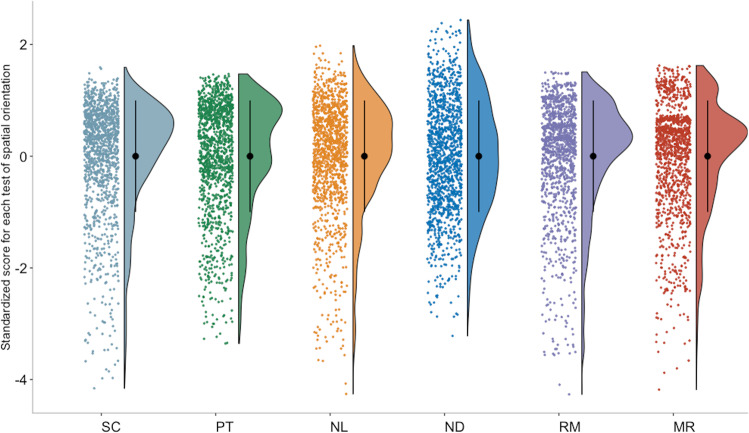
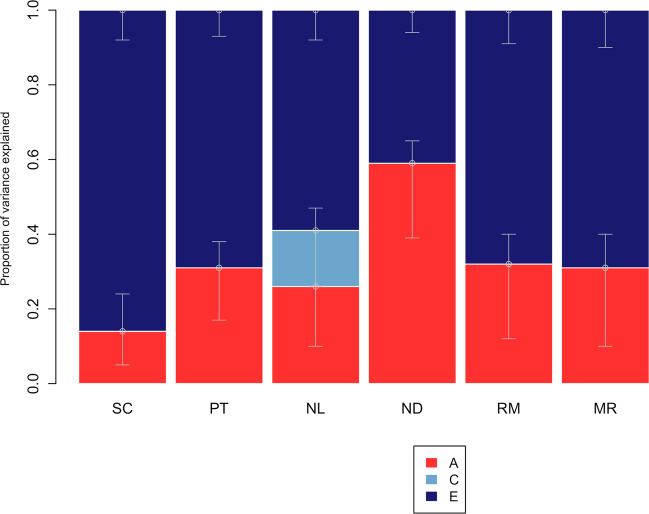
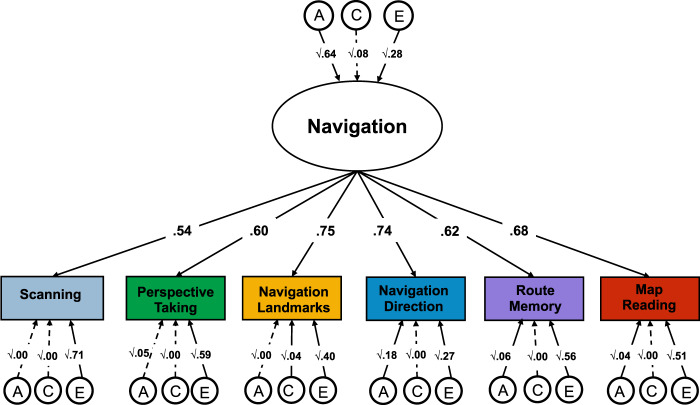
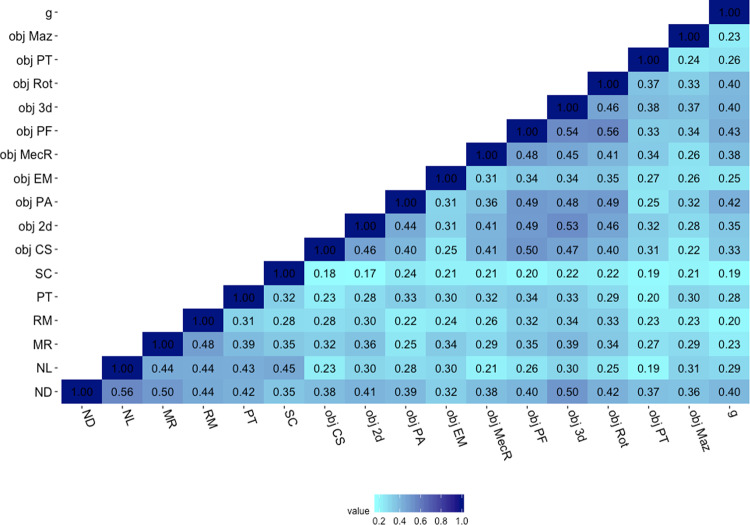
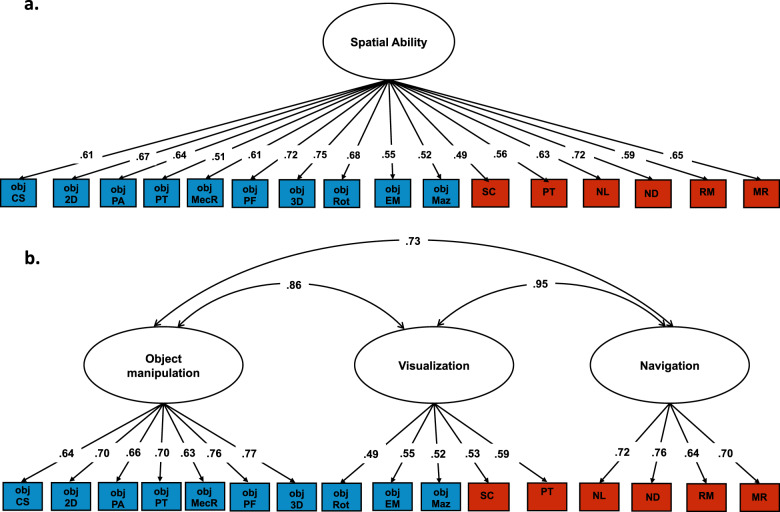
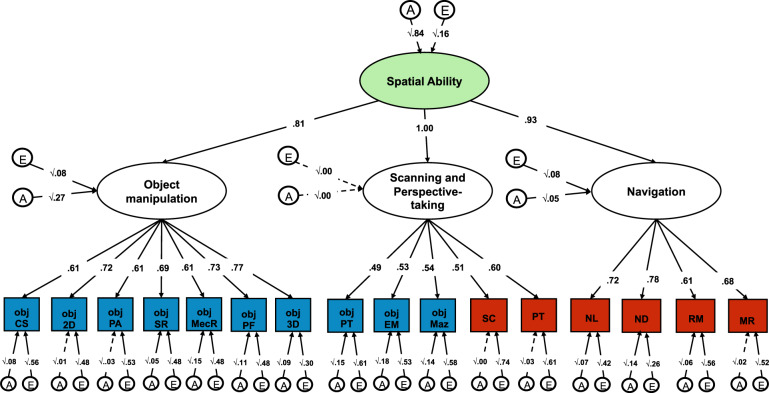
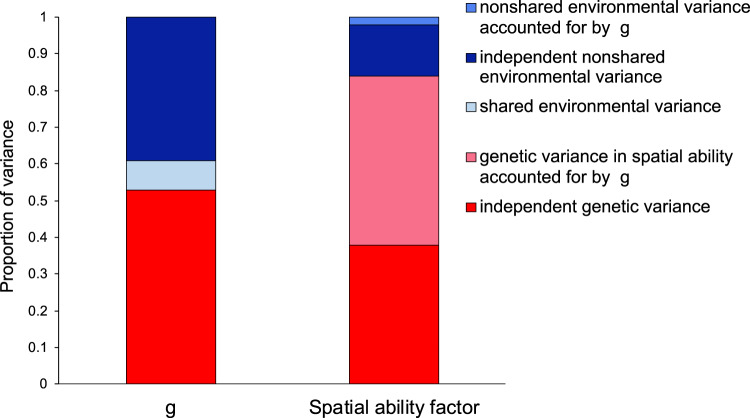
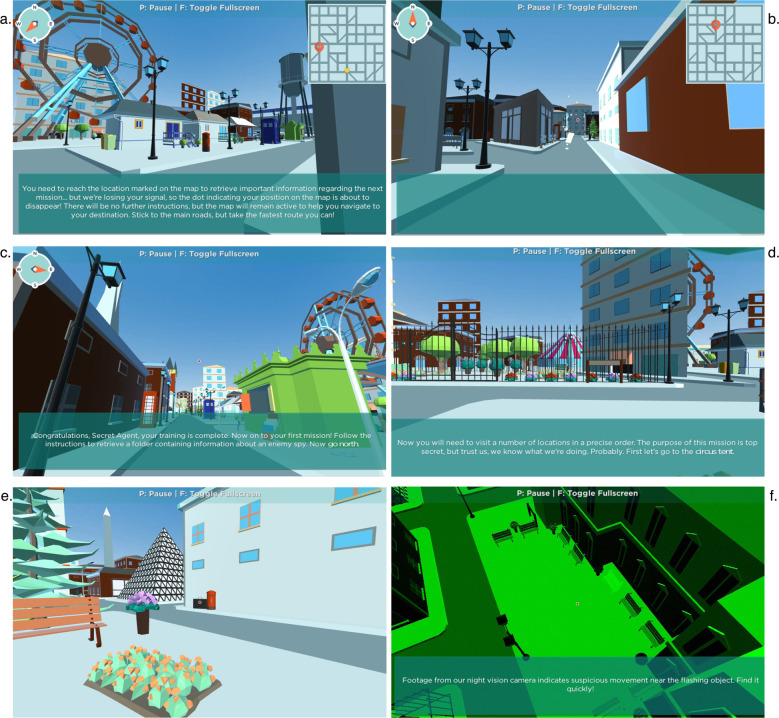
Performance in everyday spatial orientation tasks (e.g., map reading and navigation) has been considered functionally separate from performance on more abstract object-based spatial abilities (e.g., mental rotation and visualization). However, few studies have examined the link between spatial orientation and object-based spatial skills, and even fewer have done so including a wide range of spatial tests. To examine this issue and more generally to test the structure of spatial ability, we used a novel gamified battery to assess six tests of spatial orientation in a virtual environment and examined their association with ten object-based spatial tests, as well as their links to general cognitive ability ( g ). We further estimated the role of genetic and environmental factors in underlying variation and covariation in these spatial tests. Participants ( N = 2660; aged 19–22) were part of the Twins Early Development Study. The six tests of spatial orientation clustered into a single ‘ Navigation’ factor that was 64% heritable. Examining the structure of spatial ability across all 16 tests, three, substantially correlated, factors emerged: Navigation , Object Manipulation , and Visualization . These, in turn, loaded strongly onto a general factor of Spatial Ability , which was highly heritable (84%). A large portion (45%) of this high heritability was independent of g . The results point towards the existence of a common genetic network that supports all spatial abilities.
Overview
The claims and statistics of this paper haven’t been checked yet.
Free: it reads the open-access text and checks the first 5 claims that cite a source we can check. Create a free account to check every claim.
Integrity signals
Registry
Cites
Statistics
Figures
Verification
Claims the paper makes
The claims and statistics of this paper haven’t been checked yet.
Free: it reads the open-access text and checks the first 5 claims that cite a source we can check. Create a free account to check every claim.
Claims other papers make about this one
Each is checked against this paper’s own text: does it say what the citing paper says it does?
The source backs part of the claim, not all of it — or backs it for a different population, condition or comparison.
In the citing paper
“Spatial cognition, the ability to acquire, organize, exploit, and update knowledge about external space, is fundamental to both human beings and artificial intelligence (AI)1,2.”
From Brain-inspired spatial intelligence for embodied agents (2026) · cites this paper as [2]
Experimental — accuracy not yet measured
Self-check
Percentages, sums and reported differences re-computed from the paper’s own numbers.
The self-check needs the paper’s full text.
Citations
Cites
Hu, L., & Bentler, P. M. (1999) · Structural Equation Modeling A Multidisciplinary Journal · doi:10.1080/10705519909540118 · Cited by 108,788
Wickham, H. (2016) · Use R! · doi:10.1007/978-3-319-24277-4 · Cited by 33,115
Genetics of Food Intake Self-Regulation in Childhood: Literature Review and Research Opportunities
Faith, M. S., Carnell, S., & Kral, T. V. E. (2013) · Human Heredity · doi:10.1159/000353879 · Cited by 7,601
Mental Rotation of Three-Dimensional Objects
Shepard, R. N., & Metzler, J. (1971) · Science · doi:10.1126/science.171.3972.701 · Cited by 6,246
"General Intelligence," Objectively Determined and Measured
Spearman, C. (1904) · The American Journal of Psychology · doi:10.2307/1412107 · Cited by 6,207
Human Cognitive Abilities: A Survey of Factor-Analytic Studies
Carroll, J. B. (1993) · doi:10.1017/cbo9780511571312 · Cited by 4,121 · cited 2×
“15 General cognitive ability (g) only partly accounts for the genetic clustering of spatial skills 302 303 It is well established that cognitive skills correlate with each other, and that a substantial portion of variation in 304 different abilities can be accounted for by a general factor of cognitive ability (g), bo…”
BackgroundMethodAIC model selection using Akaike weights
Wagenmakers, E.-J., & Farrell, S. (2004) · Psychonomic Bulletin & Review · doi:10.3758/bf03206482 · Cited by 2,684
The malleability of spatial skills: A meta-analysis of training studies.
Uttal, D. H., Meadow, N. G., Tipton, E., Hand, L. L., Alden, A. R., Warren, C., & Newcombe, N. S. (2013) · Psychological Bulletin · doi:10.1037/a0028446 · Cited by 1,899
Wai, J., Lubinski, D., & Benbow, C. P. (2009) · Journal of Educational Psychology · doi:10.1037/a0016127 · Cited by 1,846 · cited 1×
“This test battery measures the major putative dimensions of spatial ability, and is comprised of 10 tests: (1) a mazes task (searching for a way through a 2D maze in a speeded task); (2) 2D drawing (sketching a 2D layout of a 3D object from a specified viewpoint); (3) Elithorn mazes (joining together as many dots as p…”
MethodThree-dimensional Epigenome Statistical Model: Genome-wide Chromatin Looping Prediction
Al Bkhetan, Z., & Plewczynski, D. (2018) · Scientific Reports · doi:10.1038/s41598-018-23276-8 · Cited by 1,662
Individual differences in executive functions are almost entirely genetic in origin.
Friedman, N. P., Miyake, A., Young, S. E., DeFries, J. C., Corley, R. P., & Hewitt, J. K. (2008) · Journal of Experimental Psychology: General · doi:10.1037/0096-3445.137.2.201 · Cited by 1,547
OpenMx: An Open Source Extended Structural Equation Modeling Framework
Boker, S., Neale, M., Maes, H., Wilde, M., Spiegel, M., Brick, T., Spies, J., Estabrook, R., Kenny, S., Bates, T., et al. (2011) · Psychometrika · doi:10.1007/s11336-010-9200-6 · Cited by 1,163
Perceiving Layout and Knowing Distances
Cutting, J. E., & Vishton, P. M. (1995) · Perception of Space and Motion · doi:10.1016/b978-012240530-3/50005-5 · Cited by 1,029
Hegarty, M., Montello, D. R., Richardson, A. E., Ishikawa, T., & Lovelace, K. (2006) · Intelligence · doi:10.1016/j.intell.2005.09.005 · Cited by 820
Genetics and intelligence differences: five special findings
Plomin, R., & Deary, I. J. (2015) · Molecular Psychiatry · doi:10.1038/mp.2014.105 · Cited by 702
Self-citationA dissociation between object manipulation spatial ability and spatial orientation ability
Kozhevnikov, M., & Hegarty, M. (2001) · Memory & Cognition · doi:10.3758/bf03200477 · Cited by 629 · cited 1×
“Consistent with this account we observed a partial differentiation between object-based spatial tests, 375 such as mental rotation, that are largely concerned with the intrinsic properties of objects, and visualization 376 tests, such as perspective taking and scanning, which are largely concerned with extrinsic relat…”
MethodIndividual Differences in Spatial Abilities
Hegarty, M., & Waller, D. A. (2005) · The Cambridge Handbook of Visuospatial Thinking · doi:10.1017/cbo9780511610448.005 · Cited by 575
Mackintosh, N. J. (1998) · Cited by 546
When is early visual cortex activated during visual mental imagery?
Kosslyn, S. M., & Thompson, W. L. (2003) · Psychological Bulletin · doi:10.1037/0033-2909.129.5.723 · Cited by 515 · cited 1×
“60 Object-based spatial skills, and particularly mental rotation ability, were found to be primarily associated with 61 activation of the parietal lobes.(26) Conversely, variation in learning and remembering the layout of large-scale 62 spaces has been found to be related to processing in the hippocampus and the media…”
BackgroundSex Differences in Spatial Abilities: Evolutionary Theory and Data
Silverman, I., & Eals, M. (1992) · The Adapted Mind · doi:10.1093/oso/9780195060232.003.0015 · Cited by 508
Tuan, Y.-F., & Ittelson, W. H. (1974) · Geographical Review · doi:10.2307/213804 · Cited by 484
ACE-inhibition induces a cardioprotective transcriptional response in the metabolic syndrome heart
Yakubova, A., Thorrez, L., Svetlichnyy, D., Zwarts, L., Vulsteke, V., Laenen, G., Oosterlinck, W., Moreau, Y., Dehaspe, L., Van Houdt, J., et al. (2018) · Scientific Reports · doi:10.1038/s41598-018-34547-9 · Cited by 397
Thinking About Spatial Thinking: New Typology, New Assessments
Newcombe, N. S., & Shipley, T. F. (2015) · Studying Visual and Spatial Reasoning for Design Creativity · doi:10.1007/978-94-017-9297-4_10 · Cited by 332
Spatial ability and STEM: A sleeping giant for talent identification and development
Lubinski, D. (2010) · Personality and Individual Differences · doi:10.1016/j.paid.2010.03.022 · Cited by 314
A Twin Study of Recent Life Events and Difficulties
Kendler, K. S. (1993) · Archives of General Psychiatry · doi:10.1001/archpsyc.1993.01820220041005 · Cited by 306
The Cambridge handbook of visuospatial thinking
(2006) · Choice Reviews Online · doi:10.5860/choice.43-5569 · Cited by 295
Morand‐Ferron, J., Cole, E. F., & Quinn, J. L. (2016) · Biological Reviews · doi:10.1111/brv.12174 · Cited by 289 · cited 3×
“This test battery measures the major putative dimensions of spatial ability, and is comprised of 10 tests: (1) a mazes task (searching for a way through a 2D maze in a speeded task); (2) 2D drawing (sketching a 2D layout of a 3D object from a specified viewpoint); (3) Elithorn mazes (joining together as many dots as p…”
BackgroundMethodThe evolution of sex differences in spatial ability.
Jones, C. M., Braithwaite, V. A., & Healy, S. D. (2003) · Behavioral Neuroscience · doi:10.1037/0735-7044.117.3.403 · Cited by 288
Creativity and Technical Innovation: Spatial Ability’s Unique Role
Kell, H. J., Lubinski, D., Benbow, C. P., & Steiger, J. H. (2013) · Psychological Science · doi:10.1177/0956797613478615 · Cited by 286
Emergence and Characterization of Sex Differences in Spatial Ability: A Meta-Analysis
Linn, M. C., & Petersen, A. C. (1985) · Child Development · doi:10.1111/j.1467-8624.1985.tb00213.x · Cited by 264
Haworth, C. M. A., Davis, O. S. P., & Plomin, R. (2013) · Twin Research and Human Genetics · doi:10.1017/thg.2012.91 · Cited by 259
Self-citationSex differences in spatial ability and spatial activities
Newcombe, N., Bandura, M. M., & Taylor, D. G. (1983) · Sex Roles · doi:10.1007/bf00289672 · Cited by 243
Tucker-Drob, E. M., & Briley, D. A. (2014) · Psychological Bulletin · doi:10.1037/a0035893 · Cited by 218
Self-citationSex Differences in Spatial Cognition: Advancing the Conversation
Levine, S. C., Foley, A., Lourenco, S., Ehrlich, S., & Ratliff, K. (2016) · WIREs Cognitive Science · doi:10.1002/wcs.1380 · Cited by 209
Spatial ability: A neglected dimension in talent searches for intellectually precocious youth.
Webb, R. M., Lubinski, D., & Benbow, C. P. (2007) · Journal of Educational Psychology · doi:10.1037/0022-0663.99.2.397 · Cited by 207 · cited 2×
“This test battery measures the major putative dimensions of spatial ability, and is comprised of 10 tests: (1) a mazes task (searching for a way through a 2D maze in a speeded task); (2) 2D drawing (sketching a 2D layout of a 3D object from a specified viewpoint); (3) Elithorn mazes (joining together as many dots as p…”
BackgroundMethodPredicting environmental learning from spatial abilities: An indirect route
Allen, G. L., Kirasic, K. C., Dobson, S. H., Long, R. G., & Beck, S. (1996) · Intelligence · doi:10.1016/s0160-2896(96)90026-4 · Cited by 194
McCarthy Scales of Children’s Abilities
Sands, R., & D’Amato, R. C. (2017) · Springer eBooks · doi:10.1007/978-3-319-56782-2_1462-3 · Cited by 189
McCarthy Scales of Children's Abilities
Davis, E. E. (1974) · TPGA Journal · doi:10.1080/03643409.1974.12033899 · Cited by 187
Buckley, J., Seery, N., & Canty, D. (2018) · Educational Psychology Review · doi:10.1007/s10648-018-9432-z · Cited by 179
Harnessing Spatial Thinking to Support Stem Learning
Newcombe, N. S. (2017) · OECD education working papers · doi:10.1787/7d5dcae6-en · Cited by 167 · cited 3×
“This test battery measures the major putative dimensions of spatial ability, and is comprised of 10 tests: (1) a mazes task (searching for a way through a 2D maze in a speeded task); (2) 2D drawing (sketching a 2D layout of a 3D object from a specified viewpoint); (3) Elithorn mazes (joining together as many dots as p…”
BackgroundMethodSternberg, R. J. (2000) · The Journal of Nervous and Mental Disease · doi:10.1097/00005053-200008000-00015 · Cited by 164
Rimfeld, K., Malanchini, M., Spargo, T. P., Spickernell, G., Selzam, S., McMillan, A. J., Dale, P. S., Eley, T. C., & Plomin, R. J. (2019) · Twin Research and Human Genetics · doi:10.1017/thg.2019.56 · Cited by 148
Self-citationDeary, I. J. (2013) · Current Biology · doi:10.1016/j.cub.2013.07.021 · Cited by 139
Genes Unite Executive Functions in Childhood
Engelhardt, L. E., Briley, D. A., Mann, F. D., Harden, K. P., & Tucker-Drob, E. M. (2015) · Psychological Science · doi:10.1177/0956797615577209 · Cited by 136
Self-citationMalanchini, M., Engelhardt, L. E., Grotzinger, A. D., Harden, K. P., & Tucker-Drob, E. M. (2019) · Journal of Personality and Social Psychology · doi:10.1037/pspp0000224 · Cited by 124
Self-citationStrong genetic overlap between executive functions and intelligence.
Engelhardt, L. E., Mann, F. D., Briley, D. A., Church, J. A., Harden, K. P., & Tucker-Drob, E. M. (2016) · Journal of Experimental Psychology: General · doi:10.1037/xge0000195 · Cited by 91
Self-citationThree Spaces of Spatial Cognition
Tversky, B., Bauer Morrison, J., Franklin, N., & Bryant, D. J. (1999) · The Professional Geographer · doi:10.1111/0033-0124.00189 · Cited by 81
The genetic and environmental aetiology of spatial, mathematics and general anxiety
Malanchini, M., Rimfeld, K., Shakeshaft, N. G., Rodic, M., Schofield, K., Selzam, S., Dale, P. S., Petrill, S. A., & Kovas, Y. (2017) · Scientific Reports · doi:10.1038/srep42218 · Cited by 71 · cited 1×
“examining the structure of spatial and mathematics anxiety, we found evidence for a separation between the 408 anxiety people feel towards spatial navigation and the anxiety towards object-based skills, such as completing 409 difficult jigsaw puzzles and building flat-pack furniture from instructions.(43) This observe…”
BackgroundSelf-citationTu, S., Spiers, H. J., Hodges, J. R., Piguet, O., & Hornberger, M. (2017) · Journal of Alzheimer’s Disease · doi:10.3233/jad-160592 · Cited by 70 · cited 1×
“It has been proposed that spatial orientation in 419 computer-simulated environments might reflect an allocentric (object-to-object) approximation of the abilities 420 involved in egocentric (self-to-object) real-life spatial orientation.(44) However, studies that have examined the 421 reliability of measuring navigat…”
BackgroundPhenotypic and genetic evidence for a unifactorial structure of spatial abilities
Rimfeld, K., Shakeshaft, N. G., Malanchini, M., Rodic, M., Selzam, S., Schofield, K. L., Dale, P. S., Kovas, Y. V., & Plomin, R. J. (2017) · Proceedings of the National Academy of Sciences · doi:10.1073/pnas.1607883114 · Cited by 61 · cited 3×
“In our previous work,(18) we have 39 shown that a general factor of spatial ability captures a substantial proportion of variance across numerous tests 40 of spatial skills, and that communalities across tests are largely explained by shared genetic variance.(18) 41 However, one major limitation characterized our prev…”
BackgroundResultInfluentialSelf-citationPrenatal testosterone does not explain sex differences in spatial ability
Toivainen, T., Pannini, G., Papageorgiou, K. A., Malanchini, M., Rimfeld, K., Shakeshaft, N., & Kovas, Y. (2018) · Scientific Reports · doi:10.1038/s41598-018-31704-y · Cited by 26
Self-citationAlternate Parameterization for Scalar and Non-scalar Sex-limitation Models in Mx
Medland, S. E. (2004) · Twin Research · doi:10.1375/136905204774200587 · Cited by 18
Coutrot, A., Schmidt, S., Coutrot, L., Pittman, J., Hong, L., Wiener, J. M., Hölscher, C., Dalton, R., Hornberger, M., & Spiers, H. J. (2018) · bioRxiv (Cold Spring Harbor Laboratory) · doi:10.1101/305433 · Cited by 17
Rijsdijk, F. V. (2005) · Wiley eBooks · doi:10.1002/0470013192.bsa115 · Cited by 11
Rimfeld, K., Malanchini, M., Spargo, T., Spickernell, G., Selzam, S., McMillan, A. J., Dale, P. S., Eley, T. C., & Plomin, R. J. (2019) · doi:10.31234/osf.io/xqh52 · Cited by 9
Self-citationNewcombe, N. S. (2019) · Current Biology · doi:10.1016/j.cub.2019.01.014 · Cited by 1
Research works printed but not linked: 9
- Galton F Generic images Ninet. Century 1879 6 157 169
- Zacks JM Mires JON Tversky B Hazeltine E Mental spatial transformations of objects and perspective DISCUSSION (INTRODUCTION) Spat. Cogn. Comput. 2002 2 315 332 10.1023/A:1015584100204 · doi:10.1023/a:1015584100204
- Shelton, A. L. & Yamamoto, N. Visual memory, spatial representation, and navigationin. In Current issues in memory series. The visual world in memory (ed. Brockmole, J. R.). 140–177 (Psychology Press, 2009).
- Gaulin, S. J. C. In The Cognitive Neurosciences (ed. Gazzaniga, M. S.) 1211–1225 (The MIT Press, 1995).
- Smith P Fernandes C Strand S Cognitive Abilities Test 3 (CAT3). 2001 Windsor nferNELSON
- Raven J Raven JC Court J Manual for Raven’s Progressive Matrices and Vocabulary Scales. Raven Manual 1996 Oxford Oxford University Press
- Raven JC Raven J Court J Mill Hill Vocabulary Scale. 1998 Oxford OOP
- Martin NG Eaves LJ Stages; the first to determine the genetical and environmental model Most 1977 38 79 95
- Rijsdijk, F. V. In Encyclopedia of Statistics in Behavioral Science (eds. Everitt, B. S. & Howell, D. C.) 330–331 (John Wiley & Sons Ltd., 2005).
Cited by
Entropy of city street networks linked to future spatial navigation ability
Coutrot, A., Manley, E., Goodroe, S., Gahnstrom, C., Filomena, G., Yesiltepe, D., Dalton, R. C., Wiener, J. M., Hölscher, C., Hornberger, M., et al. (2022) · Nature · doi:10.1038/s41586-022-04486-7 · Cited by 243
“Research on brain plasticity supports the notion that experience can shape brain structure as well as function [1,2].”
Ekstrom, A. D., & Hill, P. F. (2023) · Neuron · doi:10.1016/j.neuron.2023.03.001 · Cited by 163
Spiers, H. J., Coutrot, A., & Hornberger, M. (2023) · Topics in Cognitive Science · doi:10.1111/tops.12590 · Cited by 113
“However, past research suggests a large portion of the variance in spatial navigation is separable from measures of general cognitive ability (Malanchini et al., 2020).”
BackgroundHow Can We Best Assess Spatial Skills? Practical and Conceptual Challenges
Uttal, D. H., McKee, K., Simms, N. K., Hegarty, M., & Newcombe, N. S. (2024) · Journal of Intelligence · doi:10.3390/jintelligence12010008 · Cited by 81
“More recent proposals for the structure of spatial skills include models with as few as one factor (Malanchini et al. 2020) and as many as 25 (Buckley et al. 2018).”
BackgroundNavigating Spatial Ability for Mathematics Education: a Review and Roadmap
Schenck, K. E., & Nathan, M. J. (2024) · Educational Psychology Review · doi:10.1007/s10648-024-09935-5 · Cited by 63
“In another study, Malanchini et al. (2020) administered 16 spatial tests clustered into three main sub-components: Visualization , Navigation , and Object Manipulation .”
Metadata
- Authors
- Malanchini, M., Rimfeld, K., Shakeshaft, N. G., McMillan, A., Schofield, K. L., Rodic, M., Rossi, V., Kovas, Y., Dale, P. S., Tucker-Drob, E. M., & Plomin, R.
- Affiliations
- Queen Mary University of London (GB)
- King's College London (GB)
- Goldsmiths University of London (GB)
- University of New Mexico (US)
- Corresponding author
- Malanchini, Margherita
- ORCID
- Venue
- npj Science of Learning
- Published
- 2020-07-02
- Volume
- 5
- Issue
- 1
- Pages
- 9-9
- ISSN
- 2056-7936 (ISSN-L)
- PMC
- PMC7331750
- OpenAlex
- W3039505794
- Cited by
- 69
- References
- 57
- Citations by year
- 2026: 15 · 2025: 12 · 2024: 8 · 2023: 13 · 2022: 11 · 2021: 8 · 2020: 2
- FWCI
- 3.14
- Type
- journal article
- Language
- en
- Open access
- gold
- doi.org
- Licence
- cc-by
- creativecommons.org/licenses/by/4.0 (tdm)
- creativecommons.org/licenses/by/4.0 (vor)
- Locations
- npj Science of Learning (publishedVersion, cc-by)
- bioRxiv (Cold Spring Harbor Laboratory) (acceptedVersion, cc-by-nc-nd)
- PubMed Central (publishedVersion, cc-by)
- PubMed (publishedVersion)
- Goldsmiths (University of London) (submittedVersion)
- Queen Mary Research Online (Queen Mary University of London) (submittedVersion, cc-by)
- Funders
- RCUK | Medical Research Council (MR/M021475/1)
- Topics
- Social Sciences › Psychology › Experimental and Cognitive Psychology › Spatial Cognition and Navigation
- Social Sciences › Psychology › Experimental and Cognitive Psychology › Cognitive Abilities and Testing
- Social Sciences › Psychology › Developmental and Educational Psychology › Cognitive and developmental aspects of mathematical skills
- Keywords
- spatial ability, spatial cognition, general intelligence, heritability, genetic factors, environmental factors, spatial orientation, navigation, mental rotation, spatial visualization, object manipulation, map reading, factor structure, Twins Early Development Study, gamified assessment, virtual worlds
About these checks
Registry, retraction, Cites and statistics results are computed, not judged, with one exception: a printed reference that no index lists is read once by a model before it counts as a citation error. Claims are extracted by a model and kept only when their quote appears verbatim in the text; each cited source is then checked, with a model’s help, for whether it says what the claim relies on. Those verdicts can be wrong — read the claim’s quote and the cited source before relying on one.
Statistics and arithmetic are recomputed, not judged.
Confidence bands are shown only for fields calibrated on our annotated test set. None is calibrated yet, so no band is shown.
What counts as a claim ›How we measure confidence ›How we check this ›
Are you an author, or do you see a problem with this page? Request a review
Data sources
Bibliographic data: Semantic Scholar, OpenAlex, Crossref.
Contains information from the Semantic Scholar Academic Graph Datasets, made available under the ODC Attribution License (ODC-BY 1.0).
Semantic Scholar’s data is described in: Kinney, R., et al. (2023). The Semantic Scholar Open Data Platform. arXiv:2301.10140.
