

From expression footprints to causal pathways: contextualizing large signaling networks with CARNIVAL
Open accessPublished version of a preprint
The DOI matches its Crossref record; 52 of the 52 references it cites were found in a registry or an index.
Abstract
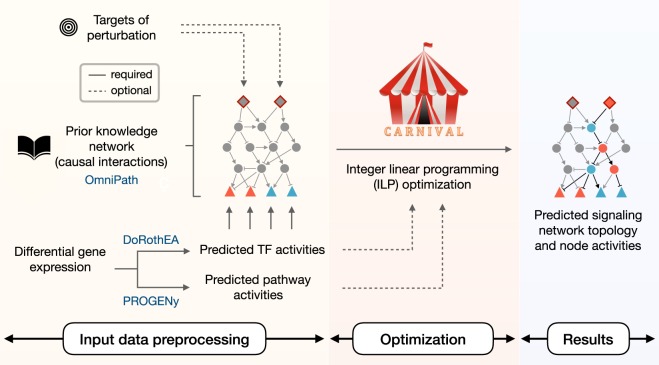
While gene expression profiling is commonly used to gain an overview of cellular processes, the identification of upstream processes that drive expression changes remains a challenge. To address this issue, we introduce CARNIVAL, a causal network contextualization tool which derives network architectures from gene expression footprints. CARNIVAL (CAusal Reasoning pipeline for Network identification using Integer VALue programming) integrates different sources of prior knowledge including signed and directed protein–protein interactions, transcription factor targets, and pathway signatures. The use of prior knowledge in CARNIVAL enables capturing a broad set of upstream cellular processes and regulators, leading to a higher accuracy when benchmarked against related tools. Implementation as an integer linear programming (ILP) problem guarantees efficient computation. As a case study, we applied CARNIVAL to contextualize signaling networks from gene expression data in IgA nephropathy (IgAN), a condition that can lead to chronic kidney disease. CARNIVAL identified specific signaling pathways and associated mediators dysregulated in IgAN including Wnt and TGF-β, which we subsequently validated experimentally. These results demonstrated how CARNIVAL generates hypotheses on potential upstream alterations that propagate through signaling networks, providing insights into diseases.
Overview
The claims and statistics of this paper haven’t been checked yet.
Free: it reads the open-access text and checks the first 5 claims that cite a source we can check. Create a free account to check every claim.
Integrity signals
Registry
Cites
Statistics
Figures
Verification
Claims the paper makes
The claims and statistics of this paper haven’t been checked yet.
Free: it reads the open-access text and checks the first 5 claims that cite a source we can check. Create a free account to check every claim.
Claims other papers make about this one
Each is checked against this paper’s own text: does it say what the citing paper says it does?
The source backs part of the claim, not all of it — or backs it for a different population, condition or comparison.
In the citing paper
“To infer signaling processes, the CARNIVAL algorithm combines upstream perturbation information (i.e., drug targets) with downstream measurements (i.e., transcription factor (TF) activities) and a causal prior knowledge network (PKN) (Liu et al, 2019).”
From Network integration of thermal proteome profiling with multi-omics data decodes PARP inhibition (2024) · cites this paper as Liu et al, 2019
Experimental — accuracy not yet measured
Self-check
Percentages, sums and reported differences re-computed from the paper’s own numbers.
The self-check needs the paper’s full text.
Citations
Cites
Subramanian, A., Tamayo, P., Mootha, V. K., Mukherjee, S., Ebert, B. L., Gillette, M. A., Paulovich, A., Pomeroy, S. L., Golub, T. R., Lander, E. S., et al. (2005) · Proceedings of the National Academy of Sciences · doi:10.1073/pnas.0506580102 · Cited by 53,625
Cytoscape: A software Environment for integrated models of biomolecular interaction networks
Shannon, P., Markiel, A., Ozier, O., Baliga, N. S., Wang, J. T., Ramage, D., Amin, N., Schwikowski, B., & Ideker, T. (2003) · Genome Research · doi:10.1101/gr.1239303 · Cited by 51,888
limma powers differential expression analyses for RNA-sequencing and microarray studies
Ritchie, M. E., Phipson, B., Wu, D., Hu, Y., Law, C. W., Shi, W., & Smyth, G. K. (2015) · Nucleic Acids Research · doi:10.1093/nar/gkv007 · Cited by 40,458
KEGG: new perspectives on genomes, pathways, diseases and drugs
Kanehisa, M., Furumichi, M., Tanabe, M., Sato, Y., & Morishima, K. (2017) · Nucleic Acids Research · doi:10.1093/nar/gkw1092 · Cited by 8,865 · cited 1×
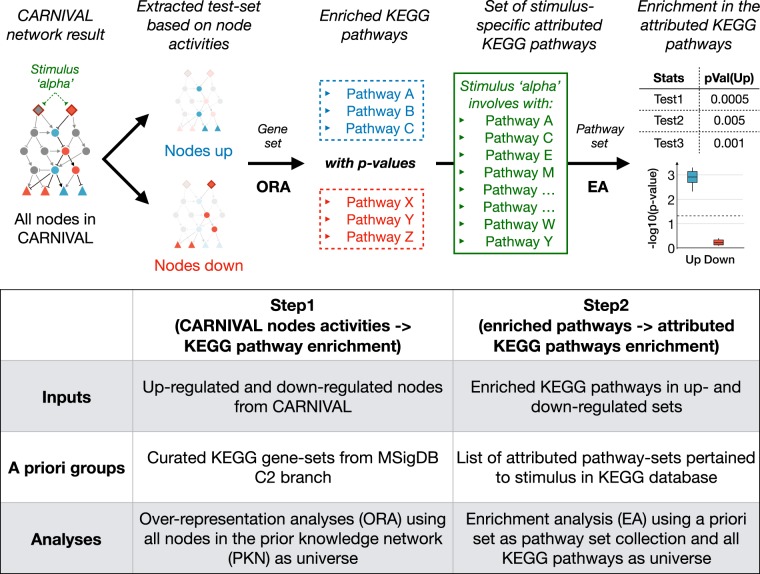
“We first determined which pathways are known to be linked to the perturbations by different molecules according to the KEGG database (30); referred to perturbation-attributed pathways henceforth.”
BackgroundLeek, J. T., Johnson, W. E., Parker, H. S., Jaffe, A. E., & Storey, J. D. (2012) · Bioinformatics · doi:10.1093/bioinformatics/bts034 · Cited by 6,231 · cited 1×
“Batch effects were removed using the combat function of the sva R-package.(39) Differential gene expression compared to vehicle control in the same dataset was then computed with the limma R package.”
MethodInsights into the regulation of protein abundance from proteomic and transcriptomic analyses
Vogel, C., & Marcotte, E. M. (2012) · Nature Reviews Genetics · doi:10.1038/nrg3185 · Cited by 4,195 · cited 1×
“Such methods can provide valuable insight, but are limited by the fact that the abundance and activities of signaling proteins only partially correlate with gene expression (Vogel and Marcotte, 2012).”
BackgroundPhosphoSitePlus, 2014: mutations, PTMs and recalibrations
Hornbeck, P. V., Zhang, B., Murray, B., Kornhauser, J. M., Latham, V., & Skrzypek, E. (2015) · Nucleic Acids Research · doi:10.1093/nar/gku1267 · Cited by 3,411 · cited 1×
“The measurements with 19 phosphoprotein-binding antibodies were mapped to 14 differential protein activities using the curated regulatory sites in the PhosphositePlus knowledgebase (21).”
MethodOncogenic pathway signatures in human cancers as a guide to targeted therapies
Bild, A. H., Yao, G., Chang, J. T., Wang, Q., Potti, A., Chasse, D., Joshi, M.-B., Harpole, D., Lancaster, J. M., Berchuck, A., et al. (2006) · Nature · doi:10.1038/nature04296 · Cited by 2,032
Wyatt, R. J., & Julian, B. A. (2013) · New England Journal of Medicine · doi:10.1056/nejmra1206793 · Cited by 1,222
Benchmark and integration of resources for the estimation of human transcription factor activities
Garcia-Alonso, L., Holland, C. H., Ibrahim, M. M., Turei, D., & Saez-Rodriguez, J. (2019) · Genome Research · doi:10.1101/gr.240663.118 · Cited by 1,122 · cited 1×
“Another one is to predict transcription factor (TF) activities based on their regulons.(10,11) However, these approaches do not provide information on the topology of signaling pathways.”
Background
Cited by
Items 101–162 of 162
Kim, Y., Han, Y.-H., Hopper, C., Lee, J., Joo, J. I., Gong, J., Lee, C., Jang, S., Kang, J., Kim, T., et al. (2024) · Cell Reports Methods · doi:10.1016/j.crmeth.2024.100773 · Cited by 4
“54 Consequently, the activity changes of proteins represented by nodes in the afatinib DRCN can be compared and validated with the RNA expression fold changes measured by our in-house experiments.”
Chen, Y.-G., Mao, R.-B., Xu, J., Huang, Y., Xu, J., Cui, S., Zhu, Z., Ji, X., Huang, S.-H., Huang, Y., et al. (2024) · International Journal of Molecular Sciences · doi:10.3390/ijms25115654 · Cited by 3
“Additionally, integer linear programming (ILP) techniques like TPS [17] and CARNIVAL [18] refine the representation of signaling networks to fit observed data.”
MethodBumbaca, B., Huggins, J. R., Birtwistle, M. R., & Gallo, J. M. (2025) · npj Systems Biology and Applications · doi:10.1038/s41540-025-00493-2 · Cited by 3
Hamed, O., Reitz, C. J., Kuzmanov, U., Gramolini, S., Hu, M., Halpern, J., Billia, F., & Gramolini, A. O. (2026) · Nature Cardiovascular Research · doi:10.1038/s44161-026-00880-w · Cited by 3
Kassuhn, W. N., Cutillas, P. R., Kessler, M., Sehouli, J., Braicu, E. I., Blüthgen, N., & Kulbe, H. (2023) · Cancers · doi:10.3390/cancers15123155 · Cited by 2
Inferring and evaluating network medicine-based disease modules with nextflow
Kersting, J., Bûcheron, C., Spindler, L., Aguirre‐Plans, J., Manz, Q., Pock, T., Tan, M., Delgado-Chaves, F. M., Nogales, C., Schmidt, H. H. H. W., et al. (2026) · Bioinformatics · doi:10.1093/bioinformatics/btag223 · Cited by 2
DeepSNEM: Deep Signaling Network Embeddings for compound mechanism of action identificationPreprint
Fotis, C., Alevizos, G., Meimetis, N., Koleri, C., Γκέκας, Θ., & Alexopoulos, L. G. (2021) · bioRxiv (Cold Spring Harbor Laboratory) · doi:10.1101/2021.11.29.470365 · Cited by 2
“Liu et al. developed CARNIVAL, a causal reasoning framework to identify signaling networks that best explain a set of transcription factor (TF) activity scores, calculated from differential GEx data [13].”
MethodInfluentialBica, V., Venafra, V., Massacci, G., Graziosi, S., Gualdi, S., Minnella, G., Sorà, F., Chiusolo, P., Brunetti, M. E., Napolitano, G., et al. (2025) · bioRxiv (Cold Spring Harbor Laboratory) · doi:10.1101/2025.01.08.631869 · Cited by 2
Amelkina, O., & Comizzoli, P. (2026) · Frontiers in Veterinary Science · doi:10.3389/fvets.2025.1728981 · Cited by 1
Ten quick tips for causal analysis of biomedical omics data
Svinin, G., Loo, R. T. J., Kumar, N. V., Murthy, V. V., Uzuner, D., Díaz‐Uriarte, R., Conesa, A., Bontempi, G., Vinga, S., Granata, I., et al. (2026) · PLoS Computational Biology · doi:10.1371/journal.pcbi.1014668 · Cited by 1
Binenbaum, I., Lefaki, M., Chondrogianni, N., & Chatziioannou, A. A. (2020) · Biogerontology · doi:10.1007/s10522-020-09866-y · Cited by 1
scRNA-Seq-based drug repurposing targeting idiopathic pulmonary fibrosis (IPF)Preprint
Liu, A., Lee, J., Han, N., & Bender, A. (2022) · bioRxiv (Cold Spring Harbor Laboratory) · doi:10.1101/2022.09.17.508360 · Cited by 2
Self-citationMapping the ISR Landscape in Cognitive Disorders via single-cell multi-omicsPreprint
Torkenczy, K. A., Reineke, L. C., Dooling, S. W., Henderson, B., Itzhak, D. N., Yang, B. A., He, D., Myers, R., Walter, P., Tyanova, S., et al. (2025) · bioRxiv (Cold Spring Harbor Laboratory) · doi:10.1101/2025.02.28.640905 · Cited by 1
Regulation Flow Analysis discovers molecular mechanisms of action from large knowledge databasesPreprint
Roca, C. P., Sysoev, O., Eyre, E., Galan, S., Sinibaldi, D., Tedder, P. M. R., & Mangion, J. (2025) · bioRxiv (Cold Spring Harbor Laboratory) · doi:10.1101/2025.06.15.659785 · Cited by 1
“Signaling in large KGs has been modeled by a number of approaches that integrate omics data [10, 11, 12, 13, 14, 15, 16].”
McColl, T. J., Zhang, R., Dugourd, A. J. F., Sáez-Rodríguez, J., & Clarke, D. C. (2025) · bioRxiv (Cold Spring Harbor Laboratory) · doi:10.1101/2025.10.11.681841 · Cited by 1
“We set alpha weight and beta weight to their default values of 1 and 0.2, respectively (Liu et al. , 2019).”
InfluentialMammalian Intracellular Dickkopf1 Couples Proteostasis with InflammationPreprint
Jaschke, N., Pählig, S., Sinha, A. N., Adolph, T. E., Gentzel, M., Ledesma-Colunga, M. G., Wang, A., Grzybek, M., Thiele, S., Schwärzler, J., et al. (2021) · SSRN Electronic Journal · doi:10.2139/ssrn.3962446
Construction of an inter-organ transomic network for whole-body metabolism
Kokaji, T., & Kuroda, S. (2022) · Current Opinion in Endocrine and Metabolic Research · doi:10.1016/j.coemr.2022.100361
Rodrigues, D. (2022) · Research Publications (Maastricht University) · doi:10.26481/dis.20220713dr
Liu, H., Yuan, M., Mitra, R., Zhou, X., Min, L., Lei, W., Zhou, S., Huang, Y., Hou, F., Eischen, C. M., et al. (2022) · Figshare · doi:10.6084/m9.figshare.21332885
Causal query estimation in partially observed biomolecular networks
Mohammad-Taheri, S. (2023) · Digital Repository Service (Northeastern University) · doi:10.17760/d20620608
MAGELLAN: Automated Generation of Interpretable Computational Models for Biological ReasoningPreprint
Clarke, M. A., Barker, C. G., Sun, Y., Roumeliotis, T. I., Choudhary, J. S., & Fisher, J. (2025) · bioRxiv (Cold Spring Harbor Laboratory) · doi:10.1101/2025.05.16.653408
“Another tool, COSMOS, uses ‘omics data expressed in the form of kinase and transcription factor activities to generate mechanistic models using network-level causal reasoning 46,47 .”
Data meets prior knowledge for interpretable mechanistic inference in biology
Gómez-Cabrero, D., & Tegner, J. N. (2025) · Nature Machine Intelligence · doi:10.1038/s42256-025-01075-x
Koumadorakis, D. E., Dimitrakopoulos, G. Ν., Exarchos, T. P., Vlamos, P., & Vrahatis, A. G. (2026) · International Journal of Artificial Intelligence Tools · doi:10.1142/s0218213025400147
Dalpedri, B. (2024) · Institutional Research Information System (Università degli Studi di Trento) · doi:10.15168/11572_437302
Hosseini-Gerami, L., Higgins, I. A., Collier, D. A., Laing, E., Evans, D., Broughton, H. B., & Bender, A. (2024) · Figshare · doi:10.6084/m9.figshare.26583078
Liu, H., Yuan, M., Mitra, R., Zhou, X., Long, M., Lei, W., Zhou, S., Huang, Y., Hou, F., Eischen, C. M., et al. (2022) · Figshare · doi:10.6084/m9.figshare.21332888
Βαθεία εκμάθηση για κωδικοποίηση σηματοδοτικών δικτύων
Alevizos, G. (2020) · DSpace - NTUA (National Technical University of Athens) · doi:10.26240/heal.ntua.20201
Winkler, S., Winkler, I., Figaschewski, M., Tiede, T., Nordheim, A., & Kohlbacher, O. (2022) · Figshare · doi:10.6084/m9.figshare.19619541
Hosseini-Gerami, L., Ficulle, E., Humphryes-Kirilov, N., Airey, D. C., Scherschel, J., Kananathan, S., Eastwood, B. J., Bose, S., Collier, D. A., Laing, E., et al. (2023) · Figshare · doi:10.6084/m9.figshare.22618886
Pačínková, A., & Popovici, V. C. (2022) · Figshare · doi:10.6084/m9.figshare.20552266
Pačínková, A., & Popovici, V. C. (2022) · Figshare · doi:10.6084/m9.figshare.20552269
Transcriptomic Connectivity for Read-Across Inference of Chemical Bioactivity
Shah, I., & Chambers, B. (2021) · Figshare · doi:10.23645/epacomptox.16586618
Koleri, C. (2023) · DSpace - NTUA (National Technical University of Athens) · doi:10.26240/heal.ntua.25790
Hosseini-Gerami, L., Higgins, I. A., Collier, D. A., Laing, E., Evans, D., Broughton, H. B., & Bender, A. (2024) · Figshare · doi:10.6084/m9.figshare.26583072
Hosseini-Gerami, L., Higgins, I. A., Collier, D. A., Laing, E., Evans, D., Broughton, H. B., & Bender, A. (2024) · Figshare · doi:10.6084/m9.figshare.26583075
Zazas, I.-G. (2022) · DSpace - NTUA (National Technical University of Athens) · doi:10.26240/heal.ntua.23578
Martorell‐Marugán, J., López-Domínguez, R., García-Moreno, A., Toro-Domínguez, D., García, J. A. V., Barturen, G., Martín-Gómez, A., Troulé, K., López, G. G., Al‐Shahrour, F., et al. (2021) · Figshare · doi:10.6084/m9.figshare.14843112
Winkler, S., Winkler, I., Figaschewski, M., Tiede, T., Nordheim, A., & Kohlbacher, O. (2022) · Figshare · doi:10.6084/m9.figshare.19619538
Hosseini-Gerami, L., Higgins, I. A., Collier, D. A., Laing, E., Evans, D., Broughton, H. B., & Bender, A. (2024) · Figshare · doi:10.6084/m9.figshare.26583069
Integration of gene expression data with causal networks
Rajh, M. (2023) · Repository of the University of Ljubljana (University of Ljubljana)
Exploring the Features and Challenges of Proteolysis Targeting Chimera (PROTAC) Development
You, I. (2023) · Digital Access to Scholarship at Harvard (DASH) (Harvard University)
Leung, G. H. D., Pun, F. W., Naumov, V., Gennert, D. G., Kamya, P. R. N., Aliper, A., Ren, F., & Zhavoronkov, A. A. (2026) · Springer eBooks · doi:10.1007/978-3-031-98022-0_3 · Cited by 1
Lee, H., & Lee, G. (2026) · bioRxiv (Cold Spring Harbor Laboratory) · doi:10.64898/2026.03.20.712775
Wang, X., Hou, R., Chen, J., He, B., Liu, P., Zhu, G., Lan, H., & Zhu, W. (2026) · Journal of Clinical Laboratory Analysis · doi:10.1002/jcla.70196
“Subsequently, a network-optimization approach [35] was used to identify putative causal paths connecting up-regulated receptors with these TFs.”
Systems analysis of intercellular communication in the tumor microenvironment
Massenet-Regad, L. (2023) · theses.fr (ABES) · doi:10.70675/909b8153z00efz42f7za922z6b476829dbf2
Leveraging training expertise to build capacity in computational personalised medicine
Lloret-Llinares, M., Thomas‐López, D., Carbonell‐Caballero, J., Calzone, L., Conejero, J., Harrison, J. P., Kratochvíl, M., Montagud, A., Noël, V., Nortamo, H., et al. (2026) · Bioinformatics Advances · doi:10.1093/bioadv/vbag070
“…includes material on basic computing skills, usage of HPC, and on the tools that the consortium focused on: CellNOpt (Terfve et al. 2012), CARNIVAL (Liu et al. 2019, Rodriguez-Mier et al. 2025), and MaBoSS (Stoll et al. 2017) to characterise cell signalling under different formalisms, COBREXA…”
Ye, X., Tikhomirova, D., Oksanen, M., Gaetani, M., Gharibi, H., Mastropasqua, F., & Tammimies, K. (2026) · bioRxiv (Cold Spring Harbor Laboratory) · doi:10.64898/2026.05.04.722615
Prado‐Rodríguez, R., González, P., Banga, J. R., & Doallo, R. (2026) · Applied Soft Computing · doi:10.1016/j.asoc.2026.115422
ERFA: Combining expression data with large knowledge graphs and regulation flow for MoA discovery
Sysoev, O., Roca, C. P., Eyre, E., Galan, S., Tedder, P. M. R., & Mangion, J. (2025) · International Conference on Biomedical and Bioinformatics Engineering (ICBBE) · doi:10.1145/3794209.3794278
Al‐Sayegh, M., Khalili, M., Alzaabi, M., Sultana, M., Ali, L., Ali, M. O. I., & El-Hadidi, M. (2026) · Adipocyte · doi:10.1080/21623945.2026.2680625
“…to human pluripotent stem cell models of adipogenesis, include time-resolved profiling to capture the dynamic evolution of each molecular layer, and apply causal network modelling approaches [36] and machine learning-based feature interpretation [37–39] to refine regulatory hierarchy inference.”
Mason, M., Masarone, S., Clelford, T., Atlas, E., Meier, M. J., Rowan‐Carroll, A., Pruteanu, L.-L., Trairatphisan, P., Schmidt, F., Lane, J., et al. (2026) · BMC Bioinformatics · doi:10.1186/s12859-026-06566-1
“The inferred TF activities are integrated with the liver-constrained PPI and CELLSCAPE predicted targets with CARNIVAL [20], which formulates network optimization as an integer linear program.”
Self-citationPhysioMap: an ontology-grounded causal knowledge graph of human physiologyPreprint
Hoehndorf, R., Schofield, P. N., & Gkoutos, G. V. (2026) · bioRxiv (Cold Spring Harbor Laboratory) · doi:10.64898/2026.08.03.742471
“8,9 These approaches provide broad coverage, but local traversal does not specify the response of a coupled system to intervention.”
Thomas, J. P., Wooldridge, T., Cozzetto, D., Lambie, N., Kudo, H., Saifuddin, A., Gul, L., Módos, D., Goldin, R. D., Matthews, N., et al. (2026) · bioRxiv (Cold Spring Harbor Laboratory) · doi:10.64898/2026.08.11.744139
“To investigate the upstream signalling architecture associated with transcriptional dysregulation in patients with prior anti-TNF failure, CARNIVAL causal network inference was applied 15 .”
InfluentialWatkins, L. D., & Saucerman, J. J. (2026) · bioRxiv (Cold Spring Harbor Laboratory) · doi:10.64898/2026.09.24.754086
Pang, J., Li, Y., Qi, Z., & Yang, W. (2026) · PLoS ONE · doi:10.1371/journal.pone.0359583
“HLA-DRB1 ranked first overall (0.674), with the model-derived CARNIVAL component contributing its largest normalized evidence value [27].”
InfluentialLi, V. O. K., Lam, J. C. K., Han, Y., & Cheung, L. Y. L. (2026) · arXiv (Cornell University) · doi:10.48550/arxiv.2610.08736
“15 Reverse-Gene-Finder traces influential neural representations back to gene tokens to identify candidate genetic biomarkers of AD.”
Liu, X. (2026) · Frontiers in Plant Science · doi:10.3389/fpls.2026.1965677
“CARNIVAL offers a complementary method to organizing future candidates into plausible directed regulatory triplets (Liu et al., 2019).”
Martinez‐de‐Morentin, X., Khan, S. A., Cenzano, I., Lehmann, R., Maillo, A., Lagani, V., Tegner, J. N., & Gómez-Cabrero, D. (2026) · Nature Machine Intelligence · doi:10.1038/s42256-026-01311-y
“Moreover, CORNETO unifies several methods—flux balance analysis (FBA) 15 , sparse FBA (sFBA) 16,17 , integrative metabolic analysis tool (iMAT) 18 , causal reasoning for network identification using integer value programming (CARNIVAL) 19 and prize-collecting Steiner trees (PCSTs) 20 —as special cases of a single form…”
InfluentialA Bioinformatics Investigation of the Emerging Neuroprotective Role of Kisspeptins
OGGIANO, N. P. (2026) · Electronic Theses and Dissertations Repository (University of Pisa)
Metadata
- Authors
- Liu, A., Trairatphisan, P., Gjerga, E., Didangelos, A., Barratt, J., & Saez-Rodriguez, J.
- Affiliations
- Heidelberg University (DE)
- University of Leicester (GB)
- ORCID
- Venue
- npj Systems Biology and Applications
- Published
- 2019-11-11
- Volume
- 5
- Issue
- 1
- Pages
- 40-40
- ISSN
- 2056-7189 (ISSN-L)
- PMC
- PMC6848167
- OpenAlex
- W2986455832
- Semantic Scholar
- 15981d0dee2ac5ee45460005078efb647b0b2fe5
- Cited by
- 151
- References
- 50
- Citations by year
- 2026: 16 · 2025: 24 · 2024: 21 · 2023: 20 · 2022: 32 · 2021: 25 · 2020: 11 · 2019: 2
- FWCI
- 5.87
- Type
- journal article
- Language
- en
- Open access
- gold
- doi.org
- Licence
- cc-by
- creativecommons.org/licenses/by/4.0 (tdm)
- creativecommons.org/licenses/by/4.0 (vor)
- Locations
- npj Systems Biology and Applications (publishedVersion, cc-by)
- PubMed Central (publishedVersion, cc-by)
- PubMed (publishedVersion)
- DOAJ (DOAJ: Directory of Open Access Journals) (submittedVersion)
- Funders
- Innovative Medicines Initiative 2 Joint Undertaking "TransQST"
- European Union's Horizon 2020 program "Marie-Curie ITN"
- Topics
- Life Sciences › Biochemistry, Genetics and Molecular Biology › Molecular Biology › Bioinformatics and Genomic Networks
- Life Sciences › Biochemistry, Genetics and Molecular Biology › Molecular Biology › Gene Regulatory Network Analysis
- Health Sciences › Medicine › Health Informatics › Biomedical Text Mining and Ontologies
- Keywords
- carnival, causal network inference, signaling networks, integer linear programming, prior knowledge incorporation, protein-protein interaction, transcription factor targets, pathway signatures, IgA nephropathy, Wnt signaling, TGF-beta signaling, upstream regulators, chronic kidney disease
- MeSH terms
- Algorithms, Gene Expression Regulation, Humans, Programming, Linear, Software, Transcription Factors, Signal Transduction, Computational Biology, Gene Expression Profiling, Microarray Analysis, Gene Regulatory Networks
About these checks
Registry, retraction, Cites and statistics results are computed, not judged, with one exception: a printed reference that no index lists is read once by a model before it counts as a citation error. Claims are extracted by a model and kept only when their quote appears verbatim in the text; each cited source is then checked, with a model’s help, for whether it says what the claim relies on. Those verdicts can be wrong — read the claim’s quote and the cited source before relying on one.
Statistics and arithmetic are recomputed, not judged.
Confidence bands are shown only for fields calibrated on our annotated test set. None is calibrated yet, so no band is shown.
What counts as a claim ›How we measure confidence ›How we check this ›
Are you an author, or do you see a problem with this page? Request a review
Data sources
Bibliographic data: Semantic Scholar, OpenAlex, Crossref.
Contains information from the Semantic Scholar Academic Graph Datasets, made available under the ODC Attribution License (ODC-BY 1.0).
Semantic Scholar’s data is described in: Kinney, R., et al. (2023). The Semantic Scholar Open Data Platform. arXiv:2301.10140.
