

Divergent evolutionary trajectories of bryophytes and tracheophytes from a complex common ancestor of land plants
Open accessPublished version of a preprint
The DOI matches its Crossref record; 212 of the 213 references it cites were found in a registry or an index.
Abstract
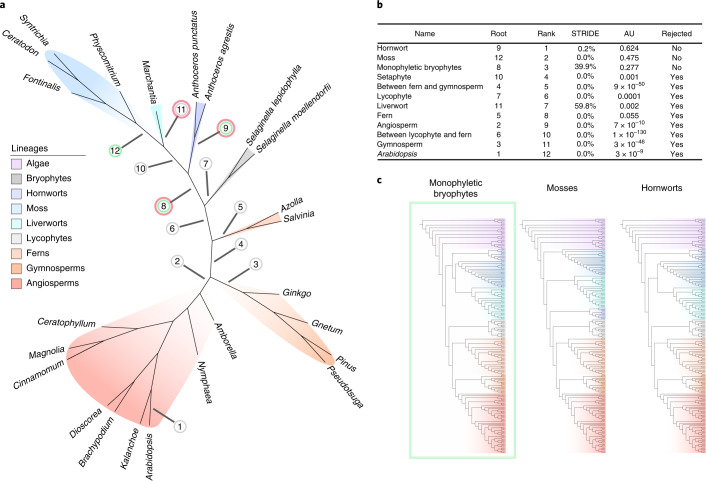
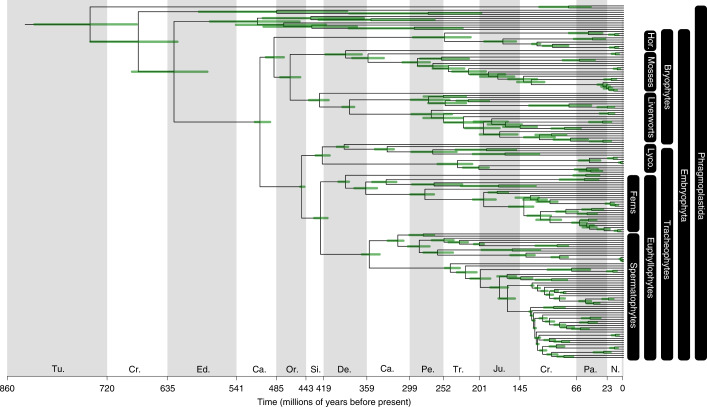
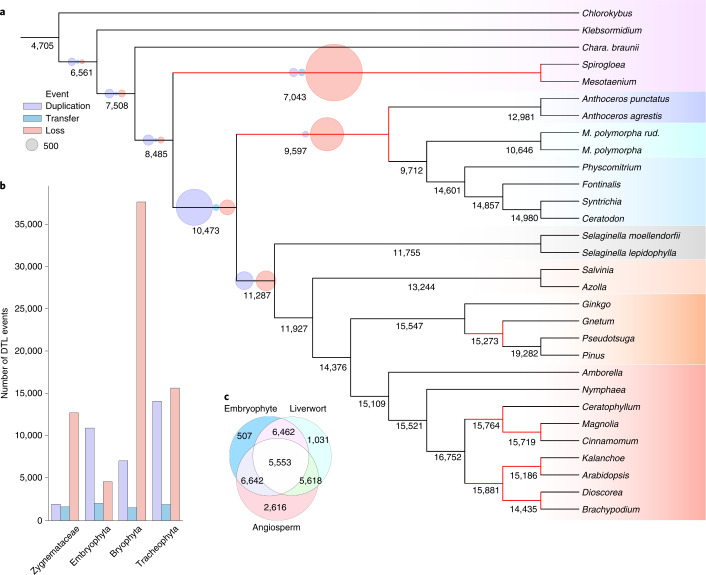
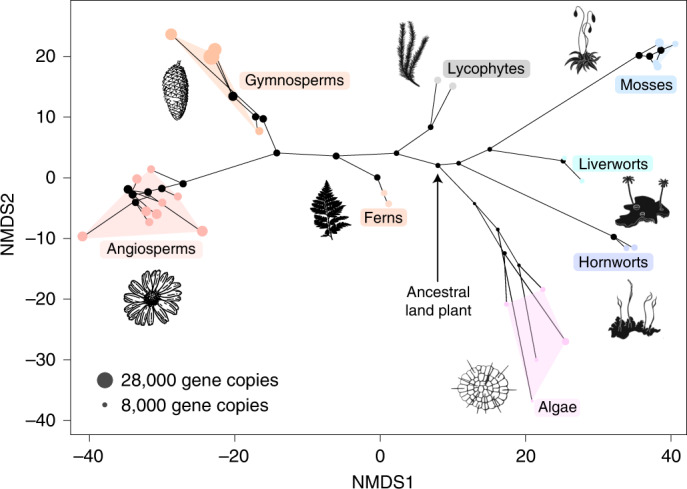
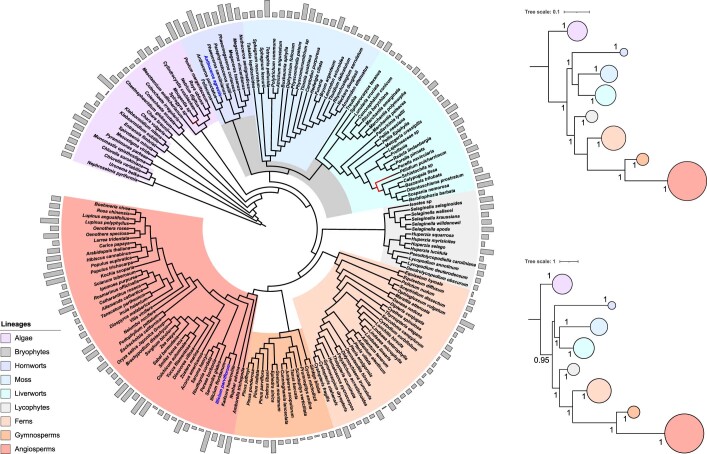
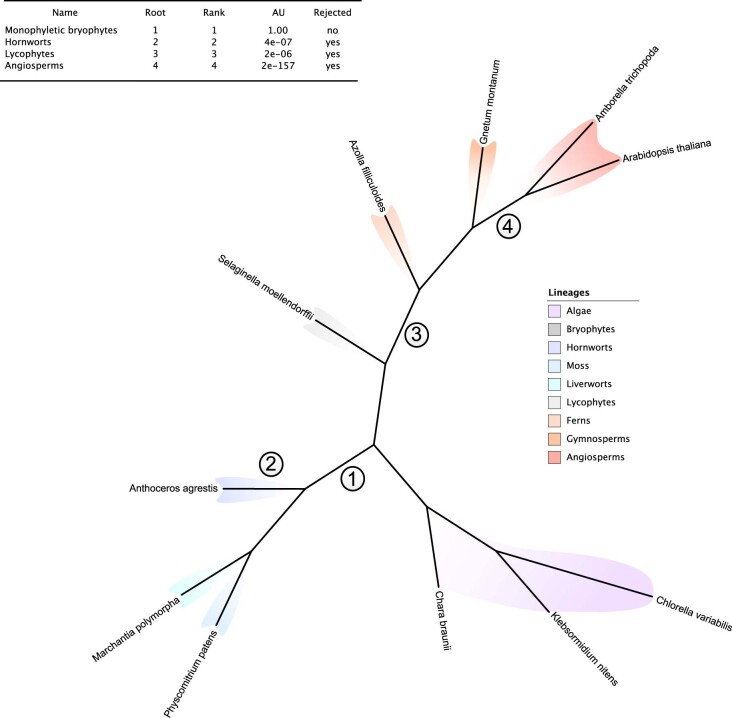
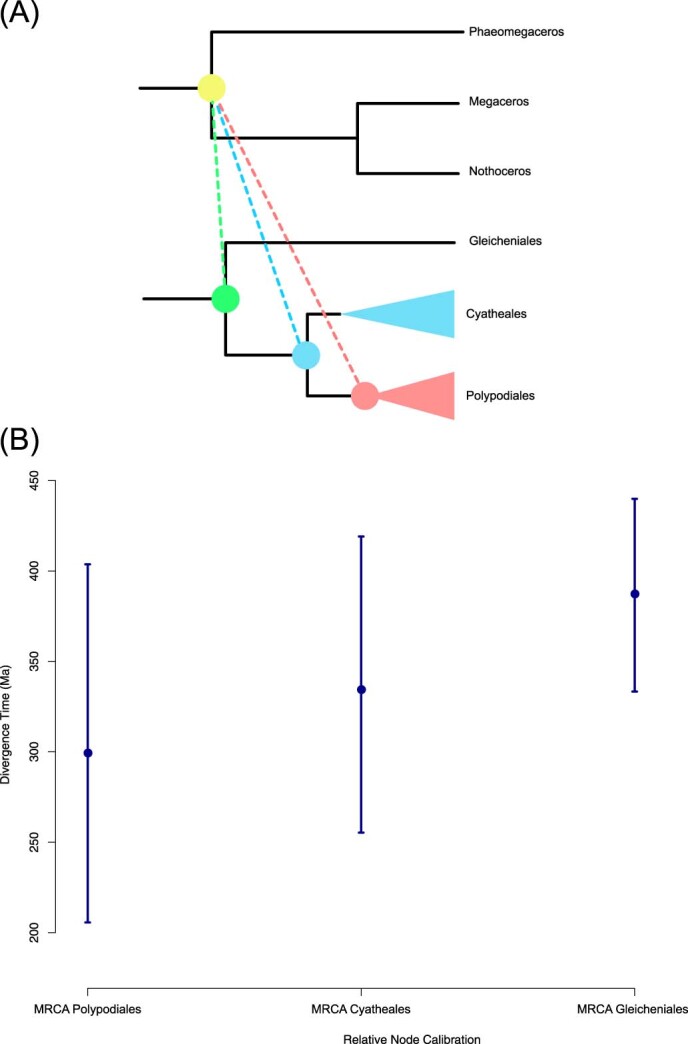
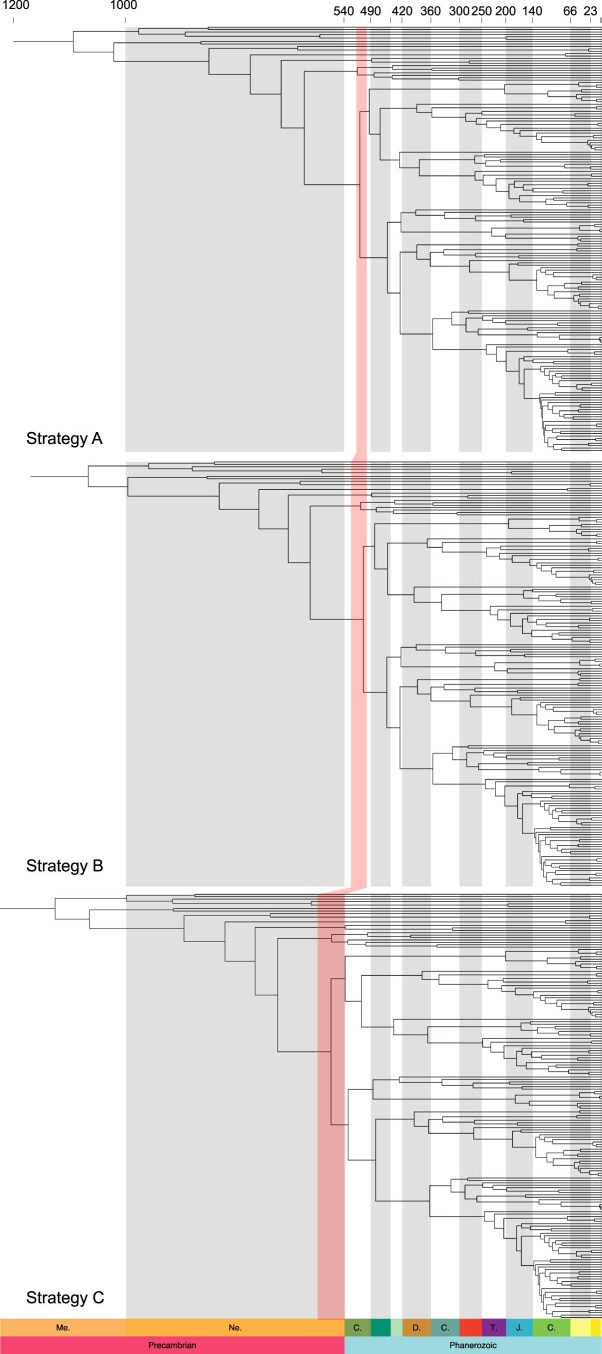
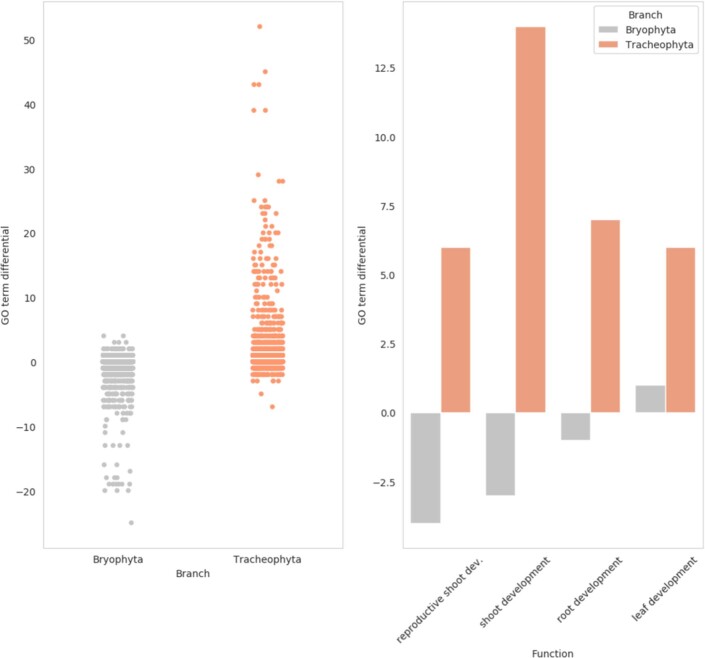
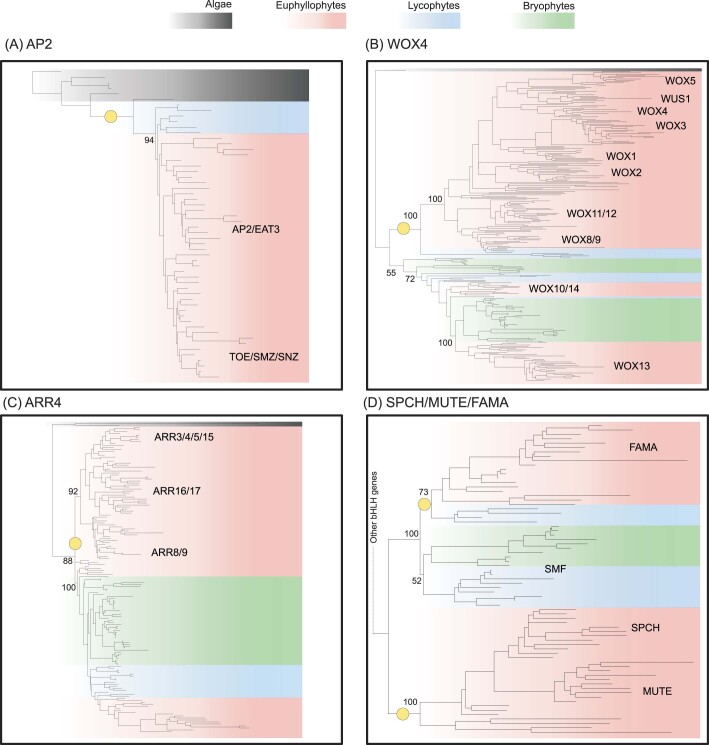
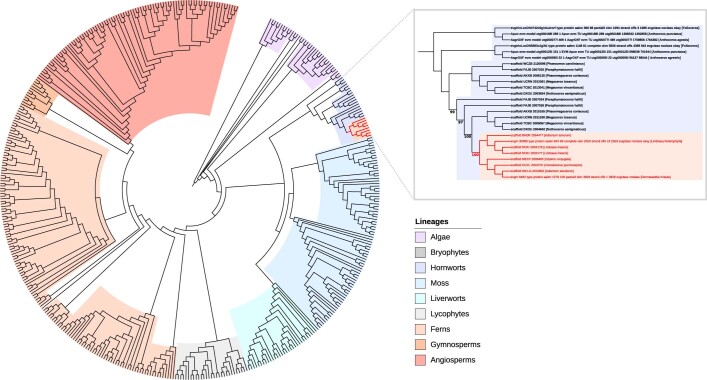
The origin of plants and their colonization of land fundamentally transformed the terrestrial environment. Here we elucidate the basis of this formative episode in Earth history through patterns of lineage, gene and genome evolution. We use new fossil calibrations, a relative clade age calibration (informed by horizontal gene transfer) and new phylogenomic methods for mapping gene family origins. Distinct rooting strategies resolve tracheophytes (vascular plants) and bryophytes (non-vascular plants) as monophyletic sister groups that diverged during the Cambrian, 515–494 million years ago. The embryophyte stem is characterized by a burst of gene innovation, while bryophytes subsequently experienced an equally dramatic episode of reductive genome evolution in which they lost genes associated with the elaboration of vasculature and the stomatal complex. Overall, our analyses reveal that extant tracheophytes and bryophytes are both highly derived from a more complex ancestral land plant. Understanding the origin of land plants requires tracing character evolution across a diversity of modern lineages.
Overview
The claims and statistics of this paper haven’t been checked yet.
Free: it reads the open-access text and checks the first 5 claims that cite a source we can check. Create a free account to check every claim.
Integrity signals
Registry
Cites
Statistics
Figures
Verification
Claims the paper makes
The claims and statistics of this paper haven’t been checked yet.
Free: it reads the open-access text and checks the first 5 claims that cite a source we can check. Create a free account to check every claim.
Self-check
Percentages, sums and reported differences re-computed from the paper’s own numbers.
The self-check needs the paper’s full text.
Citations
Cites
Items 201–212 of 212
Reply to Hedges et al.: Accurate timetrees do indeed require accurate calibrations
Morris, J. L., Puttick, M. N., Clark, J., Edwards, D., Kenrick, P., Pressel, S., Wellman, C. H., Yang, Z., Schneider, H., & Donoghue, P. C. J. (2018) · Proceedings of the National Academy of Sciences · doi:10.1073/pnas.1812816115 · Cited by 12 · cited 1×
“Hedges et al. 39 and Su et al. 23 argued against the suitability of this maximum age constraint on the basis that calibrations derived from fossil absences are unreliable and that the middle Cambrian maximum age exerts too great an influence on the posterior estimate 8,41 .”
BackgroundSelf-citationPerformance of A Priori and A Posteriori Calibration Strategies in Divergence Time Estimation
Beavan, A. J. S., Donoghue, P. C. J., Beaumont, M., & Pisani, D. (2020) · Genome Biology and Evolution · doi:10.1093/gbe/evaa105 · Cited by 12
Self-citationLate Jurassic-Early Cretaceous coal-forming plants of the Bureya Basin, Russian Far East
Markevich, V. S., & Bugdaeva, E. V. (2014) · Stratigraphy and Geological Correlation · doi:10.1134/s0869593814030071 · Cited by 12
Stevens, L. G., & Hilton, J. M. (2009) · American Journal of Botany · doi:10.3732/ajb.0800221 · Cited by 12
Oguracaulis banksii gen. et sp. nov., a mid-Mesozoic tree-fern from Tasmania, Australia
Tidwell, W., Nishida, H., & Webster, N. (1989) · Papers and proceedings of the Royal Society of Tasmania · doi:10.26749/rstpp.123.15 · Cited by 11
Stull, G. W., Qu, X., Parins‐Fukuchi, C., et al. (2021) · bioRxiv (Cold Spring Harbor Laboratory) · doi:10.1101/2021.03.13.435279 · Cited by 10
Plant Evolution: When Arabidopsis Is More Ancestral Than Marchantia
Rich, M. K., & Delaux, P. (2020) · Current Biology · doi:10.1016/j.cub.2020.04.077 · Cited by 9 · cited 1×
“Neither lineage occupies an ancestral position, with lineage-specific gene gain and loss events driving high disparity in both bryophytes and tracheophytes, reinforcing the view that there are no extant embryophytes that uniquely preserve the ancestral state 20,21,60 .”
BackgroundRelative time constraints improve molecular datingPreprint
Szöllősi, G. J., Höhna, S., Williams, T. A., Schrempf, D., Daubin, V., & Boussau, B. (2020) · bioRxiv (Cold Spring Harbor Laboratory) · doi:10.1101/2020.10.17.343889 · Cited by 7
Self-citationSpiekermann, R., Jasper, A., Siegloch, A. M., Guerra-Sommer, M., & Uhl, D. (2021) · Review of Palaeobotany and Palynology · doi:10.1016/j.revpalbo.2021.104415 · Cited by 7
Li, R., Li, X., Deng, S., & Sun, B. (2020) · Geobios · doi:10.1016/j.geobios.2020.07.003 · Cited by 6
A rooted phylogeny resolves early bacterial evolutionPreprint
Coleman, G., Davín, A. A., Mahendrarajah, T., Spang, A., Hugenholtz, P., Szöllősi, G., & Williams, T. (2020) · bioRxiv · doi:10.1101/2020.07.15.205187 · Cited by 1
Self-citationFlores, J., Bippus, A. C., Suárez, G., & Hyvönen, J. (2020) · MorphoBank datasets · doi:10.7934/p3670 · Cited by 1
Cited by
Genomes of multicellular algal sisters to land plants illuminate signaling network evolution
Feng, X., Zheng, J., Irisarri, I., Yu, H., Zheng, B., Ali, Z. M., de Vries, S., Keller, J., Fürst‐Jansen, J. M. R., Dadras, A., et al. (2024) · Nature Genetics · doi:10.1038/s41588-024-01737-3 · Cited by 134
“The reconstruction of ancestral gene content is a powerful means to explain the evolution of plant form and function as well as biological novelty 81 .”
Bechteler, J., Peñaloza-Bojacá, G. F., Bell, D., Burleigh, J. G., McDaniel, S. F., Davis, E., Sessa, E. B., Bippus, A. C., Cargill, D. C., Chantanaorrapint, S., et al. (2023) · American Journal of Botany · doi:10.1002/ajb2.16249 · Cited by 130
ATP synthase evolution on a cross-braced dated tree of life
Mahendrarajah, T. A., Moody, E. R. R., Schrempf, D., Szánthó, L. L., Dombrowski, N., Davín, A. A., Pisani, D., Donoghue, P. C. J., Szöllősi, G. J., Williams, T. A., et al. (2023) · Nature Communications · doi:10.1038/s41467-023-42924-w · Cited by 86
Self-citationGenome evolution in plants and the origins of innovation
Clark, J. (2023) · New Phytologist · doi:10.1111/nph.19242 · Cited by 77
Self-citationA geological timescale for bacterial evolution and oxygen adaptation
Davín, A., Woodcroft, B. J., Soo, R. M., Morel, B., Murali, R., Schrempf, D., Clark, J., Álvarez-Carretero, S., Boussau, B., Moody, E. R. R., et al. (2025) · Science · doi:10.1126/science.adp1853 · Cited by 84
Self-citation
Metadata
- Authors
- Harris, B. J., Clark, J. W., Schrempf, D., Szöllősi, G. J., Donoghue, P. C. J., Hetherington, A. M., & Williams, T. A.
- Affiliations
- University of Bristol (GB)
- Eötvös Loránd University (HU)
- Corresponding author
- Williams, Tom A.
- ORCID
- Venue
- Nature Ecology & Evolution
- Published
- 2022-09-29
- Volume
- 6
- Issue
- 11
- Pages
- 1634-1643
- ISSN
- 2397-334X (ISSN-L)
- PMC
- PMC9630106
- OpenAlex
- W4297996490
- Cited by
- 187
- References
- 213
- Citations by year
- 2026: 36 · 2025: 55 · 2024: 47 · 2023: 46 · 2022: 3
- FWCI
- 31.49
- Type
- journal article
- Language
- en
- Open access
- hybrid
- doi.org
- Licence
- cc-by
- creativecommons.org/licenses/by/4.0 (tdm)
- creativecommons.org/licenses/by/4.0 (vor)
- Locations
- Nature Ecology & Evolution (publishedVersion, cc-by)
- bioRxiv (Cold Spring Harbor Laboratory) (acceptedVersion, cc-by-nc)
- PubMed Central (publishedVersion, cc-by)
- PubMed (publishedVersion)
- ELTE Digital Institutional Repository (EDIT) (Eötvös Loránd University) (submittedVersion, other-oa)
- Explore Bristol Research (submittedVersion, cc-by)
- Funders
- Gordon and Betty Moore Foundation (GBMF9741)
- New Phytologist Trust
- Leverhulme Trust (RPG-2019, RPG‐2019‐004)
- European Commission (HORIZON2020, 714774, 201024)
- National Natural Science Foundation of China
- Technische Universität Bergakademie Freiberg
- Directorate for Biological Sciences
- Biotechnology and Biological Sciences Research Council (BB/T012773, BB/N000919/1, BB/T012773/1)
- Natural Environment Research Council (NE/P013678/1, NE/N003438/1, NE/P00251X/1)
- Topics
- Life Sciences › Agricultural and Biological Sciences › Ecology, Evolution, Behavior and Systematics › Plant Diversity and Evolution
- Life Sciences › Agricultural and Biological Sciences › Ecology, Evolution, Behavior and Systematics › Bryophyte Studies and Records
- Life Sciences › Biochemistry, Genetics and Molecular Biology › Genetics › Chromosomal and Genetic Variations
- Keywords
- plant origin, bryophytes, vascular plants, land plants, phylogenomics, gene family evolution, genome reduction, vascularization, stomatal complex, fossil calibration, horizontal gene transfer, monophyly, character evolution
- MeSH terms
- Biological Evolution, Fossils, Phylogeny, Plants, Embryophyta, Tracheophyta
About these checks
Registry, retraction, Cites and statistics results are computed, not judged, with one exception: a printed reference that no index lists is read once by a model before it counts as a citation error. Claims are extracted by a model and kept only when their quote appears verbatim in the text; each cited source is then checked, with a model’s help, for whether it says what the claim relies on. Those verdicts can be wrong — read the claim’s quote and the cited source before relying on one.
Statistics and arithmetic are recomputed, not judged.
Confidence bands are shown only for fields calibrated on our annotated test set. None is calibrated yet, so no band is shown.
What counts as a claim ›How we measure confidence ›How we check this ›
Are you an author, or do you see a problem with this page? Request a review
Data sources
Bibliographic data: Semantic Scholar, OpenAlex, Crossref.
Contains information from the Semantic Scholar Academic Graph Datasets, made available under the ODC Attribution License (ODC-BY 1.0).
Semantic Scholar’s data is described in: Kinney, R., et al. (2023). The Semantic Scholar Open Data Platform. arXiv:2301.10140.
