

Divergent evolutionary trajectories of bryophytes and tracheophytes from a complex common ancestor of land plants
Open accessPublished version of a preprint
The DOI matches its Crossref record; 212 of the 213 references it cites were found in a registry or an index.
Abstract
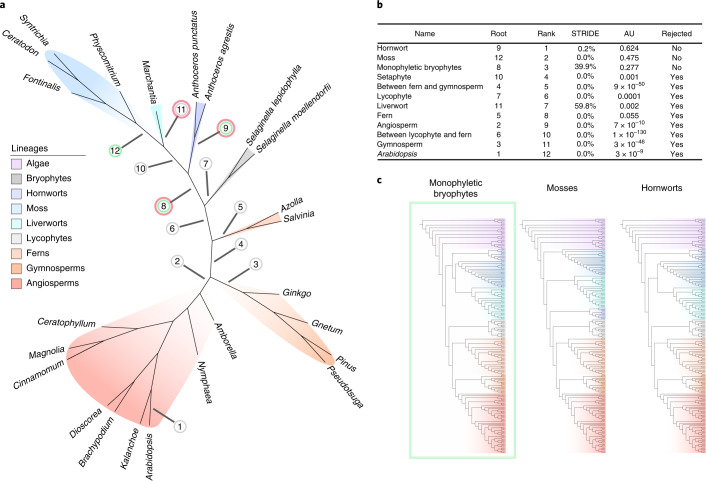
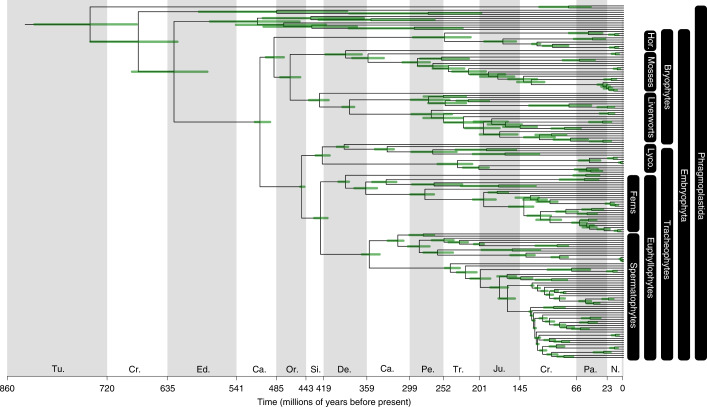
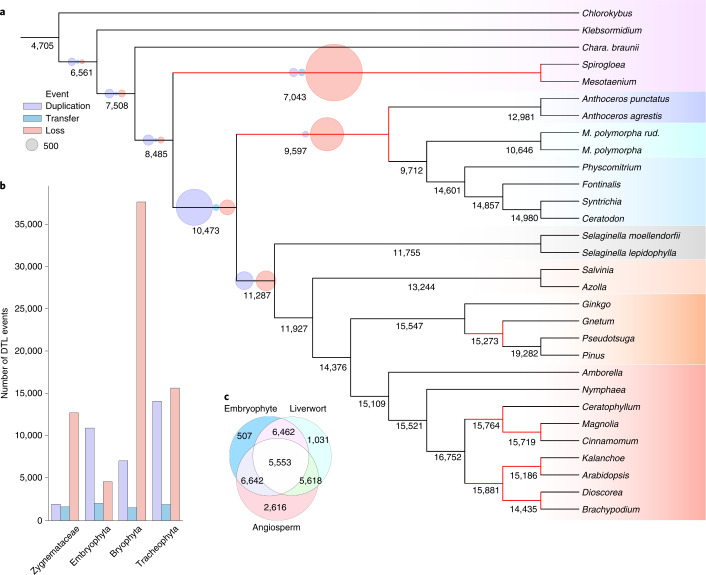
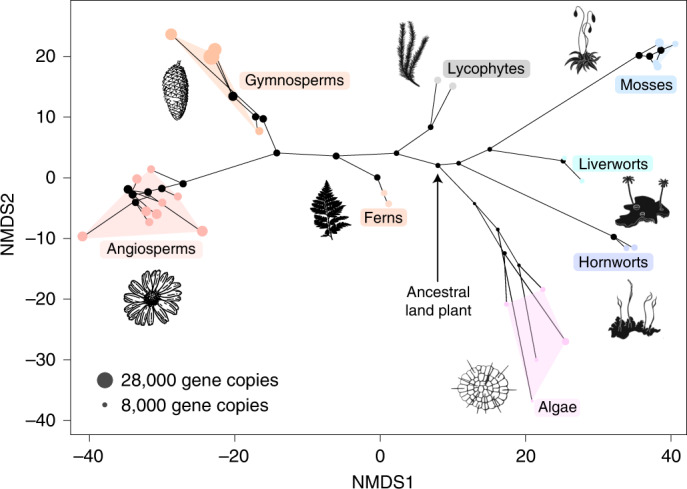
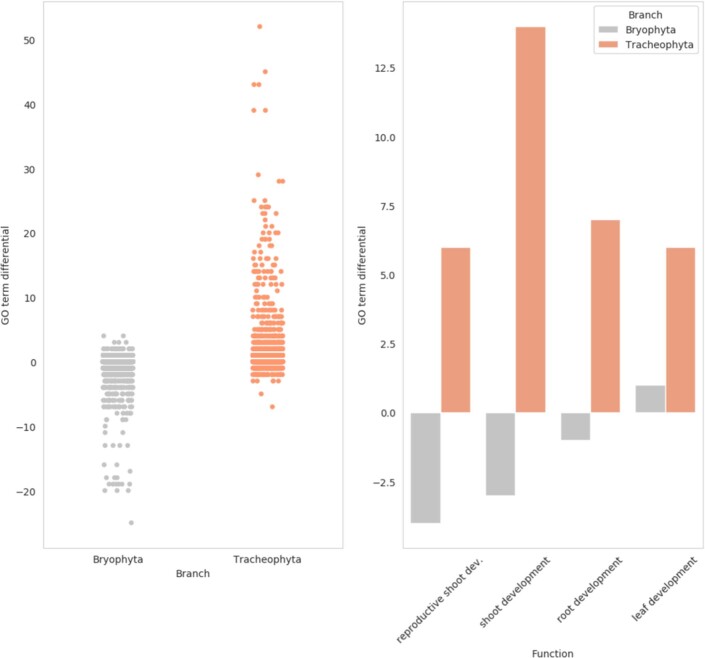
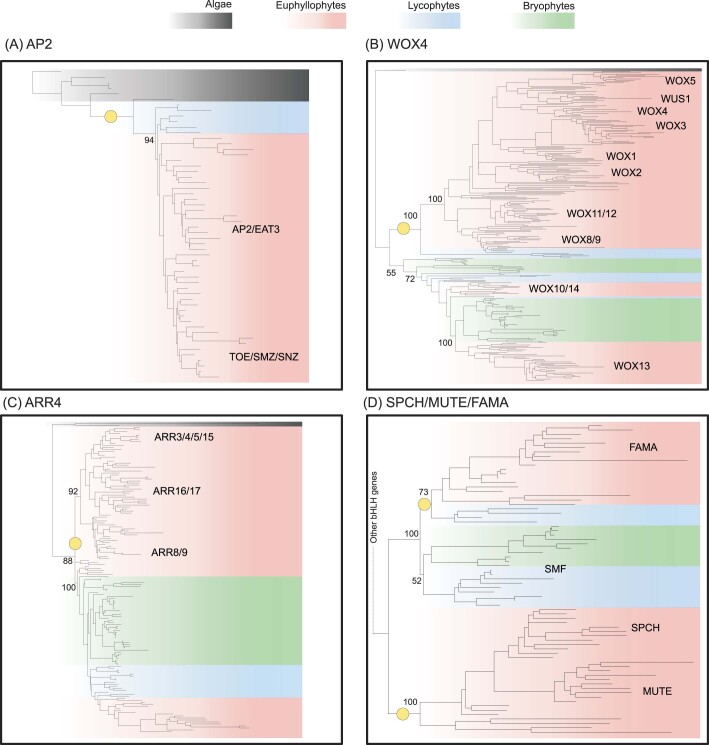
The origin of plants and their colonization of land fundamentally transformed the terrestrial environment. Here we elucidate the basis of this formative episode in Earth history through patterns of lineage, gene and genome evolution. We use new fossil calibrations, a relative clade age calibration (informed by horizontal gene transfer) and new phylogenomic methods for mapping gene family origins. Distinct rooting strategies resolve tracheophytes (vascular plants) and bryophytes (non-vascular plants) as monophyletic sister groups that diverged during the Cambrian, 515–494 million years ago. The embryophyte stem is characterized by a burst of gene innovation, while bryophytes subsequently experienced an equally dramatic episode of reductive genome evolution in which they lost genes associated with the elaboration of vasculature and the stomatal complex. Overall, our analyses reveal that extant tracheophytes and bryophytes are both highly derived from a more complex ancestral land plant. Understanding the origin of land plants requires tracing character evolution across a diversity of modern lineages.
Overview
The claims and statistics of this paper haven’t been checked yet.
Free: it reads the open-access text and checks the first 5 claims that cite a source we can check. Create a free account to check every claim.
Integrity signals
Registry
Cites
Statistics
Figures
Verification
Claims the paper makes
The claims and statistics of this paper haven’t been checked yet.
Free: it reads the open-access text and checks the first 5 claims that cite a source we can check. Create a free account to check every claim.
Self-check
Percentages, sums and reported differences re-computed from the paper’s own numbers.
The self-check needs the paper’s full text.
Citations
Cites
IQ-TREE: A Fast and Effective Stochastic Algorithm for Estimating Maximum-Likelihood Phylogenies
Nguyen, L.-T., Schmidt, H. A., von Haeseler, A., & Minh, B. Q. (2015) · Molecular Biology and Evolution · doi:10.1093/molbev/msu300 · Cited by 26,046 · cited 5×
“A maximum likelihood tree was inferred from an alignment of 30 species of plants and algae, comprising 185 single-copy orthologues and 71,855 sites, under the LG + C60 + G4 + F model in IQ-TREE 69 , and rooted in accordance with our previous phylogenetic analysis.”
MethodInfluentialFast and sensitive protein alignment using DIAMOND
Buchfink, B., Xie, C., & Huson, D. H. (2015) · Nature Methods · doi:10.1038/nmeth.3176 · Cited by 14,201 · cited 3×
“The Arabidopsis thaliana protein sequence for PHOT1 was used to BLAST a database of 177 species of plant and transcriptomes.”
MethodInfluentialPAML 4: Phylogenetic Analysis by Maximum Likelihood
Yang, Z. (2007) · Molecular Biology and Evolution · doi:10.1093/molbev/msm088 · Cited by 13,879 · cited 1×
“We fixed the tree topology to that recovered by the Bayesian analysis and used the normal approximation method in MCMCtree (v. 4.9i) [81], with branch lengths first estimated under the LG + G4 model in codeml (v 4.9i) 81 .”
MethodBUSCO: assessing genome assembly and annotation completeness with single-copy orthologs
Simão, F. A., Waterhouse, R. M., Ioannidis, P., Kriventseva, E. V., & Zdobnov, E. M. (2015) · Bioinformatics · doi:10.1093/bioinformatics/btv351 · Cited by 13,344
Posterior summarization in Bayesian phylogenetics using tracer 1.7
Rambaut, A., Drummond, A. J., Xie, D., Baele, G., & Suchard, M. A. (2018) · Systematic Biology · doi:10.1093/sysbio/syy032 · Cited by 11,159
Extracellular vesicles: Exosomes, microvesicles, and friends
Raposo, G., & Stoorvogel, W. (2013) · Journal of Cell Biology · doi:10.1083/jcb.201211138 · Cited by 8,099 · cited 1×
“Exosomes and complex cytoskeletons are essential for multicellular organisms to function 43,44 , and the inferred loss of these gene families is consistent with the hypothesis that the body plan of the algal ancestor of embryophytes was multicellular 5 , rather than possessing the single-cell or…”
BackgroundOrthoFinder: phylogenetic orthology inference for comparative genomics
Emms, D. M., & Kelly, S. (2019) · Genome Biology · doi:10.1186/s13059-019-1832-y · Cited by 7,676
Accelerated Profile HMM Searches
Eddy, S. R. (2011) · PLoS Computational Biology · doi:10.1371/journal.pcbi.1002195 · Cited by 6,975 · cited 1×
“To functionally annotate the gene families, we inferred the consensus sequence of each gene family alignment using hidden Markov modelling 91 .”
MethodKanehisa, M., Sato, Y., & Morishima, K. (2016) · Journal of Molecular Biology · doi:10.1016/j.jmb.2015.11.006 · Cited by 4,055
An efficient algorithm for large-scale detection of protein families
Enright, A. J. (2002) · Nucleic Acids Research · doi:10.1093/nar/30.7.1575 · Cited by 3,588
Cited by
Genomes of multicellular algal sisters to land plants illuminate signaling network evolution
Feng, X., Zheng, J., Irisarri, I., Yu, H., Zheng, B., Ali, Z. M., de Vries, S., Keller, J., Fürst‐Jansen, J. M. R., Dadras, A., et al. (2024) · Nature Genetics · doi:10.1038/s41588-024-01737-3 · Cited by 134
“The reconstruction of ancestral gene content is a powerful means to explain the evolution of plant form and function as well as biological novelty 81 .”
Bechteler, J., Peñaloza-Bojacá, G. F., Bell, D., Burleigh, J. G., McDaniel, S. F., Davis, E., Sessa, E. B., Bippus, A. C., Cargill, D. C., Chantanaorrapint, S., et al. (2023) · American Journal of Botany · doi:10.1002/ajb2.16249 · Cited by 121
ATP synthase evolution on a cross-braced dated tree of life
Mahendrarajah, T. A., Moody, E. R. R., Schrempf, D., Szánthó, L. L., Dombrowski, N., Davín, A. A., Pisani, D., Donoghue, P. C. J., Szöllősi, G. J., Williams, T. A., et al. (2023) · Nature Communications · doi:10.1038/s41467-023-42924-w · Cited by 86
Self-citationGenome evolution in plants and the origins of innovation
Clark, J. (2023) · New Phytologist · doi:10.1111/nph.19242 · Cited by 77
Self-citationA geological timescale for bacterial evolution and oxygen adaptation
Davín, A., Woodcroft, B. J., Soo, R. M., Morel, B., Murali, R., Schrempf, D., Clark, J., Álvarez-Carretero, S., Boussau, B., Moody, E. R. R., et al. (2025) · Science · doi:10.1126/science.adp1853 · Cited by 83
Self-citationHisanaga, T., Romani, F., Wu, S., Kowar, T., Wu, Y., Lintermann, R., Fridrich, A., Cho, C. H., Chaumier, T., Jamge, B., et al. (2023) · Current Biology · doi:10.1016/j.cub.2023.08.073 · Cited by 68
“In bryophytes, which diverged from vascular plants ca. 500–460 mya and comprise hornworts, liverworts, and mosses, 38 a fraction of TEs are covered by H3K27me3 in the liverwort M. polymorpha , 31 whereas TEs in the model moss Physcomi-trium patens are covered mostly by H3K9me2.”
Green land: Multiple perspectives on green algal evolution and the earliest land plants
McCourt, R. M., Lewis, L. A., Strother, P. K., Delwiche, C. F., Wickett, N. J., de Vries, J., & Bowman, J. L. (2023) · American Journal of Botany · doi:10.1002/ajb2.16175 · Cited by 66
Bryophytes hold a larger gene family space than vascular plants
Dong, S., Wang, S., Li, L., Jin, Y., Zhang, Y., Xue, J., Chen, H., Ma, J., Zeng, Y., Cai, Y., et al. (2025) · Nature Genetics · doi:10.1038/s41588-025-02325-9 · Cited by 65
“The identification of NOD-like receptor genes was described in Supplementary Note 6.”
InfluentialAdaptive evolution of the enigmatic Takakia now facing climate change in Tibet
Hu, R., Li, X., Hu, Y., Zhang, R., Lv, Q., Zhang, M., Sheng, X., Zhao, F., Chen, Z., Ding, Y., et al. (2023) · Cell · doi:10.1016/j.cell.2023.07.003 · Cited by 55
Evolution of phenotypic disparity in the plant kingdom
Clark, J., Hetherington, A. J., Morris, J. L., Pressel, S., Duckett, J. G., Puttick, M. N., Schneider, H., Kenrick, P., Wellman, C. H., & Donoghue, P. C. J. (2023) · Nature Plants · doi:10.1038/s41477-023-01513-x · Cited by 54
“…of all land plants, which is unsurprising because they have long been considered among the simplest of land plants, serving as an experimental proxy for the ancestral embryophyte (for example 30 ), or having lost phenotypic characters that the other bryophyte lineages have retained 23,31 .”
BackgroundSelf-citationEvolutionary origins and functional diversification of Auxin Response Factors
Hernández-García, J., Carrillo-Carrasco, V. P., Rienstra, J., Tanaka, K., de Roij, M., Dipp-Álvarez, M., Freire-Ríos, A., Crespo, I., Boer, R., van den Berg, W. A. M., et al. (2024) · Nature Communications · doi:10.1038/s41467-024-55278-8 · Cited by 46
“The second event occurred close to the origin of embryophytes, almost undoubtedly in an ancestor of all land plants, together with hundreds of other gene families concurrently appearing and expanding (Harris et al., 2022b).”
The evolution of flavonoid biosynthesis
Davies, K. M., André, C. M., Kulshrestha, S., Zhou, Y., Schwinn, K. E., Albert, N. W., Chagné, D., van Klink, J. W., Landi, M., & Bowman, J. L. (2024) · Philosophical Transactions of the Royal Society B Biological Sciences · doi:10.1098/rstb.2023.0361 · Cited by 47
The plant response to high CO2 levels is heritable and orchestrated by DNA methylation
Panda, K., Mohanasundaram, B., Gutierrez, J., McLain, L., Castillo, S. E., Sheng, H., Casto, A. L., Gratacós, G., Chakrabarti, A., Fahlgren, N., et al. (2023) · New Phytologist · doi:10.1111/nph.18876 · Cited by 46
Cryogenian Origins of Multicellularity in Archaeplastida
Bowles, A. M. C., Williamson, C. J., Williams, T. A., & Donoghue, P. C. J. (2024) · Genome Biology and Evolution · doi:10.1093/gbe/evae026 · Cited by 40
Self-citationFunctional genomic perspectives on plant terrestrialization
Kunz, C. F., Goldbecker, E. S., & de Vries, J. (2025) · Trends in Genetics · doi:10.1016/j.tig.2025.02.006 · Cited by 37
Pan-phylum genomes of hornworts reveal conserved autosomes but dynamic accessory and sex chromosomes
Schafran, P., Hauser, D. A., Nelson, J. M., Xu, X., Mueller, L. A., Kulshrestha, S., Smalley, I., de Vries, S., Irisarri, I., de Vries, J., et al. (2025) · Nature Plants · doi:10.1038/s41477-024-01883-w · Cited by 33
“1).”
Lüth, V. M., & Reski, R. (2023) · Current Biology · doi:10.1016/j.cub.2023.09.042 · Cited by 31
Systems Biology of Streptophyte Cell Evolution
Goldbecker, E. S., & de Vries, J. (2025) · Annual Review of Plant Biology · doi:10.1146/annurev-arplant-083123-060254 · Cited by 33
Shen, C., Li, H., Shu, L., Huang, W., & Zhu, R. (2024) · New Phytologist · doi:10.1111/nph.20221 · Cited by 30
Donoghue, P. C. J., & Clark, J. (2024) · Current Biology · doi:10.1016/j.cub.2023.12.036 · Cited by 25
Self-citationBowles, A. M. C., Williams, T. A., Donoghue, P. C. J., Campbell, D. A., & Williamson, C. J. (2024) · New Phytologist · doi:10.1111/nph.19860 · Cited by 26
Self-citationSexual reproduction in land plants: an evolutionary perspective
Becker, A., Chen, X., Dresselhaus, T., Gutsche, N., Müller‐Schüssele, S. J., Sprunck, S., Theißen, G., de Vries, S., & Zachgo, S. (2025) · Plant Reproduction · doi:10.1007/s00497-025-00522-4 · Cited by 26
Streamlined regulation of chloroplast development in the liverwort Marchantia polymorpha
Yelina, N. E., Frangedakis, E., Wang, Z., Schreier, T. B., Rever, J., Tomaselli, M., Forestier, E. C. F., Billakurthi, K., Ren, S., Bai, Y., et al. (2024) · Cell Reports · doi:10.1016/j.celrep.2024.114696 · Cited by 24
Systems acclimation to osmotic stress in zygnematophyte cells
Zegers, J. M. S., Pfeifer, L., Darienko, T., Schmitt, K., Dorsch, C. A., Kunz, C. F., Braus, G. H., Classen, B., Valerius, O., & de Vries, J. (2026) · Nature Communications · doi:10.1038/s41467-026-68329-z · Cited by 24
“Phylogenomic research over the last decade has consistently recovered the Zygnematophyceae as the closest algal relatives of embry-ophytes (land plants) 1 – 5 .”
A deep-time landscape of plant cis-regulatory sequence evolution
Amundson, K., Hendelman, A., Ciren, D., Yang, H., de Neve, A. E., Tal, S., Sulema, A., Jackson, D. P., Bartlett, M. E., Lippman, Z. B., et al. (2026) · Science · doi:10.1126/science.adt8983 · Cited by 30
Immunobiodiversity: Conserved and specific immunity across land plants and beyond
Castel, B., Mahboubi, K. E., Jacquet, C., & Delaux, P. (2023) · Molecular Plant · doi:10.1016/j.molp.2023.12.005 · Cited by 22
Zhou, X., Peng, T., Zeng, Y., Cai, Y., Zuo, Q., Zhang, L., Dong, S., & Liu, Y. (2023) · Frontiers in Plant Science · doi:10.3389/fpls.2023.1271357 · Cited by 19
Re-examining meristems through the lens of evo-devo
Arnoux-Courseaux, M., & Coudert, Y. (2023) · Trends in Plant Science · doi:10.1016/j.tplants.2023.11.003 · Cited by 19
Lu, Y., Loue-Manifel, J., Bollier, N., Gadient, P., Winter, F. D., Carella, P., Hoguin, A., Grey--Switzman, S., Marnas, H., Simon, F., et al. (2024) · Current Biology · doi:10.1016/j.cub.2024.01.014 · Cited by 20
“3,7,10,40 Consistent with their distinctive features, phylogenetic analysis indicates that (E)Gametophoresofmutantlinesaresmallerthanthewildtypeandfrequentlydesiccated(upper).”
Evolving circuitries in plant signaling cascades
Zegers, J. M. S., Irisarri, I., de Vries, S., & de Vries, J. (2024) · Journal of Cell Science · doi:10.1242/jcs.261712 · Cited by 19
A timetree of Fungi dated with fossils and horizontal gene transfers
Szánthó, L. L., Merényi, Z., Donoghue, P. C. J., Gabaldón, T., Nagy, L. G., Szöllősi, G. J., & Ocaña‐Pallarès, E. (2025) · Nature Ecology & Evolution · doi:10.1038/s41559-025-02851-z · Cited by 21
“To overcome the computational bottleneck of dating with site-heterogeneous models, we utilized the Mcmcdate software 50,51 , which performs relaxed molecular clock analyses on precomputed phylograms (trees with branch lengths representing substitutions per site).”
Self-citationFrangedakis, E., Marron, A. O., Waller, M., Neubauer, A., Tse, S. W., Yue, Y., Ruaud, S., Waser, L., Sakakibara, K., & Szövényi, P. (2023) · Frontiers in Plant Science · doi:10.3389/fpls.2023.1108027 · Cited by 19
“Current phylogenetic evidence strongly supports the idea that land plants comprise two major monophyletic clades, the vascular plants (tracheophytes) and the bryophytes (Puttick et al., 2018; Leebens-Mack et al., 2019; Harris et al., 2020; Su et al., 2021; Harris et al., 2022).”
BackgroundResultInfluentialAn optimized transformation protocol for Anthoceros agrestis and three more hornwort species
Waller, M., Frangedakis, E., Marron, A. O., Sauret-Gueto, S., Rever, J., Sabbagh, C. R. R., Hibberd, J. M., Haseloff, J. P., RENZAGLIA, K. S., & Szövényi, P. (2023) · The Plant Journal · doi:10.1111/tpj.16161 · Cited by 17
“There is mounting evidence that morphological, and developmental characters were independently lost and gained in each of the three lineages of bryophytes (Clark et al., 2022; Harris et al., 2022; Li et al., 2020).”
BackgroundDutta, P., Prasad, P., Indoilya, Y., Gautam, N., Kumar, A., Sahu, V., Kumari, M., Singh, S. S., Asthana, A. K., Bag, S. K., et al. (2024) · Environmental Pollution · doi:10.1016/j.envpol.2024.123506 · Cited by 18
Raval, P. K., MacLeod, A. I., & Gould, S. B. (2024) · PLoS Biology · doi:10.1371/journal.pbio.3002608 · Cited by 18
“It demonstrates an expansion and divergence of protein families at the time of plant terrestrialization and in line with a recent study that identified around 10,000 duplications at the birth of embryophytes [102].”
ResultWu, J., Deng, Q., Qiu, Y., Liu, C., Lin, C., Ru, Y., Sun, Y., Lai, J., Liu, L., Shen, X., et al. (2024) · New Phytologist · doi:10.1111/nph.20040 · Cited by 19
Petroll, R., Varshney, D., Hiltemann, S., Finke, H., Schreiber, M., de Vries, J., & Rensing, S. A. (2024) · The Plant Journal · doi:10.1111/tpj.17184 · Cited by 19
“At the same time, bryophytes such as the liverwort Marchantia polymorpha and the hornwort Anthoceros agrestis have apparently gone through secondary gene loss (Harris et al., 2022; Li, Nishiyama, et al., 2020; Puttick et al., 2018).”
Sanmartín, M., Rojo, E., Kurenda, A., Larruy, B., Zamarreño, A. M., Delgadillo, M. O., Brito‐Gutiérrez, P., García‐Mina, J. M., Farmer, E. E., & Sánchez‐Serrano, J. J. (2024) · New Phytologist · doi:10.1111/nph.19803 · Cited by 17
“…that vasculature is a character that liver-worts lost during evolution, rather than being an acquisition along the expansion of tracheophytes (Harris et al ., 2022), while being maintained in some mosses for which advanced vascular functions have recently been uncovered (Brodribb et al .,…”
Singh, A. K., Pandey, A. K., Dodmani, B. A., Swati, S., Joshi, R., Wongamthing, R., Mishra, S., & Karanwal, R. (2024) · Microbiology Research Journal International · doi:10.9734/mrji/2024/v34i81466 · Cited by 16
Peñaloza-Bojacá, G. F., Burleigh, J. G., Maciel‐Silva, A. S., Cargill, D. C., Bell, D., Sessa, E. B., McDaniel, S. F., Davis, E., Endara, L., Allen, N. S., et al. (2025) · Annals of Botany · doi:10.1093/aob/mcaf002 · Cited by 16
Gaining or cutting SLAC : the evolution of plant guard cell signalling pathways
Sussmilch, F. C., Maierhofer, T., Herrmann, J., Voss, L. J., Lind, C., Messerer, M., Müller, H. M., Bünner, M. S., Ache, P., Mayer, K., et al. (2024) · New Phytologist · doi:10.1111/nph.20172 · Cited by 17
The ancestral chromatin landscape of land plants
Hisanaga, T., Wu, S., Schafran, P., Axelsson, E., Akimcheva, S., Dolan, L., Li, F., & Berger, F. (2023) · New Phytologist · doi:10.1111/nph.19311 · Cited by 13
“Hornworts form a monophyletic group that diverged before the divergence of liverworts and mosses and thus the traits common to hornworts and mosses or liverworts are hypothetically representative of the ancestral traits of bryophytes [28,36].”
BackgroundLoss of Plastid Developmental Genes Coincides With a Reversion to Monoplastidy in Hornworts
MacLeod, A. I., Raval, P. K., Stockhorst, S., Knopp, M. R., Frangedakis, E., & Gould, S. B. (2022) · Frontiers in Plant Science · doi:10.3389/fpls.2022.863076 · Cited by 13
Novel genomic approaches support Xenacoelomorpha as sister to all BilateriaPreprint
Álvarez‐Presas, M., Ruiz‐Trillo, I., & Paps, J. (2024) · Research Square · doi:10.21203/rs.3.rs-5529390/v1 · Cited by 15
Diverse branching forms regulated by a core auxin transport mechanism in plants
Spencer, V., Bentall, L., & Harrison, C. J. (2023) · Development · doi:10.1242/dev.201209 · Cited by 13
Parameter Estimation and Species Tree Rooting Using ALE and GeneRax
Williams, T. A., Davín, A., Morel, B., Szánthó, L. L., Spang, A., Stamatakis, A., Hugenholtz, P., & Szöllősi, G. J. (2023) · Genome Biology and Evolution · doi:10.1093/gbe/evad134 · Cited by 12
“…duplication frequencies between multicellular and unicellular eukaryotes was observed in a recent analysis of 31 strepto-phyte genomes using ALE (Harris, Clark, et al. 2022): median branchwise T/D was 0.21 for multicellular plants, and 1.11 for their algal relatives (Harris, Clark, et al. 2022).”
InfluentialSelf-citationEvolution of a plant growth-regulatory protein interaction specificity
Ji, Z., Belfield, E. J., Zhang, S., Bouvier, J. W., Li, S., Schnell, J. R., Fu, X., & Harberd, N. P. (2023) · Nature Plants · doi:10.1038/s41477-023-01556-0 · Cited by 12
“19)) exist in liverworts, but not in mosses or hornworts (perhaps through gene loss during bryophyte evolution 21 ).”
Evolutionary assembly of the plant terrestrialization toolkit from protein domains
Ashok, A. D., de Vries, S., Darienko, T., Irisarri, I., & de Vries, J. (2024) · Proceedings of the Royal Society B Biological Sciences · doi:10.1098/rspb.2024.0985 · Cited by 13
Hu, S., Shi, G., Yang, C.-A., de Peer, Y. V., Li, Z., & Xue, J. (2025) · Plant Communications · doi:10.1016/j.xplc.2025.101497 · Cited by 11
The auxin gatekeepers: Evolution and diversification of the YUCCA family
Vijayanathan, M., Faryad, A., Abeywickrama, T. D., Christensen, J. M., & Neilson, E. H. J. (2025) · The Plant Journal · doi:10.1111/tpj.70563 · Cited by 11
“The YUC tree was rooted using bryophytes (early diverging (ED) clade) (Harris et al., 2022; Qiu & Mishler, 2024).”
Species‐specific stomatal ABA responses in juvenile ferns grown from spores
Wuyun, T., Niinemets, Ü., & Hõrak, H. (2023) · New Phytologist · doi:10.1111/nph.19215 · Cited by 11
Hormonal and genetic control of pluripotency in bryophyte model systems
Flores‐Sandoval, E., Nishihama, R., & Bowman, J. L. (2023) · Current Opinion in Plant Biology · doi:10.1016/j.pbi.2023.102486 · Cited by 11
A Fossil Record of Spores before Sporophytes
Strother, P. K., & Taylor, W. A. (2024) · Diversity · doi:10.3390/d16070428 · Cited by 11
“An apparent consensus that the Zygnematophyceae are sister to the Embryophyta [14–18] at the very least requires considerable gene loss [19], or “mosaic and reductive evolu-tion” [20].”
BackgroundKrawczyk, K., Szablińska‐Piernik, J., Paukszto, Ł., Maździarz, M. A., Sulima, P., Przyborowski, J. A., Szczecińska, M., & Sawicki, J. (2025) · Scientific Data · doi:10.1038/s41597-025-04373-6 · Cited by 12
Evolutionary insights into light-induced stomatal opening mechanisms
Ivsic, C., Shabala, S. N., & Sussmilch, F. C. (2025) · Trends in Plant Science · doi:10.1016/j.tplants.2025.03.005 · Cited by 10
Goldbecker, E. S., Varshney, D., Holzhausen, A., Darienko, T., Zhou, H., Dadras, A., Pfeifer, L., Pröschold, T., López‐Gómez, E., Woelken, E., et al. (2026) · The Plant Cell · doi:10.1093/plcell/koag224 · Cited by 13
“We currently assume that the lineage of Zygnematophyceae has undergone an ancient genome reduction and/or rampant gene loss (Harris et al. 2022; Kunz et al. 2025) concomitant with a streamlining of their cell biological toolkit (Zegers et al. 2024; Goldbecker and de Vries 2025).”
The sexual lability hypothesis for the origin of the land plant generation cycle
Renner, S. S., & Sokoloff, D. D. (2024) · Current Biology · doi:10.1016/j.cub.2024.05.029 · Cited by 10
Relationships Among the Bryophytes and Vascular Plants: A Case Study in Deep-Time Reconstruction
Qiu, Y., & Mishler, B. D. (2024) · Diversity · doi:10.3390/d16070426 · Cited by 11
“Four other studies used less sophisticated models, GTR+gamma for nucleotide data [27] and JTT, JTTF and JTTDCMUT [27], LG + C60 + G + F [18,31], and LG + C20 + F + R5 [32] for amino acid sequences, presumably because they represented computationally implementable choices.”
BackgroundMethodInfluentialOrdovician marine Charophyceae and insights into land plant derivations
Liu, L., Han, J., Zhang, Z., Tang, Q., Pang, K., Li, R., Wu, Y., Hua, H., Guo, B., Cai, C., et al. (2025) · Nature Plants · doi:10.1038/s41477-025-02003-y · Cited by 11
“Recent molecular clock estimates suggest that land plants evolved from streptophyte algae in the middle Cambrian–Early Ordovician 1,21 .”
An alternate route for cellulose microfibril biosynthesis in plants
Roberts, E. M., Yuan, K., Chaves, A. M., Pierce, E. T., Cresswell, R., Dupree, R., Yu, X., Blanton, R. L., Wu, S., Bezanilla, M., et al. (2024) · Science Advances · doi:10.1126/sciadv.adr5188 · Cited by 9
“This is consistent with the observation that gene family loss was common throughout plant evolution ( 52 ).”
Андреевна, Р. М., Domashkina, V. V., Maksimova, A. I., Pawlowski, K., & Voitsekhovskaja, O. V. (2023) · Frontiers in Ecology and Evolution · doi:10.3389/fevo.2023.1097115 · Cited by 9
Elucidation of arsenic detoxification mechanism in Marchantia polymorpha: The role of ACR3
Li, M., Boisson‐Dernier, A., Bertoldi, D., Ardini, F., Larcher, R., Grotti, M., & Varotto, C. (2024) · Journal of Hazardous Materials · doi:10.1016/j.jhazmat.2024.134088 · Cited by 9
Uncovering the core genetic programs governing plant guard cell biology
Nguyen, C. C., Thibivilliers, S., Li, Y., Fazekas, C. T., Yang, E. J. Y., Asiamah, J. Y., Peláez‐Vico, M. Á., Castro‐Guerrero, N. A., Mendoza‐Cózatl, D. G., Martin, O., et al. (2025) · New Phytologist · doi:10.1111/nph.70678 · Cited by 8
Xue, J.-Y., Yang, C.-A., Hu, S., Fan, H., Zhang, Y.-M., Shao, Z., Li, L., Wang, S., Wei, T., Dong, S., et al. (2025) · Cell Genomics · doi:10.1016/j.xgen.2025.101107 · Cited by 8
“Therefore, the proposed bryophytes’ reductive evolution 46 S5).”
Phylogenomic frameworks from deep archaeplastid evolution to embryophyte diversification
Baştürk, M. N., Kunz, C. F., Darienko, T., Pröschold, T., de Vries, J., & Chen, H. (2026) · Current Biology · doi:10.1016/j.cub.2026.03.019 · Cited by 11
The evolutionary origins of streptophyte multicellularity
Darienko, T., Kunz, C. F., Goldbecker, E. S., Endriulaitytė, E., Bierenbroodspot, M. J., Lorenz, M., Irisarri, I., Pröschold, T., Bürstenbinder, K., Buschmann, H., et al. (2026) · New Phytologist · doi:10.1111/nph.71415 · Cited by 9
Presence of vitamin B 12 metabolism in the last common ancestor of land plants
Dorrell, R. G., Nef, C., Altan-Ochir, S., Bowler, C., & Smith, A. G. (2024) · Philosophical Transactions of the Royal Society B Biological Sciences · doi:10.1098/rstb.2023.0354 · Cited by 11
“…accumulation of evolutionary innovations associated with the colonization of land in the closest streptophyte relatives of land plants [34], and the importance of gene losses as well as gene family expansions for the post-terrestrial diversification of both bryophytes and vascular plants [35].”
BackgroundResultLoss of Lateral suppressor gene is associated with evolution of root nodule symbiosis in Leguminosae
Liu, T., Liu, Z. X., Fan, J., Yuan, Y., Liu, H., Xian, W., Xiang, S., Yang, X., Liu, Y., Liu, S.-L., et al. (2024) · Genome biology · doi:10.1186/s13059-024-03393-6 · Cited by 8
Medaris, L. G., Jicha, B. R., Singer, B. S., Wathen, B. A., Li, Y., & Driese, S. G. (2022) · The Journal of Geology · doi:10.1086/724252 · Cited by 8
“…and concentrations of organic acids associated with weathering at those times, most notably originating from the colonization (or, “greening”) of the continents by bryophytes (nonvascular plants) and tracheophytes (vascular plants) in Cambrian time (Morris et al. 2018; Harris et al. 2022).”
BackgroundDiscovery and Anticancer Activity of the Plagiochilins from the Liverwort Genus Plagiochila
Bailly, C. (2023) · Life · doi:10.3390/life13030758 · Cited by 8
“Bryophytes and tracheophytes (non-vascular and vascular plants, respectively) derive from an ancestral land plant and diverged during the Cambrian, some 500 million years ago [3].”
BackgroundThe role of fossils for reconstructing the evolution of plant development
Hetherington, A. J. (2024) · Development · doi:10.1242/dev.204322 · Cited by 8
Self-citationThe power and limitations of species tree-aware phylogeneticsPreprint
Williams, T. A., Davín, A., Morel, B., Szánthó, L. L., Spang, A., Stamatakis, A., Hugenholtz, P., & Szöllősi, G. J. (2023) · bioRxiv (Cold Spring Harbor Laboratory) · doi:10.1101/2023.03.17.533068 · Cited by 8
Self-citationMultiple transcription factors mediate acclimation of Chlamydomonas to light stressPreprint
Wulf, D., Krüger, F. J., Klages, L. J., Viehöver, P., Jin, E., Wobbe, L., Eisenhut, M., Kruse, O., Blifernez-Klassen, O., & Bräutigam, A. (2023) · bioRxiv (Cold Spring Harbor Laboratory) · doi:10.1101/2023.10.30.564712 · Cited by 8
“Hence, binding motifs are strongly conserved for these three TFs between the seed plant A. thaliana and the microalga C. reinhardtii , between which lies an evolutionary distance of 675-850 million years (Harris et al., 2022).”
Backgrounddos Santos, W. L., Pôrto, K. C., & Pinheiro, F. (2024) · The Botanical Review · doi:10.1007/s12229-024-09301-8 · Cited by 7
“Bryophytes (mosses, liverworts, and hornworts) are a monophyletic group of plants comprising the simplest plants on Earth living in terrestrial environments (Harris et al., 2021).”
Rousk, K. (2025) · American Journal of Botany · doi:10.1002/ajb2.70086 · Cited by 7
Liu, J., Wei, Q., Zhao, Z., Qiang, F., Li, G., & Wu, G. (2024) · Plant and Cell Physiology · doi:10.1093/pcp/pcae054 · Cited by 7
Patel, N., Budke, J. M., & Bainard, J. D. (2025) · Annals of Botany · doi:10.1093/aob/mcaf012 · Cited by 7
Panstruga, R., Fürst‐Jansen, J. M. R., & de Vries, J. (2025) · New Phytologist · doi:10.1111/nph.70399 · Cited by 7
Blanco‐Moreno, C., Bippus, A. C., & Tomescu, A. M. F. (2025) · Annals of Botany · doi:10.1093/aob/mcaf070 · Cited by 6
Transfer cells in Horneophyton lignieri illuminate the origin of vascular tissues in land plants
Kenrick, P., & Long, E. J. (2025) · New Phytologist · doi:10.1111/nph.70850 · Cited by 6
The Evolutionary Journey of Sterol Synthesis Pathways in Eukaryotes
Ferreira-Guerra, M., Coleto‐Alcudia, V., Mora‐García, S., & Caño‐Delgado, A. I. (2025) · Plant and Cell Physiology · doi:10.1093/pcp/pcaf016 · Cited by 7
Clark, J., & Donoghue, P. C. J. (2025) · Royal Society Open Science · doi:10.1098/rsos.242158 · Cited by 6
Self-citationArctic‐Boreal Bryophyte Dynamics Since the Last Glacial Inferred From Ancient DNA Metabarcoding
Herzschuh, U., Liu, Y., Liu, S., Stoof‐Leichsenring, K. R., Porada, P., Courtin, J., Farkas, L. Z., Böhmer, T., Biskaborn, B. K., Diekmann, B., et al. (2025) · Journal of Biogeography · doi:10.1111/jbi.70015 · Cited by 6
Evolutionary shifts in plant adaptation mediated by phytohormones
Arabia, A., & Munné‐Bosch, S. (2026) · Plant Communications · doi:10.1016/j.xplc.2026.101892 · Cited by 6
Mikulášková, E., Peterka, T., Šmerda, J., & Hájek, M. (2023) · Journal of Systematics and Evolution · doi:10.1111/jse.13005 · Cited by 6
“Bryophytes, as a sister lineage to vascular plants (Harris et al., 2022), have important implications as model organisms in biological research.”
BackgroundThe role of auxin-mediated gene activation in the bryophyte, Physcomitrium patens
Bascom, C., Tu, D., Repakula, S., Prigge, M. J., & Estelle, M. A. (2025) · Journal of Experimental Botany · doi:10.1093/jxb/eraf183 · Cited by 6
“Despite immense genome diversity across the plant lineage (Harris et al. , 2022), the molecular mechanisms for nuclear auxin signaling remain conserved from bryophytes to angiosperms (Rensing et al. , 2008; Flores-Sandoval et al. , 2015; Bowman et al. , 2017; Matthes et al. , 2019).”
Strullu‐Derrien, C., Servais, T., & Kenrick, P. (2023) · Botany Letters · doi:10.1080/23818107.2023.2200293 · Cited by 6
Evolution of immunity networks across embryophytes
de León, I. P. (2023) · Current Opinion in Plant Biology · doi:10.1016/j.pbi.2023.102450 · Cited by 6
Hisanaga, T., Romani, F., Wu, S., Kowar, T., Lintermann, R., Jamge, B., Montgomery, S. A., Axelsson, E., Akimcheva, S., Dierschke, T., et al. (2022) · SSRN Electronic Journal · doi:10.1101/2022.10.24.513474 · Cited by 6
Brunkard, J. O. (2024) · Results and problems in cell differentiation · doi:10.1007/978-3-031-62036-2_4 · Cited by 5
Fujiwara, T., HongMei, L., Zhu, R., & Schneider, H. (2025) · Journal of Systematics and Evolution · doi:10.1111/jse.13159 · Cited by 5
“…reconstructing the evolutionary history of the genomic blueprints underlying the di ff erences in species diversity, morphospace occupation, and ecological disparity among the lineages of the tree of life (One Thousand Plant Transcriptomes Initiative, 2019; Harris et al., 2022; Kress et al., 2022).”
Adamakis, I. S., Sotiriou, P., Ntanou, N., Nelson, J. M., & Giannoutsou, E. P. (2025) · International Journal of Molecular Sciences · doi:10.3390/ijms26083602 · Cited by 5
“In fact, the ancestral angiosperm may have shared more genes with the ancestral land plant than the ancestral liverwort did [71].”
Redox buffering and H2O2 orchestrate the vegetative development of Marchantia polymorpha
Kock, C., Helmig, J., Gutsche, N., Dierschke, T., Müller‐Schüssele, S. J., & Zachgo, S. (2025) · The Plant Journal · doi:10.1111/tpj.70317 · Cited by 6
“Terrestrialization involved significant morphological and physiological plant innovations, including more intricate meristems that contributed to the formation of increasingly complex plants (Bowman et al., 2017; de Vries & Archibald, 2018; Harris et al., 2022).”
Stomata as an important hub for the ecophysiology of leaves and nonfoliar tissues
Daloso, D. M., Freire, F. B. S., Morais, E. G., Lima, V. F., Bahadar, H., Boanares, D., Yoshida, T., Menezes‐Silva, P. E., & Cardoso, A. Á. (2025) · PLANT PHYSIOLOGY · doi:10.1093/plphys/kiaf637 · Cited by 5
Polyploid genome evolution across land plants: Progress and perspectives
Weiss‐Schneeweiss, H., Schneeweiss, G. M., & Wickett, N. J. (2026) · Current Opinion in Plant Biology · doi:10.1016/j.pbi.2025.102857 · Cited by 5
The Architecture of Sexual Systems in Mosses and its Ecological and Evolutionary Consequences
dos Santos, W. L., Maciel‐Silva, A. S., Pinheiro, F., & Marks, R. A. (2026) · Integrative and Comparative Biology · doi:10.1093/icb/icag016 · Cited by 5
Characterization of the fiber-like cortical cells in moss gametophytes
Chernova, T., Ageeva, M. V., Ivanov, O., Lev‐Yadun, S., & Gorshkova, T. (2024) · Planta · doi:10.1007/s00425-024-04367-5 · Cited by 5
“…that bryophytes might not be the origin of vascular plants but rather a sister group, and that both bryophytes and vascular plants evolved from an extinct taxon that was structurally more complex than bryophytes (Edwards et al. 2022; Harris et al. 2022; Tomescu 2022; Woudenberg et al. 2022).”
MS2/GmAMS1 encodes a bHLH transcription factor important for tapetum degeneration in soybean
Yu, J., Xu, Y., Huang, Y., Zhu, Y., Zhou, L., Zhang, Y., Li, B., Liu, H., Fu, A., & Xu, M. (2024) · Plant Cell Reports · doi:10.1007/s00299-024-03300-0 · Cited by 5
“Modern land plants consist of two major monophyletic clades, the tracheophytes (vascular plants) and the bryo-phytes (mosses, liverworts, and hornworts) (Harris et al. 2022).”
Bryo-FIGHTs: Emerging insights and principles acquired from non-vascular plant-pathogen interactions
Jeong, H., Patterson, H., & Carella, P. (2023) · Current Opinion in Plant Biology · doi:10.1016/j.pbi.2023.102484 · Cited by 5
Eocene liverwort and moss species preserved in Anglesea amber from Australia
Paulsen, M., Ohlsen, D. J., Cantrill, D. J., & Stilwell, J. D. (2025) · Review of Palaeobotany and Palynology · doi:10.1016/j.revpalbo.2025.105330 · Cited by 4
Metadata
- Authors
- Harris, B. J., Clark, J. W., Schrempf, D., Szöllősi, G. J., Donoghue, P. C. J., Hetherington, A. M., & Williams, T. A.
- Affiliations
- University of Bristol (GB)
- Eötvös Loránd University (HU)
- Corresponding author
- Williams, Tom A.
- ORCID
- Venue
- Nature Ecology & Evolution
- Published
- 2022-09-29
- Volume
- 6
- Issue
- 11
- Pages
- 1634-1643
- ISSN
- 2397-334X (ISSN-L)
- PMC
- PMC9630106
- OpenAlex
- W4297996490
- Cited by
- 187
- References
- 213
- Citations by year
- 2026: 36 · 2025: 55 · 2024: 47 · 2023: 46 · 2022: 3
- FWCI
- 31.49
- Type
- journal article
- Language
- en
- Open access
- hybrid
- doi.org
- Licence
- cc-by
- creativecommons.org/licenses/by/4.0 (tdm)
- creativecommons.org/licenses/by/4.0 (vor)
- Locations
- Nature Ecology & Evolution (publishedVersion, cc-by)
- bioRxiv (Cold Spring Harbor Laboratory) (acceptedVersion, cc-by-nc)
- PubMed Central (publishedVersion, cc-by)
- PubMed (publishedVersion)
- ELTE Digital Institutional Repository (EDIT) (Eötvös Loránd University) (submittedVersion, other-oa)
- Explore Bristol Research (submittedVersion, cc-by)
- Funders
- Gordon and Betty Moore Foundation (GBMF9741)
- New Phytologist Trust
- Leverhulme Trust (RPG-2019, RPG‐2019‐004)
- European Commission (HORIZON2020, 714774, 201024)
- National Natural Science Foundation of China
- Technische Universität Bergakademie Freiberg
- Directorate for Biological Sciences
- Biotechnology and Biological Sciences Research Council (BB/T012773, BB/N000919/1, BB/T012773/1)
- Natural Environment Research Council (NE/P013678/1, NE/N003438/1, NE/P00251X/1)
- Topics
- Life Sciences › Agricultural and Biological Sciences › Ecology, Evolution, Behavior and Systematics › Plant Diversity and Evolution
- Life Sciences › Agricultural and Biological Sciences › Ecology, Evolution, Behavior and Systematics › Bryophyte Studies and Records
- Life Sciences › Biochemistry, Genetics and Molecular Biology › Genetics › Chromosomal and Genetic Variations
- Keywords
- plant origin, bryophytes, vascular plants, land plants, phylogenomics, gene family evolution, genome reduction, vascularization, stomatal complex, fossil calibration, horizontal gene transfer, monophyly, character evolution
- MeSH terms
- Biological Evolution, Fossils, Phylogeny, Plants, Embryophyta, Tracheophyta
About these checks
Registry, retraction, Cites and statistics results are computed, not judged, with one exception: a printed reference that no index lists is read once by a model before it counts as a citation error. Claims are extracted by a model and kept only when their quote appears verbatim in the text; each cited source is then checked, with a model’s help, for whether it says what the claim relies on. Those verdicts can be wrong — read the claim’s quote and the cited source before relying on one.
Statistics and arithmetic are recomputed, not judged.
Confidence bands are shown only for fields calibrated on our annotated test set. None is calibrated yet, so no band is shown.
What counts as a claim ›How we measure confidence ›How we check this ›
Are you an author, or do you see a problem with this page? Request a review
Data sources
Bibliographic data: Semantic Scholar, OpenAlex, Crossref.
Contains information from the Semantic Scholar Academic Graph Datasets, made available under the ODC Attribution License (ODC-BY 1.0).
Semantic Scholar’s data is described in: Kinney, R., et al. (2023). The Semantic Scholar Open Data Platform. arXiv:2301.10140.
