

Limits to the accurate and generalizable use of soundscapes to monitor biodiversity
Open accessThe DOI matches its Crossref record; 27 of the 28 references it cites were found in a registry or an index; none of the 1 sources its claims cite is checked for support yet.
Abstract
Although eco-acoustic monitoring has the potential to deliver biodiversity insight on vast scales, existing analytical approaches behave unpredictably across studies.
Overview
CoChat Summary
TL;DR
Across 8,023 soundscape recordings paired with avifaunal point counts from four ecosystems, acoustic indices and machine learning embeddings did not generalize in predicting species richness. Soundscape change was consistently correlated with community change, but the authors conclude soundscape monitoring should be used cautiously and alongside in-person surveys.
Key findings
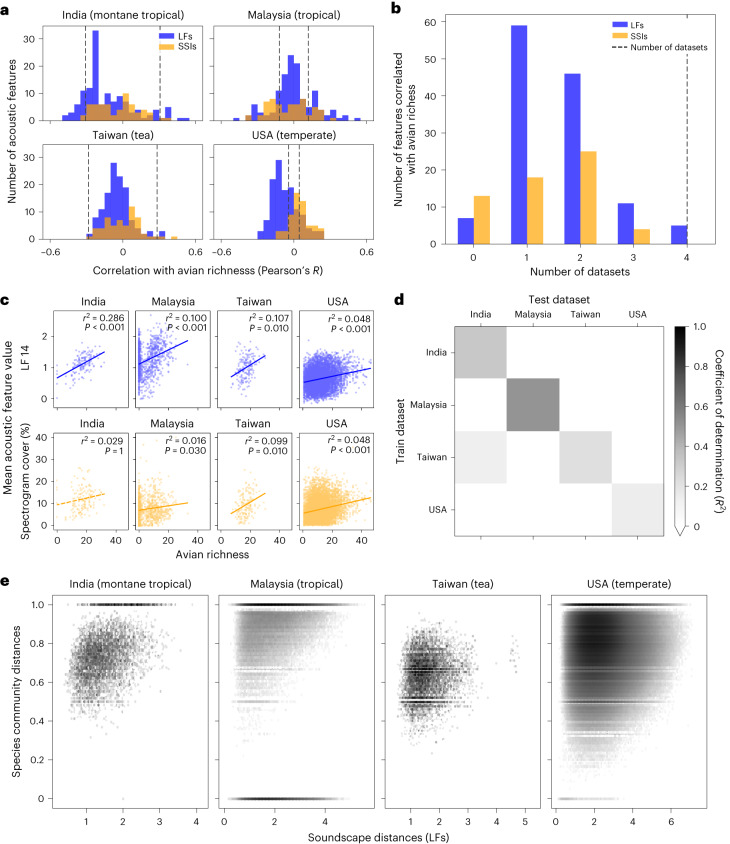
- Many acoustic features correlated with avian richness within datasets, but only 4 learned features (LFs) and no soundscape indices (SSIs) correlated across all four datasets; most correlated in only one or two datasets (105 LFs, 43 SSIs).
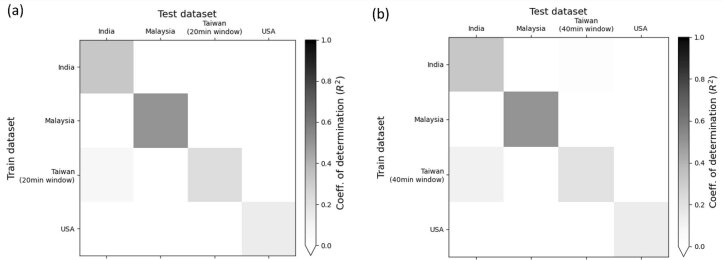
- Machine learning models predicted richness within datasets with R² = 0.32 (India), 0.50 (Malaysia), 0.22 (Taiwan) and 0.14 (USA), but cross-dataset performance was poor: except Taiwan-to-India (R² = 0.13), all cross-dataset R² values were < 0.
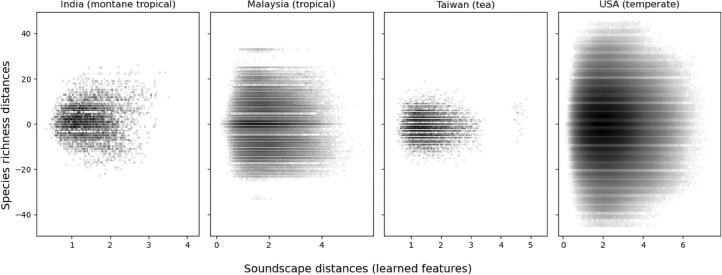
- Pairwise soundscape change correlated with pairwise avian community change within every dataset (Spearman Mantel test, P ≤ 0.001 for all), including all 14 Malaysia sites (P ≤ 0.03), but soundscape change was not significantly correlated with change in species richness in any dataset.
- The authors report no common acoustic features of biodiverse soundscapes and note many cases where similar soundscapes were associated with very different avian communities.
Methods
- Collated 8,023 short (1–20 min) recordings with paired avifaunal data from four datasets: USA temperate forest (n = 6,734, one site), Malaysia tropical rainforest (n = 977, 14 sites), Taiwan tea landscape (n = 165, 16 sites) and India montane tropical forest/grassland (n = 147, 91 sites).
- For each recording, calculated 128-dimensional VGGish CNN embeddings (LFs) and 60 analytically derived soundscape indices (SSIs); avian richness was based on unique species per point count, with eBird checklists used for the USA and expert point counts for India, Malaysia and Taiwan.
- Used univariate Pearson correlations, random forest regression for richness prediction with 70/30 train-test splits, and Mantel tests comparing Euclidean soundscape-feature distances with Jaccard community distances.
Limitations
- The paper states that without high-quality ground-truth data from the exact location being studied, soundscape methods should not be used to generate species-richness predictions, and that soundscape change is limited because similar soundscapes can accompany very different communities.
- The authors suggest non-biotic sounds (for example, motors) or non-avian biotic sounds (for example, insects and amphibians) may contribute more to soundscapes than birds, so richness predictions may reflect latent habitat-suitability variables rather than direct avian vocal contributions.
- Evident from the text: datasets differ greatly in sample size (USA n = 6,734 versus India n = 147), survey design, recording equipment and habitat, and the USA used eBird checklists rather than standardized in-person point counts; Taiwan audio was sparser and matched to point counts using a 1-hour window.
Model-written summary. Check it against the paper before relying on it.
Integrity signals
Registry
Cites
Statistics
Figures
Verification
Claims the paper makes
0 Valid · 0 Not valid · 1 Not checked · 25 Own results and interpretations
A result the paper reports from its own data — it cites no other source for it, so there is none to check. The quote shows it is in the paper.
In the paper
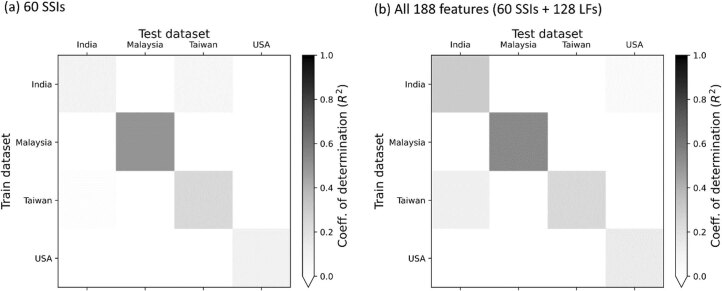
“Similar results were found when using only the 60 SSIs or all 188 features (128 LFs + 60 SSIs) together to predict richness (Extended Data Fig. 1).”
§ Limits to the accurate and generalizable use of soundscapes to monitor biodiversity > Main
plain- Asserted: passes — The authors put it forward as true.
- Checkable: passes — It can be checked against evidence.
- Load-bearing: unclear — It is unclear whether the paper’s conclusions depend on it.
- Based: passes — The paper gives a reason why it holds.
A result the paper reports from its own data — it cites no other source for it, so there is none to check. The quote shows it is in the paper.
In the paper
“By training a machine learning model on the full-dimensional learned feature vectors, we were able to predict species richness within datasets with relative success (coefficient of determination R2 = 0.32, 0.50, 0.22 and 0.14 for India, Malaysia, Taiwan and the USA, respectively; Fig. 1d).”
- Also stated in: § Main · hedged
“We then found that a machine learning model trained on compound indices was able to produce within-dataset predictions of species richness with some success.”
§ Limits to the accurate and generalizable use of soundscapes to monitor biodiversity > Main
plainstates an association- Asserted: passes — The authors put it forward as true.
- Checkable: passes — It can be checked against evidence.
- Load-bearing: passes — The paper’s conclusions depend on it.
- Based: passes — The paper gives a reason why it holds.
- Also stated in: § Main · hedged
A result the paper reports from its own data — it cites no other source for it, so there is none to check. The quote shows it is in the paper.
In the paper
“Most acoustic features correlated significantly with species richness in either one or two of the four datasets (105 LFs, 43 SSIs; Fig. 1b).”
- Also stated in: § Main · plain
“However, only four LFs and no SSIs correlated significantly with richness in all datasets, with most only correlating with richness in one or two datasets (105 LFs and 43 SSIs).”
- Also stated in: § Main · plain
“However, features did not behave consistently across datasets and most were only correlated with richness in one or two datasets”
§ Limits to the accurate and generalizable use of soundscapes to monitor biodiversity > Main
plainstates an association- Asserted: passes — The authors put it forward as true.
- Checkable: passes — It can be checked against evidence.
- Load-bearing: passes — The paper’s conclusions depend on it.
- Based: passes — The paper gives a reason why it holds.
- Also stated in: § Main · plain
A result the paper reports from its own data — it cites no other source for it, so there is none to check. The quote shows it is in the paper.
In the paper
“There was no significant correlation between dataset sample sizes and within-dataset or mean cross-dataset R2 values (Pearson’s correlation P > 0.05).”
§ Limits to the accurate and generalizable use of soundscapes to monitor biodiversity > Main
plain- Asserted: passes — The authors put it forward as true.
- Checkable: passes — It can be checked against evidence.
- Load-bearing: passes — The paper’s conclusions depend on it.
- Based: passes — The paper gives a reason why it holds.
A result the paper reports from its own data — it cites no other source for it, so there is none to check. The quote shows it is in the paper.
In the paper
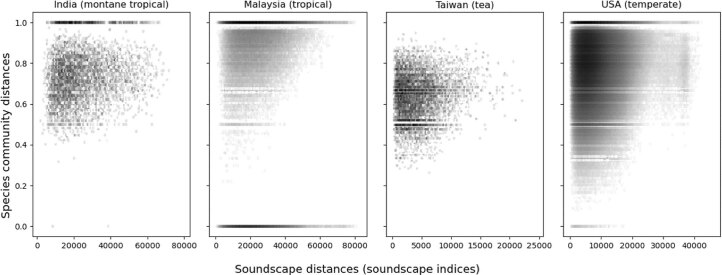
“There were more examples where communities changed but soundscapes did not than the converse, indicated by clustering of points in the upper left of Fig. 1e.”
- Also stated in: § Main · plain
“However, this approach was also limited, as there were many examples where similar soundscapes were associated with very different avian communities.”
§ Limits to the accurate and generalizable use of soundscapes to monitor biodiversity > Main
plain- Asserted: passes — The authors put it forward as true.
- Checkable: passes — It can be checked against evidence.
- Load-bearing: passes — The paper’s conclusions depend on it.
- Based: passes — The paper gives a reason why it holds.
- Also stated in: § Main · plain
11 more claims
Create a free account to see all 26 claims and every source verdict.
- It may state two separate claims as one. 4
- Probably not a substantial claim. 6
Claims other papers make about this one
Each is checked against this paper’s own text: does it say what the citing paper says it does?
In the citing paper
“Currently, no single best index exists, as most indices have been tested only in a handful of habitats or land use contexts, and when used individually, they often yielded mixed results27,28.”
From Soundscapes and deep learning enable tracking biodiversity recovery in tropical forests (2023) · cites this paper as [28]
Self-check
Percentages, sums and reported differences re-computed from the paper’s own numbers.
Each contradiction between two passages listed here was confirmed by an independent check.
Rated minor: it would not touch a result — a value no result rests on, a p-value that stays on the same side of the significance level, or a conflict that is clerical, resolved elsewhere in the paper, or outside its own findings.
In the paper
§ Limits to the accurate and generalizable use of soundscapes to monitor biodiversity > Main
“We collated 8,023 short (1–20 min) soundscape recordings collected concurrently with manually recorded avifaunal community data from four diverse datasets: a temperate forest in Ithaca, USA (n = 6,734, one site), a varied tropical rainforest landscape in Sabah, Malaysia (n = 977, 14 sites), an agricultural tea landscape in Chiayi, Taiwan (n = 165, 16 sites)”
§ Limits to the accurate and generalizable use of soundscapes to monitor biodiversity > Methods > Acoustic features
“For Taiwan, where audio data were sparser, features were averaged across all audio recordings that begun within a 1-hour window centred around the start time of the point count, resulting in an average of four 1-minute audio recordings per point count.”
Citations
Cites
Global Biodiversity: Indicators of Recent Declines
Butchart, S. H. M., Walpole, M., Collen, B., van Strien, A., Scharlemann, J. P. W., Almond, R. E. A., Baillie, J. E. M., Bomhard, B., Brown, C., Bruno, J., et al. (2010) · Science · doi:10.1126/science.1187512 · Cited by 4,892
Audio Set: An ontology and human-labeled dataset for audio events
Gemmeke, J. F., Ellis, D. P. W., Freedman, D., Jansen, A., Lawrence, W., Moore, R. C., Plakal, M., & Ritter, M. (2017) · 2017 IEEE International Conference on Acoustics, Speech and Signal Processing (ICASSP) · doi:10.1109/icassp.2017.7952261 · Cited by 3,134
CNN architectures for large-scale audio classification
Hershey, S., Chaudhuri, S., Ellis, D. P. W., Gemmeke, J. F., Jansen, A., Moore, R. C., Plakal, M., Platt, D., Saurous, R. A., Seybold, B., et al. (2017) · 2017 IEEE International Conference on Acoustics, Speech and Signal Processing (ICASSP) · doi:10.1109/icassp.2017.7952132 · Cited by 2,023
The eBird enterprise: An integrated approach to development and application of citizen science
Sullivan, B. L., Aycrigg, J. L., Barry, J. H., Bonney, R. E., Bruns, N., Cooper, C. B., Damoulas, T., Dhondt, A. A., Dietterich, T., Farnsworth, A., et al. (2014) · Biological Conservation · doi:10.1016/j.biocon.2013.11.003 · Cited by 1,155
BirdNET: A deep learning solution for avian diversity monitoring
Kahl, S., Wood, C. M., Eibl, M., & Klinck, H. (2021) · Ecological Informatics · doi:10.1016/j.ecoinf.2021.101236 · Cited by 903
Self-citationGlobal biodiversity change: The bad, the good, and the unknown
Pereira, H. M., Navarro, L. M., & Martins, I. S. (2012) · Annual Review of Environment and Resources · doi:10.1146/annurev-environ-042911-093511 · Cited by 777
Emerging opportunities and challenges for passive acoustics in ecological assessment and monitoring
Gibb, R., Browning, E., Glover‐Kapfer, P., & Jones, K. E. (2019) · Methods in Ecology and Evolution · doi:10.1111/2041-210x.13101 · Cited by 730
Rapid Acoustic Survey for Biodiversity Appraisal
Sueur, J., Pavoine, S., Hamerlynck, O., & Duvail, S. (2008) · PLoS ONE · doi:10.1371/journal.pone.0004065 · Cited by 684
Acoustic Indices for Biodiversity Assessment and Landscape Investigation
Sueur, J., Farina, A., Gasc, A., Pieretti, N., & Pavoine, S. (2014) · Acta Acustica united with Acustica · doi:10.3813/aaa.918757 · Cited by 519
Hill, A. P., Prince, P., Piña Covarrubias, E., Doncaster, C. P., Snaddon, J. L., & Rogers, A. (2018) · Methods in Ecology and Evolution · doi:10.1111/2041-210x.12955 · Cited by 507
Cited by
Using acoustic indices in ecology: Guidance on study design, analyses and interpretation
Bradfer‐Lawrence, T., Desjonqueres, C., Eldridge, A., Johnston, A., & Metcalf, O. (2023) · Methods in Ecology and Evolution · doi:10.1111/2041-210x.14194 · Cited by 106
Soundscapes and deep learning enable tracking biodiversity recovery in tropical forests
Müller, J., Mitesser, O., Schaefer, H. M., Seibold, S., Busse, A., Kriegel, P., Rabl, D., Gelis, R., Arteaga, A., Freile, J., et al. (2023) · Nature Communications · doi:10.1038/s41467-023-41693-w · Cited by 89
“This is in line with a recent meta-analysis using a global data set of audio-recordings paired with manual avifaunal point counts 28 .”
Napier, T., Ahn, E., Allen‐Ankins, S., Schwarzkopf, L., & Lee, I. (2024) · Expert Systems with Applications · doi:10.1016/j.eswa.2024.124220 · Cited by 76
Kath, H., Serafini, P. P., Campos, I. B., Gouvêa, T. S., & Sonntag, D. (2024) · Ecological Informatics · doi:10.1016/j.ecoinf.2024.102710 · Cited by 71
Bradfer‐Lawrence, T., Duthie, A. B., Abrahams, C., Adam, M., Barnett, R. J., Beeston, A. V., Darby, J., Dell, B. L., Gardner, N., Gasc, A., et al. (2024) · Methods in Ecology and Evolution · doi:10.1111/2041-210x.14357 · Cited by 73
“This may stem from genuine differences among soundscapes from different ecosystems (e.g. Barbaro et al., 2022; Sethi et al., 2023), or from methodological decisions made during data collection and analysis (Bradfer-Lawrence et al., 2020; Gasc et al., 2015).”
Self-citationExploring the relationship between the soundscape and the environment: A systematic review
Turlington, K., Suárez‐Castro, A. F., Teixeira, D., Linke, S., & Sheldon, F. (2024) · Ecological Indicators · doi:10.1016/j.ecolind.2024.112388 · Cited by 52
Teixeira, D., Roe, P., van Rensburg, B. J., Linke, S., McDonald, P. G., Tucker, D., & Fuller, S. (2024) · Conservation Science and Practice · doi:10.1111/csp2.13132 · Cited by 38
“Like other authors (e.g., Allen-Ankins et al., 2023; Sethi et al., 2023), we recommend that indices be tested and ground-truthed using data from conventional survey methods, as the weight of evidence indicates that the relationships of acoustic indices to biodiversity are currently unresolved for…”
BackgroundTowards interpretable learned representations for ecoacoustics using variational auto-encoding
Gibb, K., Eldridge, A., Sandom, C. J., & Simpson, I. (2023) · Ecological Informatics · doi:10.1016/j.ecoinf.2023.102449 · Cited by 42
The limits of acoustic indices
Llusia, D. (2024) · Nature Ecology & Evolution · doi:10.1038/s41559-024-02348-1 · Cited by 32
The effect of latitude on the efficacy of acoustic indices to predict biodiversity: A meta-analysis
Pan, W., Goodale, E. B., Jiang, A., & Mammides, C. (2024) · Ecological Indicators · doi:10.1016/j.ecolind.2024.111747 · Cited by 27
Ross, S. R. P. ‐., & Sasaki, T. (2023) · Ecological Research · doi:10.1111/1440-1703.12434 · Cited by 35
Acoustic indices fail to represent different facets of biodiversity
Giuliani, M., Mirante, D., Abbondanza, E., & Santini, L. (2024) · Ecological Indicators · doi:10.1016/j.ecolind.2024.112451 · Cited by 33
Williams, B., Balvanera, S. M., Sethi, S. S., Lamont, T. A. C., Jompa, J., Prasetya, M. E., Richardson, L. E., Chapuis, L., Weschke, E., Hoey, A. S., et al. (2025) · PLoS Computational Biology · doi:10.1371/journal.pcbi.1013029 · Cited by 27
Self-citationSoundscape Analytics: A New Frontier of Knowledge Discovery in Soundscape Data
Pijanowski, B. C., Rivas, F., Banerjee, S., Minghim, R., Lima, S. L., Bowers-Sword, R., Guzman, S. R., Revuelta-Acosta, J. D., Adeniji, A. E., Grimes, S. E., et al. (2024) · Current Landscape Ecology Reports · doi:10.1007/s40823-024-00101-9 · Cited by 24
“…(see [5] for extensive reviews of work conducted in the past 15 years) as proxies for biodiversity metrics (e.g., species richness) [31, 99–103], to compare acoustic patterns across habitat types, assess impacts of habitat disturbance, track post-restoration habitat recovery, and assess…”
Soundscape analysis reveals fine ecological differences among coral reef habitats
Azofeifa‐Solano, J. C., Parsons, M. J., Brooker, R. M., McCauley, R. D., Pygas, D. R., Feeney, W. E., Simpson, S., Nedelec, S. L., Croxford, E. M., Meekan, M. G., et al. (2025) · Ecological Indicators · doi:10.1016/j.ecolind.2025.113120 · Cited by 26
Acoustic monitoring for tropical insect conservation
Riede, K., & Balakrishnan, R. (2025) · Philosophical Transactions of the Royal Society B Biological Sciences · doi:10.1098/rstb.2024.0046 · Cited by 32
AviEar: An IoT-Based Low-Power Solution for Acoustic Monitoring of Avian Species
Verma, R., & Kumar, S. (2024) · IEEE Sensors Journal · doi:10.1109/jsen.2024.3487638 · Cited by 14
“While these two species are not representative of all bird groups, they were the ones observed with high vocal activity in the area where AviEar was deployed [57].”
Kotian, M., Biniwale, S., Mourya, P., Buřivalová, Z., & Choksi, P. (2024) · Conservation Science and Practice · doi:10.1111/csp2.13133 · Cited by 24
“…these encouraging studies, many indices have shown inconsistencies across various types of biomes, degrees of species diversity, vocalizing communities, and environmental complexity, especially in tropical forests (Buxton et al., 2018; Jorge et al., 2018; Mammides et al., 2017; Sethi et al., 2023).”
Mammides, C., Wuyuan, P., Huang, G., Sreekar, R., Ieronymidou, C., Jiang, A., Goodale, E. B., & Papadopoulos, H. (2025) · Ecological Indicators · doi:10.1016/j.ecolind.2025.113105 · Cited by 15
Galappaththi, S., Goodale, E. B., Sun, J., Jiang, A., & Mammides, C. (2024) · Global Ecology and Conservation · doi:10.1016/j.gecco.2024.e02922 · Cited by 22
Zhao, W., Jin, J., Bao, Z., Wu, J., Zhang, Q., Yu, C., & Wang, G. (2025) · Ecological Indicators · doi:10.1016/j.ecolind.2025.113565 · Cited by 12
Ross, S. R. P. ‐., Friedman, N. R., Dudley, K. L., Yoshida, T., Yoshimura, M., Economo, E. P., Armitage, D. W., & Donohue, I. (2023) · Global Change Biology · doi:10.1111/gcb.17067 · Cited by 16
“…on critical indicator taxa (Gasc et al., 2017), while acoustic indices provide rapid infor - mation on a combination of biodiversity and other meaningful aspects of soundscape change (Bradfer-Lawrence et al., 2020; Harris et al., 2016; Müller et al., 2023; Rajan et al., 2022; Sethi et al., 2023).”
BackgroundTemporal dynamics of acoustic diversity in managed forests
Müller, S., Jahn, O., Jung, K., Mitesser, O., Ammer, C., Böhm, S. M., Ehbrecht, M., Farina, A., Renner, S. C., Pieretti, N., et al. (2024) · Frontiers in Ecology and Evolution · doi:10.3389/fevo.2024.1392882 · Cited by 13
Acoustic indices track local vertebrate biodiversity in a subtropical landscape
Botero-Cañola, S., Wilson, K. N., Garcia, E., Heisey, M. L., Reeves, L. E., Burkett-Cadena, N. D., Romagosa, C. M., Sieving, K. E., & Wisely, S. M. (2024) · Ecological Indicators · doi:10.1016/j.ecolind.2024.112292 · Cited by 18
Biases in Ecoacoustics Analysis: A Protocol to Equalize Audio Recorders
Potenza, A., Zaffaroni-Caorsi, V., Benocci, R., Guagliumi, G., Fouani, J. M., Bisceglie, A., & Zambon, G. (2024) · Sensors · doi:10.3390/s24144642 · Cited by 10
The potential of soundscapes as an ecosystem monitoring tool for urban biodiversity
Arzberger, S., Fairbairn, A. J., Hemauer, M., Mühlbauer, M., Weissmann, J. A., & Egerer, M. (2025) · Journal of Urban Ecology · doi:10.1093/jue/juaf002 · Cited by 15
The efficacy of acoustic indices for monitoring abundance and diversity in soil soundscapes
Metcalf, O., Nunes, C. A., Abrahams, C., Baccaro, F. B., Bradfer‐Lawrence, T., Lees, A. C., do Vale, É. M., & Barlow, J. (2024) · Ecological Indicators · doi:10.1016/j.ecolind.2024.112954 · Cited by 10
“Other studies have shown that none of the commonest acoustic indices have a consistent relationship with avian species richness that can be generalised across differing biophysical and biogeographic gradients (Sethi et al., 2023).”
Integrated above‐ and below‐ground ecological monitoring for nature‐based solutions
Warner, E. A., Giuliani, L. M., Campbell, G. A., Smith, P., Seddon, N., Seddon, D., & Smith, A. C. (2025) · Ecological Solutions and Evidence · doi:10.1002/2688-8319.70043 · Cited by 11
“Producing species richness metrics from acoustic data requires extensive training data for comparison and models can only detect vocalisations from well-characterised, common species (Sethi et al., 2023 ).”
InfluentialWang, S., Duan, Y., Cao, R., Feng, J., Ge, J., & Wang, T. (2025) · Biological Conservation · doi:10.1016/j.biocon.2025.111115 · Cited by 10
Opening the Pandora's box of acoustic indices
Sugai, L. S. M., & Costa‐Pereira, R. (2025) · Trends in Ecology & Evolution · doi:10.1016/j.tree.2025.07.012 · Cited by 6
Soundscapes and Vibroscapes – Encyclopedia of Biodiversity, 3rd Ed.
Pijanowski, B. C., & Rivas, F. (2023) · Elsevier eBooks · doi:10.1016/b978-0-12-822562-2.00381-9 · Cited by 6
‘I rarely get outside’: scientists ditch fieldwork in the age of AI
Irwin, A. (2026) · Nature · doi:10.1038/d41586-025-04150-w · Cited by 4
Sanderfoot, O. V., Tingley, M. W., Bassing, S. B., Vaughan, J. K., June, N. A., & Gardner, B. (2024) · Global Ecology and Conservation · doi:10.1016/j.gecco.2024.e03044 · Cited by 15
Loo, Y. Y., Lee, M. Y., Shaheed, S., Maul, T., & Clink, D. J. (2025) · The Journal of the Acoustical Society of America · doi:10.1121/10.0034638 · Cited by 8
Soundscape-based evaluation of small-scale forest management interventions
Arend, D., Gebhard, A., Triantafyllopoulos, A., Schuller, B. W., Scherer‐Lorenzen, M., & Müeller, S. (2025) · Forest Ecology and Management · doi:10.1016/j.foreco.2025.123067 · Cited by 5
Azofeifa‐Solano, J. C., Parsons, M. J., Kemp, J. D., Brooker, R. M., McCauley, R. D., Madhusudhana, S., Wyatt, M., Simpson, S. D., & Erbe, C. (2025) · Remote Sensing in Ecology and Conservation · doi:10.1002/rse2.70044 · Cited by 5
Ashton‐Butt, A., Newson, S. E., Doser, J. W., Gillings, S., Kornienko, T., Fenchuk, V., Pearce‐Higgins, J. W., Scott, C. D., & Atkinson, P. W. (2025) · Global Ecology and Biogeography · doi:10.1111/geb.70175 · Cited by 7
Berman, L. M., Perea, S., Sagar, H. S. S. C., Persche, M. E., Ingram, G., Maeda, T. M., Yoh, N., Müller, J. C., Schlüter, J., Zapata, N., et al. (2026) · Global Ecology and Biogeography · doi:10.1111/geb.70224 · Cited by 5
Thoret, E., Jourdan, H., & Gasc, A. (2026) · The Journal of the Acoustical Society of America · doi:10.1121/10.0043166 · Cited by 6
Temporal patterns of Amazonian insect acoustic activity
Howells, N., Lees, A. C., Barlow, J., Berenguer, É., Rossi, L. C., Sueur, J., Sullivan, M. J. P., Ramos, Y. G., & Metcalf, O. (2025) · Philosophical Transactions of the Royal Society B Biological Sciences · doi:10.1098/rstb.2024.0337 · Cited by 6
“This variation, alongside the differing responses of indices to the different metrics of insect acoustic activity in our own study, further highlights the lack of generalizability in acoustic index response to soundscapes [34,35].”
Grinfeder, E., Lorenzi, C., Teytaut, Y., Haupert, S., & Sueur, J. (2025) · Ecological Indicators · doi:10.1016/j.ecolind.2025.113882 · Cited by 5
Qiu, Y., Tong, J., Fu, H., Lyu, S., Rizky, M. Y. R., Wu, J., Wei, G., & Xue, M. (2024) · Ecological Indicators · doi:10.1016/j.ecolind.2024.112363 · Cited by 5
Mammides, C., Wuyuan, P., Huang, G., et al. (2024) · SSRN Electronic Journal · doi:10.2139/ssrn.4823337 · Cited by 3
Large-scale recovery in Costa Rica’s payment for ecosystem service programPreprint
Delgado, G. L., van den Hoogen, J., Dent, D. H., Bradfer‐Lawrence, T., Werden, L. K., Cole, R. J., Quesada, C. D., Fajarado, J.-A. J., Rodríguez, A. M., Solorzano, E. M., et al. (2024) · bioRxiv (Cold Spring Harbor Laboratory) · doi:10.1101/2024.09.03.610944 · Cited by 3
Bai, Z., Qi, Z., Wang, C., Hao, Z., & Guo, Q. (2025) · Urban forestry & urban greening · doi:10.1016/j.ufug.2025.129131 · Cited by 3
Xie, J., Xie, S., Liu, Y., Jing, X., Zhu, M., Xie, L., Zhang, J., Qian, K., & Schuller, B. W. (2025) · Artificial Intelligence Review · doi:10.1007/s10462-025-11414-4 · Cited by 6
“The second approach is based on acoustic indices (AIs), emphasizing the extraction of features from the entire soundscape to infer biodiversity (Sethi et al. 2023).”
Duan, Y., Wang, S., Cao, R., Feng, J., Ge, J., & Wang, T. (2025) · Ecosphere · doi:10.1002/ecs2.70493 · Cited by 2
Wang, H., He, X., Yao, Z., Wang, B., Jiang, Y., & Lin, L. (2025) · Ecological Indicators · doi:10.1016/j.ecolind.2025.113266 · Cited by 3
Rajan, S. C., Vishnu, M., Mitra, A., Sooraj, N. P., Athira, K., Pillai, M. S., & Jaishanker, R. N. (2024) · Scientific Reports · doi:10.1038/s41598-024-53153-6 · Cited by 3
“References 10,41 , particularly at the community-level studies.”
BackgroundMammides, C., Huang, G., Sree, R. M. K., Ieronymidou, C., & Papadopoulos, H. (2024) · Research Square · doi:10.21203/rs.3.rs-4494063/v1 · Cited by 2
Interpretable and Robust Machine Learning for Exploring and Classifying Soundscape DataPreprint
Omprakash, A., Balakrishnan, R., Ewers, R. M., & Sethi, S. S. (2024) · bioRxiv (Cold Spring Harbor Laboratory) · doi:10.1101/2024.11.07.622465 · Cited by 3
Self-citationMalhi, V., Brignoli, G., Hallam, J., Njoroge, P., Lens, L., Somveille, M., & Day, J. J. (2025) · Ibis · doi:10.1111/ibi.13459 · Cited by 1
Inter-annual and campaign-based diel dynamics of spring bird vocal activity in a central urban park
Bai, Z., Meng, L., Qi, Z., Jiang, S., Jin, J., & Wang, C. (2026) · Urban forestry & urban greening · doi:10.1016/j.ufug.2026.129391 · Cited by 1
Soundscape as a proxy for seagrass meadow condition and anthropogenic activity
Manna, G. L., Morello, G., Merella, M. M., Crobu, A., Pansini, A., Guala, I., Mancuso, F. P., Bosch‐Belmar, M., Mangano, M. C., Sarà, G., et al. (2026) · Ecological Indicators · doi:10.1016/j.ecolind.2026.115290 · Cited by 1
Kath, H., Gouvêa, T. S., & Sonntag, D. (2026) · Methods in Ecology and Evolution · doi:10.1111/2041-210x.70373 · Cited by 2
“…vast recordings is infeasible, and automatic analysis remains challenging due to undirected recording setups, overlapping species calls, distant tar - get sounds and environmental noise such as wind and rain (Browning et al., 2017 ; Enari et al., 2026 ; Oswald et al., 2022 ; Sethi et al., 2023 ).”
Leveraging time-based acoustic patterns for ecosystem analysis
Castro-Ospina, A. E., Marín, P. A. R., López, J. D., & Martinez-Vargas, J. D. (2024) · Neural Computing and Applications · doi:10.1007/s00521-024-10157-7 · Cited by 2
Towards using virtual acoustics for evaluating spatial ecoacoustic monitoring technologies
Penru, N. P. L., Heath, B. E., Dunning, J., Picinali, L., Ewers, R. M., & Sethi, S. S. (2024) · Methods in Ecology and Evolution · doi:10.1111/2041-210x.14405 · Cited by 3
Self-citationMammides, C., Ieronymidou, C., & Papadopoulos, H. (2024) · Research Square · doi:10.21203/rs.3.rs-4635704/v1 · Cited by 1
Biodiversity and Ecosystem Monitoring using deep learningPreprint
Hussain, D., Almoustafa, T. A., Shakoor, S., Fauz, F., Ahmed, R., & Ansari, S. (2025) · Research Square · doi:10.21203/rs.3.rs-7478081/v1 · Cited by 1
SANE: an Index of Anthropogenic Noise Levels for Wildlife Research in Terrestrial EcosystemsPreprint
Giuliani, M., Mirante, D., Russo, L. F., Zampetti, A., & Santini, L. (2025) · bioRxiv (Cold Spring Harbor Laboratory) · doi:10.64898/2025.12.23.696194 · Cited by 1
Acoustic Indices Track Local Vertebrate Biodiversity in a Subtropical LandscapePreprint
Botero-Cañola, S., Wilson, K. N., Garcia, E., et al. (2024) · SSRN Electronic Journal · doi:10.2139/ssrn.4758761
MAJOR SOUNDSCAPE DIFFERENCES IN THE WEST COAST OF SCOTLAND ARE REFLECTED IN ACOUSTIC INDICES
Dell, B. L., White, P. R., Bull, J., & Risch, D. (2024) · International Conference on Underwater Acoustics (ICUA) · doi:10.25144/22210
“Whilst numerous studies have found promising correlations between individual indices and ecological parameters when ground-truthed 13 , these correlations were often specific to a habitat or location and not general 14 .”
BackgroundSoundscape-Based Evaluation of Small-Scale Forest Management InterventionsPreprint
Arend, D., Gebhard, A., Triantafyllopoulos, A., et al. (2024) · SSRN Electronic Journal · doi:10.2139/ssrn.5063298
Acoustic indexes as predictors of bird richness: Insights from atlantic forest fragments
Löw, T. L., de Freitas, R. H. A., Brito, G. R. R., Roos, A. L., & de Macedo-Soares, L. C. P. (2026) · Ecological Indicators · doi:10.1016/j.ecolind.2026.114848
Mammides, C., Ieronymidou, C., & Papadopoulos, H. (2025) · Scientific Data · doi:10.1038/s41597-025-04807-1 · Cited by 2
“However, recent research has highlighted that the indices’ performance is, in many cases, inconsistent 13,14 and varies considerably across regions 14,15 depending on the specific characteristics of the soundscapes in those areas 6,16 .”
Relationships between species assemblage richness and acoustic indices
Rojas, Y. E. L., Xie, J., & Colonna, J. G. (2025) · Anais do Workshop de Computação Aplicada à Gestão do Meio Ambiente e Recursos Naturais (WCAMA) · doi:10.5753/wcama.2025.9006
“While these studies have shown promising results, the extent to which these indices can serve as reliable proxies for measuring diversity remains unclear [Mammides et al. 2017, Bicudo et al. 2023, Sethi et al. 2023, Llusia 2024, Mammides et al. 2025].”
Intermediate-Task Transfer Learning for Bioacoustic Data
Kath, H., Gouvêa, T. S., & Sonntag, D. (2025) · Lecture notes in computer science · doi:10.1007/978-3-032-02813-6_4
“However, these methods are controversial and have been shown to misrepresent biodiversity in some cases [3,32].”
(2025) · Nature Ecology & Evolution · doi:10.1038/s41559-025-02860-y
Quantifying the effect of forest edge on tropical fauna using explainable ecoacoustics metrics
Bouche, A., Jourdan, H., Takerkart, S., Meringo, H. D., Thoret, E., & Gasc, A. (2026) · The Journal of the Acoustical Society of America · doi:10.1121/10.0043951 · Cited by 2
Ye, Z., Xiang, Y., Zhang, Z., Yang, Y., & Xiong, Y. (2025) · Global Ecology and Conservation · doi:10.1016/j.gecco.2025.e03943 · Cited by 2
Gibb, K., Eldridge, A., Shuaibu, A. L., & Simpson, I. (2025) · bioRxiv (Cold Spring Harbor Laboratory) · doi:10.64898/2025.12.09.693207
“The former is fast growing in popularity thanks to discriminative models such as BirdNET [2], but despite rapid uptake, issues of reliability undermine trust; the latter has come under criticism due to lack of reliable, interpretable, generalisable means to describe whole soundscape recordings [3].”
Suggestions for extending, expanding, and integrating passive acoustic monitoring programs
Wood, C. M. (2025) · Ecological Indicators · doi:10.1016/j.ecolind.2025.114549 · Cited by 1
Jiang, Q., Mao, R., Zhao, Y., Xie, J., Lin, C., Zhu, R., Xiao, Z., & Chang, J. (2026) · Avian Research · doi:10.1016/j.avrs.2026.100361 · Cited by 2
Kesling, J. R., Walters, A., & Simonds, K. (2026) · The Anthropocene Review · doi:10.1177/20530196261419125
“In addition to the rise of anthropogenic disturbances, increasingly artificial elements penetrate natural spaces, inducing ecological changes (Sethi et al., 2023).”
Accounting for noise improves the generalization of acoustic indices when estimating biodiversityPreprint
Suárez-Ronay, S. H., Biljman, K., Belmaker, J., et al. (2026) · SSRN Electronic Journal · doi:10.2139/ssrn.6546052
Acoustic indices are driven by habitat characteristics, not bird diversityPreprint
Chen, Y.-F., Mammides, C., Li, S., et al. (2026) · SSRN Electronic Journal · doi:10.2139/ssrn.6553867
Akoglu, I., Bacak, E., Bilgin, S., Duran, M., Boyla, K. A., Akçay, Ç., & Ertör‐Akyazi, P. (2026) · bioRxiv (Cold Spring Harbor Laboratory) · doi:10.64898/2026.05.20.726349
Scale-dependent landscape effects on soundscape: A case study in Guangzhou, China
Chen, J., Xiao, R., Hu, K., & Ding, Z. (2026) · Avian Research · doi:10.1016/j.avrs.2026.100395
Integrating Ecological Meaning, Sensor Deployment, and Analytical Choices in Coastal Ecoacoustics
Azofeifa-Solano, J. C., Mulà, C., Kemp, J. D., et al. (2026) · Springer eBooks · doi:10.1007/978-3-031-94229-7_20-1
Allen‐Ankins, S., Barati, A., & McDonald, P. G. (2026) · Ecological Indicators · doi:10.1016/j.ecolind.2026.114985
Ecological specificity of acoustic indices varies with soundscape composition and habitat contextPreprint
Geukes, S. J., Bernard, C., Barile, C., & Kissling, W. D. (2026) · SSRN Electronic Journal · doi:10.2139/ssrn.6884127
Comparative analysis of bioacoustic indices: Performance and limitations
Rojas, Y. E. L., Xie, J., Frery, A. C., & Colonna, J. G. (2026) · Ecological Indicators · doi:10.1016/j.ecolind.2026.115035
Decoding coral reef soundscapes for monitoring and conservation
Azofeifa‐Solano, J. C., Kemp, J. D., Erbe, C., Brooker, R. M., McCauley, R. D., & Parsons, M. J. (2026) · Trends in Ecology & Evolution · doi:10.1016/j.tree.2026.05.016
Mammides, C., Huang, G., Sreekar, R., Ieronymidou, C., & Papadopoulos, H. (2026) · Environmental and Sustainability Indicators · doi:10.1016/j.indic.2026.101387 · Cited by 4
Wang, Z., & Yu, G. (2026) · Sensors · doi:10.3390/s26133972 · Cited by 3
“These sounds may mask target vocalizations, distort MFCC feature morphology, and introduce abnormal high-amplitude feature responses [4,5,15–17].”
Acoustic indices can be driven by habitat characteristics rather than bird diversity
Chen, Y., Mammides, C., Li, S., Darras, K., & Shen, X. (2026) · Environmental and Sustainability Indicators · doi:10.1016/j.indic.2026.101412 · Cited by 1
JIANG, X., Engelmann, N., Vienneau, D., & Röösli, M. (2026) · Noise and Health · doi:10.4103/nah.nah_261_25
Forest degradation reduces acoustic partitioning in tropical avian communities
Darby, J. B., Metcalf, O., Barlow, J., Berenguer, É., Ferreira, J., de Moura, N. G., Nunes, C. A., & Lees, A. C. (2026) · Journal of Avian Biology · doi:10.1002/jav.03662
Xu, Z., Kang, J., Hu, R., Jin, X., Wang, B., & Yu, L. (2026) · Environmental Technology & Innovation · doi:10.1016/j.eti.2026.105137 · Cited by 1
Accounting for noise improves the generalization of acoustic indices when estimating biodiversity
Suárez-Ronay, S. H., Biljman, K., Belmaker, J., & Yovel, Y. (2026) · Ecological Indicators · doi:10.1016/j.ecolind.2026.115304
The role of conservation bioacoustics in achieving global biodiversity goals
Perea, S., Rhinehart, T. A., Bouffaut, L., Araya‐Salas, M., Davidson, I. K., Arcila-Pérez, L. F., Kitzes, J. A., & Buřivalová, Z. (2026) · Nature Reviews Biodiversity · doi:10.1038/s44358-026-00189-3 · Cited by 3
Duarte‐Marín, S., Angel-Soto, S., Arroyave-Acevedo, S., & Sánchez-Rojas, E. J. (2026) · Bioacoustics · doi:10.1080/09524622.2026.2709011
Acoustic indices differ in their sensitivity to biophony, geophony, and temporal ecological dynamics
Geukes, S. J., Bernard, C., Barile, C., & Kissling, W. D. (2026) · Ecological Indicators · doi:10.1016/j.ecolind.2026.115563
Linking the forest soundscape with structural and ecological attributes: a bioacoustic approach
Amin, M. S., Fahim, M. S. I., Kloepper, L. N., Saimun, M. S. R., Ahammed, S., Sultana, F., Hossain, M. M., & Khan, M. A. S. A. (2026) · Bioacoustics · doi:10.1080/09524622.2026.2733884
Acoustic event detection for spatiotemporal patterns of bird activity in protected areas
Xu, X., Huang, Y., Sun, X., Zhang, C., Ling, J., & Yu, S. (2026) · The Journal of the Acoustical Society of America · doi:10.1121/10.0044420
Metadata
- Authors
- Sethi, S. S., Bick, A., Ewers, R. M., Klinck, H., Ramesh, V., Tuanmu, M.-N., & Coomes, D. A.
- Affiliations
- University of Cambridge (GB)
- Imperial College London (GB)
- Cornell University (US)
- Biodiversity Research Center, Academia Sinica (TW)
- Corresponding author
- Sethi, Sarab S.
- Venue
- Nature Ecology & Evolution
- Published
- 2023-07-31
- Volume
- 7
- Issue
- 9
- Pages
- 1373-1378
- ISSN
- 2397-334X (ISSN-L)
- PMC
- PMC10482675
- OpenAlex
- W4385416115
- Semantic Scholar
- 590db7df777fe3803b929951e13584ecedc5e345
- Cited by
- 95
- References
- 28
- Citations by year
- 2026: 35 · 2025: 29 · 2024: 25 · 2023: 6
- FWCI
- 23.35
- Type
- journal article
- Language
- en
- Open access
- hybrid
- doi.org
- Licence
- cc-by
- creativecommons.org/licenses/by/4.0 (tdm)
- creativecommons.org/licenses/by/4.0 (vor)
- Locations
- Nature Ecology & Evolution (publishedVersion, cc-by)
- PubMed Central (publishedVersion, cc-by)
- PubMed (publishedVersion)
- Apollo (University of Cambridge) (submittedVersion, cc-by)
- NORA - Norwegian Open Research Archives (submittedVersion, cc-by)
- Spiral (Imperial College London) (submittedVersion, other-oa)
- Apollo (cc-by)
- Funders
- World Wildlife Fund
- Yayasan Sime Darby
- Academia Sinica
- Ministry of Science and Technology, Taiwan (MOST111-2321-B002-019)
- National Science and Technology Council
- Cornell Lab of Ornithology
- Topics
- Life Sciences › Agricultural and Biological Sciences › Ecology, Evolution, Behavior and Systematics › Animal Vocal Communication and Behavior
- Physical Sciences › Environmental Science › Ecology › Wildlife Ecology and Conservation
- Physical Sciences › Environmental Science › Ecology › Avian ecology and behavior
- Keywords
- soundscape, biodiversity monitoring, species richness, avifauna, machine learning prediction, community change
- MeSH terms
- Machine Learning, Humans, Ecosystem, Biodiversity
About these checks
Registry, retraction, Cites and statistics results are computed, not judged, with one exception: a printed reference that no index lists is read once by a model before it counts as a citation error. Claims are extracted by a model and kept only when their quote appears verbatim in the text; each cited source is then checked, with a model’s help, for whether it says what the claim relies on. Those verdicts can be wrong — read the claim’s quote and the cited source before relying on one.
A language model drew the claims from the paper on 2026-10-10, under version 3 of the claim definition (model deepseek-v4.1-flash, prompt extract-v3).
A second model labelled each claim on 2026-10-10 (model jev-1.13-20260917, definition revision gold-guideline-v0.2).
Statistics and arithmetic are recomputed, not judged.
Confidence bands are shown only for fields calibrated on our annotated test set. None is calibrated yet, so no band is shown.
What counts as a claim ›How we measure confidence ›How we check this ›
Are you an author, or do you see a problem with this page? Request a review
Data sources
Bibliographic data: Semantic Scholar, OpenAlex, Crossref.
Contains information from the Semantic Scholar Academic Graph Datasets, made available under the ODC Attribution License (ODC-BY 1.0).
Semantic Scholar’s data is described in: Kinney, R., et al. (2023). The Semantic Scholar Open Data Platform. arXiv:2301.10140.
