

Initial evidence of research quality of registered reports compared with the standard publishing model
Open accessPublished version of a preprint
The DOI matches its Crossref record; 47 of the 47 references it cites were found in a registry or an index; 18 of the 54 sources its claims cite were checked for support.
Abstract
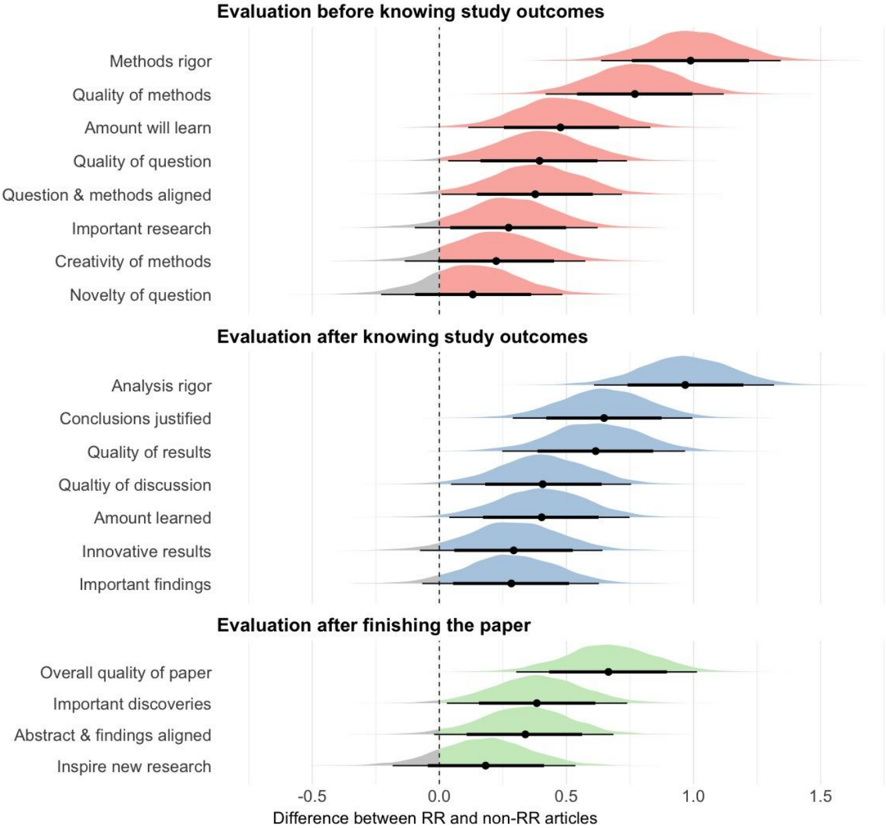
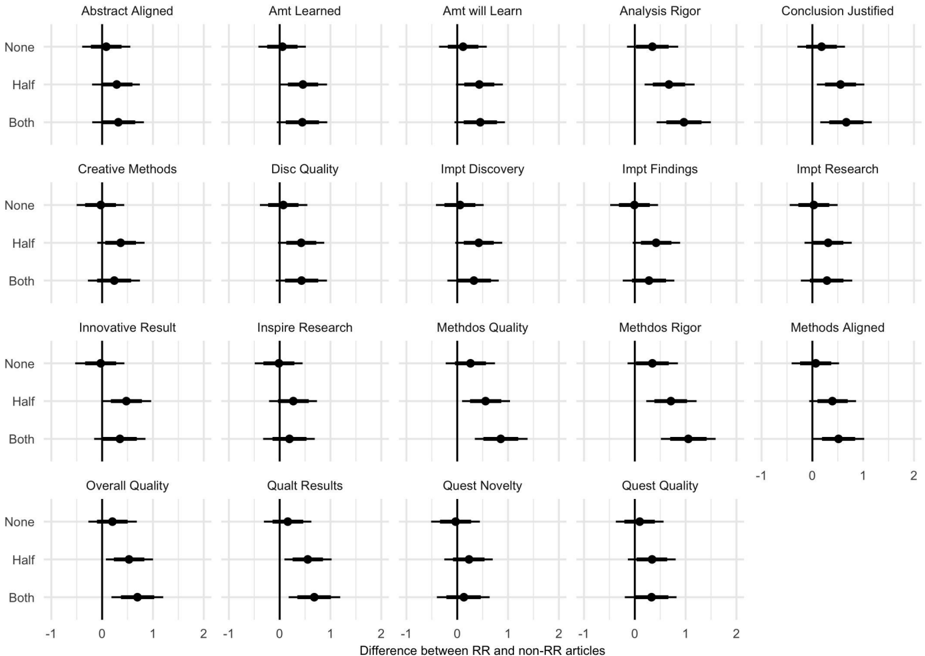
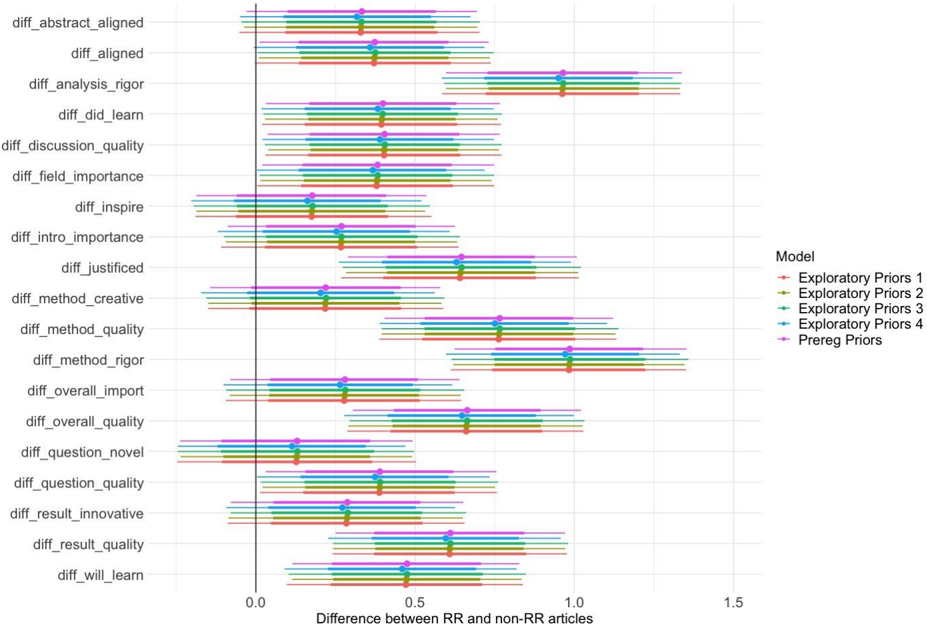
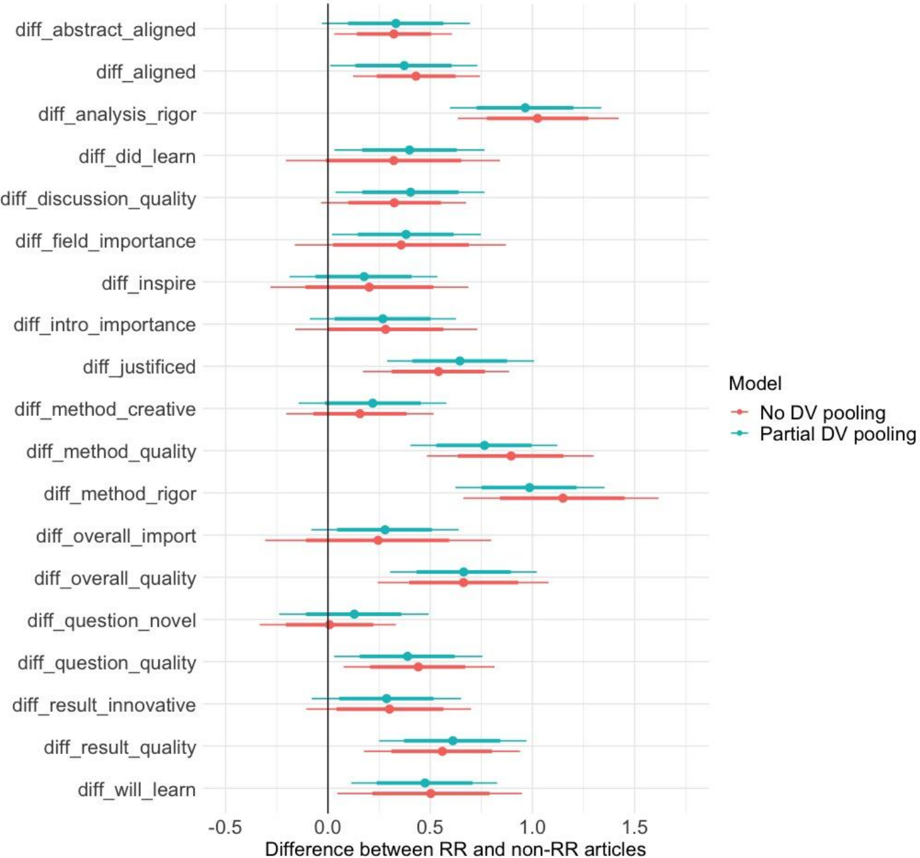
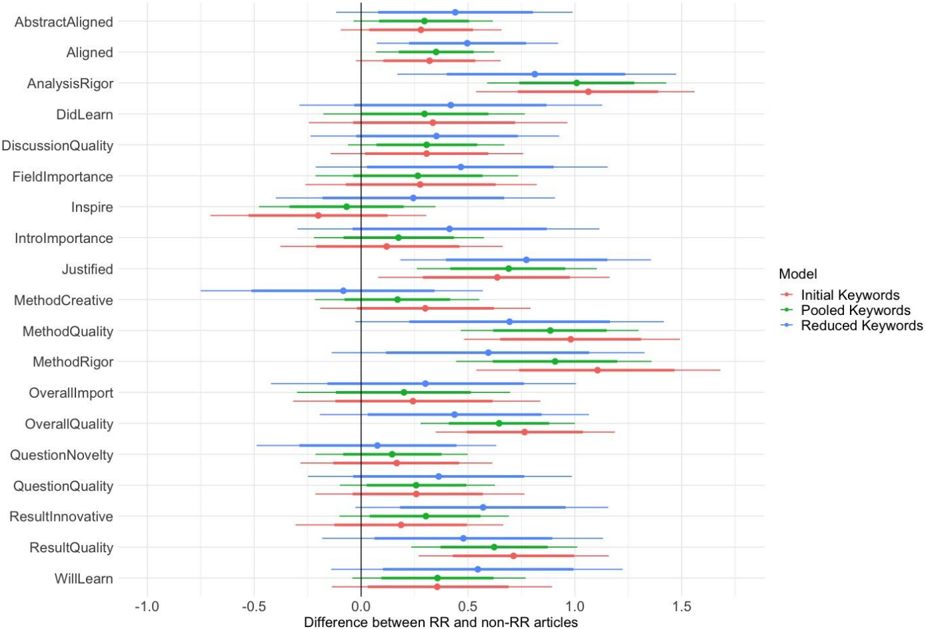
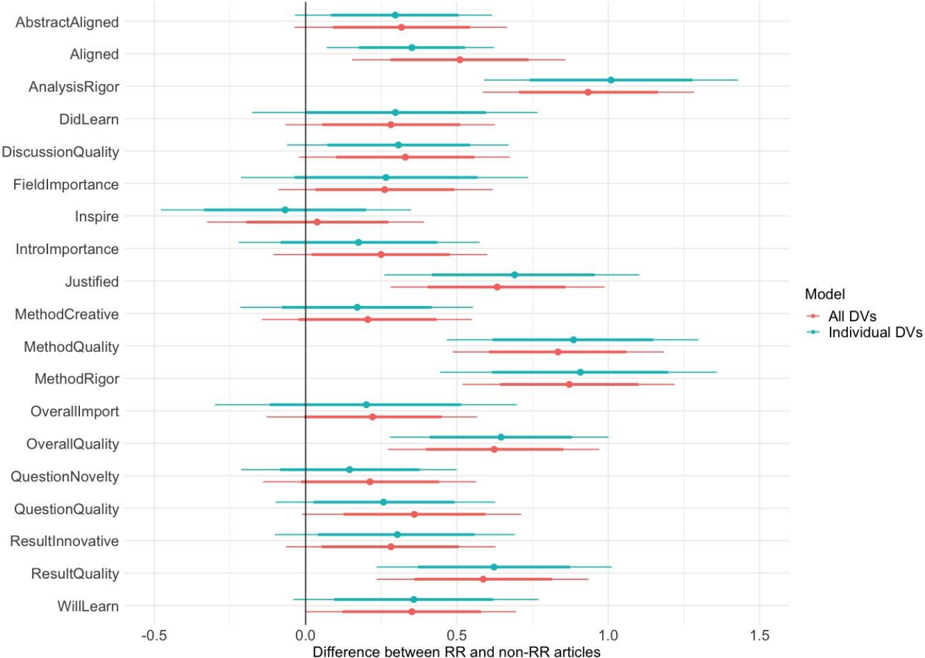
In registered reports (RRs), initial peer review and in-principle acceptance occur before knowing the research outcomes. This combats publication bias and distinguishes planned from unplanned research. How RRs could improve the credibility of research findings is straightforward, but there is little empirical evidence. Also, there could be unintended costs such as reducing novelty. Here, 353 researchers peer reviewed a pair of papers from 29 published RRs from psychology and neuroscience and 57 non-RR comparison papers. RRs numerically outperformed comparison papers on all 19 criteria (mean difference 0.46, scale range -4 to +4) with effects ranging from RRs being statistically indistinguishable from comparison papers in novelty (0.13, 95% credible interval [-0.24, 0.49]) and creativity (0.22, [-0.14, 0.58]) to sizeable improvements in rigour of methodology (0.99, [0.62, 1.35]) and analysis (0.97, [0.60, 1.34]) and overall paper quality (0.66, [0.30, 1.02]). RRs could improve research quality while reducing publication bias and ultimately improve the credibility of the published literature.
Overview
CoChat Summary
TL;DR
In a naturalistic comparison, 353 researchers peer reviewed paired Registered Reports (RRs) and standard-model articles, rating RRs higher on all 19 evaluated criteria. RRs showed the largest advantages in methodological and analysis rigor, with little evidence of costs to novelty or creativity.
Key findings
- Across 29 RRs and 57 matched comparison articles, RRs outperformed comparison papers on all 19 criteria, with an average difference of 0.46 on a −4 to +4 scale and a range of 0.13 to 0.96; 12 of 19 criteria had 95% credible intervals excluding zero.
- Largest advantages were for rigor of methodology (0.99, 95% CrI [0.62, 1.35]) and analysis (0.97, [0.60, 1.34]), and overall paper quality (0.66, [0.30, 1.02]); smallest differences were novelty (0.13, [−0.24, 0.49]) and creativity (0.22, [−0.14, 0.58]).
- Objective coding showed more preregistration (59% of RRs vs 7% author-based and 0% journal-based comparisons), open data (86% vs 18% and 14%), open materials (59% vs 11% and 7%), and larger median sample sizes (220 vs 118 and 78).
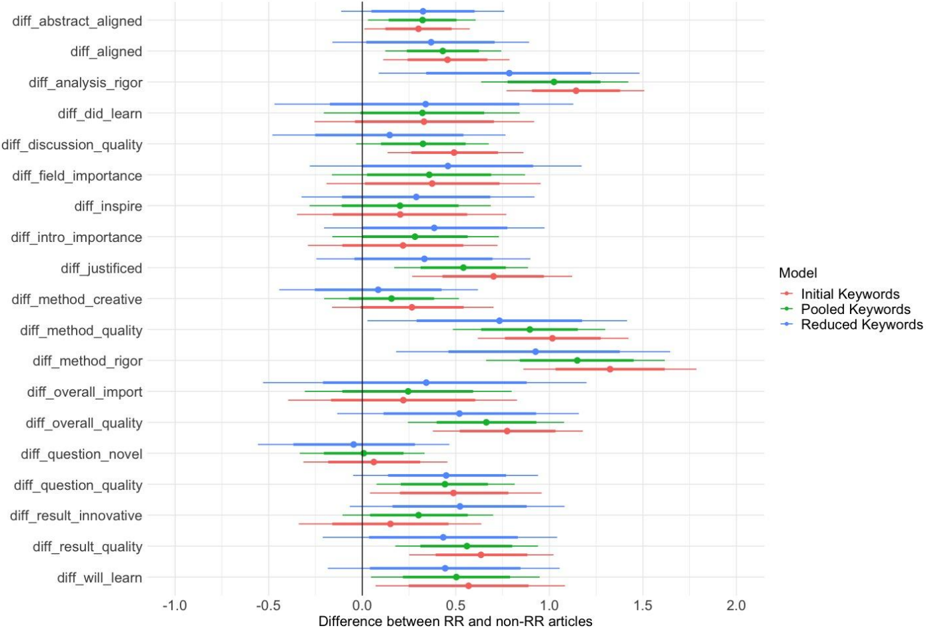
- Between-subjects analysis using only the first reviewed article showed a similar pattern, with an average effect size of 0.43 and range 0.04 to 0.93.
Methods
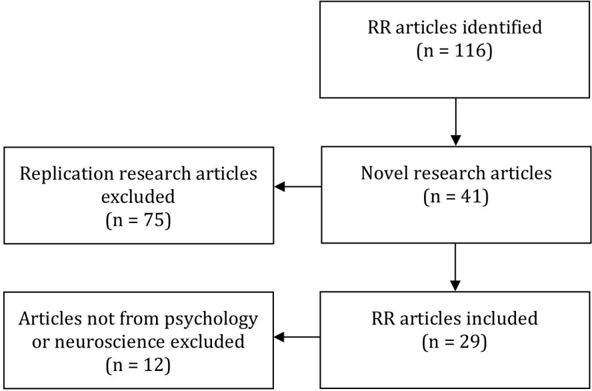
- Observational quasi-experimental study using 29 published RRs in psychology and neuroscience reporting novel research (replication RRs excluded) and 57 comparison articles matched by journal/date or lead author/date, totaling 86 articles.
- 353 recruited researchers, matched to articles by self-reported expertise, each peer reviewed one RR and one comparison article in randomized order; they rated 19 criteria on bipolar 9-point scales from −4 to +4.
- Preregistered Bayesian multilevel models estimated within-subjects and between-subjects effects; article coding assessed sample size, sample justification, difficult-to-reach populations, study design, open practices, and statcheck-detected reporting errors.
Limitations
- The paper states that the naturalistic design lacked random assignment of research to RR versus standard publication, and authors/editors self-select into RRs; matching on topic, journal, and lead author was intended to reduce but not eliminate confounding.
- The paper also states that RRs are a new format, so early-adoption behavior may not generalize; quality was assessed via peer-review ratings rather than replicability or generalizability, and reviewer representativeness is unknown.
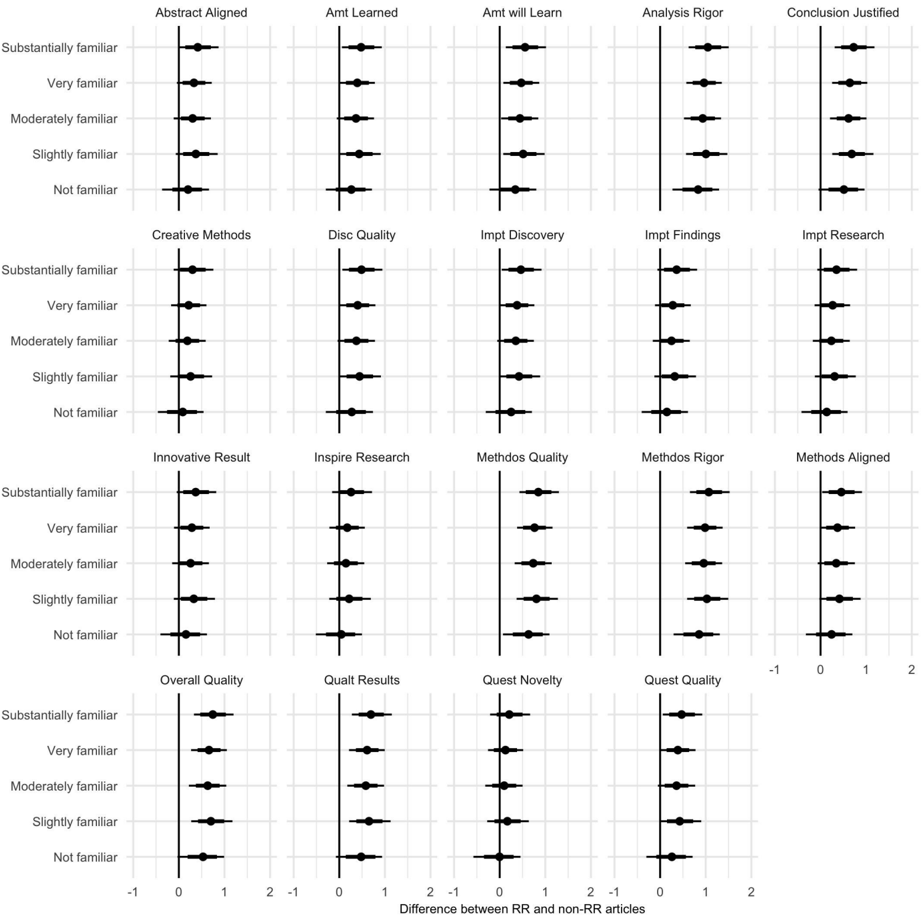
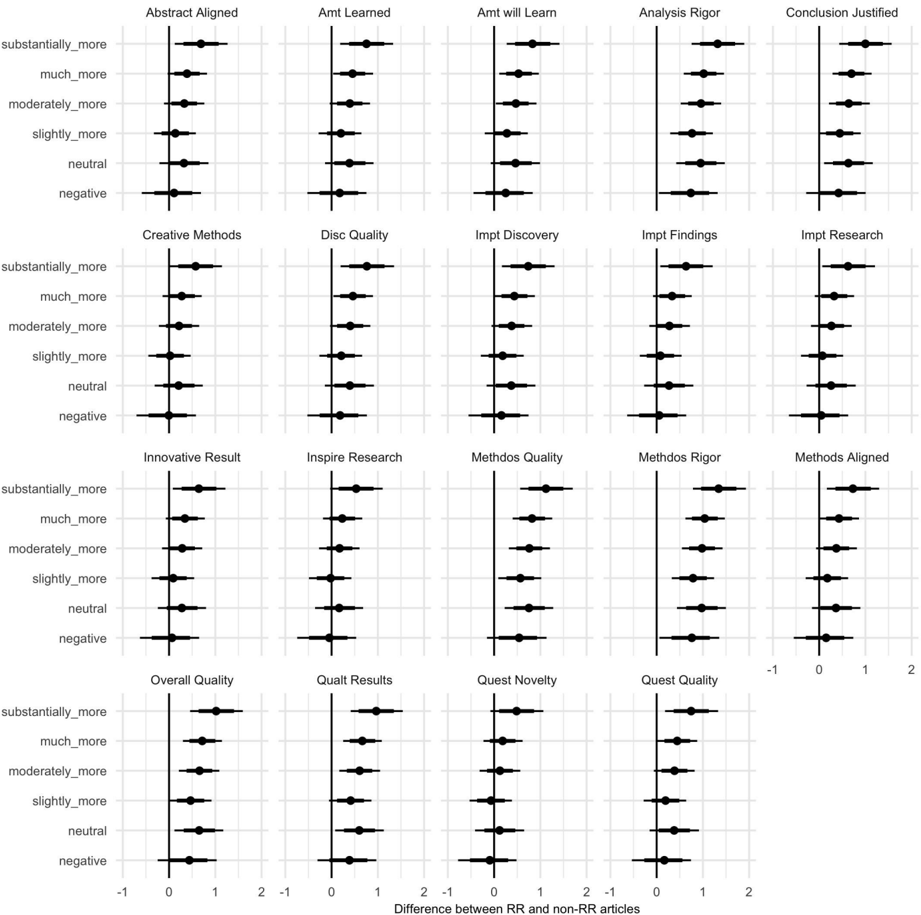
- Evident from the text: reviewers were not fully blinded to article type, with 54% correctly identifying the RR and 54% correctly identifying the comparison paper as not an RR; exploratory analyses showed larger perceived RR advantages among reviewers more familiar with or more favorable toward RRs, though every subgroup estimate remained directionally favorable.
Model-written summary. Check it against the paper before relying on it.
Integrity signals
Registry
Cites
Statistics
Figures
Verification
Claims the paper makes
8 Valid · 1 Not valid · 12 Not checked · 165 Own results and interpretations
The sources with a verdict support this claim; the rest weren’t checked yet, have no full text we could read, or their verdicts aren’t rated yet.
In the paper
“Positive results are much more likely to be published than negative results 5-7”
What the sources say
- Supportedcites [5] Smith, R. Peer review: a flawed process at the heart of science and journals. J. R. Soc. Med. 99, 178–182 (2006). source
In the Bias section (page not provided), Smith says editorial peer review has been strongly biased against negative studies and that authors often do not write them up. This supports the claim that positive results are much more likely to be published. (LLM, conf=0.90)
- Not checked — no full text of the sourcecites [6] Fanelli, D. Negative results are disappearing from most disciplines and countries. Scientometrics 90, 891–904 (2012). source
- Supportedcites [7] Fanelli, D. ‘Positive’ results increase down the hierarchy of the sciences. PLoS ONE 5, e10068 (2010). source
The Discussion section, “2C—Non-publication of negative and/or statistically non-significant results” (page unavailable), describes a publication bias against negative results. It says such results can remain unpublished because researchers may not submit them or reviewers and editors may reject them. (LLM, conf=0.88)
plainstates an association- Asserted: passes — The authors put it forward as true.
- Checkable: passes — It can be checked against evidence.
- Load-bearing: passes — The paper’s conclusions depend on it.
- Based: passes — The paper gives a reason why it holds.
- Supported
The sources with a verdict support this claim; the rest weren’t checked yet, have no full text we could read, or their verdicts aren’t rated yet.
In the paper
“Positive results -- finding that a treatment is effective or that there is a relationship between two variables -- are more likely to be published than negative results 6-12 .”
What the sources say
- Not checked — no full text of the sourcecites [6] Fanelli, D. Negative results are disappearing from most disciplines and countries. Scientometrics 90, 891–904 (2012). source
- Supportedcites [7] Fanelli, D. ‘Positive’ results increase down the hierarchy of the sciences. PLoS ONE 5, e10068 (2010). source
The Discussion section on non-publication of negative results says such results may remain unpublished because researchers do not submit them or editors and reviewers reject them. It also explicitly describes a publication bias against negative results. (LLM, conf=0.91)
- Not checked — no full text of the sourcecites [8] Franco, A., Malhotra, N. & Simonovits, G. Publication bias in the social sciences: unlocking the file drawer. Science 345, 1502–1505 (2014). source
- Not checked — no full text of the sourcecites [9] Dickersin, K. The existence of publication bias and risk factors for its occurrence. JAMA 263, 1385–1389 (1990). source
- Not checked — no full text of the sourcecites [10] Mahoney, M. J. Publication prejudices: an experimental study of confirmatory bias in the peer review system. Cogn. Ther. Res. 1, 161–175 (1977). source
- Not checked — no full text of the sourcecites [11] Greenwald, A. G. Consequences of prejudice against the null hypothesis. Psychol. Bull. 82, 1–20 (1975). source
- Not checked — no full text of the sourcecites [12] Sterling, T. D. Publication decisions and their possible effects on inferences drawn from tests of significance—or vice versa. J. Am. Stat. Assoc. 54, 30–34 (1959). source
hedgedstates an association- Asserted: passes — The authors put it forward as true.
- Checkable: passes — It can be checked against evidence.
- Load-bearing: passes — The paper’s conclusions depend on it.
- Based: passes — The paper gives a reason why it holds.
The cited sources support only part of this claim — read each source’s verdict below.
In the paper
“This may contribute to publication bias, selective reporting, and questionable research practices that reduce the credibility of the published literature 18-25 .”
What the sources say
- Supportedcites [18] Begley, C. G. & Ellis, L. M. Raise standards for preclinical cancer research. Nature 483, 531–533 (2012). source
In BUILDING A STRONGER SYSTEM, the authors say that pressure for a clear, complete ‘perfect’ story can encourage selected data sets or massaged results. Improving the reliability of preclinical cancer studies calls for more publication of negative findings, while CONFIRMING RESEARCH FINDINGS links selective presentation of experiments to irreproducible results. Together, these passages support the citing sentence’s hedged account of how publication preferences may undermine the literature’s credibility. (LLM, conf=0.90)
- Not checked — no full text of the sourcecites [19] Prinz, F., Schlange, T. & Asadullah, K. Believe it or not: how much can we rely on published data on potential drug targets? Nat. Rev. Drug Discov. 10, 712–712 (2011). source
- Partly supportedcites [20] Camerer, C. F. et al. Evaluating replicability of laboratory experiments in economics. Science 351, 1433–1436 (2016). sourceExperimental — accuracy not yet measured
The Main Text (page not provided) says original effect sizes tended to be inflated and that this could stem from publication bias; it also discusses concerns about false positives and reproducibility. It does not say that attention to positive, novel, or clean findings causes publication bias, selective reporting, or questionable research practices. (LLM, conf=0.82)
- Not checked — no full text of the sourcecites [21] Camerer, C. F. et al. Evaluating the replicability of social science experiments in Nature and Science between 2010 and 2015. Nat. Hum. Behav. 2, 637–644 (2018). source
- Partly supportedcites [22] Klein, R. A. et al. Many Labs 2: investigating variation in replicability across samples and settings. Adv. Methods Pract. Psychol. Sci. 1, 443–490 (2018). sourceExperimental — accuracy not yet measured
The Implications section says positive results are perceived as more publishable and describes analytic and post hoc practices that can inflate false positives and diminish credibility. The Discussion also identifies publication bias and p-hacking as possible explanations for replication failures, but says the study cannot determine whether they caused those failures. Our copy does not connect attention to novel or clean findings specifically to these practices. (LLM, conf=0.84)
- Partly supportedcites [23] Klein, R. A. et al. Investigating variation in replicability: a ‘many labs’ replication project. Soc. Psychol. 45, 142–152 (2014). sourceExperimental — accuracy not yet measured
The introduction (p. 4) says infrequent direct replication can leave spurious findings in the published literature, supporting the concern about credibility. It does not link that problem to attention to positive, novel, or clean findings, or discuss publication bias, selective reporting, or questionable research practices as the claimed pathway. (LLM, conf=0.84)
- Partly supportedcites [24] Open Science Collaboration. Estimating the reproducibility of psychological science. Science 349, aac4716 (2015). sourceExperimental — accuracy not yet measured
Insights on Reproducibility (p. 13) links a preference for positive results to publication and reporting bias and says these biases may inflate published effect sizes. Implications and Limitations (p. 15) discusses incentives favoring innovation over verification. The paper does not establish the claimed link to questionable research practices or specifically discuss attention to “clean” findings. (LLM, conf=0.82)
- Not checked yetcites [25] Ebersole, C. R. et al. Many Labs 3: evaluating participant pool quality across the academic semester via replication. J. Exp. Soc. Psychol. 67, 68–82 (2016). source
Checked before — its earlier verdict is held back until a new check runs.
hedgedstates a possible cause- Asserted: passes — The authors put it forward as true.
- Checkable: passes — It can be checked against evidence.
- Load-bearing: passes — The paper’s conclusions depend on it.
- Based: passes — The paper gives a reason why it holds.
- Supported
A result the paper reports from its own data — it cites no other source for it, so there is none to check. The quote shows it is in the paper.
In the paper
“In reality, 99.43% of the reviewers provided data for both articles.”
plain- Asserted: passes — The authors put it forward as true.
- Checkable: passes — It can be checked against evidence.
- Load-bearing: passes — The paper’s conclusions depend on it.
- Based: passes — The paper gives a reason why it holds.
A result the paper reports from its own data — it cites no other source for it, so there is none to check. The quote shows it is in the paper.
In the paper
“better alignment between the research question and methodology (estimate = 0.37, [0.01, 0.73], standardized ES = 0.19, [0.01, 0.37])”
plainstates an association- Asserted: passes — The authors put it forward as true.
- Checkable: passes — It can be checked against evidence.
- Load-bearing: passes — The paper’s conclusions depend on it.
- Based: passes — The paper gives a reason why it holds.
46 more claims
Create a free account to see all 186 claims and to verify the 1 reference still open.
- Probably not a substantial claim. 116
- It may state two separate claims as one. 42
- The quote only partly states this claim. 10
Self-check
Percentages, sums and reported differences re-computed from the paper’s own numbers.
Each contradiction between two passages listed here was confirmed by an independent check.
Rated minor: it would not touch a result — a value no result rests on, a p-value that stays on the same side of the significance level, or a conflict that is clerical, resolved elsewhere in the paper, or outside its own findings.
In the paper
“Of the 29 RR and control article matches, each had an average of 12.5 reviewers with a low of 3 and a high of 24 ( SD =5.59).”
Reported 12.5 · recomputed 12.172414
Rated minor: it would not touch a result — a value no result rests on, a p-value that stays on the same side of the significance level, or a conflict that is clerical, resolved elsewhere in the paper, or outside its own findings.
In the paper
§ Results
“Finally, a majority of reviewers correctly identified the RR as a RR (54%; 190 correct, 38 incorrect, 125 unsure) and the comparison paper as not a RR (54%; 192 correct, 30 incorrect, 131 unsure).”
§ Results
“In the within-subjects model, 19 of 19 outcome criteria remained directionally consistent with an RR performance advantage for reviewers that guessed one paper correctly ( n =168), and 14 of 19 outcome criteria remained directionally consistent for reviewers that guessed neither paper correctly ( n =87).”
Citations
Cites
brms : An R Package for Bayesian Multilevel Models Using Stan
Bürkner, P.-C. (2017) · Journal of Statistical Software · doi:10.18637/jss.v080.i01 · Cited by 9,476
Estimating the reproducibility of psychological science
Open Science Collaboration (2015) · Science · doi:10.1126/science.aac4716 · Cited by 8,515
Simmons, J. P., Nelson, L. D., & Simonsohn, U. (2011) · Psychological Science · doi:10.1177/0956797611417632 · Cited by 6,567
Raise standards for preclinical cancer research
Begley, C. G., & Ellis, L. M. (2012) · Nature · doi:10.1038/483531a · Cited by 2,979
Measuring the Prevalence of Questionable Research Practices With Incentives for Truth Telling
John, L. K., Loewenstein, G., & Prelec, D. (2012) · Psychological Science · doi:10.1177/0956797611430953 · Cited by 2,239
Believe it or not: how much can we rely on published data on potential drug targets?
Prinz, F., Schlange, T., & Asadullah, K. (2011) · Nature Reviews Drug Discovery · doi:10.1038/nrd3439-c1 · Cited by 1,888
Publication bias in the social sciences: Unlocking the file drawer
Franco, A., Malhotra, N., & Simonovits, G. (2014) · Science · doi:10.1126/science.1255484 · Cited by 1,542
Camerer, C. F., Dreber, A., Holzmeister, F., Ho, T.-H., Huber, J., Johannesson, M., Kirchler, M., Nave, G., Nosek, B. A., Pfeiffer, T., et al. (2018) · Nature Human Behaviour · doi:10.1038/s41562-018-0399-z · Cited by 1,521
Self-citationThe Existence of Publication Bias and Risk Factors for Its Occurrence
Dickersin, K. (1990) · JAMA: The Journal of the American Medical Association · doi:10.1001/jama.1990.03440100097014 · Cited by 1,417
Evaluating replicability of laboratory experiments in economics
Camerer, C. F., Dreber, A., Forsell, E., Ho, T.-H., Huber, J., Johannesson, M., Kirchler, M., Almenberg, J., Altmejd, A., Chan, T., et al. (2016) · Science · doi:10.1126/science.aaf0918 · Cited by 1,314
Cited by
Replicability, Robustness, and Reproducibility in Psychological Science
Nosek, B. A., Hardwicke, T. E., Moshontz, H., Allard, A., Corker, K. S., Dreber, A., Fidler, F., Hilgard, J., Kline Struhl, M., Nuijten, M. B., et al. (2022) · Annual Review of Psychology · doi:10.1146/annurev-psych-020821-114157 · Cited by 770
Self-citationJusup, M., Holme, P., Kanazawa, K., Takayasu, M., Romić, I., Wang, Z., Geček, S., Lipić, T., Podobnik, B., Wang, L., et al. (2022) · Physics Reports · doi:10.1016/j.physrep.2021.10.005 · Cited by 643
The past, present and future of Registered Reports
Chambers, C. D., & Tzavella, L. (2021) · Nature Human Behaviour · doi:10.1038/s41562-021-01193-7 · Cited by 499
Investigating the replicability of preclinical cancer biology
Errington, T. M., Mathur, M., Soderberg, C. K., Denis, A., Perfito, N., Iorns, E., & Nosek, B. A. (2021) · eLife · doi:10.7554/elife.71601 · Cited by 462
Self-citationChallenges for assessing replicability in preclinical cancer biology
Errington, T. M., Denis, A., Perfito, N., Iorns, E., & Nosek, B. A. (2021) · eLife · doi:10.7554/elife.67995 · Cited by 267
Self-citationPositionality and Its Problems: Questioning the Value of Reflexivity Statements in Research
Savolainen, J., Casey, P. J., McBrayer, J. P., & Schwerdtle, P. N. (2023) · Perspectives on Psychological Science · doi:10.1177/17456916221144988 · Cited by 148
The Replication Crisis Has Led to Positive Structural, Procedural, and Community Changes
Korbmacher, M., Azevedo, F., Pennington, C. R., Hartmann, H., Pownall, M., Schmidt, K., Elsherif, M., Breznau, N., Robertson, O., Kalandadze, T., et al. (2023) · Communications Psychology · doi:10.1038/s44271-023-00003-2 · Cited by 137
“…has also found that Registered Reports are perceived to be higher in research quality than regular articles, as well as equivalent in creativity and importance 77 , while also allowing to report more negative results 78 , which may provide further incentives for researchers to adopt this format.”
BackgroundBig little lies: a compendium and simulation of p -hacking strategies
Stefan, A. M., & Schönbrodt, F. D. (2023) · Royal Society Open Science · doi:10.1098/rsos.220346 · Cited by 208
“Therefore, registered reports are currently considered the highest quality standard for confirmatory research [114].”
BackgroundOpen and reproducible neuroimaging: From study inception to publication
Niso, G., Botvinik‐Nezer, R., Appelhoff, S., de la Vega, A. I., Estéban, O., Etzel, J. A., Finc, K., Ganz, M., Gau, R., Halchenko, Y. O., et al. (2022) · NeuroImage · doi:10.1016/j.neuroimage.2022.119623 · Cited by 127
Why most psychological research findings are not even wrong
Scheel, A. M. (2022) · Infant and Child Development · doi:10.1002/icd.2295 · Cited by 125
Survey of open science practices and attitudes in the social sciences
Ferguson, J., Littman, R., Christensen, G., Paluck, E. L., Swanson, N., Wang, Z., Miguel, E. A., Birke, D. J., & Pezzuto, J.-H. (2023) · Nature Communications · doi:10.1038/s41467-023-41111-1 · Cited by 135
“16,17,25 – 27), and it remains a key direction for future meta-science research. about norms for this practice due to space limitations in the survey.”
BackgroundHow to improve scientific peer review: four schools of thought
Waltman, L., Kaltenbrunner, W., Pinfield, S., & Woods, H. B. (2023) · Learned Publishing · doi:10.1002/leap.1544 · Cited by 71
“According to Soderberg et al. (2021), ‘the standard model of peer review and publication is vulnerable to biases that can reduce the credibility of the published literature’.”
BackgroundThe thresholding problem and variability in the EEG graph network parameters
Adamovich, T., Zakharov, I., Олеговна, Т. А., & Malykh, S. B. (2022) · Scientific Reports · doi:10.1038/s41598-022-22079-2 · Cited by 88
“Current experience shows that pre-registration leads to higher level of the replicability of the research 42 .”
BackgroundEmpirical evidence of widespread exaggeration bias and selective reporting in ecology
Kimmel, K. A., Avolio, M. L., & Ferraro, P. J. (2023) · Nature Ecology & Evolution · doi:10.1038/s41559-023-02144-3 · Cited by 94
The past, present, and future of Registered ReportsPreprint
Chambers, C., & Tzavella, L. (2020) · doi:10.31222/osf.io/43298 · Cited by 63
The benefits of preregistration and Registered Reports
Lakens, D., Mesquida, C., Rasti, S., & Ditroilo, M. (2024) · Evidence-Based Toxicology · doi:10.1080/2833373x.2024.2376046 · Cited by 105
Good scientific practice in EEG and MEG research: Progress and perspectives
Niso, G., Krol, L. R., Combrisson, E., Dubarry, A., Elliott, M., Clément, F., Héjja‐Brichard, Y., Herbst, S. K., Jerbi, K., Ković, V., et al. (2022) · NeuroImage · doi:10.1016/j.neuroimage.2022.119056 · Cited by 76
“Initial evidence suggests that the research quality of pre-registered studies is judged higher than that of traditional publications (Soderberg et al., 2021), while a comparison of registered versus conventional reports revealed a striking imbalance of 44% versus 96% of positive findings, respectively (Scheel et al.”
ResultWhy research integrity matters and how it can be improved
Bouter, L. M. (2023) · Accountability in Research · doi:10.1080/08989621.2023.2189010 · Cited by 69
“And there is an important bonus: in registered reports review comments can actually improve the design of the study, which is not the case for the standard work flow (Soderberg et al. 2021).”
Ten simple rules for good research practice
Schwab, S., Janiaud, P., Dayan, M., Amrhein, V., Panczak, R., Palagi, P. M., Hemkens, L. G., Ramon, M., Rothen, N., Senn, S. J., et al. (2022) · PLoS Computational Biology · doi:10.1371/journal.pcbi.1010139 · Cited by 56
“To go even further, registered reports are a novel article type that incentivize high-quality research—irrespective of the ultimate study outcome [25,26].”
BackgroundTen simple rules for writing a Registered Report
Henderson, E. L., & Chambers, C. (2022) · PLoS Computational Biology · doi:10.1371/journal.pcbi.1010571 · Cited by 58
“Registered Reports encourage methodological rigour (see [22]) and transparent planning and reporting, while reducing biases and likely representing a less distorted and selective picture of research than standard papers (see [2,3]).”
BackgroundCredibility crisis in agricultural economics
Ferraro, P. J., & Shukla, P. (2022) · Applied Economic Perspectives and Policy · doi:10.1002/aepp.13323 · Cited by 60
Song, H., Markowitz, D. M., & Taylor, S. H. (2022) · Journal of Communication · doi:10.1093/joc/jqac017 · Cited by 41
Vize, C. E., Sharpe, B. M., Miller, J. D., Lynam, D. R., & Soto, C. J. (2022) · European Journal of Personality · doi:10.1177/08902070221111857 · Cited by 54
“Although registered reports can improve the overall rigor of studies interested in trait-bytrait interactions (Soderberg et al., 2021), both preregistration and registered reports allow for greater transparency in the research process which in turn allows researchers to accurately evaluate the…”
BackgroundOpen Science Needs No Martyrs, but We Must Recognize the Need for Reform
Susi, T. (2022) · doi:10.4000/books.oep.16156 · Cited by 36
Big Little Lies: A Compendium and Simulation of p-Hacking StrategiesPreprint
Stefan, A. M., & Schönbrodt, F. D. (2022) · doi:10.31234/osf.io/xy2dk · Cited by 35
Process and Bureaucracy: Scientific Reform as Civilisation
Penders, B. (2022) · Bulletin of Science Technology & Society · doi:10.1177/02704676221126388 · Cited by 47
“…of registered reports report empirical success, with a significantly higher amount of manuscripts reporting negative or null results (Scheel et al., 2021; Soderberg et al., 2021) and the promotion of “reproducibility, transparency and selfcorrection across disciplines” (Chambers & Tzavella, 2022).”
BackgroundAn Action Plan for Diamond Open Access
Borrell-Damián, L., & Rooryck, J. (2022) · doi:10.4000/books.oep.16147 · Cited by 61
Open Minded: Searching for Truth about the Unconscious Mind
Newell, B. R., & Shanks, D. R. (2023) · doi:10.7551/mitpress/14922.001.0001 · Cited by 17
Preregistration and registered reports
Reich, J. (2021) · Educational Psychologist · doi:10.1080/00461520.2021.1900851 · Cited by 35
From grassroots to global: A blueprint for building a reproducibility network
UK Reproducibility Network Steering Committee (2021) · PLoS Biology · doi:10.1371/journal.pbio.3001461 · Cited by 35
“Moreover, we are seeing innovative partnerships, such as Registered Reports Funding Partnerships between funders and journals, which aim to streamline the process of applying for funding and submitting a Registered Report, in the hope that this will improve both efficiency and quality [4].”
BackgroundExpert opinions on threats and impacts in the marine environment
Kvamsdal, S. F., Hopland, A. O., Li, Y., & Selle, S. (2022) · Marine Policy · doi:10.1016/j.marpol.2022.105382 · Cited by 37
Reporting all results efficiently: A RARE proposal to open up the file drawer
Laitin, D. D., Miguel, E. A., Alrababa’h, A., Bogdanoski, A., Grant, S., Hoeberling, K., Mo, C. H., Moore, D. A., Vazire, S., Weinstein, J. M., et al. (2021) · Proceedings of the National Academy of Sciences · doi:10.1073/pnas.2106178118 · Cited by 40
Self-citationOpen Science: Towards Greater Transparency and Openness in Science
Maedche, A., Elshan, E., Hoehle, H., Lehrer, C., Recker, J., Sunyaev, A., Sturm, B., & Werth, O. (2024) · Business & Information Systems Engineering · doi:10.1007/s12599-024-00858-7 · Cited by 43
Evans, T. R., Branney, P., Clements, A. J., & Hatton, E. (2021) · Accountability in Research · doi:10.1080/08989621.2021.1969233 · Cited by 41
“Preregistration initiatives like Registered Reports (Chambers 2013), where preregistered plans are peer-reviewed before data collection and receive in-principle acceptance where subsequent publication is virtually guaranteed regardless of the eventual results, are of great value to basic research (Scheel, Schijen, and…”
BackgroundFreiling, I., Krause, N. M., Scheufele, D. A., & Chen, K. (2021) · Journal of Communication · doi:10.1093/joc/jqab032 · Cited by 42
Research integrity requires to be aware of good and questionable research practices
Boisgontier, M. P. (2022) · European Rehabilitation Journal · doi:10.52057/erj.v2i1.24 · Cited by 28
“Importantly, the methods and analyses of Registered Reports are perceived as more rigorous by reviewers and of higher overall quality than standard articles with no detriment to the importance and creativity of the research [9].”
MethodDudda, L., Kormann, E., Kozula, M., DeVito, N. J., Klebel, T., Dewi, A. P. M., Spijker, R., Stegeman, I., Van den Eynden, V., Ross-Hellauer, T., et al. (2025) · Royal Society Open Science · doi:10.1098/rsos.242057 · Cited by 28
“Five studies investigated the effect of pre-registration [108,118] (three studies), [120], one the effect of publishing the protocol of a study [66] and two studies investigated registered reports [97,114].”
Toward open science in PLS-SEM: Assessing the state of the art and future perspectives
Adler, S. J., Sharma, P. N., & Radomir, L. (2023) · Journal of Business Research · doi:10.1016/j.jbusres.2023.114291 · Cited by 44
Briker, R., & Gerpott, F. H. (2023) · Organizational Research Methods · doi:10.1177/10944281231210309 · Cited by 30
“A study by Soderberg et al. (2021) provides additional evidence for this evaluation from outside of the fi elds of management and applied psychology.”
InfluentialCenter for Open Science: Strategic PlanPreprint
Nosek, B. A., Shaw, L. C., Errington, T. M., Pfeiffer, N., & Zaringhalam, M. (2017) · OSF Preprints (OSF Preprints) · doi:10.31219/osf.io/x2w9h · Cited by 30
Self-citationPolitical ideology and trust in scientists in the USA
Gligorić, V., Kleef, G. A. V., & Rutjens, B. T. (2025) · Nature Human Behaviour · doi:10.1038/s41562-025-02147-z · Cited by 38
“In line with this, we suggest that researchers in the field conduct registered reports, as they have significantly better quality than standard publishing models 44,45 (also note that even preregistrations might not be optimal due to changes in reporting 46 ).”
Ellis, R. J. (2022) · eNeuro · doi:10.1523/eneuro.0017-22.2022 · Cited by 30
“A recent study (Soderberg et al., 2021) recruited 353 researchers to peer review and compare pairs of psychology and neuroscience papers where one was a registered report (out of 29 total) and one was a standard report (57 total).”
BackgroundOptimizing the methodology of human sleep and memory research
Németh, D., Gerbier, É., Born, J., Rickard, T. C., Diekelmann, S., Fogel, S. M., Genzel, L., Prehn‐Kristensen, A., Payne, J. D., Dresler, M., et al. (2023) · Nature Reviews Psychology · doi:10.1038/s44159-023-00262-0 · Cited by 26
“…procedures — pre-registration in online registries and registered reports — increase the quality of research by reducing inappropriate data-analysis practices, including p-hacking, HARKing (hypothesizing after the results are known) and the application of unplanned statistical tests 186,187,189 .”
A guide for social science journal editors on easing into open science
Silverstein, P., Elman, C., Montoya, A. K., McGillivray, B., Pennington, C. R., Harrison, C. H., Steltenpohl, C. N., Röer, J. P., Corker, K. S., Charron, L., et al. (2024) · Research Integrity and Peer Review · doi:10.1186/s41073-023-00141-5 · Cited by 29
“…• RRs are judged (through masked peer‑review) as being higher in rigor, quality, and detail, as well as comparable in creativity and importance [56] RRs create more administrative burden, due to reviewers being required at Stage 1 and Stage 2 • Compared to a ‘traditional’ manuscript, the RR…”
BackgroundSelf-citationRegistration of health and medical research
Cashin, A. G., Richards, G. C., DeVito, N., Mellor, D. T., & Lee, H. (2021) · BMJ Evidence-Based Medicine · doi:10.1136/bmjebm-2021-111836 · Cited by 31
Why ex post peer review encourages high-risk research while ex ante review discourages it
Gross, K., & Bergstrom, C. T. (2021) · Proceedings of the National Academy of Sciences · doi:10.1073/pnas.2111615118 · Cited by 27
“[43] Courtney K Soderberg, Timothy M Errington, Sarah R Schiavone, Julia Bottesini, Felix Singleton Thorn, Simine Vazire, Kevin M Esterling, and Brian A Nosek.”
BackgroundDrude, N., Martinez‐Gamboa, L., Danziger, M., Collazo, A., Kniffert, S., Wiebach, J., Nilsonne, G., Konietschke, F., Piper, S. K., Pawel, S., et al. (2022) · Translational Medicine Communications · doi:10.1186/s41231-022-00130-8 · Cited by 28
Reckoning With Our Crisis: An Agenda for the Field of Social and Personality Psychology
Schiavone, S. R., & Vazire, S. (2022) · Perspectives on Psychological Science · doi:10.1177/17456916221101060 · Cited by 25
Self-citationSilverstein, P., Pennington, C. R., Branney, P., O'Connor, D. B., Lawlor, E., O'Brien, E., & Lynott, D. (2024) · British Journal of Psychology · doi:10.1111/bjop.12700 · Cited by 27
“…informing people that Registered Report articles are perceived as higher-quality relative to standard (non-registered) journal articles without any perceived differences in novelty and creativity (Soderberg et al., 2021) may make them more likely to consider this route to publication in the future.”
BackgroundBalafoutas, L., Celse, J., Karakostas, A., & Umashev, N. (2024) · Journal of Behavioral and Experimental Economics · doi:10.1016/j.socec.2024.102327 · Cited by 24
Open Science in Suicide Research Is Open for Business
Kirtley, O. J., Janssens, J. J., & Kaurin, A. (2022) · Crisis · doi:10.1027/0227-5910/a000859 · Cited by 19
“Emerging research on RRs suggests they outperform “traditional” article types on various criteria, including quality and rigor of methodology and analysis, novelty, and creativity (Soderberg et al., 2021).”
BackgroundUnequal treatment under the flaw: race, crime & retractions
Savolainen, J. (2023) · Current Psychology · doi:10.1007/s12144-023-04739-2 · Cited by 26
“As a result, a new generation of scholars is adopting innovative workflow standards, such as research preregistration (Soderberg et al., 2021), to improve the reproducibility of their research.”
Modelling Scientific Communities
O’Connor, C. (2023) · Cambridge University Press eBooks · doi:10.1017/9781009359535 · Cited by 28
Tiller, N. B., & Ekkekakis, P. (2023) · Kinesiology Review · doi:10.1123/kr.2022-0039 · Cited by 19
The replication crisis has led to positive structural, procedural, and community changesPreprint
Korbmacher, M., Azevedo, F., Pennington, C. R., Hartmann, H., Pownall, M., Schmidt, K., Elsherif, M. M., Breznau, N., Robertson, O. M., Kalandadze, T., et al. (2023) · MetArXiv (OSF Preprints) · doi:10.31222/osf.io/r6cvx · Cited by 23
Meier, M., Lonsdorf, T. B., LUPIEN, S. J., Stalder, T., Laufer, S., Sicorello, M., Linz, R., & Puhlmann, L. M. C. (2022) · Comprehensive Psychoneuroendocrinology · doi:10.1016/j.cpnec.2022.100144 · Cited by 20
“Indeed, first studies attempting to assess the quality of RRs suggest that their methodological and overall quality is perceived as higher as compared to standard publications [71,72].”
BackgroundValidity and Transparency in Quantifying Open-Ended Data
Conry‐Murray, C., Waltzer, T., DeBernardi, F. C., Fossum, J. L., Haasova, S., Matthews, M. S., O’Mahony, A., Moreau, D., Baum, M. A., Karhulahti, V., et al. (2024) · Advances in Methods and Practices in Psychological Science · doi:10.1177/25152459241275217 · Cited by 33
“Initial evidence also suggests that Registered Reports (i.e., in which the research design and hypotheses are evaluated before data collection) show signs of increased quality compared with similar articles from a more traditional publishing model (Soderberg et al., 2021).”
Registered Reports in Special Education: Introduction to the Special Series
Cook, B. G., Maggin, D. M., & Robertson, R. E. (2021) · Remedial and Special Education · doi:10.1177/0741932521996459 · Cited by 14
A toolbox to evaluate the trustworthiness of published findings
Adler, S. J., Röseler, L., & Schöniger, M. K. (2023) · Journal of Business Research · doi:10.1016/j.jbusres.2023.114189 · Cited by 21
Risk of bias in exercise science: A systematic review of 340 studies
Preobrazenski, N., McCaig, A., Turner, A., Kushner, M., Pacitti, L. J., Mendolia, P., MacDonald, B., Storoschuk, K. L., Bouck, T., Zaza, Y., et al. (2024) · iScience · doi:10.1016/j.isci.2024.109010 · Cited by 25
“49 Althoughtheexactmechanismsunderlyingtheimprovingreportingpracticeswithinexercisescienceareunclear, itislikelythattheproductionofnumerousrobustreportingguidelinesinthepast25yearshascontributed.”
Doing reliable research in comparative psychology: Challenges and proposals for improvement.
Tecwyn, E. C. (2021) · Journal of comparative psychology · doi:10.1037/com0000291 · Cited by 20
Evaluating Research Transparency and Openness in Communication Sciences and Disorders Journals
Schroeder, S. R., Gaeta, L., Amin, M. E., Chow, J. C., & Borders, J. C. (2022) · Journal of Speech Language and Hearing Research · doi:10.1044/2022_jslhr-22-00330 · Cited by 17
A review of extant literature and recent trends in residential construction waste reduction
Albsoul, H., Doan, D. T., Aigwi, I. E., & GhaffarianHoseini, A. (2024) · Waste Management & Research The Journal for a Sustainable Circular Economy · doi:10.1177/0734242x241241607 · Cited by 19
“Peer-reviewed articles establish the credibility of research findings and reduce bias (Soderberg et al., 2021).”
Reviewing and Revisiting the Processes and Emergent States Underlying Team Diversity Effects
Reinert, C., Buengeler, C., Lehmann‐Willenbrock, N., & Homan, A. C. (2024) · Small Group Research · doi:10.1177/10464964241275748 · Cited by 18
“Scholars could reach trans-parency about the focus adopted by pre-registering their studies, following open science practices (for an overview and best practices, see Briker & Gerpott, 2023; Soderberg et al., 2021).”
Examining the replicability of online experiments selected by a decision market
Holzmeister, F., Johannesson, M., Camerer, C. F., Chen, Y., Ho, T., Hoogeveen, S., Huber, J., Imai, N., Imai, T., Jin, L. J., et al. (2024) · Nature Human Behaviour · doi:10.1038/s41562-024-02062-9 · Cited by 27
Self-citationA qualitative analysis of stakeholder experiences with Registered Reports Funding Partnerships
Drax, K., Clark, R. W. A., Chambers, C., Munafo, M. R., & Thompson, J. (2021) · Wellcome Open Research · doi:10.12688/wellcomeopenres.17029.1 · Cited by 15
The inner workings of Registered ReportsPreprint
Dienes, Z. P. (2020) · doi:10.31234/osf.io/yhp2a · Cited by 14
Song, H., Markowitz, D., & Taylor, S. (2021) · Journal of Communications · doi:10.31219/osf.io/g328c · Cited by 39
So you got a null result. Will anyone publish it?
Kozlov, M. (2024) · Nature · doi:10.1038/d41586-024-02383-9 · Cited by 18
Preregistration and Registered Reports in Sociology: Strengths, Weaknesses, and Other Considerations
Manago, B. N. (2023) · The American Sociologist · doi:10.1007/s12108-023-09563-6 · Cited by 18
“Second, there is considerable evidence that, on the whole, preregistration, registered reports, and similar open-science practices increase research quality (Chambers and Tzavella 2022; Nuijten et al., 2016; Scheel, 2021; Soderberg et al., 2021; Wicherts et al. 2011).”
BackgroundInfluentialHow thoughtful experimental design can empower biologists in the omics era
Wagner, M. R., & Kleiner, M. (2025) · Nature Communications · doi:10.1038/s41467-025-62616-x · Cited by 22
Klees‐Themens, G., & Théoret, H. (2023) · European Journal of Neuroscience · doi:10.1111/ejn.16073 · Cited by 12
“One way to increase transparency and reduce selective reporting/ non-publication is to register studies (Nosek et al., 2018; Soderberg et al., 2021), which was done only once in the reviewed studies (Jonker et al., 2021).”
BackgroundSample size planning for complex study designs: A tutorial for the mlpwr package
Zimmer, F., Henninger, M., & Debelak, R. (2023) · Behavior Research Methods · doi:10.3758/s13428-023-02269-0 · Cited by 22
“Looking at recent developments, registered reports are indeed accompanied by more frequent justification of sample size (Soderberg et al., 2021).”
BackgroundTincani, M., Travers, J. C., Dowdy, A., Slocum, T. A., & Deitrich, R. (2025) · Perspectives on Behavior Science · doi:10.1007/s40614-025-00441-9 · Cited by 17
“Some investigators have reported open science practices have positive effects on methodological quality and rigor of research (e.g., Soderberg et al., 2021), but others have found equivocal effects of open science practices on QRPs (e.g., van den Akker, 2023).”
Timming, A. R., Farndale, E., Budhwar, P. S., & Wood, G. (2021) · Human Resource Management Journal · doi:10.1111/1748-8583.12359 · Cited by 13
Hanging the Anchor Off a New Ship: A Meta-Analysis of Anchoring EffectsPreprint
Röseler, L., & Schütz, A. (2022) · PsyArXiv (OSF Preprints) · doi:10.31234/osf.io/wf2tn · Cited by 21
Open and reproducible neuroimaging: from study inception to publicationPreprint
Niso, G., Botvinik‐Nezer, R., Appelhoff, S., de la Vega, A. I., Estéban, O., Etzel, J. A., Finc, K., Ganz, M., Gau, R., Halchenko, Y. O., et al. (2022) · doi:10.31219/osf.io/pu5vb · Cited by 12
Open Science in Applied Linguistics: An Introduction to MetasciencePreprint
Al‐Hoorie, A. H., & Hiver, P. V. (2023) · OSF Preprints (OSF Preprints) · doi:10.31219/osf.io/76dak · Cited by 12
New ways of seeing: Four ways you have not thought about Registered Reports yet
Gerpott, F. H., Briker, R., & Banks, G. C. (2024) · The Leadership Quarterly · doi:10.1016/j.leaqua.2024.101783 · Cited by 13
Scientists should get credit for correcting the literature
Ribeiro, M. D., KALICHMAN, M. W., & Vasconcelos, S. M. R. (2022) · Nature Human Behaviour · doi:10.1038/s41562-022-01415-6 · Cited by 11
Machine Learning for Experiments in the Social Sciences
Green, J., & Mark H. White, II (2023) · Cambridge University Press eBooks · doi:10.1017/9781009168236 · Cited by 19
Lakens, D. (2023) · PsyArXiv (OSF Preprints) · doi:10.31234/osf.io/dtvs7 · Cited by 17
Registered reports and associated benefits for agricultural economics
Arpinon, T., & Lefebvre, M. (2024) · Q Open · doi:10.1093/qopen/qoae011 · Cited by 13
Ng, J. Y., Lin, B., Parikh, T., Cramer, H., & Moher, D. (2024) · PLoS ONE · doi:10.1371/journal.pone.0302655 · Cited by 18
“The multi-modal treatment delivery of some types of CAIM are not well substantiated by research, often limiting its focus to one or two treatment interventions [53].”
BackgroundA framework for assessing the trustworthiness of scientific research findings
Nosek, B. A., Allison, D. B., Jamieson, K. H., Mcnutt, M. K., Nielsen, A. B., & Wolf, S. M. (2026) · Proceedings of the National Academy of Sciences · doi:10.1073/pnas.2536736123 · Cited by 18
“Observational evidence suggests that shifting the primary evaluation away from the findings is associated with greater rigor and quality of research (36), and with a lower likelihood of ignoring negative or null findings (37).”
Self-citationWhy most psychological research findings are not even wrongPreprint
Scheel, A. M. (2021) · Infant and Child Development · doi:10.31234/osf.io/8w2sd · Cited by 61
Deressa, T. K., Stern, D. I., Vangronsveld, J., Minx, J. C., Lizin, S., Malina, R. M., & Bruns, S. B. (2023) · EcoEvoRxiv · doi:10.32942/x24g6z · Cited by 14
Reproducibility failure in biomedical research: problems and solutions
Haven, T. L., & Ioannidis, J. P. A. (2026) · Annual Review of Medicine · doi:10.1146/annurev-med-050124-050859 · Cited by 9
GamiDOC: The Importance of Designing Gamification in a Proper Way
Bassanelli, S., Bucchiarone, A., & Gini, F. (2024) · IEEE Transactions on Games · doi:10.1109/tg.2024.3364061 · Cited by 13
“Some authors [113], [114] suggest that registered reports and study preregistrations might provide an increased methodological rigor.”
A Systematic Review on the Evolution of Power Analysis Practices in Psychological Research
Vankelecom, L., Schacht, O., Laroy, N., Loeys, T., & Moerkerke, B. (2025) · Psychologica Belgica · doi:10.5334/pb.1318 · Cited by 19
Keener, S. K., Kepes, S., & Torka, A. (2023) · Acta Psychologica · doi:10.1016/j.actpsy.2023.104005 · Cited by 14
Practical approaches to improving translatability and reproducibility in preclinical pain research
Soliman, N., & Denk, F. (2023) · Brain Behavior and Immunity · doi:10.1016/j.bbi.2023.09.023 · Cited by 10
“Similar benefits of pre-registration have been shown in psychology and neuroscience research (Soderberg et al., 2021).”
BackgroundPennington, C. R., & Heim, D. (2021) · Addiction Research & Theory · doi:10.1080/16066359.2021.1931142 · Cited by 12
Em, S., Serey, M., Sam, R., Pen, D., & Chin, P. (2025) · IGI Global eBooks · doi:10.4018/979-8-3373-0654-4.ch003 · Cited by 8
Reis, D., & Friese, M. (2022) · Springer eBooks · doi:10.1007/978-3-031-04968-2_5 · Cited by 14
Not all pre-registrations are equal
Waldron, S., & Allen, C. P. G. (2022) · Neuropsychopharmacology · doi:10.1038/s41386-022-01418-x · Cited by 9
“Researchers might gain the perceived reliability benefits of pre-registration [7] without the drawbacks of longer and more involved research planning processes and the increased likelihood of null findings [8].”
BackgroundShaw, S. D., & Nave, G. (2023) · Journal of Business Research · doi:10.1016/j.jbusres.2023.114129 · Cited by 10
On the Use and Misuses of Preregistration: A Reply to Klonsky (2024)
Vize, C. E., Phillips, N. L., Miller, J. D., & Lynam, D. (2024) · Assessment (Odessa, Fla.) · doi:10.1177/10731911241275256 · Cited by 9
“There is correlational evidence to suggest that preregistration, particularly when peer-reviewed (i.e., using a Registered Report format), is related to increased rigor of a study (e.g., Soderberg et al., 2021) via these secondary benefits.”
Future Directions for Chemosensory Connectomes: Best Practices and Specific Challenges
Veldhuizen, M. G., Cecchetto, C., Fjældstad, A. W., Farruggia, M. C., Hartig, R., Nakamura, Y., Pellegrino, R., Yeung, A. W. K., & Fischmeister, F. P. S. (2022) · Frontiers in Systems Neuroscience · doi:10.3389/fnsys.2022.885304 · Cited by 9
Research on registered report research
Higgs, M. D., & Gelman, A. (2021) · Nature Human Behaviour · doi:10.1038/s41562-021-01148-y · Cited by 8
Metadata
- Authors
- Soderberg, C. K., Errington, T. M., Schiavone, S. R., Bottesini, J., Thorn, F. S., Vazire, S., Esterling, K. M., & Nosek, B. A.
- Affiliations
- Center for Open Science (US)
- University of California, Davis (US)
- The University of Melbourne (AU)
- University of California, Riverside (US)
- Corresponding author
- Nosek, Brian A.
- ORCID
- Venue
- Nature Human Behaviour
- Published
- 2021-06-24
- Volume
- 5
- Issue
- 8
- Pages
- 990-997
- ISSN
- 2397-3374 (ISSN-L)
- OpenAlex
- W3174993952
- Semantic Scholar
- b870928f45680afa8e394c85bfaddd487cd6c4d2
- Cited by
- 295
- References
- 41
- Citations by year
- 2026: 27 · 2025: 47 · 2024: 43 · 2023: 61 · 2022: 85 · 2021: 28
- FWCI
- 39.83
- Type
- journal article
- Language
- en
- Open access
- green
- doi.org
- Licence
- public-domain
- www.springernature.com/gp/researchers/text-and-data-mining (tdm)
- www.springernature.com/gp/researchers/text-and-data-mining (vor)
- Locations
- Nature Human Behaviour (publishedVersion)
- MetArXiv (OSF Preprints) (submittedVersion, public-domain)
- PubMed (publishedVersion)
- RePEc: Research Papers in Economics (acceptedVersion)
- MetArXiv (OSF Preprints) (acceptedVersion)
- Funders
- James S. McDonnell Foundation (220020498)
- Arnold Ventures, no reference number
- Topics
- Social Sciences › Psychology › Experimental and Cognitive Psychology › Psychology Research and Bibliometrics
- Social Sciences › Library and Information Sciences › Academic Publishing and Open Access
- Social Sciences › Decision Sciences › Statistics, Probability and Uncertainty › Meta-analysis and systematic reviews
- Keywords
- research quality, publication bias, research credibility, novelty, creativity, methodological quality, open science
- MeSH terms
- Data Analysis, Humans, Neurosciences, Psychology, Registries, Research, Research Design, Peer Review, Research, Research Report
About these checks
Registry, retraction, Cites and statistics results are computed, not judged, with one exception: a printed reference that no index lists is read once by a model before it counts as a citation error. Claims are extracted by a model and kept only when their quote appears verbatim in the text; each cited source is then checked, with a model’s help, for whether it says what the claim relies on. Those verdicts can be wrong — read the claim’s quote and the cited source before relying on one.
The claim verdicts this report counts are experimental: their accuracy is not yet measured.
A language model drew the claims from the paper on 2026-10-10, under version 3 of the claim definition (model deepseek-v4.1-flash, prompt extract-v3).
A second model labelled each claim on 2026-10-10 (model jev-1.13-20260917, definition revision gold-guideline-v0.2).
Cited sources are checked with a language model’s help (gpt-6-sol).
Statistics and arithmetic are recomputed, not judged.
Confidence bands are shown only for fields calibrated on our annotated test set. None is calibrated yet, so no band is shown.
What counts as a claim ›How we measure confidence ›How we check this ›
Are you an author, or do you see a problem with this page? Request a review
Data sources
Bibliographic data: Semantic Scholar, OpenAlex, Crossref.
Contains information from the Semantic Scholar Academic Graph Datasets, made available under the ODC Attribution License (ODC-BY 1.0).
Semantic Scholar’s data is described in: Kinney, R., et al. (2023). The Semantic Scholar Open Data Platform. arXiv:2301.10140.
