

Initial evidence of research quality of registered reports compared with the standard publishing model
Open accessPublished version of a preprint
The DOI matches its Crossref record; 47 of the 47 references it cites were found in a registry or an index; 18 of the 54 sources its claims cite were checked for support.
Abstract
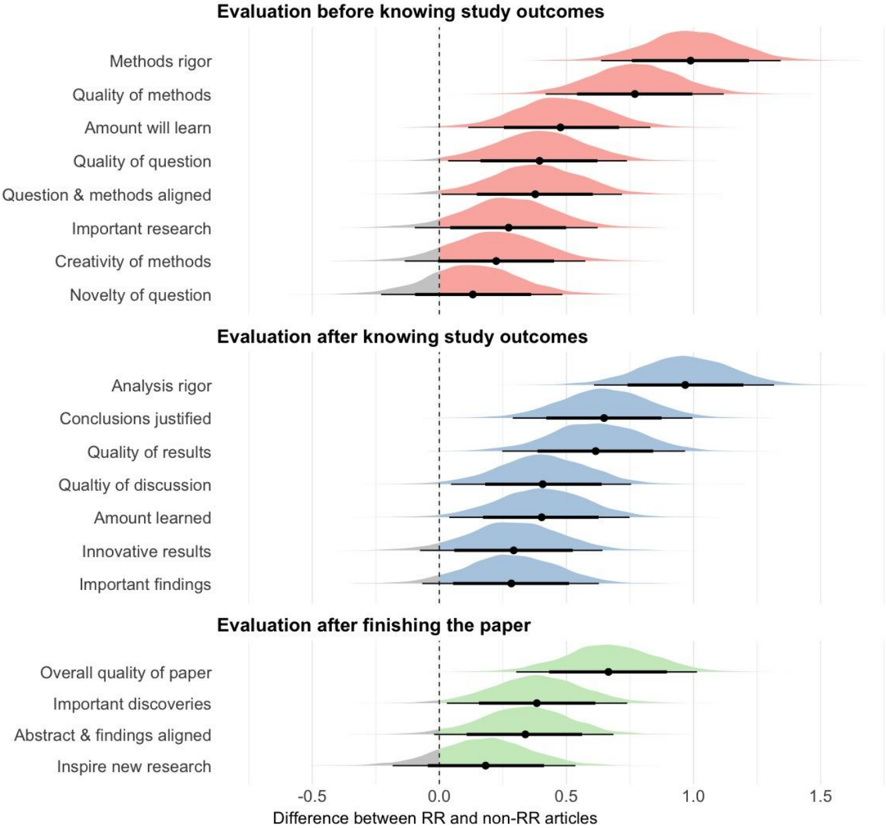
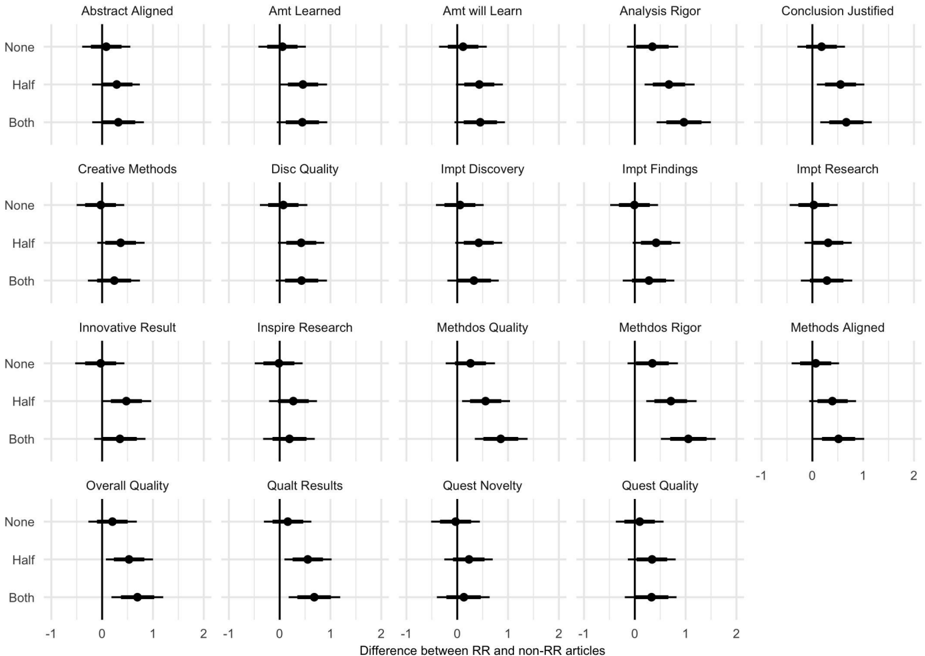
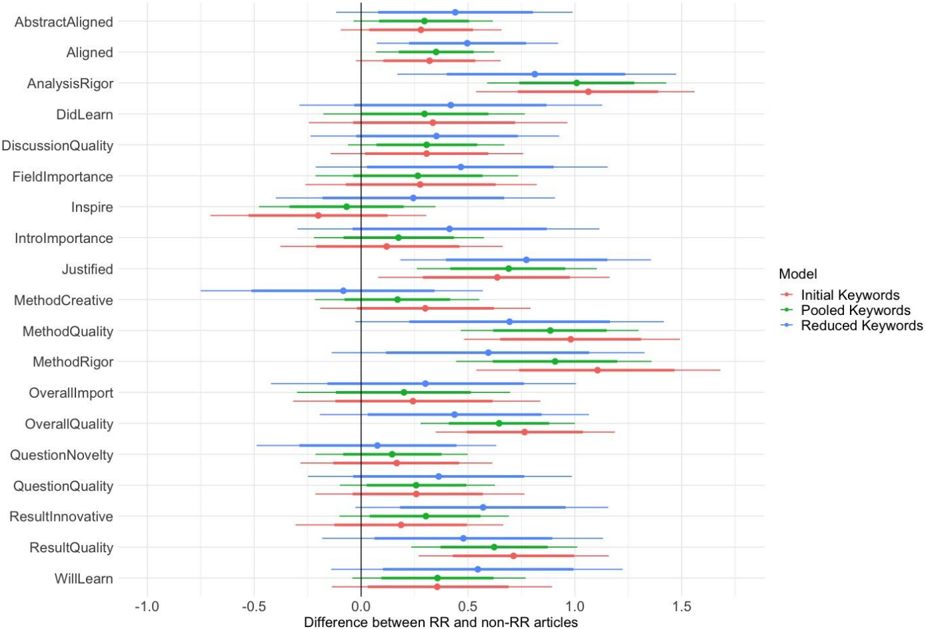
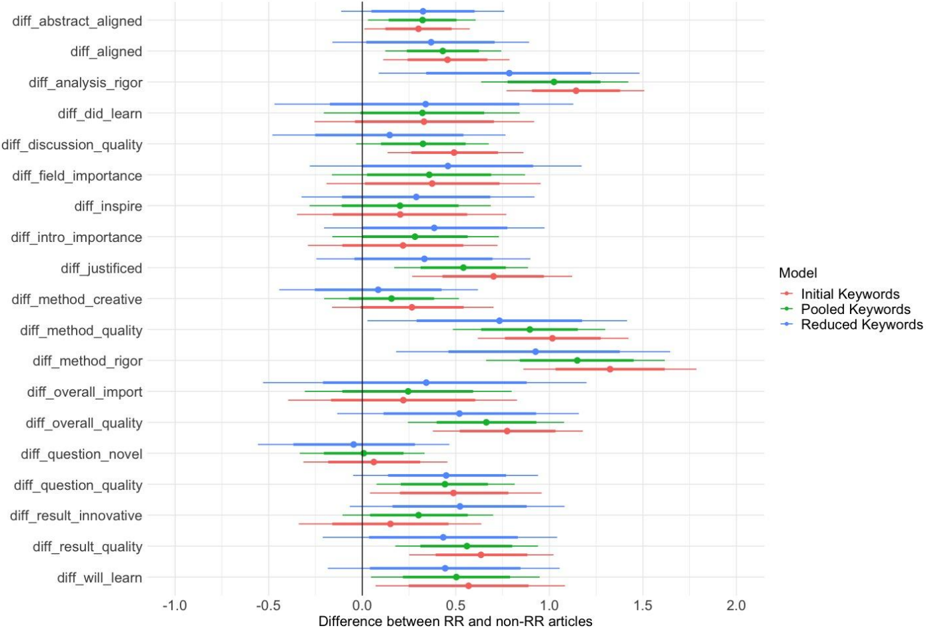
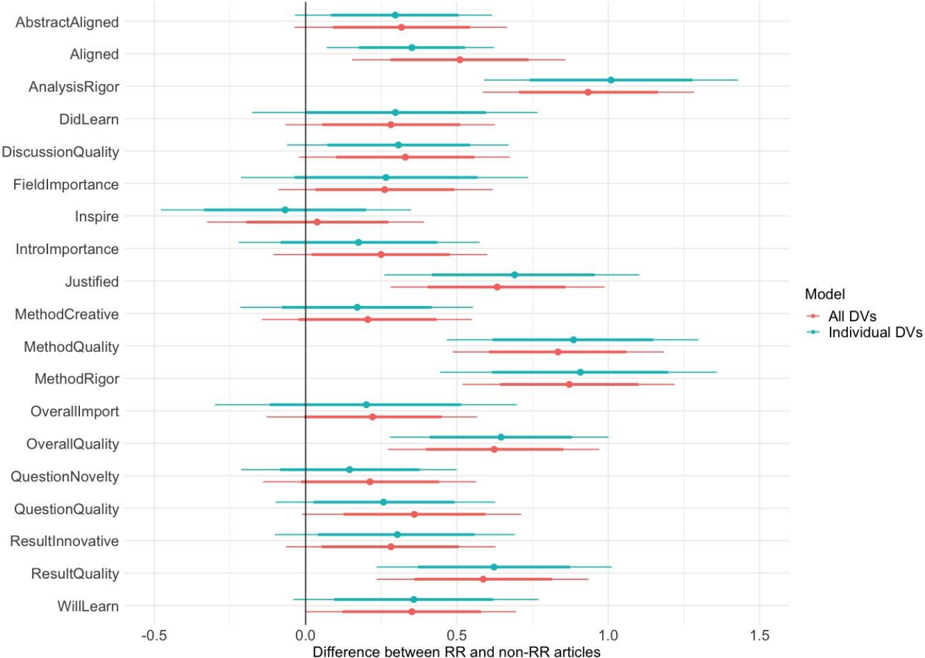
In registered reports (RRs), initial peer review and in-principle acceptance occur before knowing the research outcomes. This combats publication bias and distinguishes planned from unplanned research. How RRs could improve the credibility of research findings is straightforward, but there is little empirical evidence. Also, there could be unintended costs such as reducing novelty. Here, 353 researchers peer reviewed a pair of papers from 29 published RRs from psychology and neuroscience and 57 non-RR comparison papers. RRs numerically outperformed comparison papers on all 19 criteria (mean difference 0.46, scale range -4 to +4) with effects ranging from RRs being statistically indistinguishable from comparison papers in novelty (0.13, 95% credible interval [-0.24, 0.49]) and creativity (0.22, [-0.14, 0.58]) to sizeable improvements in rigour of methodology (0.99, [0.62, 1.35]) and analysis (0.97, [0.60, 1.34]) and overall paper quality (0.66, [0.30, 1.02]). RRs could improve research quality while reducing publication bias and ultimately improve the credibility of the published literature.
Overview
CoChat Summary
TL;DR
In a naturalistic comparison, 353 researchers peer reviewed paired Registered Reports (RRs) and standard-model articles, rating RRs higher on all 19 evaluated criteria. RRs showed the largest advantages in methodological and analysis rigor, with little evidence of costs to novelty or creativity.
Key findings
- Across 29 RRs and 57 matched comparison articles, RRs outperformed comparison papers on all 19 criteria, with an average difference of 0.46 on a −4 to +4 scale and a range of 0.13 to 0.96; 12 of 19 criteria had 95% credible intervals excluding zero.
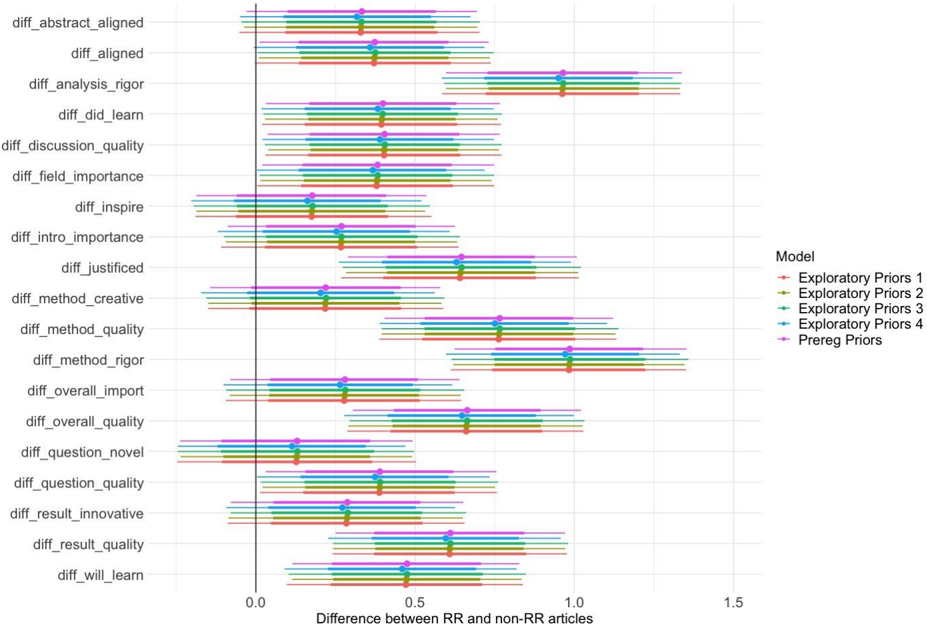
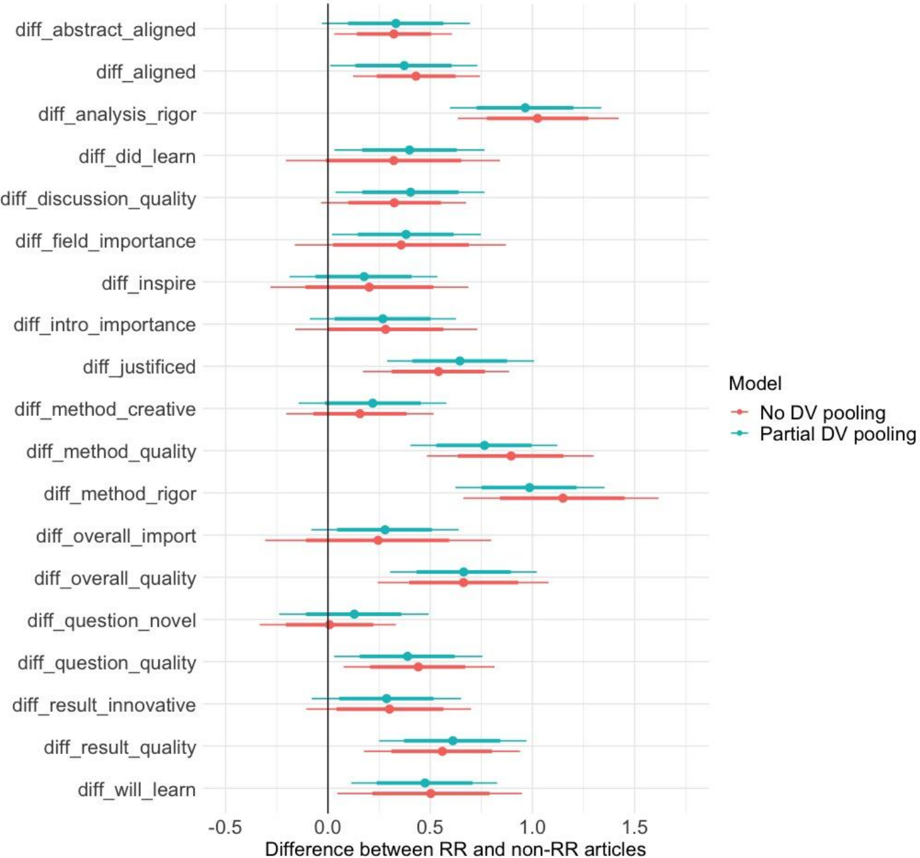
- Largest advantages were for rigor of methodology (0.99, 95% CrI [0.62, 1.35]) and analysis (0.97, [0.60, 1.34]), and overall paper quality (0.66, [0.30, 1.02]); smallest differences were novelty (0.13, [−0.24, 0.49]) and creativity (0.22, [−0.14, 0.58]).
- Objective coding showed more preregistration (59% of RRs vs 7% author-based and 0% journal-based comparisons), open data (86% vs 18% and 14%), open materials (59% vs 11% and 7%), and larger median sample sizes (220 vs 118 and 78).
- Between-subjects analysis using only the first reviewed article showed a similar pattern, with an average effect size of 0.43 and range 0.04 to 0.93.
Methods
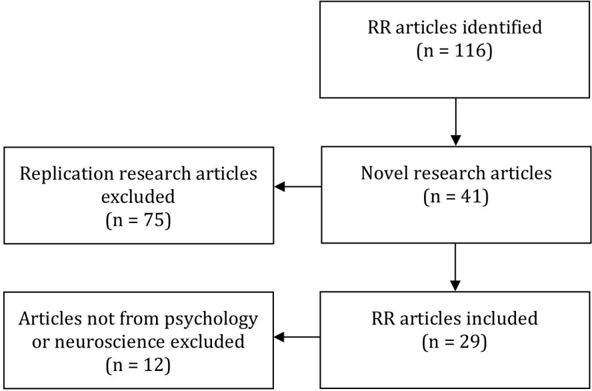
- Observational quasi-experimental study using 29 published RRs in psychology and neuroscience reporting novel research (replication RRs excluded) and 57 comparison articles matched by journal/date or lead author/date, totaling 86 articles.
- 353 recruited researchers, matched to articles by self-reported expertise, each peer reviewed one RR and one comparison article in randomized order; they rated 19 criteria on bipolar 9-point scales from −4 to +4.
- Preregistered Bayesian multilevel models estimated within-subjects and between-subjects effects; article coding assessed sample size, sample justification, difficult-to-reach populations, study design, open practices, and statcheck-detected reporting errors.
Limitations
- The paper states that the naturalistic design lacked random assignment of research to RR versus standard publication, and authors/editors self-select into RRs; matching on topic, journal, and lead author was intended to reduce but not eliminate confounding.
- The paper also states that RRs are a new format, so early-adoption behavior may not generalize; quality was assessed via peer-review ratings rather than replicability or generalizability, and reviewer representativeness is unknown.
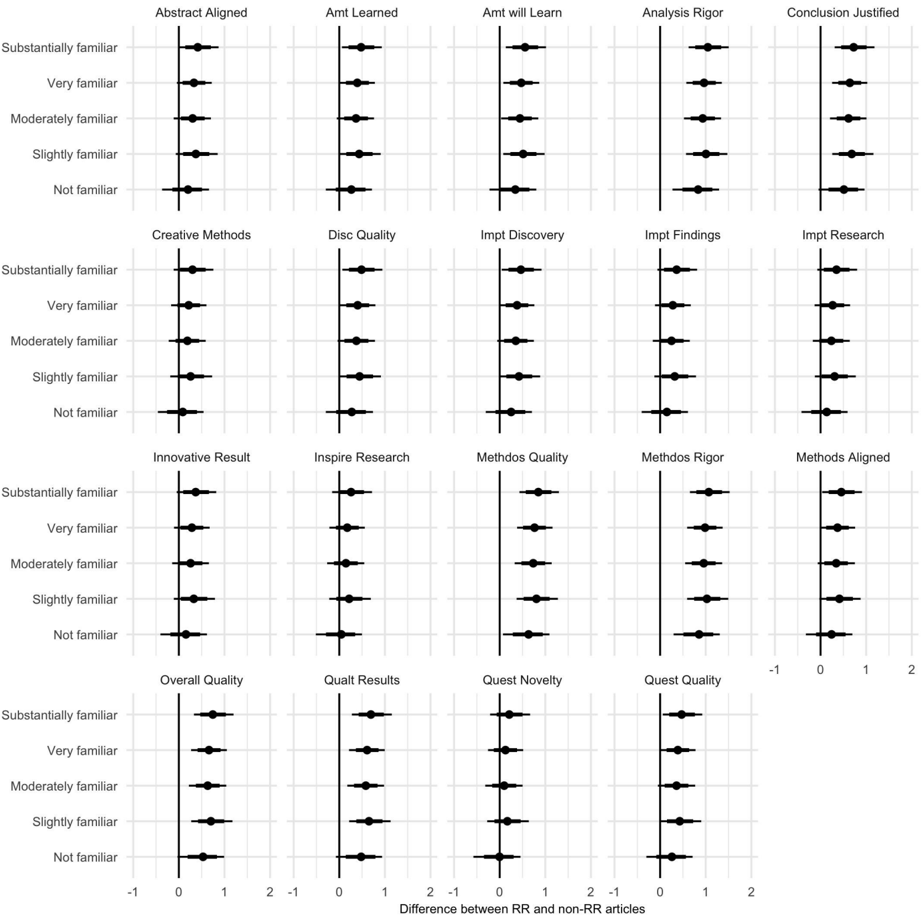
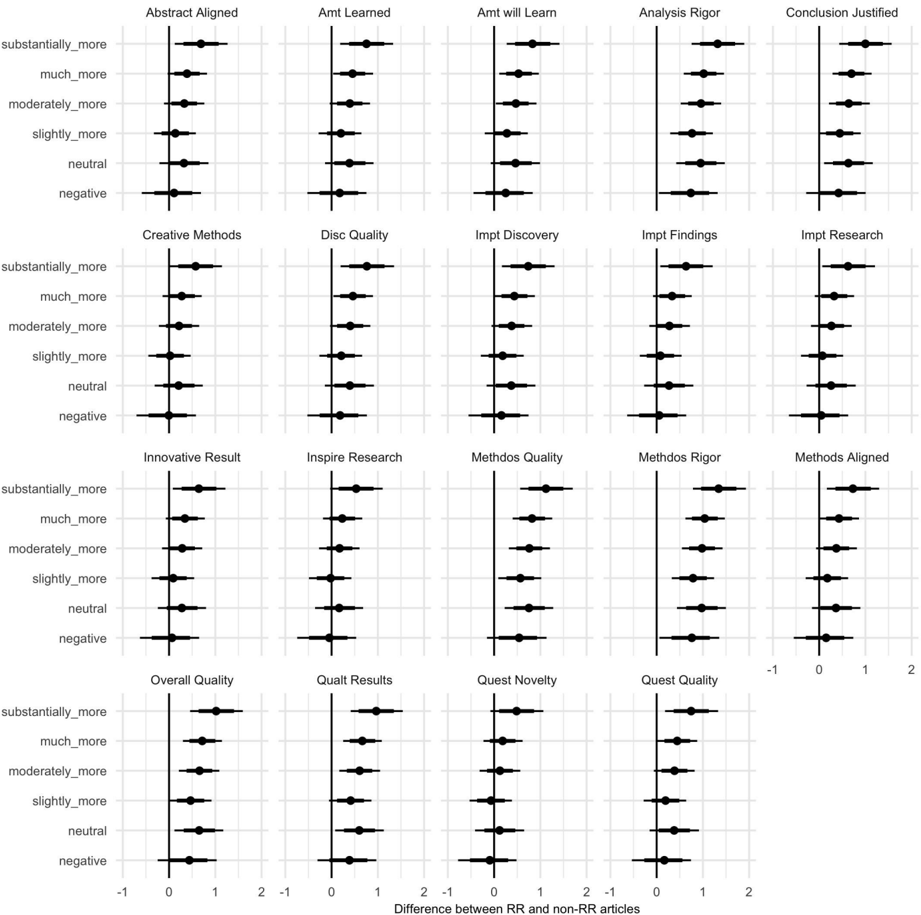
- Evident from the text: reviewers were not fully blinded to article type, with 54% correctly identifying the RR and 54% correctly identifying the comparison paper as not an RR; exploratory analyses showed larger perceived RR advantages among reviewers more familiar with or more favorable toward RRs, though every subgroup estimate remained directionally favorable.
Model-written summary. Check it against the paper before relying on it.
Integrity signals
Registry
Cites
Statistics
Figures
Verification
Claims the paper makes
8 Valid · 1 Not valid · 12 Not checked · 165 Own results and interpretations
The sources with a verdict support this claim; the rest weren’t checked yet, have no full text we could read, or their verdicts aren’t rated yet.
In the paper
“Positive results are much more likely to be published than negative results 5-7”
What the sources say
- Supportedcites [5] Smith, R. Peer review: a flawed process at the heart of science and journals. J. R. Soc. Med. 99, 178–182 (2006). source
In the Bias section (page not provided), Smith says editorial peer review has been strongly biased against negative studies and that authors often do not write them up. This supports the claim that positive results are much more likely to be published. (LLM, conf=0.90)
- Not checked — no full text of the sourcecites [6] Fanelli, D. Negative results are disappearing from most disciplines and countries. Scientometrics 90, 891–904 (2012). source
- Supportedcites [7] Fanelli, D. ‘Positive’ results increase down the hierarchy of the sciences. PLoS ONE 5, e10068 (2010). source
The Discussion section, “2C—Non-publication of negative and/or statistically non-significant results” (page unavailable), describes a publication bias against negative results. It says such results can remain unpublished because researchers may not submit them or reviewers and editors may reject them. (LLM, conf=0.88)
plainstates an association- Asserted: passes — The authors put it forward as true.
- Checkable: passes — It can be checked against evidence.
- Load-bearing: passes — The paper’s conclusions depend on it.
- Based: passes — The paper gives a reason why it holds.
- Supported
The sources with a verdict support this claim; the rest weren’t checked yet, have no full text we could read, or their verdicts aren’t rated yet.
In the paper
“Positive results -- finding that a treatment is effective or that there is a relationship between two variables -- are more likely to be published than negative results 6-12 .”
What the sources say
- Not checked — no full text of the sourcecites [6] Fanelli, D. Negative results are disappearing from most disciplines and countries. Scientometrics 90, 891–904 (2012). source
- Supportedcites [7] Fanelli, D. ‘Positive’ results increase down the hierarchy of the sciences. PLoS ONE 5, e10068 (2010). source
The Discussion section on non-publication of negative results says such results may remain unpublished because researchers do not submit them or editors and reviewers reject them. It also explicitly describes a publication bias against negative results. (LLM, conf=0.91)
- Not checked — no full text of the sourcecites [8] Franco, A., Malhotra, N. & Simonovits, G. Publication bias in the social sciences: unlocking the file drawer. Science 345, 1502–1505 (2014). source
- Not checked — no full text of the sourcecites [9] Dickersin, K. The existence of publication bias and risk factors for its occurrence. JAMA 263, 1385–1389 (1990). source
- Not checked — no full text of the sourcecites [10] Mahoney, M. J. Publication prejudices: an experimental study of confirmatory bias in the peer review system. Cogn. Ther. Res. 1, 161–175 (1977). source
- Not checked — no full text of the sourcecites [11] Greenwald, A. G. Consequences of prejudice against the null hypothesis. Psychol. Bull. 82, 1–20 (1975). source
- Not checked — no full text of the sourcecites [12] Sterling, T. D. Publication decisions and their possible effects on inferences drawn from tests of significance—or vice versa. J. Am. Stat. Assoc. 54, 30–34 (1959). source
hedgedstates an association- Asserted: passes — The authors put it forward as true.
- Checkable: passes — It can be checked against evidence.
- Load-bearing: passes — The paper’s conclusions depend on it.
- Based: passes — The paper gives a reason why it holds.
The cited sources support only part of this claim — read each source’s verdict below.
In the paper
“This may contribute to publication bias, selective reporting, and questionable research practices that reduce the credibility of the published literature 18-25 .”
What the sources say
- Supportedcites [18] Begley, C. G. & Ellis, L. M. Raise standards for preclinical cancer research. Nature 483, 531–533 (2012). source
In BUILDING A STRONGER SYSTEM, the authors say that pressure for a clear, complete ‘perfect’ story can encourage selected data sets or massaged results. Improving the reliability of preclinical cancer studies calls for more publication of negative findings, while CONFIRMING RESEARCH FINDINGS links selective presentation of experiments to irreproducible results. Together, these passages support the citing sentence’s hedged account of how publication preferences may undermine the literature’s credibility. (LLM, conf=0.90)
- Not checked — no full text of the sourcecites [19] Prinz, F., Schlange, T. & Asadullah, K. Believe it or not: how much can we rely on published data on potential drug targets? Nat. Rev. Drug Discov. 10, 712–712 (2011). source
- Partly supportedcites [20] Camerer, C. F. et al. Evaluating replicability of laboratory experiments in economics. Science 351, 1433–1436 (2016). sourceExperimental — accuracy not yet measured
The Main Text (page not provided) says original effect sizes tended to be inflated and that this could stem from publication bias; it also discusses concerns about false positives and reproducibility. It does not say that attention to positive, novel, or clean findings causes publication bias, selective reporting, or questionable research practices. (LLM, conf=0.82)
- Not checked — no full text of the sourcecites [21] Camerer, C. F. et al. Evaluating the replicability of social science experiments in Nature and Science between 2010 and 2015. Nat. Hum. Behav. 2, 637–644 (2018). source
- Partly supportedcites [22] Klein, R. A. et al. Many Labs 2: investigating variation in replicability across samples and settings. Adv. Methods Pract. Psychol. Sci. 1, 443–490 (2018). sourceExperimental — accuracy not yet measured
The Implications section says positive results are perceived as more publishable and describes analytic and post hoc practices that can inflate false positives and diminish credibility. The Discussion also identifies publication bias and p-hacking as possible explanations for replication failures, but says the study cannot determine whether they caused those failures. Our copy does not connect attention to novel or clean findings specifically to these practices. (LLM, conf=0.84)
- Partly supportedcites [23] Klein, R. A. et al. Investigating variation in replicability: a ‘many labs’ replication project. Soc. Psychol. 45, 142–152 (2014). sourceExperimental — accuracy not yet measured
The introduction (p. 4) says infrequent direct replication can leave spurious findings in the published literature, supporting the concern about credibility. It does not link that problem to attention to positive, novel, or clean findings, or discuss publication bias, selective reporting, or questionable research practices as the claimed pathway. (LLM, conf=0.84)
- Partly supportedcites [24] Open Science Collaboration. Estimating the reproducibility of psychological science. Science 349, aac4716 (2015). sourceExperimental — accuracy not yet measured
Insights on Reproducibility (p. 13) links a preference for positive results to publication and reporting bias and says these biases may inflate published effect sizes. Implications and Limitations (p. 15) discusses incentives favoring innovation over verification. The paper does not establish the claimed link to questionable research practices or specifically discuss attention to “clean” findings. (LLM, conf=0.82)
- Not checked yetcites [25] Ebersole, C. R. et al. Many Labs 3: evaluating participant pool quality across the academic semester via replication. J. Exp. Soc. Psychol. 67, 68–82 (2016). source
Checked before — its earlier verdict is held back until a new check runs.
hedgedstates a possible cause- Asserted: passes — The authors put it forward as true.
- Checkable: passes — It can be checked against evidence.
- Load-bearing: passes — The paper’s conclusions depend on it.
- Based: passes — The paper gives a reason why it holds.
- Supported
A result the paper reports from its own data — it cites no other source for it, so there is none to check. The quote shows it is in the paper.
In the paper
“In reality, 99.43% of the reviewers provided data for both articles.”
plain- Asserted: passes — The authors put it forward as true.
- Checkable: passes — It can be checked against evidence.
- Load-bearing: passes — The paper’s conclusions depend on it.
- Based: passes — The paper gives a reason why it holds.
A result the paper reports from its own data — it cites no other source for it, so there is none to check. The quote shows it is in the paper.
In the paper
“better alignment between the research question and methodology (estimate = 0.37, [0.01, 0.73], standardized ES = 0.19, [0.01, 0.37])”
plainstates an association- Asserted: passes — The authors put it forward as true.
- Checkable: passes — It can be checked against evidence.
- Load-bearing: passes — The paper’s conclusions depend on it.
- Based: passes — The paper gives a reason why it holds.
46 more claims
Create a free account to see all 186 claims and to verify the 1 reference still open.
- Probably not a substantial claim. 116
- It may state two separate claims as one. 42
- The quote only partly states this claim. 10
Self-check
Percentages, sums and reported differences re-computed from the paper’s own numbers.
Each contradiction between two passages listed here was confirmed by an independent check.
Rated minor: it would not touch a result — a value no result rests on, a p-value that stays on the same side of the significance level, or a conflict that is clerical, resolved elsewhere in the paper, or outside its own findings.
In the paper
“Of the 29 RR and control article matches, each had an average of 12.5 reviewers with a low of 3 and a high of 24 ( SD =5.59).”
Reported 12.5 · recomputed 12.172414
Rated minor: it would not touch a result — a value no result rests on, a p-value that stays on the same side of the significance level, or a conflict that is clerical, resolved elsewhere in the paper, or outside its own findings.
In the paper
§ Results
“Finally, a majority of reviewers correctly identified the RR as a RR (54%; 190 correct, 38 incorrect, 125 unsure) and the comparison paper as not a RR (54%; 192 correct, 30 incorrect, 131 unsure).”
§ Results
“In the within-subjects model, 19 of 19 outcome criteria remained directionally consistent with an RR performance advantage for reviewers that guessed one paper correctly ( n =168), and 14 of 19 outcome criteria remained directionally consistent for reviewers that guessed neither paper correctly ( n =87).”
Citations
Cites
brms : An R Package for Bayesian Multilevel Models Using Stan
Bürkner, P.-C. (2017) · Journal of Statistical Software · doi:10.18637/jss.v080.i01 · Cited by 9,476
Estimating the reproducibility of psychological science
Open Science Collaboration (2015) · Science · doi:10.1126/science.aac4716 · Cited by 8,515
Simmons, J. P., Nelson, L. D., & Simonsohn, U. (2011) · Psychological Science · doi:10.1177/0956797611417632 · Cited by 6,567
Raise standards for preclinical cancer research
Begley, C. G., & Ellis, L. M. (2012) · Nature · doi:10.1038/483531a · Cited by 2,979
Measuring the Prevalence of Questionable Research Practices With Incentives for Truth Telling
John, L. K., Loewenstein, G., & Prelec, D. (2012) · Psychological Science · doi:10.1177/0956797611430953 · Cited by 2,239
Believe it or not: how much can we rely on published data on potential drug targets?
Prinz, F., Schlange, T., & Asadullah, K. (2011) · Nature Reviews Drug Discovery · doi:10.1038/nrd3439-c1 · Cited by 1,888
Publication bias in the social sciences: Unlocking the file drawer
Franco, A., Malhotra, N., & Simonovits, G. (2014) · Science · doi:10.1126/science.1255484 · Cited by 1,542
Camerer, C. F., Dreber, A., Holzmeister, F., Ho, T.-H., Huber, J., Johannesson, M., Kirchler, M., Nave, G., Nosek, B. A., Pfeiffer, T., et al. (2018) · Nature Human Behaviour · doi:10.1038/s41562-018-0399-z · Cited by 1,521
Self-citationThe Existence of Publication Bias and Risk Factors for Its Occurrence
Dickersin, K. (1990) · JAMA: The Journal of the American Medical Association · doi:10.1001/jama.1990.03440100097014 · Cited by 1,417
Evaluating replicability of laboratory experiments in economics
Camerer, C. F., Dreber, A., Forsell, E., Ho, T.-H., Huber, J., Johannesson, M., Kirchler, M., Almenberg, J., Altmejd, A., Chan, T., et al. (2016) · Science · doi:10.1126/science.aaf0918 · Cited by 1,314
Cited by
Items 101–200 of 289
Storkel, H. L., & Gallun, F. J. (2022) · Journal of Speech Language and Hearing Research · doi:10.1044/2021_jslhr-21-00513 · Cited by 8
How to improve scientific peer review: Four schools of thoughtPreprint
Waltman, L., Kaltenbrunner, W., Pinfield, S., et al. (2022) · doi:10.31235/osf.io/v8ghj · Cited by 8
Registered report adoption in academic journals: assessing rates in different research domains
Lin, T., Cheng, H., Cheng, L.-F., & Hung, T. (2024) · Scientometrics · doi:10.1007/s11192-023-04896-y · Cited by 14
Sandilos, L. E., Hindman, A. H., Lathrop, J. A., & Wu, Q. (2023) · Review of Research in Education · doi:10.3102/0091732x231210246 · Cited by 12
“Notably, intervention research is making strides in this direction with the advent of open science frameworks in which researchers preregis-ter hypotheses and planned analyses prior to determining the intervention outcomes (Soderberg et al., 2021).”
BackgroundJuniar, D., van Ballegooijen, W., Kleygrewe, G., van Schaik, A., Passchier, J., & Riper, H. M. (2025) · Frontiers in Digital Health · doi:10.3389/fdgth.2025.1603389 · Cited by 22
How open science can support the 3Rs and improve animal research
Janssens, M. R. E., Gaillard, S. D. M., de Haan, J. J., de Leeuw, W., Brooke, M., Burke, M., Flores-Dourojeanni, J. P., Kruijen, I., Menon, J. M. L., Smith, A. J., et al. (2023) · Research Ideas and Outcomes · doi:10.3897/rio.9.e105198 · Cited by 8
Supporting study registration to reduce research waste
Purgar, M., Glasziou, P., Klanjšček, T., Nakagawa, S., & Čulina, A. (2024) · Nature Ecology & Evolution · doi:10.1038/s41559-024-02433-5 · Cited by 17
“…quality between registered reports and standard literature: registered reports showed a more rigorous methodology, a higher quality of methodology and a better alignment between the research question and the methodology 42 (see the study for details on how these variables were obtained).”
A plan for systematic reviews for high-need areas in forensic science
Chin, J. M., Arabia, A.-M., McKinnon, M., Page, M. J., & Searston, R. A. (2024) · Forensic Science International Synergy · doi:10.1016/j.fsisyn.2024.100542 · Cited by 10
“This will allow review authors to help improve the review before resources have already been expended [41].”
BackgroundToward Open Science: Contributing to Research Culture Change
Shaw, L. C., Errington, T. M., & Mellor, D. T. (2022) · Science Editor · doi:10.36591/se-d-4501-14 · Cited by 12
Self-citationPremiering pre-registration at PLOS Biology
Pariente, N., & Editors, O. B. O. T. P. B. S. (2022) · PLoS Biology · doi:10.1371/journal.pbio.3001611 · Cited by 6
“Thus, external expert input at this stage of the process clearly has value and should lead to more robust articles, as was suggested by a recent analysis of registered report research quality [4].”
BackgroundPre-registration for empirical research and its practices: A tutorial on Open Science Framework
Hasegawa, R., Tada, K., Yonemitsu, F., Ikeda, A., Yamada, Y., Takahashi, K., & Kondo, H. M. (2021) · The Japanese journal of psychology · doi:10.4992/jjpsy.92.20217 · Cited by 13
Good Scientific Practice in MEEG Research: Progress and PerspectivesPreprint
Niso, G., Krol, L. R., Combrisson, E., Dubarry, A., Elliott, M., Clément, F., Héjja‐Brichard, Y., Herbst, S. K., Jerbi, K., Ković, V., et al. (2021) · doi:10.31219/osf.io/n2ryp · Cited by 7
Baldwin, J. R. (2023) · Journal of Child Psychology and Psychiatry · doi:10.1111/jcpp.13898 · Cited by 8
Norris, E., O’Mahony, A., Coyne, R., Varol, T., Green, J., Reynolds, J. P., & Toomey, E. C. (2024) · Health Psychology and Behavioral Medicine · doi:10.1080/21642850.2024.2351939 · Cited by 6
“A recent evaluation of RRs involved researchers reading the full-texts of psychology and neuroscience RRs and standard reports while blinded to whether it was a RR or not (Soderberg et al., 2021).”
BackgroundBichsel, O., Imbach, L., & Gassert, R. (2025) · Journal of NeuroEngineering and Rehabilitation · doi:10.1186/s12984-025-01701-0 · Cited by 8
“Recent evidence suggests that registered reports could improve research quality while reducing publication bias [89–91].”
Steinfath, T. P., Azanova, M., Kapralov, N., Loesche, T., Enk, L., Nikulin, V. V., & Villringer, A. (2026) · Psychophysiology · doi:10.1111/psyp.70297 · Cited by 14
Anthony, N., Tisseaux, A., & Naudet, F. (2022) · Journal of Clinical Epidemiology · doi:10.1016/j.jclinepi.2023.05.016 · Cited by 7
Zeiler, K., Mellor, D., Pickett, J., Steltenpohl, C., Chin, J. M., DeHaven, A. C., Heycke, T., Vazire, S., & Holcombe, A. O. (2020) · Law Technology and Humans · doi:10.5204/lthj.1875 · Cited by 9
Self-citationSegerstrom, S. C., Diefenbach, M. A., Hamilton, K., O'Connor, D. B., Tomiyama, A. J., Bacon, S., Bennett, G. G., Brondolo, E. N., Czajkowski, S. M., Davidson, K. W., et al. (2023) · Annals of Behavioral Medicine · doi:10.1093/abm/kaac044 · Cited by 14
Segerstrom, S. C., Diefenbach, M. A., Hamilton, K., O'Connor, D. B., & Tomiyama, A. J. (2023) · Health Psychology · doi:10.1037/hea0001236 · Cited by 9
Methner, N., Dahme, B., & Menzel, C. (2023) · Social Psychology · doi:10.32872/spb.9665 · Cited by 7
“Examples of changed behaviors include increasing sample sizes (e.g., in registered reports; Soderberg et al., 2021), preregistering and sharing data/ material (Christensen et al., 2019; Nosek et al., 2022), and conducting replications and large-scale collaborations (e.g., ManyBabies; Byers-Heinlein…”
BackgroundPersonality Science: United in Diversity
Rauthmann, J. F. (2020) · Personality Science · doi:10.5964/ps.5297 · Cited by 6
Montoya, A. K., Krenzer, W. L. D., & Fossum, J. L. (2020) · doi:10.31234/osf.io/mbhrc · Cited by 6
Segerstrom, S. C., Diefenbach, M. A., Hamilton, K., O'Connor, D. B., & Tomiyama, A. J. (2022) · doi:10.31234/osf.io/dj3xe · Cited by 6
Retractions and Rewards in Science: An Open Question for Reviewers and Funders
Ribeiro, M. D., KALICHMAN, M. W., & Vasconcelos, S. M. R. (2023) · Science and Engineering Ethics · doi:10.1007/s11948-023-00446-0 · Cited by 8
The Benefits of Preregistration and Registered ReportsPreprint
Lakens, D., Mesquida, C., Rasti, S., & Ditroilo, M. (2024) · doi:10.31234/osf.io/dqap7 · Cited by 6
The Replication Database: Documenting the Replicability of Psychological SciencePreprint
Röseler, L., Kaiser, L., Doetsch, C. A., Klett, N., Seida, C., Schütz, A., Aczél, B., Adelina, N., Agostini, V., Alarie, S., et al. (2024) · doi:10.31222/osf.io/me2ub · Cited by 6
Lila, M. A., Ryan, C. D., & Diekman, C. B. (2025) · Annual Review of Food Science and Technology · doi:10.1146/annurev-food-111523-121925 · Cited by 6
Binney, R. J., Smith, L., Rossit, S., Demeyere, N., Learmonth, G., Olgiati, E., Halai, A. D., Rounis, E., Evans, J. J., Edelstyn, N. M. J., et al. (2025) · Brain Communications · doi:10.1093/braincomms/fcaf162 · Cited by 10
“27 Of course, the greatest motivation of all for this format is the potential to establish an unbiased evidence base on questions of scientific importance.”
Lakens, D. (2025) · International Review of Social Psychology · doi:10.5334/irsp.1038 · Cited by 11
“For example, Registered Reports allow more non-significant results to be published, while the articles are at least as high-quality as standard publications (Allen & Mehler 2019; Scheel et al. 2021; Soderberg et al. 2021).”
Vollert, J., Spivack, J., Adamson, B. J. S., Baron, R., Farrar, J. T., Gilron, I., Hohenschurz‐Schmidt, D., Kerns, R. D., Mackey, S., Markman, J. D., et al. (2025) · Pain · doi:10.1097/j.pain.0000000000003798 · Cited by 8
Opening the Black Box of Peer Review
Vazire, S. (2021) · Physics · doi:10.1103/physics.14.169 · Cited by 3
Self-citationSegerstrom, S. C., Diefenbach, M. A., Hamilton, K., O'Connor, D. B., & Tomiyama, A. J. (2023) · Psychosomatic Medicine · doi:10.1097/psy.0000000000001186 · Cited by 5
Stress Regulation via Being in Nature and Social Support in Adults, a Meta-analysis
Sparacio, A., Ropovik, I., Jiga‐Boy, G. M., Cem, A., & IJzerman, H. R. (2023) · Collabra Psychology · doi:10.1525/collabra.77343 · Cited by 9
“Registered Reports will provide a much more accurate estimate of the effect sizes in this literature, and therefore, the exact efficacy of being in nature (Soderberg et al., 2021).”
BackgroundGötz, M., & O’Boyle, E. H. (2023) · Emerald Group Publishing Limited eBooks · doi:10.1108/s0742-730120230000041004 · Cited by 11
Preclinicaltrials.eu: prospective registration of animal studies
Menon, J. M. L., van der Naald, M., Chamuleau, S. A. J., & Duncker, D. J. (2023) · European Heart Journal · doi:10.1093/eurheartj/ehad623 · Cited by 8
Brohmer, H., Köstenbaumer, D., Thaller, A., Fleiß, E., Athenstaedt, U., & Posch, A. (2023) · Energy Efficiency · doi:10.1007/s12053-023-10157-x · Cited by 8
“They would go beyond self-reported PEBs and intentions and, in combination with registered report protocols, research design and diagnostic strength would potentially improve (Lange et al., 2020; Soderberg et al., 2021).”
BackgroundRiesthuis, P., & Otgaar, H. (2024) · Journal of Criminal Psychology · doi:10.1108/jcp-04-2024-0031 · Cited by 8
The Replication Database: Documenting the Replicability of Psychological Science
Röseler, L., Kaiser, L., Doetsch, C. A., Klett, N., Seida, C., Schütz, A., Aczél, B., Adelina, N., Agostini, V., Alarie, S., et al. (2024) · Journal of Open Psychology Data · doi:10.5334/jopd.101 · Cited by 30
“Moreover, individual researchers and smaller groups of researchers have started engaging in more replication research (e.g., Soderberg et al., 2021; Visser et al., 2022; Pavlov et al., 2021).”
BackgroundEvaluating Registered Reports Funding Partnerships: a feasibility study
Clark, R., Drax, K., Chambers, C. D., Munafò, M., & Thompson, J. (2021) · Wellcome Open Research · doi:10.12688/wellcomeopenres.17028.1 · Cited by 5
Evaluating Research Transparency and Openness in Communication Sciences and Disorders JournalsPreprint
Schroeder, S. R., Gaeta, L. M., Amin, M. E., et al. (2022) · doi:10.31234/osf.io/dy5zs · Cited by 5
Nature welcomes Registered Reports
(2023) · Nature · doi:10.1038/d41586-023-00506-2 · Cited by 6
Improving medical research in the United Kingdom
Bradley, S. H., DeVito, N., Lloyd, K. E., Logullo, P., & Butler, J. E. (2022) · BMC Research Notes · doi:10.1186/s13104-022-06050-y · Cited by 6
“Early evidence suggests that registered reports do improve the quality and rigor of proposed study designs [20, 21].”
BackgroundRegistered reports in forensic science
Houck, M. M., Chin, J. M., Swofford, H., & Gibb, C. L. (2022) · Royal Society Open Science · doi:10.1098/rsos.221076 · Cited by 7
Registered Reports: benefits and challenges of implementing in medicine
Lloyd, K. E., & Chambers, C. (2024) · British Journal of General Practice · doi:10.3399/bjgp24x736185 · Cited by 4
Bertin, P., & Nera, K. (2025) · International Review of Social Psychology · doi:10.5334/irsp.979 · Cited by 7
How open science can benefit bilingualism research: A lesson in six tales
Ben, R. D., Brouillard, M., Gonzalez‐Barrero, A. M., Killam, H., Kremin, L. V., Quirk, E., Sander‐Montant, A., Schott, E., Tsui, R. K. Y., & Byers‐Heinlein, K. (2022) · Bilingualism Language and Cognition · doi:10.1017/s1366728922000256 · Cited by 4
Trinity review: integrating Registered Reports with research ethics and funding reviews
Mori, Y., Takashima, K., Ueda, K., Sasaki, K., & Yamada, Y. (2022) · BMC Research Notes · doi:10.1186/s13104-022-06043-x · Cited by 6
“As a result, it could prevent file drawer problems [12] and publication bias [13, 14], questionable research practices or research misconduct, and, as a result, increase reproducibility [8, 15] in the same way as traditional RRs.”
BackgroundResultBeware influential findings that have not been replicated
Rastle, K., Chan, J., Cleary, A., Pexman, P. M., & Staub, A. (2022) · Journal of Memory and Language · doi:10.1016/j.jml.2022.104390 · Cited by 3
Mzhelsky, A. (2023) · Science Editor and Publisher · doi:10.24069/sep-22-53 · Cited by 4
Automatic registration for UK trials
Bradley, S. H., Lloyd, K. E., & DeVito, N. (2022) · BMJ · doi:10.1136/bmj.o41 · Cited by 5
Barch, D. (2021) · Biological Psychiatry Global Open Science · doi:10.1016/j.bpsgos.2021.07.002 · Cited by 4
Doing Reliable Research in Comparative Psychology: Challenges and Proposals for ImprovementPreprint
Tecwyn, E. C. (2021) · doi:10.31234/osf.io/95uvr · Cited by 4
Optimizing Methodology of Sleep and Memory Research in HumansPreprint
Németh, D., Gerbier, É., Born, J., Rickard, T. C., Diekelmann, S., Fogel, S. M., Genzel, L., Prehn‐Kristensen, A., Payne, J. D., Dresler, M., et al. (2023) · Preprints.org · doi:10.20944/preprints201908.0208.v4 · Cited by 4
Fellnhofer, K., Wennberg, K. J., Allison, T. H., Arenius, P. M., Lévesque, M., Gish, J. J., & Pollack, J. M. (2026) · Entrepreneurship Theory and Practice · doi:10.1177/10422587251401175 · Cited by 6
“Considering that entrepreneurship is an exceptionally interdisciplinary field and often benefits from cross-disciplinary methodological input (Scheel et al., 2021; Soderberg et al., 2021), entrepreneurship scholars are well-positioned to adopt transparency-enhancing practices from other disciplines.”
Reproducible brain PET data analysis: easier said than done
Naseri, M., Ramakrishnapillai, S., & Carmichael, O. T. (2024) · Frontiers in Neuroinformatics · doi:10.3389/fninf.2024.1420315 · Cited by 4
Systematic mapping and bibliometric analysis of meta-analyses on animal cognition
Mizuno, A., Lagisz, M., Pollo, P., Guillette, L. M., Soma, M., & Nakagawa, S. (2025) · Neuroscience & Biobehavioral Reviews · doi:10.1016/j.neubiorev.2025.106342 · Cited by 8
Preregistration templates as a new addition to the evidence-based toxicology toolbox
Mellor, D. T., Corker, K. S., & Whaley, P. (2024) · Evidence-Based Toxicology · doi:10.1080/2833373x.2024.2314303 · Cited by 2
Assessing the effects of a precommitment policy applied during peer review
Haber, N., Errington, T. M., Daley, M., Whaley, P., & Nosek, B. A. (2024) · Evidence-Based Toxicology · doi:10.1080/2833373x.2024.2386955 · Cited by 2
Self-citationRibeiro, M. D., & Vasconcelos, S. M. R. (2024) · Anais da Academia Brasileira de Ciências · doi:10.1590/0001-3765202420240038 · Cited by 3
Leung, A., Mahmoud, A., Jeans, R., Fulcher, B., van Swinderen, B., & Tsuchiya, N. (2025) · PLoS Biology · doi:10.1371/journal.pbio.3003217 · Cited by 4
“In particular, validating features on blinded datasets while utilizing a registered report approach can help mitigate biases toward certain features [23].”
Psychological Science Accelerator: A Promising Resource for Clinical Psychological Science
Beshears, J. E., Gjoneska, B., Schmidt, K., Pfuhl, G., Saari, T. T., McAuliffe, W. H. B., Steltenpohl, C. N., Onie, S., Chartier, C. R., & Moshontz, H. (2022) · Springer eBooks · doi:10.1007/978-3-031-04968-2_19 · Cited by 4
Hüffmeier, J., & Mertes, M. (2023) · Meta-Psychology · doi:10.15626/mp.2022.3271 · Cited by 5
Baldwin, J. R., & Larsson, H. (2024) · JCPP Advances · doi:10.1002/jcv2.12275 · Cited by 4
Open science, communication, and collaboration for the future of palaeoproteomics
Dekker, J. A. A., Peters, C., Winter, R. M., Collins, M. J., Dickinson, M. R., Harvey, V. L., Hill, E., Nair, B., Tsutaya, T., Viñas-Caron, L. C., et al. (2025) · Peer Community Journal · doi:10.24072/pcjournal.576 · Cited by 9
“…Report differ between journals, but the core concept is to submit a research plan including hypotheses, methodologies and planned analyses (Soderberg et al., 2021), which is subjected to peer review and can be either published separately or result in an in-principle acceptance of a later…”
Proceedings of the Paris Open Science European Conference: OSEC 2022
Conference, O. S. E. (2022) · doi:10.4000/books.oep.15829 · Cited by 5
Opportunities and challenges for Registered Reports in ecology and evolution
(2022) · Nature Communications · doi:10.1038/s41467-022-32900-1 · Cited by 3
Opening Doors to Open Science and Scholarship for School Psychology Research, Training, and PracticePreprint
Roberson, A. J., Farmer, R. L., Shaw, S. R., Upton, S. R., & Zaheer, I. (2020) · PsyArXiv (OSF Preprints) · doi:10.31234/osf.io/su53p · Cited by 5
Publishing Visualization Studies as Registered Reports: Expected Benefits and Researchers’ AttitudesPreprint
Besançon, L., Bezerianos, A., Dragicevic, P., Isenberg, P., & Jansen, Y. (2021) · OSF Preprints (OSF Preprints) · doi:10.31219/osf.io/3z7kx · Cited by 5
“Although this is possible, Soderberg et al. [46] found that reviewers in psychology and neuroscience judged Registered Reports as no less novel or creative than traditional papers, while rating Registered Reports as more rigorous and of higher quality overall.”
Background(FULL GUIDE) A Guide for Social Science Journal Editors on Easing into Open SciencePreprint
Silverstein, P., Elman, C., Montoya, A. K., McGillivray, B., Pennington, C. R., Harrison, C. H., Steltenpohl, C. N., Röer, J. P., Corker, K. S., Charron, L., et al. (2026) · OSF Preprints (OSF Preprints) · doi:10.31219/osf.io/hstcx · Cited by 4
Self-citationSilva, F. M., Adegboye, A. R. A., Curioni, C. C., Gomes, F. D. S., Collins, G. S., Kac, G., Cook, J. A., Ismail, L. C., Page, M. J., Khandpur, N., et al. (2023) · medRxiv · doi:10.1101/2023.06.08.23291109 · Cited by 3
No evidence for decision fatigue using large-scale field data from healthcare
Andersson, D., Lindberg, M., Tinghög, G., & Persson, E. (2025) · Communications Psychology · doi:10.1038/s44271-025-00207-8 · Cited by 3
Travers, J. C., Dowdy, A., Tincani, M., & Slocum, T. (2025) · Remedial and Special Education · doi:10.1177/07419325251375992 · Cited by 2
Public Administration Beyond Public Administration Journals
Olsen, A. L., Bendtsen, K., & van Leeuwen, P. (2026) · PS Political Science & Politics · doi:10.1017/s1049096526101942 · Cited by 3
“The abstracts were rated on eight key measures, previously validated by Soderberg et al. (2021) as capturing different quality characteristics.”
Lin, Y., Tao, Y., He, Z., Wang, H., Zheng, Y., & Jin, Y. (2026) · Frontiers in Neurology · doi:10.3389/fneur.2026.1788223 · Cited by 2
“Because the Registered Reports format includes peer review and in-principle acceptance before results are known, it may help reduce publication bias and other forms of outcome-driven bias while strengthening methodological and analytical rigor (64).”
Conceptual replication study of fifteen JDM effects: Insights from the Polish sample
Sobków, A., Sobczak, A., Latacz, K., Gambuś, P., Tyc, A., Goryczka, K., Barcik, K., Janosz, A., Hetmańczuk, W., Gonczar, T., et al. (2022) · Polish Psychological Bulletin · doi:10.24425/ppb.2022.141862 · Cited by 6
Ni, H., Price, P. C., & Jones, C. J. (2024) · School Psychology Review · doi:10.1080/2372966x.2024.2365618 · Cited by 3
“Registered reports, on the other hand, are gaining traction as a method to enhance research rigor and mitigate publication bias (Soderberg et al., 2021).”
Publish without bias or perish without replications
Ventura, R. (2022) · Studies in History and Philosophy of Science Part A · doi:10.1016/j.shpsa.2022.08.010 · Cited by 2
Edelsbrunner, P. A., Ruggeri, K., Damnjanović, K., Greiff, S., Lemoine, J. E., & Ziegler, M. D. (2022) · European Journal of Psychological Assessment · doi:10.1027/1015-5759/a000743 · Cited by 3
Treat societally impactful scientific insights as open-source software artifacts
Liem, C. C. S., & Demetriou, A. M. (2023) · IEEE/ACM International Conference on Software Engineering: Software Engineering in Society (ICSE-SEIS) · doi:10.1109/icse-seis58686.2023.00020 · Cited by 4
“positive effects on research quality and integrity [42]; however, this still involves the review of complete experimental setups.”
BackgroundNo panacea, but a pivotal progress – A response to Souza-Neto and Moyle
Chen, Z., & Li, X. R. (2024) · Tourism Management · doi:10.1016/j.tourman.2024.105062 · Cited by 2
Retractions and rewards in science: An open question for reviewers and fundersPreprint
Ribeiro, M. D., KALICHMAN, M. W., & Vasconcelos, S. M. R. (2022) · bioRxiv (Cold Spring Harbor Laboratory) · doi:10.1101/2022.05.31.494225 · Cited by 2
The effects of isolated game elements on adherence rates in food-based response inhibition trainingPreprint
MacLellan, A., Pennington, C. R., Lawrence, N., Westwood, S. J., Jones, A., Slegrova, A., Sung, B., Parker, L., Relph, L., Miranda, J. O., et al. (2024) · doi:10.31234/osf.io/2e73b · Cited by 2
Registered Reports in School Psychology Research: Initial Experiences, Analyses, and Future
Shaw, S. R., Pecsi, S., Infantino, E., Kang, Y. H., Verma, N., & von Hagen, A. (2024) · Canadian Journal of School Psychology · doi:10.1177/08295735241263912 · Cited by 2
“…supporting a clinical practice create cumulative evidence that allows psychologists to infer whether an intervention or practice is truly effective versus a single study that may merely show statistically significant improvements due to error (Gehlbach & Robinson, 2021; Soderberg et al., 2021).”
Support for preregistration and registered reports at Historical Biology
Young, M. T. (2025) · Historical Biology · doi:10.1080/08912963.2025.2567087 · Cited by 2
“…combat reporting and publication biases (e.g. see Chambers & Tzavella, 2022; Lakens et al., 2024; Munafò et al., 2017; Reich, 2021; Scheel et al., 2021; Soderberg et al., 2021), and supporting Findability, Accessibility, Interoperability and Reusability (FAIR) principles (Wilkinson et al., 2016).”
Researchers‘ perspectives on preregistration in animal researchPreprint
Priboi, C., Mayer, B., Vergauwe, E., Elger, B. S., & Würbel, H. (2025) · bioRxiv (Cold Spring Harbor Laboratory) · doi:10.1101/2025.11.07.687141 · Cited by 2
LaPlante, D. A., Louderback, E. R., Ghaharian, K., et al. (2025) · International Gambling Studies · doi:10.1080/14459795.2025.2456797 · Cited by 1
Preobrazenski, N., Mladen, S. P. S., Causer, E., Menezes, E. S., Islam, H., Drouin, P. J., Tschakovsky, M. E., & Gurd, B. J. (2025) · Translational Exercise Biomedicine · doi:10.1515/teb-2025-0002 · Cited by 2
“Implementing measures against biases, including reporting bias, not only enhances the credibility of science [30] but can also conserve resources [31] and minimize potential harm to participants [32].”
Improving research on developmental psychopathology with Registered Reports
Syed, M., & Frankenhuis, W. E. (2025) · Development and Psychopathology · doi:10.1017/s0954579425100552 · Cited by 2
“There is some initial evidence that reviewers of Registered Reports rate them as more rigorous than standard reports along numerous dimensions, both before and after knowing the findings of the study (Soderberg et al., 2021).”
Consistent and Precise Description of Research Outputs Could Improve Implementation of Open Science
Mayo‐Wilson, E., Grant, S., Corker, K. S., & Moher, D. (2025) · Advances in Methods and Practices in Psychological Science · doi:10.1177/25152459251375445 · Cited by 5
“…not registered, some journals do not make Stage 1 manuscripts publicly available, and some journals that accept Registered Reports do not have public policies about studies that are withdrawn (Chambers & Tzavella, 2022; Hard-wicke & Ioannidis, 2018; Montoya et al., 2021; Soderberg et al., 2021).”
Elite Partisan Disagreement and Military Victory: Evidence from South Korean Battle Experiments
Joseph, M. F., Chung, J. H., & Park, H. S. (2026) · American Political Science Review · doi:10.1017/s0003055426101543 · Cited by 1
Priboi, C., Mayer, B., Vergauwe, E., Elger, B. S., & Würbel, H. (2026) · PLoS Biology · doi:10.1371/journal.pbio.3003511 · Cited by 5
The role of Infrastructure for Software in Open Science
Lucke, U. (2022) · doi:10.4000/books.oep.16184 · Cited by 1
Actes des Journées européennes de la science ouverte
Conference, O. S. E. (2022) · doi:10.4000/books.oep.15822 · Cited by 2
Gabriel, M. (2022) · doi:10.4000/books.oep.16089 · Cited by 1
Open Science in Psychosomatic Medicine
Psychosomatic Medicine Open Science Working Group (2023) · Psychosomatic Medicine · doi:10.1097/psy.0000000000001189 · Cited by 1
The status quo, challenges, and recommendations of pre-registration in psychological science
Jiawei, Z. H. A. O., Tao, X. I. A., & Chuan-Peng, H. (2024) · Advances in Psychological Science · doi:10.3724/sp.j.1042.2024.00715 · Cited by 3
Bramley, P., Hulman, J., & Wanstall, H. (2024) · Anaesthesia · doi:10.1111/anae.16411 · Cited by 2
“Registered reports (where submissions to journals are made based on a study proposal before data are collected and accepted or rejected on this basis) in other fi elds have been found to be associated with less signi fi cant results [19] but papers being rated ashigher quality [20].”
No Peeking: Peer Review and Presumptive Blinding
Ballantyne, N., & Celniker, J. B. (2024) · Canadian Journal of Philosophy · doi:10.1017/can.2024.25 · Cited by 2
“Initial evidence suggests that registered reports yield higher quality publications than the traditional reviewing model (Soderberg et al., 2021), and there are surely other ways in which blinding and open science practices can complement each other en route to improving science (Waltman et al.,…”
The introduction of Registered Reports in the Autism journal: The what, why and how
Manning, C. (2024) · Autism · doi:10.1177/13623613241285676 · Cited by 1
“Pre-Data Registered Reports also allow methodological flaws to be identified and corrected before data collection, which can lead to increased research quality (Soderberg et al., 2021).”
Metadata
- Authors
- Soderberg, C. K., Errington, T. M., Schiavone, S. R., Bottesini, J., Thorn, F. S., Vazire, S., Esterling, K. M., & Nosek, B. A.
- Affiliations
- Center for Open Science (US)
- University of California, Davis (US)
- The University of Melbourne (AU)
- University of California, Riverside (US)
- Corresponding author
- Nosek, Brian A.
- ORCID
- Venue
- Nature Human Behaviour
- Published
- 2021-06-24
- Volume
- 5
- Issue
- 8
- Pages
- 990-997
- ISSN
- 2397-3374 (ISSN-L)
- OpenAlex
- W3174993952
- Semantic Scholar
- b870928f45680afa8e394c85bfaddd487cd6c4d2
- Cited by
- 295
- References
- 41
- Citations by year
- 2026: 27 · 2025: 47 · 2024: 43 · 2023: 61 · 2022: 85 · 2021: 28
- FWCI
- 39.83
- Type
- journal article
- Language
- en
- Open access
- green
- doi.org
- Licence
- public-domain
- www.springernature.com/gp/researchers/text-and-data-mining (tdm)
- www.springernature.com/gp/researchers/text-and-data-mining (vor)
- Locations
- Nature Human Behaviour (publishedVersion)
- MetArXiv (OSF Preprints) (submittedVersion, public-domain)
- PubMed (publishedVersion)
- RePEc: Research Papers in Economics (acceptedVersion)
- MetArXiv (OSF Preprints) (acceptedVersion)
- Funders
- James S. McDonnell Foundation (220020498)
- Arnold Ventures, no reference number
- Topics
- Social Sciences › Psychology › Experimental and Cognitive Psychology › Psychology Research and Bibliometrics
- Social Sciences › Library and Information Sciences › Academic Publishing and Open Access
- Social Sciences › Decision Sciences › Statistics, Probability and Uncertainty › Meta-analysis and systematic reviews
- Keywords
- research quality, publication bias, research credibility, novelty, creativity, methodological quality, open science
- MeSH terms
- Data Analysis, Humans, Neurosciences, Psychology, Registries, Research, Research Design, Peer Review, Research, Research Report
About these checks
Registry, retraction, Cites and statistics results are computed, not judged, with one exception: a printed reference that no index lists is read once by a model before it counts as a citation error. Claims are extracted by a model and kept only when their quote appears verbatim in the text; each cited source is then checked, with a model’s help, for whether it says what the claim relies on. Those verdicts can be wrong — read the claim’s quote and the cited source before relying on one.
The claim verdicts this report counts are experimental: their accuracy is not yet measured.
A language model drew the claims from the paper on 2026-10-10, under version 3 of the claim definition (model deepseek-v4.1-flash, prompt extract-v3).
A second model labelled each claim on 2026-10-10 (model jev-1.13-20260917, definition revision gold-guideline-v0.2).
Cited sources are checked with a language model’s help (gpt-6-sol).
Statistics and arithmetic are recomputed, not judged.
Confidence bands are shown only for fields calibrated on our annotated test set. None is calibrated yet, so no band is shown.
What counts as a claim ›How we measure confidence ›How we check this ›
Are you an author, or do you see a problem with this page? Request a review
Data sources
Bibliographic data: Semantic Scholar, OpenAlex, Crossref.
Contains information from the Semantic Scholar Academic Graph Datasets, made available under the ODC Attribution License (ODC-BY 1.0).
Semantic Scholar’s data is described in: Kinney, R., et al. (2023). The Semantic Scholar Open Data Platform. arXiv:2301.10140.
