

Negativity drives online news consumption
Open accessThe DOI matches its Crossref record; 65 of the 66 references it cites were found in a registry or an index; 12 of the 107 sources its claims cite were checked for support.
Abstract
Online media is important for society in informing and shaping opinions, hence raising the question of what drives online news consumption. Here we analyse the causal effect of negative and emotional words on news consumption using a large online dataset of viral news stories. Specifically, we conducted our analyses using a series of randomized controlled trials ( N = 22,743). Our dataset comprises ~105,000 different variations of news stories from Upworthy.com that generated ∼5.7 million clicks across more than 370 million overall impressions. Although positive words were slightly more prevalent than negative words, we found that negative words in news headlines increased consumption rates (and positive words decreased consumption rates). For a headline of average length, each additional negative word increased the click-through rate by 2.3%. Our results contribute to a better understanding of why users engage with online media.
Overview
CoChat Summary
TL;DR
Using 22,743 randomized controlled trials from Upworthy, this paper finds that negative words in news headlines causally increase click-through rates, while positive words decrease them. The effects are robust across dictionaries and controls, with discrete sadness increasing clicks and joy/fear decreasing clicks.
Key findings
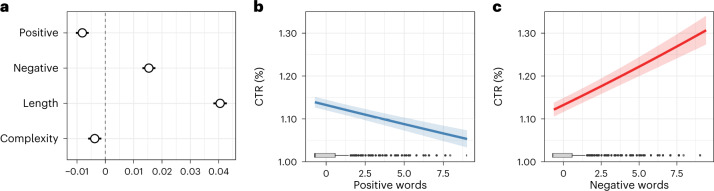
- Negative words increased consumption: β = 0.015, SE = 0.001, z = 17.423, P < 0.001, 99% CI = (0.013, 0.018); for an average-length headline, each additional negative word increased CTR by 2.3%, and a one-SD larger proportion of negative words increased odds of clicking by 1.5%.
- Positive words decreased consumption: β = −0.008, SE = 0.001, z = −9.238, P < 0.001, 99% CI = (−0.010, −0.006); for an average-length headline, each positive word decreased CTR by 1.0%, and a one-SD increase in positive-word proportion decreased odds of clicking by 0.8%.
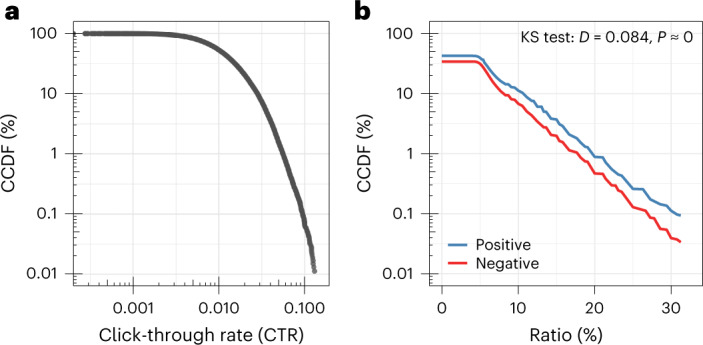
- Positive words were slightly more prevalent than negative words overall (2.83% vs 2.62% of all words; KS test D = 0.574, P < 0.001, two-tailed).
- For discrete emotions, sadness had a positive effect (β = 0.006, P < 0.001), joy and fear had negative effects (β = −0.009 and β = −0.007, respectively, P < 0.001), and anger was not statistically significant (β = 0.000, P = 0.666; equivalence test inconclusive).
Methods
- Data came from the Upworthy Research Archive confirmatory sample: N = 22,743 RCTs, reduced after pre-registered filtering to 12,448 RCTs comprising 53,699 headlines, over 205 million impressions, and 2,778,124 clicks; the broader dataset included ~105,000 headline variations, ~5.7 million clicks, and >370 million impressions.
- Each RCT randomly showed different headline variations for the same news story and measured CTR as clicks per impression; the main analysis used multilevel binomial regression with random intercepts and, in a second model, varying slopes, controlling for headline length, Gunning Fog complexity, and platform age.
- Sentiment was extracted with LIWC positive/negative dictionaries and negation handling; discrete emotions used the NRC emotion lexicon; robustness checks included alternative dictionaries, negation approaches, complexity measures, quadratic effects, image-RCT removal, log-transformed CTR, moralized language, and topic modeling.
Limitations
- The paper states that Upworthy differs from traditional news sources because of its “click-bait” headlines, that conclusions apply at the news-story level rather than the individual level, and that the analysis cannot infer readers’ subjective feelings from language.
- The paper also notes limitations of using the NRC emotion lexicon for discrete emotions and the scarcity of dictionaries for alternative dimensional emotion models.
- Evident from the text: the data are aggregated at the headline level with no individual-level user data, come from a single platform during 2013–2015, and exclude image RCTs because image data were unavailable, which may limit generalizability.
Model-written summary. Check it against the paper before relying on it.
Integrity signals
Registry
Cites
Statistics
Figures
Verification
Claims the paper makes
7 Valid · 2 Not valid · 35 Not checked · 95 Own results and interpretations
The sources with a verdict support this claim; the rest weren’t checked yet, have no full text we could read, or their verdicts aren’t rated yet.
In the paper
“First, we repeated the analysis with alternative sentiment dictionaries as an additional validation. Specifically, we examined both the NRC dictionary63,64 and the SentiStrength dictionary65. We found that the coefficient estimates were in good agreement, contributing to the robustness of our results (Supplementary Table 4 and Fig. 2).”
§ Negativity drives online news consumption > Results > Robustness checks
What the sources say
- Not checked yetcites [63] Mohammad, S. & Turney, P. Proc. NAACL HLT 2010 Workshop on Computational Approaches to Analysis and Generation of Emotion in Text (Association for Computational Linguistics, 2010).
- Supportedcites [64] Mohammad, S. M. in Emotion Measurement (ed. Meiselman, H. L.) 201–237 (Woodhead Publishing, 2016). source
In the citing sentence the reference is attached specifically to 'the NRC dictionary' (refs 63,64), while SentiStrength carries its own separate reference (65) and the agreement of coefficient estimates is the citing authors' own robustness analysis. Our copy of Mohammad's 'Sentiment Analysis' chapter is precisely a description of the NRC lexicons: §5.1.1 (Crowdsourced Emotion Lexicons) details the NRC Emotion Lexicon (EmoLex, ~14k terms, binary associations with eight basic emotions plus positive/negative sentiment, from Mohammad & Turney, 2010), and §5.1.3 lists NRC-VAD, NRC-EmoLex and the NRC Emotion Intensity Lexicon among the most widely used sentiment/emotion lexicons. So as an identification citation for the NRC sentiment dictionary the source is that thing. Searches for 'SentiStrength'/'Thelwall' returned no exact-phrase passage in our copy, consistent with that dictionary being credited to the separate reference rather than to this chapter. (LLM, conf=0.80)
- Not checked yetcites [65] Thelwall M Buckley K Paltoglou G Cai D Kappas A Sentiment strength detection in short informal text J. Am. Soc. Inf. Sci. Technol. 2010 61 2544 2558 10.1002/asi.21416 source
plain- Asserted: passes — The authors put it forward as true.
- Checkable: passes — It can be checked against evidence.
- Load-bearing: unclear — It is unclear whether the paper’s conclusions depend on it.
- Based: passes — The paper gives a reason why it holds.
The cited sources that could be checked couldn’t confirm or dispute this claim.
In the paper
“Notably, we uncovered a negativity bias in the data even though Upworthy branded itself as a ‘positive news outlet’53.”
§ Negativity drives online news consumption > Discussion
What the sources say
- Could not verifycites [53] Matias J Munger K Le Quere MA Ebersole C The Upworthy Research Archive, a time series of experiments in U.S. media Nat. Sci. Data 2021 8 195 10.1038/s41597-021-00934-7 PMC8329003 34341340 sourceExperimental — accuracy not yet measured
The part of the sentence this citation is attached to is the characterization of Upworthy's self-branding as a 'positive news outlet' (the 'negativity bias in the data' is the citing authors' own analysis of the archive). Our copy of Matias et al. (2021) describes Upworthy's editorial identity only as 'a media publisher founded in 2012 to reach large audiences with "stuff that matters"' (Background & Summary) and as writers/editors seeking content they saw as 'awesome, meaningful, and visual' (Technical Validation); it never states that Upworthy branded itself as a positive news outlet. Searches for 'positive news outlet'/brand self-description and for 'negativity bias'/emotional tone of headlines returned no passage on either point, and our copy reports no substantive finding about headline negativity in the dataset. Not contrary evidence, simply absent. (LLM, conf=0.62)
plainstates an association- Asserted: passes — The authors put it forward as true.
- Checkable: passes — It can be checked against evidence.
- Load-bearing: unclear — It is unclear whether the paper’s conclusions depend on it.
- Based: passes — The paper gives a reason why it holds.
- Could not verify
The cited sources support only part of this claim — read each source’s verdict below.
In the paper
“Consistent with findings from previous literature21,43,61, we found that several dyads such as outrage and disapproval are associated with higher CTRs.”
§ Negativity drives online news consumption > Results > Extension to discrete emotions
What the sources say
- Not checked yetcites [21] Crockett MJ Moral outrage in the digital age Nat. Hum. Behav. 2017 1 769 771 10.1038/s41562-017-0213-3 31024117 source
- Partly supportedcites [43] Rathje S Van Bavel JJ van der Linden S Out-group animosity drives engagement on social media Proc. Natl Acad. Sci. USA 2021 118 e2024292118 10.1073/pnas.2024292118 34162706 PMC8256037 sourceExperimental — accuracy not yet measured
The Results (Study 1: Major Media Outlets; page unavailable) link negative and moral-emotional language to more shares and retweets, and the Discussion links outrage to online engagement. The paper does not report click-through rates or analyze emotional dyads such as outrage and disapproval, so it supports the broader engagement point but not the stated CTR finding. (LLM, conf=0.86)
- Not checked yetcites [61] Brady WJ Crockett MJ Van Bavel JJ The MAD model of moral contagion: the role of motivation, attention, and design in the spread of moralized content online Perspect. Psychol. Sci. 2020 15 978 1010 10.1177/1745691620917336 32511060 source
plainstates an association- Asserted: passes — The authors put it forward as true.
- Checkable: passes — It can be checked against evidence.
- Load-bearing: unclear — It is unclear whether the paper’s conclusions depend on it.
- Based: passes — The paper gives a reason why it holds.
A result the paper reports from its own data — it cites no other source for it, so there is none to check. The quote shows it is in the paper.
In the paper
“We observed a statistically significant and positive coefficient for sadness (𝛽 = 0.006, SE = 0.001, z = 5.295, P < 0.001, 99% CI = (0.003, 0.009))”
§ Negativity drives online news consumption > Results > Extension to discrete emotions
plainstates an association- Asserted: passes — The authors put it forward as true.
- Checkable: passes — It can be checked against evidence.
- Load-bearing: passes — The paper’s conclusions depend on it.
- Based: passes — The paper gives a reason why it holds.
A result the paper reports from its own data — it cites no other source for it, so there is none to check. The quote shows it is in the paper.
In the paper
“A one standard deviation larger proportion of negative words increases the odds of a user clicking the headline by 1.5%.”
§ Negativity drives online news consumption > Results > Effect of negative language on news consumption
plainstates a cause- Asserted: passes — The authors put it forward as true.
- Checkable: passes — It can be checked against evidence.
- Load-bearing: passes — The paper’s conclusions depend on it.
- Based: passes — The paper gives a reason why it holds.
69 more claims
Create a free account to see all 139 claims and to verify the 95 references still open.
- Probably not a substantial claim. 46
- It may state two separate claims as one. 33
Claims other papers make about this one
Each is checked against this paper’s own text: does it say what the citing paper says it does?
The source backs part of the claim, not all of it — or backs it for a different population, condition or comparison.
In the citing paper
“Negativity drives particularly online news consumption [6,7] and social media platform use [7].”
From Impact of Media-Induced Uncertainty on Mental Health: Narrative-Based Perspective. (2025) · cites this paper as [6]
Experimental — accuracy not yet measuredThe cited source says what the claim attributes to it.
In the citing paper
“Human ratings were not significantly correlated with NRC codings for Trust, Surprise, Disgust, and Anticipation.”
From GPT is an effective tool for multilingual psychological text analysis (2024) · cites this paper as [18]
The cited source says what the claim attributes to it.
In the citing paper
“We used only these four emotions because Robertson et al. (18) found that only those emotions were significantly correlated with human rater judgments.”
From GPT is an effective tool for multilingual psychological text analysis (2024) · cites this paper as [18]
In the citing paper
“These effects held up when we controlled for other linguistic features shown to play an important role in information diffusion (here: moral and emotional words, negativity) (32, 48), as well as users’ follower counts and tweet publication date.”
From Expressions of uncertainty in online science communication hinder information diffusion (2024) · cites this paper as [48]
In the citing paper
“Previous field experiments have examined whether online news sources and social media increase polarization (Bail et al. 2018) and how negative emotionality (Robertson et al. 2023a) and toxicity (Beknazar-Yuzbashev et al. 2022) affect engagement.”
From Social Media and Morality. (2024) · cites this paper as Robertson et al. 2023a
Statistics recomputed
Every reported test result, recomputed from its test statistic and degrees of freedom. A result shows as not adding up only once an independent check has confirmed it.
- Consistentz = 17.423reported p < .001 · recomputed p < .001
“z = 17.423, p < .001”
- Consistentz = -9.238reported p < .001 · recomputed p < .001
“z = −9.238, p < .001”
- Consistentz = 43.945reported p < .001 · recomputed p < .001
“z = 43.945, p < .001”
- Consistentz = -4.163reported p < .001 · recomputed p < .001
“z = −4.163, p < .001”
- Consistentz = -56.917reported p < .001 · recomputed p < .001
“z = −56.917, p < .001”
10 more recomputed tests
Create a free account to see every test the Stats check recomputed.
Self-check
Percentages, sums and reported differences re-computed from the paper’s own numbers.
Each contradiction between two passages listed here was confirmed by an independent check.
Rated minor: it would not touch a result — a value no result rests on, a p-value that stays on the same side of the significance level, or a conflict that is clerical, resolved elsewhere in the paper, or outside its own findings.
In the paper
“The size of the confirmatory Upworthy data archive is N = 22,743 RCTs, with between 3 and 12 headlines per RCT. This thus corresponds to a total sample of between 68,229 and 227,430 headlines.”
§ Negativity drives online news consumption > Methods > Sampling plan
Reported 227430 · recomputed 272916
Rated minor: it would not touch a result — a value no result rests on, a p-value that stays on the same side of the significance level, or a conflict that is clerical, resolved elsewhere in the paper, or outside its own findings.
In the paper
§ Negativity drives online news consumption > Results > RCTs comparing news consumption
“a, CCDF comparing CTRs across all headline variations (N = 53,669).”
§ Negativity drives online news consumption > Results > RCTs comparing news consumption
“Overall, the 12,448 RCTs comprise 53,699 different headlines, which received over 205 million impressions and 2,778,124 clicks.”
Rated minor: it would not touch a result — a value no result rests on, a p-value that stays on the same side of the significance level, or a conflict that is clerical, resolved elsewhere in the paper, or outside its own findings.
In the paper
§ Negativity drives online news consumption > Methods > Sampling plan
“The size of the confirmatory Upworthy data archive is N = 22,743 RCTs, with between 3 and 12 headlines per RCT.”
§ Negativity drives online news consumption > Methods > Large-scale field experiments
“First, all experiments solely consisting of a single headline variation were discarded.”
Citations
Cites
Statistical Power Analysis for the Behavioral Sciences
Cohen, J. (2013) · doi:10.4324/9780203771587 · Cited by 25,373
An argument for basic emotions
Ekman, P. (1992) · Cognition and Emotion · doi:10.1080/02699939208411068 · Cited by 9,646 · cited 2×
“Furthermore, we studied the effects of 24 emotional dyads from Plutchik’s model 68 , these dyads being complex emotions composed of two basic emotions 69 .”
The spread of true and false news online
Vosoughi, S., Roy, D., & Aral, S. (2018) · Science · doi:10.1126/science.aap9559 · Cited by 8,847 · cited 9×
“For thoroughness, we also conducted exploratory analyses using the four other basic emotions from the NRC emotion dictionary for which the correlation with human judgments was considerably lower in our validation study (Supplementary Tables 21 and 22).”
InfluentialBaumeister, R. F., Bratslavsky, E., Finkenauer, C., & Vohs, K. D. (2001) · Review of General Psychology · doi:10.1037/1089-2680.5.4.323 · Cited by 7,678
Twitter mood predicts the stock market
Bollen, J., Mao, H., & Zeng, X. (2011) · Journal of Computational Science · doi:10.1016/j.jocs.2010.12.007 · Cited by 5,206 · cited 1×
“As such, online media has a profound impact on society across domains such as marketing 10,11 , finance 12–14 , health 15 and politics 16–19 .”
Negativity Bias, Negativity Dominance, and Contagion
Rozin, P., & Royzman, E. B. (2001) · Personality and Social Psychology Review · doi:10.1207/s15327957pspr0504_2 · Cited by 4,342
Exposure to ideologically diverse news and opinion on Facebook
Bakshy, E., Messing, S., & Adamic, L. A. (2015) · Science · doi:10.1126/science.aaa1160 · Cited by 3,245
What Makes Online Content Viral?
Berger, J., & Milkman, K. L. (2012) · Journal of Marketing Research · doi:10.1509/jmr.10.0353 · Cited by 3,178 · cited 2×
“As such, negativity embedded in online content explains the speed and virality of online diffusion dynamics (for example, response time, branching of online cascades) 7,34,35,37,39–41 .”
Fears, phobias, and preparedness: toward an evolved module of fear and fear learning
Öhman, A., & Mineka, S. (2001) · Psychological Review · doi:10.1037/0033-295x.108.3.483 · Cited by 3,147
Using Online Conversations to Study Word-of-Mouth Communication
Godes, D., & Mayzlin, D. (2004) · Marketing Science · doi:10.1287/mksc.1040.0071 · Cited by 2,601 · cited 1×
“As such, online media has a profound impact on society across domains such as marketing 10,11 , finance 12–14 , health 15 and politics 16–19 .”
Research works printed but not linked: 9
- Pooley E Grins, gore and videotape: the trouble with local TV news N. Y. Mag. 1989 22 36 44
- Simon, H. A. in Computers, Communications, and the Public Interest (ed. Greenberger, M.) 38–72 (The Johns Hopkins Press, 1971).
- Klein, E. Why We’re Polarized (Avid Reader Press, Simon & Schuster, 2020).
- Naveed, N., Gottron, T., Kunegis, J. & Alhadi, A. C. Proc. 3rd International Web Science Conference (Association for Computing Machinery, 2011).
- Kim, J. & Yoo, J. 2012 International Conference on Social Informatics (IEEE, 2012).
- Mohammad, S. & Turney, P. Proc. NAACL HLT 2010 Workshop on Computational Approaches to Analysis and Generation of Emotion in Text (Association for Computational Linguistics, 2010).
- Plutchik, R. Emotion: Theory, Research, and Experience 2nd edn (Academic Press, 1984).
- Pennebaker, J. W., Boyd, R. L., Jordan, K. & Blackburn, K. The development and psychometric properties of LIWC2015. Univ. Texas Libraries http://hdl.handle.net/2152/31333 (2015).
- Gunning, R. The Technique of Clear Writing (McGraw-Hill, 1952).
Cited by
Items 101–200 of 333
Expert Bias and Democratic Erosion: Assessing Expert Perceptions of Contemporary American Democracy
Bergeron-Boutin, O., Carey, J. M., Helmke, G., & Rau, E. G. (2024) · PS Political Science & Politics · doi:10.1017/s1049096523000719 · Cited by 6
“It is plausible that excessive pessimism regarding the state of American democracy may attract a substantial audience, given the propensity to consume negative news (Robertson et al. 2023; Sacerdote, Sehgal, and Cook 2020).”
BackgroundWang, H., Li, Y., & Ning, X. (2024) · Journal of Medical Internet Research · doi:10.2196/48491 · Cited by 9
“The elements of news coverage may arouse the feelings of the audience, and the individual differences in the appraisal of news content may be illustrated in variations of audience responses [22], which is also applicable in crisis communication [23,24].”
BackgroundCommunity Fact-Checks Trigger Moral Outrage in Replies to Misleading Posts on Social Media
Chuai, Y., Sergeeva, A., Lenzini, G., & Pröllochs, N. (2025) · CHI Conference on Human Factors in Computing Systems · doi:10.1145/3706598.3713909 · Cited by 25
Self-citationRethinking news framing with large language models
Tohidi, A., Haider, S., & Watts, D. J. (2025) · Scientific Reports · doi:10.1038/s41598-025-29519-9 · Cited by 16
Smith, C., Cobos, C., Odom-Konja, R. M., Pleasants, E., Makhijani, S. A., Hummel, E., Dolgins, E., Leo, L., Rodriguez, R., Sleath, B. L., et al. (2026) · Journal of Pediatric and Adolescent Gynecology · doi:10.1016/j.jpag.2026.01.004 · Cited by 5
Normalized effect size (NES): a novel feature selection model for Urdu fake news classification
Wasim, M., Cheema, S. M., & Pires, I. M. (2023) · PeerJ Computer Science · doi:10.7717/peerj-cs.1612 · Cited by 5
The significance of the cartographic sign: influences of symbol shape on intuitive judgments
Klettner, S. (2024) · Cartography and Geographic Information Science · doi:10.1080/15230406.2024.2334454 · Cited by 5
“As users are more inclined to access negative news stories (Robertson et al., 2023) and as negative news headlines are becoming more prevalent (Rozado et al., 2022), the present empirical study used negative map content.”
Ranjbar, P., Khosrojavid, M., & Shal, R. S. (2025) · Journal of Human Behavior in the Social Environment · doi:10.1080/10911359.2025.2507147 · Cited by 6
Spanish Nurses’ Knowledge and Perceptions of Climate Change: A Qualitative Study
Caraballo-Betancort, A. M., Marcilla-Toribio, I., Notario‐Pacheco, B., Moratalla-Cebrian, M. L., Perez-Moreno, A., del Hoyo-Herraiz, A., Poyatos‐León, R., & Martínez-Andrés, M. (2025) · Nursing Reports · doi:10.3390/nursrep15070226 · Cited by 5
“Another common distortion is the media’s tendency to prioritise or exaggerate the most negative aspects of the issue [53–55], generating anxiety and rejection among the public [56].”
Kollig, F., & Fiesler, C. L. (2023) · ACM Conference on Computer Supported Cooperative Work (CSCW) · doi:10.1145/3584931.3607012 · Cited by 4
Mendoza, G. A. S., Ballar, K. J., Yap, J. K., & Deinla, I. B. (2023) · Media Asia · doi:10.1080/01296612.2023.2279343 · Cited by 6
“There is also an innate negativity bias among citizens as information consumers pay more attention to and remember more easily posts of negative events and statements (Ali et al., 2019; Robertson et al., 2023).”
BackgroundA Topology-Based Approach for Predicting Toxic Outcomes on Twitter and YouTube
Etta, G., Cinelli, M., Marco, N. D., Avalle, M., Panconesi, A., & Quattrociocchi, W. (2024) · IEEE Transactions on Network Science and Engineering · doi:10.1109/tnse.2024.3398219 · Cited by 13
“These debates are characterized by several antisocial behaviours like cyberbullying [11], sexual harassment [12], trolling [13], and hate speech [14] which, in turn, contribute to the rise of individual and societal problems [15], [16], [17].”
BackgroundThe role of science communication in advancing translational gerontology
Farrelly, C. (2024) · Journal of the American Geriatrics Society · doi:10.1111/jgs.19098 · Cited by 4
Winkel, M. (2024) · AI and Ethics · doi:10.1007/s43681-024-00604-5 · Cited by 11
“It is right here that a circle between the AI dangers, news discourses and the readership appears: If the news media themselves are influenced my AI applications, the readers will build their opinions on AI, responsibility and ethics with the support of AI itself (cf. [ 151, 152 ]).”
Unsuccessful Candidates Are More Concerned About Electoral Fairness than Election Winners
Senninger, R., Bækgaard, M., & Seeberg, H. B. (2024) · The Journal of Politics · doi:10.1086/734240 · Cited by 7
Media Output Score, a New Indicator for Measuring Online Media Coverage
Oliveira, U., Soares, C. P. D. A., & Trigo, M. (2023) · Journalism and Media · doi:10.3390/journalmedia5010003 · Cited by 4
Using State-of-the-art Emotion Detection Models in a Crisis Communication Context
Bruyne, L. D., van der Meer, T. G. L. A., Clercq, O. D., & Hoste, V. (2024) · Computational Communication Research · doi:10.5117/ccr2024.1.1.debr · Cited by 5
The reduction of effective feedback reception due to negative emotions in appeals
Zhang, P., Peng, B., Mi, Z., Lin, Z., Du, H., Cheng, L., Zhou, X., & Cao, G. (2024) · Humanities and Social Sciences Communications · doi:10.1057/s41599-024-03009-1 · Cited by 7
“In such environment, negative content easily attracts citizens ’ attention and spreads rapidly (Robertson et al. 2023), prompting departments to provide feedback as soon as possible (Kelley and Davis 1994; Goes et al. 2014; Wang et al. 2019; Robertson et al. 2023).”
Diffusion of tax-related communication on social media
Puklavec, Ž., Stavrova, O., Kogler, C., & Zeelenberg, M. (2024) · Journal of Behavioral and Experimental Economics · doi:10.1016/j.socec.2024.102203 · Cited by 3
Xue, H., Zhang, J., & Zhang, X. (2025) · Social Media + Society · doi:10.1177/20563051251318172 · Cited by 8
“At the consumption level, a study found that negative words in news headlines increased online click-through rates while positive words decreased consumption rates ( C. E.Robertson et al., 2023).”
Kaklauskas, A., Kim, Y., Žilinskij, G., Gurčinas, V., Kaklauskiene, L., Naimavičienė, J., Milevicius, V., Naimavicius, S., & Kildienė, S. (2025) · Energy and Buildings · doi:10.1016/j.enbuild.2025.116497 · Cited by 8
Zollo, S., Sangiorgio, E., Etta, G., Marco, N. D., Cinelli, M., Cerqueti, R., & Quattrociocchi, W. (2026) · Technological Forecasting and Social Change · doi:10.1016/j.techfore.2026.124668 · Cited by 8
Althuizen, N. (2023) · Journal of Advertising · doi:10.1080/00913367.2023.2261027 · Cited by 6
“Issuing a brand disclaimer to refute negative information could perhaps help, but a caveat is that brand disclaimers (see Supplemental Online Appendices B, C, and D for some examples) are less likely to attract attention online than negative information (Robertson et al. 2023).”
Sosyal Medyadaki Haberlerin Başlıklarındaki Duygusal Kelimelerin Haber Tüketimine Etkileri
Özsalih, A. (2024) · SELÇUK ÜNİVERSİTESİ İLETİŞİM FAKÜLTESİ AKADEMİK DERGİSİ · doi:10.18094/josc.1377241 · Cited by 5
Beyond Sentiment: Examining the Role of Moral Foundations in User Engagement with News on Twitter
D'Ignazi, J., Kalimeri, K., & Beiró, M. (2025) · Web Science Conference · doi:10.1145/3717867.3717871 · Cited by 5
“Interestingly, we find that moral triggering is generally associated with negative sentiment in the tweet’s discussion, in line with the results of [51].”
Using livestreaming technology to connect the public with secretive and maligned animals
Bachhuber, O. M., Roberts, M. C., Singer, R. M., Brewster, D. R., Brewster, R., Dunham, K. K., Boback, S. M., & Taylor, E. N. (2025) · Frontiers in Amphibian and Reptile Science · doi:10.3389/famrs.2025.1599382 · Cited by 3
“…areas may experience less “ green time ” (Larson et al., 2019; McCrorie et al., 2021; Olsen et al., 2022; Park et al., 2021), leading to increasing in fl uence from sensational media portrayals of snakes that elicit fear and disgust (Ali et al., 2019; Robertson et al., 2023; Sui et al., 2023).”
Misery Loves Complexity: Exploring Linguistic Complexity in the Context of Emotion Detection
Singh, P., Bruyne, L. D., Clercq, O. D., & Lefever, E. (2023) · Findings of the Association for Computational Linguistics: EMNLP (Findings of EMNLP) · doi:10.18653/v1/2023.findings-emnlp.857 · Cited by 9
An Exploratory Case Study on Data Breach Journalism
Ruohonen, J., Hjerppe, K., & von Zastrow, M. (2024) · International Conference on Availability, Reliability and Security (ARES) · doi:10.1145/3664476.3670456 · Cited by 4
“This result is hardly surprising in the sense that negative news commonly surpass positive ones, partially because negativity often drives consumption [32, 42].”
BackgroundOpening the Pandora box: Neural processing of self-relevant negative social information
Nicolaou, S., Vega, D., & Marco‐Pallarés, J. (2024) · Biological Psychology · doi:10.1016/j.biopsycho.2024.108982 · Cited by 3
Espinosa, L., Singh, L., Eimer, T., Olsson, A., & Holmes, E. A. (2023) · Journal of Anxiety Disorders · doi:10.1016/j.janxdis.2023.102763 · Cited by 3
Voted In, Standing Out: Public Response to Immigrants' Political AccessionPreprint
Grossman, G., & Zonszein, S. (2021) · doi:10.31219/osf.io/xd4wk · Cited by 3
Visualizing femicide in the print media: A comparison of Italy and the UK
Freeland, J., Baroni, A., & Jogie, M. (2025) · Media Culture & Society · doi:10.1177/01634437251336149 · Cited by 2
“Moreover, the camera still tells a story about deception, betrayal, and murder that is in line with the old newsroom saying, “if it bleeds, it leads,” to say that news about crime and tragedy sells more newspapers (Robertson et al., 2023: 812).”
The Attention-Information Trade-Off
Serra-García, M. (2026) · American Economic Review · doi:10.1257/aer.20240850 · Cited by 7
Schäfer, S., Gorski, L. C., Greber, H., & Lecheler, S. K. (2025) · Journalism Practice · doi:10.1080/17512786.2025.2538127 · Cited by 3
“As a result, audiences were more likely to engage with negative news stories (Robertson et al. 2023; van der Meer, Hameleers, and Kroon 2020), rendering them more financially rewarding for journalism in comparison to positive news stories.”
Peer opinion and the legitimacy of international organizations
Ecker-Ehrhardt, M., Dellmuth, L., & Tallberg, J. (2025) · The Review of International Organizations · doi:10.1007/s11558-025-09600-8 · Cited by 4
“…the consumption of political information, more specifically, experimental evidence suggests that nega - tive headlines increase the propensity of participants to engage with online reporting of political issues (Soroka & McAdams, 2015; Knobloch-Westerwick et al., 2020 ; Robertson et al., 2023).”
Reading Faces: The Power of Facial Expressions as Visual Cues in Reports of Social Movements
Sun, Y., Kang, J.-W., McLeod, D. M., & Rojas, H. (2025) · Mass Communication & Society · doi:10.1080/15205436.2025.2544227 · Cited by 2
Chao, F., Zhou, Q., Yu, G., & Sun, Y. (2025) · Humanities and Social Sciences Communications · doi:10.1057/s41599-025-05772-1 · Cited by 3
“This aligns with fi ndings by Robertson et al. (2023), who observed that sadness positively impacted news consumption.”
Andersen, K. V., & Shehata, A. (2025) · The International Journal of Press/Politics · doi:10.1177/19401612251356664 · Cited by 3
Papa, V., Constantinou, E., & Lamprianou, I. (2025) · Communications · doi:10.1515/commun-2024-0137 · Cited by 2
“Additionally, an analysis of emotional language – specific emotion labels such as anger, fear, joy, and sadness – found that headlines containing sad words increase click-through rates (Robertson et al., 2023).”
Water for Fire: Framing Water Governance Debates During the 2025 Los Angeles Fires
Brown, A. R., Zúñiga-Terán, A. A., & Gerlak, A. K. (2026) · Environmental Communication · doi:10.1080/17524032.2026.2616467 · Cited by 2
“…polarization is well-documented, spurred by highly partisan media (Melki & Sekeris, 2019), the tendency of negativity to drive news consumption (Robertson et al., 2023), and confirmation bias that draws people to political narratives that align with their preexisting beliefs…”
Zhang, Q., Marcinkiewicz, V., Bowen, L., Kozlowski, T. R. W., Inatani, T., UEDA, Y., Katsuno, H., Asada, M., & Morgan, P. L. (2026) · Transportation Research Part A Policy and Practice · doi:10.1016/j.tra.2026.104885 · Cited by 4
Numbers and narratives: Understanding community sentiment about renewable energy infrastructure
Colvin, R. M. (2026) · Energy Policy · doi:10.1016/j.enpol.2026.115291 · Cited by 3
Spielvogel, I. K., Koban, K., Juricek, S., & Matthes, J. (2026) · Digital Journalism · doi:10.1080/21670811.2026.2669528 · Cited by 2
Hendrickx, J., Remoortere, A. V., & Opgenhaffen, M. (2023) · Journalism and Media · doi:10.3390/journalmedia4030060 · Cited by 5
Burton, J. W., Herzog, S. M., & Lorenz-Spreen, P. (2026) · CHI Conference on Human Factors in Computing Systems · doi:10.1145/3772318.3790602 · Cited by 4
Americans misperceive the frequency and format of political debate
Bailey, E. R., White, M., Iyengar, S. S., & Akinola, M. (2024) · Scientific Reports · doi:10.1038/s41598-024-55131-4 · Cited by 2
“There is evidence that negative information spreads more quickly on social media and is often amplified by social media algorithms that promote or push content to the forefront of users’ pages 20–22 .”
BackgroundMartín-Neira, J.-I., Irarrázaval, J., & Gómez, R. (2025) · VISUAL REVIEW International Visual Culture Review / Revista Internacional de Cultura Visual · doi:10.62161/revvisual.v17.5757 · Cited by 4
How to Tell a (News) Story? Quantifying the Impact of News Format and Storytelling on Engagement
Ghose, D., Mudambi, S. M., Kumar, S., & Srivastava, J. (2025) · Information Systems Research · doi:10.1287/isre.2022.0650 · Cited by 6
Bridging the News and Social Media Divide: An Emerging Imperative for Democracy
Wihbey, J. (2024) · The Annals of the American Academy of Political and Social Science · doi:10.1177/00027162251370901 · Cited by 3
“Negativity in general has a greater association with news engagement in online environments (Robertson et al. 2023).”
Climate geroscience: the case for ‘wisdom-inquiry’ science
Farrelly, C. (2024) · Biology Letters · doi:10.1098/rsbl.2024.0426 · Cited by 2
Addressing Online Political HostilityPreprint
Rasmussen, J. S. (2023) · Thesis Commons (OSF Preprints) · doi:10.31237/osf.io/745px · Cited by 2
Heltzel, G., & Laurin, K. (2024) · doi:10.31234/osf.io/f3p4s · Cited by 2
What does my group consider moral?: How social influence shapes moral expressionsPreprint
del Rosario, K., Bavel, J. J. V., & West, T. V. (2024) · PsyArXiv (OSF Preprints) · doi:10.31234/osf.io/dwzq2 · Cited by 4
Inside Out or Not: Privacy Implications of Emotional Disclosure
Naghizade, E., Ji, K., Tag, B., & Salim, F. D. (2024) · ACM International Joint Conference on Pervasive and Ubiquitous Computing (UbiComp) · doi:10.1145/3675094.3677598 · Cited by 3
Damiano, A. D., Xie, W., & Jong, C.-H. (2025) · Atlantic Journal of Communication · doi:10.1080/15456870.2025.2473443 · Cited by 1
“Particularly, Robertson et al. (2023) found that negative words in news headlines increased consumption rates (and positive words decreased consumption rates).”
Urges now, interests later: On the factors and dynamics of epistemic curiosity
Dan, O., Leshkowitz, M., Livnat, O., & Hassin, R. R. (2025) · Cognition · doi:10.1016/j.cognition.2025.106107 · Cited by 3
Mohammadinodooshan, A., & Carlsson, N. F. (2025) · Proceedings of the International AAAI Conference on Web and Social Media · doi:10.1609/icwsm.v19i1.35871 · Cited by 3
Is it Just Fluff? Topics, News Values, and Normative Democratic Implications of BBC’s The Happy Pod
Palmer, R. A., & Paul, S. (2025) · Journalism Studies · doi:10.1080/1461670x.2025.2537358 · Cited by 3
Maier, M., Maier, J., Gorski, L. C., & Schmidt, F. (2025) · Journalism & Mass Communication Quarterly · doi:10.1177/10776990251359658 · Cited by 1
Artificial intelligence versus human news anchors: Trust in the age of AI
Breviglieri, F., Guerreiro, J., & Loureiro, S. M. C. (2025) · Journal of Marketing Communications · doi:10.1080/13527266.2025.2573320 · Cited by 3
Schwaderer, C. (2025) · Risk Hazards & Crisis in Public Policy · doi:10.1002/rhc3.70042 · Cited by 2
Can fictional stories beat the congeniality bias? Selective exposure to fiction and non-fiction
Appel, M., Gabel, J. J., Wimmer, L., Klöppel, M., & Richter, T. (2025) · Human Communication Research · doi:10.1093/hcr/hqaf027 · Cited by 3
Can News Sentiment Improve Deep Learning Models for Nifty 50 Index Forecasting?
Chaithra, Mohan, B. R., & Kolukuluri, V. (2025) · IEEE Access · doi:10.1109/access.2025.3644013 · Cited by 1
“Conducting a causal analysis between financial news sentiment and index returns can help quantify the importance of sentiment scores in forecasting stock movements [4].”
Sentiment analysis of cultural differences in online comments on popular news
Hordiienko, K., & Kormaníková, L. (2025) · Linguistic Frontiers · doi:10.2478/lf-2025-0020 · Cited by 2
“Misinterpreting these sentiment patterns can lead to inadequate policy responses, corporate missteps, and deepened cultural misunderstandings (Yang et al. 2020; Wankhade et al. 2022; Robertson et al. 2023).”
Sentiment-Driven Differential Engagement: Hyperpartisan Vs. Non-hyperpartisan Users on X
Mohammadinodooshan, A., & Carlsson, N. F. (2026) · Lecture notes in computer science · doi:10.1007/978-3-032-13821-7_10 · Cited by 1
“An extensive body of literature has examined factors influencing user engagement on social media, highlighting sentiment as a key factor [3, 26, 4].”
U.S. Partisan Media Criticize the Out-Party More than They Praise the In-Party
Yu, X., & Wojcieszak, M. (2026) · Political Behavior · doi:10.1007/s11109-025-10115-6 · Cited by 2
Jacob, M. S., Lelkes, Y., & Westwood, S. J. (2026) · PNAS Nexus · doi:10.1093/pnasnexus/pgag038 · Cited by 2
Features of successful behavioral interventions: A data driven analysis of megastudy effects
Patel, Y., Goldwert, D., Constantino, S. M., & Vlasceanu, M. (2026) · Current Research in Behavioral Sciences · doi:10.1016/j.crbeha.2026.100210 · Cited by 1
Platforms, journalism and the amplification of terror: an ecological account
Walsh, J. P. (2026) · Information Communication & Society · doi:10.1080/1369118x.2026.2642846 · Cited by 3
“While algorithms can be, and at times have been, programmed to prioritize authoritative sources and socially significant material, they largely exploit core psychological proclivities, particularly negativity bias and emotional reactivity to optimize attention capture (Robertson et al., 2023).”
When AI Rewrites the News: How Sentiment, Framing, and LLM Disclosure Shape Perceptions
Khatiwada, P., Pappu, V., Bagozzi, B. E., & Mauriello, M. L. (2026) · CHI Conference on Human Factors in Computing Systems · doi:10.1145/3772318.3791527 · Cited by 6
Cromme, S., Harrison, R. N., & Finlay, K. A. (2026) · Women s Health · doi:10.1177/17455057261440884 · Cited by 2
“98 Indeed, evidence that approximately 70%–80% of women tolerate the procedure in some settings 17,76,99 highlights that negative experiences are not universal, nor should providers be uniformly characterised as dismissive or uncaring.”
Unequal penalties: user status dynamics in the spread of social media misinformation
Bae, S. Y., & DeFranza, D. (2026) · Journal of Computer-Mediated Communication · doi:10.1093/jcmc/zmag005 · Cited by 2
Aging and the Ethics of Longevity Science
Farrelly, C. (2026) · doi:10.1093/9780197830062.001.0001 · Cited by 2
Your pain, my gain: Schadenfreude as a driving mechanism of online “liking” behavior
Lunt, D. C., Lunt, L. D., Wood, A. D., & Highley, Z. C. (2026) · Acta Psychologica · doi:10.1016/j.actpsy.2026.107413 · Cited by 3
Ross, A., Morgan, A. J., McNaught, G., Green, R., & Reavley, N. J. (2026) · Australian & New Zealand Journal of Psychiatry · doi:10.1177/00048674261462377 · Cited by 2
“This further contrasts to traditional news sources where a negativity bias influences the production and consumption of news (Andersen et al., 2024; Robertson et al., 2023).”
Sarteshnizi, I. T., Nassir, N., Rajabifard, A., & Haghani, M. (2026) · Safety Science · doi:10.1016/j.ssci.2026.107502 · Cited by 1
Liu, S., Altay, S., & Mercier, H. (2022) · Climatic Change · doi:10.1007/s10584-022-03429-5 · Cited by 1
PORTRAYALS OF RURAL WOMEN’S EMPOWERMENT IN ONLINE NEWS REPORTING
Abdullah, F. N. A., & Hamid, N. A. (2023) · International Journal of Law Government and Communication · doi:10.35631/ijlgc.833007 · Cited by 1
Das Internet als Versuchskäfig? Aufmerksamkeitssteuerung und Konditionierung
Appel, M. (2023) · Springer eBooks · doi:10.1007/978-3-662-66608-1_4 · Cited by 1
Hasta que el amor nos separe: el contrarrelato como instrumento narrativo. Una aproximación teórica
Cela, U. C. J., Sarasqueta, G., Sétula, R., Educación, N., Olsen, M. F., & Cela, U. C. J. (2024) · Correspondencias & Análisis · doi:10.24265/cian.2024.n19.05 · Cited by 2
Hordiienko, K., & Joukl, Z. (2024) · Journal of Linguistics/Jazykovedný casopis · doi:10.2478/jazcas-2024-0027 · Cited by 1
Sponholz, L., & Meuth, A.-M. (2025) · Social Sciences & Humanities Open · doi:10.1016/j.ssaho.2025.101291 · Cited by 2
Cores-Sarría, L., Heiselberg, L., Skovsgaard, M., & Bakker, B. N. (2025) · Journalism Studies · doi:10.1080/1461670x.2025.2490968 · Cited by 8
“…Soroka and colleagues have explored the negativity bias in the news and demonstrate that negative news generally yields higher levels of arousal (Soroka, Fournier, and Nir 2019; Soroka and McAdams 2015) and increases demand for this type of news (Robertson et al. 2023; Trussler and Soroka 2014).”
Are influencers more influential? Social endorsement and memory on social media
Bilgin, E., & Wang, Q. (2025) · Memory · doi:10.1080/09658211.2025.2513604 · Cited by 1
“In online environments, negative words have been found to increase online news consumption (Robertson et al., 2023).”
Atlı, Y., & İlhan, N. (2025) · Information Discovery and Delivery · doi:10.1108/idd-04-2024-0063 · Cited by 2
Fleerackers, A., Engelmann, I., Riedlinger, M. E., Osman, K., Vodden, L., Esau, K., Srinivas, A., & Bruns, A. (2025) · Journalism Practice · doi:10.1080/17512786.2025.2545440 · Cited by 1
“…investigation (Kalsnes and Larsson 2018; Nielsen and Fletcher 2023; Schöne, Parkinson, and Goldenberg 2021; Sisco, Bosetti, and Weber 2017), as neither Robertson et al. (2023) nor Schöne, Parkinson, and Goldenberg (2021) focused on climate-related emergencies, Facebook, or Canada or Australia.”
Siegen, D., & Vogler, D. (2025) · Media and Communication · doi:10.17645/mac.10040 · Cited by 1
“Most importantly, audience studies have shown that negativity, which is inherent in issues related to crises, drives online news consumption (Robertson et al., 2023) and the spread of content on Twitter (Schöne et al., 2021).”
Chuai, Y., Zhao, J., & Lenzini, G. (2025) · Proceedings of the ACM on Human-Computer Interaction · doi:10.1145/3757479 · Cited by 3
Vivanco-Carlevari, A., Oosterwijk, S., & Kleef, G. A. V. (2023) · doi:10.31234/osf.io/phqrw · Cited by 1
The Impact of Repeated Financial Misinformation on InvestmentsPreprint
Yun, J. H., An, J., & Platt, M. L. (2025) · SSRN Electronic Journal · doi:10.2139/ssrn.5187289 · Cited by 1
Mobile Broadband and the Decline of Incumbency AdvantagePreprint
Guriev, S. M., Melnikov, N., Silva, J. E., & Zhuravskaya, E. V. (2025) · SSRN Electronic Journal · doi:10.2139/ssrn.5285099 · Cited by 4
Incentivizing Engagement: Experimental Evidence on Journalist Performance PayPreprint
Balbuzanov, I., Gars, J., Stalinski, M., & Tjernström, E. (2025) · SSRN Electronic Journal · doi:10.2139/ssrn.5363425 · Cited by 1
Patterns, Models, and Challenges in Online Social Media: A SurveyPreprint
Marco, A. D., Bonetti, A., Martino, E. D., Loru, E., Nudo, J., Pandolfo, M. E., Pecile, G., Sangiorgio, E., Scalco, I., Zollo, S., et al. (2025) · SSRN Electronic Journal · doi:10.2139/ssrn.5355426 · Cited by 1
Chi, Z., & Ke, B. (2026) · SSRN Electronic Journal · doi:10.2139/ssrn.6663899 · Cited by 1
Sociology of Journalism Mores in Sierra Leone: Communication, Application and Dereliction
Bangura, M. (2023) · British Journal of Mass Communication and Media Research · doi:10.52589/bjmcmr-mp7a3p2a
Appel, M. (2023) · Springer eBooks · doi:10.1007/978-3-662-66608-1_1
M-commerce in emerging markets: the effect of quality on consumer loyalty
Mesquita, E., Herrero, E., & Gonzalez, M. (2023) · Retail Management Review · doi:10.53946/rmrreview.v4i1.45 · Cited by 1
Equivalence framing and its effects on truth judgments: evidence from China
Yao, S., & Li, H. (2024) · Chinese Journal of Communication · doi:10.1080/17544750.2024.2306559
Sentiment-Score Analysis of P2P Lending Industry on Android Applications in Indonesia
Kristanti, N., & Ramantoko, G. (2023) · International Conference on Advanced Engineering and Technologies (ICONNIC) · doi:10.1109/iconnic59854.2023.10467273
Metadata
- Authors
- Robertson, C. E., Pröllochs, N., Schwarzenegger, K., Pärnamets, P., Van Bavel, J. J., & Feuerriegel, S.
- Affiliations
- New York University (US)
- Justus-Liebig-Universität Gießen (DE)
- ETH Zurich (CH)
- Karolinska Institutet (SE)
- Corresponding author
- Feuerriegel, Stefan
- Venue
- Nature Human Behaviour
- Published
- 2023-03-16
- Volume
- 7
- Issue
- 5
- Pages
- 812-822
- ISSN
- 2397-3374 (ISSN-L)
- PMC
- PMC10202797
- OpenAlex
- W4327568915
- Semantic Scholar
- bd764e9c8705fdc0b582c850c86f7020adf036aa
- Cited by
- 333
- References
- 66
- Citations by year
- 2026: 106 · 2025: 99 · 2024: 78 · 2023: 45
- FWCI
- 155.23
- Type
- journal article
- Language
- en
- Open access
- hybrid
- doi.org
- Licence
- cc-by
- creativecommons.org/licenses/by/4.0 (tdm)
- creativecommons.org/licenses/by/4.0 (vor)
- Locations
- Nature Human Behaviour (publishedVersion, cc-by)
- PubMed Central (publishedVersion, cc-by)
- PubMed (publishedVersion)
- RePEc: Research Papers in Economics (submittedVersion)
- Open access LMU (Ludwid Maxmilian's Universitat Munchen) (submittedVersion, cc-by)
- Repository for Publications and Research Data (ETH Zurich) (submittedVersion, cc-by)
- ETH Zürich Research Collection
- Funders
- John Templeton Foundation (61378)
- Topics
- Social Sciences › Communication › News Media Framing and Political Communication
- Social Sciences › Sociology and Political Science › Misinformation and Its Impacts
- Social Sciences › Sociology and Political Science › Media Influence and Politics
- Keywords
- online news consumption, negative words, emotional words, news headlines, click-through rate, user engagement, online media, positive words
- MeSH terms
- Emotions, Humans, Mass Media, Causality, Internet, Information Seeking Behavior
About these checks
Registry, retraction, Cites and statistics results are computed, not judged, with one exception: a printed reference that no index lists is read once by a model before it counts as a citation error. Claims are extracted by a model and kept only when their quote appears verbatim in the text; each cited source is then checked, with a model’s help, for whether it says what the claim relies on. Those verdicts can be wrong — read the claim’s quote and the cited source before relying on one.
The claim verdicts this report counts are experimental: their accuracy is not yet measured.
A language model drew the claims from the paper on 2026-10-08, under version 3 of the claim definition (model deepseek-v4.1-flash, prompt extract-v3).
A second model labelled each claim on 2026-10-08 (model jev-1.13-20260917, definition revision gold-guideline-v0.2).
Cited sources are checked with a language model’s help (qwen3.8-omni-flash and gpt-6-sol).
Statistics and arithmetic are recomputed, not judged.
Confidence bands are shown only for fields calibrated on our annotated test set. None is calibrated yet, so no band is shown.
What counts as a claim ›How we measure confidence ›How we check this ›
Are you an author, or do you see a problem with this page? Request a review
Data sources
Bibliographic data: Semantic Scholar, OpenAlex, Crossref.
Contains information from the Semantic Scholar Academic Graph Datasets, made available under the ODC Attribution License (ODC-BY 1.0).
Semantic Scholar’s data is described in: Kinney, R., et al. (2023). The Semantic Scholar Open Data Platform. arXiv:2301.10140.
