

Negativity drives online news consumption
Open accessThe DOI matches its Crossref record; 65 of the 66 references it cites were found in a registry or an index; 12 of the 107 sources its claims cite were checked for support.
Abstract
Online media is important for society in informing and shaping opinions, hence raising the question of what drives online news consumption. Here we analyse the causal effect of negative and emotional words on news consumption using a large online dataset of viral news stories. Specifically, we conducted our analyses using a series of randomized controlled trials ( N = 22,743). Our dataset comprises ~105,000 different variations of news stories from Upworthy.com that generated ∼5.7 million clicks across more than 370 million overall impressions. Although positive words were slightly more prevalent than negative words, we found that negative words in news headlines increased consumption rates (and positive words decreased consumption rates). For a headline of average length, each additional negative word increased the click-through rate by 2.3%. Our results contribute to a better understanding of why users engage with online media.
Overview
CoChat Summary
TL;DR
Using 22,743 randomized controlled trials from Upworthy, this paper finds that negative words in news headlines causally increase click-through rates, while positive words decrease them. The effects are robust across dictionaries and controls, with discrete sadness increasing clicks and joy/fear decreasing clicks.
Key findings
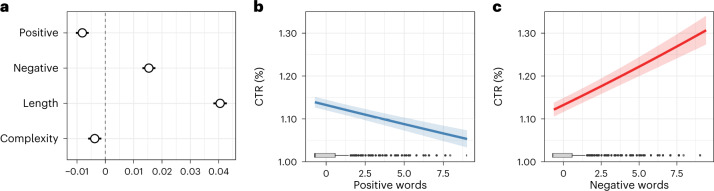
- Negative words increased consumption: β = 0.015, SE = 0.001, z = 17.423, P < 0.001, 99% CI = (0.013, 0.018); for an average-length headline, each additional negative word increased CTR by 2.3%, and a one-SD larger proportion of negative words increased odds of clicking by 1.5%.
- Positive words decreased consumption: β = −0.008, SE = 0.001, z = −9.238, P < 0.001, 99% CI = (−0.010, −0.006); for an average-length headline, each positive word decreased CTR by 1.0%, and a one-SD increase in positive-word proportion decreased odds of clicking by 0.8%.
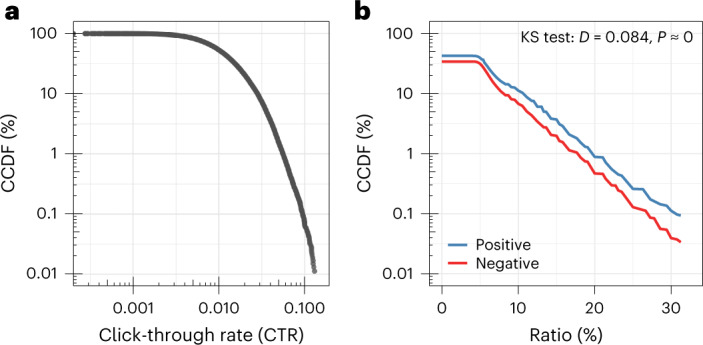
- Positive words were slightly more prevalent than negative words overall (2.83% vs 2.62% of all words; KS test D = 0.574, P < 0.001, two-tailed).
- For discrete emotions, sadness had a positive effect (β = 0.006, P < 0.001), joy and fear had negative effects (β = −0.009 and β = −0.007, respectively, P < 0.001), and anger was not statistically significant (β = 0.000, P = 0.666; equivalence test inconclusive).
Methods
- Data came from the Upworthy Research Archive confirmatory sample: N = 22,743 RCTs, reduced after pre-registered filtering to 12,448 RCTs comprising 53,699 headlines, over 205 million impressions, and 2,778,124 clicks; the broader dataset included ~105,000 headline variations, ~5.7 million clicks, and >370 million impressions.
- Each RCT randomly showed different headline variations for the same news story and measured CTR as clicks per impression; the main analysis used multilevel binomial regression with random intercepts and, in a second model, varying slopes, controlling for headline length, Gunning Fog complexity, and platform age.
- Sentiment was extracted with LIWC positive/negative dictionaries and negation handling; discrete emotions used the NRC emotion lexicon; robustness checks included alternative dictionaries, negation approaches, complexity measures, quadratic effects, image-RCT removal, log-transformed CTR, moralized language, and topic modeling.
Limitations
- The paper states that Upworthy differs from traditional news sources because of its “click-bait” headlines, that conclusions apply at the news-story level rather than the individual level, and that the analysis cannot infer readers’ subjective feelings from language.
- The paper also notes limitations of using the NRC emotion lexicon for discrete emotions and the scarcity of dictionaries for alternative dimensional emotion models.
- Evident from the text: the data are aggregated at the headline level with no individual-level user data, come from a single platform during 2013–2015, and exclude image RCTs because image data were unavailable, which may limit generalizability.
Model-written summary. Check it against the paper before relying on it.
Integrity signals
Registry
Cites
Statistics
Figures
Verification
Claims the paper makes
7 Valid · 2 Not valid · 35 Not checked · 95 Own results and interpretations
The sources with a verdict support this claim; the rest weren’t checked yet, have no full text we could read, or their verdicts aren’t rated yet.
In the paper
“First, we repeated the analysis with alternative sentiment dictionaries as an additional validation. Specifically, we examined both the NRC dictionary63,64 and the SentiStrength dictionary65. We found that the coefficient estimates were in good agreement, contributing to the robustness of our results (Supplementary Table 4 and Fig. 2).”
§ Negativity drives online news consumption > Results > Robustness checks
What the sources say
- Not checked yetcites [63] Mohammad, S. & Turney, P. Proc. NAACL HLT 2010 Workshop on Computational Approaches to Analysis and Generation of Emotion in Text (Association for Computational Linguistics, 2010).
- Supportedcites [64] Mohammad, S. M. in Emotion Measurement (ed. Meiselman, H. L.) 201–237 (Woodhead Publishing, 2016). source
In the citing sentence the reference is attached specifically to 'the NRC dictionary' (refs 63,64), while SentiStrength carries its own separate reference (65) and the agreement of coefficient estimates is the citing authors' own robustness analysis. Our copy of Mohammad's 'Sentiment Analysis' chapter is precisely a description of the NRC lexicons: §5.1.1 (Crowdsourced Emotion Lexicons) details the NRC Emotion Lexicon (EmoLex, ~14k terms, binary associations with eight basic emotions plus positive/negative sentiment, from Mohammad & Turney, 2010), and §5.1.3 lists NRC-VAD, NRC-EmoLex and the NRC Emotion Intensity Lexicon among the most widely used sentiment/emotion lexicons. So as an identification citation for the NRC sentiment dictionary the source is that thing. Searches for 'SentiStrength'/'Thelwall' returned no exact-phrase passage in our copy, consistent with that dictionary being credited to the separate reference rather than to this chapter. (LLM, conf=0.80)
- Not checked yetcites [65] Thelwall M Buckley K Paltoglou G Cai D Kappas A Sentiment strength detection in short informal text J. Am. Soc. Inf. Sci. Technol. 2010 61 2544 2558 10.1002/asi.21416 source
plain- Asserted: passes — The authors put it forward as true.
- Checkable: passes — It can be checked against evidence.
- Load-bearing: unclear — It is unclear whether the paper’s conclusions depend on it.
- Based: passes — The paper gives a reason why it holds.
The cited sources that could be checked couldn’t confirm or dispute this claim.
In the paper
“Notably, we uncovered a negativity bias in the data even though Upworthy branded itself as a ‘positive news outlet’53.”
§ Negativity drives online news consumption > Discussion
What the sources say
- Could not verifycites [53] Matias J Munger K Le Quere MA Ebersole C The Upworthy Research Archive, a time series of experiments in U.S. media Nat. Sci. Data 2021 8 195 10.1038/s41597-021-00934-7 PMC8329003 34341340 sourceExperimental — accuracy not yet measured
The part of the sentence this citation is attached to is the characterization of Upworthy's self-branding as a 'positive news outlet' (the 'negativity bias in the data' is the citing authors' own analysis of the archive). Our copy of Matias et al. (2021) describes Upworthy's editorial identity only as 'a media publisher founded in 2012 to reach large audiences with "stuff that matters"' (Background & Summary) and as writers/editors seeking content they saw as 'awesome, meaningful, and visual' (Technical Validation); it never states that Upworthy branded itself as a positive news outlet. Searches for 'positive news outlet'/brand self-description and for 'negativity bias'/emotional tone of headlines returned no passage on either point, and our copy reports no substantive finding about headline negativity in the dataset. Not contrary evidence, simply absent. (LLM, conf=0.62)
plainstates an association- Asserted: passes — The authors put it forward as true.
- Checkable: passes — It can be checked against evidence.
- Load-bearing: unclear — It is unclear whether the paper’s conclusions depend on it.
- Based: passes — The paper gives a reason why it holds.
- Could not verify
The cited sources support only part of this claim — read each source’s verdict below.
In the paper
“Consistent with findings from previous literature21,43,61, we found that several dyads such as outrage and disapproval are associated with higher CTRs.”
§ Negativity drives online news consumption > Results > Extension to discrete emotions
What the sources say
- Not checked yetcites [21] Crockett MJ Moral outrage in the digital age Nat. Hum. Behav. 2017 1 769 771 10.1038/s41562-017-0213-3 31024117 source
- Partly supportedcites [43] Rathje S Van Bavel JJ van der Linden S Out-group animosity drives engagement on social media Proc. Natl Acad. Sci. USA 2021 118 e2024292118 10.1073/pnas.2024292118 34162706 PMC8256037 sourceExperimental — accuracy not yet measured
The Results (Study 1: Major Media Outlets; page unavailable) link negative and moral-emotional language to more shares and retweets, and the Discussion links outrage to online engagement. The paper does not report click-through rates or analyze emotional dyads such as outrage and disapproval, so it supports the broader engagement point but not the stated CTR finding. (LLM, conf=0.86)
- Not checked yetcites [61] Brady WJ Crockett MJ Van Bavel JJ The MAD model of moral contagion: the role of motivation, attention, and design in the spread of moralized content online Perspect. Psychol. Sci. 2020 15 978 1010 10.1177/1745691620917336 32511060 source
plainstates an association- Asserted: passes — The authors put it forward as true.
- Checkable: passes — It can be checked against evidence.
- Load-bearing: unclear — It is unclear whether the paper’s conclusions depend on it.
- Based: passes — The paper gives a reason why it holds.
A result the paper reports from its own data — it cites no other source for it, so there is none to check. The quote shows it is in the paper.
In the paper
“We observed a statistically significant and positive coefficient for sadness (𝛽 = 0.006, SE = 0.001, z = 5.295, P < 0.001, 99% CI = (0.003, 0.009))”
§ Negativity drives online news consumption > Results > Extension to discrete emotions
plainstates an association- Asserted: passes — The authors put it forward as true.
- Checkable: passes — It can be checked against evidence.
- Load-bearing: passes — The paper’s conclusions depend on it.
- Based: passes — The paper gives a reason why it holds.
A result the paper reports from its own data — it cites no other source for it, so there is none to check. The quote shows it is in the paper.
In the paper
“A one standard deviation larger proportion of negative words increases the odds of a user clicking the headline by 1.5%.”
§ Negativity drives online news consumption > Results > Effect of negative language on news consumption
plainstates a cause- Asserted: passes — The authors put it forward as true.
- Checkable: passes — It can be checked against evidence.
- Load-bearing: passes — The paper’s conclusions depend on it.
- Based: passes — The paper gives a reason why it holds.
69 more claims
Create a free account to see all 139 claims and to verify the 95 references still open.
- Probably not a substantial claim. 46
- It may state two separate claims as one. 33
Claims other papers make about this one
Each is checked against this paper’s own text: does it say what the citing paper says it does?
The source backs part of the claim, not all of it — or backs it for a different population, condition or comparison.
In the citing paper
“Negativity drives particularly online news consumption [6,7] and social media platform use [7].”
From Impact of Media-Induced Uncertainty on Mental Health: Narrative-Based Perspective. (2025) · cites this paper as [6]
Experimental — accuracy not yet measuredThe cited source says what the claim attributes to it.
In the citing paper
“Human ratings were not significantly correlated with NRC codings for Trust, Surprise, Disgust, and Anticipation.”
From GPT is an effective tool for multilingual psychological text analysis (2024) · cites this paper as [18]
The cited source says what the claim attributes to it.
In the citing paper
“We used only these four emotions because Robertson et al. (18) found that only those emotions were significantly correlated with human rater judgments.”
From GPT is an effective tool for multilingual psychological text analysis (2024) · cites this paper as [18]
In the citing paper
“These effects held up when we controlled for other linguistic features shown to play an important role in information diffusion (here: moral and emotional words, negativity) (32, 48), as well as users’ follower counts and tweet publication date.”
From Expressions of uncertainty in online science communication hinder information diffusion (2024) · cites this paper as [48]
In the citing paper
“Previous field experiments have examined whether online news sources and social media increase polarization (Bail et al. 2018) and how negative emotionality (Robertson et al. 2023a) and toxicity (Beknazar-Yuzbashev et al. 2022) affect engagement.”
From Social Media and Morality. (2024) · cites this paper as Robertson et al. 2023a
Statistics recomputed
Every reported test result, recomputed from its test statistic and degrees of freedom. A result shows as not adding up only once an independent check has confirmed it.
- Consistentz = 17.423reported p < .001 · recomputed p < .001
“z = 17.423, p < .001”
- Consistentz = -9.238reported p < .001 · recomputed p < .001
“z = −9.238, p < .001”
- Consistentz = 43.945reported p < .001 · recomputed p < .001
“z = 43.945, p < .001”
- Consistentz = -4.163reported p < .001 · recomputed p < .001
“z = −4.163, p < .001”
- Consistentz = -56.917reported p < .001 · recomputed p < .001
“z = −56.917, p < .001”
10 more recomputed tests
Create a free account to see every test the Stats check recomputed.
Self-check
Percentages, sums and reported differences re-computed from the paper’s own numbers.
Each contradiction between two passages listed here was confirmed by an independent check.
Rated minor: it would not touch a result — a value no result rests on, a p-value that stays on the same side of the significance level, or a conflict that is clerical, resolved elsewhere in the paper, or outside its own findings.
In the paper
“The size of the confirmatory Upworthy data archive is N = 22,743 RCTs, with between 3 and 12 headlines per RCT. This thus corresponds to a total sample of between 68,229 and 227,430 headlines.”
§ Negativity drives online news consumption > Methods > Sampling plan
Reported 227430 · recomputed 272916
Rated minor: it would not touch a result — a value no result rests on, a p-value that stays on the same side of the significance level, or a conflict that is clerical, resolved elsewhere in the paper, or outside its own findings.
In the paper
§ Negativity drives online news consumption > Results > RCTs comparing news consumption
“a, CCDF comparing CTRs across all headline variations (N = 53,669).”
§ Negativity drives online news consumption > Results > RCTs comparing news consumption
“Overall, the 12,448 RCTs comprise 53,699 different headlines, which received over 205 million impressions and 2,778,124 clicks.”
Rated minor: it would not touch a result — a value no result rests on, a p-value that stays on the same side of the significance level, or a conflict that is clerical, resolved elsewhere in the paper, or outside its own findings.
In the paper
§ Negativity drives online news consumption > Methods > Sampling plan
“The size of the confirmatory Upworthy data archive is N = 22,743 RCTs, with between 3 and 12 headlines per RCT.”
§ Negativity drives online news consumption > Methods > Large-scale field experiments
“First, all experiments solely consisting of a single headline variation were discarded.”
Citations
Cites
Statistical Power Analysis for the Behavioral Sciences
Cohen, J. (2013) · doi:10.4324/9780203771587 · Cited by 25,373
An argument for basic emotions
Ekman, P. (1992) · Cognition and Emotion · doi:10.1080/02699939208411068 · Cited by 9,646 · cited 2×
“Furthermore, we studied the effects of 24 emotional dyads from Plutchik’s model 68 , these dyads being complex emotions composed of two basic emotions 69 .”
The spread of true and false news online
Vosoughi, S., Roy, D., & Aral, S. (2018) · Science · doi:10.1126/science.aap9559 · Cited by 8,847 · cited 9×
“For thoroughness, we also conducted exploratory analyses using the four other basic emotions from the NRC emotion dictionary for which the correlation with human judgments was considerably lower in our validation study (Supplementary Tables 21 and 22).”
InfluentialBaumeister, R. F., Bratslavsky, E., Finkenauer, C., & Vohs, K. D. (2001) · Review of General Psychology · doi:10.1037/1089-2680.5.4.323 · Cited by 7,678
Twitter mood predicts the stock market
Bollen, J., Mao, H., & Zeng, X. (2011) · Journal of Computational Science · doi:10.1016/j.jocs.2010.12.007 · Cited by 5,206 · cited 1×
“As such, online media has a profound impact on society across domains such as marketing 10,11 , finance 12–14 , health 15 and politics 16–19 .”
Negativity Bias, Negativity Dominance, and Contagion
Rozin, P., & Royzman, E. B. (2001) · Personality and Social Psychology Review · doi:10.1207/s15327957pspr0504_2 · Cited by 4,342
Exposure to ideologically diverse news and opinion on Facebook
Bakshy, E., Messing, S., & Adamic, L. A. (2015) · Science · doi:10.1126/science.aaa1160 · Cited by 3,245
What Makes Online Content Viral?
Berger, J., & Milkman, K. L. (2012) · Journal of Marketing Research · doi:10.1509/jmr.10.0353 · Cited by 3,178 · cited 2×
“As such, negativity embedded in online content explains the speed and virality of online diffusion dynamics (for example, response time, branching of online cascades) 7,34,35,37,39–41 .”
Fears, phobias, and preparedness: toward an evolved module of fear and fear learning
Öhman, A., & Mineka, S. (2001) · Psychological Review · doi:10.1037/0033-295x.108.3.483 · Cited by 3,147
Using Online Conversations to Study Word-of-Mouth Communication
Godes, D., & Mayzlin, D. (2004) · Marketing Science · doi:10.1287/mksc.1040.0071 · Cited by 2,601 · cited 1×
“As such, online media has a profound impact on society across domains such as marketing 10,11 , finance 12–14 , health 15 and politics 16–19 .”
Research works printed but not linked: 9
- Pooley E Grins, gore and videotape: the trouble with local TV news N. Y. Mag. 1989 22 36 44
- Simon, H. A. in Computers, Communications, and the Public Interest (ed. Greenberger, M.) 38–72 (The Johns Hopkins Press, 1971).
- Klein, E. Why We’re Polarized (Avid Reader Press, Simon & Schuster, 2020).
- Naveed, N., Gottron, T., Kunegis, J. & Alhadi, A. C. Proc. 3rd International Web Science Conference (Association for Computing Machinery, 2011).
- Kim, J. & Yoo, J. 2012 International Conference on Social Informatics (IEEE, 2012).
- Mohammad, S. & Turney, P. Proc. NAACL HLT 2010 Workshop on Computational Approaches to Analysis and Generation of Emotion in Text (Association for Computational Linguistics, 2010).
- Plutchik, R. Emotion: Theory, Research, and Experience 2nd edn (Academic Press, 1984).
- Pennebaker, J. W., Boyd, R. L., Jordan, K. & Blackburn, K. The development and psychometric properties of LIWC2015. Univ. Texas Libraries http://hdl.handle.net/2152/31333 (2015).
- Gunning, R. The Technique of Clear Writing (McGraw-Hill, 1952).
Cited by
GPT is an effective tool for multilingual psychological text analysis
Rathje, S., Mirea, D.-M., Sucholutsky, I., Marjieh, R., Robertson, C. E., & Van Bavel, J. J. (2024) · Proceedings of the National Academy of Sciences · doi:10.1073/pnas.2308950121 · Cited by 297
“…text datasets are typically analyzed for the presence of various psychological constructs, such as sentiment (i.e., positivity versus negativity) (18–22), discrete emotions such as anger or sadness (23, 24), offensiveness (25), moral emotions (26, 27), out - party animosity (5, 9), or toxicity…”
BackgroundMethodInfluentialSelf-citationAddressing climate change with behavioral science: A global intervention tournament in 63 countries
Vlasceanu, M., Doell, K. C., Bak-Coleman, J. B., Todorova, B., Berkebile-Weinberg, M. M., Grayson, S. J., Patel, Y., Goldwert, D., Pei, Y., Chakroff, A., et al. (2024) · Science Advances · doi:10.1126/sciadv.adj5778 · Cited by 269
“For instance, recent work found that online news consumption is largely driven by the negative content of the news ( 43 ).”
Self-citationUsing natural language processing to analyse text data in behavioural science
Feuerriegel, S., Maarouf, A., Bär, D., Geissler, D., Schweisthal, J., Pröllochs, N., Robertson, C. E., Rathje, S., Hartmann, J., Mohammad, S. M., et al. (2025) · Nature Reviews Psychology · doi:10.1038/s44159-024-00392-z · Cited by 140
“It is also possible to make causal inferences from text data 130 , such as the causal effect of text data (for example, the positivity or negativity of a news headline) on some behavioural outcome (for example, news consumption) 78 .”
InfluentialSelf-citationGPT is an effective tool for multilingual psychological text analysis
Rathje, S., Mirea, D.-M., Sucholutsky, I., Marjieh, R., Robertson, C., & Van Bavel, J. J. (2023) · doi:10.31234/osf.io/sekf5 · Cited by 129
Self-citationVan Bavel, J. J., Robertson, C. E., del Rosario, K., Rasmussen, J., & Rathje, S. (2024) · Annual Review of Psychology · doi:10.1146/annurev-psych-022123-110258 · Cited by 121
Self-citationRussian propaganda on social media during the 2022 invasion of Ukraine
Geissler, D., Bär, D., Pröllochs, N., & Feuerriegel, S. (2023) · EPJ Data Science · doi:10.1140/epjds/s13688-023-00414-5 · Cited by 236
Self-citationNegative online news articles are shared more to social media
Watson, J., van der Linden, S., Watson, M., & Stillwell, D. (2024) · Scientific Reports · doi:10.1038/s41598-024-71263-z · Cited by 70
“We also explored whether the influence of negativity bias is affected by news article topic (established through topic modelling, “News Article Data”), as indicated by prior research 20,48 .”
ResultDid the Roll-Out of Community Notes Reduce Engagement With Misinformation on X/Twitter?
Chuai, Y., Tian, H., Pröllochs, N., & Lenzini, G. (2024) · Proceedings of the ACM on Human-Computer Interaction · doi:10.1145/3686967 · Cited by 145
Self-citationPeople think that social media platforms do (but should not) amplify divisive content
Rathje, S., Robertson, C., Brady, W. J., & Van Bavel, J. J. (2024) · Perspectives on Psychological Science · doi:10.1177/17456916231190392 · Cited by 59
“Recent work also suggests that people choose to engage with more false and hyper-partisan news than they are exposed to on Google search, suggesting that self-selection (as opposed to algorithmic amplification) may drive some of the engagement with misinformation (R. E. Robertson et al., 2023).”
InfluentialSelf-citationInside the funhouse mirror factory: How social media distorts perceptions of norms
Robertson, C. E., del Rosario, K., & Bavel, J. J. V. (2024) · Current Opinion in Psychology · doi:10.1016/j.copsyc.2024.101918 · Cited by 136
“…appear strikingly prevalent online e often exceeding exposure to similar content in the real world and all other forms of media (See Figure 2 [40 e 43])The most widely shared content on Twitter/X and Facebook is moralized content, such as expressions of outrage and hostility towards political…”
Self-citationAddressing Climate Change with Behavioral Science: A Global Intervention Tournament in 63 CountriesPreprint
Vlasceanu, M., Doell, K. C., Bak-Coleman, J. B., & Bavel, J. J. V. (2023) · doi:10.31234/osf.io/cr5at · Cited by 48
Diffusion of Community Fact-Checked Misinformation on Twitter
Drolsbach, C., & Pröllochs, N. (2023) · Proceedings of the ACM on Human-Computer Interaction · doi:10.1145/3610058 · Cited by 79
Self-citationNegative expressions are shared more on Twitter for public figures than for ordinary users
Schöne, J. P., Garcia, D., Parkinson, B., & Goldenberg, A. (2023) · PNAS Nexus · doi:10.1093/pnasnexus/pgad219 · Cited by 46
Wenzel, M., Stasiuk-Krajewska, K., Macková, V., & Turková, K. (2023) · International Political Science Review · doi:10.1177/01925121231205259 · Cited by 65
“In addition, negative information attracts more attention and is considered more informative than positive information (Robertson et al., 2023); it is also subject to more scrutiny by the recipient, thus proving more persuasive than positive information (Jaffé and Greifeneder, 2021).”
BackgroundShabahang, R., Hwang, H., Thomas, E. F., Aruguete, M. S., McCutcheon, L. E., Orosz, G., Khanzadeh, A. A. H., Chirani, B. M., & Zsila, Á. (2024) · Computers in Human Behavior Reports · doi:10.1016/j.chbr.2024.100438 · Cited by 100
Reading dies in complexity: Online news consumers prefer simple writing
Shulman, H. C., Markowitz, D. M., & Rogers, T. (2024) · Science Advances · doi:10.1126/sciadv.adn2555 · Cited by 66
“Correlational field studies show similar patterns for online engagement in the form of likes and views ( 14 ), although their implications typically lack strong causal confidence ( 15 ).”
Bad News Bearers: The Negative Tilt of Financial PressPreprint
Niessner, M., & So, E. C. (2018) · SSRN Electronic Journal · doi:10.2139/ssrn.3219831 · Cited by 43
Supply, demand and polarization challenges facing US climate policies
Burgess, M. G., Boven, L. V., Wagner, G., Wong‐Parodi, G., Baker, K., Boykoff, M., Converse, B. A., Dilling, L., Gilligan, J. M., Inbar, Y., et al. (2024) · Nature Climate Change · doi:10.1038/s41558-023-01906-y · Cited by 55
The Virality of Hate Speech on Social Media
Maarouf, A., Pröllochs, N., & Feuerriegel, S. (2024) · Proceedings of the ACM on Human-Computer Interaction · doi:10.1145/3641025 · Cited by 35
“Unlike positive emotions, negative emotions are known to drive online behaviors such as interactions and sharing [40, 41, 44, 50].”
BackgroundSelf-citationPröllochs, N., & Feuerriegel, S. (2023) · Proceedings of the ACM on Human-Computer Interaction · doi:10.1145/3610078 · Cited by 54
Self-citationAffective information processing of fake news: evidence from NeuroIS
Lutz, B., Adam, M. T. P., Feuerriegel, S., Pröllochs, N., & Neumann, D. (2023) · European Journal of Information Systems · doi:10.1080/0960085x.2023.2224973 · Cited by 46
“…2022; Bae et al., 2021; Pröllochs et al., 2021a,b; Laato et al., 2020; London et al., 2022; Solovev & Pröllochs, 2022; Drolsbach & Pröllochs, 2023; Pröllochs & Feuerriegel, 2023; Hopp et al., 2020; Vosoughi et al., 2018), how fake news can be detected through machine learning (e.g., Ducci et al.,…”
Self-citationCommunity Notes vs. Snoping: How the Crowd Selects Fact-Checking Targets on Social Media
Pilarski, M., Solovev, K., & Pröllochs, N. (2024) · Proceedings of the International AAAI Conference on Web and Social Media · doi:10.1609/icwsm.v18i1.31387 · Cited by 55
Self-citationNegative news headlines are more attractive: negativity bias in online news reading and sharing
Zhang, M., Wu, H., Huang, Y. Q., Han, R., Fu, X., Yuan, Z., & Liang, S. (2024) · Current Psychology · doi:10.1007/s12144-024-06646-6 · Cited by 46
“Studies by Andersen et al. ( 2024 ) and Robertson et al. ( 2023 ) further support this trend, indicating that negative news is more engaging and tends to reach a larger audience.”
InfluentialEmotional content and sharing on Facebook: A theory cage match
Paletz, S. B. F., Johns, M., Murauskaitė, E., Golonka, E., Pandža, N. B., Rytting, C. A., Buntain, C., & Ellis, D. H. (2023) · Science Advances · doi:10.1126/sciadv.ade9231 · Cited by 47
“Anger words were unrelated to clicking on headlines, however ( 29 ).”
BackgroundMethodInfluentialKyrychenko, Y., Brik, T., van der Linden, S., & Roozenbeek, J. (2024) · Nature Communications · doi:10.1038/s41467-024-52179-8 · Cited by 48
“Surprisingly, negativelanguagehadnostatisticallysigni fi canteffectonengagement amongournews-sourcedataaftertheinvasion 5,54 .”
Detecting False Rumors from Retweet Dynamics on Social Media
Naumzik, C., & Feuerriegel, S. (2022) · International World Wide Web Conference (WWW) · doi:10.1145/3485447.3512000 · Cited by 36
“Cascade covariates (= z): First, emotions have been identified in social psychology research as a key driver behind consumption [48] and rumor diffusion [49].”
BackgroundSelf-citationImpact of Media-Induced Uncertainty on Mental Health: Narrative-Based Perspective.
Kesner, L., Juríčková, V., Grygarová, D., & Horáček, J. (2025) · JMIR Mental Health · doi:10.2196/68640 · Cited by 23
“Negativity drives particularly online news consumption [6,7] and social media platform use [7].”
Morality in the anthropocene: The perversion of compassion and punishment in the online world
Robertson, C. E., Shariff, A., & Bavel, J. J. V. (2024) · PNAS Nexus · doi:10.1093/pnasnexus/pgae193 · Cited by 38
Self-citationJakubik, J., Vössing, M., Pröllochs, N., Bär, D., & Feuerriegel, S. (2023) · Proceedings of the International AAAI Conference on Web and Social Media · doi:10.1609/icwsm.v17i1.22157 · Cited by 37
Self-citationResponding to public health challenges of medical advice from social media influencers
Heiss, R., Woloshin, S., Dave, S., Engel, E., Gell, S., & Willis, E. (2025) · BMJ · doi:10.1136/bmj-2025-086061 · Cited by 28
Güme, S. (2024) · Psikiyatride Guncel Yaklasimlar - Current Approaches in Psychiatry · doi:10.18863/pgy.1416316 · Cited by 42
“A study examining the effect of emotional language on news consumption found that news headlines containing negative language were more likely to be clicked, even after the content corresponding to the news story was adjusted (Robertson et al. 2023).”
Can you travel too much? The emotional numbness effect of travel frequency
Su, L., Gong, L., & Huang, Y. (2025) · Tourism Management · doi:10.1016/j.tourman.2025.105190 · Cited by 20
“These investigations have addressed positive emotions such as love, joy, pride, trust, and gratitude (Dang-Van et al., 2023; Pham & Sun, 2020) as well as negative ones including anger, disappointment, anxiety, and regret (Robertson et al., 2023; Y. Zhang et al., 2021).”
Rathje, S., & Bavel, J. J. V. (2025) · Trends in Cognitive Sciences · doi:10.1016/j.tics.2025.06.014 · Cited by 36
Effects of narratives and information valence in digital headlines on user responses
Feng, G. C. (2024) · Asian Journal of Communication · doi:10.1080/01292986.2024.2317308 · Cited by 24
“In jour-nalism, negativity has both news value (Altheide, 2003; Caple & Bednarek, 2016; Galtung & Ruge, 1965; Harcup & O ’ Neill, 2001; Robertson et al., 2023; Trussler & Soroka, 2014) and an overarching news ideology (Lengauer et al., 2012).”
BackgroundPalmer, R. A., & Edgerly, S. (2024) · Journalism Studies · doi:10.1080/1461670x.2024.2345672 · Cited by 22
“In an environment of thick competition, more negative, stridently opinionated, sensational fare is believed to get more attention, a boon at least in the short term for struggling news producers, and research suggests that continues to be true (Robertson et al. 2023; Soroka 2014).”
Zhou, S., Yang, X., Wang, Y., Zheng, X., & Zhang, Z. (2023) · Humanities and Social Sciences Communications · doi:10.1057/s41599-023-02265-x · Cited by 26
Give the Media What They Need: Negativity as a Media Access Tool for Politicians
Poljak, Ž. (2024) · The International Journal of Press/Politics · doi:10.1177/19401612241234861 · Cited by 24
“Therefore, as consumers of news, we are more prone to consume negative rather than positive news (Fournier et al. 2020; Robertson et al. 2023).”
Epistemic gratitude and the provision of information
Karabegović, M., Wang, L., Boyer, P., & Mercier, H. (2024) · Evolution and Human Behavior · doi:10.1016/j.evolhumbehav.2024.04.010 · Cited by 19
“Second, as negative information tends to be more beneficial than positive information (hence the negativity bias in information search, see, e.g., Robertson et al., 2023), we should be more grateful when we receive negative than positive information (everything else equal).”
The rise of negative portrayals of radiation oncology: A textual analysis of media news
Wawrzuta, D., Klejdysz, J., & Chojnacka, M. (2023) · Radiotherapy and Oncology · doi:10.1016/j.radonc.2023.110008 · Cited by 18
Rogers, A., Hine, K., & Prenzler, T. (2024) · Criminal Justice Studies · doi:10.1080/1478601x.2024.2329955 · Cited by 24
Lutz, B., Adam, M. T. P., Feuerriegel, S., Pröllochs, N., & Neumann, D. (2024) · Proceedings of the ACM on Human-Computer Interaction · doi:10.1145/3641030 · Cited by 31
Self-citationUnderstanding the impact of misinformation on adolescents
Ma, I., Sultan, M., Kozyreva, A., & van den Bos, W. (2025) · Nature Human Behaviour · doi:10.1038/s41562-025-02338-8 · Cited by 24
Adjusting news accuracy perceptions after deepfakes exposure: Evidence from a non-Western context
Ahmed, S., Wang, Y., & Bee, A. W. T. (2023) · Telematics and Informatics · doi:10.1016/j.tele.2023.102047 · Cited by 22
Qiu, J., & Golman, R. (2024) · Applied Cognitive Psychology · doi:10.1002/acp.4195 · Cited by 20
Believability and Harmfulness Shape the Virality of Misleading Social Media Posts
Drolsbach, C., & Pröllochs, N. (2023) · International World Wide Web Conference (WWW) · doi:10.1145/3543507.3583857 · Cited by 26
Self-citationWhat we tweet about when we tweet about taxes: A topic modelling approach
Puklavec, Ž., Kogler, C., Stavrova, O., & Zeelenberg, M. (2023) · Journal of Economic Behavior & Organization · doi:10.1016/j.jebo.2023.07.005 · Cited by 23
Lühring, J., Shetty, A., Koschmieder, C., Garcia, D., Waldherr, A., & Metzler, H. (2024) · Cognitive Research: Principles and Implications · doi:10.1186/s41235-024-00607-0 · Cited by 14
The influence of doomscrolling on mental health: a scoping review
Sharpe, A., Tyndall, I. T., Poulus, D., Obine, E. A. C., & Sharpe, B. T. (2026) · Mental Health and Digital Technologies · doi:10.1108/mhdt-10-2025-0068 · Cited by 31
Kauk, J., Humprecht, E., Kreysa, H., & Schweinberger, S. R. (2024) · Computers in Human Behavior · doi:10.1016/j.chb.2024.108546 · Cited by 21
Allen, R., Song, S., Weir, G. M., & White, K. O. (2025) · Journal of Pediatric and Adolescent Gynecology · doi:10.1016/j.jpag.2025.02.003 · Cited by 19
Wang, J. S., Haider, S., Tohidi, A., Gupta, A., Zhang, Y., Callison-Burch, C., Rothschild, D. M., & Watts, D. J. (2025) · CHI Conference on Human Factors in Computing Systems · doi:10.1145/3706598.3713716 · Cited by 40
Epstein, R., Aries, S., Grebbien, K., Salcedo, A. M., & Zankich, V. R. (2024) · Computers in Human Behavior · doi:10.1016/j.chb.2024.108342 · Cited by 17
Happy thoughts: The role of communion in accepting and sharing (mis)beliefs
Altay, S., Majima, Y., & Mercier, H. (2023) · British Journal of Social Psychology · doi:10.1111/bjso.12650 · Cited by 20
Vivanco-Carlevari, A., Oosterwijk, S., & Kleef, G. A. V. (2024) · Cognition & Emotion · doi:10.1080/02699931.2024.2385691 · Cited by 16
“For example, media studies have yielded consistent evidence that people seek out information about threatening events (Robertson et al., 2023), such as terrorist attacks, even though doing so may increase their fear of becoming a victim (Redmond et al., 2019).”
Baissa, B., Fuoli, M., & Grieve, J. (2024) · Discourse & Communication · doi:10.1177/17504813241280489 · Cited by 22
“Studies have consistently found that negative and surprising news stories are more likely to be read and shared (e.g. Bednarek, 2016a; de León and Trilling, 2021; Robertson et al., 2023).”
The evolution of online news headlines
Nickl, P. L., Moussaïd, M., & Lorenz-Spreen, P. (2025) · Humanities and Social Sciences Communications · doi:10.1057/s41599-025-04514-7 · Cited by 35
“Using the same Upworthy corpus, Robertson et al. found that negative sentiment and length increased click-through rate, while linguistic complexity and positive sentiment decreased it (Robertson et al. 2023).”
Clicks and tricks: The dark art of online persuasion
Fagan, P. (2024) · Current Opinion in Psychology · doi:10.1016/j.copsyc.2024.101844 · Cited by 26
“In fact, an analysis of 105,000 news stories found that each additional negative word in the headline increased click-through rates by 2.3% [40].”
BackgroundInfluentialAnecdotes impact medical decisions even when presented with statistical information or decision aids
Line, E. N., Jaramillo, S., Goldwater, M. B., & Horne, Z. (2024) · Cognitive Research Principles and Implications · doi:10.1186/s41235-024-00577-3 · Cited by 16
“Additionally, people are drawn more toward news that is negative than they are to positive news (Robertson et al., 2023).”
BackgroundUnveiling the hidden agenda: Biases in news reporting and consumption
Galeazzi, A., Peruzzi, A., Brugnoli, E., Delmastro, M., & Zollo, F. (2024) · PNAS Nexus · doi:10.1093/pnasnexus/pgae474 · Cited by 20
Inside the Funhouse Mirror Factory: How Social Media Distorts Perceptions of NormsPreprint
Robertson, C. E., del Rosario, K., & Bavel, J. J. V. (2024) · doi:10.31234/osf.io/kgcrq · Cited by 11
Self-citationRasmussen, S. H. R., & Petersen, M. B. (2023) · PNAS Nexus · doi:10.1093/pnasnexus/pgad382 · Cited by 23
Liu, Q., Su, F., Mu, A., & Wu, X. (2024) · Psychology Research and Behavior Management · doi:10.2147/prbm.s450934 · Cited by 18
A multinational analysis of how emotions relate to economic decisions regarding time or risk
Pertl, S. M., Srirangarajan, T., & Urminsky, O. (2024) · Nature Human Behaviour · doi:10.1038/s41562-024-01927-3 · Cited by 13
“Conversely, political messaging, news media and other persuasive methods of disseminating information (that specifically leverage emotional appeals to increase engagement) 287,288 may influence subsequent decision-making outcomes.”
Anisimova, K. V., & Patterson, J. (2024) · Climate Policy · doi:10.1080/14693062.2024.2409806 · Cited by 15
“We assume that valid evidence of public responses, especially contention, will be detectable in newspapers of quality 4 because contention is likely to readily attract coverage (Robertson et al., 2023; Vliegenthart et al., 2011).”
Rodríguez, A. D., Apprich, F., Friehs, M. A., van der Graaf, S., & Steinrücke, J. (2025) · Acta Psychologica · doi:10.1016/j.actpsy.2025.104925 · Cited by 20
“As media outlets prioritize attention-grabbing, negative headlines — highlighting disasters, political conflicts, and economic crises (Robertson et al., 2023) — people often find themselves drawn into a stream of distressing stories.”
Finding Qs: Profiling QAnon Supporters on Parler
Bär, D., Pröllochs, N., & Feuerriegel, S. (2023) · Proceedings of the International AAAI Conference on Web and Social Media · doi:10.1609/icwsm.v17i1.22124 · Cited by 20
Self-citationExpressions of uncertainty in online science communication hinder information diffusion
Stavrova, O., Kleinberg, B., Evans, A. M., & Ivanović, M. (2024) · PNAS Nexus · doi:10.1093/pnasnexus/pgae439 · Cited by 9
Exploring climate change discourses on the internet: a topic modeling study across ten years
Böhm, G., & Pfister, H. (2024) · Journal of Risk Research · doi:10.1080/13669877.2024.2387337 · Cited by 15
“Online media consumption is mostly driven by factors that attract attention and trigger affective responses (Robertson et al. 2023).”
Political ideology, emotion response, and confirmation bias
Dickinson, D. L. (2024) · Economic Inquiry · doi:10.1111/ecin.13253 · Cited by 19
How emotions in online reviews affect movie sales: Evidence from Hollywood
Ullah, R., Alam, M. A., & Zeb, A. (2025) · Journal of Retailing and Consumer Services · doi:10.1016/j.jretconser.2025.104304 · Cited by 12
Media myopia distorts public interest in US invasive plants
Woodworth, E., Tian, A., Blair, K., Pullen, J., Lefcheck, J. S., & Parker, J. D. (2023) · Biological Invasions · doi:10.1007/s10530-023-03101-8 · Cited by 11
Good intent, or just good content? Assessing MrBeast 's philanthropy
Davies, R. (2024) · Journal of Philanthropy and Marketing · doi:10.1002/nvsm.1858 · Cited by 12
Poor attention: The wealth and regional gaps in event attention and coverage on Wikipedia
Ruprechter, T., Burghardt, K., & Helić, D. (2023) · PLoS ONE · doi:10.1371/journal.pone.0289325 · Cited by 12
Unveiling the Drivers of Chinese Tourists’ Visit Intentions Regarding Malaysia
Jiang, X., Mohamed, A. E., & bin Affifudin, A. H. (2024) · Sustainability · doi:10.3390/su16083406 · Cited by 12
Misleading Polls in the Media: Does Survey Clickbait Have Social Consequences?
GRAHAM, M. H., Hillygus, D. S., & Trexler, A. (2024) · Public Opinion Quarterly · doi:10.1093/poq/nfae009 · Cited by 9
Fang, X., Heuser, S., & Stötzer, L. S. (2025) · Journal of Public Economics · doi:10.1016/j.jpubeco.2025.105309 · Cited by 21
Shabahang, R., & Weber, R. (2025) · Frontiers in Psychology · doi:10.3389/fpsyg.2025.1606604 · Cited by 9
Using generative AI to increase sceptics’ engagement with climate science
Bagó, B., Müller, P., & Bonnefon, J. (2025) · Nature Climate Change · doi:10.1038/s41558-025-02424-9 · Cited by 10
“2a), modifying headlines led to a 11 percentage impact on sceptics’ 13,46,47 , and increasing the negativity may backfire 47,48 , despite its general efficacy elsewhere 49,50 .”
Riggs, A. (2024) · Language & Communication · doi:10.1016/j.langcom.2024.02.001 · Cited by 8
Robertson, C. E., del Rosario, K., Rathje, S., & Bavel, J. J. V. (2024) · Behavioral and Brain Sciences · doi:10.1017/s0140525x23002935 · Cited by 11
Self-citationHuman Emotions in AI Explanations
Thommes, K., Lammert, O., Schütze, C., Richter, B., & Wrede, B. (2024) · Communications in computer and information science · doi:10.1007/978-3-031-63803-9_15 · Cited by 14
Keung, W. M., & So, T. Y. (2025) · Frontiers in Psychology · doi:10.3389/fpsyg.2025.1538387 · Cited by 13
Cutler, J., Contreras-Huerta, L. S., Todorova, B., Nitschke, J. P., Michalaki, K., Koppel, L., Gkinopoulos, T., Vogel, T. A., Lamm, C., Västfjäll, D., et al. (2025) · Communications Psychology · doi:10.1038/s44271-025-00332-4 · Cited by 10
“Researchtounderstandthecomplexassociationsbetweenmessageframing, emotions,andattitudesorbehavioursisongoinginareasincludingchari-tabledonations 60 ,portrayalofrefugees 61 ,andconsumptionofonlinenews 62 .”
The 2022 and 2023 Emergency Medicine Residency Match: A Cautionary Tale
Lewis, M., Williams, K., Timpe, J., Corbo, S., Wilbanks, M. D., & Hayes, A. K. (2023) · Cureus · doi:10.7759/cureus.38601 · Cited by 7
“These attention-grabbing negative headlines are likely contributing to poor perceptions of the specialty without presenting the whole story [22].”
BackgroundEducomunicación en la era de la hiperconectividad: una revisión conceptual
Albardía, M. S., Onaindia, I. A., & Peña-Fernández, S. (2023) · Comunicação, Mídia e Consumo · doi:10.18568/cmc.v20i58.2820 · Cited by 11
Negative Expressions are Shared more on Twitter for Public Figures than for Ordinary UsersPreprint
Schöne, J. P., García, D., Parkinson, B., & Goldenberg, A. (2022) · doi:10.31234/osf.io/wng5v · Cited by 7
AI in Disguise - How AI-Generated Ads' Visual Cues Shape Consumer Perception and PerformancePreprint
Exner, Y., Hartmann, J., Netzer, O., & Zhang, S. (2025) · SSRN Electronic Journal · doi:10.2139/ssrn.5096969 · Cited by 25
Positive sentiment and expertise predict the diffusion of archaeological content on social media
Bonacchi, C., Krzyzanska, M., & Acerbi, A. (2025) · Scientific Reports · doi:10.1038/s41598-025-85167-z · Cited by 11
Analyzing Social Media Activities at Bellingcat
Bär, D., Calderon, F., Lawlor, M., Licklederer, S., Totzauer, M., & Feuerriegel, S. (2023) · ACM Web Science Conference (WebSci) · doi:10.1145/3578503.3583604 · Cited by 13
“Which sentiment elicits user engagement? Previous research showed that negative language can increase engagement with news and other content online (Hansen et al. 2011; Jenders, Kasneci, and Naumann 2013; Robertson et al. 2022).”
BackgroundMethodResultInfluentialSelf-citationVoted in, standing out: Public response to immigrants' political accession
Zonszein, S., & Grossman, G. (2024) · American Journal of Political Science · doi:10.1111/ajps.12877 · Cited by 12
When curiosity gaps backfire: effects of headline concreteness on information selection decisions
Quéré, M. A. L., & Matias, J. N. (2025) · Scientific Reports · doi:10.1038/s41598-024-81575-9 · Cited by 16
Beck, W., & Daoust-Boisvert, A. (2025) · Environmental Communication · doi:10.1080/17524032.2025.2464148 · Cited by 6
“The media’s appetite for negatively framed news, as it drives consumption rates, fuels the coverage of the negative consequences of climate change (Robertson et al., 2023).”
Artificial intelligence, digital social networks, and climate emotions
Galaz, V., Metzler, H., Schill, C., Lindahl, T., Daume, S., Marklund, A., Castro, A. A., Bard, J. S., McPhearson, T., Galafassi, D., et al. (2025) · npj Climate Action · doi:10.1038/s44168-025-00225-6 · Cited by 20
“Thefeelingofbeing “ disaffected,unengaged,skeptical or disillusioned, ” for example, decreases the willingness to engage in collective climate action 86,87 .”
Feeling the heartbeat of regions: local news and economic sentiments
Broekel, T. (2025) · Journal of Economic Geography · doi:10.1093/jeg/lbaf031 · Cited by 7
Mosleh, M., Allen, J. N. L., & Rand, D. G. (2025) · Proceedings of the National Academy of Sciences · doi:10.1073/pnas.2425739122 · Cited by 14
Social feedback amplifies emotional language in online video live chats
Luo, Y., Sornette, D., & Lera, S. C. (2025) · Communications Psychology · doi:10.1038/s44271-025-00370-y · Cited by 9
“Mean-while, recent findings suggest that while negativity often has greater reach [33, 34], emotional virality is complex and context-dependent [24].”
Engagement with political videos on TikTok during the 2025 German federal election
Solovev, K., Drolsbach, C., Demirel, E., & Pröllochs, N. (2026) · EPJ Data Science · doi:10.1140/epjds/s13688-026-00632-7 · Cited by 16
Self-citationSener, B., Akpınar, E., & Ataman, M. B. (2023) · Scientific Reports · doi:10.1038/s41598-023-41573-9 · Cited by 11
“The role of emotions has been explored in various domains, such as news consumption 55 , false stories 56 , and political content 11 , demonstrating which emotional content spreads more or quickly.”
BackgroundPartisan temporal selective news avoidance: Evidence from online trace data
Heseltine, M., Barnehl, H.-M., & Wojcieszak, M. (2025) · American Journal of Political Science · doi:10.1111/ajps.12944 · Cited by 9
DICE: Advancing Social Media Research Through Digital In-Context Experiments
Roggenkamp, H., Boegershausen, J., & Hildebrand, C. (2026) · Journal of Marketing · doi:10.1177/00222429251371702 · Cited by 10
“While past research suggests that negativity at the post level drives engagement (Robertson et al. 2023), it is unclear whether this fi nding extends to the feed level.”
Metadata
- Authors
- Robertson, C. E., Pröllochs, N., Schwarzenegger, K., Pärnamets, P., Van Bavel, J. J., & Feuerriegel, S.
- Affiliations
- New York University (US)
- Justus-Liebig-Universität Gießen (DE)
- ETH Zurich (CH)
- Karolinska Institutet (SE)
- Corresponding author
- Feuerriegel, Stefan
- Venue
- Nature Human Behaviour
- Published
- 2023-03-16
- Volume
- 7
- Issue
- 5
- Pages
- 812-822
- ISSN
- 2397-3374 (ISSN-L)
- PMC
- PMC10202797
- OpenAlex
- W4327568915
- Semantic Scholar
- bd764e9c8705fdc0b582c850c86f7020adf036aa
- Cited by
- 333
- References
- 66
- Citations by year
- 2026: 106 · 2025: 99 · 2024: 78 · 2023: 45
- FWCI
- 155.23
- Type
- journal article
- Language
- en
- Open access
- hybrid
- doi.org
- Licence
- cc-by
- creativecommons.org/licenses/by/4.0 (tdm)
- creativecommons.org/licenses/by/4.0 (vor)
- Locations
- Nature Human Behaviour (publishedVersion, cc-by)
- PubMed Central (publishedVersion, cc-by)
- PubMed (publishedVersion)
- RePEc: Research Papers in Economics (submittedVersion)
- Open access LMU (Ludwid Maxmilian's Universitat Munchen) (submittedVersion, cc-by)
- Repository for Publications and Research Data (ETH Zurich) (submittedVersion, cc-by)
- ETH Zürich Research Collection
- Funders
- John Templeton Foundation (61378)
- Topics
- Social Sciences › Communication › News Media Framing and Political Communication
- Social Sciences › Sociology and Political Science › Misinformation and Its Impacts
- Social Sciences › Sociology and Political Science › Media Influence and Politics
- Keywords
- online news consumption, negative words, emotional words, news headlines, click-through rate, user engagement, online media, positive words
- MeSH terms
- Emotions, Humans, Mass Media, Causality, Internet, Information Seeking Behavior
About these checks
Registry, retraction, Cites and statistics results are computed, not judged, with one exception: a printed reference that no index lists is read once by a model before it counts as a citation error. Claims are extracted by a model and kept only when their quote appears verbatim in the text; each cited source is then checked, with a model’s help, for whether it says what the claim relies on. Those verdicts can be wrong — read the claim’s quote and the cited source before relying on one.
The claim verdicts this report counts are experimental: their accuracy is not yet measured.
A language model drew the claims from the paper on 2026-10-08, under version 3 of the claim definition (model deepseek-v4.1-flash, prompt extract-v3).
A second model labelled each claim on 2026-10-08 (model jev-1.13-20260917, definition revision gold-guideline-v0.2).
Cited sources are checked with a language model’s help (qwen3.8-omni-flash and gpt-6-sol).
Statistics and arithmetic are recomputed, not judged.
Confidence bands are shown only for fields calibrated on our annotated test set. None is calibrated yet, so no band is shown.
What counts as a claim ›How we measure confidence ›How we check this ›
Are you an author, or do you see a problem with this page? Request a review
Data sources
Bibliographic data: Semantic Scholar, OpenAlex, Crossref.
Contains information from the Semantic Scholar Academic Graph Datasets, made available under the ODC Attribution License (ODC-BY 1.0).
Semantic Scholar’s data is described in: Kinney, R., et al. (2023). The Semantic Scholar Open Data Platform. arXiv:2301.10140.
