

Negativity drives online news consumption
Open accessThe DOI matches its Crossref record; 65 of the 66 references it cites were found in a registry or an index; 12 of the 107 sources its claims cite were checked for support.
Abstract
Online media is important for society in informing and shaping opinions, hence raising the question of what drives online news consumption. Here we analyse the causal effect of negative and emotional words on news consumption using a large online dataset of viral news stories. Specifically, we conducted our analyses using a series of randomized controlled trials ( N = 22,743). Our dataset comprises ~105,000 different variations of news stories from Upworthy.com that generated ∼5.7 million clicks across more than 370 million overall impressions. Although positive words were slightly more prevalent than negative words, we found that negative words in news headlines increased consumption rates (and positive words decreased consumption rates). For a headline of average length, each additional negative word increased the click-through rate by 2.3%. Our results contribute to a better understanding of why users engage with online media.
Overview
CoChat Summary
TL;DR
Using 22,743 randomized controlled trials from Upworthy, this paper finds that negative words in news headlines causally increase click-through rates, while positive words decrease them. The effects are robust across dictionaries and controls, with discrete sadness increasing clicks and joy/fear decreasing clicks.
Key findings
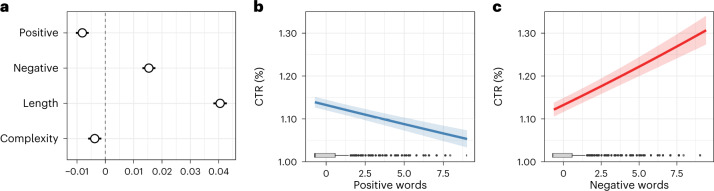
- Negative words increased consumption: β = 0.015, SE = 0.001, z = 17.423, P < 0.001, 99% CI = (0.013, 0.018); for an average-length headline, each additional negative word increased CTR by 2.3%, and a one-SD larger proportion of negative words increased odds of clicking by 1.5%.
- Positive words decreased consumption: β = −0.008, SE = 0.001, z = −9.238, P < 0.001, 99% CI = (−0.010, −0.006); for an average-length headline, each positive word decreased CTR by 1.0%, and a one-SD increase in positive-word proportion decreased odds of clicking by 0.8%.
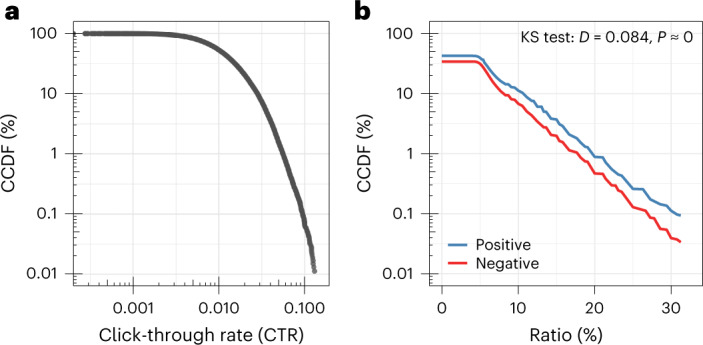
- Positive words were slightly more prevalent than negative words overall (2.83% vs 2.62% of all words; KS test D = 0.574, P < 0.001, two-tailed).
- For discrete emotions, sadness had a positive effect (β = 0.006, P < 0.001), joy and fear had negative effects (β = −0.009 and β = −0.007, respectively, P < 0.001), and anger was not statistically significant (β = 0.000, P = 0.666; equivalence test inconclusive).
Methods
- Data came from the Upworthy Research Archive confirmatory sample: N = 22,743 RCTs, reduced after pre-registered filtering to 12,448 RCTs comprising 53,699 headlines, over 205 million impressions, and 2,778,124 clicks; the broader dataset included ~105,000 headline variations, ~5.7 million clicks, and >370 million impressions.
- Each RCT randomly showed different headline variations for the same news story and measured CTR as clicks per impression; the main analysis used multilevel binomial regression with random intercepts and, in a second model, varying slopes, controlling for headline length, Gunning Fog complexity, and platform age.
- Sentiment was extracted with LIWC positive/negative dictionaries and negation handling; discrete emotions used the NRC emotion lexicon; robustness checks included alternative dictionaries, negation approaches, complexity measures, quadratic effects, image-RCT removal, log-transformed CTR, moralized language, and topic modeling.
Limitations
- The paper states that Upworthy differs from traditional news sources because of its “click-bait” headlines, that conclusions apply at the news-story level rather than the individual level, and that the analysis cannot infer readers’ subjective feelings from language.
- The paper also notes limitations of using the NRC emotion lexicon for discrete emotions and the scarcity of dictionaries for alternative dimensional emotion models.
- Evident from the text: the data are aggregated at the headline level with no individual-level user data, come from a single platform during 2013–2015, and exclude image RCTs because image data were unavailable, which may limit generalizability.
Model-written summary. Check it against the paper before relying on it.
Integrity signals
Registry
Cites
Statistics
Figures
Verification
Claims the paper makes
7 Valid · 2 Not valid · 35 Not checked · 95 Own results and interpretations
The sources with a verdict support this claim; the rest weren’t checked yet, have no full text we could read, or their verdicts aren’t rated yet.
In the paper
“First, we repeated the analysis with alternative sentiment dictionaries as an additional validation. Specifically, we examined both the NRC dictionary63,64 and the SentiStrength dictionary65. We found that the coefficient estimates were in good agreement, contributing to the robustness of our results (Supplementary Table 4 and Fig. 2).”
§ Negativity drives online news consumption > Results > Robustness checks
What the sources say
- Not checked yetcites [63] Mohammad, S. & Turney, P. Proc. NAACL HLT 2010 Workshop on Computational Approaches to Analysis and Generation of Emotion in Text (Association for Computational Linguistics, 2010).
- Supportedcites [64] Mohammad, S. M. in Emotion Measurement (ed. Meiselman, H. L.) 201–237 (Woodhead Publishing, 2016). source
In the citing sentence the reference is attached specifically to 'the NRC dictionary' (refs 63,64), while SentiStrength carries its own separate reference (65) and the agreement of coefficient estimates is the citing authors' own robustness analysis. Our copy of Mohammad's 'Sentiment Analysis' chapter is precisely a description of the NRC lexicons: §5.1.1 (Crowdsourced Emotion Lexicons) details the NRC Emotion Lexicon (EmoLex, ~14k terms, binary associations with eight basic emotions plus positive/negative sentiment, from Mohammad & Turney, 2010), and §5.1.3 lists NRC-VAD, NRC-EmoLex and the NRC Emotion Intensity Lexicon among the most widely used sentiment/emotion lexicons. So as an identification citation for the NRC sentiment dictionary the source is that thing. Searches for 'SentiStrength'/'Thelwall' returned no exact-phrase passage in our copy, consistent with that dictionary being credited to the separate reference rather than to this chapter. (LLM, conf=0.80)
- Not checked yetcites [65] Thelwall M Buckley K Paltoglou G Cai D Kappas A Sentiment strength detection in short informal text J. Am. Soc. Inf. Sci. Technol. 2010 61 2544 2558 10.1002/asi.21416 source
plain- Asserted: passes — The authors put it forward as true.
- Checkable: passes — It can be checked against evidence.
- Load-bearing: unclear — It is unclear whether the paper’s conclusions depend on it.
- Based: passes — The paper gives a reason why it holds.
The cited sources that could be checked couldn’t confirm or dispute this claim.
In the paper
“Notably, we uncovered a negativity bias in the data even though Upworthy branded itself as a ‘positive news outlet’53.”
§ Negativity drives online news consumption > Discussion
What the sources say
- Could not verifycites [53] Matias J Munger K Le Quere MA Ebersole C The Upworthy Research Archive, a time series of experiments in U.S. media Nat. Sci. Data 2021 8 195 10.1038/s41597-021-00934-7 PMC8329003 34341340 sourceExperimental — accuracy not yet measured
The part of the sentence this citation is attached to is the characterization of Upworthy's self-branding as a 'positive news outlet' (the 'negativity bias in the data' is the citing authors' own analysis of the archive). Our copy of Matias et al. (2021) describes Upworthy's editorial identity only as 'a media publisher founded in 2012 to reach large audiences with "stuff that matters"' (Background & Summary) and as writers/editors seeking content they saw as 'awesome, meaningful, and visual' (Technical Validation); it never states that Upworthy branded itself as a positive news outlet. Searches for 'positive news outlet'/brand self-description and for 'negativity bias'/emotional tone of headlines returned no passage on either point, and our copy reports no substantive finding about headline negativity in the dataset. Not contrary evidence, simply absent. (LLM, conf=0.62)
plainstates an association- Asserted: passes — The authors put it forward as true.
- Checkable: passes — It can be checked against evidence.
- Load-bearing: unclear — It is unclear whether the paper’s conclusions depend on it.
- Based: passes — The paper gives a reason why it holds.
- Could not verify
The cited sources support only part of this claim — read each source’s verdict below.
In the paper
“Consistent with findings from previous literature21,43,61, we found that several dyads such as outrage and disapproval are associated with higher CTRs.”
§ Negativity drives online news consumption > Results > Extension to discrete emotions
What the sources say
- Not checked yetcites [21] Crockett MJ Moral outrage in the digital age Nat. Hum. Behav. 2017 1 769 771 10.1038/s41562-017-0213-3 31024117 source
- Partly supportedcites [43] Rathje S Van Bavel JJ van der Linden S Out-group animosity drives engagement on social media Proc. Natl Acad. Sci. USA 2021 118 e2024292118 10.1073/pnas.2024292118 34162706 PMC8256037 sourceExperimental — accuracy not yet measured
The Results (Study 1: Major Media Outlets; page unavailable) link negative and moral-emotional language to more shares and retweets, and the Discussion links outrage to online engagement. The paper does not report click-through rates or analyze emotional dyads such as outrage and disapproval, so it supports the broader engagement point but not the stated CTR finding. (LLM, conf=0.86)
- Not checked yetcites [61] Brady WJ Crockett MJ Van Bavel JJ The MAD model of moral contagion: the role of motivation, attention, and design in the spread of moralized content online Perspect. Psychol. Sci. 2020 15 978 1010 10.1177/1745691620917336 32511060 source
plainstates an association- Asserted: passes — The authors put it forward as true.
- Checkable: passes — It can be checked against evidence.
- Load-bearing: unclear — It is unclear whether the paper’s conclusions depend on it.
- Based: passes — The paper gives a reason why it holds.
A result the paper reports from its own data — it cites no other source for it, so there is none to check. The quote shows it is in the paper.
In the paper
“We observed a statistically significant and positive coefficient for sadness (𝛽 = 0.006, SE = 0.001, z = 5.295, P < 0.001, 99% CI = (0.003, 0.009))”
§ Negativity drives online news consumption > Results > Extension to discrete emotions
plainstates an association- Asserted: passes — The authors put it forward as true.
- Checkable: passes — It can be checked against evidence.
- Load-bearing: passes — The paper’s conclusions depend on it.
- Based: passes — The paper gives a reason why it holds.
A result the paper reports from its own data — it cites no other source for it, so there is none to check. The quote shows it is in the paper.
In the paper
“A one standard deviation larger proportion of negative words increases the odds of a user clicking the headline by 1.5%.”
§ Negativity drives online news consumption > Results > Effect of negative language on news consumption
plainstates a cause- Asserted: passes — The authors put it forward as true.
- Checkable: passes — It can be checked against evidence.
- Load-bearing: passes — The paper’s conclusions depend on it.
- Based: passes — The paper gives a reason why it holds.
69 more claims
Create a free account to see all 139 claims and to verify the 95 references still open.
- Probably not a substantial claim. 46
- It may state two separate claims as one. 33
Claims other papers make about this one
Each is checked against this paper’s own text: does it say what the citing paper says it does?
The source backs part of the claim, not all of it — or backs it for a different population, condition or comparison.
In the citing paper
“Negativity drives particularly online news consumption [6,7] and social media platform use [7].”
From Impact of Media-Induced Uncertainty on Mental Health: Narrative-Based Perspective. (2025) · cites this paper as [6]
Experimental — accuracy not yet measuredThe cited source says what the claim attributes to it.
In the citing paper
“Human ratings were not significantly correlated with NRC codings for Trust, Surprise, Disgust, and Anticipation.”
From GPT is an effective tool for multilingual psychological text analysis (2024) · cites this paper as [18]
The cited source says what the claim attributes to it.
In the citing paper
“We used only these four emotions because Robertson et al. (18) found that only those emotions were significantly correlated with human rater judgments.”
From GPT is an effective tool for multilingual psychological text analysis (2024) · cites this paper as [18]
In the citing paper
“These effects held up when we controlled for other linguistic features shown to play an important role in information diffusion (here: moral and emotional words, negativity) (32, 48), as well as users’ follower counts and tweet publication date.”
From Expressions of uncertainty in online science communication hinder information diffusion (2024) · cites this paper as [48]
In the citing paper
“Previous field experiments have examined whether online news sources and social media increase polarization (Bail et al. 2018) and how negative emotionality (Robertson et al. 2023a) and toxicity (Beknazar-Yuzbashev et al. 2022) affect engagement.”
From Social Media and Morality. (2024) · cites this paper as Robertson et al. 2023a
Statistics recomputed
Every reported test result, recomputed from its test statistic and degrees of freedom. A result shows as not adding up only once an independent check has confirmed it.
- Consistentz = 17.423reported p < .001 · recomputed p < .001
“z = 17.423, p < .001”
- Consistentz = -9.238reported p < .001 · recomputed p < .001
“z = −9.238, p < .001”
- Consistentz = 43.945reported p < .001 · recomputed p < .001
“z = 43.945, p < .001”
- Consistentz = -4.163reported p < .001 · recomputed p < .001
“z = −4.163, p < .001”
- Consistentz = -56.917reported p < .001 · recomputed p < .001
“z = −56.917, p < .001”
10 more recomputed tests
Create a free account to see every test the Stats check recomputed.
Self-check
Percentages, sums and reported differences re-computed from the paper’s own numbers.
Each contradiction between two passages listed here was confirmed by an independent check.
Rated minor: it would not touch a result — a value no result rests on, a p-value that stays on the same side of the significance level, or a conflict that is clerical, resolved elsewhere in the paper, or outside its own findings.
In the paper
“The size of the confirmatory Upworthy data archive is N = 22,743 RCTs, with between 3 and 12 headlines per RCT. This thus corresponds to a total sample of between 68,229 and 227,430 headlines.”
§ Negativity drives online news consumption > Methods > Sampling plan
Reported 227430 · recomputed 272916
Rated minor: it would not touch a result — a value no result rests on, a p-value that stays on the same side of the significance level, or a conflict that is clerical, resolved elsewhere in the paper, or outside its own findings.
In the paper
§ Negativity drives online news consumption > Results > RCTs comparing news consumption
“a, CCDF comparing CTRs across all headline variations (N = 53,669).”
§ Negativity drives online news consumption > Results > RCTs comparing news consumption
“Overall, the 12,448 RCTs comprise 53,699 different headlines, which received over 205 million impressions and 2,778,124 clicks.”
Rated minor: it would not touch a result — a value no result rests on, a p-value that stays on the same side of the significance level, or a conflict that is clerical, resolved elsewhere in the paper, or outside its own findings.
In the paper
§ Negativity drives online news consumption > Methods > Sampling plan
“The size of the confirmatory Upworthy data archive is N = 22,743 RCTs, with between 3 and 12 headlines per RCT.”
§ Negativity drives online news consumption > Methods > Large-scale field experiments
“First, all experiments solely consisting of a single headline variation were discarded.”
Citations
Cites
Statistical Power Analysis for the Behavioral Sciences
Cohen, J. (2013) · doi:10.4324/9780203771587 · Cited by 25,373
An argument for basic emotions
Ekman, P. (1992) · Cognition and Emotion · doi:10.1080/02699939208411068 · Cited by 9,646 · cited 2×
“Furthermore, we studied the effects of 24 emotional dyads from Plutchik’s model 68 , these dyads being complex emotions composed of two basic emotions 69 .”
The spread of true and false news online
Vosoughi, S., Roy, D., & Aral, S. (2018) · Science · doi:10.1126/science.aap9559 · Cited by 8,847 · cited 9×
“For thoroughness, we also conducted exploratory analyses using the four other basic emotions from the NRC emotion dictionary for which the correlation with human judgments was considerably lower in our validation study (Supplementary Tables 21 and 22).”
InfluentialBaumeister, R. F., Bratslavsky, E., Finkenauer, C., & Vohs, K. D. (2001) · Review of General Psychology · doi:10.1037/1089-2680.5.4.323 · Cited by 7,678
Twitter mood predicts the stock market
Bollen, J., Mao, H., & Zeng, X. (2011) · Journal of Computational Science · doi:10.1016/j.jocs.2010.12.007 · Cited by 5,206 · cited 1×
“As such, online media has a profound impact on society across domains such as marketing 10,11 , finance 12–14 , health 15 and politics 16–19 .”
Negativity Bias, Negativity Dominance, and Contagion
Rozin, P., & Royzman, E. B. (2001) · Personality and Social Psychology Review · doi:10.1207/s15327957pspr0504_2 · Cited by 4,342
Exposure to ideologically diverse news and opinion on Facebook
Bakshy, E., Messing, S., & Adamic, L. A. (2015) · Science · doi:10.1126/science.aaa1160 · Cited by 3,245
What Makes Online Content Viral?
Berger, J., & Milkman, K. L. (2012) · Journal of Marketing Research · doi:10.1509/jmr.10.0353 · Cited by 3,178 · cited 2×
“As such, negativity embedded in online content explains the speed and virality of online diffusion dynamics (for example, response time, branching of online cascades) 7,34,35,37,39–41 .”
Fears, phobias, and preparedness: toward an evolved module of fear and fear learning
Öhman, A., & Mineka, S. (2001) · Psychological Review · doi:10.1037/0033-295x.108.3.483 · Cited by 3,147
Using Online Conversations to Study Word-of-Mouth Communication
Godes, D., & Mayzlin, D. (2004) · Marketing Science · doi:10.1287/mksc.1040.0071 · Cited by 2,601 · cited 1×
“As such, online media has a profound impact on society across domains such as marketing 10,11 , finance 12–14 , health 15 and politics 16–19 .”
Research works printed but not linked: 9
- Pooley E Grins, gore and videotape: the trouble with local TV news N. Y. Mag. 1989 22 36 44
- Simon, H. A. in Computers, Communications, and the Public Interest (ed. Greenberger, M.) 38–72 (The Johns Hopkins Press, 1971).
- Klein, E. Why We’re Polarized (Avid Reader Press, Simon & Schuster, 2020).
- Naveed, N., Gottron, T., Kunegis, J. & Alhadi, A. C. Proc. 3rd International Web Science Conference (Association for Computing Machinery, 2011).
- Kim, J. & Yoo, J. 2012 International Conference on Social Informatics (IEEE, 2012).
- Mohammad, S. & Turney, P. Proc. NAACL HLT 2010 Workshop on Computational Approaches to Analysis and Generation of Emotion in Text (Association for Computational Linguistics, 2010).
- Plutchik, R. Emotion: Theory, Research, and Experience 2nd edn (Academic Press, 1984).
- Pennebaker, J. W., Boyd, R. L., Jordan, K. & Blackburn, K. The development and psychometric properties of LIWC2015. Univ. Texas Libraries http://hdl.handle.net/2152/31333 (2015).
- Gunning, R. The Technique of Clear Writing (McGraw-Hill, 1952).
Cited by
Items 201–300 of 333
Yi, S. H. (2023) · DR-NTU (Nanyang Technological University) · doi:10.32657/10356/174204 · Cited by 2
Cutler, J., Contreras-Huerta, L. S., Todorova, B., Nitschke, J. P., Michalaki, K., Koppel, L., Gkinopoulos, T., Vogel, T. A., Lamm, C., Västfjäll, D., et al. (2024) · PsyArXiv (OSF Preprints) · doi:10.31234/osf.io/c8yxs · Cited by 2
Amusing Ourselves to Death? Education and Careers Under Digital InfluencePreprint
Cong, L. W., & Li, S. (2024) · SSRN Electronic Journal · doi:10.2139/ssrn.4830986
Medienarbeit für den „Social Proof“
Kasper, K. (2024) · Springer eBooks · doi:10.1007/978-3-658-44630-7_6
Polarizing reply patterns in comment sections of a large German news outletPreprint
Buder, J., & Anders, G. (2024) · Research Square · doi:10.21203/rs.3.rs-4773834/v1 · Cited by 1
Conceptual Mapping of Controversies
Draude, C., Dürrschnabel, D., Hirth, J., Horn, V., Kropf, J., Lamla, J., Stumme, G., & Uhlmann, M. (2024) · Lecture notes in computer science · doi:10.1007/978-3-031-67868-4_14 · Cited by 2
Ideology, motivation, and consistency between beliefs and behaviors
Laurin, K., & Chua, K. Q. (2024) · Advances in experimental social psychology · doi:10.1016/bs.aesp.2024.10.001
Municipal Cost of Living Sentiment IndexPreprint
Leong, H. (2024) · SSRN Electronic Journal · doi:10.2139/ssrn.4987429
Coping With Experiences of Sociomoral Violations Through Consumption of Anger‐Eliciting Content
Munichor, N., & Steinhart, Y. (2024) · Psychology and Marketing · doi:10.1002/mar.22171 · Cited by 1
The use of emotion words by the sciences and other subjects
Benjafield, J. G. (2024) · Scientometrics · doi:10.1007/s11192-024-05215-9
Nextdoor use and support for aggressive policing
Hopp, T., Ferrucci, P., & Reeves, H. (2024) · New Media & Society · doi:10.1177/14614448241303114 · Cited by 1
“The notion that individual-level features guide information attendance is also supported by work on the so-called negativity heuristic , which presumes that negative information (e.g., depictions of crime and disorder) is prioritized by human evaluators (Robertson et al., 2023).”
Brookfield, S., Chye, N. A., Carah, N., & GARTNER, C. E. (2025) · Health Communication · doi:10.1080/10410236.2025.2458648 · Cited by 1
“Images are known to increase clicks for online content (Li & Xie, 2019), and negativity is associated with increased engagement for news media (Robertson et al., 2023; Trussler & Soroka, 2014).”
Die Zukunft der Demokratie und die Zukunft der Medien – Anmerkungen zu einem paradoxen Verhältnis
Karmasin, M. (2025) · Medien, Kultur, Kommunikation · doi:10.1007/978-3-658-47029-6_14
Zhang, Q., Marcinkiewicz, V., Bowen, L., Kozlowski, T., Inatani, T., Ueda, Y., Katsuno, H., Asada, M., & Morgan, P. L. (2025) · SSRN Electronic Journal · doi:10.2139/ssrn.5210961
Examine the filter bubble with a focus on emotion and content
Kita, S., Mine, T., & Arakawa, Y. (2024) · International Conference on Natural Language Processing and Information Retrieval (NLPIR) · doi:10.1145/3711542.3711595
Eder, M. (2025) · Journalism · doi:10.1177/14648849251334532
“Although using a negative tone in political reporting is nothing new, research shows that online news with negatively connotated headlines draw more clicks (Robertson et al., 2023).”
Impact of Ecuadorian News Headlines Published on Facebook: A Supervised Machine Learning Approach
Lema, R., Recalde, L., & Loza-Aguirre, E. (2025) · Lecture notes in networks and systems · doi:10.1007/978-3-031-87704-9_27
Social media as tools of dissent: Evolution of SNSS in perspective
Joseph, D., & Jose, S. (2025) · International Journal of Research in English · doi:10.33545/26648717.2025.v7.i1f.356
WITHDRAWNPreprint
Leizerman, S. L. (2025) · PsyArXiv (OSF Preprints) · doi:10.31234/osf.io/aekqs_v1
Analyzing Offensive Content and Emotional Dynamics in Black Lives Matter Discourse on Twitter
Okpala, E., Cheng, L., & Elelu, K. (2025) · Proceedings of the International AAAI Conference on Web and Social Media · doi:10.1609/icwsm.v19i1.35878 · Cited by 2
Viral voices: Depictions of women’s pain experiences on social media
Mazzocca, K., Langmuir, T., Manan, J., Gagnon, M. M., & Alberts, N. M. (2025) · Journal of Pain · doi:10.1016/j.jpain.2025.105461 · Cited by 1
Summarizing Online Discussions with Prototype Relation Networks Using Large Language Models
Power, W., Gupta, S., & Zoran Obradovic, A. (2025) · IFIP advances in information and communication technology · doi:10.1007/978-3-031-96235-6_28
The Governance Role of Investor Communications: Evidence from a Field ExperimentPreprint
Xu, C., Xie, J., Zhang, B., & Zhao, X. (2025) · SSRN Electronic Journal · doi:10.2139/ssrn.5314356
Clickbait y polarización como estrategias de gancho informativo en la cobertura electoral
García, M. M. R., Sánchez-Sobradillo, I., Diez-Gracia, A., & Sánchez-García, P. (2025) · Revista Mediterránea de Comunicación · doi:10.14198/medcom.28012
An Appraisal Perspective on Public Discourse
Uusberg, A. (2025) · Theory and history in the human and social sciences · doi:10.1007/978-3-031-89741-2_3
The Necessity of Phased Research: Sentiment Fluctuations in Online Comments Caused by Product Value
Li, J., & Shen, J. (2025) · Journal of theoretical and applied electronic commerce research · doi:10.3390/jtaer20030185
Adewale, O. C., Aondover, E. M., & Ubah, V. I. (2025) · IntechOpen eBooks · doi:10.5772/intechopen.1011015
Szilassi, M., & Oosterwijk, S. (2026) · Motivation and Emotion · doi:10.1007/s11031-026-10265-y
Loss, G. R., dos Santos, E. M., & Tagliabue, B. A. (2025) · Beijing Law Review · doi:10.4236/blr.2025.163073
Distressed by all the bad news? Here’s how to stay informed but still look after yourself
Shabahang, R. (2025) · The Conversation · doi:10.64628/aa.g3ntxmuxj
Political Polarization and Trust in Institutions
Anisin, A. (2025) · Springer eBooks · doi:10.1007/978-3-032-02395-7_4
Mukai, T., & Urahigashi, T. (2025) · International Criminal Justice Review · doi:10.1177/10575677251359608
“For instance, negativity bias — the tendency to pay greater attention to and be more affected by negative content — has been well-documented both of fl ine (Baumeister et al., 2001) and online (Robertson et al., 2023; Schöne et al., 2021).”
Sarasqueta, G., Ferrero, M., Olmedo, S., Montiel, E. R. R., & Goytia, J. R. S. (2025) · Revista de Comunicación · doi:10.26441/rc24.2-2025-3941 · Cited by 1
Sentiment Analysis of Cochlear Implants in the r/Cochlear Implants Subreddit
Dimitroyannis, R. C., Oliver, E., Leung, R., Nordgren, R. K., & Imbery, T. E. (2025) · OTO Open · doi:10.1002/oto2.70165
“29 – 32 Importantly, entries with negative sentiment in this study did not receive more engagement, possibly suggesting a different mechanism for this trend in sentiment, which requires further evaluation.”
In the Face of Disinformation: To Publish or Not to Publish in the Vaza Jato Case
Araújo, R., & Belim, C. (2025) · Journalism and Media · doi:10.3390/journalmedia6040167
“…of misleading or decontextualized claims (Allen et al., 2020; Amazeen, 2020; Brennen, 2020; Cook et al., 2014; Hendrickx & Van Remoortere, 2023; Robertson et al., 2023); and (b) the democratic stakes of trust in news, especially when verification and public-interest arguments must be weighed…”
InfluentialBethäuser, J., Menold, N., & Winker, P. (2025) · PLoS ONE · doi:10.1371/journal.pone.0333066
“In contrast to print media, which seeks to maximize the number of copies sold, websites on the Internet strive to maximize the number of clicks on their articles [17].”
Persson, J., Feuerriegel, S., & Kadar, C. (2025) · SSRN Electronic Journal · doi:10.2139/ssrn.5476287
Self-citationHow Journalists Can Foster Humble Inquiry in their Work and their ReadersPreprint
al‐Gharbi, M. (2025) · SSRN Electronic Journal · doi:10.2139/ssrn.5604750
Viral News About Vulnerable People: Issues in Nepal's YouTube-Based Alternative Media
Acharya, P. (2025) · Electronic News · doi:10.1177/19312431251386848
“From the audience ’ s perspective, fi ve elements —“ scope or relevance, social importance or utility, source, facticity, and impartiality ”— determine the “ degrees of news-ness ” of a story in general (Robertson et al., 2023, p. 383).”
Attention on social media depends more on how you express yourself than on who you are
Zhao, Y., Qiao, T., Chen, Y., Kuang, M., Bai, W., Yi, Y., Huang, X., Li, W., & Wang, W. (2025) · Nature Human Behaviour · doi:10.1038/s41562-025-02323-1 · Cited by 7
The Climate-Health Communication Gap: Connecting the Dots to Drive Climate Health Action
Smith, R., Chen, K., Winner, D., & Friedhoff, S. (2025) · Health Communication · doi:10.1080/10410236.2025.2576158
“It has been demonstrated that doom and gloom messages are more likely to be shared online and on social media – a space that rewards emotionally negative content (Robertson et al., 2023; Skurka et al., 2023; Vlasceanu et al., 2024).”
InfluentialThe Lava Jato Scandal: Visual Framing of a Brazilian Political Crisis
Eder, M., & Lhamby, M. E. P. (2025) · Springer eBooks · doi:10.1007/978-3-032-01693-5_11
Vogel, M., & Buder, J. (2025) · Computers in Human Behavior Reports · doi:10.1016/j.chbr.2025.100876 · Cited by 1
How Digital Media Markets Amplify News SentimentPreprint
Berger, L. M. (2025) · SSRN Electronic Journal · doi:10.2139/ssrn.5776767 · Cited by 4
Wang, X., & Huang, Z. (2025) · SSRN Electronic Journal · doi:10.2139/ssrn.5788382
Line, E. N., Jaramillo, S., Goldwater, M. B., & Horne, Z. (2024) · Figshare · doi:10.6084/m9.figshare.26829020
Kim, S., Kim, S., & Kim, Y. (2025) · SSRN Electronic Journal · doi:10.2139/ssrn.5451435
Beyond the Headlines: Examining the Role of Negative Campaigning Media Coverage on Electoral Trust
Amakoh, K. O. (2025) · The International Journal of Press/Politics · doi:10.1177/19401612251375535
Bano, S., Hill, D. J., & Ahmad, N. (2025) · Contributions to political science · doi:10.1007/978-3-032-06596-4_11 · Cited by 2
Think society is in decline? Research gives us some reasons to be cheerful
Hanel, P. H. P. (2026) · The Conversation · doi:10.64628/ab.ahy93v3kd
When does good or bad news go viral? Morality and competence as moderators in corporate news sharing
Choi, C., & Moon, B. B. (2026) · Corporate Communications An International Journal · doi:10.1108/ccij-06-2025-0147
Implicitly tuned: The neural effects of social feedback on adolescent learning
Bosseler, A. N., Peterson, E. R., Stavropoulos, K. K. M., Mizrahi, J. C., Larson, E., Corrigan, N. M., Taulu, S., Meltzoff, A. N., & Kuhl, P. K. (2026) · Developmental Cognitive Neuroscience · doi:10.1016/j.dcn.2026.101809
SPICE Content Generates Situational Interest
Yaros, R. A. (2026) · Palgrave practical guides in communication. · doi:10.1007/978-3-032-03822-7_7
Marchlewski, E., Olow, E., & Yim, M. (2026) · SSRN Electronic Journal · doi:10.2139/ssrn.6219005
DuBosar, E., & Shin, J. (2026) · Mass Communication & Society · doi:10.1080/15205436.2026.2637143
Soroka, S., & Wlezien, C. B. (2026) · Political Communication · doi:10.1080/10584609.2026.2613647 · Cited by 1
“1 Here, negativity bias is not just a function of news production – it also reflects the priorities of news consumers, both in the past and present, offline and online (e.g., Park, 2015; Robertson et al., 2023; Soroka et al., 2019; Van der Meer et al., 2020).”
Digital media is using negativity to steal our attention — here’s how to reclaim it
Shipman, M. L., & Pierce-Messick, Z. J. (2026) · doi:10.64628/aam.kye4skctc
Unlocking Outgroup Access Online: Evidence From Cyprus
Asimovic, N. (2026) · Comparative Political Studies · doi:10.1177/00104140261431830 · Cited by 1
Firoozi, A. A., Firoozi, A. A., & Maghami, M. R. (2026) · Sustainable Futures · doi:10.1016/j.sftr.2026.101834
Understanding the Gap Between Stated and Revealed Preferences in Social Media News Feeds
Kim, D. W., Buntain, C., & Ciampaglia, G. L. (2026) · Proceedings of the ACM on Human-Computer Interaction · doi:10.1145/3817029
Gim, J., Kim, H., & Kim, J. S. (2026) · International Journal of Hospitality Management · doi:10.1016/j.ijhm.2026.104720 · Cited by 1
Public appeals and collective crisis mitigation
Haan, P., Heursen, L., Specht, J., Veltri, B., & Weizsäcker, G. (2026) · Journal of Economic Behavior & Organization · doi:10.1016/j.jebo.2026.107578
Tainturier, B. (2026) · Réseaux · doi:10.3917/res.255.0237
Consumers' perceived risk and worry about microbial food safety
Paepeghem, C. V., Hellin, J., Jacxsens, L., Uyttendaele, M., Vlerick, P., & Verbeke, W. (2026) · Food Quality and Preference · doi:10.1016/j.foodqual.2026.105980
Emotional Coding in Television News Headlines
Nagyová, P., & Hudíková, Z. (2026) · Communication Today · doi:10.34135/communicationtoday.2026.vol.17.no.1.13
Why Do They Not Want to Be Surgeons? Female Medical Students' Career Intentions in Australia
Ip, E. C., Incoll, I. W., & Nestel, D. (2026) · ANZ Journal of Surgery · doi:10.1111/ans.70725 · Cited by 1
“Cultural stereotypes and media portrayals can be exaggerated or fictional, while news coverage often highlights negative aspects to attract public interest [37].”
Why 40 per cent of people are avoiding the news, according to a psychologist
Jasemi, A. (2026) · The Conversation · doi:10.64628/aam.nauy7g6ak · Cited by 1
Manusyan, S., Grigoryan, A., Grigoryan, T., Poghosyan, A., Paremuzyan, N., & Ayanian, A. H. (2026) · Frontiers in Human Dynamics · doi:10.3389/fhumd.2026.1773510 · Cited by 1
Bread, Butter, and Bias: How News Coverage of Egg Price and Tariffs Polarizes U.S. Democracy?
Zhong, B., Zhu, Y., Wang, N., Wang, S., Xu, J., Yi, H., Lim, H. H., & Feng, G. C. (2026) · American Behavioral Scientist · doi:10.1177/00027642261450672
Vors, L., Farouk, I., Delon, P., Raboisson, D., Boucher, J.-C., & Lhermie, G. (2026) · PNAS Nexus · doi:10.1093/pnasnexus/pgag209
Urban vegetable gardens: a Portuguese semiosphere for understanding seniors’ memories and crises
Luderer, C. A. F. (2026) · Semiotica · doi:10.1515/sem-2026-0084
73Chapter 4 Journalism as a Solution to the Post-Truth Challenge?
Moland, M., Custodi, J., & Trenz, H. (2026) · De Gruyter eBooks · doi:10.1515/9783112222874-005 · Cited by 2
Song, J. Z., Tsang, I., Mouratidis, P., Saeed, M., L, A. A. O., Islam, A., & Gabison, S. (2026) · JMIR Nursing · doi:10.2196/76682
“In addition, studies have shown that those in the online health community may be more likely to post negative content to seek emotional and informational support [96,97].”
Zou, W., Qu, J. G., Yi, J., & Li, Z. (2026) · Mass Communication & Society · doi:10.1080/15205436.2026.2687866
Syharat, C. M., Zaghi, A. E., & Motaref, S. (2026) · Frontiers in Research Metrics and Analytics · doi:10.3389/frma.2026.1830196 · Cited by 1
Secară, E., & Opre, A. N. (2026) · JMIR Infodemiology · doi:10.2196/88632
“As online news consumption is driven primarily by negativity [47], HRC may be especially vulnerable to this dynamic due to its high personal relevance and the emotional weight carried by risk-related information.”
Negativity vs. Incivility: How We Engage with Partisan Content on Facebook Over Time
Kim, Y. (2026) · Mass Communication & Society · doi:10.1080/15205436.2026.2687879
Distinct motivational factors shape news-seeking in young adults
O'Donoghue, E. M., Eschmann, K. C. J., Tsujimura, H., Crawford, B., Caswell, D., Oosterwijk, S., & Gruber, M. J. (2026) · Scientific Reports · doi:10.1038/s41598-026-39354-1 · Cited by 1
“Curiosity can be elicited by salient information gaps 32 , implicating it in the drive for sense-making, and it can drive individuals to seek out negative content 36,37 .”
Framing resonance and variation in social media: the case of slow food on Instagram
García-León, R. A. (2026) · Frontiers in Nutrition · doi:10.3389/fnut.2026.1879734
“Dictionaries serve to classify words into predefined categories depending on the research goals (123, 124).”
Imagination and Idealism After the COVID-19 Pandemic
Farrelly, C. (2026) · Oxford University Press eBooks · doi:10.1093/9780197830062.003.0005
Farrelly, C. (2026) · Oxford University Press eBooks · doi:10.1093/9780197830062.003.0012
Equality and the Intersectionality of Biological Aging
Farrelly, C. (2026) · Oxford University Press eBooks · doi:10.1093/9780197830062.003.0007
The Good Life as a Constraint on Longevity Science
Farrelly, C. (2026) · Oxford University Press eBooks · doi:10.1093/9780197830062.003.0010
Philosophy and the “Framing” of Translational Science
Farrelly, C. (2026) · Oxford University Press eBooks · doi:10.1093/9780197830062.003.0002
Farrelly, C. (2026) · Oxford University Press eBooks · doi:10.1093/9780197830062.003.0003
“Fair Innings,” Women, and Longevity Science
Farrelly, C. (2026) · Oxford University Press eBooks · doi:10.1093/9780197830062.003.0008
Farrelly, C. (2026) · Oxford University Press eBooks · doi:10.1093/9780197830062.003.0009
Public Health Must Transcend Folkbiology
Farrelly, C. (2026) · Oxford University Press eBooks · doi:10.1093/9780197830062.003.0006
Farrelly, C. (2026) · Oxford University Press eBooks · doi:10.1093/9780197830062.003.0011
Introduction: The Tale of the Journey Through the Ocean of Longevity
Farrelly, C. (2026) · Oxford University Press eBooks · doi:10.1093/9780197830062.003.0001
The Frankensteinification of Translational Gerontology
Farrelly, C. (2026) · Oxford University Press eBooks · doi:10.1093/9780197830062.003.0004
Hughes, I. M., Bowling, N. A., Keith, M. G., Brossoit, R. M., & Bazzoli, A. (2026) · Computers in Human Behavior · doi:10.1016/j.chb.2026.109118
Exploring autism parenting, social support, and stigma in a Reddit community
Harrell-Webber, A., Rohde, J. A., & Wright, K. B. (2026) · Frontiers in Communication · doi:10.3389/fcomm.2026.1813037
Eagle, S. R., & Sherry, N. S. (2026) · Frontiers in Neurology · doi:10.3389/fneur.2026.1882586
“There are also known negativity biases in popular media which may explain this relationship (4, 5).”
Case Scenarios of People Living with Dementia Who Go Missing: An Education Tool to Manage Risks
Vahedi, V., Daum, C., Rutledge, E., Adekoya, A., Miguel-Cruz, A., & Liu, L. (2026) · Canadian Journal on Aging / La Revue canadienne du vieillissement · doi:10.1017/s0714980826100762
“Through the case scenarios, people living with dementia and care partners can obtain knowledge on what may happen during a missing incident from an evidence-informed lens, countering negatively biased dementia-related missing incident cases spread on popular media (Robertson et al., 2023).”
Improving Social Media Popularity Prediction with Language Model Generated Network Features
Power, W., & Zoran Obradovic, A. (2026) · IFIP advances in information and communication technology · doi:10.1007/978-3-032-30809-2_22
Limited attention and retail investors’ participation: insights from same-day earnings announcements
Lu, Y., Zhang, J., & Song, X.-Y. (2026) · Spanish Journal of Finance and Accounting / Revista Española de Financiación y Contabilidad · doi:10.1080/02102412.2026.2699549
Metadata
- Authors
- Robertson, C. E., Pröllochs, N., Schwarzenegger, K., Pärnamets, P., Van Bavel, J. J., & Feuerriegel, S.
- Affiliations
- New York University (US)
- Justus-Liebig-Universität Gießen (DE)
- ETH Zurich (CH)
- Karolinska Institutet (SE)
- Corresponding author
- Feuerriegel, Stefan
- Venue
- Nature Human Behaviour
- Published
- 2023-03-16
- Volume
- 7
- Issue
- 5
- Pages
- 812-822
- ISSN
- 2397-3374 (ISSN-L)
- PMC
- PMC10202797
- OpenAlex
- W4327568915
- Semantic Scholar
- bd764e9c8705fdc0b582c850c86f7020adf036aa
- Cited by
- 333
- References
- 66
- Citations by year
- 2026: 106 · 2025: 99 · 2024: 78 · 2023: 45
- FWCI
- 155.23
- Type
- journal article
- Language
- en
- Open access
- hybrid
- doi.org
- Licence
- cc-by
- creativecommons.org/licenses/by/4.0 (tdm)
- creativecommons.org/licenses/by/4.0 (vor)
- Locations
- Nature Human Behaviour (publishedVersion, cc-by)
- PubMed Central (publishedVersion, cc-by)
- PubMed (publishedVersion)
- RePEc: Research Papers in Economics (submittedVersion)
- Open access LMU (Ludwid Maxmilian's Universitat Munchen) (submittedVersion, cc-by)
- Repository for Publications and Research Data (ETH Zurich) (submittedVersion, cc-by)
- ETH Zürich Research Collection
- Funders
- John Templeton Foundation (61378)
- Topics
- Social Sciences › Communication › News Media Framing and Political Communication
- Social Sciences › Sociology and Political Science › Misinformation and Its Impacts
- Social Sciences › Sociology and Political Science › Media Influence and Politics
- Keywords
- online news consumption, negative words, emotional words, news headlines, click-through rate, user engagement, online media, positive words
- MeSH terms
- Emotions, Humans, Mass Media, Causality, Internet, Information Seeking Behavior
About these checks
Registry, retraction, Cites and statistics results are computed, not judged, with one exception: a printed reference that no index lists is read once by a model before it counts as a citation error. Claims are extracted by a model and kept only when their quote appears verbatim in the text; each cited source is then checked, with a model’s help, for whether it says what the claim relies on. Those verdicts can be wrong — read the claim’s quote and the cited source before relying on one.
The claim verdicts this report counts are experimental: their accuracy is not yet measured.
A language model drew the claims from the paper on 2026-10-08, under version 3 of the claim definition (model deepseek-v4.1-flash, prompt extract-v3).
A second model labelled each claim on 2026-10-08 (model jev-1.13-20260917, definition revision gold-guideline-v0.2).
Cited sources are checked with a language model’s help (qwen3.8-omni-flash and gpt-6-sol).
Statistics and arithmetic are recomputed, not judged.
Confidence bands are shown only for fields calibrated on our annotated test set. None is calibrated yet, so no band is shown.
What counts as a claim ›How we measure confidence ›How we check this ›
Are you an author, or do you see a problem with this page? Request a review
Data sources
Bibliographic data: Semantic Scholar, OpenAlex, Crossref.
Contains information from the Semantic Scholar Academic Graph Datasets, made available under the ODC Attribution License (ODC-BY 1.0).
Semantic Scholar’s data is described in: Kinney, R., et al. (2023). The Semantic Scholar Open Data Platform. arXiv:2301.10140.
