

Exome sequencing and characterization of 49,960 individuals in the UK Biobank
Open accessThe DOI matches its Crossref record; 61 of the 61 references it cites were found in a registry or an index.
Abstract
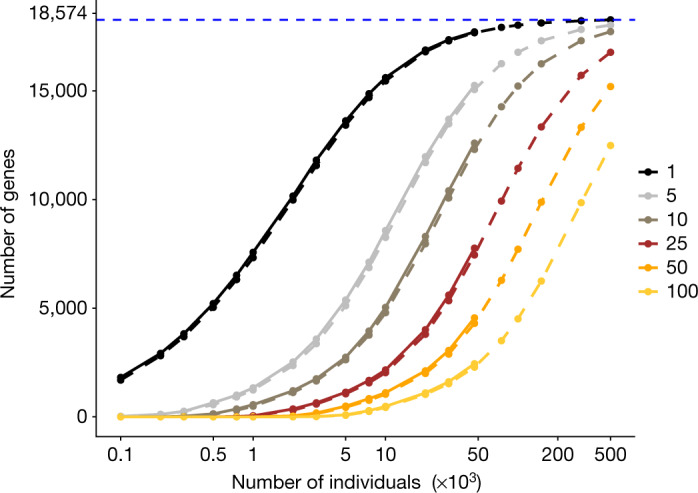
The UK Biobank is a prospective study of 502,543 individuals, combining extensive phenotypic and genotypic data with streamlined access for researchers around the world 1 . Here we describe the release of exome-sequence data for the first 49,960 study participants, revealing approximately 4 million coding variants (of which around 98.6% have a frequency of less than 1%). The data include 198,269 autosomal predicted loss-of-function (LOF) variants, a more than 14-fold increase compared to the imputed sequence. Nearly all genes (more than 97%) had at least one carrier with a LOF variant, and most genes (more than 69%) had at least ten carriers with a LOF variant. We illustrate the power of characterizing LOF variants in this population through association analyses across 1,730 phenotypes. In addition to replicating established associations, we found novel LOF variants with large effects on disease traits, including PIEZO1 on varicose veins, COL6A1 on corneal resistance, MEPE on bone density, and IQGAP2 and GMPR on blood cell traits. We further demonstrate the value of exome sequencing by surveying the prevalence of pathogenic variants of clinical importance, and show that 2% of this population has a medically actionable variant. Furthermore, we characterize the penetrance of cancer in carriers of pathogenic BRCA1 and BRCA2 variants. Exome sequences from the first 49,960 participants highlight the promise of genome sequencing in large population-based studies and are now accessible to the scientific community.
Overview
The claims and statistics of this paper haven’t been checked yet.
Free: it reads the open-access text and checks the first 5 claims that cite a source we can check. Create a free account to check every claim.
Integrity signals
Registry
Cites
Statistics
Figures
Verification
Claims the paper makes
The claims and statistics of this paper haven’t been checked yet.
Free: it reads the open-access text and checks the first 5 claims that cite a source we can check. Create a free account to check every claim.
Self-check
Percentages, sums and reported differences re-computed from the paper’s own numbers.
The self-check needs the paper’s full text.
Citations
Cites
Sudlow, C., Gallacher, J., Allen, N., Beral, V., Burton, P., Danesh, J., Downey, P., Elliott, P., Green, J., Landray, M., et al. (2015) · PLOS Medicine · doi:10.1371/journal.pmed.1001779 · Cited by 12,728
The mutational constraint spectrum quantified from variation in 141,456 humans
Karczewski, K. J., Francioli, L. C., Tiao, G., Cummings, B. B., Alföldi, J., Wang, Q., Collins, R. L., Laricchia, K. M., Ganna, A., Birnbaum, D. P., et al. (2020) · Nature · doi:10.1038/s41586-020-2308-7 · Cited by 9,434
Integrative Genomics Viewer (IGV): high-performance genomics data visualization and exploration
Thorvaldsdottir, H., Robinson, J. T., & Mesirov, J. P. (2013) · Briefings in Bioinformatics · doi:10.1093/bib/bbs017 · Cited by 9,049
The UK Biobank resource with deep phenotyping and genomic data
Bycroft, C., Freeman, C., Petkova, D., Band, G., Elliott, L. T., Sharp, K., Motyer, A., Vukcevic, D., Delaneau, O., O’Connell, J., et al. (2018) · Nature · doi:10.1038/s41586-018-0579-z · Cited by 8,876
Self-citationCADD: predicting the deleteriousness of variants throughout the human genome
Rentzsch, P., Witten, D., Cooper, G. M., Shendure, J., & Kircher, M. (2019) · Nucleic Acids Research · doi:10.1093/nar/gky1016 · Cited by 3,534
Sequence Variations in PCSK9, Low LDL, and Protection against Coronary Heart Disease
Cohen, J. C., Boerwinkle, E., Mosley, T. H., & Hobbs, H. H. (2006) · New England Journal of Medicine · doi:10.1056/nejmoa054013 · Cited by 3,181
A new multipoint method for genome-wide association studies by imputation of genotypes
Marchini, J., Howie, B., Myers, S., McVean, G., & Donnelly, P. (2007) · Nature Genetics · doi:10.1038/ng2088 · Cited by 2,609
Self-citationACMG recommendations for reporting of incidental findings in clinical exome and genome sequencing
Green, R. C., Berg, J. S., Grody, W. W., Kalia, S. S., Korf, B. R., Martin, C. L., McGuire, A. L., Nussbaum, R. L., O’Daniel, J. M., Ormond, K. E., et al. (2013) · Genetics in Medicine · doi:10.1038/gim.2013.73 · Cited by 2,541
MaCH: using sequence and genotype data to estimate haplotypes and unobserved genotypes
Li, Y., Willer, C. J., Ding, J., Scheet, P., & Abecasis, G. R. (2010) · Genetic Epidemiology · doi:10.1002/gepi.20533 · Cited by 1,843
Self-citationMeta-Analysis of BRCA1 and BRCA2 Penetrance
Chen, S., & Parmigiani, G. (2007) · Journal of Clinical Oncology · doi:10.1200/jco.2006.09.1066 · Cited by 1,802
Cited by
Items 401–500 of 621
Forrest, I. S., Chaudhary, K., Vy, H. M. T., Bafna, S., Kim, S., Won, H., Loos, R. J. F., Cho, J. H., Pasquale, L. R., Nadkarni, G. N., et al. (2021) · Human Mutation · doi:10.1002/humu.24220 · Cited by 5
“On the variant level, variant call files (VCFs) produced by Illumina v4 HiSeq 2500 contained 9,202,884 variants called in 31,250 individuals.”
MethodHypothesis-free phenotype prediction within a genetics-first framework
Lu, C., Zaucha, J. M., Gam, R., Fang, H., Smithers, B., Oates, M. E., Bernabé‐Rubio, M., Williams, J. H., Zelenka, N., Pandurangan, A. P., et al. (2023) · Nature Communications · doi:10.1038/s41467-023-36634-6 · Cited by 4
10 Years of GWAS in intraocular pressure
Gao, X., Chiariglione, M., Choquet, H., & Arch, A. J. (2023) · Frontiers in Genetics · doi:10.3389/fgene.2023.1130106 · Cited by 4
Pharmacogenomics in cardiovascular diseases
Ahmed, M., Malla, B. A., Khaja, U. M., Bhat, A. H., Ali, A., Ganie, S. A., Rehman, M. U., & Imtiyaz, Z. (2023) · Elsevier eBooks · doi:10.1016/b978-0-443-15336-5.00009-9 · Cited by 4
Sofer, T., Lee, J., Kurniansyah, N., Jain, D., Laurie, C. A., Gogarten, S. M., Conomos, M. P., Heavner, B., Hu, Y., Kooperberg, C. L., et al. (2021) · Human Genetics and Genomics Advances · doi:10.1016/j.xhgg.2021.100040 · Cited by 4
“Wright et al.4 assessed the pathogenicity and penetrance of rare variants identified in clinical studies in the population-based UK Biobank.”
BackgroundPersonalized Medicine Through GPCR Pharmacogenomics
Hauser, A. S. (2021) · Elsevier eBooks · doi:10.1016/b978-0-12-820472-6.00100-6 · Cited by 5
Hartman, K., Rashkin, S. R., Witte, J. S., & Hernandez, R. D. (2019) · bioRxiv (Cold Spring Harbor Laboratory) · doi:10.1101/2019.12.18.879916 · Cited by 4
VCF2Prot: An Efficient and Parallel Tool for Generating Personalized Proteomes from VCF FilesPreprint
ElAbd, H., Degenhardt, F. C., Lenz, T. L., Franke, A., & Wendorff, M. (2022) · bioRxiv (Cold Spring Harbor Laboratory) · doi:10.1101/2022.01.21.477084 · Cited by 4
Protein Language Model Predicts Mutation Pathogenicity and Clinical PrognosisPreprint
Liu, X., Yang, X., Ouyang, L., Guo, G., Su, J., Xi, R., Yuan, K., & Yuan, F. (2022) · bioRxiv (Cold Spring Harbor Laboratory) · doi:10.1101/2022.09.30.510294 · Cited by 5
“However, only less than 2% of mutations 13 currently have known functional interpretation [2, 3, 4], leaving most variants have yet to be identified 14 with clinical consequences.”
BackgroundLi, X., Ploner, A., Wang, Y., Mak, J. K. L., Lu, Y., Magnusson, P. K. E., Jylhävä, J., & Hägg, S. (2023) · Molecular Genetics & Genomic Medicine · doi:10.1002/mgg3.2255 · Cited by 3
“(Backman et al., 2021; Van Hout et al., 2020; Wang et al., 2021) Of those studies, the one with the largest sample size used data from 454,787 individuals and found two exome-wide significant genes, the CRP and G6PC genes, to be associated with serum CRP. (Backman et al., 2021) Particularly, these…”
BackgroundXu, B., Yang, X., Yu, M., Jiang, Y., Jiang, Y., Li, X., Li, S., Sun, X., Zhu, X., Fan, C., et al. (2025) · The Journal of Clinical Endocrinology & Metabolism · doi:10.1210/clinem/dgaf304 · Cited by 3
Using Large Genomic Biobanks to Generate Insights into Genetic Kidney Disease
Chang, A. R., Wongboonsin, J., Mallett, A. J., Morales, A., Retterer, K., Mirshahi, T., & Sayer, J. A. (2025) · Seminars in Nephrology · doi:10.1016/j.semnephrol.2025.151651 · Cited by 3
Li, P., Kang, Z., Ma, R., Zhu, C., Zhu, Y., Tang, I. Y. K., Zhang, J., Li, K., & Tong, Q. (2025) · GeroScience · doi:10.1007/s11357-025-01843-y · Cited by 3
Bylstra, Y. M., Lim, W. K., Teo, J. X., Menezes, M. A., Hodgson, J. M., Yap, F., Chambers, J. C., Yeo, K. K., Tan, P., Amor, D. J., et al. (2026) · European Journal of Human Genetics · doi:10.1038/s41431-025-02009-2 · Cited by 3
Lucas, M. R., Pilling, L. C., Delgado, J., Williamson, D. S., Shearman, J. D., Hutchison, K., & Atkins, J. L. (2026) · Hepatology Communications · doi:10.1097/hc9.0000000000000883 · Cited by 3
Clonal hematopoiesis mutation is associated with risk of incident lung cancer and death
Zhu, Y. H., Zhu, C., Li, P., Ma, R., Zhou, D., Li, K., Zhang, J., & Tong, Q. (2026) · GeroScience · doi:10.1007/s11357-026-02170-6 · Cited by 3
Carrier Frequencies of Medically Actionable Pathogenic Variants in the Russian Population
Suvorova, Y. M., Monakhova, A., Chekanov, N., Musharova, O., Moskovkina, E., Zaigrin, I. V., Antonov, I., Klimchuk, O., Pustoshilov, D., Zorina, D., et al. (2026) · International Journal of Molecular Sciences · doi:10.3390/ijms27125344 · Cited by 3
A massive effort links protein-coding gene variants to health
Okada, Y., & Wang, Q. S. (2021) · Nature · doi:10.1038/d41586-021-02873-0 · Cited by 3
Prizment, A. E., Standafer, A., Qu, C., Beutel, K. M., Wang, S., Huang, W., Lindblom, A., Pearlman, R., Guelpen, B. R. V., Wolk, A., et al. (2025) · Human Molecular Genetics · doi:10.1093/hmg/ddaf007 · Cited by 4
Anand, R., Sparla, R., Atkins, J. L., Altamura, C., Anderson, T. J., Aşıcıoğlu, E., Bassols, J., López‐Bermejo, A., Dvořáková, H. M., Fernández‐Real, J. M., et al. (2026) · BMC Cardiovascular Disorders · doi:10.1186/s12872-026-05796-8 · Cited by 3
“…genetically similar to the 1000 Genomes project European reference population [35] [the categorization of this population is described elsewhere [36] ], with HFE p.C282Y (rs1800562) and HFE p.H63D (rs1799945) genotype data from whole exome sequencing [methods developed by Regeneron [37] ].”
Association analyses of rare variants identify two genes associated with refractive error
Patasova, K., Haarman, A. E. G., Musolf, A. M., Mahroo, O. A., Rahi, J. S., Falchi, M., Verhoeven, V. J. M., Wilson, J., Klaver, C. C. W., Duggal, P., et al. (2022) · PLoS ONE · doi:10.1371/journal.pone.0272379 · Cited by 3
Multi-trait analysis of gene-by-environment interactions in large-scale genetic studies
Luo, L., Mehrotra, D. V., Shen, J., & Tang, Z.-Z. (2023) · Biostatistics · doi:10.1093/biostatistics/kxad004 · Cited by 3
Simcoe, M. J., Arno, G., Hysi, P. G., Ko, T. H., Michaelides, M., Hammond, C. J., Patel, P. J., Mahroo, O. A., & Webster, A. R. (2023) · Investigative Ophthalmology & Visual Science · doi:10.1167/iovs.64.7.31 · Cited by 3
Big Data Strikes Again: Future Utilization of the UK Biobank as a Resource for Clinical Laboratories
Alaimo, J. T., & Saunders, C. (2021) · Clinical Chemistry · doi:10.1093/clinchem/hvab005 · Cited by 3
Hutchcraft, M. L., Zhang, S., Lin, N., Gottschalk, G. L., Keck, J. W., Belcher, E. A., Sears, C., Wang, C., Liu, K., Dietz, L. E., et al. (2022) · Journal of Personalized Medicine · doi:10.3390/jpm12081297 · Cited by 3
Ancestrally and Temporally Diverse Analysis of Penetrance of Clinical Variants in 72,434 IndividualsPreprint
Forrest, I. S., Chaudhary, K., Vy, H. M. T., Bafna, S., Jordan, D. M., Rocheleau, G., Loos, R. J. F., Cho, J. H., & Do, R. (2021) · medRxiv · doi:10.1101/2021.03.11.21253430 · Cited by 3
Ancestry-specific performance of variant effect predictors in clinical variant classificationPreprint
Hoffing, R. A., Zeiberg, D., Stenton, S. L., Mort, M. E., Cooper, D. N., Hahn, M. W., O’Donnell‐Luria, A., Ward, L. D., & Radivojac, P. (2026) · bioRxiv (Cold Spring Harbor Laboratory) · doi:10.64898/2026.02.14.705914 · Cited by 4
“Quality control was performed by RGC as previously described [51].”
Deep Agentic Variant Prioritisation for Expert Level Genetic DiagnosisPreprint
Kara, M., Gungor, A. F., Kuday, S. E., Ozcelik, O., Ceylaner, S., Devrez, F. D., & Özden, F. (2026) · medRxiv · doi:10.64898/2026.02.17.26346421 · Cited by 3
Cardiovascular health and outcomes in carriers with genetic variants of hypertrophic cardiomyopathy
Patel, N., Gaonkar, M., Pampana, A., Dhaliwal, J. S., Vekariya, N., Shetty, N. S., Li, P., Kalra, R., Arora, G., & Arora, P. (2026) · Mayo Clinic Proceedings · doi:10.1016/j.mayocp.2024.12.018 · Cited by 2
Pathogenic variations illuminate functional constraints in intrinsically disordered proteins
(2026) · doi:10.1016/j.isci.2026.115215 · Cited by 2
“The classifier recovered 1,067 of 1,526 known motifs from the ELM database (69.9% recall) with a mean accuracy of 0.747 ± 0.040 (Figure S6B).”
InfluentialUncovering genetic mimics in multiple sclerosis: A single-center clinical exome sequencing study
Mandler, J. M., Härtl, J., Cordts, I., Sturm, M., Hedderich, D. M., Bafligil, C., Baki, E., Becker, B., Machetanz, G., Haack, T. B., et al. (2024) · Multiple Sclerosis Journal - Experimental, Translational and Clinical · doi:10.1177/20552173241263491 · Cited by 2
“11 A 20-fold coverage in > 80% of target bases was needed for the generated sequences.”
BackgroundCurated incidence of lysosomal storage diseases from the Taiwan Biobank
Tsai, M.-J. M., Hung, M., Lin, Y., Lee, N., Chien, Y., & Hwu, W. (2023) · npj Genomic Medicine · doi:10.1038/s41525-023-00372-x · Cited by 2
“UK BioBank has released 50,000 exomes 19 and will add an additional 200,000 exomes to become the largest open-access resource of WES data linked to health records.”
BackgroundZhang, J. (2025) · Current Genomics · doi:10.2174/0113892029356185241216063635 · Cited by 2
Exome sequencing identifies protein-coding variants associated with loneliness and social isolation
Wang, Y., Fei, C.-J., Shen, C., Ou, Y., Liu, W., Yang, L., Wu, B., Deng, Y., Feng, J., Cheng, W., et al. (2025) · Journal of Affective Disorders · doi:10.1016/j.jad.2025.01.096 · Cited by 2
Stafford‐Smith, B., Daniel, M., Peter, M., Gurasashvili, J., Baptiste, R., Bracke-Manzanares, X., Georgiou, L., Green-Armytage, A., Griffin, B., Lumborg, B., et al. (2025) · Genetics in Medicine · doi:10.1016/j.gim.2025.101446 · Cited by 3
Whole Exome Sequencing Study Uncovers Novel Candidate Genes and Protein-Coding Variants for Cataract
Chaar, D., Jiang, C., Coomson, S. Y., Duot, M., Sangani, P. K., Hoffmann, T. J., Jorgenson, E., Hufnagel, R. B., Hysi, P. G., Lachke, S. A., et al. (2025) · Investigative Ophthalmology & Visual Science · doi:10.1167/iovs.66.11.32 · Cited by 2
Allen, S., Rowlands, C. F., Latchford, A. R., Turnbull, C., & Valle, L. (2025) · Journal of Medical Genetics · doi:10.1136/jmg-2025-110911 · Cited by 2
Chuang, C.-H., Huang, H.-H., Wu, Y., Ho, N.-C., Huang, C.-T., Huang, Y.-C., Huang, H., Weng, S.-L., Lee, M., & Liao, K. (2025) · Vascular Pharmacology · doi:10.1016/j.vph.2025.107532 · Cited by 2
Frequency and Spectrum of Actionable Secondary Findings in the Maltese Population
Grech, L., Grech, C. A., Spiteri, J., Mintoff, D., & Pace, N. P. (2025) · Molecular Genetics & Genomic Medicine · doi:10.1002/mgg3.70143 · Cited by 2
The clinical utility of systematic reporting of secondary findings in prenatal diagnosis
Yin, K., Qi, Q., Zhou, X., Hao, N., Wang, R., Chang, J., Li, M., Yang, X., Wang, M., Lü, Y., et al. (2025) · Genetics in Medicine · doi:10.1016/j.gim.2025.101596 · Cited by 2
Studying rare variant polygenic risk scores using whole exome sequencing and imputed genotype data
Kang, J., Kwon, S. Y., Jung, H., Jung, H., Lim, J. E., & Oh, B. (2025) · Communications Biology · doi:10.1038/s42003-025-09215-0 · Cited by 2
“We have revised the Result section as follows: In Results:”
Almansoori, S., Amin, H. A., Alsters, S., Handley, D., Yiorkas, A. M., Hashim, N. A. N., Ramzi, N. H., Bonanomi, G., Small, P. K., Purkayastha, S., et al. (2025) · Human Genomics · doi:10.1186/s40246-025-00895-7 · Cited by 2
Zakharov, G. A., Eberhardt, R. Y., Frolova, A., Horyslavets, D., Hidari, E., Попов, И. С., Dennehy, J., Koreshkov, M., Antoniou, P., Kantsypa, V. Y., et al. (2026) · Bioinformatics · doi:10.1093/bioinformatics/btag527 · Cited by 2
“…on collecting and harmonizing sequencing data range from large cohorts such as the Genome Aggregation Database (Chen et al. 2024) and UK BioBank (Van Hout et al. 2020) to smaller disease-specific or ethnically specialized cohorts (Deciphering Developmental Disorders Study 2015, Sazonovs et al.…”
Genetic risk of cancer: a tale of diversity from the Middle East
Al-Kuraya, K. S. (2022) · The Lancet Oncology · doi:10.1016/s1470-2045(22)00003-1 · Cited by 2
Whole-genome sequencing of the UK Biobank
(2022) · Nature · doi:10.1038/d41586-022-01984-6 · Cited by 3
Huang, H. Y. R., Awuah, W. A., Garg, T., Ng, J. C., Mehta, A., Ramamoorthy, K., Kalmanovich, J. B., & Hasan, M. M. (2023) · Annals of Medicine and Surgery · doi:10.1097/ms9.0000000000000743 · Cited by 2
“Current developments in AI models may be ef fi cient, but the clinical consequences of over 98% of pathogenic variants in disease-associated genes have not yet been de fi ned [28 – 30] .”
Liu, W., Wu, B., Liu, Y., Chen, S.-D., Zhang, Y.-R., Deng, Y., Wu, X., He, X., Yang, J., Feng, J., et al. (2024) · GeroScience · doi:10.1007/s11357-024-01203-2 · Cited by 2
“The IDT xGen Exome Research Panel version 1.0 including supplemental probes on the NovaSeq6000 platform was used to capture the exomes and the full sequencing protocols were described in detail else-where [21].”
InfluentialMapping the inter- and intra-genic codon-usage landscape in Homo sapiens
Arshad, M., Uchmanowicz, M., Rana, V., Trost, B., Scherer, S. W., & Rafiq, M. A. (2026) · NAR Genomics and Bioinformatics · doi:10.1093/nargab/lqag024 · Cited by 2
“Crucially, each individual carries only ∼ 9600 synonymous variants on average, suggesting that any single gene is likely to harbor one or fewer synonymous variants per individual [ 23 ].”
Gene‐based and pathway‐based testing for rare‐variant association in affected sib pairs
Romanescu, R. G., Green, J. E., Andrulis, I. L., & Bull, S. B. (2020) · Genetic Epidemiology · doi:10.1002/gepi.22291 · Cited by 2
Geraghty, R. M., Olinger, E. G., & Sayer, J. A. (2021) · Kidney International · doi:10.1016/j.kint.2020.12.036 · Cited by 3
Statistical approaches to rare disease analyses
Hout, C. V. V. (2021) · Elsevier eBooks · doi:10.1016/b978-0-12-820140-4.00011-9 · Cited by 2
Evaluating the role of rare genetic variation in sleep duration
Meng, P., Pan, C., Cheng, S., Li, C., Yao, Y., Liu, L., Cheng, B., Yang, X., Zhang, Z., Chen, Y., et al. (2022) · Sleep Health · doi:10.1016/j.sleh.2022.05.007 · Cited by 2
Main Existing Datasets for Open Brain Research on Humans
Couvy‐Duchesne, B., Bottani, S., Camenen, E., Fang, F., Fikere, M., Gonzalez-Astudillo, J., Harvey, J., Hassanaly, R., Kassam, I., Lind, P. A., et al. (2023) · Neuromethods · doi:10.1007/978-1-0716-3195-9_24 · Cited by 2
Chimeric cohorts and consortia can power and scale precision medicine
Silva, P. J., & Sweitzer, N. K. (2023) · Elsevier eBooks · doi:10.1016/b978-0-12-824010-6.00060-5 · Cited by 2
Gratton, J., Humphries, S. E., Schmidt, A. F., Patel, R. S., Sofat, R., Finan, C., Morris, J. K., Hingorani, A. D., & Futema, M. (2023) · BMJ Public Health · doi:10.1136/bmjph-2023-000021 · Cited by 4
Deviations from Hardy Weinberg Equilibrium at CCR 5-Δ32 in Large Sequencing Data SetsPreprint
Wei, X., & Nielsen, R. (2019) · bioRxiv (Cold Spring Harbor Laboratory) · doi:10.1101/768390 · Cited by 2
Kuang, D., Li, R., Wu, Y., Weile, J., Hegele, R. A., & Roth, F. P. (2021) · bioRxiv (Cold Spring Harbor Laboratory) · doi:10.1101/2021.09.20.459182 · Cited by 2
The Genetic Determinants of Aortic DistensionPreprint
Pirruccello, J. P., Choi, S. H., Chaffin, M. D., Nekoui, M., Chou, E. L., Jurgens, S. J., Friedman, S. F., Juric, D., Stone, J. R., Batra, P., et al. (2021) · medRxiv · doi:10.1101/2021.10.16.21265089 · Cited by 2
Wendorff, M., ElAbd, H., Degenhardt, F. C., Höppner, M. P., Uellendahl-Werth, F., Wacker, E. M., Wienbrandt, L., Juzėnas, S., Koudelka, T., Ellinghaus, D., et al. (2023) · medRxiv · doi:10.1101/2023.03.22.23286498 · Cited by 2
“20 or homozygosity.(21) Further, single nucleotide variants (SNVs) were removed if the missingness was above 10% (variants that”
BackgroundFrésard, L., Facio, F. M., Chen, E. Y., Colavin, A., Johnson, B. A., Araya, C. L., Manders, T. R., Wahl, A., Metz, H. C., Nicoludis, J., et al. (2025) · medRxiv · doi:10.1101/2025.02.03.25321356 · Cited by 3
Pathogenic variations illuminate functional constraints in intrinsically disordered proteins
Deutsch, N., Erdős, G., & Dosztányi, Z. (2025) · doi:10.1101/2025.05.01.651640 · Cited by 2
High false sign rates in transcriptome-wide association studies
Gerlach, P. A., Milind, N., Spence, J. P., & Pritchard, J. K. (2026) · Nature Genetics · doi:10.1038/s41588-026-02796-4 · Cited by 1
Qiu, K., Li, J., An, P., Lou, L., Gu, T., Shao, X., Chen, M., Mao, M., Pang, W., Zheng, Y., et al. (2025) · Otology & Neurotology · doi:10.1097/mao.0000000000004594 · Cited by 1
Estimating genetic load from 5000 Chinese exomes
Du, X., Zhang, X., Wang, J., Li, J., & Xu, S. (2025) · Journal of genetics and genomics/Journal of Genetics and Genomics · doi:10.1016/j.jgg.2025.08.009 · Cited by 2
A scalable framework for identifying allelic series from summary statistics
McCaw, Z. R., Gao, J., Dey, R., Tucker, S., Zhang, Y., Gronsbell, J. L., Li, X., Fox, E. B., O’Dushlaine, C. T., & Soare, T. W. (2025) · The American Journal of Human Genetics · doi:10.1016/j.ajhg.2025.09.012 · Cited by 1
Self-citationYim, J., Park, K., & Seo, E. (2025) · Annals of Laboratory Medicine · doi:10.3343/alm.2025.0134 · Cited by 1
“The actionable SF rate in a cohort of 49,960 individuals from the UK Biobank, estimated using the ACMG v.2.0 criteria, was approximately 2% [9].”
InfluentialClonal hematopoiesis may precede the diagnosis of aplastic anemia by several years
Liu, Q. W., Fang, F., Xue, H., Wästerlid, T., Smedby, K. E. E., & Liu, X. (2026) · Blood Advances · doi:10.1182/bloodadvances.2024015776 · Cited by 1
Chondrocalcinosis and the haemochromatosis-linked HFE C282Y homozygous variant in the UK Biobank
Banfield, L. R., KNAPP, K. M., Pilling, L. C., Melzer, D. R., & Atkins, J. L. (2025) · EULAR Rheumatology Open · doi:10.1016/j.ero.2025.11.016 · Cited by 1
Germline alterations in patients with lung cancer
Govindan, R., Navo, K., Huang, M., Liu, J., Chao, C. Y., Zong, X., Sankararaman, S., Bolton, K. L., & Cao, Y. (2025) · Annals of Oncology · doi:10.1016/j.annonc.2025.12.008 · Cited by 4
Mapping rare protein-coding variants on multi-organ imaging traits
Fan, Y., Chen, J., Fan, Z., Chirinos, J. A., Stein, J. L., Sullivan, P. F., Wang, R., Nadig, A., Zhang, D. Y., Huang, S., et al. (2025) · Nature Communications · doi:10.1038/s41467-025-67431-y · Cited by 2
“Whole-exome sequencing (WES) data were obtained from the UK Biobank and the detailed sequencing protocols can be found elsewhere 18 .”
Schwantes-An, T.-H. L., Abreu, M., Neuschwander‐Tetri, B. A., Wang, J., Guo, X., Tan, J., Hegele, R. A., Davidson, N. O., Lotta, L. A., Verweij, N., et al. (2026) · Liver International · doi:10.1111/liv.70486 · Cited by 1
“WES variants were filtered using RGC's Goldilocks pipeline [18].”
The landscape of hereditary haemochromatosis risk and diagnosis across the British Isles and Ireland
Kerr, S. M., Fletcher, B. S., Tzoneva, G., Shuldiner, A. R., Gilbert, E. H., & Wilson, J. F. (2026) · Nature Communications · doi:10.1038/s41467-025-65511-7 · Cited by 2
Self-citationLucas, M. R., Delgado, J., Beaumont, R. N., Hawkes, G., Wood, A. R., Wright, C. F., Shearman, J. D., Atkins, J. L., & Pilling, L. C. (2026) · JHEP Reports · doi:10.1016/j.jhepr.2026.101781 · Cited by 1
Advancing forensic SNP typing: Insights from an interlaboratory study of the FORCE panel
Tillmar, A. O., Sturk‐Andreaggi, K., Staadig, A., Amory, C., Ballard, D., Bergseth, E. F., Børsting, C., Cisana, S., Coble, M. D., Davenport, L., et al. (2026) · Forensic Science International Genetics · doi:10.1016/j.fsigen.2026.103513 · Cited by 2
“The Human Genome Project and other similar efforts have collectively identified millions of SNPs in global human populations [6,7].”
Ercelen, D., Anderson, M., Kim, J., Haley, J. S., Cook, A., Hill, W., Dove, J., Aksentijevich, I., Carey, D. J., Stewart, D. R., et al. (2026) · The Lancet Rheumatology · doi:10.1016/s2665-9913(26)00217-1 · Cited by 1
Self-citationChallenges and opportunities in rare diseases research
Gonzaga-Jauregui, C. G. (2021) · Elsevier eBooks · doi:10.1016/b978-0-12-820140-4.00013-2 · Cited by 2
Self-citationHutchcraft, M. L., Zhang, S., Lin, N., Pickarski, J., Belcher, E. A., Wei, S., Bocklage, T. J., Miller, R. W., Villano, J. L., Cavnar, M. J., et al. (2024) · JCO Precision Oncology · doi:10.1200/po.23.00266 · Cited by 2
Assisting the analysis of insertions and deletions using regional allele frequencies
Murthy, S. B. K., Yang, S. Y.-R., Bheda, S., Tomar, N., Li, H., Yaghoobi, A., Khan, A., Kiryluk, K., Motelow, J. E., Ren, N., et al. (2024) · Functional & Integrative Genomics · doi:10.1007/s10142-024-01358-3 · Cited by 1
A modeling of complex trait phenotypic variance determinants
Hussain, S. (2024) · PNAS Nexus · doi:10.1093/pnasnexus/pgae472 · Cited by 1
Whole exome sequencing identified six novel genes for depressive symptoms
Li, Z.-Y., Fei, C.-J., Yin, R.-Y., Kang, J., Ma, Q., He, X., Wu, X., Zhao, Y., Zhang, W., Liu, W., et al. (2024) · Molecular Psychiatry · doi:10.1038/s41380-024-02804-1 · Cited by 1
Meta-analysis of exome-wide gene burden analysis of breast cancer susceptibility genes
Collister, J. A., Smith-Byrne, K., Atkins, J., REEVES, G. K., & Hunter, D. J. (2025) · npj Breast Cancer · doi:10.1038/s41523-025-00826-8 · Cited by 1
Theisen, J., Chorich, L. P., Hawkins, Z. A., Xu, H., Knight, J., Kim, H., Taylor, H. S., & Layman, L. C. (2025) · BMJ connections. · doi:10.1136/bmjccgg-2024-000004 · Cited by 1
Monti, R., Rautenstrauch, P., Ghanbari, M., James, A. R., Ohler, U., Konigorski, S., & Lippert, C. (2021) · bioRxiv (Cold Spring Harbor Laboratory) · doi:10.1101/2021.05.27.444972 · Cited by 2
Ney, G. M., & Stewart, D. R. (2021) · JNCI Journal of the National Cancer Institute · doi:10.1093/jnci/djab160 · Cited by 1
Faro, V. L., Johansson, T., Höglund, J., Hadizadeh, F., & Johansson, Å. (2022) · medRxiv · doi:10.1101/2022.04.24.22274229 · Cited by 1
Landini, A., Timmers, P. R. H. J., Frkatović-Hodžić, A., Trbojević‐Akmačić, I., Vučković, F., Pribić, T., Tzoneva, G., Shuldiner, A. R., Polašek, O., Hayward, C., et al. (2022) · medRxiv · doi:10.1101/2022.12.26.22283911 · Cited by 1
“Exome sequencing variants were annotated as described in Van Hout, et al.(2) In brief, each 380 variant was labelled with the most severe consequence across all protein-coding transcripts, 381 implemented using SnpEff(57).”
MethodInfluentialSelf-citationHandley, D., Almansoori, S., Sato, M. S., Amin, H. A., Alsters, S., Chahal, H., Purkayastha, S., Murphy, K. G., van Haelst, M. M., le Roux, C. W., et al. (2023) · medRxiv · doi:10.1101/2023.05.22.23290347 · Cited by 1
Chazara, O., Dubé, M., Wang, Q., Middleton, L., Vitsios, D., Walentinsson, A., Wang, Q., Hansson, K. M., Granger, C. B., Kjekshus, J., et al. (2023) · medRxiv · doi:10.1101/2023.07.28.23293350 · Cited by 1
Carmona, R., Pérez-Florido, J., Roldán, G., Loucera, C., Aquino, V., Toro-Barrios, N., Fernández-Rueda, J. L., Bostlemann, G., López-López, D., Ortuño, F. M., et al. (2024) · medRxiv · doi:10.1101/2024.08.01.24311343 · Cited by 2
“%) and East Asians (0.54%), from the UK Biobank conveyed a SF prevalence rate of 2% [16].”
BackgroundInfluentialABCA1 activity is associated with reduced Alzheimer’s Disease risk in APOE ε4 non-carriersPreprint
Peña‐Tauber, A., Arriaza, R. H., Guen, Y. L., Park, J. Y., & Greicius, M. D. (2025) · medRxiv · doi:10.1101/2025.01.24.25321105 · Cited by 1
Liu, Z., Fu, B., Jeong, M., Anand, P., Anand, A., Jang, S.-K., Gorla, A., Zhu, J., Pajukanta, P., Palamara, P. F., et al. (2025) · bioRxiv (Cold Spring Harbor Laboratory) · doi:10.1101/2025.10.07.681018 · Cited by 1
Raja, A., Reeves, E., Alasiri, A., de Ligt, A., Yermanos, A., de Boer, J. H., Norel, J. O., Mpakali, A., Stratikos, E., van Vugt, M., et al. (2026) · medRxiv · doi:10.64898/2026.01.22.26344601 · Cited by 2
Eisenberg, M., Packer, R. J., Shrine, N. R. G., Demidov, G. M., Pack, H., Hollox, E. J., & Fawcett, K. A. (2026) · medRxiv · doi:10.64898/2026.06.03.26354825 · Cited by 1
Resilience to dominant genetic disease in the healthy elderlyPreprint
Lacaze, P. A., Sebra, R., Riaz, M., Tiller, J. M., Revote, J., Phung, J., Parker, E. J., Orchard, S. G., Lockery, J. E., Wolfe, R. S., et al. (2019) · medRxiv · doi:10.1101/19006932 · Cited by 1
Self-citationCurtis, D. (2021) · Molecular Genetics and Metabolism · doi:10.1016/j.ymgme.2021.01.012
At Risk or Not at Risk—The Contribution of Clinical and Genetic Risk Factors to Atrial Fibrillation
Gerull, B. (2021) · Canadian Journal of Cardiology · doi:10.1016/j.cjca.2021.01.025
Проблемы при реализации креативного менеджмента в организации
Цыганкова, В. Н. (2010) · Креативная экономика · Cited by 4
Gonzaga-Jauregui, C. G., Kurolap, A., Walsh, L., Staples, J. C., Hout, C. V. V., Oetjens, M. T., Liu, D., Samaco, R. C., Weiss, K., Feldman, H. B., et al. (2021) · medRxiv · doi:10.1101/2021.05.31.21257498
Self-citationThe peacock and the sage: Reflections on the Advaita of architecture
Gandhi, R., & Ramana, M. (2016)
Vainchenker, W., & Plo, I. (2020) · Faculty Opinions – Post-Publication Peer Review of the Biomedical Literature · doi:10.3410/f.738193794.793578394
Metadata
- Authors
- Van Hout, C. V., Tachmazidou, I., Backman, J. D., Hoffman, J. D., Liu, D., Pandey, A. K., Gonzaga-Jauregui, C., Khalid, S., Ye, B., Banerjee, N., Li, A. H., O’Dushlaine, C., Marcketta, A., Staples, J., Schurmann, C., Hawes, A., Maxwell, E., Barnard, L., Lopez, A., Penn, J., Habegger, L., Blumenfeld, A. L., Bai, X., O’Keeffe, S., Yadav, A., Praveen, K., Jones, M., Salerno, W. J., Chung, W. K., Surakka, I., Willer, C. J., Hveem, K., Leader, J. B., Carey, D. J., Ledbetter, D. H., Geisinger-Regeneron DiscovEHR Collaboration, Cardon, L., Yancopoulos, G. D., Economides, A., Coppola, G., Shuldiner, A. R., Balasubramanian, S., Cantor, M., Regeneron Genetics Center, Nelson, M. R., Whittaker, J., Reid, J. G., Marchini, J., Overton, J. D., Scott, R. A., Abecasis, G. R., Yerges-Armstrong, L., & Baras, A.
- Affiliations
- AstraZeneca (United Kingdom) (GB)
- Regeneron (United States) (US)
- GlaxoSmithKline (United States) (US)
- Hasso Plattner Institute (DE)
- Columbia University Irving Medical Center (US)
- University of Michigan (US)
- Norwegian University of Science and Technology (NO)
- GlaxoSmithKline (United Kingdom) (GB)
- Deerfield (United States) (US)
- Corresponding author
- Scott, Robert A.
- Yerges-Armstrong, Laura
- Baras, Aris
- ORCID
- Van Hout, Cristopher V.
- Tachmazidou, Ioanna
- Backman, Joshua D.
- Hoffman, Joshua D.
- Liu, Daren
- Gonzaga-Jauregui, Claudia
- Ye, Bin
- Banerjee, Nilanjana
- Li, Alexander H.
- O’Dushlaine, Colm
- Marcketta, Anthony
- Staples, Jeffrey
- Schurmann, Claudia
- Maxwell, Evan
- Lopez, Alexander
- Blumenfeld, Andrew L.
- Bai, Xiaodong
- O’Keeffe, Sean
- Yadav, Ashish
- Jones, Marcus
- Salerno, William J.
- Chung, Wendy K.
- Surakka, Ida
- Willer, Cristen J.
- Hveem, Kristian
- Leader, Joseph B.
- Carey, David J.
- Ledbetter, David H.
- Economides, Aris
- Coppola, Giovanni
- Shuldiner, Alan R.
- Balasubramanian, Suganthi
- Cantor, Michael
- Nelson, Matthew R.
- Whittaker, John
- Reid, Jeffrey G.
- Marchini, Jonathan
- Overton, John D.
- Scott, Robert A.
- Abecasis, Gonçalo R.
- Yerges-Armstrong, Laura
- Baras, Aris
- Venue
- Nature
- Published
- 2020-10-21
- Volume
- 586
- Issue
- 7831
- Pages
- 749-756
- ISSN
- 0028-0836 (ISSN-L)
- 1476-4687
- PMC
- PMC7759458
- OpenAlex
- W3094550675
- Cited by
- 561
- References
- 59
- Citations by year
- 2026: 42 · 2025: 74 · 2024: 95 · 2023: 97 · 2022: 115 · 2021: 95 · 2020: 32
- FWCI
- 49.70
- Type
- journal article
- Language
- en
- Open access
- hybrid
- doi.org
- Licence
- cc-by
- creativecommons.org/licenses/by/4.0 (tdm)
- creativecommons.org/licenses/by/4.0 (vor)
- Locations
- Nature (publishedVersion, cc-by)
- Europe PMC (PubMed Central) (publishedVersion, other-oa)
- PubMed Central (publishedVersion, cc-by)
- PubMed (publishedVersion)
- RePEc: Research Papers in Economics (submittedVersion)
- publish.UP (University of Potsdam) (submittedVersion, cc-by)
- Funders
- Norges Teknisk-Naturvitenskapelige Universitet
- Norwegian Institute of Public Health
- National Heart, Lung, and Blood Institute (R01HL109946)
- Topics
- Life Sciences › Biochemistry, Genetics and Molecular Biology › Genetics › Genomics and Rare Diseases
- Life Sciences › Biochemistry, Genetics and Molecular Biology › Genetics › Genetic Associations and Epidemiology
- Life Sciences › Biochemistry, Genetics and Molecular Biology › Cancer Research › Cancer Genomics and Diagnostics
- Keywords
- exome sequencing, UK Biobank, loss-of-function mutations, coding variants, genetic association, Piezo1, varicose veins, COL6A1, MEPE, bone mineral density, IQGAP2, blood cell traits, pathogenic variants, BRCA1, BRCA2, cancer penetrance, population genomics
- MeSH terms
- Exome Sequencing, Loss of Function Mutation, Aged, Demography, Female, Genotype, United Kingdom, Humans, Ion Channels, Male, Middle Aged, Neoplasms, Peptide Fragments, Phenotype, Varicose Veins, Bone Density, Genes, BRCA1, Penetrance, ras GTPase-Activating Proteins, Collagen Type VI, Genes, BRCA2, Databases, Genetic, Exome
About these checks
Registry, retraction, Cites and statistics results are computed, not judged, with one exception: a printed reference that no index lists is read once by a model before it counts as a citation error. Claims are extracted by a model and kept only when their quote appears verbatim in the text; each cited source is then checked, with a model’s help, for whether it says what the claim relies on. Those verdicts can be wrong — read the claim’s quote and the cited source before relying on one.
Statistics and arithmetic are recomputed, not judged.
Confidence bands are shown only for fields calibrated on our annotated test set. None is calibrated yet, so no band is shown.
What counts as a claim ›How we measure confidence ›How we check this ›
Are you an author, or do you see a problem with this page? Request a review
Data sources
Bibliographic data: Semantic Scholar, OpenAlex, Crossref.
Contains information from the Semantic Scholar Academic Graph Datasets, made available under the ODC Attribution License (ODC-BY 1.0).
Semantic Scholar’s data is described in: Kinney, R., et al. (2023). The Semantic Scholar Open Data Platform. arXiv:2301.10140.
