

Exome sequencing and characterization of 49,960 individuals in the UK Biobank
Open accessThe DOI matches its Crossref record; 61 of the 61 references it cites were found in a registry or an index.
Abstract
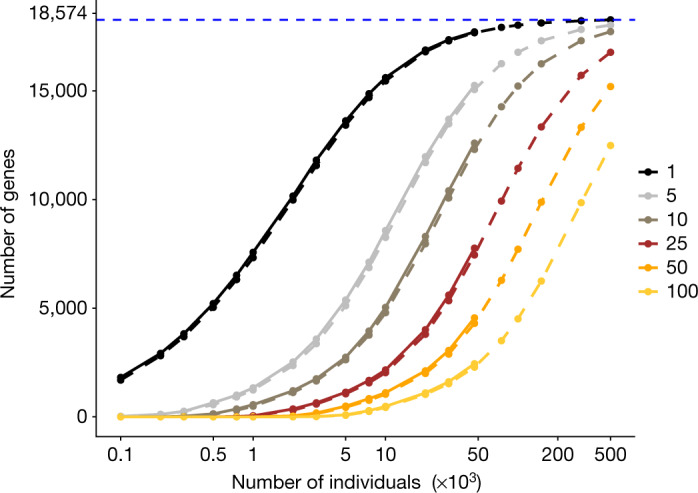
The UK Biobank is a prospective study of 502,543 individuals, combining extensive phenotypic and genotypic data with streamlined access for researchers around the world 1 . Here we describe the release of exome-sequence data for the first 49,960 study participants, revealing approximately 4 million coding variants (of which around 98.6% have a frequency of less than 1%). The data include 198,269 autosomal predicted loss-of-function (LOF) variants, a more than 14-fold increase compared to the imputed sequence. Nearly all genes (more than 97%) had at least one carrier with a LOF variant, and most genes (more than 69%) had at least ten carriers with a LOF variant. We illustrate the power of characterizing LOF variants in this population through association analyses across 1,730 phenotypes. In addition to replicating established associations, we found novel LOF variants with large effects on disease traits, including PIEZO1 on varicose veins, COL6A1 on corneal resistance, MEPE on bone density, and IQGAP2 and GMPR on blood cell traits. We further demonstrate the value of exome sequencing by surveying the prevalence of pathogenic variants of clinical importance, and show that 2% of this population has a medically actionable variant. Furthermore, we characterize the penetrance of cancer in carriers of pathogenic BRCA1 and BRCA2 variants. Exome sequences from the first 49,960 participants highlight the promise of genome sequencing in large population-based studies and are now accessible to the scientific community.
Overview
The claims and statistics of this paper haven’t been checked yet.
Free: it reads the open-access text and checks the first 5 claims that cite a source we can check. Create a free account to check every claim.
Integrity signals
Registry
Cites
Statistics
Figures
Verification
Claims the paper makes
The claims and statistics of this paper haven’t been checked yet.
Free: it reads the open-access text and checks the first 5 claims that cite a source we can check. Create a free account to check every claim.
Self-check
Percentages, sums and reported differences re-computed from the paper’s own numbers.
The self-check needs the paper’s full text.
Citations
Cites
Sudlow, C., Gallacher, J., Allen, N., Beral, V., Burton, P., Danesh, J., Downey, P., Elliott, P., Green, J., Landray, M., et al. (2015) · PLOS Medicine · doi:10.1371/journal.pmed.1001779 · Cited by 12,728
The mutational constraint spectrum quantified from variation in 141,456 humans
Karczewski, K. J., Francioli, L. C., Tiao, G., Cummings, B. B., Alföldi, J., Wang, Q., Collins, R. L., Laricchia, K. M., Ganna, A., Birnbaum, D. P., et al. (2020) · Nature · doi:10.1038/s41586-020-2308-7 · Cited by 9,434
Integrative Genomics Viewer (IGV): high-performance genomics data visualization and exploration
Thorvaldsdottir, H., Robinson, J. T., & Mesirov, J. P. (2013) · Briefings in Bioinformatics · doi:10.1093/bib/bbs017 · Cited by 9,049
The UK Biobank resource with deep phenotyping and genomic data
Bycroft, C., Freeman, C., Petkova, D., Band, G., Elliott, L. T., Sharp, K., Motyer, A., Vukcevic, D., Delaneau, O., O’Connell, J., et al. (2018) · Nature · doi:10.1038/s41586-018-0579-z · Cited by 8,876
Self-citationCADD: predicting the deleteriousness of variants throughout the human genome
Rentzsch, P., Witten, D., Cooper, G. M., Shendure, J., & Kircher, M. (2019) · Nucleic Acids Research · doi:10.1093/nar/gky1016 · Cited by 3,534
Sequence Variations in PCSK9, Low LDL, and Protection against Coronary Heart Disease
Cohen, J. C., Boerwinkle, E., Mosley, T. H., & Hobbs, H. H. (2006) · New England Journal of Medicine · doi:10.1056/nejmoa054013 · Cited by 3,181
A new multipoint method for genome-wide association studies by imputation of genotypes
Marchini, J., Howie, B., Myers, S., McVean, G., & Donnelly, P. (2007) · Nature Genetics · doi:10.1038/ng2088 · Cited by 2,609
Self-citationACMG recommendations for reporting of incidental findings in clinical exome and genome sequencing
Green, R. C., Berg, J. S., Grody, W. W., Kalia, S. S., Korf, B. R., Martin, C. L., McGuire, A. L., Nussbaum, R. L., O’Daniel, J. M., Ormond, K. E., et al. (2013) · Genetics in Medicine · doi:10.1038/gim.2013.73 · Cited by 2,541
MaCH: using sequence and genotype data to estimate haplotypes and unobserved genotypes
Li, Y., Willer, C. J., Ding, J., Scheet, P., & Abecasis, G. R. (2010) · Genetic Epidemiology · doi:10.1002/gepi.20533 · Cited by 1,843
Self-citationMeta-Analysis of BRCA1 and BRCA2 Penetrance
Chen, S., & Parmigiani, G. (2007) · Journal of Clinical Oncology · doi:10.1200/jco.2006.09.1066 · Cited by 1,802
Cited by
Items 101–200 of 621
The contribution of X-linked coding variation to severe developmental disorders
Martin, H. C., Gardner, E. J., Samocha, K. E., Kaplanis, J., Akawi, N. A., Sifrim, A., Eberhardt, R. Y., Tavares, A. L. T., Neville, M. D. C., Niemi, M., et al. (2021) · Nature Communications · doi:10.1038/s41467-020-20852-3 · Cited by 77
Reduced reproductive success is associated with selective constraint on human genes
Gardner, E. J., Neville, M. D. C., Samocha, K. E., Barclay, K., Kolk, M., Niemi, M. E. K., Kirov, G., Martin, H. C., & Hurles, M. E. (2022) · Nature · doi:10.1038/s41586-022-04549-9 · Cited by 72
Trinder, M., Paquette, M., Cermakova, L., Ban, M. R., Hegele, R. A., Baass, A. W., & Brunham, L. R. (2020) · Circulation Genomic and Precision Medicine · doi:10.1161/circgen.120.002919 · Cited by 79
Cross-protein transfer learning substantially improves disease variant prediction
(2023) · doi:10.1186/s13059-023-03024-6 · Cited by 68
“Efforts to collect population genomic data relating variants to disease phenotypes have made progress on this problem [3, 4].”
BackgroundEnvironmental and genetic predictors of human cardiovascular ageing
Shah, M., Inácio, M. H. D. A., Lu, C., Schiratti, P.-R., Zheng, S. L., Clement, A., de Marvao, A., Bai, W., King, A. P., Ware, J. S., et al. (2023) · Nature Communications · doi:10.1038/s41467-023-40566-6 · Cited by 72
Cross-protein transfer learning substantially improves disease variant prediction
Jagota, M., Ye, C., Albors, C., Rastogi, R., Koehl, A., Ioannidis, N., & Song, Y. S. (2022) · doi:10.1101/2022.11.15.516532 · Cited by 68
Allen, N. E., Arnold, M., Parish, S., Hill, M., Sheard, S., Callen, H., Fry, D., Moffat, S., Gordon, M., Welsh, S., et al. (2020) · Wellcome Open Research · doi:10.12688/wellcomeopenres.16171.2 · Cited by 70
Rare loss of function variants in the hepatokine gene INHBE protect from abdominal obesity
Deaton, A. M., Dubey, A., Ward, L. D., Dornbos, P., Flannick, J., AMP-T2D-GENES Consortium, Yee, E., Ticau, S., Noetzli, L., Parker, M. M., et al. (2022) · Nature Communications · doi:10.1038/s41467-022-31757-8 · Cited by 57
Endothelial lipase mediates efficient lipolysis of triglyceride-rich lipoproteins
Khetarpal, S. A., Vitali, C., Levin, M. G., Klarin, D. M., Park, J., Pampana, A., Millar, J. S., Kuwano, T., Dhavamani, S., Subbaiah, P. V., et al. (2021) · PLoS Genetics · doi:10.1371/journal.pgen.1009802 · Cited by 68
Clonal haematopoiesis of indeterminate potential and atrial fibrillation: an east Asian cohort study
Ahn, H., An, H. Y., Ryu, G., Lim, J., Sun, C.-H., Song, H., Choi, S., Lee, H., Maurer, T. M., Nachun, D. C., et al. (2024) · European Heart Journal · doi:10.1093/eurheartj/ehad869 · Cited by 66
Over 1000 genetic loci influencing blood pressure with multiple systems and tissues implicated
Cabrera, C., Ng, F. L., Nicholls, H., Gupta, A. K., Barnes, M. R., Munroe, P. B., & Caulfield, M. J. (2019) · Human Molecular Genetics · doi:10.1093/hmg/ddz197 · Cited by 78
A spectrum of recessiveness among Mendelian disease variants in UK Biobank
Barton, A. R., Hujoel, M. L. A., Mukamel, R. E., Sherman, M. A., & Loh, P. (2022) · The American Journal of Human Genetics · doi:10.1016/j.ajhg.2022.05.008 · Cited by 65
Rare coding variant analysis for human diseases across biobanks and ancestries
Jurgens, S. J., Wang, X., Choi, S. H., Weng, L.-C. C., Koyama, S., Pirruccello, J. P., Nguyen, T. T. H., Smadbeck, P., Jang, D., Chaffin, M. D., et al. (2024) · Nature Genetics · doi:10.1038/s41588-024-01894-5 · Cited by 68
“We identified several biologically plausible gene–disease links, which were described recently in biobank studies 4,5,41,42 (Supplementary Tables 6–8).”
Akbari, P., Sosina, O. A., Bovijn, J., Landheer, K., Nielsen, J. B., Kim, M., Aykul, S., De, T., Haas, M. E., Hindy, G., et al. (2022) · Nature Communications · doi:10.1038/s41467-022-32398-7 · Cited by 68
Self-citationZekavat, S. M., Jorshery, S. D., Rauscher, F. G., Horn, K., Sekimitsu, S., Koyama, S., Nguyen, T. T. H., Costanzo, M. C., Jang, D., Burtt, N. P., et al. (2024) · Science Translational Medicine · doi:10.1126/scitranslmed.adg4517 · Cited by 64
Precision medicine with multi-omics strategies, deep phenotyping, and predictive analysis
Ahmed, Z. (2022) · Progress in molecular biology and translational science · doi:10.1016/bs.pmbts.2022.02.002 · Cited by 67
Ward, L. D., Tu, H.-C., Quenneville, C. B., Tsour, S., Flynn-Carroll, A. O., Parker, M. M., Deaton, A. M., Haslett, P. A. J., Lotta, L. A., Verweij, N., et al. (2021) · Nature Communications · doi:10.1038/s41467-021-24563-1 · Cited by 59
Self-citationHindy, G., Dornbos, P., Chaffin, M. D., Liu, D. J., Wang, M., Selvaraj, M. S., Zhang, D., Park, J., Aguilar-Salinas, C. A., Fulton, L., et al. (2021) · The American Journal of Human Genetics · doi:10.1016/j.ajhg.2021.11.021 · Cited by 83
Self-citationIvarsdottir, E. V., Hólm, H., Benónísdóttir, S., Ólafsdóttir, Þ., Sveinbjörnsson, G., Þorleifsson, G., Eggertsson, H. P., Halldorsson, G. H., Hjörleifsson, K. E., Melsted, P., et al. (2021) · Communications Biology · doi:10.1038/s42003-021-02224-9 · Cited by 61
Li, X., Quick, C., Zhou, H., Gaynor, S. M., Liu, Y., Chen, H., Selvaraj, M. S., Sun, R., Dey, R., Arnett, D. K., et al. (2022) · Nature Genetics · doi:10.1038/s41588-022-01225-6 · Cited by 64
Self-citationGenetic and environmental determinants of diastolic heart function
Thanaj, M., Mielke, J., McGurk, K. A., Bai, W., Savioli, N., de Marvao, A., Meyer, H. V., Zeng, L., Sohler, F., Lumbers, R. T., et al. (2022) · Nature Cardiovascular Research · doi:10.1038/s44161-022-00048-2 · Cited by 59
“The sequencing methods and variant calling procedures have been described in detail 58 .”
Actionable Genotypes and Their Association with Life Span in Iceland
Jensson, B. Ö., Arnadottir, G. A., Katrínardóttir, H., Friðriksdóttir, R., Helgason, H., Oddsson, Á., Sveinbjörnsson, G., Eggertsson, H. P., Halldorsson, G. H., Atlason, B. A., et al. (2023) · New England Journal of Medicine · doi:10.1056/nejmoa2300792 · Cited by 58
Exome sequencing in genetic disease: recent advances and considerations
Ross, J. P., Dion, P. A., & Rouleau, G. A. (2020) · F1000Research · doi:10.12688/f1000research.19444.1 · Cited by 61
Mégy, K., Downes, K., Morel‐Kopp, M., Bastida, J. M., Brooks, S., Bury, L., Leinoe, E. B., Gomez, K., Morgan, N. V., Othman, M., et al. (2021) · Journal of Thrombosis and Haemostasis · doi:10.1111/jth.15459 · Cited by 54
Influence of family history on penetrance of hereditary cancers in a population setting
Jackson, L. M., Weedon, M. N., Green, H., Mallabar-Rimmer, B., Harrison, J., Wood, A. R., Ruth, K., Tyrrell, J., & Wright, C. F. (2023) · EClinicalMedicine · doi:10.1016/j.eclinm.2023.102159 · Cited by 57
Genome sequencing unveils a regulatory landscape of platelet reactivity
Keramati, A. R., Chen, M., Rodriguez, B. A. T., Yanek, L. R., Bhan, A., Gaynor, B. J., Ryan, K. A., Brody, J. A., Zhong, X. Y., Wei, Q., et al. (2021) · Nature Communications · doi:10.1038/s41467-021-23470-9 · Cited by 55
Self-citationLin, J.-R., Sin‐Chan, P., Napolioni, V., Torres, G. G., Mitra, J., Zhang, Q., Jabalameli, M. R., Wang, Z., Nguyen, N., Gao, T., et al. (2021) · Nature Aging · doi:10.1038/s43587-021-00108-5 · Cited by 53
Self-citationMN, W., L, J., JW, H., KS, R., J, T., AT, H., & CF, W. (2021) · BMJ · doi:10.1136/bmj.n214 · Cited by 51
Kelly, M., Leader, J. B., Wain, K. E., Bodian, D. L., Oetjens, M. T., Ledbetter, D. H., Martin, C. L., & Strande, N. T. (2021) · American Journal of Medical Genetics Part C Seminars in Medical Genetics · doi:10.1002/ajmg.c.31887 · Cited by 55
“A total of up to 2.6% (3,355/130,048) of adult patient-participants analyzed in our population screening program have a screen-positive finding, representing a conservative detection rate that is consistent with prior studies (Amendola et al., 2015; Dewey et al., 2016; eMERGE Clinical Annotation Working Group, 2020; G…”
BackgroundMethodResultInfluentialSelf-citationDornbos, P., Koesterer, R., Ruttenburg, A., Nguyen, T., Cole, J. B., AMP-T2D-GENES Consortium, Leong, A., Meigs, J. B., Florez, J. C., Rotter, J. I., et al. (2022) · Nature Genetics · doi:10.1038/s41588-022-01200-1 · Cited by 46
Adjusting for common variant polygenic scores improves yield in rare variant association analyses
Jurgens, S. J., Pirruccello, J. P., Choi, S. H., Morrill, V. N., Chaffin, M. D., Lubitz, S. A., Lunetta, K. L., & Ellinor, P. T. (2023) · Nature Genetics · doi:10.1038/s41588-023-01342-w · Cited by 55
Association of Pathogenic Variants in Hereditary Cancer Genes With Multiple Diseases
Zeng, C., Bastarache, L. A., Tao, R., Venner, E., Hebbring, S. J., Andujar, J. D., Bland, H. T., Crosslin, D. R., Pratap, S., Cooley, A., et al. (2022) · JAMA Oncology · doi:10.1001/jamaoncol.2022.0373 · Cited by 54
Self-citationLi, L., Chen, Z., von Scheidt, M., Li, S., Steiner, A., Güldener, U., Koplev, S., Ma, A., Hao, K., Pan, C., et al. (2022) · Basic Research in Cardiology · doi:10.1007/s00395-022-00917-8 · Cited by 61
“For 18 novel risk genes, we performed association analysis for variants located in respective loci (± 1 Mb) with lipid traits using genotyping data of UKB.”
InfluentialQiao, L., Xu, L., Yu, L., Wynn, J., Hernan, R., Zhou, X., Farkouh‐Karoleski, C., Krishnan, U., Khlevner, J., De, A., et al. (2021) · The American Journal of Human Genetics · doi:10.1016/j.ajhg.2021.08.011 · Cited by 51
“0 identical to the previous study.(20) Whole-exome sequencing of theWHICAP cohort was performed at Columbia University with the Roche SeqCap EZ Exome Probes v.”
MethodSelf-citationPolygenic architecture and cardiovascular risk of familial combined hyperlipidemia
Trinder, M., Vikulova, D. N., Pimstone, S. N., Mancini, G. B. J., & Brunham, L. R. (2021) · Atherosclerosis · doi:10.1016/j.atherosclerosis.2021.11.032 · Cited by 50
LMNA Variants and Risk of Adult-Onset Cardiac Disease
Lazarte, J., Jurgens, S. J., Choi, S. H., Khurshid, S. S., Morrill, V. N., Weng, L.-C. C., Nauffal, V., Pirruccello, J. P., Halford, J. L., Hegele, R. A., et al. (2022) · Journal of the American College of Cardiology · doi:10.1016/j.jacc.2022.04.035 · Cited by 48
Rare protein-altering variants in ANGPTL7 lower intraocular pressure and protect against glaucoma
Tanigawa, Y., Wainberg, M., Karjalainen, J., Kiiskinen, T., Venkataraman, G., Lemmelä, S., Turunen, J. A., Graham, R. R., Havulinna, A. S., Perola, M., et al. (2020) · PLOS Genetics · doi:10.1371/journal.pgen.1008682 · Cited by 49
The genetics of human hematopoiesis and its disruption in disease
Bao, E. L., Cheng, A. N., & Sankaran, V. G. (2019) · EMBO Molecular Medicine · doi:10.15252/emmm.201910316 · Cited by 42
Protein-altering variants at copy number-variable regions influence diverse human phenotypes
Hujoel, M. L. A., Handsaker, R. E., Sherman, M. A., Kamitaki, N., Barton, A. R., Mukamel, R. E., Terao, C., McCarroll, S. A., & Loh, P. (2024) · Nature Genetics · doi:10.1038/s41588-024-01684-z · Cited by 48
“While exome sequencing of the UKB was performed relatively uniformly across samples, exome capture was performed using a different Integrated DNA Technologies oligo-nucleotide lot for the first 50,000 samples 51 versus the remainder of the cohort, requiring careful treatment of this batch covariate.”
ATAV: a comprehensive platform for population-scale genomic analyses
Ren, Z., Povysil, G., Hostyk, J. A., Cui, H., Bhardwaj, N., & Goldstein, D. B. (2021) · BMC Bioinformatics · doi:10.1186/s12859-021-04071-1 · Cited by 46
Fibrillar Collagen Variants in Spontaneous Coronary Artery Dissection
Zekavat, S. M., Chou, E. L., Zekavat, M., Pampana, A., Paruchuri, K., Cardenas, C. L. L., Koyama, S., Ghazzawi, Y., Kii, E., Uddin, M. M., et al. (2022) · JAMA Cardiology · doi:10.1001/jamacardio.2022.0001 · Cited by 49
Lucas, M. R., Atkins, J. L., Pilling, L. C., Shearman, J., & Melzer, D. R. (2024) · BMJ Open · doi:10.1136/bmjopen-2023-081926 · Cited by 45
Clausen, L., Okarmus, J., Voutsinos, V., Meyer, M., Lindorff‐Larsen, K., & Hartmann‐Petersen, R. (2024) · Cellular and Molecular Life Sciences · doi:10.1007/s00018-024-05262-8 · Cited by 48
Deaton, A. M., Parker, M. M., Ward, L. D., Flynn-Carroll, A. O., BonDurant, L., Hinkle, G., Akbari, P., Lotta, L. A., Regeneron Genetics Center, RGC Management and Leadership Team, et al. (2021) · Scientific Reports · doi:10.1038/s41598-021-99091-5 · Cited by 34
Self-citationBienfait, K., Chhibber, A., Marshall, J.-C. A., Armstrong, M., Cox, C. J., Shaw, P. M., & Paulding, C. (2021) · Human Genetics · doi:10.1007/s00439-021-02282-3 · Cited by 46
Frequencies of pharmacogenomic alleles across biogeographic groups in a large-scale biobank
Li, B., Sangkuhl, K., Whaley, R. M., Woon, M., Keat, K., Whirl‐Carrillo, M., Ritchie, M. D., & Klein, T. E. (2023) · The American Journal of Human Genetics · doi:10.1016/j.ajhg.2023.09.001 · Cited by 42
Hepatocyte mARC1 promotes fatty liver disease
Lewis, L. C., Chen, L., Hameed, L. S., Kitchen, R. R., Maroteau, C., Nagarajan, S. R., Norlin, J., Daly, C. E., Szczerbinska, I., Hjuler, S. T., et al. (2023) · JHEP Reports · doi:10.1016/j.jhepr.2023.100693 · Cited by 44
Exploring the complex spectrum of dominance and recessiveness in genetic cardiomyopathies
Lipov, A., Jurgens, S. J., Mazzarotto, F., Allouba, M., Pirruccello, J. P., Aguib, Y., Gennarelli, M., Yacoub, M. H., Ellinor, P. T., Bezzina, C. R., et al. (2023) · Nature Cardiovascular Research · doi:10.1038/s44161-023-00346-3 · Cited by 42
“Exome sequencing was performed on 454,787 individuals from the UK Biobank as described previously 40,41 .”
MethodBenchmarking computational variant effect predictors by their ability to infer human traits
Tabet, D. R., Kuang, D., Lancaster, M. C., Li, R., Liu, K., Weile, J., Coté, A. G., Wu, Y., Hegele, R. A., Roden, D. M., et al. (2024) · Genome biology · doi:10.1186/s13059-024-03314-7 · Cited by 41
“…gene-trait combinations previously reported in rare-variant burden association studies in the UK Biobank (Additional file 1: Table S1) [8, 10, 22, 54], 2) extracted rare missense variants from the corresponding 99 genes; and 3) collected predicted functional scores from 24 computational variant…”
BackgroundRare coding variants in DNA damage repair genes associated with timing of natural menopause
Ward, L. D., Parker, M. M., Deaton, A. M., Tu, H.-C., Flynn-Carroll, A. O., Hinkle, G., & Nioi, P. (2022) · Human Genetics and Genomics Advances · doi:10.1016/j.xhgg.2021.100079 · Cited by 38
“Multiplehematological associationswithCHEK2werenoted ina recent studyof 49,960 exome-sequencedUKBiobankparticipants, which the authors noted could be secondary to cancer treatment.(15) To test whether these associations were shared with other breast cancer genes, we performed PheWASs on rare damaging variants in four…”
BackgroundMethodYu, K., Das, S., LeFaive, J., Kwong, A. M., Pleiness, J., Forer, L., Schönherr, S., Fuchsberger, C., Smith, A. V., & Abecasis, G. R. (2022) · The American Journal of Human Genetics · doi:10.1016/j.ajhg.2022.04.002 · Cited by 40
Self-citationSaid, M. A., Yeung, M. W., van de Vegte, Y. J., Benjamins, J. W., Dullaart, R. P. F., Ruotsalainen, S., Ripatti, S., Natarajan, P., Juarez-Orozco, L. E., Verweij, N., et al. (2021) · Arteriosclerosis, Thrombosis, and Vascular Biology · doi:10.1161/atvbaha.120.315300 · Cited by 39
Actionable genomic variants in 6045 participants from the Qatar Genome Program
Elfatih, A., Mifsud, B., Syed, N., Badii, R., Mbarek, H., Abbaszadeh, F., Estivill, X., Qatar Genome Project Management, Ismail, S. I., Al‐Muftah, W., et al. (2021) · Human Mutation · doi:10.1002/humu.24278 · Cited by 40
Deep integrative models for large-scale human genomics
Sigurdsson, A. I., Louloudis, I. E., Banasik, K., Westergaard, D., Winther, O., Lund, O., Ostrowski, S. R., Erikstrup, C., Pedersen, O. B., Nyegaard, M., et al. (2023) · Nucleic Acids Research · doi:10.1093/nar/gkad373 · Cited by 42
Cheng, Y., Schlosser, P., Hertel, J., Sekula, P., Oefner, P. J., Spiekerkoetter, U., Mielke, J., Freitag, D. F., Schmidts, M., GCKD Investigators, et al. (2021) · Nature Communications · doi:10.1038/s41467-020-20877-8 · Cited by 37
Whole-exome sequencing in UK Biobank reveals rare genetic architecture for depression
Tian, R., Ge, T., Kweon, H., Rocha, D., Lam, M., Liu, J. Z., Singh, K., Biogen Biobank Team, Levey, D. F., Gelernter, J. E., et al. (2024) · Nature Communications · doi:10.1038/s41467-024-45774-2 · Cited by 39
“The WES production and quality control (QC) is described in detail in Van Hout et al. 40 .”
Genomics and the Acute Respiratory Distress Syndrome: Current and Future Directions
Hernández-Beeftink, T., Guillén‐Guío, B., Villar, J., & Flores, C. (2019) · International Journal of Molecular Sciences · doi:10.3390/ijms20164004 · Cited by 37
An Extensive Sequence Dataset of Gold-Standard Samples for Benchmarking and DevelopmentPreprint
Baid, G., Nattestad, M., Kolesnikov, A., Goel, S., Yang, H. H., Chang, P.-C., & Carroll, A. W. (2020) · bioRxiv (Cold Spring Harbor Laboratory) · doi:10.1101/2020.12.11.422022 · Cited by 39
“Strategies such as those employed for the exome sequencing of UK Biobank, which supplement the IDT exome with additional capture probes could be one strategy for achieving a good balance of on-target accuracy and breadth of capture[33].”
MethodVerma, S. S., Keat, K., Li, B., Hoffecker, G., Risman, M., Sangkuhl, K., Whirl‐Carrillo, M., DUDEK, S. M., Verma, A., Klein, T. E., et al. (2022) · Journal of Translational Medicine · doi:10.1186/s12967-022-03745-5 · Cited by 37
Identification of Rare Loss-of-Function Genetic Variation Regulating Body Fat Distribution
Koprulu, M., Zhao, Y., Wheeler, E., Dong, L., Rocha, N., Li, C., Griffin, J. D., Patel, S., de Streek, M. V., Glastonbury, C. A., et al. (2021) · The Journal of Clinical Endocrinology & Metabolism · doi:10.1210/clinem/dgab877 · Cited by 36
Self-citationLavoro, A., Scalisi, A., Candido, S., Zanghì, G., Rizzo, R., Gattuso, G., Caruso, G., Libra, M., & Falzone, L. (2022) · International Journal of Oncology · doi:10.3892/ijo.2022.5349 · Cited by 39
“However, BRCA1 and BRCA2 mutations may increase the suscepti‐ bility to several tumor types, particularly breast and ovarian cancer (96,97).”
BackgroundGenetic map of regional sulcal morphology in the human brain from UK biobank data
Sun, B. B., Loomis, S. J., Pizzagalli, F., Shatokhina, N., Painter, J. N., Foley, C. N., Biogen Biobank Team, Sun, B. B., Tsai, E. A., Bronson, P. G., et al. (2022) · Nature Communications · doi:10.1038/s41467-022-33829-1 · Cited by 37
Self-citationGenetic architecture of complex traits and disease risk predictors
Yong, S. Y., Raben, T. G., Lello, L., & Hsu, S. (2020) · Scientific Reports · doi:10.1038/s41598-020-68881-8 · Cited by 38
Ramensky, V. E., Ershova, A. I., Zaicenoka, M., Kiseleva, A. V., Zharikova, A. A., Vyatkin, Y. V., Сотникова, Е. А., Efimova, I. A., Дивашук, М. Г., Kurilova, O. V., et al. (2021) · Frontiers in Genetics · doi:10.3389/fgene.2021.709419 · Cited by 40
Patel, A. P., Dron, J. S., Wang, M., Pirruccello, J. P., Ng, K., Natarajan, P., Lebo, M. S., Ellinor, P. T., Aragam, K. G., & Khera, A. V. (2022) · JAMA Cardiology · doi:10.1001/jamacardio.2022.0901 · Cited by 37
Hepatic SREBP signaling requires SPRING to govern systemic lipid metabolism in mice and humans
Hendrix, S., Kingma, J., Ottenhoff, R., Valiloo, M., Svecla, M., Zijlstra, L. F., Sachdev, V., Kovac, K., Levels, J. H. M., Jongejan, A., et al. (2023) · Nature Communications · doi:10.1038/s41467-023-40943-1 · Cited by 34
“Full details of the whole-exome sequencing (WES) in the UK Biobank have been reported previously 63 .”
Surakka, I. L., Fritsche, L. G., Zhou, W., Backman, J., Kosmicki, J. A., Lu, H., Brumpton, B. M., Nielsen, J. B., Gabrielsen, M. E., Skogholt, A. H., et al. (2020) · Nature Communications · doi:10.1038/s41467-020-17315-0 · Cited by 35
Self-citationMutation saturation for fitness effects at human CpG sites
Agarwal, I., & Przeworski, M. (2021) · eLife · doi:10.7554/elife.71513 · Cited by 37
Hanks, S. C., Forer, L., Schönherr, S., LeFaive, J., Martins, T., Welch, R., Taliun, S. A. G., BRAFF, D. L., Johnsen, J. M., Kenny, E. E., et al. (2022) · The American Journal of Human Genetics · doi:10.1016/j.ajhg.2022.07.012 · Cited by 34
Unexplained Female Infertility Associated with Genetic Disease Variants
Dougherty, M. P., Poch, A. M., Chorich, L. P., Hawkins, Z. A., Hongyan, X., Roman, R. A., Liu, H., Brakta, S., Taylor, H. S., KNIGHT, J. W., et al. (2023) · New England Journal of Medicine · doi:10.1056/nejmc2211539 · Cited by 36
Missense variants in TAF1 and developmental phenotypes: Challenges of determining pathogenicity
Cheng, H., Capponi, S., Wakeling, E. L., Marchi, E. J., Li, Q., Zhao, M., Weng, C., Piatek, S., Ahlfors, H., Kleyner, R. S., et al. (2019) · Human Mutation · doi:10.1002/humu.23936 · Cited by 37
Germline genetic variation impacts clonal hematopoiesis landscape and progression to malignancy
Liu, J., Tran, D., Xue, L., Wiley, B. J., Vlasschaert, C., Watson, C. J., MacGregor, H. A. J., Zong, X., Chan, I. C. C., Das, I., et al. (2025) · Nature Genetics · doi:10.1038/s41588-025-02250-x · Cited by 33
Praveen, K., Dobbyn, L., Gurski, L., Ayer, A. H., Staples, J. C., Mishra, S., Bai, Y., Kaufman, A., Moscati, A., Benner, C., et al. (2022) · Communications Biology · doi:10.1038/s42003-022-03408-7 · Cited by 35
“15 Supplementary Methods 79 80 Phenotype definition: 81 Hearing loss in GHS, MALMO and SINAI was defined using ICD-10 codes: cases were 82 individuals who had (1) a problem-list entry of the ICD-10 diagnosis code (H903-H908, H911, 83 H919), (2) an inpatient hospitalization-discharge ICD-10 diagnosis code, or (3) an en…”
BackgroundMethodSelf-citationGenetics of mitochondrial diseases: Current approaches for the molecular diagnosis
Schlieben, L. D., & Prokisch, H. (2023) · Handbook of clinical neurology · doi:10.1016/b978-0-12-821751-1.00011-7 · Cited by 39
Yield of genetic association signals from genomes, exomes and imputation in the UK Biobank
Gaynor, S. M., Joseph, T., Bai, X., Zou, Y., Boutkov, B., Maxwell, E. K., Delaneau, O., Hofmeister, R. J., Krasheninina, O. A., Balasubramanian, S., et al. (2024) · Nature Genetics · doi:10.1038/s41588-024-01930-4 · Cited by 34
“Our primary analyses included 149,195 UKB participants with data from IMP 27 , WES 28,29 and WGS 21 as described in Supplementary Figs.”
Self-citationInherited variants in CHD3 show variable expressivity in Snijders Blok-Campeau syndrome
van der Spek, J., den Hoed, J., Blok, L. S., Dingemans, A. J. M., Schijven, D., Nellåker, C., Venselaar, H., Astuti, G., Barakat, T. S., Bebin, E. M., et al. (2022) · Genetics in Medicine · doi:10.1016/j.gim.2022.02.014 · Cited by 34
Establishing the Medical Actionability of Genomic Variants
Goddard, K. A. B., Lee, K., Buchanan, A. H., Powell, B. C., & Hunter, J. E. (2022) · Annual Review of Genomics and Human Genetics · doi:10.1146/annurev-genom-111021-032401 · Cited by 36
“0 of the ACMG Secondary Findings list have been used worldwide, and large studies have found a frequency of approximately 2% for medically actionable secondary findings on this list (26,38,82,92).”
MethodEstimating cancer risk in carriers of Lynch syndrome variants in UK Biobank
Fummey, E., Navarro, P., Plazzer, J., Frayling, I. M., Knott, S., & Tenesa, A. (2024) · Journal of Medical Genetics · doi:10.1136/jmg-2023-109791 · Cited by 33
Whole exome sequencing analyses identified novel genes for Alzheimer's disease and related dementia
Zhang, Y.-R., Wu, B., Chen, S., Yang, L., Deng, Y., Guo, Y. X., Wu, X., Liu, W., Kang, J., Feng, J., et al. (2024) · Alzheimer s & Dementia · doi:10.1002/alz.14181 · Cited by 32
Integration of variant annotations using deep set networks boosts rare variant association testing
Clarke, B., Holtkamp, E., Öztürk, H., Mück, M., Wahlberg, M., Meyer, K., Munzlinger, F., Brechtmann, F., Hölzlwimmer, F. R., Lindner, J., et al. (2024) · Nature Genetics · doi:10.1038/s41588-024-01919-z · Cited by 37
“Since the dataset had not been subjected to variant-or sample-level filtering prior to release by the UK Biobank, we applied additional quality control(QC) following [26].”
MethodMachine learning–based penetrance of genetic variants
Forrest, I. S., Vy, H. M. T., Rocheleau, G., Jordan, D. M., Petrazzini, B. O., Nadkarni, G. N., Cho, J. H., Ganapathi, M., Huang, K., Chung, W. K., et al. (2025) · Science · doi:10.1126/science.adm7066 · Cited by 34
Self-citationZhou, S., Sosina, O. A., Bovijn, J., Laurent, L., Sharma, V., Akbari, P., Forgetta, V., Jiang, L., Kosmicki, J. A., Banerjee, N., et al. (2023) · Nature Genetics · doi:10.1038/s41588-023-01444-5 · Cited by 32
Self-citationAn allelic-series rare-variant association test for candidate-gene discovery
McCaw, Z. R., O’Dushlaine, C. T., Somineni, H., Bereket, M. D., Klein, C., Karaletsos, T., Casale, F. P., Koller, D., & Soare, T. W. (2023) · The American Journal of Human Genetics · doi:10.1016/j.ajhg.2023.07.001 · Cited by 28
“Missense variants were annotated as benign (BMV) if they were predicted to be benign by PolyPhen2 and tolerated or tolerated low confidence by SIFT.(33,34) We further filtered PTVs to remove low-confidence loss of function by LOFTEE.”
MethodSelf-citationIntegrating common and rare variants improves polygenic risk prediction across diverse populations
Williams, J., Chen, T., Hua, X., Wong, W. S. W., Yu, K. F., Kraft, P. L., Li, X., & Zhang, H. (2026) · Nature Communications · doi:10.1038/s41467-026-72185-2 · Cited by 31
Evolution of Human Brain Size-Associated NOTCH2NL Genes Proceeds toward Reduced Protein Levels
Lodewijk, G. A., Fernandes, D. P., Vretzakis, I., Savage, J. E., & Jacobs, F. M. J. (2020) · Molecular Biology and Evolution · doi:10.1093/molbev/msaa104 · Cited by 30
Denamur, É., Condamine, B., Esposito‐Farèse, M., Royer, G., Clermont, O., Laouenan, C., Lefort, A., LASTOURS, V. D., Galardini, M., COLIBAFI, T., et al. (2022) · PLoS Genetics · doi:10.1371/journal.pgen.1010112 · Cited by 33
Gao, X., Chiariglione, M., & Arch, A. J. (2022) · Nature Communications · doi:10.1038/s41467-022-35188-3 · Cited by 29
Rare genetic variants impact muscle strength
Huang, Y., Bodnár, D., Chen, C., Sánchez-Andrade, G., Sanderson, M., Biogen Biobank Team, Whelan, C. D., Bronson, P. G., Sexton, D., John, S., et al. (2023) · Nature Communications · doi:10.1038/s41467-023-39247-1 · Cited by 30
“Such adjustment had only a minimal impact on the top fi ndings for hand grip strength (Supplementary Data 14), suggesting that the respective impact of rare variants on cognitive and muscle function is likely related, yet largely independent.”
Self-citationde Andrade, K. C., Strande, N. T., Kim, J., Haley, J. S., Hatton, J. N., Frone, M. N., Khincha, P. P., Thone, G. M., Mirshahi, U. L., Schneider, C., et al. (2023) · Human Genetics and Genomics Advances · doi:10.1016/j.xhgg.2023.100242 · Cited by 35
Self-citationLoss-of-Function Variants in the Tumor-Suppressor Gene PTPN14 Confer Increased Cancer Risk
Ólafsdóttir, Þ., Stacey, S., Sveinbjörnsson, G., Þorleifsson, G., Norland, K., Sigurgeirsson, B., Thorisdottir, K., Kristjansson, A. K., Tryggvadóttír, L., Sarin, K. Y., et al. (2021) · Cancer Research · doi:10.1158/0008-5472.can-20-3065 · Cited by 28
“The quality control applied to variants in the UK Biobank exome sequencing data has been described, with singletons validated by visual inspection using criteria that have been shown to correlate well with Sanger validation (36).”
MethodZhou, G., Ren, X., Tang, Z., Li, W., Chen, W., He, Y., Wei, B., Zhang, H., Ma, F., Chen, X., et al. (2023) · Frontiers in Immunology · doi:10.3389/fimmu.2023.1043380 · Cited by 32
Wuttke, M., König, E., Katsara, M., Kirsten, H., Farahani, S. K., Teumer, A., Li, Y., Lang, M., Göçmen, B., Pattaro, C., et al. (2023) · Nature Communications · doi:10.1038/s41467-023-36864-8 · Cited by 28
Exome-wide analysis implicates rare protein-altering variants in human handedness
Schijven, D., Soheili-Nezhad, S., Fisher, S. E., & Francks, C. (2024) · Nature Communications · doi:10.1038/s41467-024-46277-w · Cited by 27
“Whole-exome sequencing was performed by the UK Biobank according to protocols described elsewhere 93,94 .”
Analysis of 14,392 whole genomes reveals 3.5% of Qataris carry medically actionable variants
Elfatih, A., Saad, C., Qatar Genome Project Management, Ismail, S. I., Al‐Muftah, W., Badji, R. M., Darwish, D., Fadl, T., Yasin, H., Ennaifar, M., et al. (2024) · European Journal of Human Genetics · doi:10.1038/s41431-024-01656-1 · Cited by 27
Güvenek, A., Parikshak, N., Zamolodchikov, D., Gelfman, S., Moscati, A., Dobbyn, L., Stahl, E. A., Shuldiner, A. R., & Coppola, G. (2024) · Communications Biology · doi:10.1038/s42003-024-06684-7 · Cited by 30
“Exome sequencing data from the UK Biobank were processedas previously described 42,63 .”
Self-citationTitin Truncating Variants in Adults Without Known Congestive Heart Failure
Pirruccello, J. P., Bick, A. G., Friedman, S. F., Chaffin, M. D., Aragam, K. G., Choi, S. H., Lubitz, S. A., Ho, C. Y., Ng, K., Philippakis, A., et al. (2020) · Journal of the American College of Cardiology · doi:10.1016/j.jacc.2020.01.013 · Cited by 27
Jeon, S., Choi, H., Jeon, Y., Choi, W.-H., Choi, H., An, K., Ryu, H., Bhak, J., Lee, H., Kwon, Y., et al. (2024) · GigaScience · doi:10.1093/gigascience/giae014 · Cited by 28
“However, none of these studies covered the entirety of genomic variation, and they have limitations on genome-wide data analyses [5, 6].”
Functional Validation of Osteoporosis Genetic Findings Using Small Fish Models
Kague, É., & Karasik, D. (2022) · Genes · doi:10.3390/genes13020279 · Cited by 29
Fitzgerald, T. W., & Birney, E. (2022) · Cell Genomics · doi:10.1016/j.xgen.2022.100167 · Cited by 28
Identifying therapeutic drug targets using bidirectional effect genes
Estrada, K., Froelich, S., Wuster, A., Bauer, C. R., Sterling, T., Clark, W. T., Ru, Y., Trinidad, M., Nguyen, H. P., Luu, A. R., et al. (2021) · Nature Communications · doi:10.1038/s41467-021-21843-8 · Cited by 25
Self-citation
Metadata
- Authors
- Van Hout, C. V., Tachmazidou, I., Backman, J. D., Hoffman, J. D., Liu, D., Pandey, A. K., Gonzaga-Jauregui, C., Khalid, S., Ye, B., Banerjee, N., Li, A. H., O’Dushlaine, C., Marcketta, A., Staples, J., Schurmann, C., Hawes, A., Maxwell, E., Barnard, L., Lopez, A., Penn, J., Habegger, L., Blumenfeld, A. L., Bai, X., O’Keeffe, S., Yadav, A., Praveen, K., Jones, M., Salerno, W. J., Chung, W. K., Surakka, I., Willer, C. J., Hveem, K., Leader, J. B., Carey, D. J., Ledbetter, D. H., Geisinger-Regeneron DiscovEHR Collaboration, Cardon, L., Yancopoulos, G. D., Economides, A., Coppola, G., Shuldiner, A. R., Balasubramanian, S., Cantor, M., Regeneron Genetics Center, Nelson, M. R., Whittaker, J., Reid, J. G., Marchini, J., Overton, J. D., Scott, R. A., Abecasis, G. R., Yerges-Armstrong, L., & Baras, A.
- Affiliations
- AstraZeneca (United Kingdom) (GB)
- Regeneron (United States) (US)
- GlaxoSmithKline (United States) (US)
- Hasso Plattner Institute (DE)
- Columbia University Irving Medical Center (US)
- University of Michigan (US)
- Norwegian University of Science and Technology (NO)
- GlaxoSmithKline (United Kingdom) (GB)
- Deerfield (United States) (US)
- Corresponding author
- Scott, Robert A.
- Yerges-Armstrong, Laura
- Baras, Aris
- ORCID
- Van Hout, Cristopher V.
- Tachmazidou, Ioanna
- Backman, Joshua D.
- Hoffman, Joshua D.
- Liu, Daren
- Gonzaga-Jauregui, Claudia
- Ye, Bin
- Banerjee, Nilanjana
- Li, Alexander H.
- O’Dushlaine, Colm
- Marcketta, Anthony
- Staples, Jeffrey
- Schurmann, Claudia
- Maxwell, Evan
- Lopez, Alexander
- Blumenfeld, Andrew L.
- Bai, Xiaodong
- O’Keeffe, Sean
- Yadav, Ashish
- Jones, Marcus
- Salerno, William J.
- Chung, Wendy K.
- Surakka, Ida
- Willer, Cristen J.
- Hveem, Kristian
- Leader, Joseph B.
- Carey, David J.
- Ledbetter, David H.
- Economides, Aris
- Coppola, Giovanni
- Shuldiner, Alan R.
- Balasubramanian, Suganthi
- Cantor, Michael
- Nelson, Matthew R.
- Whittaker, John
- Reid, Jeffrey G.
- Marchini, Jonathan
- Overton, John D.
- Scott, Robert A.
- Abecasis, Gonçalo R.
- Yerges-Armstrong, Laura
- Baras, Aris
- Venue
- Nature
- Published
- 2020-10-21
- Volume
- 586
- Issue
- 7831
- Pages
- 749-756
- ISSN
- 0028-0836 (ISSN-L)
- 1476-4687
- PMC
- PMC7759458
- OpenAlex
- W3094550675
- Cited by
- 561
- References
- 59
- Citations by year
- 2026: 42 · 2025: 74 · 2024: 95 · 2023: 97 · 2022: 115 · 2021: 95 · 2020: 32
- FWCI
- 49.70
- Type
- journal article
- Language
- en
- Open access
- hybrid
- doi.org
- Licence
- cc-by
- creativecommons.org/licenses/by/4.0 (tdm)
- creativecommons.org/licenses/by/4.0 (vor)
- Locations
- Nature (publishedVersion, cc-by)
- Europe PMC (PubMed Central) (publishedVersion, other-oa)
- PubMed Central (publishedVersion, cc-by)
- PubMed (publishedVersion)
- RePEc: Research Papers in Economics (submittedVersion)
- publish.UP (University of Potsdam) (submittedVersion, cc-by)
- Funders
- Norges Teknisk-Naturvitenskapelige Universitet
- Norwegian Institute of Public Health
- National Heart, Lung, and Blood Institute (R01HL109946)
- Topics
- Life Sciences › Biochemistry, Genetics and Molecular Biology › Genetics › Genomics and Rare Diseases
- Life Sciences › Biochemistry, Genetics and Molecular Biology › Genetics › Genetic Associations and Epidemiology
- Life Sciences › Biochemistry, Genetics and Molecular Biology › Cancer Research › Cancer Genomics and Diagnostics
- Keywords
- exome sequencing, UK Biobank, loss-of-function mutations, coding variants, genetic association, Piezo1, varicose veins, COL6A1, MEPE, bone mineral density, IQGAP2, blood cell traits, pathogenic variants, BRCA1, BRCA2, cancer penetrance, population genomics
- MeSH terms
- Exome Sequencing, Loss of Function Mutation, Aged, Demography, Female, Genotype, United Kingdom, Humans, Ion Channels, Male, Middle Aged, Neoplasms, Peptide Fragments, Phenotype, Varicose Veins, Bone Density, Genes, BRCA1, Penetrance, ras GTPase-Activating Proteins, Collagen Type VI, Genes, BRCA2, Databases, Genetic, Exome
About these checks
Registry, retraction, Cites and statistics results are computed, not judged, with one exception: a printed reference that no index lists is read once by a model before it counts as a citation error. Claims are extracted by a model and kept only when their quote appears verbatim in the text; each cited source is then checked, with a model’s help, for whether it says what the claim relies on. Those verdicts can be wrong — read the claim’s quote and the cited source before relying on one.
Statistics and arithmetic are recomputed, not judged.
Confidence bands are shown only for fields calibrated on our annotated test set. None is calibrated yet, so no band is shown.
What counts as a claim ›How we measure confidence ›How we check this ›
Are you an author, or do you see a problem with this page? Request a review
Data sources
Bibliographic data: Semantic Scholar, OpenAlex, Crossref.
Contains information from the Semantic Scholar Academic Graph Datasets, made available under the ODC Attribution License (ODC-BY 1.0).
Semantic Scholar’s data is described in: Kinney, R., et al. (2023). The Semantic Scholar Open Data Platform. arXiv:2301.10140.
