

Exome sequencing and characterization of 49,960 individuals in the UK Biobank
Open accessThe DOI matches its Crossref record; 61 of the 61 references it cites were found in a registry or an index.
Abstract
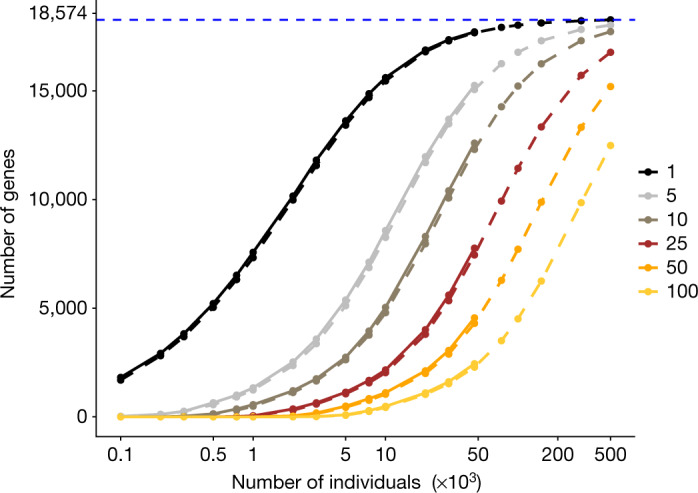
The UK Biobank is a prospective study of 502,543 individuals, combining extensive phenotypic and genotypic data with streamlined access for researchers around the world 1 . Here we describe the release of exome-sequence data for the first 49,960 study participants, revealing approximately 4 million coding variants (of which around 98.6% have a frequency of less than 1%). The data include 198,269 autosomal predicted loss-of-function (LOF) variants, a more than 14-fold increase compared to the imputed sequence. Nearly all genes (more than 97%) had at least one carrier with a LOF variant, and most genes (more than 69%) had at least ten carriers with a LOF variant. We illustrate the power of characterizing LOF variants in this population through association analyses across 1,730 phenotypes. In addition to replicating established associations, we found novel LOF variants with large effects on disease traits, including PIEZO1 on varicose veins, COL6A1 on corneal resistance, MEPE on bone density, and IQGAP2 and GMPR on blood cell traits. We further demonstrate the value of exome sequencing by surveying the prevalence of pathogenic variants of clinical importance, and show that 2% of this population has a medically actionable variant. Furthermore, we characterize the penetrance of cancer in carriers of pathogenic BRCA1 and BRCA2 variants. Exome sequences from the first 49,960 participants highlight the promise of genome sequencing in large population-based studies and are now accessible to the scientific community.
Overview
The claims and statistics of this paper haven’t been checked yet.
Free: it reads the open-access text and checks the first 5 claims that cite a source we can check. Create a free account to check every claim.
Integrity signals
Registry
Cites
Statistics
Figures
Verification
Claims the paper makes
The claims and statistics of this paper haven’t been checked yet.
Free: it reads the open-access text and checks the first 5 claims that cite a source we can check. Create a free account to check every claim.
Self-check
Percentages, sums and reported differences re-computed from the paper’s own numbers.
The self-check needs the paper’s full text.
Citations
Cites
Sudlow, C., Gallacher, J., Allen, N., Beral, V., Burton, P., Danesh, J., Downey, P., Elliott, P., Green, J., Landray, M., et al. (2015) · PLOS Medicine · doi:10.1371/journal.pmed.1001779 · Cited by 12,728
The mutational constraint spectrum quantified from variation in 141,456 humans
Karczewski, K. J., Francioli, L. C., Tiao, G., Cummings, B. B., Alföldi, J., Wang, Q., Collins, R. L., Laricchia, K. M., Ganna, A., Birnbaum, D. P., et al. (2020) · Nature · doi:10.1038/s41586-020-2308-7 · Cited by 9,434
Integrative Genomics Viewer (IGV): high-performance genomics data visualization and exploration
Thorvaldsdottir, H., Robinson, J. T., & Mesirov, J. P. (2013) · Briefings in Bioinformatics · doi:10.1093/bib/bbs017 · Cited by 9,049
The UK Biobank resource with deep phenotyping and genomic data
Bycroft, C., Freeman, C., Petkova, D., Band, G., Elliott, L. T., Sharp, K., Motyer, A., Vukcevic, D., Delaneau, O., O’Connell, J., et al. (2018) · Nature · doi:10.1038/s41586-018-0579-z · Cited by 8,876
Self-citationCADD: predicting the deleteriousness of variants throughout the human genome
Rentzsch, P., Witten, D., Cooper, G. M., Shendure, J., & Kircher, M. (2019) · Nucleic Acids Research · doi:10.1093/nar/gky1016 · Cited by 3,534
Sequence Variations in PCSK9, Low LDL, and Protection against Coronary Heart Disease
Cohen, J. C., Boerwinkle, E., Mosley, T. H., & Hobbs, H. H. (2006) · New England Journal of Medicine · doi:10.1056/nejmoa054013 · Cited by 3,181
A new multipoint method for genome-wide association studies by imputation of genotypes
Marchini, J., Howie, B., Myers, S., McVean, G., & Donnelly, P. (2007) · Nature Genetics · doi:10.1038/ng2088 · Cited by 2,609
Self-citationACMG recommendations for reporting of incidental findings in clinical exome and genome sequencing
Green, R. C., Berg, J. S., Grody, W. W., Kalia, S. S., Korf, B. R., Martin, C. L., McGuire, A. L., Nussbaum, R. L., O’Daniel, J. M., Ormond, K. E., et al. (2013) · Genetics in Medicine · doi:10.1038/gim.2013.73 · Cited by 2,541
MaCH: using sequence and genotype data to estimate haplotypes and unobserved genotypes
Li, Y., Willer, C. J., Ding, J., Scheet, P., & Abecasis, G. R. (2010) · Genetic Epidemiology · doi:10.1002/gepi.20533 · Cited by 1,843
Self-citationMeta-Analysis of BRCA1 and BRCA2 Penetrance
Chen, S., & Parmigiani, G. (2007) · Journal of Clinical Oncology · doi:10.1200/jco.2006.09.1066 · Cited by 1,802
Cited by
Items 601–621 of 621
Ao, X., Kolifarhood, G., Parisien, M., Bortsov, A. V., Grant, A. V., & Diatchenko, L. B. (2026) · Genome Medicine · doi:10.1186/s13073-026-01732-9
“Details of sample preparation, sequencing and initial processing have been described previously [19, 20].”
Li, J., Ge, Y., Du, J., Yang, L., Wu, B., Hang, C., Shen, M., Mao, Y. M., Zhang, T. B., Bo, Q., et al. (2026) · Advanced Science · doi:10.1002/advs.76582
“0 on the Illumina NovaSeq 6000 platform, achieving > 95% coverage at 20 × depth [ 47 ].”
Uromodulin T62P variant causes kidney tubular stress and injury modulated by age and polygenic riskPreprint
Khan, A., Gresch, A., Olinger, E. G., Mariniello, M., Shang, N., Pérez-Gómez, M. V., Dinsmore, I. R., Mabillard, H. R., Mirshahi, T., Chang, A., et al. (2026) · medRxiv · doi:10.64898/2026.07.29.26359269
Genetic Modifiers of ABCA1 Activity Interact with APOE Isoforms to Mediate Alzheimer's Disease Risk
Peña‐Tauber, A., Arriaza, R. H., Reil, D., Muntaner, M., Park, J. Y., Grenier‐Boley, B., Hulsman, M., Amouyel, P., Bellenguez, C., Charbonnier, C., et al. (2026) · Annals of Neurology · doi:10.1002/ana.78303
Evolution‐guided yeast complementation reveals functional differences in human PSPH variants
Campa‐Álvarez, M., Ascencio, D., Vallebueno‐Estrada, M., González-Orozco, E., Martínez-Guerrero, C. E., Montiel, R., & DeLuna, A. (2026) · FEBS Open Bio · doi:10.1002/2211-5463.70308
The pleiotropic landscape of rare variant associations with multiple cancers in large biobanks
Suger, A. H., Harrison, T. A., Zhang, J., Wu, M. C., Darst, B. F., & Lindström, S. (2026) · Human Genetics and Genomics Advances · doi:10.1016/j.xhgg.2026.100662
“11,29,42 The UKB WES data-set of 469,589 participants contained approximately 27 million genetic variants in coding regions.”
Banfield, L. R., Pilling, L. C., Melzer, D. R., Shearman, J. R., KNAPP, K. M., & Atkins, J. L. (2026) · medRxiv · doi:10.64898/2026.08.19.26360796
Lazaridi, I.-A., Hall, T. S., Hanson, H., Fasham, J., Baple, E. L., Weedon, M. N., Wright, C. F., & Jackson, L. M. (2026) · European Journal of Human Genetics · doi:10.1038/s41431-026-02231-6
Role of Polygenic Risk Scores and Artificial Intelligence
Rossi, M., Gandin, I., Barbati, G., Garoia, F., Ferro, M. D., Gigli, M., & Sinagra, G. (2026) · Springer eBooks · doi:10.1007/978-3-032-34334-5_13
Harnessing the human mutational spectrum to advance missense variant effect prediction
Pathak, A. K. (2026) · Edinburgh Research Archive (University of Edinburgh) · doi:10.7488/era/7794
Kotnik, U., Lovrečić, L., & Peterlin, B. (2026) · Frontiers in Genetics · doi:10.3389/fgene.2026.1847596
“The process of NGS results in the generation of a large amount of data (Van Hout et al., 2020; Auton et al., 2015), meaning that genomic diagnosis can frequently reveal additional findings in genes unrelated to the original diagnosis within the patient’s genome.”
A Primary Care Perspective on the Clinical Utility of Genomic, Proteomic, and Metabolomic Testing
al., S. M. T. E. M. E. (2024) · Letters in High Energy Physics
Garcia, M., Luo, Y., Lama, J. K., Young, T. L., Rossin, E. J., Pasquale, L. R., Hysi, P. G., Khawaja, A. P., Mackey, D. A., Craig, J. E., et al. (2026) · Genetics in Medicine · doi:10.1016/j.gim.2026.102750
Guo, L., Yuan, F., Zhou, N., Zhao, M., Liu, R., Jing, M., Feenstra, K. A., & Hou, Q. (2026) · International Journal of Molecular Sciences · doi:10.3390/ijms27198914
“The UKB provides a high-quality resource of genotype and phenotype data encompassing both common and rare variants [26,27].”
InfluentialStatistical and Coalescent Models for Genotype Imputation of Modern and Ancient Genomes
Kumar, K. (2026) · Deep Blue (University of Michigan) · doi:10.7302/dspace/30566
Rare genetic variants influence participation in cognitive components of the UK BiobankPreprint
Fenner, E., Holmans, P., O’Donovan, M. C., Owen, M. J., Rees, E., & Walters, J. T. (2026) · medRxiv · doi:10.64898/2026.10.08.26365060
Investigating Genetic and Epigenetic Changes in an Abnormal Uterine Leiomyoma Case
Latton, R. (2024) · Otago University Research Archive (University of Otago)
Imputed Rare‐Variant Aggregate Analysis Is a Powerful Approach to Detect Genetic Associations
Liu, T., Auer, P. L., Wang, G. T., Naderi, E., DeWan, A. T., & Leal, S. M. (2026) · Genetic Epidemiology · doi:10.1002/gepi.70061
Lewis, M. A. (2025) · Zenodo (CERN European Organization for Nuclear Research) · doi:10.5281/zenodo.15705587
Niewisch, M. R., Akinniyi, S. A., de Andrade, K. C., Kim, J., Zeigler, L. P., Haley, J. S., Urban, G. M., Carey, D. J., Stewart, D. R., & Savage, S. A. (2026) · PLoS Genetics · doi:10.1371/journal.pgen.1012352
Self-citationPopulation-based genetic screening for tumour predisposition
Grohs, L., Steinke‐Lange, V., Ripperger, T., & Aretz, S. (2026) · Medizinische Genetik · doi:10.1515/medgen-2026-3023
Metadata
- Authors
- Van Hout, C. V., Tachmazidou, I., Backman, J. D., Hoffman, J. D., Liu, D., Pandey, A. K., Gonzaga-Jauregui, C., Khalid, S., Ye, B., Banerjee, N., Li, A. H., O’Dushlaine, C., Marcketta, A., Staples, J., Schurmann, C., Hawes, A., Maxwell, E., Barnard, L., Lopez, A., Penn, J., Habegger, L., Blumenfeld, A. L., Bai, X., O’Keeffe, S., Yadav, A., Praveen, K., Jones, M., Salerno, W. J., Chung, W. K., Surakka, I., Willer, C. J., Hveem, K., Leader, J. B., Carey, D. J., Ledbetter, D. H., Geisinger-Regeneron DiscovEHR Collaboration, Cardon, L., Yancopoulos, G. D., Economides, A., Coppola, G., Shuldiner, A. R., Balasubramanian, S., Cantor, M., Regeneron Genetics Center, Nelson, M. R., Whittaker, J., Reid, J. G., Marchini, J., Overton, J. D., Scott, R. A., Abecasis, G. R., Yerges-Armstrong, L., & Baras, A.
- Affiliations
- AstraZeneca (United Kingdom) (GB)
- Regeneron (United States) (US)
- GlaxoSmithKline (United States) (US)
- Hasso Plattner Institute (DE)
- Columbia University Irving Medical Center (US)
- University of Michigan (US)
- Norwegian University of Science and Technology (NO)
- GlaxoSmithKline (United Kingdom) (GB)
- Deerfield (United States) (US)
- Corresponding author
- Scott, Robert A.
- Yerges-Armstrong, Laura
- Baras, Aris
- ORCID
- Van Hout, Cristopher V.
- Tachmazidou, Ioanna
- Backman, Joshua D.
- Hoffman, Joshua D.
- Liu, Daren
- Gonzaga-Jauregui, Claudia
- Ye, Bin
- Banerjee, Nilanjana
- Li, Alexander H.
- O’Dushlaine, Colm
- Marcketta, Anthony
- Staples, Jeffrey
- Schurmann, Claudia
- Maxwell, Evan
- Lopez, Alexander
- Blumenfeld, Andrew L.
- Bai, Xiaodong
- O’Keeffe, Sean
- Yadav, Ashish
- Jones, Marcus
- Salerno, William J.
- Chung, Wendy K.
- Surakka, Ida
- Willer, Cristen J.
- Hveem, Kristian
- Leader, Joseph B.
- Carey, David J.
- Ledbetter, David H.
- Economides, Aris
- Coppola, Giovanni
- Shuldiner, Alan R.
- Balasubramanian, Suganthi
- Cantor, Michael
- Nelson, Matthew R.
- Whittaker, John
- Reid, Jeffrey G.
- Marchini, Jonathan
- Overton, John D.
- Scott, Robert A.
- Abecasis, Gonçalo R.
- Yerges-Armstrong, Laura
- Baras, Aris
- Venue
- Nature
- Published
- 2020-10-21
- Volume
- 586
- Issue
- 7831
- Pages
- 749-756
- ISSN
- 0028-0836 (ISSN-L)
- 1476-4687
- PMC
- PMC7759458
- OpenAlex
- W3094550675
- Cited by
- 561
- References
- 59
- Citations by year
- 2026: 42 · 2025: 74 · 2024: 95 · 2023: 97 · 2022: 115 · 2021: 95 · 2020: 32
- FWCI
- 49.70
- Type
- journal article
- Language
- en
- Open access
- hybrid
- doi.org
- Licence
- cc-by
- creativecommons.org/licenses/by/4.0 (tdm)
- creativecommons.org/licenses/by/4.0 (vor)
- Locations
- Nature (publishedVersion, cc-by)
- Europe PMC (PubMed Central) (publishedVersion, other-oa)
- PubMed Central (publishedVersion, cc-by)
- PubMed (publishedVersion)
- RePEc: Research Papers in Economics (submittedVersion)
- publish.UP (University of Potsdam) (submittedVersion, cc-by)
- Funders
- Norges Teknisk-Naturvitenskapelige Universitet
- Norwegian Institute of Public Health
- National Heart, Lung, and Blood Institute (R01HL109946)
- Topics
- Life Sciences › Biochemistry, Genetics and Molecular Biology › Genetics › Genomics and Rare Diseases
- Life Sciences › Biochemistry, Genetics and Molecular Biology › Genetics › Genetic Associations and Epidemiology
- Life Sciences › Biochemistry, Genetics and Molecular Biology › Cancer Research › Cancer Genomics and Diagnostics
- Keywords
- exome sequencing, UK Biobank, loss-of-function mutations, coding variants, genetic association, Piezo1, varicose veins, COL6A1, MEPE, bone mineral density, IQGAP2, blood cell traits, pathogenic variants, BRCA1, BRCA2, cancer penetrance, population genomics
- MeSH terms
- Exome Sequencing, Loss of Function Mutation, Aged, Demography, Female, Genotype, United Kingdom, Humans, Ion Channels, Male, Middle Aged, Neoplasms, Peptide Fragments, Phenotype, Varicose Veins, Bone Density, Genes, BRCA1, Penetrance, ras GTPase-Activating Proteins, Collagen Type VI, Genes, BRCA2, Databases, Genetic, Exome
About these checks
Registry, retraction, Cites and statistics results are computed, not judged, with one exception: a printed reference that no index lists is read once by a model before it counts as a citation error. Claims are extracted by a model and kept only when their quote appears verbatim in the text; each cited source is then checked, with a model’s help, for whether it says what the claim relies on. Those verdicts can be wrong — read the claim’s quote and the cited source before relying on one.
Statistics and arithmetic are recomputed, not judged.
Confidence bands are shown only for fields calibrated on our annotated test set. None is calibrated yet, so no band is shown.
What counts as a claim ›How we measure confidence ›How we check this ›
Are you an author, or do you see a problem with this page? Request a review
Data sources
Bibliographic data: Semantic Scholar, OpenAlex, Crossref.
Contains information from the Semantic Scholar Academic Graph Datasets, made available under the ODC Attribution License (ODC-BY 1.0).
Semantic Scholar’s data is described in: Kinney, R., et al. (2023). The Semantic Scholar Open Data Platform. arXiv:2301.10140.
