

Unrepresentative big surveys significantly overestimated US vaccine uptake
Open accessPublished version of a preprint
The DOI matches its Crossref record; 53 of the 53 references it cites were found in a registry or an index; 14 of the 30 sources its claims cite were checked for support.
Abstract
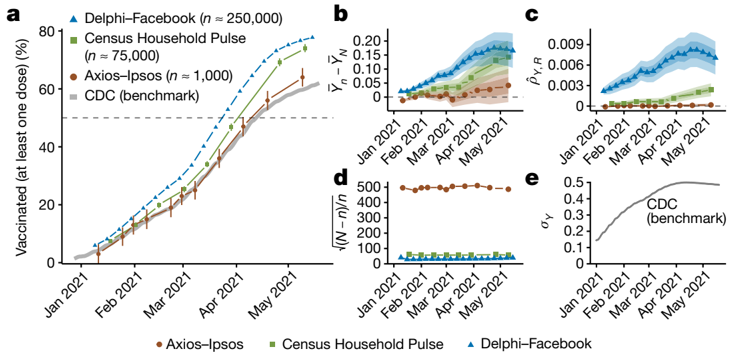
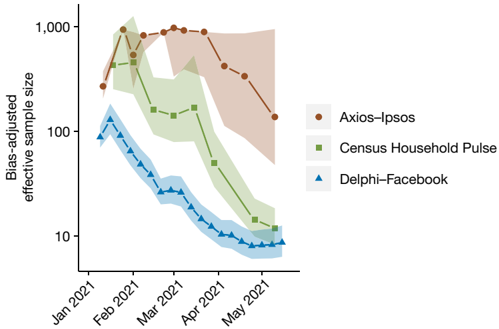
Surveys are a crucial tool for understanding public opinion and behaviour, and their accuracy depends on maintaining statistical representativeness of their target populations by minimizing biases from all sources. Increasing data size shrinks confidence intervals but magnifies the effect of survey bias: an instance of the Big Data Paradox 1. Here we demonstrate this paradox in estimates of first-dose COVID-19 vaccine uptake in US adults from 9 January to 19 May 2021 from two large surveys: Delphi-Facebook 2,3 (about 250,000 responses per week) and Census Household Pulse 4 (about 75,000 every two weeks). In May 2021, Delphi-Facebook overestimated uptake by 17 percentage points (14-20 percentage points with 5% benchmark imprecision) and Census Household Pulse by 14 (11-17 percentage points with 5% benchmark imprecision), compared to a retroactively updated benchmark the Centers for Disease Control and Prevention published on 26 May 2021. Moreover, their large sample sizes led to miniscule margins of error on the incorrect estimates. By contrast, an Axios-Ipsos online panel 5 with about 1,000 responses per week following survey research best practices 6 provided reliable estimates and uncertainty quantification. We decompose observed error using a recent analytic framework 1 to explain the inaccuracy in the three surveys. We then analyse the implications for vaccine hesitancy and willingness. We show how a survey of 250,000 respondents can produce an estimate of the population mean that is no more accurate than an estimate from a simple random sample of size 10. Our central message is that data quality matters more than data quantity, and that compensating the former with the latter is a mathematically provable losing proposition.
Overview
CoChat Summary
TL;DR
Two large US COVID-19 vaccine surveys, Delphi-Facebook and Census Household Pulse, substantially overestimated first-dose vaccine uptake relative to a CDC benchmark, while a much smaller Axios-Ipsos panel tracked the benchmark well. The paper uses the Big Data Paradox framework to show that larger sample sizes magnified bias and produced misleadingly narrow confidence intervals.
Key findings
- In May 2021, Delphi-Facebook overestimated first-dose vaccine uptake by 17 percentage points (14–20 with 5% benchmark imprecision) and Census Household Pulse by 14 percentage points (11–17 with 5% benchmark imprecision), compared with the CDC benchmark published on 26 May 2021; Axios-Ipsos’ error was 4.2 percentage points (1–7 with 5% benchmark imprecision).
- Despite having far larger samples—Delphi-Facebook n = 4,525,633 across 19 waves, Census Household Pulse n = 606,615 across 8 waves, Axios-Ipsos n = 11,421 across 11 waves—the large surveys had miniscule margins of error on incorrect estimates.
- Delphi-Facebook’s bias-adjusted effective sample size was less than 10 in April 2021, a 99.99% reduction from its raw average weekly sample size of 250,000; Census Household Pulse also had over 99% reductions in effective sample size by May 2021.
- Axios-Ipsos’ 95% confidence intervals contained the CDC benchmark in 10 out of 11 surveys (91% empirical coverage), and the error decomposition suggested increasing error in the large surveys was primarily driven by increasing data defect correlation.
Methods
- Comparative analysis of three online surveys targeting US adults from 9 January to 19 May 2021: Delphi-Facebook (about 250,000 responses per week), Census Household Pulse (about 75,000 every two weeks), and Axios-Ipsos (about 1,000 per week), benchmarked against CDC first-dose vaccination counts as of 26 May 2021.
- Used a previously formulated statistical framework to decompose total error into data defect correlation, data scarcity, and inherent problem difficulty, and to calculate bias-adjusted effective sample size; sensitivity analyses used ±5% and ±10% benchmark imprecision.
- Compared survey designs, recruitment, weighting, and respondent composition, with additional small-to-medium online surveys analysed in Extended Data.
Limitations
- Stated in the paper: the vaccine uptake analysis only examines data defect correlation for an outcome with an available benchmark, first-dose vaccine uptake; absence of evidence of bias for other outcomes is not evidence of its absence. The analysis relies on the accuracy of CDC estimates, and if CDC selection bias were significant enough to alter results, that would itself be another Big Data Paradox. Axios-Ipsos’ question wording differs from the other surveys and may contribute to observed differences. Small surveys can also be wrong, and whether small-area methods outperform large biased surveys is an open question.
- Evident from the text: the ±5% and ±10% benchmark imprecision scenarios may not capture latent systemic issues affecting CDC vaccination reporting; CDC age-coded counts were missing for some jurisdictions, reaching about 10% of total US vaccinations at its peak, and the authors assume the adult fraction among missing-age vaccinations equals the adult fraction among reported-age vaccinations. The study is an observational comparison of existing surveys, not a randomized design.
Model-written summary. Check it against the paper before relying on it.
Integrity signals
Registry
Cites
Statistics
Figures
Verification
Claims the paper makes
13 Valid · 1 Not valid · 11 Not checked · 98 Own results and interpretations
Every source the paper cites for this claim was checked and supports it.
In the paper
“However, once this control is lost, small increases in ddc beyond what is expected in simple random samples can result in marked reductions of effective sample sizes for large populations 1 .”
What the sources say
- Supportedcites [1] Meng, X.-L. Statistical paradises and paradoxes in big data (I): Law of large populations, big data paradox, and the 2016 US presidential election. Ann. Appl. Stat. 12, 685–726 (2018). source
Section 3 (pp. 14–16) says probabilistic sampling keeps the data defect index under control, while even a small departure can cause a dramatic reduction in effective sample size as population size grows. The paper also describes a seemingly trivial data defect correlation as substantially reducing effective sample size (p. 21). (LLM, conf=0.93)
plainstates a possible cause- Asserted: passes — The authors put it forward as true.
- Checkable: passes — It can be checked against evidence.
- Load-bearing: passes — The paper’s conclusions depend on it.
- Based: passes — The paper gives a reason why it holds.
- Supported
The cited sources support only part of this claim — read each source’s verdict below.
In the paper
“small-area methods that borrow information across subgroups 48 can perform better with higher-quality-albeit few-data”
What the sources say
- Partly supportedcites [48] Park, D. K., Gelman, A. & Bafumi, J. Bayesian multilevel estimation with poststratification: State-level estimates from national polls. Polit. Anal. 12, 375–385 (2004). sourceExperimental — accuracy not yet measured
The Overview (p. 2) says that many demographic-by-state categories have few or no observations, yet the multilevel method performs well. The Discussion (p. 9) says partial pooling outperforms complete and no pooling, but the paper does not establish that the data were higher-quality or that data quality explains the improvement. (LLM, conf=0.86)
plainstates an association- Asserted: passes — The authors put it forward as true.
- Checkable: passes — It can be checked against evidence.
- Load-bearing: unclear — It is unclear whether the paper’s conclusions depend on it.
- Based: passes — The paper gives a reason why it holds.
- Partly supported
A result the paper states — it cites no source for it, so there is none to check. The quote shows it is in the paper.
In the paper
“Moreover, their large sample sizes led to miniscule margins of error on the incorrect estimates.”
plainstates a cause- Asserted: passes — The authors put it forward as true.
- Checkable: passes — It can be checked against evidence.
- Load-bearing: passes — The paper’s conclusions depend on it.
- Based: passes — The paper gives a reason why it holds.
A result the paper reports from its own data — it cites no other source for it, so there is none to check. The quote shows it is in the paper.
In the paper
“The total error of each survey's estimate of vaccine uptake (Fig. 1b) increases over time for all studies, most markedly for Delphi-Facebook.”
plainstates a cause- Asserted: passes — The authors put it forward as true.
- Checkable: passes — It can be checked against evidence.
- Load-bearing: passes — The paper’s conclusions depend on it.
- Based: passes — The paper gives a reason why it holds.
- Rests on an assumption not shown here.
A result the paper reports from its own data — it cites no other source for it, so there is none to check. The quote shows it is in the paper.
In the paper
“Inherent problem difficulty is a population quantity common to all three surveys that peaks when the benchmark vaccination rate approaches 50% in April 2021 (Fig. 1e).”
plainstates an association- Asserted: passes — The authors put it forward as true.
- Checkable: passes — It can be checked against evidence.
- Load-bearing: unclear — It is unclear whether the paper’s conclusions depend on it.
- Based: passes — The paper gives a reason why it holds.
- Rests on an assumption not shown here.
46 more claims
Create a free account to see all 123 claims and to verify the 2 references still open.
- Probably not a substantial claim. 38
- It may state two separate claims as one. 42
Self-check
Percentages, sums and reported differences re-computed from the paper’s own numbers.
Each contradiction between two passages listed here was confirmed by an independent check.
Rated minor: it would not touch a result — a value no result rests on, a p-value that stays on the same side of the significance level, or a conflict that is clerical, resolved elsewhere in the paper, or outside its own findings.
In the paper
§ Extended Data Table 2 | Contribution of offline recruitment and weighting schemes to discrepancies between surveys · p. 17
“In the Axios-Ipsos 22 March 2020 wave, the offline panellists ( n = 21) were 24 percentage points less likely to be vaccinated than online panellists ( n = 974).”
§ Explanations for error · p. 4
“dropping these offline respondents ( n = 21, or 1% of the sample) in their 22 March 2021 wave”
Citations
Cites
Sample Selection Bias as a Specification Error
Heckman, J. J. (1979) · Econometrica · doi:10.2307/1912352 · Cited by 28,779
Fry, A., Littlejohns, T. J., Sudlow, C., Doherty, N., Adamska, L., Sprosen, T., Collins, R., & Allen, N. E. (2017) · American Journal of Epidemiology · doi:10.1093/aje/kwx246 · Cited by 3,979
Interval Estimation for a Binomial Proportion
Brown, L. D., Cai, T. T., & DasGupta, A. (2001) · Statistical Science · doi:10.1214/ss/1009213286 · Cited by 3,538
The Parable of Google Flu: Traps in Big Data Analysis
Lazer, D., Kennedy, R., King, G., & Vespignani, A. (2014) · Science · doi:10.1126/science.1248506 · Cited by 2,523
Nonresponse rates and nonresponse bias in household surveys
Groves, R. M. (2006) · Public Opinion Quarterly · doi:10.1093/poq/nfl033 · Cited by 2,420
Big data: a revolution that will transform how we live, work, and think
Armstrong, K. (2014) · Information, Communication & Society · doi:10.1080/1369118x.2014.923482 · Cited by 1,629
Haas, E. J., Angulo, F. J., McLaughlin, J. M., Anis, E., Singer, S. R., Khan, F., Brooks, N., Smaja, M., Mircus, G., Pan, K., et al. (2021) · The Lancet · doi:10.1016/s0140-6736(21)00947-8 · Cited by 1,564
Neyman, J. (1934) · Journal of the Royal Statistical Society · doi:10.2307/2342192 · Cited by 1,086
Computer and Internet Use in the United States: 2003
Day, J. C., Janus, A. L., & Davis, J. T. (2005) · Cited by 1,032
Allcott, H., Boxell, L., Conway, J., Gentzkow, M., Thaler, M., & Yang, D. (2020) · Journal of Public Economics · doi:10.1016/j.jpubeco.2020.104254 · Cited by 999
Research works printed but not linked: 8
- Kreuter, F. et al. Partnering with Facebook on a university-based rapid turn-around global survey. Surv. Res. Methods 14, 159–163 (2020).
- Acknowledgements We thank F. Kreuter, A. Reinhart and the Delphi Group at CMU; Facebook's Demography and Survey Science group; F. Barlas, C. Jackson, C. Morris, M. Newall and the Public Affairs team at Ipsos; and J. Fields and J. Hunter Childs at the US Census Bureau for productive conversations about their surveys. We further thank the Delphi Group at CMU for their help in computing weekly design effects for their survey; the Ipsos team for providing data on their 'offline' respondents; the CDC for responding to our questions; S. Paddock, other participants at the JPSM 2021 lecture (delivered by X.-L.M.) and S. Finch for providing comments; A. Edwards-Levy for inspiring our interest in this topic; and R. Born for suggesting more intuitive terms used in equation (1). V.C.B. is funded by the University of Oxford's Clarendon Fund and the EPSRC and MRC through the OxWaSP CDT programme (EP/ L016710/1). X.-L.M. acknowledges partial financial support by NSF. S.F. acknowledges the support of the EPSRC (EP/V002910/1).
- Kish, L. Survey Sampling (Wiley, 1965).
- Groves, R. M. et al. Survey Methodology Vol. 561 (Wiley, 2011).
- Groen, J. Sources of error in survey and administrative data: the importance of reporting procedures. J. Off. Stat. 28, 173–198 (2012).
- Associated Press–NORC Center for Public Affairs Research. The June 2021 AP–NORC center poll (2021).
- Bethlehem, J. in Survey Nonresponse (eds Groves, R. M. et al.) 275-288 (Wiley, 2002).
- Meng, X.-L. in Past, Present, and Future of Statistical Science (eds Lin, X. et al.) 537-562 (CRC Press, 2014).
Cited by
Advances in Artificial Intelligence for Infectious-Disease Surveillance
Brownstein, J. S., Rader, B., Astley, C. M., & Tian, H. (2023) · New England Journal of Medicine · doi:10.1056/nejmra2119215 · Cited by 167
REFORMS: Consensus-based Recommendations for Machine-learning-based Science
Kapoor, S., Cantrell, E. M., Peng, K., Pham, T. H., Bail, C. A., Gundersen, O. E., Hofman, J. M., Hullman, J., Lones, M. A., Malik, M. M., et al. (2024) · Science Advances · doi:10.1126/sciadv.adk3452 · Cited by 129
“When the sampling frame is unrepresentative, increasing the sample size can shrink confidence intervals without decreasing bias in estimates, thus giving false confidence ( 123 ).”
Communicating doctors’ consensus persistently increases COVID-19 vaccinations
Bartoš, V., Bauer, M., Cahlíková, J., & Chytilová, J. (2022) · Nature · doi:10.1038/s41586-022-04805-y · Cited by 130
We need to talk about nonprobability samples
Boyd, R. J., Powney, G. D., & Pescott, O. L. (2023) · Trends in Ecology & Evolution · doi:10.1016/j.tree.2023.01.001 · Cited by 145
“The formula shows that, for a given selection bias, effective sample size is lower in the presence of measurement error [8].”
BackgroundThe Epidemiology of Long Coronavirus Disease in US Adults
Robertson, M. M., Qasmieh, S. A., Kulkarni, S., Teasdale, C. A., Jones, H. E., McNairy, M. L., Borrell, L. N., & Nash, D. (2022) · Clinical Infectious Diseases · doi:10.1093/cid/ciac961 · Cited by 106
Statistical Modeling of Spatially Stratified Heterogeneous Data
Wang, J., Haining, R., Zhang, T., Xu, C., Hu, M., Yin, Q., Li, L., Zhou, C., Li, G., & Chen, H. (2024) · Annals of the American Association of Geographers · doi:10.1080/24694452.2023.2289982 · Cited by 160
“…be insufficient data to provide nice estimates of the parameters in each stratum using traditional estimation methods — referred to as the data sparsity problem, or the biased sample problem when not all strata have been sampled (see, e.g., Meng 2018; J. Wang et al. 2018; Bradley et al. 2021).”
MethodTreating gaps and biases in biodiversity data as a missing data problem
Bowler, D. E., Boyd, R. J., Callaghan, C. T., Robinson, R. A., Isaac, N. J. B., & Pocock, M. J. O. (2024) · Biological reviews/Biological reviews of the Cambridge Philosophical Society · doi:10.1111/brv.13127 · Cited by 118
Psychological inoculation protects against the social media infodemic
McPhedran, R., Ratajczak, M., Mawby, M., King, E., Yang, Y., & Gold, N. (2023) · Scientific Reports · doi:10.1038/s41598-023-32962-1 · Cited by 122
Astley, C. M., Tuli, G., Cord, K. A. M., Cohn, E. L., Rader, B. M., Varrelman, T. J., Chiu, S., Deng, X., Stewart, K., Farag, T. H., et al. (2021) · Proceedings of the National Academy of Sciences · doi:10.1073/pnas.2111455118 · Cited by 82
Kessler, R. C., Ruhm, C. J., Puac‐Polanco, V., Hwang, I. H., Lee, S., Petukhova, M. V., Sampson, N. A., Ziobrowski, H. N., Zaslavsky, A. M., & Zubizarreta, J. R. (2022) · JAMA Network Open · doi:10.1001/jamanetworkopen.2022.17223 · Cited by 83
Athey, S. C., Grabarz, K., Luca, M., & Wernerfelt, N. (2023) · Proceedings of the National Academy of Sciences · doi:10.1073/pnas.2208110120 · Cited by 96
COVID-19 Vaccine Hesitancy: The Role of Socioeconomic Factors and Spatial Effects
Lee, J., & Huang, Y. (2022) · Vaccines · doi:10.3390/vaccines10030352 · Cited by 74
“Our findings, therefore, should be free from the survey sampling bias that has been found to plague even the largest surveys ever conducted for COVID-19 vaccination, such as those conducted by the Delphi-Facebook and Census Household Pulse [25].”
BackgroundGlobal survey on COVID-19 beliefs, behaviours and norms
Collis, A., Garimella, K. V., Moehring, A., Rahimian, M. A., Babalola, S. O., Gobat, N., Shattuck, D. C., Stolow, J. A., Aral, S., & Eckles, D. (2022) · Nature Human Behaviour · doi:10.1038/s41562-022-01347-1 · Cited by 81
“Using caution when opening letters and packages (9)”
BackgroundGarfin, D. R., Thompson, R. R., Holman, E. A., Wong‐Parodi, G., & Silver, R. C. (2022) · JAMA Network Open · doi:10.1001/jamanetworkopen.2022.17251 · Cited by 69
Why weight? Analytic approaches for large-scale population neuroscience data
Gard, A. M., Hyde, L. W., Heeringa, S. G., West, B. T., & Mitchell, C. M. (2023) · Developmental Cognitive Neuroscience · doi:10.1016/j.dcn.2023.101196 · Cited by 58
Stoler, J. B., Klofstad, C., Enders, A. M., & Uscinski, J. E. (2022) · Social Science & Medicine · doi:10.1016/j.socscimed.2022.115112 · Cited by 56
Wolter, F., Mayerl, J., Andersen, H. K., Wieland, T., & Junkermann, J. (2022) · Socius Sociological Research for a Dynamic World · doi:10.1177/23780231221094749 · Cited by 47
“Research in the United States has also shown that surveys on COVID19 vaccination coverage may be severely distorted by issues other than social desirability bias, like the unrepresentativeness of (large online) samples and/or poor survey quality (Bradley et al. 2021).”
BackgroundAre Nonprobability Surveys Fit for Purpose?
Jerit, J., & Barabas, J. (2023) · Public Opinion Quarterly · doi:10.1093/poq/nfad037 · Cited by 55
Precise Quantification of Behavioral Individuality From 80 Million Decisions Across 183,000 Flies
de Bivort, B. L., Buchanan, S. M., Skutt-Kakaria, K., Gajda, E., Ayroles, J. F., O’Leary, C., Reimers, P., Akhund‐Zade, J., Senft, R. A., Maloney, R. T., et al. (2022) · Frontiers in Behavioral Neuroscience · doi:10.3389/fnbeh.2022.836626 · Cited by 47
Studying the genetics of participation using footprints left on the ascertained genotypes
Benónísdóttir, S., & Kong, A. (2023) · Nature Genetics · doi:10.1038/s41588-023-01439-2 · Cited by 43
Zanocco, C. M., Flora, J. A., & Boudet, H. S. (2022) · PLOS Climate · doi:10.1371/journal.pclm.0000026 · Cited by 47
“Probability-based samples of this size are adequate for generating general population estimates and have even been shown to outperform much larger samples acquired using convenience-based sampling [68].”
BackgroundThe Big Data Paradox in Clinical Practice
Msaouel, P. (2022) · Cancer Investigation · doi:10.1080/07357907.2022.2084621 · Cited by 43
“…been labeled the “ big data paradox ” and is a major culprit behind the unreliable predictions made from the 2016 United States general election polling datasets (2), Google Flu Trends (3), and Delphi – Facebook, i.e. the largest public health survey ever conducted in the United States to date (4).”
BackgroundFossil fuel communities support climate policy coupled with just transition assistance
Gazmararian, A. F. (2023) · Energy Policy · doi:10.1016/j.enpol.2023.113880 · Cited by 51
Effect of Cash Benefits on Health Care Utilization and Health: A Randomized Study
Agarwal, S. D., Cook, B. L., & Liebman, J. B. (2024) · JAMA · doi:10.1001/jama.2024.13004 · Cited by 43
Association of compassion and empathy with prosocial health behaviors and attitudes in a pandemic
Karnaze, M. M., Bellettiere, J., & Bloss, C. S. (2022) · PLoS ONE · doi:10.1371/journal.pone.0271829 · Cited by 43
Christen, P., & Schnell, R. (2023) · International Journal for Population Data Science · doi:10.23889/ijpds.v8i1.2115 · Cited by 45
Parton distributions need representative sampling
Courtoy, A., Huston, J. W., Nadolsky, P., Xie, K., Yan, M., & Yuan, C. –. (2023) · Physical review. D/Physical review. D. · doi:10.1103/physrevd.107.034008 · Cited by 48
“The formalism from survey studies [23, 24] then tells us that, given the complexity of PDF models, confounding correlations may dominate the sampling bias ∆E even when the sample SRS deviation, proportional to 1/ √ Ns, is small.”
BackgroundNguyen, K. H., Levisohn, A., McChesney, C., Vasudevan, L., Bednarczyk, R. A., & Corlin, L. (2023) · Annals of Medicine · doi:10.1080/07853890.2023.2232818 · Cited by 40
“For example, a report found that data from the HPS may overestimate COVID-19 vaccination coverage compared to the CDC’s COVID Data Tracker, which is derived from provider-reported vaccine administration data; however, the HPS estimates showed similar patterns in relative coverage by sex, age group, and state compared…”
ResultKandeel, A., ELdeyahy, I., Elsood, H. A., Fahim, M., Afifi, S., Kamar, S. A., BahaaEldin, H., Ahmed, E., Mohsen, A. M., & Abdelghaffar, K. (2023) · BMC Public Health · doi:10.1186/s12889-023-15283-w · Cited by 32
“However, survey results accuracy depends on maintaining statistical representativeness of their target populations by minimizing biases [10].”
BackgroundA framework for understanding selection bias in real-world healthcare data
Kundu, R., Shi, X., Morrison, J., Barrett, J., & Mukherjee, B. (2024) · Journal of the Royal Statistical Society Series A (Statistics in Society) · doi:10.1093/jrsssa/qnae039 · Cited by 38
“This phenomenon has recently been termed as the “curse of large n” (Kaplan et al., 2014; Bradley et al., 2021).”
BackgroundTowards geospatially-resolved public-health surveillance via wastewater sequencing
Tierney, B. T., Foox, J., Ryon, K. A., Butler, D., Damle, N., Young, B. G., Mozsary, C., Babler, K. M., Yin, X., Carattini, Y., et al. (2024) · Nature Communications · doi:10.1038/s41467-024-52427-x · Cited by 35
“…undersampled populations that may not be regularly tested 9 , (4) be more cost-effective than doing repeated individual tests 10 , and (5) reduce the reliance on self-reported data, which has proven a challenge in estimating both global SARS-CoV-2 burden and individual vaccination status 11 .”
Klaassen, F., Chitwood, M. H., Cohen, T., Pitzer, V. E., Russi, M., Swartwood, N. A., Salomon, J. A., & Menzies, N. A. (2022) · Clinical Infectious Diseases · doi:10.1093/cid/ciac438 · Cited by 26
“Fourth, we estimated the relationship between prior infection and vaccination status using survey data that have been criticized for nonrepresentativeness [32].”
InfluentialExpansion of Child Tax Credits and Mental Health of Parents With Low Income in 2021
Nam, J., & Kwon, S. J. (2024) · JAMA Network Open · doi:10.1001/jamanetworkopen.2023.56419 · Cited by 29
Heacock, R. M., Capodilupo, E. R., Czeisler, M. É., Weaver, M. D., Czeisler, C. A., Howard, M. E., & Rajaratnam, S. M. W. (2022) · Frontiers in Physiology · doi:10.3389/fphys.2022.884154 · Cited by 25
“Limitations of this study may include selection bias potentially amplified by the Big Data Paradox, self-reported alcohol data, and potential unmeasured effects of the COVID-19 pandemic.”
BackgroundMedia use and vaccine resistance
Green, J., Druckman, J. N., Baum, M. A., Ognyanova, K., Simonson, M. D., Perlis, R. H., & Lazer, D. (2023) · PNAS Nexus · doi:10.1093/pnasnexus/pgad146 · Cited by 25
“Moreover, for reasons we explain in Appendix F (and in contrast to prior findings regarding survey-based vaccination estimates (23)), the differences between our survey-based estimates of vaccination rates and the CDC’s administrative records are at least partially attributable to difficulties in…”
ResultOptimising the use of electronic medical records for large scale research in psychiatry
Newby, D., Taylor, N., Joyce, D. W., & Winchester, L. M. (2024) · Translational Psychiatry · doi:10.1038/s41398-024-02911-1 · Cited by 39
Clarke, B., Alley, L. J., Ghai, S., Flake, J. K., Rohrer, J. M., Simmons, J. P., Schiavone, S. R., & Vazire, S. (2024) · Social and Personality Psychology Compass · doi:10.1111/spc3.12979 · Cited by 35
A practical agenda for incorporating trust into pandemic preparedness and response
Bollyky, T. J., & Petersen, M. B. (2024) · Bulletin of the World Health Organization · doi:10.2471/blt.23.289979 · Cited by 31
“67 Accordingly, a successful strategy for monitoring mistrust as a risk to an effective health emergency response must rely on a combination of methods, such as representative online surveys, social media monitoring and ethnographic field observations.”
BackgroundTrajectories of psychological distress over multiple COVID-19 lockdowns in Australia
Botha, F., Morris, R. W., Butterworth, P., & Glozier, N. (2022) · SSM - Population Health · doi:10.1016/j.ssmph.2022.101315 · Cited by 31
“As such, any stable, time-invariant differences between people may contribute to bias in the current results, such as unadjusted differences in education or rurality (Bradley et al., 2021; but see Astley et al., 2021).”
Sensitivity Analysis for Survey Weights
Hartman, E., & Huang, M. (2023) · Political Analysis · doi:10.1017/pan.2023.12 · Cited by 23
“For example, Bradley et al. (2021) discuss bias in public opinion surveys used to estimateCOVID-19 vaccination rates.Modern surveys nearly always rely on weighting adjustments, and researchers must carefully examine how survey weights are constructed. For example, Kennedy et al. (2018) found that a primary driver of b…”
BackgroundInfluentialAddressing selection bias in the UK Biobank neurological imaging cohortPreprint
Bradley, V. C., & Nichols, T. E. (2022) · medRxiv · doi:10.1101/2022.01.13.22269266 · Cited by 37
“Bradley et al. (2021) further demonstrates how this Big Data Paradox can even affect large surveys that do take steps to counteract selection bias.”
BackgroundResultInfluentialSelf-citationDisparities in COVID-19 Vaccine Booster Uptake in the USA: December 2021–February 2022
Gaffney, A. W., Himmelstein, D. U., McCormick, D., et al. (2022) · Journal of General Internal Medicine · doi:10.1007/s11606-022-07648-5 · Cited by 21
The Case for Globalizing Fairness: A Mixed Methods Study on Colonialism, AI, and Health in Africa
Asiedu, M., Dieng, A., Haykel, I., Rostamzadeh, N., Pfohl, S., Nagpal, C., Nagawa, M., Oppong, A., Koyejo, S., & Heller, K. (2024) · ACM Conference on Equity and Access in Algorithms, Mechanisms, and Optimization (EAAMO) · doi:10.1145/3689904.3694708 · Cited by 42
“We end our discussion with practical recommendations for the development and deployment of fairness-aware ML-based solutions in health in Africa.”
Social isolation during the COVID-19 pandemic in Spain: a population study
Martínez-Garcia, M., Sansano‐Sansano, E., Castillo-Hornero, A., Femenía, R., Roomp, K., & Oliver, N. (2022) · Scientific Reports · doi:10.1038/s41598-022-16628-y · Cited by 25
Distorted insights from human mobility data
Gallotti, R., Maniscalco, D., Barthélemy, M., & Domenico, M. D. (2024) · Communications Physics · doi:10.1038/s42005-024-01909-x · Cited by 34
“In fact, results might be platform-dependent 55 and data quantity cannot compensate for lack of data quality 56 .”
Morris, A. H., Horvat, C. M., Stagg, B. C., Grainger, D. W., Lanspa, M. J., Orme, J. F., Clemmer, T. P., Weaver, L. K., Thomas, F. O., Grissom, C. K., et al. (2022) · Journal of the American Medical Informatics Association · doi:10.1093/jamia/ocac143 · Cited by 25
van Loon, A., Giorgi, S., Willer, R., & Eichstaedt, J. C. (2022) · Proceedings of the International AAAI Conference on Web and Social Media · doi:10.1609/icwsm.v16i1.19399 · Cited by 25
Mocha, Y. B., de Gialluly, S. S., Griesser, M., & Markman, S. (2023) · Biological reviews/Biological reviews of the Cambridge Philosophical Society · doi:10.1111/brv.12986 · Cited by 30
“…other researchers of cooperative breeding (e.g. Griesser & Suzuki, 2016; Heldstab et al ., 2017; Schradin, 2017) and statisticians (e.g. Meng, 2018; Bradley et al ., 2021) in prioritising a modest sample size of reliably classi fi ed species over a more comprehensive sample with a higher…”
BackgroundWong‐Parodi, G., & Garfin, D. R. (2022) · International Journal of Disaster Risk Reduction · doi:10.1016/j.ijdrr.2022.103135 · Cited by 18
“Such methods produce less biased results than convenience samples, which use snowball sampling, opt-in, or social media recruitment methods [5,6].”
Mocha, Y. B., Dahan, T., Zou, Y., Griesser, M., & Markman, S. (2023) · Proceedings of the Royal Society B Biological Sciences · doi:10.1098/rspb.2023.0607 · Cited by 17
“We join biologists [17,72,73] and statisticians [74,75] in suggesting that, in the absence of these resources, meta-analyses should be based on smaller and more accurate datasets, rather than larger but less accurate ones.”
BackgroundTracking COVID-19 Infections Using Survey Data on Rapid At-Home Tests
Santillana, M., Uslu, A., Urmi, T., Quintana, A., Druckman, J. N., Ognyanova, K., Baum, M., Perlis, R. H., & Lazer, D. M. J. (2024) · JAMA Network Open · doi:10.1001/jamanetworkopen.2024.35442 · Cited by 19
Best practice recommendations to measure and estimate workplace accident underreporting
Bazzoli, A., & Probst, T. M. (2024) · Safety Science · doi:10.1016/j.ssci.2024.106660 · Cited by 18
Freese, J., & Jin, O. S. (2025) · Annual Review of Sociology · doi:10.1146/annurev-soc-090524-043117 · Cited by 25
In-person schooling and associated COVID-19 risk in the United States over spring semester 2021
Wiens, K. E., Smith, C. P., Badillo‐Goicoechea, E., Grantz, K. H., Grabowski, M. K., Azman, A. S., Stuart, E. A., & Lessler, J. (2022) · Science Advances · doi:10.1126/sciadv.abm9128 · Cited by 17
The effect of altruism on COVID-19 vaccination rates
Recio, L. Á. H., Rodríguez, D. P., Atienza, P., Garzón, A. J., & Cantarero, D. (2023) · Health Economics Review · doi:10.1186/s13561-022-00415-6 · Cited by 18
“Many such studies on pandemics have been carried out and there are already numerous works compiling their main results [24-27] or addressing specific groups such as health workers or students in the health area [28-31] or pregnant women [32].”
BackgroundConsumption responses to an unconditional child allowance in the United States
Parolin, Z., Giupponi, G., Lee, E. K., & Collyer, S. M. (2024) · Nature Human Behaviour · doi:10.1038/s41562-024-01835-6 · Cited by 20
“Moreover, recent studies have shown that surveys on individual behaviours during the era of coronavirus disease 2019 (COVID-19) often suffer from low response rates or other threats to representativeness that challenge the validity of survey findings 12,13 .”
The Effect of Vaccine Mandates on Disease Spread: Evidence from College COVID-19 Mandates
Acton, R. K., Cao, W., Cook, E., Imberman, S. A., & Lovenheim, M. (2022) · National Bureau of Economic Research · doi:10.3386/w30303 · Cited by 17
“For the US adult population overall, Bradley et al. (2021) find that the Pulse Survey overstates vaccination rates by 14 percent in May 2021, with gaps widening between January and May.”
A new method for spatial three-dimensional prediction of soil heavy metals contamination
Shen, F., Xu, C., Wang, J., et al. (2023) · CATENA · doi:10.1016/j.catena.2023.107658 · Cited by 15
Evaluating the generalizability of the COVID States survey — a large-scale, non-probability surveyPreprint
Radford, J. P., Green, J., Quintana, A., Safarpour, A., Simonson, M. D., Baum, M., Lazer, D. M. J., Ognyanova, K., Druckman, J. N., Perlis, R. H., et al. (2022) · OSF Preprints (OSF Preprints) · doi:10.31219/osf.io/cwkg7 · Cited by 16
The Mixed Subjects Design: Treating Large Language Models as Potentially Informative Observations
Broska, D., Howes, M., & van Loon, A. (2025) · Sociological Methods & Research · doi:10.1177/00491241251326865 · Cited by 64
Using absolutist word frequency from online searches to measure population mental health dynamics
Adam‐Troian, J., Bonetto, É., & Arciszewski, T. (2022) · Scientific Reports · doi:10.1038/s41598-022-06392-4 · Cited by 16
Zahnd, W. E., Silverman, A., Self, S. C. W., Hung, P., Natafgi, N., Adams, S. A., Merrell, M. A., Owens, O. L., Crouch, E. L., & Eberth, J. M. (2023) · The Journal of Rural Health · doi:10.1111/jrh.12753 · Cited by 16
Chioléro, A., Tancredi, S., & Ioannidis, J. P. A. (2023) · European Journal of Epidemiology · doi:10.1007/s10654-023-01049-6 · Cited by 17
“Another issue with big data is that their size gives a false sense of security [19].”
BackgroundResultIsolation and Quarantine for Coronavirus Disease 2019 in the United States, 2020–2022
Oeltmann, J. E., Vohra, D., Matulewicz, H. H., DeLuca, N., Smith, J. P., Couzens, C., Lash, R. R., Harvey, B., Boyette, M., Edwards, A., et al. (2023) · Clinical Infectious Diseases · doi:10.1093/cid/ciad163 · Cited by 15
Athey, S. C., Grabarz, K., Luca, M., & Wernerfelt, N. (2022) · National Bureau of Economic Research · doi:10.3386/w30273 · Cited by 17
Inference with non-probability samples and survey data integration: a science mapping study
Salvatore, C. (2023) · METRON · doi:10.1007/s40300-023-00243-6 · Cited by 23
“In this context, social media might also be relevant for administering surveys [18, 57].”
BackgroundDisparities in mobile phone ownership reflect inequities in access to healthcare
Blake, A., Hazel, A., Jakurama, J., Matundu, J., & Bharti, N. (2023) · PLOS Digital Health · doi:10.1371/journal.pdig.0000270 · Cited by 20
“Large data sets cannot overcome inherent biases by virtue of their size alone [47].”
BackgroundEffects of the expanded Child Tax Credit on employment outcomes
Ananat, E., Glasner, B., Hamilton, C., Parolin, Z., & Pignatti, C. (2024) · Journal of Public Economics · doi:10.1016/j.jpubeco.2024.105168 · Cited by 22
Megatsari, H., Kusuma, D., Ernawaty, E., & Putri, N. K. (2022) · Vaccines · doi:10.3390/vaccines10111857 · Cited by 13
Relihan, D. P., Holman, E. A., Garfin, D. R., Ditto, P. H., & Silver, R. C. (2023) · Political Psychology · doi:10.1111/pops.12894 · Cited by 14
“…big data studies (e.g., smartphone mobility data, Twitter data; Engel-Rebitzer et al., 2022; Green et al., 2020; Jiang et al., 2021) also suffer from biases as their samples are self-selected, not probability based (Bradley et al., 2021), and are typically not representative of the population.”
BackgroundProbability vs. Nonprobability Sampling: From the Birth of Survey Sampling to the Present Day
Kalton, G. (2023) · Statistics in Transition New Series · doi:10.59170/stattrans-2023-029 · Cited by 30
Gurdasani, D., Akrami, A., Bradley, V. C., Costello, A. M. D. L., Greenhalgh, T., Flaxman, S. R., McKee, M., Michie, S., Pagel, C., Rasmussen, S. D., et al. (2021) · The Lancet Child & Adolescent Health · doi:10.1016/s2352-4642(21)00342-4 · Cited by 12
Self-citationTaube, J. C., Susswein, Z., & Bansal, S. (2023) · JMIR Public Health and Surveillance · doi:10.2196/42128 · Cited by 14
“Furthermore, it is critical that ground-truth data to correct biases in health behavior be used at a fine spatial and temporal scale to avoid further exacerbation of biases (eg, [19]).”
Lee, B., Lee, K., & Hartmann, B. (2023) · Science Advances · doi:10.1126/sciadv.adi1540 · Cited by 13
Mandev, A., Plötz, P., & Sprei, F. (2024) · Environmental Research Communications · doi:10.1088/2515-7620/ad419f · Cited by 10
Herman, P. M., Slaughter, M. E., Qureshi, N., Azzam, T., Cella, D. F., Coulter, I. D., DiGuiseppi, G., Edelen, M. O., Kapteyn, A., Rodriguez, A., et al. (2024) · Journal of Medical Internet Research · doi:10.2196/63032 · Cited by 13
“Most KnowledgePanel members have their own internet access and computers, but those who do not (approximately 5% [17]) are provided with a device and access as needed to ensure that the panel is representative of all adults in the United States regardless of phone, electronic device, and internet…”
InfluentialAnzalone, A. J., Sun, J., Vinson, A. J., Beasley, W. H., Hillegass, W. B., Murray, K. A., Hendricks, B. M., Haendel, M. A., Geary, C. R., Bailey, K. L., et al. (2023) · PLoS ONE · doi:10.1371/journal.pone.0279968 · Cited by 10
“, county vaccination rates), which has been inconsistent between local, state, and national tracking systems [55], and public surveys that have limitations given the sampling strategies [56].”
BackgroundSexual identity, poverty, and utilization of government services
Deal, C., Greenberg, S., & Gonzales, G. (2024) · Journal of Population Economics · doi:10.1007/s00148-024-01031-w · Cited by 12
“In terms of limitations, other researchers have raised concerns about the repre-sentativeness of the HPS data, especially for estimating vaccine take-up and other COVID-19-related outcomes (Bradley et al. 2021).”
Pouwels, K. B., Eyre, D. W., House, T., Aspey, B., Matthews, P. C., Stoesser, N. E., Newton, J. N., Diamond, I. D., Studley, R., Taylor, N., et al. (2024) · Nature Communications · doi:10.1038/s41467-024-49201-4 · Cited by 14
“These fi ndings support the suggestion that even large studies that aim to randomly select individuals from the target population have to carefully consider how to preventandminimiseselectionbiasandaccountforvaccinationstatus when using carefully designed surveys for infectious diseases 12 .”
Suitner, C., Casara, B. G. S., Maggi, S., & Baldo, V. (2022) · Vaccines · doi:10.3390/vaccines10040490 · Cited by 10
“Data were collected by using the certified panel of IPSOS, which previously provided evidence of representativeness and data quality for estimating vaccination coverages [16].”
MethodGumanova, N. G., Gorshkov, A. Y., Bogdanova, N. L., Korolev, A. I., & Drapkina, O. M. (2022) · Vaccines · doi:10.3390/vaccines10040581 · Cited by 11
“Thus, any potential variability can be predominantly due to recall bias of the respondents, which has been reported as substantial for unrepresentative surveys [17].”
BackgroundEpidemic modelling of monitoring public behavior using surveys during pandemic-induced lockdowns
Koher, A., Jørgensen, F. J., Petersen, M. B., & Lehmann, S. (2023) · Communications Medicine · doi:10.1038/s43856-023-00310-z · Cited by 12
“Our ability to sample directly from highly curated central database, with a 25% response rate despite no compensation offered to respondents is not necessarily replicable in many other countries, especially outside of Europe 50 .”
Representation and Hesitancy in Population Health Research: Evidence from a COVID-19 Antibody Study
Dutz, D., Greenstone, M., Hortaçsu, A., Lacouture, S., Mogstad, M., Shaikh, A. M., Torgovitsky, A., & van Dijk, W. (2023) · National Bureau of Economic Research · doi:10.3386/w30880 · Cited by 11
Enhancing (Publications on) Data Quality: Deeper Data Minding and Fuller Data Confession
Meng, X. (2021) · Journal of the Royal Statistical Society Series A (Statistics in Society) · doi:10.1111/rssa.12762 · Cited by 9
“A most recent example is reported in Bradley et al. (2021), where it is demonstrated that, compared to the benchmark provided by the CDC on the rate of vaccination in the United States, the worst estimates came from the largest survey, consisting of about a quarter of a million Facebook users.”
ResultSelf-citationVaccination and Voting Patterns in the U.S.: Analysis of COVID-19 and Flu Surveys From 2010 to 2022
Rönn, M. M., Menzies, N. A., & Salomon, J. A. (2023) · American Journal of Preventive Medicine · doi:10.1016/j.amepre.2023.03.001 · Cited by 9
Determinants of people’s motivations to approach COVID-19 vaccination centers
Keser, C., & Rau, H. A. (2023) · Scientific Reports · doi:10.1038/s41598-023-30244-4 · Cited by 10
Choice Architecture, Privacy Valuations, and Selection Bias in Consumer Data
Lin, T., & Strulov-Shlain, A. (2025) · Marketing Science · doi:10.1287/mksc.2023.0373 · Cited by 13
The uneven effects of the COVID-19 pandemic on National Statistical Offices
Wollburg, P. R., Contreras, I., Carletto, C., et al. (2022) · Statistical Journal of the IAOS · doi:10.3233/sji-220044 · Cited by 8
“ple based traditional surveys [27], and the unsuspected”
BackgroundDouble Your Variance, Dirtify Your Bayes, Devour Your Pufferfish, and Draw your Kidstrogram
Meng, X. (2022) · The New England Journal of Statistics in Data Science · doi:10.51387/22-nejsds6 · Cited by 11
Self-citationYang, Y., Dempsey, W., Han, P., Deshmukh, Y., Richardson, S. T., Tom, B. D. M., & Mukherjee, B. (2024) · Science Advances · doi:10.1126/sciadv.adj0266 · Cited by 11
Eisenberg, M. D., Singh, Y., & Sood, N. (2022) · JAMA Health Forum · doi:10.1001/jamahealthforum.2022.2570 · Cited by 9
Andridge, R. (2024) · Journal of the Royal Statistical Society Series A (Statistics in Society) · doi:10.1093/jrsssa/qnae005 · Cited by 11
Selection Neglect and Political Beliefs
Brundage, M., Little, A. T., & You, S. (2022) · doi:10.31219/osf.io/p49at · Cited by 7
Peng, J., Liu, X., Cai, Z., et al. (2024) · Heliyon · doi:10.1016/j.heliyon.2024.e33566 · Cited by 7
New Data Sources for Demographic Research
Breen, C. F., & Feehan, D. M. (2024) · Population and Development Review · doi:10.1111/padr.12671 · Cited by 13
The Effect of COVID-19 Vaccinations on Self-Reported Depression and Anxiety During February 2021
Rubinstein, M., Haviland, A. M., & Breslau, J. A. (2023) · Statistics and Public Policy · doi:10.1080/2330443x.2023.2190008 · Cited by 5
“For example, Daly, Jones, and Robinson (2021) found that the CTIS survey over represents White individuals, those with higher education, and those who have received COVID-19 vaccinations (see also Bradley et al. 2021).”
BackgroundResultInfluentialDema, E., Copas, A. J., Clifton, S., et al. (2022) · Wellcome Open Research · doi:10.12688/wellcomeopenres.16963.2 · Cited by 7
Nadai, M. D., Roomp, K., Lepri, B., & Oliver, N. (2022) · Scientific Reports · doi:10.1038/s41598-022-05041-0 · Cited by 8
Donnelly, R., & Schoenbachler, A. K. (2024) · Society and Mental Health · doi:10.1177/21568693241226979 · Cited by 9
“Second, the HPS relies on online surveys and response rates are quite low, which raises concerns about population rep-resentativeness and accuracy (e.g., Bradley et al. 2021; Peterson et al. 2021).”
Using routinely collected data for research purposes: challenges and mitigation strategies
Hoffmann, S., Morris, T. P., Herrmann, M., Heinze, G., Wynants, L., CALSTER, B. V., Bischl, B., Schmid, M., Shaw, P. A., Mathes, T., et al. (2026) · BMJ · doi:10.1136/bmj-2025-087812 · Cited by 12
Metadata
- Authors
- Bradley, V. C., Kuriwaki, S., Isakov, M., Sejdinovic, D., Meng, X.-L., & Flaxman, S.
- Affiliations
- University of Oxford (GB)
- Stanford University (US)
- Harvard University (US)
- Corresponding author
- Flaxman, Seth
- Venue
- Nature
- Published
- 2021-12-08
- Volume
- 600
- Issue
- 7890
- Pages
- 695-700
- ISSN
- 0028-0836 (ISSN-L)
- 1476-4687
- PMC
- PMC8653636
- OpenAlex
- W4200003648
- Cited by
- 248
- References
- 47
- Citations by year
- 2026: 27 · 2025: 28 · 2024: 58 · 2023: 73 · 2022: 53 · 2021: 8
- FWCI
- 66.81
- Type
- journal article
- Language
- en
- Open access
- bronze
- doi.org
- Licence
- www.springer.com/tdm (tdm)
- www.springer.com/tdm (vor)
- Locations
- Nature (publishedVersion)
- medRxiv (acceptedVersion, cc-by)
- PubMed Central (publishedVersion)
- PubMed (publishedVersion)
- Digital Access to Scholarship at Harvard (DASH) (Harvard University) (acceptedVersion)
- arXiv (Cornell University) (submittedVersion)
- RePEc: Research Papers in Economics (submittedVersion)
- arXiv (Cornell University) (cc-by)
- Funders
- National Science Foundation
- Carnegie Mellon University
- University of Oxford
- Centers for Disease Control and Prevention
- Medical Research Council
- Engineering and Physical Sciences Research Council (EP/V002910/1, EP/V002910/2, EP/L016710/1)
- Clarendon Fund
- Topics
- Social Sciences › Sociology and Political Science › Survey Methodology and Nonresponse
- Physical Sciences › Mathematics › Statistics and Probability › Survey Sampling and Estimation Techniques
- Social Sciences › Health › Vaccine Coverage and Hesitancy
- Keywords
- survey bias, survey representativeness, COVID-19 vaccine uptake, online panel survey, Facebook survey, vaccine hesitancy, vaccine willingness
- MeSH terms
- Big Data, COVID-19, COVID-19 Vaccines, Vaccination Hesitancy, Centers for Disease Control and Prevention, U.S., Female, Humans, Male, Research Design, United States, Vaccination, Bias, Sample Size, Health Care Surveys, Benchmarking, Social Media, Datasets as Topic
About these checks
Registry, retraction, Cites and statistics results are computed, not judged, with one exception: a printed reference that no index lists is read once by a model before it counts as a citation error. Claims are extracted by a model and kept only when their quote appears verbatim in the text; each cited source is then checked, with a model’s help, for whether it says what the claim relies on. Those verdicts can be wrong — read the claim’s quote and the cited source before relying on one.
The claim verdicts this report counts are experimental: their accuracy is not yet measured.
A language model drew the claims from the paper on 2026-10-10, under version 3 of the claim definition (model deepseek-v4.1-flash, prompt extract-v3).
A second model labelled each claim on 2026-10-10 (model jev-1.13-20260917, definition revision gold-guideline-v0.2).
Cited sources are checked with a language model’s help (gpt-6-sol).
Statistics and arithmetic are recomputed, not judged.
Confidence bands are shown only for fields calibrated on our annotated test set. None is calibrated yet, so no band is shown.
What counts as a claim ›How we measure confidence ›How we check this ›
Are you an author, or do you see a problem with this page? Request a review
Data sources
Bibliographic data: Semantic Scholar, OpenAlex, Crossref.
Contains information from the Semantic Scholar Academic Graph Datasets, made available under the ODC Attribution License (ODC-BY 1.0).
Semantic Scholar’s data is described in: Kinney, R., et al. (2023). The Semantic Scholar Open Data Platform. arXiv:2301.10140.
