

Unrepresentative big surveys significantly overestimated US vaccine uptake
Open accessPublished version of a preprint
The DOI matches its Crossref record; 53 of the 53 references it cites were found in a registry or an index; 14 of the 30 sources its claims cite were checked for support.
Abstract
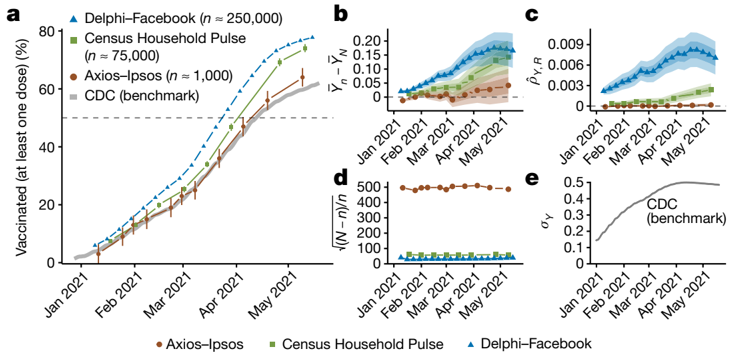
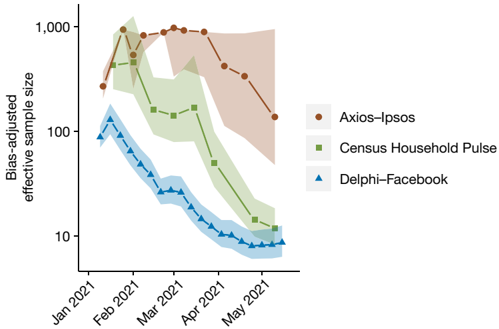
Surveys are a crucial tool for understanding public opinion and behaviour, and their accuracy depends on maintaining statistical representativeness of their target populations by minimizing biases from all sources. Increasing data size shrinks confidence intervals but magnifies the effect of survey bias: an instance of the Big Data Paradox 1. Here we demonstrate this paradox in estimates of first-dose COVID-19 vaccine uptake in US adults from 9 January to 19 May 2021 from two large surveys: Delphi-Facebook 2,3 (about 250,000 responses per week) and Census Household Pulse 4 (about 75,000 every two weeks). In May 2021, Delphi-Facebook overestimated uptake by 17 percentage points (14-20 percentage points with 5% benchmark imprecision) and Census Household Pulse by 14 (11-17 percentage points with 5% benchmark imprecision), compared to a retroactively updated benchmark the Centers for Disease Control and Prevention published on 26 May 2021. Moreover, their large sample sizes led to miniscule margins of error on the incorrect estimates. By contrast, an Axios-Ipsos online panel 5 with about 1,000 responses per week following survey research best practices 6 provided reliable estimates and uncertainty quantification. We decompose observed error using a recent analytic framework 1 to explain the inaccuracy in the three surveys. We then analyse the implications for vaccine hesitancy and willingness. We show how a survey of 250,000 respondents can produce an estimate of the population mean that is no more accurate than an estimate from a simple random sample of size 10. Our central message is that data quality matters more than data quantity, and that compensating the former with the latter is a mathematically provable losing proposition.
Overview
CoChat Summary
TL;DR
Two large US COVID-19 vaccine surveys, Delphi-Facebook and Census Household Pulse, substantially overestimated first-dose vaccine uptake relative to a CDC benchmark, while a much smaller Axios-Ipsos panel tracked the benchmark well. The paper uses the Big Data Paradox framework to show that larger sample sizes magnified bias and produced misleadingly narrow confidence intervals.
Key findings
- In May 2021, Delphi-Facebook overestimated first-dose vaccine uptake by 17 percentage points (14–20 with 5% benchmark imprecision) and Census Household Pulse by 14 percentage points (11–17 with 5% benchmark imprecision), compared with the CDC benchmark published on 26 May 2021; Axios-Ipsos’ error was 4.2 percentage points (1–7 with 5% benchmark imprecision).
- Despite having far larger samples—Delphi-Facebook n = 4,525,633 across 19 waves, Census Household Pulse n = 606,615 across 8 waves, Axios-Ipsos n = 11,421 across 11 waves—the large surveys had miniscule margins of error on incorrect estimates.
- Delphi-Facebook’s bias-adjusted effective sample size was less than 10 in April 2021, a 99.99% reduction from its raw average weekly sample size of 250,000; Census Household Pulse also had over 99% reductions in effective sample size by May 2021.
- Axios-Ipsos’ 95% confidence intervals contained the CDC benchmark in 10 out of 11 surveys (91% empirical coverage), and the error decomposition suggested increasing error in the large surveys was primarily driven by increasing data defect correlation.
Methods
- Comparative analysis of three online surveys targeting US adults from 9 January to 19 May 2021: Delphi-Facebook (about 250,000 responses per week), Census Household Pulse (about 75,000 every two weeks), and Axios-Ipsos (about 1,000 per week), benchmarked against CDC first-dose vaccination counts as of 26 May 2021.
- Used a previously formulated statistical framework to decompose total error into data defect correlation, data scarcity, and inherent problem difficulty, and to calculate bias-adjusted effective sample size; sensitivity analyses used ±5% and ±10% benchmark imprecision.
- Compared survey designs, recruitment, weighting, and respondent composition, with additional small-to-medium online surveys analysed in Extended Data.
Limitations
- Stated in the paper: the vaccine uptake analysis only examines data defect correlation for an outcome with an available benchmark, first-dose vaccine uptake; absence of evidence of bias for other outcomes is not evidence of its absence. The analysis relies on the accuracy of CDC estimates, and if CDC selection bias were significant enough to alter results, that would itself be another Big Data Paradox. Axios-Ipsos’ question wording differs from the other surveys and may contribute to observed differences. Small surveys can also be wrong, and whether small-area methods outperform large biased surveys is an open question.
- Evident from the text: the ±5% and ±10% benchmark imprecision scenarios may not capture latent systemic issues affecting CDC vaccination reporting; CDC age-coded counts were missing for some jurisdictions, reaching about 10% of total US vaccinations at its peak, and the authors assume the adult fraction among missing-age vaccinations equals the adult fraction among reported-age vaccinations. The study is an observational comparison of existing surveys, not a randomized design.
Model-written summary. Check it against the paper before relying on it.
Integrity signals
Registry
Cites
Statistics
Figures
Verification
Claims the paper makes
13 Valid · 1 Not valid · 11 Not checked · 98 Own results and interpretations
Every source the paper cites for this claim was checked and supports it.
In the paper
“However, once this control is lost, small increases in ddc beyond what is expected in simple random samples can result in marked reductions of effective sample sizes for large populations 1 .”
What the sources say
- Supportedcites [1] Meng, X.-L. Statistical paradises and paradoxes in big data (I): Law of large populations, big data paradox, and the 2016 US presidential election. Ann. Appl. Stat. 12, 685–726 (2018). source
Section 3 (pp. 14–16) says probabilistic sampling keeps the data defect index under control, while even a small departure can cause a dramatic reduction in effective sample size as population size grows. The paper also describes a seemingly trivial data defect correlation as substantially reducing effective sample size (p. 21). (LLM, conf=0.93)
plainstates a possible cause- Asserted: passes — The authors put it forward as true.
- Checkable: passes — It can be checked against evidence.
- Load-bearing: passes — The paper’s conclusions depend on it.
- Based: passes — The paper gives a reason why it holds.
- Supported
The cited sources support only part of this claim — read each source’s verdict below.
In the paper
“small-area methods that borrow information across subgroups 48 can perform better with higher-quality-albeit few-data”
What the sources say
- Partly supportedcites [48] Park, D. K., Gelman, A. & Bafumi, J. Bayesian multilevel estimation with poststratification: State-level estimates from national polls. Polit. Anal. 12, 375–385 (2004). sourceExperimental — accuracy not yet measured
The Overview (p. 2) says that many demographic-by-state categories have few or no observations, yet the multilevel method performs well. The Discussion (p. 9) says partial pooling outperforms complete and no pooling, but the paper does not establish that the data were higher-quality or that data quality explains the improvement. (LLM, conf=0.86)
plainstates an association- Asserted: passes — The authors put it forward as true.
- Checkable: passes — It can be checked against evidence.
- Load-bearing: unclear — It is unclear whether the paper’s conclusions depend on it.
- Based: passes — The paper gives a reason why it holds.
- Partly supported
A result the paper states — it cites no source for it, so there is none to check. The quote shows it is in the paper.
In the paper
“Moreover, their large sample sizes led to miniscule margins of error on the incorrect estimates.”
plainstates a cause- Asserted: passes — The authors put it forward as true.
- Checkable: passes — It can be checked against evidence.
- Load-bearing: passes — The paper’s conclusions depend on it.
- Based: passes — The paper gives a reason why it holds.
A result the paper reports from its own data — it cites no other source for it, so there is none to check. The quote shows it is in the paper.
In the paper
“The total error of each survey's estimate of vaccine uptake (Fig. 1b) increases over time for all studies, most markedly for Delphi-Facebook.”
plainstates a cause- Asserted: passes — The authors put it forward as true.
- Checkable: passes — It can be checked against evidence.
- Load-bearing: passes — The paper’s conclusions depend on it.
- Based: passes — The paper gives a reason why it holds.
- Rests on an assumption not shown here.
A result the paper reports from its own data — it cites no other source for it, so there is none to check. The quote shows it is in the paper.
In the paper
“Inherent problem difficulty is a population quantity common to all three surveys that peaks when the benchmark vaccination rate approaches 50% in April 2021 (Fig. 1e).”
plainstates an association- Asserted: passes — The authors put it forward as true.
- Checkable: passes — It can be checked against evidence.
- Load-bearing: unclear — It is unclear whether the paper’s conclusions depend on it.
- Based: passes — The paper gives a reason why it holds.
- Rests on an assumption not shown here.
46 more claims
Create a free account to see all 123 claims and to verify the 2 references still open.
- Probably not a substantial claim. 38
- It may state two separate claims as one. 42
Self-check
Percentages, sums and reported differences re-computed from the paper’s own numbers.
Each contradiction between two passages listed here was confirmed by an independent check.
Rated minor: it would not touch a result — a value no result rests on, a p-value that stays on the same side of the significance level, or a conflict that is clerical, resolved elsewhere in the paper, or outside its own findings.
In the paper
§ Extended Data Table 2 | Contribution of offline recruitment and weighting schemes to discrepancies between surveys · p. 17
“In the Axios-Ipsos 22 March 2020 wave, the offline panellists ( n = 21) were 24 percentage points less likely to be vaccinated than online panellists ( n = 974).”
§ Explanations for error · p. 4
“dropping these offline respondents ( n = 21, or 1% of the sample) in their 22 March 2021 wave”
Citations
Cites
Sample Selection Bias as a Specification Error
Heckman, J. J. (1979) · Econometrica · doi:10.2307/1912352 · Cited by 28,779
Fry, A., Littlejohns, T. J., Sudlow, C., Doherty, N., Adamska, L., Sprosen, T., Collins, R., & Allen, N. E. (2017) · American Journal of Epidemiology · doi:10.1093/aje/kwx246 · Cited by 3,979
Interval Estimation for a Binomial Proportion
Brown, L. D., Cai, T. T., & DasGupta, A. (2001) · Statistical Science · doi:10.1214/ss/1009213286 · Cited by 3,538
The Parable of Google Flu: Traps in Big Data Analysis
Lazer, D., Kennedy, R., King, G., & Vespignani, A. (2014) · Science · doi:10.1126/science.1248506 · Cited by 2,523
Nonresponse rates and nonresponse bias in household surveys
Groves, R. M. (2006) · Public Opinion Quarterly · doi:10.1093/poq/nfl033 · Cited by 2,420
Big data: a revolution that will transform how we live, work, and think
Armstrong, K. (2014) · Information, Communication & Society · doi:10.1080/1369118x.2014.923482 · Cited by 1,629
Haas, E. J., Angulo, F. J., McLaughlin, J. M., Anis, E., Singer, S. R., Khan, F., Brooks, N., Smaja, M., Mircus, G., Pan, K., et al. (2021) · The Lancet · doi:10.1016/s0140-6736(21)00947-8 · Cited by 1,564
Neyman, J. (1934) · Journal of the Royal Statistical Society · doi:10.2307/2342192 · Cited by 1,086
Computer and Internet Use in the United States: 2003
Day, J. C., Janus, A. L., & Davis, J. T. (2005) · Cited by 1,032
Allcott, H., Boxell, L., Conway, J., Gentzkow, M., Thaler, M., & Yang, D. (2020) · Journal of Public Economics · doi:10.1016/j.jpubeco.2020.104254 · Cited by 999
Research works printed but not linked: 8
- Kreuter, F. et al. Partnering with Facebook on a university-based rapid turn-around global survey. Surv. Res. Methods 14, 159–163 (2020).
- Acknowledgements We thank F. Kreuter, A. Reinhart and the Delphi Group at CMU; Facebook's Demography and Survey Science group; F. Barlas, C. Jackson, C. Morris, M. Newall and the Public Affairs team at Ipsos; and J. Fields and J. Hunter Childs at the US Census Bureau for productive conversations about their surveys. We further thank the Delphi Group at CMU for their help in computing weekly design effects for their survey; the Ipsos team for providing data on their 'offline' respondents; the CDC for responding to our questions; S. Paddock, other participants at the JPSM 2021 lecture (delivered by X.-L.M.) and S. Finch for providing comments; A. Edwards-Levy for inspiring our interest in this topic; and R. Born for suggesting more intuitive terms used in equation (1). V.C.B. is funded by the University of Oxford's Clarendon Fund and the EPSRC and MRC through the OxWaSP CDT programme (EP/ L016710/1). X.-L.M. acknowledges partial financial support by NSF. S.F. acknowledges the support of the EPSRC (EP/V002910/1).
- Kish, L. Survey Sampling (Wiley, 1965).
- Groves, R. M. et al. Survey Methodology Vol. 561 (Wiley, 2011).
- Groen, J. Sources of error in survey and administrative data: the importance of reporting procedures. J. Off. Stat. 28, 173–198 (2012).
- Associated Press–NORC Center for Public Affairs Research. The June 2021 AP–NORC center poll (2021).
- Bethlehem, J. in Survey Nonresponse (eds Groves, R. M. et al.) 275-288 (Wiley, 2002).
- Meng, X.-L. in Past, Present, and Future of Statistical Science (eds Lin, X. et al.) 537-562 (CRC Press, 2014).
Cited by
Items 101–200 of 252
How Do Science Journalists Evaluate Psychology Research?
Bottesini, J. G., Aschwanden, C., Rhemtulla, M., & Vazire, S. (2023) · Advances in Methods and Practices in Psychological Science · doi:10.1177/25152459231183912 · Cited by 11
“A large but nonrepresentative (or biased) sample may result in inaccurate estimates with small CIs that convey trustworthiness but are in fact incorrect (e.g., Bradley et al., 2021).”
BackgroundSargent, R. H., Laurie, S., Weakland, L. F., Lavery, J. V., Salmon, D. A., Orenstein, W. A., & Breiman, R. F. (2022) · Journal of Medical Internet Research · doi:10.2196/37920 · Cited by 10
Woolley, A. E., Dryden‐Peterson, S., Kim, A., et al. (2022) · Open Forum Infectious Diseases · doi:10.1093/ofid/ofac505 · Cited by 6
“We were mindful that data quality matters as much as, if not more than, data quantity and ensured that our findings were not a victim of the “big data paradox,” a mathematical tendency of big data sets to minimize errors due to small sample size while magnifying errors linked to systematic biases that make the sample…”
Kilada, S., French, N., Perkins, E., & Hungerford, D. (2023) · Vaccine X · doi:10.1016/j.jvacx.2023.100387 · Cited by 6
“A study conducted in the USA on COVID-19 vaccine uptake gives examples of how surveys can have biases and overestimate uptake[26].”
BackgroundResultMeasuring vaccination coverage and concerns of vaccine holdouts from web search logs
Chang, S. Y., Fourney, A., & Horvitz, E. (2024) · Nature Communications · doi:10.1038/s41467-024-50614-4 · Cited by 12
Voters Share Polls That Say What They Want to Hear: Experimental Evidence From Spain and the USA
Fernández-Roldán, A., & Barnfield, M. (2024) · International Journal of Public Opinion Research · doi:10.1093/ijpor/edae047 · Cited by 8
Risk Model Development and Validation in Clinical Oncology: Lessons Learned
Lyman, G. H., Msaouel, P., & Kuderer, N. M. (2022) · Cancer Investigation · doi:10.1080/07357907.2022.2137914 · Cited by 6
“This “big data paradox” adversely influenced the prediction models for the 2016US presidential election (27) and led to the significant overestimation of COVID-19 vaccine uptake in the US (28).”
BackgroundKoivula, A., & Sivonen, J. (2022) · Lecture notes in computer science · doi:10.1007/978-3-031-05897-4_16 · Cited by 9
Kreuter, F. (2021) · Nature · doi:10.1038/d41586-021-03604-1 · Cited by 5
Bussemakers, C., van Dijk, M., Dima, A. L., & de Bruin, M. (2023) · Social Science & Medicine · doi:10.1016/j.socscimed.2023.116395 · Cited by 5
“…data, but only for specific behaviours on which external population data is available, such as mobility (Gollwitzer et al., 2021) or vaccination (Bradley et al., 2021) or in specific contexts where behaviour could be directly observed, such as preventive behaviour of healthcare professionals…”
BackgroundInfluentialMancini, A. D., Sowards, S., Blumberg, A., Lynch, R., Fardella, G., Maewsky, N., & Prati, G. (2024) · Anxiety Stress & Coping · doi:10.1080/10615806.2023.2299983 · Cited by 6
“Moreover, opt-in surveys can overestimate effects and introduce sampling error (Bradley et al., 2021; Pierce et al., 2020).”
BackgroundThe effects of the American Rescue Plan Act on racial equity in health insurance coverage
Katsikas, A., & Mukhopadhyay, S. (2023) · Health Services Research · doi:10.1111/1475-6773.14166 · Cited by 6
van der Velden, P. G., Contino, C., de Vroege, L., Das, M., Bosmans, M. W. G., & Zijlmans, J. (2023) · Journal of Affective Disorders · doi:10.1016/j.jad.2023.06.042 · Cited by 6
Varrelman, T. J., Rader, B. M., Astley, C. M., & Brownstein, J. S. (2021) · medRxiv · doi:10.1101/2021.12.17.21267995 · Cited by 5
“UMD-CTIS is a statistical sample of Facebook users, and there may be important limitations to generalizing effect estimates from a selected sample [13].”
BackgroundPerformance Measures for Sample Selection Bias Correction by Weighting
Liu, A.-C., Scholtus, S., Deun, K. V., & de Waal, T. (2025) · Journal of Official Statistics · doi:10.1177/0282423x251318463 · Cited by 5
“The large sample size also resulted in a narrow estimated variance so that the confidence interval could hardly cover the true value (Bradley et al. 2021).”
Copula-Based Data-Driven Multiple-Point Simulation Method
Sohrabian, B., & Tercan, A. E. (2023) · Spatial Statistics · doi:10.1016/j.spasta.2023.100802 · Cited by 4
Keyes, K. M., Pakserian, D., Rudolph, K. E., Salum, G. A., & Stuart, E. A. (2024) · Current topics in behavioral neurosciences · doi:10.1007/7854_2024_465 · Cited by 4
Taking One for the (Other) Team: Does Political Diversity Lower Vaccination Uptake?
Kim, S. E., & Pelc, K. J. (2024) · Political Behavior · doi:10.1007/s11109-024-09932-y · Cited by 7
“While unrepresentative surveys have shown a tendency to overestimate vaccine uptake given social desirability bias (Bradley et al., 2021), the CES, which is designed to be “representative” of the adult US population, appears to closely track actual uptake numbers.”
Perceived Risk for Severe COVID-19 and Oral Antiviral Use Among Antiviral-Eligible US Adults
Penrose, K., Srivastava, A., Shen, Y., Robertson, M. M., Kulkarni, S., Allen, K. E., Porter, T. M., Puzniak, L., McLaughlin, J. M., & Nash, D. (2024) · Infectious Diseases and Therapy · doi:10.1007/s40121-024-01003-3 · Cited by 6
“…from sociodemographic differences in recruitment and response rates and has been shown to provide reliable and nationally representative estimates for other COVID indicators [33], we were unable to account for potential nonresponse bias related to SARS-CoV-2 infection history or oral antiviral use.”
ResultZeng, C., Hays, R. D., Rodriguez, A., Hanmer, J., Herman, P. M., & Edelen, M. O. (2024) · Quality of Life Research · doi:10.1007/s11136-024-03747-4 · Cited by 6
The 2024 US Presidential Election PoSSUM Poll
Cerina, R., & Duch, R. M. (2024) · PS Political Science & Politics · doi:10.1017/s1049096524000982 · Cited by 16
“This has affected the accuracy of election surveys (Clinton et al. 2021; Kennedy et al. 2018) as well as surveys conducted in other areas (Bradley et al. 2021).”
Stockham, N., Washington, P. Y., Chrisman, B., Paskov, K. M., Jung, J.-Y., & Wall, D. P. (2022) · JMIR Public Health and Surveillance · doi:10.2196/31306 · Cited by 7
Nelson, V., Bashyal, B., Tan, P., & Argyris, Y. A. (2024) · Social Science & Medicine · doi:10.1016/j.socscimed.2024.116775 · Cited by 7
Qasmieh, S. A., Robertson, M. M., & Nash, D. (2023) · Health Security · doi:10.1089/hs.2023.0046 · Cited by 5
“58,59”
Sarkar, J., & Sarkar, C. (2024) · Preprints.org · doi:10.20944/preprints202402.1366.v1 · Cited by 3
Self‐reported mental health and the Dobbs decision: Variation by State abortion laws
Collins, J. M., & Das, V. (2024) · Contemporary Economic Policy · doi:10.1111/coep.12678 · Cited by 3
Sexual orientation and financial well-being in the United States
Carpenter, C. S., Dasgupta, K., Merchant, Z., et al. (2025) · Journal of Economic Behavior & Organization · doi:10.1016/j.jebo.2025.106967 · Cited by 3
Harnessing the leading edge: machine learning ventures in chemistry and materials science
Li, Y., Guo, F., Lien, S., Yusoff, A. R. B. M., Zheng, Z., Zhang, J., & Gao, P. (2025) · Physical Chemistry Chemical Physics · doi:10.1039/d5cp00373c · Cited by 5
Wu, J., Feng, T., & Jia, P. (2025) · Transport Policy · doi:10.1016/j.tranpol.2025.103833 · Cited by 6
Appolloni, L., Valeri, D., & D’Alessandro, D. (2025) · Atmosphere · doi:10.3390/atmos16101163 · Cited by 5
Li, X., Ye, Z., Lei, L., Wen, Y., & Huang, J. (2026) · Sustainability · doi:10.3390/su18052578 · Cited by 3
Sigalo, N., & Frías-Martínez, V. (2023) · JMIR Infodemiology · doi:10.2196/43700 · Cited by 4
Association between COVID-19 Booster Vaccination and COVID-19 Outcomes among U.S. Adults
Nguyen, K. H., McChesney, C., Patel, R., Bednarczyk, R. A., Vasudevan, L., & Corlin, L. (2024) · Vaccines · doi:10.3390/vaccines12050503 · Cited by 6
“While the HPS may overestimate COVID-19 vaccination and booster coverage data compared to provider-reported vaccine administration data, the HPS estimates showed similar trends in coverage by sex, age group, and state compared to the provider-reported vaccine administration data [55,56].”
ResultReal-World Data Versus Probability Surveys for Estimating Health Conditions at the State Level
Marker, D. A., Hilton, C., Zelko, J. S., Duke, J. D., Rolka, D. B., Kaufmann, R. B., & Boyd, R. (2024) · Journal of Survey Statistics and Methodology · doi:10.1093/jssam/smae036 · Cited by 4
Bailey, M. A. (2025) · Political Analysis · doi:10.1017/pan.2024.13 · Cited by 3
Chaturvedi, R. R., Angrisani, M., Troxel, W., Jain, M., Gutsche, T., Ortega, E., Boch, A., Liang, C., Sima, S., Mezlini, A. M., et al. (2025) · PNAS Nexus · doi:10.1093/pnasnexus/pgaf295 · Cited by 3
“Further, probability sampling likely better accounted for unobserved factors ( 66, 72, 73), leading to ALiR’s stronger performance on nonrepresentative data and AoU ’s poorer performance on representative data, even within larger subgroups.”
Carter, A. R., Clayton, G., Borges, M. C., Howe, L. D., Hughes, R. A., Smith, G. D., Lawlor, D. A., Tilling, K. M., & Griffith, G. J. (2023) · BMC Public Health · doi:10.1186/s12889-023-16767-5 · Cited by 5
“This makes establishing causality between risk factors and COVID-19 difficult and identifying whether changes in associations over time are true changes, or changes in testing selection pressures [5, 13, 14].”
BackgroundMethodological Context and Communication on Data Quality: Discussion of Bailey (2023)
Eltinge, J. L. (2023) · Harvard Data Science Review · doi:10.1162/99608f92.4e03a698 · Cited by 3
Anraad, C., van Empelen, P., Ruiter, R. A. C., & van Keulen, H. M. (2023) · Vaccine · doi:10.1016/j.vaccine.2023.10.068 · Cited by 6
Some Open Questions on Multiple-Source Extensions of Adaptive-Survey Design Concepts and Methods
Coffey, S., Damineni, J., Eltinge, J. L., Mathur, A., Varela, K., & Zotti, A. (2024) · Journal of Official Statistics · doi:10.1177/0282423x241235270 · Cited by 3
“Expanded work with survey nonresponse and non-survey data sources have led to further empirical exploration of bias, which in many cases may make the predominant contribution to mean squared error (Bradley et al. 2021; Meng 2018; Rao 2021).”
BackgroundDaniels, B., Boffa, J., Kwan, A. T., & Moyo, S. (2023) · Research Ethics · doi:10.1177/17470161231174734 · Cited by 3
“By allowing researchers to generate high-quality data in this fashion, the method resolves the Big Data Paradox that often occurs in administrative health care data: “The bigger the data, the surer we fool ourselves” (Bradley et al., 2021; Meng, 2018).”
MethodTurning COVID-19 Vaccines into Vaccinations: New Evidence from Sub-Saharan Africa
Wollburg, P. R., Markhof, Y. V., Kanyanda, S. S. E., & Zezza, A. (2022) · World Bank, Washington, DC eBooks · doi:10.1596/1813-9450-10152 · Cited by 3
Kavanagh, E., Whitehouse, J., & Waller, B. M. (2022) · PsyArXiv (OSF Preprints) · doi:10.31234/osf.io/7tbyr · Cited by 5
Treating gaps and biases in biodiversity data as a missing data problemPreprint
Bowler, D. E., Boyd, R., Callaghan, C. T., Isaac, N. J. B., Robinson, R. A., & Pocock, M. J. O. (2023) · doi:10.32942/x2089s · Cited by 3
Taking One for the (Other) Team: Does Political Diversity Lower Vaccination Uptake?Preprint
Kim, S. E., & Pelc, K. J. (2023) · SSRN Electronic Journal · doi:10.2139/ssrn.4658449 · Cited by 3
Mocha, Y. B., Woith, M., Drobniak, S. M., Markman, S., Frisoni, F., Baglione, V., Boersma, J., Cousseau, L., Covas, R., de Miranda, G. H. B., et al. (2024) · bioRxiv (Cold Spring Harbor Laboratory) · doi:10.1101/2024.04.26.591342 · Cited by 3
Current Reporting Practices in Human Neuroscience ResearchPreprint
Gard, A. M., Shariq, D. A., Albrecht, A., Lurie, A., Kim, H. C., Mitchell, C. M., & Hyde, L. W. (2024) · bioRxiv (Cold Spring Harbor Laboratory) · doi:10.1101/2024.09.28.615619 · Cited by 2
Evaluating the accuracy of survey data: a case study of COVID-19 vaccination rates in Germany
von Glasenapp, K. (2025) · BMC Medical Research Methodology · doi:10.1186/s12874-025-02702-2 · Cited by 4
Zhang, X., Yang, F., He, Z., Li, W., & Yang, M. C. (2025) · Computers Environment and Urban Systems · doi:10.1016/j.compenvurbsys.2025.102370 · Cited by 8
Matthews, R. A. (2026) · Journal of the Royal Society of Medicine · doi:10.1177/01410768261419062 · Cited by 2
Zangeneh, S. Z., Skalland, T., Yuhas, K., Emel, L., Tapsoba, J. D. D., Reed, D. M., Amos, C. I., Donnell, D. J., Moore, A. T., Justman, J. E., et al. (2024) · Epidemiology · doi:10.1097/ede.0000000000001705 · Cited by 2
“…social media can provide large quantities of data with increased coverage of diverse populations, they suffer from substantial data quality issues, 37 usually do not collect biospecimen data to capture accurate seroprevalence estimates, and are often restricted to questionnaire data or are used…”
BackgroundFrom syringes to dishes: Improving food sufficiency through vaccination
Aslım, E. G., Fu, W., Tekin, E., & You, S. (2025) · Journal of Public Economics · doi:10.1016/j.jpubeco.2025.105392 · Cited by 6
Data Quality in Estimates from Probability-Based Online Panels: Systematic Review and Meta-Analysis
Ivanovska, A., Bošnjak, M., & Vehovar, V. (2025) · Acta Informatica Pragensia · doi:10.18267/j.aip.279 · Cited by 2
The “Law of Large Populations” Does Not Herald a Paradigm Shift in Survey Sampling
Little, R. J. A. (2023) · Harvard Data Science Review · doi:10.1162/99608f92.6b049957 · Cited by 2
A novel adaptation of spatial interpolation methods to map health attitudes related to COVID-19
Behal, R., Davis, K., & Doering, J. (2023) · BMC Proceedings · doi:10.1186/s12919-023-00264-z · Cited by 4
“However, subsequent research has highlighted the limited utility of increasing sample size to overcome a nonrepresentative sampling methodology [9].”
BackgroundLe, D. V., Fukuzawa, D., & Le, D. T. (2023) · Journal of Asian Public Policy · doi:10.1080/17516234.2023.2275226 · Cited by 3
“In this case, it is expected to be higher in absolute value compared to estimation with the ‘reghdfe’ option (in Tables 2 and 3) due to a more significant measurement error of the data, which causes attenuation bias (Bradley et al., 2021).”
InfluentialMcCabe, R., & Donnelly, C. A. (2023) · Journal of The Royal Society Interface · doi:10.1098/rsif.2023.0456 · Cited by 1
“Specifically, our results validate our a priori expectation of a skewed response among social media respondents thus providing an important reminder of the potentially biased conclusions that could be drawn from non-representative samples [21].”
ResultSelection Neglect and Political Beliefs
Brundage, M., Little, A. T., & You, S. S. (2024) · Annual Review of Political Science · doi:10.1146/annurev-polisci-041322-033325 · Cited by 14
Precise quantification of behavioral individuality from 80 million decisions across 183,000 fliesPreprint
de Bivort, B. L., Buchanan, S. M., Skutt-Kakaria, K., et al. (2021) · bioRxiv (Cold Spring Harbor Laboratory) · doi:10.1101/2021.12.15.472856 · Cited by 2
Carter, A. R., Clayton, G., Borges, M. C., Howe, L. D., Hughes, R. A., Smith, G. D., Lawlor, D. A., Tilling, K. M., & Griffith, G. J. (2022) · medRxiv · doi:10.1101/2022.05.05.22274721 · Cited by 2
Consumption Responses to an Unconditional Child Allowance in the United StatesPreprint
Parolin, Z., Giupponi, G., Lee, E. K., et al. (2022) · doi:10.31219/osf.io/k2mwy · Cited by 2
Pouwels, K. B., Eyre, D. W., House, T., et al. (2023) · medRxiv · doi:10.1101/2023.02.26.23286474 · Cited by 2
Accurate Measures of Vaccination and Concerns of Vaccine Holdouts from Web Search LogsPreprint
Chang, S. Y., Fourney, A., & Horvitz, E. (2023) · arXiv (Cornell University) · doi:10.48550/arxiv.2306.07457 · Cited by 2
A multi-modal panel dataset to understand the psychological impact of the pandemic
van der Vegt, I., & Kleinberg, B. (2023) · Scientific Data · doi:10.1038/s41597-023-02438-y · Cited by 9
van der Linden, L., Waterschoot, C., van den Hemel, E., Kunneman, F., van den Bosch, A. P. J., & Krahmer, E. (2024) · doi:10.31234/osf.io/fxjkw · Cited by 2
The Mixed Subjects Design: Treating Large Language Models as Potentially Informative ObservationsPreprint
Broska, D., Howes, M., & van Loon, A. (2024) · SocArXiv (OSF Preprints) · doi:10.31235/osf.io/j3bnt · Cited by 4
Agricultural Soil Carbon: A Call for Improved Evidence of Climate MitigationPreprint
Bradford, M. A., Oldfield, E. E., Arredondo, M. G., Black, H. I. J., Forbes, E. S., Jevon, F. V., Kelly, C., Lavallee, J. M., Liu, S., Polussa, A., et al. (2025) · OSF Preprints (OSF Preprints) · doi:10.31219/osf.io/uk3n2_v1 · Cited by 6
Challenges Confronting Mass Survey Research and Its Pluralistic Response
Smidt, C. D. (2024) · Oxford University Press eBooks · doi:10.1093/oxfordhb/9780192868282.013.60 · Cited by 1
Nonrepresentativeness in Population Health Research: Evidence from a COVID-19 Antibody Study
Dutz, D., Greenstone, M., Hortaçsu, A., Lacouture, S., Mogstad, M., Shaikh, A. M., Torgovitsky, A., & van Dijk, W. (2024) · American Economic Review Insights · doi:10.1257/aeri.20230195 · Cited by 2
“Recent concerns about nonrepresentativeness in health studies have been raised by Einav et al. (2020), Oster (2020), and Bradley et al. (2021), among others.”
BackgroundDiaz-Bone, R., Bisang, L., & Schwegler, G. (2024) · Springer eBooks · doi:10.1007/978-3-658-39759-3_25-1 · Cited by 2
Estimation of the distribution function and quantiles through data integration
Cobo, B., Martínez, S., & Rueda, M. D. M. (2025) · Statistical Papers · doi:10.1007/s00362-025-01727-5 · Cited by 2
“A clear example of the biases in the estimates produced by large non-probability surveys is presented in Bradley et al. (2021 ) who show this problem in the estimation of the first dose of COVID-19 Vaccine adoption with two large surveys: Delphi–Facebook (about 250,000 responses per week by using…”
A Bayesian model for repeated cross-sectional epidemic prevalence survey data
Steyn, N., Chadeau‐Hyam, M., Elliott, P., & Donnelly, C. A. (2025) · PLoS Computational Biology · doi:10.1371/journal.pcbi.1013515 · Cited by 2
“While these methods provide an unprecedented volume of data, they are often subject to biases and limitations that make reliable inference and interpretation difficult [6].”
Fusaro, V. A., Baidoo, C. E., Carey, N., & Coley, R. L. (2025) · Social Science & Medicine · doi:10.1016/j.socscimed.2025.118795 · Cited by 1
Moon, W.-J. (2026) · Korean Journal of Radiology · doi:10.3348/kjr.2026.0004 · Cited by 1
Feng, G., Wang, H., Zhang, T., Wang, L., Huang, L., Wei, Y., Chen, Z., Sun, F., & Xu, H. (2026) · The Innovation Medicine · doi:10.59717/j.xinn-med.2026.100197 · Cited by 1
Kuru, O. (2026) · Public Opinion Quarterly · doi:10.1093/poq/nfag006 · Cited by 1
Moving From Representativeness Toward Transportability in an Era of Digital and Big Data
Chioléro, A. (2026) · International Journal of Public Health · doi:10.3389/ijph.2026.1609306 · Cited by 1
Kundu, R., Shi, X., Kleinsasser, M. J., Fritsche, L. G., Salvatore, M., & Mukherjee, B. (2026) · Biostatistics · doi:10.1093/biostatistics/kxag001 · Cited by 5
Enriching the teaching experience at UQ
Kavanagh, L., & O’Moore, L. (2007) · Cited by 1
Syndromic Surveillance 2.0: Emerging Global Surveillance Strategies for Infectious Disease Epidemics
Ramchand, R., Ahluwalia, S. C., Avriette, M., Cecchine, G., Cooper, M., Foran, C., Hicks, D., Lander, N., & Lee, S. D. (2023) · Rand health quarterly · doi:10.7249/rhq-11-01-08 · Cited by 4
Reitsma, M. B., Rose, S., Reinhart, A., Goldhaber‐Fiebert, J. D., & Salomon, J. A. (2023) · Medical Decision Making · doi:10.1177/0272989x231218024 · Cited by 1
Psychiatric Epidemiology During the COVID-19 Pandemic
Eisenberg‐Guyot, J., Presskreischer, R., & Pamplin, J. R. (2024) · Current Epidemiology Reports · doi:10.1007/s40471-024-00342-6 · Cited by 2
Vaccine effectiveness against emerging COVID-19 variants using digital health data
Varrelman, T. J., Rader, B. M., Remmel, C. A. L., Tuli, G., Han, A., Astley, C. M., & Brownstein, J. S. (2024) · Communications Medicine · doi:10.1038/s43856-024-00508-9
Ivanovska, A., Bošnjak, M., & Vehovar, V. (2025) · Journal of Health and Rehabilitation Sciences · doi:10.33700/jhrs.4.1.137 · Cited by 1
Eltinge, J. L. (2025) · Journal of Official Statistics · doi:10.1177/0282423x251331327 · Cited by 1
“See, for example, the reviews and related discussion in Little and Rubin (2019), Miller et al. (2020), Bradley et al. (2021), and Eltinge (2023).”
The role of unrealized gains and borrowing in the taxation of the rich
Fox, E., & Liscow, Z. (2025) · Journal of Public Economics · doi:10.1016/j.jpubeco.2025.105518 · Cited by 5
Lessons Learned from the COVID-19 Pandemic: A Statistician’s Reflection
Lin, X. (2022) · Statistical Science · doi:10.1214/22-sts860 · Cited by 1
“Selection bias was also observed in several other large digital surveys (Bradley et al., 2021).”
BackgroundStryzh, V. O. (2022) · Asthma and allergy · doi:10.31655/2307-3373-2022-3-57-65 · Cited by 1
Long-term consequences of the coronavirus infection: review of scientific sources
Matviyenko, I. N., & Игнатова, Т. Б. (2023) · Ukrainian journal of Perinatology and Pediatrics · doi:10.15574/pp.2023.93.118 · Cited by 1
Is It Time for a New Paradigm in Biodiversity Monitoring? Lessons From Opinion Polling
Boyd, R. J. (2023) · Harvard Data Science Review · doi:10.1162/99608f92.707dff70 · Cited by 1
An Instrumental Variable for Non-ignorable Nonresponse
Kuriwaki, S. (2023) · Harvard Data Science Review · doi:10.1162/99608f92.cfb82819 · Cited by 1
Self-citationBig data, big problems: Responding to "Are we there yet?"Preprint
Reinhart, A., & Tibshirani, R. J. (2021) · arXiv · doi:10.48550/arxiv.2109.00680 · Cited by 5
Using bootstrapping to account for sampling variation and large study bias in meta-analysisPreprint
Schmitz, J., Packheiser, J., Παπαδάτου-Παστού, Μ., Ocklenburg, S., & McManus, I. C. (2022) · PsyArXiv (OSF Preprints) · doi:10.31234/osf.io/4rcn7 · Cited by 1
Energy Communities Support Climate Policy in Exchange for Transition AssistancePreprint
Gazmararian, A. F. (2022) · Research Square · doi:10.21203/rs.3.rs-1865306/v3 · Cited by 1
Syed, M. (2022) · doi:10.31234/osf.io/t5jm3 · Cited by 1
Lee, B., Lee, K., & Hartmann, B. S. (2023) · SocArXiv (OSF Preprints) · doi:10.31235/osf.io/5b3a4 · Cited by 2
Geospatially-resolved public-health surveillance via wastewater sequencingPreprint
Tierney, B. T., Foox, J., Ryon, K. A., et al. (2023) · medRxiv · doi:10.1101/2023.05.31.23290781 · Cited by 1
Boyd, R., Bowler, D. E., Isaac, N. J. B., et al. (2023) · doi:10.32942/x2kk61 · Cited by 1
Fossil Fuel Communities Support Climate Policy Coupled with Just Transition AssistancePreprint
Gazmararian, A. F. (2023) · Research Square · doi:10.21203/rs.3.rs-1865306/v7 · Cited by 1
Sarkar, J., & Sarkar, C. (2024) · Preprints.org · doi:10.20944/preprints202402.1366.v2
Metadata
- Authors
- Bradley, V. C., Kuriwaki, S., Isakov, M., Sejdinovic, D., Meng, X.-L., & Flaxman, S.
- Affiliations
- University of Oxford (GB)
- Stanford University (US)
- Harvard University (US)
- Corresponding author
- Flaxman, Seth
- Venue
- Nature
- Published
- 2021-12-08
- Volume
- 600
- Issue
- 7890
- Pages
- 695-700
- ISSN
- 0028-0836 (ISSN-L)
- 1476-4687
- PMC
- PMC8653636
- OpenAlex
- W4200003648
- Cited by
- 248
- References
- 47
- Citations by year
- 2026: 27 · 2025: 28 · 2024: 58 · 2023: 73 · 2022: 53 · 2021: 8
- FWCI
- 66.81
- Type
- journal article
- Language
- en
- Open access
- bronze
- doi.org
- Licence
- www.springer.com/tdm (tdm)
- www.springer.com/tdm (vor)
- Locations
- Nature (publishedVersion)
- medRxiv (acceptedVersion, cc-by)
- PubMed Central (publishedVersion)
- PubMed (publishedVersion)
- Digital Access to Scholarship at Harvard (DASH) (Harvard University) (acceptedVersion)
- arXiv (Cornell University) (submittedVersion)
- RePEc: Research Papers in Economics (submittedVersion)
- arXiv (Cornell University) (cc-by)
- Funders
- National Science Foundation
- Carnegie Mellon University
- University of Oxford
- Centers for Disease Control and Prevention
- Medical Research Council
- Engineering and Physical Sciences Research Council (EP/V002910/1, EP/V002910/2, EP/L016710/1)
- Clarendon Fund
- Topics
- Social Sciences › Sociology and Political Science › Survey Methodology and Nonresponse
- Physical Sciences › Mathematics › Statistics and Probability › Survey Sampling and Estimation Techniques
- Social Sciences › Health › Vaccine Coverage and Hesitancy
- Keywords
- survey bias, survey representativeness, COVID-19 vaccine uptake, online panel survey, Facebook survey, vaccine hesitancy, vaccine willingness
- MeSH terms
- Big Data, COVID-19, COVID-19 Vaccines, Vaccination Hesitancy, Centers for Disease Control and Prevention, U.S., Female, Humans, Male, Research Design, United States, Vaccination, Bias, Sample Size, Health Care Surveys, Benchmarking, Social Media, Datasets as Topic
About these checks
Registry, retraction, Cites and statistics results are computed, not judged, with one exception: a printed reference that no index lists is read once by a model before it counts as a citation error. Claims are extracted by a model and kept only when their quote appears verbatim in the text; each cited source is then checked, with a model’s help, for whether it says what the claim relies on. Those verdicts can be wrong — read the claim’s quote and the cited source before relying on one.
The claim verdicts this report counts are experimental: their accuracy is not yet measured.
A language model drew the claims from the paper on 2026-10-10, under version 3 of the claim definition (model deepseek-v4.1-flash, prompt extract-v3).
A second model labelled each claim on 2026-10-10 (model jev-1.13-20260917, definition revision gold-guideline-v0.2).
Cited sources are checked with a language model’s help (gpt-6-sol).
Statistics and arithmetic are recomputed, not judged.
Confidence bands are shown only for fields calibrated on our annotated test set. None is calibrated yet, so no band is shown.
What counts as a claim ›How we measure confidence ›How we check this ›
Are you an author, or do you see a problem with this page? Request a review
Data sources
Bibliographic data: Semantic Scholar, OpenAlex, Crossref.
Contains information from the Semantic Scholar Academic Graph Datasets, made available under the ODC Attribution License (ODC-BY 1.0).
Semantic Scholar’s data is described in: Kinney, R., et al. (2023). The Semantic Scholar Open Data Platform. arXiv:2301.10140.
