

Quantum computational advantage with a programmable photonic processor
Open accessThe DOI matches its Crossref record; 51 of the 57 references it cites were found in a registry or an index, and 1 are not checked yet; 25 of the 36 sources its claims cite were checked for support.
Abstract
A quantum computer attains computational advantage when outperforming the best classical computers running the best-known algorithms on well-defined tasks. No photonic machine offering programmability over all its quantum gates has demonstrated quantum computational advantage: previous machines 1,2 were largely restricted to static gate sequences. Earlier photonic demonstrations were also vulnerable to spoofing 3 , in which classical heuristics produce samples, without direct simulation, lying closer to the ideal distribution than do samples from the quantum hardware. Here we report quantum computational advantage using Borealis, a photonic processor offering dynamic programmability on all gates implemented. We carry out Gaussian boson sampling 4 (GBS) on 216 squeezed modes entangled with three-dimensional connectivity 5 , using a time-multiplexed and photon-number-resolving architecture. On average, it would take more than 9,000 years for the best available algorithms and supercomputers to produce, using exact methods, a single sample from the programmed distribution, whereas Borealis requires only 36 μs. This runtime advantage is over 50 million times as extreme as that reported from earlier photonic machines. Ours constitutes a very large GBS experiment, registering events with up to 219 photons and a mean photon number of 125. This work is a critical milestone on the path to a practical quantum computer, validating key technological features of photonics as a platform for this goal.
Verified 2026-11-25 · 1 reference not checked yet
Overview
CoChat Summary
TL;DR
The paper reports a photonic Gaussian boson sampling experiment, Borealis, claiming quantum computational advantage with a fully programmable processor. Using 216 squeezed modes and photon-number-resolving detection, the authors estimate that exact classical simulation would take more than 9,000 years for one sample, while the experiment takes 36 μs.
Key findings
- Borealis implements Gaussian boson sampling on 216 squeezed modes with three-dimensional connectivity, and the paper reports events with up to 219 photons and a mean photon number of 125.
- The authors estimate that the best available classical algorithms and supercomputers would need more than 9,000 years on average to produce one sample from the programmed distribution, versus 36 μs for Borealis.
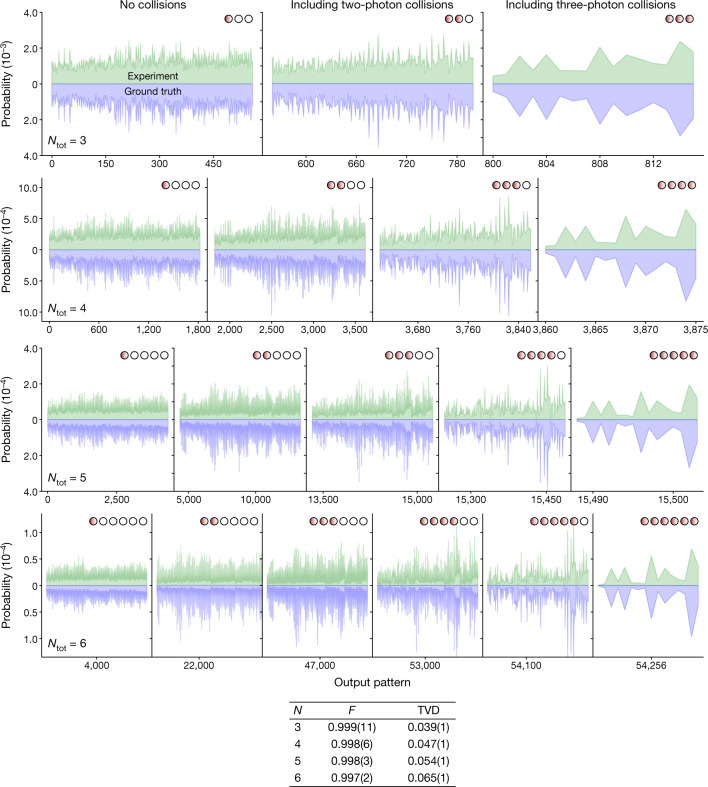
- In the low-photon-number regime, the paper reports fidelities in excess of 99% and TVDs below or equal to 6.5% for total photon-number sectors 3 to 6.
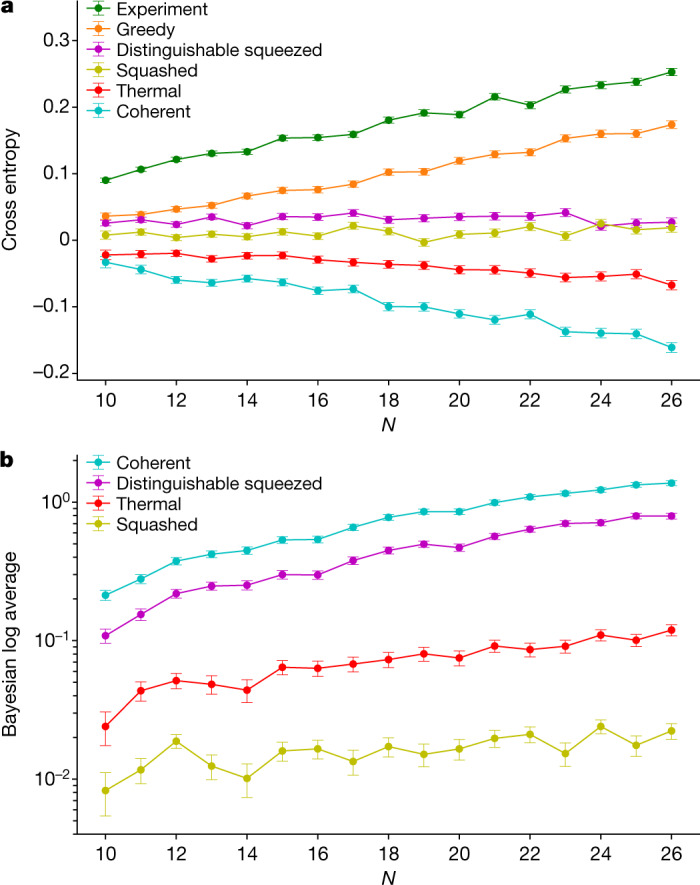
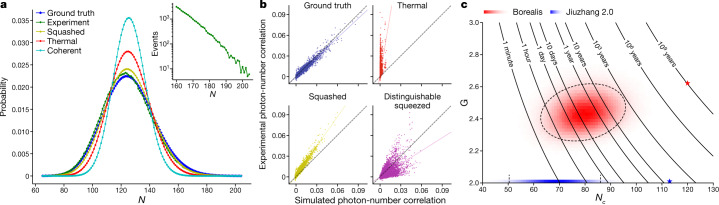
- For the intermediate regime, they analyze 10^6 samples and state that the best adversary (the greedy sampler) remained below the experiment in cross-entropy; for the large regime, the experimental total photon-number distribution has its highest probability at N = 124.35 ± 0.02, with support past 160 photons.
Methods
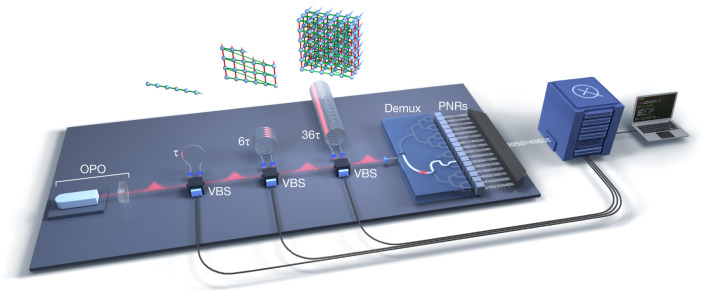
- The experiment uses a time-multiplexed photonic processor with three loop-based interferometers, a 6 MHz pulsed squeezed-light source, and 16-channel demultiplexing to route outputs to superconducting TES photon-number-resolving detectors.
- The device synthesizes a 216-mode Gaussian state by injecting 216 squeezed-light pulses into the interferometer; the loops enable couplings at separations of 1, 6, and 36 time bins.
- Performance is assessed by comparing experimental samples to the calibrated lossy ground truth using fidelity, total variation distance, cross-entropy benchmarks, Bayesian log averages, and cumulant comparisons against several classical adversaries.
Limitations
- The paper states that because estimating all probabilities from the characterized transmission matrix would require orders of magnitude more samples, their analysis is limited; this is why data beyond N > 6 were left for later benchmarks.
- The authors note that the demultiplexer and filter stack introduce losses, estimated at roughly 15% and 20%, respectively, and say improved detector speed could eliminate the demultiplexer.
- Evident from the text: the reported advantage is tied to a specific programmed distribution and a calibrated lossy ground truth, so it is not a general proof of all photonic computations.
Model-written summary. Check it against the paper before relying on it.
Integrity signals
Registry
Cites
Statistics
Figures
Verification
Claims the paper makes
15 Valid · 6 Not valid · 3 Not checked · 69 Own results and interpretations
At least one cited source doesn’t support this claim or points to a different paper, and none confirmed it — see the verdicts below.
In the paper
“In addition, its output cannot be efficiently spoofed in cross-entropy benchmarks using a generalization of the most recent polynomial-time algorithms3.”
§ Quantum computational advantage with a programmable photonic processor > Main
What the sources say
- Disputedcites [3] Villalonga, B. et al. Efficient approximation of experimental Gaussian boson sampling. Preprint at https://arxiv.org/abs/2109.11525 (2021). sourceExperimental — accuracy not yet measured
Our copy never names Borealis (it analyses the GBS experiments of its Refs. 1 and 2, up to 144 output modes), but its central conclusion runs opposite to what the citing sentence attributes to it: the Discussion (p. 8) states that 'a quadratic classical algorithm obtained a better approximation to the ideal distribution' and that the methodology 'can be applied to other boson sampling proposals where marginal probabilities can be computed efficiently'. On the cross-entropy metric specifically, Section III (pp. 7-8, Fig. 6) reports that the order-3 greedy sampler has XE similar to the experiment and that the 2nd-order samplers have smaller (better) XE than the experiment at large click numbers, i.e. efficient XE spoofing is demonstrated, not ruled out. The only hedge the paper offers is cost scaling — the order-k generalization is exponential in k and the scaling with k is called 'an interesting open question' (Introduction p. 2, Discussion p. 8) — which qualifies but does not assert impossibility for a device like Borealis. (LLM, conf=0.68)
Checked by a reasoning model — may be wrong.
plain- Asserted: passes — The authors put it forward as true.
- Checkable: passes — It can be checked against evidence.
- Load-bearing: passes — The paper’s conclusions depend on it.
- Based: passes — The paper gives a reason why it holds.
- Disputed
The cited sources that could be checked couldn’t confirm or dispute this claim.
In the paper
“On average, it would take more than 9,000 years for the best available algorithms and supercomputers to produce, using exact methods, a single sample from the programmed distribution”
- Also stated in: § Experiment · hedged
“we estimate that, on average, it would take Fugaku 9,000 years to generate one sample”
§ Quantum computational advantage with a programmable photonic processor > Abstract
What the sources say
- Could not verifycites [30] Bulmer JF The boundary for quantum advantage in Gaussian boson sampling Sci. Adv. 2021 8 eabl9236 PMC8791606 35080972 sourceExperimental — accuracy not yet measured
The Results (Benchmarking; page not provided) estimate seconds per sample for the paper’s simulated GBS systems, potentially milliseconds on Fugaku. The Discussion (page not provided) mentions programmability as a possible feature of future experiments, but our copy does not identify the claimed programmed distribution or give a 9,000-year estimate for an exact sample from it. Searched for the 9,000-year estimate and programmed distribution. (LLM, conf=0.78)
- Could not verifycites [34] Quesada N Quadratic speed-up for simulating gaussian boson sampling PRX Quantum 2022 3 010306 sourceExperimental — accuracy not yet measured
Our full copy (not truncated) contains no years-scale estimate anywhere: searched for '9,000 years', single-sample run time, supercomputer, programmed distribution. The only concrete runtimes are in Sec. IV BENCHMARKING — ~7 h for a 56×56 loop hafnian on a 96-CPU Azure workstation and 'roughly 2 weeks for generating a single sample' for m = 100 modes, N = 50 photons — and the Abstract stresses probabilities can be computed 'in a single workstation, i.e., without the need of a supercomputer'. So the paper neither states the 9,000-year figure nor addresses whatever device/distribution that figure belongs to; its own state-of-the-art exact-sampling numbers point in the opposite direction (much shorter), which means the attribution is unsupported rather than confirmed. (LLM, conf=0.65)
hedged- Asserted: passes — The authors put it forward as true.
- Checkable: passes — It can be checked against evidence.
- Load-bearing: passes — The paper’s conclusions depend on it.
- Based: passes — The paper gives a reason why it holds.
- Also stated in: § Experiment · hedged
Every source the paper cites for this claim was checked and supports it.
In the paper
“we estimate that Fugaku would require 1.5 h, on average, to generate one sample from the experiment in ref. 2”
§ Quantum computational advantage with a programmable photonic processor > Experiment
What the sources say
- Supportedcites [2] Zhong H-S Phase-programmable Gaussian boson sampling using stimulated squeezed light Phys. Rev. Lett. 2021 127 180502 34767431 source
The paper’s Abstract identifies its Jiuzhang 2.0 experiment as a Gaussian boson-sampling experiment that produced samples. The citing authors present the 1.5-hour Fugaku figure as their own estimate; the citation identifies the experiment being simulated, not the source of that estimate. (LLM, conf=0.91)
hedged- Asserted: passes — The authors put it forward as true.
- Checkable: passes — It can be checked against evidence.
- Load-bearing: passes — The paper’s conclusions depend on it.
- Based: passes — The paper gives a reason why it holds.
- Rests on 2 assumptions not shown here.
- Supported
Every source the paper cites for this claim was checked and supports it.
In the paper
“if one were to target a universal and programmable interferometer, with depth equal to the number of modes, that covers densely the set of unitary matrices, the exponential accumulation of loss would prohibit showing a quantum advantage.”
§ Quantum computational advantage with a programmable photonic processor > Experiment
What the sources say
- Supportedcites [5] Deshpande A Quantum computational advantage via high-dimensional gaussian boson sampling Sci. Adv. 2022 8 eabi7894 34985960 PMC8730598 source
The Results section (“High-dimensional GBS and evidence for hardness”) says that implementing arbitrary unitary transformations requires a circuit whose depth scales linearly with its size. It then states that photon loss scales exponentially with depth, making such models efficiently classically simulatable for sufficiently large numbers of modes in the absence of optical error correction. (LLM, conf=0.92)
- Supportedcites [31] Qi H Brod DJ Quesada N García-Patrón R Regimes of classical simulability for noisy Gaussian boson sampling Phys. Rev. Lett. 2020 124 100502 32216428 source
The main text (p. 2) states exactly the attributed content: 'In most linear-optical architectures, photon loss is defined by unit depth of the circuit, leading to an exponential decrease of transmission with the depth. Our results imply that, asymptotically, GBS implemented on these platforms is rendered efficiently simulable by losses if the depth is linear in the number of modes... lossy GBS inevitably loses its quantum advantage for sufficiently large sizes.' The abstract (p. 1) repeats it ('photon loss increases exponentially with the circuit depth, noisy GBS loses its quantum advantage in the asymptotic limit'), and Sec. II of the Supplemental Material (p. 7) names interferometer-depth loss 'the main scalability bottleneck'. A universal/programmable mesh of depth equal to the number of modes falls inside the class of architectures the paper treats, so the consequent is supported; the descriptors 'universal and programmable' and 'covers densely the set of unitary matrices' are the citing authors' motivation for the depth choice and are not asserted by the source, which speaks of 'most linear-optical architectures' generally and adds the caveat that a running-time advantage may persist at intermediate sizes. (LLM, conf=0.85)
hedgedstates a cause- Asserted: passes — The authors put it forward as true.
- Checkable: passes — It can be checked against evidence.
- Load-bearing: passes — The paper’s conclusions depend on it.
- Based: passes — The paper gives a reason why it holds.
- Supported
The cited sources support only part of this claim — read each source’s verdict below.
In the paper
“As discussed in the Methods, combined with the high brightness of our source averaging r ~ 1.1, places our experiment well beyond any attempt at a now-known polynomial-time approximate classical simulation31.”
§ Quantum computational advantage with a programmable photonic processor > Methods > Connectivity
What the sources say
- Partly supportedcites [31] Qi H Brod DJ Quesada N García-Patrón R Regimes of classical simulability for noisy Gaussian boson sampling Phys. Rev. Lett. 2020 124 100502 32216428 sourceExperimental — accuracy not yet measured
Our copy supplies the framework the citing sentence leans on: a sufficient condition (inequality (1)) for approximate polynomial-time classical simulation of noisy GBS in terms of squeezing r, transmission η and detector quality q_D, which the authors call 'a natural and useful test that any alleged quantum advantage demonstration with noisy GBS must pass' (p. 1), together with the explicit statement that 'increasing the amount of input squeezing is helpful to evade our classical simulation algorithm' and that 'the region where quantum computational supremacy has not been ruled out expands as we increase ... the amount of input squeezing' (Abstract p. 1; Discussion p. 4). However, the paper never evaluates r ≈ 1.1: the only experiments it plugs into inequality (1) are r ≈ 0.1 (Ref. [48]) and r ≈ 0.38 (Ref. [49]), the latter giving 'no solution for any ε ∈ [0,1]' (p. 2). Moreover, the source's condition is only sufficient for simulability — failing it means supremacy is 'not ruled out', not that the device is provably 'well beyond any attempt at a now-known polynomial-time approximate classical simulation'; that stronger, universal phrasing is the citing authors' own extrapolation. (LLM, conf=0.75)
boostedstates a cause- Asserted: passes — The authors put it forward as true.
- Checkable: passes — It can be checked against evidence.
- Load-bearing: passes — The paper’s conclusions depend on it.
- Based: passes — The paper gives a reason why it holds.
- Partly supported
53 more claims · 8 with their cited sources checked
Create a free account to see all 93 claims and to verify the 10 references still open.
- It may state two separate claims as one. 26
- Probably not a substantial claim. 10
Citations
Cites
Quantum supremacy using a programmable superconducting processor
Arute, F., Arya, K., Babbush, R., Bacon, D., Bardin, J. C., Barends, R., Biswas, R., Boixo, S., Brandao, F. G. S. L., Buell, D. A., et al. (2019) · Nature · doi:10.1038/s41586-019-1666-5 · Cited by 7,720 · cited 2×
“Only a handful of experiments have used quantum devices to carry out computational tasks that are outside the reach of present-day classical computers 1,2,6,7 .”
BackgroundMethodWeedbrook, C., Pirandola, S., García-Patrón, R., Cerf, N. J., Ralph, T. C., Shapiro, J. H., & Lloyd, S. (2012) · Reviews of Modern Physics · doi:10.1103/revmodphys.84.621 · Cited by 3,664
Quantum computational advantage using photons
Zhong, H.-S., Wang, H., Deng, Y.-H., Chen, M.-C., Peng, L.-C., Luo, Y.-H., Qin, J., Wu, D., Ding, X., Hu, Y., et al. (2020) · Science · doi:10.1126/science.abe8770 · Cited by 2,405 · cited 8×
“Our solutions to these challenges for this work are, respectively, (1) the design of a bright and tunable source of single-mode squeezed states and phase stabilization techniques (OPO and interferometer) using locking schemes compatible with PNR detectors, (2) active demultiplexing to increase the effective rate of PN…”
BackgroundMethodInfluentialStrong Quantum Computational Advantage Using a Superconducting Quantum Processor
Wu, Y., Bao, W.-S., Cao, S., Chen, F., Chen, M.-C., Chen, X., Chung, T.-H., Deng, H., Du, Y., Fan, D., et al. (2021) · Physical Review Letters · doi:10.1103/physrevlett.127.180501 · Cited by 1,059
Counting near-infrared single-photons with 95% efficiency
Lita, A. E., Miller, A. J., & Nam, S. W. (2008) · Optics Express · doi:10.1364/oe.16.003032 · Cited by 734 · cited 1×
“Spatial overlap is ensured by using single-mode fibre coupling at the entrance and exit of each loop delay, and samples are collected using an array of photon-number resolving (PNR) detectors based on superconducting transition-edge sensors (TES) with 95% detection efficiency 39,40 .”
MethodSelf-citationTopological fault-tolerance in cluster state quantum computation
Raussendorf, R., Harrington, J., & Goyal, K. (2007) · New Journal of Physics · doi:10.1088/1367-2630/9/6/199 · Cited by 617
Quantum circuits with many photons on a programmable nanophotonic chip
Arrazola, J. M., Bergholm, V., Brádler, K., Bromley, T. R., Collins, M. J., Dhand, I., Fumagalli, A., Gerrits, T., Goussev, A., Helt, L. G., et al. (2021) · Nature · doi:10.1038/s41586-021-03202-1 · Cited by 567 · cited 3×
“Spatial overlap is ensured by using single-mode fibre coupling at the entrance and exit of each loop delay, and samples are collected using an array of photon-number resolving (PNR) detectors based on superconducting transition-edge sensors (TES) with 95% detection efficiency 39,40 .”
BackgroundMethodSelf-citationHamilton, C. S., Kruse, R., Sansoni, L., Barkhofen, S., Silberhorn, C., & Jex, I. (2017) · Physical Review Letters · doi:10.1103/physrevlett.119.170501 · Cited by 503 · cited 5×
“Equation (4) captures the collision-free complexity of the hafnian of an N × N matrix of O N ( 2 ) c N 3 /2 c because in that case G = 2.”
BackgroundMethodInfluentialGeneration of time-domain-multiplexed two-dimensional cluster state
Asavanant, W., Shiozawa, Y., Yokoyama, S., Charoensombutamon, B., Emura, H., Alexander, R. N., Takeda, S., Yoshikawa, J.-I., Menicucci, N. C., Yonezawa, H., et al. (2019) · Science · doi:10.1126/science.aay2645 · Cited by 476 · cited 1×
“Using time-domain multiplexing, large one-and two-dimensional cluster states have been deterministically generated 21–23 with programmable linear operations implemented by projective measurements 24,25 , whereas similar operations have been implemented in ref.”
MethodQuantum circuits with many photons on a programmable nanophotonic chip
Arrazola, J. M., Bergholm, V., Brádler, K., Bromley, T. R., Collins, M. J., Dhand, I., Fumagalli, A., Gerrits, T., Goussev, A., Helt, L. G., et al. (2021) · RePEc: Research Papers in Economics · Cited by 463
Self-citation
Research works printed but not linked: 1
- 56th edition of the top 500 Top 500 the List https://www.top500.org/lists/top500/2020/11/ (2020).
Cited by
Items 101–200 of 1,033
Brain-inspired computing systems: a systematic literature review
Zolfagharinejad, M., Alegre-Ibarra, U., Chen, T., Kinge, S., & van der Wiel, W. G. (2024) · The European Physical Journal B · doi:10.1140/epjb/s10051-024-00703-6 · Cited by 39
Quantum utility – definition and assessment of a practical quantum advantage
Herrmann, N., Arya, D., Doherty, M. W., Mingare, A., Pillay, J. C., Preis, F., & Prestel, S. (2023) · IEEE International Conference on Quantum Software (QSW) · doi:10.1109/qsw59989.2023.00028 · Cited by 71
Yu, M., Khishe, M., Qian, L., Martín, D. R., Abualigah, L., & Ghazal, T. M. (2024) · Journal of Artificial Intelligence and Soft Computing Research · doi:10.2478/jaiscr-2024-0018 · Cited by 38
Simulating large-size quantum spin chains on cloud-based superconducting quantum computers
Yu, H., Zhao, Y., & Wei, T.-C. (2023) · Physical Review Research · doi:10.1103/physrevresearch.5.013183 · Cited by 59
Quantum computing for market research
Sáez‐Ortuño, L., Huertas-García, R., Forgas‐Coll, S., Sánchez, J., & Puertas, E. (2024) · Journal of Innovation & Knowledge · doi:10.1016/j.jik.2024.100510 · Cited by 60
Liu, Y., Singh, S., Smith, K. C., Crane, E., Martyn, J. M., Eickbusch, A., Schuckert, A., Li, R. D., Sinanan-Singh, J., Soley, M. B., et al. (2026) · PRX Quantum · doi:10.1103/4rf7-9tfx · Cited by 171
Gottesman-Kitaev-Preskill qubit synthesizer for propagating light
Takase, K., Fukui, K., Kawasaki, A., Asavanant, W., Endo, M., Yoshikawa, J., van Loock, P., & Furusawa, A. (2023) · npj Quantum Information · doi:10.1038/s41534-023-00772-y · Cited by 69
Bonsai Algorithm: Grow Your Own Fermion-to-Qubit Mappings
Miller, A., Zimborás, Z., Knecht, S., Maniscalco, S., & García-Pérez, G. (2023) · PRX Quantum · doi:10.1103/prxquantum.4.030314 · Cited by 74
Spectrally shaped and pulse-by-pulse multiplexed multimode squeezed states of light
Kouadou, T., Sansavini, F., Ansquer, M., Henaff, J., Treps, N., & Parigi, V. (2023) · APL Photonics · doi:10.1063/5.0156331 · Cited by 50
Rivera, N., Sloan, J., Salamin, Y., Joannopoulos, J. D., & Soljacic, M. (2023) · Proceedings of the National Academy of Sciences · doi:10.1073/pnas.2219208120 · Cited by 50
On physics-informed neural networks for quantum computers
Markidis, S. (2022) · Frontiers in Applied Mathematics and Statistics · doi:10.3389/fams.2022.1036711 · Cited by 61
On-chip generation and dynamic piezo-optomechanical rotation of single photons
Bühler, D. D., Weiß, M., Crespo-Poveda, A., Nysten, E. D. S., Finley, J. J., Müller, K. M., Santos, P. V., de Lima, M. M., & Krenner, H. J. (2022) · Nature Communications · doi:10.1038/s41467-022-34372-9 · Cited by 46
Toward Molecular Spin Qubit Devices: Integration of Magnetic Molecules into Solid-State Devices
Fursina, A. A., & Sinitskii, A. S. (2023) · ACS Applied Electronic Materials · doi:10.1021/acsaelm.3c00472 · Cited by 40
Quantum machine learning with Adaptive Boson Sampling via post-selection
Hoch, F., Caruccio, E., Rodari, G., Francalanci, T., Suprano, A., Giordani, T., Carvacho, G., Spagnolo, N., Koudia, S., Proietti, M., et al. (2025) · Nature Communications · doi:10.1038/s41467-025-55877-z · Cited by 74
Reconfigurable Silicon Photonic Chip for the Generation Of Frequency-Bin-Entangled Qudits
Borghi, M., Tagliavacche, N., Sabattoli, F. A., Dirani, H. E., Youssef, L., Petit-Étienne, C., Pargon, E., Sipe, J. E., Liscidini, M., Sciancalepore, C., et al. (2023) · Physical Review Applied · doi:10.1103/physrevapplied.19.064026 · Cited by 46
Implementing any Linear Combination of Unitaries on Intermediate-term Quantum Computers
Chakraborty, S. (2024) · Quantum · doi:10.22331/q-2024-10-10-1496 · Cited by 116
Pentangelo, C., Giano, N. D., Piacentini, S., Arpe, R., Ceccarelli, F., Crespi, A., & Osellame, R. (2024) · Nanophotonics · doi:10.1515/nanoph-2023-0636 · Cited by 44
Deep Quantum-Transformer Networks for Multimodal Beam Prediction in ISAC Systems
Tariq, S., Arfeto, B. E., Khalid, U., Kim, S., Duong, T. Q., & Shin, H. (2024) · IEEE Internet of Things Journal · doi:10.1109/jiot.2024.3420455 · Cited by 55
Superconducting single-photon detector with a speed of 5 GHz and a photon number resolution of 61
Zhang, T., Huang, J., Zhang, X., Ding, C., Yu, H., Xiao, Y., Lv, C., Liu, X., Wang, Z., You, L., et al. (2024) · Photonics Research · doi:10.1364/prj.522714 · Cited by 39
Bova, F., Goldfarb, A., & Melko, R. G. (2022) · Management Science · doi:10.1287/mnsc.2022.4578 · Cited by 44
Error-Resilience Phase Transitions in Encoding-Decoding Quantum Circuits
Turkeshi, X., & Sierant, P. (2024) · Physical Review Letters · doi:10.1103/physrevlett.132.140401 · Cited by 47
Generation of three-dimensional cluster entangled state
Roh, C., Gwak, G., Yoon, Y.-D., & Ra, Y.-S. (2025) · Nature Photonics · doi:10.1038/s41566-025-01631-2 · Cited by 60
QSAN: A Near-Term Achievable Quantum Self-Attention Network
Shi, J., Zhao, R.-X., Wang, W., Zhang, S., & Li, X. (2024) · IEEE Transactions on Neural Networks and Learning Systems · doi:10.1109/tnnls.2024.3504828 · Cited by 72
Progress in quantum structured light
Forbes, A., Nothlawala, F., & Vallés, A. (2025) · Nature Photonics · doi:10.1038/s41566-025-01795-x · Cited by 59
Scalable photonic quantum technologies
Wang, H., Ralph, T. C., Renema, J. J., Lu, C., & Pan, J.-W. (2025) · Nature Materials · doi:10.1038/s41563-025-02306-7 · Cited by 93
Experimental quantum-enhanced kernel-based machine learning on a photonic processor
Yin, Z., Agresti, I., de Felice, G., Brown, D., Toumi, A., Pentangelo, C., Piacentini, S., Crespi, A., Ceccarelli, F., Osellame, R., et al. (2025) · Nature Photonics · doi:10.1038/s41566-025-01682-5 · Cited by 83
Accelerated quantum Monte Carlo with probabilistic computers
Chowdhury, S., Camsari, K. Y., & Datta, S. (2023) · Communications Physics · doi:10.1038/s42005-023-01202-3 · Cited by 40
Realization of higher-order topological lattices on a quantum computer
Koh, J. M., Tai, T., & Lee, C. H. (2024) · Nature Communications · doi:10.1038/s41467-024-49648-5 · Cited by 68
The potential of multidimensional photonic computing
Bente, I., Taheriniya, S., Lenzini, F., Brückerhoff‐Plückelmann, F., Kues, M., Bhaskaran, H., Wright, C. D., & Pernice, W. H. P. (2025) · Nature Reviews Physics · doi:10.1038/s42254-025-00843-3 · Cited by 69
HyperQUEEN: Hyperspectral Quantum Deep Network For Image Restoration
Lin, C.-H., & Chen, Y.-Y. (2023) · IEEE Transactions on Geoscience and Remote Sensing · doi:10.1109/tgrs.2023.3274355 · Cited by 46
Quantum reservoir computing in finite dimensions
Martínez‐Peña, R., & Ortega, J. (2023) · Physical review. E · doi:10.1103/physreve.107.035306 · Cited by 66
Monolithic Integration of Single Quantum Emitters in hBN Bullseye Cavities
Spencer, L., Horder, J., Kim, S., Toth, M., & Aharonovich, I. (2023) · ACS Photonics · doi:10.1021/acsphotonics.3c01282 · Cited by 29
Quantum Gaussian process regression for Bayesian optimization
Rapp, F., & Roth, M. (2024) · Quantum Machine Intelligence · doi:10.1007/s42484-023-00138-9 · Cited by 45
Large-inductance superconducting microstrip photon detector enabling 10 photon-number resolution
Kong, L.-D., Zhang, T.-Z., Liu, X., Li, H., Wang, Z., Xie, X., & You, L. (2024) · Advanced Photonics · doi:10.1117/1.ap.6.1.016004 · Cited by 40
Çalıkyılmaz, U., Groppe, S., Groppe, J., Winker, T., Prestel, S., Shagieva, F., Arya, D., Preis, F., & Gruenwald, L. (2023) · Proceedings of the VLDB Endowment · doi:10.14778/3598581.3598603 · Cited by 47
Bell Sampling from Quantum Circuits
Hangleiter, D., & Gullans, M. J. (2024) · Physical Review Letters · doi:10.1103/physrevlett.133.020601 · Cited by 28
Evolutionary Algorithms and Quantum Computing: Recent Advances, Opportunities, and Challenges
Rehman, J. U., Ulum, M. S., Shaffar, A. W., Hakim, A. A., Mujirin, Abdullah, Z., Al-Hraishawi, H., Chatzinotas, S., & Shin, H. (2025) · IEEE Access · doi:10.1109/access.2025.3530952 · Cited by 40
Programmable photonic integrated meshes for modular generation of optical entanglement links
Dong, M., Zimmermann, M., Heim, D., Choi, H., Clark, G., Leenheer, A. J., Palm, K. J., Witte, A., Dominguez, D., Gilbert, G. N., et al. (2023) · npj Quantum Information · doi:10.1038/s41534-023-00708-6 · Cited by 43
Multimode squeezed state for reconfigurable quantum networks at telecommunication wavelengths
Rodriguez, V. R., Fainsin, D., Zanin, G. L., Treps, N., Diamanti, E., & Parigi, V. (2024) · Physical Review Research · doi:10.1103/physrevresearch.6.043113 · Cited by 47
Deterministic photon source interfaced with a programmable silicon-nitride integrated circuit
Wang, Y., Faurby, C. F. D., Ruf, F., Sund, P. I., Nielsen, K., Volet, N., Heck, M. J. R., Bart, N., Wieck, A. D., Ludwig, A., et al. (2023) · npj Quantum Information · doi:10.1038/s41534-023-00761-1 · Cited by 40
Adjoint method in machine learning: A pathway to efficient inverse design of photonic devices
Kang, C., Seo, D., Boriskina, S. V., & Chung, H. (2024) · Materials & Design · doi:10.1016/j.matdes.2024.112737 · Cited by 39
Kashif, M., Rashid, M., Al-Kuwari, S. M., & Shafique, M. (2024) · Design, Automation, and Test in Europe · doi:10.23919/date58400.2024.10546644 · Cited by 52
Gradient-Descent Quantum Process Tomography by Learning Kraus Operators
Ahmed, S., Quijandría, F., & Kockum, A. F. (2023) · Physical Review Letters · doi:10.1103/physrevlett.130.150402 · Cited by 54
Femtosecond-laser-written low-loss multiscan waveguides in fused silica
Skryabin, N. N., Zhuravitskii, S. A., Dyakonov, I. V., Straupe, S. S., Kalinkin, A. A., & Kulik, S. P. (2024) · Physical Review Applied · doi:10.1103/physrevapplied.22.064079 · Cited by 32
Fast transition-edge sensors suitable for photonic quantum computing
Hummatov, R., Lita, A. E., Farrahi, T., Otrooshi, N., Fayer, S. E., Collins, M. J., Durkin, M., Bennett, D. A., Ullom, J. N., Mirin, R. P., et al. (2023) · Journal of Applied Physics · doi:10.1063/5.0149478 · Cited by 26
Self-citationProposal of Low-Loss Non-Volatile Mid-Infrared Optical Phase Shifter Based on Ge2Sb2Te3S2
Miyatake, Y., Makino, K., Tominaga, J., Miyata, N., Nakano, T., Okano, M., Toprasertpong, K., Takagi, S., & Takenaka, M. (2023) · IEEE Transactions on Electron Devices · doi:10.1109/ted.2023.3235865 · Cited by 26
Mitigating Barren Plateaus of Variational Quantum Eigensolvers
Liu, X., Liu, G., Zhang, H.-K., Huang, J., & Wang, X. (2024) · IEEE Transactions on Quantum Engineering · doi:10.1109/tqe.2024.3383050 · Cited by 74
Heralded nonlocal quantum gates for distributed quantum computation in a decoherence-free subspace
Su, W., Qin, W., Miranowicz, A., Li, T., & Nori, F. (2024) · Physical Review A · doi:10.1103/physreva.110.052612 · Cited by 31
Enhanced Detection Rate and High Photon-Number Efficiencies with a Scalable Parallel SNSPD
Stasi, L., Taher, T., Resta, G. V., Zbinden, H., Thew, R., & Bussières, F. (2024) · ACS Photonics · doi:10.1021/acsphotonics.4c01680 · Cited by 43
Deterministic Quantum Light Arrays from Giant Silica-Shelled Quantum Dots
Nguyen, H., Sharp, D., Fröch, J. E., Cai, Y., Wu, S., Monahan, M., Munley, C., Manna, A., Majumdar, A., Kagan, C. R., et al. (2022) · ACS Applied Materials & Interfaces · doi:10.1021/acsami.2c18475 · Cited by 32
Fyrillas, A., Faure, O., Maring, N., Sénellart, J., & Belabas, N. (2024) · Optica · doi:10.1364/optica.512148 · Cited by 49
Characterization of entanglement on superconducting quantum computers of up to 414 qubits
Kam, J. F., Kang, H., Hill, C. D., Mooney, G. J., & Hollenberg, L. C. L. (2024) · Physical Review Research · doi:10.1103/physrevresearch.6.033155 · Cited by 42
Tellurium/Silicon based p-n photodiode for near infrared heterostructure photodetector applications
Park, B., Beak, S., Yang, J., et al. (2024) · Applied Surface Science · doi:10.1016/j.apsusc.2024.162242 · Cited by 25
Bellante, A., Fioravanti, T., Carminati, M., Zanero, S., & Luongo, A. (2025) · Computers & Security · doi:10.1016/j.cose.2025.104341 · Cited by 44
Information processing at the speed of light
AbuGhanem, M. (2024) · Frontiers of Optoelectronics · doi:10.1007/s12200-024-00133-3 · Cited by 35
Superconducting quantum computers: who is leading the future?
AbuGhanem, M. (2025) · EPJ Quantum Technology · doi:10.1140/epjqt/s40507-025-00405-7 · Cited by 61
Extending the computational reach of a superconducting qutrit processor
Goss, N., Ferracin, S., Hashim, A., Carignan-Dugas, A., Kreikebaum, J. M., Naik, R., Santiago, D., & Siddiqi, I. A. (2024) · npj Quantum Information · doi:10.1038/s41534-024-00892-z · Cited by 58
UGV-UAV Integration Advancements for Coordinated Missions: A Review
Shahar, F. S., Sultan, M. T. H., Nowakowski, M., & Łukaszewicz, A. (2025) · Journal of Intelligent & Robotic Systems · doi:10.1007/s10846-025-02273-w · Cited by 25
The impact of cost function globality and locality in hybrid quantum neural networks on NISQ devices
Kashif, M., & Al-Kuwari, S. M. (2023) · Machine Learning Science and Technology · doi:10.1088/2632-2153/acb12f · Cited by 44
Spoofing Cross-Entropy Measure in Boson Sampling
Oh, C., Jiang, L., & Fefferman, B. (2023) · Physical Review Letters · doi:10.1103/physrevlett.131.010401 · Cited by 37
Programmable Photonic Quantum Circuits with Ultrafast Time-Bin Encoding
Bouchard, F., Fenwick, K. L., Bonsma-Fisher, K., England, D. G., Bustard, P. J., Heshami, K., & Sussman, B. (2024) · Physical Review Letters · doi:10.1103/physrevlett.133.090601 · Cited by 33
Practical Introduction to Benchmarking and Characterization of Quantum Computers
Hashim, A., Nguyen, L. B., Goss, N., Marinelli, B., Naik, R., Chistolini, T., Hines, J., Marceaux, J. P., Kim, Y., Gokhale, P., et al. (2025) · PRX Quantum · doi:10.1103/prxquantum.6.030202 · Cited by 133
Fundamental Limitation on the Detectability of Entanglement
Liu, P., Liu, Z., Chen, S., & Ma, X. (2022) · Physical Review Letters · doi:10.1103/physrevlett.129.230503 · Cited by 36
Single-Electron Spin Qubits in Silicon for Quantum Computing
Hu, G., Huang, W., Cai, R., Wang, L., Yang, C. H., Cao, G., Xue, X., Huang, P., & He, Y. (2025) · Intelligent Computing · doi:10.34133/icomputing.0115 · Cited by 33
Engineering Clock Transitions in Molecular Lanthanide Complexes
Stewart, R., Canaj, A. B., Liu, S., Martí, E. R., Celmina, A., Nichol, G. S., Cheng, H., Murrie, M., & Hill, S. (2024) · Journal of the American Chemical Society · doi:10.1021/jacs.3c09353 · Cited by 28
Simulating lossy Gaussian boson sampling with matrix-product operators
Liu, M., Oh, C., Liu, J., Jiang, L., & Alexeev, Y. (2023) · Physical Review A · doi:10.1103/physreva.108.052604 · Cited by 37
Kanno, K., Kohda, M., Imai, R., Koh, S., Mitarai, K., Mizukami, W., & Nakagawa, Y. O. (2026) · Physical Review Research · doi:10.1103/dmn4-snfx · Cited by 207
Continuous dynamical decoupling of optical 171Yb+ qudits with radiofrequency fields
Zalivako, I. V., Borisenko, A. S., Semerikov, I. A., Korolkov, A. E., Sidorov, P., Galstyan, K. P., Semenin, N. V., Smirnov, V. N., Aksenov, M. D., Fedorov, A. K., et al. (2023) · Frontiers in Quantum Science and Technology · doi:10.3389/frqst.2023.1228208 · Cited by 23
Group-theoretic error mitigation enabled by classical shadows and symmetries
Zhao, A., & Miyake, A. (2024) · npj Quantum Information · doi:10.1038/s41534-024-00854-5 · Cited by 50
Reconfigurable inverse-designed phase-change photonics
Wu, C., Jiao, Z., Deng, H., Huang, Y., Yu, H., Takeuchi, I., Ríos, C., & Li, M. (2025) · APL Photonics · doi:10.1063/5.0234637 · Cited by 27
Recent advances in high-dimensional quantum frequency combs
Chang, K.-C., Cheng, X., Sarihan, M. C., & Wong, C. W. (2025) · Newton · doi:10.1016/j.newton.2025.100024 · Cited by 60
Dynamical Quantum Phase Transitions of the Schwinger Model: Real-Time Dynamics on IBM Quantum
Pomarico, D., Cosmai, L., Facchi, P., Lupo, C., Pascazio, S., & Pepe, F. V. (2023) · Entropy · doi:10.3390/e25040608 · Cited by 43
Supporting quantum technologies with an ultralow-loss silicon photonics platform
Cherchi, M., Bera, A., Kemppinen, A., Nissilä, J., Tappura, K., Caputo, M., Lehtimäki, L., Lehtinen, J. S., Govenius, J., Hassinen, T., et al. (2023) · Advanced Photonics Nexus · doi:10.1117/1.apn.2.2.024002 · Cited by 25
Light in quantum computing and simulation: perspective
Walmsley, I. A. (2023) · Optica Quantum · doi:10.1364/opticaq.507527 · Cited by 31
Scalable flux controllers using adiabatic superconductor logic for quantum processors
Takeuchi, N., Yamae, T., Luo, W., Hirayama, F., Yamamoto, T., & Yoshikawa, N. (2023) · Physical Review Research · doi:10.1103/physrevresearch.5.013145 · Cited by 21
Madigawa, A. A., Donges, J. N., Gaál, B., Li, S., Jacobsen, M. A., Liu, H., Dai, D., Su, X., Shang, X., Ni, H., et al. (2024) · ACS Photonics · doi:10.1021/acsphotonics.3c01368 · Cited by 34
Riemannian optimization of photonic quantum circuits in phase and Fock space
Yao, Y., Miatto, F. M., & Quesada, N. (2024) · SciPost Physics · doi:10.21468/scipostphys.17.3.082 · Cited by 42
Self-citationExperimentally Finding Dense Subgraphs Using a Time-Bin Encoded Gaussian Boson Sampling Device
Sempere-Llagostera, S., Patel, R. B., Walmsley, I. A., & Kolthammer, W. S. (2022) · Physical Review X · doi:10.1103/physrevx.12.031045 · Cited by 38
Wang, X., Zhang, X., Chen, B., Zhu, Y., Qin, Y., Dong, L., Cai, J., Sui, D., Wu, J., Zhang, Q., et al. (2025) · Nature Materials · doi:10.1038/s41563-025-02398-1 · Cited by 36
Proietti, M., Cerocchi, F., & Dispenza, M. (2022) · Physical Review A · doi:10.1103/physreva.106.022437 · Cited by 24
Universal and Ultrafast Quantum Computation Based on Free-Electron-Polariton Blockade
Karnieli, A., Tsesses, S., Yu, R., Rivera, N., Arie, A., Kaminer, I. E., & Fan, S. (2024) · PRX Quantum · doi:10.1103/prxquantum.5.010339 · Cited by 31
Tensor networks for quantum computing
Berezutskii, A. V., Liu, M., Acharya, A., Ellerbrock, R., Gray, J., Haghshenas, R., He, Z., Khan, A., Kuzmin, V., Lyakh, D. I., et al. (2025) · Nature Reviews Physics · doi:10.1038/s42254-025-00853-1 · Cited by 124
Room-temperature waveguide-coupled silicon single-photon avalanche diodes
Gövdeli, A., Straguzzi, J. N., Yong, Z., Lin, Y., Luo, X., Chua, H., Lo, G., Sacher, W. D., & Poon, J. K. S. (2024) · npj Nanophotonics · doi:10.1038/s44310-024-00003-y · Cited by 32
Zelaya, K., Markowitz, M., & Miri, M. (2024) · Scientific Reports · doi:10.1038/s41598-024-60700-8 · Cited by 27
Topological Hong-Ou-Mandel interference
Ehrhardt, M., Dittel, C., Heinrich, M., & Szameit, A. (2024) · Science · doi:10.1126/science.ado8192 · Cited by 27
OneQ: A Compilation Framework for Photonic One-Way Quantum Computation
Zhang, H., Wu, A., Wang, Y., Li, G., Shapourian, H., Shabani, A., & Ding, Y. (2023) · Proceedings - International Symposium on Computer Architecture/Proceedings · doi:10.1145/3579371.3589047 · Cited by 42
Unified laser stabilization and isolation on a silicon chip
White, A. D., Ahn, G. H., Luhtaru, R., Guo, J., Morin, T. J., Saxena, A., Chang, L., Majumdar, A., Gasse, K. V., Bowers, J. E., et al. (2024) · Nature Photonics · doi:10.1038/s41566-024-01539-3 · Cited by 38
Strong nanophotonic quantum squeezing exceeding 3.5 dB in a foundry-compatible Kerr microresonator
Shen, Y., Hsieh, P., Sridhar, S. K., Feldman, S., Chang, Y.-C., Smith, T. A., & Dutt, A. (2025) · Optica · doi:10.1364/optica.542968 · Cited by 43
Zalivako, I. V., Nikolaeva, A. S., Borisenko, A. S., Korolkov, A. E., Sidorov, P., Galstyan, K. P., Semenin, N. V., Smirnov, V. N., Aksenov, M. A., Makushin, K. M., et al. (2025) · Quantum Reports · doi:10.3390/quantum7020019 · Cited by 40
Taguchi, Y., Wang, Y., Tanomura, R., Tanemura, T., & Ozeki, Y. (2023) · Physical Review Applied · doi:10.1103/physrevapplied.19.054002 · Cited by 20
Time-Domain Universal Linear-Optical Operations for Universal Quantum Information Processing
Yonezu, K., Enomoto, Y., Yoshida, T. O., & Takeda, S. (2023) · Physical Review Letters · doi:10.1103/physrevlett.131.040601 · Cited by 32
Experimental Optical Simulator of Reconfigurable and Complex Quantum Environment
Renault, P., Nokkala, J., Roeland, G., Joly, N. Y., Zambrini, R., Maniscalco, S., Piilo, J., Treps, N., & Parigi, V. (2023) · PRX Quantum · doi:10.1103/prxquantum.4.040310 · Cited by 27
Manenti, R., & Motta, M. (2023) · Oxford University Press eBooks · doi:10.1093/oso/9780198787488.005.0002 · Cited by 20
Enabling large-scale and high-precision fluid simulations on near-term quantum computers
Chen, Z., Ma, T.-Y., Ye, C.-C., Xu, L., Bai, W., Zhou, L., Tan, M.-Y., Zhuang, X., Xu, X., Wang, Y., et al. (2024) · Computer Methods in Applied Mechanics and Engineering · doi:10.1016/j.cma.2024.117428 · Cited by 47
Quantum monte carlo for economics: Stress testing and macroeconomic deep learning
Skavysh, V., Priazhkina, S., Guala, D., & Bromley, T. R. (2023) · Journal of Economic Dynamics and Control · doi:10.1016/j.jedc.2023.104680 · Cited by 31
Universal quantum computing with qubits embedded in trapped-ion qudits
Nikolaeva, A. S., Kiktenko, E. O., & Fedorov, A. K. (2024) · Physical Review A · doi:10.1103/physreva.109.022615 · Cited by 28
Certified Randomness from Quantum Supremacy
Aaronson, S., & Hung, S.-H. (2023) · ACM Symposium on Theory of Computing (STOC) · doi:10.1145/3564246.3585145 · Cited by 62
Quantum Algorithms for Quantum Molecular Systems: A Survey
Zhang, Y., Zhang, X., Sun, J., Lin, H., Huang, Y., Lv, D., & Yuan, X. (2025) · Wiley Interdisciplinary Reviews Computational Molecular Science · doi:10.1002/wcms.70020 · Cited by 38
Exponentially Improved Dispersive Qubit Readout with Squeezed Light
Qin, W., Miranowicz, A., & Nori, F. (2024) · Physical Review Letters · doi:10.1103/physrevlett.133.233605 · Cited by 34
Aramyan, S., McGregor, K., Sandeep, S., & Haczku, A. (2022) · Frontiers in Immunology · doi:10.3389/fimmu.2022.945317 · Cited by 21
Metadata
- Authors
- Madsen, L. S., Laudenbach, F., Askarani, M. F., Rortais, F., Vincent, T., Bulmer, J. F. F., Miatto, F. M., Neuhaus, L., Helt, L. G., Collins, M. J., Lita, A. E., Gerrits, T., Nam, S. W., Vaidya, V. D., Menotti, M., Dhand, I., Vernon, Z., Quesada, N., & Lavoie, J.
- Affiliations
- Xanadu Quantum Technologies (Canada) (CA)
- National Institute of Standards and Technology (US)
- Corresponding author
- Quesada, Nicolás
- Lavoie, Jonathan
- ORCID
- Venue
- Nature
- Published
- 2022-06-01
- Volume
- 606
- Issue
- 7912
- Pages
- 75-81
- ISSN
- 0028-0836 (ISSN-L)
- 1476-4687
- PMC
- PMC9159949
- OpenAlex
- W4281891658
- Semantic Scholar
- 3ce3aad1563a1a34068b38ce0f88eecfadb69f53
- Cited by
- 1,101
- References
- 57
- Citations by year
- 2026: 202 · 2025: 282 · 2024: 302 · 2023: 259 · 2022: 56
- FWCI
- 60.16
- Type
- journal article
- Language
- en
- Open access
- hybrid
- doi.org
- Licence
- cc-by
- creativecommons.org/licenses/by/4.0 (tdm)
- creativecommons.org/licenses/by/4.0 (vor)
- Locations
- Nature (publishedVersion, cc-by)
- PubMed Central (publishedVersion, cc-by)
- PubMed (publishedVersion)
- FIU - Digital Commons (Florida International University) (submittedVersion, cc-by)
- Florida International University Digital Commons (Florida International University) (submittedVersion)
- RePEc: Research Papers in Economics (submittedVersion)
- Funders
- Government of Ontario
- University of Toronto
- National Institute of Standards and Technology
- Topics
- Physical Sciences › Computer Science › Artificial Intelligence › Quantum Computing Algorithms and Architecture
- Physical Sciences › Physics and Astronomy › Atomic and Molecular Physics, and Optics › Quantum Information and Cryptography
- Physical Sciences › Computer Science › Artificial Intelligence › Neural Networks and Reservoir Computing
- Keywords
- quantum advantage, Borealis, Gaussian boson sampling, photon-number-resolving detection, spoofing attacks, quantum computing hardware
About these checks
Registry, retraction, Cites and statistics results are computed, not judged, with one exception: a printed reference that no index lists is read once by a model before it counts as a citation error. Claims are extracted by a model and kept only when their quote appears verbatim in the text; each cited source is then checked, with a model’s help, for whether it says what the claim relies on. Those verdicts can be wrong — read the claim’s quote and the cited source before relying on one.
The claim verdicts this report counts are experimental: their accuracy is not yet measured.
A language model drew the claims from the paper on 2026-10-10, under version 3 of the claim definition (model deepseek-v4.1-flash, prompt extract-v3).
A second model labelled each claim on 2026-10-10 (model jev-1.13-20260917, definition revision gold-guideline-v0.2).
Cited sources are checked with a language model’s help (qwen3.8-omni-flash and gpt-6-sol).
Statistics and arithmetic are recomputed, not judged.
Confidence bands are shown only for fields calibrated on our annotated test set. None is calibrated yet, so no band is shown.
What counts as a claim ›How we measure confidence ›How we check this ›
Are you an author, or do you see a problem with this page? Request a review
Data sources
Bibliographic data: Semantic Scholar, OpenAlex, Crossref.
Contains information from the Semantic Scholar Academic Graph Datasets, made available under the ODC Attribution License (ODC-BY 1.0).
Semantic Scholar’s data is described in: Kinney, R., et al. (2023). The Semantic Scholar Open Data Platform. arXiv:2301.10140.
