

Quantum computational advantage with a programmable photonic processor
Open accessThe DOI matches its Crossref record; 51 of the 57 references it cites were found in a registry or an index, and 1 are not checked yet; 25 of the 36 sources its claims cite were checked for support.
Abstract
A quantum computer attains computational advantage when outperforming the best classical computers running the best-known algorithms on well-defined tasks. No photonic machine offering programmability over all its quantum gates has demonstrated quantum computational advantage: previous machines 1,2 were largely restricted to static gate sequences. Earlier photonic demonstrations were also vulnerable to spoofing 3 , in which classical heuristics produce samples, without direct simulation, lying closer to the ideal distribution than do samples from the quantum hardware. Here we report quantum computational advantage using Borealis, a photonic processor offering dynamic programmability on all gates implemented. We carry out Gaussian boson sampling 4 (GBS) on 216 squeezed modes entangled with three-dimensional connectivity 5 , using a time-multiplexed and photon-number-resolving architecture. On average, it would take more than 9,000 years for the best available algorithms and supercomputers to produce, using exact methods, a single sample from the programmed distribution, whereas Borealis requires only 36 μs. This runtime advantage is over 50 million times as extreme as that reported from earlier photonic machines. Ours constitutes a very large GBS experiment, registering events with up to 219 photons and a mean photon number of 125. This work is a critical milestone on the path to a practical quantum computer, validating key technological features of photonics as a platform for this goal.
Verified 2026-11-25 · 1 reference not checked yet
Overview
CoChat Summary
TL;DR
The paper reports a photonic Gaussian boson sampling experiment, Borealis, claiming quantum computational advantage with a fully programmable processor. Using 216 squeezed modes and photon-number-resolving detection, the authors estimate that exact classical simulation would take more than 9,000 years for one sample, while the experiment takes 36 μs.
Key findings
- Borealis implements Gaussian boson sampling on 216 squeezed modes with three-dimensional connectivity, and the paper reports events with up to 219 photons and a mean photon number of 125.
- The authors estimate that the best available classical algorithms and supercomputers would need more than 9,000 years on average to produce one sample from the programmed distribution, versus 36 μs for Borealis.
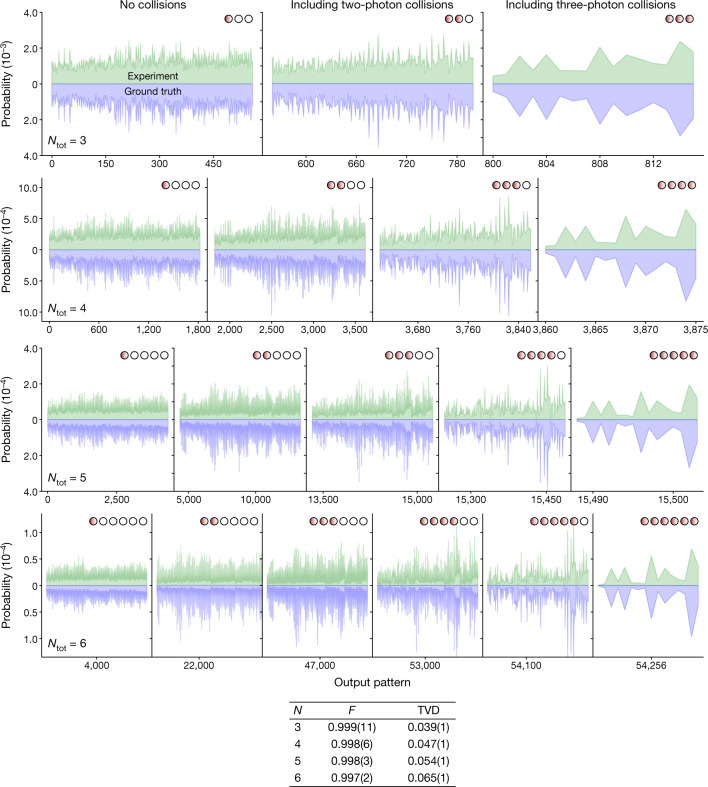
- In the low-photon-number regime, the paper reports fidelities in excess of 99% and TVDs below or equal to 6.5% for total photon-number sectors 3 to 6.
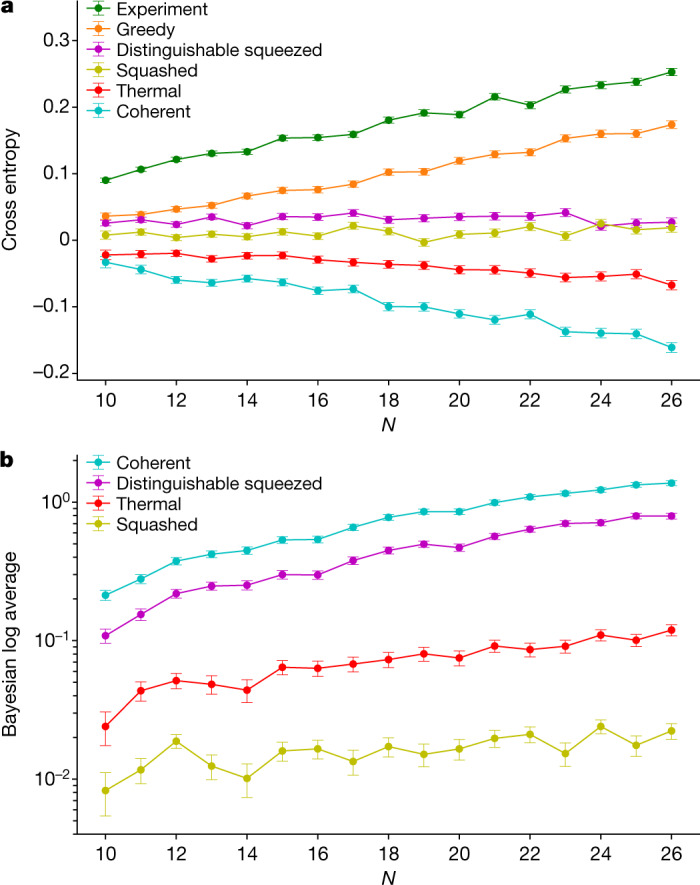
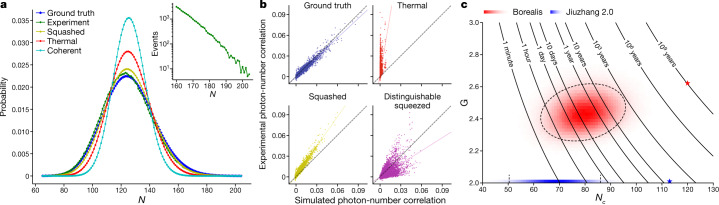
- For the intermediate regime, they analyze 10^6 samples and state that the best adversary (the greedy sampler) remained below the experiment in cross-entropy; for the large regime, the experimental total photon-number distribution has its highest probability at N = 124.35 ± 0.02, with support past 160 photons.
Methods
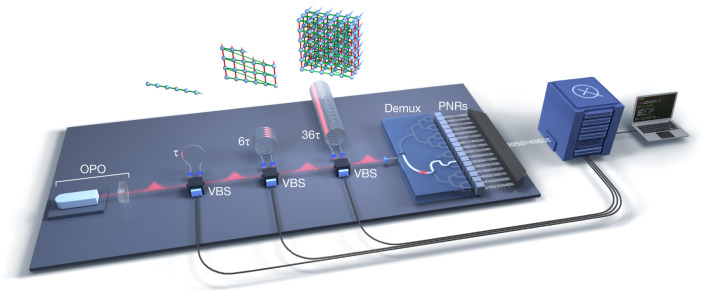
- The experiment uses a time-multiplexed photonic processor with three loop-based interferometers, a 6 MHz pulsed squeezed-light source, and 16-channel demultiplexing to route outputs to superconducting TES photon-number-resolving detectors.
- The device synthesizes a 216-mode Gaussian state by injecting 216 squeezed-light pulses into the interferometer; the loops enable couplings at separations of 1, 6, and 36 time bins.
- Performance is assessed by comparing experimental samples to the calibrated lossy ground truth using fidelity, total variation distance, cross-entropy benchmarks, Bayesian log averages, and cumulant comparisons against several classical adversaries.
Limitations
- The paper states that because estimating all probabilities from the characterized transmission matrix would require orders of magnitude more samples, their analysis is limited; this is why data beyond N > 6 were left for later benchmarks.
- The authors note that the demultiplexer and filter stack introduce losses, estimated at roughly 15% and 20%, respectively, and say improved detector speed could eliminate the demultiplexer.
- Evident from the text: the reported advantage is tied to a specific programmed distribution and a calibrated lossy ground truth, so it is not a general proof of all photonic computations.
Model-written summary. Check it against the paper before relying on it.
Integrity signals
Registry
Cites
Statistics
Figures
Verification
Claims the paper makes
15 Valid · 6 Not valid · 3 Not checked · 69 Own results and interpretations
At least one cited source doesn’t support this claim or points to a different paper, and none confirmed it — see the verdicts below.
In the paper
“In addition, its output cannot be efficiently spoofed in cross-entropy benchmarks using a generalization of the most recent polynomial-time algorithms3.”
§ Quantum computational advantage with a programmable photonic processor > Main
What the sources say
- Disputedcites [3] Villalonga, B. et al. Efficient approximation of experimental Gaussian boson sampling. Preprint at https://arxiv.org/abs/2109.11525 (2021). sourceExperimental — accuracy not yet measured
Our copy never names Borealis (it analyses the GBS experiments of its Refs. 1 and 2, up to 144 output modes), but its central conclusion runs opposite to what the citing sentence attributes to it: the Discussion (p. 8) states that 'a quadratic classical algorithm obtained a better approximation to the ideal distribution' and that the methodology 'can be applied to other boson sampling proposals where marginal probabilities can be computed efficiently'. On the cross-entropy metric specifically, Section III (pp. 7-8, Fig. 6) reports that the order-3 greedy sampler has XE similar to the experiment and that the 2nd-order samplers have smaller (better) XE than the experiment at large click numbers, i.e. efficient XE spoofing is demonstrated, not ruled out. The only hedge the paper offers is cost scaling — the order-k generalization is exponential in k and the scaling with k is called 'an interesting open question' (Introduction p. 2, Discussion p. 8) — which qualifies but does not assert impossibility for a device like Borealis. (LLM, conf=0.68)
Checked by a reasoning model — may be wrong.
plain- Asserted: passes — The authors put it forward as true.
- Checkable: passes — It can be checked against evidence.
- Load-bearing: passes — The paper’s conclusions depend on it.
- Based: passes — The paper gives a reason why it holds.
- Disputed
The cited sources that could be checked couldn’t confirm or dispute this claim.
In the paper
“On average, it would take more than 9,000 years for the best available algorithms and supercomputers to produce, using exact methods, a single sample from the programmed distribution”
- Also stated in: § Experiment · hedged
“we estimate that, on average, it would take Fugaku 9,000 years to generate one sample”
§ Quantum computational advantage with a programmable photonic processor > Abstract
What the sources say
- Could not verifycites [30] Bulmer JF The boundary for quantum advantage in Gaussian boson sampling Sci. Adv. 2021 8 eabl9236 PMC8791606 35080972 sourceExperimental — accuracy not yet measured
The Results (Benchmarking; page not provided) estimate seconds per sample for the paper’s simulated GBS systems, potentially milliseconds on Fugaku. The Discussion (page not provided) mentions programmability as a possible feature of future experiments, but our copy does not identify the claimed programmed distribution or give a 9,000-year estimate for an exact sample from it. Searched for the 9,000-year estimate and programmed distribution. (LLM, conf=0.78)
- Could not verifycites [34] Quesada N Quadratic speed-up for simulating gaussian boson sampling PRX Quantum 2022 3 010306 sourceExperimental — accuracy not yet measured
Our full copy (not truncated) contains no years-scale estimate anywhere: searched for '9,000 years', single-sample run time, supercomputer, programmed distribution. The only concrete runtimes are in Sec. IV BENCHMARKING — ~7 h for a 56×56 loop hafnian on a 96-CPU Azure workstation and 'roughly 2 weeks for generating a single sample' for m = 100 modes, N = 50 photons — and the Abstract stresses probabilities can be computed 'in a single workstation, i.e., without the need of a supercomputer'. So the paper neither states the 9,000-year figure nor addresses whatever device/distribution that figure belongs to; its own state-of-the-art exact-sampling numbers point in the opposite direction (much shorter), which means the attribution is unsupported rather than confirmed. (LLM, conf=0.65)
hedged- Asserted: passes — The authors put it forward as true.
- Checkable: passes — It can be checked against evidence.
- Load-bearing: passes — The paper’s conclusions depend on it.
- Based: passes — The paper gives a reason why it holds.
- Also stated in: § Experiment · hedged
Every source the paper cites for this claim was checked and supports it.
In the paper
“we estimate that Fugaku would require 1.5 h, on average, to generate one sample from the experiment in ref. 2”
§ Quantum computational advantage with a programmable photonic processor > Experiment
What the sources say
- Supportedcites [2] Zhong H-S Phase-programmable Gaussian boson sampling using stimulated squeezed light Phys. Rev. Lett. 2021 127 180502 34767431 source
The paper’s Abstract identifies its Jiuzhang 2.0 experiment as a Gaussian boson-sampling experiment that produced samples. The citing authors present the 1.5-hour Fugaku figure as their own estimate; the citation identifies the experiment being simulated, not the source of that estimate. (LLM, conf=0.91)
hedged- Asserted: passes — The authors put it forward as true.
- Checkable: passes — It can be checked against evidence.
- Load-bearing: passes — The paper’s conclusions depend on it.
- Based: passes — The paper gives a reason why it holds.
- Rests on 2 assumptions not shown here.
- Supported
Every source the paper cites for this claim was checked and supports it.
In the paper
“if one were to target a universal and programmable interferometer, with depth equal to the number of modes, that covers densely the set of unitary matrices, the exponential accumulation of loss would prohibit showing a quantum advantage.”
§ Quantum computational advantage with a programmable photonic processor > Experiment
What the sources say
- Supportedcites [5] Deshpande A Quantum computational advantage via high-dimensional gaussian boson sampling Sci. Adv. 2022 8 eabi7894 34985960 PMC8730598 source
The Results section (“High-dimensional GBS and evidence for hardness”) says that implementing arbitrary unitary transformations requires a circuit whose depth scales linearly with its size. It then states that photon loss scales exponentially with depth, making such models efficiently classically simulatable for sufficiently large numbers of modes in the absence of optical error correction. (LLM, conf=0.92)
- Supportedcites [31] Qi H Brod DJ Quesada N García-Patrón R Regimes of classical simulability for noisy Gaussian boson sampling Phys. Rev. Lett. 2020 124 100502 32216428 source
The main text (p. 2) states exactly the attributed content: 'In most linear-optical architectures, photon loss is defined by unit depth of the circuit, leading to an exponential decrease of transmission with the depth. Our results imply that, asymptotically, GBS implemented on these platforms is rendered efficiently simulable by losses if the depth is linear in the number of modes... lossy GBS inevitably loses its quantum advantage for sufficiently large sizes.' The abstract (p. 1) repeats it ('photon loss increases exponentially with the circuit depth, noisy GBS loses its quantum advantage in the asymptotic limit'), and Sec. II of the Supplemental Material (p. 7) names interferometer-depth loss 'the main scalability bottleneck'. A universal/programmable mesh of depth equal to the number of modes falls inside the class of architectures the paper treats, so the consequent is supported; the descriptors 'universal and programmable' and 'covers densely the set of unitary matrices' are the citing authors' motivation for the depth choice and are not asserted by the source, which speaks of 'most linear-optical architectures' generally and adds the caveat that a running-time advantage may persist at intermediate sizes. (LLM, conf=0.85)
hedgedstates a cause- Asserted: passes — The authors put it forward as true.
- Checkable: passes — It can be checked against evidence.
- Load-bearing: passes — The paper’s conclusions depend on it.
- Based: passes — The paper gives a reason why it holds.
- Supported
The cited sources support only part of this claim — read each source’s verdict below.
In the paper
“As discussed in the Methods, combined with the high brightness of our source averaging r ~ 1.1, places our experiment well beyond any attempt at a now-known polynomial-time approximate classical simulation31.”
§ Quantum computational advantage with a programmable photonic processor > Methods > Connectivity
What the sources say
- Partly supportedcites [31] Qi H Brod DJ Quesada N García-Patrón R Regimes of classical simulability for noisy Gaussian boson sampling Phys. Rev. Lett. 2020 124 100502 32216428 sourceExperimental — accuracy not yet measured
Our copy supplies the framework the citing sentence leans on: a sufficient condition (inequality (1)) for approximate polynomial-time classical simulation of noisy GBS in terms of squeezing r, transmission η and detector quality q_D, which the authors call 'a natural and useful test that any alleged quantum advantage demonstration with noisy GBS must pass' (p. 1), together with the explicit statement that 'increasing the amount of input squeezing is helpful to evade our classical simulation algorithm' and that 'the region where quantum computational supremacy has not been ruled out expands as we increase ... the amount of input squeezing' (Abstract p. 1; Discussion p. 4). However, the paper never evaluates r ≈ 1.1: the only experiments it plugs into inequality (1) are r ≈ 0.1 (Ref. [48]) and r ≈ 0.38 (Ref. [49]), the latter giving 'no solution for any ε ∈ [0,1]' (p. 2). Moreover, the source's condition is only sufficient for simulability — failing it means supremacy is 'not ruled out', not that the device is provably 'well beyond any attempt at a now-known polynomial-time approximate classical simulation'; that stronger, universal phrasing is the citing authors' own extrapolation. (LLM, conf=0.75)
boostedstates a cause- Asserted: passes — The authors put it forward as true.
- Checkable: passes — It can be checked against evidence.
- Load-bearing: passes — The paper’s conclusions depend on it.
- Based: passes — The paper gives a reason why it holds.
- Partly supported
53 more claims · 8 with their cited sources checked
Create a free account to see all 93 claims and to verify the 10 references still open.
- It may state two separate claims as one. 26
- Probably not a substantial claim. 10
Citations
Cites
Quantum supremacy using a programmable superconducting processor
Arute, F., Arya, K., Babbush, R., Bacon, D., Bardin, J. C., Barends, R., Biswas, R., Boixo, S., Brandao, F. G. S. L., Buell, D. A., et al. (2019) · Nature · doi:10.1038/s41586-019-1666-5 · Cited by 7,720 · cited 2×
“Only a handful of experiments have used quantum devices to carry out computational tasks that are outside the reach of present-day classical computers 1,2,6,7 .”
BackgroundMethodWeedbrook, C., Pirandola, S., García-Patrón, R., Cerf, N. J., Ralph, T. C., Shapiro, J. H., & Lloyd, S. (2012) · Reviews of Modern Physics · doi:10.1103/revmodphys.84.621 · Cited by 3,664
Quantum computational advantage using photons
Zhong, H.-S., Wang, H., Deng, Y.-H., Chen, M.-C., Peng, L.-C., Luo, Y.-H., Qin, J., Wu, D., Ding, X., Hu, Y., et al. (2020) · Science · doi:10.1126/science.abe8770 · Cited by 2,405 · cited 8×
“Our solutions to these challenges for this work are, respectively, (1) the design of a bright and tunable source of single-mode squeezed states and phase stabilization techniques (OPO and interferometer) using locking schemes compatible with PNR detectors, (2) active demultiplexing to increase the effective rate of PN…”
BackgroundMethodInfluentialStrong Quantum Computational Advantage Using a Superconducting Quantum Processor
Wu, Y., Bao, W.-S., Cao, S., Chen, F., Chen, M.-C., Chen, X., Chung, T.-H., Deng, H., Du, Y., Fan, D., et al. (2021) · Physical Review Letters · doi:10.1103/physrevlett.127.180501 · Cited by 1,059
Counting near-infrared single-photons with 95% efficiency
Lita, A. E., Miller, A. J., & Nam, S. W. (2008) · Optics Express · doi:10.1364/oe.16.003032 · Cited by 734 · cited 1×
“Spatial overlap is ensured by using single-mode fibre coupling at the entrance and exit of each loop delay, and samples are collected using an array of photon-number resolving (PNR) detectors based on superconducting transition-edge sensors (TES) with 95% detection efficiency 39,40 .”
MethodSelf-citationTopological fault-tolerance in cluster state quantum computation
Raussendorf, R., Harrington, J., & Goyal, K. (2007) · New Journal of Physics · doi:10.1088/1367-2630/9/6/199 · Cited by 617
Quantum circuits with many photons on a programmable nanophotonic chip
Arrazola, J. M., Bergholm, V., Brádler, K., Bromley, T. R., Collins, M. J., Dhand, I., Fumagalli, A., Gerrits, T., Goussev, A., Helt, L. G., et al. (2021) · Nature · doi:10.1038/s41586-021-03202-1 · Cited by 567 · cited 3×
“Spatial overlap is ensured by using single-mode fibre coupling at the entrance and exit of each loop delay, and samples are collected using an array of photon-number resolving (PNR) detectors based on superconducting transition-edge sensors (TES) with 95% detection efficiency 39,40 .”
BackgroundMethodSelf-citationHamilton, C. S., Kruse, R., Sansoni, L., Barkhofen, S., Silberhorn, C., & Jex, I. (2017) · Physical Review Letters · doi:10.1103/physrevlett.119.170501 · Cited by 503 · cited 5×
“Equation (4) captures the collision-free complexity of the hafnian of an N × N matrix of O N ( 2 ) c N 3 /2 c because in that case G = 2.”
BackgroundMethodInfluentialGeneration of time-domain-multiplexed two-dimensional cluster state
Asavanant, W., Shiozawa, Y., Yokoyama, S., Charoensombutamon, B., Emura, H., Alexander, R. N., Takeda, S., Yoshikawa, J.-I., Menicucci, N. C., Yonezawa, H., et al. (2019) · Science · doi:10.1126/science.aay2645 · Cited by 476 · cited 1×
“Using time-domain multiplexing, large one-and two-dimensional cluster states have been deterministically generated 21–23 with programmable linear operations implemented by projective measurements 24,25 , whereas similar operations have been implemented in ref.”
MethodQuantum circuits with many photons on a programmable nanophotonic chip
Arrazola, J. M., Bergholm, V., Brádler, K., Bromley, T. R., Collins, M. J., Dhand, I., Fumagalli, A., Gerrits, T., Goussev, A., Helt, L. G., et al. (2021) · RePEc: Research Papers in Economics · Cited by 463
Self-citation
Research works printed but not linked: 1
- 56th edition of the top 500 Top 500 the List https://www.top500.org/lists/top500/2020/11/ (2020).
Cited by
Items 501–600 of 1,033
Submicrosecond high-fidelity dispersive readout of a spin qubit with squeezed photons
Kam, C., & Hu, X. (2024) · Physical Review A · doi:10.1103/physreva.109.l040402 · Cited by 10
Programmable space-frequency linear transformations in photonic interlacing architectures
Friedman, J., Zelaya, K., Honari-Latifpour, M., & Miri, M. (2025) · Scientific Reports · doi:10.1038/s41598-025-19176-3 · Cited by 12
Towards the Simplest Model of Quantum Supremacy: Atomic Boson Sampling in a Box Trap
Kocharovsky, V. V., Kocharovsky, V. V., Shannon, W., & Tarasov, S. V. (2023) · Entropy · doi:10.3390/e25121584 · Cited by 9
Quantum Monte Carlo for Economics: Stress Testing and Macroeconomic Deep LearningPreprint
Skavysh, V., Priazhkina, S., Guala, D., & Bromley, T. (2022) · SSRN Electronic Journal · doi:10.2139/ssrn.4207839 · Cited by 4
Low-loss polarization-maintaining optical router for photonic quantum information processing
Wang, P., Baek, S.-Y., Edamatsu, K., & Kaneda, F. (2024) · Japanese Journal of Applied Physics · doi:10.35848/1347-4065/ad3533 · Cited by 5
Demonstration of hardware efficient photonic variational quantum algorithm
Agresti, I., Paul, K., Schiansky, P., Steiner, S., Yin, Z., Pentangelo, C., Piacentini, S., Crespi, A., Ban, Y., Ceccarelli, F., et al. (2025) · Physical Review Research · doi:10.1103/d7bb-ybfh · Cited by 15
Benchmarking a boson sampler with Hamming nets
Iakovlev, I. A., Sotnikov, O. M., Dyakonov, I. V., Kiktenko, E. O., Fedorov, A. K., Straupe, S. S., & Mazurenko, V. V. (2023) · Physical Review A · doi:10.1103/physreva.108.062420 · Cited by 8
Sharing quantum steering via standard projective measurements
Dong, S., Cai, Z., Wu, C., & Ren, C. (2024) · Physical Review A · doi:10.1103/physreva.110.012203 · Cited by 5
Dellios, A. S., Opanchuk, B., Goodman, N., Reid, M. D., & Drummond, P. D. (2025) · Physics Letters A · doi:10.1016/j.physleta.2025.130529 · Cited by 15
QD-MSA : A quantum distributed tensor network framework for multimodal sentiment analysis
Li, Y., Li, Y., Qi, Z., Yang, H., Shang, R., & Jiao, L. (2025) · Information Fusion · doi:10.1016/j.inffus.2025.103404 · Cited by 8
Classical simulability of constant-depth linear-optical circuits with noise
Oh, C. (2025) · npj Quantum Information · doi:10.1038/s41534-025-01041-w · Cited by 9
Bała, M., Krzemień, W., Hiesmayr, B. C., Baran, J., Dulski, K., Klimaszewski, K., Raczyński, L., Shopa, R. Y., & Wiślicki, W. (2025) · The European Physical Journal C · doi:10.1140/epjc/s10052-025-14862-y · Cited by 8
High dimensional counterdiabatic quantum computing
Tancara, D., & Albarrán-Arriagada, F. (2025) · npj Quantum Information · doi:10.1038/s41534-025-01070-5 · Cited by 10
Low‐Loss Polarization‐Maintaining Router for Single and Entangled Photons at a Telecom Wavelength
Wang, P., Baek, S.-Y., Yabuno, M., Miki, S., Terai, H., & Kaneda, F. (2025) · Advanced Quantum Technologies · doi:10.1002/qute.202500355 · Cited by 7
Quantum Data Management: From Theory to Opportunities
Hai, R., Hung, S.-H., & Feld, S. (2024) · IEEE International Conference on Data Engineering (ICDE) · doi:10.1109/icde60146.2024.00410 · Cited by 10
Machine Learning based Discrimination for Excited State Promoted Readout
Azad, U., & Zhang, H. (2022) · IEEE/ACM Symposium on Edge Computing (SEC) · doi:10.1109/sec54971.2022.00053 · Cited by 7
A comprehensive survey on quantum computer usage: How many qubits are employed for what purposes?Preprint
Ichikawa, T., Hakoshima, H., Inui, K., Ito, K., Matsuda, R., Mitarai, K., Miyamoto, K., Mizukami, W., Mizuta, K., Mōri, T., et al. (2023) · arXiv (Cornell University) · doi:10.48550/arxiv.2307.16130 · Cited by 6
Quantum computing for data-centric engineering and science
Herbert, S. (2022) · Data-Centric Engineering · doi:10.1017/dce.2022.36 · Cited by 6
Goldberg, A. Z. (2023) · Optica Quantum · doi:10.1364/opticaq.501218 · Cited by 6
Arbitrary-phase locking of fiber unbalanced Mach-Zehnder interferometers
Chen, R., Luo, Y.-H., Long, J., & Liu, J. (2024) · Physical Review Applied · doi:10.1103/physrevapplied.22.054051 · Cited by 8
Variational quantum simulation using non-Gaussian continuous-variable systems
Stornati, P., Acín, A., Chabaud, U., Dauphin, A., Parigi, V., & Centrone, F. (2024) · Physical Review Research · doi:10.1103/physrevresearch.6.043212 · Cited by 15
Li, R., Wang, B., Wang, H., Zhang, Z., Qian, K., Zhao, Q., Wei, C. L., Dong, W., Cao, Q., Jin, T., et al. (2025) · Cryogenics · doi:10.1016/j.cryogenics.2025.104231 · Cited by 5
Uotila, V. (2025) · Frontiers in Computer Science · doi:10.3389/fcomp.2025.1649354 · Cited by 13
Behrends, J., & Béri, B. (2025) · PRX Quantum · doi:10.1103/gskb-t5ql · Cited by 30
Quantum Feasibility Labeling for NP-Complete Vertex Coloring Problem
Zhan, J. (2025) · IEEE Access · doi:10.1109/access.2025.3545262 · Cited by 10
Recovering quantum entanglement after its certification
Kim, H.-J., Jung, J.-H., Lee, K.-J., & Ra, Y.-S. (2023) · Science Advances · doi:10.1126/sciadv.adi5261 · Cited by 6
Efficient single-photon emission via quantum-confined charge funneling to quantum dots
Park, S., Azizur-Rahman, K. M., Shima, D. M., Balakrishnan, G., Yu, J., Jung, H., Mah, J. J., Prescott, S., Chen, P., Addamane, S., et al. (2025) · Communications Materials · doi:10.1038/s43246-025-01017-5 · Cited by 6
Image Analysis-Synthesis Using the Quantum Fourier Transform
Patel, T. K., Knutson, D., Uehara, G. S., Marfai, F. S., Jazwin, C., Larson, J. S., & Spanias, A. (2025) · IEEE International Symposium on Circuits and Systems proceedings · doi:10.1109/iscas56072.2025.11043342 · Cited by 4
Non-Kolmogorovian Probabilities and Quantum Technologies
Holik, F. (2022) · Entropy · doi:10.3390/e24111666 · Cited by 6
Brusaschi, E., Borghi, M., Bacchi, M., Liscidini, M., Galli, M., & Bajoni, D. (2024) · Optica Quantum · doi:10.1364/opticaq.528566 · Cited by 5
Optimal estimates of trace distance between bosonic Gaussian states and applications to learning
Bittel, L., Mele, F. A., Mele, A. A., Tirone, S., & Lami, L. (2025) · Quantum · doi:10.22331/q-2025-06-12-1769 · Cited by 47
Stefszky, M., Bruch, F. V., Santandrea, M., Ricken, R., Quiring, V., Eigner, C., Herrmann, H., & Silberhorn, C. (2023) · Optics Express · doi:10.1364/oe.498423 · Cited by 5
Amooei, M., Kulkarni, G. S., Upham, J., & Boyd, R. W. (2025) · Physical Review A · doi:10.1103/physreva.111.023714 · Cited by 7
Plasmonic slot waveguides: a quantum leap in nonlinear nanophotonics
Yanez, L. R., Hu, H., Ciracì, C., & Palomba, S. (2025) · Frontiers in Nanotechnology · doi:10.3389/fnano.2025.1536462 · Cited by 5
Quasi-Perfect state transfer in spin chains via parametrization of on-site energies
Bezaz, F., Nelmes, C. C., Estarellas, M. P., Spiller, T. P., & D’Amico, I. (2025) · Physica Scripta · doi:10.1088/1402-4896/adcb71 · Cited by 10
Squeezing enhancement by suppression of noise through a resonant interferometric coupler
Viola, A., Malaspina, F., & Liscidini, M. (2024) · Optics Letters · doi:10.1364/ol.532868 · Cited by 8
Quantum technology concepts for 6G networks
Amiri, Z., Bassoli, R., Boche, H., Charania, S. A., Czarske, J. W., Das, S. K., Deppe, C., Dev, S., Fitzek, F. H. P., Habibie, M. I., et al. (2026) · Elsevier eBooks · doi:10.1016/b978-0-44-327410-7.00032-6 · Cited by 7
Deterministic Nonlocal Quantum Gate with Room-Temperature Memory Modules
Lei, X., Li, J., Zhou, X., Yan, J., Ji, M., Yan, Z., Jia, X., Xie, C., & Peng, K. (2025) · Physical Review Letters · doi:10.1103/xt77-2gpw · Cited by 5
Power of quantum measurement in simulating unphysical operations
Zhao, X., Zhang, L., Zhao, B., & Wang, X. (2025) · Physical Review Research · doi:10.1103/physrevresearch.7.013334 · Cited by 18
Experimental validation of boson sampling using detector binning
Anguita, M. C., Camillini, A., Marzban, S., Robbio, M., Seron, B., Novo, L., & Renema, J. J. (2025) · Quantum Science and Technology · doi:10.1088/2058-9565/adecbc · Cited by 17
Zwingel, M., May, C. M., Reitelshöfer, S., & Mauerer, W. (2025) · Springer eBooks · doi:10.1007/978-3-031-74010-7_23 · Cited by 5
A Prototype For Quantum Database In Hybrid Quantum: A Complete EcosystemPreprint
chakraborty, S. (2022) · Research Square · doi:10.21203/rs.3.rs-2156463/v1 · Cited by 3
Approximating outcome probabilities of linear optical circuits
Lim, Y., & Oh, C. (2023) · npj Quantum Information · doi:10.1038/s41534-023-00791-9 · Cited by 10
Acoustic phonon phase gates with number-resolving phonon detection
Qiao, H. W., Wang, Z., Andersson, G., Anferov, A., Conner, C. R., Joshi, Y. J., Li, S., Miller, J. M., Wu, X., Yan, H., et al. (2025) · Nature Physics · doi:10.1038/s41567-025-03027-z · Cited by 10
Silicon Quantum Photonics ‐ Platform and Applications
Ekici, Ç., Semenova, E. S., Bacco, D., & Ding, Y. (2023) · Wiley eBooks · doi:10.1002/9783527837427.ch22 · Cited by 4
Qumode transfer between continuous- and discrete-variable devices
Macridin, A., Li, A. C. Y., & Spentzouris, P. (2024) · Physical Review A · doi:10.1103/physreva.109.032419 · Cited by 4
Niu, B., Qian, C., Jing, X., Wan, C., Kong, Y., Chen, T., Liu, Y., & Lu, L. (2023) · Frontiers in Physics · doi:10.3389/fphy.2022.1099909 · Cited by 4
Boost clustering with Gaussian Boson Sampling: a quantum-classical hybrid approach
Bonaldi, N., Rossi, M. S., Mattioli, D., Grapulin, M., Fernandéz, B. S., Caputo, D., Magagnini, M., Osti, A., & Veronese, F. (2024) · Quantum Machine Intelligence · doi:10.1007/s42484-024-00185-w · Cited by 5
Characterization of a forced damped harmonic oscillator in a magneto-optical trap of 133 Cs atoms
Baek, J., Lee, S., Lee, M.-H., & Moon, G. (2023) · Journal of the Optical Society of America B · doi:10.1364/josab.489096 · Cited by 4
Ultrafast all-optical measurement of squeezed vacuum in a lithium niobate nanophotonic circuit
Williams, J., Sendonaris, E., Nehra, R., Gray, R. M., Sekine, R., Ledezma, L. M., & Marandi, A. (2025) · Physical Review Research · doi:10.1103/rvmb-ljd3 · Cited by 10
Accurate unsupervised photon counting from transition-edge-sensor signals
Dalbec-Constant, N., Thekkadath, G., England, D. G., Sussman, B., Gerrits, T., & Quesada, N. (2025) · Physical Review Applied · doi:10.1103/c11p-d13h · Cited by 7
Self-citationQuantum computing using photons
Couteau, C. (2025) · The European Physical Journal A · doi:10.1140/epja/s10050-025-01517-5 · Cited by 10
n-qubit operations on sphere and queueing scaling limits for programmable quantum computer
Dai, W. (2023) · Quantum Information Processing · doi:10.1007/s11128-023-03851-3 · Cited by 5
Nasehi, Z., & Hosseini, S. E. (2025) · Scientific Reports · doi:10.1038/s41598-025-01926-y · Cited by 4
Multimode amplitude squeezing through cascaded nonlinear processes
Pontula, S., Salamin, Y., & Marin Soljacic, A. (2024) · Conference on Lasers and Electro-Optics · doi:10.1364/cleo_fs.2024.fth1m.3 · Cited by 6
Post-selection in noisy Gaussian boson sampling: part is better than whole
Yang, T.-Y., Shen, Y.-X., Cao, Z., & Wang, X. (2023) · Quantum Science and Technology · doi:10.1088/2058-9565/acf06c · Cited by 4
Relation Between Quantum Advantage in Supervised Learning and Quantum Computational Advantage
Pérez-Guijarro, J., Pagés-Zamora, A., & Fonollosa, J. R. (2023) · IEEE Transactions on Quantum Engineering · doi:10.1109/tqe.2023.3347476 · Cited by 12
Overview of Digital Quantum Simulator: Applications and Comparison with Latest Methods
Tang, H., Simancas-García, J. L., Mai, J., Cheng, M., Iqbal, I., & Por, L. Y. (2024) · SPIN · doi:10.1142/s2010324724400046 · Cited by 4
Gaussian boson sampling with 1,024 squeezed states in 8,176 modes
Liu, H. C., Su, H., Deng, Y.-H., Gong, S.-Q., Gu, Y.-C., Tang, H., Jia, M.-H., Wei, Q., Song, Y.-K., Wang, D.-Z., et al. (2026) · Nature · doi:10.1038/s41586-026-10523-6 · Cited by 39
Resource-efficient generalized quantum subspace expansion
Yang, B., Yoshioka, N., Harada, H., Hakkaku, S., Tokunaga, Y., Hakoshima, H., Yamamoto, K., & Endo, S. (2025) · Physical Review Applied · doi:10.1103/physrevapplied.23.054021 · Cited by 26
Xu, W., Du, J., Qu, J., Wang, H., Chen, W., & Zhou, L. (2025) · Optical Materials Express · doi:10.1364/ome.555571 · Cited by 7
Noisy Random Quantum Circuit Sampling and its Classical Simulation
Zhang, M., Wang, C., & Han, Y. (2023) · Advanced Quantum Technologies · doi:10.1002/qute.202300030 · Cited by 8
Zhu, C., Song, J., Zhang, Y., He, P., Deng, X., Tang, K. K., Pi, M., Liu, X., Gao, P., Zhang, D., et al. (2026) · Nano Letters · doi:10.1021/acs.nanolett.5c05185 · Cited by 5
Quantum-inspired classical algorithm for molecular vibronic spectraPreprint
Oh, C., Lim, Y., Wong, Y., et al. (2022) · arXiv (Cornell University) · doi:10.48550/arxiv.2202.01861 · Cited by 3
Quantum phase transition in a quantum Rabi square with next-nearest-neighbor hopping
Xu, Y., Sun, F.-X., He, Q., Pu, H., & Zhang, W. (2024) · Physical Review A · doi:10.1103/physreva.110.023702 · Cited by 7
Long-term stability of squeezed light in a fiber-based system using automated alignment
Nakamura, T., Nomura, T., Endo, M., Sakaguchi, A., Ruofan, H., Kashiwazaki, T., Umeki, T., Takase, K., Asavanant, W., Yoshikawa, J., et al. (2024) · Review of Scientific Instruments · doi:10.1063/5.0203988 · Cited by 6
Multi-Channel Gating Chip in 0.18 µm High-Voltage CMOS for Quantum Applications
Ribisch, C., Hofbauer, M., Poushi, S. S. K., Zimmer, A., Schneider-Hornstein, K., Goll, B., & Zimmermann, H. (2023) · Sensors · doi:10.3390/s23249644 · Cited by 3
Simon’s Algorithm in the NISQ Cloud
Robertson, R., Doucet, E., Spicer, E., & Deffner, S. (2025) · Entropy · doi:10.3390/e27070658 · Cited by 13
Improving continuous-variable quantum channels with unitary averaging
Swain, S. N., Marshman, R. J., Rohde, P. P., Lund, A. P., Solntsev, A. S., & Ralph, T. C. (2024) · Physical Review A · doi:10.1103/physreva.110.032622 · Cited by 6
Benchmarking Quantum Computational Advantages on Supercomputers
Wu, J., & Liu, Y. (2024) · Advanced Quantum Technologies · doi:10.1002/qute.202400143 · Cited by 5
Efficient quantum state estimation with low-rank matrix completion
Tariq, S., Farooq, A., Rehman, J. U., Duong, T. Q., & Shin, H. (2024) · EPJ Quantum Technology · doi:10.1140/epjqt/s40507-024-00261-x · Cited by 7
Benchmarking Quantum Annealers with Near-Optimal Minor-Embedded Instances
Gilbert, V., Rodriguez, J., & Louise, S. (2024) · IEEE International Conference on Quantum Computing and Engineering (QCE) · doi:10.1109/qce60285.2024.00068 · Cited by 8
Transition of Anticoncentration in Gaussian Boson Sampling
Ehrenberg, A., Iosue, J. T., Deshpande, A., Hangleiter, D., & Gorshkov, A. V. (2025) · Physical Review Letters · doi:10.1103/physrevlett.134.140601 · Cited by 27
Effect of photonic errors on quantum enhanced dense-subgraph finding
Solomons, N. R., Thomas, O., & McCutcheon, D. P. S. (2023) · Physical Review Applied · doi:10.1103/physrevapplied.20.054043 · Cited by 4
Few-mode squeezing in type-I parametric downconversion by complete group velocity matching
Horoshko, D. B., Kolobov, M. I., Parigi, V., & Treps, N. (2024) · Optics Letters · doi:10.1364/ol.528280 · Cited by 8
Mach-Zehnder Interferometer Cell for Realization of Quantum Computer; A Feasibility Study
Motaharifar, M., & Kaatuzian, H. (2023) · doi:10.1109/icee59167.2023.10334740 · Cited by 4
Second moment of Hafnians in Gaussian boson sampling
Ehrenberg, A., Iosue, J. T., Deshpande, A., Hangleiter, D., & Gorshkov, A. V. (2025) · Physical Review A · doi:10.1103/physreva.111.042412 · Cited by 20
Gaussian boson sampling at finite temperature
Bressanini, G., Kwon, H., & Kim, M. S. (2024) · Physical Review A · doi:10.1103/physreva.109.013707 · Cited by 4
Explore flowchart and pseudocode concepts in algorithms and programming
Tarsini, I., & Anggraeni, R. (2024) · Indonesian Journal of Multidisciplinary Science · doi:10.55324/ijoms.v3i5.807 · Cited by 23
An Assessment of U.S.-Allied Nations' Industrial Bases in Quantum Technology
Parker, E., Silberglitt, R., Gonzales, D., Sanchez, N., Lee, J. W., Rand, L., Schmid, J., Dortmans, P., & Eusebi, C. A. (2023) · RAND Corporation eBooks · doi:10.7249/rra2055-1 · Cited by 5
Adaptive non-Gaussian quantum state engineering
Crescimanna, V., Yu, S., Heshami, K., & Patel, R. B. (2025) · Physical Review A · doi:10.1103/jhkz-84dz · Cited by 8
Ranjan, A., Patel, T., Gandhi, H., Silver, D., Cutler, W., & Tiwari, D. (2023) · International Conference for High Performance Computing, Networking, Storage and Analysis (SC) · doi:10.1145/3581784.3607058 · Cited by 4
Mapping nonlinear mode interactions in coupled Kerr resonators
Trinchão, L. O., Peres, L., Gonçalves, E. S., Nienstedt, M., dos Santos, L. F., Jarschel, P. F., Alegre, T. P. M., Tomazio, N. B., & Wiederhecker, G. S. (2026) · Optics Letters · doi:10.1364/ol.586517 · Cited by 4
Matrix permanent and determinant from a spin system
Alase, A., Doty, O., & Feder, D. L. (2023) · Physical Review A · doi:10.1103/physreva.108.012207 · Cited by 3
Stable Many-Body Resonances in Open Quantum Systems
Peña, R., Kyaw, T. H., & Romero, G. (2022) · Symmetry · doi:10.3390/sym14122562 · Cited by 4
Smoothed analysis-based noise manipulation for spatial photonic Ising machines
Ye, X., Zhang, W., & He, Z. (2025) · Chinese Optics Letters · doi:10.3788/col202523.032501 · Cited by 5
Machine Learning for Anomaly Detection in Particle PhysicsPreprint
Belis, V., Odagiu, P., & Aarrestad, T. K. (2023) · arXiv (Cornell University) · doi:10.3929/ethz-b-000654879 · Cited by 3
Photonic Hybrid Integration: Strategies and Promises of Advanced Additive Manufacturing
Shi, Z., Huang, H., Penty, R. V., & Cheng, Q. (2025) · Advanced Optical Materials · doi:10.1002/adom.202501750 · Cited by 5
Cryogenic feedforward of a photonic quantum state
Thiele, F., Lamberty, N., Hummel, T., Lange, N. A., Procopio, L. M., Barua, A., Lengeling, S., Quiring, V., Eigner, C., Silberhorn, C., et al. (2025) · Optica · doi:10.1364/optica.551287 · Cited by 14
Unary Quantum Finite State Automata with Control Language
Mereghetti, C., Palano, B., & Raucci, P. (2024) · Applied Sciences · doi:10.3390/app14041490 · Cited by 5
Entropy, entanglement, and susceptibility of three qubits near quantum criticality
Castorene, B., Peña, F. J., Norambuena, A., Ulloa, S. E., Araya, C., & Vargas, P. F. (2025) · Physical review. E · doi:10.1103/physreve.111.034118 · Cited by 3
Effective descriptions of bosonic systems can be considered complete
Arzani, F., Booth, R. I., & Chabaud, U. (2025) · Nature Communications · doi:10.1038/s41467-025-64872-3 · Cited by 32
Treespilation: Architecture- and State-Optimised Fermion-to-Qubit MappingsPreprint
Miller, A., Glos, A., & Zimborás, Z. (2024) · Research Square · doi:10.21203/rs.3.rs-4343077/v1 · Cited by 5
Group Delay Controlled by the Decoherence of a Single Artificial Atom
Cheng, Y.-T., Hsieh, K.-C., Wu, B., Niu, Z., Aziz, F., Huang, Y.-H., Wen, P. Y., Lin, K.-T., Lin, Y., Chen, J. C., et al. (2025) · Physical Review Letters · doi:10.1103/fkzb-fxv4 · Cited by 7
Meta-designing quantum experiments with language models
Arlt, S., Duan, H., Li, F., Xie, S. M., Wu, Y., & Krenn, M. (2026) · Nature Machine Intelligence · doi:10.1038/s42256-025-01153-0 · Cited by 31
Robust calibration and energy optimization in reconfigurable photonic processors
Litvin, I. A., Elmas, G., El-Safty, K., Chaudhary, S., & Nötzel, J. (2025) · Optics Express · doi:10.1364/oe.566817 · Cited by 5
Efficient light propagation algorithm using quantum computers
Cholsuk, C., Davani, S., Conlon, L. O., Vogl, T., & Eilenberger, F. X. (2024) · Physica Scripta · doi:10.1088/1402-4896/ad2d4c · Cited by 4
Sample efficient graph classification using binary Gaussian boson sampling
Anteneh, A., & Pfister, O. (2023) · Physical Review A · doi:10.1103/physreva.108.062411 · Cited by 7
Fermion parity switching in a short Kitaev chain coupled to a photonic cavity
Becerra, V. F., & Dmytruk, O. (2026) · Physical review. B./Physical review. B · doi:10.1103/hszk-ymf3 · Cited by 8
Metadata
- Authors
- Madsen, L. S., Laudenbach, F., Askarani, M. F., Rortais, F., Vincent, T., Bulmer, J. F. F., Miatto, F. M., Neuhaus, L., Helt, L. G., Collins, M. J., Lita, A. E., Gerrits, T., Nam, S. W., Vaidya, V. D., Menotti, M., Dhand, I., Vernon, Z., Quesada, N., & Lavoie, J.
- Affiliations
- Xanadu Quantum Technologies (Canada) (CA)
- National Institute of Standards and Technology (US)
- Corresponding author
- Quesada, Nicolás
- Lavoie, Jonathan
- ORCID
- Venue
- Nature
- Published
- 2022-06-01
- Volume
- 606
- Issue
- 7912
- Pages
- 75-81
- ISSN
- 0028-0836 (ISSN-L)
- 1476-4687
- PMC
- PMC9159949
- OpenAlex
- W4281891658
- Semantic Scholar
- 3ce3aad1563a1a34068b38ce0f88eecfadb69f53
- Cited by
- 1,101
- References
- 57
- Citations by year
- 2026: 202 · 2025: 282 · 2024: 302 · 2023: 259 · 2022: 56
- FWCI
- 60.16
- Type
- journal article
- Language
- en
- Open access
- hybrid
- doi.org
- Licence
- cc-by
- creativecommons.org/licenses/by/4.0 (tdm)
- creativecommons.org/licenses/by/4.0 (vor)
- Locations
- Nature (publishedVersion, cc-by)
- PubMed Central (publishedVersion, cc-by)
- PubMed (publishedVersion)
- FIU - Digital Commons (Florida International University) (submittedVersion, cc-by)
- Florida International University Digital Commons (Florida International University) (submittedVersion)
- RePEc: Research Papers in Economics (submittedVersion)
- Funders
- Government of Ontario
- University of Toronto
- National Institute of Standards and Technology
- Topics
- Physical Sciences › Computer Science › Artificial Intelligence › Quantum Computing Algorithms and Architecture
- Physical Sciences › Physics and Astronomy › Atomic and Molecular Physics, and Optics › Quantum Information and Cryptography
- Physical Sciences › Computer Science › Artificial Intelligence › Neural Networks and Reservoir Computing
- Keywords
- quantum advantage, Borealis, Gaussian boson sampling, photon-number-resolving detection, spoofing attacks, quantum computing hardware
About these checks
Registry, retraction, Cites and statistics results are computed, not judged, with one exception: a printed reference that no index lists is read once by a model before it counts as a citation error. Claims are extracted by a model and kept only when their quote appears verbatim in the text; each cited source is then checked, with a model’s help, for whether it says what the claim relies on. Those verdicts can be wrong — read the claim’s quote and the cited source before relying on one.
The claim verdicts this report counts are experimental: their accuracy is not yet measured.
A language model drew the claims from the paper on 2026-10-10, under version 3 of the claim definition (model deepseek-v4.1-flash, prompt extract-v3).
A second model labelled each claim on 2026-10-10 (model jev-1.13-20260917, definition revision gold-guideline-v0.2).
Cited sources are checked with a language model’s help (qwen3.8-omni-flash and gpt-6-sol).
Statistics and arithmetic are recomputed, not judged.
Confidence bands are shown only for fields calibrated on our annotated test set. None is calibrated yet, so no band is shown.
What counts as a claim ›How we measure confidence ›How we check this ›
Are you an author, or do you see a problem with this page? Request a review
Data sources
Bibliographic data: Semantic Scholar, OpenAlex, Crossref.
Contains information from the Semantic Scholar Academic Graph Datasets, made available under the ODC Attribution License (ODC-BY 1.0).
Semantic Scholar’s data is described in: Kinney, R., et al. (2023). The Semantic Scholar Open Data Platform. arXiv:2301.10140.
