

Quantum computational advantage with a programmable photonic processor
Open accessThe DOI matches its Crossref record; 51 of the 57 references it cites were found in a registry or an index, and 1 are not checked yet; 25 of the 36 sources its claims cite were checked for support.
Abstract
A quantum computer attains computational advantage when outperforming the best classical computers running the best-known algorithms on well-defined tasks. No photonic machine offering programmability over all its quantum gates has demonstrated quantum computational advantage: previous machines 1,2 were largely restricted to static gate sequences. Earlier photonic demonstrations were also vulnerable to spoofing 3 , in which classical heuristics produce samples, without direct simulation, lying closer to the ideal distribution than do samples from the quantum hardware. Here we report quantum computational advantage using Borealis, a photonic processor offering dynamic programmability on all gates implemented. We carry out Gaussian boson sampling 4 (GBS) on 216 squeezed modes entangled with three-dimensional connectivity 5 , using a time-multiplexed and photon-number-resolving architecture. On average, it would take more than 9,000 years for the best available algorithms and supercomputers to produce, using exact methods, a single sample from the programmed distribution, whereas Borealis requires only 36 μs. This runtime advantage is over 50 million times as extreme as that reported from earlier photonic machines. Ours constitutes a very large GBS experiment, registering events with up to 219 photons and a mean photon number of 125. This work is a critical milestone on the path to a practical quantum computer, validating key technological features of photonics as a platform for this goal.
Verified 2026-11-25 · 1 reference not checked yet
Overview
CoChat Summary
TL;DR
The paper reports a photonic Gaussian boson sampling experiment, Borealis, claiming quantum computational advantage with a fully programmable processor. Using 216 squeezed modes and photon-number-resolving detection, the authors estimate that exact classical simulation would take more than 9,000 years for one sample, while the experiment takes 36 μs.
Key findings
- Borealis implements Gaussian boson sampling on 216 squeezed modes with three-dimensional connectivity, and the paper reports events with up to 219 photons and a mean photon number of 125.
- The authors estimate that the best available classical algorithms and supercomputers would need more than 9,000 years on average to produce one sample from the programmed distribution, versus 36 μs for Borealis.
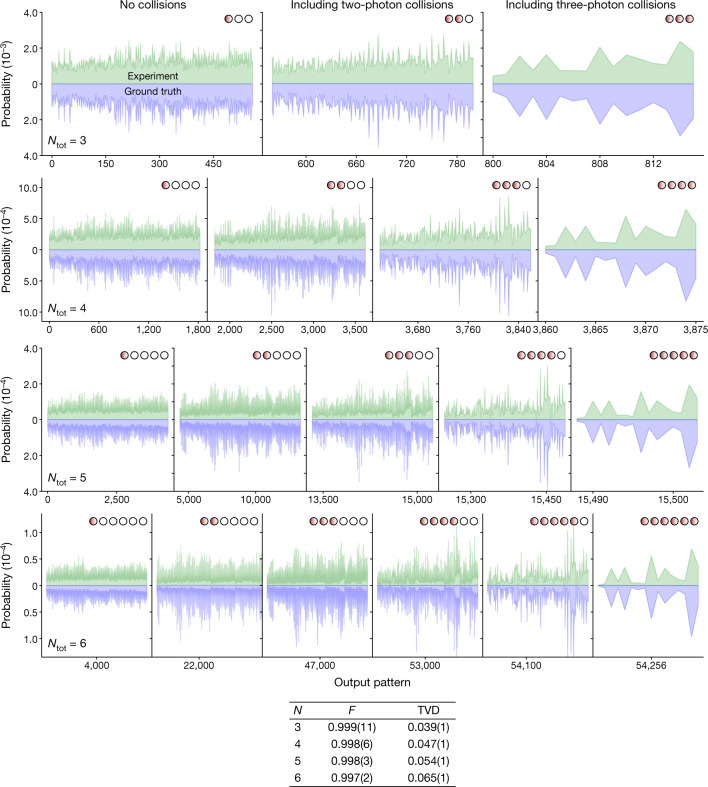
- In the low-photon-number regime, the paper reports fidelities in excess of 99% and TVDs below or equal to 6.5% for total photon-number sectors 3 to 6.
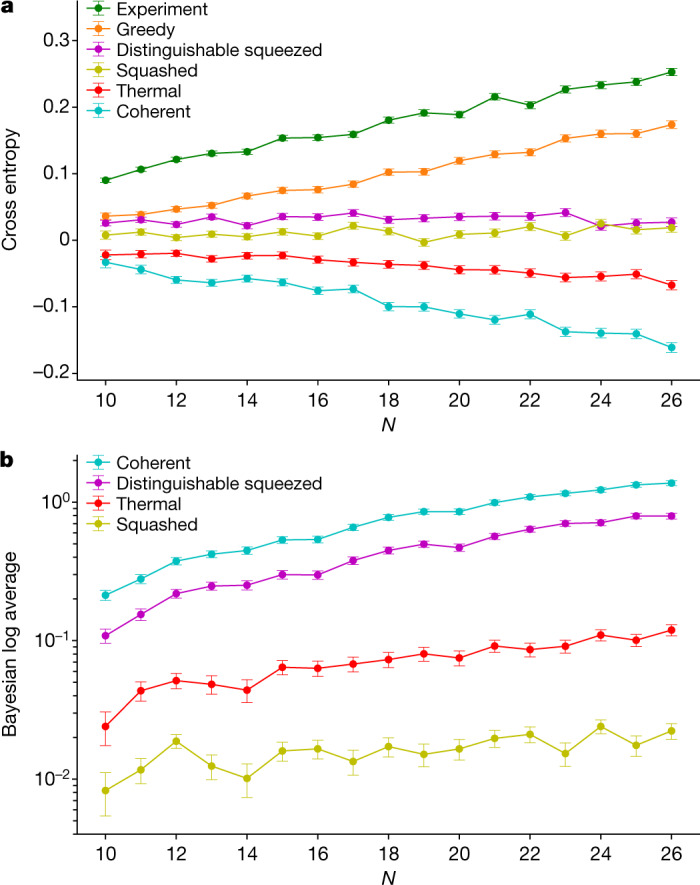
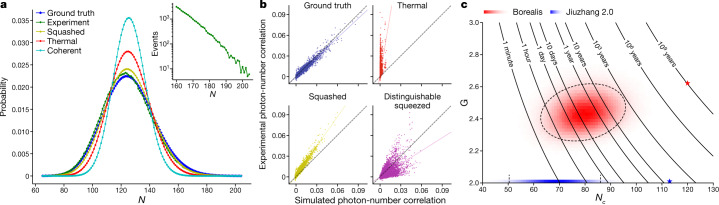
- For the intermediate regime, they analyze 10^6 samples and state that the best adversary (the greedy sampler) remained below the experiment in cross-entropy; for the large regime, the experimental total photon-number distribution has its highest probability at N = 124.35 ± 0.02, with support past 160 photons.
Methods
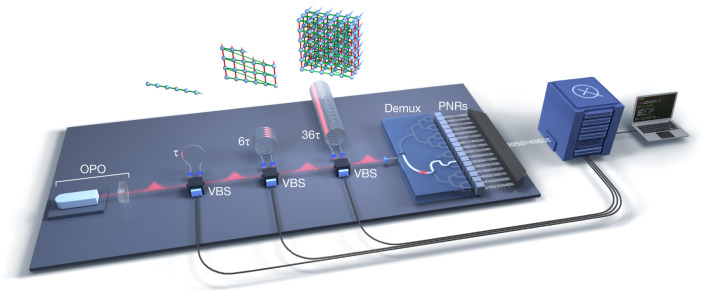
- The experiment uses a time-multiplexed photonic processor with three loop-based interferometers, a 6 MHz pulsed squeezed-light source, and 16-channel demultiplexing to route outputs to superconducting TES photon-number-resolving detectors.
- The device synthesizes a 216-mode Gaussian state by injecting 216 squeezed-light pulses into the interferometer; the loops enable couplings at separations of 1, 6, and 36 time bins.
- Performance is assessed by comparing experimental samples to the calibrated lossy ground truth using fidelity, total variation distance, cross-entropy benchmarks, Bayesian log averages, and cumulant comparisons against several classical adversaries.
Limitations
- The paper states that because estimating all probabilities from the characterized transmission matrix would require orders of magnitude more samples, their analysis is limited; this is why data beyond N > 6 were left for later benchmarks.
- The authors note that the demultiplexer and filter stack introduce losses, estimated at roughly 15% and 20%, respectively, and say improved detector speed could eliminate the demultiplexer.
- Evident from the text: the reported advantage is tied to a specific programmed distribution and a calibrated lossy ground truth, so it is not a general proof of all photonic computations.
Model-written summary. Check it against the paper before relying on it.
Integrity signals
Registry
Cites
Statistics
Figures
Verification
Claims the paper makes
15 Valid · 6 Not valid · 3 Not checked · 69 Own results and interpretations
At least one cited source doesn’t support this claim or points to a different paper, and none confirmed it — see the verdicts below.
In the paper
“In addition, its output cannot be efficiently spoofed in cross-entropy benchmarks using a generalization of the most recent polynomial-time algorithms3.”
§ Quantum computational advantage with a programmable photonic processor > Main
What the sources say
- Disputedcites [3] Villalonga, B. et al. Efficient approximation of experimental Gaussian boson sampling. Preprint at https://arxiv.org/abs/2109.11525 (2021). sourceExperimental — accuracy not yet measured
Our copy never names Borealis (it analyses the GBS experiments of its Refs. 1 and 2, up to 144 output modes), but its central conclusion runs opposite to what the citing sentence attributes to it: the Discussion (p. 8) states that 'a quadratic classical algorithm obtained a better approximation to the ideal distribution' and that the methodology 'can be applied to other boson sampling proposals where marginal probabilities can be computed efficiently'. On the cross-entropy metric specifically, Section III (pp. 7-8, Fig. 6) reports that the order-3 greedy sampler has XE similar to the experiment and that the 2nd-order samplers have smaller (better) XE than the experiment at large click numbers, i.e. efficient XE spoofing is demonstrated, not ruled out. The only hedge the paper offers is cost scaling — the order-k generalization is exponential in k and the scaling with k is called 'an interesting open question' (Introduction p. 2, Discussion p. 8) — which qualifies but does not assert impossibility for a device like Borealis. (LLM, conf=0.68)
Checked by a reasoning model — may be wrong.
plain- Asserted: passes — The authors put it forward as true.
- Checkable: passes — It can be checked against evidence.
- Load-bearing: passes — The paper’s conclusions depend on it.
- Based: passes — The paper gives a reason why it holds.
- Disputed
The cited sources that could be checked couldn’t confirm or dispute this claim.
In the paper
“On average, it would take more than 9,000 years for the best available algorithms and supercomputers to produce, using exact methods, a single sample from the programmed distribution”
- Also stated in: § Experiment · hedged
“we estimate that, on average, it would take Fugaku 9,000 years to generate one sample”
§ Quantum computational advantage with a programmable photonic processor > Abstract
What the sources say
- Could not verifycites [30] Bulmer JF The boundary for quantum advantage in Gaussian boson sampling Sci. Adv. 2021 8 eabl9236 PMC8791606 35080972 sourceExperimental — accuracy not yet measured
The Results (Benchmarking; page not provided) estimate seconds per sample for the paper’s simulated GBS systems, potentially milliseconds on Fugaku. The Discussion (page not provided) mentions programmability as a possible feature of future experiments, but our copy does not identify the claimed programmed distribution or give a 9,000-year estimate for an exact sample from it. Searched for the 9,000-year estimate and programmed distribution. (LLM, conf=0.78)
- Could not verifycites [34] Quesada N Quadratic speed-up for simulating gaussian boson sampling PRX Quantum 2022 3 010306 sourceExperimental — accuracy not yet measured
Our full copy (not truncated) contains no years-scale estimate anywhere: searched for '9,000 years', single-sample run time, supercomputer, programmed distribution. The only concrete runtimes are in Sec. IV BENCHMARKING — ~7 h for a 56×56 loop hafnian on a 96-CPU Azure workstation and 'roughly 2 weeks for generating a single sample' for m = 100 modes, N = 50 photons — and the Abstract stresses probabilities can be computed 'in a single workstation, i.e., without the need of a supercomputer'. So the paper neither states the 9,000-year figure nor addresses whatever device/distribution that figure belongs to; its own state-of-the-art exact-sampling numbers point in the opposite direction (much shorter), which means the attribution is unsupported rather than confirmed. (LLM, conf=0.65)
hedged- Asserted: passes — The authors put it forward as true.
- Checkable: passes — It can be checked against evidence.
- Load-bearing: passes — The paper’s conclusions depend on it.
- Based: passes — The paper gives a reason why it holds.
- Also stated in: § Experiment · hedged
Every source the paper cites for this claim was checked and supports it.
In the paper
“we estimate that Fugaku would require 1.5 h, on average, to generate one sample from the experiment in ref. 2”
§ Quantum computational advantage with a programmable photonic processor > Experiment
What the sources say
- Supportedcites [2] Zhong H-S Phase-programmable Gaussian boson sampling using stimulated squeezed light Phys. Rev. Lett. 2021 127 180502 34767431 source
The paper’s Abstract identifies its Jiuzhang 2.0 experiment as a Gaussian boson-sampling experiment that produced samples. The citing authors present the 1.5-hour Fugaku figure as their own estimate; the citation identifies the experiment being simulated, not the source of that estimate. (LLM, conf=0.91)
hedged- Asserted: passes — The authors put it forward as true.
- Checkable: passes — It can be checked against evidence.
- Load-bearing: passes — The paper’s conclusions depend on it.
- Based: passes — The paper gives a reason why it holds.
- Rests on 2 assumptions not shown here.
- Supported
Every source the paper cites for this claim was checked and supports it.
In the paper
“if one were to target a universal and programmable interferometer, with depth equal to the number of modes, that covers densely the set of unitary matrices, the exponential accumulation of loss would prohibit showing a quantum advantage.”
§ Quantum computational advantage with a programmable photonic processor > Experiment
What the sources say
- Supportedcites [5] Deshpande A Quantum computational advantage via high-dimensional gaussian boson sampling Sci. Adv. 2022 8 eabi7894 34985960 PMC8730598 source
The Results section (“High-dimensional GBS and evidence for hardness”) says that implementing arbitrary unitary transformations requires a circuit whose depth scales linearly with its size. It then states that photon loss scales exponentially with depth, making such models efficiently classically simulatable for sufficiently large numbers of modes in the absence of optical error correction. (LLM, conf=0.92)
- Supportedcites [31] Qi H Brod DJ Quesada N García-Patrón R Regimes of classical simulability for noisy Gaussian boson sampling Phys. Rev. Lett. 2020 124 100502 32216428 source
The main text (p. 2) states exactly the attributed content: 'In most linear-optical architectures, photon loss is defined by unit depth of the circuit, leading to an exponential decrease of transmission with the depth. Our results imply that, asymptotically, GBS implemented on these platforms is rendered efficiently simulable by losses if the depth is linear in the number of modes... lossy GBS inevitably loses its quantum advantage for sufficiently large sizes.' The abstract (p. 1) repeats it ('photon loss increases exponentially with the circuit depth, noisy GBS loses its quantum advantage in the asymptotic limit'), and Sec. II of the Supplemental Material (p. 7) names interferometer-depth loss 'the main scalability bottleneck'. A universal/programmable mesh of depth equal to the number of modes falls inside the class of architectures the paper treats, so the consequent is supported; the descriptors 'universal and programmable' and 'covers densely the set of unitary matrices' are the citing authors' motivation for the depth choice and are not asserted by the source, which speaks of 'most linear-optical architectures' generally and adds the caveat that a running-time advantage may persist at intermediate sizes. (LLM, conf=0.85)
hedgedstates a cause- Asserted: passes — The authors put it forward as true.
- Checkable: passes — It can be checked against evidence.
- Load-bearing: passes — The paper’s conclusions depend on it.
- Based: passes — The paper gives a reason why it holds.
- Supported
The cited sources support only part of this claim — read each source’s verdict below.
In the paper
“As discussed in the Methods, combined with the high brightness of our source averaging r ~ 1.1, places our experiment well beyond any attempt at a now-known polynomial-time approximate classical simulation31.”
§ Quantum computational advantage with a programmable photonic processor > Methods > Connectivity
What the sources say
- Partly supportedcites [31] Qi H Brod DJ Quesada N García-Patrón R Regimes of classical simulability for noisy Gaussian boson sampling Phys. Rev. Lett. 2020 124 100502 32216428 sourceExperimental — accuracy not yet measured
Our copy supplies the framework the citing sentence leans on: a sufficient condition (inequality (1)) for approximate polynomial-time classical simulation of noisy GBS in terms of squeezing r, transmission η and detector quality q_D, which the authors call 'a natural and useful test that any alleged quantum advantage demonstration with noisy GBS must pass' (p. 1), together with the explicit statement that 'increasing the amount of input squeezing is helpful to evade our classical simulation algorithm' and that 'the region where quantum computational supremacy has not been ruled out expands as we increase ... the amount of input squeezing' (Abstract p. 1; Discussion p. 4). However, the paper never evaluates r ≈ 1.1: the only experiments it plugs into inequality (1) are r ≈ 0.1 (Ref. [48]) and r ≈ 0.38 (Ref. [49]), the latter giving 'no solution for any ε ∈ [0,1]' (p. 2). Moreover, the source's condition is only sufficient for simulability — failing it means supremacy is 'not ruled out', not that the device is provably 'well beyond any attempt at a now-known polynomial-time approximate classical simulation'; that stronger, universal phrasing is the citing authors' own extrapolation. (LLM, conf=0.75)
boostedstates a cause- Asserted: passes — The authors put it forward as true.
- Checkable: passes — It can be checked against evidence.
- Load-bearing: passes — The paper’s conclusions depend on it.
- Based: passes — The paper gives a reason why it holds.
- Partly supported
53 more claims · 8 with their cited sources checked
Create a free account to see all 93 claims and to verify the 10 references still open.
- It may state two separate claims as one. 26
- Probably not a substantial claim. 10
Citations
Cites
Quantum supremacy using a programmable superconducting processor
Arute, F., Arya, K., Babbush, R., Bacon, D., Bardin, J. C., Barends, R., Biswas, R., Boixo, S., Brandao, F. G. S. L., Buell, D. A., et al. (2019) · Nature · doi:10.1038/s41586-019-1666-5 · Cited by 7,720 · cited 2×
“Only a handful of experiments have used quantum devices to carry out computational tasks that are outside the reach of present-day classical computers 1,2,6,7 .”
BackgroundMethodWeedbrook, C., Pirandola, S., García-Patrón, R., Cerf, N. J., Ralph, T. C., Shapiro, J. H., & Lloyd, S. (2012) · Reviews of Modern Physics · doi:10.1103/revmodphys.84.621 · Cited by 3,664
Quantum computational advantage using photons
Zhong, H.-S., Wang, H., Deng, Y.-H., Chen, M.-C., Peng, L.-C., Luo, Y.-H., Qin, J., Wu, D., Ding, X., Hu, Y., et al. (2020) · Science · doi:10.1126/science.abe8770 · Cited by 2,405 · cited 8×
“Our solutions to these challenges for this work are, respectively, (1) the design of a bright and tunable source of single-mode squeezed states and phase stabilization techniques (OPO and interferometer) using locking schemes compatible with PNR detectors, (2) active demultiplexing to increase the effective rate of PN…”
BackgroundMethodInfluentialStrong Quantum Computational Advantage Using a Superconducting Quantum Processor
Wu, Y., Bao, W.-S., Cao, S., Chen, F., Chen, M.-C., Chen, X., Chung, T.-H., Deng, H., Du, Y., Fan, D., et al. (2021) · Physical Review Letters · doi:10.1103/physrevlett.127.180501 · Cited by 1,059
Counting near-infrared single-photons with 95% efficiency
Lita, A. E., Miller, A. J., & Nam, S. W. (2008) · Optics Express · doi:10.1364/oe.16.003032 · Cited by 734 · cited 1×
“Spatial overlap is ensured by using single-mode fibre coupling at the entrance and exit of each loop delay, and samples are collected using an array of photon-number resolving (PNR) detectors based on superconducting transition-edge sensors (TES) with 95% detection efficiency 39,40 .”
MethodSelf-citationTopological fault-tolerance in cluster state quantum computation
Raussendorf, R., Harrington, J., & Goyal, K. (2007) · New Journal of Physics · doi:10.1088/1367-2630/9/6/199 · Cited by 617
Quantum circuits with many photons on a programmable nanophotonic chip
Arrazola, J. M., Bergholm, V., Brádler, K., Bromley, T. R., Collins, M. J., Dhand, I., Fumagalli, A., Gerrits, T., Goussev, A., Helt, L. G., et al. (2021) · Nature · doi:10.1038/s41586-021-03202-1 · Cited by 567 · cited 3×
“Spatial overlap is ensured by using single-mode fibre coupling at the entrance and exit of each loop delay, and samples are collected using an array of photon-number resolving (PNR) detectors based on superconducting transition-edge sensors (TES) with 95% detection efficiency 39,40 .”
BackgroundMethodSelf-citationHamilton, C. S., Kruse, R., Sansoni, L., Barkhofen, S., Silberhorn, C., & Jex, I. (2017) · Physical Review Letters · doi:10.1103/physrevlett.119.170501 · Cited by 503 · cited 5×
“Equation (4) captures the collision-free complexity of the hafnian of an N × N matrix of O N ( 2 ) c N 3 /2 c because in that case G = 2.”
BackgroundMethodInfluentialGeneration of time-domain-multiplexed two-dimensional cluster state
Asavanant, W., Shiozawa, Y., Yokoyama, S., Charoensombutamon, B., Emura, H., Alexander, R. N., Takeda, S., Yoshikawa, J.-I., Menicucci, N. C., Yonezawa, H., et al. (2019) · Science · doi:10.1126/science.aay2645 · Cited by 476 · cited 1×
“Using time-domain multiplexing, large one-and two-dimensional cluster states have been deterministically generated 21–23 with programmable linear operations implemented by projective measurements 24,25 , whereas similar operations have been implemented in ref.”
MethodQuantum circuits with many photons on a programmable nanophotonic chip
Arrazola, J. M., Bergholm, V., Brádler, K., Bromley, T. R., Collins, M. J., Dhand, I., Fumagalli, A., Gerrits, T., Goussev, A., Helt, L. G., et al. (2021) · RePEc: Research Papers in Economics · Cited by 463
Self-citation
Research works printed but not linked: 1
- 56th edition of the top 500 Top 500 the List https://www.top500.org/lists/top500/2020/11/ (2020).
Cited by
Items 901–1,000 of 1,033
Efficient detection of non-Gaussian states via Wigner-function test
Lee, J., Park, J., & Nha, H. (2026) · Physical Review A · doi:10.1103/sp7n-q2s1 · Cited by 1
Edwards, M. S. (2026) · Springer eBooks · doi:10.1007/978-3-032-03650-6_4
Multi-photon quantum interference and entanglement
Pont, M. (2023) · theses.fr (ABES) · doi:10.70675/2058f3b5z6090z4b31z9a1dzca3a3d51dd4e · Cited by 2
Report on scipost_202304_00012v1
Karácsony, M., Oroszlány, L., & Zimborás, Z. (2023) · SciPost Physics Core · doi:10.21468/scipost.report.7589
Dynamic Quantum Gate Based on Controllable Chiral Liquid Crystal Nanostructure
Ding, S., Zhu, D. X., Zhang, Y., Liu, S., Sun, R., Chen, W., Chen, F.-T., Jiang, J., Lu, Y., & Chen, P. (2026) · Nano Letters · doi:10.1021/acs.nanolett.6c02279
Daka, C., & Bhattacharyya, S. (2026) · New Journal of Physics · doi:10.1088/1367-2630/ae8053 · Cited by 1
Boson sampling with self-generation of squeezing via interaction of photons and atoms
Tarasov, S. V., & Kocharovsky, V. V. (2026) · Physical Review A · doi:10.1103/lld4-7qmt · Cited by 1
Lin, M., & Noh, K. (2025) · Physical Review A · doi:10.1103/physreva.111.052445 · Cited by 5
Linear-optical protocols for mitigating and suppressing noise in bosonic systems
Teo, Y. S., Shringarpure, S. U., Cho, S.-J., & Jeong, H. (2025) · Quantum Science and Technology · doi:10.1088/2058-9565/adc82c · Cited by 7
Programmable multimode squeezed light at visible wavelengths with >400 modes
Presutti, F., Wright, L. G., Ma, S.-Y., et al. (2024) · doi:10.1364/cleo_fs.2024.ff2h.4
System Integration of High-Performance Continuous-Variable Quantum Key Distribution
Piétri, Y. (2024) · theses.fr (ABES) · doi:10.70675/db1a062ez48e2z464czbcbaz8de1a6ebb41a
Characterizing Gaussian quantum processes with Gaussian resources
Grove, L. W., Barge, P. J., & Jacob, K. V. (2025) · Physical Review A · doi:10.1103/sxd2-5z5d · Cited by 2
STMC: Small-Tile Multiple-Copy Compilation for Reliable Measurement-Based Quantum Computing
Dong, R., Mo, Z., Li, Y., Pawar, A., Yang, J., Zhang, Y., & Tang, X. (2025) · 2025 IEEE/ACM International Conference On Computer Aided Design (ICCAD) · doi:10.1109/iccad66269.2025.11240760 · Cited by 1
Райков, А. Н. (2024) · SpringerBriefs in applied sciences and technology · doi:10.1007/978-981-97-1291-5_9
Digital payments in network formation games: Theory of adoption and quantum algorithms
Priazhkina, S., Palmer, S. J., Martín-Ramiro, P., Orús, R., Mugel, S., & Skavysh, V. (2026) · Journal of Economic Dynamics and Control · doi:10.1016/j.jedc.2026.105386 · Cited by 2
From growth to integration: Quantum dot devices for quantum photonics
Huber, T., Pfenning, A. T., Michl, J., & Höfling, S. (2026) · Applied Physics Reviews · doi:10.1063/5.0287406 · Cited by 3
Revisiting Gaussian genuine entanglement witnesses with modern software
Shchukin, E. V., & van Loock, P. (2026) · Physical Review Research · doi:10.1103/drmr-qf2q · Cited by 2
Kumar, R. R., Basu, P., & Chack, D. (2026) · Advanced Quantum Technologies · doi:10.1002/qute.70353 · Cited by 1
Quantum circuits for simulating linear interferometers
Leone, H., Turner, P. S., & Devitt, S. J. (2025) · Physical Review Research · doi:10.1103/z5l3-z2dr · Cited by 1
Manenti, R., & Motta, M. (2023) · Oxford University Press eBooks · doi:10.1093/oso/9780198787488.003.0006
Manenti, R., & Motta, M. (2023) · Oxford University Press eBooks · doi:10.1093/oso/9780198787488.003.0004
Quantum computing with time-travelling quantum gates
Wang, C., Lu, C., & Chen, M.-C. (2023) · Acta Physica Sinica · doi:10.7498/aps.73.20231289
On-chip squeezed light in the audio frequency band
Zhu, X., Cao, Y., Liu, R., et al. (2026) · 中国科学通报:英文版 · doi:10.1016/j.scib.2026.08.054
Universal entanglement revival of topological origin
Chen, D. S., Chesi, S., & Choi, M. (2025) · Physical Review A · doi:10.1103/qsc2-rcy7 · Cited by 3
Manenti, R., & Motta, M. (2023) · Oxford University Press eBooks · doi:10.1093/oso/9780198787488.003.0009
Distribution of nonlocality on quantum random circuits
Arango, A. C. G., Holik, F., Giuntini, R., Freytes, H., & Sergioli, G. (2025) · Physical Review A · doi:10.1103/8nbw-bvj2 · Cited by 4
A complexity transition in displaced Gaussian Boson sampling
Li, Z., Solomons, N. R., Bulmer, J. F. F., Patel, R. B., & Walmsley, I. A. (2025) · npj Quantum Information · doi:10.1038/s41534-025-01062-5 · Cited by 4
Self-citationNonlinearity of photonic quantum memristors in high-frequency regime
Agresti, I., & Walther, P. J. (2022) · Photonics for Quantum (PfQ) · doi:10.1117/12.2631512
Manenti, R., & Motta, M. (2023) · Oxford University Press eBooks · doi:10.1093/oso/9780198787488.003.0003
Matrix product state on a quantum computer
Liu, Y., Huang, G.-Y., Wang, Y., & Wu, J. (2025) · New Journal of Physics · doi:10.1088/1367-2630/ae1ce5 · Cited by 3
Hybrid Classical-Quantum Architecture for Vectorised Image Classification of Hand-Written Sketches
Cordero, Y., Biswas, S., Vilariño, F., & Bilkis, M. (2026) · Lecture notes in computer science · doi:10.1007/978-3-032-31673-8_24 · Cited by 1
Scaling strategies for photonic neural networks
Zhang, H., Ma, Y., Wang, Z., Cheng, X., Laing, A., & Liu, A. Q. (2026) · Nature Reviews Physics · doi:10.1038/s42254-026-00984-z · Cited by 1
Performance evaluation and control improvements for solving optimization problems on NISQ platforms
Gilbert, V. (2024) · theses.fr (ABES) · doi:10.70675/81f9c638z5867z40e4zaed8ze9824ff5a163 · Cited by 1
Automated design of photonic quantum circuits
Yao, Y. (2023) · theses.fr (ABES) · doi:10.70675/137f6c70zbc72z4cbdzb338z6722012d84e0
A perspective on solid-state quantum light sources: materials and atomic defects
Singh, A. K. K., Sharma, P., Mandal, K. K., Eswaramoorthy, L., & Kumar, A. (2026) · Nano Futures · doi:10.1088/2399-1984/ae7242 · Cited by 4
Finazzer, M. (2024) · theses.fr (ABES) · doi:10.70675/3952a21bzb3e2z4f25z885azf88f5a072a9f
Approximating outcome probabilities of linear optical circuitsPreprint
Lim, Y., & Oh, C. (2022) · arXiv (Cornell University) · doi:10.48550/arxiv.2211.07184
Time-domain-multiplexed Gaussian Boson sampling for graph problems in finance
He, S., Ai, B., Gao, P., Liu, H., He, J.-J., Hu, K.-M., Zhu, Y., & Wu, J. (2025) · Chip · doi:10.1016/j.chip.2025.100181 · Cited by 3
QUANTUM COMPUTERS: AN OVERVIEW OF THEIR MARKET AND PHYSICAL REALISATIONS
MARMELLO, P. T. D. S. M., & PAULA, C. D. P. (2022) · doi:10.17771/pucrio.acad.61595 · Cited by 1
Experimental loopback boson sampling
Biriukov, Y. A., Morozov, R., Okhlopkov, K. I., Dyakonov, I. V., Skryabin, N. N., Zhuravitskii, S. A., Dryazgov, M. A., Taratorin, K. V., Rakhlin, M. V., Galimov, A. I., et al. (2026) · Optica Quantum · doi:10.1364/opticaq.599335 · Cited by 2
Continuous-variable cluster states in optical microresonator
Wang, Z., Li, K., Wang, Y., Zhou, X., Cheng, Y. H., Jing, B., Sun, F.-X., Li, J., Li, Z., Gong, Q., et al. (2024) · IEEE Photonics Conference · doi:10.1109/ipc60965.2024.10799849
Fast-forwarding molecular ground state preparation with optimal control on analog quantum simulators
Castaldo, D., Rosa, M., & Corni, S. (2024) · The Journal of Chemical Physics · doi:10.1063/5.0204618 · Cited by 1
Open QBench: A benchmarking framework for evaluating quantum computing platforms
Wojciechowski, K., Kurowski, K., Slysz, M., & Pecyna, T. (2026) · Quantum Information Processing · doi:10.1007/s11128-026-05115-2 · Cited by 2
Development and application prospect of photonic integrated circuits
Zhang, P. (2024) · Applied and Computational Engineering · doi:10.54254/2755-2721/84/20240843
Practical considerations for assignment of photon numbers with SNSPDs
Schapeler, T., Mischke, I., Schlue, F., Stefszky, M., Brecht, B., Silberhorn, C., & Bartley, T. J. (2026) · APL Quantum · doi:10.1063/5.0304127 · Cited by 7
Photon-number entanglement from cascaded parametric down-conversion
Xue, S.-T., Jiang, H., Wang, J., Ren, Z.-C., Wang, X.-L., & Wang, H.-T. (2025) · Physical Review A · doi:10.1103/slsq-t87h · Cited by 2
Rethinking Programming Paradigms in the QC-HPC Context
Caíno‐Lores, S., Claudino, D., Dumitrescu, E., et al. (2024) · Lecture notes in computer science · doi:10.1007/978-3-031-61763-8_8
Beyond Classical Limits: Quantum Computing Advances in Post-Binary Era
Gupta, D., Gayratovich, E. N., Isaev, F., Ulugbek, U., Gulamov, I., Jurayeva, S., & Ishnazarov, A. (2026) · Advances in computational intelligence and robotics book series · doi:10.4018/979-8-2600-0156-1.ch002
(2023) · Oxford University Press eBooks · doi:10.1093/oso/9780198787488.002.0004
Temporal Multiplexing of Heralded Photons Based on Thin Film Lithium Niobate Photonics
Ekici, Ç., Yu, Y., Adcock, J. C., Muthali, A. L., Zahidy, M., Tan, H., Lin, Z., Li, H., Oxenløwe, L. K., Cai, X., et al. (2024) · doi:10.1364/cleo_fs.2024.fm1k.6
Salehi, R., Malik, A. W., Novotny, M. A., & Khan, S. U. (2026) · Scientific Reports · doi:10.1038/s41598-026-51033-9 · Cited by 1
“According to the literature, Quantum Processing Units (QPUs) exhibit diverse physical implementations, including photonic systems 40 , superconducting circuits 41 , and ion-trapped devices 42 .”
Efficient fiber-coupled single-photon sources based on near infrared quantum dots
Margaria, N. (2024) · theses.fr (ABES) · doi:10.70675/31042e27za594z42f6z84a7zeb3512470cc2
Manenti, R., & Motta, M. (2023) · Oxford University Press eBooks · doi:10.1093/oso/9780198787488.003.0010
Lund, A. P., & Ralph, T. C. (2024) · Elsevier eBooks · doi:10.1016/b978-0-323-95703-8.00111-7
Photon number resolving detection in commercially produced SNSPDs
Rambo, T. M., Doredla, J. S., Jones, H., Oshiro, L., Boyd, S., & Miller, A. (2024) · Quantum Computing, Communication, and Simulation · doi:10.1117/12.2687215
High-Rate Photon-Number Resolved Detection with Transition-Edge Sensors Enabled by Machine Learning
Li, Z., Kendall, M. J. H., Zhu, R., Mer, E., Yu, S., Walmsley, I. A., & Patel, R. B. (2024) · Quantum 2.0 Conference and Exhibition · doi:10.1364/quantum.2024.qm2a.4
A Review of Quantum Attention MechanismsPreprint
Zhao, R.-X., Lu, Y., Shi, J., Wang, S., Wang, Y., & Li, X. (2025) · doi:10.36227/techrxiv.174494983.39165941/v1
(2023) · Oxford University Press eBooks · doi:10.1093/oso/9780198787488.002.0003
Exploring advancements and prospects of laser technologies towards practical quantum advantage
Dadras, S. (2024) · Photonics for Quantum (PfQ) · doi:10.1117/12.3029667
Anonymous, & Zhang, X. (2026) · Physical Review A · doi:10.1103/93x9-y3y9
Gaussian Boson Sampling for Binary Optimization
Cazalis, J., Chai, Y., Jansen, K., Kühn, S., & Shah, T. (2023) · IEEE International Conference on Quantum Computing and Engineering (QCE) · doi:10.1109/qce57702.2023.10268
Schrödinger’s bug: a survey on quantum software debugging
Rosa, E. C. R., & de Santiago, R. (2026) · Quantum Information Processing · doi:10.1007/s11128-026-05114-3 · Cited by 4
Generation of spin and photons entangled states with semiconductor quantum dots
Coste, N. (2023) · theses.fr (ABES) · doi:10.70675/1927063czf894z459bz9bd2zf87d388a5e41 · Cited by 1
Experimental Realization of Spontaneous Parametric Down ConversionPreprint
Hasani, M., & Motaharifar, M. (2024) · doi:10.1364/opticaopen.28024766
Gaussian Boson Sampling CompilationPreprint
Alarcón, S. L., & Rueda, F. (2022) · Research Square · doi:10.21203/rs.3.rs-1813584/v1
Gaussian Boson Sampling to Accelerate NP-Complete Vertex-Minor Graph Classification
Sureka, M., & Guha, S. (2024) · IEEE International Conference on Quantum Computing and Engineering (QCE) · doi:10.1109/qce60285.2024.00032 · Cited by 1
Chip-based quantum signature network reaches 200 km
You, C., & Magaña‐Loaiza, O. S. (2025) · Light Advanced Manufacturing · doi:10.37188/lam.2025.041
QURIOSO: Quantum gate parameter predictIon through quantum-enhanced long-short term memory
Loglisci, C. A. A. M. D., Losavio, V. N., Pascazio, S., & Malerba, D. (2026) · Quantum Machine Intelligence · doi:10.1007/s42484-026-00374-9 · Cited by 1
Quantum-Enhanced Versus Classical Support Vector Machine: An Application to Stock Index ForecastingPreprint
Mercadier, M. (2024) · SSRN Electronic Journal · doi:10.2139/ssrn.4682186
Enhancing Image Recognition Using Gaussian Boson Sampling
Anonymous, Chen, M.-C., Liu, H.-L., Su, H., Gu, Y.-C., Tang, H., Jia, M.-H., Deng, Y.-H., Han-tao, S., Wei, Q., et al. (2026) · Physical Review Letters · doi:10.1103/9mb1-t3w4 · Cited by 18
Biclustering a dataset using photonic quantum computing
Borle, A., & Bhave, A. (2024) · Frontiers in Computer Science · doi:10.3389/fcomp.2024.1441879
Family of One‐Parameter Multipartite Entanglement Measures
Ren, H., Li, Y., & Luo, Y. (2026) · Advanced Quantum Technologies · doi:10.1002/qute.202500617
Efficient mediated multiparty semi-quantum secret sharing protocol based on single-qubit reordering
Younes, M. A., Zebboudj, S., & Gharbi, A. (2026) · International Journal of Quantum Information · doi:10.1142/s0219749926500176
Quantum Computing Explained: A Beginner's Guide to the Future of Processing
John, W. M. (2025) · International Journal of Information Technology Research Studies (IJITRS) · doi:10.63090/ijitrs/3139.3209.0013
Structured light–matter interaction in semiconductor cavity quantum electrodynamics
Liu, S., Ma, J., Liu, H., Wang, Y., Li, X., Ni, H., Niu, Z., Zou, K., Meng, Y., Hu, X., et al. (2026) · Nature Nanotechnology · doi:10.1038/s41565-026-02275-1
Deep learning as a tool of quantum error reduction in quantum image processingPreprint
Werner, K., Wereszczyński, K., Potempa, R., & Cyran, K. A. (2023) · Preprints.org · doi:10.20944/preprints202310.0073.v1
Hyperloss from coherent spatial-mode mixing in quantum-correlated networks
Grebien, S., Gurs, J., Schnabel, R., & Korobko, M. (2026) · Nature Communications · doi:10.1038/s41467-026-75899-5 · Cited by 2
Conti, C. (2023) · Quantum science and technology · doi:10.1007/978-3-031-44226-1_2
A Gaussian Boson Sampling Based Ising Solver
Zhu, H., Chen, H. S., Cai, H. N., Chen, T., Chin, L. K., Zhang, X. D., & Liu, A. Q. (2024) · Optical Fiber Communication Conference · doi:10.1364/ofc.2024.tu3c.2
Characterization of spatial Schmidt modes in high-gain SU(1,1) interferometers
Scharwald, D., & Sharapova, P. R. (2026) · Physical Review Research · doi:10.1103/ph64-ts39 · Cited by 3
Variational Optical Phase Learning on a Continuous-Variable Quantum Compiler
Feldman, M. A., Volkoff, T. J., Hong, S., Marvinney, C. E., Holmes, Z., Pooser, R. C., Sornborger, A. T., & Marino, A. M. (2026) · PRX Quantum · doi:10.1103/7l8z-zn2m
Analysis of the action of conventional trapped-ion entangling gates in qudit space
Anonymous, Semenin, N. V., Zalivako, I. V., Smirnov, V. N., Semerikov, I. A., Khabarova, K. Y., & Kolachevsky, N. (2026) · Physical Review A · doi:10.1103/sxrf-1h7v · Cited by 2
Simulation of time-dependent quantum dynamics using quantum computers
Lötstedt, E., Nishi, T., & Yamanouchi, K. (2024) · Advances in atomic, molecular, and optical physics · doi:10.1016/bs.aamop.2024.05.002 · Cited by 1
Optimal Task Scheduling in 6G Networks: A Variational Quantum Computing Approach
Khalid, U., Rehman, J. U., Farooq, A., Zaman, F., & Shin, H. (2024) · Lecture notes of the Institute for Computer Sciences, Social Informatics and Telecommunications Engineering · doi:10.1007/978-3-031-67357-3_5 · Cited by 3
(2023) · Oxford University Press eBooks · doi:10.1093/oso/9780198787488.002.0005
Qiu, R., Tian, T., Dong, W., Wang, E., Zhao, L., & Xue, B. (2026) · International Symposium on Advances in Electrical, Electronics and Computer Engineering (ISAEECE) · doi:10.1109/isaeece70502.2026.11635375
Shang, J., Zhu, Y., Fan, Y.-N., Kou, Y., Yan, X. Q., Zhang, Y., & Wang, F. (2025) · Optics Communications · doi:10.1016/j.optcom.2025.132845
Xue, S.-T., Jiang, H., Wang, J., Ren, Z.-C., Wang, X.-L., & Wang, H.-T. (2026) · Physical Review Applied · doi:10.1103/xcbj-vbyc
Dynamical Complexity of Non-Gaussian Many-Body Systems with Dissipation
González-García, G., Gorshkov, A. V., Cirac, J. I., & Trivedi, R. (2025) · Physical Review Letters · doi:10.1103/rd56-b8tc · Cited by 6
The rotating wave approximation
Manenti, R., & Motta, M. (2023) · Oxford University Press eBooks · doi:10.1093/oso/9780198787488.005.0001
Photon losses create tension for Gaussian boson sampling
Tura, J. (2024) · Nature Physics · doi:10.1038/s41567-024-02610-0
Manenti, R., & Motta, M. (2023) · Oxford University Press eBooks · doi:10.1093/oso/9780198787488.003.0007
Quantum simulation of Hamiltonian dynamics
Manenti, R., & Motta, M. (2023) · Oxford University Press eBooks · doi:10.1093/oso/9780198787488.003.0011
On-Chip Generation of Copolarized and Spectrally Separable Photon Pairs
Wang, X., Zhou, L., Li, Y., Mohanraj, S. S., Shi, X., Yu, Z., Yang, R., Chen, X., Wu, G., Hao, H., et al. (2026) · Physical Review Letters · doi:10.1103/cpwf-k58g · Cited by 5
Brockmeier, J., Schapeler, T., Lange, N. A., Höpker, J. P., Herrmann, H., Silberhorn, C., & Bartley, T. J. (2025) · New Journal of Physics · doi:10.1088/1367-2630/ade46c
Efficient Quantum Circuit Simulation by Tensor Network Methods on Modern GPUsPreprint
Pan, F. P., Gu, H., Kuang, L., et al. (2023) · arXiv (Cornell University) · doi:10.48550/arxiv.2310.03978
Metadata
- Authors
- Madsen, L. S., Laudenbach, F., Askarani, M. F., Rortais, F., Vincent, T., Bulmer, J. F. F., Miatto, F. M., Neuhaus, L., Helt, L. G., Collins, M. J., Lita, A. E., Gerrits, T., Nam, S. W., Vaidya, V. D., Menotti, M., Dhand, I., Vernon, Z., Quesada, N., & Lavoie, J.
- Affiliations
- Xanadu Quantum Technologies (Canada) (CA)
- National Institute of Standards and Technology (US)
- Corresponding author
- Quesada, Nicolás
- Lavoie, Jonathan
- ORCID
- Venue
- Nature
- Published
- 2022-06-01
- Volume
- 606
- Issue
- 7912
- Pages
- 75-81
- ISSN
- 0028-0836 (ISSN-L)
- 1476-4687
- PMC
- PMC9159949
- OpenAlex
- W4281891658
- Semantic Scholar
- 3ce3aad1563a1a34068b38ce0f88eecfadb69f53
- Cited by
- 1,101
- References
- 57
- Citations by year
- 2026: 202 · 2025: 282 · 2024: 302 · 2023: 259 · 2022: 56
- FWCI
- 60.16
- Type
- journal article
- Language
- en
- Open access
- hybrid
- doi.org
- Licence
- cc-by
- creativecommons.org/licenses/by/4.0 (tdm)
- creativecommons.org/licenses/by/4.0 (vor)
- Locations
- Nature (publishedVersion, cc-by)
- PubMed Central (publishedVersion, cc-by)
- PubMed (publishedVersion)
- FIU - Digital Commons (Florida International University) (submittedVersion, cc-by)
- Florida International University Digital Commons (Florida International University) (submittedVersion)
- RePEc: Research Papers in Economics (submittedVersion)
- Funders
- Government of Ontario
- University of Toronto
- National Institute of Standards and Technology
- Topics
- Physical Sciences › Computer Science › Artificial Intelligence › Quantum Computing Algorithms and Architecture
- Physical Sciences › Physics and Astronomy › Atomic and Molecular Physics, and Optics › Quantum Information and Cryptography
- Physical Sciences › Computer Science › Artificial Intelligence › Neural Networks and Reservoir Computing
- Keywords
- quantum advantage, Borealis, Gaussian boson sampling, photon-number-resolving detection, spoofing attacks, quantum computing hardware
About these checks
Registry, retraction, Cites and statistics results are computed, not judged, with one exception: a printed reference that no index lists is read once by a model before it counts as a citation error. Claims are extracted by a model and kept only when their quote appears verbatim in the text; each cited source is then checked, with a model’s help, for whether it says what the claim relies on. Those verdicts can be wrong — read the claim’s quote and the cited source before relying on one.
The claim verdicts this report counts are experimental: their accuracy is not yet measured.
A language model drew the claims from the paper on 2026-10-10, under version 3 of the claim definition (model deepseek-v4.1-flash, prompt extract-v3).
A second model labelled each claim on 2026-10-10 (model jev-1.13-20260917, definition revision gold-guideline-v0.2).
Cited sources are checked with a language model’s help (qwen3.8-omni-flash and gpt-6-sol).
Statistics and arithmetic are recomputed, not judged.
Confidence bands are shown only for fields calibrated on our annotated test set. None is calibrated yet, so no band is shown.
What counts as a claim ›How we measure confidence ›How we check this ›
Are you an author, or do you see a problem with this page? Request a review
Data sources
Bibliographic data: Semantic Scholar, OpenAlex, Crossref.
Contains information from the Semantic Scholar Academic Graph Datasets, made available under the ODC Attribution License (ODC-BY 1.0).
Semantic Scholar’s data is described in: Kinney, R., et al. (2023). The Semantic Scholar Open Data Platform. arXiv:2301.10140.
