

The DOI matches its Crossref record; 46 of the 46 references it cites were found in a registry or an index.
Beating the break-even point with a discrete-variable-encoded logical qubit
Open accessAbstract
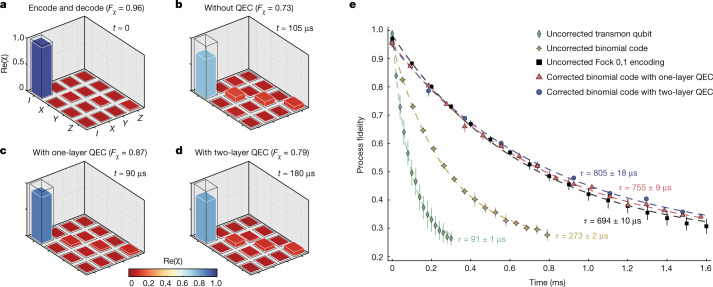
Quantum error correction (QEC) aims to protect logical qubits from noises by using the redundancy of a large Hilbert space, which allows errors to be detected and corrected in real time 1 . In most QEC codes 2–8 , a logical qubit is encoded in some discrete variables, for example photon numbers, so that the encoded quantum information can be unambiguously extracted after processing. Over the past decade, repetitive QEC has been demonstrated with various discrete-variable-encoded scenarios 9–17 . However, extending the lifetimes of thus-encoded logical qubits beyond the best available physical qubit still remains elusive, which represents a break-even point for judging the practical usefulness of QEC. Here we demonstrate a QEC procedure in a circuit quantum electrodynamics architecture 18 , where the logical qubit is binomially encoded in photon-number states of a microwave cavity 8 , dispersively coupled to an auxiliary superconducting qubit. By applying a pulse featuring a tailored frequency comb to the auxiliary qubit, we can repetitively extract the error syndrome with high fidelity and perform error correction with feedback control accordingly, thereby exceeding the break-even point by about 16% lifetime enhancement. Our work illustrates the potential of hardware-efficient discrete-variable encodings for fault-tolerant quantum computation 19 .
Overview
The claims and statistics of this paper haven’t been checked yet.
Free: it reads the open-access text and checks the first 5 claims that cite a source we can check. Create a free account to check every claim.
Integrity signals
Registry
Cites
Statistics
Figures


Verification
Claims the paper makes
The claims and statistics of this paper haven’t been checked yet.
Free: it reads the open-access text and checks the first 5 claims that cite a source we can check. Create a free account to check every claim.
Claims other papers make about this one
Each is checked against this paper’s own text: does it say what the citing paper says it does?
The cited source says what the claim attributes to it.
In the citing paper
“Our logical memory beyond breakeven extends previous results using bosonic codes16,35,36 to multiqubit codes, and it is a critical step towards logical operation breakeven.”
From Quantum error correction below the surface code threshold (2025) · cites this paper as [36]
The cited source says what the claim attributes to it.
In the citing paper
“Experiments demonstrating this exploitation at the single bosonic mode level have been performed using cat codes21–23,33–35, binominal codes36 and GKP codes37–39.”
From Hardware-efficient quantum error correction via concatenated bosonic qubits (2025) · cites this paper as [36]
The cited source says what the claim attributes to it.
In the citing paper
“Moreover, we have beaten the break-even point for QEC of quantum memories, a result few other experiments have accomplished22,28–30.”
From Quantum error correction of qudits beyond break-even (2025) · cites this paper as [29]
Self-check
Percentages, sums and reported differences re-computed from the paper’s own numbers.
The self-check needs the paper’s full text.
Citations
Cites
Scheme for reducing decoherence in quantum computer memory
Shor, P. W. (1995) · Physical Review A · doi:10.1103/physreva.52.r2493 · Cited by 4,479
Charge-insensitive qubit design derived from the Cooper pair box
Koch, J., Yu, T. M., Gambetta, J., Houck, A. A., Schuster, D. I., Majer, J., Blais, A., Devoret, M. H., Girvin, S. M., & Schoelkopf, R. J. (2007) · Physical Review A · doi:10.1103/physreva.76.042319 · Cited by 3,351
Error Correcting Codes in Quantum Theory
Steane, A. M. (1996) · Physical Review Letters · doi:10.1103/physrevlett.77.793 · Cited by 2,677
Good quantum error-correcting codes exist
Calderbank, A. R., & Shor, P. W. (1996) · Physical Review A · doi:10.1103/physreva.54.1098 · Cited by 2,516 · cited 1×
“(3) Quantum recovery operations are imperfect.”
Circuit quantum electrodynamics
Blais, A., Grimsmo, A. L., Girvin, S. M., & Wallraff, A. (2021) · Reviews of Modern Physics · doi:10.1103/revmodphys.93.025005 · Cited by 1,931
Khaneja, N., Reiss, T., Kehlet, C., Schulte-Herbrüggen, T., & Glaser, S. J. (2005) · Journal of Magnetic Resonance · doi:10.1016/j.jmr.2004.11.004 · Cited by 1,854 · cited 1×
“The cavity control pulses for encoding and decoding the bosonic logical qubit and implementing the recovery operations after each error detection are generated from numerical optimization with the gradient ascent pulse engineering (GRAPE) method [18].”
MethodQuantum error correction for quantum memories
Terhal, B. M. (2015) · Reviews of Modern Physics · doi:10.1103/revmodphys.87.307 · Cited by 1,354
Suppressing quantum errors by scaling a surface code logical qubit
Google Quantum, A. I., Acharya, R., Aleiner, I., Allen, R., Andersen, T. I., Ansmann, M., Arute, F., Arya, K., Asfaw, A., Atalaya, J., et al. (2023) · Nature · doi:10.1038/s41586-022-05434-1 · Cited by 1,103
Paik, H., Schuster, D. I., Bishop, L. S., Kirchmair, G., Catelani, G., Sears, A. P., Johnson, B. R., Reagor, M. J., Frunzio, L., Glazman, L. I., et al. (2011) · Physical Review Letters · doi:10.1103/physrevlett.107.240501 · Cited by 1,054
Extending the lifetime of a quantum bit with error correction in superconducting circuits
Ofek, N., Petrenko, A., Heeres, R., Reinhold, P., Leghtas, Z., Vlastakis, B., Liu, Y., Frunzio, L., Girvin, S. M., Jiang, L., et al. (2016) · Nature · doi:10.1038/nature18949 · Cited by 941
Research works printed but not linked: 1
- Nielsen, M. A. & Chuang, I. L. Quantum Computation and Quantum Information, 10th ed. (Cambridge Univ. Press, 2010).
Cited by
Quantum error correction below the surface code threshold
Collaborators, G. Q. A. A., Acharya, R., Abanin, D. A., Aghababaie-Beni, L., Aleiner, I., Andersen, T. I., Ansmann, M., Arute, F., Arya, K., Asfaw, A., et al. (2025) · Nature · doi:10.1038/s41586-024-08449-y · Cited by 778
“This equation allows us to establish a strict upper bound on Γ logical , since Simulations suggest [37, 38] that in the surface code p Y ∼ p X p Z is suppressed compared to p X and p Z , because Y errors predominantly occur as independent X and Z errors.”
Real-time quantum error correction beyond break-even
Sivak, V. V., Eickbusch, A., Royer, B., Singh, S., Tsioutsios, I., Ganjam, S., Miano, A., Brock, B. L., Ding, A. Z., Frunzio, L., et al. (2023) · Nature · doi:10.1038/s41586-023-05782-6 · Cited by 407
Hardware-efficient quantum error correction via concatenated bosonic qubits
Putterman, H., Noh, K., Hann, C. T., MacCabe, G. S., Aghaeimeibodi, S., Patel, R. N., Lee, M., Jones, W. M., Moradinejad, H., Rodriguez, R., et al. (2025) · Nature · doi:10.1038/s41586-025-08642-7 · Cited by 108
Advanced CMOS manufacturing of superconducting qubits on 300 mm wafers
Van Damme, J., Massar, S., Acharya, R., Ivanov, T., Perez Lozano, D., Canvel, Y., Demarets, M., Vangoidsenhoven, D., Hermans, Y., Lai, J. G., et al. (2024) · Nature · doi:10.1038/s41586-024-07941-9 · Cited by 63
“The substrate–air, metal–air and substrate–metal interface participation ratios were calculated for the four different capacitor geometries (width and gap in {13, 24, 48, 90} μm).”
MethodQuantum error correction of qudits beyond break-even
Brock, B. L., Singh, S., Eickbusch, A., Sivak, V. V., Ding, A. Z., Frunzio, L., Girvin, S. M., & Devoret, M. H. (2025) · Nature · doi:10.1038/s41586-025-08899-y · Cited by 64
Metadata
- Authors
- Ni, Z., Li, S., Deng, X., Cai, Y., Zhang, L., Wang, W., Yang, Z.-B., Yu, H., Yan, F., Liu, S., Zou, C.-L., Sun, L., Zheng, S.-B., Xu, Y., & Yu, D.
- Affiliations
- Southern University of Science and Technology (CN)
- Tsinghua University (CN)
- Fuzhou University (CN)
- Beijing Academy of Quantum Information Sciences (CN)
- University of Science and Technology of China (CN)
- Corresponding author
- Sun, Luyan
- Zheng, Shi-Biao
- Xu, Yuan
- Yu, Dapeng
- ORCID
- Venue
- Nature
- Published
- 2023-03-22
- Volume
- 616
- Issue
- 7955
- Pages
- 56-60
- ISSN
- 0028-0836 (ISSN-L)
- 1476-4687
- PMC
- PMC10076216
- OpenAlex
- W4353055568
- Semantic Scholar
- 193ff9ad61e8487911af7c8496381439a2b179e1
- Cited by
- 176
- References
- 46
- Citations by year
- 2026: 34 · 2025: 62 · 2024: 56 · 2023: 24
- FWCI
- 16.57
- Type
- journal article
- Language
- en
- Open access
- hybrid
- doi.org
- Licence
- cc-by
- creativecommons.org/licenses/by/4.0 (tdm)
- creativecommons.org/licenses/by/4.0 (vor)
- Locations
- Nature (publishedVersion, cc-by)
- PubMed Central (publishedVersion, cc-by)
- PubMed (publishedVersion)
- arXiv (Cornell University) (submittedVersion)
- RePEc: Research Papers in Economics (submittedVersion)
- arXiv (Cornell University)
- Funders
- National Natural Science Foundation of China (2019B121203002, 11875108, No. 11875108, 11925404, 12274080, 2016ZT06D348, 11890704, 12274198, No. 11890704, 11904158, 92165209, 12061131011, No. 12274080, U1801661, 92265210)
- China Postdoctoral Science Foundation (BX2021167)
- Science, Technology and Innovation Commission of Shenzhen Municipality (U1801661, Z190012, KYTDPT20181011104202253)
- National Key Research and Development Program of China (2017YFA0304303)
- Basic and Applied Basic Research Foundation of Guangdong Province (2022A1515010324, 2019B121203002)
- Topics
- Physical Sciences › Computer Science › Artificial Intelligence › Quantum Computing Algorithms and Architecture
- Physical Sciences › Physics and Astronomy › Atomic and Molecular Physics, and Optics › Quantum Information and Cryptography
- Physical Sciences › Physics and Astronomy › Atomic and Molecular Physics, and Optics › Quantum Mechanics and Applications
- Keywords
- quantum error correction, logical qubits, photon number states, microwave cavity, circuit quantum electrodynamics, frequency combs, feedback control, qubit lifetime, break-even point, fault-tolerant quantum computing, superconducting qubits
About these checks
Registry, retraction, Cites and statistics results are computed, not judged, with one exception: a printed reference that no index lists is read once by a model before it counts as a citation error. Claims are extracted by a model and kept only when their quote appears verbatim in the text; each cited source is then checked, with a model’s help, for whether it says what the claim relies on. Those verdicts can be wrong — read the claim’s quote and the cited source before relying on one.
Statistics and arithmetic are recomputed, not judged.
Confidence bands are shown only for fields calibrated on our annotated test set. None is calibrated yet, so no band is shown.
What counts as a claim ›How we measure confidence ›How we check this ›
Are you an author, or do you see a problem with this page? Request a review
How to cite
Cite CoChat for the checks on this page, and the paper for its own findings.
- This page
- CoChat. (2026). Citation check: Beating the break-even point with a discrete-variable-encoded logical qubit. https://app.cochat.ai/papers/10.1038/s41586-023-05784-4
- The paper
- Ni, Z., Li, S., Deng, X., Cai, Y., Zhang, L., Wang, W., Yang, Z.-B., Yu, H., Yan, F., Liu, S., Zou, C.-L., Sun, L., Zheng, S.-B., Xu, Y., & Yu, D. (2023). Beating the break-even point with a discrete-variable-encoded logical qubit. Nature. https://doi.org/10.1038/s41586-023-05784-4
Data sources
Bibliographic data: Semantic Scholar, OpenAlex, Crossref.
Contains information from the Semantic Scholar Academic Graph Datasets, made available under the ODC Attribution License (ODC-BY 1.0).
Semantic Scholar’s data is described in: Kinney, R., et al. (2023). The Semantic Scholar Open Data Platform. arXiv:2301.10140.
