

The DOI matches its Crossref record; 78 of the 88 references it cites were found in a registry or an index; 75 of the 87 sources its claims cite were checked for support.
Hardware-efficient quantum error correction via concatenated bosonic qubits
Open accessAbstract
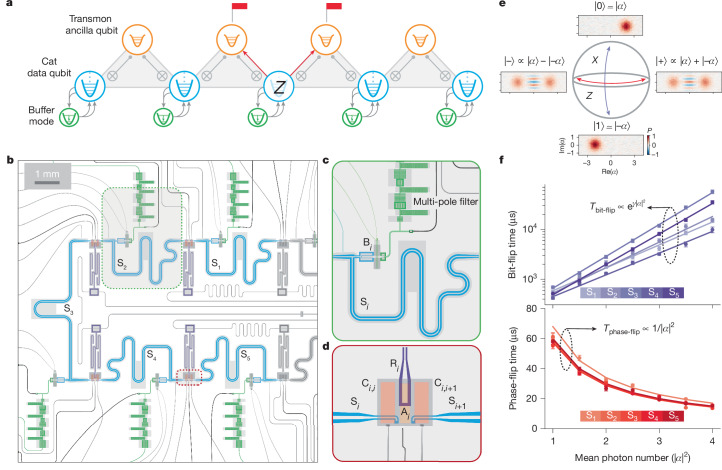
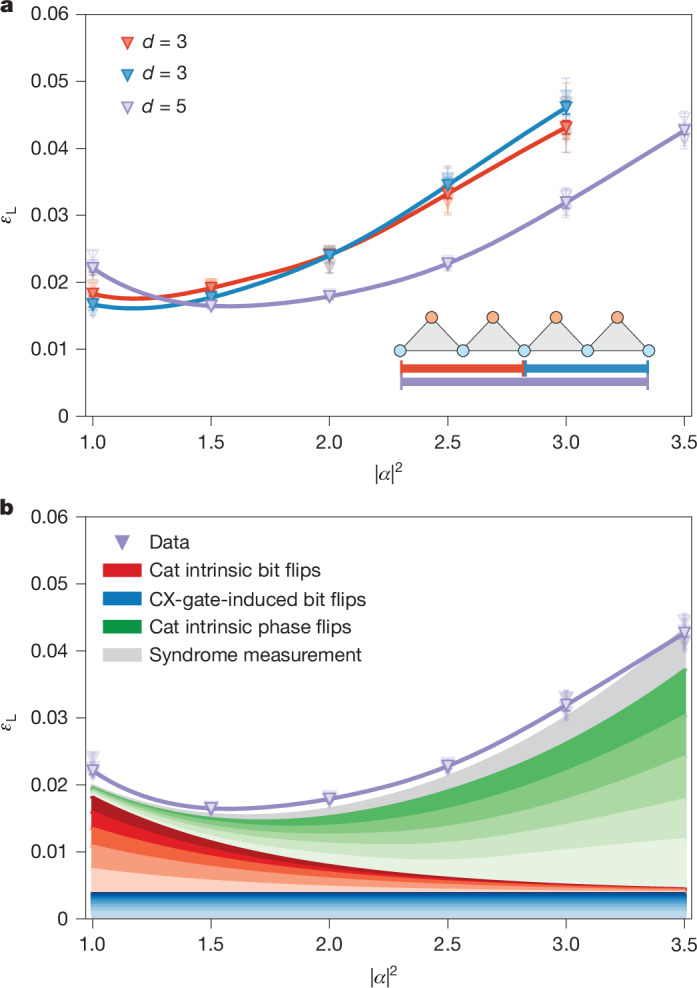
To solve problems of practical importance1,2, quantum computers probably need to incorporate quantum error correction, in which a logical qubit is redundantly encoded in many noisy physical qubits3–5. The large physical-qubit overhead associated with error correction motivates the search for more hardware-efficient approaches6–18. Here, using a superconducting quantum circuit19, we realize a logical qubit memory formed from the concatenation of encoded bosonic cat qubits with an outer repetition code of distance d = 5 (ref. 10). A stabilizing circuit passively protects cat qubits against bit flips20–24. The repetition code, using ancilla transmons for syndrome measurement, corrects cat qubit phase flips. We study the performance and scaling of the logical qubit memory, finding that the phase-flip correcting repetition code operates below the threshold. The logical bit-flip error is suppressed with increasing cat qubit mean photon number, enabled by our realization of a cat-transmon noise-biased CX gate. The minimum measured logical error per cycle is on average 1.75(2)% for the distance-3 code sections, and 1.65(3)% for the distance-5 code. Despite the increased number of fault locations of the distance-5 code, the high degree of noise bias preserved during error correction enables comparable performance. These results, where the intrinsic error suppression of the bosonic encodings enables us to use a hardware-efficient outer error-correcting code, indicate that concatenated bosonic codes can be a compelling model for reaching fault-tolerant quantum computation. Bosonic qubits can be engineered to feature intrinsic protection against certain kinds of errors, which makes quantum error correction across many bosonic qubits possible with less overhead.
Overview
CoChat Summary
TL;DR
This paper demonstrates a superconducting logical qubit memory built from concatenated bosonic cat qubits plus an outer distance-5 repetition code, using noise-biased CX gates for syndrome extraction. The best measured logical error per cycle is 1.65 ± 0.03% for the distance-5 section and 1.75 ± 0.02% on average for the distance-3 sections, showing hardware-efficient error correction with preserved noise bias.
Key findings
- The device consists of five bosonic storage modes and four ancilla transmons; the storage modes have average \(T_1 > 60\,\mu s\) and average \(T_2 > 80\,\mu s\).
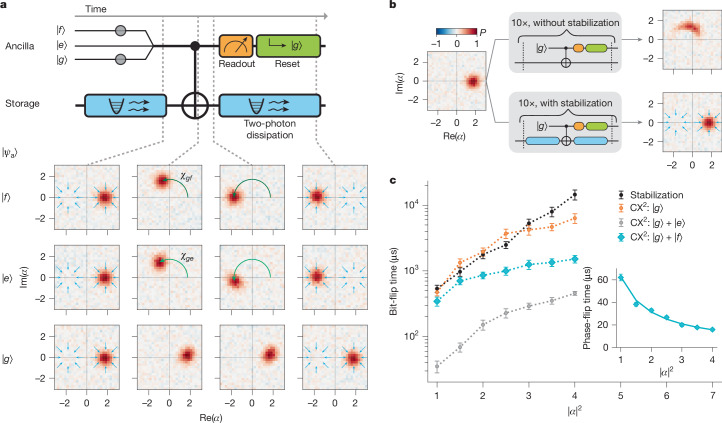
- At \(|\alpha|^2 = 2\), the cat qubits achieve greater than 1 ms bit-flip times and 27–33 \(\mu s\) phase-flip times, corresponding to a noise bias greater than 30.
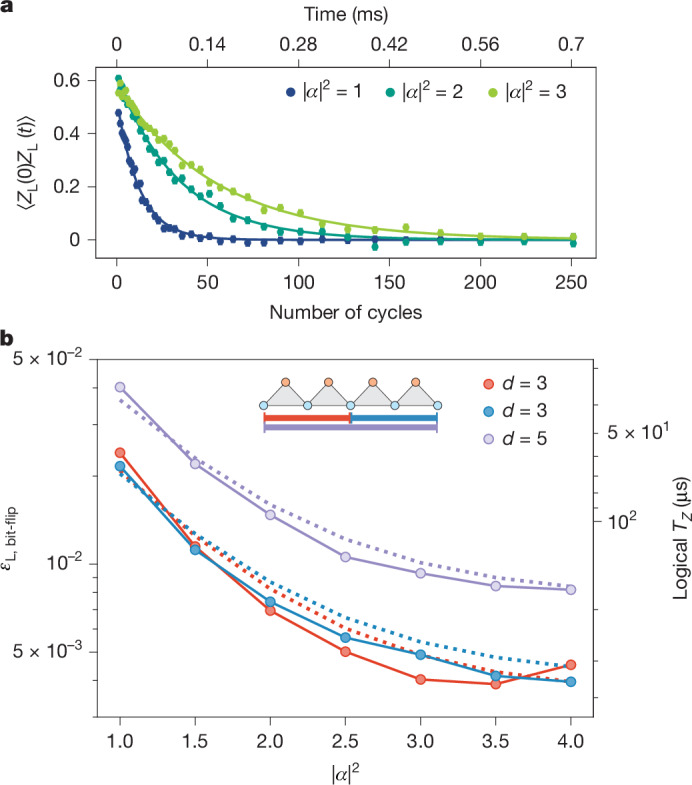
- The best-measured overall logical error per cycle for the distance-5 section is \(1.65 \pm 0.03\%\) at \(|\alpha|^2 = 1.5\); the distance-3 sections reach \(1.83 \pm 0.03\%\) and \(1.67 \pm 0.04\%\) at \(|\alpha|^2 = 1\), with average \(1.75 \pm 0.02\%\).
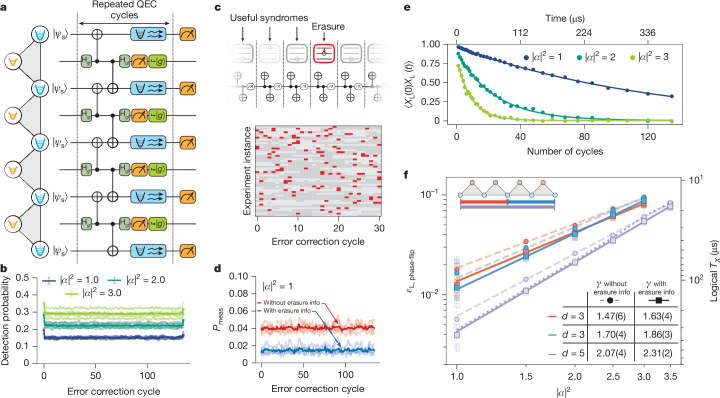
- With erasure information incorporated, the logical phase-flip rate is reduced by about 20% at \(|\alpha|^2 = 1.5\) for \(d=5\), and syndrome-measurement error probability is reduced by over a factor of two at \(|\alpha|^2 = 1\).
Methods
- Built a microfabricated superconducting circuit implementing a distance-5 repetition cat code: five cat-qubit data modes stabilized by two-photon dissipation and four transmon ancillas for stabilizer measurement.
- Used a noise-biased CX gate based on tunable dispersive coupling and \(\chi\)-matching, with ancilla states encoded as \(|0_a\rangle = |g\rangle\) and \(|1_a\rangle = |f\rangle\), to measure repetition-code syndromes.
- Quantified performance by repeated syndrome-extraction cycles, decoding with minimum-weight perfect matching, and extracting logical bit-flip and phase-flip rates from exponential fits to logical-operator decay.
Limitations
- The paper states that a repetition code of biased-noise qubits does not possess a proper asymptotic threshold because physical bit-flip errors are uncorrectable and set a lower bound on logical error.
- The logical performance is currently dominated by intrinsic cat bit-flip and phase-flip errors, and ancilla-induced bit-flip errors remain a concern, though not the present limiting factor.
- Evident from the text: the reported code is a logical memory demonstration rather than a full fault-tolerant computer, and several projected improvements are described as idealized or contingent on better coherence times and gate performance.
Model-written summary. Check it against the paper before relying on it.
Integrity signals
Registry
Cites
Statistics
Figures
Verification
Claims the paper makes
19 Valid · 3 Not valid · 1 Not checked · 69 Own results and interpretations
Some cited sources support this claim and some don’t — read each source’s verdict below.
In the paper
“A stabilizing circuit passively protects cat qubits against bit flips20–24.”
§ Hardware-efficient quantum error correction via concatenated bosonic qubits > Abstract
What the sources say
- Disputedcites [20] Mirrahimi, M. et al. Dynamically protected cat-qubits: a new paradigm for universal quantum computation. New J. Phys. 16, 045014 (2014). sourceExperimental — accuracy not yet measured
The Summary and conclusions says the driven dissipative process suppresses phase-flip errors, while single-photon decay produces bit-flip errors. It says protection against that decay requires continuously monitoring photon-number parity, rather than passive protection by the stabilizing process. (LLM, conf=0.88)
Checked by a reasoning model — may be wrong.
- Partly supportedcites [21] Leghtas, Z. et al. Confining the state of light to a quantum manifold by engineered two-photon loss. Science 347, 853–857 (2015). sourceExperimental — accuracy not yet measured
The main text (p. 1) says engineered two-photon loss confines the oscillator to a manifold of two opposite-phase states, supporting passive stabilization. It does not establish protection against bit flips: the same passage says the system cannot correct errors within that manifold, and single-photon loss causes decoherence there. (LLM, conf=0.87)
- Disputedcites [22] Touzard, S. et al. Coherent oscillations inside a quantum manifold stabilized by dissipation. Phys. Rev. X 8, 021005 (2018). sourceExperimental — accuracy not yet measured
Our copy of Touzard et al. (Phase-flips characterization, supp.) states the opposite polarity of protection: 'if the temperature of our system had been 0K, our manifold stabilization would have protected the encoding against phase-flips exponentially with the average number of photons.' On bit flips it says they are not removed by the stabilization but grow with cat size — single-photon jumps 'correspond to bit-flips within the encoding manifold which eventually destroy the coherence of the encoded qubit... at a rate 2nκ₁' (Abstract/main text), and 'Although encoding with a Schrödinger cat state of larger amplitude increases the bit-flip rate, given by 2nκ₁...' (Phase-flips characterization). The paper only notes that the gate operation 'is not affected by the dominant source of errors: bit-flips' and that remaining bit-flips 'can be corrected by fault-tolerant joint parity measurements' — i.e. active/corrected after the fact, not passively protected by the stabilizing circuit. So this source supports stabilization protecting against phase-flips, not bit flips. (LLM, conf=0.82)
Checked by a reasoning model — may be wrong.
- Supportedcites [23] Lescanne, R. et al. Exponential suppression of bit-flips in a qubit encoded in an oscillator. Nat. Phys. 16, 509–513 (2020). source
The paper reports that a Josephson circuit couples the cat-qubit mode to its environment and enabled an exponential decrease in bit-flip rate (p. 4). Its Fig. 1 description (p. 1) explains that the resulting dynamics stabilizes the cat-qubit states and suppresses bit flips, supporting the paraphrase of passive protection. (LLM, conf=0.93)
- Supportedcites [24] Putterman, H. et al. Preserving phase coherence and linearity in cat qubits with exponential bit-flip suppression. Preprint at https://arxiv.org/abs/2409.17556 (2024). source
The Introduction (p. 1) says that stabilizing the oscillator in the cat-qubit state manifold is necessary for exponential protection against bit-flip errors, and describes the engineered two-photon dissipation that provides that stabilization. The Introduction (p. 2) reports exponentially suppressed bit-flip rates in the resulting device. (LLM, conf=0.90)
plainstates a cause- Asserted: passes — The authors put it forward as true.
- Checkable: passes — It can be checked against evidence.
- Load-bearing: passes — The paper’s conclusions depend on it.
- Based: passes — The paper gives a reason why it holds.
- Disputed
Some cited sources support this claim and some don’t — read each source’s verdict below.
In the paper
“Some of these experiments are approaching26, or have surpassed28, the threshold at which scaling of the error-correcting code size leads to exponential improvements in the logical qubit error rate.”
§ Hardware-efficient quantum error correction via concatenated bosonic qubits > Main
What the sources say
- Disputedcites [26] Google Qunatum AI et al. Suppressing quantum errors by scaling a surface code logical qubit. Nature 614, 676–681 (2023). sourceExperimental — accuracy not yet measured
The citation is attached to “have surpassed” the threshold. In “Towards large-scale quantum error correction,” the paper instead says its device is close to threshold and estimates that component performance must improve by at least 20% to move below it. It describes the observed improvement with code size as a finite-size crossover, not the exponential suppression expected below threshold. (LLM, conf=0.88)
Checked by a reasoning model — may be wrong.
- Supportedcites [28] Google Quantum AI and Collaborators. Quantum error correction below the surface code threshold. Nature https://doi.org/10.1038/s41586-024-08449-y (2024). source
The Main section explains that below the critical threshold, increasing code distance suppresses logical error exponentially. The Outlook reports that this experiment demonstrated below-threshold surface-code memory, with logical error per cycle more than halved each time code distance increased by two. Page numbers are not supplied in our copy. (LLM, conf=0.94)
plainstates a cause- Asserted: passes — The authors put it forward as true.
- Checkable: passes — It can be checked against evidence.
- Load-bearing: unclear — It is unclear whether the paper’s conclusions depend on it.
- Based: passes — The paper gives a reason why it holds.
- Disputed
Some cited sources support this claim and some don’t — read each source’s verdict below.
In the paper
“This was proposed in ref. 10, but existing proposals for cat–cat CX gates are hampered by large control errors10,12,15.”
§ Hardware-efficient quantum error correction via concatenated bosonic qubits > Conclusion and outlook
What the sources say
- Disputedcites [10] Guillaud, J. & Mirrahimi, M. Repetition cat qubits for fault-tolerant quantum computation. Phys. Rev. X 9, 041053 (2019). sourceExperimental — accuracy not yet measured
Section VII (page unavailable) says pump fluctuations during the proposed cat–cat CNOT gate cause only small geometric-phase fluctuations and an effective phase-flip error. Section VI likewise says the gate's precision is not affected by imprecision in the rotation angle. The paper does not describe its proposal as hampered by large control errors; it makes the contrary point about robustness to these control fluctuations. (LLM, conf=0.85)
Checked by a reasoning model — may be wrong.
- Partly supportedcites [12] Guillaud, J. & Mirrahimi, M. Error rates and resource overheads of repetition cat qubits. Phys. Rev. A 103, 042413 (2021). sourceExperimental — accuracy not yet measured
Section II (p. 3) describes a cat-qubit CX proposal and phase-flip errors arising from finite adiabaticity, but says those errors can be reduced with a feed-forward Hamiltonian. It does not say that existing proposals are hampered by large control errors; Section B (p. 7) instead reports high-fidelity logical CNOT gates under its modeled errors. (LLM, conf=0.77)
- Partly supportedcites [15] Chamberland, C. et al. Building a fault-tolerant quantum computer using concatenated cat codes. PRX Quantum 3, 010329 (2022). sourceExperimental — accuracy not yet measured
The CNOT discussion (section B, page unavailable) says the proposed cat-qubit gate has residual nonadiabatic error, and Appendix D, §4 identifies the compensating Hamiltonian as a significant error source. These passages support the existence of gate errors, but they do not establish that existing proposals are hampered by large control errors, such as inaccuracies in applied controls. (LLM, conf=0.76)
plainstates a cause- Asserted: passes — The authors put it forward as true.
- Checkable: passes — It can be checked against evidence.
- Load-bearing: passes — The paper’s conclusions depend on it.
- Based: passes — The paper gives a reason why it holds.
- Disputed
The cited sources support only part of this claim — read each source’s verdict below.
In the paper
“Here, using a superconducting quantum circuit19, we realize a logical qubit memory formed from the concatenation of encoded bosonic cat qubits with an outer repetition code of distance d = 5 (ref. 10).”
§ Hardware-efficient quantum error correction via concatenated bosonic qubits > Abstract
What the sources say
- Supportedcites [19] Blais, A., Huang, R.-S., Wallraff, A., Girvin, S. M. & Schoelkopf, R. J. Cavity quantum electrodynamics for superconducting electrical circuits: An architecture for quantum computation. Phys. Rev. A 69, 062320 (2004). source
Citation 19 is attached to “superconducting quantum circuit,” not to the citing authors’ claim that they realized a distance-5 cat-qubit memory. Section III (p. 3) describes the source paper’s proposed superconducting-circuit architecture, supporting that identification. The memory realization is not attributed to this source. (LLM, conf=0.93)
- Partly supportedcites [10] Guillaud, J. & Mirrahimi, M. Repetition cat qubits for fault-tolerant quantum computation. Phys. Rev. X 9, 041053 (2019). sourceExperimental — accuracy not yet measured
Our copy of Guillaud & Mirrahimi (2019) clearly supplies the scheme the citation is offered for: Sec. III states 'In order to extend the protection to phase-flip errors, we propose to embed the cat qubits in a repetition code (Fig. 2)', with the code C1 defined by the n-1 stabilizers S_j = X_j X_{j+1} and phase-flip correcting capacity (n-1)/2, i.e. concatenation of bosonic cat qubits with an outer repetition code. However, the paper formulates this for a general length-n code and illustrates it with n = 3 (Fig. 7 caption); no passage of our copy specifies a distance d = 5 (searches: 'distance d = 5 / five data cat qubits', 'n = 5 repetition code logical qubit memory'), so that specific parameter sits with the citing experiment rather than with this source. Note also that this source is a theoretical proposal ('a promising candidate for a first demonstration'), not a realization in a superconducting circuit — but the citing sentence credits the realization to itself and to ref. 19, so that is not a mismatch here. (LLM, conf=0.75)
plain- Asserted: passes — The authors put it forward as true.
- Checkable: passes — It can be checked against evidence.
- Load-bearing: passes — The paper’s conclusions depend on it.
- Based: passes — The paper gives a reason why it holds.
- Supported
The cited sources support only part of this claim — read each source’s verdict below.
In the paper
“For quantum computers to solve problems in materials design, quantum chemistry and cryptography, in which known speed-ups relative to classical computations are attainable, currently proposed algorithms require trillions of qubit gate operations to be applied in an error-free manner1,2.”
§ Hardware-efficient quantum error correction via concatenated bosonic qubits > Main
What the sources say
- Partly supportedcites [1] Gidney, C. & Ekerå, M. How to factor 2048 bit RSA integers in 8 hours using 20 million noisy qubits. Quantum 5, 433 (2021). sourceExperimental — accuracy not yet measured
The opening passage and Section 1.1 give large circuit-cost estimates for cryptographic problems, and Section 3.1 describes error correction to manage gate errors. The paper does not extend those estimates to materials design or quantum chemistry, and its stated count for factoring a 2048-bit RSA integer is approximately 3 billion Toffoli gates, not trillions. It also models noisy operations rather than requiring physical gates to be error-free. (LLM, conf=0.86)
- Partly supportedcites [2] Dalzell, A. M. et al. Quantum algorithms: a survey of applications and end-to-end complexities. Preprint at https://arxiv.org/abs/2310.03011 (2023). sourceExperimental — accuracy not yet measured
The Molecule(s) & references table reports 10^12–10^14 T/Toffoli gates for some lithium-ion battery molecules, supporting trillion-scale estimates for some chemistry problems. But the Outlook estimates billions, not trillions, of Toffoli gates to break practical cryptosystems. The survey therefore does not support presenting trillions of operations as a requirement across all three areas. (LLM, conf=0.88)
plain- Asserted: passes — The authors put it forward as true.
- Checkable: passes — It can be checked against evidence.
- Load-bearing: passes — The paper’s conclusions depend on it.
- Based: passes — The paper gives a reason why it holds.
- Partly supported
55 more claims · 11 with their cited sources checked
Create a free account to see all 92 claims and every source verdict.
- Probably not a substantial claim. 9
- It may state two separate claims as one. 25
Citations
Cites
Scheme for reducing decoherence in quantum computer memory
Shor, P. W. (1995) · Physical Review A · doi:10.1103/physreva.52.r2493 · Cited by 4,479
Surface codes: Towards practical large-scale quantum computation
Fowler, A. G., Mariantoni, M., Martinis, J. M., & Cleland, A. N. (2012) · Physical Review A · doi:10.1103/physreva.86.032324 · Cited by 3,059 · cited 2×
“Prof. Zaki Leghtas.”
Blais, A., Huang, R.-S., Wallraff, A., Girvin, S. M., & Schoelkopf, R. J. (2004) · Physical Review A · doi:10.1103/physreva.69.062320 · Cited by 2,989
Dennis, E., Kitaev, A., Landahl, A., & Preskill, J. (2002) · Journal of Mathematical Physics · doi:10.1063/1.1499754 · Cited by 1,768
Self-citationEncoding a qubit in an oscillator
Gottesman, D., Kitaev, A., & Preskill, J. (2001) · Physical Review A · doi:10.1103/physreva.64.012310 · Cited by 1,532
Self-citationDennis, E., Kitaev, A., Landahl, A., & Preskill, J. (2001) · CERN Document Server (European Organization for Nuclear Research) · Cited by 1,485
Self-citationLogical quantum processor based on reconfigurable atom arrays
Bluvstein, D., Evered, S. J., Geim, A. A., Li, S. H., Zhou, H., Manovitz, T., Ebadi, S., Cain, M., Kalinowski, M., Hangleiter, D., et al. (2024) · Nature · doi:10.1038/s41586-023-06927-3 · Cited by 1,119 · cited 1×
“Referee #2 (Remarks to the Author) The authors report on a quantum logical memory experiment, realizing a distance-5 repetition code of bosonic cat qubits, on a superconducting circuit architecture.”
Suppressing quantum errors by scaling a surface code logical qubit
Google Quantum, A. I., Acharya, R., Aleiner, I., Allen, R., Andersen, T. I., Ansmann, M., Arute, F., Arya, K., Asfaw, A., Atalaya, J., et al. (2023) · Nature · doi:10.1038/s41586-022-05434-1 · Cited by 1,103 · cited 2×
“Referee #2 (Remarks to the Author) The authors report on a quantum logical memory experiment, realizing a distance-5 repetition code of bosonic cat qubits, on a superconducting circuit architecture.”
Extending the lifetime of a quantum bit with error correction in superconducting circuits
Ofek, N., Petrenko, A., Heeres, R., Reinhold, P., Leghtas, Z., Vlastakis, B., Liu, Y., Frunzio, L., Girvin, S. M., Jiang, L., et al. (2016) · Nature · doi:10.1038/nature18949 · Cited by 941
Self-citationResolving photon number states in a superconducting circuit
Schuster, D. I., Houck, A. A., Schreier, J. A., Wallraff, A., Gambetta, J. M., Blais, A., Frunzio, L., Majer, J., Johnson, B., Devoret, M. H., et al. (2007) · Nature · doi:10.1038/nature05461 · Cited by 850
Cited by
Scaling and logic in the colour code on a superconducting quantum processor
Lacroix, N., Bourassa, A., Heras, F. J. H., Zhang, L. M., Bausch, J., Senior, A. W., Edlich, T., Shutty, N., Sivak, V., Bengtsson, A., et al. (2025) · Nature · doi:10.1038/s41586-025-09061-4 · Cited by 51
Self-citationBeyond NISQ: The Megaquop Machine
Preskill, J. P. (2025) · ACM Transactions on Quantum Computing · doi:10.1145/3723153 · Cited by 150
Self-citationLiu, Y., Singh, S., Smith, K. C., Crane, E., Martyn, J. M., Eickbusch, A., Schuckert, A., Li, R. D., Sinanan-Singh, J., Soley, M. B., et al. (2025) · PRX Quantum · doi:10.1103/4rf7-9tfx · Cited by 169
Criticality-Enhanced Quantum Sensing with a Parametric Superconducting Resonator
Beaulieu, G., Minganti, F., Frasca, S., Scigliuzzo, M., Felicetti, S., Candia, R. D., & Scarlino, P. (2025) · PRX Quantum · doi:10.1103/prxquantum.6.020301 · Cited by 67
“This type of resonator plays a key role in superconducting quantum technology, such as in Josephson parametric amplifier [72] and cat qubits [71, 73, 74], both of which are build on systems nearly identical to the one considered here.”
LDPC-cat codes for low-overhead quantum computing in 2D
Ruiz, D., Guillaud, J., Leverrier, A., Mirrahimi, M., & Vuillot, C. (2025) · Nature Communications · doi:10.1038/s41467-025-56298-8 · Cited by 90
“Flip chip technology enables connections between corresponding qubits in the memory layer and the computing layer.”
Metadata
- Authors
- Putterman, H., Noh, K., Hann, C. T., MacCabe, G. S., Aghaeimeibodi, S., Patel, R. N., Lee, M., Jones, W. M., Moradinejad, H., Rodriguez, R., Mahuli, N., Rose, J., Owens, J. C., Levine, H., Rosenfeld, E., Reinhold, P., Moncelsi, L., Alcid, J. A., Alidoust, N., Arrangoiz-Arriola, P., Barnett, J., Bienias, P., Carson, H. A., Chen, C., Chen, L., Chinkezian, H., Chisholm, E. M., Chou, M.-H., Clerk, A., Clifford, A., Cosmic, R., Curiel, A. V., Davis, E., DeLorenzo, L., D’Ewart, J. M., Diky, A., D’Souza, N., Dumitrescu, P. T., Eisenmann, S., Elkhouly, E., Evenbly, G., Fang, M. T., Fang, Y., Fling, M. J., Fon, W., Garcia, G., Gorshkov, A. V., Grant, J. A., Gray, M. J., Grimberg, S., Grimsmo, A. L., Haim, A., Hand, J., He, Y., Hernandez, M., Hover, D., Hung, J. S. C., Hunt, M., Iverson, J., Jarrige, I., Jaskula, J.-C., Jiang, L., Kalaee, M., Karabalin, R., Karalekas, P. J., Keller, A. J., Khalajhedayati, A., Kubica, A., Lee, H., Leroux, C., Lieu, S., Ly, V., Madrigal, K. V., Marcaud, G., McCabe, G., Miles, C., Milsted, A., Minguzzi, J., Mishra, A., Mukherjee, B., Naghiloo, M., Oblepias, E., Ortuno, G., Pagdilao, J., Pancotti, N., Panduro, A., Paquette, J., Park, M., Peairs, G. A., Perello, D., Peterson, E. C., Ponte, S., Preskill, J., Qiao, J., Refael, G., Resnick, R., Retzker, A., Reyna, O. A., Runyan, M., Ryan, C. A., Sahmoud, A., Sanchez, E., Sanil, R., Sankar, K., Sato, Y., Scaffidi, T., Siavoshi, S., Sivarajah, P., Skogland, T., Su, C.-J., Swenson, L. J., Teo, S. M., Tomada, A., Torlai, G., Wollack, E. A., Ye, Y., Zerrudo, J. A., Zhang, K., Brandão, F. G. S. L., Matheny, M. H., & Painter, O.
- Affiliations
- Amazon (United States) (US)
- Google (United States) (US)
- University of Chicago (US)
- Yale University (US)
- California Institute of Technology (US)
- Hebrew University of Jerusalem (IL)
- University of California, Irvine (US)
- Corresponding author
- Putterman, Harald
- Painter, Oskar
- ORCID
- Putterman, Harald
- Noh, Kyungjoo
- Hann, Connor T.
- MacCabe, Gregory S.
- Aghaeimeibodi, Shahriar
- Patel, Rishi N.
- Lee, Menyoung
- Jones, William M.
- Moradinejad, Hesam
- Owens, John Clai
- Levine, Harry
- Rosenfeld, Emma
- Reinhold, Philip
- Moncelsi, Lorenzo
- Barnett, James
- Carson, Hugh A.
- Chen, Li
- Chou, Ming-Han
- Clerk, Aashish
- Davis, Erik
- Dumitrescu, Philipp T.
- Eisenmann, Shmuel
- Elkhouly, Essam
- Evenbly, Glen
- Fang, Yawen
- Gorshkov, Alexey V.
- Gray, Mason J.
- Grimberg, Sebastian
- Grimsmo, Arne L.
- Hover, David
- Hung, Jimmy S. C.
- Jarrige, Ignace
- Jaskula, Jean-Christophe
- Jiang, Liang
- Karalekas, Peter J.
- Keller, Andrew J.
- Khalajhedayati, Amirhossein
- Kubica, Aleksander
- Lee, Hanho
- Marcaud, Guillaume
- McCabe, Gavin
- Milsted, Ashley
- Mishra, Anurag
- Mukherjee, Biswaroop
- Naghiloo, Mahdi
- Pancotti, Nicola
- Park, Minje
- Peairs, Gregory A.
- Perello, David
- Preskill, John
- Qiao, Johnson
- Refael, Gil
- Retzker, Alex
- Ryan, Colm A.
- Sankar, Krishanu
- Scaffidi, Thomas
- Sivarajah, Prasahnt
- Teo, Stephanie M.
- Torlai, Giacomo
- Wollack, E. Alex
- Ye, Yufeng
- Zhang, Kailing
- Brandão, Fernando G. S. L.
- Matheny, Matthew H.
- Painter, Oskar
- Venue
- Nature
- Published
- 2025-02-26
- Volume
- 638
- Issue
- 8052
- Pages
- 927-934
- ISSN
- 0028-0836 (ISSN-L)
- 1476-4687
- PMC
- PMC11864976
- OpenAlex
- W4407957966
- Semantic Scholar
- 2c21ed9cd19e343be17c32dd39a3bf756f6c23e9
- Cited by
- 108
- References
- 88
- Citations by year
- 2026: 51 · 2025: 57
- FWCI
- 42.98
- Type
- journal article
- Language
- en
- Open access
- hybrid
- doi.org
- Licence
- cc-by-nc-nd
- creativecommons.org/licenses/by-nc-nd/4.0 (tdm)
- creativecommons.org/licenses/by-nc-nd/4.0 (vor)
- Locations
- Nature (publishedVersion, cc-by-nc-nd)
- PubMed Central (publishedVersion, cc-by-nc-nd)
- PubMed (publishedVersion)
- arXiv (Cornell University) (submittedVersion)
- RePEc: Research Papers in Economics (submittedVersion)
- arXiv (Cornell University)
- Funders
- California Institute of Technology
- Topics
- Physical Sciences › Computer Science › Artificial Intelligence › Quantum Computing Algorithms and Architecture
- Physical Sciences › Physics and Astronomy › Atomic and Molecular Physics, and Optics › Quantum Information and Cryptography
- Physical Sciences › Physics and Astronomy › Atomic and Molecular Physics, and Optics › Quantum Mechanics and Applications
- Keywords
- quantum error correction, cat qubits, repetition codes, superconducting qubits, transmon qubits, fault-tolerant quantum computing, hardware overhead
About these checks
Registry, retraction, Cites and statistics results are computed, not judged, with one exception: a printed reference that no index lists is read once by a model before it counts as a citation error. Claims are extracted by a model and kept only when their quote appears verbatim in the text; each cited source is then checked, with a model’s help, for whether it says what the claim relies on. Those verdicts can be wrong — read the claim’s quote and the cited source before relying on one.
The claim verdicts this report counts are experimental: their accuracy is not yet measured.
A language model drew the claims from the paper on 2026-09-30, under version 3 of the claim definition (model deepseek-v4.1-flash, prompt extract-v3).
A second model labelled each claim on 2026-09-30 (model jev-1.13-20260917, definition revision gold-guideline-v0.2).
Cited sources are checked with a language model’s help (gpt-6-sol and qwen3.8-omni-flash).
Statistics and arithmetic are recomputed, not judged.
Confidence bands are shown only for fields calibrated on our annotated test set. None is calibrated yet, so no band is shown.
What counts as a claim ›How we measure confidence ›How we check this ›
Are you an author, or do you see a problem with this page? Request a review
How to cite
Cite CoChat for the checks on this page, and the paper for its own findings.
- This page
- CoChat. (2026). Citation check: Hardware-efficient quantum error correction via concatenated bosonic qubits. https://app.cochat.ai/papers/10.1038/s41586-025-08642-7
- The paper
- Putterman, H., Noh, K., Hann, C. T., MacCabe, G. S., Aghaeimeibodi, S., Patel, R. N., Lee, M., Jones, W. M., Moradinejad, H., Rodriguez, R., Mahuli, N., Rose, J., Owens, J. C., Levine, H., Rosenfeld, E., Reinhold, P., Moncelsi, L., Alcid, J. A., Alidoust, N., . . . Painter, O. (2025). Hardware-efficient quantum error correction via concatenated bosonic qubits. Nature. https://doi.org/10.1038/s41586-025-08642-7
Data sources
Bibliographic data: Semantic Scholar, OpenAlex, Crossref.
Contains information from the Semantic Scholar Academic Graph Datasets, made available under the ODC Attribution License (ODC-BY 1.0).
Semantic Scholar’s data is described in: Kinney, R., et al. (2023). The Semantic Scholar Open Data Platform. arXiv:2301.10140.
