

Evidence for the utility of quantum computing before fault tolerance
Open accessThe DOI matches its Crossref record; 43 of the 43 references it cites were found in a registry or an index.
Abstract
Quantum computing promises to offer substantial speed-ups over its classical counterpart for certain problems. However, the greatest impediment to realizing its full potential is noise that is inherent to these systems. The widely accepted solution to this challenge is the implementation of fault-tolerant quantum circuits, which is out of reach for current processors. Here we report experiments on a noisy 127-qubit processor and demonstrate the measurement of accurate expectation values for circuit volumes at a scale beyond brute-force classical computation. We argue that this represents evidence for the utility of quantum computing in a pre-fault-tolerant era. These experimental results are enabled by advances in the coherence and calibration of a superconducting processor at this scale and the ability to characterize 1 and controllably manipulate noise across such a large device. We establish the accuracy of the measured expectation values by comparing them with the output of exactly verifiable circuits. In the regime of strong entanglement, the quantum computer provides correct results for which leading classical approximations such as pure-state-based 1D (matrix product states, MPS) and 2D (isometric tensor network states, isoTNS) tensor network methods 2,3 break down. These experiments demonstrate a foundational tool for the realization of near-term quantum applications 4,5 .
Overview
The claims and statistics of this paper haven’t been checked yet.
Free: it reads the open-access text and checks the first 5 claims that cite a source we can check. Create a free account to check every claim.
Integrity signals
Registry
Cites
Statistics
Figures
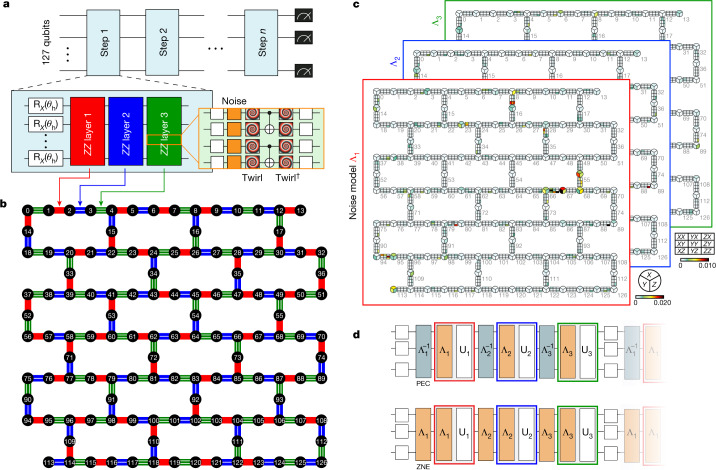
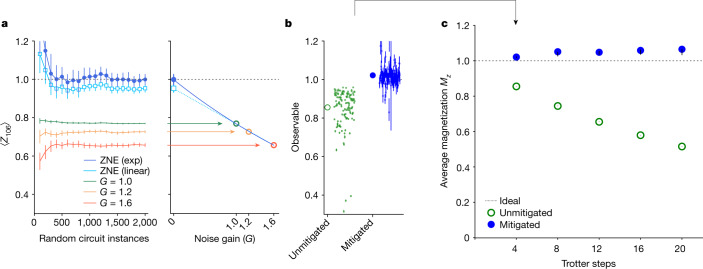
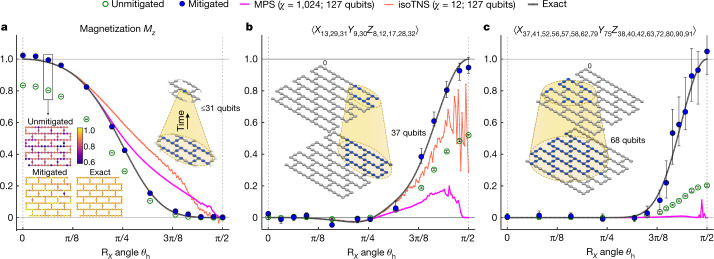
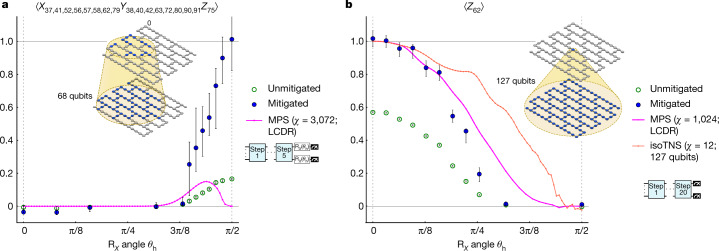
Verification
Claims the paper makes
The claims and statistics of this paper haven’t been checked yet.
Free: it reads the open-access text and checks the first 5 claims that cite a source we can check. Create a free account to check every claim.
Claims other papers make about this one
Each is checked against this paper’s own text: does it say what the citing paper says it does?
The cited source says what the claim attributes to it.
In the citing paper
“However, mobile qubit architectures, such as QCCD and optical tweezers24,25, can distribute resources more efficiently than stationary qubit architectures26–28, because qubits flow through the QPU like bits in a classical processor, with separated memory structures, data buses and logic units, each optimized for their purpose12.”
From A 98-qubit trapped-ion quantum computer with all-to-all connectivity (2026) · cites this paper as [26]
Self-check
Percentages, sums and reported differences re-computed from the paper’s own numbers.
The self-check needs the paper’s full text.
Citations
Cites
Quantum Computing in the NISQ era and beyond
Preskill, J. (2018) · Quantum · doi:10.22331/q-2018-08-06-79 · Cited by 8,830
Quantum supremacy using a programmable superconducting processor
Arute, F., Arya, K., Babbush, R., Bacon, D., Bardin, J. C., Barends, R., Biswas, R., Boixo, S., Brandao, F. G. S. L., Buell, D. A., et al. (2019) · Nature · doi:10.1038/s41586-019-1666-5 · Cited by 7,720
The density-matrix renormalization group in the age of matrix product states
Schollwöck, U. (2011) · Annals of Physics · doi:10.1016/j.aop.2010.09.012 · Cited by 4,818 · cited 2×
“Tensor networks have been widely used to approximate and compress quantum state vectors that arise in the study of the low-energy eigenstates of and time evolution by local Hamiltonians 2,32,33 and, more recently, have been successfully used to simulate low-depth noisy quantum circuits 34–36 .”
MethodCharge-insensitive qubit design derived from the Cooper pair box
Koch, J., Yu, T. M., Gambetta, J., Houck, A. A., Schuster, D. I., Majer, J., Blais, A., Devoret, M. H., Girvin, S. M., & Schoelkopf, R. J. (2007) · Physical Review A · doi:10.1103/physreva.76.042319 · Cited by 3,351 · cited 1×
“For the experimental implementation, we primarily used the IBM Eagle processor ibm_kyiv, composed of 127 fixed-frequency transmon qubits 15 with heavy-hex connectivity and median T 1 and T 2 times of 288 μs and 127 μs, respectively.”
MethodPurification of Noisy Entanglement and Faithful Teleportation via Noisy Channels
Bennett, C. H., Brassard, G., Popescu, S., Schumacher, B., Smolin, J. A., & Wootters, W. K. (1996) · Physical Review Letters · doi:10.1103/physrevlett.76.722 · Cited by 2,961 · cited 1×
“…restricting to jump operators acting on local pairs of qubits yields a sparse noise model that can be efficiently learned for many qubits and that accurately captures the noise associated with layers of two-qubit Clifford gates, including crosstalk, when combined with random Pauli twirls 23,24 .”
BackgroundNoisy intermediate-scale quantum algorithms
Bharti, K., Cervera-Lierta, A., Kyaw, T. H., Haug, T., Alperin-Lea, S., Anand, A., Degroote, M., Heimonen, H., Kottmann, J. S., Menke, T., et al. (2022) · Reviews of Modern Physics · doi:10.1103/revmodphys.94.015004 · Cited by 2,231
Improved simulation of stabilizer circuits
Aaronson, S., & Gottesman, D. (2004) · Physical Review A · doi:10.1103/physreva.70.052328 · Cited by 1,515 · cited 1×
“Clifford circuits serve as useful benchmarks of estimates produced by error mitigation, as they can be efficiently simulated classically 29 .”
BackgroundError Mitigation for Short-Depth Quantum Circuits
Temme, K., Bravyi, S., & Gambetta, J. M. (2017) · Physical Review Letters · doi:10.1103/physrevlett.119.180509 · Cited by 1,379 · cited 2×
“based on pulse stretching 9,17,18 or subcircuit repetition 20–22 have circum-vented the need for precise noise learning, while relying on simplistic assumptions about the device noise.”
BackgroundSelf-citationEvolution of entanglement entropy in one-dimensional systems
Calabrese, P., & Cardy, J. (2005) · Journal of Statistical Mechanics: Theory and Experiment · doi:10.1088/1742-5468/2005/04/p04010 · Cited by 1,295 · cited 1×
“As entanglement (bond dimension) of a generic state grows linearly (exponentially) with time evolution until it saturates the volume law, deep quantum circuits are inherently difficult for tensor networks 37 .”
BackgroundError mitigation extends the computational reach of a noisy quantum processor
Kandala, A., Temme, K., Córcoles, A. D., Mezzacapo, A., Chow, J. M., & Gambetta, J. M. (2019) · Nature · doi:10.1038/s41586-019-1040-7 · Cited by 871 · cited 2×
“based on pulse stretching 9,17,18 or subcircuit repetition 20–22 have circum-vented the need for precise noise learning, while relying on simplistic assumptions about the device noise.”
BackgroundSelf-citation
Research works printed but not linked: 5
- Shor, P. W. in Proc. 35th Annual Symposium on Foundations of Computer Science 124–134 (IEEE, 1994).
- Kitaev, A. Y. Quantum measurements and the Abelian Stabilizer Problem. Preprint at https://arxiv.org/abs/quant-ph/9511026 (1995). · arXiv
- Li Y Benjamin SC Efficient variational quantum simulator incorporating active error minimization Phys. Rev. X 2017 7 021050
- Endo S Benjamin SC Li Y Practical quantum error mitigation for near-future applications Phys. Rev. X 2018 8 031027
- Zhou Y Stoudenmire EM Waintal X What limits the simulation of quantum computers? Phys. Rev. X 2020 10 041038
Cited by
Logical quantum processor based on reconfigurable atom arrays
Bluvstein, D., Evered, S. J., Geim, A. A., Li, S. H., Zhou, H., Manovitz, T., Ebadi, S., Cain, M., Kalinowski, M., Hangleiter, D., et al. (2024) · Nature · doi:10.1038/s41586-023-06927-3 · Cited by 1,119
“Because in the two-copy measurements for each error-detection threshold we also measure the overall system purity, we can extrapolate our expectation values to the case of unit purity (zero noise) 54 .”
BackgroundCai, Z., Babbush, R., Benjamin, S. C., Endo, S., Huggins, W. J., Li, Y., McClean, J. R., & O’Brien, T. E. (2023) · Reviews of Modern Physics · doi:10.1103/revmodphys.95.045005 · Cited by 591
“However, while this will work well with depolarising gate noise, it may change the gate error model for more general gate noise such that the factor of increase in the error strength is no longer well-defined (Kim et al. , 2023b).”
BackgroundMethodInfluentialA tweezer array with 6,100 highly coherent atomic qubits
Manetsch, H. J., Nomura, G., Bataille, E., Lv, X., Leung, K. H., & Endres, M. (2025) · Nature · doi:10.1038/s41586-025-09641-4 · Cited by 491
“Our results, along with recent developments 8,22–24 , indicate that universal quantum computing and QEC with thousands to tens of thousands of physical qubits could be a near-term prospect.”
Does provable absence of barren plateaus imply classical simulability?
Cerezo, M., Larocca, M., García-Martín, D., Diaz, N. L., Braccia, P., Fontana, E., Rudolph, M. S., Bermejo, P., Ijaz, A., Thanasilp, S., et al. (2025) · Nature Communications · doi:10.1038/s41467-025-63099-6 · Cited by 110
“Forinstance,therecentworkof 171 studiedwhy certain quantum experiments 172 could be ef fi ciently simulated via tensor networks?.”
Chemistry beyond the scale of exact diagonalization on a quantum-centric supercomputer
Moreno, J. R., Motta, M., Haas, H., Javadi-Abhari, A., Jurcevic, P., Kirby, W., Martiel, S., Sharma, K., Sharma, S., Shirakawa, T., et al. (2025) · Science Advances · doi:10.1126/sciadv.adu9991 · Cited by 442
Quantum dynamics in Krylov space: Methods and applications
Nandy, P., Matsoukas-Roubeas, A. S., Martínez-Azcona, P., Dymarsky, A. Y., & del Campo, A. (2025) · Physics Reports · doi:10.1016/j.physrep.2025.05.001 · Cited by 345
IBM quantum computers: evolution, performance, and future directions
AbuGhanem, M. (2025) · The Journal of Supercomputing · doi:10.1007/s11227-025-07047-7 · Cited by 343
Farrell, R. C., Illa, M., Ciavarella, A. N., & Savage, M. J. (2024) · PRX Quantum · doi:10.1103/prxquantum.5.020315 · Cited by 286
Distributed quantum computing: A survey
Caleffi, M., Amoretti, M., Ferrari, D., Illiano, J., Manzalini, A., & Cacciapuoti, A. S. (2024) · Computer Networks · doi:10.1016/j.comnet.2024.110672 · Cited by 256
Tour de gross: A modular quantum computer based on bivariate bicycle codesPreprint
Yoder, T. J., Schoute, E., Rall, P., Pritchett, E., Gambetta, J., Cross, A. W., Carroll, M. S., & Beverland, M. E. (2025) · arXiv (Cornell University) · doi:10.48550/arxiv.2506.03094 · Cited by 254
Quantum simulations of hadron dynamics in the Schwinger model using 112 qubits
Farrell, R. C., Illa, M., Ciavarella, A. N., & Savage, M. J. (2024) · Physical review. D/Physical review. D. · doi:10.1103/physrevd.109.114510 · Cited by 247
Quantum Computing for High-Energy Physics: State of the Art and Challenges
Di Meglio, A., Jansen, K., Tavernelli, I., Alexandrou, C., Arunachalam, S., Bauer, C. W., Borras, K., Carrazza, S., Crippa, A., Croft, V., et al. (2024) · PRX Quantum · doi:10.1103/prxquantum.5.037001 · Cited by 215
Self-citationJavadi-Abhari, A., Treinish, M., Krsulich, K., Wood, C. J., Lishman, J., Gacon, J., Martiel, S., Nation, P. D., Bishop, L. S., Cross, A. W., et al. (2024) · arXiv (Cornell University) · doi:10.48550/arxiv.2405.08810 · Cited by 208
“For example, Qiskit was used in a recent paper that showed evidence of utility for quantum computers by using error mitigation [51].”
BackgroundMethodChallenges and opportunities in quantum optimization
Abbas, A., Ambainis, A., Augustino, B., Bärtschi, A., Buhrman, H., Coffrin, C., Cortiana, G., Dunjko, V., Egger, D. J., Elmegreen, B. G., et al. (2024) · Nature Reviews Physics · doi:10.1038/s42254-024-00770-9 · Cited by 201
“We have highlighted key problem classes in optimization, reviewed existing algorithms and suggested new research directions.”
Modern computing: Vision and challenges
Gill, S. S., Wu, H., Patros, P., Ottaviani, C., Arora, P., Pujol, V. C., Haunschild, D., Parlikad, A. K., Cetinkaya, O., Lutfiyya, H., et al. (2024) · Telematics and Informatics Reports · doi:10.1016/j.teler.2024.100116 · Cited by 197
“By studying the results of these computations, researchers can gain a deeper insight into the nature of our universe [143].”
BackgroundObservation of constructive interference at the edge of quantum ergodicity
Collaborators, G. Q. A. A., Abanin, D. A., Acharya, R., Beni, L. A., Aigeldinger, G., Ajoy, A., Alcaraz, R., Aleǐner, I. L., Andersen, T. I., Ansmann, M., et al. (2025) · Nature · doi:10.1038/s41586-025-09526-6 · Cited by 194
“As such, OTOCs are viable candidates for realizing practical quantum advantage, a chief milestone sought by recent experiments 36–38 .”
Alexeev, Y., Amsler, M., Barroca, M. A., Bassini, S., Battelle, T., Camps, D., Casanova, D., Choi, Y. J., Chong, F. T., Chung, C., et al. (2024) · Future Generation Computer Systems · doi:10.1016/j.future.2024.04.060 · Cited by 192
Benchmarking quantum computers
Proctor, T., Young, K., Baczewski, A. D., & Blume-Kohout, R. (2025) · Nature Reviews Physics · doi:10.1038/s42254-024-00796-z · Cited by 67
A site-resolved two-dimensional quantum simulator with hundreds of trapped ions
Guo, S., Wu, Y., Ye, J., Zhang, L., Lian, W., Yao, R., Wang, Y., Yan, R., Yi, Y.-J., Xu, Y., et al. (2024) · Nature · doi:10.1038/s41586-024-07459-0 · Cited by 181
“Actually, it is known that RF heating is not significant for ions in the crystal phase, and that it only becomes severe when the ions already acquire sufficient energy to melt into a cloud phase and when their motion becomes chaotic [10].”
InfluentialSelf-citationClassically Estimating Observables of Noiseless Quantum Circuits
Angrisani, A., Schmidhuber, A., Rudolph, M. S., Cerezo, M., Holmes, Z., & Huang, H.-Y. (2025) · Physical Review Letters · doi:10.1103/lh6x-7rc3 · Cited by 173
Liu, Y., Singh, S., Smith, K. C., Crane, E., Martyn, J. M., Eickbusch, A., Schuckert, A., Li, R. D., Sinanan-Singh, J., Soley, M. B., et al. (2026) · PRX Quantum · doi:10.1103/4rf7-9tfx · Cited by 171
Machine learning for practical quantum error mitigation
Liao, H., Wang, D. S., Sitdikov, I., Salcedo, C., Seif, A., & Minev, Z. (2024) · Nature Machine Intelligence · doi:10.1038/s42256-024-00927-2 · Cited by 167
“QEM is paving the way to near-term quantum utility and a path to outperform classical supercomputers [2, 9].”
InfluentialCombining quantum processors with real-time classical communication
Vazquez, A. C., Tornow, C., Ristè, D., Woerner, S., Takita, M., & Egger, D. J. (2024) · Nature · doi:10.1038/s41586-024-08178-2 · Cited by 157
“Current quantum hardware is noisy, can only store information for a short time and is limited to a few quantum bits, that is, qubits, typically arranged in a planar connectivity 1 .”
Pauli Propagation: A Computational Framework for Simulating Quantum Systems
Rudolph, M. S., Jones, T., Teng, Y., Angrisani, A., & Holmes, Z. (2026) · PRX Quantum · doi:10.1103/6vd7-l9bn · Cited by 156
“…individual Pauli string evolution make it particularly valuable in verifying and benchmarking current quantum simulations and experimental measurements of operator dynamics across various platforms, such as superconducting qubits [67, 68], trapped ion systems [69], and Rydberg atom arrays [70].”
Quantum many-body simulations on digital quantum computers: State-of-the-art and future challenges
Fauseweh, B. (2024) · Nature Communications · doi:10.1038/s41467-024-46402-9 · Cited by 152
“Recently advanced error mitigation techniques 161 were used to push the boundaries of system sizes into the regime of 100 qubits to simulate the time evolution of a 2D transverse fi eld Ising model.”
Efficient Tensor Network Simulation of IBM’s Eagle Kicked Ising Experiment
Tindall, J., Fishman, M., Stoudenmire, E. M., & Sels, D. (2024) · PRX Quantum · doi:10.1103/prxquantum.5.010308 · Cited by 152
“The dynamics of this model was recently simulated on the IBM Eagle quantum processor [10], which corresponds to a lattice of 6 × 3 heavy-hexagons plus two additional qubits.”
BackgroundMethodInfluentialQuantum Computing: Navigating the Future of Computation, Challenges, and Technological Breakthroughs
Memon, Q. A., Ahmad, M. A., & PECHT, M. G. (2024) · Quantum Reports · doi:10.3390/quantum6040039 · Cited by 157
Beyond NISQ: The Megaquop Machine
Preskill, J. P. (2025) · ACM Transactions on Quantum Computing · doi:10.1145/3723153 · Cited by 151
“Or maybe the logical error rate could be somewhat larger, as we expect to be able to boost the simulable circuit volume using various error mitigation techniques in the megaquop era just as we do in the NISQ era [17].”
Quantum-Centric Algorithm for Sample-Based Krylov DiagonalizationPreprint
Yu, J., Moreno, J. R., Iosue, J. T., Bertels, L. W., Claudino, D., Fuller, B., Groszkowski, P., Humble, T. S., Jurcevic, P., Kirby, W., et al. (2025) · arXiv (Cornell University) · doi:10.48550/arxiv.2501.09702 · Cited by 151
“A key advantage of this approach is that convergence is guaranteed when the initial state has polynomial overlap with the ground state, and it relies on simulating quantum dynamics using circuits that can be executed at sizes beyond the reach of exact classical meth-ods [20, 21].”
A Polynomial-Time Classical Algorithm for Noisy Quantum Circuits
Schuster, T., Yin, C., Gao, X., & Yao, N. Y. (2025) · Physical Review X · doi:10.1103/xct1-7kf2 · Cited by 153
Lie-algebraic classical simulations for quantum computing
Goh, M. L., Larocca, M., Cincio, Ł., Cerezo, M., & Sauvage, F. (2025) · Physical Review Research · doi:10.1103/3y65-f5w6 · Cited by 147
“As the size of experimentally demonstrated quantum systems is starting to exceed what can be simulated classically, it is of great importance to rely on faithful classical computational results [6], even if they are restricted to special types of quantum evolutions, input states, and observables.”
Mind the gaps: The fraught road to quantum advantagePreprint
Eisert, J., & Preskill, J. P. (2025) · arXiv (Cornell University) · doi:10.48550/arxiv.2510.19928 · Cited by 144
“Entangling gates exploit collective vibrational modes of the ions and typically require tens of microseconds.”
Beyond-classical computation in quantum simulation
King, A. D., Nocera, A., Rams, M. M., Dziarmaga, J., Wiersema, R., Bernoudy, W., Raymond, J., Kaushal, N., Heinsdorf, N., Harris, R., et al. (2025) · Science · doi:10.1126/science.ado6285 · Cited by 138
Gujju, Y., Matsuo, A., & Raymond, R. (2024) · Physical Review Applied · doi:10.1103/physrevapplied.21.067001 · Cited by 140
Drug design on quantum computers
(2024) · doi:10.1038/s41567-024-02411-5 · Cited by 132
Scalable, High-Fidelity All-Electronic Control of Trapped-Ion Qubits
Löschnauer, C., Toba, J. M., Hughes, A. C., King, S. A., Weber, M., Srinivas, R., Matt, R., Nourshargh, R., Allcock, D. T. C., Ballance, C. J., et al. (2025) · PRX Quantum · doi:10.1103/h4wk-v31j · Cited by 134
Krylov diagonalization of large many-body Hamiltonians on a quantum processor
Yoshioka, N., Amico, M., Kirby, W., Jurcevic, P., Dutt, A., Fuller, B., Garion, S., Haas, H., Hamamura, I., Ivrii, A., et al. (2025) · Nature Communications · doi:10.1038/s41467-025-59716-z · Cited by 133
“Since each distinct two-qubit layer requires its own noise learning for probabilistic error ampli fi cation (PEA — see below), it is advantageous to minimize the number of distinct layers in the circuits.”
InfluentialDemonstration of low-overhead quantum error correction codes
Wang, K., Lu, Z., Zhang, C., Liu, G., Chen, J., Wang, Y., Wu, Y., Xu, S., Zhu, X., Jin, F., et al. (2026) · Nature Physics · doi:10.1038/s41567-025-03157-4 · Cited by 124
Self-citationClassical surrogate simulation of quantum systems with LOWESAPreprint
Rudolph, M. S., Fontana, E., Holmes, Z., & Cincio, Ł. (2023) · arXiv (Cornell University) · doi:10.48550/arxiv.2308.09109 · Cited by 129
“[21] and [38], we do not feel confident that finer details in the full landscape can be trusted.”
InfluentialHyyppä, E., Vepsäläinen, A. P., Papič, M., Chan, C. F., Inel, S., Landra, A., Liu, W., Luus, J., Marxer, F., Ockeloen-Korppi, C. F., et al. (2024) · PRX Quantum · doi:10.1103/prxquantum.5.030353 · Cited by 125
“We also demonstrate that non-Markovian coherent errors arising from microwave pulse distortions contribute to the gate error of sub-10-ns single-qubit gates.”
Digital quantum magnetism on a trapped-ion quantum computer
Haghshenas, R., Chertkov, E., Mills, M. J., Kadow, W., Lin, S.-H., Chen, Y., Cade, C., Niesen, I., Begušić, T., Rudolph, M. S., et al. (2026) · Nature · doi:10.1038/s41586-026-10445-3 · Cited by 122
“Other recent works targeting quantum advantage via Ising model dynamics have worked in the limit of strong Floquet heating [23] (with all local observables converging quickly to infinite-temperature values) or employed analog quantum simulations with native (non-programmable) interactions [22].”
InfluentialAn elementary review on basic principles and developments of qubits for quantum computing
Chae, E., Choi, J., & Kim, J. (2024) · Nano Convergence · doi:10.1186/s40580-024-00418-5 · Cited by 120
“While this remains an open question, IBM has recently published a paper on solving the Schrödinger equation for the celebrated quantum Ising model using a 127-qubit quantum computer [123].”
BackgroundMethodTensor networks for quantum computing
Berezutskii, A. V., Liu, M., Acharya, A., Ellerbrock, R., Gray, J., Haghshenas, R., He, Z., Khan, A., Kuzmin, V., Lyakh, D. I., et al. (2025) · Nature Reviews Physics · doi:10.1038/s42254-025-00853-1 · Cited by 124
“A good example is how quantum circuits are used to simulate many-body physics, such as the experiment on the dynamics of a kicked Ising model 78 .”
InfluentialZimborás, Z., Koczor, B., Holmes, Z., Borrelli, E.-M., Gilyén, A., Huang, H.-Y., Cai, Z., Acín, A., Aolita, L., Banchi, L., et al. (2025) · arXiv (Cornell University) · doi:10.48550/arxiv.2501.05694 · Cited by 119
Towards near-term quantum simulation of materials
Clinton, L., Cubitt, T. S., Flynn, B., Gambetta, F. M., Klassen, J., Montanaro, A., Piddock, S., Santos, R. A., & Sheridan, E. (2024) · Nature Communications · doi:10.1038/s41467-023-43479-6 · Cited by 118
“Furthermore, IBM has run accurate Hamiltonian simulation experiments involving approximately 3000 two-qubit gates 69 .”
Quantum computing of fluid dynamics using the hydrodynamic Schrödinger equation
Meng, Z., & Yang, Y. (2023) · Physical Review Research · doi:10.1103/physrevresearch.5.033182 · Cited by 113
Observation of Josephson harmonics in tunnel junctions
Willsch, D., Rieger, D., Winkel, P., Willsch, M., Dickel, C., Krause, J., Ando, Y., Lescanne, R., Leghtas, Z., Bronn, N. T., et al. (2024) · Nature Physics · doi:10.1038/s41567-024-02400-8 · Cited by 115
“With the advancement 12–14 of superconducting artificial atom technology, the measurement and understanding of subtle features in the Josephson effect, similar to the fine structure discovered in natural atoms, is increasingly relevant in setting the accuracy of both circuit control and circuit…”
BackgroundRealization of High-Fidelity CZ Gate Based on a Double-Transmon Coupler
Li, R., Kubo, K., Ho, Y., Yan, Z., Nakamura, Y., & Goto, H. (2024) · Physical Review X · doi:10.1103/physrevx.14.041050 · Cited by 113
“…devices [1] and pioneering the era of fault-tolerant quantum computing [2], the blooming of qubit technologies, including superconducting qubits [3–5], trapped ions [6, 7], neutral atoms [8, 9], photonics [10] and other solid-state qubits [11–13], have made substantial strides toward the exciting…”
BackgroundNon-Abelian braiding of Fibonacci anyons with a superconducting processor
Xu, S., Sun, Z.-Z., Wang, K., Li, H., Zhu, Z., Dong, H., Deng, J., Zhang, X., Chen, J., Wu, Y., et al. (2024) · Nature Physics · doi:10.1038/s41567-024-02529-6 · Cited by 113
“In recent years, notable advances have been achieved towards the fabrication of programmable quantum platforms such as superconducting circuits 22–25 , Rydberg atomic arrays 26 , photons 27,28 and trapped ions 29,30 , giving rise to unprecedented opportunities in the synthesis and exploration of…”
Self-citationQML-IDS: Quantum Machine Learning Intrusion Detection System
Abreu, D. M. D., Rothenberg, C. E., & Abelém, A. (2024) · IEEE Symposium on Computers and Communications (ISCC) · doi:10.1109/iscc61673.2024.10733655 · Cited by 114
“Recent advances in quantum computing signify a main shift towards the era of quantum utility, highlighting a crucial phase in the evolution of quantum technologies where quantum computers now outperform classical methods in solving complex problems efficiently and accurately [1].”
BackgroundIntegrating quantum computing resources into scientific HPC ecosystems
Beck, T. L., Baroni, A., Bennink, R. S., Buchs, G., Pérez, E. A. C., Eisenbach, M., da Silva, R. F., Meena, M. G., Gottiparthi, K., Groszkowski, P., et al. (2024) · Future Generation Computer Systems · doi:10.1016/j.future.2024.06.058 · Cited by 110
“While advanced methods for error correction and noise mitigation are currently under active development [3], it is clear that maintaining the delicate coherent state of the many-qubit system is a major scientific and technological challenge [4, 5, 6, 7].”
BackgroundMolecular nanomagnets: a viable path toward quantum information processing?
Chiesa, A., Santini, P. M., Garlatti, E., Luis, F., & Carretta, S. (2024) · Reports on Progress in Physics · doi:10.1088/1361-6633/ad1f81 · Cited by 106
Scalable tensor-network error mitigation for near-term quantum computingPreprint
Filippov, S., Leahy, M., Rossi, M. A. C., & García-Pérez, G. (2023) · arXiv (Cornell University) · doi:10.48550/arxiv.2307.11740 · Cited by 106
Tunable Inductive Coupler for High-Fidelity Gates Between Fluxonium Qubits
Zhang, H., Ding, C., Weiss, D., Huang, Z., Ma, Y., Guinn, C. R., Sussman, S., Chitta, S. P., Chen, D., Houck, A., et al. (2024) · PRX Quantum · doi:10.1103/prxquantum.5.020326 · Cited by 105
“Superconducting circuits are a promising platform for the development of scalable, error-corrected quantum computation, heralded by many recent advances towards large scale quantum processors [1, 2] and continued improvements on performances of qubits and gate operations [3–5].”
BackgroundEarly Fault-Tolerant Quantum Computing
Katabarwa, A., Gratsea, K., Caesura, A., & Johnson, P. D. (2024) · PRX Quantum · doi:10.1103/prxquantum.5.020101 · Cited by 103
“The recent work of [125] provides evidence for the utility of noisy quantum devices in the pre-fault tolerant era and emphasizes the role of hardware advances to achieve this.”
BackgroundBenchmarking a trapped-ion quantum computer with 30 qubits
Chen, J.-S., Nielsen, E., Ebert, M., Inlek, V., Wright, K., Chaplin, V., Maksymov, A., Páez, E., Poudel, A., Maunz, P., et al. (2024) · Quantum · doi:10.22331/q-2024-11-07-1516 · Cited by 103
Dynamics of disordered quantum systems with two- and three-dimensional tensor networks
Tindall, J., Mello, A. F., Fishman, M., Stoudenmire, E. M., & Sels, D. (2026) · Science · doi:10.1126/science.adx2728 · Cited by 101
“Accurately simulating the dynamics of many-body quantum systems in two and three dimensions is one of the grand challenges of physics research.”
Neural-network quantum states for many-body physics
Medvidović, M., & Moreno, J. R. (2024) · The European Physical Journal Plus · doi:10.1140/epjp/s13360-024-05311-y · Cited by 103
“[30, 163] employ a deep feed-forward convolutional neural network (CNN) to explore the transverse-field Ising model whose dynamics has recently been shown to be accessible in Rydberg atom experiments [164–166] and superconducting quantum devices [167].”
Simulating Noisy Variational Quantum Algorithms: A Polynomial Approach
Shao, Y., Wei, F., Cheng, S., & Liu, Z. (2024) · Physical Review Letters · doi:10.1103/physrevlett.133.120603 · Cited by 102
“In this section, we validate the efficiency of OBPPP method in practical applications by performing a classical simulation of IBM’s 127-qubit Eagle processor [47].”
BackgroundMethodInfluentialHybrid Oscillator-Qubit Quantum Processors: Simulating Fermions, Bosons, and Gauge Fields
Crane, E., Smith, K. C., Tomesh, T., Eickbusch, A., Martyn, J. M., Kühn, S., Funcke, L., DeMarco, M. A., Chuang, I. L., Wiebe, N., et al. (2026) · Physical Review X · doi:10.1103/s5bn-z4jq · Cited by 100
Simulating Quantum Circuits with Arbitrary Local Noise Using Pauli Propagation
Angrisani, A., Mele, A. A., Rudolph, M. S., Cerezo, M., & Holmes, Z. (2026) · PRX Quantum · doi:10.1103/fb28-wlv2 · Cited by 100
Coherent control of a superconducting qubit using light
Warner, H., Holzgrafe, J., Yankelevich, B., Barton, D. R., Poletto, S., Xin, C. J., Sinclair, N. E., Zhu, D., Sete, E. A., Langley, B., et al. (2025) · Nature Physics · doi:10.1038/s41567-025-02812-0 · Cited by 99
“Superconducting (SC) qubits and SC quantum circuits have emerged as one of the most promising quantum computing (QC) platforms and have been used to demonstrate processing advantages over classical supercomputers, even in the presence of system noise 1,2 .”
Practical and efficient quantum circuit synthesis and transpiling with Reinforcement LearningPreprint
Kremer, D., Villar, V., Paik, H., Duran, I., Faro, I., & Cruz-Benito, J. (2024) · arXiv (Cornell University) · doi:10.48550/arxiv.2405.13196 · Cited by 100
“In 2023, IBM has demonstrated that with 127-qubit Eagle processor and error mitigation techniques, we can execute quantum circuits outside the reach of classical exact computing methods – the beginning of quantum utility [1].”
MethodPhotonic Source of Heralded Greenberger-Horne-Zeilinger States
Cao, H., Hansen, L. M., Giorgino, F., Carosini, L., Zahálka, P., Zilk, F., Loredo, J. C., & Walther, P. J. (2024) · Physical Review Letters · doi:10.1103/physrevlett.132.130604 · Cited by 96
Quantum Cloud Computing: A Review, Open Problems, and Future DirectionsPreprint
Nguyen, H. T., Krishnan, P., Krishnaswamy, D., Usman, M., & Buyya, R. (2024) · arXiv (Cornell University) · doi:10.48550/arxiv.2404.11420 · Cited by 97
“…with their 127-qubit superconducting processor, showcasing accurate expectation values measurement beyond classical computation capabilities, highlighting advancements in coherence, calibration, and noise management as critical enablers for pre-fault-tolerant quantum computing applications [93].”
BackgroundGauging tensor networks with belief propagation
Tindall, J., & Fishman, M. (2023) · SciPost Physics · doi:10.21468/scipostphys.15.6.222 · Cited by 96
“We should also point out a wide range of different serial schedules have also been proposed in the BP literature with various advantages and disadvantages [ 172, 175–177 ] — comparing these to each other and our custom schedule in the context of tensor network gauging is a topic of future research.”
BackgroundNoise-induced shallow circuits and the absence of barren plateaus
Mele, A. A., Angrisani, A., Ghosh, S., Khatri, S., Eisert, J., França, D. S., & Quek, Y. (2026) · Nature Physics · doi:10.1038/s41567-026-03245-z · Cited by 98
“Recent years have seen a tussle between demonstrations of quantum advantage 3,6,8–10 and subsequent efficient classical simulation 11–20 .”
Ganjam, S., Wang, Y., Lu, Y., Banerjee, A., Lei, C. U., Krayzman, L., Kisslinger, K., Zhou, C., Li, R., Jia, Y., et al. (2024) · Nature Communications · doi:10.1038/s41467-024-47857-6 · Cited by 93
Nishimori transition across the error threshold for constant-depth quantum circuits
Chen, E. H., Zhu, G., Verresen, R., Seif, A., Bäumer, E., Layden, D., Tantivasadakarn, N., Zhu, G., Sheldon, S., Vishwanath, A., et al. (2024) · Nature Physics · doi:10.1038/s41567-024-02696-6 · Cited by 97
“51.”
Self-citationStabilizer Tensor Networks: Universal Quantum Simulator on a Basis of Stabilizer States
Masot-Llima, S., & García-Sáez, A. (2024) · Physical Review Letters · doi:10.1103/physrevlett.133.230601 · Cited by 94
LDPC-cat codes for low-overhead quantum computing in 2D
Ruiz, D., Guillaud, J., Leverrier, A., Mirrahimi, M., & Vuillot, C. (2025) · Nature Communications · doi:10.1038/s41467-025-56298-8 · Cited by 91
“Current processors, constrained by quantum decoherence to error rates around 10 − 3 − 10 − 4 even for the best among them [11–13], cannot reliably execute these algorithms.”
Begušić, T., Gray, J., & Chan, G. K.-L. (2024) · Science Advances · doi:10.1126/sciadv.adk4321 · Cited by 89
“A recent quantum experiment of this kind simulated the kicked Ising model on IBM’s 127-qubit processor (8).”
InfluentialAssessing the Benefits and Risks of Quantum ComputersPreprint
Scholten, T. L., Williams, C. J., Moody, D., Mosca, M., Hurley, W. L., Zeng, W. J., Troyer, M., & Gambetta, J. (2024) · arXiv · doi:10.48550/arxiv.2401.16317 · Cited by 90
Beyond Bits: A Review of Quantum Embedding Techniques for Efficient Information Processing
Khan, M. A., Aman, M. N., & Sikdar, B. (2024) · IEEE Access · doi:10.1109/access.2024.3382150 · Cited by 89
Scalable quantum simulations of scattering in scalar field theory on 120 qubits
Zemlevskiy, N. A. (2025) · Physical review. D/Physical review. D. · doi:10.1103/qr72-51v1 · Cited by 90
“Error mitigation is vital for the successful extraction of observables from noisy quantum simulations [9].”
BackgroundMethodNation, P. D., Saki, A. A., Brandhofer, S., Bello, L., Garion, S., Treinish, M., & Javadi-Abhari, A. (2025) · Nature Computational Science · doi:10.1038/s43588-025-00792-y · Cited by 90
Effective quantum volume, fidelity and computational cost of noisy quantum processing experiments
Kechedzhi, K., Isakov, S. V., Mandrà, S., Villalonga, B., Mi, X., Boixo, S., & Smelyanskiy, V. (2024) · Future Generation Computer Systems · doi:10.1016/j.future.2023.12.002 · Cited by 42
Real-Time Operator Evolution in Two and Three Dimensions via Sparse Pauli Dynamics
Begušić, T., & Chan, G. K. (2025) · PRX Quantum · doi:10.1103/prxquantum.6.020302 · Cited by 84
“[24].”
Applying quantum approximate optimization to the heterogeneous vehicle routing problem
Fitzek, D., Ghandriz, T., Laine, L., Granath, M., & Kockum, A. F. (2024) · Scientific Reports · doi:10.1038/s41598-024-76967-w · Cited by 80
The Quantum Optimization Benchmarking Library
Koch, T., Neira, D. E. B., Chen, Y., Cortiana, G., Egger, D. J., Heese, R., Hegade, N. N., Cadavid, A. G., Huang, R. S., Itoko, T., et al. (2026) · Nature Computational Science · doi:10.1038/s43588-026-00991-1 · Cited by 82
“With recent advances in quantum hardware 4 , systematic benchmarking of quantum optimization algorithms and comparison with classical solvers have become feasible.”
A Perspective on Protein Structure Prediction Using Quantum Computers
Doğa, H., Raubenolt, B. A., Cumbo, F., Joshi, J., DiFilippo, F. P., Qin, J., Blankenberg, D. J., & Shehab, O. (2024) · Journal of Chemical Theory and Computation · doi:10.1021/acs.jctc.4c00067 · Cited by 81
“It is a small 7-10 amino acid loop that is highly conserved in many RNA helicases of the same family, including those found in coronaviruses [26].”
Superconducting Qubits above 20 GHz Operating over 200 mK
Anferov, A., Harvey, S. P., Wan, F., Simon, J., & Schuster, D. (2024) · PRX Quantum · doi:10.1103/prxquantum.5.030347 · Cited by 79
“…for microwave quantum interconnects [5, 6], provide new opportunities for direct integration with superconducting digital logic [7–9], and help manage the heat load from expanding numbers of qubit control lines [10] as super-conducting quantum processors [11–13] expand beyond hundreds of qubits.”
BackgroundSuperconducting microwave cavities and qubits for quantum information systems
Krasnok, A., Dhakal, P., Fedorov, A., Frigola, P., Kelly, M., & Kutsaev, S. (2024) · Applied Physics Reviews · doi:10.1063/5.0155213 · Cited by 79
Dynamical simulations of many-body quantum chaos on a quantum computer
Fischer, L. E., Leahy, M., Eddins, A., Keenan, N., Ferracin, D., Rossi, M. A. C., Kim, Y., He, A., Pietracaprina, F., Sokolov, B., et al. (2026) · Nature Physics · doi:10.1038/s41567-025-03144-9 · Cited by 80
“This marks a substantial improvement over the 𝒪𝒪 (10 Hz) rates reported in previous experiments 27 .”
InfluentialSelf-citationAll-optical superconducting qubit readout
Arnold, G., Werner, T., Sahu, R., Kapoor, L. N., Qiu, L., & Fink, J. M. (2025) · Nature Physics · doi:10.1038/s41567-024-02741-4 · Cited by 78
“Currently, the most powerful quantum processors utilize more than 100 qubits requiring hundreds of high-bandwidth coaxial cables with appropriate signal conditioning 9 , that is, attenuation and careful thermalization on the input as well as isolation and low noise amplification on the output (Fig.”
Programmable simulations of molecules and materials with reconfigurable quantum processors
Maskara, N., Ostermann, S., Shee, J., Kalinowski, M., Gomez, A. M., Bravo, R. A., Wang, D. S., Krylov, A. I., Yao, N. Y., Head‐Gordon, M., et al. (2025) · Nature Physics · doi:10.1038/s41567-024-02738-z · Cited by 78
“In particular, experiments have probed non-equilibrium quantum dynamics 32–34 , exotic forms of emergent magnetism 35–38 and long-range entangled topological matter 39–41 in regimes that push the limits of state-of-the-art classical simulations 42 .”
Data-driven decoding of quantum error correcting codes using graph neural networks
Lange, M., Havström, P., Srivastava, B., Bengtsson, I., Bergentall, V., Hammar, K., Heuts, O., van Nieuwenburg, E., & Granath, M. (2025) · Physical Review Research · doi:10.1103/physrevresearch.7.023181 · Cited by 76
“Unlike noise mitigation schemes where errors are reduced by classical post-processing [6–8], QEC methods encode quantum information in a way that allows for the detection and correction of errors without destroying the information itself.”
Hamiltonian simulation for hyperbolic partial differential equations by scalable quantum circuits
Sato, Y., Kondo, R., Hamamura, I., Onodera, T., & Yamamoto, N. (2024) · Physical Review Research · doi:10.1103/physrevresearch.6.033246 · Cited by 77
“The targeted Hamiltonians are, for example, Ising Hamiltonians [23, 24] and molecular Hamiltonians [25].”
BackgroundMethodSimulating quantum circuit expectation values by Clifford perturbation theory
Begušić, T., Hejazi, K., & Chan, G. K. (2025) · The Journal of Chemical Physics · doi:10.1063/5.0269149 · Cited by 76
Practical Quantum Advantage on Partially Fault-Tolerant Quantum Computer
Toshio, R., Akahoshi, Y., Fujisaki, J., Oshima, H., Sato, S., & Fujii, K. (2025) · Physical Review X · doi:10.1103/physrevx.15.021057 · Cited by 76
Benchmarking Digital Quantum Simulations Above Hundreds of Qubits Using Quantum Critical Dynamics
Miessen, A., Egger, D. J., Tavernelli, I., & Mazzola, G. (2024) · PRX Quantum · doi:10.1103/prxquantum.5.040320 · Cited by 75
“In introducing this benchmark, we report some of the largest-scale digital quantum simulations as of today [14, 102–104].”
Best Practices for Quantum Error Mitigation with Digital Zero-Noise Extrapolation
Majumdar, R., Rivero, P., Metz, F., Hasan, A., & Wang, D. S. (2023) · IEEE International Conference on Quantum Computing and Engineering (QCE) · doi:10.1109/qce57702.2023.00102 · Cited by 74
“In this work, we focus on the insertion of identities due to the simplicity of implementation, although quasi-probability-based approaches are possible as well [7, 8].”
MethodMeasurement-based long-range entangling gates in constant depth
Bäumer, E., & Woerner, S. (2025) · Physical Review Research · doi:10.1103/physrevresearch.7.023120 · Cited by 72
“As quantum computers are scaling up and we are entering the era of quantum utility [1], the depth of quantum circuits that entangle all qubits naturally increases.”
Probabilistic error cancellation for dynamic quantum circuits
Gupta, R. S., van den Berg, E., Takita, M., Ristè, D., Temme, K., & Kandala, A. (2024) · Physical Review A · doi:10.1103/physreva.109.062617 · Cited by 70
Self-citationQuantum computing and chemistry
Weidman, J. D., Sajjan, M., Mikolas, C. A., Stewart, Z. J., Pollanen, J., Kais, S., & Wilson, A. K. (2024) · Cell Reports Physical Science · doi:10.1016/j.xcrp.2024.102105 · Cited by 71
Grand Challenge of Quantum Applications
Babbush, R., King, R., Boixo, S., Huggins, W. J., Khattar, T., Low, G. H., McClean, J. R., O’Brien, T. E., & Rubin, N. C. (2026) · PRX Quantum · doi:10.1103/6r9l-lynr · Cited by 73
“Notable claims were made by IBM [87] and D-Wave [88] in 2024 but then challenged by several groups shortly thereafter using relatively standard methods [89–93].”
Optimal Partitioning of Quantum Circuits Using Gate Cuts and Wire Cuts
Brandhofer, S., Polian, I., & Krsulich, K. (2023) · IEEE Transactions on Quantum Engineering · doi:10.1109/tqe.2023.3347106 · Cited by 70
“Recent works in quantum error mitigation have demonstrated a significant impact on the errors incurred during the execution of quantum computations [36], [37], [38].”
BackgroundQuantum Error Mitigated Classical Shadows
Jnane, H., Steinberg, J., Cai, Z., Nguyen, H. C., & Koczor, B. (2024) · PRX Quantum · doi:10.1103/prxquantum.5.010324 · Cited by 70
“Of course, in reality magnifying the error rates precisely is rather involved but has been successfully demonstrated in even large-scale experiments [40].”
BackgroundMethodInfluentialEfficient Quantum-Enhanced Classical Simulation for Patches of Quantum Landscapes
Lerch, S., Puig, R., Rudolph, M. S., Angrisani, A., Jones, T., Cerezo, M., Thanasilp, S., & Holmes, Z. (2026) · PRX Quantum · doi:10.1103/fhc5-8sm6 · Cited by 69
Fermionic wave packet scattering: a quantum computing approach
Chai, Y., Crippa, A., Jansen, K., Kühn, S., Pascuzzi, V. R., Tacchino, F., & Tavernelli, I. (2025) · Quantum · doi:10.22331/q-2025-02-19-1638 · Cited by 68
“In order to mitigate the effects of hardware noise, we employed probabilistic error amplification (PEA) [60] with zero-noise extrapolation [46, 61].”
Metadata
- Authors
- Kim, Y., Eddins, A., Anand, S., Wei, K. X., van den Berg, E., Rosenblatt, S., Nayfeh, H., Wu, Y., Zaletel, M., Temme, K., & Kandala, A.
- Affiliations
- IBM Research - Cambridge (United States) (US)
- University of California, Berkeley (US)
- IBM (United States) (US)
- RIKEN (JP)
- Lawrence Berkeley National Laboratory (US)
- Corresponding author
- Eddins, Andrew
- Kandala, Abhinav
- ORCID
- Venue
- Nature
- Published
- 2023-06-14
- Volume
- 618
- Issue
- 7965
- Pages
- 500-505
- ISSN
- 0028-0836 (ISSN-L)
- 1476-4687
- PMC
- PMC10266970
- OpenAlex
- W4380627387
- Semantic Scholar
- f9253a3e2627f1c2a0a7e2cea320a4ec4e4d2ff9
- Cited by
- 1,050
- References
- 41
- Citations by year
- 2026: 226 · 2025: 399 · 2024: 358 · 2023: 67
- FWCI
- 98.85
- Type
- journal article
- Language
- en
- Open access
- hybrid
- doi.org
- Licence
- cc-by
- creativecommons.org/licenses/by/4.0 (tdm)
- creativecommons.org/licenses/by/4.0 (vor)
- Locations
- Nature (publishedVersion, cc-by)
- PubMed Central (publishedVersion, cc-by)
- PubMed (publishedVersion)
- eScholarship (California Digital Library) (submittedVersion, cc-by)
- OSTI OAI (U.S. Department of Energy Office of Scientific and Technical Information) (submittedVersion)
- RePEc: Research Papers in Economics (submittedVersion)
- Funders
- National Science Foundation (DEAC02-05CH11231, 2137603, 2138259, 2138296, 2138307, 2138286)
- U.S. Department of Energy (-AC02-05CH11231, 05CH11231, DE AC02 05CH11231, DESC0022716, DE-AC02-)
- National Energy Research Scientific Computing Center (DE–AC02–05CH11231, 05CH11231, AC02-05CH11231)
- Office of Science (DEAC02–05CH11231, AC02-05CH11231, DE-AC02)
- Office of Advanced Cyberinfrastructure (#2138286, #2138296, 2138259, #2138307, 2137603)
- Basic Energy Sciences (DE-AC02, DE-AC02-05CH11231., AC02–05CH11231)
- Lawrence Berkeley National Laboratory (AC02‐05CH11231, DE-AC02-05CH11231, 05CH11231)
- Topics
- Physical Sciences › Computer Science › Artificial Intelligence › Quantum Computing Algorithms and Architecture
- Physical Sciences › Physics and Astronomy › Atomic and Molecular Physics, and Optics › Quantum Information and Cryptography
- Physical Sciences › Physics and Astronomy › Atomic and Molecular Physics, and Optics › Quantum many-body systems
- Keywords
- quantum computing, NISQ devices, superconducting qubits, noise characterization, tensor network states, matrix product states, entanglement, quantum advantage
About these checks
Registry, retraction, Cites and statistics results are computed, not judged, with one exception: a printed reference that no index lists is read once by a model before it counts as a citation error. Claims are extracted by a model and kept only when their quote appears verbatim in the text; each cited source is then checked, with a model’s help, for whether it says what the claim relies on. Those verdicts can be wrong — read the claim’s quote and the cited source before relying on one.
Statistics and arithmetic are recomputed, not judged.
Confidence bands are shown only for fields calibrated on our annotated test set. None is calibrated yet, so no band is shown.
What counts as a claim ›How we measure confidence ›How we check this ›
Are you an author, or do you see a problem with this page? Request a review
Data sources
Bibliographic data: Semantic Scholar, OpenAlex, Crossref.
Contains information from the Semantic Scholar Academic Graph Datasets, made available under the ODC Attribution License (ODC-BY 1.0).
Semantic Scholar’s data is described in: Kinney, R., et al. (2023). The Semantic Scholar Open Data Platform. arXiv:2301.10140.
