

Gap junctions desynchronize a neural circuit to stabilize insect flight
Open accessThe DOI matches its Crossref record; 66 of the 66 references it cites were found in a registry or an index.
Abstract
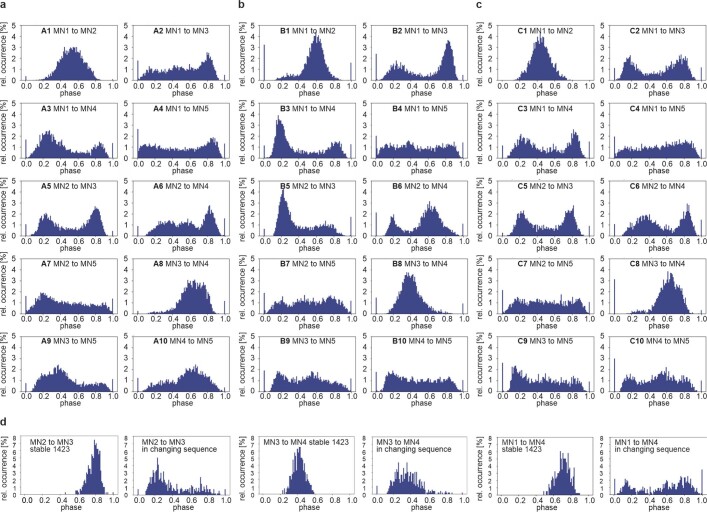
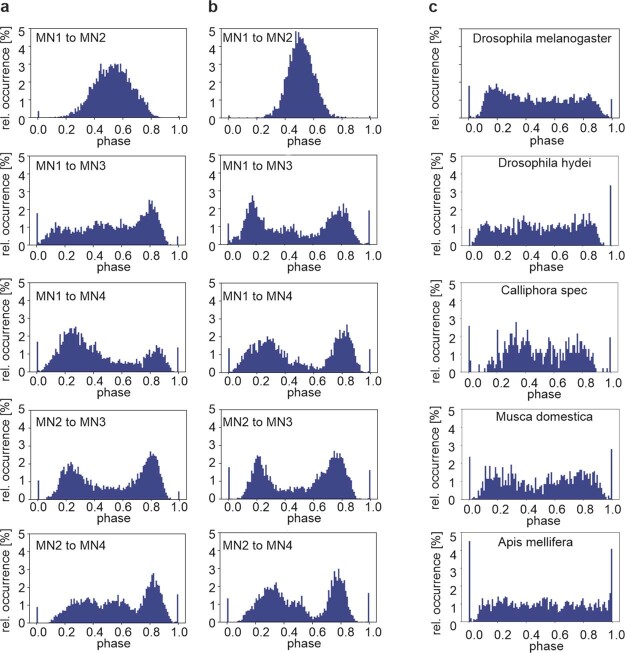
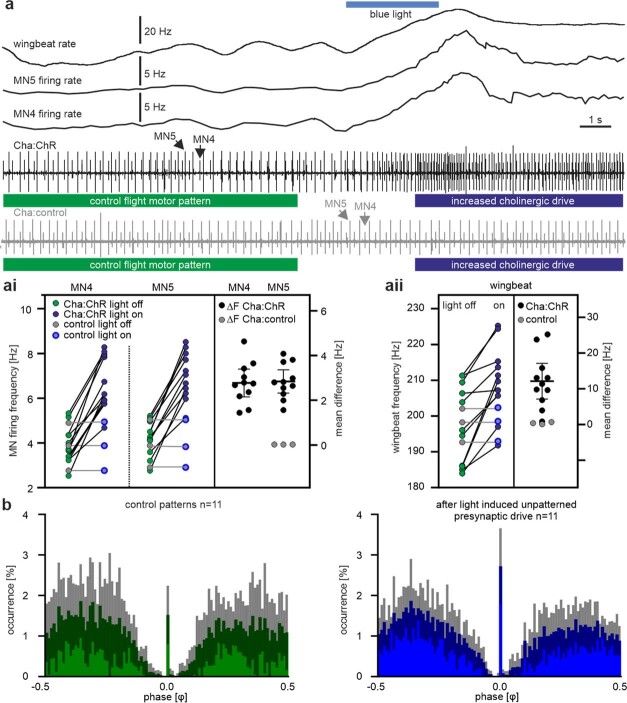
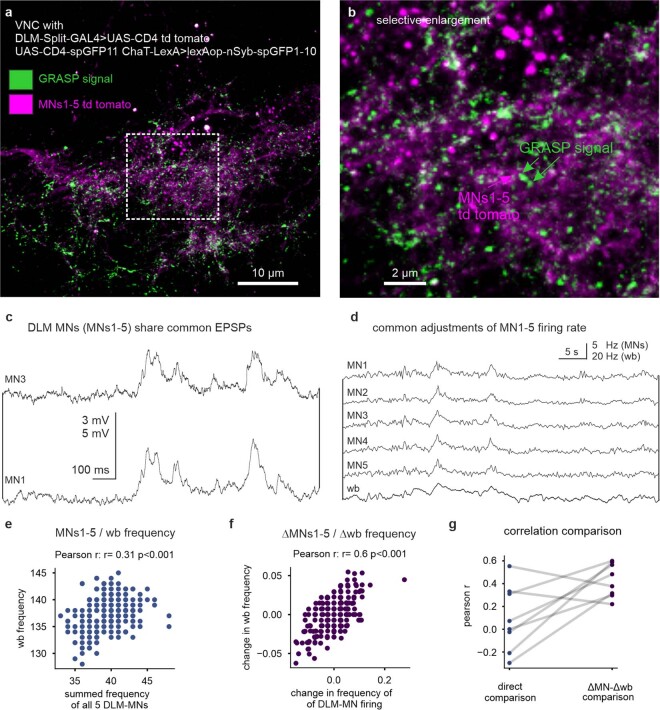
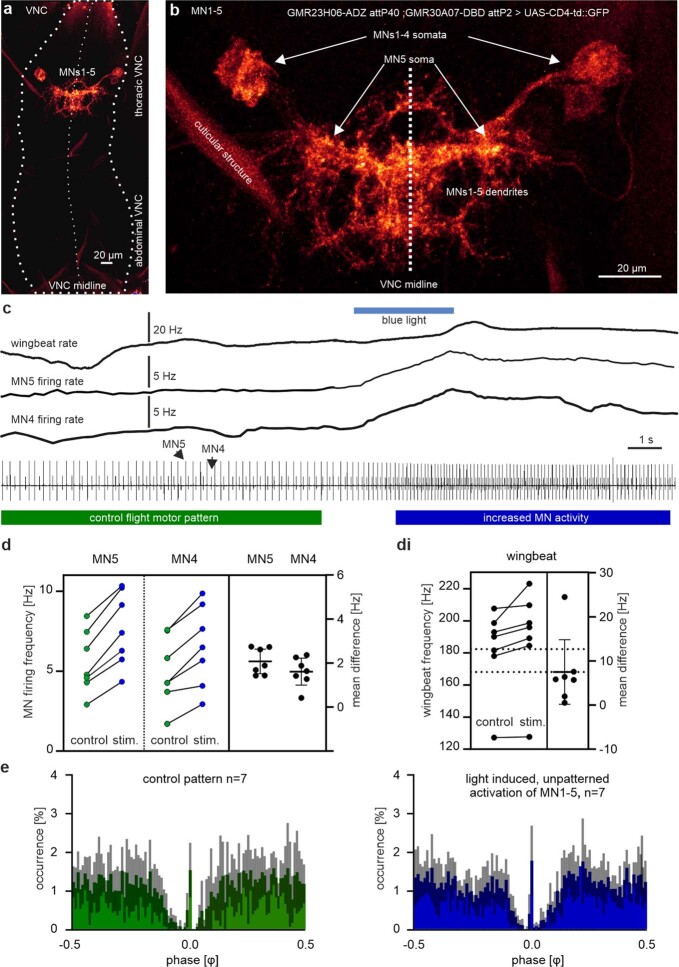
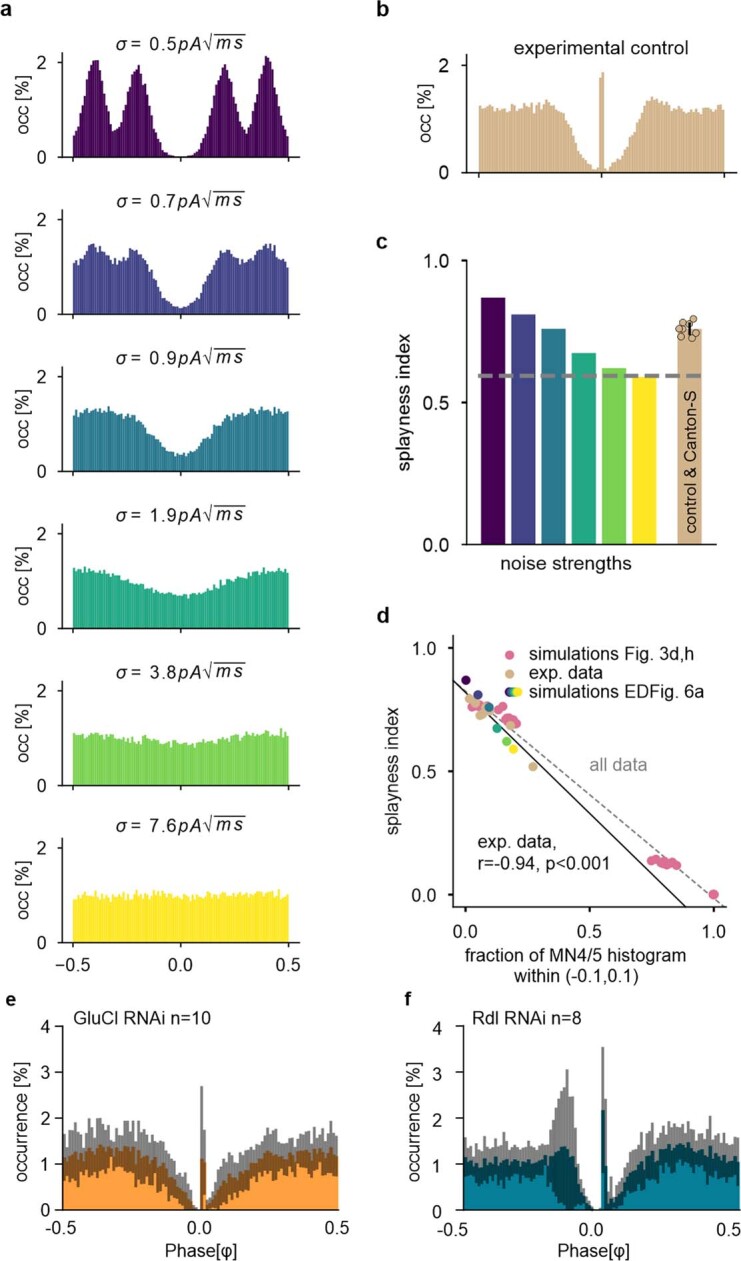
, the architecture and function of the central-pattern-generating (CPG) neural network remain unclear. Here, on the basis of an experiment-theory approach including electrophysiology, optophysiology, Drosophila genetics and mathematical modelling, we identify a miniaturized circuit solution with unexpected properties. The CPG network consists of motoneurons interconnected by electrical synapses that, in contrast to doctrine, produce network activity splayed out in time instead of synchronized across neurons. Experimental and mathematical evidence support a generic mechanism for network desynchronization that relies on weak electrical synapses and specific excitability dynamics of the coupled neurons. In small networks, electrical synapses can synchronize or desynchronize network activity, depending on the neuron-intrinsic dynamics and ion channel composition. In the asynchronous flight CPG, this mechanism translates unpatterned premotor input into stereotyped neuronal firing with fixed sequences of cell activation that ensure stable wingbeat power and, as we show, is conserved across multiple species. Our findings prove a wider functional versatility of electrical synapses in the dynamic control of neural circuits and highlight the relevance of detecting electrical synapses in connectomics.
Overview
The claims and statistics of this paper haven’t been checked yet.
Free: it reads the open-access text and checks the first 5 claims that cite a source we can check. Create a free account to check every claim.
Integrity signals
Registry
Cites
Statistics
Figures
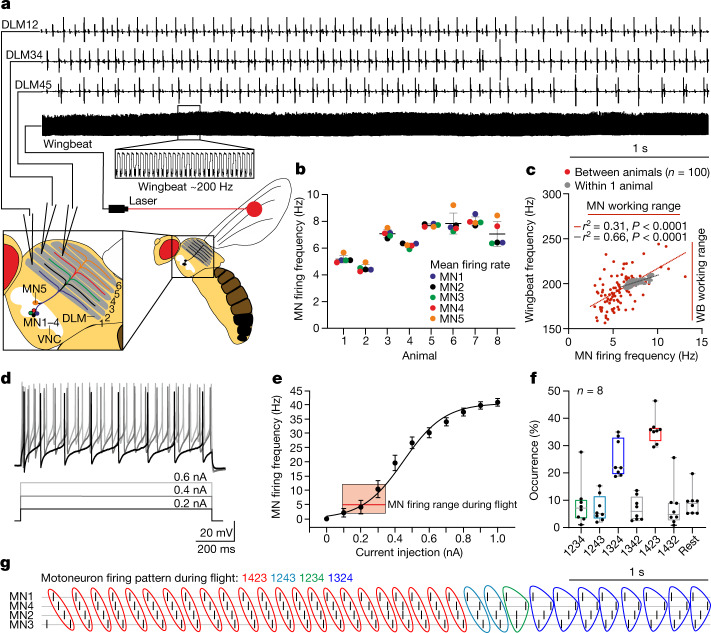
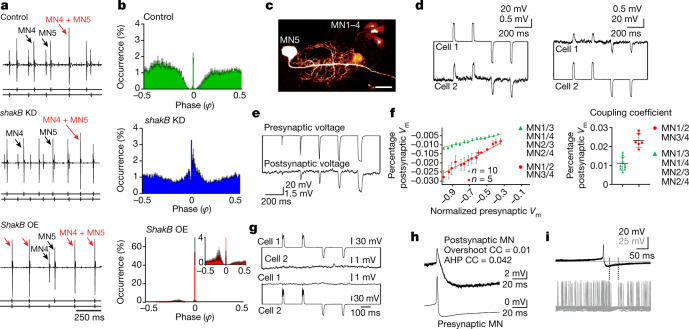
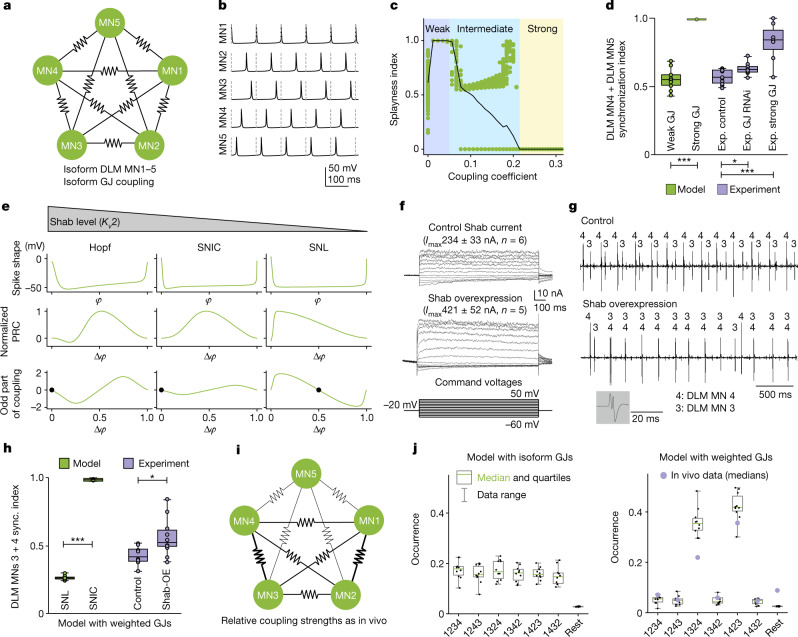
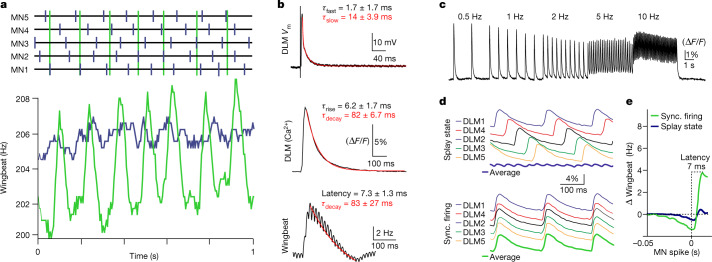
Verification
Claims the paper makes
The claims and statistics of this paper haven’t been checked yet.
Free: it reads the open-access text and checks the first 5 claims that cite a source we can check. Create a free account to check every claim.
Claims other papers make about this one
Each is checked against this paper’s own text: does it say what the citing paper says it does?
The source backs part of the claim, not all of it — or backs it for a different population, condition or comparison.
In the citing paper
“which through experimental and modeling studies are thought to lead to a limited possible set of DLMn spiking orders (Hürkey et al., 2023).”
From Organization of circuits linking descending input to motor output in the Drosophila Male Adult Nerve Cord connectome (2026) · cites this paper as Hürkey et al., 2023
Experimental — accuracy not yet measuredThe cited source says what the claim attributes to it.
In the citing paper
“Recent work indicates that the relative spike timing of DLM MNs is determined by electrical coupling through gap junctions59, which are not yet resolvable in the FANC dataset.”
From Synaptic architecture of leg and wing premotor control networks in Drosophila (2024) · cites this paper as [59]
In the citing paper
“The presence of weak synaptic connectivity between DLM MNs complements recent work demonstrating that gap junctions between DLM MNs offset their spike timing during flight42.”
From Connectomic reconstruction of a female Drosophila ventral nerve cord (2024) · cites this paper as [42]
Self-check
Percentages, sums and reported differences re-computed from the paper’s own numbers.
The self-check needs the paper’s full text.
Citations
Cites
Dynamical Systems in Neuroscience: The Geometry of Excitability and Bursting
Izhikevich, E. M. (2006) · The MIT Press eBooks · doi:10.7551/mitpress/2526.001.0001 · Cited by 3,765
How Many Species of Insects and Other Terrestrial Arthropods Are There on Earth?
Stork, N. E. (2018) · Annual Review of Entomology · doi:10.1146/annurev-ento-020117-043348 · Cited by 1,537
A GAL4-Driver Line Resource for Drosophila Neurobiology
Jenett, A., Rubin, G. M., Ngo, T.-T. B., Shepherd, D., Murphy, C., Dionne, H., Pfeiffer, B. D., Cavallaro, A., Hall, D., Jeter, J., et al. (2012) · Cell Reports · doi:10.1016/j.celrep.2012.09.011 · Cited by 1,449
Type I membranes, phase resetting curves, and synchrony
Ermentrout, B. (1996) · Neural Computation · doi:10.1162/neco.1996.8.5.979 · Cited by 1,001
Fast and sensitive GCaMP calcium indicators for imaging neural populations
Zhang, Y., Rózsa, M., Liang, Y., Bushey, D., Wei, Z., Zheng, J., Reep, D., Broussard, G. J., Tsang, A., Tsegaye, G., et al. (2023) · Nature · doi:10.1038/s41586-023-05828-9 · Cited by 870
Brian 2, an intuitive and efficient neural simulator
Stimberg, M., Brette, R., & Goodman, D. F. (2019) · eLife · doi:10.7554/elife.47314 · Cited by 749
Decoding the organization of spinal circuits that control locomotion
Kiehn, O. (2016) · Nature Reviews Neuroscience · doi:10.1038/nrn.2016.9 · Cited by 742
Goodenough, D. A., & Paul, D. L. (2009) · Cold Spring Harbor Perspectives in Biology · doi:10.1101/cshperspect.a002576 · Cited by 613
Parabolic Bursting in an Excitable System Coupled with a Slow Oscillation
Ermentrout, G. B., & Kopell, N. (1986) · SIAM Journal on Applied Mathematics · doi:10.1137/0146017 · Cited by 596
The Aerodynamics of Free-Flight Maneuvers in Drosophila
Fry, S. N., Sayaman, R., & Dickinson, M. H. (2003) · Science · doi:10.1126/science.1081944 · Cited by 533
On the Phase Reduction and Response Dynamics of Neural Oscillator Populations
Brown, E., Moehlis, J., & Holmes, P. (2004) · Neural Computation · doi:10.1162/089976604322860668 · Cited by 510
Dephasing and Bursting in Coupled Neural Oscillators
Han, S. K., Kurrer, C., & Kuramoto, Y. (1995) · Physical Review Letters · doi:10.1103/physrevlett.75.3190 · Cited by 408
Transsynaptic mapping of second-order taste neurons in flies by trans-Tango
Talay, M., Richman, E. B., Snell, N. J., Hartmann, G. G., Fisher, J. D., Sorkaç, A., Santoyo, J. F., Chou-Freed, C., Nair, N., Johnson, M., et al. (2017) · Neuron · doi:10.1016/j.neuron.2017.10.011 · Cited by 301
Josephson, R. K., Malamud, J. G., & Stokes, D. R. (2000) · Journal of Experimental Biology · doi:10.1242/jeb.203.18.2713 · Cited by 261
Galán, R. F., Ermentrout, G. B., & Urban, N. N. (2005) · Physical Review Letters · doi:10.1103/physrevlett.94.158101 · Cited by 259
Dynamics of Spiking Neurons Connected by Both Inhibitory and Electrical Coupling
Lewis, T. J., & Rinzel, J. (2003) · Journal of Computational Neuroscience · doi:10.1023/a:1023265027714 · Cited by 259
Innexins: members of an evolutionarily conserved family of gap-junction proteins
Phelan, P. (2005) · Biochimica et Biophysica Acta (BBA) - Biomembranes · doi:10.1016/j.bbamem.2004.10.004 · Cited by 257
Vervaeke, K., Lőrincz, A., Gleeson, P., Farinella, M., Nusser, Z., & Silver, R. A. (2010) · Neuron · doi:10.1016/j.neuron.2010.06.028 · Cited by 231
Motor and sensory flight neurones in a locust demonstrated using cobalt chloride
Tyrer, N. M., & Altman, J. S. (1974) · Journal of Comparative Neurology · doi:10.1002/cne.901570203 · Cited by 228
Dynamics of Spiking Neurons with Electrical Coupling
Chow, C. C., & Kopell, N. (2000) · Neural Computation · doi:10.1162/089976600300015295 · Cited by 223
Channelrhodopsin-2–XXL, a powerful optogenetic tool for low-light applications
Dawydow, A., Gueta, R., Ljaschenko, D., Ullrich, S., Hermann, M., Ehmann, N., Gao, S., Fiala, A., Langenhan, T., Nagel, G., et al. (2014) · Proceedings of the National Academy of Sciences · doi:10.1073/pnas.1408269111 · Cited by 207
Invertebrate central pattern generator circuits
Selverston, A. I. (2010) · Philosophical Transactions of the Royal Society B: Biological Sciences · doi:10.1098/rstb.2009.0270 · Cited by 169
Voltage Sensitivity and Gating Charge in Shaker and Shab Family Potassium Channels
Islas, L. D., & Sigworth, F. J. (1999) · The Journal of General Physiology · doi:10.1085/jgp.114.5.723 · Cited by 165
Beyond plasticity: the dynamic impact of electrical synapses on neural circuits
Alcamí, P., & Pereda, A. E. (2019) · Nature Reviews Neuroscience · doi:10.1038/s41583-019-0133-5 · Cited by 159
Neuronal Networks with Gap Junctions: A Study of Piecewise Linear Planar Neuron Models
Coombes, S. (2008) · SIAM Journal on Applied Dynamical Systems · doi:10.1137/070707579 · Cited by 157
Gutierrez, G. J., O’Leary, T., & Marder, E. (2013) · Neuron · doi:10.1016/j.neuron.2013.01.016 · Cited by 154
Ostojic, S., Brunel, N., & Hakim, V. (2008) · Journal of Computational Neuroscience · doi:10.1007/s10827-008-0117-3 · Cited by 141
Synchrony and so much more: Diverse roles for electrical synapses in neural circuits
Connors, B. W. (2017) · Developmental Neurobiology · doi:10.1002/dneu.22493 · Cited by 131
Weaver, A. (2010) · Frontiers in Behavioral Neuroscience · doi:10.3389/fnbeh.2010.00038 · Cited by 119
Novel flight style and light wings boost flight performance of tiny beetles
Farisenkov, S. E., Kolomenskiy, D., Petrov, P. N., Engels, T., Lapina, N. A., Lehmann, F., Onishi, R., Liu, H., & Polilov, A. A. (2022) · Nature · doi:10.1038/s41586-021-04303-7 · Cited by 113
Dendritic Remodeling and Growth of Motoneurons during Metamorphosis of Drosophila melanogaster
Consoulas, C., Restifo, L. L., & Levine, R. B. (2002) · The Journal of Neuroscience · doi:10.1523/jneurosci.22-12-04906.2002 · Cited by 111
Role of calcium in the regulation of mechanical power in insect flight
Gordon, S., & Dickinson, M. H. (2006) · Proceedings of the National Academy of Sciences · doi:10.1073/pnas.0510109103 · Cited by 108
Johnson, B. R., Peck, J. H., & Harris‐Warrick, R. M. (1993) · Journal of Comparative Physiology A · doi:10.1007/bf00195397 · Cited by 99
Mechanics of the thorax in flies
Deora, T., Gundiah, N., & Sane, S. P. (2017) · Journal of Experimental Biology · doi:10.1242/jeb.128363 · Cited by 98
Neurons associated with the dorsal longitudinal flight muscles of Drosophila melanogaster
Coggshall, J. C. (1978) · Journal of Comparative Neurology · doi:10.1002/cne.901770410 · Cited by 97
Molecular dynamics of cyclically contracting insect flight muscle in vivo
Dickinson, M. H., Farman, G. P., Frye, M. A., Bekyarova, T., Gore, D. B., Maughan, D. W., & Irving, T. C. (2005) · Nature · doi:10.1038/nature03230 · Cited by 95
Ikeda, K., & Koenig, J. H. (1988) · Journal of Comparative Neurology · doi:10.1002/cne.902730312 · Cited by 92
Fast and sensitive GCaMP calcium indicators for imaging neural populationsPreprint
Zhang, Y., Rózsa, M., Liang, Y., et al. (2021) · bioRxiv (Cold Spring Harbor Laboratory) · doi:10.1101/2021.11.08.467793 · Cited by 87
Stability of the splay state in pulse-coupled networks
Zillmer, R., Livi, R., Politi, A., & Torcini, A. (2007) · Physical Review E · doi:10.1103/physreve.76.046102 · Cited by 77
Gao, W. J., Wormington, A. B., Newman, D. E., & Pallas, S. L. (2000) · The Journal of Comparative Neurology · doi:10.1002/(sici)1096-9861(20000619)422:1<140::aid-cne9>3.0.co;2-0 · Cited by 73
Self-citationMarder, E., Gutierrez, G. J., & Nusbaum, M. P. (2017) · Developmental Neurobiology · doi:10.1002/dneu.22410 · Cited by 73
Synchronization and frustration in oscillator networks with attractive and repulsive interactions
Zanette, D. H. (2005) · Europhysics Letters (EPL) · doi:10.1209/epl/i2005-10238-4 · Cited by 64
Output pattern generation by Drosophila flight motoneurons
Harcombe, E. S., & Wyman, R. J. (1977) · Journal of Neurophysiology · doi:10.1152/jn.1977.40.5.1066 · Cited by 62
Roles for Electrical Coupling in Neural Circuits as Revealed by Selective Neuronal Deletions
Marder, E. (1984) · Journal of Experimental Biology · doi:10.1242/jeb.112.1.147 · Cited by 61
Barthmaier, P., & Fyrberg, E. A. (1995) · Developmental Biology · doi:10.1006/dbio.1995.1186 · Cited by 59
Qualitative changes in phase-response curve and synchronization at the saddle-node-loop bifurcation
Hesse, J., Schleimer, J., & Schreiber, S. (2017) · Physical review. E · doi:10.1103/physreve.95.052203 · Cited by 49
Self-citationDuch, C., Bayline, R. J., & Levine, R. B. (2000) · The Journal of Comparative Neurology · doi:10.1002/(sici)1096-9861(20000619)422:1<1::aid-cne1>3.0.co;2-s · Cited by 45
Self-citationThe Molecular Trigger for High-Speed Wing Beats in a Bee
Iwamoto, H., & Yagi, N. (2013) · Science · doi:10.1126/science.1237266 · Cited by 41
The cyclically repetitive firing sequencess of identifiedDrosophila flight motoneurons
Harcombe, E. S., & Wyman, R. J. (1978) · Journal of Comparative Physiology A · doi:10.1007/bf00656881 · Cited by 38
Calcium and stretch activation modulate power generation in Drosophila flight muscle
Wang, Q., Zhao, C., & Swank, D. M. (2011) · Biophysical Journal · doi:10.1016/j.bpj.2011.09.034 · Cited by 37
Neural Interactions Controlling Timing of Flight Muscle Activity in Drosophila
Koenig, J. H., & Ikeda, K. (1980) · Journal of Experimental Biology · doi:10.1242/jeb.87.1.121 · Cited by 32
Intra-neuronal Competition for Synaptic Partners Conserves the Amount of Dendritic Building Material
Ryglewski, S., Vonhoff, F., Scheckel, K., & Duch, C. (2017) · Neuron · doi:10.1016/j.neuron.2016.12.043 · Cited by 30
Self-citationDendrites are dispensable for basic motoneuron function but essential for fine tuning of behavior
Ryglewski, S., Kadas, D., Hutchinson, K. M., Schützler, N., Vonhoff, F., & Duch, C. (2014) · Proceedings of the National Academy of Sciences · doi:10.1073/pnas.1416247111 · Cited by 29
Self-citationKuehn, C., & Duch, C. (2012) · European Journal of Neuroscience · doi:10.1111/ejn.12104 · Cited by 26
Self-citationHesse, J., Schleimer, J., Maier, N., Schmitz, D., & Schreiber, S. (2022) · Nature Communications · doi:10.1038/s41467-022-31195-6 · Cited by 26
Self-citationKoenig, J. H., & Ikeda, K. (1983) · Journal of Comparative Physiology A · doi:10.1007/bf00605020 · Cited by 23
Asymmetry and modulation of spike timing in electrically coupled neurons
Sevetson, J. L., & Haas, J. S. (2014) · Journal of Neurophysiology · doi:10.1152/jn.00843.2014 · Cited by 23
Biophysical models of intrinsic homeostasis: Firing rates and beyond
Niemeyer, N., Schleimer, J., & Schreiber, S. (2021) · Current Opinion in Neurobiology · doi:10.1016/j.conb.2021.07.011 · Cited by 22
Self-citationModeling the Influence of Ion Channels on Neuron Dynamics in Drosophila
Berger, S. D., & Crook, S. M. (2015) · Frontiers in Computational Neuroscience · doi:10.3389/fncom.2015.00139 · Cited by 21
Schlurmann, M., & Hausen, K. (2007) · Journal of Comparative Neurology · doi:10.1002/cne.21182 · Cited by 11
Splay states and two-cluster states in ensembles of excitable units
Ronge, R., & Zaks, M. A. (2021) · The European Physical Journal Special Topics · doi:10.1140/epjs/s11734-021-00173-2 · Cited by 11
Preparation of Drosophila Central Neurons for in situ Patch Clamping
Ryglewski, S., & Duch, C. (2012) · Journal of Visualized Experiments · doi:10.3791/4264 · Cited by 10
Self-citationPhase‐response curves of ion channel gating kinetics
Schleimer, J., & Schreiber, S. (2018) · Mathematical Methods in the Applied Sciences · doi:10.1002/mma.5232 · Cited by 10
Self-citationHesse, J., & Schleimer, J.-H. (2019) · Figshare · doi:10.5281/zenodo.2628348 · Cited by 7
Self-citationFragile X Mental Retardation Protein Restricts Small Dye Iontophoresis Entry into Central Neurons
Kennedy, T., & Broadie, K. S. (2017) · Journal of Neuroscience · doi:10.1523/jneurosci.0723-17.2017 · Cited by 6
How to correctly quantify neuronal phase-response curves from noisy recordings
Hesse, J., & Schreiber, S. (2019) · Journal of Computational Neuroscience · doi:10.1007/s10827-019-00719-3
Self-citation
Cited by
Soft Materials and Devices Enabling Sensorimotor Functions in Soft Robots
Su, J., He, K., Li, Y., Tu, J., & Chen, X. (2025) · Chemical Reviews · doi:10.1021/acs.chemrev.4c00906 · Cited by 126
Tools for connectomic reconstruction and analysis of a female Drosophila ventral nerve cord
Azevedo, A., Lesser, E., Phelps, J. S., Mark, B., Elabbady, L., Kuroda, S., Sustar, A., Moussa, A., Kandelwal, A., Dallmann, C. J., et al. (2022) · doi:10.1101/2022.12.15.520299 · Cited by 120
Connectomic reconstruction of a female Drosophila ventral nerve cord
Azevedo, A., Lesser, E., Phelps, J. S., Mark, B., Elabbady, L., Kuroda, S., Sustar, A., Moussa, A., Khandelwal, A., Dallmann, C. J., et al. (2024) · Nature · doi:10.1038/s41586-024-07389-x · Cited by 120
“The presence of weak synaptic connectivity between DLM MNs complements recent work demonstrating that gap junctions between DLM MNs offset their spike timing during flight 42 .”
Synaptic architecture of leg and wing premotor control networks in Drosophila
Lesser, E., Azevedo, A. W., Phelps, J. S., Elabbady, L., Cook, A., Syed, D. S., Mark, B., Kuroda, S., Sustar, A., Moussa, A., et al. (2024) · Nature · doi:10.1038/s41586-024-07600-z · Cited by 71
“Recent work indicates that the relative spike timing of DLM MNs is determined by electrical coupling through gap junctions 59 , which are not yet resolvable in the FANC dataset.”
Synaptic architecture of leg and wing premotor control networks in Drosophila
Lesser, E., Azevedo, A. W., Phelps, J. S., Elabbady, L., Cook, A., Syed, D. S., Mark, B., Kuroda, S., Sustar, A., Moussa, A., et al. (2023) · doi:10.1101/2023.05.30.542725 · Cited by 71
Metadata
- Authors
- Hürkey, S., Niemeyer, N., Schleimer, J.-H., Ryglewski, S., Schreiber, S., & Duch, C.
- Affiliations
- Johannes Gutenberg University Mainz (DE)
- Humboldt-Universität zu Berlin (DE)
- Corresponding author
- Schreiber, Susanne
- Duch, Carsten
- ORCID
- Venue
- Nature
- Published
- 2023-05-24
- Volume
- 618
- Issue
- 7963
- Pages
- 118-125
- ISSN
- 0028-0836 (ISSN-L)
- 1476-4687
- PMC
- PMC10232364
- OpenAlex
- W4378070410
- Cited by
- 64
- References
- 63
- Citations by year
- 2026: 13 · 2025: 26 · 2024: 23 · 2023: 2
- FWCI
- 7.76
- Type
- journal article
- Language
- en
- Open access
- hybrid
- doi.org
- Licence
- cc-by
- creativecommons.org/licenses/by/4.0 (tdm)
- creativecommons.org/licenses/by/4.0 (vor)
- Locations
- Nature (publishedVersion, cc-by)
- PubMed Central (publishedVersion, cc-by)
- PubMed (publishedVersion)
- RePEc: Research Papers in Economics (submittedVersion)
- Gutenberg Open Science (submittedVersion, cc-by-nd)
- Gutenberg Open Science (cc-by)
- Funders
- European Commission (HORIZON2020, 864243)
- Deutsche Forschungsgemeinschaft
- Einstein Stiftung Berlin (EP‐2021‐621)
- Topics
- Life Sciences › Neuroscience › Cellular and Molecular Neuroscience › Neurobiology and Insect Physiology Research
- Life Sciences › Neuroscience › Cognitive Neuroscience › Neural dynamics and brain function
- Life Sciences › Biochemistry, Genetics and Molecular Biology › Molecular Biology › Connexins and lens biology
- Keywords
- gap junctions, electrical synapses, central pattern generator, insect flight, Drosophila, motor neurons, ion channels, connectomics
- MeSH terms
- Animals, Drosophila melanogaster, Flight, Animal, Motor Neurons, Neural Pathways, Gap Junctions, Electrical Synapses, Electrophysiological Phenomena
About these checks
Registry, retraction, Cites and statistics results are computed, not judged, with one exception: a printed reference that no index lists is read once by a model before it counts as a citation error. Claims are extracted by a model and kept only when their quote appears verbatim in the text; each cited source is then checked, with a model’s help, for whether it says what the claim relies on. Those verdicts can be wrong — read the claim’s quote and the cited source before relying on one.
Statistics and arithmetic are recomputed, not judged.
Confidence bands are shown only for fields calibrated on our annotated test set. None is calibrated yet, so no band is shown.
What counts as a claim ›How we measure confidence ›How we check this ›
Are you an author, or do you see a problem with this page? Request a review
Data sources
Bibliographic data: Semantic Scholar, OpenAlex, Crossref.
Contains information from the Semantic Scholar Academic Graph Datasets, made available under the ODC Attribution License (ODC-BY 1.0).
Semantic Scholar’s data is described in: Kinney, R., et al. (2023). The Semantic Scholar Open Data Platform. arXiv:2301.10140.
