

Autonomous chemical research with large language models
Open accessThe DOI matches its Crossref record; 47 of the 47 references it cites were found in a registry or an index.
Abstract
Transformer-based large language models are making significant strides in various fields, such as natural language processing 1–5 , biology 6,7 , chemistry 8–10 and computer programming 11,12 . Here, we show the development and capabilities of Coscientist, an artificial intelligence system driven by GPT-4 that autonomously designs, plans and performs complex experiments by incorporating large language models empowered by tools such as internet and documentation search, code execution and experimental automation. Coscientist showcases its potential for accelerating research across six diverse tasks, including the successful reaction optimization of palladium-catalysed cross-couplings, while exhibiting advanced capabilities for (semi-)autonomous experimental design and execution. Our findings demonstrate the versatility, efficacy and explainability of artificial intelligence systems like Coscientist in advancing research.
Overview
The claims and statistics of this paper haven’t been checked yet.
Free: it reads the open-access text and checks the first 5 claims that cite a source we can check. Create a free account to check every claim.
Integrity signals
Registry
Cites
Statistics
Figures
Verification
Claims the paper makes
The claims and statistics of this paper haven’t been checked yet.
Free: it reads the open-access text and checks the first 5 claims that cite a source we can check. Create a free account to check every claim.
Claims other papers make about this one
Each is checked against this paper’s own text: does it say what the citing paper says it does?
The source backs part of the claim, not all of it — or backs it for a different population, condition or comparison.
In the citing paper
“The broader literature on autonomous scientific systems has already argued for more rigorous evaluation protocols and transparent tool interfaces [3,5,7-12].”
From From Scientific Copilots to Tool-Grounded Autonomy: AI Agents in Simulation-Driven Materials Discovery (2026) · cites this paper as [8]
Experimental — accuracy not yet measuredThe source backs part of the claim, not all of it — or backs it for a different population, condition or comparison.
In the citing paper
“To the best of our knowledge, no prior review has isolated simulation-driven, toolorchestrating AI agent workflows for materials discovery as a distinct evidence base with study-level extraction of autonomy, validation, and reproducibility [3-14].”
From From Scientific Copilots to Tool-Grounded Autonomy: AI Agents in Simulation-Driven Materials Discovery (2026) · cites this paper as [8]
Experimental — accuracy not yet measuredThe source backs part of the claim, not all of it — or backs it for a different population, condition or comparison.
In the citing paper
“In parallel, chemistry-oriented reviews have shown that large language models can move beyond text generation toward tool use, retrieval, planning, code execution, and multi-agent coordination [5-10].”
From From Scientific Copilots to Tool-Grounded Autonomy: AI Agents in Simulation-Driven Materials Discovery (2026) · cites this paper as [8]
Experimental — accuracy not yet measuredThe source backs part of the claim, not all of it — or backs it for a different population, condition or comparison.
In the citing paper
“In scientific discovery, agents dynamically compose and execute hypothesis-testing pipelines spanning simulations, lab protocols, and data analysis [61, 62, 63, 64].”
From Code as Agent Harness (2026) · cites this paper as [62]
Experimental — accuracy not yet measuredThe source backs part of the claim, not all of it — or backs it for a different population, condition or comparison.
In the citing paper
“The central challenge is not only to predict a property, but to manage the sequence of reasoning and action that connects a scientific objective to executable computational or experimental steps [2-10].”
From From Scientific Copilots to Tool-Grounded Autonomy: AI Agents in Simulation-Driven Materials Discovery (2026) · cites this paper as [8]
Experimental — accuracy not yet measured
7 more claims about this paper
Create a free account to see every claim other papers make about this one.
Self-check
Percentages, sums and reported differences re-computed from the paper’s own numbers.
The self-check needs the paper’s full text.
Citations
Cites
Scaling Laws for Neural Language Models
Kaplan, J., McCandlish, S., Henighan, T., Brown, T. B., Chess, B., Child, R., Gray, S., Radford, A., Wu, J., & Amodei, D. (2020) · arXiv · doi:10.48550/arxiv.2001.08361 · Cited by 9,550 · cited 1×
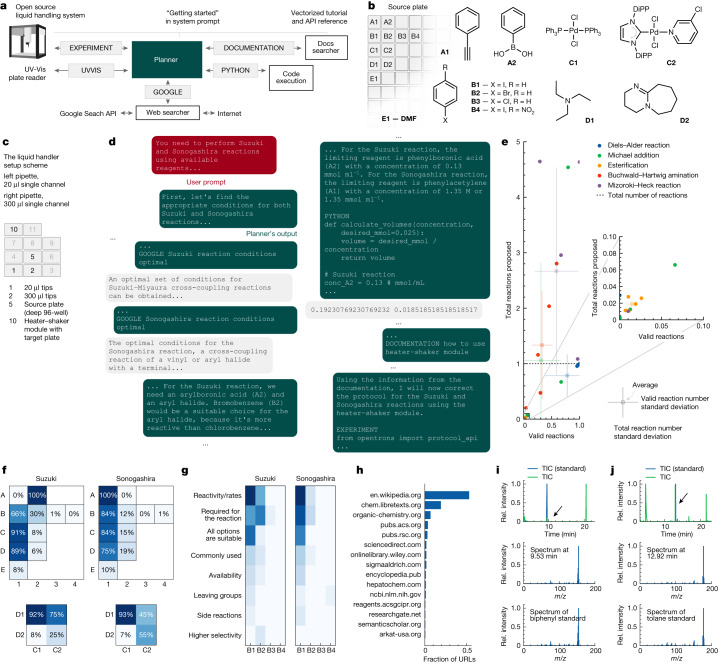
“Extreme scaling of models 13 , as demonstrated by OpenAI, has led to significant breakthroughs in the field 1,14 .”
Evolutionary-scale prediction of atomic level protein structure with a language model
Lin, Z., Akin, H., Rao, R., Hie, B., Zhu, Z., Lu, W., Smetanin, N., Verkuil, R., Kabeli, O., Shmueli, Y., et al. (2022) · doi:10.1101/2022.07.20.500902 · Cited by 5,990 · cited 1×
“These models have been successfully applied to various domains, including natural language 1–5 , biological 6,7 and chemical research 8–10 as well as code generation 11,12 .”
Survey of Hallucination in Natural Language Generation
Ji, Z., Lee, N., Frieske, R., Yu, T., Su, D., Xu, Y., Ishii, E., Bang, Y. J., Madotto, A., & Fung, P. (2023) · ACM Computing Surveys · doi:10.1145/3571730 · Cited by 5,025 · cited 1×
“These results show the importance of grounding LLMs to avoid ‘hallucinations’ 31 .”
Survey of Hallucination in Natural Language Generation
Ji, Z., Lee, N., Frieske, R., Yu, T., Su, D., Xu, Y., Ishii, E., Bang, Y., Chen, D., Dai, W., et al. (2022) · arXiv · doi:10.48550/arxiv.2202.03629 · Cited by 4,981
LLaMA: Open and Efficient Foundation Language Models
Touvron, H., Lavril, T., Izacard, G., Martinet, X., Lachaux, M.-A., Lacroix, T., Rozière, B., Goyal, N., Hambro, E., Azhar, F., et al. (2023) · arXiv · doi:10.48550/arxiv.2302.13971 · Cited by 4,602
Chain-Of-Thought Prompting Elicits Reasoning in Large Language Models
Wei, J., Wang, X., Schuurmans, D., Bosma, M., Ichter, B., Xia, F., Chi, E., Le, Q. V., & Zhou, D. (2022) · Advances in Neural Information Processing Systems 35 · doi:10.52202/068431-1800 · Cited by 4,505
Liu, P., Yuan, W., Fu, J., Jiang, Z., Hayashi, H., & Neubig, G. (2023) · ACM Computing Surveys · doi:10.1145/3560815 · Cited by 4,361 · cited 1×
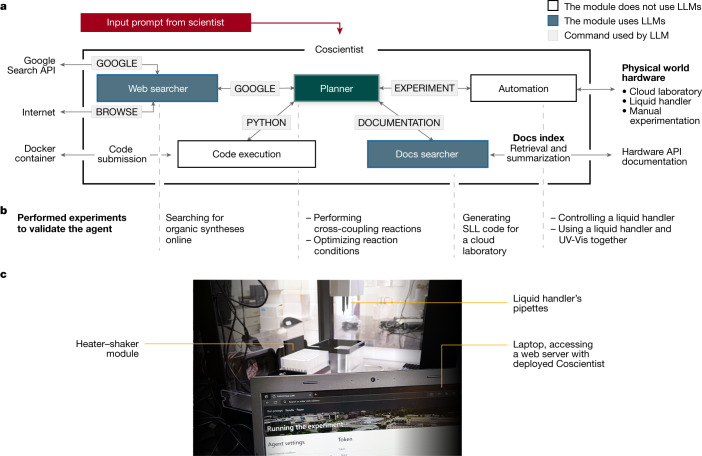
“System prompts (static inputs defining the LLMs’ goals) for the Planner are engineered 1,27 in a modular fashion, described as four commands that define the action space: The PYTHON command allows the Planner to perform calculations to prepare the experiment using a ‘Code execution’ module.”
Liu, P., Yuan, W., Fu, J., Jiang, Z., Hayashi, H., & Neubig, G. (2021) · arXiv · doi:10.48550/arxiv.2107.13586 · Cited by 4,352 · cited 1×
“System prompts (static inputs defining the LLMs’ goals) for the Planner are engineered 1,27 in a modular fashion, described as four commands that define the action space: The PYTHON command allows the Planner to perform calculations to prepare the experiment using a ‘Code execution’ module.”
Chain-of-Thought Prompting Elicits Reasoning in Large Language Models
Wei, J., Wang, X., Schuurmans, D., Bosma, M., Ichter, B., Xia, F., Chi, E., Le, Q., & Zhou, D. (2022) · arXiv · doi:10.48550/arxiv.2201.11903 · Cited by 4,263 · cited 1×
“This can be done through advanced prompting strategies, such as ReAct 34 , Chain of Thought 35 and Tree of Thoughts 36 .”
Billion-scale similarity search with GPUs
Johnson, J., Douze, M., & Jegou, H. (2021) · IEEE Transactions on Big Data · doi:10.1109/tbdata.2019.2921572 · Cited by 4,228
Training language models to follow instructions with human feedback
Ouyang, L., Wu, J., Jiang, X., Almeida, D., Wainwright, C. L., Mishkin, P., Zhang, C., Agarwal, S., Slama, K., Ray, A., et al. (2022) · arXiv · doi:10.48550/arxiv.2203.02155 · Cited by 4,208
Billion-scale similarity search with GPUs
Johnson, J., Douze, M., & Jégou, H. (2017) · arXiv · doi:10.48550/arxiv.1702.08734 · Cited by 4,140 · cited 1×
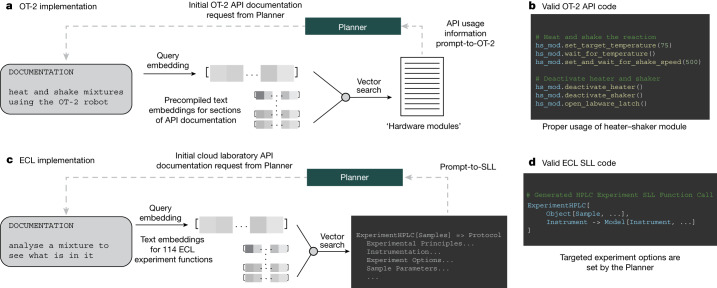
“Retrieval of similar vectors from this database occurs at inference time, usually using one of the approximate nearest neighbour search algorithms 44 .”
The probabilistic relevance framework: BM25 and beyond
Robertson, S., & Zaragoza, H. (2009) · Foundations and Trends® in Information Retrieval · doi:10.1561/1500000019 · Cited by 3,374 · cited 1×
“At inference time, all documents containing words from a query are selected and ranked based on various manually defined formulas 42 .”
PaLM: Scaling Language Modeling with Pathways
Chowdhery, A., Narang, S., Devlin, J., Bosma, M., Mishra, G., Roberts, A., Barham, P., Chung, H. W., Sutton, C., Gehrmann, S., et al. (2022) · arXiv · doi:10.48550/arxiv.2204.02311 · Cited by 2,590
Sparks of Artificial General Intelligence: Early experiments with GPT-4
Bubeck, S., Chandrasekaran, V., Eldan, R., Gehrke, J., Horvitz, E., Kamar, E., Lee, P., Lee, Y. T., Li, Y., Lundberg, S., et al. (2023) · arXiv · doi:10.48550/arxiv.2303.12712 · Cited by 1,526
Burger, B., Maffettone, P. M., Gusev, V. V., Aitchison, C. M., Bai, Y., Wang, X., Li, X., Alston, B. M., Li, B., Clowes, R., et al. (2020) · Nature · doi:10.1038/s41586-020-2442-2 · Cited by 1,516
BioGPT: generative pre-trained transformer for biomedical text generation and mining
Luo, R., Sun, L., Xia, Y., Qin, T., Zhang, S., Poon, H., & Liu, T.-Y. (2022) · Briefings in Bioinformatics · doi:10.1093/bib/bbac409 · Cited by 1,150
Predicting reaction performance in C–N cross-coupling using machine learning
Ahneman, D. T., Estrada, J. G., Lin, S., Dreher, S. D., & Doyle, A. G. (2018) · Science · doi:10.1126/science.aar5169 · Cited by 1,058
A robotic platform for flow synthesis of organic compounds informed by AI planning
Coley, C. W., Thomas, D. A., Lummiss, J. A. M., Jaworski, J. N., Breen, C. P., Schultz, V., Hart, T., Fishman, J. S., Rogers, L., Gao, H., et al. (2019) · Science · doi:10.1126/science.aax1566 · Cited by 1,052 · cited 1×
“Examples range from the autonomous discovery 17,18 and optimization of organic reactions 19 to the development of automated flow systems 20,21 and mobile platforms 22 .”
On-demand continuous-flow production of pharmaceuticals in a compact, reconfigurable system
Adamo, A., Beingessner, R. L., Behnam, M., Chen, J., Jamison, T. F., Jensen, K. F., Monbaliu, J.-C. M., Myerson, A. S., Revalor, E. M., Snead, D. R., et al. (2016) · Science · doi:10.1126/science.aaf1337 · Cited by 941 · cited 1×
“Examples range from the autonomous discovery 17,18 and optimization of organic reactions 19 to the development of automated flow systems 20,21 and mobile platforms 22 .”
Training Compute-Optimal Large Language Models
Hoffmann, J., Borgeaud, S., Mensch, A., Buchatskaya, E., Cai, T., Rutherford, E., Casas, D. D. L., Hendricks, L. A., Welbl, J., Clark, A., et al. (2022) · Advances in Neural Information Processing Systems 35 · doi:10.52202/068431-2176 · Cited by 932
Training Compute-Optimal Large Language Models
Hoffmann, J., Borgeaud, S., Mensch, A., Buchatskaya, E., Cai, T., Rutherford, E., Casas, D. D. L., Hendricks, L. A., Welbl, J., Clark, A., et al. (2022) · arXiv · doi:10.48550/arxiv.2203.15556 · Cited by 929
Augmenting large language models with chemistry tools
M. Bran, A., Cox, S., Schilter, O., Baldassari, C., White, A. D., & Schwaller, P. (2024) · Nature Machine Intelligence · doi:10.1038/s42256-024-00832-8 · Cited by 794
LaMDA: Language Models for Dialog Applications
Thoppilan, R., De Freitas, D., Hall, J., Shazeer, N., Kulshreshtha, A., Cheng, H.-T., Jin, A., Bos, T., Baker, L., Du, Y., et al. (2022) · arXiv · doi:10.48550/arxiv.2201.08239 · Cited by 778
Controlling an organic synthesis robot with machine learning to search for new reactivity
Granda, J. M., Donina, L., Dragone, V., Long, D.-L., & Cronin, L. (2018) · Nature · doi:10.1038/s41586-018-0307-8 · Cited by 740 · cited 1×
“Examples range from the autonomous discovery 17,18 and optimization of organic reactions 19 to the development of automated flow systems 20,21 and mobile platforms 22 .”
ReAct: Synergizing Reasoning and Acting in Language Models
Yao, S., Zhao, J., Yu, D., Du, N., Shafran, I., Narasimhan, K., & Cao, Y. (2022) · arXiv · doi:10.48550/arxiv.2210.03629 · Cited by 608 · cited 1×
“This can be done through advanced prompting strategies, such as ReAct 34 , Chain of Thought 35 and Tree of Thoughts 36 .”
A systematic evaluation of large language models of code
Xu, F. F., Alon, U., Neubig, G., & Hellendoorn, V. J. (2022) · Proceedings of the 6th ACM SIGPLAN International Symposium on Machine Programming · doi:10.1145/3520312.3534862 · Cited by 540
A platform for automated nanomole-scale reaction screening and micromole-scale synthesis in flow
Perera, D., Tucker, J. W., Brahmbhatt, S., Helal, C. J., Chong, A., Farrell, W., Richardson, P., & Sach, N. W. (2018) · Science · doi:10.1126/science.aap9112 · Cited by 465 · cited 1×
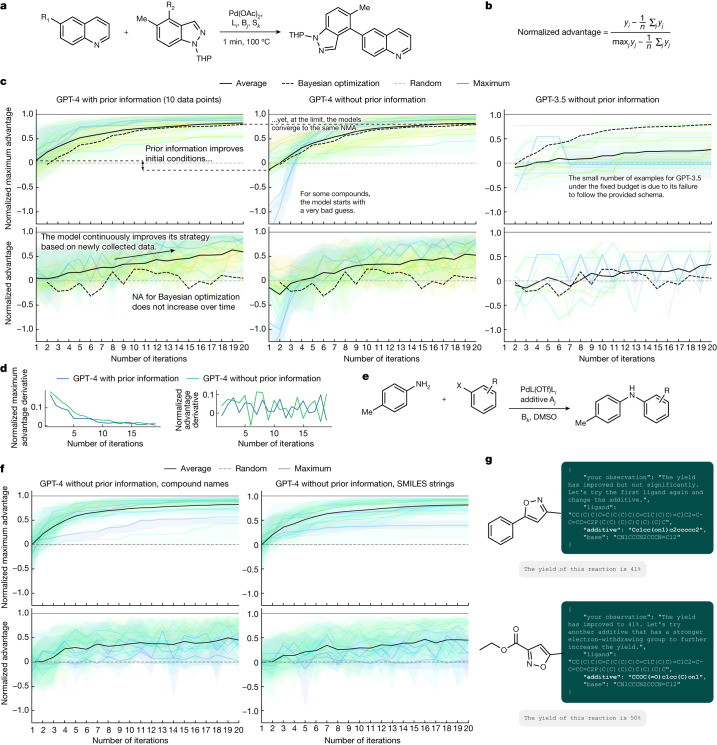
“One is a Suzuki reaction dataset collected by Perera et al. 50 , where these reactions were performed in flow with varying ligands, reagents/bases and solvents (Fig.”
Fine-Tuning Language Models from Human Preferences
Ziegler, D. M., Stiennon, N., Wu, J., Brown, T. B., Radford, A., Amodei, D., Christiano, P., & Irving, G. (2019) · arXiv · doi:10.48550/arxiv.1909.08593 · Cited by 413 · cited 1×
“Moreover, techniques such as reinforcement learning from human feedback 15 can considerably enhance the quality of generated text and the models’ capability to perform diverse tasks while reasoning about their decisions 16 .”
Leveraging large language models for predictive chemistry
Jablonka, K. M., Schwaller, P., Ortega-Guerrero, A., & Smit, B. (2024) · Nature Machine Intelligence · doi:10.1038/s42256-023-00788-1 · Cited by 378 · cited 1×
“These models have been successfully applied to various domains, including natural language 1–5 , biological 6,7 and chemical research 8–10 as well as code generation 11,12 .”
Lin, J., Ma, X., Lin, S.-C., Yang, J.-H., Pradeep, R., & Nogueira, R. (2021) · Proceedings of the 44th International ACM SIGIR Conference on Research and Development in Information Retrieval · doi:10.1145/3404835.3463238 · Cited by 360
Chemformer: a pre-trained transformer for computational chemistry
Irwin, R., Dimitriadis, S., He, J., & Bjerrum, E. J. (2022) · Machine Learning: Science and Technology · doi:10.1088/2632-2153/ac3ffb · Cited by 343 · cited 1×
“These models have been successfully applied to various domains, including natural language 1–5 , biological 6,7 and chemical research 8–10 as well as code generation 11,12 .”
CodeGen: An Open Large Language Model for Code with Multi-Turn Program Synthesis
Nijkamp, E., Pang, B., Hayashi, H., Tu, L., Wang, H., Zhou, Y., Savarese, S., & Xiong, C. (2022) · arXiv · doi:10.48550/arxiv.2203.13474 · Cited by 330 · cited 1×
“These models have been successfully applied to various domains, including natural language 1–5 , biological 6,7 and chemical research 8–10 as well as code generation 11,12 .”
Bai, Y., Kadavath, S., Kundu, S., Askell, A., Kernion, J., Jones, A., Chen, A., Goldie, A., Mirhoseini, A., & Kaplan, J. (2022) · arXiv (Cornell University) · doi:10.48550/arxiv.2212.08073 · Cited by 326 · cited 1×
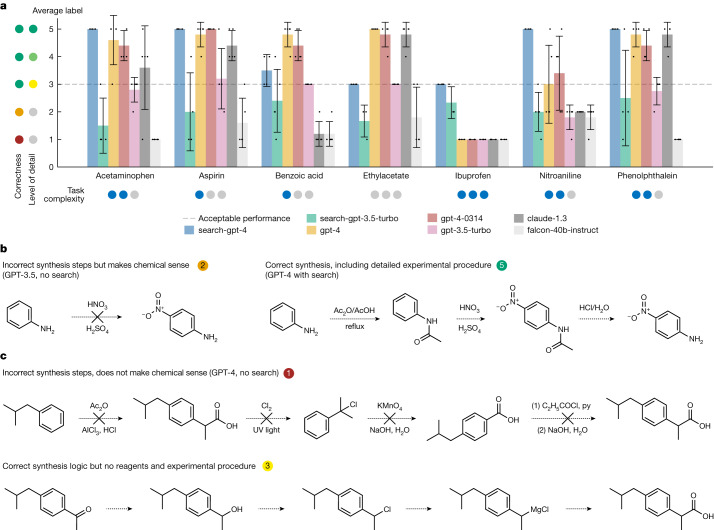
“5 and GPT-4, Anthropic’s Claude 1.3 28 and Falcon-40B-Instruct 29 —considered one of the best open-source models at the time of this experiment as per the OpenLLM leaderboard 30 .”
InfluentialClosed-loop optimization of general reaction conditions for heteroaryl Suzuki-Miyaura coupling
Angello, N. H., Rathore, V., Beker, W., Wołos, A., Jira, E. R., Roszak, R., Wu, T. C., Schroeder, C. M., Aspuru-Guzik, A., Grzybowski, B. A., et al. (2022) · Science · doi:10.1126/science.adc8743 · Cited by 208 · cited 1×
“Examples range from the autonomous discovery 17,18 and optimization of organic reactions 19 to the development of automated flow systems 20,21 and mobile platforms 22 .”
ChemCrow: Augmenting large-language models with chemistry tools
Bran, A. M., Cox, S., Schilter, O., Baldassari, C., White, A. D., & Schwaller, P. (2023) · arXiv · doi:10.48550/arxiv.2304.05376 · Cited by 122
Atlas: a brain for self-driving laboratories
Hickman, R. J., Sim, M., Pablo‐García, S., Tom, G., Woolhouse, I., Hao, H., Bao, Z., Bannigan, P., Allen, C. J., Aldeghi, M., et al. (2025) · Digital Discovery · doi:10.1039/d4dd00115j · Cited by 82
Caramelli, D., Granda, J. M., Mehr, S. H. M., Cambié, D., Henson, A. B., & Cronin, L. (2021) · ACS Central Science · doi:10.1021/acscentsci.1c00435 · Cited by 76 · cited 1×
“Examples range from the autonomous discovery 17,18 and optimization of organic reactions 19 to the development of automated flow systems 20,21 and mobile platforms 22 .”
A study of the effect of term proximity on query expansion
Vechtomova, O., & Wang, Y. (2006) · Journal of Information Science · doi:10.1177/0165551506065787 · Cited by 65 · cited 1×
“When strategies such as Transformer models are used, there are more chances to account for synonyms natively without doing synonym-based query expansion, as would be done in the first approach 45 .”
Kim, H., Na, J., & Lee, W. B. (2021) · Journal of Chemical Information and Modeling · doi:10.1021/acs.jcim.1c01289 · Cited by 64
Bayesian Optimization of Catalysis with In-Context Learning
Ramos, M. C., Michtavy, S. S., White, A. D., & Porosoff, M. D. (2026) · ACS Central Science · doi:10.1021/acscentsci.5c02418 · Cited by 37
Atlas: A Brain for Self-driving LaboratoriesPreprint
Hickman, R. J., Sim, M. R., Pablo‐García, S., et al. (2023) · ChemRxiv · doi:10.26434/chemrxiv-2023-8nrxx · Cited by 24
Leveraging Large Language Models for Predictive ChemistryPreprint
Jablonka, K. M., Schwaller, P., Ortega‐Guerrero, A., et al. (2023) · ChemRxiv · doi:10.26434/chemrxiv-2023-fw8n4-v3 · Cited by 23
Tu, Z., Yang, W., Fu, Z., Xie, Y., Tan, L., Xiong, K., Li, M., & Lin, J. (2020) · ACM SIGIR International Conference on Theory of Information Retrieval (ICTIR) · doi:10.1145/3409256.3409818 · Cited by 22 · cited 1×
“Information retrieval systems are usually based on two candidate selection approaches: inverted search index and vector database 38–41 .”
Sánchez-García, R., Havasi, D., Takács, G., Robinson, M. C., Lee, A. A., von Delft, F., & Deane, C. M. (2023) · Digital Discovery · doi:10.1039/d2dd00071g · Cited by 18 · cited 1×
“To address this, we performed several computational experiments to evaluate how a similar approach can be used to retrieve compounds from large compound libraries 47 .”
Transformer Based Language Models for Similar Text Retrieval and RankingPreprint
Qadrud-Din, J., Rabiou, A. B., Walker, R., Soni, R., Gajek, M., Pack, G., & Rangaraj, A. (2020) · arXiv (Cornell University) · doi:10.48550/arxiv.2005.04588 · Cited by 8
Large Language Model Guided Tree-of-Thought
Long, J. (2023) · arXiv · doi:10.48550/arxiv.2305.08291 · cited 1×
“This can be done through advanced prompting strategies, such as ReAct 34 , Chain of Thought 35 and Tree of Thoughts 36 .”
Research works printed but not linked: 3
- Brown, T. et al. in Advances in Neural Information Processing Systems Vol. 33 (eds Larochelle, H. et al.) 1877–1901 (Curran Associates, 2020).
- Data Mining. Mining of Massive Datasets (Cambridge Univ., 2011).
- Running experiments. Emerald Cloud Lab https://www.emeraldcloudlab.com/guides/runningexperiments (2023).
Cited by
The Rise and Potential of Large Language Model Based Agents: A Survey
Xi, Z., Chen, W., Guo, X., He, W., Ding, Y., Hong, B., Zhang, M., Wang, J., Jin, S., Zhou, E., et al. (2023) · arXiv · doi:10.48550/arxiv.2309.07864 · Cited by 972
The rise and potential of large language model based agents: a survey
Xi, Z., Chen, W., Guo, X., He, W., Ding, Y., Hong, B., Zhang, M., Wang, J., Jin, S., Zhou, E., et al. (2025) · Science China Information Sciences · doi:10.1007/s11432-024-4222-0 · Cited by 970
Augmenting large language models with chemistry tools
M. Bran, A., Cox, S., Schilter, O., Baldassari, C., White, A. D., & Schwaller, P. (2024) · Nature Machine Intelligence · doi:10.1038/s42256-024-00832-8 · Cited by 794
Dell'Acqua, F., McFowland III, E., Mollick, E. R., Lifshitz-Assaf, H., Kellogg, K., Rajendran, S., Krayer, L., Candelon, F., & Lakhani, K. R. (2023) · SSRN Electronic Journal · doi:10.2139/ssrn.4573321 · Cited by 794
Self-Driving Laboratories for Chemistry and Materials Science
Tom, G., Schmid, S. P., Baird, S. G., Cao, Y., Darvish, K., Hao, H., Lo, S., Pablo-García, S., Rajaonson, E. M., Skreta, M., et al. (2024) · Chemical Reviews · doi:10.1021/acs.chemrev.4c00055 · Cited by 707
Metadata
- Authors
- Boiko, D. A., MacKnight, R., Kline, B., & Gomes, G.
- Affiliations
- Carnegie Mellon University (US)
- Corresponding author
- Gomes, Gabe
- Venue
- Nature
- Published
- 2023-12-20
- Volume
- 624
- Issue
- 7992
- Pages
- 570-578
- ISSN
- 0028-0836 (ISSN-L)
- 1476-4687
- PMC
- PMC10733136
- OpenAlex
- W4389991792
- Cited by
- 1,050
- References
- 37
- Citations by year
- 2026: 458 · 2025: 401 · 2024: 186 · 2023: 5
- FWCI
- 77.41
- Type
- journal article
- Language
- en
- Open access
- hybrid
- doi.org
- Licence
- cc-by
- creativecommons.org/licenses/by/4.0 (tdm)
- creativecommons.org/licenses/by/4.0 (vor)
- Locations
- Nature (publishedVersion, cc-by)
- PubMed Central (publishedVersion, cc-by)
- PubMed (publishedVersion)
- RePEc: Research Papers in Economics (submittedVersion)
- Funders
- National Science Foundation (2221346, 2202693)
- Carnegie Mellon University
- Topics
- Physical Sciences › Materials Science › Materials Chemistry › Machine Learning in Materials Science
- Physical Sciences › Computer Science › Artificial Intelligence › Artificial Intelligence Applications
- Life Sciences › Pharmacology, Toxicology and Pharmaceutics › Drug Discovery › Computational Drug Discovery Methods
- Keywords
- large language models, GPT-4, experimental automation, reaction condition optimization, palladium-catalyzed cross-coupling, program execution
- MeSH terms
- Artificial Intelligence, Automation, Catalysis, Documentation, Electric Power Supplies
About these checks
Registry, retraction, Cites and statistics results are computed, not judged, with one exception: a printed reference that no index lists is read once by a model before it counts as a citation error. Claims are extracted by a model and kept only when their quote appears verbatim in the text; each cited source is then checked, with a model’s help, for whether it says what the claim relies on. Those verdicts can be wrong — read the claim’s quote and the cited source before relying on one.
Statistics and arithmetic are recomputed, not judged.
Confidence bands are shown only for fields calibrated on our annotated test set. None is calibrated yet, so no band is shown.
What counts as a claim ›How we measure confidence ›How we check this ›
Are you an author, or do you see a problem with this page? Request a review
Data sources
Bibliographic data: Semantic Scholar, OpenAlex, Crossref.
Contains information from the Semantic Scholar Academic Graph Datasets, made available under the ODC Attribution License (ODC-BY 1.0).
Semantic Scholar’s data is described in: Kinney, R., et al. (2023). The Semantic Scholar Open Data Platform. arXiv:2301.10140.
