

Last-mile delivery increases vaccine uptake in Sierra Leone
Open accessPublished version of a preprint
The DOI matches its Crossref record; 70 of the 70 references it cites were found in a registry or an index; 13 of the 27 sources its claims cite were checked for support.
Abstract
Abstract Less than 30% of people in Africa received a dose of the COVID-19 vaccine even 18 months after vaccine development 1 . Here, motivated by the observation that residents of remote, rural areas of Sierra Leone faced severe access difficulties 2 , we conducted an intervention with last-mile delivery of doses and health professionals to the most inaccessible areas, along with community mobilization. A cluster randomized controlled trial in 150 communities showed that this intervention with mobile vaccination teams increased the immunization rate by about 26 percentage points within 48–72 h. Moreover, auxiliary populations visited our community vaccination points, which more than doubled the number of inoculations administered. The additional people vaccinated per intervention site translated to an implementation cost of US $33 per person vaccinated. Transportation to reach remote villages accounted for a large share of total intervention costs. Therefore, bundling multiple maternal and child health interventions in the same visit would further reduce costs per person treated. Current research on vaccine delivery maintains a large focus on individual behavioural issues such as hesitancy. Our study demonstrates that prioritizing mobile services to overcome access difficulties faced by remote populations in developing countries can generate increased returns in terms of uptake of health services 3 .
Overview
CoChat Summary
TL;DR
A pre-registered cluster randomized controlled trial in 150 rural Sierra Leone communities found that bringing vaccines and health workers to remote villages, plus community mobilization, increased verified adult COVID-19 vaccination by about 26 percentage points within 48–72 hours. The intervention also drew in additional people from nearby areas, more than doubling vaccination counts, at an implementation cost of about US $33 per person vaccinated.
Key findings
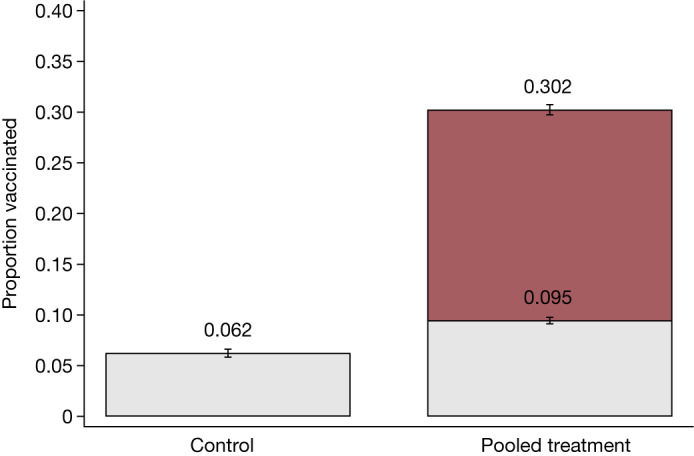
- In 150 communities, the intent-to-treat effect on adult vaccination was 26 percentage points (OLS, P < 0.001, n = 12,096); the text says vaccination rose from 6.2% in control villages to 30.2% in treatment villages.
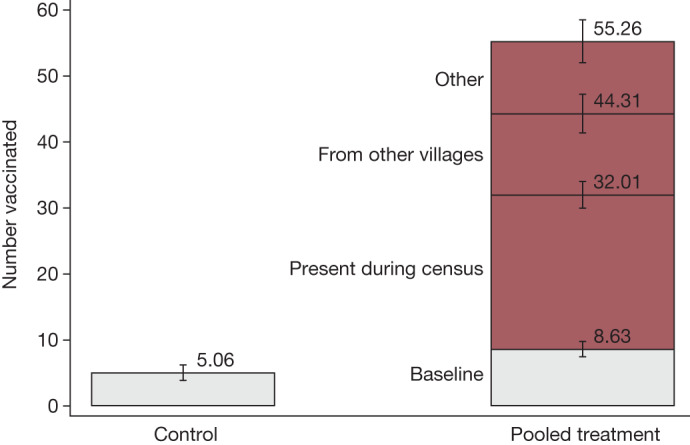
- The number of vaccinated people per treatment site increased from about 9 pre-intervention to about 55 during the 2–3 day intervention window, a 6-fold increase.
- The paper reports that 53% of vaccinated people not captured in the census were visitors from nearby villages, with the remaining 47% being returnees, commuters, or others not in the census.
- The intervention cost was US $33 per person vaccinated; the total cost to reach 100 villages was $156,023.5 (about $1,560 per village), and the authors estimate this would approach $23 per person vaccinated at larger scale.
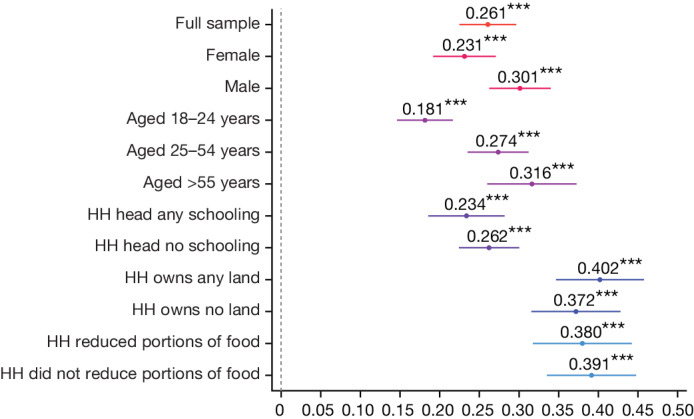
- Heterogeneity: the treatment effect was 7 percentage points larger for men than women and 12 percentage points larger for people >55 than those aged 18–24; no detectable differences were found by education, land ownership, or food security.
Methods
- Design: Pre-registered cluster randomized controlled trial in 150 rural villages in Sierra Leone, with 100 intervention and 50 control communities; intervention villages received mobile vaccination teams plus community mobilization, and treatment villages were further split into door-to-door and small-group outreach.
- Sample/data: Villages were drawn from remote communities outside the 5-mile PHU catchment area; the census covered 29,588 individuals across the 150 villages, and the baseline survey included 2,240 respondents.
- Analysis: Main impacts were estimated with OLS intent-to-treat models with randomization-block fixed effects and village-clustered robust standard errors; the paper also analyzes village-level vaccination counts, knowledge/trust outcomes in a 45-village subsample, and subgroup heterogeneity.
Limitations
- The paper states that the $33 cost per vaccinated person varied substantially across villages because vaccination rates ranged from 0 to 69%.
- The authors note that 2 of the 100 treatment villages did not allow the intervention, which inflates the overall average cost.
- They report large cross-team variation in performance; some teams administered more than twice as many vaccines as others.
- Evident from the text: the study’s primary vaccination-rate outcome is measured over a short 48–72 hour window, so the paper does not establish long-term persistence of uptake.
Model-written summary. Check it against the paper before relying on it.
Integrity signals
Registry
Cites
Statistics
Figures
Verification
Claims the paper makes
10 Valid · 2 Not valid · 9 Not checked · 135 Own results and interpretations
Every source the paper cites for this claim was checked and supports it.
In the paper
“Our study demonstrates that prioritizing mobile services to overcome access difficulties faced by remote populations in developing countries can generate increased returns in terms of uptake of health services3.”
§ Last-mile delivery increases vaccine uptake in Sierra Leone > Abstract
What the sources say
- Supportedcites [3] Partapuri T Steinglass R Sequeira J Integrated delivery of health services during outreach visits: a literature review of program experience through a routine immunization lens J. Infect. Dis. 2012 205 S20 S27 10.1093/infdis/jir771 22315382 PMC3273971 source
The Abstract describes outreach as a way to reach remote populations with limited access to fixed services in lower-income countries. It says outreach can deliver immunization to a large share of the target population and that integrating services may bring rapid uptake of linked interventions. This supports the cited proposition that mobile or outreach services can increase service uptake; the citing authors’ statement about what their own study demonstrates is not attributed to this source. (LLM, conf=0.86)
boostedstates a cause- Asserted: passes — The authors put it forward as true.
- Checkable: passes — It can be checked against evidence.
- Load-bearing: passes — The paper’s conclusions depend on it.
- Based: passes — The paper gives a reason why it holds.
- Supported
Every source the paper cites for this claim was checked and supports it.
In the paper
“By contrast, efforts at community engagement in Bangladesh, including simple acts of taking maternal and child health interventions to rural populations, contributed to increasing the infant vaccination rate from 1% in the early 1980s to more than 70% within 10 years8.”
§ Last-mile delivery increases vaccine uptake in Sierra Leone > Main
What the sources say
- Supportedcites [8] Asadullah MN Savoia A Mahmud W Paths to development: is there a Bangladesh surprise? World Develop. 2014 62 138 154 10.1016/j.worlddev.2014.05.013 source
In Section 3(a) ('Bangladesh's national income'), our copy states verbatim that 'The immunization rate in Bangladesh increased from 1 percent in the early 1980s to over 70 percent within ten years', matching the claim's magnitude and time window. The causal part is supported in Section 4(c) ('Have growth and public infrastructures aided development?'), which credits 'widespread application of community-based approaches (e.g. investment in community health workers)' and NGOs' 'ability to reach the most deprived populations', plus BRAC's OTEP/CSP health workers who mobilized communities and instructed mothers on immunizing children, and the 'NGO-and government-led social campaigns' framed around 'child and maternal wellbeing'. The hedged 'contributed to' is consistent with the paper, which lists community engagement alongside fertility decline and the diarrhoea campaign. (LLM, conf=0.85)
plainstates a cause- Asserted: passes — The authors put it forward as true.
- Checkable: passes — It can be checked against evidence.
- Load-bearing: unclear — It is unclear whether the paper’s conclusions depend on it.
- Based: passes — The paper gives a reason why it holds.
- Supported
The cited sources that could be checked couldn’t confirm or dispute this claim.
In the paper
“However, the highest median effect size was among educational interventions (median = 6.25)19,20.”
§ Last-mile delivery increases vaccine uptake in Sierra Leone > Comparison with other vaccination efforts
What the sources say
- Could not verifycites [19] Usman HR Randomized controlled trial to improve childhood immunization adherence in rural Pakistan: redesigned immunization card and maternal education Trop. Med. Int. Health 2011 16 334 342 10.1111/j.1365-3156.2010.02698.x 21159080 PMC3763701 sourceExperimental — accuracy not yet measured
The Results report risk ratios for individual trial groups, not median effect sizes across intervention categories. The Discussion says the redesigned card was more effective than education alone in this trial, but does not assess which category had the highest median effect size. Searches for “6.25” and “median educational interventions effect size” found no matching result in our copy. (LLM, conf=0.76)
- Could not verifycites [20] Andersson N Evidence-based discussion increases childhood vaccination uptake: a randomised cluster controlled trial of knowledge translation in Pakistan BMC Int. Health Hum. Rights 2009 9 S8 10.1186/1472-698X-9-S1-S8 19828066 PMC3226240 sourceExperimental — accuracy not yet measured
The Results report vaccination outcomes for this trial, not a comparison of effect sizes across intervention types. Searches for “median effect size,” “educational interventions,” and “6.25” found no passage supporting the claimed highest median. (LLM, conf=0.76)
plain- Asserted: passes — The authors put it forward as true.
- Checkable: passes — It can be checked against evidence.
- Load-bearing: unclear — It is unclear whether the paper’s conclusions depend on it.
- Based: passes — The paper gives a reason why it holds.
- Could not verify
Every source the paper cites for this claim was checked and supports it.
In the paper
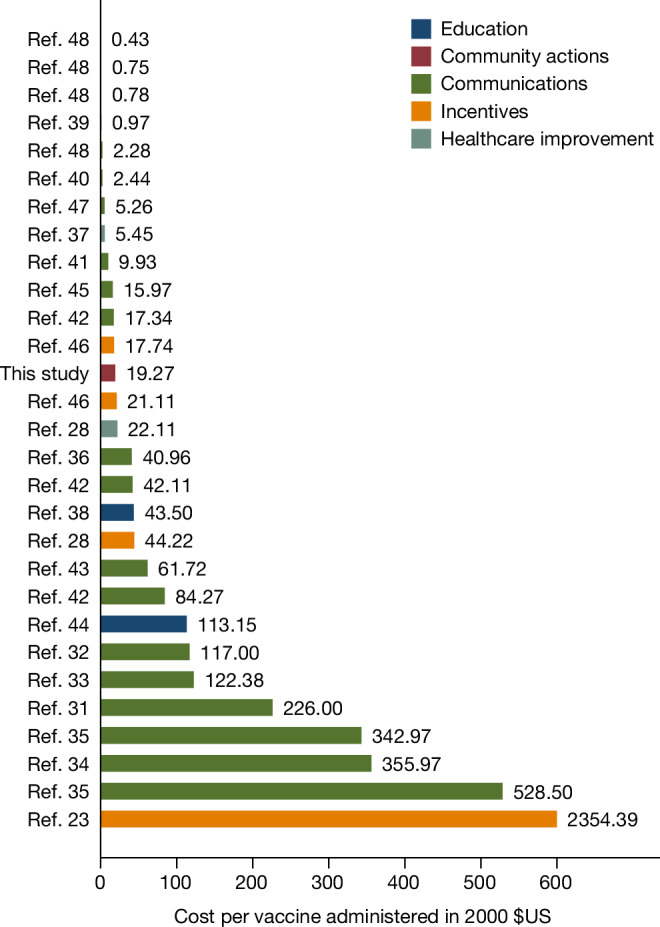
“The only other COVID-19 vaccine study in our review to provide cost information21 offered $24 as a financial incentive to get vaccinated in Sweden.”
§ Last-mile delivery increases vaccine uptake in Sierra Leone > Cost-effectiveness relative to other strategies
What the sources say
- Supportedcites [21] Campos-Mercade P Monetary incentives increase COVID-19 vaccinations Science 2021 374 879 882 10.1126/science.abm0475 34618594 PMC10765478 source
The trial description in the Abstract states that participants in Sweden were offered SEK 200 (about US$24) if they got vaccinated within 30 days. The phrase “only other COVID-19 vaccine study in our review” describes the citing authors’ review, not a finding attributed to this source. (LLM, conf=0.94)
plain- Asserted: passes — The authors put it forward as true.
- Checkable: passes — It can be checked against evidence.
- Load-bearing: unclear — It is unclear whether the paper’s conclusions depend on it.
- Based: passes — The paper gives a reason why it holds.
- Supported
A result the paper reports from its own data — it cites no other source for it, so there is none to check. The quote shows it is in the paper.
In the paper
“A cluster randomized controlled trial in 150 communities showed that this intervention with mobile vaccination teams increased the immunization rate by about 26 percentage points within 48–72 h.”
- Also stated in: § Main · plain
“A cluster randomized controlled trial (RCT) across 150 communities showed that the vaccination rate in treatment villages increased by about 26 percentage points in response to this intervention.”
- Also stated in: § Effects on COVID-19 vaccination rate · plain
“The intent-to-treat effect was 26 percentage points (OLS regression, s.e. = 0.018, P < 0.001, n = 12,096).”
§ Last-mile delivery increases vaccine uptake in Sierra Leone > Abstract
plainstates a causen = 12,096- Asserted: passes — The authors put it forward as true.
- Checkable: passes — It can be checked against evidence.
- Load-bearing: passes — The paper’s conclusions depend on it.
- Based: passes — The paper gives a reason why it holds.
- Also stated in: § Main · plain
53 more claims
Create a free account to see all 156 claims and to verify the 11 references still open.
- Probably not a substantial claim. 69
- It may state two separate claims as one. 48
- The quote only partly states this claim. 1
Self-check
Percentages, sums and reported differences re-computed from the paper’s own numbers.
Each contradiction between two passages listed here was confirmed by an independent check.
Rated minor: it would not touch a result — a value no result rests on, a p-value that stays on the same side of the significance level, or a conflict that is clerical, resolved elsewhere in the paper, or outside its own findings.
In the paper
§ Last-mile delivery increases vaccine uptake in Sierra Leone > Methods > Literature review of vaccination uptake RCT studies
“The final list of 144 articles comprises 234 distinct interventions for which we can report a percentage-point change relative to a control group (Supplementary Table 2).”
§ Last-mile delivery increases vaccine uptake in Sierra Leone > Comparison with other vaccination efforts
“We identified 144 different published RCT studies that report the results of 235 distinct interventions.”
Citations
Cites
Bootstrap-Based Improvements for Inference With Clustered Errors
Cameron, A. C., Gelbach, J. B., & Miller, D. L. (2008) · Review of Economics and Statistics · doi:10.1162/rest.90.3.414 · Cited by 4,417
A global survey of potential acceptance of a COVID-19 vaccine
Lazarus, J. V., Ratzan, S. C., Palayew, A., Gostin, L. O., Larson, H. J., Rabin, K., Kimball, S., & El-Mohandes, A. (2021) · Nature Medicine · doi:10.1038/s41591-020-1124-9 · Cited by 2,904
Anderson, M. L. (2008) · Journal of the American Statistical Association · doi:10.1198/016214508000000841 · Cited by 2,410 · cited 1×
“31 We also report the bootstrapped p-value 32 to account for regressions with a small number of clusters.”
MethodTukey, J. W. (1977) · International Linear Collider · Cited by 2,155
Measuring the impact of COVID-19 vaccine misinformation on vaccination intent in the UK and USA
Loomba, S., de Figueiredo, A., Piatek, S. J., de Graaf, K., & Larson, H. J. (2021) · Nature Human Behaviour · doi:10.1038/s41562-021-01056-1 · Cited by 1,800
COVID-19 vaccine acceptance and hesitancy in low- and middle-income countries
(2021) · doi:10.1038/s41591-021-01454-y · Cited by 1,105
Self-citationChater, N., & Loewenstein, G. (2023) · Behavioral and Brain Sciences · doi:10.1017/s0140525x22002023 · Cited by 710
The online competition between pro- and anti-vaccination views
Johnson, N. F., Velásquez, N., Restrepo, N. J., Leahy, R., Gabriel, N., El Oud, S., Zheng, M., Manrique, P., Wuchty, S., & Lupu, Y. (2020) · Nature · doi:10.1038/s41586-020-2281-1 · Cited by 700
Banerjee, A. V., Duflo, E., Glennerster, R., & Kothari, D. (2010) · BMJ · doi:10.1136/bmj.c2220 · Cited by 508 · cited 3×
“Health infrastructure in the typical African nation is even more fragile than it is in India.”
BackgroundUsing implementation intentions prompts to enhance influenza vaccination rates
Milkman, K. L., Beshears, J., Choi, J. J., Laibson, D., & Madrian, B. C. (2011) · Proceedings of the National Academy of Sciences · doi:10.1073/pnas.1103170108 · Cited by 498
Sharma, M., Ying, R., Tarr, G., & Barnabas, R. (2015) · Nature · doi:10.1038/nature16044 · Cited by 491 · cited 1×
“The mobile delivery concept has produced large effects on HIV testing, 13 but rigorously demonstrating effectiveness in vaccine delivery is critical, given the persistent low rates of vaccination in low-income countries.”
BackgroundEgger, D., Miguel, E., Warren, S. S., Shenoy, A., Collins, E., Karlan, D., Parkerson, D., Mobarak, A. M., Fink, G., Udry, C., et al. (2021) · Science Advances · doi:10.1126/sciadv.abe0997 · Cited by 462 · cited 2×
“In the results Extended Data Tables 3, 4, 6 and 7, we also adjust for the fact that we conduct multiple tests on the same dataset by implementing false discovery rate (FDR) corrections and report the FDR q-values.”
MethodSelf-citationBehavioural nudges increase COVID-19 vaccinations
Dai, H., Saccardo, S., Han, M. A., Roh, L., Raja, N., Vangala, S., Modi, H., Pandya, S., Sloyan, M., & Croymans, D. M. (2021) · Nature · doi:10.1038/s41586-021-03843-2 · Cited by 462 · cited 1×
“Text-based reminders in the U.S. 25,26 and defaulting people into a vaccination appointment in Italy (so that they are forced to opt out) 27 increase vaccination rates between 0 and 3.5 percentage points.”
BackgroundInfluentialMilkman, K. L., Patel, M. S., Gandhi, L., Graci, H. N., Gromet, D. M., Ho, H., Kay, J. S., Lee, T. W., Akinola, M., Beshears, J., et al. (2021) · Proceedings of the National Academy of Sciences · doi:10.1073/pnas.2101165118 · Cited by 372
Monetary incentives increase COVID-19 vaccinations
Campos-Mercade, P., Meier, A. N., Schneider, F. H., Meier, S., Pope, D., & Wengström, E. (2021) · Science · doi:10.1126/science.abm0475 · Cited by 306 · cited 1×
“A study in Sweden 21 offered monetary rewards of US$24 to get a COVID-19 vaccine, and this increases the vaccination rate by an extra 4 percentage points, from 72% to 76%.”
BackgroundNo evidence for nudging after adjusting for publication bias
Maier, M., Bartoš, F., Stanley, T. D., Shanks, D. R., Harris, A. J. L., & Wagenmakers, E.-J. (2022) · Proceedings of the National Academy of Sciences · doi:10.1073/pnas.2200300119 · Cited by 284
Opting In vs Opting Out of Influenza Vaccination
Chapman, G. B., Li, M., Colby, H., & Yoon, H. (2010) · JAMA · doi:10.1001/jama.2010.892 · Cited by 266
A 680,000-person megastudy of nudges to encourage vaccination in pharmacies
Milkman, K. L., Gandhi, L., Patel, M. S., Graci, H. N., Gromet, D. M., Ho, H., Kay, J. S., Lee, T. W., Rothschild, J., Bogard, J. E., et al. (2022) · Proceedings of the National Academy of Sciences · doi:10.1073/pnas.2115126119 · Cited by 192
RCTs to Scale: Comprehensive Evidence from Two Nudge Units
DellaVigna, S., & Linos, E. (2020) · National Bureau of Economic Research · doi:10.3386/w27594 · Cited by 189
Owais, A., Hanif, B., Siddiqui, A. R., Agha, A., & Zaidi, A. K. (2011) · BMC Public Health · doi:10.1186/1471-2458-11-239 · Cited by 185
Equitable access to COVID-19 vaccines makes a life-saving difference to all countries
Ye, Y., Zhang, Q., Wei, X., Cao, Z., Yuan, H., & Zeng, D. D. (2022) · Nature Human Behaviour · doi:10.1038/s41562-022-01289-8 · Cited by 162 · cited 1×
“10,11 Our implementation efforts taught us that Sierra Leone MoHS needed to engage in “learning by doing” to develop novel distribution systems to reach remote populations with those doses.”
BackgroundBangure, D., Chirundu, D., Gombe, N., Marufu, T., Mandozana, G., Tshimanga, M., & Takundwa, L. (2015) · BMC Public Health · doi:10.1186/s12889-015-1470-6 · Cited by 160
Uddin, M. J., Shamsuzzaman, M., Horng, L., Labrique, A., Vasudevan, L., Zeller, K., Chowdhury, M., Larson, C. P., Bishai, D., & Alam, N. (2016) · Vaccine · doi:10.1016/j.vaccine.2015.11.024 · Cited by 155
Paths to Development: Is there a Bangladesh Surprise?
Asadullah, M. N., Savoia, A., & Mahmud, W. (2014) · World Development · doi:10.1016/j.worlddev.2014.05.013 · Cited by 141
Islam, S., Islam, T., & Islam, M. R. (2022) · Clinical Pathology · doi:10.1177/2632010x221075584 · Cited by 136
Stockwell, M. S., Westhoff, C., Kharbanda, E. O., Vargas, C. Y., Camargo, S., Vawdrey, D. K., & Castaño, P. M. (2014) · American Journal of Public Health · doi:10.2105/ajph.2013.301620 · Cited by 131
Szilagyi, P. G., Albertin, C. S., Humiston, S. G., Rand, C. M., Schaffer, S. J., Brill, H., Stankaitis, J. A., Yoo, B., Blumkin, A. K., & Stokley, S. K. (2013) · Academic Pediatrics · doi:10.1016/j.acap.2013.01.002 · Cited by 120
Randomized Controlled Trial of Text Message Reminders for Increasing Influenza Vaccination
Regan, A. K., Bloomfield, L., Peters, I., & Effler, P. V. (2017) · The Annals of Family Medicine · doi:10.1370/afm.2120 · Cited by 113
Andersson, N., Cockcroft, A., Ansari, N. M., Omer, K., Baloch, M., Ho Foster, A., Shea, B., Wells, G. A., & Soberanis, J. L. (2009) · BMC International Health and Human Rights · doi:10.1186/1472-698x-9-s1-s8 · Cited by 107 · cited 1×
“19,20 The intervention we conducted in Sierra Leone – where mobile health teams visit remote communities for 48-72 hours to ease their access burden – produces a larger percentage point effect size than 223 (95”
BackgroundPandey, P., Sehgal, A. R., Riboud, M., Levine, D., & Goyal, M. (2007) · JAMA · doi:10.1001/jama.298.16.1867 · Cited by 104
Habib, M. A., Soofi, S., Cousens, S., Anwar, S., Haque, N. U., Ahmed, I., Ali, N., Tahir, R., & Bhutta, Z. A. (2017) · The Lancet Global Health · doi:10.1016/s2214-109x(17)30184-5 · Cited by 102
Jacobson, M., Chang, T., Shah, M., Pramanik, R., & Shah, S. B. (2022) · Vaccine · doi:10.1016/j.vaccine.2022.08.060 · Cited by 101
Szilagyi, P. G., Humiston, S. G., Gallivan, S., Albertin, C., Sandler, M., & Blumkin, A. (2011) · Archives of Pediatrics & Adolescent Medicine · doi:10.1001/archpediatrics.2011.73 · Cited by 93
Letters designed with behavioural science increase influenza vaccination in Medicare beneficiaries
Yokum, D. V., Lauffenburger, J. C., Ghazinouri, R., & Choudhry, N. K. (2018) · Nature Human Behaviour · doi:10.1038/s41562-018-0432-2 · Cited by 92
Usman, H. R., Rahbar, M. H., Kristensen, S., Vermund, S. H., Kirby, R. S., Habib, F., & Chamot, E. (2011) · Tropical Medicine & International Health · doi:10.1111/j.1365-3156.2010.02698.x · Cited by 89
Chang, T., Jacobson, M., Shah, M., Pramanik, R., & Shah, S. (2021) · doi:10.3386/w29403 · Cited by 78 · cited 1×
“22 City and state-wide lotteries offering financial rewards in the United States 23,24 produced very small or negative effects.”
BackgroundKrieger, J. W., Castorina, J., Walls, M. L., Weaver, M. R., & Ciske, S. J. (2000) · American Journal of Preventive Medicine · doi:10.1016/s0749-3797(99)00134-8 · Cited by 77
The impact of computer-generated messages on childhood immunization coverage
Dini, E. F., Linkins, R. W., & Sigafoos, J. (2000) · American Journal of Preventive Medicine · doi:10.1016/s0749-3797(99)00086-0 · Cited by 74
Lugada, E., Millar, D., Haskew, J., Grabowsky, M., Garg, N., Vestergaard, M., Kahn, J., Muraguri, N., & Mermin, J. (2010) · PLoS ONE · doi:10.1371/journal.pone.0012435 · Cited by 73
End COVID-19 in low- and middle-income countries
Mobarak, A. M., Miguel, E., Abaluck, J., Ahuja, A., Alsan, M., Banerjee, A., Breza, E., Chandrasekhar, A. G., Duflo, E., Dzansi, J., et al. (2022) · Science · doi:10.1126/science.abo4089 · Cited by 68 · cited 1×
“In the results Extended Data Tables 3, 4, 6 and 7, we also adjust for the fact that we conduct multiple tests on the same dataset by implementing false discovery rate (FDR) corrections and report the FDR q-values.”
MethodSelf-citationEvidence from a statewide vaccination RCT shows the limits of nudges
Rabb, N., Swindal, M., Glick, D., Bowers, J., Tomasulo, A., Oyelami, Z., Wilson, K. H., & Yokum, D. (2022) · Nature · doi:10.1038/s41586-022-04526-2 · Cited by 63 · cited 1×
“Text-based reminders in the U.S. 25,26 and defaulting people into a vaccination appointment in Italy (so that they are forced to opt out) 27 increase vaccination rates between 0 and 3.5 percentage points.”
BackgroundInfluentialOyo-Ita, A. E., Bosch‐Capblanch, X., Ross, A. J., Oku, A. O., Esu, E., Ameh, S., Oduwole, O. A., Arikpo, D., & Meremikwu, M. M. (2021) · PLoS ONE · doi:10.1371/journal.pone.0248236 · Cited by 63
Effectiveness and Cost of Bidirectional Text Messaging for Adolescent Vaccines and Well Care
O'Leary, S. T., Lee, M., Lockhart, S., Eisert, S., Furniss, A., Barnard, J., Shmueli, D., Stokley, S., Dickinson, L. M., & Kempe, A. (2015) · Pediatrics · doi:10.1542/peds.2015-1089 · Cited by 60
Herrett, E. L., Williamson, E., van Staa, T. P., Rañopa, M., Free, C., Chadborn, T., Goldacre, B. M., & Smeeth, L. L. (2016) · BMJ Open · doi:10.1136/bmjopen-2015-010069 · Cited by 60 · cited 1×
“Two studies reported the cost in currencies other than USD, 33,34 and these costs were converted to USD equivalent for the year the study was published, using exchange rate data from the respective countries’ national statistics agencies.”
MethodPowell‐Jackson, T., Fabbri, C., Dutt, V., Tougher, S., & Singh, K. (2018) · PLoS Medicine · doi:10.1371/journal.pmed.1002519 · Cited by 52
Pramanik, S., Ghosh, A., Nanda, R. B., de Rouw, M., Forth, P., & Albert, S. (2018) · BMC Public Health · doi:10.1186/s12889-018-5458-x · Cited by 47
A citywide experiment testing the impact of geographically targeted, high-pay-off vaccine lotteries
Milkman, K. L., Gandhi, L., Ellis, S. F., Graci, H. N., Gromet, D. M., Mobarak, R. S., Buttenheim, A. M., Duckworth, A. L., Pope, D., Stanford, A., et al. (2022) · Nature Human Behaviour · doi:10.1038/s41562-022-01437-0 · Cited by 44 · cited 2×
“A financial incentive of US$10-50 combined with other nudges in the United States did not produce any effect.”
BackgroundDid you get your shots? Experimental evidence on the role of reminders
Busso, M., Cristia, J., & Humpage, S. D. (2015) · Journal of Health Economics · doi:10.1016/j.jhealeco.2015.08.005 · Cited by 43
Kawakatsu, Y., Adesina, A. O., Kadoi, N., & Aiga, H. (2020) · Vaccine · doi:10.1016/j.vaccine.2020.07.075 · Cited by 39
Optimal Design of Population-Level Financial Incentives of Influenza Vaccination for the Elderly
Yue, M., Wang, Y., Low, C. K., Yoong, J., & Cook, A. R. (2019) · Value in Health · doi:10.1016/j.jval.2019.08.006 · Cited by 38 · cited 1×
“Two studies reported the cost in currencies other than USD, 33,34 and these costs were converted to USD equivalent for the year the study was published, using exchange rate data from the respective countries’ national statistics agencies.”
MethodPartapuri, T., Steinglass, R., & Sequeira, J. (2012) · Journal of Infectious Diseases · doi:10.1093/infdis/jir771 · Cited by 37
Increasing pneumococcal vaccination in managed care through telephone outreach.
Winston, C. A., Mims, A. D., & Leatherwood, K. A. (2007) · PubMed · Cited by 36
Remove barriers to technology adoption for people in poverty
Mobarak, A. M., & Saldanha, N. A. (2022) · Nature Human Behaviour · doi:10.1038/s41562-022-01323-9 · Cited by 33
Self-citationRCT of Centralized Vaccine Reminder/Recall for Adults
Hurley, L. P., Beaty, B. L., Lockhart, S., Gurfinkel, D., Breslin, K. D., Dickinson, M., Whittington, M. D., Roth, H., & Kempe, A. (2018) · American Journal of Preventive Medicine · doi:10.1016/j.amepre.2018.04.022 · Cited by 32
Did Ohio’s Vaccine Lottery Increase Vaccination Rates? A Pre-Registered, Synthetic Control Study
Lang, D., Esbenshade, L., & Willer, R. (2023) · Journal of Experimental Political Science · doi:10.1017/xps.2021.32 · Cited by 31 · cited 1×
“22 City and state-wide lotteries offering financial rewards in the United States 23,24 produced very small or negative effects.”
BackgroundNudging COVID-19 Vaccine Uptake by Changing the Default: A Randomized Controlled Trial
Tentori, K., Pighin, S., Giovanazzi, G., Grignolio, A., Timberlake, B., & Ferro, A. (2022) · Medical Decision Making · doi:10.1177/0272989x221101536 · Cited by 31
Kagucia, E. W., Ochieng, B. O., Were, J. A., Hayford, K. T., Obor, D., O’Brien, K. L., & Gibson, D. G. (2021) · BMJ Global Health · doi:10.1136/bmjgh-2020-003357 · Cited by 31
Access to COVID-19 Vaccines in High-, Middle-, and Low-Income Countries Hosting Clinical Trials
Ramachandran, R., Ross, J. S., & Miller, J. E. (2021) · JAMA Network Open · doi:10.1001/jamanetworkopen.2021.34233 · Cited by 28
Szilagyi, P. G., Albertin, C. S., Gurfinkel, D., Beaty, B. L., Zhou, X., Vangala, S., Rice, J. D., Campbell, J. D., Whittington, M. D., Valderrama, R., et al. (2020) · PEDIATRICS · doi:10.1542/peds.2019-2689 · Cited by 27
Kempe, A., Saville, A. W., Beaty, B. L., Dickinson, L. M., Gurfinkel, D., Eisert, S. L., Roth, H., Herrero, D., Trefren, L., & Herlihy, R. (2016) · Academic Pediatrics · doi:10.1016/j.acap.2016.11.016 · Cited by 25
Sengupta, P., Benjamin, A. I., Myles, P. R., & Babu, B. V. (2017) · Journal of Public Health · doi:10.1093/pubmed/fdw131 · Cited by 25 · cited 1×
“16,17,18 Figure 6 demonstrates the immense heterogeneity of effect sizes across those 234 different treatments.”
BackgroundGurfinkel, D., Kempe, A., Albertin, C. S., Breck, A., Zhou, X., Vangala, S., Beaty, B. L., Rice, J. D., Tseng, C., Campbell, J. D., et al. (2021) · Journal of Adolescent Health · doi:10.1016/j.jadohealth.2021.02.023 · Cited by 18
Increasing influenza vaccine uptake in children: A randomised controlled trial
Yeung, K. H. T., Tarrant, M., Chan, K. C. C., Tam, W. H., & Nelson, E. A. S. (2018) · Vaccine · doi:10.1016/j.vaccine.2018.07.066 · Cited by 17
Yoo, B., Humiston, S. G., Szilagyi, P. G., Schaffer, S. J., LONG, C. E., & Kolasa, M. (2015) · BMC Health Services Research · doi:10.1186/s12913-015-1169-5 · Cited by 15
Worldwide vaccine inequality threatens to unleash the next COVID-19 variant
Oehler, R. L., & Vega, V. R. (2022) · International Journal of Infectious Diseases · doi:10.1016/j.ijid.2022.08.010 · Cited by 14 · cited 1×
“In the results Extended Data Tables 3, 4, 6 and 7, we also adjust for the fact that we conduct multiple tests on the same dataset by implementing false discovery rate (FDR) corrections and report the FDR q-values.”
MethodKulle, A.-C., Schumacher, S., & von Bieberstein, F. (2024) · Journal of Public Health · doi:10.1093/pubmed/fdad213 · Cited by 13 · cited 1×
“12 This implies that we may need to further emphasize access interventions if we are to increase the global vaccination rate and improve vaccine equity.”
BackgroundNo reason to expect large and consistent effects of nudge interventionsPreprint
Szászi, B., Higney, A., Charlton, A., Gelman, A., Ziano, I., Aczél, B., Goldstein, D. G., Yeager, D. S., & Tipton, E. (2022) · doi:10.31234/osf.io/mwhf3 · Cited by 13
Ateudjieu, J., Tchio-Nighie, K. H., Goura, A. P., Ndinakie, M. Y., Dieffi Tchifou, M., Amada, L., Tsafack, M., Kiadjieu Dieumo, F. F., Guenou, E., Nangue, C., et al. (2022) · JMIR Public Health and Surveillance · doi:10.2196/32213 · Cited by 8 · cited 1×
“16,17,18 Figure 6 demonstrates the immense heterogeneity of effect sizes across those 234 different treatments.”
BackgroundDefault change nudges Covid-19 vaccine uptake: a randomized controlled trialPreprint
Tentori, K., Pighin, S., Giovanazzi, G., Grignolio, A., Timberlake, B., & Ferro, A. M. (2021) · doi:10.31234/osf.io/9bsjg · Cited by 3
(2014) · Institutional Repository University of Antioquia (University of Antioquia) · doi:10.1371/journal.pone
Research works printed but not linked: 2
- Herrett E Text messaging reminders for influenza vaccine in primary care: a cluster randomised controlled trial (TXT4FLUJAB) BMJ Open 2016 6 e010069 10.1136/bmjopen-2015-010069 26895984 PMC4762100 · DOI
- Yue M Optimal design of population-level financial incentives of influenza vaccination for the elderly Value Health 2020 23 200 208 10.1016/j.jval.2019.08.006 32113625 · DOI
Cited by
Hierarchical Ceramic Nanofibrous Aerogels for Universal Passive Radiative Cooling
Lan, P., Hwang, C., Chen, T., et al. (2024) · Advanced Functional Materials · doi:10.1002/adfm.202410285 · Cited by 62
Megastudy shows that reminders boost vaccination but adding free rides does not
Milkman, K. L., Ellis, S. F., Gromet, D. M., Jung, Y., Luscher, A. S., Mobarak, R. S., Paxson, M. K., Zumaran, R. A. S., Kuan, R., Berman, R., et al. (2024) · Nature · doi:10.1038/s41586-024-07591-x · Cited by 47
“Our findings also speak only to the benefit of providing free rides to vaccination sites and not to the benefits of finding other ways to increase the ease of vaccine access, such as bringing mobile vaccination clinics to remote communities 67 , which proved efficacious in Sierra Leone.”
The Economics of Infectious Diseases
Auld, M. C., Fenichel, E. P., & Toxvaerd, F. (2025) · Journal of Economic Literature · doi:10.1257/jel.20241649 · Cited by 10
Trends and inequalities in full immunisation coverage among one-year-olds in Sierra Leone, 2008–2019
Osborne, A., Bangura, C., Sesay, U., & Ahinkorah, B. O. (2025) · BMC Pediatrics · doi:10.1186/s12887-025-05644-2 · Cited by 5
Optimising human rabies vaccine supply chains: A modelling study
Luka, M. M., Ferguson, E. A., Rees, E. M., et al. (2025) · Vaccine · doi:10.1016/j.vaccine.2025.127108 · Cited by 5
Metadata
- Authors
- Meriggi, N. F., Voors, M., Levine, M., Ramakrishna, V., Kangbai, D. M., Rozelle, M., Tyler, E., Kallon, S., Nabieu, J., Cundy, S., & Mobarak, A. M.
- Affiliations
- University of Oxford (GB)
- Wageningen University & Research (NL)
- University of Illinois Urbana-Champaign (US)
- Boston University (US)
- Ministry of Health and Sanitation (SL)
- University of Sierra Leone (SL)
- Yale University (US)
- Corresponding author
- Meriggi, Niccolò F.
- Mobarak, Ahmed Mushfiq
- Venue
- Nature
- Published
- 2024-03-13
- Volume
- 627
- Issue
- 8004
- Pages
- 612-619
- ISSN
- 0028-0836 (ISSN-L)
- 1476-4687
- PMC
- PMC10954551
- OpenAlex
- W4392747566
- Cited by
- 36
- References
- 52
- Citations by year
- 2026: 11 · 2025: 14 · 2024: 7
- FWCI
- 14.44
- Type
- journal article
- Language
- en
- Open access
- hybrid
- doi.org
- Licence
- cc-by
- creativecommons.org/licenses/by/4.0 (tdm)
- creativecommons.org/licenses/by/4.0 (vor)
- Locations
- Nature (publishedVersion, cc-by)
- Research Square (acceptedVersion, cc-by)
- PubMed (publishedVersion)
- Socio-Environmental Systems Modeling (submittedVersion, cc-by)
- RePEc: Research Papers in Economics (submittedVersion)
- Figshare (submittedVersion, cc-by)
- Funders
- Yale University
- International Growth Centre
- UK Research and Innovation
- Nederlandse Organisatie voor Wetenschappelijk Onderzoek (VI.Vidi.191.154, 21148)
- Topics
- Social Sciences › Health › Vaccine Coverage and Hesitancy
- Health Sciences › Health Professions › General Health Professions › Health Policy Implementation Science
- Social Sciences › Health › Public Health and Social Inequalities
- Keywords
- last-mile delivery, COVID-19 vaccination, vaccine uptake, mobile vaccination teams, rural healthcare access, community mobilization, vaccination coverage, implementation costs, transportation costs, Sierra Leone
- MeSH terms
- Vaccination Coverage, COVID-19, COVID-19 Vaccines, Vaccination Hesitancy, Adult, Child, Community Health Services, Female, Humans, Mobile Health Units, Mothers, Sierra Leone, Transportation, Rural Health Services, Mass Vaccination
About these checks
Registry, retraction, Cites and statistics results are computed, not judged, with one exception: a printed reference that no index lists is read once by a model before it counts as a citation error. Claims are extracted by a model and kept only when their quote appears verbatim in the text; each cited source is then checked, with a model’s help, for whether it says what the claim relies on. Those verdicts can be wrong — read the claim’s quote and the cited source before relying on one.
The claim verdicts this report counts are experimental: their accuracy is not yet measured.
A language model drew the claims from the paper on 2026-10-10, under version 3 of the claim definition (model deepseek-v4.1-flash, prompt extract-v3).
A second model labelled each claim on 2026-10-10 (model jev-1.13-20260917, definition revision gold-guideline-v0.2).
Cited sources are checked with a language model’s help (gpt-6-sol and qwen3.8-omni-flash).
Statistics and arithmetic are recomputed, not judged.
Confidence bands are shown only for fields calibrated on our annotated test set. None is calibrated yet, so no band is shown.
What counts as a claim ›How we measure confidence ›How we check this ›
Are you an author, or do you see a problem with this page? Request a review
Data sources
Bibliographic data: Semantic Scholar, OpenAlex, Crossref.
Contains information from the Semantic Scholar Academic Graph Datasets, made available under the ODC Attribution License (ODC-BY 1.0).
Semantic Scholar’s data is described in: Kinney, R., et al. (2023). The Semantic Scholar Open Data Platform. arXiv:2301.10140.
