

Network statistics of the whole-brain connectome of Drosophila
Open accessThe DOI matches its Crossref record; 113 of the 114 references it cites were found in a registry or an index; 68 of the 76 sources its claims cite were checked for support.
Abstract
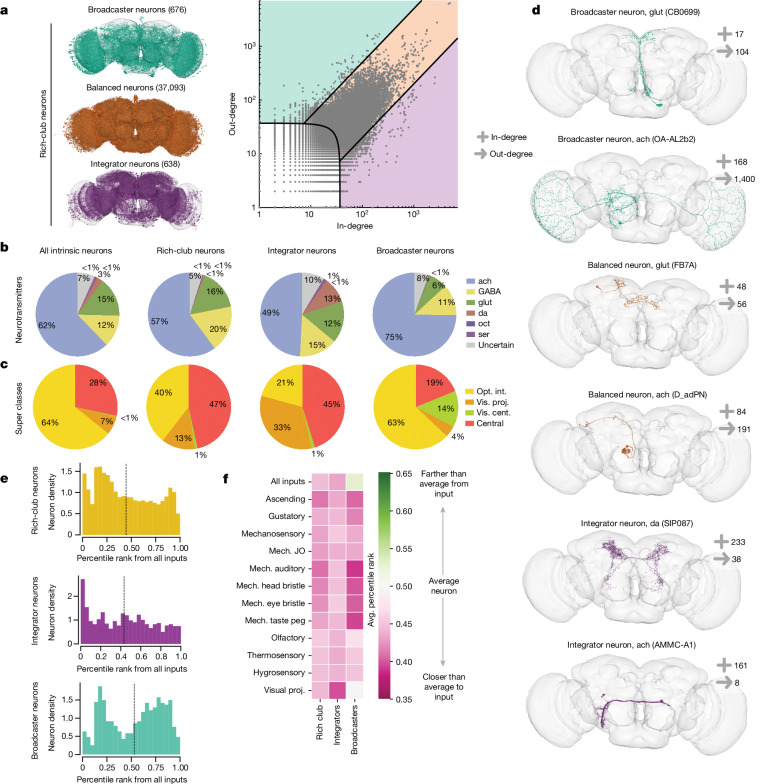
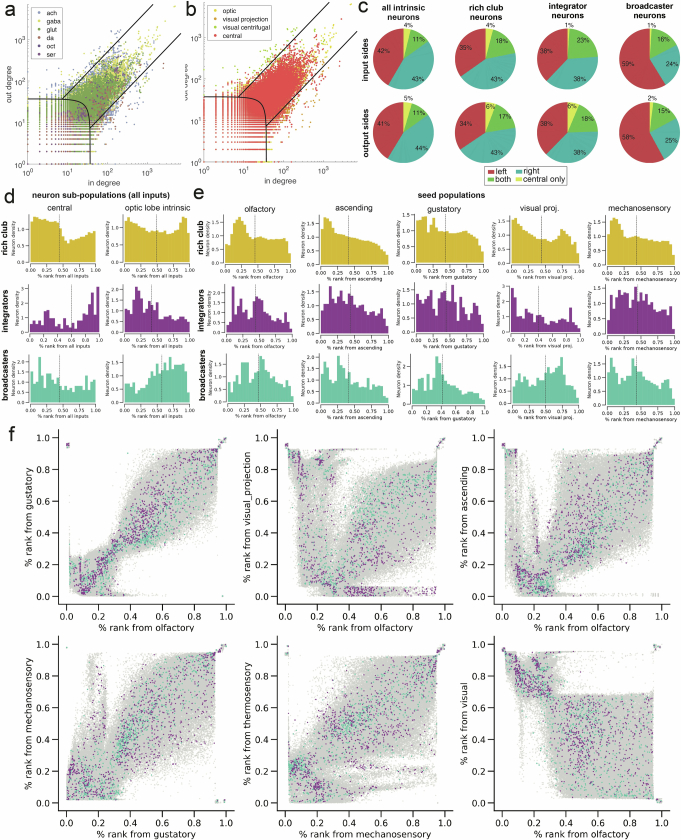
Brains comprise complex networks of neurons and connections, similar to the nodes and edges of artificial networks. Network analysis applied to the wiring diagrams of brains can offer insights into how they support computations and regulate the flow of information underlying perception and behaviour. The completion of the first whole-brain connectome of an adult fly, containing over 130,000 neurons and millions of synaptic connections1–3, offers an opportunity to analyse the statistical properties and topological features of a complete brain. Here we computed the prevalence of two- and three-node motifs, examined their strengths, related this information to both neurotransmitter composition and cell type annotations4,5, and compared these metrics with wiring diagrams of other animals. We found that the network of the fly brain displays rich-club organization, with a large population (30% of the connectome) of highly connected neurons. We identified subsets of rich-club neurons that may serve as integrators or broadcasters of signals. Finally, we examined subnetworks based on 78 anatomically defined brain regions or neuropils. These data products are shared within the FlyWire Codex ( https://codex.flywire.ai ) and should serve as a foundation for models and experiments exploring the relationship between neural activity and anatomical structure. The network of the fly brain is highly recurrent and displays rich-club organization, with a large population (30%) of preferentially connected neurons.
Overview
CoChat Summary
## TL;DR
This paper analyzes the first complete adult Drosophila brain connectome as a directed weighted network and finds that, despite sparsity, the fly brain is highly interconnected, small-world, and rich-club organized. It also shows that reciprocal, recurrent, and motif-based structure varies by neurotransmitter composition and across neuropils.
## Key findings
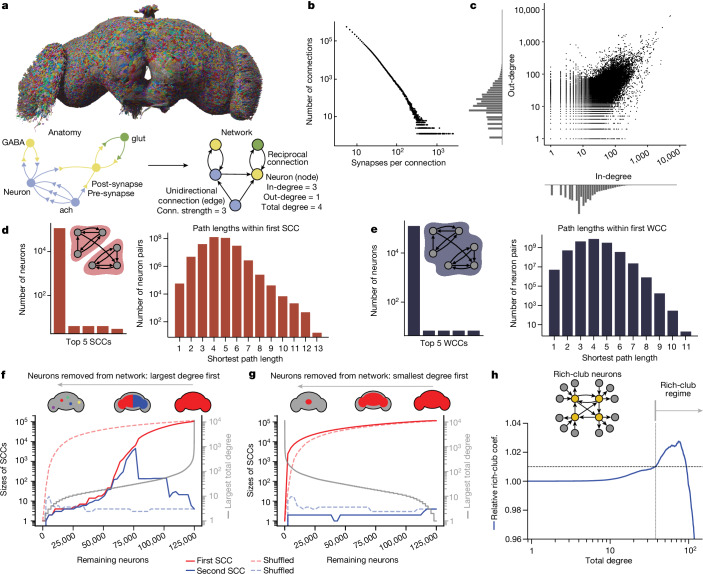
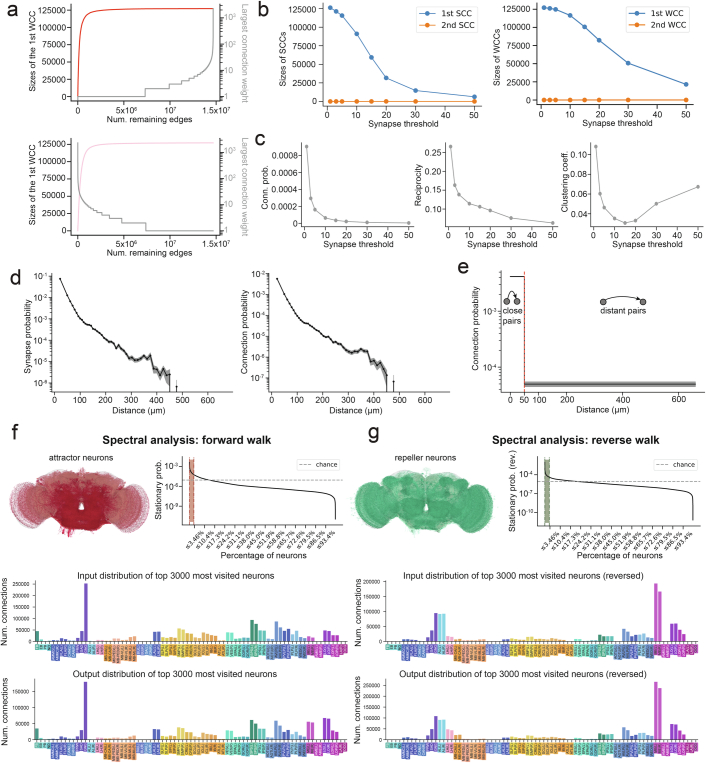
- The v630 connectome snapshot analyzed here contains 127,978 neurons and 2,613,129 thresholded connections; 93.3% of neurons are in one strongly connected component and 98.8% in one weakly connected component.
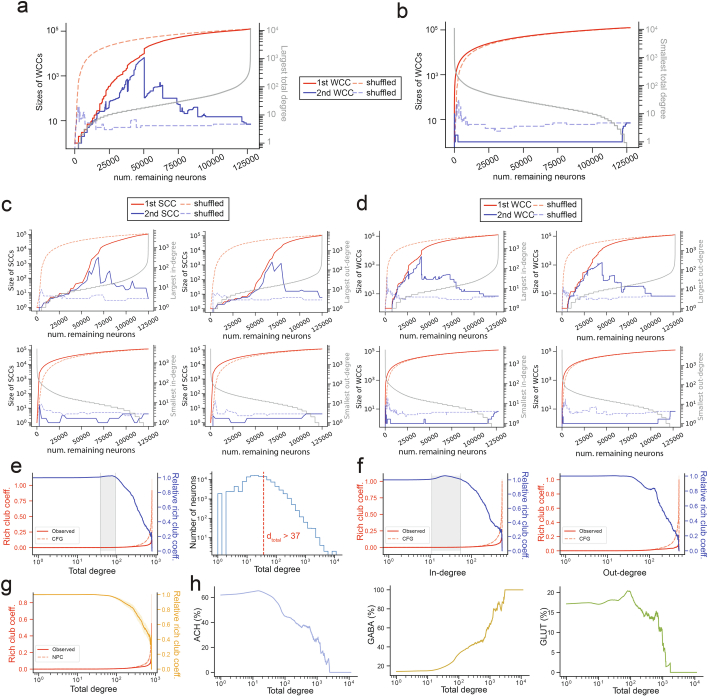
- The fly brain shows a rich-club regime with a total-degree cutoff of 37, containing 40,218 neurons (~30% of the connectome); the connection probability within the rich club is 0.000870, or 5.4× the overall probability.
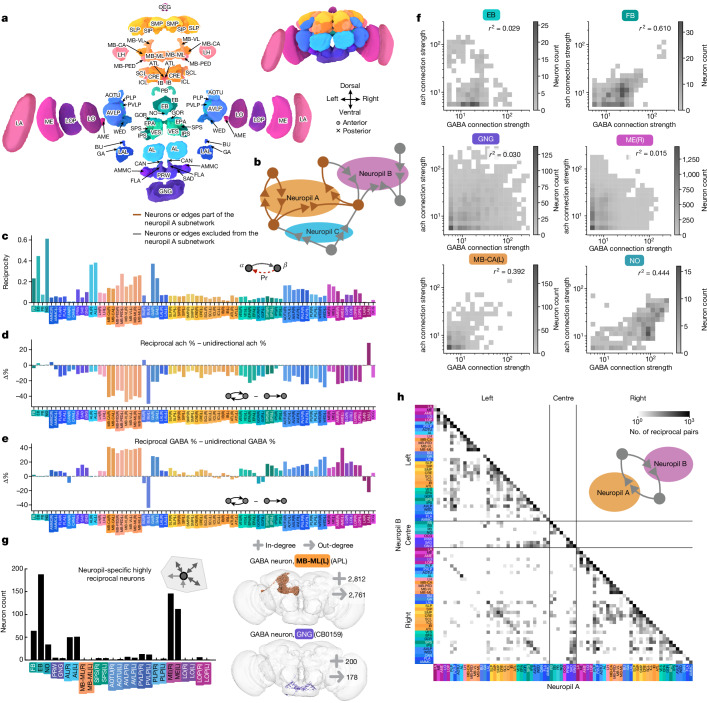
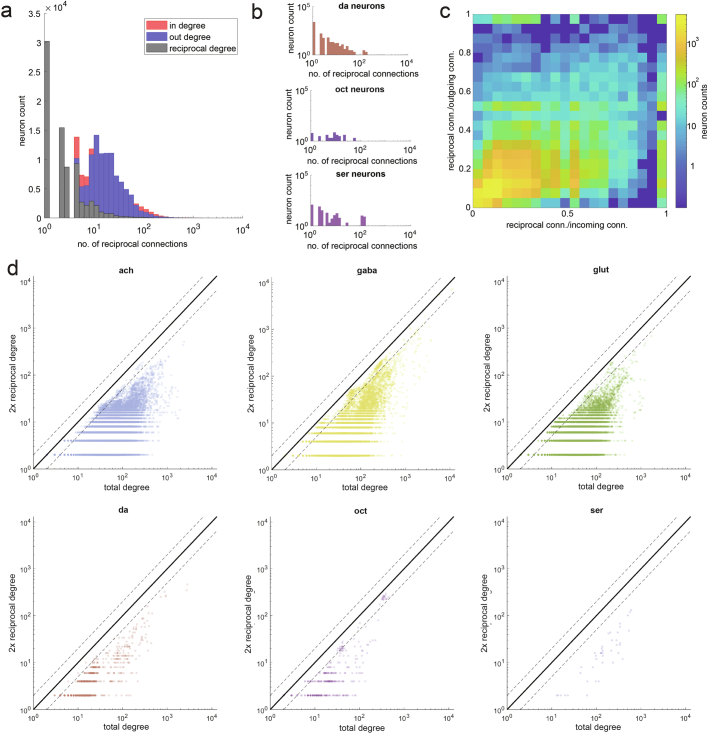
- Recurrence is widespread: reciprocity across the brain is 0.138, the clustering coefficient is 0.0477, and the small-worldness coefficient is SΔ = 141.
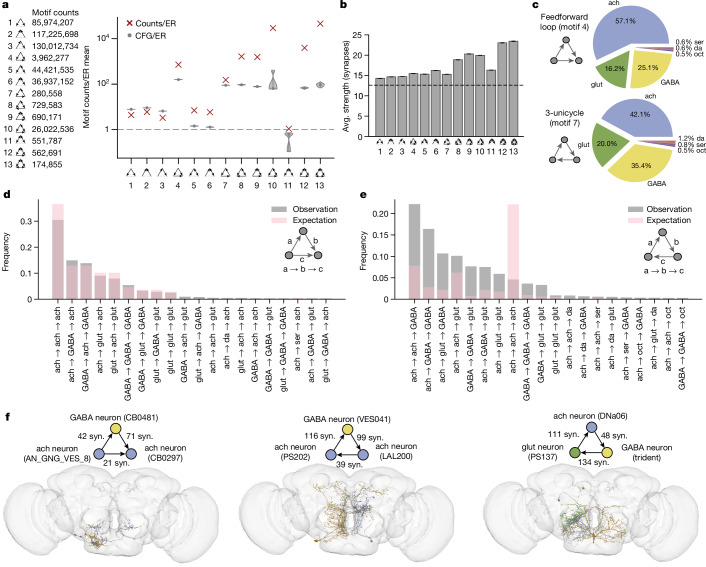
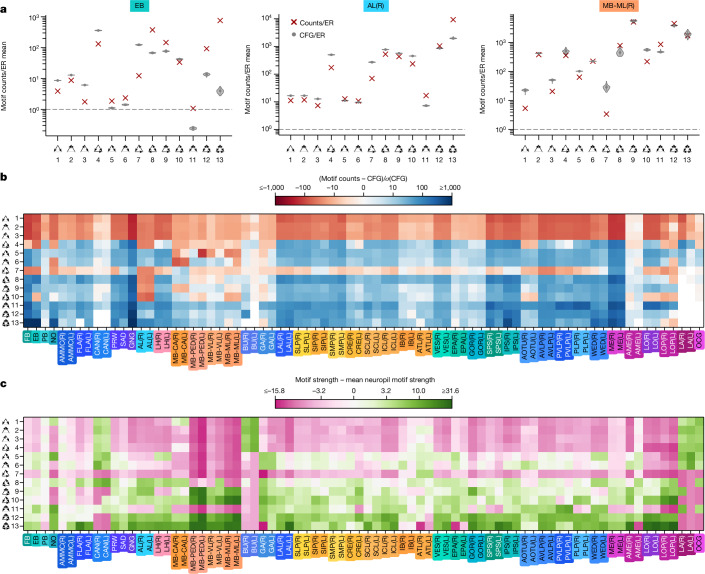
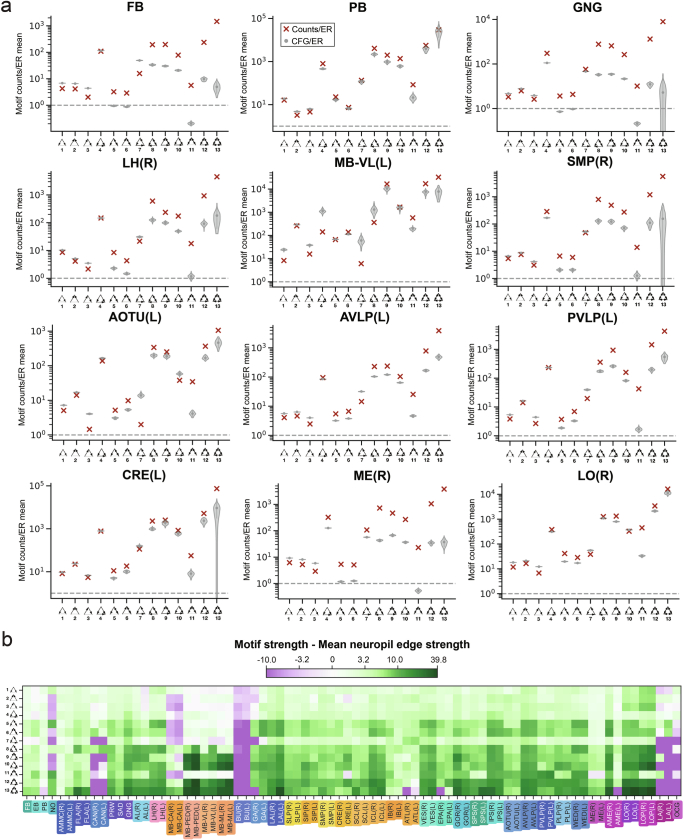
- Motif analyses show that feedforward motifs (1–3) are under-represented, while complex/recurrent motifs (7–13) are over-represented; 3% of neurons were visited 61.2% of the time in the forward random-walk stationary distribution, and 3% were visited 42.4% of the time in the reverse walk.
## Methods
- The study analyzes the v630 snapshot of the FlyWire Drosophila connectome as a directed weighted graph, using a five-synapse threshold per connection for most analyses and comparing results to ER, CFG, NND, and NPC null models.
- The dataset is from a 7-day-old adult female D. melanogaster; analyses use synapse-detected, community-proofread EM reconstructions with 78 neuropils and neurotransmitter predictions for six neurotransmitters.
- Main analyses include connected components, spectral random-walk analysis, rich-club detection, reciprocity/clustering/small-worldness, three-node motif counts, neurotransmitter composition of motifs, neuropil subnetworks, and probabilistic flow-based ranking relative to sensory inputs.
## Limitations
- The paper states that neurotransmitter predictions are 94% accurate but can misidentify some neurons; it manually corrected Kenyon cells and notes that other systematic misidentifications may remain.
- The authors explicitly note that the synaptic connectome is incomplete as a picture of information flow because they do not have gap junction maps or the extent of neuropeptide signaling.
- They also say that results are sensitive to the synapse threshold and that automated synapse detection has a non-negligible error rate; this is a limitation stated in the paper.
- Evident from the text: the analyzed snapshot is not fully complete at publication time, since the optic lobes were only ~80% complete in v630 and many missing neurons were photoreceptors.
Model-written summary. Check it against the paper before relying on it.
Integrity signals
Registry
Cites
Statistics
Figures
Verification
Claims the paper makes
33 Valid · 11 Not valid · 3 Not checked · 172 Own results and interpretations
Some cited sources support this claim and some don’t — read each source’s verdict below.
In the paper
“A high clustering coefficient and an over-representation of highly connected motifs suggest that the local structure of the brain displays a high degree of non-randomness, consistent with previous studies in C. elegans7,21 and in the mouse cortex11,24,25.”
§ Network statistics of the whole-brain connectome of Drosophila > Neurotransmitter composition of three-node motifs
What the sources say
- Supportedcites [7] Varshney, L. R., Chen, B. L., Paniagua, E., Hall, D. H. & Chklovskii, D. B. Structural properties of the Caenorhabditis elegans neuronal network. PLoS Comput. Biol. 7, e1001066 (2011). 21304930 PMC3033362 source
The Discussion describes the C. elegans networks as having large clustering coefficients. The Results (Gap Junction Network, “Motifs”) report that fully connected triplets are overrepresented relative to degree-preserving random networks, supporting the claim of non-random local structure in C. elegans. (LLM, conf=0.91)
- Partly supportedcites [21] Cook, S. J. et al. Whole-animal connectomes of both Caenorhabditis elegans sexes. Nature 571, 63–71 (2019). 31270481 PMC6889226 sourceExperimental — accuracy not yet measured
In “The architecture of information flow” (page unavailable), the paper calls the feedforward loop a prevalent motif in the C. elegans connectome and describes extensive cross-connectivity. It does not report a high clustering coefficient or show that highly connected motifs are over-represented relative to a random network, so it supports only part of the attributed claim. (LLM, conf=0.75)
- Disputedcites [11] Turner, N. L. et al. Reconstruction of neocortex: organelles, compartments, cells, circuits, and activity. Cell 185, 1082–1100 (2022). 35216674 PMC9337909 sourceExperimental — accuracy not yet measured
The Results section reports high clustering and overrepresentation of highly connected motifs relative to an Erdős–Rényi model, but says these patterns are largely predicted by a degree-preserving configuration model. It concludes that nonrandomness of cortical connectivity is subtler than commonly supposed; the Discussion cautions against calling cortical motifs highly “nonrandom.” (LLM, conf=0.88)
Checked by a reasoning model — may be wrong.
- Partly supportedcites [24] Song, S., Sjöström, P. J., Reigl, M., Nelson, S. & Chklovskii, D. B. Highly nonrandom features of synaptic connectivity in local cortical circuits. PLoS Biol. 3, e68 (2005). 15737062 PMC1054880 sourceExperimental — accuracy not yet measured
The Discussion reports highly nonrandom connectivity and overrepresented motifs in local layer 5 cortical circuits. However, the Introduction says the available data were insufficient to analyze network properties such as high local clustering; the paper does not establish a high clustering coefficient. (LLM, conf=0.88)
- Partly supportedcites [25] Perin, R., Berger, T. K. & Markram, H. A synaptic organizing principle for cortical neuronal groups. Proc. Natl Acad. Sci. USA 108, 5419–5424 (2011). 21383177 PMC3069183 sourceExperimental — accuracy not yet measured
Our copy supports the substantive content: the Results (p. null, 'Distributed Cell Assemblies') state they searched 'for possible patterns of nonrandom connectivity' and found certain three- and four-neuron motifs 'significantly overrepresented (P < 0.01)', with significant excess connections first appearing in groups of six neurons; the Results ('Constraints on Network Topology') add that 'the degree of clustering was significantly higher than expected for a random network' and the topology resembled the Watts–Strogatz (small-world) model rather than random or scale-free networks, and the Discussion restates that assemblies 'are not arranged randomly'. The part not supported is the citing sentence's placement of this work among 'previous studies in ... the mouse cortex': Perin et al. recorded layer 5 pyramidal neurons in rat somatosensory cortex (Wistar rats, postnatal days 14–16; Materials and Methods, 'Electrophysiological Recordings'), so the mouse attribution and the neonatal in-vitro slice setting are not this study's. Also, the paper explicitly reports no hubs and a binomial-like (non-power-law) degree distribution, so 'highly connected motifs' overstates it — the over-representation is of specific small connectivity motifs and of connection probability scaling with common neighbours. (LLM, conf=0.72)
hedgedstates an association- Asserted: passes — The authors put it forward as true.
- Checkable: passes — It can be checked against evidence.
- Load-bearing: passes — The paper’s conclusions depend on it.
- Based: passes — The paper gives a reason why it holds.
- Supported
Some cited sources support this claim and some don’t — read each source’s verdict below.
In the paper
“With these conditions, this CFG model is mathematically equivalent to the Maslov–Sneppen edge-swapping null model66–68.”
§ Network statistics of the whole-brain connectome of Drosophila > Methods > ER and CFG null models
What the sources say
- Supportedcites [66] Maslov, S. & Sneppen, K. Specificity and stability in topology of protein networks. Science 296, 910–913 (2002). 11988575 source
The citation is offered to identify the 'Maslov–Sneppen edge-swapping null model', and our copy of Maslov & Sneppen (2002) defines exactly that: the Abstract/p. 2 describes a 'null model' network built by randomly reshuffling links 'while keeping the in- and out-degree of each node constant', via an algorithm that picks a pair of directed edges A → B and C → D and rewires them to A → D and C → B (aborting when a new link already exists, to avoid multiple edges). The p. 1 Abstract likewise states the null model is one 'in which al[l] links were randomly rewired'. The assertion of mathematical equivalence to the citing paper's CFG model is the citing authors' own conclusion, not something attributed to this source, so nothing in the sentence exceeds what the paper contains. (LLM, conf=0.85)
- Disputedcites [67] Milo, R., Kashtan, N., Itzkovitz, S., Newman, M. E. J. & Alon, U. On the uniform generation of random graphs with prescribed degree sequences. Preprint at arxiv.org/abs/cond-mat/0312028 (2003). sourceExperimental — accuracy not yet measured
Our copy never states that the stub-matching (configuration) procedure and the Maslov–Sneppen-type edge-switching procedure are mathematically equivalent; it treats them as two distinct algorithms ('switching' [refs incl. Maslov & Sneppen 2002, p. 2 §II.A; ref [16] p. 4] and 'matching' [p. 2 §II.B]) both aimed at the same ensemble of simple graphs with a given degree sequence (Introduction, p. 1). More decisively, it reports that their samples are NOT equivalent: in the toy test the matching algorithm 'introduces a bias, undersampling the configuration of Fig. 2a' while the switching algorithm samples uniformly (§III, p. 3), and the Conclusions (p. 3) say the matching method 'has measurable deviations from uniformity'. The only equivalence the paper offers is empirical closeness under realistic conditions ('the difference between them is small', Introduction p. 1; deviations 'small enough to make no significant difference to most previously published results', §IV p. 3), which is weaker than mathematical equivalence. (LLM, conf=0.65)
Checked by a reasoning model — may be wrong.
- Partly supportedcites [68] Fosdick, B. K., Larremore, D. B., Nishimura, J. & Ugander, J. Configuring random graph models with fixed degree sequences. SIAM Rev. 60, 315–355 (2016). sourceExperimental — accuracy not yet measured
Our copy touches the relation only obliquely: in Section 1.4 (A brief history of applications...) it credits Maslov & Sneppen [90] as 'other work on configuration model null models of genetic regulatory networks, using correct sampling techniques, was also being conducted in parallel to the above controversy', and Sections 2.1/2.4 establish that correctly specified double-edge-swap Markov chains have a uniform stationary distribution over configuration-model graph spaces. However, no passage states that the configuration model is 'mathematically equivalent' to a Maslov–Sneppen edge-swapping null model, and the claim's qualifier 'with these conditions' is not tied to any such equivalence statement; indeed Section 2.1 lists the swap's other names (degree-preserving rewirings, checkerboard swaps, tetrads, alternating rectangles) without naming Maslov–Sneppen, and the paper repeatedly stresses that the CFG model is a family of eight distinct spaces whose choice changes results. So the equivalence/identity part of the attributed claim is unsupported by our copy. (LLM, conf=0.68)
plain- Asserted: passes — The authors put it forward as true.
- Checkable: passes — It can be checked against evidence.
- Load-bearing: unclear — It is unclear whether the paper’s conclusions depend on it.
- Based: passes — The paper gives a reason why it holds.
- Supported
The cited sources support only part of this claim — read each source’s verdict below.
In the paper
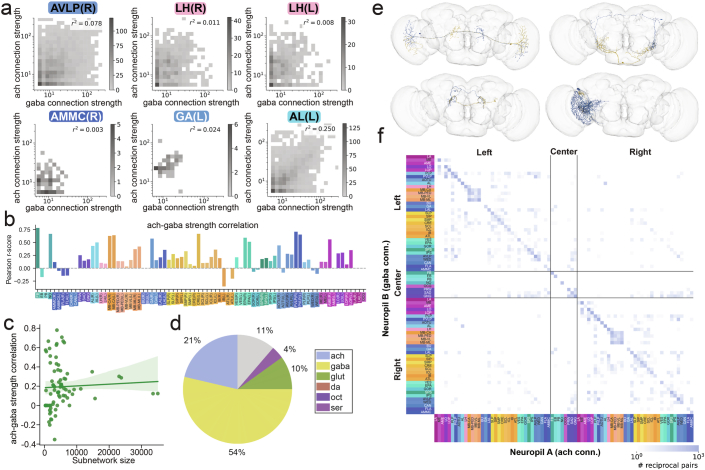
“This gives us a graph with 127,978 neurons and 2,613,129 connections3 (Fig. 1a and Methods).”
§ Network statistics of the whole-brain connectome of Drosophila > Summary of the dataset and definitions
What the sources say
- Partly supportedcites [3] Dorkenwald, S. et al. Neuronal wiring diagram of an adult brain. Nature10.1038/s41586-024-07558-y (2023). PMC11446842 39358518 sourceExperimental — accuracy not yet measured
The ‘Synapses and connections’ section defines connections between neurons and reports 2,700,513 connections among 134,181 identified neurons at a five-synapse threshold. ‘Reconstruction of a whole fly brain’ says the paper’s analysis uses version 783. Our copy does not give the claimed counts for a v630 snapshot, so it supports the connectome context but not the two specific numbers. (LLM, conf=0.84)
plain- Asserted: passes — The authors put it forward as true.
- Checkable: passes — It can be checked against evidence.
- Load-bearing: passes — The paper’s conclusions depend on it.
- Based: passes — The paper gives a reason why it holds.
- Partly supported
Every source the paper cites for this claim was checked and supports it.
In the paper
“These numbers are comparable to those found in a similar analysis of the hemibrain dataset31.”
§ Network statistics of the whole-brain connectome of Drosophila > Neurons form one connected component
What the sources say
- Supportedcites [31] Scheffer, L. K. et al. A connectome and analysis of the adult Drosophila central brain. eLife 9, e57443 (2020). 32880371 PMC7546738 source
The section “Paths in the fly brain are short” (page not provided) analyzes path lengths in the hemibrain dataset and reports that three quarters of neuron pairs are connected by a path with fewer than three interneurons. This supports citing the paper for a comparable short-path analysis, though the citing sentence does not provide its own numbers for a direct numerical check. (LLM, conf=0.88)
plain- Asserted: passes — The authors put it forward as true.
- Checkable: passes — It can be checked against evidence.
- Load-bearing: unclear — It is unclear whether the paper’s conclusions depend on it.
- Based: passes — The paper gives a reason why it holds.
- Supported
The cited sources that could be checked couldn’t confirm or dispute this claim.
In the paper
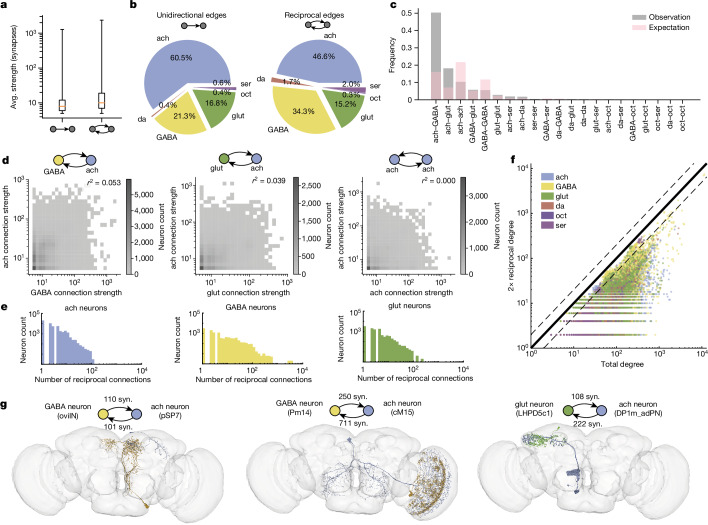
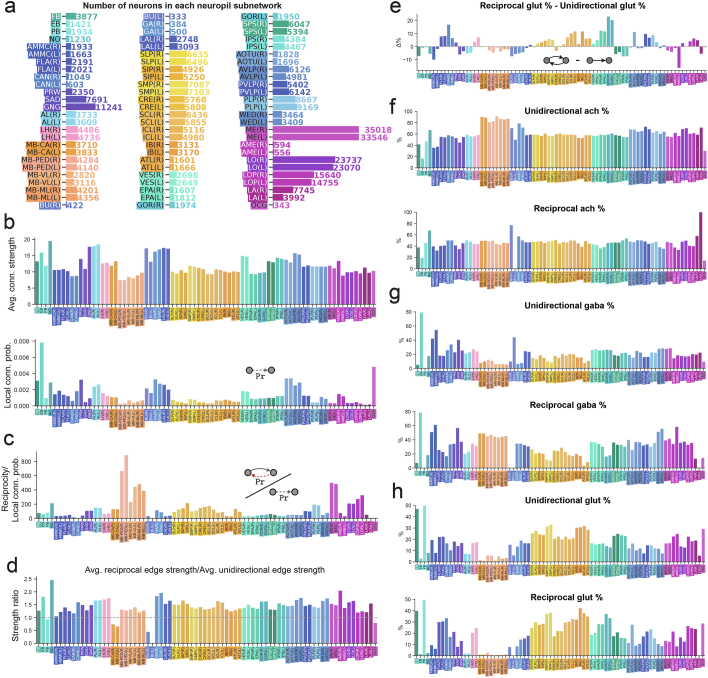
“Inhibitory connections in the brain have more synapses on average compared with excitatory connections3, which may partially explain the higher average strength of reciprocal connections.”
§ Network statistics of the whole-brain connectome of Drosophila > Neurotransmitter makeup of reciprocal connections
What the sources say
- Could not verifycites [3] Dorkenwald, S. et al. Neuronal wiring diagram of an adult brain. Nature10.1038/s41586-024-07558-y (2023). PMC11446842 39358518 sourceExperimental — accuracy not yet measured
The ‘Synapses and connections’ section defines connection strength by synapse count, while ‘Neurotransmitter identity’ reports higher average degrees for GABAergic neurons. Neither passage compares the average number of synapses per inhibitory and excitatory connection. Searches for that comparison and for reciprocal-connection strength found no passage establishing the attributed claim. (LLM, conf=0.72)
hedgedstates a possible cause- Asserted: passes — The authors put it forward as true.
- Checkable: passes — It can be checked against evidence.
- Load-bearing: unclear — It is unclear whether the paper’s conclusions depend on it.
- Based: passes — The paper gives a reason why it holds.
- Rests on an assumption not shown here.
- Could not verify
125 more claims · 17 with their cited sources checked
Create a free account to see all 219 claims and to verify the 4 references still open.
- It may state two separate claims as one. 67
- Probably not a substantial claim. 28
- The quote only partly states this claim. 1
Self-check
Percentages, sums and reported differences re-computed from the paper’s own numbers.
Rated minor: it would not touch a result — a value no result rests on, a p-value that stays on the same side of the significance level, or a conflict that is clerical, resolved elsewhere in the paper, or outside its own findings.
In the paper
“Of the 127,978 neurons in the brain, 77,607 participate in at least one reciprocal connection: approximately 2 in every 3 neurons”
§ Network statistics of the whole-brain connectome of Drosophila > Reciprocal degree across the population
Reported 66.66666666666666 · recomputed 60.640891
Citations
Cites
Deep Residual Learning for Image Recognition
He, K., Zhang, X., Ren, S., & Sun, J. (2016) · 2016 IEEE Conference on Computer Vision and Pattern Recognition (CVPR) · doi:10.1109/cvpr.2016.90 · Cited by 235,474
Collective dynamics of ‘small-world’ networks
Watts, D. J., & Strogatz, S. H. (1998) · Nature · doi:10.1038/30918 · Cited by 43,060 · cited 1×
“High small-worldness coefficients are associated with efficient communication between nodes (44, 45).”
Network motifs: simple building blocks of complex networks.
Milo, R., Shen-Orr, S., Itzkovitz, S., Kashtan, N., Chklovskii, D., & Alon, U. (2002) · Science · doi:10.1126/science.298.5594.824 · Cited by 7,368
Depth-First Search and Linear Graph Algorithms
Tarjan, R. (1972) · SIAM Journal on Computing · doi:10.1137/0201010 · Cited by 6,081 · cited 1×
“All neurons within an SCC are mutually reach- 129 able via directed pathways (39).”
The structure of the nervous system of the nematode Caenorhabditis elegans
White, J. G., Southgate, E., Thomson, J. N., & Brenner, S. (1986) · Philosophical Transactions of the Royal Society of London. B, Biological Sciences · doi:10.1098/rstb.1986.0056 · Cited by 5,589 · cited 2×
“…the anten-581 nal lobes (AL), medullae (MB), and ellipsoid body (EB), there 582 are many NSRNs, while in other neuropils, such as the superior 583 for instance, it is likely that some of the NSRNs found in the 596 AVLP provide feedback to the auditory circuits which span this 597 brain region (61).”
Efficient behavior of small-world networks
Latora, V., & Marchiori, M. (2001) · Physical Review Letters · doi:10.1103/physrevlett.87.198701 · Cited by 5,119
The Human Connectome: A Structural Description of the Human Brain
Sporns, O., Tononi, G., & Kötter, R. (2005) · PLoS Computational Biology · doi:10.1371/journal.pcbi.0010042 · Cited by 3,260
Specificity and Stability in Topology of Protein Networks
Maslov, S., & Sneppen, K. (2002) · Science · doi:10.1126/science.1065103 · Cited by 3,051
Rich-club organization of the human connectome
van den Heuvel, M. P., & Sporns, O. (2011) · The Journal of Neuroscience · doi:10.1523/jneurosci.3539-11.2011 · Cited by 2,354
Stochastic blockmodels and community structure in networks
Karrer, B., & Newman, M. E. J. (2011) · Physical Review E · doi:10.1103/physreve.83.016107 · Cited by 2,025
Cited by
Neuronal wiring diagram of an adult brain
Dorkenwald, S., Matsliah, A., Sterling, A. R., Schlegel, P., Yu, S.-C., McKellar, C. E., Lin, A., Costa, M., Eichler, K., Yin, Y., et al. (2024) · Nature · doi:10.1038/s41586-024-07558-y · Cited by 570
“…in the central brain can be reached by starting from any modality—this ‘small world’ property of the network is covered in more detail by Lin et al. 49 Comparing orders revealed that almost all neurons in the central brain are reached early starting from some modality, with the exception of…”
InfluentialSelf-citationNeural circuit mechanisms for steering control in walking Drosophila
Rayshubskiy, A., Holtz, S. L., Bates, A. S., Vanderbeck, Q. X., Capdevila, L. S., Rockwell, V., & Wilson, R. I. (2020) · doi:10.1101/2020.04.04.024703 · Cited by 64
“For example, DNa03 and LAL010 both receive strong bilaterally symmetric projections from another excitatory central complex output cell type, (Dorkenwald et al., 2023, 2022; Lin et al., 2024; Zheng et al., 2018).”
Self-citationThe fly connectome reveals a path to the effectome
Pospisil, D. A., Aragon, M. J., Dorkenwald, S., Matsliah, A., Sterling, A. R., Schlegel, P., Yu, S.-C., McKellar, C. E., Costa, M., Eichler, K., et al. (2024) · Nature · doi:10.1038/s41586-024-07982-0 · Cited by 36
“There has been sustained interest in the analysis of large-scale anatomic information 10,28–30 .”
InfluentialSelf-citationDistributed control circuits across a brain-and-cord connectome
Bates, A. S., Phelps, J. S., Kim, M., Yang, H. H., Matsliah, A., Ajabi, Z., Perlman, E., Delgado, K. M., Osman, M. A. M., Salmon, C. K., et al. (2026) · Nature · doi:10.1038/s41586-026-10735-w · Cited by 100
“Other large-scale connectome analyses have focused mainly on cells deep in the CNS 6,7,43 .”
Self-citationNeural circuit mechanisms for steering control in walking Drosophila
Rayshubskiy, A., Holtz, S. L., Bates, A. S., Vanderbeck, Q. X., Serratosa Capdevila, L., Rockwell, V., & Wilson, R. (2025) · eLife · doi:10.7554/elife.102230 · Cited by 27
Self-citationToward Principles of Brain Network Organization and Function
Kulkarni, S., & Bassett, D. S. (2025) · Annual Review of Biophysics · doi:10.1146/annurev-biophys-030722-110624 · Cited by 37
Evolution of neural circuitry and cognition
Farnworth, M. S., & Montgomery, S. H. (2024) · Biology Letters · doi:10.1098/rsbl.2023.0576 · Cited by 23
Connectomic analysis of taste circuits in Drosophila
Walker, S. R., Peña-Garcia, M., & Devineni, A. V. (2025) · Scientific Reports · doi:10.1038/s41598-025-89088-9 · Cited by 24
“49 In our whole-brain simulations, we found that stimulation of GRNs activated a large proportion of 2Ns but only a minority of 3Ns.”
ViMO - Visual Analysis of Neuronal Connectivity Motifs
Troidl, J., Warchol, S., Choi, J., Matelsky, J., Dhanyasi, N., Wang, X., Wester, B. A., Wei, D., Lichtman, J. W., Pfister, H., et al. (2023) · IEEE Transactions on Visualization and Computer Graphics · doi:10.1109/tvcg.2023.3327388 · Cited by 18
A multisynaptic spiking neuron for simultaneously encoding spatiotemporal dynamics
Fan, L., Shen, H., Lian, X., Li, Y., Yao, M., Li, G., & Hu, D. (2025) · Nature Communications · doi:10.1038/s41467-025-62251-6 · Cited by 33
“In the primary visual cortex of mice 24,57 , the maximum number of synapsesinthemultisynapticconnectionsbetweenpyramidalneurons is only fi ve.”
Physical Network Constraints Define the Multiplicative Architecture of the Brain’s ConnectomePreprint
Piazza, B., Barabási, D. L., Menichetti, G., Castro, A. F., & Barabási, A.-Ĺ. (2025) · bioRxiv (Cold Spring Harbor Laboratory) · doi:10.1101/2025.02.27.640551 · Cited by 23
“The recent proliferation of connectome data has also yielded puzzling outcomes: although the degree distributions do not exhibit a clear power-law scaling 18–20 , the observed prevalence of highly connected neurons 19–22 remains a hallmark typically associated with scale-free networks 23 .”
Nonequilibrium physics of brain dynamics
Nartallo-Kaluarachchi, R., Kringelbach, M. L., Deco, G., Lambiotte, R., & Goriely, A. (2025) · Physics Reports · doi:10.1016/j.physrep.2025.10.003 · Cited by 35
“Its directed structure reveals that some neurons operate as ‘broadcasters’ , with many more out-going connections than incoming, whilst others are ‘integrators’ with a larger number of incoming connections [93].”
Infrequent strong connections constrain connectomic predictions of neuronal function
Currier, T. A., & Clandinin, T. R. (2025) · Cell · doi:10.1016/j.cell.2025.05.007 · Cited by 20
BIFROST: A method for registering diverse imaging datasets of the Drosophila brain
Brezovec, B. E., Berger, A. B., Hao, Y. A., Lin, A., Ahmed, O. M., Pacheco, D. A., Thiberge, S. Y., Murthy, M., & Clandinin, T. R. (2024) · Proceedings of the National Academy of Sciences · doi:10.1073/pnas.2322687121 · Cited by 17
Self-citationSynaptic connectome of a neurosecretory network in the Drosophila brain
McKim, T. H., Gera, J., Gayban, A. J. B., Christie, K., Shin, J., Reinhard, N., Manoli, G., Hilpert, S., Callaerts, P., van Breugel, F., et al. (2026) · eLife · doi:10.1101/2024.08.28.609616 · Cited by 22
Francés, R., Rabah, Y., Préat, T., & Plaçais, P.-Y. (2024) · Nature Communications · doi:10.1038/s41467-024-54778-x · Cited by 12
A complete wiring diagram of the fruit-fly brain
Devineni, A. V. (2024) · Nature · doi:10.1038/d41586-024-03029-6 · Cited by 13
Scale-free behavior of weight distributions of connectomes
Cirunay, M. T., Ódor, G., Papp, I., & Deco, G. (2025) · Physical Review Research · doi:10.1103/physrevresearch.7.013134 · Cited by 13
“For one, by itself, the brain of a fly ( Drosophilia ) is sparse as it is compared to C.elegans , a larva zebra fish, and a mouse [32].”
Centralized brain networks underlie body part coordination during groomingPreprint
Özdil, P. G., Arreguit, J., Scherrer, C., Ijspeert, A. J., & Ramdya, P. P. (2024) · bioRxiv (Cold Spring Harbor Laboratory) · doi:10.1101/2024.12.17.628844 · Cited by 8
Activity of a descending neuron associated with visually elicited flight saccades in Drosophila
Buchsbaum, E., & Schnell, B. (2025) · Current Biology · doi:10.1016/j.cub.2024.12.001 · Cited by 10
Robinson, J. W., Bechard, A. T., Frame, A. K., Evans, M. R., Atheby, A., Sharma, S., Alaka, W., Lawal, H. O., & Simon, A. F. (2025) · Current Research in Insect Science · doi:10.1016/j.cris.2025.100113 · Cited by 16
“Furthermore, the neurons that release these small neurotransmitters project to many regions, revealed through a chemoconnectomics map (Deng et al., 2019; Dorkenwald et al., 2024; Lin et al., 2024).”
Minati, L., Sparacino, L., Tegnitsap, J. V. N., Zhao, M., Fang, F., Mijatović, G., Antonacci, Y., Valdes-Sosa, P. A., Ito, H., Frasca, M., et al. (2025) · Chaos Solitons & Fractals · doi:10.1016/j.chaos.2025.117111 · Cited by 10
MaBouDi, H., Roper, M. G., Guiraud, M., Juusola, M., Chıttka, L., & Marshall, J. A. R. (2025) · eLife · doi:10.7554/elife.89929 · Cited by 9
Long-range axon branching: contributions to brain network plasticity and repair
Richards, L. J., Huang, C., Bauer, A. Q., & Lee, J. (2026) · Nature reviews. Neuroscience · doi:10.1038/s41583-025-01008-y · Cited by 15
Synaptic shot noise triggers fast and slow global oscillations in balanced neural networks
Goldobin, D. S., Ageeva, M. V., di Volo, M., Tixidre, F., & Torcini, A. (2025) · Physical review. E · doi:10.1103/47h5-fbyy · Cited by 11
Neural circuit mechanisms for steering control in walking Drosophila
Rayshubskiy, A., Holtz, S. L., Bates, A., Vanderbeck, Q. X., Capdevila, L. S., & Wilson, R. I. (2024) · doi:10.7554/elife.102230.1 · Cited by 5
Self-citationFoundation models in clinical oncology: Progresses and perspectives
Li, J., Fu, J., Geng, X., & Wang, H. (2025) · Cancer Letters · doi:10.1016/j.canlet.2025.218220 · Cited by 11
Reconstructing the human brain’s wiring diagram from axons up
Heilbronner, S. R., Reid, R. C., Casta, T. K., & Pestilli, F. (2025) · Trends in Neurosciences · doi:10.1016/j.tins.2025.11.001 · Cited by 5
Inferring neural population codes for Drosophila acoustic communication
Pang, R., Baker, C. A., Murthy, M., & Pillow, J. W. (2025) · Proceedings of the National Academy of Sciences · doi:10.1073/pnas.2417733122 · Cited by 6
Self-citationBergoin, R., Torcini, A., Deco, G., Quoy, M., & Zamora‐López, G. (2025) · PLoS Computational Biology · doi:10.1371/journal.pcbi.1012973 · Cited by 15
“The brain’s connectivity follows a modular and a hierarchical organization at different spatial and functional scales 1–6 .”
Provata, A., Almirantis, Y., & Li, W. (2025) · Entropy · doi:10.3390/e27030257 · Cited by 4
Statistical Mechanics of Directed Networks
Boguñá, M., & Serrano, M. Á. (2025) · Entropy · doi:10.3390/e27010086 · Cited by 3
On human nanoscale synaptome: Morphology modeling and storage estimation
Nowinski, W. L. (2024) · PLoS ONE · doi:10.1371/journal.pone.0310156 · Cited by 8
From connectome to effectome: learning the causal interaction map of the fly brainPreprint
Pospisil, D. A., Aragon, M. J., Dorkenwald, S., Matsliah, A., Sterling, A. R., Schlegel, P., Yu, S.-C., McKellar, C. E., Costa, M., Eichler, K., et al. (2023) · bioRxiv (Cold Spring Harbor Laboratory) · doi:10.1101/2023.10.31.564922 · Cited by 3
“01% of neuron pairs form a synaptic contact [14]): thus a strong prior can be placed on the vast majority of the effectome.”
BackgroundSelf-citationA pair of interneurons that confer positive real-time valence to sweet sensation in Drosophila
Christie, K. W., Dadyala, T. S., Sinakevitch, I. G., Chung, P., Ito, M., & Shao, L. (2026) · Current Biology · doi:10.1016/j.cub.2025.12.058 · Cited by 7
A Comprehensive Survey of Subgraph Matching: [Experiments & Analysis]
Jiang, H., Pandey, S., & Liu, H. (2025) · Proceedings of the ACM on Management of Data · doi:10.1145/3771791 · Cited by 7
Jiang, R., Tian, Y. L., Yuan, X., & Guo, F. (2025) · Current Biology · doi:10.1016/j.cub.2025.02.056 · Cited by 3
Ciampelli, C., Galleri, G., Galioto, M., Mereu, P., Pirastru, M., Bernardoni, R., Albani, D., Crosio, C., & Iaccarino, C. (2025) · International Journal of Molecular Sciences · doi:10.3390/ijms26052093 · Cited by 3
“Recently, both the whole-brain connectome of an adult fly, containing over 130,000 neurons and millions of synaptic connections [36,37] and network statistics of the whole-brain connectome have become available [38], opening new important scenarios to brain studies.”
Network structure governs Drosophila brain functionality
Zhang, X., Yang, P., Feng, J., Wen, K., Yan, G., Luo, Q., Lin, W., & Lu, X. B. (2025) · Fundamental Research · doi:10.1016/j.fmre.2025.01.017 · Cited by 9
“Below, we introduce a hypothesis that use different methods to estimate the connection weights between neurons: We assume that the source neuron has the same influence on the target neuron through every synapse, which is widely used in neuron graph statistics analysis [18] .”
Péntek, B., & Ercsey-Ravasz, M. (2025) · Network Neuroscience · doi:10.1162/netn_a_00455 · Cited by 4
“We constructed the connectome at the level of neuropils (also referred to as the projectome) using the algorithm developed by the FlyWire project team (Dorkenwald et al., 2024; Lin et al., 2024).”
InfluentialInvariant synaptic density across speciesPreprint
Castro, A. F., & Cardona, A. (2024) · bioRxiv (Cold Spring Harbor Laboratory) · doi:10.1101/2024.07.18.604056 · Cited by 5
Synaptic Organization of the Primate Retina: Toward a Human Foveal Connectome
Kim, Y. J., & Dacey, D. M. (2026) · Annual Review of Vision Science · doi:10.1146/annurev-vision-110323-104530 · Cited by 2
Simple input–output dependencies explain neuronal activity
Lynn, C. W. (2026) · Nature Physics · doi:10.1038/s41567-026-03306-3 · Cited by 5
“These sparse, heavy-tailed, balanced and directed weights are universal features of synaptic connectivity observed across brain regions and species 2,3,59–62 .”
High-speed whole-brain imaging in Drosophila
Gauthey, W., Lin, A., Ahmed, O. M., Leifer, A. M., Murthy, M., & Thiberge, S. Y. (2026) · Nature Communications · doi:10.1038/s41467-026-72437-1 · Cited by 6
“Finally, even experimental approaches where only a few cell types are labeled would bene fi t from whole-brain imaging, as circuits often comprise neurons with process distributed throughout the brain 33,34 .”
Self-citationStatistical physics of large-scale neural activity with loops
Carcamo, D. P., & Lynn, C. W. (2025) · Proceedings of the National Academy of Sciences · doi:10.1073/pnas.2426926122 · Cited by 6
The Connectome Interpreter ToolkitPreprint
Yin, Y., Hoeller, J., Mathiasen, A., Tsang, J., Charrier, M. E., & Cardona, A. (2025) · bioRxiv (Cold Spring Harbor Laboratory) · doi:10.1101/2025.09.29.679410 · Cited by 5
Wheelock, J. M., Pritchard, R., Kumar, S., & Lu, H. (2025) · Biophysical Journal · doi:10.1016/j.bpj.2025.09.015 · Cited by 2
Bergoin, R., Torcini, A., Deco, G., et al. (2024) · bioRxiv (Cold Spring Harbor Laboratory) · doi:10.1101/2024.07.15.603496 · Cited by 2
Highly energy-efficient information-handling dynamics of the brain
G, J., & Guo, W. (2026) · National Science Review · doi:10.1093/nsr/nwag373 · Cited by 2
“Drosophila melanogaster [18 ], ant [38 ], mouse [39 ] and human by an NS.”
Weight distributions in the fruit-fly and the mouse connectomes
Cirunay, M. T., Papp, I., & Ódor, G. (2026) · Chaos Solitons & Fractals · doi:10.1016/j.chaos.2026.118425 · Cited by 1
Opening the black box of neural variability: From noise to mechanisms
Rentzeperis, I., Li, J., Bauer, R., & van Leeuwen, C. (2026) · Neuroscience & Biobehavioral Reviews · doi:10.1016/j.neubiorev.2026.106661 · Cited by 2
Liu, H., Zheng, P., & Wang, X. (2026) · Frontiers in Neural Circuits · doi:10.3389/fncir.2026.1731513 · Cited by 3
“…neurons and approximately 7,000 synaptic connections, has been mapped at single-cell and synaptic resolution, representing one of the few fully resolved connectomes currently available for any animal species (Cook Steven et al., 2019; Witvliet et al., 2021; Varshney et al., 2011; Lin et al., 2024).”
Guo, L., Zhang, N., Tang, P., Dolin, J., Kiassat, L., Yoshikawa, S., & Simpson, J. H. (2026) · iScience · doi:10.1016/j.isci.2026.114902 · Cited by 2
“45 In Figure S2C, we present the pre-synaptic partners of T1L-LegPN as an example; T2L-and T3L-LegPN connection numbers are given in Figure S2D.”
Neuron Segment Connectivity Prediction With Multimodal Features for Connectomics
Chen, Q., Chen, X., Wang, C., Xiong, Z., & Wu, F. (2026) · IEEE Transactions on Medical Imaging · doi:10.1109/tmi.2026.3658169 · Cited by 1
“Analyzing this most comprehensive connectome has yielded significant insights into whole-brain network properties [5], connectome-based cell typing [6], brain causality [7], and numerous other areas [8], [9], [10].”
Quantifying the compressibility of the human brain
Weaver, N., Faskowitz, J., Betzel, R. F., & Lynn, C. W. (2026) · Proceedings of the National Academy of Sciences · doi:10.1073/pnas.2531115123 · Cited by 3
“At much smaller scales, similarly sparse networks have also been found to dominate both the correlations and physical connections between neurons (25–27, 51, 52).”
Structure–function relationships across scales: implications for atlases
Constable, R. T. (2026) · Frontiers in Neuroscience · doi:10.3389/fnins.2025.1750272 · Cited by 2
“A notable finding is that 93.3% of the neurons are in “strongly connected networks” (connected to more than 1 other neuron) and that many paths connect neuron pairs (Lin et al., 2024).”
InfluentialKoh, Z. M., Arceo, R. A., Hammer, J., Chau, K., Light, S. E. W., Dolojan, A., Januszewski, M., Svara, F., & Smith, C. J. (2025) · Cell Reports · doi:10.1016/j.celrep.2025.116761 · Cited by 4
“7 While it is well known that precise connectivity is important, the connectome of even the simplest vertebrate circuits is not complete.”
Leveraging network motifs to improve artificial neural networks
Zhang, H., Yang, C.-H. H., Zenil, H., Chen, P., Shen, Y., Kiani, N. A., & Tegner, J. N. (2025) · Nature Communications · doi:10.1038/s41467-025-66533-x · Cited by 2
“…connectome analyses of Drosophila further identi fi ed sub-sets of rich-club neurons with putative roles as integrators or broad-casters of signals 32 , suggesting by analogy that motifs in deep ANNs might play distinct roles in shaping whether a network frames its…”
Kamiyama, D., Kamiyama, R., Nishida, Y., Sego, A., Vining, G. B., Bui, K. C., Fitch, M., Do, H. G. T., Avraham, O., & Chihara, T. (2025) · Nature Communications · doi:10.1038/s41467-025-65900-y · Cited by 3
Linking structure and function: biological insights from fly connectomes
Lin, A., & Murthy, M. (2025) · Nature Methods · doi:10.1038/s41592-025-02949-z · Cited by 2
Self-citationA Computational Perspective on the No-Strong-Loops Principle in Brain NetworksPreprint
Hadaeghi, F., Fakhar, K., Khajehnejad, M. A., & Hilgetag, C. C. (2025) · bioRxiv (Cold Spring Harbor Laboratory) · doi:10.1101/2025.09.24.678310 · Cited by 5
“Managing reciprocity may help optimize stability, memory, and representational diversity in artificial systems, particularly those operating in resource-constrained environments or aiming to emulate biological efficiency.”
Langstaff, R. A. W., Srivastava, P., Kunin, A. B., & Gutierrez, G. J. (2025) · eNeuro · doi:10.1523/eneuro.0123-25.2025 · Cited by 4
Ryu, S., Wei, Y., Wu, Z., Zhang, T., Lee, D., Najafi, H., & Kim, W. J. (2025) · FEBS Open Bio · doi:10.1002/2211-5463.70107 · Cited by 4
Partial recurrence enables robust and efficient computationPreprint
Ghosh, M., & Goodman, D. F. M. (2025) · bioRxiv (Cold Spring Harbor Laboratory) · doi:10.1101/2025.07.28.667142 · Cited by 1
Corradini, E., Parlapiano, F., Ronci, A., Terracina, G., & Ursino, D. (2025) · Computers in Biology and Medicine · doi:10.1016/j.compbiomed.2025.110135 · Cited by 2
Koh, Z. M., Arceo, R. A., Hammer, J., Chau, K., Light, S. E. W., Dolojan, A., Januszewski, M., Svara, F., & Smith, C. J. (2025) · bioRxiv (Cold Spring Harbor Laboratory) · doi:10.1101/2025.03.05.641432 · Cited by 1
High-order synchronization in identical neurons with asymmetric pulse coupling
Abhay, & Dar, G. (2025) · Physical review. E · doi:10.1103/physreve.111.034202 · Cited by 2
Connectome architecture favours within-module diffusion and between-module routingPreprint
Seguin, C., Puxeddu, M. G., Faskowitz, J., Betzel, R. F., & Sporns, O. (2025) · bioRxiv (Cold Spring Harbor Laboratory) · doi:10.1101/2025.02.10.637586 · Cited by 2
Cascades and convergence: dynamic signal flow in a synapse-level brain networkPreprint
Betzel, R., Puxeddu, M. G., Seguin, C., et al. (2025) · bioRxiv · doi:10.1101/2024.12.04.624189 · Cited by 4
Langstaff, R. A. W., Srivastava, P., Kunin, A. B., et al. (2024) · bioRxiv (Cold Spring Harbor Laboratory) · doi:10.1101/2024.10.25.620362 · Cited by 1
Cell-type specific projection patterns promote balanced activity in cortical microcircuitsPreprint
Kurth, A. C., Albers, J., Diesmann, M., & van Albada, S. J. (2024) · bioRxiv (Cold Spring Harbor Laboratory) · doi:10.1101/2024.10.03.616539 · Cited by 7
“These efforts enabled further work on the statistical analysis of the connectivity [29] and a computational model of the whole fly brain at neuronal resolution [30].”
MaBouDi, H., Roper, M. G., Guiraud, M., et al. (2023) · bioRxiv (Cold Spring Harbor Laboratory) · doi:10.1101/2023.06.04.543620 · Cited by 1
Dense and distributed neuropeptide network in the nerve net of Hydra vulgaris
Rothenfusser, J. D. L. C., Yañez-Guerra, L. A., Teufel, F., & Yuste, R. (2026) · PLoS Computational Biology · doi:10.1371/journal.pcbi.1014037 · Cited by 2
“This form of “wireless” communication, described in C. elegans as well as Drosophila [5,6], is thought to be predominantly mediated by neuropeptides—short polypeptide hormones produced through the proteolytic cleavage of larger precursor proteins [7].”
Fluctuation–dissipation of the Kuramoto model on fruit-fly connectomes
Ódor, G., Papp, I., & Deco, G. (2026) · Chaos Solitons & Fractals · doi:10.1016/j.chaos.2026.119150 · Cited by 3
“The network statistics of the whole brain were published in [32].”
Spatial constraints reshape critical-like propagation in neural networks
Li, T.-Y., Xiu-ying, Z., 裴, Q.-M. 启. P., Jia, Y., & Yu, D. (2026) · Chaos Solitons & Fractals · doi:10.1016/j.chaos.2026.119155
Unique neural activity states predict action selection in response to visual threat
Zucker-Scharff, I., Brezovec, B. E., Hao, Y. A., Wang, Y., Choi, M., Su, S. J., & Clandinin, T. R. (2026) · Current Biology · doi:10.1016/j.cub.2026.07.077
Li, Q., Ping, W., Zhang, K., & Wang, C. (2026) · bioRxiv (Cold Spring Harbor Laboratory) · doi:10.64898/2026.08.21.745055 · Cited by 2
“FlyWire network analysis finds it in Drosophila as well [1,25] , and calcium imaging shows resting-state co-fluctuations organizing into reproducible modules centered on higher-order neuropils [8,9,26] .”
Synaptic dynamics anisotropy in β-Ga2O3 artificial axon-multi-synapse for neuromorphic applications
Yu, Z., Xu, Y., Wu, C., Hu, H., Wang, S., Wu, F., Liu, Z., & Guo, D. (2026) · Journal of Material Science and Technology · doi:10.1016/j.jmst.2026.07.079
Innervation of the anal canal revisited through micro‐ CT imaging
Docter, D., Visser, S. C., Benninga, M. A., der Veer, J. H.-V., DeRuiter, M. C., Roelofs, J. J. T. H., Derikx, J. P. M., de Jong, J. R., de Bakker, B. S., & Gorter, R. R. (2026) · Journal of Anatomy · doi:10.1111/joa.70221
Partial recurrence can enable robust and efficient computation
Ghosh, M., & Goodman, D. F. M. (2026) · Communications AI & Computing · doi:10.1038/s44488-026-00013-z · Cited by 2
Thomas-Hegarty, J., Pulver, S. R., & Smith, V. A. (2026) · Journal of Computational Neuroscience · doi:10.1007/s10827-026-00945-6
Shi, T., Chen, Y., Liu, C., & Zhang, R. (2026) · bioRxiv (Cold Spring Harbor Laboratory) · doi:10.64898/2026.06.30.735468
“After neuronal morphologies have been reconstructed, downstream connectomic analyses still often depend on predefined neuron types, curated partner labels, expert-guided clustering or iterative refinement [4–9].”
A new bridge from sleep to wake in fruit flies
Vecsey, C. G., Moi, R. C., & Christie, C. M. (2026) · SLEEP · doi:10.1093/sleep/zsag175
“First, f lies have greatly reduced neural complexity—the entire adult nervous system contains 135 000 neurons, and there are now robust f ly brain connec-tomes that can be mined for neural morphology and potential upstream and downstream partners [ 11– 14].”
The Mushroom Body of the Insect Brain
Fiala, A. (2026) · Oxford University Press eBooks · doi:10.1093/9780197851494.003.0174
A Structural Principle for Macroscopic Neural Dynamics CorrelationsPreprint
Wu, Q., Wen, Q., & Liu, C. (2026) · bioRxiv (Cold Spring Harbor Laboratory) · doi:10.64898/2026.06.14.729168
Developmental Continuity of Brain Network Core Organization in C. elegansPreprint
Yadav, P., & Singh, A. (2026) · bioRxiv (Cold Spring Harbor Laboratory) · doi:10.64898/2026.06.12.730308
“This is surprising because Witvliet et al. found that the network becomes more feedforward, so it would be expected that strong connectivity decreases [38]. all stages.”
Rank Dependency of Rescaled Pruning in Recurrent Neural NetworksPreprint
Wang, A. Q., Kim, S. H., & Choi, H. (2026) · bioRxiv (Cold Spring Harbor Laboratory) · doi:10.64898/2026.05.30.728930
“Such sparse, high-rank networks— observed across systems ranging from cortical networks [22,26,27] to fly connectome [28]— can emerge from large-scale synaptic pruning.”
Zhang, X., Fan, J., Zhang, Y., Zhang, L., Lan, Y., Song, M., & Jiang, T. (2026) · Neurocomputing · doi:10.1016/j.neucom.2026.133939 · Cited by 1
Sinner, M., & Bringmann, H. (2026) · Somnologie - Schlafforschung und Schlafmedizin · doi:10.1007/s11818-026-00555-5
Chen, X., Ma, X., Zhang, Y., Zhang, X., & Lu, X. (2026) · IEEE International Conference on Pattern Recognition, Machine Vision and Artificial Intelligence (PRMVAI) · doi:10.1109/prmvai70103.2026.11605713 · Cited by 1
Kadandelu, M., Periya, S., Rekha, P. D., & Raghu, S. V. (2026) · Reviews in the Neurosciences · doi:10.1515/revneuro-2025-0144
“Scientists have created a connectome, or a map of the entire fl y brain, illustrating the connections between each neuron and synapse, owing to the implementation of such a remarkable system (Lin et al. 2024; Schlegel et al. 2024).”
The Drosophila connectome reveals axo-axonic synapses on descending neurons
Ceballos, C. C., Lopez, J., Roachford, T., Sanchez, D., Jara, S. D., Robbins, K., Spencer, C., Murphey, R. K., & Pena, R. F. O. (2026) · iScience · doi:10.1016/j.isci.2026.115624 · Cited by 1
“10,35 In the fly VNC, only ∼ 1% of the possible DN-to-DN pairs form axo-axonic synapses, an order of magnitude sparser than axo-dendritic contacts in either the MANC or FAFB brain datasets.”
InfluentialMcAllister, J., Houghton, C. J., Wade, J., & O’Donnell, C. (2026) · bioRxiv (Cold Spring Harbor Laboratory) · doi:10.64898/2026.03.30.715411 · Cited by 5
“…task variance may simply point to the link between cell type and the structural features identified of self-recurrency, clustering, and node degrees (43, 44); however this in itself may further indicate how structural network features are relevant for biological network dynamics and functions.”
Coupled multiplex FitzHugh-Nagumo dynamics: conditions for network-induced Turing patterns
Luan, Y., Liang, J., & Xiao, M. (2026) · Nonlinear Dynamics · doi:10.1007/s11071-026-12417-8
“The connectome organization can constrain or help predict observed biological activity patterns [20, 21].”
Hao, H., Li, M., Wu, J., Sheng, P., & Qu, L. (2026) · Expert Systems with Applications · doi:10.1016/j.eswa.2026.132059
Cascades and convergence: Dynamic signal flow in a synapse-level brain network
Betzel, R. F., Puxeddu, M. G., Seguin, C., & Mišić, B. (2026) · PLOS complex systems. · doi:10.1371/journal.pcsy.0000091 · Cited by 4
Thomas-Hegarty, J., Pulver, S. R., & Smith, V. A. (2026) · bioRxiv (Cold Spring Harbor Laboratory) · doi:10.64898/2026.03.03.709276
“Further, BNs are unable to represent cyclic structures, which is problematic in a NIF context due to the abundance of reciprocal connections within nervous systems (Edelman & Gally, 2013; Lin et al., 2024).”
Ahmed, I., Zhang, B.-L., Yue, B., Islam, N., Rahman, M. A., Mithu, M. M., & Tang, X. (2026) · New medicine. · doi:10.61958/nmqv6943
Neuropeptide F-expressing neurons in Drosophila constitute centrifugal pathway to optic lobes
Wang, J., & Lehmann, F. (2026) · PLoS ONE · doi:10.1371/journal.pone.0343221 · Cited by 1
“In general, our anatomical reconstruction aligns with previous findings on NPF cell morphology [5–9,44 Notably, we could not detect the existence of a sixth subtype of NPF neurons (DM neurons) that has been described in the medial dorsal brain in a prior study of NPF function [46].”
Sexual dimorphism in the cell number of the adult Drosophila brain
Singh, N. P., & Harbison, S. T. (2026) · PLoS ONE · doi:10.1371/journal.pone.0342456 · Cited by 1
Metadata
- Authors
- Lin, A., Yang, R., Dorkenwald, S., Matsliah, A., Sterling, A. R., Schlegel, P., Yu, S.-C., McKellar, C. E., Costa, M., Eichler, K., Bates, A. S., Eckstein, N., Funke, J., Jefferis, G. S. X. E., & Murthy, M.
- Affiliations
- Princeton University (US)
- MRC Laboratory of Molecular Biology (GB)
- University of Cambridge (GB)
- Howard Hughes Medical Institute (US)
- Corresponding author
- Murthy, Mala
- ORCID
- Venue
- Nature
- Published
- 2024-10-02
- Volume
- 634
- Issue
- 8032
- Pages
- 153-165
- ISSN
- 0028-0836 (ISSN-L)
- 1476-4687
- PMC
- PMC11446825
- OpenAlex
- W4403062850
- Cited by
- 147
- References
- 84
- Citations by year
- 2026: 52 · 2025: 65 · 2024: 26
- FWCI
- 34.86
- Type
- journal article
- Language
- en
- Open access
- hybrid
- doi.org
- Licence
- cc-by-nc-nd
- creativecommons.org/licenses/by-nc-nd/4.0 (tdm)
- creativecommons.org/licenses/by-nc-nd/4.0 (vor)
- Locations
- Nature (publishedVersion, cc-by-nc-nd)
- bioRxiv (Cold Spring Harbor Laboratory) (acceptedVersion, cc-by-nd)
- PubMed Central (publishedVersion, cc-by-nc-nd)
- PubMed (publishedVersion)
- PubMed Central (submittedVersion, cc-by-nd)
- RePEc: Research Papers in Economics (submittedVersion)
- Apollo (University of Cambridge) (submittedVersion, cc-by-nc-nd)
- Funders
- Wellcome Trust (220343/Z/20/Z, 203261/Z/16/Z)
- National Institute of Mental Health (RF1MH117815, RF1MH129268)
- National Institute of Neurological Disorders and Stroke (R01NS110060, U24NS126935, R35NS111580)
- Topics
- Life Sciences › Neuroscience › Cognitive Neuroscience › Functional Brain Connectivity Studies
- Life Sciences › Neuroscience › Cellular and Molecular Neuroscience › Neurobiology and Insect Physiology Research
- Physical Sciences › Physics and Astronomy › Statistical and Nonlinear Physics › Complex Network Analysis Techniques
- Keywords
- Drosophila brain, whole-brain connectome, network motifs, rich club, recurrent connectivity, neuronal cell types, neuropil, brain network topology
About these checks
Registry, retraction, Cites and statistics results are computed, not judged, with one exception: a printed reference that no index lists is read once by a model before it counts as a citation error. Claims are extracted by a model and kept only when their quote appears verbatim in the text; each cited source is then checked, with a model’s help, for whether it says what the claim relies on. Those verdicts can be wrong — read the claim’s quote and the cited source before relying on one.
The claim verdicts this report counts are experimental: their accuracy is not yet measured.
A language model drew the claims from the paper on 2026-10-10, under version 3 of the claim definition (model deepseek-v4.1-flash, prompt extract-v3).
A second model labelled each claim on 2026-10-10 (model jev-1.13-20260917, definition revision gold-guideline-v0.2).
Cited sources are checked with a language model’s help (gpt-6-sol and qwen3.8-omni-flash).
Statistics and arithmetic are recomputed, not judged.
Confidence bands are shown only for fields calibrated on our annotated test set. None is calibrated yet, so no band is shown.
What counts as a claim ›How we measure confidence ›How we check this ›
Are you an author, or do you see a problem with this page? Request a review
Data sources
Bibliographic data: Semantic Scholar, OpenAlex, Crossref.
Contains information from the Semantic Scholar Academic Graph Datasets, made available under the ODC Attribution License (ODC-BY 1.0).
Semantic Scholar’s data is described in: Kinney, R., et al. (2023). The Semantic Scholar Open Data Platform. arXiv:2301.10140.
