

End-to-end data-driven weather prediction
Open accessThe DOI matches its Crossref record; 81 of the 81 references it cites were found in a registry or an index; none of the 19 sources its claims cite is checked for support yet.
Abstract
Weather prediction is critical for a range of human activities, including transportation, agriculture and industry, as well as for the safety of the general public. Machine learning transforms numerical weather prediction (NWP) by replacing the numerical solver with neural networks, improving the speed and accuracy of the forecasting component of the prediction pipeline 1–6 . However, current models rely on numerical systems at initialization and to produce local forecasts, thereby limiting their achievable gains. Here we show that a single machine learning model can replace the entire NWP pipeline. Aardvark Weather, an end-to-end data-driven weather prediction system, ingests observations and produces global gridded forecasts and local station forecasts. The global forecasts outperform an operational NWP baseline for several variables and lead times. The local station forecasts are skilful for up to ten days of lead time, competing with a post-processed global NWP baseline and a state-of-the-art end-to-end forecasting system with input from human forecasters. End-to-end tuning further improves the accuracy of local forecasts. Our results show that skilful forecasting is possible without relying on NWP at deployment time, which will enable the realization of the full speed and accuracy benefits of data-driven models. We believe that Aardvark Weather will be the starting point for a new generation of end-to-end models that will reduce computational costs by orders of magnitude and enable the rapid, affordable creation of customized models for a range of end users.
Overview
CoChat Summary
TL;DR
Aardvark Weather is an end-to-end data-driven weather prediction system that ingests raw observations and produces global gridded forecasts and local station forecasts without relying on numerical weather prediction at deployment time. It is competitive with operational NWP baselines for several variables and lead times, and its local forecasts are skilful up to 10 days.
Key findings
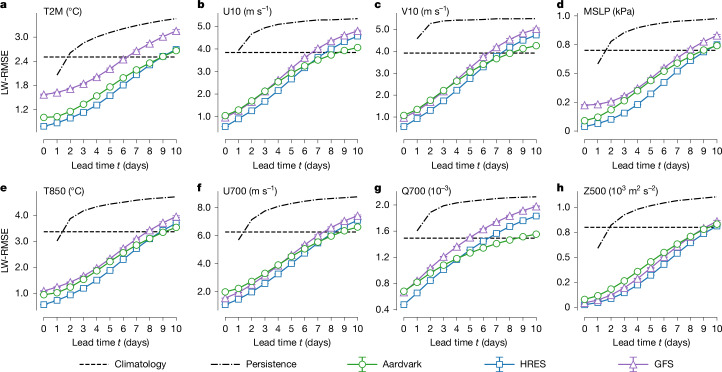
- On a global 1.50° grid, Aardvark matched or outperformed GFS across most lead times, with the only exception being geopotential at 500 hPa, and approached HRES performance for most variables; errors were larger at higher atmospheric levels and shorter lead times, and forecasts tended to become spectrally blurred at longer lead times.
- Aardvark ingests approximately 8% of the observations available to conventional NWP systems, and generating a full forecast from observational data takes approximately 1 s on four NVIDIA A100 GPUs, compared with approximately 1,000 node hours required by HRES for data assimilation and forecasting alone.
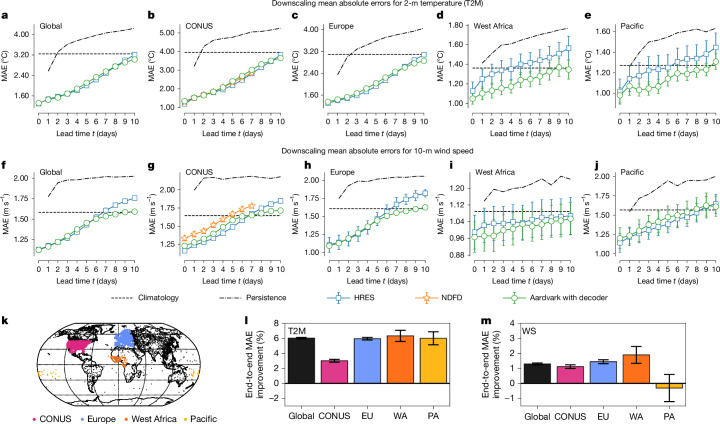
- Station forecasts for 2-m temperature and 10-m wind speed were skilful up to 10 days; for temperature, Aardvark was competitive with station-corrected HRES over CONUS and Europe, matched NDFD over CONUS, and outperformed station-corrected HRES in West Africa and the Pacific at all lead times; for wind speed, it had higher errors than station-corrected HRES over CONUS, significantly outperformed NDFD, was similar to station-corrected HRES over Europe up to 4 days and better thereafter, generally outperformed station-corrected HRES over West Africa, and performed slightly worse over the Pacific.
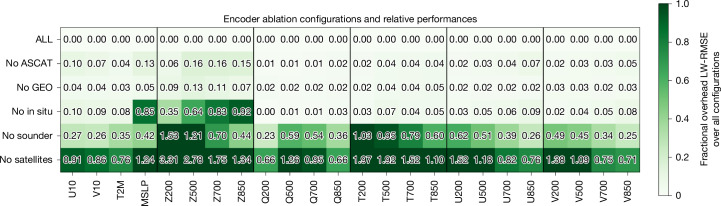
- End-to-end fine-tuning reduced 2-m temperature MAE by 6% over Europe, West Africa, the Pacific and globally, and by 3% over CONUS; for 10-m wind speed, improvements were 1–2% for all regions except the Pacific. Encoder ablations showed satellite data are crucial, with LEO sounder data most important, while in situ observations are most important for surface variables and also play a surprisingly large role in geopotential at lower levels.
Methods
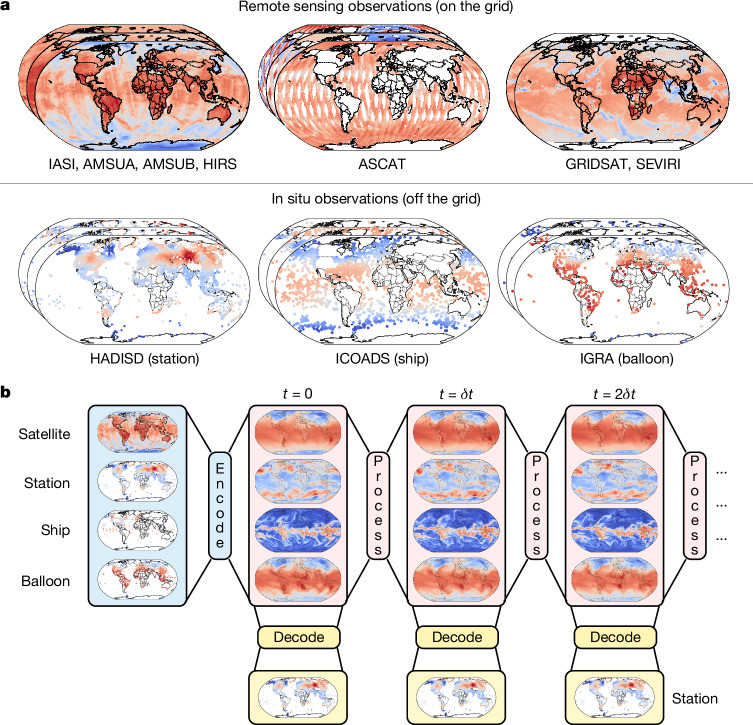
- Aardvark consists of three modules: an encoder that estimates a gridded initial atmospheric state from raw observations, a processor that autoregressively produces 24-h global forecasts out to 10 days, and task-specific decoders that produce local station forecasts; the architecture is a neural process combining SetConv layers with vision transformers for encoder and processor, and a lightweight U-Net plus SetConv and MLP for the decoder.
- Inputs include remote sensing data (ASCAT scatterometer, AMSU-A/B, MHS, HIRS/4, IASI, GridSat geostationary) and in situ data (HadISD land stations, ICOADS marine observations, IGRA radiosondes), plus temporal and orographic variables; training used ERA5 reanalysis for pretraining, with data before 2018 for training, 2018 as test and 2019 as validation.
- Global forecasts were evaluated against persistence, climatology, HRES and GFS using latitude-weighted RMSE with ERA5 as ground truth; station forecasts were evaluated against per-station persistence and climatology, station-corrected HRES, and NDFD over CONUS using MAE; end-to-end fine-tuning jointly optimized encoder, processor and decoder for specific variables and regions.
Limitations
- The paper states that Aardvark does not yet run at the resolution of IFS; further studies are required to increase grid resolution and produce forecast ensembles, for example through diffusion; further observational modalities will probably increase skill; integrating new instruments without training data may require simulated data; and observation drift can be mitigated by regularly fine-tuning all modules with recent data.
- The text makes evident that evaluation uses ERA5 as ground truth, although HRES analysis is of higher quality than ERA5, with discrepancies limited for the 2018 test year; Aardvark’s errors are larger at higher atmospheric levels and shorter lead times than operational baselines, possibly due to higher observation concentration near the surface; and forecasts tend to become spectrally blurred at longer lead times.
- The text also makes evident that the station-corrected HRES baseline is not necessarily state-of-the-art in downscaling, NDFD is only available over CONUS, the study considered a single downstream decoder for station forecasting, and the system operates at 1.50° resolution with five vertical levels.
Model-written summary. Check it against the paper before relying on it.
Integrity signals
Registry
Cites
Statistics
Figures
Verification
Claims the paper makes
0 Valid · 1 Not valid · 15 Not checked · 58 Own results and interpretations
A result the paper reports from its own data — it cites no other source for it, so there is none to check. The quote shows it is in the paper.
In the paper
“Over Europe, Aardvark had similar errors with the station-corrected HRES up to 4 days of lead time and outperformed it thereafter.”
§ End-to-end data-driven weather prediction > Evaluation of station forecasting
plain- Asserted: passes — The authors put it forward as true.
- Checkable: passes — It can be checked against evidence.
- Load-bearing: unclear — It is unclear whether the paper’s conclusions depend on it.
- Based: passes — The paper gives a reason why it holds.
A result the paper states — it cites no source for it, so there is none to check. The quote shows it is in the paper.
In the paper
“Aardvark Weather is a deep learning model that provides forecasts of eastward wind, northward wind, specific humidity, geopotential and temperature (at 200, 500, 700 and 850 hPa pressure levels), 10-m eastward wind, 10-m northward wind, 2-m temperature and mean sea level pressure on a dense global grid, and station forecasts for 2-m temperature and 10-m wind speed.”
§ End-to-end data-driven weather prediction > Aardvark Weather
plain- Asserted: passes — The authors put it forward as true.
- Checkable: passes — It can be checked against evidence.
- Load-bearing: passes — The paper’s conclusions depend on it.
- Based: passes — The paper gives a reason why it holds.
A result the paper states — it cites no source for it, so there is none to check. The quote shows it is in the paper.
In the paper
“We present Aardvark Weather, an end-to-end data-driven weather forecasting system capable of generating predictions with no input from conventional NWP by instead learning a mapping from raw input observations to output forecasts.”
§ End-to-end data-driven weather prediction > Main
plainstates a cause- Asserted: passes — The authors put it forward as true.
- Checkable: passes — It can be checked against evidence.
- Load-bearing: passes — The paper’s conclusions depend on it.
- Based: passes — The paper gives a reason why it holds.
A result the paper reports from its own data — it cites no other source for it, so there is none to check. The quote shows it is in the paper.
In the paper
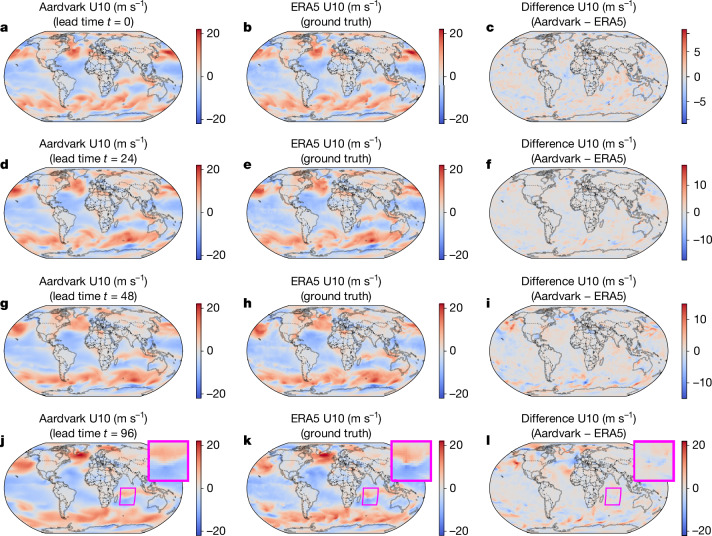
“Aardvark successfully captured the large-scale features of the atmospheric state, both in the mid-latitudes and the tropics.”
§ End-to-end data-driven weather prediction > Evaluation of global forecasting
plain- Asserted: passes — The authors put it forward as true.
- Checkable: passes — It can be checked against evidence.
- Load-bearing: passes — The paper’s conclusions depend on it.
- Based: passes — The paper gives a reason why it holds.
A result the paper states — it cites no source for it, so there is none to check. The quote shows it is in the paper.
In the paper
“Overall, Aardvark’s errors were larger at higher atmospheric levels and shorter lead times than those of the operational baselines.”
§ End-to-end data-driven weather prediction > Evaluation of global forecasting
plainstates an association- Asserted: passes — The authors put it forward as true.
- Checkable: passes — It can be checked against evidence.
- Load-bearing: unclear — It is unclear whether the paper’s conclusions depend on it.
- Based: passes — The paper gives a reason why it holds.
35 more claims
Create a free account to see all 74 claims and to verify the 19 references still open.
- It may state two separate claims as one. 22
- Probably not a substantial claim. 19
- The quote only partly states this claim. 1
Citations
Cites
U-Net: Convolutional Networks for Biomedical Image Segmentation
Ronneberger, O., Fischer, P., & Brox, T. (2015) · Lecture notes in computer science · doi:10.1007/978-3-319-24574-4_28 · Cited by 99,404
An Image is Worth 16x16 Words: Transformers for Image Recognition at Scale
Dosovitskiy, A., Beyer, L., Kolesnikov, A., Weissenborn, D., Zhai, X., Unterthiner, T., Dehghani, M., Minderer, M., Heigold, G., Gelly, S., et al. (2020) · arXiv · doi:10.48550/arxiv.2010.11929 · Cited by 47,472 · cited 2×
“Embeddings for each patch use a multi-layer perceptron following a previous study 27 .”
Matplotlib: a 2D graphics environment
Hunter, J. D. (2007) · Computing in Science & Engineering · doi:10.1109/mcse.2007.55 · Cited by 39,249
Hersbach, H., Bell, B., Berrisford, P., Hirahara, S., Horányi, A., Muñoz‐Sabater, J., Nicolas, J., Peubey, C., Radu, R., Schepers, D., et al. (2020) · Quarterly Journal of the Royal Meteorological Society · doi:10.1002/qj.3803 · Cited by 31,882 · cited 4×
“34), which remained operational until 2017.”
InfluentialOn the difficulty of training recurrent neural networks
Pascanu, R., Mikolov, T., & Bengio, Y. (2012) · arXiv · doi:10.48550/arxiv.1211.5063 · Cited by 4,310 · cited 1×
“Owing to the complexities of training recurrent neural networks, including the need for a spin-up period and gradient instabilities 26 , we opted for a non-recurrent approach.”
5th International Conference on Learning Representations (ICLR 17)
Havrylov, S., & Titov, I. (2017) · Cited by 3,503
International Conference on Learning Representations (ICLR 2013)
松尾, 豊. (2013) · 人工知能学会誌 = Journal of Japanese Society for Artificial Intelligence · Cited by 2,932
Accurate medium-range global weather forecasting with 3D neural networks
Bi, K., Xie, L., Zhang, H., Chen, X., Gu, X., & Tian, Q. (2023) · Nature · doi:10.1038/s41586-023-06185-3 · Cited by 1,670 · cited 3×
“…to a processor module, which produces a gridded forecast at a lead time of 24 h. Forecasts at subsequent lead times are produced by autoregressively feeding the predictions of the processor module back to it as an input, similar to the existing approaches in data-driven weather forecasting 1,6 .”
Learning skillful medium-range global weather forecasting
Lam, R., Sanchez-Gonzalez, A., Willson, M., Wirnsberger, P., Fortunato, M., Alet, F., Ravuri, S., Ewalds, T., Eaton-Rosen, Z., Hu, W., et al. (2023) · Science · doi:10.1126/science.adi2336 · Cited by 1,466 · cited 7×
“This phenomenon is commonly observed in data-driven weather forecasting systems 1,6,35 .”
InfluentialFirst- and Second-Order Conservative Remapping Schemes for Grids in Spherical Coordinates
Jones, P. W. (1999) · Monthly Weather Review · doi:10.1175/1520-0493(1999)127<2204:fasocr>2.0.co;2 · Cited by 842 · cited 1×
“33), in which both datasets were coarsened to 1.50° resolution using first-order conservative re-gridding 61 .”
Influential
Research works printed but not linked: 3
- Gelsthorpe, R., Schied, E. & Wilson, J. ASCAT-Metop’s advanced scatterometer. ESA Bull. 102, 19–27 (2000).
- Vaughan, A., Lane, N. D. & Herzog, M. Multivariate climate downscaling with latent neural processes. In Tackling Climate Change with Machine Learning ICML Workshop (2021).
- Nguyen, T., Brandstetter, J., Kapoor, A., Gupta, J. K. & Grover, A. In Proceedings of the 40th International Conference on Machine Learning, 25904–25938 (PMLR, 2023).
Cited by
Items 201–300 of 310
An adaptive and evolvable deep reinforcement learning framework for weather predictionPreprint
Wu, Q., Li, H., & Huang, J. (2026) · arXiv · doi:10.48550/arxiv.2608.09948
“Weather forecasts save lives and shape trillion-dollar decisions in agriculture, energy, and transportation 1,2 .”
SPPM-FT: Multiscale Decoupled Transformer for Station-Specific Precipitation Forecasting
Liu, Q., Gao, X., Cheng, W., Sun, Z., Zu, Z., Jin, Y., Wang, W., Zhao, D., & Xia, J. (2026) · IEEE Transactions on Geoscience and Remote Sensing · doi:10.1109/tgrs.2026.3683153
“[18], [19], [20], [21], [22], [23], has demonstrated remarkable capabilities in modeling large-scale circulation fields and the co-evolution of multiple meteorological variables.”
Physics-informed cross-coupled information flow modeling for spatiotemporal dynamical systems
Yu, H., Zhao, H., Zhang, Y. L., Lin, L., Zhang, Z., Gao, S., & Wang, J. (2026) · Information Sciences · doi:10.1016/j.ins.2026.123649
Zhang, H., He, Y., & Sheng, Z. (2026) · Geophysical Research Letters · doi:10.1029/2026gl123655
“However, current “AI + meteorology” research is highly concentrated on forecasting (Allen et al., 2025; Bodnar et al., 2025; Bi et al., 2023; K. Chen et al., 2025; L. Chen et al., 2023; Lam et al., 2023; Kurth et al., 2023; NOAA, n.d.), while research on reconstructing high‐fidelity,…”
A millisecond-feedback neural network controller for sub-0.1% laser power stability
Zhang, Z., Jiang, X., Huang, H., Li, X., Song, Z., Guo, F., & Tian, L. (2026) · Device · doi:10.1016/j.device.2026.101140
Xie, Y., Song, L., Chen, M., Han, F., Chen, S. Z., Song, W., Cui, X., & Han, L. (2026) · Quarterly Journal of the Royal Meteorological Society · doi:10.1002/qj.70202
“This section presents ablation experiments (Anna et al., 2025) to evaluate RISE-net’s core components and their impact on precipitation nowcasting.”
Representation Learning of Near-Surface Atmospheric Fields
Vozár, M. (2026) · Lecture notes in networks and systems · doi:10.1007/978-3-032-26214-1_16
Wang, F., Yu, Q., Li, Y., Chen, M., Fei, C., Xu, K., Gu, L., Wei, W., Gong, J., Ma, L., et al. (2026) · arXiv · doi:10.48550/arxiv.2608.00012
“Models such as Aurora [47], Aardvark Weather [48], and Prithvi WxC [49] show strong potential for weather forecasting and early warning.”
Matsushita, H., & Nishiki, T. (2026) · Neuroscience · doi:10.1016/j.neuroscience.2026.10.020
Invited perspectives: Towards usable compound event research
Kornhuber, K., Bevacqua, E., de Brito, M. M., Jäger, W., Rivoire, P., Rogers, C. D. W., Banfi, F., Batıbeniz, F., Carruthers, J. G., Michele, C. D., et al. (2026) · Natural hazards and earth system sciences · doi:10.5194/nhess-26-4309-2026
Choudhury, A., Panda, J., & Bhattacharyya, S. (2026) · Asia-Pacific Journal of Atmospheric Sciences · doi:10.1007/s13143-026-00458-3
“Pre-processing of these conditions again necessitates substantial computational resources (Allen et al. 2025).”
Shchur, A., & Skarga-Bandurova, I. (2026) · arXiv · doi:10.48550/arxiv.2603.13563
Machine learning in climate model workflows: A comprehensive review
Popoola, K., Ahmed, M., Nicholson, S., Narayanagari, S. P., & Ajani, A. A. (2026) · Next research. · doi:10.1016/j.nexres.2026.102572
AI weather prediction toward multi-scale earth system prediction: status and pathways
Zhang, J., Chen, Q., Zhang, F., Niu, Z., Zhang, Z., Ling, F., Guo, B., Liu, H., Bai, C., Li, G., et al. (2026) · Science Bulletin · doi:10.1016/j.scib.2026.05.045
CANet: Global Weather Forecast Network with Climatology-Aware Prior Constraints
Yan, F., Zhang, Y., Wang, Q., Song, C., Li, T., Geng, K., Chen, H., & Jiang, F. (2026) · International Conference on High Performance Compilation, Computing and Communications (HP3C) · doi:10.1145/3833907.3833927
“GraphDOP, Aardvark Weather, and DAWP all explore this direction from different perspectives, showing that observations can be used to generate forecasting results directly [1, 2, 8].”
Machine Learning Weather Prediction: Models, Verification and Limits
Raji, N. (2026) · International Journal of Information Technology Research Studies (IJITRS) · doi:10.63090/ijitrs/3139.3209.0040
Reanalysis: Multidecade-long records of observations-based earth system climate
Bosilovich, M. G., Breen, K. H., Collow, A. B. M., Darmenov, A., Gandoin, R., Robertson, F. R., & Wild, M. (2026) · Elsevier eBooks · doi:10.1016/b978-0-443-15748-6.00141-6
Wang, X., Jia, H., Nakao, K., Hu, C., & Kikumoto, H. (2026) · Urban Climate · doi:10.1016/j.uclim.2026.102898
Li, X., Zhang, M., Zhong, Z., Li, Q., & Li, X. (2026) · Applied Computing and Geosciences · doi:10.1016/j.acags.2026.100328
From Drops to Grid: Noise-Aware Spatio-Temporal Neural Process for Rainfall Estimation
Sarabia, R. P., Cordulus, J. N., Birk, M., & Assent, I. (2026) · doi:10.1109/cvprf71909.2026.00254
“End-to-end frameworks such as Aardvark [2], FengWu-4DVar [66], FuXi-DA [69], and ECMWF’s ongoing observation integration efforts [41] show promise in combining unstructured observations to improve forecasts and reduce computational cost [6].”
Nurhanif, Yanti, Y., Maghfirah, G., Muliadi, Zakaria, & Surbakti, M. S. (2026) · IOP Conference Series Earth and Environmental Science · doi:10.1088/1755-1315/1646/1/012019
WeatherBridge and the limits of global weather interpolation at held-out query timesPreprint
Sukhorukov, D., Zakharov, A., Maximov, Y., Makarov, I., & Oseledets, I. (2026) · Research Square · doi:10.21203/rs.3.rs-11183024/v1
Pure and physics-guided deep learning approaches for spatio-temporal groundwater level prediction
Salis, M., Sartor, G., Meo, R., Ferraris, S., & Atto, A. M. (2026) · Machine Learning Science and Technology · doi:10.1088/2632-2153/ae9af0
“In the following, we describe the building blocks of our neural network architectures, for which we have been inspired by [14, 46, 47].”
AI for science: reframing AI’s role in discovery
Cranmer, K. S., Lawrence, N. D., Montgomery, J., & Thérien, D. (2026) · RSS Data Science and Artificial Intelligence · doi:10.1093/rssdat/udag003
Long-term multi-horizon weather prediction using geo-based physics-informed learning
Althobaiti, A. (2026) · Journal of King Saud University - Computer and Information Sciences · doi:10.1007/s44443-026-01044-3
Data-driven solar forecasting enables near-optimal economic decisionsPreprint
Dai, Z., Yin, M., Chen, X., Carpentieri, A., Leinonen, J., Bonev, B., Zhong, C., Kurth, T., Sun, J., Cherukuri, R., et al. (2025) · arXiv · doi:10.48550/arxiv.2509.06925
A GNN-based station-level downscaling method for 2-m air temperature by considering region terrain
Lai, H., Lu, B., Lin, C., & Zhang, S. (2025) · Results in Engineering · doi:10.1016/j.rineng.2025.108825
Xu, X., sun, X., Zhu, S., Zhong, X., Huang, Y., Zhu, Z., Liu, J., & Li, H. (2026) · arXiv · doi:10.48550/arxiv.2603.15358
“Notably, the short-term forecast skill of FuXiWeather2 shows a marked enhancement over previous end-to-end models [27, 29], a benefit attributed to the improved quality of the analysis fields.”
InfluentialUse of Machine Learning techniques for flood forecasting
Mercier, V. (2025) · theses.fr (ABES) · doi:10.70675/49a88875zbbf1z47b5zab22z6c15b9baa356
AxiomOcean: Forecasting the Three-Dimensional Structure of the Upper OceanPreprint
Wu, S., Chen, Y., Pu, G., Sun, X., Yijun, C., Qi, J., Kong, M., Yang, K., Xu, L., Wang, W., et al. (2026) · arXiv · doi:10.48550/arxiv.2605.10455
Apeliotes: A Diffusion-Based Modeling Framework for km-scale Multi-Level Atmospheric Fields
Frastali, E. R., Paudel, A., Golbazi, M., & Liu, F. (2026) · International Conference on Machine Learning and Applications · doi:10.1109/icmla69890.2026.00057
“Traditional numerical weather prediction (NWP) [13] uses physics-based models constrained by observations via data assimilation and refined with statistical post-processing [14, 15].”
Annetta, M., Purohit, S., Vagle, V., & Deo, D. (2026) · International Journal of Information Technology and Computer Science Applications · doi:10.58776/ijitcsa.v4i2.256
“Conversely, the recent generation of global AI weather models has demonstrated that neural operators and transformer-like architectures can match or surpass operational deterministic skill at many medium-range synoptic scales while dramatically reducing forecast latency [5], [6], [7], [8], [9].”
Wu, Y., Liao, Q., Li, Z., & Sheng, Z. (2026) · doi:10.5194/egusphere-2026-4972
Yin, W., Zhou, C., Zhong, M., Wang, X., Tian, R., Zhang, W., Xiao, Y., Chen, H., Kong, J., Zhao, Q., et al. (2026) · Earth and Space Science · doi:10.1029/2025ea004409
“The emergence of state‐of‐the‐art artificial intelligence (AI) weather forecast models have demonstrated revolutionary capabilities in global weather forecasting (e.g., GraphCast, Pangu‐Weather, etc.) (Allen et al., 2025; Bi et al., 2023; Lang et al., 2024; Lam et al., 2023; Zhang et al., 2023).”
Artificiall Intelligence for Tropical Cyclone Forecasting
Gomez, M. (2026) · IRIS
Learning joint predictive distributions from observations with coordinate-aware covariance boundsPreprint
Yi, C., & Seo, Y. A. (2026) · arXiv · doi:10.48550/arxiv.2610.09898
Chen, Q., Zhan, P., Cui, H., Cui, W., & Hoteit, I. (2026) · King Abdullah University of Science and Technology Repository (King Abdullah University of Science and Technology) · doi:10.48550/arxiv.2610.15540
Wessel, J. B., Spuler, F. R., Ferro, C. A. T., Kretschmer, M., & Sippel, S. (2026) · arXiv · doi:10.48550/arxiv.2610.20519
“AIWP models still rely on initial conditions from physical data assimilation, the first models that forecast directly from observations have been emerging [McNally et al., 2024, Alexe et al., 2024, Allen et al., 2025a].”
Skillful and realistic precipitation forecasting with reinforced diffusionPreprint
Şener, O., Avati, A., Hafner, D., Lin, J., Manduchi, L., Pang, X., Huang, L., Hoefler, T., Schumacher, R., & Koltun, V. (2026) · arXiv · doi:10.48550/arxiv.2610.38775
“…smooth variables such as temperature and geopotential height by exploiting reanalysis datasets and flexible architectures (Bodnar et al., 2025; Lam et al., 2023; Price et al., 2025; Pathak et al., 2022; Sun et al., 2025; Bi et al., 2023; Allen et al., 2025; Alet et al., 2025; Kochkov et al., 2024).”
FT-HGNN: Factor-Guided Hierarchical Graph Learning for Dense-Grid Wind Post-processing
Huang, Q., Zhang, P., Zhou, Y., Sun, J., Rui, Z., & Pu, Y. (2026) · Lecture notes in computer science · doi:10.1007/978-981-92-7744-5_9
Cloud4D: Estimating Cloud Properties at a High Spatial and Temporal Resolution
Lin, J., Gryspeerdt, E., & Clark, R. (2025) · Oxford University Research Archive (ORA) (University of Oxford) · doi:10.48550/arxiv.2511.19431
“Modern machine-learning systems such as GraphCast (Lam et al., 2023), Pangu-Weather (Bi et al., 2023), and Aardvark (Allen et al., 2025) inherit this problem: they train on “reanalysis” data that comes from the same physics-based models and therefore bake in the same biases.”
Multimodal Spatiotemporal Atmospheric Data Assimilation with Latent Video Flow-matchingPreprint
Chakraborty, D., & Maulik, R. (2026) · arXiv · doi:10.48550/arxiv.2608.05103
Seo, K. (2025) · Journal of Electrical Engineering and Technology · doi:10.1007/s42835-025-02551-5
“With the advancement of AI, its application in weather forecasting has also become increasingly active [1, 2].”
A Hybrid ML‐PDE Framework for Predicting Breaking Ocean Waves
Liu, Y., Adcock, T. A. A., van den Bremer, T. S., & Eeltink, D. (2026) · Journal of Geophysical Research Machine Learning and Computation · doi:10.1029/2026jh001251
Júnior, G. G., Chotolli, L. C., da Silva, V. L., Pedro, M. L. A., & Santos, M. D. C. (2026) · Revista da Sociedade Brasileira de Ensino de Química · doi:10.56117/resbenq.2026.v7.e072612
A physics-guided integrated global to regional method for high-resolution weather forecasting
Zhang, J., Dai, Y., Wang, Y., He, F., Xu, P., & Yin, J. (2026) · npj Climate and Atmospheric Science · doi:10.1038/s41612-026-01555-w
Bai, Y., Zhang, T., Darby, S. E., Merz, B., Kettner, A. J., Michaelides, K., Jiang, S., 毛舒悦, Li, Y. W., Guan, M., et al. (2026) · Earth-Science Reviews · doi:10.1016/j.earscirev.2026.105612
Can LLM Agents Improve Imperfect Earth System Model Parameterizations?Preprint
Lamb, K. D. (2026) · arXiv · doi:10.48550/arxiv.2611.03543
“Recent advances in machine learning (ML) have enabled emulation of model components (Gentine et al., 2018; Rasp et al., 2018; Bolton and Zanna, 2019) and even full model surrogates (Allen et al., 2025; Bi et al., 2023; Lam et al., 2023; Price et al., 2025).”
Station-trained air-quality forecasts without regional emission inventoriesPreprint
Lee, T. (2026) · EarthArXiv (California Digital Library) · doi:10.31223/x54z4t
Dewettinck, W. (2026) · Ghent University Academic Bibliography (Ghent University)
Machine-learning exploration of isotope-informed near-term temperature forecast at European sites
Samborska-Goik, K. (2026) · Atmospheric Research · doi:10.1016/j.atmosres.2026.109448
Chen, W. (2025) · Apollo (University of Cambridge) · doi:10.17863/cam.120138
Artificial intelligence pathways from weather to climatePreprint
Beucler, T., Neelin, J. D., Su, H., Asthana, S., Bretherton, C., Chapman, W., Christopoulos, C., Clark, S. K., Grover, A., Lopez‐Gomez, I., et al. (2026) · arXiv · doi:10.48550/arxiv.2610.09770
“End-to-end observation forecasting systems such as GraphDOP [11] and Aardvark Weather [10] aim to learn directly from heterogeneous observations how to forecast variables of interest, rather than relying on a hand-designed sequence of observation operators, data assimilation, model integration, and…”
The calibration deficit: a challenge for Earth system simulation and emulationPreprint
Cox, P. M., Durran, D. R., Eyring, V., Schneider, T., Watson‐Parris, D., Williamson, D., & Balaji, V. (2026) · doi:10.5194/egusphere-2026-6437
On complex network techniques for atmospheric flow analysis: a polar vortex case study
Reboredo-Prado, M., Lambiotte, R., Moroz, I. M., & Osprey, S. (2025) · Journal of Physics Complexity · doi:10.1088/2632-072x/ae20e9
“This could, for example, help validate observations-driven machine-learned models, by checking that network structures are preserved [ 45].”
Waldorp, L., Mürtz, T., Jansen, A. T. M., & Haslbeck, J. M. B. (2026) · arXiv · doi:10.48550/arxiv.2606.09283
“These methods, simulations to determine which intervention is optimal, have led to great advances in weather prediction (Allen et al., 2025) and in determining climate policy (Hazeleger et al., 2024).”
Physics-Informed Machine Learning for Wind Forecasting using WRF
Krepek, A., Fister, I., & Vilhar, A. (2026) · IEEE World Symposium on Applied Machine Intelligence and Informatics (SAMI) · doi:10.1109/sami68106.2026.11420321
A Station-Based Evaluation of Machine Learning-based Weather Forecasting Models in Northern NorwayPreprint
Chen, S., Uebbing, L., Samuelsen, E. M., Leontidis, G., Salberg, A.-B., Lefèvre, S., Jenssen, R., & Wickstrøm, K. (2026) · arXiv · doi:10.48550/arxiv.2609.10564
“In contrast, Aardvark learns an end-to-end mapping from observations to global gridded and local station forecasts, reducing its dependence on NWP-generated initial states [61].”
Bounded Transport-Residual Closure for Solver-Coupled Graph-Based Global Atmospheric ForecastingPreprint
Deng, C., Li, C., Luo, W., Wang, Z., & Zhu, L. (2026) · doi:10.5194/egusphere-2026-4741
“Recent large-scale systems have achieved strong medium-range forecast skill, including FourCastNet Pathak et al. (2022), Pangu-Weather Bi et al. (2023), GraphCast Lam et al. (2023), FuXi Chen et al. (2023b), FengWu Chen et al. (2023a), AIFS Lang et al. (2024), GenCast Price et al. (2025), Aurora Bodnar et al. (2025),…”
Iorliam, A., Iorliam, I. B., & Shehu, Y. I. (2026) · Babylonian Journal of Internet of Things · doi:10.58496/bjiot/2026/014
Context-Aware Deep Learning for Defect Classification in Atomic-Resolution STEMPreprint
Dan, J., Zhang, C., Loh, L., Verzhbitskiy, I., Chen, Y., Eda, G., Bosman, M., & Loh, N. D. (2026) · arXiv · doi:10.48550/arxiv.2606.09419
“This phenomenon is not unique to microscopy: medical diagnosis from X-rays without patient history [18], weather prediction from satellite images without atmospheric profiles [19], and autonomous driving from cameras without LiDAR [20] all illustrate the same ambiguity.”
Yang, S., Liu, Z., Han, T., Fei, B., Bai, L., Liu, C., Zou, Z., Ji, X., Ouyang, W., & Shi, Z. (2026) · arXiv · doi:10.48550/arxiv.2609.22217
“Recent observation foundation models [7], [8], [18] theoretically support arbitrary-location modeling, yet they operate at the global scale and still treat GIO modeling as latent interpolation, leading to averaged results, redundant multi-source inputs, and unaffordable computation for in-situ…”
Graph neural network–based data assimilation for spatial reconstruction under sparse observations
Huang, W., 徐国勋, Zhao, W., Liang, Y., Xia, H., Gong, Y., & Yang, Z. (2026) · Ocean Modelling · doi:10.1016/j.ocemod.2026.102849
Can Deep Neural Networks Improve Compression of Very Large Scientific Data?Preprint
Alhumaidi, M., Li, G., Skiadopoulos, S., & Kalnis, P. (2026) · King Abdullah University of Science and Technology Repository (King Abdullah University of Science and Technology) · doi:10.48550/arxiv.2606.14353
Toward development of machine learning version of Real-Time Mesoscale Analysis (RTMA)
Rančić, M., de Pondeca, M. S. F. V., Purser, R. J., Gibbs, A., Colón, E., Morris, M., Zhao, G., Ge, G., & Ladwig, T. T. (2026) · NOAA Institutional Repository · doi:10.25923/frz0-h186
CAIRT PerReC Executive Summary
Sinnhuber, B., Höpfner, M., Zumsprekel, C. R. R., Preusse, P., Kaumanns, J., Rhode, S., Ungermann, J., Funke, B., Raspollini, P., Errera, Q., et al. (2026) · Repository KITopen (Karlsruhe Institute of Technology) · doi:10.5281/zenodo.18758614
WeatherDreamer: Learning a World Model from Multimodal Earth ObservationsPreprint
Duffy, K., Penn, E., Ballard, T., Posch, A., & Vandal, T. (2026) · arXiv · doi:10.48550/arxiv.2611.18393
MarsNet: Learning the Martian Atmosphere from Observations AlonePreprint
Mengwall, S., & Battalio, J. M. (2026) · arXiv · doi:10.48550/arxiv.2611.12787
“Recent models also take in observations, either alongside a reanalysis, as in Aardvark and WeatherNext 3 (Allen et al., 2025; Rasp et al., 2026), or alone, as in GraphDOP (Alexe”
Rutnätsbaserade variabeltransformationer och modellkobmination för vindkraftsprognoser
Bengtsson, F. (2025) · KTH Publication Database DiVA (KTH Royal Institute of Technology)
Learning Land-Surface Hydrology World Model from Satellite ObservationsPreprint
Li, S., Qi, Z., Xu, X., & Zhang, D. (2026) · arXiv · doi:10.48550/arxiv.2611.28963
“End-to-end systems that ingest observations include Aardvark [3], which is pre-trained on reanalysis, and GraphDOP [2, 6], which is trained only on observations, develops Earth-system representations in its latent [39] and inspires our query-able decoder; Earth-o1 [22] forecasts the atmosphere from…”
Hyper-Localized Weather Forecasting System
Singh, V. (2025) · Journal of Information Systems Engineering & Management · doi:10.52783/jisem.v10i41s.7995
“The model achieves performance levels similar to standard operational NWP frameworks at a reduced cost and increased speed, according to research done by [7].”
InfluentialKnowledge-data fusion framework for frequency security assessment in low-inertia power systemsPreprint
Zhang, Y., Yao, W., Lan, Y., Shuai, H., Wei, S., Gan, W., Duan, C., Wen, J., & Cheng, S. (2025) · arXiv · doi:10.48550/arxiv.2509.07320
“For instance, in weather forecasting, numerical methods are often limited by prohibitive computational expenses 51-52 .”
Agarwal, N., Chaudhary, N., & Tripathi, K. C. (2025) · BENTHAM SCIENCE PUBLISHERS eBooks · doi:10.2174/9789815324693125040005
Veery, A Flat Satellite Scatterometer for Global, Hourly Refresh of Ocean Surface Vector Winds
Walton, M. P., Laraway, A., & Long, D. G. (2025) · Digital Commons - USU (Utah State University) · doi:10.26077/04d6-f0f1
Insights from machine learning-based forecasts of convective hazards and environments
Mazurek, A. C., Schumacher, R. S., Rasmussen, K. L., van den Heever, S. C., Chen, H., & Hill, A. J. (2025) · Digital Collections of Colorado (Colorado State University) · doi:10.25675/3.04279
Understanding ozone, climate and their interactions with causal machine learning
Hickman, S. H. M. (2025) · Apollo (University of Cambridge) · doi:10.17863/cam.122273
Augmented-ML for Spatio-Temporal Bias Correction of Wave Forecasts in Data-Sparse RegionsPreprint
Juniper, M. C. R., Juniper, M. C. R., Steele, E. C. C., Pillai, A. C., & Ashton, I. G. C. (2026) · Authorea · doi:10.22541/au.177574470.02829560/v1
Shi, J., & Mehrkanoon, S. (2026) · arXiv · doi:10.48550/arxiv.2604.10328
Sun, F. (2026) · International Conference on Communications, Information System and Computer Engineering (CISCE) · doi:10.1109/cisce69494.2026.11504642
“Second, data-driven methods relying on local sensors provide real-time observations but lack predictive power beyond 2-3 hours [5].”
MambaRain: Multi-Scale Mamba-Attention Framework for 0-3 Hour Precipitation NowcastingPreprint
Shi, C., Wu, C., Xu, X., Li, H., Fan, N., Han, X., Feng, Y., Zhu, Y., Liu, B., Zang, Z., et al. (2026) · arXiv · doi:10.48550/arxiv.2605.14606
“…nowcasting—the generation of high-resolution rainfall intensity forecasts for the upcoming 0–3 hours—plays an indispensable role in weather-dependent decision-making across aviation safety, agricultural planning, flood control, and urban infrastructure management [1], [2], [3], [4], [5], [6], [7].”
A Predictive Dashboard for Ocean Plastic Accumulation using Remote Sensing and Marine Meteorology
Kalingarani, G., S, S. S. K., & Ganapathi.R, S. K. (2026) · International Conference on Smart Electronic Devices and Intelligent Systems (ICSEDIS) · doi:10.1109/icsedis68157.2026.11518387
A GNSS ZTD enhancement framework integrating physical constraints and hybrid neural networks
Li, H., Zhao, Q., Guo, H., Wu, A., Liu, M., Yao, Y., Zeng, Z., Liang, H., Guo, Q., Ma, Y., et al. (2026) · Advances in Space Research · doi:10.1016/j.asr.2026.05.078
Black, D., Robertson, J., Al-Taai, Q. R. A., Figueiredo, J., Wasige, E., Romeira, B., Donati, G. P., & Hurtado, A. (2026) · SPIE Machine Learning in Photonics · doi:10.1117/12.3100523
“This data originates from countless embedded sources within our environment and technologies for applications in various fields including autonomous vehicles [1], perimeter security [2], weather monitoring [3] and medicine [4].”
Modelling convective cell occurrence in proximity to cold fronts using extreme gradient boosting
Pacey, G., Pfahl, S., & Schielicke, L. (2026) · Meteorologische Zeitschrift · doi:10.1127/metz/202520
“Most machine learning weather prediction (MLWP) approaches still utilise physics-based ERA5 reanalysis data to generate the training datasets, which of course involves using convectional NWP. Work on purely observational-based MLWP models is ongoing (e.g. Allen et al., 2025; ECWMF, 2025).”
Sampling sea state using a diffusion modelPreprint
Wu, J., Chapron, B., & Zanna, L. (2026) · Research Square · doi:10.21203/rs.3.rs-10145730/v1
OmniPMNet: Bridging discrete and gridded PM10 forecasts via omni-query neural processesPreprint
He, S., & Wang, S. (2026) · arXiv · doi:10.48550/arxiv.2607.11896
“ConvCNPs have been used for local climate downscaling [32], simulation-to-reality frameworks for environmental NPs [33] align gridded numerical simulations with real sensor networks, and Aardvark [34] scales NP-style ideas to end-to-end weather prediction from sparse observations.”
Zhang, X., Yang, C., Zhang, Z., & He, J. (2026) · IEEE Internet of Things Journal · doi:10.1109/jiot.2026.3719278
“Allen et al. [17] proposed an end-to-end framework that learns spatiotemporal features directly from raw sensor data to enable full-process environmental prediction.”
Agentic AI for Reservoir Flood Dispatching: A Physics–Cognition Collaborative Framework
Yan, S., & Hao, S. (2026) · Applied Sciences · doi:10.3390/app16168171
Machine Learning Predictive Models for the Chemical Transformation Processes of Ferrihydrite
Lili, X. U., Liang, Y. U. A. N., Boyou, P. A. N., & Li, R. (2026) · EARTH AND ENVIRONMENT · doi:10.3724/ee.1672-9250.2026.54.171
Xu, Y., Chakraborty, D., Guan, H., Wang, S., & Maulik, R. (2026) · arXiv · doi:10.48550/arxiv.2609.29027
“…(NWP) background to produce gridded analyses for short-range forecasting [38]; Aardvark maps observations directly to global gridded and local station forecasts [16]; and VAE-Var and latent variational assimilation produce analyses by optimizing within learned state representations [39, 40].”
M$^2$Weather: A Benchmark for Joint Multi-Station and Multi-Variable Weather ForecastingPreprint
Li, R., Wang, X., Wang, M., Liu, H., Chen, C., Tang, Z., & Li, K. (2026) · arXiv · doi:10.48550/arxiv.2610.00370
“Station weather forecasting is a fundamental task in meteorology (Zhu et al., 2023), with important applications in agriculture, energy scheduling, transportation, and disaster early warning (Allen et al., 2025).”
ปัจจัยการคงอยู่ในงานของครู สังกัดสำนักงานเขตบางขุนเทียน กรุงเทพมหานคร
Oanmaunvai, S., & Panjarattanakorn, D. (2025) · Journal of Administrative and Management Innovation
Domain-Adaptive Data Assimilation for Global AI Weather ForecastingPreprint
Seo, M., Brenowitz, N., Kim, D., Lee, H., & Kim, C. (2026) · arXiv · doi:10.48550/arxiv.2610.03172
AI-Based Reconstruction of Eddy-Resolved Subsurface Currents in the Indo-Pacific Convergence Zone
Duan, Q., Li, X., Zhang, Y., Zheng, Y., Wang, M., Xia, Y., Wu, W., Zhang, Y., Sun, Q., Lianyi, Z., et al. (2026) · IEEE Journal of Selected Topics in Applied Earth Observations and Remote Sensing · doi:10.1109/jstars.2026.3740366
“Data-driven approaches have demonstrated remarkable skill in weather forecasting [34], [35], climate prediction [36], [37], ocean forecasting [38], [39], and subsurface structure reconstruction [40], [41] by learning nonlinear and cross-scale relationships directly from data.”
Hong, S.-Y., & Kim, Y.-H. (2026) · Journal of Marine Science and Engineering · doi:10.3390/jmse14201886
Xie, B., Liu, J., & Wang, X. (2026) · Research Square · doi:10.21203/rs.3.rs-11310457/v1
Shaqarin, T., Al-Manasra, I., Zhang, T., Ianiro, A., Discetti, S., & Noack, B. R. (2026) · arXiv · doi:10.48550/arxiv.2610.15547
“Data-driven models [8–10] learn the input-output relationship directly from experimental measurements without requiring prior knowledge of the governing physics.”
Meteorological Stations in the Era of Smart Sensing: Advances, Challenges, and Opportunities
Samir, S., Hassine, L., & Aroussi, H. K. (2026) · Procedia Computer Science · doi:10.1016/j.procs.2026.09.145
Kent, B. M., & Turner, R. E. (2026) · arXiv · doi:10.48550/arxiv.2611.11257
“For example, one may wish to understand the dynamics of vortex induced vibration when designing a structure [58], analyse cavity flow in industrial and scientific contexts [64], or forecast the weather [1, 3].”
Self-citation
Metadata
- Authors
- Allen, A., Markou, S., Tebbutt, W., Requeima, J., Bruinsma, W. P., Andersson, T. R., Herzog, M., Lane, N. D., Chantry, M., Hosking, J. S., & Turner, R. E.
- Affiliations
- University of Cambridge (GB)
- University of Toronto (CA)
- Microsoft Research (United Kingdom) (GB)
- British Antarctic Survey (GB)
- European Centre for Medium-Range Weather Forecasts (GB)
- Corresponding author
- Markou, Stratis
- Turner, Richard E.
- ORCID
- Venue
- Nature
- Published
- 2025-03-20
- Volume
- 641
- Issue
- 8065
- Pages
- 1172-1179
- ISSN
- 0028-0836 (ISSN-L)
- 1476-4687
- PMC
- PMC12119340
- OpenAlex
- W4408657432
- Cited by
- 312
- References
- 80
- Citations by year
- 2026: 221 · 2025: 77
- FWCI
- 77.98
- Type
- journal article
- Language
- en
- Open access
- hybrid
- doi.org
- Licence
- cc-by
- creativecommons.org/licenses/by/4.0 (tdm)
- creativecommons.org/licenses/by/4.0 (vor)
- Locations
- Nature (publishedVersion, cc-by)
- PubMed Central (publishedVersion, cc-by)
- PubMed (publishedVersion)
- arXiv (submittedVersion, cc-by)
- NERC Open Research Archive (Natural Environment Research Council) (submittedVersion, cc-by)
- RePEc: Research Papers in Economics (submittedVersion)
- Apollo (University of Cambridge) (submittedVersion, cc-by)
- Zenodo (CERN European Organization for Nuclear Research) (submittedVersion)
- Apollo (cc-by)
- Funders
- National Science Foundation
- Alan Turing Institute (Y028880/1)
- UK Research and Innovation (AI4ER, EP/S022961/1)
- DeepMind
- University of Cambridge
- Met Office
- Cambridge Trust
- University of Toronto
- European Centre for Medium-Range Weather Forecasts
- National Oceanic and Atmospheric Administration
- Engineering and Physical Sciences Research Council (EP/S022961/1, EP/Y028880/1, EP/T005386/1, EP/W002965/1)
- National Environmental Satellite, Data, and Information Service
- British Antarctic Survey
- Topics
- Physical Sciences › Earth and Planetary Sciences › Atmospheric Science › Meteorological Phenomena and Simulations
- Physical Sciences › Environmental Science › Environmental Engineering › Hydrological Forecasting Using AI
- Social Sciences › Transportation › Traffic Prediction and Management Techniques
- Keywords
- numerical weather prediction, forecast skill, computational complexity reduction, meteorological observations
About these checks
Registry, retraction, Cites and statistics results are computed, not judged, with one exception: a printed reference that no index lists is read once by a model before it counts as a citation error. Claims are extracted by a model and kept only when their quote appears verbatim in the text; each cited source is then checked, with a model’s help, for whether it says what the claim relies on. Those verdicts can be wrong — read the claim’s quote and the cited source before relying on one.
A language model drew the claims from the paper on 2026-11-28, under version 3 of the claim definition (model deepseek-v4.1-flash, prompt extract-v3).
A second model labelled each claim on 2026-11-28 (model jev-1.13-20260917, definition revision gold-guideline-v0.2).
Statistics and arithmetic are recomputed, not judged.
Confidence bands are shown only for fields calibrated on our annotated test set. None is calibrated yet, so no band is shown.
What counts as a claim ›How we measure confidence ›How we check this ›
Are you an author, or do you see a problem with this page? Request a review
Data sources
Bibliographic data: Semantic Scholar, OpenAlex, Crossref.
Contains information from the Semantic Scholar Academic Graph Datasets, made available under the ODC Attribution License (ODC-BY 1.0).
Semantic Scholar’s data is described in: Kinney, R., et al. (2023). The Semantic Scholar Open Data Platform. arXiv:2301.10140.
